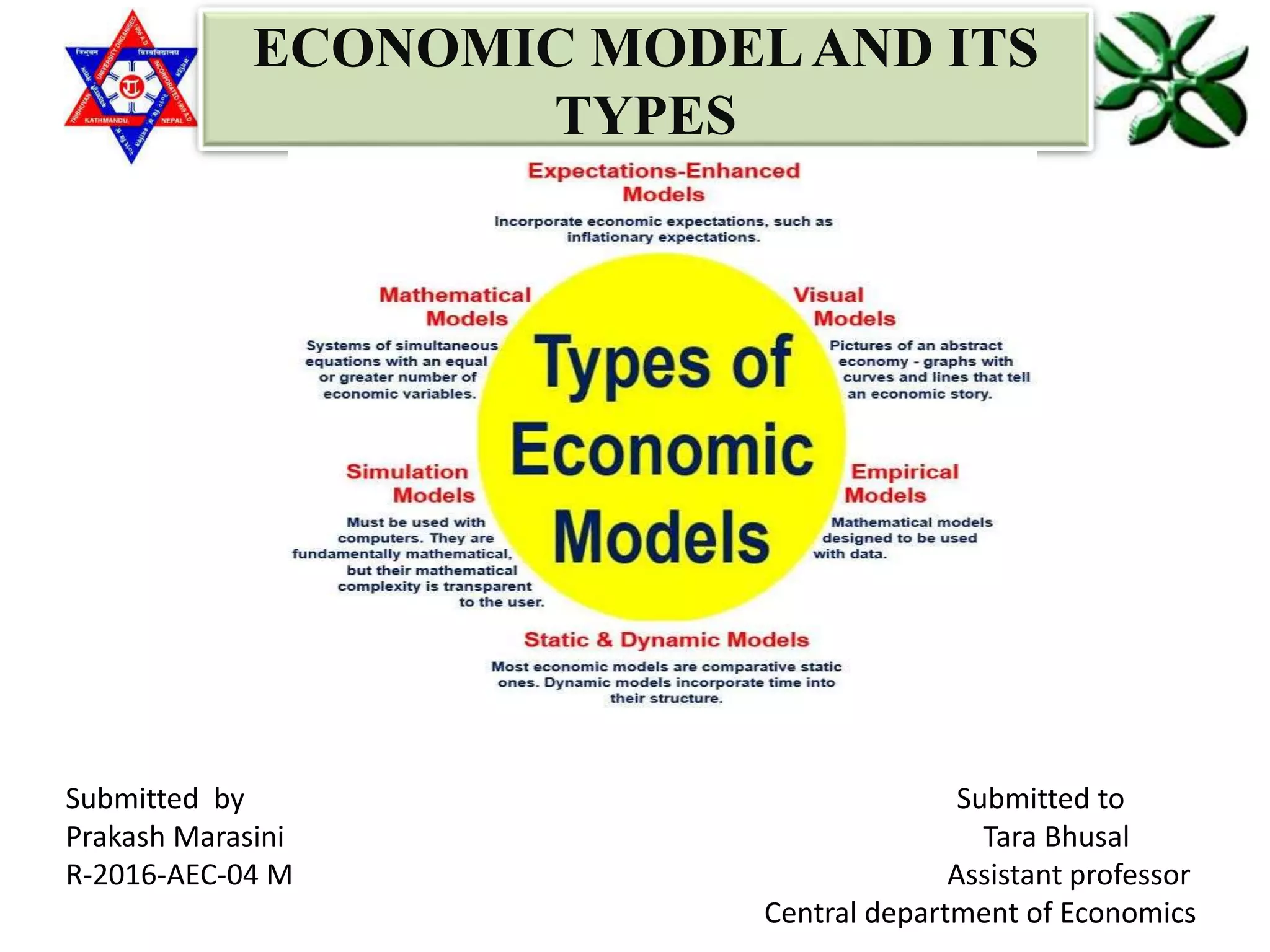
ECONOMIC MODEL AND ITS TYPES
ECONOMIC MODELAND ITS
TYPES
Submitted by Submitted to
Prakash Marasini Tara Bhusal
R-2016-AEC-04 M Assistant professor
Central department of Economics
INTRODUCTION
 simplified description of reality, designed to yield hypotheses about
economic behavior that can be tested
 Feature is necessarily subjective in design because there are no
objective measures of economic outcomes
 A model may have various exogenous variables, and those variables
may change to create various responses by economic variables
 Methodological uses of models include investigation, theorizing,
and fitting theories to the world (Morgan, 2008)
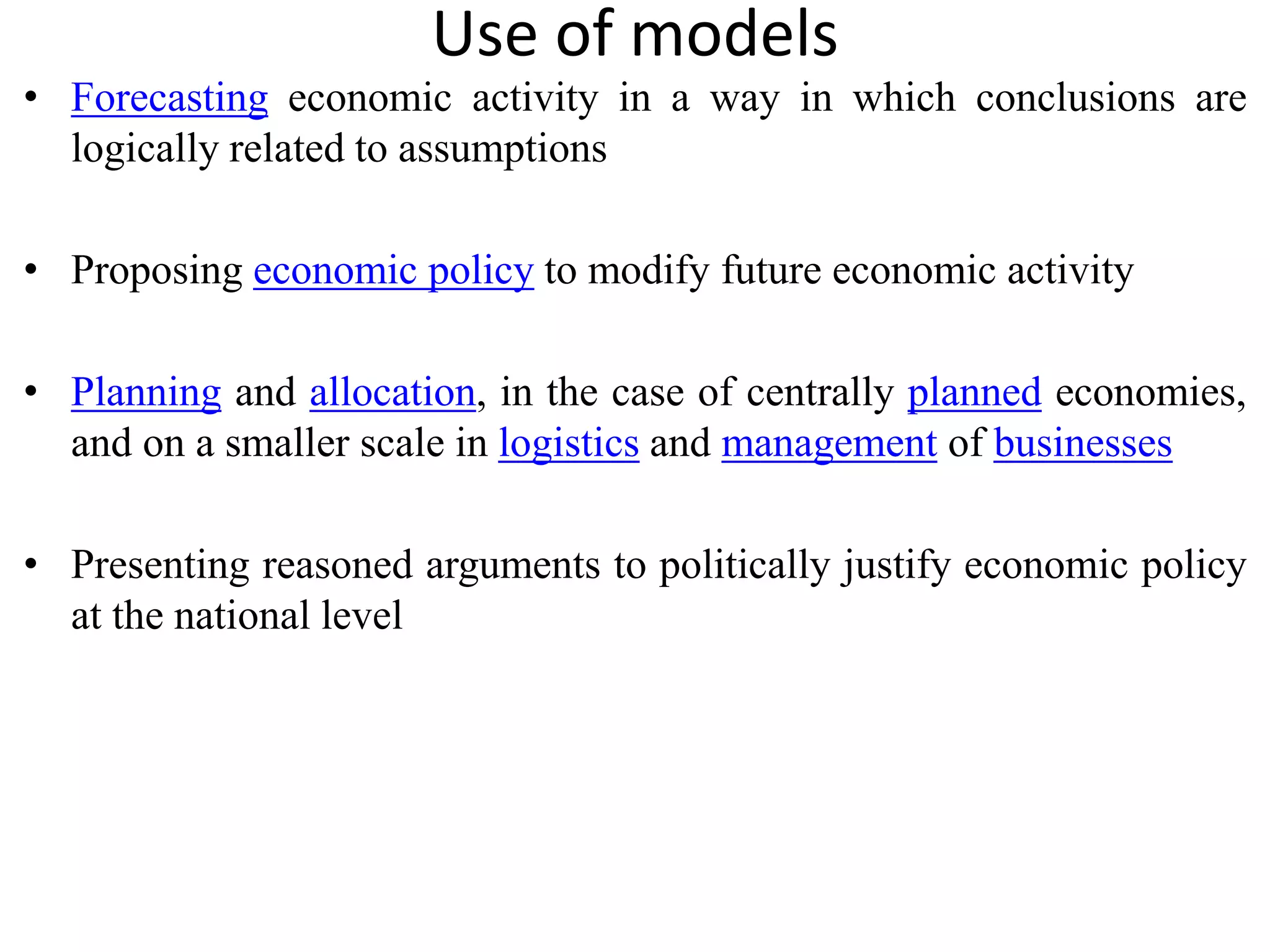
Use of models
• Forecasting economic activity in a way in which conclusions are
logically related to assumptions
• Proposing economic policy to modify future economic activity
• Planning and allocation, in the case of centrally planned economies,
and on a smaller scale in logistics and management of businesses
• Presenting reasoned arguments to politically justify economic policy
at the national level
OBJECTIVES
Broad
• To know about economic model and types of
economic model
Specific
• To know about use and limitation of different
models
• To know about linear and non-linear model used
in economic analysis
METHODOLOGY
• Information and data on different economic
model in agriculture economics were
collected from several journals, books, articles
available in the internet. Internet search was
the main source of findings included in this
paper.
DISCUSSION
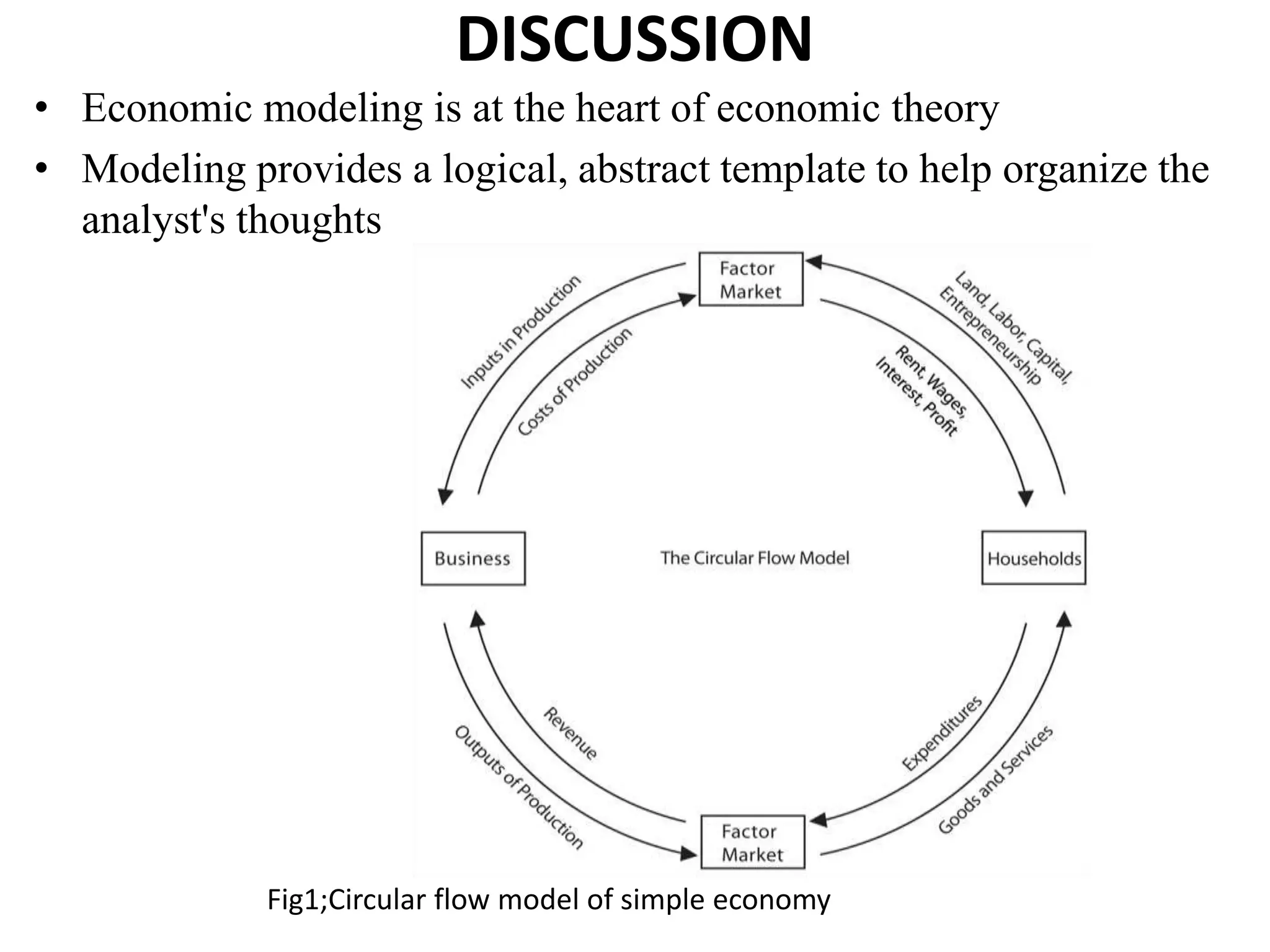
• Economic modeling is at the heart of economic theory
• Modeling provides a logical, abstract template to help organize the
analyst's thoughts
Fig1;Circular flow model of simple economy
Classification of economic model
 According to whether all the model variables are
deterministic, economic models can be classified as stochastic
or non-stochastic models
 According to whether all the variables are quantitative,
economic models are classified as discrete or continuous
choice model
 According to the model's intended purpose/function, it can be
classified as quantitative or qualitative
 According to the model's ambit, it can be classified as a
general equilibrium model, a partial equilibrium model, or
non-equilibrium model
 According to the way of representation, logical, physical,
geometric or algebraic models etc
Others classification
• Visual model
 Simply pictures of an abstract economy; graphs with lines and
curves that tell an economic story
 relatively easy to understand, but are somewhat limited in their
scope. Model, the Loanable Funds Model are visual model
Fig 2; Visual model showing demand and supply
Mathematical Models
most formal and abstract of the economic models
 Manipulation and use of these models require a
good knowledge of algebra or calculus
 For example, in microeconomics model would
include a supply function (explaining the behavior
of producers, or those who supply commodities
to the market ), a demand curve (explaining the
behavior of purchasers).
Simulation Models
• must be used with computers, embody the very best
features of mathematical models without requiring
that the user be proficient in mathematics
• usually starts with initial or "default" values assigned
by the program
• quite useful in classroom instruction.
Static and dynamic model
Most of the models used in economics are
comparative statics models
Some of the more sophisticated models in
macroeconomics and business cycle analysis are
dynamic models.
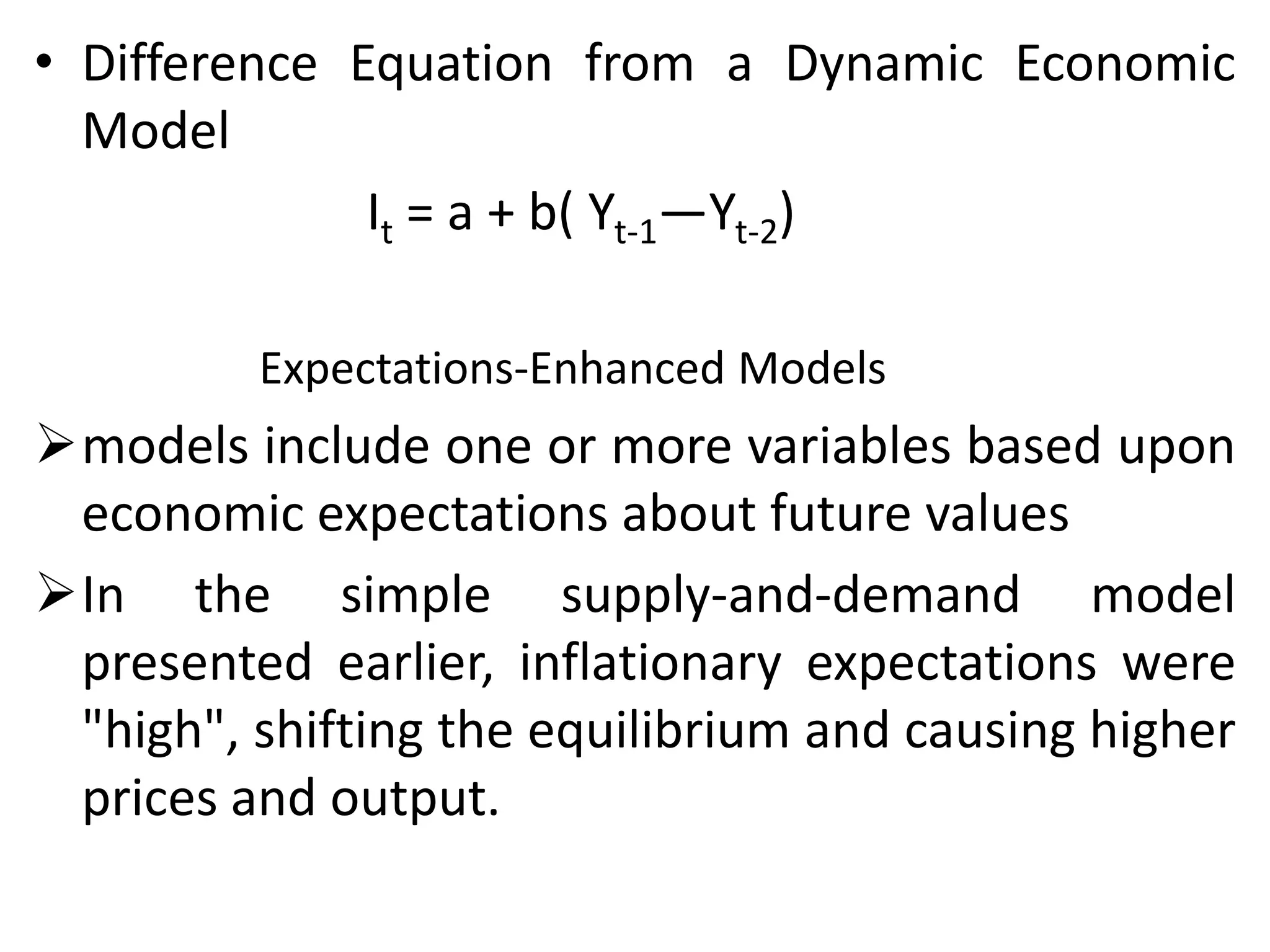
• Difference Equation from a Dynamic Economic
Model
It = a + b( Yt-1—Yt-2)
Expectations-Enhanced Models
models include one or more variables based upon
economic expectations about future values
In the simple supply-and-demand model
presented earlier, inflationary expectations were
"high", shifting the equilibrium and causing higher
prices and output.
• Economic models often incorporate economic
expectations, such as inflationary expectations. Such
models are called expectations-enhanced models
Linear Model
• Linear programming, regression, we mostly follow
linear principles. We use large-sample properties of
OLS estimators, particularly the property of
consistency
Non linear model
Quadratic equation, Cobb-Douglass production
function, logistic regression function (logit, probit
and tobit model)
Based on intended purpose
1. Qualitative models:
qualitative models are occasionally used
 example is non-numerical decision tree analysis
Qualitative models often suffer from lack of
precision
2. Quantitative models
At a more practical level, quantitative modeling is
applied to many areas of economics
Demand and supply model
Aggregate models:
• Macroeconomics needs to deal with aggregate
quantities such as output, the price level,
the interest rate and so on
• This process of aggregation and functional
dependency between various aggregates
usually is interpreted statistically and
validated by econometrics.
• Keynesian model is a functional relationship
between consumption and national income: C
= C(Y).
CONCLUSION
• Economic modeling is at the heart of economic
theory
• Modeling provides a logical, abstract template to
help organize the analyst's thoughts.
• Economist uses model to map how the price rises
of agricultural commodities effect on overall
livelihood: cost of living, demand for electricity or
using other commodities.
Economic model

Economic model

  • 1.
    ECONOMIC MODEL ANDITS TYPES ECONOMIC MODELAND ITS TYPES Submitted by Submitted to Prakash Marasini Tara Bhusal R-2016-AEC-04 M Assistant professor Central department of Economics
  • 2.
    INTRODUCTION  simplified descriptionof reality, designed to yield hypotheses about economic behavior that can be tested  Feature is necessarily subjective in design because there are no objective measures of economic outcomes  A model may have various exogenous variables, and those variables may change to create various responses by economic variables  Methodological uses of models include investigation, theorizing, and fitting theories to the world (Morgan, 2008)
  • 3.
    Use of models •Forecasting economic activity in a way in which conclusions are logically related to assumptions • Proposing economic policy to modify future economic activity • Planning and allocation, in the case of centrally planned economies, and on a smaller scale in logistics and management of businesses • Presenting reasoned arguments to politically justify economic policy at the national level
  • 4.
    OBJECTIVES Broad • To knowabout economic model and types of economic model Specific • To know about use and limitation of different models • To know about linear and non-linear model used in economic analysis
  • 5.
    METHODOLOGY • Information anddata on different economic model in agriculture economics were collected from several journals, books, articles available in the internet. Internet search was the main source of findings included in this paper.
  • 6.
    DISCUSSION • Economic modelingis at the heart of economic theory • Modeling provides a logical, abstract template to help organize the analyst's thoughts Fig1;Circular flow model of simple economy
  • 7.
    Classification of economicmodel  According to whether all the model variables are deterministic, economic models can be classified as stochastic or non-stochastic models  According to whether all the variables are quantitative, economic models are classified as discrete or continuous choice model  According to the model's intended purpose/function, it can be classified as quantitative or qualitative  According to the model's ambit, it can be classified as a general equilibrium model, a partial equilibrium model, or non-equilibrium model  According to the way of representation, logical, physical, geometric or algebraic models etc
  • 8.
    Others classification • Visualmodel  Simply pictures of an abstract economy; graphs with lines and curves that tell an economic story  relatively easy to understand, but are somewhat limited in their scope. Model, the Loanable Funds Model are visual model Fig 2; Visual model showing demand and supply
  • 9.
    Mathematical Models most formaland abstract of the economic models  Manipulation and use of these models require a good knowledge of algebra or calculus  For example, in microeconomics model would include a supply function (explaining the behavior of producers, or those who supply commodities to the market ), a demand curve (explaining the behavior of purchasers).
  • 10.
    Simulation Models • mustbe used with computers, embody the very best features of mathematical models without requiring that the user be proficient in mathematics • usually starts with initial or "default" values assigned by the program • quite useful in classroom instruction. Static and dynamic model Most of the models used in economics are comparative statics models Some of the more sophisticated models in macroeconomics and business cycle analysis are dynamic models.
  • 11.
    • Difference Equationfrom a Dynamic Economic Model It = a + b( Yt-1—Yt-2) Expectations-Enhanced Models models include one or more variables based upon economic expectations about future values In the simple supply-and-demand model presented earlier, inflationary expectations were "high", shifting the equilibrium and causing higher prices and output.
  • 12.
    • Economic modelsoften incorporate economic expectations, such as inflationary expectations. Such models are called expectations-enhanced models Linear Model • Linear programming, regression, we mostly follow linear principles. We use large-sample properties of OLS estimators, particularly the property of consistency Non linear model Quadratic equation, Cobb-Douglass production function, logistic regression function (logit, probit and tobit model)
  • 13.
    Based on intendedpurpose 1. Qualitative models: qualitative models are occasionally used  example is non-numerical decision tree analysis Qualitative models often suffer from lack of precision 2. Quantitative models At a more practical level, quantitative modeling is applied to many areas of economics Demand and supply model
  • 14.
    Aggregate models: • Macroeconomicsneeds to deal with aggregate quantities such as output, the price level, the interest rate and so on • This process of aggregation and functional dependency between various aggregates usually is interpreted statistically and validated by econometrics. • Keynesian model is a functional relationship between consumption and national income: C = C(Y).
  • 16.
    CONCLUSION • Economic modelingis at the heart of economic theory • Modeling provides a logical, abstract template to help organize the analyst's thoughts. • Economist uses model to map how the price rises of agricultural commodities effect on overall livelihood: cost of living, demand for electricity or using other commodities.