
PRESENTATION ON: EMERGING GLOBALIZATION & TRADING BLOCKSSUB: BUSINESS ENVIRONMENTGIVEN BY:ABDULLAH SHAHIDMBA 2ndSemPIMT MANDIGOBINDGARH
GLOBALIZATIONDEFINITION:According to dictionary globalization means different things to different people.But in a broad concept Globalization (or globalization) describes an ongoing process by which regional economies, societies, and cultures have become integrated through a globe-spanning network of communication and trade. The term is sometimes used to refer specifically to economic globalization:the integration of national economies into the international economy through trade, foreign direct investment, capital flows, migration, and the spread of technology.. However, globalization is usually recognized as being driven by a combination of economic, technological, sociocultural, political, and biological factors.
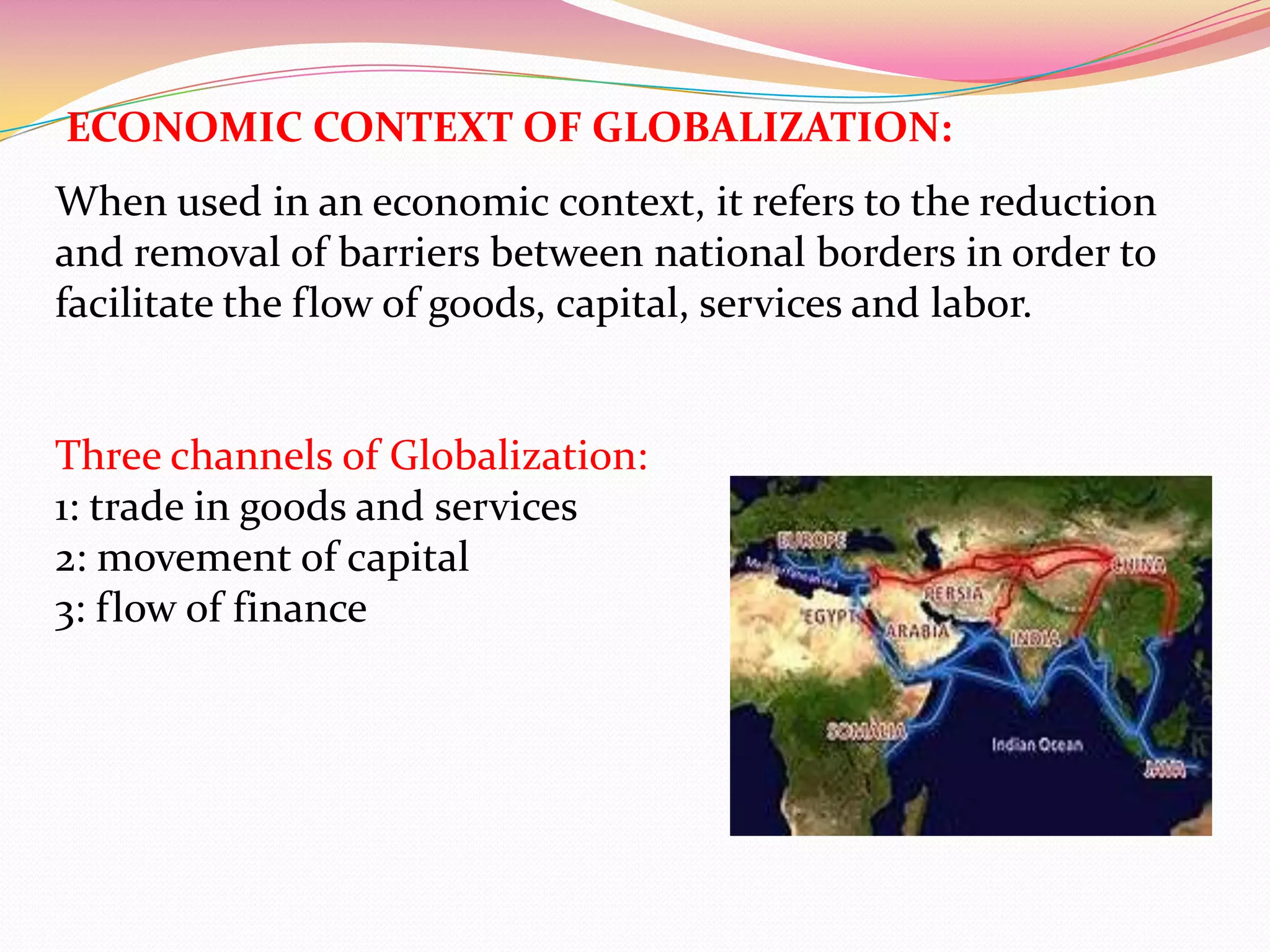
ECONOMIC CONTEXT OF GLOBALIZATION:When used in an economic context, it refers to the reduction and removal of barriers between national borders in order to facilitate the flow of goods, capital, services and labor.Three channels of Globalization:1: trade in goods and services2: movement of capital3: flow of finance
GLOBALIZATION IN INDIA:Globalization in India is generally taken to mean integrating the economy of  the country with the world economy.
The real way to the globalization process was provided by the government of India in July,1991 at the behest of the IMF and the world bank.Steps taken by GOI:Full convertibility of rupee on current account
Open the economy to FDI
Removing constraints & obstacles to the entry of MNCs in India.(dilution of restrictive laws like FERA)
Liberalization programmes (dilution of quantitative restrictions to tariffs)
Bringing down the level of import dutiesEFFECTS OF GLOBALIZATIONGlobalization has various aspects which affect the world in several different ways such as:Industrial - emergence of worldwide production markets and broader access to a range of foreign products for consumers and companies. Particularly movement of material and goods between and within national boundaries. International trade in manufactured goods increased more than 100 times (from $95 billion to $12 trillion) in the 50 years since 1955Financial - emergence of worldwide financial markets and better access to external financing for borrowers. By the early part of the 21st century more than $1.5 trillion in national currencies were traded daily to support the expanded levels of trade and investment.Economic - realization of a global common market, based on the freedom of exchange of goods and capital. The interconnectedness of these markets, however meant that an economic collapse in any one given country could not be contained.
Political - some use "globalization" to mean the creation of a world government which regulates the relationships among governments and guarantees the rights arising from social and economic globalization.Informational - increase in information flows between geographically remote locations. Arguably this is a technological change with the advent of fibre optic communications, satellites, and increased availability of telephone and Internet.Ecological - the advent of global environmental challenges that might be solved with international cooperation, such as climate change, cross-boundary water and air pollution, over-fishing of the ocean, and the spread of invasive speciesSocial - development of the system of non-governmental organizations as main agents of global public policy, including humanitarian aid and developmental effortsTechnical & Cultural
NEGATIVE  EFFECTS:Effects on disease:Globalization, the flow of information, goods, capital and people across political and geographic boundaries, has also helped to spread some of the deadliest infectious diseases known to humans. Eg. Swine fluBrain drain:Opportunities in richer countries drives talent away from poorer countries, leading to brain drains.Indian students going abroad for their higher studies costs India a foreign exchange outflow of $10 billion annually.Economic liberalization:Government deregulation and failed regulation of Wall Street's investment banks were important contributors to the subprime mortgage crisis.Effect on Income disparity:A study by the World Institute for Development Economics Research at United Nations University reports that the richest 1% of adults alone owned 40% of global assets in the year 2000. The combined wealth of the 10 million millionaires grew to nearly $41 trillion in 2008
TRADING BLOCKSA trade block is a type of intergovernmental agreement , often part of a regional intergovernmental organization ,where regional barriers to trade (tariffs and non tariffs barriers) are reduced or eliminated among the participating states.Types of Trading BlocksEconomic & Monetary  UnionCommon MarketsCustom UnionsFree trade areasOther
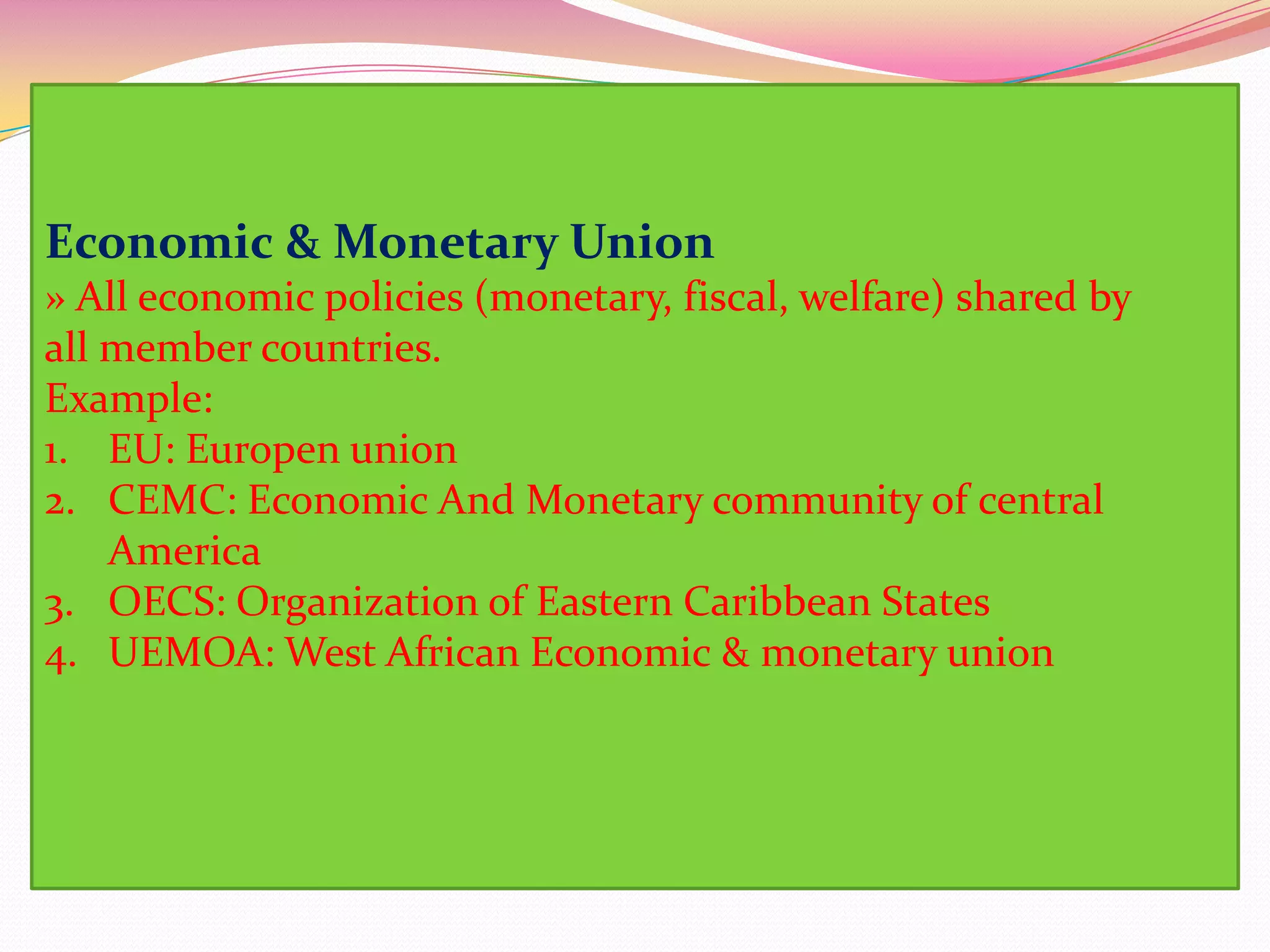
Economic & Monetary Union» All economic policies (monetary, fiscal, welfare) shared byall member countries.Example:EU: Europen unionCEMC: Economic And Monetary community of central AmericaOECS: Organization of Eastern Caribbean StatesUEMOA: West African Economic & monetary union
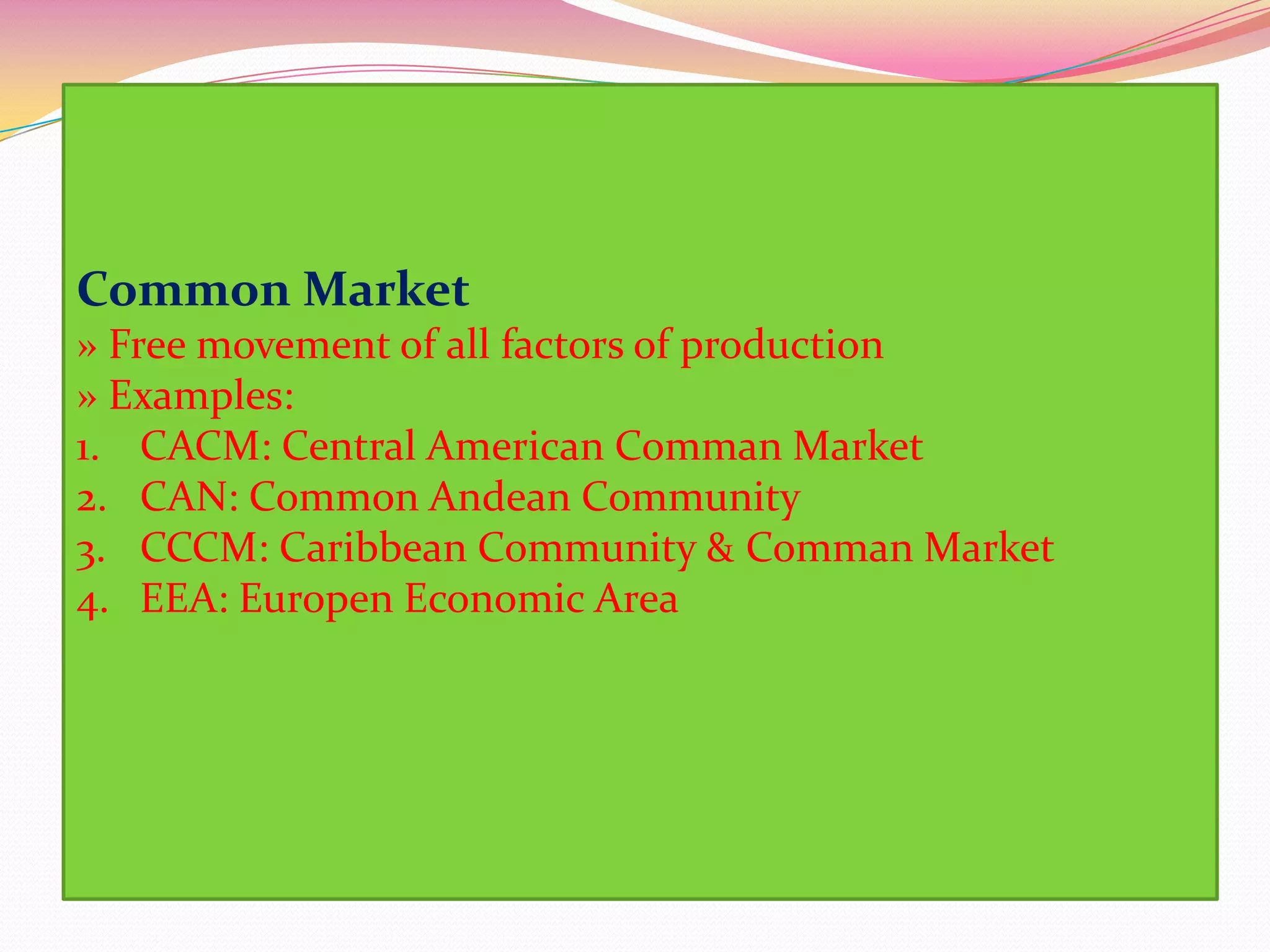
Common Market» Free movement of all factors of production» Examples:CACM: Central American Comman MarketCAN: Common Andean CommunityCCCM: Caribbean Community & Comman MarketEEA: Europen Economic Area

Globalization & trading blocks

  • 1.
    PRESENTATION ON: EMERGINGGLOBALIZATION & TRADING BLOCKSSUB: BUSINESS ENVIRONMENTGIVEN BY:ABDULLAH SHAHIDMBA 2ndSemPIMT MANDIGOBINDGARH
  • 2.
    GLOBALIZATIONDEFINITION:According to dictionaryglobalization means different things to different people.But in a broad concept Globalization (or globalization) describes an ongoing process by which regional economies, societies, and cultures have become integrated through a globe-spanning network of communication and trade. The term is sometimes used to refer specifically to economic globalization:the integration of national economies into the international economy through trade, foreign direct investment, capital flows, migration, and the spread of technology.. However, globalization is usually recognized as being driven by a combination of economic, technological, sociocultural, political, and biological factors.
  • 3.
    ECONOMIC CONTEXT OFGLOBALIZATION:When used in an economic context, it refers to the reduction and removal of barriers between national borders in order to facilitate the flow of goods, capital, services and labor.Three channels of Globalization:1: trade in goods and services2: movement of capital3: flow of finance
  • 4.
    GLOBALIZATION IN INDIA:Globalizationin India is generally taken to mean integrating the economy of the country with the world economy.
  • 5.
    The real wayto the globalization process was provided by the government of India in July,1991 at the behest of the IMF and the world bank.Steps taken by GOI:Full convertibility of rupee on current account
  • 6.
  • 7.
    Removing constraints &obstacles to the entry of MNCs in India.(dilution of restrictive laws like FERA)
  • 8.
    Liberalization programmes (dilutionof quantitative restrictions to tariffs)
  • 9.
    Bringing down thelevel of import dutiesEFFECTS OF GLOBALIZATIONGlobalization has various aspects which affect the world in several different ways such as:Industrial - emergence of worldwide production markets and broader access to a range of foreign products for consumers and companies. Particularly movement of material and goods between and within national boundaries. International trade in manufactured goods increased more than 100 times (from $95 billion to $12 trillion) in the 50 years since 1955Financial - emergence of worldwide financial markets and better access to external financing for borrowers. By the early part of the 21st century more than $1.5 trillion in national currencies were traded daily to support the expanded levels of trade and investment.Economic - realization of a global common market, based on the freedom of exchange of goods and capital. The interconnectedness of these markets, however meant that an economic collapse in any one given country could not be contained.
  • 10.
    Political - some use"globalization" to mean the creation of a world government which regulates the relationships among governments and guarantees the rights arising from social and economic globalization.Informational - increase in information flows between geographically remote locations. Arguably this is a technological change with the advent of fibre optic communications, satellites, and increased availability of telephone and Internet.Ecological - the advent of global environmental challenges that might be solved with international cooperation, such as climate change, cross-boundary water and air pollution, over-fishing of the ocean, and the spread of invasive speciesSocial - development of the system of non-governmental organizations as main agents of global public policy, including humanitarian aid and developmental effortsTechnical & Cultural
  • 11.
    NEGATIVE EFFECTS:Effectson disease:Globalization, the flow of information, goods, capital and people across political and geographic boundaries, has also helped to spread some of the deadliest infectious diseases known to humans. Eg. Swine fluBrain drain:Opportunities in richer countries drives talent away from poorer countries, leading to brain drains.Indian students going abroad for their higher studies costs India a foreign exchange outflow of $10 billion annually.Economic liberalization:Government deregulation and failed regulation of Wall Street's investment banks were important contributors to the subprime mortgage crisis.Effect on Income disparity:A study by the World Institute for Development Economics Research at United Nations University reports that the richest 1% of adults alone owned 40% of global assets in the year 2000. The combined wealth of the 10 million millionaires grew to nearly $41 trillion in 2008
  • 12.
    TRADING BLOCKSA tradeblock is a type of intergovernmental agreement , often part of a regional intergovernmental organization ,where regional barriers to trade (tariffs and non tariffs barriers) are reduced or eliminated among the participating states.Types of Trading BlocksEconomic & Monetary UnionCommon MarketsCustom UnionsFree trade areasOther
  • 13.
    Economic & MonetaryUnion» All economic policies (monetary, fiscal, welfare) shared byall member countries.Example:EU: Europen unionCEMC: Economic And Monetary community of central AmericaOECS: Organization of Eastern Caribbean StatesUEMOA: West African Economic & monetary union
  • 14.
    Common Market» Freemovement of all factors of production» Examples:CACM: Central American Comman MarketCAN: Common Andean CommunityCCCM: Caribbean Community & Comman MarketEEA: Europen Economic Area
  • 15.
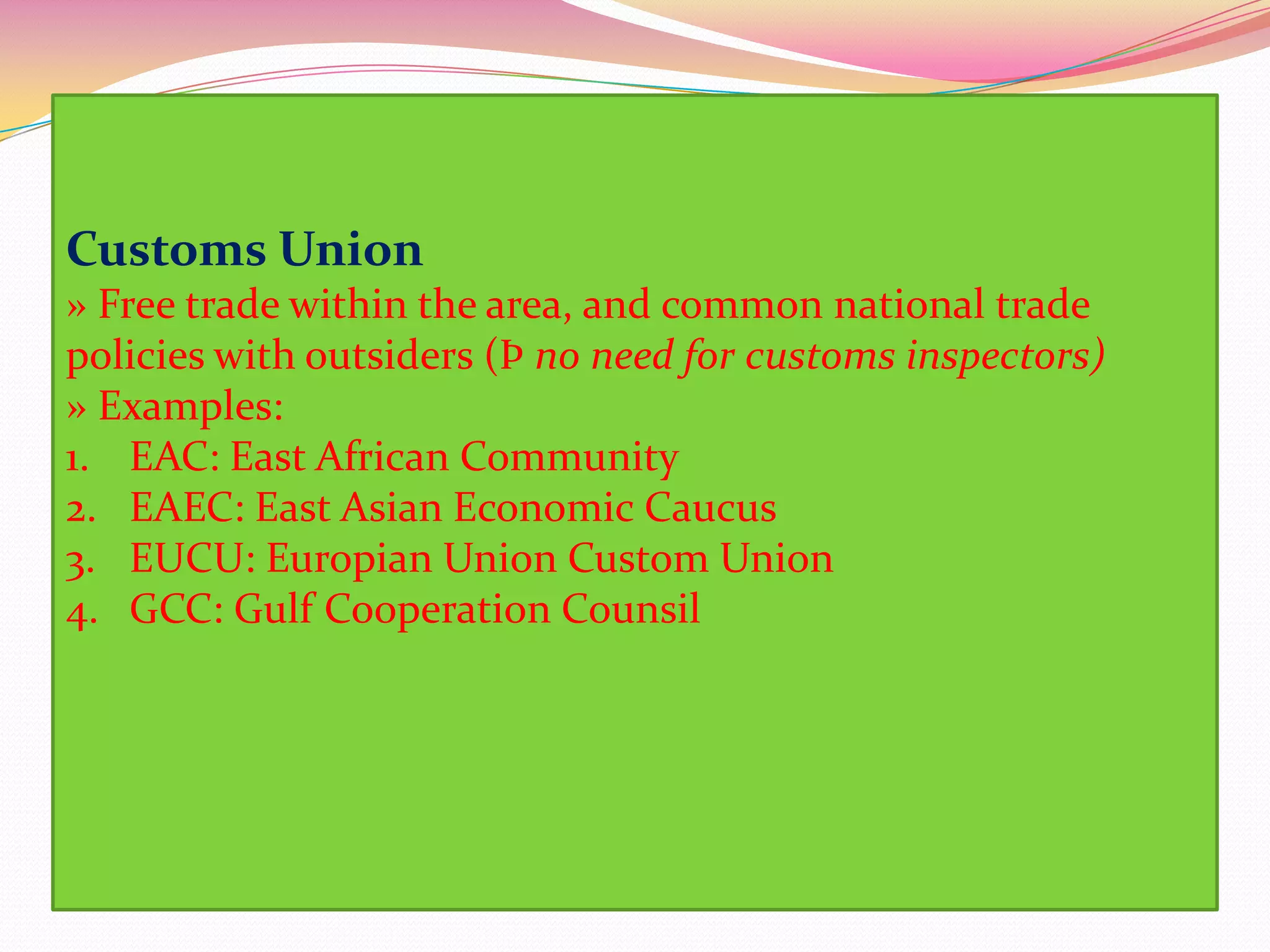
    Customs Union» Freetrade within the area, and common national tradepolicies with outsiders (Þ no need for customs inspectors)» Examples:EAC: East African CommunityEAEC: East Asian Economic CaucusEUCU: Europian Union Custom UnionGCC: Gulf Cooperation Counsil
  • 16.
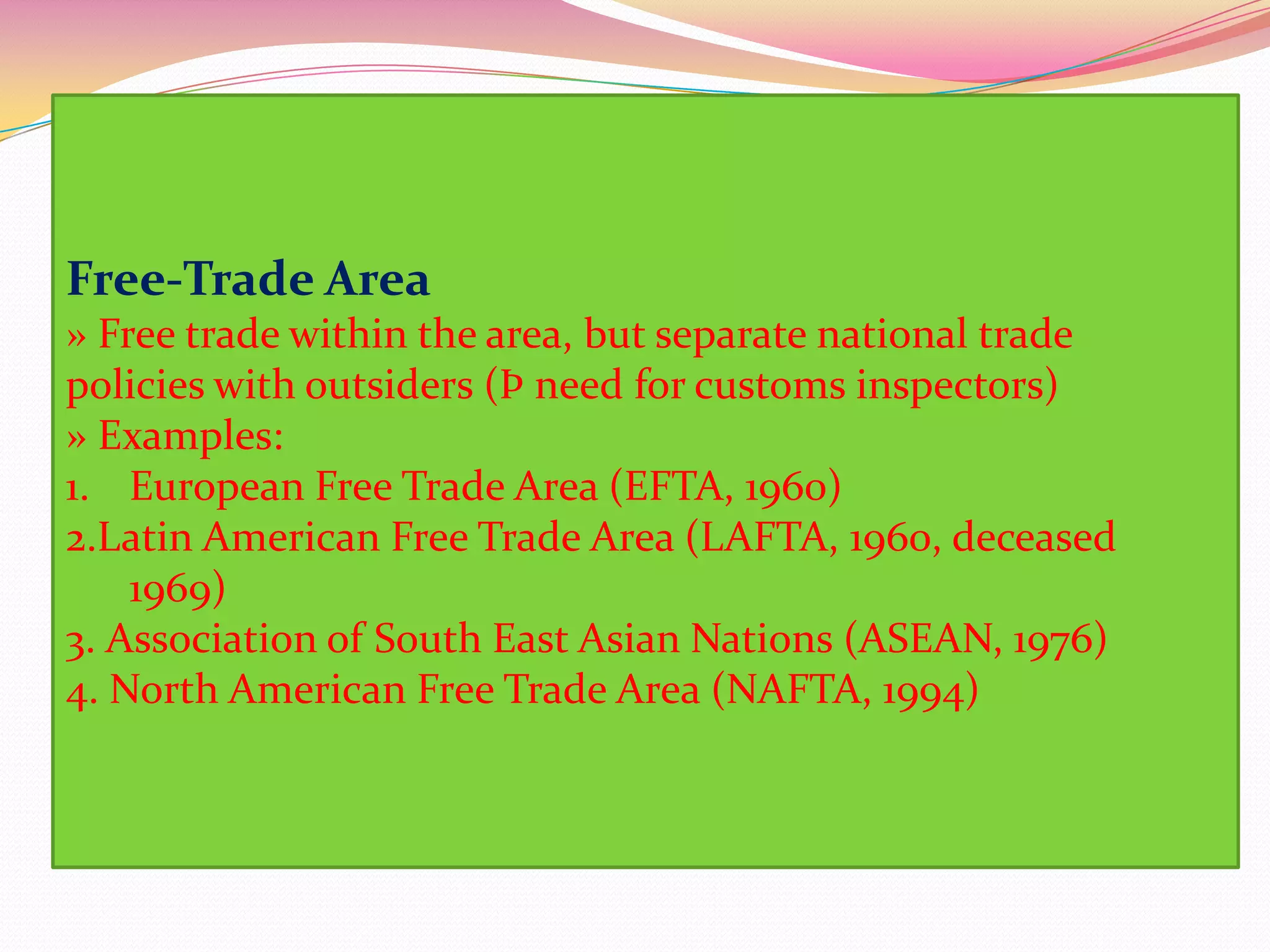
    Free-Trade Area» Freetrade within the area, but separate national tradepolicies with outsiders (Þ need for customs inspectors)» Examples:European Free Trade Area (EFTA, 1960)2.Latin American Free Trade Area (LAFTA, 1960, deceased 1969)3. Association of South East Asian Nations (ASEAN, 1976)4. North American Free Trade Area (NAFTA, 1994)
  • 17.
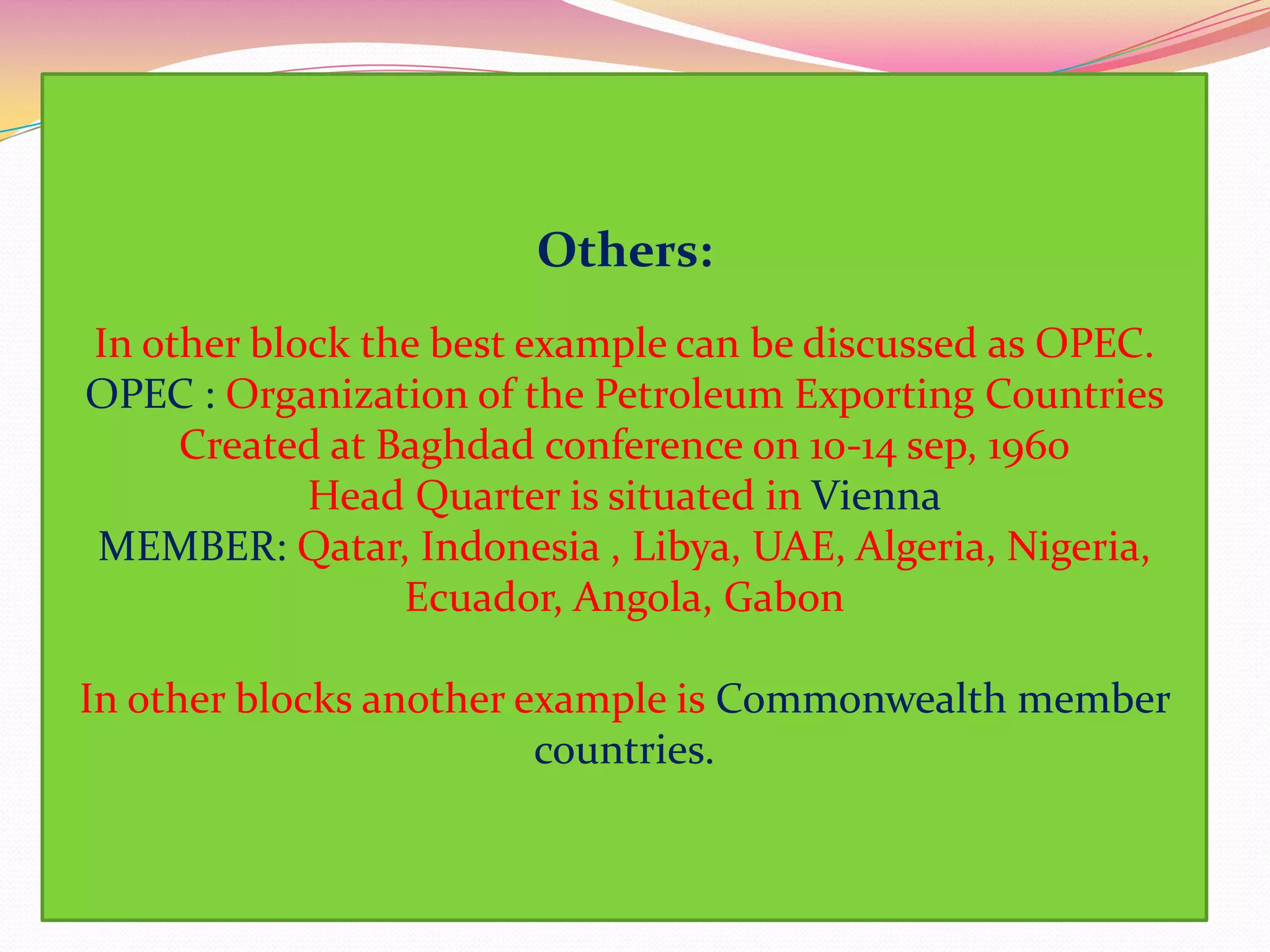
    Others:In other blockthe best example can be discussed as OPEC.OPEC : Organization of the Petroleum Exporting Countries Created at Baghdad conference on 10-14 sep, 1960Head Quarter is situated in ViennaMEMBER: Qatar, Indonesia , Libya, UAE, Algeria, Nigeria, Ecuador, Angola, GabonIn other blocks another example is Commonwealth member countries.
  • 18.