Economic Environment
•all the economics surrounding that influence business
•it affects the business decision relating to the resources
allocation, cost, profit & expenditure
•Important component of economic environment of
business in Nepal consist of economic structure,
economic reforms and economic Policies
•Structure of any countries economy determined by size
of its population, income level, natural resources,
agricultural and manufacturing activities, Openness of
economy, the degree of urbanization etc
Economic Dimensions of Economy
• The Dimensions or the factors constituting the business environment
include political, social, technological, legal and economic factors which
are considered important for taking decisions and for improving the
operations of a firm.
• Dimensions of an economy refers to the facets of economy of a
country.
• Dimensions of an economy reflect the economic development of a
country
• part of general environment which influences the performance of
many firms at the same time.
• Economic Dimension consists of factors like inflation rates, interest
rates, consumers’ incomes, economic policies, market conditions etc.
which affect the performance of a business firm.
•Economic Dimensions of an Economy may be analyzed through four facets or
dimensions
• Economic dimension: GNP per-capita income, personal consumption and
expenditure, personal ownership of good, inflation rate, private investment,
poverty situation and level of employment, budget position, fiscal and monetary
policies
• Socio economic dimension: indicate quality of people and demographic
composition of a country, migration of population.
• The industrial and agricultural dimension indicate the agricultural and industrial
base of the economy.
• The economic development dimension indicates economic development plan,
policies, strategies etc.
Economic dimension
• It indicates the economic performance of a country
• It is major external economic performance through balance of
payment, statement exchange rates
• internal economic performance through aggregate result in terms of
output, price and employment
• It indicates the supply side performance and demand side performance
• It indicates important economic variables
• GNP per-capita income, personal consumption and expenditure,
personal ownership of good, inflation rate, private investment, poverty
situation and level of employment, budget position, fiscal and
monetary policies
•Following are the main aspects of Economic dimension:
• (i) The role of public and private sectors in the existing structure of the
economy.
• (ii) The rate of increase in GNP and per capita income both at current
and constant prices.
• (iii) Amount of exports and imports of different products.
• (iv) Increase in transportation and communication facilities.
• (v) Trends in agricultural and industrial production.
• (vi) Amount of savings and investments.
• (vii) Internal as well as external public debts.
• (viii) Nature of money supply in the economy.
• (ix) Planned outlay in private and public sector.
• (x) Balance of payments and changes in foreign exchange reserves.
Analysis of economic dimension and its impact on
business
GDP:
 The monetary value of all goods and services produced within a
nation over a specified period of time.
Indicator used to measure performance of country’s economy
used to measure the size and growth of economy.
 important component of the overall health of economy
Increasing GDP rates helps in creating attractive market and attract the
business people and investors to expand their business.
GDP of Nepal in FY 2016/17 was Rs.200728(in crore) acc.to 14th plan
GDP Per capita income
• It is the average income of the people of a country in a particular year
• It is country’s economic out put per person
• It is the national income divided by the total population of the country
• Nepal's per capita income is one of the lowest in the world.
• Second lowest in south Asia after Afghanistan.
• Nepal’s per capita income can be used as an indicator of general level of income,
demand and poverty of its people
• per capita income indicate the wealth of people in a country and estimate the
business activities within the country .
• more business activities get expand along with increase in the wealth and
purchasing power of people.
• Nepal’s GDP per capita income during FY 2016/17 was Rs 79.37(thousand) acc. To
14th plan.
•Interest Rates:
Changes in the interest rates greatly affect the demand for
goods and services. For example, low long term rates on home
loans are beneficial for banks and consumers both.
•Consumer Income:
Increase in the incomes of the consumers leads to increase in
their purchasing power. Hence, demand for goods and services
rises.
• Inflation Rate:
High inflation rate increases the cost of production and hence
puts constraints on firms. Inflation can cause adverse effect on
the economy. Inflation also affect the new investment planning
of investor. Inflation rate increased up to 8.7% during 13th plan.
• Taxes:
Taxes are financial charges or levy imposed. taxes have important impact on
business. Business firm act as tax collectors and interested in lowering the tax
burden.
• Monetary policies:
It is the process by which the central bank of country controls the supply of money,
availabilities of money or rate of interest in order to attained the growth and
stabilities of economy .
• Fiscal policies:
Determines country’s economic direction. It is related to levels of taxation and
public expenditure.
• Saving, debt and credit availability
consumer saving put positively contribute to debt and credit availability. The
commercial bank could be in position to loan out money to business man and
entrepreneur
•Income distributions
A business firm interest in knowing the pattern of income
distribution to estimate the demand for given commodity as a
better purchasing power depends upon the income level.
•Poverty situation: (21.6%) according to 14th plan.
•Foreign exchange rates: the rate between two currencies at
which one is exchanged for another.
•BOP:
•The international debt crises:
Socio economic dimension/ Basic social and
economic indicators for Nepal
•Population
Most general indicator of potential market size.
Can provide basis for estimating consumption.
Acc. To census 2068 population of Nepal was 26494504.
Population growth rate 1.35%
•Population density and regional distribution
Densely populated areas tend to make product distribution
less costly
Density of population 180/Sq.km.(acc.to 2068 census)
Himalayan region 6.73%, Hilly region 43%, Terai region 50.27%
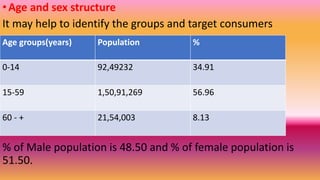
•Age and sex structure
It may help to identify the groups and target consumers
% of Male population is 48.50 and % of female population is
51.50.
Age groups(years) Population %
0-14 92,49232 34.91
15-59 1,50,91,269 56.96
60 - + 21,54,003 8.13
•Labour force composition
Labour force is most important input in the production process
Labour force composition provides information of quality and quantity
of people available
It creates impact on country’s ability to produce
It provides data of labour force available in a country
Help business firms in formulating human resource strategies and
marketing plans
It may include sector wise involvement, active and inactive population, women
labour force, labour force participation, self employed population etc
•Employment trends
People are giving up their traditional family occupation
Attraction of new occupation
Shrinking employment opportunities in rural areas
Economic transformation generating new employment
opportunities
Rise in literacy and educational level
Skilled and talented manpower produced
•Migration and foreign employment
Migration from rural to urban areas, from Himalayan and hilly to
terai region
More than 3 million people working out side the country
The industrial dimension
•Condition of agro based industries
•Construction material producing industries
•Agricultural tools producing industries
•Export oriented industries
•Service sector industries
An over view of the 14th economic Development
plan: Its objectives and strategies
• The era of planned development started in Nepal with the launching of first 5 year plan
in 1956 A.D.
• Through 5 year plan government tries to develop the state and bring welfare in the
society .
• The government assumes the responsibility to fulfill the basic need of people by
uplifting the standard of living.
• the government determine the national goal and targets, set priorities adopts polices
and strategies and mobilizes scarce resources available from different sources to meet
the goal and targets .
• Nepalese 5 year plan have so far played imp role in bringing growth and development
within the country in different sectors .
• 5 year plan are the sources of economic data in Nepal. These plan provide very useful
information to business firms.
Vision of 14th plan
• Independent, prosperous and socialism oriented national
economy and prosperous Nepalese
Goal
To reach the level of middle income country by being welfare state
with social justice.
Strategies
•Increase out put through transformation of agriculture
sector and expansion of tourism industries as well as
small and middle business
•Building infrastructures for the development of energy,
road and air transportation. Information and
communication
•Promote high and sustainable human development
•Promote good governance
•Gender equality
Economic environment

Economic environment

  • 1.
  • 2.
    •all the economicssurrounding that influence business •it affects the business decision relating to the resources allocation, cost, profit & expenditure •Important component of economic environment of business in Nepal consist of economic structure, economic reforms and economic Policies •Structure of any countries economy determined by size of its population, income level, natural resources, agricultural and manufacturing activities, Openness of economy, the degree of urbanization etc
  • 3.
    Economic Dimensions ofEconomy • The Dimensions or the factors constituting the business environment include political, social, technological, legal and economic factors which are considered important for taking decisions and for improving the operations of a firm. • Dimensions of an economy refers to the facets of economy of a country. • Dimensions of an economy reflect the economic development of a country • part of general environment which influences the performance of many firms at the same time. • Economic Dimension consists of factors like inflation rates, interest rates, consumers’ incomes, economic policies, market conditions etc. which affect the performance of a business firm.
  • 4.
    •Economic Dimensions ofan Economy may be analyzed through four facets or dimensions • Economic dimension: GNP per-capita income, personal consumption and expenditure, personal ownership of good, inflation rate, private investment, poverty situation and level of employment, budget position, fiscal and monetary policies • Socio economic dimension: indicate quality of people and demographic composition of a country, migration of population. • The industrial and agricultural dimension indicate the agricultural and industrial base of the economy. • The economic development dimension indicates economic development plan, policies, strategies etc.
  • 5.
    Economic dimension • Itindicates the economic performance of a country • It is major external economic performance through balance of payment, statement exchange rates • internal economic performance through aggregate result in terms of output, price and employment • It indicates the supply side performance and demand side performance • It indicates important economic variables • GNP per-capita income, personal consumption and expenditure, personal ownership of good, inflation rate, private investment, poverty situation and level of employment, budget position, fiscal and monetary policies
  • 6.
    •Following are themain aspects of Economic dimension: • (i) The role of public and private sectors in the existing structure of the economy. • (ii) The rate of increase in GNP and per capita income both at current and constant prices. • (iii) Amount of exports and imports of different products. • (iv) Increase in transportation and communication facilities. • (v) Trends in agricultural and industrial production. • (vi) Amount of savings and investments. • (vii) Internal as well as external public debts. • (viii) Nature of money supply in the economy. • (ix) Planned outlay in private and public sector. • (x) Balance of payments and changes in foreign exchange reserves.
  • 7.
    Analysis of economicdimension and its impact on business GDP:  The monetary value of all goods and services produced within a nation over a specified period of time. Indicator used to measure performance of country’s economy used to measure the size and growth of economy.  important component of the overall health of economy Increasing GDP rates helps in creating attractive market and attract the business people and investors to expand their business. GDP of Nepal in FY 2016/17 was Rs.200728(in crore) acc.to 14th plan
  • 8.
    GDP Per capitaincome • It is the average income of the people of a country in a particular year • It is country’s economic out put per person • It is the national income divided by the total population of the country • Nepal's per capita income is one of the lowest in the world. • Second lowest in south Asia after Afghanistan. • Nepal’s per capita income can be used as an indicator of general level of income, demand and poverty of its people • per capita income indicate the wealth of people in a country and estimate the business activities within the country . • more business activities get expand along with increase in the wealth and purchasing power of people. • Nepal’s GDP per capita income during FY 2016/17 was Rs 79.37(thousand) acc. To 14th plan.
  • 9.
    •Interest Rates: Changes inthe interest rates greatly affect the demand for goods and services. For example, low long term rates on home loans are beneficial for banks and consumers both. •Consumer Income: Increase in the incomes of the consumers leads to increase in their purchasing power. Hence, demand for goods and services rises. • Inflation Rate: High inflation rate increases the cost of production and hence puts constraints on firms. Inflation can cause adverse effect on the economy. Inflation also affect the new investment planning of investor. Inflation rate increased up to 8.7% during 13th plan.
  • 10.
    • Taxes: Taxes arefinancial charges or levy imposed. taxes have important impact on business. Business firm act as tax collectors and interested in lowering the tax burden. • Monetary policies: It is the process by which the central bank of country controls the supply of money, availabilities of money or rate of interest in order to attained the growth and stabilities of economy . • Fiscal policies: Determines country’s economic direction. It is related to levels of taxation and public expenditure. • Saving, debt and credit availability consumer saving put positively contribute to debt and credit availability. The commercial bank could be in position to loan out money to business man and entrepreneur
  • 11.
    •Income distributions A businessfirm interest in knowing the pattern of income distribution to estimate the demand for given commodity as a better purchasing power depends upon the income level. •Poverty situation: (21.6%) according to 14th plan. •Foreign exchange rates: the rate between two currencies at which one is exchanged for another. •BOP: •The international debt crises:
  • 12.
    Socio economic dimension/Basic social and economic indicators for Nepal •Population Most general indicator of potential market size. Can provide basis for estimating consumption. Acc. To census 2068 population of Nepal was 26494504. Population growth rate 1.35% •Population density and regional distribution Densely populated areas tend to make product distribution less costly Density of population 180/Sq.km.(acc.to 2068 census) Himalayan region 6.73%, Hilly region 43%, Terai region 50.27%
  • 13.
    •Age and sexstructure It may help to identify the groups and target consumers % of Male population is 48.50 and % of female population is 51.50. Age groups(years) Population % 0-14 92,49232 34.91 15-59 1,50,91,269 56.96 60 - + 21,54,003 8.13
  • 14.
    •Labour force composition Labourforce is most important input in the production process Labour force composition provides information of quality and quantity of people available It creates impact on country’s ability to produce It provides data of labour force available in a country Help business firms in formulating human resource strategies and marketing plans It may include sector wise involvement, active and inactive population, women labour force, labour force participation, self employed population etc
  • 15.
    •Employment trends People aregiving up their traditional family occupation Attraction of new occupation Shrinking employment opportunities in rural areas Economic transformation generating new employment opportunities Rise in literacy and educational level Skilled and talented manpower produced •Migration and foreign employment Migration from rural to urban areas, from Himalayan and hilly to terai region More than 3 million people working out side the country
  • 16.
    The industrial dimension •Conditionof agro based industries •Construction material producing industries •Agricultural tools producing industries •Export oriented industries •Service sector industries
  • 17.
    An over viewof the 14th economic Development plan: Its objectives and strategies • The era of planned development started in Nepal with the launching of first 5 year plan in 1956 A.D. • Through 5 year plan government tries to develop the state and bring welfare in the society . • The government assumes the responsibility to fulfill the basic need of people by uplifting the standard of living. • the government determine the national goal and targets, set priorities adopts polices and strategies and mobilizes scarce resources available from different sources to meet the goal and targets . • Nepalese 5 year plan have so far played imp role in bringing growth and development within the country in different sectors . • 5 year plan are the sources of economic data in Nepal. These plan provide very useful information to business firms.
  • 18.
    Vision of 14thplan • Independent, prosperous and socialism oriented national economy and prosperous Nepalese Goal To reach the level of middle income country by being welfare state with social justice.
  • 19.
    Strategies •Increase out putthrough transformation of agriculture sector and expansion of tourism industries as well as small and middle business •Building infrastructures for the development of energy, road and air transportation. Information and communication •Promote high and sustainable human development •Promote good governance •Gender equality