A
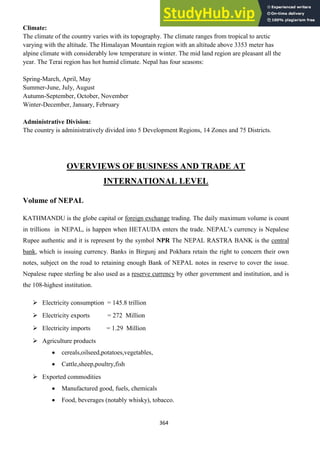
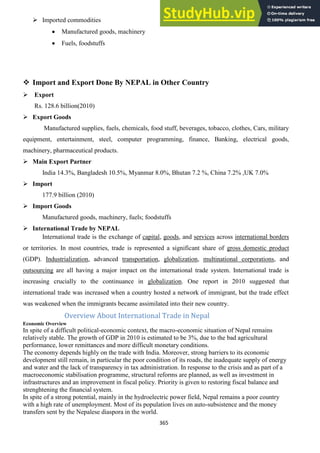
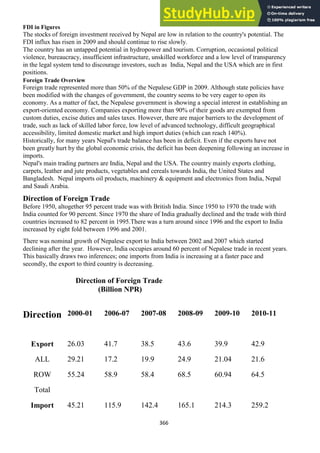
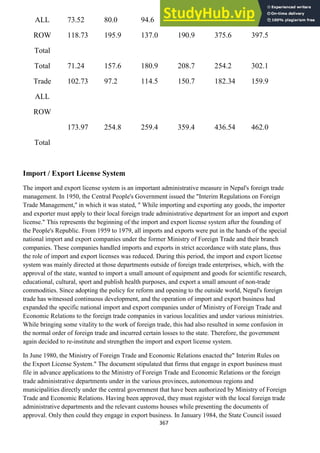
GLOBAL / COUNTRY STUDY AND REPORT
On
“Agriculture sector for Nepal”
Submitted to
Gujarat Technological University
In partial fulfillment of the
Requirement of the award for the degree of
Master of Business Administration
In
Under The Guidance Of
Faculty Guide
Ms. Sulabh Narayan (Assistant Professor)
Submitted by
Vahora Mahammad Soyeb.A. (117550592121) ParmarSwapnil.D.(117550592122)
Parmar Kinjal.J. (117550592123) Gor Parth .U. (117550592124)
Parmar Bharat.B. (117550592125) PatelPratik.M. (117550592126)
MBA SEMESTER IV
(Batch 2011-2013)
--------------------------------------------------------------------------------
THE SARDAR PATEL COLLEGE OF ADMINISTRATION & MANAGEMENT,
V.V. NAGAR –BAKROL,
ANAND 2011-13
---------------------------------------------------------------------------------------------------------------------
1
Students’ Declaration
We hereby declare that the report for Global/ Country Study Report entitled ―Agriculture
sector‖ in (Nepal) is a result of our own work and our indebtedness to other work publications,
references, if any, have been duly acknowledged.
I also declare for this report all information is collect for internet, Newspapers, BSE-NSE stock
markets exchange and Nepal Annual Report and some Nepal web side to use for collection of
works. The information mansion that for related for particular data is hone barely good effect
Nepal Agriculture sector as well as Nepal economy and GDP. Also to better relationship to India
and Nepal for Agriculture related all transactions and works.
Place: SPCAM-MBA (Signature)
Bakrol-anand
We sign by:
Vahora Mahammad Soyeb.A. (117550592121)
ParmarSwapnil.D. (117550592122)
Parmar Kinjal.J. (117550592123)
Gor Parth .U. (117550592124)
Parmar Bharat.B. (117550592125)
Patel Pratik.M. (117550592126)
2
Acknowledgement
I am glad to express my profound sentiments of gratitude to all valuable help for the
successful completion of this report I ―Bharat Parmar‖ student of MBA (Semi-IV) here take an
opportunity to prepare a report of ―Agriculture Sector in Nepal
I hereby thankful to my Faculty guide ―Sulabh Narayan (Assistant Professor)‖ for
SPCAM-MBA Bakrol Anand. I also thankful at last, but not the least, I am also thankful to my
parents and my friends who helped me and guided me.
I hereby thanks‘ to my Director-General Mr. T.D.Diwari for SPCAM-MBA Bakrol
Anand.
I express my views for all necessary information provided to me for the visit at the cost
of their valuable time.
3
4
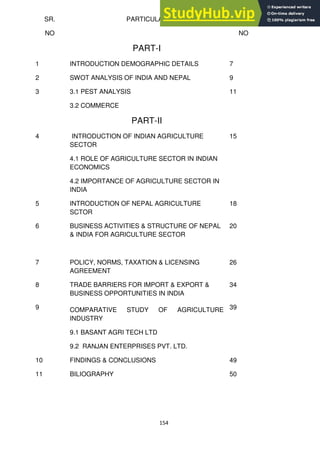
Table Content
No. Topic Page No.
1. Introduction for Economic Overview of Nepal 6 to 10
2. A REVIEW OF TRADE AND INDUSTRIAL POLICY IN 10 to 15
NEPAL
3. PESTEL Analysis of NEPAL 16 to 22
4. Conclusion 22 to 23
5
Economic Overview of Nepal
Nepal initiated planned economic development with its First Five-Year Plan in
1956, with mixed economic policy as the guiding principle of the state. Nepal
liberalized its economy with a wide range of economic reforms in early 1990s.
Those reforms induced remarkable growth in the key areas of the economy such as
industry, trade, foreign investment, finance and international transactions.
Nepal was reform and restructuring process undertaken since the 1990s, has been
instrumental in making the economy more investment-friendly, transparent,
market-oriented and efficient. Implementation of structural reforms has created a
sound base for economic development. It has encouraged establishment of joint
venture banks and private financial institutions, privatization of state-owned
companies and increased role of the private sector in the economy.
There was a market oriented economic policies have encouraged private sector
participation in economic activities, limiting the government‘s role to that of a
facilitator and developer of prerequisites, which would support the private sector to
become more efficient and competitive. Similarly, doing away with the licensing
requirements and quantitative restrictions in industry and trade, simplification of
regulatory processes, provision of current account convertibility, broadening the
areas of the FDI and a host of other reform measures have created an environment
for enhancing efficiency and competition in various economic activities.
6
FDI in Figures
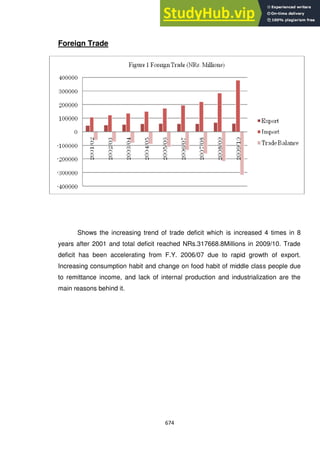
Imports have risen fast from US$1.6 billion (26 percent of GDP) in FY 2000-01 to
US $5.2 billion (30 percent of GDP) in FY2009-10 – largely due to thriving
consumption made possible by remittances. Exports have remained under US $1
billion, and as a share of GDP, have continuously declined from 13 percent to 7
percent. Exports of readymade garments, carpets and Pashmina – the erstwhile
main exports have declined. Official remittances rose from about 13.8 percent of
GDP in FY 2006-07 to 22 percent of GDP in FY 2008-09. This is less than the
total amount as it does not account for inflows from India and informal channels.
Fueled by high remittances, monetary growth has been high in the last two years.
The effects of being landlocked and of having to transit goods through India
continued to be reflected in the early 1990s. As a result of the lapse of the trade
and transit treaties with India in March 1989, Nepal faced shortages of certain
consumer goods, raw materials, and other industrial inputs, a situation that led to a
decline in industrial production.

ECONOMIC SETTING



ROLE OF GOVERNMENT



MONEY AND BANKING



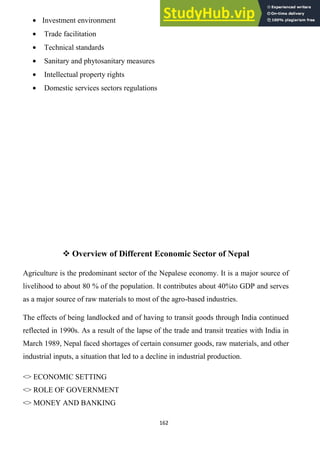
AGRICULTURE



INDUSTRY



TOURISM

7
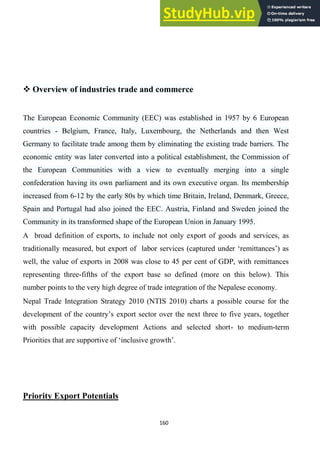
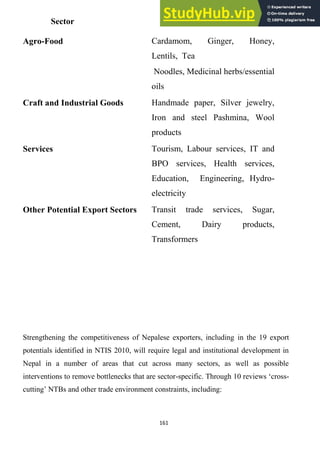
Overview of Industries Trade and Commerce of Nepal
Introduction
India is Nepal‘s largest trade partner and source of foreign investment; India is also
the only transit providing country for Nepal. Nepal has the largest volume of trade
with India. Nepal also has the largest trade deficit with India, and this figure is
increasing from year to year. Of late, it is widely felt that Nepal must concentrate
heavily on import substitution and in setting up and furtherance of export-oriented
industries. To achieve this, Nepal must attract direct foreign investment with more
and more value additions in Nepal so that it may industrialize faster and also
increase trade with India so as to reduce the trade deficits with the trading partners.
Trends in trade and investment:
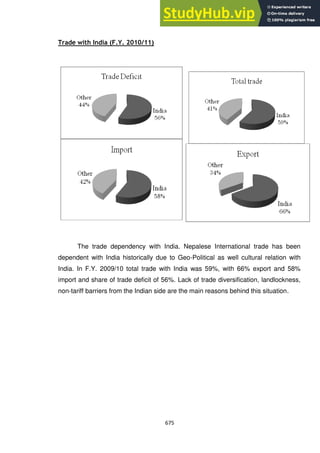
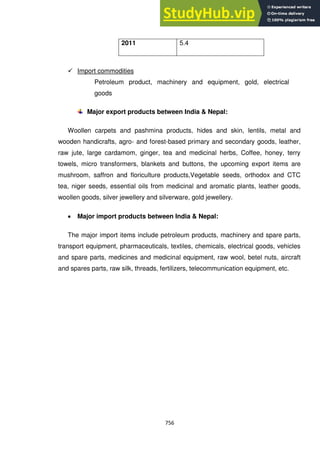
Bilateral trade was US$ 4.21 billion during Nepalese fiscal year 2010-11 (July 16 –
July 15). Nepal‘s import from India amounted to US$ 3.62 billion and exports to
India aggregated US$ 599.7 million. In the first six months of fiscal year 2011-12,
Nepal‘s total trade with India was about US$ 1.93 billion; Nepal‘s exports to India
were about US$ 284.8 million; and imports from India were about US$ 1.64
billion.
Since 1996, Nepal‘s exports to India have grown more than eleven times and
bilateral trade more than ten times; the bilateral trade that was 29.8% of total
external trade of Nepal in year 1995-96 has increased to 66.4% in 2010-11. Since
1995-96, the total external trade of Nepal has increased from NRs. 9433 crores
(IRs.5895 crores) to NRs. 45946.1 crores (IRs. 28716.3 crores). 83% of this
8
increase is on account of increase in the bilateral trade between India and Nepal,
which grew from NRs. 2808 crores (IRs. 1755 crores) in 1995-96 to NRs. 16319.9
crores (IRs. 10199.9 crores) in first six months of 2011-12. Nepal‘s exports also
increased from NRs.1988 crores (IRs. 1242 crores) in 1995-96 to NRs. 3591.6
crores
(IRs. 2244.7 crores) in first six months of 2011-12. 45% of this increase was on
account of increase in Nepal‘s exports to India.
Overview about International Trade in Nepal
Economic Overview
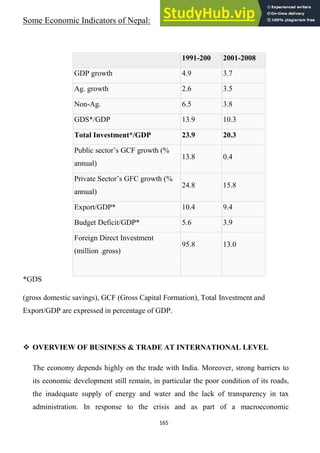
In spite of a difficult political-economic context, the macro-economic situation of
Nepal remains relatively stable. The growth of GDP in 2010 is estimated to be 3%,
due to the bad agricultural performance, lower remittances and more difficult
monetary conditions.
The economy depends highly on the trade with India. Moreover, strong barriers to
its economic development still remain, in particular the poor condition of its roads,
the inadequate supply of energy and water and the lack of transparency in tax
administration. In response to the crisis and as part of a macroeconomic
stabilisation programme, structural reforms are planned, as well as investment in
infrastructures and an improvement in fiscal policy. Priority is given to restoring
fiscal balance and strengthening the financial system.
In spite of a strong potential, mainly in the hydroelectric power field, Nepal
remains a poor country with a high rate of unemployment. Most of its population
lives on auto-subsistence and the money transfers sent by the Nepalese diaspora in
the world.
9

Business Tips about Nepal
We currently have no business tips posted for Nepal.
Be the first to feature your expertise related to Nepal. Post any content you may
have that features your expertise by clicking on the button below.

Import and Export Services in Nepal
Unicrafts (P) Ltd
Custom Manufacturing, Nepal
Manufacturers and exporters of 70% pashmina/30% silk and 100%
pashmina, 100% cotton, 100% bamboo and other nature fiber shawls,
stoles...
Krishna Raut, Consultant
International Trade Consulting, Nepal
I am innovatively efficient to facilitate foreign investors to invest money in
different types of profitable business in Nepal.
10

2. A REVIEW OF TRADE AND INDUSTRIAL POLICY IN NEPAL
INVESTMENT POLICY
The Industrial Policy of 1992 identifies foreign investment promotion as an
important strategy to achieve increasing industrial production, meeting the basic
needs of the people, creating employment opportunities, and paving the way for
improvement in the balance of payments situation.
ENVIRONMENT IN NEPAL
The purpose of industrial policy is to attain economic growth by providing
investors with incentives to en-gage in productive growth. An in depth review of
Nepal‘s industrial policy and environment suggests that the government has been
able to attain macroeconomic stability in terms of inflation, interest rates and
exchange rate. However, Nepal‘s industrial policy seems unable to provide
incentives for both domestic and foreign investment.
SECTOR SPECIFIC POLICIES
SAWTEE and Action Aid Nepal recently conducted a research study to identify
goods and services with comparative advantage. The study selected three items
(tea, herbs and leather) from the goods sector and two sub-sectors from the
11
services sector (tourism and information and communication technology-ICT). The
next section of the research brief will explore government policies and initiatives
to promote the sectors and products. Tea realizing the potential of tea, the
government has for-emulated policies to promote private investment in the sector.
HERBS
Nepal‘s forest related policies and regulations seek to create economic incentives
for the local people to conserve the forest while safeguarding their traditional
livelihood options. Various laws and regulations govern the production, processing
and exports of herbs. One of the important policies is the Master Plan for the
Forestry Sector (MPFS) of 1989. The 25 year policy and planning framework
seeks to manage forest for income and employment opportunities through people‘s
participation in the development, management and conservation of forest
resources.
LEATHER
Despite Nepal‘s trade potential in leather and leather products, the government has
neither formulated a policy framework nor implemented any specific programmes
to promote the sector. The leather sector is hindered by a range of constraints that
include sluggish growth of livestock population and inability to export higher value
added finished leather and leather products. Targeted programmes in partnership
with the private sector are necessary to promote the sector. In addition, livestock
development should be given priority and directly linked to the development of the
leather sector.
12
TOURISM
The potential of tour-ism in Nepal was realized as early as the First Plan
(1955-60). Since then the government has formulated and implemented various
plans and policies for the promotion of the sector. The ten year master plan that
was prepared during the Fourth Plan is one of the most important steps taken for
the development of the sector. Under the plan a number of airports and airstrips
were con-strutted, and credit was extended to the private sector for the construction
of hotels. In addition, the government became aware of the need to conserve wild
life and national parks to promote tourism.
Present Trade in Nepal
Today the present trade in Nepal same geographically economically with
India. That prospect for developing export markets with India and south is easy as
there are minimal transportation constraints as compared to the mountainous north.
Nepal's agricultural and industrial centers are concentrated in the region. In the
1950s, over 90% of the foreign trade was carried on with India but over the years
the total amount of trade between India and Nepal has reduced substantially.
Nevertheless, today despite several attempts to diversify foreign trade and make it
less dependent on India, but India remains the main trading partner of Nepal.
13
Therefore, the smooth transit of goods over India depends on the friendly
relations between the two countries. In 1950, under the Treaty of Trade and
Commerce between India and Nepal, India agreed to provide transit facilities to
Nepal. The 1989 stalemate in trade negotiations between the two countries,
adversely affected the Nepalese economy. Nepal's exports were subjected to high
tariffs and import from India also carried increased costs. There was an overall
shortage of essential commodities like fire, baby food, medicines, etc. Eventually,
with political changes taking place in both the countries, the trade and transit
dispute was finally resolved in June 1990. In order to avoid any economy
difficulties, it is therefore, important for Nepal to maintain a friendly relation with
India.
Relations between India and Nepal are close yet fraught with difficulties stemming
from geographical location, economics, the problems inherent in big power-small
power relations, and common ethnic, linguistic and cultural identities that overlap
the two countries' borders. New Delhi and Katmandu initiated their intertwined
relationship with the 1950 Indo-Nepal Treaty of Peace and Friendship and
accompanying letters that defined security relations between the two countries, and
an agreement governing both bilateral trade and trade transiting Indian soil. The
1950 treaty and letters stated that "neither government shall tolerate any threat to
the security of the other by a foreign aggressor" and obligated both sides "to inform
each other of any serious friction or misunderstanding with any neighboring state
likely to cause any breach in the friendly relations subsisting between the two
governments." These accords cemented a "special relationship" between India and
Nepal that granted Nepal preferential economic treatment and provided Nepalese
in India the same economic and educational opportunities as Indian citizens. Jayant
Prasad is India's ambassador to Nepal. The Treaty of Peace and Friendship, signed
14
between the two countries in the year 1950, needs to be contemporized to suit
current needs. As stated earlier, Nepal looks up to emerging India as an
opportunity for growth in the form of easy access to technology, investment and
market. Nepal hopes for greater tangible cooperation from India.
New Vistas in India-Nepal Trade Relations
India still possess the tag of ―Solitaire‖ in Nepal‘s international trade
domain as it‘s maintain the strategic proportion of sixty one percent of Nepal‘s
total trade and accounts nearly sixty seven percent of total exports as per the
various data suggested in 2008.
Nepal - India Relations: Current Issues
Nepal-India relations are 'unique' for reasons ranging from geographical contiguity
to close cultural ties, and extensive institutional and social relationships. Cultural,
economic and geographical factors along with the common bond of a shared
religion have had a great influence on bilateral relations. As two sovereign nations,
both India and Nepal are naturally guided by their national interests. These
interests are related to cultural, economic and security areas. Despite some
turbulence in the past, India-Nepal relations have remained close, stable and
mutually beneficial.
15
3. PESTEL Analysis of NEPAL
Nepal and India have a long history of Trade treaties and bilateral arrangements
that have helped broaden the scope of investment and measures that contribute to
sustainable economic development in Nepal.
About the country:
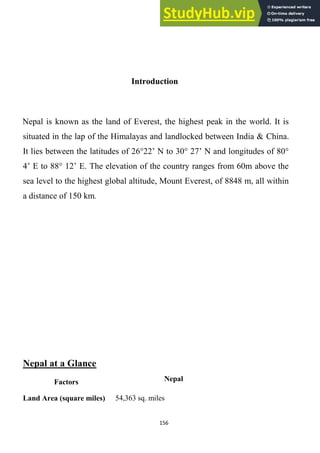
Nepal, the mid-Himalayan country of Asia has its border with India on the South,
East & West and China on the North. It is located between latitude 26 degree 22
minutes North to 30 degree 27 minutes North and longitude 80 degree 4 minutes
East to 88 degree 12 minutes East. Being land locked country the sea access is
about 1,150 Km from the border.
The largest contributor to Nepal‘s FDI is India. The Indian companies have made a
significant contribution to the Nepalese economy both in terms of employment
generation and by way of generation of revenue to the Nepalese exchequer.
Political Analysis of Nepal
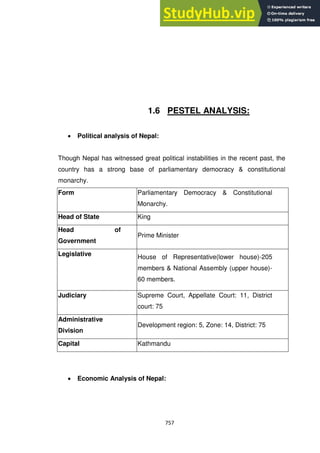
Type Representative Multi-party Democracy
Constitution Interim Constitution Promulgated on January 15,
2007. Constituent Assembly convened in May 2008
16
to draft a new constitution. In May 2010, a deadline
for drafting of the constitution was extended by 1yr.
Executive President (Head of State), Prime Minister (Head of
Government)
Legislative The constituent assembly is a unicameral parliament,
consisting of 601 members, 240 members were
elected through a direct electoral process
representing single member constituencies across a
country, 355 members were nominated from party
lists through a proportional representative system &
26 were nominated by the cabinet representative of
ethnic & indigenous communities
Elections Constituent assembly election held on April 10, 2008
National Days Republic day, Jestha 15(May 28), Democracy day,
Falgun 7 (Mid-February), (Note: Jestha & Falgun are
month of Nepalese calendar)
Political party United communist party of Nepal –Maoist (UCPN-
M), Formerly known as Communist party of Nepal-
Maoist(CPN-M),NepaliCongress(NC),
Communist party of Nepal- United Marxist Leninist
(CPN-UML), Madhesi People‘s Right Forum
(MPRF), Tarai Madhes Democracy Party (TMDP),
Sadhbhavana Party (SP), Rastriya Prajatantra Party(RPP)
17
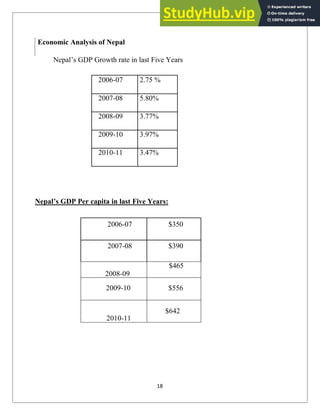
Economic Analysis of Nepal
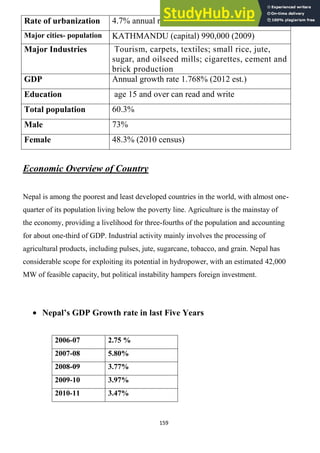
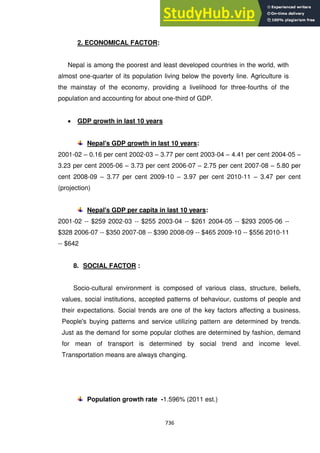
Nepal‘s GDP Growth rate in last Five Years
2006-07 2.75 %
2007-08 5.80%
2008-09 3.77%
2009-10 3.97%
2010-11 3.47%
Nepal’s GDP Per capita in last Five Years:
2006-07 $350
2007-08 $390
2008-09
$465
2009-10 $556
2010-11
$642
18
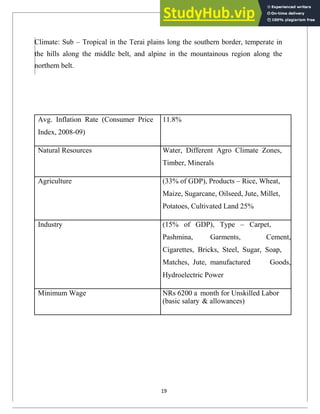
Climate: Sub – Tropical in the Terai plains long the southern border, temperate in
the hills along the middle belt, and alpine in the mountainous region along the
northern belt.
Avg. Inflation Rate (Consumer Price 11.8%
Index, 2008-09)
Natural Resources Water, Different Agro Climate Zones,
Timber, Minerals
Agriculture (33% of GDP), Products – Rice, Wheat,
Maize, Sugarcane, Oilseed, Jute, Millet,
Potatoes, Cultivated Land 25%
Industry (15% of GDP), Type – Carpet,
Pashmina, Garments, Cement,
Cigarettes, Bricks, Steel, Sugar, Soap,
Matches, Jute, manufactured Goods,
Hydroelectric Power
Minimum Wage NRs 6200 a month for Unskilled Labor
(basic salary & allowances)
19
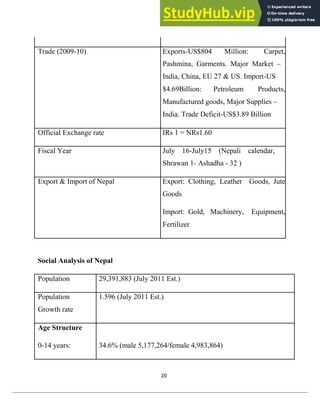
Trade (2009-10) Exports-US$804 Million: Carpet,
Pashmina, Garments. Major Market –
India, China, EU 27 & US. Import-US
$4.69Billion: Petroleum Products,
Manufactured goods, Major Supplies –
India. Trade Deficit-US$3.89 Billion
Official Exchange rate IRs 1 = NRs1.60
Fiscal Year July 16-July15 (Nepali calendar,
Shrawan 1- Ashadha - 32 )
Export & Import of Nepal Export: Clothing, Leather Goods, Jute
Goods
Import: Gold, Machinery, Equipment,
Fertilizer
Social Analysis of Nepal
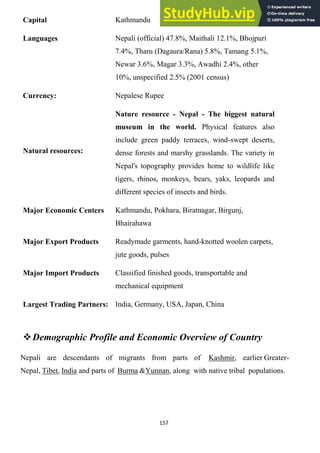
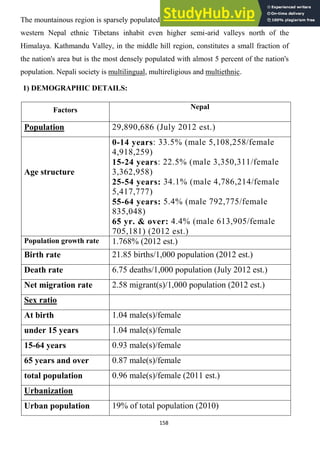
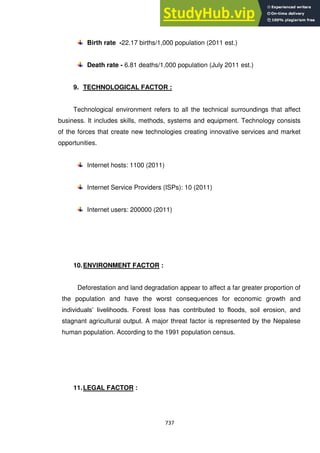
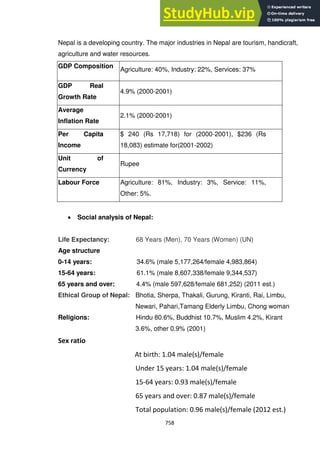
Population 29,391,883 (July 2011 Est.)
Population 1.596 (July 2011 Est.)
Growth rate
Age Structure
0-14 years: 34.6% (male 5,177,264/female 4,983,864)
20
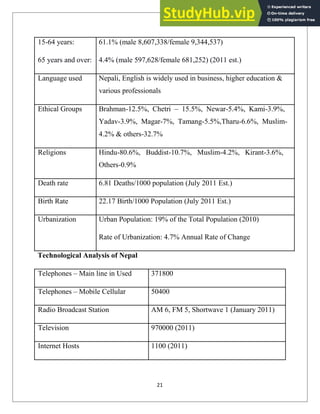
15-64 years: 61.1% (male 8,607,338/female 9,344,537)
65 years and over: 4.4% (male 597,628/female 681,252) (2011 est.)
Language used Nepali, English is widely used in business, higher education &
various professionals
Ethical Groups Brahman-12.5%, Chetri – 15.5%, Newar-5.4%, Kami-3.9%,
Yadav-3.9%, Magar-7%, Tamang-5.5%,Tharu-6.6%, Muslim-
4.2% & others-32.7%
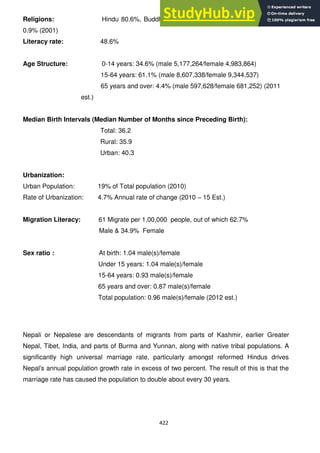
Religions Hindu-80.6%, Buddist-10.7%, Muslim-4.2%, Kirant-3.6%,
Others-0.9%
Death rate 6.81 Deaths/1000 population (July 2011 Est.)
Birth Rate 22.17 Birth/1000 Population (July 2011 Est.)
Urbanization Urban Population: 19% of the Total Population (2010)
Rate of Urbanization: 4.7% Annual Rate of Change
Technological Analysis of Nepal
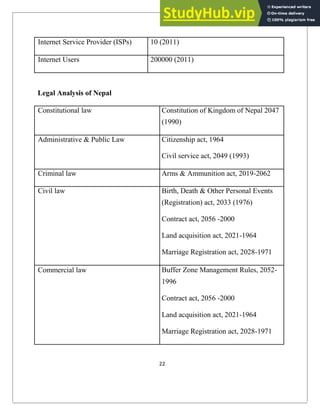
Telephones – Main line in Used 371800
Telephones – Mobile Cellular 50400
Radio Broadcast Station AM 6, FM 5, Shortwave 1 (January 2011)
Television 970000 (2011)
Internet Hosts 1100 (2011)
21
Internet Service Provider (ISPs) 10 (2011)
Internet Users 200000 (2011)
Legal Analysis of Nepal
Constitutional law Constitution of Kingdom of Nepal 2047
(1990)
Administrative & Public Law Citizenship act, 1964
Civil service act, 2049 (1993)
Criminal law Arms & Ammunition act, 2019-2062
Civil law Birth, Death & Other Personal Events
(Registration) act, 2033 (1976)
Contract act, 2056 -2000
Land acquisition act, 2021-1964
Marriage Registration act, 2028-1971
Commercial law Buffer Zone Management Rules, 2052-
1996
Contract act, 2056 -2000
Land acquisition act, 2021-1964
Marriage Registration act, 2028-1971
22
4. Conclusion:
Having PESTEL analysis of NEPAL we can identify that that there are
immense business opportunity lies in Telecommunication services, Textile
Industry, Internet Service Provider & Most important from Indian market point of
view an Agriculture Sector. India needs to take advantage of such great
opportunity & can enter in Nepal for doing business out there.
23
24
Table Contents
No. Content Page No.
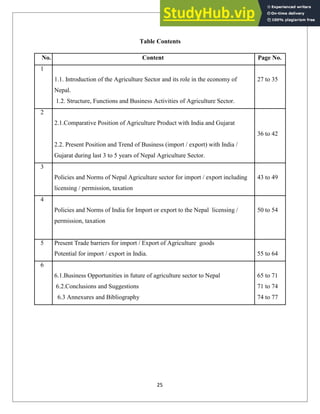
1
1.1. Introduction of the Agriculture Sector and its role in the economy of 27 to 35
Nepal.
1.2. Structure, Functions and Business Activities of Agriculture Sector.
2
2.1.Comparative Position of Agriculture Product with India and Gujarat
36 to 42
2.2. Present Position and Trend of Business (import / export) with India /
Gujarat during last 3 to 5 years of Nepal Agriculture Sector.
3
Policies and Norms of Nepal Agriculture sector for import / export including 43 to 49
licensing / permission, taxation
4
Policies and Norms of India for Import or export to the Nepal licensing / 50 to 54
permission, taxation
5 Present Trade barriers for import / Export of Agriculture goods
Potential for import / export in India. 55 to 64
6
6.1.Business Opportunities in future of agriculture sector to Nepal 65 to 71
6.2.Conclusions and Suggestions 71 to 74
6.3 Annexures and Bibliography 74 to 77
25
PRECAPE
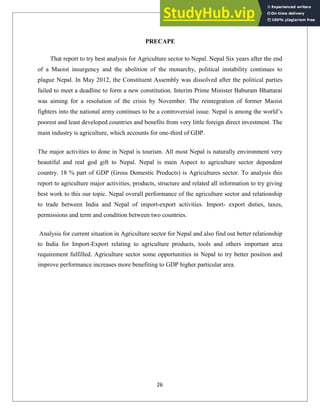
That report to try best analysis for Agriculture sector to Nepal. Nepal Six years after the end
of a Maoist insurgency and the abolition of the monarchy, political instability continues to
plague Nepal. In May 2012, the Constituent Assembly was dissolved after the political parties
failed to meet a deadline to form a new constitution. Interim Prime Minister Baburam Bhattarai
was aiming for a resolution of the crisis by November. The reintegration of former Maoist
fighters into the national army continues to be a controversial issue. Nepal is among the world‘s
poorest and least developed countries and benefits from very little foreign direct investment. The
main industry is agriculture, which accounts for one-third of GDP.
The major activities to done in Nepal is tourism. All most Nepal is naturally environment very
beautiful and real god gift to Nepal. Nepal is main Aspect to agriculture sector dependent
country. 18 % part of GDP (Gross Domestic Products) is Agricultures sector. To analysis this
report to agriculture major activities, products, structure and related all information to try giving
best work to this our topic. Nepal overall performance of the agriculture sector and relationship
to trade between India and Nepal of import-export activities. Import- export duties, taxes,
permissions and term and condition between two countries.
Analysis for current situation in Agriculture sector for Nepal and also find out better relationship
to India for Import-Export relating to agriculture products, tools and others important area
requirement fulfilled. Agriculture sector some opportunities in Nepal to try better position and
improve performance increases more benefiting to GDP higher particular area.
26
1. Introduction about agriculture sector in Nepal
Introduction
USAID Nepal is presently undertaking a process of economic growth assessment as a basis for
designing its support to contribute to an inclusive economic growth in Nepal as the country
prepares for embarking on prosperity, modernity and just society through consolidation of
ongoing peace process. Fostering high economic growth and enhancing access of the poor and
excluded to the benefit of growth is the basis for sustainable peace and poverty reduction.
Agriculture sector is the important sector of the economy that holds the potential of such broad
based and pro-poor growth. The present assessment is to complement to the overall economic
growth assessment process from the perspective of agriculture sector.
The purpose of this assessment is to identify key constraints and opportunities for growth in
agriculture sector, review policy environment and ongoing activities of development partners in
the sector to outline the scope for USAID support to help spur inclusive growth in agriculture.
The present assessment was carried out involving reviews, interactions and field visits in a
period of July 10 to August 2.
2. An overview of agriculture and poverty in Nepal
2.1 Sector structure Agriculture continues to provide a broad base to the Nepalese
economy. Nearly four
Fifths of all Nepalese households are essentially farm households,
1 who derive nearly half of income from agricultural sources consisting of farm income and
agricultural wage income (Annex 1, Figure 1). Engaging two-thirds of labor force, this sector
alone contributes some one-third to the GDP. As such, the growth originating in agriculture
holds high potential to have relatively wider impact on poverty reduction and inclusiveness.
27
Smallholders and marginal farms predominate Nepalese agriculture with the average holding
size of 0.8 ha. Nearly a half of all farms have less than 0.5 ha of land, while those with less than
1 ha of land constitute nearly three-fourths of all holdings (Annex 1, Table
1). Farms are getting smaller – average size of holding declined by 28 percent between 1961 and
2001.
Landless farmers are gradually leaving agriculture as it is hard to eke out livelihood there
without holding land asset. The number of holdings without land has decreased by 16.8 % from
32.1 thousand in 1991/92. The number of permanent agricultural workers declined to 179
thousand persons – down by some 41 %.
1Of the total 4.25 million households, 3.36 million constitute agricultural holdings. 1Nepal's
agriculture is overwhelmed by subsistence family farms. Seventy-eight percent farm holdings
have been reported to be producing mainly for home consumption. The proportion of holdings
that produce mainly for sale is not even 1 percent, while little over 21% farm families use their
farm produce almost equally for both sale and home consumption (CBS, WB, DFID, and ADB,
2006). Ironically, these subsistence farms are not capable of supporting the adequate subsistence
of the farm families. For 60 percent holdings the annual farm production was not sufficient to
feed their household until the next harvest; 40% holdings were deficient for up to 6 months while
20 percent holdings were deficient for more than half a year.
Agricultural production is mostly dominated by crop sub-sector which accounts for nearly two-
third of AGDP. Cereal crops account for over 80 % of annual cropped area wherein paddy alone
occupies 40 percent followed by maize (about 20%) and wheat (about 17 %). Cropping intensity
is low at 1.8 on the average. Farms operate in a mixed farming system of crop and livestock
interfacing forest. Large livestock population provides sources of meat, milk, draft power and
farm yard manure. Production of staple food grains is the choice of common priority for the
farms, especially production of paddy wherever it is possible to grow.
28
2.2 Sector performance
Overall economy and agriculture is not doing well in recent years. Overall economic growth rate
declined from 4.8 percent in the 1990s to 3.2 percent during 2001-2006. Agriculture virtually
stagnated -- agriculture sector growth rate was 2.7 percent per annum in the 90s and 2.8 percent
during 2001 to 2006. Marred by low labor productivity, agriculture is not able to contribute to
the economy its due (33 percent share of GDP with 66 percent of country's labor force employed
in the sector). Growth of cereals production remained weak, cash crops had mixed performance,
while high value horticulture crops performed relatively better. Yields of cereals are persistently
low. Yield estimates per hectare for 2007 have been reported to be at 2.77 mt for paddy, 2.16 mt
for maize and 2.23 mt. for wheat. It is to be noted that this year is considered to be a good crop
year due to better monsoon records (MOF, 2008).
Nepal's agriculture is heavily inclined to food grains production guided by food sufficiency
objectives and yet the food self-sufficiency has often been in the doldrums
2Average annual production of food grains is estimated to the tune of 7.7 million tons, of which
paddy alone constitutes nearly a half. During deficit years, the food grains shortfall ranged from
22 thousand tons to 485 thousand tons while surplus during better harvest years ranged from 68
thousand tons to 213 thousand tons. Agriculture registered an impressive 5.7% growth last year
2007. Whether this rate will sustain depends largely on the monsoon pattern this year and
thereafter.
The economy has been apparently undergoing some structural changes with the shrinkage of
agriculture relative to the secondary and tertiary sectors of the economy.
Within agriculture, some commercialization and diversification have been taking place in recent
years taking advantage of rapidly unfolding market opportunities created by improvement in
accessibility and fuelled by growth in size of urban population. Some indicators of farm level
performance in this connection have been presented in Box 2. Despite greater intensification of
crop production, return from crop production declined, while return from livestock rearing
29
improved. Cost -- price squeeze intensified in crop agriculture. Likewise, importance of
agriculture as a source of household income declined, although it still continues to be the single
largest source of household income.
Some framers in the better endowed and well-connected areas are getting involved in producing
high value commodities for commercial purposes. Fruits, vegetables, spices, tea and livestock
products are increasing and products like coffee and honey are emerging (Annex 1, Table 3).
However, the pace is not very impressive. During the period 1995 to 2005, average annual
growth rates for fruits, milk and meat hovered around 3 percent; only the growth rate of
vegetable production was an exception at 5.1.
Economy of Nepal
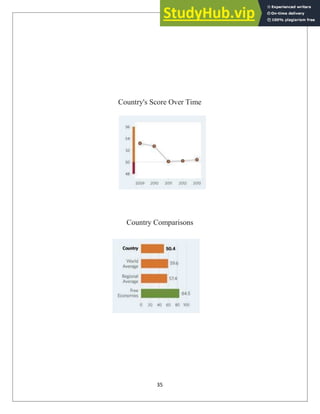
Nepal‘s economic freedom score is 50.4, making its economy the 141st freest in the 2013 Index.
Its score has increased by 0.2 point since last year, with improvements in business freedom and
the control of government spending offsetting deteriorations in labor freedom and trade freedom.
Nepal is ranked 31st out of 41 countries in the Asia–Pacific region, and its score remains far
below world and regional averages. The Nepalese economy continues to lack the entrepreneurial
dynamism needed for broad-based economic growth and sustainable long-term development.
With the statist approach to the economy holding development progress far below the country‘s
potential, state interference continues to hurt regulatory efficiency, and there has been little effort
to open the economy or engage in world markets. Nepal‘s scores for investment and financial
freedom are among the lowest in the world.
Lingering political instability undercuts the government‘s ability and willingness to implement
necessary institutional reforms, further undermining the already fragile foundations of economic
freedom. Property rights are poorly protected by the inefficient judicial system, which is subject
to substantial political influence. Systemic corruption in the non-transparent legal framework
also continues to obstruct much-needed expansion of private investment and production.
Nepal opened up its economy in the early 1990s with the adoption of economic reformpackage.
The reform measures have since covered almost all sectors of the economy including trade and
investment, fiscal and monetary policies, financial and capital markets and other economic and
30
social sectors. The import licensing system and quantitative restrictions were eliminated and
tariff rates and structure were reduced and rationalized to make the trade sector competitive. The
trade weighted nominal rate of protection declined from about 80 per cent in the early 1980s to
about 31 per cent in 1994. Similarly, the average rate of protection has declined from about 111
per cent in 1989 to 16 per cent in 1992. In a similar manner, the number of slabs subject to
protection fell from more than 100 in the 1980s to 5 in 1996. Additional measures initiated to
promote international trade include the introduction of a bonded warehouse, duty-drawback
scheme, initiation of the multi-modal facility (dry port) and an export-processing zone.
A new bilateral trade treaty signed with India in 1996 supported the trade reform program of
Nepal. The treaty allows Nepal to export manufactured products to India free of customs duty
and quantitative restrictions. Similarly, in order to improve the environment for investment, the
Industrial Enterprise Act, 1992 and the Foreign Investment and Technology Transfer Act (1992)
were enacted in line with the open, liberal and market-oriented policy. These Acts have further
improved investment incentives. No license is required for the establishment, expansion and
modernization of industries except for a few related with defense, public health and environment.
In short, the environment was made more conducive to larger inflows of foreign direct
investment (FDI).
Financial sector reforms have also been carried out to support the trade and industrial reforms.
Interest rates were deregulated and joint-venture banks were allowed to open up. Nepal also
included full convertibility of the Nepalese rupees on the current account. The overvalued
Nepalese currency was also corrected to improve export competitiveness of the 4 trade and
industrial sectors. HMG/N has been committed towards trade liberalization through
simplification of trade and tax procedures, and also through revising custom tariffs to encourage
exports and ultimately attract more foreign investments.7 Furthermore; various sectoral
strategies have been introduced to attract investment. The Hydropower Policy 1992 has opened
up new avenues to develop the hydropower of the country by motivating national and foreign
private investors in this sector. The liberalized aviation policy has contributed tourism industry
significantly. Road, airport construction and telecommunication services have also been opened
to the private sector in order to attract more domestic as well as foreign investments and to
improve service delivery.
31
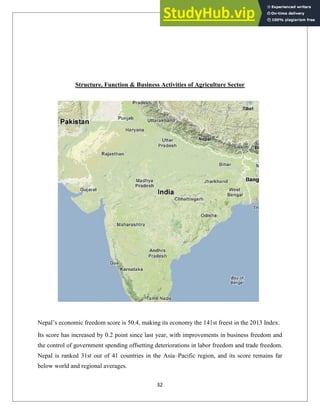
Structure, Function & Business Activities of Agriculture Sector
Nepal‘s economic freedom score is 50.4, making its economy the 141st freest in the 2013 Index.
Its score has increased by 0.2 point since last year, with improvements in business freedom and
the control of government spending offsetting deteriorations in labor freedom and trade freedom.
Nepal is ranked 31st out of 41 countries in the Asia–Pacific region, and its score remains far
below world and regional averages.
32
The Nepalese economy continues to lack the entrepreneurial dynamism needed for broad-based
economic growth and sustainable long-term development. With the statist approach to the
economy holding development progress far below the country‘s potential, state interference
continues to hurt regulatory efficiency, and there has been little effort to open the economy or
engage in world markets. Nepal‘s scores for investment and financial freedom are among the
lowest in the world.
Six years after the end of a Maoist insurgency and the abolition of the monarchy, political
instability continues to plague Nepal. In May 2012, the Constituent Assembly was dissolved
after the political parties failed to meet a deadline to form a new constitution. Interim Prime
Minister Baburam Bhattarai was aiming for a resolution of the crisis by November. The
reintegration of former Maoist fighters into the national army continues to be a controversial
issue. Nepal is among the world‘s poorest and least developed countries and benefits from very
little foreign direct investment. The main industry is agriculture, which accounts for one-third of
GDP.
Rule of Law View Methodology
Property Rights 30.0 Create a Graph using this measurement
Freedom from Corruption 22.0 Create a Graph using this measurement
The rule of law is weak and is being further damaged by deepening polarization and
factionalism. Protections for property rights are not enforced effectively. The judicial system is
inefficient, with lower-level courts particularly vulnerable to political pressure. Public-sector
corruption continues to be a serious concern. Effective anti-corruption measures are not in place,
and government officials exploit their positions for personal gain.
Limited Government View Methodology
Government Spending 89.2 Create a Graph using this measurement
Fiscal Freedom 85.8 Create a Graph using this measurement
33
The top income and corporate tax rates are 25 percent. Other taxes include a value-added tax
(VAT) and a property tax. The overall tax burden equals 13.2 percent of total domestic income.
Government spending is 18.9 percent of GDP. The budget balance has been in deficit, with
public debt hovering around 34 percent of GDP. Subsidies, particularly to state-owned
enterprises like the Nepal Oil Company, continue to stretch public coffers.
Regulatory Efficiency View Methodology
Business Freedom 57.2 Create a Graph using this measurement
Labor Freedom 44.3 Create a Graph using this measurement
Monetary Freedom 75.1 Create a Graph using this measurement
Despite some progress in modernizing the regulatory framework, time-consuming and costly
requirements continue to reduce overall regulatory efficiency. Completing licensing
requirements takes more than 100 days and costs over six times the level of annual average
income. The labor market remains inefficient, and chronic unemployment and underemployment
continue. Inflation has moderated but remains high.
Open Markets View Methodology
Trade Freedom 60.8 Create a Graph using this measurement
Investment Freedom 10.0 Create a Graph using this measurement
Financial Freedom 30.0 Create a Graph using this measurement
Although some tariffs have been reduced, the trade-weighted average tariff rate remains high at
12.1 percent, and pervasive non-tariff barriers further restrict trade freedom. Private investment
is hamstrung by political instability, and the inefficient investment regime further impedes
foreign investment. The financial sector remains fragmented, and government ownership and
influence in the allocation of credit remain substantial.
34
Country's Score Over Time
Country Comparisons
35
2. Present Positions & Trade of Agriculture Business (Import-Export) with India and
Nepal
(2008-2013).
36
Comparative Position of Agriculture sector to Nepal
Agricultural marketing support
In the United States the Agricultural Marketing Service (AMS) is a division of USDA and has
programs for cotton, dairy, fruit and vegetable, livestock and seed, poultry, and tobacco. These
programs provide testing, standardization, grading and market news services and oversee
marketing agreements and orders, administer research and promotion programs, and purchase
commodities for federal food programs. The AMS also enforces certain federal laws. USDA also
provides support to the Agricultural Marketing Resource Center at Iowa State University and to
Penn State University.
In the United Kingdom support for marketing of some commodities was provided before and
after the Second World War by boards such as the Milk Marketing Board and the Egg Marketing
Board, but these were closed down in the 1970s. As a colonial power Britain
established marketing boards in many countries, particularly in Africa. Some continue to exist
although many were closed down at the time of the introduction of structural adjustment
measures in the 1990s.
In recent years several developing countries have established government-sponsored marketing
or agribusiness units. South Africa, for example, started the National Agricultural Marketing
Council (NAMC) as a response to the deregulation of the agriculture industry and closure of
marketing boards in the country. India has the long-established National Institute of Agricultural
Marketing (NIAM). These are primarily research and policy organizations, but other agencies
provide facilitating services for marketing channels, such as the provision of infrastructure,
market information and documentation support. Examples include the National Agricultural
Marketing Development Corporation (NAMDEVCO) in Trinidad and Tobago and the New
Guyana Marketing Corporation.
Several organizations provide support to developing countries to develop their agricultural
marketing systems, including FAO's agricultural marketing unit and various donor organizations.
There has also recently been considerable interest by NGOs to carry out activities to link farmers
to markets.
37
Agricultural marketing development
Well-functioning marketing systems necessitate a strong private sector backed up by appropriate
policy and legislative frameworks and effective government support services. Such services can
include provision of market infrastructure, supply of market information (as done by USDA, for
example), and agricultural extension services able to advise farmers on marketing. Training in
marketing at all levels is also needed. One of many problems faced in agricultural marketing in
38
developing countries is the latent hostility to the private sector and the lack of understanding of
the role of the intermediary. For this reason ―middleman‖ has become very much a pejorative
word.
Agricultural advisory services and the market
Promoting market orientation in agricultural advisory services aims to provide for the sustainable
enhancement of the capabilities of the rural poor to enable them to benefit from agricultural
markets and help them to adapt to factors which impact upon these. As a study by the Overseas
Development Institute demonstrates, a value chain approach to advisory services indicates that
the range of clients serviced should go beyond farmers to include input providers, producers,
producer organizations and processors and traders.
Market infrastructure
Efficient marketing infrastructure such as wholesale, retail and assembly markets
and storage facilities is essential for cost-effective marketing, to minimise post-harvest
losses and to reduce health risks. Markets play an important role in rural development, income
generation, food security, developing rural-market linkages and gender issues. Planners need to
be aware of how to design markets that meet a community's social and economic needs and how
to choose a suitable site for a new market. In many cases sites are chosen that are inappropriate
and result in under-use or even no use of the infrastructure constructed. It is also not sufficient
just to build a market: attention needs to be paid to how that market will be managed, operated
and maintained. In most cases, where market improvements were only aimed at infrastructure
upgrading and did not guarantee maintenance and management, most failed within a few years.
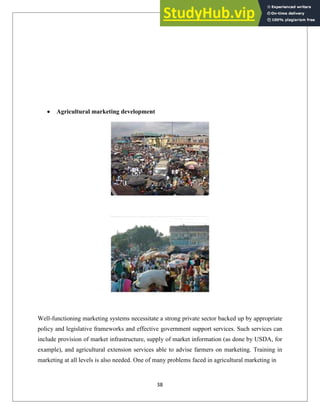
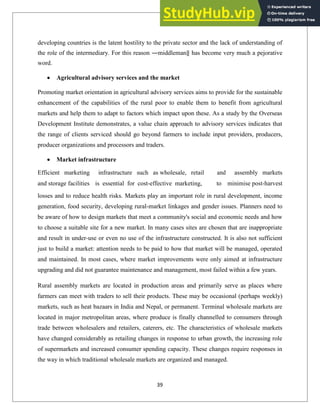
Rural assembly markets are located in production areas and primarily serve as places where
farmers can meet with traders to sell their products. These may be occasional (perhaps weekly)
markets, such as heat bazaars in India and Nepal, or permanent. Terminal wholesale markets are
located in major metropolitan areas, where produce is finally channelled to consumers through
trade between wholesalers and retailers, caterers, etc. The characteristics of wholesale markets
have changed considerably as retailing changes in response to urban growth, the increasing role
of supermarkets and increased consumer spending capacity. These changes require responses in
the way in which traditional wholesale markets are organized and managed.
39
Retail marketing systems in western countries have broadly evolved from traditional street
markets through to the modern hypermarket or out-of-town shopping Centre. In developing
countries, there remains considerable scope to improve agricultural marketing by constructing
new retail markets, despite the growth of supermarkets, although municipalities often view
markets as sources of revenue rather than infrastructure requiring development. Effective
regulation of markets is essential. Inside the market, both hygiene rules and revenue collection
activities have to be enforced. Of equal importance, however, is the maintenance of order outside
the market. Licensed traders in a market will not be willing to cooperate in raising standards if
they face competition from unlicensed operators outside who do not pay any of the costs
involved in providing a proper service.
Market information
Efficient market information can be shown to have positive benefits for farmers and traders. Up-
to-date information on prices and other market factors enables farmers to negotiate with traders
and also facilitates spatial distribution of products from rural areas to towns and between
markets. Most governments in developing countries have tried to provide market information
services to farmers, but these have tended to experience problems of sustainability. Moreover,
even when they function, the service provided is often insufficient to allow commercial decisions
to be made because of time lags between data collection and dissemination. Modern
communications technologies open up the possibility for market information services to improve
information delivery through SMS on cell phones and the rapid growth of FM radio stations in
many developing countries offers the possibility of more localized information services. In the
longer run, the internet may become an effective way of delivering information to farmers.
However, problems associated with the cost and accuracy of data collection still remain to be
addressed. Even when they have access to market information, farmers often require assistance
in interpreting that information. For example, the market price quoted on the radio may refer to a
wholesale selling price and farmers may have difficulty in translating this into a realistic price at
their local assembly market. Various attempts have been made in developing countries to
introduce commercial market information services but these have largely been targeted at
traders, commercial farmers or exporters. It is not easy to see how small, poor farmers can
generate sufficient income for a commercial service to be profitable although in India a new
40
service introduced by Thompson Reuters was reportedly used by over 100,000 farmers in its first
year of operation. Esoko in West Africa attempts to subsidize the cost of such services to farmers
by charging access to a more advanced feature set of mobile-based tools to businesses.
Marketing training
Farmers frequently consider marketing as being their major problem. However, while they are
able to identify such problems as poor prices, lack of transport and high post-harvest losses, they
are often poorly equipped to identify potential solutions. Successful marketing requires learning
new skills, new techniques and new ways of obtaining information. Extension officers working
with ministries of agriculture or NGOs are often well-trained in horticultural production
techniques but usually lack knowledge of marketing or post-harvest handling. Ways of helping
them develop their knowledge of these areas, in order to be better able to advise farmers about
market-oriented horticulture, need to be explored. While there is a range of generic guides and
other training materials available from FAO and others, these should ideally be tailored to
national circumstances to have maximum effect.
Enabling environments
Agricultural marketing needs to be conducted within a supportive policy, legal, institutional,
macro-economic, infrastructural and bureaucratic environment. Traders and others cannot make
investments in a climate of arbitrary government policy changes, such as those that restrict
imports and exports or internal produce movement. Those in business cannot function if their
trading activities are hampered by excessive bureaucracy. Inappropriate law can distort and
reduce the efficiency of the market, increase the costs of doing business and retard the
development of a competitive private sector. Poor support institutions, such as agricultural
extension services, municipalities that operate markets inefficiently and export promotion bodies,
can be particularly damaging. Poor roads increase the cost of doing business, reduce payments to
farmers and increase prices to consumers. Finally, the ever-present problem of corruption can
seriously impact on agricultural marketing efficiency in many countries by increasing the
transaction costs faced by those in the marketing chain.
41
Recent developments
New marketing linkages between agribusiness, large retailers and farmers are gradually being
developed, e.g. through contract farming, group marketing and other forms of collective action.
Donors and NGOs are paying increasing attention to ways of promoting direct linkages between
farmers and buyers. The growth of supermarkets, particularly in Latin America and East and
South East Asia, is having a significant impact on marketing channels for horticultural, dairy and
livestock products. Nevertheless, ―spot‖ markets will continue to be important for many years,
necessitating attention to infrastructure improvement such as for retail and wholesale markets.
42
3. Policies and Norms of Nepal for Agriculture sector for import / export including
licensing / permission, taxation
Success Agriculture equipment’s in Nepal
Combine harvester:
It is a technology which is introduced without Government interventions. It is adopted in
western and central Terai region. There are 9 combine harvesters in operation for
harvesting rice and wheat. The cost of harvesting and threshing is reduced to about 50
percent after adoption of this technology. Small plot size and maintenance problems are
the major hurdle for the further diffusion of this technology.
Adoption of Minimum Tillage by Power Tiller Drill:
Traditional wheat sowing is done through broadcasting seed on the prepared surface
(mainly by animal power) and manipulating them with soil through tillage operations
(ploughing 4 times and planked 5 times). Poor tilt and manual seed broadcasting cause
poor plant stand. The minimum tillage by Power Tiller Drills (PTD) has been popular
among small to medium scale farmers, as the drills perform three operations e.g. soil
tilling, seed sowing, and planking, simultaneously. Minimum Tillage by PTD produced
the highest mean grain yield of 3.5 ton/ha compared to 2.9 ton/ha by farmers‘ Practice. It
was found to be the most economical and showed the mean Net Return of 25755 Rs./ha
& Farmer‘s Practice showed the mean Net Return of 18060 Rs/ha. Zero-till Drill for
Kidney bean, Peas, Lentil and Wheat produced the mean grain yield of 2925, 9750 (green
pods), 1500, and 3725 kg/ha compared to 2350, 8375 (green pods), 900, and 3100 kg/ha
by farmer‘s practice respectively.
Biogas:
Biogas support program(BSP) is one of the successful program in Nepal Till date
189,122 biogas plants are installed and more than 95% of constructed plants are in
operation. . Favorable policy with subsidy, private sector partnership, comprehensive
quality standards and strong monitoring mechanism are the major pillar of this program.
72 private Biogas Companies have been strengthened,16 Biogas appliances
43
manufacturing workshops are developed by this program. BSP is an ISO 9001:2000
certification holder for its strong quality management system and subsidy administration.
Biogas support program has also received fund from carbon trading.
Treadle Pump:
Treadle pump is easy to operate, fabricated locally, recovers the investment in short
duration and costs less.. It can lift water up to 22 ft, can irrigate upto 5-10 kattha and it
had been tested in Terai region of Nepal during 1993/94. IDE/Nepal is supporting
technically for pump fabrication, marketing and installation. To date, 100000 farmers
have been benefited by the use of treadle pump in irrigating various crops and have
become successful in income generation. Six private companies are fabricating through
distributing local dealers.
Drip Irrigation technology:
IDE/Nepal, through R & D, has developed easy & low cost drip irrigation technology for
Nepal. 5000 farmers have been successful to cultivate vegetable and to generate income.
As field can be irrigated with less water, it is more affective in areas having water
scarcity. It has been very successful in hilly region and north belt of Terai region.
Improved Water Mill (IWM)
Improved Water Mill Support Programme has been honored by the prestigious London
based ―Ashden Award 2007‖ in recognition to upgrading over 2,400 traditional water
mills in the Himalayas of Nepal and improving livelihood of millers and mill users and
stemming the rise in diesel mills. It is being implemented through 16 service centers and
eight Ghatta Owner's Associations (GDA) in 16 hill districts of Nepal. By end of June
2007, it had helped to install 2,767 improved water mills; 2,473 are of short shaft used for
efficient grinding and 294 units are of long shaft used for other end uses such as rice mill,
saw-mill, oil expeller, lokta beater, chiura making. It has replaced diesel mills directly
helping to contribute in reduction of carbon dioxide emissions and hence global warming
to some extent.
44
Gravity Ropeway
Gravity ropeway technology was transferred from Northern India to Nepal in
collaboration with ICIMOD and private manufacturer/supplier. Couple of demonstration
ropeways had been installed in Marpha and Tukche VDCs of Mustang district to
facilitate apple transportation from orchards to the road heads. Afterwards, it installed
Janagaon/Bishaltar ropeway in Benighat VDC, Hadikhola- Chiraudi ropeway in Kalleri
VDC of Dhading, and Torisawara-Bishaltar ropeway in Jori Sawara VDC of Gorkha with
financial support from the donors. Initial study showed that transportation cost of agro-
based products decreased by at least 50% after being served by gravity ropeway system.
It provided confidence to the villagers to supply their products (e.g. Vegetables, milk and
other agri and forest products) in larger amounts, to enter the competitive market in cities.
It also improved their socio-economic status and health, education and community
awareness. In addition, it created employment opportunities & supporting business of
local manufacturers and service providers. There could be many other places where this
technology would be applicable.
Other Agricultural Machineries:
Some agricultural machinery developed by AED, NARC viz. Hand Maize Sheller, Coffee
pulper, Millet thresher cum pearler; low cost solar dryers are commercialized and
adopted by the farmers in different parts of Nepal. Hand maize Sheller is used for
shelling maize which reduces the drudgery of women farmers in shelling maize. Coffee
pulper is adopted in commercial scale pulping of coffee at community level which
significantly (more than 50%) increased the capacity and efficiency than the wooden
pulper. These coffee pullers helped the farmers to produce quality coffee parchment
efficiently. Similarly for the millet farmers who are at present threshing and pearling
millet manually has got an option for efficient threshing and pearling as well as reduction
of drudgery. For the remote areas where other types of commercial solar dryers are costly
and difficult to maintain, the low-cost solar dryer is developed and promoted by AED.
45
ISSUES & CONSTRAINTS OF AGRICULTURAL MECHANIZATION:
Socioeconomic Issues:
Lack of Alternative Employment Opportunities
Poor situation in industrialization and development of service sector has resulted very little
employment opportunities in the sectors other than agriculture. The present increasing trend of
young people going abroad as a labour is still a debatable issue on its contribution in the national
development in long run. In this context creation of local employment opportunities in other
sector viz. industries & service sector will create a favorable situation for agricultural
mechanization in the country.
Small and fragmented land holding
Small and fragmented land holding has been one of the major constraints in slow pace on
adoption of agricultural mechanization in Nepal. As about 50 % of the holdings is having land
area below 0.5 ha, the mechanization program and policy should address the farmers of all
categories; specially small and medium land holding size.
Declining Sharing of family labor
The customs of sharing family labour in the labour intensive agricultural operations like
transplanting and harvesting is found to be declining in the rural areas. The farmers reported that
there is lack of labour in the peak agricultural labour demanding season. Due to lack of
employment opportunities in the country, huge numbers of young people are going abroad to
Malaysia and Gulf to work as a labor. Hence, the agricultural operation is found to be completely
dependent upon the old and female members of the family.
Poor Conditions of Blacksmiths
The blacksmiths which can play important role in agricultural mechanization through fabrication
of agricultural tools and implements are the deprived group in the community and their
indigenous skill and technology is at the verge of extinction from the community, due to lack of
commercialization and modernization of their skills as well as lack of recognition of their
contribution by the community and the state.
46
Gender Concerns
Except tillage and marketing activities in the crop production activities, in all farm activities,
women farmer (labor‘s) contribution is found to be ranging from 40 percent to 64 percent. This
share is even found to be increased due to our flux of male members of household to urban area
and even abroad in search of job. The contribution of women in farming operation is rarely
recognized and their drudgery on farm operation is not addressed. Major agricultural operations
related to women‘s drudgery in Nepal are rice transplanting, weeding, harvesting, transportation ,
milling etc. Even though the constitution of Nepal has declared illegal to discriminate the
women, the wage rate of agricultural women labor in villages is found to be only about 50
percent to that of male labor.
Capital Constraints
Agriculture in Nepal is dominated by subsistence level of farming communities. It is mainly due
to lack of capital, technology and market. Even though, there is extension of credit institutions in
Nepal, the interest rates are found to be more in rural sector than in urban sector (viz. housing
loan, car loans etc.). Many co-operatives and micro credit institutions have been evolved in the
villages of Terai; they need awareness and model projects on co-operative farming for
intensification and commercialization of agriculture with appropriate mechanization.
Technological Issues & Constraints
Need of agricultural mechanization for small-holders:
As the farm holding size and socio-economic background of Nepal is diverse and is mainly
dominated by small farmers and poor farmers, the mechanization need to be focused on
appropriate mechanization technologies addressing the needs of different category of farmers in
Terai , hill and mountain. Hence the agricultural mechanization program should not be limited to
promote increased use of tractor but also include improved manual tools; animal drawn
implements and appropriate mechanical machinery in Terai. As the majority of the farm
operation is performed by women, the tools and machinery are to be promoted by catering the
needs of women farmers. The research and development on farmer friendly appropriate tools and
machinery is also needed to be reoriented addressing gender concerns.
47
Availability of spare parts:
From the perspective of the farmers, the major technological constraints are difficulty in
availability of spare parts, lack of training on operation and maintenance of farm machinery,
inadequate facility for servicing and repair of farm machinery. At present, Nepal has to
dependent on the imported tractor, power tiller and other farm machinery and the dealers and
traders are not financially strong enough to stock all necessary spare parts. Hence the farmers
have to wait for months to get the necessary spare parts. Moreover the cost of spare parts is also
reported to be high.
Poor condition of local agricultural machinery fabricators:
Blacksmiths used to play an important role in producing and repairing hand tools and bullock
drawn implements. It was estimated that more than 85 percent of hand tools and implements are
made by local blacksmiths (Manandhar 1999). Due to poor economic background, lack of
modernization in their technology, social system, poor education level these blacksmiths could
not commercialize their skills of manufacturing agri tools and implements in the community.
Enhancing the capacity of those blacksmiths through capital support, manufacturing facility
upgrading, training (fabricating and repair and maintenance skill on improved agricultural
machinery and entrepreneurship) etc. not only uplift the deprived section of the society but also
contribute the community by supplying improved agricultural tools & implements and providing
repair and maintenance facilities locally.
Lack of technical and safety standards
There have been no standards adopted in production and import of agricultural machinery in
Nepal. There have been several accidents during use of agricultural machinery. Hence there is
need of enforcing safety standards on agricultural machinery production and import.
48
Policy Issues
Lack of agricultural mechanization policy:
Due to lack of clear-cut policy on agricultural mechanization, the agricultural mechanization is
not found to be streamlined as per the need of the farming communities and national
development goals on commercialization of agriculture in Nepal. Hence there is need of clear-cut
policy on agricultural mechanization and other related policy is also needed to be amended
accordingly. The policy should guide for the amendment of existing unfavorable legislation and
enforce favorable legislation measures; strengthen institutional setup for promotion of
agricultural mechanization; focus on implementation of appropriate agril mechanization
programs and projects with priority.
Lack of Recognition of Farm Machinery Custom Hiring Enterprise
It is evident from the land size distribution and economy of the village that each household
cannot purchase full set of farm machinery for its own use. The most of the farm machinery
owners in Terai, first they use in their own field after that they rent out those machineries to
others. More holdings are found to be served by the tractors, threshers, sprayer & pump set.
Custom hiring of farm machinery is taking place in an informal way in each village without any
support from government. To improve the profitability from each agricultural machine, the
operation hours is to be increased. These custom-hiring enterprises could play an important role
on introduction of improved farm machinery and spread the benefit to the farmers in the
community. Hence, government should recognize this custom hiring enterprise and support
through training and credit.
49
4. Policies and Norms of India for Import or export to the Nepal Agriculture
sector including licensing / permission, taxation etc.
General Provisions Regarding Imports and
Exports Exports and Imports free unless regulated
Exports and Imports shall be free, except in cases where they are regulated by the provisions of
this Policy or any other law for the time being in force. The item wise export and import policy
shall be, as specified in ITC (HS) published and notified by Director General of Foreign Trade,
as amended from time to time.
Interpretation of Policy
If any question or doubt arises in respect of the interpretation of any provision contained in this
Policy, or regarding the classification of any item in the ITC(HS) or Handbook or Handbook or
Schedule Of DEPB Rate the said question or doubt shall be referred to the Director General of
Foreign Trade whose decision thereon shall be final and binding.
If any question or doubt arises whether a Licence/ certificate/permission has been issued in
accordance with this Policy or if any question or doubt arises touching upon the scope and
content of such documents, the same shall be referred to the Director General of Foreign Trade
whose decision thereon shall be final and binding.
Procedure
The Director General of Foreign Trade may, in any case or class of cases, specify the procedure
to be followed by an exporter or importer or by any licensing or any other competent authority
for the purpose of implementing the provisions of the Act, the Rules and the Orders made
thereunder and this Policy. Such procedures shall be included in the Handbook, Handbook, and
Schedule of DEPB Rate and in ITC (HS) and published by means of a Public Notice. Such
procedures may, in like manner, be amended from time to time.
The Handbook is a supplement to the Foreign Trade Policy and contains relevant procedures
and other details. The procedure of availing benefits under various schemes of the Policy is
given in the Handbook.
50
Exemption from Policy/ Procedure
Any request for relaxation of the provisions of this Policy or of any procedure, on the ground
that there is genuine hardship to the applicant or that a strict application of the Policy or the
procedure is likely to have an adverse impact on trade, may be made to the Director General of
Foreign Trade for such relief as may be necessary. The Director General of Foreign Trade may
pass such orders or grant such relaxation or relief, as he may deem fit and proper.
The Director General of Foreign Trade may, in public interest, exempt any person or class or
category of persons from any provision of this Policy or any procedure and may, while granting
such exemption, impose such conditions as he may deem fit. Such request may be considered
only after consulting Advance Licensing Committee (ALC) if the request is in respect of a
provision of Chapter-4 (excluding any provision relating to Gem & Jewellery sector) of the
Policy/ Procedure. However, any such request in respect of a provision other than Chapter-4
and Gem & Jewellery sector as given above may be considered only after consulting Policy
Relaxation Committee.
Restricted Goods
Any goods, the export or import of which is restricted under ITC(HS) may be exported or
imported only in accordance with a Licence/ certificate/ permission or a public notice issued in
this behalf.
Terms and Conditions of a Licence/Certificate/ Permission
Every Licence/certificate/permission shall be valid for the period of validity specified in the
Licence/ certificate/ permission and shall contain such terms and conditions as may be specified
by the licensing authority which may include:
The quantity, description and value of the goods
Actual User condition
Export obligation
The value addition to be achieved
The minimum export price
51
Licence/Certificate/ Permission not a Right
No person may claim a Licence/certificate/ permission as a right and the Director General of
Foreign Trade or the licensing authority shall have the power to refuse to grant or renew a
Licence/certificate/permission in accordance with the provisions of the Act and the Rules made
there under.
penalty
If a Licence/certificate/permission holder violates any condition of the Licence/certificate/
permission or fails to fulfill the export obligation, he shall be liable for action in accordance with
the Act, the Rules and Orders made there under, the Policy and any other law for the time being
in force.
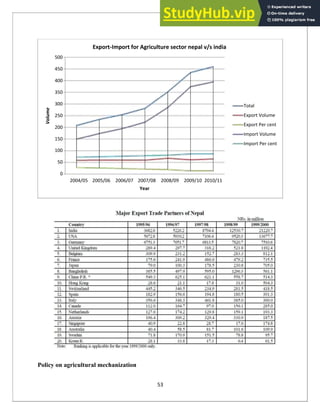
Nepal's trade scenario 2004/05-2010/11 (in NRs billion) to Agriculture and others Sectors
Export Import
Year Total
Volume Per cent Volume Per cent
2004/05 208.2 58.7 28.2 149.5 71.8
2005/06 234.0 60.2 25.7 173.8 74.3
2006/07 254.1 59.4 23.4 194.7 76.6
2007/08 281.2 59.3 21.1 221.9 78.9
2008/09 352.2 67.7 19.2 284.5 80.8
2009/10 435.2 60.8 14.0 374.3 86.0
2010/11 459.46 64.56 14.1 394.9 85.9
52
Export-Import for Agriculture sector nepal v/s india
500
450
400
350
Volume
300
250
200
150
100
50
0
2004/05 2005/06 2006/07 2007/08 2008/09 2009/10 2010/11
Year
Total
Export Volume
Export Per cent
Import Volume
Import Per cent
Policy on agricultural mechanization
53
Agricultural mechanization can contribute to the growth of agricultural production and rural
develop-ment while reducing rural poverty. Correct and timely government interventions are
crucial to achieve these kinds of objectives. For example, the development of minor irrigation—
particularly private, investment-based expansion of shallow tube wells—contributed to the
impressive performance and expansion of boro rice in Bangladesh. This was an outcome of the
government‘s market liberalization policy for irrigation equipment in the late 1980s. This policy
promoted rapid expansion of irrigated boro-rice farming in the dry season (Hossain 2009).
Similar interventions are needed in agricultural mechanization in Nepal. In the same vein,
linking rural and agricultural mechanization with occupa-27
Tional castes of Nepal, particularly liberated Haliyas11, Kami12 and Luhar for manufacturing,
importing, and marketing agricultural tools and equipment can contribute to poverty reduction in
rural areas. This can be done by setting up cooperatives to increase employment opportunities,
improve livelihoods, and reduce poverty.
Strategies of Government of Nepal for agricultural growth and poverty reduction
Nepal‘s development plans have had agriculture as a central component, and there has been a
continuing evolution in agricultural plans that have all been committed to growth, development,
and poverty reduction (Table 3.1). That said, there has been a lack of clarity in the formulation of
policy. As a result, the agricultural plans overlap in their time frame and have the same
overarching goals, while differing somewhat in their emphasis.
provision of irrigation, roads, fertilizer, and technology development, as well as the development
of agribusinesses
agriculture with the encouragement of the private sector and cooperatives, and added the concept
of sustainability through the conservation of natural resources and biodiversity .
54
5. What is a Trade Barrier between India and Nepal to Agriculture Sector?
Trade barriers are measures that governments or public authorities introduce to make imported
goods or services less competitive than locally produced goods and services. Not everything that
prevents or restricts trade can be characterized as a trade barrier.
A trade barrier may be linked to the very product or service that is traded, for example technical
requirements. A barrier can also be of an administrative nature, for example rules and procedures
in connection with the transaction. In a number of areas, special international ground rules have
been agreed, which limit the ways in which countries can regulate trade. It means that some
barriers are legal while others are illegal.
Trade barriers within the EU are subject to special rules that apply to the internal market of the
EU.
Sometimes it may also be possible to assist companies that face obstacles to trade that do not fall
under the definition of actual trade barriers.
Non-tariff barriers to trade
Non-tariff barriers to trade (NTBs) are trade barriers that restrict imports but are not in the
usual form of a tariff. Some common examples of NTB's are anti-dumping measures and
countervailing duties, which, although called non-tariff barriers, have the effect of tariffs once
they are enacted.
Their use has risen sharply after the WTO rules led to a very significant reduction in tariff use.
Some non-tariff trade barriers are expressly permitted in very limited circumstances, when they
are deemed necessary to protect health, safety, sanitation, or depletable natural resources. In
other forms, they are criticized as a means to evade free trade rules such as those of the World
Trade Organization (WTO), the European Union (EU), or North American Free Trade
Agreement (NAFTA) that restrict the use of tariffs.
55
Some of non-tariff barriers are not directly related to foreign economic regulations but
nevertheless have a significant impact on foreign-economic activity and foreign trade between
countries.
Trade between countries is referred to trade in goods, services and factors of production. Non-
tariff barriers to trade include import quotas, special licenses, unreasonable standards for the
quality of goods, bureaucratic delays at customs, export restrictions, limiting the activities of
state trading, export subsidies, countervailing duties, technical barriers to trade, sanitary and
phyto-sanitary measures, rules of origin, etc. Sometimes in this list they include macroeconomic
measures affecting trade.
1. Specific Limitations on Trade:
1. Import Licensing requirements
2. Proportion restrictions of foreign to domestic goods (local content requirements)
3. Minimum import price limits
4. Embargoes
Customs and Administrative Entry Procedures:
5. Valuation systems
6. Anti-dumping practices
7. Tariff classifications
8. Documentation requirements
9. Fees Standard disparities
10. Packaging, labeling, and marking
11. Government procurement policies
12. Export subsidies
13. Countervailing duties
14. Domestic assistance programs
56
Examples of Non-Tariff Barriers to Trade
Non-tariff barriers to trade can be the following:
Import bans
General or product-specific quotas
Rules of Origin
Quality conditions imposed by the importing country on the exporting countries
Sanitary and phytosanitary conditions
Packaging conditions
Labeling conditions
Product standards
Complex regulatory environment
Determination of eligibility of an exporting country by the importing country
Determination of eligibility of an exporting establishment (firm, company) by the
importing country.
World Trade Organization and Nepalese Agriculture
Introduction
The World Trade Organization (WTO) is the only global international organization dealing with
the rules of trade between nations. At its heart are the WTO agreements, negotiated and signed
by the bulk of the world‘s trading nations and ratified in their parliaments. The goal is to help
producers of goods and services, exporters, and importers conduct their business. The WTO
began life on 1 January 1995, but its trading system is half a century older.
Objectives of WTO
The main objectives of WTO can be specified as;
1. To make transparent international trade related rules
2. To help producers and traders of goods and services
57
3. To strengthen world‘s economic situation and increase investment, employment and income
Functions of WTO:
The Article III of agreement establishing the multilateral Trade Organization/WTO has specified
five specific functions of WTO (Bhandari, 2001). They are:
Administrative Functions: Under this function of WTO facilitates the implementation,
administration, operation, and advances the cause of objectives of WTO agreement, multilateral
trade agreements and provides framework for the implementation, administration and operation
of pluri-lateral trade agreements.
Platform for negotiation: WTO works as a platform where its members joining their helping
hands can advance negotiations among themselves concerning their multilateral trade relations in
matters dealt under the WTO agreements and enlisted in its annexes.
Execution: WTO administers the understanding on rules and procedures governing the
settlement of disputes.
Trade Principles of WTO
The major principles of the WTO agreements are
Non- discrimination
Free Movement of Foreign Products, Services or Nationals
Transparency
Special and Differential Treatment
Nepal’s Accession to the WTO
Nepal‘s accession to the WTO was the result of a long and complicated process of negotiations
at multilateral, bilateral and domestic level that lasted over fourteen years. On April 23, 2004 the
protocol entered into force and Nepal became the 147
th
member of the WTO. Nepal undertook
25 systematic commitments under the terms of its accession to WTO.
58
Nepal is the first officially classified least developed countries (LDCs) to join since the WTO
was established in 1995. According to the Nepalese government, the accession will present
challenges and opportunities, particularly considering its large trade deficit
Agreement related to Agriculture Sector in WTO
Agreement on Agriculture (AOA)
The AOA was the outcome of the Uruguay Round (UR) negotiations that started in 1986 and
concluded in 1994. The long-term objectives set by the AOA are to establish a fair and market
oriented agricultural trading system through substantial reductions in 1agricultural support and
protection.
AOA deals all the matters of tariff, domestic support and export subsidies. It is rightly identified
that the root cause of distortion of international trade in agriculture is the massive domestic
subsidies given by industrialized countries over the decades (WTO, 1995). In order to minimize
such dumped exports and to keep their markets open for efficient agricultural producers of the
world, the starting point has to be the reduction of the domestic production subsidies given by
the industrialized countries, followed by reduction of export subsidies and the volume of
subsidized exports, and minimum market access opportunity for foreign agricultural producers‖.
Domestic Support
Domestic support provides commitments to reduce agricultural subsidies and other programmes
including those raise or guarantee farm gate prices and farmers‘ incomes. These supports are
divided by the AOA into different boxes in tricky way.
Market Access:
Market access is one of the three main pillars of the AOA – the other two being domestic support
measures and export competition. It deals with rules and commitments related to import of
goods. Its purpose is to expand trade by preventing various non-tariff barriers and by binding and
reducing tariffs. In the WTO context, market access is about both obligations and rights. Nepal‘s
obligation is to provide market access to other Members in return for her right of access to
59
others‘ markets for Nepalese goods on multilaterally agreed terms. Thus, a balanced analysis of
market access provisions would cover both obligations and rights.
Export subsidies and export restrictions
In common with all least developed countries (LDCs) and a majority of the developing countries,
Nepal does not subsidize exports. At the time of the WTO accession, it committed not to
subsidize exports in future also. One of the conclusions of the study is that this commitment is
unlikely to have any negative implications for the Nepalese agriculture for two reasons. First,
export subsidization is not a sound economic policy. Second, Nepal could not afford export
subsidies at its low level of economic development. On the other hand, there were several
instances in the past when export subsidization by other countries had some negative effects on
the Nepalese agriculture. Therefore, it is in Nepal‘s interest to tighten WTO rules on export
subsidy (Tiwari et al, 2004).
Implication on Nepalese Agriculture:
Nepal can promote exports through various incentive measures of the WTO Subsidies
Agreement.
Limited implications of the WTO rules on export restriction and taxation policies.
Nepal is occasionally affected negatively by export subsidization by others
Domestic policy issues and analytical needs
General Agreement on Trade in services (GAT)
This Agreement opens the door for foreign investment in different sectors while accessing the
membership of WTO by Nepal, had agreed on 74 different sectors and sub-sectors for trade out
of which only 2 sectors are related to agriculture. They include
1. Animal medical services
2. Technical Experiment and investigation services
60
WTO and Emerging Issues in Nepalese Agriculture
Keeping eyes on the benefits that can arise from the agreements of WTO; we need to address
major issues in agricultural sector. The issues at hand include scale sensitivity, trade restriction at
disguise, resource mobility and technology transfer (Pant, 2004 & 2007).
a) Scale Sensitivity of WTO Provisions
It is usually believed that the WTO Agreement on Agriculture (AOA) does not focus on
addressing the development needs and concerns of the small-scale subsistence farmers in
developing countries. It rather tends to emphasize on commercial agriculture and trade. For
example, rules under WTO say that the fees and charges on the services from the public sector
should match the amount of the service provided and not be based on the volume of transactions.
b) Disguised Protection in the Name of Quality Standard
The AOA commits reductions in protection measures and trade distorting subsidies. The
experience shows that the agricultural trade has become more protected in the developed
countries after the establishment of WTO. In Nepal the agriculture is exposed to market forces in
the name of economic liberalization.
c) Competitiveness
The major problem in international competition is our small scale and high cost of production.
Low technology production makes our product less competitive in terms of quality. In addition,
our trading partners may prevent entry of our products in the name of protecting animal, plant
and human health and life in their country. We have competitiveness in the products with low
capital and high labour inputs. Some of such products are, for example, hybrid vegetable seeds,
flower seeds, medicinal herbs, silk, honey, dry fruits and cottage cheese.
61
d) Labour Mobility
Nepal‘s agriculture sector is labour surplus. As the surplus labour comes out of it, farms will
experience labour shortage. This will have two effects. First, wage rate in the farm will increase.
That will not only make agriculture workers better of but also make technological interventions
like mechanization financially viable to adopt. Second, some farms will not be able to afford for
higher wage or mechanization. Such financially non-viable farms need to go for enterprise
transformation for increasing productivity. This will increase the efficiency of the farm sector.
e) Land Mobility
There are two issues in land mobility. First, moving land from low productive enterprises to high
productive enterprises is experienced for centuries. The speed is gaining in recent years. Some
examples of such movements of land (generally referred as change in cropping pattern) are as
follows.
maize/millet farming upland is getting shifted to summer vegetables, ginger and
cardamom
fallow lands during winter is moved to winter vegetables
pasture lands in hills are shifter to tea, coffee and fruits
f) Technology Transfer in Agribusiness
The TRIPS measure is expected to accelerate the pace of generation of agricultural technology.
However, the royalty rights of the inventors will make the technology costlier to the users. On
the other hand, the agribusiness can make better choice of technology for adoption and it will
increase the productive efficiency and net gain of the agribusiness. Increase in the price of
agricultural products due to reduction in the farm subsidies in developed countries will increase
the demand of agricultural products from developing countries and is expected to facilitate
investment in agriculture in LDCs. It ultimately will help in the modernization of agriculture
sector.
g) Service Sector Openings
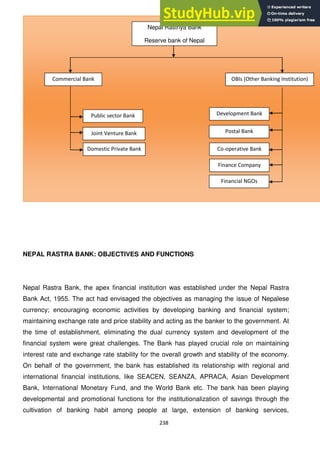
62
Nepal has opened some services to foreign investment with some conditions like compulsory
incorporation of certain portion of equity to domestic investors, and employment of local staff
except a certain fraction of high level experts and managers. Among the services opened, those
directly concerned with the agribusiness are (a) veterinary services, (b) research and
development services and (c) technical testing and analysis services. Opening of these services is
expected to attract foreign direct investment in such agribusiness. In addition, availability of the
better services will help domestic agribusinesses to expand. It will also help promote the product
quality for export.
Market Access Barriers to Select Nepalese Agricultural Exports- imports
1.1 Nepalese agriculture and export-import trade
Agriculture plays a significant role in the Nepalese economy. Despite the decline of its
contribution to GDP from 47.4 per cent in 1990–91 to 39.2 per cent in 2003–04, it is still the
largest sector of the economy and the main livelihood for about 80 per cent of the population
(Ghimire and Dahal 2004).
Nepal‘s export trade is highly concentrated, both in product and destination. While carpet,
textiles and agricultural produce represent 70 per cent of total exports, three markets—the U.S.,
Germany and India—are its major destinations, covering more than 80 per cent of total exports.
Therefore, the
Challenges are to increase Nepal‘s exports in the international market by diversifying its export
profile. One of the possibilities is through agricultural exports.
1.2 Objectives of the research
■ study the existing tariff and non-tariff barriers on select agricultural produce of Nepal;
■ identify problems the Nepalese agricultural exports face in the international market; and
■ propose some measures at the international and regional levels to minimize, if not eliminate,
export barriers.
63
1.3 Limitations
■ The study looks at multilateral trade issues, but not at the preferential market access facilities
nor
The bilateral and regional trade issues despite their importance for Nepal, particularly in
the context of its heavy trade reliance on India;2
■ the study looks mainly at the demand side, i.e., market access barriers (tariff and non-tariff ) on
select agricultural products, and does not focus on supply side;
Conclusions
The major provisions of WTO relating to the agribusiness are in the Agreement on Agriculture,
SPS/TBT agreements and TRIPS agreements. Other agreements of WTO affect the agribusiness
indirectly. Several provisions of these agreements can be used to support agricultural production,
marketing and trade. For this purpose, we need to revise our domestic policies in standards
setting and certification, increasing the production scale and making our resources mobile.
Nepal is concerned with the food security and safeguarding rural employment, for which we
need some flexibility under the provisions for domestic support. We are also questioning the
extremely high subsidies and tariff walls even now being maintained by the developed countries,
although they are committed to reduction of both under the Uruguay round. We are seeking
better market access for our agricultural products for integration to multilateral trading system.
Because of the large dependency on agriculture for employment, even minor changes in
agricultural employment opportunities, commonly prices or trade conditions can have major
socio-economic ramifications in Nepal. To comply with the principles of WTO without
compromising our development needs and livelihood of the farmers we need some additional
facilities like
Maximum improvement of opportunities and terms of access (like duty free quota free
access to the markets in developed countries) for agricultural products of our production
potential
64
Meaningful and practical special and differential treatment to LDCs to enable them to
take appropriate domestic policy measures to address growth and development needs in
agriculture; and
In the meantime, it is absolutely necessary to protect the resource poor subsistence
farmers from surges of cheap subsidized imports.
Nepalese farmers being small in nature they may face difficult in competing to the international
market. Therefore, we need to protect major commodities like food grains, fruits, vegetables,
meat and milk and their processed products for protecting the interest of our farmers
65
6.1 Business opportunities in Nepal
Agriculture and Natural Resources Sector in Nepal
Nepal is enumerated as one of world's poorest countries according to GDP (Gross Domestic
Product) per capita. It is a country that is interlocked between great powers like India and China
and has a difficult topography, inferior infrastructure, uncertain political situation, low human
capital and a historically weak economic growth.
This is the negative side of Nepal but it is also possible to look at Nepal in a positive light. The
difficult topography provides great opportunities for a unique tourist experience. It also creates a
fantastic possibility for hydroelectric power because of the presence of gigantic mountains and
numerous water courses that flow through them.
After the peace treaty of 2006 which put a stop at a bloody civil war, there have been winds of
change blowing over Nepal. Economic growth has accelerated and since the election that gave
birth to a government dominated by the ex- guerilla, some kind of political stability has been
achieved.
Today, the economic growth scales around 5% - 6 % and that has been resulted due to
improved agriculture, increased flow of tourists and a brisk growth in distribution and retail
trade. This growth occurs through a strongly increasing inflow of capital from Nepalese people
working abroad who send home money to their families. The biggest problem lies in the
manufacturing industry with almost zero percent of growth which is mostly due to insecurity
around legislation and a militant union movement.
Agriculture is the biggest sector in the country and the official export is dominated by the textile
industry. So far India has been the largest business partner but since the Maoists have come into
power, doors have been opened to China and an attempt to balance these great powers against
one another has been initiated.
66
Business in Nepal is still much relation-based and a large contact network holds great
importance. Direct investment is something that the new government has laid much hopes on but
complicated rules and regulations still pose as a hindrance in the smooth turning of the wheel.
Artamus in Nepal
Artamus in Nepal focuses on internet marketing and on outsourcing of services. Artamus has
collaboration with the majority of IT companies in the country and can therefore offer
programming and development within all big programming languages. There are also several
persons involved in producing texts etc. for a number of different languages.
The company works even with investments in the country and helps Nepalese companies to
reach bigger markets outside the country and we also offer services that makes establishment of
international companies in Nepal easier and less complicated.
Apart from outsourcing to Nepal, there are also few interesting areas of future investment in
Nepal
Hydroelectric power - there is a huge potential for international companies to be a part of
the hydroelectric power in Nepal.
Infrastructure - Both road infrastructure, railway and airway must be improved or better
designed.
Telecommunication - Like in many other countries in the region, there is an explosion of
mobile phone users.
Tourism within a niched area and specialized ecotourism has a strong potential in the
country.
67
Description
Despite some decline in recent years, agriculture remains by far the largest sector in the
Nepali economy, employing 71% of the population and accounting for 33% of gross
domestic product in 2007.
The sector is also an important source of livelihood for a majority of poor people in the
country; indeed, poverty in Nepal is primarily a rural problem, one strongly associated
with gender, ethnicity, caste, and religion.
This study assesses ADB's assistance to Nepal‘s agriculture and natural resources sector
from 1997 to 2007 to identify opportunities for improving future program performance.
Overall assessment of the sector assistance is partly successful.
ADB assistance to the sector reached about $228 million during 1997–2007, or about
21% of total assistance during the period of about $1.08 billion. Of this, $82.7 million
went to agricultural production and marketing; $73.7 million to the agricultural and rural
sector; and $50.6 million to irrigation, drainage, and flood protection.
Among the findings, the study recognized ADB‘s lead position as development partner in
agriculture and natural resources in Nepal, while its strategies and programs helped
address poverty and inequality. Noteworthy in this regard was its support to foster
inclusive development by addressing gender, caste, and ethnic discrimination through
inclusive public policies. ADB is also credited with helping to improve agricultural
productivity through greater use of irrigation facilities, and with advocating and
providing support to diversify and commercialize agriculture.
The study recommends, among other things, that ADB increase its strategic focus in
supporting agriculture and natural resources by increasing investment in rural
infrastructure, such as irrigation, rural roads, and market infrastructure.
Agriculture Sector Performance
Agriculture accounted for 40% of gross domestic product (GDP) in 1997 and, despite
68
Falling to 33% by 2007 remains by far the largest sector of the economy.
It employed 81% of the population in 1997, a figure that fell to 71% by 2007.7 The
contribution of the sector to per
Capita GDP was only around half that of other sectors, illustrating low productivity. Over
the
evaluation period, agricultural growth rates averaged 3.3% during the Ninth Plan (1997–
2001)
but only 2.67%
Farming systems distribution and characteristics
The country is divided into three geographical regions: a high altitude mountain region along the
northern belt with colder climatic conditions; a central hilly region with moderate climatic
conditions; a low altitude Terai-plain along the southern belt with warmer climatic conditions. Its
fish production is totally dependent on inland water Nepal is a land-locked country. Carp
polyculture in ponds is by far the most common and viable aquaculture production system
adopted in Nepal and in 2003/2004 made up about 90 percent of the total production of 18 060
tonnes. The major part of the pond fish production takes place in the southern part of the country
– the Terai plain – where 94 percent of the fish ponds are located. These ponds cover over 97
percent of the water surface area and account for over 98 percent of the total pond fish
production in the country. Data compiled for 2003/2004 showed an average pond fish yield of
3.00 tonnes/ha in Terai plain, which exceeded the national average of 2.96 tonnes/ha and is twice
the average yield in the hills and mountains. The key to the growing popularity of the system in
Terai is the warmer climatic conditions which are conducive to higher fish growth.
Cage fish culture with herbivorous carps has been confined to lakes of the Pokhara valley in the
western hills and the Indrasarober reservoir in the central hills of the country. The system is very
popular amongst rural communities. In 2003/2004 this practice covered about 34 000 m3 of
cages with an average yield of about 6 kg/m3 of cage. Carp polyculture in enclosures is practiced
only in the lakes of Pokhara valley where it is a popular aquaculture activity. It has further
emphasized the potential role of lakes for increasing fish production.
69
Rice-fish culture is one of the earlier initiatives in Nepal and one which has potential. It is mostly
practiced in the hills and valleys. It has more recently also started to become popular in the Terai.
In 2003/2004 it covered an area of 218 ha. With improved management and careful planning, the
practice could be expanded significantly in future.
Fish culture in gholes (marginal agricultural land along irrigated areas, ditches, flood plains and
swamps) has been developed for improving the livelihood of rural targeted communities. Fish
production activities in such areas also help to promote the ecology of the water bodies. This
practice has been mostly concentrated in the Terai. There are about 12 500 ha of gholes available
in the country, of which about 1215 ha have been utilized for fish culture in 2003/2004.
The corridors in the hills and mountains are potential locations for the culture of high-value cold
water species such as rainbow trout (Onchorhynchus my kiss). Its technical feasibility has been
proven, but the practice has not yet been introduced on a commercial scale.
Agriculture Security
Over 70 percent of Nepal‘s population works in the agriculture sector, accounting for 38 percent
of the GDP. Nevertheless, Nepal struggles to produce an adequate supply of food for its citizens.
Farmers have limited access to improved seeds, new technologies, and market opportunities.
Declining agricultural production has depressed rural economies and increased widespread
hunger and urban migration. Almost 50 percent of Nepal‘s population is undernourished, and
nearly half of all children under 5 are chronically malnourished. Chronic malnutrition has
debilitating effects, such as blindness, brain damage, and infectious diseases, which often can
result in lifetime damage.
Despite these difficulties, there are many opportunities to help ensure an adequate food supply for all
Nepalis. The Government of Nepal has made food security a national priority. USAID-supported
programs already have demonstrated impact by increasing agriculture productivity and incomes of
smallholder farmers. As a focus country for the U.S. Feed the Future Initiative, Nepal
70
continues to receive USAID support for scaling up programs that sustainably increase
agricultural productivity and facilitate access to markets. USAID also will support improved
nutrition by increasing the production and consumption of nutritious food products and
improving hygiene and access to safe water.
USAID supported over 85,000 smallholder farmers in 26 remote, conflict-affected
districts to adopt improved farming techniques. USAID‘s work has increased the incomes
of 430,000 rural farmers (54 percent women) by over 50 percent.
USAID helped flood-affected communities improve farmer productivity and incomes,
rehabilitate essential infrastructure such as irrigation systems and bridges, and build
resilience against future natural disasters. For example, 4,400 vegetable farmers increased
their household incomes by more than 300 percent over several crop cycles as a result of
improved agricultural technologies such as integrated pest management, post-harvest
storage, and marketing.
USAID trained over 49,000 households on improved maize production technologies in 20
remote hill districts. USAID‘s work resulted in the production of more than 1,000
kilograms of improved maize seed covering over 50,000 hectares of land, thereby
increasing incomes and food security for poor, disadvantaged farmers. Similarly, USAID
supported the Government of Nepal in releasing four new drought-tolerant maize
varieties, which have lowered crop loss and contributed to higher maize yields.
71
6.2 Conclusion & Suggestion for Agriculture sector in Nepal
Nepal is concerned with the food security and safeguarding rural employment, for which we
need some flexibility under the provisions for domestic support. We are also questioning the
extremely high subsidies and tariff walls even now being maintained by the developed countries,
although they are committed to reduction of both under the Uruguay round. We are seeking
better market access for our agricultural products for integration to multilateral trading system.
Maximum improvement of opportunities and terms of access (like duty free quota free
access to the markets in developed countries) for agricultural products of our production
potential
Meaningful and practical special and differential treatment to LDCs to enable them to
take appropriate domestic policy measures to address growth and development needs in
agriculture; and
In the meantime, it is absolutely necessary to protect the resource poor subsistence farmers
from surges of cheap subsidized imports
Agriculture is the principal source of food, income, and employment for the majority,
particularly the poorest. Growth in agriculture is, therefore, crucial for reducing poverty,
and preliminary findings from the National Living Standards Survey indicate that despite
the insurgency, the sector has made a significant contribution to poverty reduction.
However, agriculture is largely based on low-value cereals and subsistence production, with a
mere 13 percent of output traded in markets. The sector‘s current 40 percent share in national
GDP is declining, although there is considerable scope for increasing productivity and value-
added.
72
1. Increasing productivity and value addition through commercialization and irrigation
investments
Commercialization:
This will require action along several fronts, including policy support, meeting quality
standards, capacity building and market information for producers, applied research,
and investment in the supply chain for high value commodities. Trade can be promoted
by strengthening institutions and systems for quality control and certification, and
investing in laboratories, testing stations, and human resources.
Irrigation and emphasis on farmer management:
Irrigation infrastructure can be improved by: (a) promoting both surface and groundwater
irrigation for commercial and industrial crops in the Terai, while encouraging high-value
horticulture and cereal production in the Mountains and Hills; (b) developing year-round irrigation
in perennial flow areas and small storage facilities in other areas; (c) building low pressure
sprinklers and drips for high value crops, and shallow and deep tube wells only where profitable;
and (d) investing in mini- and micro-hydro facilities, to facilitate power generation and lift
irrigation in the hills . The Government should encourage farmer management of irrigation
infrastructure, and support matching-grants for demand-driven farm interventions.
2. Improving the functioning of factor markets
Factor markets should be reviewed based on analytical work and cross-country
experience. Those can promote land redistributive policies, achieve a more accessible
legal system to address land disputes, and identify market and non-market mechanisms
to improve access to land. Measures should be defined to improve land administration
systems, particularly cadastral and land title records, to provide greater security of
ownership and reduce transactions costs. Work on rural finance should develop strategies
to provide services to people in isolated areas, where the traditional Grameen model is
unsuitable.
73
3. Reaching out to the poor and investing in basic infrastructure
Due to the protracted conflict and instability of the Government, decentralized approach to
empower communities and devolve decision-making power to the local level has become the
hallmark for better service delivery. The use of non-governmental agencies has become an
important vehicle to facilitate access to livelihood opportunities and income generating activities,
particularly for the most disadvantaged groups. A mix of local, public and private investments in
roads, communication and power remain critical to improve access to assets, integration with
markets, generate off-season employment, especially for the most backward areas. As political,
administrative and fiscal decentralization is brought back on track, role for local government will
need to be defined to meet local demands, involve communities and improve accountability.
6.3 Annexure
World Trade Organization (WTO)
General Agreement on Trade in services (GAT)
Least developed countries (LDCs)
Agreement on Agriculture (AOA)
Agriculture Perspective Plan (APP)
National Agricultural Policy (NAP)
Gross Domestic Product (GDP)
European Union (EU)
North American Free Trade Agreement (NAFTA)
Advance Licensing Committee (ALC)
Three-Year Interim Plan (TYIP)
National Agricultural Policy (NAP)
74
Reference/Bibliography
FNCCI, Nepal Rastra Bank and Trade Promotion Centre
CBS (2002) Population Census 2001, NPC/CBS, 2002.
FBC (2006) Feasibility Study on Agriculture Mechanization in Terai Region of Nepal.
Report Submitted to Agricultural Engineering Directorate, Harihar Bhawan, and Lalitpur.
Labor Policy –2056, Ministry of Labour, Kathmandu
Manandhar, GB, KB Shrestha and SK Adhikary (2006). Mechanization Strategy to
Commercialize Agriculture. Paper Presented at a Workshop Organized by FNCCI
During Nepal Agro Mechanization and Technology Development Expo-2062. March
2-8, 2006. Biratnagar, Nepal
Manandhar, GB and SK Adhikary (2006). Role of Blacksmiths in Agricultural Mechanization.
Paper Presented at a National Workshop on Agricultural Mechanization in Nepal
Organized by Nepalese Society of Agricultural Engineers. June 10-11, 1999.
Lalitpur, Nepal
MOAC (2008) Statistical Information on Nepalese Agriculture, MOAC, Singh
durbar, Kathmandu, Nepal
Mulki Ain (Civil Code) 2020
NSCA (2001/2) National Sample Census of Agriculture Nepal 2001/02, CBS 2004.
Pariyar et al, (2001). Baseline Study on Agricultural Mechanization Needs in Nepal. Rice wheat
Consortium for Indo-Gang etic Plains, New Delhi, India
75
76
Rijk, A G.(1989). Agricultural Mechanization Policy and Strategy. Asian Productivity
Organization, Tokyo, Japan.
WECS, (2002), Water Resource Strategy, Water and Energy Commission Secretariat, Singh durbar,
Kathmandu.
http://www.saarcnet.com/newsaarcnet/govtpolicies
http://pib.nic.in/archieve/lreleng
http://commerce.nic.in/nepal.doc
http://www.catmando.com/gov/industry/fipd
http://www.saarcnet.org/newsaarcnet/saarclinks/publications
http://www.facd.gov.np/news
http://www.nepalnews.com.np/contents/englishdaily/ktmpost
http://www.ncti-india.com/htdocs/aboutus.htm
http://www.fncci.org.
www.vyapaarasia.com/nepal
http://www.meadev.nic.in/foreign
http://www.fncci.org
www.south-asia.com/embassy-india
www.worldbank.org.np
www.biswabank.org.np
www.ndf2002.gov.np
http://www.tradeknowledgenetwork.net
www.labournepal.org
www.fesnepal.org
: http://www.nationsencyclopedia.com/Asia-and-Oceania/Nepal-CUSTOMS-AND-
DUTIES.html#ixzz2Nuziv3ld
http://www.nationsencyclopedia.com/Asia-and-Oceania/Nepal-CUSTOMS-AND-DUTIES.html
76
A
GLOBAL COUNTRY REPORT
ON
―NEPAL HEALTH INDSUTRY‖
77
Submitted to
Gujarat Technological University
IN PARTIAL FULFILLMENT OF THE
REQUIREMENT OF THE AWARD FOR THE DEGREE OF
MASTER OF BUSINESS ADMINISTRATION
UNDER THE GUIDANCE OF
Faculty Guide
Ass.Prof. SULABH NARAYAN
Submitted by
Barot Vandana - Enrollment No:-117550592127
Barot Vidhi - Enrollment No:-117550592128
Rami Nikita - Enrollment No:-117550592129
Darji Neel M. - Enrollment No:-117550592130
Prajapati Kinjal - Enrollment No:-117550592131
Vohra Amin - Enrollment No:-117550592132
[Batch: 2011-13,]
MBA SEMESTER IV
SARDAR PATEL EDUCATION CAMPUS
MBA PROGRAMME
Affiliated to Gujarat Technological University, Ahmedabad.
April, 2013
78
PART- I
79
TABLE OF CONTENT
Sr. Content
1. Demographic Profile & Economic Overview of Nepal
2. An Overview Of Industries Trade And Commerce Of Nepal
3. Overview Of Different Economic Sector Of Nepal
4 Present Trade Relation And Business Volume Of Different
Product With India/ Gujarat
5. Environmental Factors at Public Transport Service Industry in
Nepal
6.
Pestl Analysis Of Nepal
7. Conclusion
1) DEMOGRAPHIC PROFILE & ECONOMIC OVERVIEW OF THE
NEPAL
Nepal's population has grown from 9 million people in 1950 to 26.6 million in
2011. Nepal's population increased from 23,151,423 in 2001 to 26,620,809, with a
subsequent family size decline from 5.44 to 4.7 Although the population growth
recorded was only 1.4 percent for the latest census period, some 1,917,903 absentee
80
population was noted, over a million more than 762 thousand in 2001, most being
male workers. This correlated with the drop in sex ratio from 94.41 as compared to
99.80 for 2001.
The Nepalese are descendants of three major migrations from India, Tibet, and
North Burma and the Chinese province of Yunnan via Assam. Even though Indo-
Nepalese migrants were latecomers to Nepal relative to the migrants from the north,
they have come to dominate the country not only numerically, but also socially,
politically, and economically.
In the Terai, a part of the Ganges Basin with 20% of the land, much of the
population is physically and culturally similar to the Indo Aryans northern India.
Indo-Aryan and West Asian looking mixed people live in the hill region. Indo-
Aryan ancestry has been a source of prestige in Nepal for centuries, and the ruling
families have been of Indo-Aryan and Hindu background. The mountainous
highlands are sparsely populated. Kathmandu Valley, in the middle hill region,
constitutes a small fraction of the nation's area but is the most densely populated,
with almost 20% of the population.
According to the World Refugee Survey 2008, published by the US Committee for
Refugees and Immigrants, Nepal hosted a population of refugees and asylum
seekers in 2007 numbering approximately 130,000. Of this population,
approximately 109,200 persons were from Bhutan and 20,500 from People's
Republic of China. The government of Nepal restricted ethnic Nepalese expelled
from Bhutan to seven camps in the Jhapa and Morang districts, and refugees were
not permitted to work in most professions.
POPULATION STRUCTURE
81
An Overview of Nepalese Economy
Nepal is among the poorest and least developed countries in the world. In fact
Nepal doesn't stand anywhere to its otherwise developing neighbors such as India,
DATA SIZE
Population 26,620,000(2011)
Growth Rate 1.6%
Population below 14 Years old 39%
Population of age 15 to 64 57.3 %
Population above 65
3.7 %
The median age (Average) 20.07 %
The median age (Male)
19.91 %
The median age (Females) 20.24
Ratio (Male:Female)
1, 000:1,060
Life expectancy (Average)
66.16 Years
Life expectancy (Male)
64.94
Life expectancy (Female)
67.44
Literacy Rate (Average)
68.2% ( According to the UNDP report 2011)
Literacy Rate
NA
82
Pakistan and Bangladesh. Almost 45% of its population living below the poverty
line, Nepal has to do much catching before being termed a Developing Economy.
Agriculture is the mainstay of the economy, providing a livelihood for three-fourths
of the population and accounting for 38% of GDP. Most of the agriculture activities
take place in the Tarai region. The sub-standard equipments and pesticides along
with the medieval mode of agriculture make it a tough affair. The industrial sector
is in a dismal condition. Industrial activity mainly involves the processing of
agricultural products including jute, sugarcane, tobacco, and grain. These things are
hardly considered industrial activities by New-school economists.
Economy of Nepal
GDP (PPP) $39.14 billion
GDP (OER) $6.655 billion
GDP (RGR) 2.7%
GDP Per capita (PPP) $1,400
GDP (By sector) Agriculture38%,
Industry21% and Services
41%
Unemployment rate 42%
Population below poverty line 45%
Inflation rate (consumer prices) 7.8%
Budget Revenues: $1.153 billion
Expenditures: $1.789 billion
Agriculture is the mainstay of the economy, providing a livelihood for three-fourths
of the population and accounting for about one-third of GDP. Industrial activity
mainly involves the processing of agricultural products, including pulses, jute,
sugarcane, tobacco, and grain. Nepal has considerable scope for exploiting its
potential in hydropower, with an estimated 42,000 MW of feasible capacity, but
political instability hampers foreign investment. Additional challenges to Nepal's
83
growth include its landlocked geographic location, civil strife and labor unrest, and
its susceptibility to natural disaster.
GDP (purchasing power parity):
$37.74 billion (2011 est.)
country comparison to the world: 100
$36.52 billion (2010 est.)
$34.88 billion (2009 est.)
note: data are in 2011 US dollars
Agriculture - products:
Pulses, rice, corn, wheat, sugarcane, jute, root crops; milk, water buffalo meat
Industries: tourism, carpets, textiles; small rice, jute, sugar, and oilseed mills;
cigarettes, cement and brick production .
Industrial production growth rate:1.4% (FY10)
Country comparison to the world: 139
Electricity - production: 3.156 billion KWh (2010 est.)
Country comparison to the world: 126
Electricity - consumption: 4.833 billion KWh (2010 est.)
Country comparison to the world: 114
Electricity - imports: 70 million kWh (2010 est.)
Oil - consumption:20,000 bbl/day (2010 est.)
country comparison to the world: 129
Oil - imports:
13,740 bbl/day (2009 est.)
country comparison to the world: 135
Current account balance:-$437.9 million (2010 est.)
84
country comparison to the world: 106 $537 million (2009 est.)
Exports: $896 million (2011 est.)
Country comparison to the world: 157; $901.9 million (2010 est.)
Exports - commodities:
Clothing, pulses, carpets, textiles, juice, Pashima, jute goods
Exports - partners:India 66.4%, US 6.8%, Germany 4.8%, Bangladesh 5.4%
(2011)
Imports: $5.4 billion (2011 est.)
Country comparison to the world: 119
$5.016 billion (2010 est.)
Imports - commodities: petroleum products, machinery and equipment, gold,
electrical goods, medicine
Imports - partners: India 65.2%, China 11.5% (2010)
Debt - external:$4.5 billion (2009)
country comparison to the world: 118
$3.285 billion (2008)
1) OVERVIEW OF INDUSTRIES TRADE AND COMMERCE OF NEPAL
Commercial and Economic Relations:
India is Nepal‘s largest trade partner and source of foreign investment; India is also
the only transit providing country for Nepal.
Trends in trade and investment:
Bilateral trade was US$ 4.21 billion during Nepalese fiscal year 2010-11 (July 16 –
July 15). Nepal‘s import from India amounted to US$ 3.62 billion and exports to
India aggregated US$ 599.7 million. In the first six months of fiscal year 2011-12,
Nepal‘s total trade with India was about US$ 1.93 billion; Nepal‘s exports to India
were about US$ 284.8 million; and imports from India were about US$ 1.64 billion.
85
Since 1996, Nepal‘s exports to India have grown more than eleven times and
bilateral trade more than ten times; the bilateral trade that was 29.8% of total
external trade of Nepal in year 1995-96 has increased to 66.4% in 2010-11. Since
1995-96, the total external trade of Nepal has increased from NRs. 9433 crores
(IRs.5895 crores) to NRs. 45946.1 crores (IRs. 28716.3 crores). 83% of this
increase is on account of increase in the bilateral trade between India and Nepal,
which grew from NRs. 2808 crores (IRs. 1755 crores) in 1995-96 to NRs. 16319.9
crores (IRs. 10199.9 crores) in first six months of 2011-12. Nepal‘s exports also
increased from NRs.1988 crores (IRs. 1242 crores) in 1995-96 to NRs. 3591.6
crores (IRs. 2244.7 crores) in first six months of 2011-12. 45% of this increase was
on account of increase in Nepal‘s exports to India.
Nepal‘s main imports from India are petroleum products (28.6%), motor vehicles
and spare parts (7.8%), M. S. billet (7%), medicines (3.7%), other machinery and
spares (3.4%), coldrolled sheet in coil (3.1%), electrical equipment (2.7%),
hotrolled sheet in coil (2%), M. S. wires, roads, coils and bars (1.9%), cement
(1.5%), agriculture equipment and parts (1.2%), chemical fertilizer (1.1%),
chemicals (1.1%) and thread (1%). Nepal‘s export basket to India mainly comprises
jute goods (9.2%), zinc sheet (8.9%), textiles (8.6%), threads (7.7%), polyster yarn
(6%), juice (5.4%), catechue (4.4%), Cardamom (4.4%), wire (3.7%), tooth paste
(2.2%) and M. S. Pipe (2.1%).
3) OVERVIEW OF DIFFERENT ECONOMIC SECTOR OF NEPAL
Nepal is one of the poorest countries in the world and was listed as the eleventh
poorest among 121 countries in 1989. Estimates of its per capita income for 1988
ranged from US$158 to US$180. Various factors contributed to the economic
underdevelopment--including terrain, lack of resource endowment, landlocked
position, lack of institutions for modernization, weak infrastructure, and a lack of
policies conducive to development.
Until 1951 Nepal had very little contact with countries other than India, Tibet, and
Britain. Movement of goods or people from one part of the country to another
usually required passage through India, making Nepal dependent on trade with or
via India. The mountains to the north and the lack of economic growth in Tibet
86
(China's Xizang Autonomous Region after 1959) meant very little trade was
possible with Nepal's northern neighbor.
Prior to 1951, there were few all-weather roads, and the transportation of goods was
difficult. Goods were able to reach Kathmandu by railroad, trucks, and ropeways,
but for other parts of the country such facilities remained almost non-existent. This
lack of infrastructure made it hard to expand markets and pursue economic growth.
Since 1951 Nepal has tried to expand its contacts with other countries and to
improve its infrastructure, although the lack of significant progress was still evident
in the early 1990s.
The effects of being landlocked and of having to transit goods through India
continued to be reflected in the early 1990s. As a result of the lapse of the trade and
transit treaties with India in March 1989, Nepal faced shortages of certain consumer
goods, raw materials, and other industrial inputs, a situation that led to a decline in
industrial production.
2) OVERVIEW OF BUSINESS AND TRADE AT INTERNATIONAL LEVEL
Nepal may not be among the best known of trading centers in Asia, but there are
many reasons why certain businesses should consider trade in Nepal. Since, 1951
the Nepali government has worked hard to liberalize the country‘s economy, by
improving transportation and communication facilities, as well as industry and
agriculture. The Nepali government has tried to make the Nepali economy more
conducive to investment by entering into various trade agreements and investment
protection pacts. The export areas that Nepal does best in are the production of
garments and carpets industry. With the European Union accounting for
approximately 47% of all garment and rug exports. Nepal has also steadily climbed
the scales in terms of ease of doing business in, with an increase of 3 places to 107.
The Nepali economy has also been doing very well over the past few years, with
economic growth in the 2000‘s averaging between 4-6% on a annual basis.
So the Nepali market has steadily expanded and gotten richer, with GDP per capita
increasing albeit at a slower rate, over the past 30 years. However, it should be
noted that there is a sever lack of skilled labor in the country and there is little sign
87
of this changing, with little government investment in education. So anything
beyond basic manufacturing is likely to be difficult in Nepal.
Another aspect of the Nepali economy is that it is heavily reliant on the Indian
economy and exports; the local market is very weak in terms of consumption
potential. So if international trade conditions are poor or if the Indian economy is
performing poorly, it is very likely that the Nepali economy will also be performing
poorly. But that does not make it any less of a manufacturing center for garment
and rug producers. In fact, overtime many manufacturers from China have been
locating to Nepal in order to take advantage of its lower wages and lower costs. But
once again this has been restricted mainly to basic manufacturing as opposed to any
technological manufacturers. But keep in mind, there is also a level of political
instability in the country that makes any large long term investing slightly difficult.
3) PRESENT TRADE RELATION AND BUSINESS VOLUME OF DIFFERENT
PRODUCT WITH INDIA/GUJARAT
About 95 per cent of Nepal's trade is with India, The main items of export to India
are rice and other food grains, hides and skins, oilseeds, timber, ghee and medicinal
herbs. The main items of import from India are cotton yarn and cloth, woolen cloth,
chemicals, kerosene and salt.
In recent years with the establishment of diplomatic and economic relations with an
increasing number of countries, Nepal's trade is gradually becoming diversified
geographically.
Even so for some years to come, rapid expansion of trade with countries other than
India will be difficult for certain reasons.
First, Nepal is dependent upon Indian railways and ports for trade with other
countries. The capacity of Indian railways and ports is, however; Inadequate even to
meet the needs of the rapidly developing Indian economy.
Second, the small scale of Nepal's trade makes it difficult to attract overseas
businessmen,
88
Third an organized business community which will make positive efforts to
promote trade does not exist in Nepal today. The growth of trade associations is a
recent phenomenon in Nepal. Even now only some half a dozen trade organizations
arc registered with the Government and their activities are confined mostly to their
respective localities.
The author is Secretary to His Majesty's Government of Nepal in the Ministry of
finance and Economic Affairs. This article is however, written in the author's
personal capacity and does not in any way represent the official views of His
Majesty's Government.
4)PESTEL ANALYSIS OF NAPAL
HERE are four areas that represent the most common external influences. These
are:
Political and Legal factors – for example, new laws and regulations or
decisions made by governments.
Economic factors – changes in the economy, people's spending power, and
patterns of wealth.
Socio-cultural factors – changes and trends in society, for example, the
number of people aged over 60 in society
Technological factors – changes in techniques or equipment that can lead to
the development of new goods and services or new ways of doing things.
89
Political Factors
The country in the present day is in the transitional phase. The Constituent
Assembly Polls being the major issue so various other matters are overlooked. The
existing political instability as the constituent election has successfully completed is
anticipated to be stabilize, which will certainly help the business environment to
become favorable in the country. With so much of instability in Nepalese political
sector, it is apparent that the rules and regulations are unstable as well. Hence, it is
very important for any company to be extra cautious and adaptive to the changes in
the policies regarding the laws and legislations.
Economic Factors
The most significant of all external forces with which a business must contend is
the economic environment of the country. The general economic conditions and
trends are the most crucial to the economic viability and success of the business.
The economic environment consists of factors that affect consumer purchasing
power and spending patterns and it depends on income level, price, savings, and
availability of credit. The purchasing power of Nepalese people is very low due to
political instability, higher inflation rate and unemployment. The recent slowdown
economy is principally led by contraction in manufacturing and tourism industry,
and steep drop in exports.
Socio-cultural Factors
Socio-cultural environment is composed of various class, structure, beliefs, values,
social institutions, accepted patterns of behavior, customs of people and their
expectations. Hence, any industry must take into consideration the socio-cultural
90
environment for developing its policy and strategy. Socio-cultural environment
influences the demand and supply of goods and services.
Society's habits and tastes are changing. People are being educated and are more
aware of the importance of the environment and healths and are becoming 'green
consumers'. Green consumers prefer goods and services that are environmentally-
friendly' and which have less impact on the environment and is good for health. The
green consumer, for example, prefers to travel by bus or cycle.
Environmental Factors at Public Transport Service Industry in Nepal:
An introduction
We all make use of the services provided by transportation companies. We probably
have caught the bus in town or travelled on a school bus or made an intercity
journey by Nepal Yatayat or Safa Tempo. Some of us have travelled on a super
91
green energy-efficient Trolley bus. We know that, Nepal does not have a long
history of transport service industry. Even though, with a population of 25 million,
Nepal is a potential market for transport industry.
Technological Factors
Technological environment refers to all the technical surroundings that affect
business. It includes skills, methods, systems and equipment. Technology consists
of the forces that create new technologies creating innovative services and market
opportunities. The most dramatic force shaping people's lives is technology.
Various types of sophisticated technologies are invented and implemented in
international transportation Service. Services like path navigator, wireless
communication in vehicle and other safety measures are already in use in
international industry but in Nepal it is lagging behind. Crowded and the unsafe
module of the procedure are till we considered. That makes the capacity below the
actual level and makes difficult to compete with other. It ends up with a poor
working condition for the employees.
Legal Factors
Responsible businesses not only abide by the law, they seek to create standards
above minimum requirements. Public transportation has to be aware of a number of
legal factors. Legal changes that affect business are closely tied up with political
ones. Many changes in the law stem from government policy. The Department of
Transport Management (Dotm) government's transportation services governing
body used to recommend the transportation fare. Many other laws are nation-wide,
for example, the standards for bus transport emissions. Public transport must make
sure that all its buses meet these requirements. It has to anticipate and prepare to
meet future legal changes. From 2010 Nepal is entering in WTO, as part of an
92
initiative called Carbon Reduction Commitment, public transport and other
companies will need to buy carbon credits. These credits will permit companies to
generate specific quantities of carbon emissions.
CONCLUSION
In recent years Nepal‘s economic and social wellbeing have been undermined by
political insecurity. The king was assassinated and his replacement was nowhere
near as popular. Governments were dismissed out of hand, and for a decade at least
Maoist guerillas terrorised much of the country. Pictures of the king and queen once
hung in temples as well as homes and businesses.
Nepal is still one of the world‘s poorest countries, and hunger, premature death,
inadequate housing, and poor sanitation still characterize life in rural areas. Half the
population lives below the UN poverty line of $1.25 a day. In terms of GDP Nepal
is ranked 115th of the world‘s economies, and it depends heavily on foreign aid,
93
and on the remittances of soldiers serving overseas and people who have gone
abroad in search of employment
PART- II
94
TABLE OF CONTENT
Ch.No Content Page.No
1 Introduction ,Structure, Function And Business
Activity
2
1.1 Introduction Of The Nepal Health Industry 3
1.2 Importance Of Nepal Health Industry 6
1.3 HISTORY OF NEPALESE HEALTH INDUSTRY 10
2 Comparative Position 21
2.1 Comparative Position Of Nepal Health Industry
With Indian Health Industry
22
2.2 Present Position And Trend Of Business In Nepal
Health Industry
30
3 Policies, Norms And Present Barriers Of Nepal
And Indian Health Industry
36
95
3.1 Policies And Norms Of Nepal Health Industry 37
3.2 Present Barriers Of Health Industry In Nepal 41
4 Potential For Health Industry In India And
Business Opportunity In Future
43
4.1 Potential For Health Industry In India 44
4.2 Business Opportunity In Future 48
5. Conclusion 54
6. Suggestion 56
96
1.
Introduction
Structure,
Function
And
Business Activity
97
1.1- INTRODUCTION OF NEPAL HEALTH INDUSTRY
NEPAL HEALTH INDUSTRY
Modern health services initiated about 120 years ago in Nepal, with eight health
facilities established in different parts of the country at a time. The pace of
growth of health service was slow till 1950s and after that health sector took
steady and continuous growth with establishment of more health facilities at all
level and establishment of health facilities by non-governmental organizations
also in different parts of the country.
Government was the largest service provider followed by non-governmental
organizations and the private sector had very small contribution till 1993. After
restoration of democracy in 1990, the public sector also has grown with
establishment of sub health posts and primary health centers and both the
private for profit and not for profit (NGO and cooperative) hospitals have grown
significantly.
The public sector has established at least one modern health facility in every
village development committee and in the rural areas it is the only agency
providing health services. The private and non-governmental sector is
contributing mainly in secondary and tertiary care health services and they are
more concentrated in urban areas and district head quarters.
The human resource for health production also has grown significantly in last
15 years with establishment of medical, nursing and allied health science
institutions both in public and private sector.
As a result of this there is over production of some category of human
resources such as ANM, AHW etc already, though quality is an issue often
raised. Similarly, the pharmaceutical industry also has grown significantly with
98
establishment of 40 plants of modern drugs and 18 plants of traditional drugs
and currently meets one third drug need of the country.
Overall growth of health sector has begun to contribute in national socio-
economic development by reducing morbidity & mortality from disease &
making people healthy, economically productive and live longer. The growth of
health sector has also brought the challenges along with the opportunities.
MAJOR INVESTMENTS IN THE SECTOR INCLUDE:
Temasek Holdings, Singapore's state-owned investment company, has
invested Rs 140 crore (US$ 25.92 million) in the cancer care provider
HealthCare Global Enterprises (HCG)
LifeCell International Pvt Ltd has won funding of Rs 35 crore (US$ 6.48 million)
from Helion Venture Partners. The investment will be used to increase LifeCell's
market awareness and penetration in the country, said Mr Mayur Abhaya, CEO
and MD, LifeCell
Spice Global has made an investment of Rs 400 crore (US$ 74.07 million) in a
new healthcare foray to launch multi-speciality Saket City Hospital in the New
Delhi. The hospital will have 1000 bed capacity by the end of its third and final
phase, expected by mid-2016
1.2- IMPORTANCE OF HEALTH INDUSTRY
The Pharmaceutical sector makes a significant contribution to European and
global well-being through the availability of safe and effective medicines,
economic growth and sustainable employment. Overall, EU-27 production of
pharmaceuticals was estimated at €190 billion with exports equivalent to €210
99
billion and imports accounting for €161 billion (a positive trade balance of €49
billion) in 2007.
The Medical devices sector covers a dynamic, innovation-driven, highly
competitive industry within a global market. It covers some 10 000 types of
products, from the simplest tongue depressor to the most sophisticated
scanning equipment.
Today's healthcare needs are dependent on the rising number of health
professionals. The healthcare industry employs over fifteen million workers in
both salary and wages section. It's one of the fastest growing professions, and
it's also expected to generate more than three million jobs in the next decade.
The healthcare industries combine several sectors that are essential for
providing products and services. Among the sectors include drug manufacture,
diagnostic services, biotechnology, hospital equipment and instrument,
diagnostic labs and nursing homes.
100
AN OVERVIEW ON NEPAL ECONOMY
o The gross domestic product (GDP) of Nepal grew by 4.6% in Fiscal
Year 2012 (ended in July 2012), up from 3.8% a year earlier.
o Investment ratio was not encouraging due to political instability and
deteriorating situation of law and order. Ultimately, it has impeded
the path of economic growth and deterred poverty alleviation
activities.
o Banks‘ liquidity constraint eased, growth in credit was slow because
there were few attractive investment opportunities.
101
NEPAL HEALTH INDUSTRY
The Indian healthcare sector is estimated to reach US$ 100 billion by 2015,
growing 20 per cent year-on-year (y-o-y), as per rating agency Fitch. The
industry is expected to touch US$ 280 billion by 2020, on the back of increasing
demand for specialised and quality healthcare facilities.
India is the most competitive destination with advantages of lower cost and
sophisticated treatments, highlighted the RNCOS report titled 'Indian
Healthcare - New Avenues for Growth'. The report further elaborates that
several key trends are backing the growth of India's healthcare sector.
"India is a very important market for many reasons. The government continues
to invest in healthcare. We see that healthcare is expanding across the country.
There is a growth opportunity and we continue to invest very much in India.
There is so much innovation in India," highlighted Mr Adam H Schechter,
Executive Vice President and President, Global Human Health Division, Merck.
Market Size
Private equity (PE) and venture capital (VC) investments in the healthcare
industry in India are increasing rapidly. In 2012, the industry absorbed US$ 1.2
billion across 48 deals, according to research firm Venture Intelligence.
The hospital and diagnostic centre in India has attracted foreign direct
investment (FDI) worth US$ 1,542.35 million, while drugs & pharmaceutical and
medical & surgical appliances industry has registered FDI worth US$ 9,783.31
million and US$ 584.14 million, respectively during April 2000 to December
102
2012, according to data provided by Department of Industrial Policy and
Promotion (DIPP).
Indian pharmaceutical industry is projected to show double-digit growth in near
future owing to a rise in pharmaceutical outsourcing and rising investments by
multinational companies, as per RNCOS report titled 'Indian Pharma Sector
Forecast 2014'.The report highlighted that focus of the industry will shift towards
capitalising the potential of tier-III and rural areas. Emerging sectors, such as
bio-generics and pharma packaging will also pave way for the pharmaceutical
market to continue its upward trend during the forecast period (FY 2012- FY
2014).
Trends and Investments
Healthcare providers in India plan to spend Rs 5,700 crore (US$ 1.05 billion) on
IT products and services in 2013, a 7 per cent rise over 2012 revenues worth
Rs 5,300 crore (US$ 981.50 million), according to a report by Gartner. It is
expected to grow to 3.9 per cent to reach Rs 1,720 crore (US$ 318.52 million)
in 2013, with most of this growth coming from enterprise communication
equipment.
Further, the hospital services market, which represents one of the most
important segments of the Indian healthcare industry, is expected to be worth
US$ 81.2 billion by 2015, as per a RNCOS report.
103
1.3- HISTORY OF NEPALESE HEALTH INDUSTRY
Public health and health care services in Nepal are provided by both the public
and private sector and fares poorly by international standards. According to
2011 census, more than one third (38.17%) of the total households do not have
toilet in their houses. Tap/Piped water is the main source of drinking water for
47.78% of the total households. Tube well/hand pump is the main source of
drinking water for about 35% of the total households, while spout, uncovered
well/kuwa and covered well/kuwa are the main source for 5.74%, 4.71% and
2.45% respectively. Based on 2010 World Health Organization (WHO) data,
Nepal ranked 139 in life expectancy in 2010 with the average Nepalese living to
65.8 years.
Disease prevalence is higher in Nepal than it is in other South Asian countries,
especially in rural areas. Leading diseases and illnesses include diarrhea,
gastrointestinal disorders, goiter, intestinal parasites, leprosy, visceral
leishmaniasis and tuberculosis. About 4 out of 1,000 adults aged 15 to 49 had
human immunodeficiency virus (HIV), and the HIV prevalence rate was 0.5%.
Malnutrition also remains very high: about 47% of children under 5 are stunted,
15 percent wasted, and 36 percent underweight, although there has been a
declining trend for these rates over the past five years, they remain alarmingly
high.In spite of these figures, some improvements in health care have been
made, most notable is the significant progress in maternal-child
health.[105][106] Overall Nepal‘s HDI for health was 0.77 in 2011, ranking
Nepal 126 out of 194 countries, up from 0.444 in 1980.
104
Overview of the performance of health sector since NDF 2004
The environment in health sector
The environment in health sector is guided by health sector strategy: an agenda
for reform approved by Government of Nepal in 2003. this strategy is prepared
on the basis of poverty reduction strategy, health sector reform, sector wide
approach, second long term health plan 1997-2017 and donor harmonization.
The Interim Constitution of Nepal promulgated in January 2007 and it has
established the basic health services as the fundamental right of every citizen
of the country. Similarly, the child health services and reproductive health
services also have been taken as the fundamental human right of the children
and women.
Implementation of Sector Wide Program in Health Sector
Government of Nepal approved the Nepal Health Sector Program,
Implementation Plan (2004-09) and health sector wide program initiated from
July 2004. Joint Financing Agreement (JFA) signed for pool funding with
International Development Association (IDA) and Department for International
Development (DFID). With the start of sector wide program joint annual review
for annual work plan and budget and performance review is done twice a year.
In accordance to the sector wide program, single reporting system, account
audit of the expenditures by office of the auditor general and single foreign
exchange account in Nepal Rastra Bank instituted for the purpose of the pool
partners. The non -pooled partners also started to align and harmonize their
contributions in the sector wide program on the basis of the of ear marked
projects. Some signatories of the ‗statement of intent‘ have shown interest in
pool funding, however the decision is yet to come.
Aid Alignment and Harmonization
As part of the aid alignment and harmonization, statement of intent signed, in
February 2004 by Government of Nepal and 11 external development partners
105
and to institutionalize this, health sector development partnership forum formed.
This forum is chaired by health secretary and includes other representatives
from other government and some non- governmental agencies despite EDPs
who signed statement of intent. The three year interim national development
plan of Nepal (2007-08 -2009-10) approved by Government of Nepal recently
and as a part of alignment and harmonization the UN agencies e.g. UNFPA,
UNICEF, WHO and UNDP also prepared three year plan as United Nations
Development Assistance Framework. The agreement signed with the
Government of Germany supporting health sector is also three years as above.
New International Initiative: International Health Partnership
This is a new international health initiative coordinated by British Government to
support achieving the health sector millennium development goals using the
approach of Paris Declaration on Aid Effectiveness- 2005. Nepal is one of the
signatories out of the eight countries in initial phase and agencies committed to
support this initiative are DFID, WHO, Norway Government, UNICEF, UNFPA,
ILO, Bill and Melinda Gates Foundation, GAVI, Global Fund, World Bank etc.
106
INTRODUCTION OF THE COMPANY
TAJ PHARMACEUTICALS
The Beginnings
With a basket including personal care, health care and other products, TAJ
GROUP has set up Group Companies across the world that can manage its
businesses more efficiently. Given the vast range of products, sourcing,
production and marketing have been divested to leading group companies that
conduct their operations independently.
Our company clear vision to bring Ayurveda to society in a contemporary form
and to unravel the mystery behind the 5,000 year old system of medicine. This
included referring to ancient ayurvedic texts, selecting indigenous herbs and
subjecting the formulations to modern pharmacological, toxicological and safety
tests to create new drugs and therapies. We export API, branded formulations
and generic formulations to over 14 countries. Our inherent strength lies in
identifying relevant API and formulations, and selling them at affordable prices
across the world. All this has been possible because of our innovative and
sustained marketing efforts. We are all set to spread our wings further and
touch more lives across the globe.
Healthy Environment
As a responsible corporate citizen espoused to the cause of a better quality of
life, Taj Pharmaceuticals accords high priority to Safety, Health and
Environment. We are committed to protecting the environment we operate in,
and ensuring the health and safety of our employees and stakeholders.
107
Our Mission
Our mission is to become the recognized leader in accelerating discovery and
development of novel, small molecule drug therapies. The innovative
application of our proprietary computational lead drug design technology
provides the opportunity to substantially compress the time and cost of drug
development and have a dramatic impact on important disease states.
Taj Pharmaceuticals products can broadly be categorized into four main ranges
Pharmaceutical
Personal Care
Well-being
Animal Health
Medicines
The medicinal range broadly classified into four categories
Children's Health,
Men's Health,
Women's Health,
General Health
Pure Herbal & gaributti
Amalaki: Useful in treating cough, cold, sore throat and respiratory tract
infections. It protects cells from free radical damage and is an excellent anti
oxidant.
Arjuna: This herb improves blood circulation and is used as a tonic for the
heart.
Ashvagandha: Commonly known as Winter Cherry, this herb acts as an ant-
stress agent that imparts a sense of well-being and helps in coping with life's
daily stresses.
Brahmi: A well-known herb that helps in improving general alertness.
108
Karela: Commonly known as Bitter Gourd, it is known to aid in the metabolism
of carbohydrates.
Lasuna: Commonly referred to as Garlic, Lasuna helps in controlling the excess
conversion of lipids and cholesterol.
Neem: A popular herb, Neem has anti-bacterial, anti-fungal and blood purifying
properties. It is very useful in skin disorders and helps maintain a healthy,
beautiful and glowing skin.
Shuddha Guggulu: It regulates fat metabolism and helps remove excess
cholesterol from the body.
Shallaki: This herb treats joint problems.
Tagara: It has mild sedative properties, which are useful for insomnia and sleep
disorders.
Triphala: A digestive aid compound and a bowel cleanser.
Tulasi: It has anti-microbial and anti-inflammatory properties, and is useful in
respiratory tract infections like dry or wet cough, cold and sore throat.
109
BUSINESS ACTIVITY
Taj Pharma committed to the standards of ethics and integrity
We are totally committed to improving the safety and wellbeing of all people
who work with us, or come into contact with our operations and products.
Introduction
Business Opportunities with TAJ PHARMACEUTICALS LTD
TAJ PHARMACEUTICALS LTD. (Pharmaceuticals Inc.) is a product-driven
pharmaceutical company with diversified expertise. While TPL is relatively new
to the US market, it is by no means a new player.
As a wholly owned subsidiary of TAJ PHARMACEUTICALS LTD.
Our product development and manufacturing capability, teamed with our ability
to market products in many global markets, makes TPL an attractive business
ally. A key part of our business strategy is to collaborate with partners with
complementary skills - "A Win-Win" strategy that strengthens the position of our
partners as well as TPL.
110
TPL has already experienced commercial success penetrating the US health
care market, and looks forward to enhanced growth and future business
opportunities through collaboration and strategic alliances.
API Development and Production
Dosage Form Development and Manufacturing
Contract Manufacturing
Sales and Marketing
Marketing Strategies
Licensing
API Development and Production
For those who want to manufacture their own product or brand, without the time
and costs associated with developing the API (Active Pharmaceutical
Ingredient), We can provide the API, eliminating this step from your process.
The key advantages of using our backwardly integrated system are:
Ensuring continuity of supply
Ensuring consistent quality of product
Competitive costs
Resources to respond in a timely fashion to meet demand
Dosage Form Development and Manufacturing
We experience as a global manufacturer makes us aptly suited to take on the
complex process of solid or liquid dosage form development. At TAJ
PHARMACEUTICALS LTD., we continually reverse engineer to improve upon
our development process, enhancing the yield, with a focus on cost efficiencies.
111
Contract Manufacturing
To expand your product line with minimum investment, TAJ
PHARMACEUTICALS LTD. provides "LOCK KEY" manufacturing services
including API and dosage form development, to allow you to focus on marketing
and selling the product. This is an efficient way to increase your product line
and profit margins, while taking advantage of TAJ PHARMACEUTICALS LTD.'
manufacturing experience and expertise.
Sales and Marketing
We has set itself apart in the marketplace by the rapid growth of its product line,
its willingness to emulate complex drug formulations, and its core competencies
in anti-infective, gastrointestinal, cardiovascular and analgesics arenas.
TAJ PHARMACEUTICALS LTD. has a commercial advantage as many of the
high-profit branded drugs with expiring patents over the next few years are in
the categories where we has proven its expertise.
TPL has a self-contained marketing group that works to co-market products
(the same chemical under different brands), and co-promote products (the
same brand name carried by two different companies). TPL has marketed their
services out to other companies, as they perform all of the steps in the
pharmaceutical process - from development and manufacturing to distribution
and sales.TPL's commitment to quickly expanding the breadth and depth of
their product line has been key to their success in the marketplace.
Marketing Strategies
112
Our Marketing Strategies as emphasized by the name is the department which
is focused primarily on developing and establishing different strategies for the
promotion/distribution of Branded/Generic as well as the OTC products for TPL.
One of the key tasks for the department is to identify/look out for various
opportunities in different markets or channels of distribution and to pursue those
opportunities developing and establishing new relationships in the market.
Managed Care / Internet marketing are few of the key areas that the
department is looking to introduce into their ever expanding products portfolio.
The department is headed by DR.C.R.BHATT and together with his team they
are dedicated to strive and promote TPL products into the new expanding
market horizon.
Licensing
TPL prides itself on taking a creative, mutually beneficial approach to licensing
arrangements. By being open to both outward and inward licensing
opportunities, TPL fulfills unmet needs in the marketplace.
113
3.
Comparative
Position
114
2.1- INDUSTRY COMPARISONS- NEPAL AND INDIA
MANUFACTURING
The manufacturing plant is located in the pleasing surroundings of 30000 sq.
yard and with a garden providing ideal environmental conditions. The total
carpet area of the plant is 3750 sq.m. which is divided into various sections for
tablet and capsule manufacturing facilities. Every section has adequate space
for current operations and provisions for future growth. A separate building
housing Administration, Quality Control Laboratory and Quality Assurance
section measures 452 sq.m. The units are built with utmost care and foresight
from the design stage itself to minimize chances of cross contamination.
The plant has a "U" shaped corridor to ease the internal movement of both-
men and material. There are internal sectional corridors leading to the
processing areas. Processing areas are separated from corridors through
suitable airlocks and pressure differentials. The same level of separation and
care for avoiding contamination exists for packaging also. There are suitable
sized stores and quarantines to receive, quarantine and store various materials
and finished products.
There are two separate manufacturing facilities for beta lactam and non-beta
lactam production. The Khatraj Plant produces only non-beta lactam tablets,
capsules, liquid & dry powder, injectable, syrups. The plant has WHO-GMP
Certification and ISO-9002 Certification and all the products can match any
international standards or requirements.
All the facilities conform to international standards and the company also aims
to satisfy the international requirements of TGA, MCA, MCC. Apart from the
manufacturing facilities, the factory building has other utility premises,
Godowns, Administrative Building and an ultramodern and hi-tech R & D
115
Centre. Sophisticated machinery at the manufacturing plants and the quality
systems are in place with ultramodern equipment‘s.
The installed capacity of our plants is:
Category
Installed
Capacity/Annum
Tablets 3000 millions
Capsules 750 millions
Injectable 100 millions
Syrups 1.8 million litres
Ointments 9 million tubes
116
STORERAGE
The stores are manned by professionals to manage them rightly. The Khatraj
units are dedicated to non beta lactam production. There is a separate area for
antituberculars (specifically Rifampicin).Being a people driven Company,
Lincoln Pharma puts highest emphasis on personal development of human
skills, marketing techniques, and safety standards for its work force. They are
committed to their responsibilities towards the environment, share holder family
and society at large.
QUALITY ASSURANCE
Quality policy is mandated and supported by the Executive Management and
coordinated by an independent Corporate Quality Assurance (CQA)
Department.
117
Financial Resources Required and Funding Gap
There is a funding gap even in the in the current year‘s health sector budget.
The funding gap will increase significantly as shown in table 6 in coming years
as the ministry has to allocate more resources in the following areas-
• Free essential health care services
• Achievement of millennium development goals including three year interim
plan–especially for scaling up of safe motherhood and neonatal care
activities and HIV and AIDS control & prevention activities
• Prolapse of uterus surgery
• Implementation of additional nutritional interventions
• Scaling up of communicable diseases and initiation of non- communicable
disease interventions
• Health system improvement – information system, human resource
development, infrastructure development and other areas
118
R & D CENTER
Right from inception, Lincoln puts a major thrust on developing innovative and
technology based products aiming at optimizing the use of drugs for better
therapeutic purposes.
The R & D center is equipped with sophisticated instruments and equipments
for in-house physical, chemical and microbiological analysis of all products.
A dedicated group of technocrats mans the R&D center. New product
development, Quality improvement in existing products, process development
and validation are undertaken here.
The ceaseless efforts to develop products by using Optimized Drug Delivery –
ensures greater potency & effectiveness, lesser side-effort & toxicity levels,
better stability, low cost hence greater accessibility , ease of administration and
best patient compliance.
Increased patient‘s awareness & cutthroat competition amongst the
manufacturers induces the company to develop & introduce excellence and
novelty in its products.
119
Lincoln‘s R&D is keeping pace with the changing pharmaceutical technology.
As a result of focused research, Lincoln has filed patent for NAMSAFE – a
hepato-protective combination of Nimesulide with Recemethionine and a
product patent for the protective combination of nimsulide with racemethionine
and several more patent applications are in the pipeline.
In the true sense Lincoln‘s R&D is committed to developing technology-based
products with competitive prices for the patients.
120
Tablet & Capsule Section
Newly built-up facility with installed capacity of 100 crores of tablets per annum
/ per single shift
• No B-Lactum, Hormone and Cancer Departments.
• Facilities to manufacture Sustained Release Formulation.
• Three exclusive granulation shops:
Dry Granulation
Wet Granulation
Colored Granulation
• Unidirectional flow of men and material
• Six compression cubicles with separate Air Handling Units.
• Centralized Air condition System to maintain 40 RH and 22-Degree
Temperature in granulation, compression, blending and packing
cubicles areas.
• Flame proof motors in granulation and coating sections.
• All Non-Air Condition area fully ventilated with 5 micron filed air.
• Coating facility including 48" – 150 kg NEOCOATER.
• Central Dust extraction system provided with pick up at all powder
generating point.
• Flame proof motors in granulation and coating sections.
• Water System: DM water having circulating loop to maintain 80-
Degree Celsius temperature. D.M. Storage tank of SS316.
• Own Deep Bore well for water.
• D G Set of 250 KWT.
• Stores are fully computerized.
121
Potential section
Sterile Liquid Injection Ampoules & Vials with capacity of 80,000 Ampoule per
shift & 25,000 Vials per shift (2ml to 50ml Vial)
• Sterile Area having pressure gradient:
15 Pascal in manufacturing and passage
25 Pascal in wash and sterile
40 Pascal in filling area
• Multi column 80 per hour
• Three Manufacturing rooms and Three separate filling areas.
• Sterile Dry Power B-Lactum 40,000 Vials per shift with Separate
Entry & AHU
• Washing under HEPA filter.
• Sterilization by Double Door Dryer.
• Autoclave by Double Door Dryer.
• Poly Urethane coated jointless Flooring.
• Blister Packing of Ampoule and Vial.
• Shrink Package of finished products.
122
2.2- Present Position And Trend Of Business In Nepal Health Industry
Recent Research & Development Infrastructure
There is a vast research and development infrastructure in the country. It
comprises of research and development laboratories, institutes, professional
societies and others. These are spread all over the country and carry out
research and development activities in various fields, some of which are in
frontier areas of science and technology.
Major ones are Department of Scientific and Industrial Research which includes
Council of Scientific and Industrial Research which has 38 laboratories, more
than 500 Scientific and Industrial Research Organizations, Department of
Science and Technology has around 20 scientific institutions, Department of
Biotechnology has around 6 laboratories, Indian Council of Medical Research
(ICMR) with over 25 laboratories, Indian Council of Agricultural Research with
39 laboratories, Defense Research and Development Organization (DRDO)
with around 40 laboratories Department of Space with around 8 laboratories
and Department of Atomic Energy with about 15 laboratories. There exists a
vast network of universities, technical institutions and colleges in the country.
123
A few important ones involved in industrial research are highlighted here:
CSIR Laboratories
The Council of Scientific and Industrial Research (CSIR) has a network of
national laboratories/institutes in various parts of the country to undertake
research in diverse field of science and technology and with emphasis on
applied research and utilization of research results. There are, at the end of
2005-06, 38 research establishments in different parts of the country. They are
in various sectors like Physical sciences, Chemical sciences, Biological
sciences, Engineering sciences and Information sciences. It has a total Science
and Technology staff of 15,420 at the end of 2005-06. The efforts have resulted
into many innovative products, processes and services benefiting many
industrial and business units including SMEs.
124
Scientific and Industrial Research Organizations
These organizations have significantly contributed to enhancing innovativeness
in the country. DST, DBT and other Ministries/Departments of the Government
have supported a few of these Organizations. There is a scheme of registration
of such units, which is operated by the Department of Scientific and Industrial
Research. Those units who have qualified scientists and researchers and have
also established good infrastructure facilities, have developed innovative
products, processes, procedures and technologies, qualify for recognition. At
the end of 2005-06, there were 560 units in the country, in various fields.
125
In-house R&D units of industry
There are a number of companies in industry who have in-house R&D units.
There is a system of recognition of such units by the DSIR. Those who are
engaged in innovative research and development activities, have qualified and
experienced R&D personnel and such activities are separate from other
activities of the organization viz. production, quality control, qualify for
recognition. At the end of 2005-06, there were 1205 recognized units in the
country, in various industrial sectors.
Professional Societies
There are a number of professional societies in the country promoting research
and development. Prominent ones are Indian Academy of Sciences, Bangalore,
Indian National Academy of Engineering, New Delhi, Indian National Science
Academy, New Delhi, Indian Science Congress, Kolkata and National Academy
of Sciences, Allahabad. Activities of these Societies include striving excellence
in the field of engineering, undertaking research projects, enhancing academia-
industry interaction, operating Distinguished Visiting Professorship Scheme,
organizing yearly Indian Science Congress (where grass root innovators exhibit
their newly developed products) etc. The DST provides some financial and
professional support to these societies. In addition, there are even larger
professional societies such as Institution of Engineers, Institution of Chemical
Engineers, Institution of Industrial Engineers and others.
There are a number of professional Societies in the IT sector. A few important
ones are Center for Materials for Electronics Technology (C-MET), Center for
Development Advanced Computing (C-DAC), Society for Applied Microwave
Electronics Engineering and Research (SAMEER) Electronics and Computer
126
Software Export Promotion Council (ESC), DOEACC- for human resource
development
127
Centers for Technology and Innovation Management
The DSIR has initiated a process of setting up of Centers of Technology and
Innovation Management at different locations in the country. The objective is to
provide support to industry particularly the SMEs in this area. The activities
include undertaking cluster development studies, case studies, scouting
innovation, enhancing interface between academia and industry, data
generation, sharing of knowledge and providing solutions to technical problems,
undertaking technology and innovation related policy research studies and
developing training tools and modules.
Centers of Excellence in Biotechnology
The DBT has a Scheme to augment and strengthen institutional research
capacity for greater innovation in the area of biotechnology through support for
establishment of Centers of Excellence. The Department supports centers in
identified thrust areas, which would be built around gifted individuals in existing
universities and national laboratories with influx of new and young scientists.
Support is given to expand and develop faculty research capabilities and to
enhance research infrastructure.
128
3.
Policies, Norms
And
Present Barriers of Nepal
And
Indian Health Industry
129
3.1 POLICIES AND NORMS OF NEPAL HEALTH INDUSTRY
POLICY INITIATIVES IN HEALTH SECTOR
a. Maternity Incentive Scheme
In February 2005 Government of Nepal declared maternity scheme, a demand
side financing to promote the maternal health and to achieve the millennium
development goal no 5 - the maternal health. Under this scheme pregnant
woman attending health facility for child delivery will be provided cash up to
NRs 1500.00 in high mountain region, NRs 1000.00 in hilly region & NRs
500.00 in terai or plain part of Nepal as transport compensation. In case
delivery attended by a trained health personnel at home, he/she will be paid
NRs 300.00, but client will not get the incentive. The delivery services are
provided free of cost in25 low human development index districts and in other
districts the client has to pay the users fee. Currently the incentive scheme is
limited to public sector health facilities and medical colleges, both public and
private. Recent evaluation of this scheme has shown that the utilization of the
scheme by the pregnant women is quite satisfactory, while there are some
administrative problems as well.
b. Pro Poor Guideline for Health Services
This scheme introduced in February 2006 to increase the access of the poor in
hospital services. This scheme is limited to district hospitals and primary health
care centers and under this scheme ultra poor and poor will get free or
subsidized services in emergency conditions and conditions that need indoor
admission and treatment.
Individuals needing treatment in emergency or indoor services has to pay NRs
100.00 as a registration fee, but for ultra poor, the scheme will subsidize all
130
expenses including registration fee and receive free treatment and for poor fifty
percent exemption in registration fee and all treatment expenses will be
covered by the scheme and well off people, no subsidy or has to pay the total
charges for registration and treatment. The ultra poor has been categorized as
those households whose annual income is sufficient for buying food for six
months, the poor for more than six months and less than one year and well off
more than one year. Evaluation is under plan and the findings can be helpful for
further improvement if required especially in the context of utilization of services
by the target groups.
c. Free Essential Health Care Services in Health Post and Sub Health
Post
Some essential health services related to maternal health, child health and
control of communicable diseases were free since long time and from mid
January 2008, 22 items of essential drugs for sub health post and 32 essential
drug items for health post also made free throughout the country and it will be
expanded up to district hospitals in phases. Similarly, registration fee also
abolished in these health facilities in an effort to increase the access of the
people to health services and remove the financial for barrier for utilizing health
services and establish health as basic fundamental human right of every citizen
in accordance to the Interim Constitution of Nepal.
131
d. Establishment of New Health facilities or Upgrading of Health
Facilities
After July 2004 four district hospitals established –in Dolpa, Kalikot, Mugu and
Rolpa districts and two regional hospitals established in Hetauda (partnership
approach) of central development region and Surkhet of mid western
development region. District hospital of Dang upgraded to 50 bed general
hospital and 25 primary health care centers also established in different parts of
the country by upgrading health post and sub health posts. New facilities
established in traditional medicine services also.
e. Disaggregating Health Service Utilization Data
Pilot study on disaggregating of health services data on the basis of the age,
gender, caste, ethnicity and religious minority started in three districts in the
current year. This will help to develop additional interventions in health services
for the weaker sections of the society.
f. Japanese Encephalitis Vaccine
Japanese Encephalitis is responsible for 300-500 deaths and 3000-5000 cases
affecting mainly children in terai and some hilly districts every year. Mass
vaccination to everybody living in high risk area and routine immunization to
one year child initiated in phase wise with the single dose JE vaccine. As a
result of this, the number of deaths and cases due to JE dropped remarkably in
2007.
132
g. Malaria Prevention by Vector Control
Malaria especially the plasmodium vivax malaria is endemic in 65 districts of
the Nepal, and severe type of malaria known as plasmodium falciparum malaria
is endemic in certain areas of the country only. To control the vector and
thereby reduce the cases, long lasting insecticide treated bed nets (LLIN)
distributed in highly endemic areas focusing poor people and falciparum
malaria. In the last three years 304,122 pieces of bed nets distributed in terai
districts.
h. Avian Flu Control Program
Avian flu control and prevention program launched in 2005, as joint action
between Department of Health Services and Directorate of Live Stocks under
the Ministry of Agriculture. As a part of the control program, orientation,
awareness campaign, capacity building and surveillance works has been
started.
133
3.2- PRESENT BARRIERS OF HEALTH INDUSTRY IN NEPAL
Future Actions of Ministry of Health and Population in Health Sector
Development
Ministry of Health & Population will continue to act in the following
areas-
Improve deployment and retention of human resource for health
Initiate production of midwife and community mid wife
Scaling up of low cost high output interventions that can assist achieve
MDG and three year plan
Demand side financing in Kala-azar Control
Strengthen patient referral system
Implement quality assurance in health service and human esource
production by initiating accreditation system
Financial management -Ministry has identified financial management
including development of early reporting system as the prioritized agenda
for coordination and collaboration
Develop modalities of public -private -partnership
Review essential health care package in the context of basic health care
Integration of adolescent and sexual health program with population
activities
Establish municipal health office
Improve harmonization in accordance to health sector strategy: an
agenda for reform
Explore alternative financing scheme for urban areas
Enhance health sector reform with focus of good governance,
transparency and human rights if the political scenario improves
134
Close coordination and collaboration with other stakeholders working in
health sector
Build consensus in international health partnership strategy
Continue to develop inclusive policy in health management and services
Role of External Development Partners in Health Sector Development
Ministry expects availability of more resources from EDPs to scale up the
millennium development goals, health system improvement, and
implementation of three year Interim national development plan of health sector
and sustaining the ongoing reforms in health service delivery.
Fulfilment of Commitments of NDF -2004
Ministry of health and population has fulfilled all the major commitments done in
NDF 2004 as far as the resources and political environment allowed. The proof
of this is the availability of increased resources in health sector for last four
years almost doubling of health sector budget in the year 2007-08 in
comparison to the year 2004-05. Similarly, the improvement of health indicators
as shown by the Nepal Demographic and Health Survey 2006 is another area
of fulfillment of commitments.
135
4.
Potential
For
Health Industry In India
And Business Opportunity In Future
136
4.1 POTENTIAL FOR HEALTH INDUSTRY IN INDIA
IMPROVEMENT IN HEALTH MANAGEMENT AND HEALTH SYSTEM
1. Infrastructure Development
As the Ministry of Health & Population has low capacity in building construction,
authority transferred to Department of Urban Development and Building
Construction for the health facility construction and maintenance. In last three
years, 387 building construction projects initiated and out of them 88
completed. The external development partners are contributing by constructing
9 district level medical stores in different districts as separate projects. Ministry
of Health & Population had no maintenance plan of health facilities earlier, so
building maintenance plan for health facilities prepared in 2007 and it is under
implementation.
2. Human Resource Management
Human resource management has improved in comparison to NDF 2004
meeting, but challenges are still there. Study carried out in 2006 by Ministry of
Health & Population has shown that 76 percent of health personnel posts were
fulfilled in comparison to sanctioned posts. The main problem of human
resource is related to deployment and retention of physicians and one category
of nurses in peripheral health facilities. But there is problem of deployment and
retention of all categories of health personnel in high mountain districts.
137
Ministry has implemented the two year compulsory service scheme to
physicians, who studied the medical course under the scholarship scheme of
the Government of Nepal and in 2007, 141 medical doctors, who have
completed the medical course in scholarship have joined Department of Health
Services to work in peripheral health facilities. To improve the maternal health,
1000 maternal and child health workers working in sub health enrolled in 18
month long ANM course and all of them have graduated and now posted in
their original duty stations. The vacant posts of maternal and child health
workers and assistant nurse midwives fulfilled by contractual service in many
districts. To improve the biomedical equipment maintenance system, one year
duration biomedical equipment technician course prepared and 37 persons
have already graduated in two batches. The improvement of maternal health is
a major concern and ministry has approved the skilled birth attendant policy in
2007 and training of skilled birth attendants initiated to meet the target of 60%
delivery by skilled birth attendants by 2015. The total number estimated is
8,000 SBA, based on geography and populations.
3. Decentralized Management of Health Facilities
Ministry initiated health sector decentralization in 2002 under the local self
governance act 1999 and till date hand over of 1433 sub health posts, health
posts and primary health centers to local health facility management committee
completed in 28 districts. Management of bigger hospitals is very challenging
for local bodies, so hospital board formed in 17 hospitals and total hospitals
under the board are now 52.
138
To enhance the decentralization process social block grant system to districts
initiated in Jhapa, Morang, Saptari, Dhanusha, Parsa, Bhaktapur, Rupendehi,
Kaski, Parbat, Dang, Banke, Jumla, Kailali and Kanchanpur districts. In
administrative decentralization some of the authority of the ministry delegated
to Department of Health Services and Regional Health Directorates. Studies on
decentralization have shown mixed effect, but all studies have consistently
shown increase in health service utilization. The main problem observed in the
decentralized management of health facilities is absence of elected bodies in
the local bodies and capacity to manage special sector such as health facilities.
The hand over process has to be stopped since the financial year 2006-07 due
to present political context and focus on constituent assembly elections.
4. Social inclusion in Health Sector
Inclusive policy implemented in some areas of the health sector. The local
health facility management committee is the very good example of the
implementation of the inclusive policy. The committee consists of five women
representatives including representative of the Janjati and Dalit. Inclusive policy
introduced in under graduate courses admissions too in government
scholarship in medical and dental courses by Ministry of Education and under
this special quota allocated to women, Janjati and Dalit. Janakpur Nursing
Campus, under theMinistry of Health is the first institution to introduce inclusive
scheme on district, caste and ethnicity basis. Similarly, BP Koirala Institute of
Health Science, Dharan a medical university under the Ministry of Health &
Population introduced inclusive policy in al its academic programs providing
special quota to Janjati, Madhesis and Dalits.
This institute has also allocated special quota to residents of the remote
districts. 100 Janjati, Dalit and Muslim women also completed ANM course
organized by Ministry of Health & Population. Department of health services
arranged general mobile clinics in all 205 electoral constituencies targeting poor
139
and disadvantaged groups. Out of the total 20,000 employees under the
Ministry of Health and Population, one third employees are women.
5. Effect of Conflict on Health
The health sector was less affected during the ten year long conflict and health
service delivery has improved after signing the peace accord by the
Government of Nepal and CPN (Maoist) on 21 November 2007, though new
conflict emerged in ten districts of eastern terai. Health service delivery is
continuing despite some difficulties in these conflict hit districts.
6. Quality Assurance in Health Care
Quality assurance is a major issue and a QA policy in health care approved by
the cabinet recently. Department of Health Services has formed the district
quality assurance teams in all 75 districts and training and orientation has
already started.
7. HIV and AIDS Control Board
National Center for AIDS & STD control could not function because of lack of
capacity of the center. To improve the coordination in prevention and control
activities national HIV & AIDS control board formed recently.
4.2 BUSINESS OPPORTUNITY IN FUTURE
GROWTH GENERATES HEALTH CARE CHALLENGES
At first blush, the basic numbers paint a grim picture. While there's a
double-digit annual increase in health outlays, as many as 3.1 million
people are infected with HIV and roughly 800 000 contract an infectious
form of tuberculosis each year.
140
The country graduates 27 000 doctors each year but most want to work in
major cities. Millions must walk miles to see a physician.
A fee-levying private health care sector comprises 82% of overall health
expenditures, while less than 1% of the population is covered by health
insurance.
Still, experts say that India's health care sector is both booming and
moving quickly to resolve many of the endemic structural problems that
the country has faced in recent decades.
That the health sector is booming is evident from outlays alone. In the
1990s, Indian health care grew at a compound annual rate of 16%. Total
health outlays now top US$34 billion, which translates into roughly 6% of
the gross domestic product. Moreover, the government's Department of
Commerce projects spending will top US$40 billion by 2012.
141
Yet, the challenges are enormous.
Foremost among those is one familiar to Canadians: a shortage of
physicians, particularly ones who are willing to hang up a shingle in rural
and remote areas of the country.
―Every year, about 27 000 graduate doctors [graduate] from Indian
medical colleges. But, more than 75% of Indian doctors are based in
cities, whereas about 70% of patients in this country are village-based,‖
says Dr. Swapan Jana, secretary of the Society for Social Pharmacology,
an Indian nongovernmental organization.
142
Current Challenges in Health Sector
The following challenges have been identified and prioritized by the ministry in
view of the requirement of additional investments –
1. Prolapse of Uterus
Recent studies have shown that uterine prolapse is a major problem in contrary
to the earlier understanding of low prevalence. Nepal Demographic & Health
Survey 2006 has shown that 7 percent women aged 15-49 years are
experiencing prolapse of uterus symptoms, while the study done by UNFPA,
Nepal Country Office in 2006 has also shown 600,000 women suffering from
symptoms of prolapse uterus, with 186,000 suffering of complete procedontia
and need surgical intervention or hysterectomy. A national strategy has been
drafted and to address the problem of resources a special fund has been
created.
2. HIV & AIDS Control
HIV & AIDS control and prevention measures are in progress and the
prevalence has begun to reverse in some high risk groups such as intravenous
drug users and commercial sex workers. The current situation is concentrated
epidemic only, but there is a threat that it can be general epidemic due to the
migrant laborers. Problem is increasing in mid west and far west development
regions as the migrant laborers, go for work in big cies of India and get infected
there due to the their high risk behaviour and after returning home infect their
wives. Migrant workers from rest of the country go for work outside India with
very low HIV prevalence countries.
143
3. Avian Flu
Avian flu national action plan has been approved in 2005 and necessary control
measures started jointly with Live Stock Department of Ministry of Agriculture.
The World Bank has approved the grant of 15 million US dollar for the both
sector. In view of the Nepal‘s strategic location in between China and India
additional resources may require.
4. Nutrition
Nutritional indicators found not significantly improved in the Nepal Demographic
and Health Survey 2006 and current nutritional interventions in nutrition are
limited to Vitamin A and albendazole tablet distribution to under five children,
iron tablet distribution to pregnant women and iodization of salt. Some
additional interventions such as demonstration of feeding practices at all health
facilities and establishment of nutrition rehabilitation centers for managing third
degree malnutrition is required.
5. Non -Communicable Diseases
Mortality and morbidity from non-communicable diseases such as chronic
bronchitis, diabetes, hypertension, stroke, and cancer is increasing very fast
and the study done in 1999 has shown double burden of the disease in the
country and no interventions implemented except establishment of separate
hospitals for cancer and heart disease by public sector. In the terai region, high
arsenic content has been found in the underground drinking water, which is the
only source for water in many areas.
144
Future Actions of Ministry of Health and Population in Health Sector
Development
Ministry of Health & Population will continue to act in the following areas-
Improve deployment and retention of human resource for health
Initiate production of midwife and community mid wife
Scaling up of low cost high output interventions that can assist achieve
MDG and three year plan
Demand side financing in Kala-azar Control
Strengthen patient referral system
Implement quality assurance in health service and human resource
production by initiating accreditation system
Financial management
Ministry has identified financial management including development of
early reporting system as the prioritized agenda for coordination and
collaboration
Develop modalities of public -private -partnership
Review essential health care package in the context of basic health care
Integration of adolescent and sexual health program with population
activities
Establish municipal health office
Improve harmonization in accordance to health sector strategy: an
agenda for reform
Explore alternative financing scheme for urban areas
Enhance health sector reform with focus of good governance,
transparency and human rights if the political scenario improves
Close coordination and collaboration with other stakeholders working in
health sector
Build consensus in international health partnership strategy
145
Continue to develop inclusive policy in health management and services
Role of External Development Partners in Health Sector Development
Ministry expects availability of more resources from EDPs to scale up the
millennium development goals, health system improvement, implementation of
three year interim national development plan of health sector and sustaining the
ongoing reforms in health service delivery.
146
5.
CONCLUSION
147
CONCLUSION
Health sector strategy and sector wide program contributed significantly in
health sector development in Nepal. This is possible due to joint effort of
government and external development partners with the spirit of close
coordination and harmonization to maximize the available resources that
helped to bring tangible changes in health status of people of Nepal. Ministry of
Health & Population will continue to work in the same process, so that it can
achieve the health sector millennium development goals and further improve
the health status of the people of Nepal. External assistance is crucial at this
juncture to sustain the current programs and services and implement new one
and ministry will continue policy reforms in health sector as far as the current
political environment allows and availability of the resources.
Fulfillment of Commitments of NDF
Ministry of health and population has fulfilled all the major commitments
done in NDF Up to 2015 as far as the resources and political environment
allowed.
The proof of this is the availability of increased resources in health sector
for last four years almost doubling of health sector budget in the year
2010-11 in comparison to the year 2011-12. Similarly the improvement of
health indicators as shown by the Nepal Demographic and Health Survey
2011 is another area of fulfillment of commitments.
148
6.
SUGGESTIONS
149
SUGGESTIONS
Nepalese Health sector requires a striking balance between potentially
conflicting objectives of promoting competition and risk entailed in
financial deregulation in the liberalized context. It is universally accepted
that Health must be regulated and well supervised, but also needs to
become more competitive.
Nepal still lacks the health institutions. Developing a market and creating
institutions for heath could be encouraged to widen and deepen the heath
sector and avail better health services in terms of its quantity and quality.
Still there are some structural and institutional weaknesses, making
reform efforts less effective. However, reforms are continuous process;
require sufficient time and budget, conductive environment and continuity
in policy. Nepalese financial sector is still in the process of broad and
comprehensive reform program.
Improve deployment and retention of human resource for health.
Rapid development in information and communication has brought about
revolution in the financial system.
Review essential health care package in the context of basic health care.
Integration of adolescent and sexual health program with population
activities.
Establish municipal health office.
INTERNET LINK
150
http://en.wikipedia.org/wiki/Nepal#Geographyhttp://data.worldbank.org/ind
icator/FB.BNK.CAPA.ZS/countries?display=default
http://www.ibef.org/industry/healthcare-india.aspx
www.tajpharmaceuticals.com
www.lincolnpharma.com
A
GLOBAL COUNTRY REPORT
ON
“NEPAL AGRICULTURE SECTOR”
151
Submitted for the Partial Fulfillment of
MASTERS OF BUSINESS ADMINISTRATION (MBA) (2012-2013)
Gujarat Technological University - Ahmadabad
Under the Guidance of:
MS. SULABHA NARAYAN (Assistant Professor)
Submitted BY:
VINIT PATEL (117550592133)
JENESH INANI (117550592133)
MUNIR KAPADIYA (117550592135)
RAJESH VIKMA (117550592136)
MOHIT PATEL (117550592137)
MANAN VAGHELA (117550592138)
[BATCH: 2012-13]
SARDAR PATEL COLLEGE OF ADMINISTRATION AND MANAGEMENT (SPCAM M.B.A)
AFFILIATED TO GUJARAT TECHNOLOGICAL UNIVERSITY, AHEMEDABAD. MAY-2013
STUDENT DECLARATION
We, Bearing Enroll 117550592133; 117550592134; 117550592135;
117550592136; 117550592137; 117550592138;hereby declare that the report
for Global/ Country Study Report entitled ―NEPAL AGRICULTURE SECTOR
“is a result of our own work and our indebtedness to other work publications,
references, if any, have been duly acknowledged.
152
Place: Anand
Date:
1. VINIT PATEL (117550592133)
2. JENESH INANI (117550592134)
3. MUNIR KAPADIYA
(117550592135)
4. RAJESH VIKMA (117550592136)
5. MOHIT PATEL (117550592137)
6. MANAN VAGHELA (117550592138)
PREFACE
In today‘s competitive environment, survival of the fittest is the new motto. That
is why it‘s necessary that the theoretical knowledge is accompanied by practical
knowledge. In an MBA programme, project study forms an important and an
integral part. It helps in bridging the gap between the two main important
aspects the theoretical as well practical knowledge.
―Knowledge and Human Power are synonyms‖, once said the great philosopher
Francis Bacon. However based on the experience within today‘s global
markets, he would probably say, ―The ability to capture, communicate &
leverage knowledge to solve problems is human power‖. This raises the
question how exactly one can best capture, communicate & leverage
knowledge, especially within world of system engineering.
As a part of this M.B.A. degree, we have to prepare a grand project, which is
designed keeping the prerogative and preferences of industry. This Grand
Project allows us to implement what we have learned within the four walls of
classroom and implement it in this Grand Project.
This Report that we are submitting intends to highlight our versatility in
sustaining the pulls and pressure of day to day professional life and put to
perspective the facts that we are capable enough to deliver whenever a
challenge is thrown to us.
153
This Report is divided into three parts. The First Part gives the basic information
about the industry. The Second Part gives the details and activities of the
company. And last and third part consists of Research Analysis and Conclusion
on the basis of particular Research Process. At the end we have provided a
shortlist of the reference books and the sites that provided useful information
during the project.
ACKNOWLEDGEMENT
We have taken efforts in this project. However, it would not have been possible without the
kind support and help of many individuals and organizations. We would like to extend my
sincere thanks to all of them.
We are highly indebted to PROF. SULABHA NARAYAN for their guidance and
constant supervision as well as for providing necessary information regarding the project &
also for their support in completing the project.
We would like to express my gratitude towards our parents & the principal DR. T. D.
TIWARI sir of the SARDAR PATEL COLLEGE OF ADMINISTRATION AND MANAGEMENT for
their kind co-operation and encouragement which help me in completion of this project.
Our thanks and appreciations also go to our colleague and friends in developing the project
and people who have willingly helped me out with their abilities.
TABLE OF CONTENT
154
SR.
NO
PARTICULAR PAGE
NO
PART-I
1 INTRODUCTION DEMOGRAPHIC DETAILS 7
2 SWOT ANALYSIS OF INDIA AND NEPAL 9
3 3.1 PEST ANALYSIS
3.2 COMMERCE
11
PART-II
4 INTRODUCTION OF INDIAN AGRICULTURE
SECTOR
4.1 ROLE OF AGRICULTURE SECTOR IN INDIAN
ECONOMICS
4.2 IMPORTANCE OF AGRICULTURE SECTOR IN
INDIA
15
5 INTRODUCTION OF NEPAL AGRICULTURE
SCTOR
18
6 BUSINESS ACTIVITIES & STRUCTURE OF NEPAL
& INDIA FOR AGRICULTURE SECTOR
20
7 POLICY, NORMS, TAXATION & LICENSING
AGREEMENT
26
8 TRADE BARRIERS FOR IMPORT & EXPORT &
BUSINESS OPPORTUNITIES IN INDIA
34
9 COMPARATIVE STUDY OF AGRICULTURE
INDUSTRY
9.1 BASANT AGRI TECH LTD
9.2 RANJAN ENTERPRISES PVT. LTD.
39
10 FINDINGS & CONCLUSIONS 49
11 BILIOGRAPHY 50
155
156
Introduction
Nepal is known as the land of Everest, the highest peak in the world. It is
situated in the lap of the Himalayas and landlocked between India & China.
It lies between the latitudes of 26°22‘ N to 30° 27‘ N and longitudes of 80°
4‘ E to 88° 12‘ E. The elevation of the country ranges from 60m above the
sea level to the highest global altitude, Mount Everest, of 8848 m, all within
a distance of 150 km.
Nepal at a Glance
Factors Nepal
Land Area (square miles) 54,363 sq. miles
157
Capital Kathmandu
Languages Nepali (official) 47.8%, Maithali 12.1%, Bhojpuri
7.4%, Tharu (Dagaura/Rana) 5.8%, Tamang 5.1%,
Newar 3.6%, Magar 3.3%, Awadhi 2.4%, other
10%, unspecified 2.5% (2001 census)
Currency: Nepalese Rupee
Natural resources:
Nature resource - Nepal - The biggest natural
museum in the world. Physical features also
include green paddy terraces, wind-swept deserts,
dense forests and marshy grasslands. The variety in
Nepal's topography provides home to wildlife like
tigers, rhinos, monkeys, bears, yaks, leopards and
different species of insects and birds.
Major Economic Centers Kathmandu, Pokhara, Biratnagar, Birgunj,
Bhairahawa
Major Export Products Readymade garments, hand-knotted woolen carpets,
jute goods, pulses
Major Import Products Classified finished goods, transportable and
mechanical equipment
Largest Trading Partners: India, Germany, USA, Japan, China
Demographic Profile and Economic Overview of Country
Nepali are descendants of migrants from parts of Kashmir, earlier Greater-
Nepal, Tibet, India and parts of Burma &Yunnan, along with native tribal populations.
158
The mountainous region is sparsely populated above 3,000 m (9,800 ft), but in central &
western Nepal ethnic Tibetans inhabit even higher semi-arid valleys north of the
Himalaya. Kathmandu Valley, in the middle hill region, constitutes a small fraction of
the nation's area but is the most densely populated with almost 5 percent of the nation's
population. Nepali society is multilingual, multireligious and multiethnic.
1) DEMOGRAPHIC DETAILS:
Factors Nepal
Population 29,890,686 (July 2012 est.)
Age structure
0-14 years: 33.5% (male 5,108,258/female
4,918,259)
15-24 years: 22.5% (male 3,350,311/female
3,362,958)
25-54 years: 34.1% (male 4,786,214/female
5,417,777)
55-64 years: 5.4% (male 792,775/female
835,048)
65 yr. & over: 4.4% (male 613,905/female
705,181) (2012 est.)
Population growth rate 1.768% (2012 est.)
Birth rate 21.85 births/1,000 population (2012 est.)
Death rate 6.75 deaths/1,000 population (July 2012 est.)
Net migration rate 2.58 migrant(s)/1,000 population (2012 est.)
Sex ratio
At birth 1.04 male(s)/female
under 15 years 1.04 male(s)/female
15-64 years 0.93 male(s)/female
65 years and over 0.87 male(s)/female
total population 0.96 male(s)/female (2011 est.)
Urbanization
Urban population 19% of total population (2010)
159
Rate of urbanization 4.7% annual rate of change (2010-15 est.)
Major cities- population KATHMANDU (capital) 990,000 (2009)
Major Industries Tourism, carpets, textiles; small rice, jute,
sugar, and oilseed mills; cigarettes, cement and
brick production
GDP Annual growth rate 1.768% (2012 est.)
Education age 15 and over can read and write
Total population 60.3%
Male 73%
Female 48.3% (2010 census)
Economic Overview of Country
Nepal is among the poorest and least developed countries in the world, with almost one-
quarter of its population living below the poverty line. Agriculture is the mainstay of
the economy, providing a livelihood for three-fourths of the population and accounting
for about one-third of GDP. Industrial activity mainly involves the processing of
agricultural products, including pulses, jute, sugarcane, tobacco, and grain. Nepal has
considerable scope for exploiting its potential in hydropower, with an estimated 42,000
MW of feasible capacity, but political instability hampers foreign investment.
Nepal’s GDP Growth rate in last Five Years
2006-07 2.75 %
2007-08 5.80%
2008-09 3.77%
2009-10 3.97%
2010-11 3.47%
160
 Overview of industries trade and commerce
The European Economic Community (EEC) was established in 1957 by 6 European
countries - Belgium, France, Italy, Luxembourg, the Netherlands and then West
Germany to facilitate trade among them by eliminating the existing trade barriers. The
economic entity was later converted into a political establishment, the Commission of
the European Communities with a view to eventually merging into a single
confederation having its own parliament and its own executive organ. Its membership
increased from 6-12 by the early 80s by which time Britain, Ireland, Denmark, Greece,
Spain and Portugal had also joined the EEC. Austria, Finland and Sweden joined the
Community in its transformed shape of the European Union in January 1995.
A broad definition of exports, to include not only export of goods and services, as
traditionally measured, but export of labor services (captured under ‗remittances‘) as
well, the value of exports in 2008 was close to 45 per cent of GDP, with remittances
representing three-fifths of the export base so defined (more on this below). This
number points to the very high degree of trade integration of the Nepalese economy.
Nepal Trade Integration Strategy 2010 (NTIS 2010) charts a possible course for the
development of the country‘s export sector over the next three to five years, together
with possible capacity development Actions and selected short- to medium-term
Priorities that are supportive of ‗inclusive growth‘.
Priority Export Potentials
161
Sector Goods
Agro-Food Cardamom, Ginger, Honey,
Lentils, Tea
Noodles, Medicinal herbs/essential
oils
Craft and Industrial Goods Handmade paper, Silver jewelry,
Iron and steel Pashmina, Wool
products
Services Tourism, Labour services, IT and
BPO services, Health services,
Education, Engineering, Hydro-
electricity
Other Potential Export Sectors Transit trade services, Sugar,
Cement, Dairy products,
Transformers
Strengthening the competitiveness of Nepalese exporters, including in the 19 export
potentials identified in NTIS 2010, will require legal and institutional development in
Nepal in a number of areas that cut across many sectors, as well as possible
interventions to remove bottlenecks that are sector-specific. Through 10 reviews ‗cross-
cutting‘ NTBs and other trade environment constraints, including:
162
Investment environment
Trade facilitation
Technical standards
Sanitary and phytosanitary measures
Intellectual property rights
Domestic services sectors regulations
 Overview of Different Economic Sector of Nepal
Agriculture is the predominant sector of the Nepalese economy. It is a major source of
livelihood to about 80 % of the population. It contributes about 40%to GDP and serves
as a major source of raw materials to most of the agro-based industries.
The effects of being landlocked and of having to transit goods through India continued
reflected in 1990s. As a result of the lapse of the trade and transit treaties with India in
March 1989, Nepal faced shortages of certain consumer goods, raw materials, and other
industrial inputs, a situation that led to a decline in industrial production.
<> ECONOMIC SETTING
<> ROLE OF GOVERNMENT
<> MONEY AND BANKING
163
<>LABOR
<>AGRICULTURE
<> LAND REFORM
<>FORESTS
<>INDUSTRY
<>TOURISM
Type of Industries
Different types of industries are established in all the industrial districts. The Industries
are classified into different groups:
Textile and Garment
Rolling Mills and Metal
Electrical and Electronics
Food and Beverage
Furniture
Pulp, Paper and Stationary
Poultry and Hatchery
Machinery and Material
Construction Material
Rubber, plastic and Allied Products
Pharmaceutical and Chemical
Handicrafts and Curios
Characteristics of the Nepalese Economy
• Low productivity, low income and widespread poverty
• High population growth rate
164
• High illiteracy and low level of human capital development
• Low level of capital accumulation
• Small open economy heavily influenced by a single neighbour in the South
(prices, exchange rates, financial sector policies)
Major Issues and Problems:
Industrialists are indirectly forcing the privatization of industrial estates.
Disagreement on sharing of cost of repairs and maintenance of buildings, roads
etc.
Selling of buildings to tenant Chances of labor being united. And Land
occupancy
Sick or closed industries
Hiring of security persons.
Hesitation on the payment of service charges.
Some industrial districts are not running a profit.
More funds needed for repair and maintenance.
Shortage and loss of water distribution.
165
Some Economic Indicators of Nepal:
*GDS
(gross domestic savings), GCF (Gross Capital Formation), Total Investment and
Export/GDP are expressed in percentage of GDP.
 OVERVIEW OF BUSINESS & TRADE AT INTERNATIONAL LEVEL
The economy depends highly on the trade with India. Moreover, strong barriers to
its economic development still remain, in particular the poor condition of its roads,
the inadequate supply of energy and water and the lack of transparency in tax
administration. In response to the crisis and as part of a macroeconomic
1991-200 2001-2008
GDP growth 4.9 3.7
Ag. growth 2.6 3.5
Non-Ag. 6.5 3.8
GDS*/GDP 13.9 10.3
Total Investment*/GDP 23.9 20.3
Public sector‘s GCF growth (%
annual)
13.8 0.4
Private Sector‘s GFC growth (%
annual)
24.8 15.8
Export/GDP* 10.4 9.4
Budget Deficit/GDP* 5.6 3.9
Foreign Direct Investment
(million .gross)
95.8 13.0
166
programmers, structural reforms are planned, as well as investment in infrastructures
and an improvement in fiscal policy. Priority is given to restoring fiscal balance and
strengthening the financial system.
In spite of a strong potential, mainly in the hydroelectric power field, Nepal remains
a poor country with a high rate of unemployment. Most of its population lives on
auto-sub sentence and the money transfers sent by the Nepalese Diaspora in the
world.
Prospects for further growth are affected by two recent major developments.
First, Nepal completed its accession to the WTO and became the 147th member in
April 2004. Being the first LDC to become a member of the multilateral trading
regime, Nepal faces considerable opportunities as well as challenges in enhancing its
capacity and competitiveness.
The most notable ingredients of Nepal‘s accession package are:
(i) agreement to bind other duties and charges at zero and phase them out within 10
years;
(ii)agreement to bind average tariff at 42 percent for the agricultural products and 24
percent for all other products, and;
(iii) agreement to allow up to 80 percent foreign equity participation in 70
services sub-sectors spanning distribution, retail and wholesale services and audio-
visual.
Second, the rescinding of Multi-Fiber Agreement quotas at the end of 2004 has
dramatically changed prospects for Nepal‘s garment industry – that accounted for 18
percent of total exports in FY 2003/04 – and exports in the sector have already
plummeted by 40 percent in the first ten months of 2005 compared to same period of
2004.
These two issues accentuate the need for trade policy reforms to relieve critical
behind-the-border constraints and improve the overall climate for investment.
167
First, despite significant improvements in customs administration, significant work
remains to be done to improve duty drawback, trade facilitation, standards and
quality, infrastructure and transport, and provide business support services.
Second, the competitiveness of the country hinges critically on reforms in labor and
financial markets with a view to facilitate efficient use of resources and eliminate
barriers to entry . Finally, the existing anti-export bias inherent in the cascading
structure of tariffs should be adjusted carefully.
 PRESENT TRAD RELATIONS & BUSINESS VOLUME OF THE
DIFFERENT PRODUCT WITH INDIA
Nepal-India relations are 'unique' for reasons ranging from geographical contiguity to
close cultural ties, and extensive institutional and social relationships. Cultural,
economic & geographical factors along with the common bond of a shared religion
have had a great influence on bilateral relations. Despite some turbulence in the past,
India-Nepal relations have remained close, stable and mutually beneficial.
As stated earlier, Nepal looks up to emerging India as an opportunity for growth in the
form of easy access to technology, investment and market. Nepal hopes for greater
tangible cooperation from India.
Information and Communication Technology: During the last two decades,
the ICT has made a turnaround to the extent never experienced before, taking the world
into a different arena of connectivity, and the sector is emerging as the fastest growing
industry in the world. If properly developed, it has a potential to emerge as an important
168
trading item. The added advantage is that the transport and transit requirements do not
hinder in any way. The Government has initiated various efforts including formulation
of policies, enactment of the Electronic Transactions Act, establishing an information
technology park and promoting human resources in ICT.
Inadequate Trade Related Assistance: Only a few development partners have
shown enthusiasm to come forward to meet Nepal‘s needs for technological and
financial resources. Nepal needs to develop major trade infrastructure to facilitate trade.
This would require significant investments which the Government alone will not be
able to bear on its own.
Customs and duties: Customs duties ranging from 0% to 140%. Most primary
products, including live animals and fish, enter duty-free. Machinery and goods related
to basic needs are charged 5%. Duties on agricultural imports were fixed in 2003 at
10%. Cigarettes and alcoholic beverages are charged at 100%, although alcoholic
beverages with more that 60% alcohol is prohibited altogether.
The modalities of the remittance scheme: India bank will send the Nepal
remittances through NEFT to the Dedicated Accounting Unit (DAU) at the Payment
Systems Group (PSG) of SBI in the IT Department. The IFSC Code of PSG-DAU is
SBIN0004430 which should be entered in field No. 5569 of NEFT message format.
Information sharing: DTAA includes provisions for ―exchange of information,
assistance in collection of taxes between tax authorities and anti-abuse provisions.‖ The
169
exchange of information will extend to exchanging bank details, and could be shared
with other law enforcement agencies with the consent of the information supplying
country.
Political meetings: Informed sources said the Finance Minister enquired about the
current political situation, peace process and constitution writing in the light of the
upcoming coming expiry of the term of the Constituent Assembly (CA) on November
30. Nepali leaders briefed him about the recent seven-point peace pact, ongoing process
of categorisation of Maoist combatants, formation of a State Restructuring Commission,
and plans to extend the CA by another six months.
PESTL ANALYSIS OF INDONESIA & INDIA
country
Pestle
Analysis
NEPAL
Political
The political Situation in the country is not stable. it is apparent that the
rules and regulations are unstable as well.
170
Economical
Nepal is facing increasing inflation day by day. The economic
environment consists of factors that affect consumer purchasing power
and spending patterns and it depends on income level, price, savings,
and availability of credit.
Socio-cultural
Socio-cultural environment is composed of various class, structure,
beliefs, values, social institutions, accepted patterns of behavior,
customs of people and their expectations. Socio-cultural environment
influences the demand and supply of goods and services.
Technological Technological environment refers to all the technical surroundings that
affect business. This is particularly true in transport and tourism and
agricultural sector of Nepal.
Legal It is apparent that the rules and regulations are unstable.
Environmental
In Nepal growing awareness of the potential impacts of climate change
is affecting how companies operate and the products they offer, both
creating new markets and diminishing or destroying existing ones for
agricultural and animal related products which Nepal mainly exports to
India and other countries
CONCLUSIONS
Nepal‘s exports growth remained below satisfactory level last decade despite continued
efforts to harness benefits from the regional and multilateral trading systems. Major
exportable items have witnessed decline, thereby steadily raising the trade deficit.
Political instability and continued conflict further eroded Nepal‘s export performance
during the period. A silver lining in the deteriorated export performances can be traced
in the on-going peace and constitution-building process, which has unlocked prospects
for building of New Nepal.
However, the trade sector should get high priority on the countries development agenda.
Hence, addressing the ‗supply-side constraints‘ is imperative for achieving the desired
economic growth through export orientation.
171
172
INTRODUCTION OF INDIAN AGRICULTURE SECTOR
Agriculture is the backbone of Indian Economy. About 65% of Indian population depends
directly on agriculture and it accounts for around 22% of GDP. Agriculture derives its
importance from the fact that it has vital supply and demand links with the manufacturing
sector. During the past five years agriculture sector has witnessed spectacular advances in
the production and productivity of food grains, oilseeds, commercial crops, fruits, vegetables,
food grains, poultry and dairy. India has emerged as the second largest producer of fruits
and vegetables in the world in addition to being the largest overseas exporter of cashews
and spices. Further, India is the highest producer of milk in the world.
In the Indian sub continent, agriculture has a long history of more than 10,000 years with
majority of the population solely dependent on the industry. Consequently this sector has
played a significant role in the overall socio economic development of the nation. The Annual
Report 2009-2010 pertaining to this sector released by the Ministry of Agriculture has
revealed that the total geographical area of India is 328.7 million hectares and about 140.3
million hectares of this is net sown area with 193.7 million hectares found to be the gross
cropped area.
Among all the nations of the world, India is the largest producer of fresh fruits with some of
the top ones in the list including sesame seeds, ginger, turmeric, fennel, badian, jute, cashew
nuts, pulses, mangoes, chillies and peppers. India has claimed the second largest population
of cattle with about 281million cattle. The country also has reserved the second position in
the production of commodities like cashew, garlic, cardamom, onions, tomatoes, coconut,
cabbage, cotton seed, fresh vegetables, ground nut, wheat, rice sugarcane, tea, green peas,
cauliflower, potato and inland fish.
India has been producing tobacco, coconut, rapeseed and tomatoes in huge amount entitling
itself to be called as the third largest producer of these products. The Indian Agriculture
Research Institute (INRI) established in 1905 has a commendable achievement of bringing
about the Indian Green Revolution of the 1970s. The Indian Council of Agricultural Research
(ICAR) is today the apex body in agriculture and the
173
connected arena in the country responsible for looking after all the researches and education
in the segment. The union minister of Agriculture is also the president of ICAR.
Farmers confront the problems of finance. They lack adequate marketing services for selling
their farm produce. However, since agriculture has been the Indian business handed over by
the tradition, the future of agriculture in the nation is bright.
Major Crops of India:
Rice, Wheat, Sugarcane, Oilseeds, Pulses, Cotton, Jowar, Bajra, Ragi, Tea, Coffee,
Coconut, Cashew, Rubber, Spices, Cauliflower, Onion, Cabbage, Mango, Banana, Sapota,
Acid lime
The Role of Agriculture in India Economic Development:
 Agriculture constitutes the backbone of the Indian economy. It contributes around 32
per cent of the national income and provides employment to 70 per cent of Indian
working force. Further, agricultural product constitutes 50 per cent of our exports and
manufactures with agricultural content (cloth, sugar and manufactured jute)
contributes another 20 per cent of India's export.
 Thus around 70 per cent of our exports consist of agricultural product. The role of
agriculture in the industrial development of the economy is no less important.
Agricultural sector supplies raw materials to the agro-based industries like sugar, jute,
cotton, ground-nut and oilseeds. Failure of agricultural crops spells a disaster for the
Indian industries.
 Agriculture also directly and indirectly provides a market for the industrial products.
Directly, agricultural sector consumes industrial products like chemical fertilizers,
pesticides, insecticides and small tools and equipments.
 Indirectly, the success in agricultural sector increases the purchasing capacity of the
people to purchase industrial products.
 Thus, agriculture occupies a pivotal position in the Indian economy. And, a rapid
development of the economy depends on a smooth and sustained growth in the
agricultural sector
174
Importance of Agriculture in Indian Economy:
The following points emphasize the importance of agriculture in Indian Economy.
1) Share of Agriculture in National Income:-Agriculture has got a prime role in Indian
economy. Though the share of agriculture in national income has come down, still it has a
substantial share in GDP The contributory share of agriculture in Gross Domestic Product
was 55.4% in 1950-51, 52% in 1960-61 and is reduced to 18.5% only at present. The share
of the agricultural sector‘s capital formation in GDP declined from 2.2% in the late 1999s to
1.9% at present.
(2) Important Contribution to Employment:-Agriculture sector, at present, provides livelihood
to 65 to 70% of the total population. The sector provides employment to 58.4% of country‘s
work force and is the single largest private sector occupation.
(3) Important Source of Industrial Development: Various important industries in India find
their raw material from agriculture sector -cotton and jute textile industries, sugar, vanaspati
etc are directly dependent on agriculture. Handloom, spinning oil milling, rice thrashing etc
are various small scale and cottage industries which are dependent on agriculture sector for
their raw material. This highlights the importance of agriculture in industrial development of
the nation.
(4) Importance in International Trade:-India‘s foreign trade is deeply associated with
agriculture sector. Agriculture accounts for about 14.7% of the total export earnings. Besides,
goods made with the raw material of agriculture sector also contribute about 20% in Indian
exports.
INTRODUCTION OF NEPAL AGRICULTURE SECTOR:
Nepal. Agriculture is the major sector of Nepalese economy. It provides employment
opportunities to 66 percent of the total population and contributes about 39 percent in the
GDP. Therefore, the development of agriculture sector is key for the development of national
economy. The DOA bears overall responsibility for the agricultural growth and development
of agriculture sector.Agriculture sector still has got prime role to play in Nepalese economy.
This sector has offered employment to 66 per cent of the economically active population, 39
175
percent contribution is made to the GDP with 13 percent of the total foreign trade of the
country. Keeping in view of the contribution, the agriculture sector was given priority for its
development from the onset of the periodic plans till the Eighth Five Year Plan.
Economic Overview
According to the World Bank, agriculture is the main source of food, income, and
employment for the majority. In trying to increase agricultural production and diversify the
agricultural base, the government focused on irrigation, the use of fertilizers and insecticides,
the introduction of new implements and new seeds of high-yield varieties, and the provision
of credit. The lack of distribution of these inputs, as well as problems in obtaining supplies,
however, inhibited progress. Although land reclamation and settlement were occurring in the
Tarai Region, environmental degradation and ecological imbalance resulting from
deforestation also prevented progress.
Although new agricultural technologies helped increase food production, there still was room
for further growth. Past experience indicated bottlenecks, however, in using modern
technology to achieve a healthy growth. The conflicting goals of producing cash crops both
for food and for industrial inputs also were problematic.
The Role of Agriculture in Nepal Economic Development:-
The production of crops fluctuated widely as a result of these factors as well as weather
conditions. Although agricultural production grew at an average annual rate of 2.4 percent
from 1974 to 1989, it did not keep pace with population growth, which increased at an
average annual rate of 2.6 percent over the same period. Further, the annual average growth
rate of food grain production was only 1.2 percent during the same period.
There were some successes. Fertile lands in the Tarai Region and hardworking peasants in
the Hill Region provided greater supplies of food staples (mostly rice and corn), increasing
176
the daily caloric intake of the population locally to over 2,000 calories per capita in 1988 from
about 1,900 per capita in 1965. Moreover, areas with access to irrigation facilities increased
from approximately 6,200 hectares in 1956 to nearly 583,000 hectares by 1990.
AGRICLUTURE BUSINESS ACTIVITIES IN INDIA AND GUJRAT
The Department of Agriculture and Cooperation is responsible for the formulation and
implementation of National policies and programmes aimed at achieving rapid agricultural
growth through optimum utilization of the country‘s land, water, soil and plant resources.
The Department undertakes all possible measures to ensure timely and adequate supply of
inputs and services such as fertilizers, seeds, pesticides, agricultural implements and also to
provide agricultural credit, crop insurance and ensure remunerative returns to the farmer for
his agricultural produce.
The Department is entrusted with the responsibility for collection and maintenance of a wide
range of statistical and economic data relating to agriculture, required for development
planning, organizing agricultural census, assisting and advising the States in undertaking
scarcity relief measures and in management of natural calamities e.g. flood, drought,
cyclone, etc.
The Department is responsible for the formulation of overall cooperative policy in the country,
matters relating to national cooperative organizations, cooperative training and education.
The Department also participates in activities of international organizations, for fostering
bilateral cooperation in agricultural and allied sectors and for promotion of export in
agricultural commodities
STRUCTURE OF INDIA AGRICLUTURE
177
State Co-operative Bank (SCB):
The structure of the co-operative credit societies in India is three-tiered and federal in
character consisting of Primary Agricultural Credit Societies (PACS) at the base level, the
District Central Co-operative Banks (DCCB) at the district level and the State Co-operative
Banks (SCB) at the state level. SCB act as the apex bank.
Farming Structure:
All those activities in agriculture which are undertaken jointly and which directly influence the
primary process, are included in co-operative farming. Under this system, all decisions
influencing production, partly or completely, are taken by the co-operative society. These
decisions may range from joint management and planning for particular purpose to the
complete control of all resources.
The main objectives of a co-operative farming society are to:
1. Secure increased agricultural production through more intensive programme of land
improvement and agriculture.
2. Undertake improved techniques in agriculture and agro-based industries, so as to make
proper utilization of land, manpower, cattle, knowledge and skill of farmers;
3. Ensure suitable and scientific crop planning and rotation of crops.
4. Secure increased and regular employment for the members.
5. Provide solutions to the pressing agrarian problems from which the country is suffering.
AGRICLUTURE IN NEPAL BUSINESS ACTIVITIES
Rice is the most important cereal crop. In 1966 total rice production amounted to a little more than 1
million tons; by 1989 more than 3 million tons were produced. Fluctuation in rice production was very
common because of changes in rainfall; overall, however, rice production had increased following the
introduction of new cultivation techniques as well as increases in cultivated land. By 1988
approximately 3.9 million hectares of land were under paddy cultivation. Many people in Nepal devote
their lives to cultivating rice to survive. In 1966 approximately 500,000 tons of corn, the second major
food crop, were produced. By 1989 production had increased to over 1 million tons.
Other food crops included wheat, millet, barley, and coffee, but their contribution to
the agricultural sector was small. Increased production of cash crops, used as input to new
industries, dominated in the early 1970s. Sugarcane and tobacco also showed considerable
178
increases in production from the 1970s to the l980s. Potatoes and oilseed production had
shown moderate growth since 1980. Medicinal herbs were grown in the north on the slopes
of the Himalayas, but increases in production were limited by continued environmental
degradation. According to government statistics, production of milk, meat, and fruit had
improved but as of the late 1980s still had not reached a point where nutritionally balanced
food was available to most people.
Additionally, the increases in meat and milk production had not met the desired level
of output as of 1989. Nepal has more than 50% of people engaged in agriculture. Food
grains contributed 76 percent of total crop production in 1988-89. In 1989-90 despite poor
weather conditions and a lack of agricultural inputs, particularly fertilizer, there was a
production increase of 5 percent. In fact, severe weather fluctuations often affected
production levels. Some of the gains in production through the 1980s were due to increased
productivity of the work force (about 7 percent over fifteen years); other gains were due to
increased land use and favorable weather conditions. According to Statistical Information on
Nepalese Agriculture (2008/2009) only 65.6% of people depends on agriculture and 21% of
land is cultivated whereas 6.99% of land is uncultivated.
STRUCTURE OF NEPAL AGRICLUTURE
Agriculture is the main source of food, income, and employment for the majority. Nepal
increase agricultural production and diversify the agricultural base, the government focused
on irrigation, the use offertilizers and insecticides, the introduction of new implements and
new seeds of high-yield varieties, and the provision of credit. The lack of distribution of these
inputs, as well as problems in obtaining supplies, however, inhibited progress. Although land
reclamation and settlement were occurring in the Tarai Region, environmental degradation
and ecological imbalance resulting from deforestation also prevented progress.
Although new agricultural technologies helped increase food production, there still was room
for further growth. Past experience indicated bottlenecks, however, in using modern
technology to achieve a healthy growth. The conflicting goals of producing cash crops both
for food and for industrial inputs also were problematic.
The production of crops fluctuated widely as a result of these factors as well as weather
conditions. Although agricultural production grew at an average annual rate of 2.4 percent
from 1974 to 1989, it did not keep pace with population growth, which increased at an
179
average annual rate of 2.6 percent over the same period.[1]
Further, the annual average
growth rate of food grain production was only 1.2 percent during the same period.
There were some successes. Fertile lands in the Tarai Region and hardworking peasants in
the Hill Region provided greater supplies of food staples (mostly rice and corn), increasing
the daily caloric intake of the population locally to over 2,000 calories per capita
Overview of Nepal policy:
Nepal‘s export were goods and services grew from US$57.1 million in 1965 to
US$712 million in 2004 and increased as a percentage of gross domestic product from 7.8
percent to 16.8 percent, averaging 13.2 percent for the period. There was export earned the
foreign exchange that permitted Nepal‘s to purchase petroleum products, palm oil, and
machinery necessary for industrial production and growth.
During the World Bank and Nepal government data indicate that from 1960 to 2004
total GDP grew from US$1.4 billion to US$6.2 billion, averaging 3.6 percent annual growth
for the period. Although garments was the most impotent export included agricultural product
such as rice, wheat and sugarcane etc. export commodities in Nepal was clothing, pluses,
carpets, textiles, juice, pashima, jute goods and export partners was a India 57.4%, Germany
5.4% and U S 9.6%.
Nepalolian economy was poorest and least developed countries in the
world,with about one-quarter of its population living below the poverty line. The
country has to face several challenges, like the high external debt and inflation rate.
Agriculture is the mainstay of the economy, providing a live lihood for three-
fourths of the population and accounting for a little over one -third of GDP.there
was agriculture GDP 75%, Industry GDP 7% and Services GDP 18%. So
Nepal‘s GDP was agriculture product and 75% population depend in
agriculture.
180
Agricultural exports:
Agriculture plays a significant role in the Nepalese economy. Nepal‘s major agricultural
exports consist of products of Tea, Coffee, Rice and wheat are the main food crops
including maize, sugarcane, oilseed, jute, millet, pulses and root crops. Nepal has also had
some success at diversifying into higher valued and good qulity of Rice and Wheat was
export. The lowland Terai region produces an agricultural surplus, agricultural in 75 percent
of the population and accounting for 33 percent of GDP. The two product for main export in
agricultural exports.
Major Exports:
Metal statues
Tea & coffee
Filigree goods
Wooden crafts
Woolen garment & Accessories
Polyester yarn
Jute bags
Jute cutting
Textiles
Vegetable ghee
Pipe
Herbs
Oil cakes
Tooth paste
Handicraft goods
Carpets
Clothes
Major Imports:
Oil
Gold
181
Iron & Steel
Pharmaceutical product
Cement
Electronic appliances
Food
Vehicles
NORMS OF AGRICULTURE
Against this backdrop, this paper aims at highlighting and articulating a host of major issues
and suggesting some policy prescriptions. Section I enumerates major issues that continue
to constrain the growth of Indian agriculture. Section II recounts the policy intentions relating
to agriculture encapsulated in the recently announced, Common Minimum Program (CMP).
In the light of the assessment of the situation in agriculture and the CMP, the following two
sections, Section III and Section IV offer some policy prescriptions – both for immediate
future as well as for medium-term consideration.
Import & Export Licensing Permission
Terms and Conditions of a Licence/Certificate/ Permission:
Every licence/certificate/permission shall be valid for the period of validity specified
in the licence/ certificate/ permission and shall contain such terms and conditions as may be
specified by the licensing authority which may include:
(a) The quantity, description and value of the goods;
(b) Actual User condition;
(c) Export obligation;
182
(d) The value addition to be achieved; and
(e) The minimum export price.
Licence/Certificate/ Permission not a Right:
No person may claim a licence/certificate/ permission as a right and the Director
General of Foreign Trade or the licensing authority shall have the power to refuse to grant or
renew a licence/certificate/permission in accordance with the provisions of the Act and the
Rules made there under.
Restricted Goods:
Any goods, the export or import of which is restricted under ITC(HS) may be exported
or imported only in accordance with a licence/ certificate/ permission or a public notice issued
in this behalf.Any goods, the export or import of which is restricted under ITC(HS) may be
exported or imported only in accordance with a licence/ certificate/ permission or a public
notice issued in this behalf.
Procedure :
The Director General of Foreign Trade may, in any case or class of cases, specify the
procedure to be followed by an exporter or importer or by any licensing or any other
competent authority for the purpose of implementing the provisions of the Act, the Rules and
the Orders made thereunder and this Policy. Such procedures shall be included in the
Handbook , Handbook , Schedule of DEPB Rate and in ITC and published by means of a
Public Notice. Such procedures may, in like manner, be amended from time to time.
The supplement to the Foreign Trade Policy and contains relevant procedures and other
details. The procedure of availing benefits under various schemes of the Policy.
Exports and Imports free unless regulated:
183
Exports and Imports shall be free, except in cases where they are regulated by the
provisions of this Policy or any other law for the time being in force. The item wise export and
import policy shall be, as specified in ITC(HS) published and notified by Director General of
Foreign Trade, as amended from time to time.
AGRICULTURAL TAXATION IN INDIA
 Agricultural property and some agricultural income were being taxed in the early 1990s,
but the revenue from these taxes was negligible. In the early 1950s, however, land
revenue agricultural property taxes were a significant form of government income,
providing just under 10 percent of the tax revenue of the central, state, and union territory
governments. At the end of the 1980s, that proportion was less than 1 percent because
land revenue had been fixed. For instance, land revenue was an average of Rs28 per
hectare in Kerala and Rs23 per hectare in Uttar Pradesh, the two states with the highest
assessment rates. The national average was Rs16.50 per hectare. Agricultural property
also was subject to stamp duties and registration fees. (All property transactions have to
be made on official, stamped forms, and registration fees have to be paid to register
transactions.)
 Provide project import status with a concessional import duty of 5 percent for the setting
up of mechanized handling systems and pallet racking systems in ‗mandis‘ or
warehouses for food grains and sugar as well as full exemption from service tax for the
installation and commissioning of such equipment.
 Provide project import status at a concessional customs duty of 5 per cent with full
exemption from service tax to the initial setting up and expansion of Cold storage, cold
room including farm pre-coolers for preservation or storage of agriculture and related
sectors produce ; andProcessing units for such produce. Provide full exemption from
customs duty refrigeration units required for the manufacture of refrigerated vans or
trucks.
184
 Provide concessional customs duty of 5 per cent to specified agricultural machinery not
manufactured in India;
 Provide central excise exemption to specified equipment for preservation, storage and
processing of agriculture and related sectors and exemption from service tax to the
storage and warehousing of their produce; and Provide full exemption from excise duty to
trailers and semi-trailers used in agriculture.
 Concessional import duty to specified machinery for use in the plantation sector to be,
extended up to March 31, 2011 along with a CVD exemption.
 To exempt the testing and certification of agricultural seeds from service tax.
 The transportation by road of cereals, and pulses to be exempted from service tax.
 Transportation by rail to remain exempt.
 To ease the cash flow position for small-scale manufacturers, they would be permitted to
take full credit of Central Excise duty paid on capital goods in a single installment in the
year of their receipt. Secondly, they would be permitted to pay Central Excise duty on a
quarterly, rather than monthly, basis.
 Tax concessions are proposed to assist the growth of agriculture and associated
industries
 Estimated agriculture sector growth at 5.4 per cent during this fiscal year
 Export taxes. Syria‘s legislation an agricultural production tax is levied on all agricultural
commodities which are exported. Effectively this constitutes an export tax.
 Generally, this tax ranges between 9.5 and 12% of the production value. The products
can be categorized as follows:
 Products on which an production tax of 12% of their average price at the time of export is
levied. This product group includes fresh and processed vegetables and fruits, olives,
olive oil and other products made from olives (a total of 88 commodities).
 Products on which an export tax of 9-9.5% of their average price at the time of exports is
levied (see Table A- xx in the Appendix).]
EXIM policy of Indian country-
185
A developing country such as India needs to import technology and capital goods. To
offset these imports, the government of India provides export promotion schemes.
The Indian government also uses import quotas; import licensing and import duties to
help balance the import-export trade in India.
The EXIM Policy of India has been updated several times in recent years. The most
recent version covers the period from 2009 to 2014. The short term objective for this
revision to the EXIM policy is to halt and reverse the declines in India trade within a
volatile world market. Tactics used to achieve this objective include: increase market
access, diversify the export markets, provide fiscal incentives, reduce procedures, and
change to institutions.
EXIM POLICY 2009 TO 2014 HIGHLIGHTS
Some key highlights of this EXIM policy 2009 to 2014 revisions are:
 Market Access and Export Market Diversification:
Incentive schemes have been expand to cover new markets and new product
categories. New markets, sixteen from Latin America and ten from Asia-Oceania have
been added as part of the Focus Market Scheme. The incentives available have
increased from 2.5% to 3% for these new markets.
 New Product Incentive Scheme:
This covers a wide variety of products ranging from engineering, plastics, textiles,
Green technology, Jute & Siscal, technical textiles, project goods, vegetable textiles
and some electronics. The incentives increased from 1.25% to 2%.
 Technology Upgrades:
For companies in certain sectors such as engineering and electronic products who
want to upgrade their technology, zero duty will be assessed.
 Gems & Jewelry Sector:
Gold Jewelry exports will be permitted to receive Duty Drawbacks. This is where the
duty collected on the export will refunded.
186
 Value added Manufacturing:
To increase Value added Manufacturing exports, a 15% minimum value addition on
imported inputs has now been prescribed.
 Procedure Simplification:
Increase from 15 to 50, the number of sample pieces allowed to be imported by
exporters at duty free rates.
Given the recent downward turn in the global economy, India's exports have also
been shrinking. It is hope that some of the latest EXIM policy promotion schemes will
help to accelerated India's import-export industry again.
 Objectives:
 To accelerate the economy from low level of economic activities to high level of economic
activities by making it a globally oriented vibrant economy and to derive maximum benefits
from expanding global market opportunities.
 To stimulate sustained economic growth by providing access to essential raw materials,
intermediates, components,' consumables and capital goods required for augmenting
production.
 To enhance the techno local strength and efficiency of Indian agriculture, industry and
services, thereby, improving their competitiveness.
 To generate new employment.
 Opportunities and encourage the attainment of internationally accepted standards of quality.
 To provide quality consumer products at reasonable prices.
187
LICENSES / CERTIFICATION OF AGRICULTURE SECTOR OF INDIA
188
189
TRADE BARRIERS
Trade barriers are government-induced restrictions on international trade. The barriers can
take many forms, including the following:
Tariffs
Non-tariff barriers to trade
o Import licenses
o Export licenses
o Import quotas
o Subsidies
o Voluntary Export Restraints
o Local content requirements
o Embargo
o Currency devaluation
Examples of free trade areas:
North American Free Trade Agreement (NAFTA)
South Asia Free Trade Agreement (SAFTA)
European Free Trade Association
European Union (EU)
Union of South American Nations
New West Partnership (An internal free-trade zone in Canada between Alberta, British
Columbia, and Saskatchewan)
Gulf Cooperation Council common market
Nepal‟s Trade Regulation Agreements
190
Nepal is part of many different Trade Agreements with countries around the world. These is
the General Agreement on Tariffs and Trades (GATT), Nepal has been adopting an open
and market oriented trade policy for the last two decades with expectations that such policy
generates positive impacts on the resource mobilization, economic development and poverty
alleviation.
Due to joining the GATT Nepal was required to reduce subsidies and tariffs on imported
goods in the hope to increase world trade and stimulate the world‘s economy. Nepal has also
joined in different regional agreements such as Asia-Pacific Economic Cooperation (APEC)
and ASEAN Free Trade Area (AFTA). APEC and AFTA both allow for member economies to
grow and strength due to the decreasing and elimination of tariffs and non-tariff barriers to
trade. These international agreements that Nepal has entered into have allowed for many
different countries to have easier trade with Nepal on all matter of goods.
Import tariffs are generally assessed on an ad valorem basis, with duties ranging from
0% to 140%. Most primary products, including live animals and fish, enter duty-free.
Machinery and goods related to basic needs are charged 5%. Duties on agricultural
imports were fixed in 2003 at 10%.
Cigarettes and alcoholic beverages are charged at 100%, although alcoholic
beverages with more that 60% alcohol are prohibited altogether. Other prohibited
imports include narcotic drugs and beef and beef products.
Valuable metals and jewelry are prohibited except under bag and baggage
regulations.
Nepal's weighted average tariff rate in 2000, the most recent data available, was
17.7%. This average probably increased in 2001 and 2002 because of "security
surcharges" levied on most imports.
No special fee was assessed on goods with tariff rates less than 2.5%. For goods with
charged duties up to 5%, the surcharge was 1%, and for all those with duties above
5%, the surcharge was 3%.
Import Restriction:
191
Nepal has few remaining items that are prohibited due to the general trade agreements it
has come to with many countries. According to the Nation Agency for Export
Development (NAFED) imports that are still prohibited include: acids, batteries, berare
document, bio produt, chemicals, tobacco, paint, perfume, poission, liquider etc. these
products many of these goods are prohibited from being imported because they are
created within the borders of Nepal and as such are viewed as being crucial to economic
stability within Nepal.
Export restrictions:
Nepal‘s exports are not acceptable for carriage to any international destinations unless
otherwise indicated. Restrictions may apply depending on destination. Various regulatory
clearances in addition to customs clearance may be required for certain commodities,
thereby extending the transit time.
APO/FPO addresses.
C.O.D. shipments.
Human corpses, human organs or body parts, human and animal embryos, or
cremated or disinterred human remains.
Explosives are acceptable for carriage to Canada, Germany, France, Japan, United
Arab Emirates and United Kingdom.
Firearms, weaponry and their parts ..
Perishable foodstuffs and foods and beverages requiring refrigeration or other
environmental control.
Live animals including insects, except as provided in the Live Animals section in the
FedEx Service Guide.
Plants and plant material, including cut flowers.
Lottery tickets and gambling devices where prohibited by law.
Money example coins, cash, currency, paper money and negotiable instruments
equivalent to cash such as endorsed stocks, bonds and cash letters.
Pornographic and/or obscene material.
Shipment restrictions.
192
Which states that all good either entering or leaving the country must be carried on Nepolian
vessels. Other restrictions deal with more specific items. Some plants for both import and
export will require approval from the Ministry of Agriculture before they are allowable. Some
animals may require an inspection from the Nepolian Veterinary Service before import or
export is allowable. All food items will require a health inspection certificate from the country
of origin before being allowed into Nepal Items produced locally will have to adhere to all
import and export standards and in some cases higher standards.
Import/Export barriers in India
Tariff and non-tariff barriers. In 1991, India initiated economic reforms to tide over the budget
deficit, balance of payments problems and structural imbalances in several industry sectors
of the economy. In successive years, India has made the trade regime increasingly more
transparent. However, India's tariffs are still high by international standards, and many
quantitative restrictions on imports still exist. These high tariffs and import restrictions have
constrained U.S. firms from selling in this market and U.S. investors from importing
competitive inputs in several industries.
Principles of Restriction:
DGFT may, through a notification, adopt and enforce any measure necessary for:-
Protection of public morals.
Protection of human, animal or plant life or health.
Protection of patents, trademarks and copyrights and the prevention of deceptive
practices.
Prevention of prison labor.
Protection of national treasures of artistic, historic or archaeological value.
Conservation of exhaustible natural resources.
Protection of trade of fissionable material or material from which they are derived; and
Prevention of traffic in arms, ammunition and implements of war.
193
Import Restrictions :
India has few remaining items that are prohibited due to the general trade agreements it has
come to with many countries. Imports that are still prohibited include: agriculture products
many of these goods are prohibited from being imported because they are created within the
borders of India and as such are viewed as being crucial to economic stability within India.
Export Restrictions:
India has few items are export restriction. India has employed some type of restriction on
cotton export. When an exporting country institutes border restriction, the expected impact is
for world price to be pushed higher while internal price are pressured lower. Based on
reported price data, policy decisions by India have added to the volatility and uncertainty in
the world cotton market. India announces that all registration of cotton export will be
suspended until further orders. Shipment of previously registered export contracts are
stopped with an immediate effort cotton prices in Gujarat.
COMPARATIVE STUDY OF AGRICULTURE OF INDUSTRY (FERTILIZER
COMPANY)
Indian fertilizer company information:
Basant Agro Tech India Ltd
194
Basant Agro Tech India registered a net profit of ` 99.10 lakhs in 2001- 2002. In 2002-
2003, the net profit stood at ` 85.80 lakhs, in 2003-2004 it was ` 90.41 lakhs, and in 2004-
2005, it amounted to ` 122.70 lakh. This shows that the profit level of the company has risen
in the last couple of years. The Basant agro tech India limited company is a leading fertilizers
manufacturing company in India's western region. The company have a brand name Krishi
Sanjivani and this is a registered trademark. Its fertilizers are sold mainly in the states of
Maharashtra, Chattisgarh, Andhra Pradesh, and Madhya Pradesh.
Basant Agro Tech India's product portfolio includes fertilizers of various grades, agricultural
inputs, and seeds. The company specializes in the manufacture of nitrogen, phosphate,
potash (NPK) mixture, and granulated fertilizers. It also has a plant with the capacity of
60,000 TPA. The company is also quite well-known for its production of single super
phosphate for which it has a production capacity of 83,000 TPA. In 2005, Basant Agro Tech
India manufactured 60,919 MT of SSP fertilizers and 39,194 MT of NPK mixture fertilizers.
Basant Agro Tech India Limited has registered significant growth in the last few years.
Efforts must be made by the fertilizer industry of private sector in India and the government
of India so that it continues to grow.
Location of Plant Capacity (MTS) Type of Fertilizer
Kaulkhed Akola ( M.S) 60,000 T.P.A. NPK Granulated Mixed
Fertilizers.
Kanheri Akola (M.S ) 1,20,000 T.P.A.
75, 000 T.P.A
Single Super Phosphate (SSP)
powder
SSP/NPK Granulation
Sangli (M.S) 30,000 T.P.A. NPK Granulated Mixed
Fertilizers.
Hospet ( Karnataka ) 45,000 T.P.A. Single Super Phosphate (SSP)
NPK Granulated Mixed
195
Fertilizers.
Neemuch ( M.P ) 75.000 T.P.A
30,000 T.P.A
Single Super Phosphate (SSP)
Powder
NPK Granulated Mixed
fertilizers
 Financial Analysis:
Capital Structure - Basant Agro Tech (India) Ltd.
Period Instrument Authorized
Capital
Issued
Capital
- P A I D U P -
From To (Rs. cr) (Rs. cr) Shares
(nos)
Face
Value
Capital
(Rs.
Cr)
2011 2012 Equity
Share
20.00 9.06 90627500 1.0 9.6
2010 2011 Equity
Share
25.0 8.4 83627500 1.0 8.4
2009 2010 Equity
Share
25.0 8.4 83627500 1.0 8.4
2008 2009 Equity
Share
25.0 8.4 8362750 10.0 8.4
2007 2008 Equity
Share
25.0 8.4 8362750 10.0 8.4
2006 2007 Equity
Share
10.0 8.0 7962750 10.0 8.0
2005 2006 Equity
Share
10.0 3.2 3185100 10.0 3.2
196
2004 2005 Equity
Share
10.0 3.2 3185100 10.0 3.2
2003 2004 Equity
Share
10.0 3.2 3185100 10.0 3.2
2002 2003 Equity
Share
10.0 3.2 3185100 10.0 3.2
2001 2002 Equity
Share
10.0 3.2 3185100 10.0 3.2
2000 2001 Equity
Share
10.0 3.2 3185100 10.0 3.2
1999 2000 Equity
Share
10.0 3.2 3185100 10.0 3.2
1996 1999 Equity
Share
10.0 3.2 3185100 10.0 3.2
1994 1996 Equity
Share
5.0 3.2 3185100 10.0 3.2
1993 1994 Equity
Share
5.0 .7 660000 10.0 .7
Profit & Loss - Basant Agro Tech (India) Ltd.
Mar'12 Mar'11 Mar'10 Mar'09 Mar'08 Mar'07
12 Months 12 Months 12
Months
12
Months
12
Months
12
Months
INCOME:
Sales Turnover 277.99 168.71 130.74 128.52 109.37 92.41
Excise Duty 1.54 0.00 0.00 0.00 0.00 0.00
NET SALES 276.45 168.71 130.74 128.52 109.37 92.41
Other Income 0.68 0.00 0.00 0.00 0.00 0.00
TOTAL
INCOME
268.30 168.88 131.58 128.91 109.84 92.87
197
EXPENDITURE:
Manufacturing
Expenses
16.45 5.73 4.91 3.98 3.37 2.98
Material
Consumed
217.12 131.30 97.51 98.81 83.55 71.04
Personal
Expenses
4.50 3.33 2.52 2.22 1.56 1.26
Selling
Expenses
0.00 0.00 7.63 7.68 8.11 7.64
Administrative
Expenses
19.62 12.29 4.31 4.00 3.29 2.67
Expenses
Capitalised
0.00 0.00 0.00 0.00 0.00 0.00
Provisions
Made
0.00 0.00 0.00 0.00 0.00 0.00
TOTAL
EXPENDITURE
257.69 152.65 116.88 116.69 99.88 85.59
Operating
Profit
23.79 16.06 13.86 11.82 9.49 6.82
EBITDA 24.47 16.23 14.70 12.22 9.97 7.28
Depreciation 4.39 2.95 3.23 2.40 1.77 1.52
Other Write-
offs
0.00 0.00 0.00 0.00 0.00 0.00
EBIT 20.08 13.28 11.47 9.82 8.19 5.76
Interest 8.31 6.19 4.93 3.50 2.59 1.74
EBT 11.76 7.09 6.54 6.32 5.60 4.03
Taxes 4.18 1.02 0.97 0.88 0.61 0.46
Profit and Loss
for the Year
7.58 6.08 5.57 5.44 4.99 3.57
Non Recurring
Items
0.00 0.00 -0.0 -0.0 -0.0 -0.0
Other Non
Cash
Adjustments
0.10 -0.1 -0.0 -0.0 0.00 0.00
198
Other
Adjustments
0.00 0.16 0.08 0.05 0.00 0.00
REPORTED
PAT
7.68 6.08 5.54 5.43 4.97 3.56
KEY ITEMS
Preference
Dividend
0.00 0.00 0.00 0.00 0.00 0.00
Equity
Dividend
0.72 0.59 0.50 0.67 0.50 0.72
Equity
Dividend (%)
7.99 7.00 6.00 7.99 6.00 8.99
Shares in Issue
(Lakhs)
906.28 836.28 836.28 83.63 83.63 79.63
EPS -
Annualised
(Rs)
0.85 0.73 0.66 6.49 5.94 4.47
199
 Fertilizer company in Nepal :
Company Profile
Ranjan Enterprises activities are chemicals, water treatment, special chemicals for
petrochemical, fertilizer and sugar factory.
Balancesheet - Basant Agro Tech (India) Ltd.
Particulars Mar'12 Mar'11 Mar'10 Mar'09 Mar'08 Mar'07
Liabilities 12
Months
12
Months
12
Months
12
Months
12
Months
12
Months
Share Capital 9.06 9.76 8.36 8.36 8.36 7.96
Reserves & Surplus 51.48 39.91 34.68 29.81 25.21 19.13
Net Worth 60.54 49.68 43.05 38.17 33.57 27.10
Secured Loans 69.61 47.16 32.04 28.46 22.43 15.45
Unsecured Loans 21.12 16.66 10.05 9.55 5.01 7.52
TOTAL LIABILITIES 151.28 113.49 85.13 76.18 61.01 50.07
Assets
Gross Block 73.93 59.02 50.83 48.02 36.61 27.53
(-) Acc. Depreciation 22.50 18.22 15.38 12.21 9.93 8.26
Net Block 51.43 40.81 35.45 35.81 26.68 19.27
Capital Work in
Progress.
6.86 4.78 2.98 0.64 0.36 2.84
Investments. 0.00 0.04 0.04 0.04 0.04 0.07
Inventories 76.44 54.71 40.27 26.00 26.78 15.59
Sundry Debtors 64.20 36.81 25.43 20.54 14.66 17.28
Cash And Bank 1.76 1.58 2.60 3.17 4.88 4.55
Loans And Advances 11.49 10.35 8.87 7.74 5.31 3.89
Total Current Assets 153.88 103.45 77.18 57.44 51.63 41.31
Current Liabilities 55.53 34.02 28.08 15.45 16.04 11.97
Provisions 5.36 1.55 2.44 2.30 1.65 1.44
Total Current Liabilities 60.89 35.57 30.51 17.75 17.69 13.41
NET CURRENT ASSETS 92.99 67.87 46.66 39.69 33.94 27.90
Misc. Expenses 0.00 0.00 0.00 0.00 0.00 0.00
TOTAL ASSETS 151.28 113.49 85.13 76.18 61.01 50.07
200
Most of Our Customer is Fertilizer and Sugar Factories in Nepal since 1985.
Ranjan Enterprises also became distributor for Sulphuric Acid and Complex Fertilizer from
one of biggest manufacture in a for west side part of Nepal.
Now, Ranjan Enterprises expand their business in Boiler. Ranjan
Enterprises has 2 office : Kathmandu
Ranjan Enterprises provide engineer who has experience more than 20 years and young
engineer who has a good achievment spirit.
[ Buying Categories ]
- Other Inorganic Chemicals >> Chemicals
- Other Organic Chemicals >> Chemicals
- Fertilizer >> Agriculture
- Timber >> Construction & Real Estate
- Water Treatment >> Environment
[ keyword ]
Chemicals , environment , boiler
Registration Date 2006/08/12 (Year/Month/Date)
Buyer / Seller in EC21 Buyer
Business Type Agent
Year established 1998
Employees total 11 – 50
Annual revenue USD 1,000,001 - 2,000,000
Contact Information
Company
Ranjan Enterprises Pvt. Ltd.
Address
7/144 Resham Kothi
Road No. 2
Birgunj
44301
201
Phone +977-51-521379
Fax (00977-1) 4487567
Duty Structure on fertilizer products in India
The Indian fertilizer sector in general and Urea producers in particular have benefited from
increased availability of natural gas while the entire sector also benefited from timely
payment of fertilizer subsidy in cash. Implementation of partial de-control of fertilizer regime
as recommended by the group of ministers (GOM) to let rates of non-urea fertilizers be
determined by the market will help in product innovation and improved efficiency among the
phosphatic fertilizer manufacturers.
The actual subsidy burden of the government is set to be relatively lower in FY 2009-10 over
the previous year with drastic 48% fall in urea prices, 62% fall in DAP prices and 23% fall in
potassium chloride (Muriate of Potash) in April 2009-January 2010 over the corresponding
previous year period.
But urea prices have hardened from $233.90 per tonne in October 2009 to $275.75 per
tonne in January 2010, while DAP prices have rebounded from $290.25 in November 2009
to $427.50 in January 2010.
202
If global prices continue to harden, then the relative benefit of lower fertilizer subsidy will no
longer be available. So, the government cannot postpone the hike in fertilizer prices for too
long.
FINDINGS & CONCLUSIONS
 The country‘s GDP has been increasing over the years and it reached a whopping in 2009,
while the share of agriculture, livestock, forestry and fishery contributed 15.29% of total
GDP.
 This report also includes the market trends and outlook of Nepal‘s agriculture industry. Under
the Agriculture Plan, 2010-2014, the government allocated national budget that amounted to
the Ministry of Agriculture (MOA). In order to become one of the major agricultural
commodity exporters, Nepal will push for the development in Papua, where expansion works
will be carried out on a 1.6mn hectare area located in Kathmandu..
 Also, this report provides a ranking of the leading players in the agriculture industry as well
as their respective financial highlights. In 2009, the top players in the country‘s agriculture
industry were smart is one of the leading palm-based companies in the country with net sales
that amounted to in 2009.
 As compare to India the Nepal fertilizer has a financially in these sector is weak but their
achievement in these sector are not in compare to the Indian fertilizer industry it also
includes that a data that included highest in compare with the the Nepal that I found to the
whole that is founding the India is the highest in the agriculture & fertilizers sector in compare
with the Nepal.
 The products & services related with the agriculture food products that also are the most
important in comparing in both the countries. That India exported to the Nepal of the
agriculture related products & also it includes the whole products & services. in compare with
the Nepalion company also is the most important in data finding.
203
BIBILIOGRAPHY
Resources
1. http://www.business.gov/industries/agribusiness
2. http://www.eicc.org/mcc/ag/faqs.html
3. http://www.asf.org.pk/faqs.php
4. http://www.centad.org/relatedinfo22.asp
5. http://india.gov.in/citizen/agriculture/faq
6. http://www.entrepreneurswebsite.com/2011/02/26/agriculture-industry-of-india/
7. http://india.gov.in/citizen/agriculture/index.php?id=52
8. http://internationalbusiness.wikia.com/wiki/Indonesia's_Import/Export_restrictions-_AAH
9. http://www.rediff.com/money/report/budget-2010-sme-fertilizers-cut-customs-duty-on-
inputs/20100211.htm
10.http://www.gbgnepal.com/en/agriculture/article/2011/agriculture_overview_of nepal .php
11.,http://www.indianchild.com/agricultural_credit_india.htm ,http://www.banknetindia.com/banking
/budget1019.htm http://taxguru.in/income-tax/major-highlights-of-union-budget-2010-
11.html
12.http://www.caclubindia.com/articles/key-features-of-budget-2010-2011-4783.asp
13.http://trak.in/tags/business/2010/02/26/india-budget-highlights-2010-tax-benefits-direct-
indirect/
14.http://www.livemint.com/2010/02/26150449/Key-Features-of-Budget-201020.html
15.http://www.authorstream.com/Presentation/pratm_18-494439-union-budget-2010-2011/
16.http://www.asiatradehub.com/indonesia/tradepolicy.asp
17.2%http://www.caclubindia.com/news/full-exemption-from-excise-duty-to-trailers-amp-semi-
trailers5708.
204
A
GLOBAL COUNTRY STUDY REPORT
ON
NEPAL
SUBMITTED TO
SARDAR PATEL COLLEGE OF ADMINISTRATION & MANAGEMENT
(SPCAM-MBA)
IN PARTIAL FULLLILLMENT OF THE
REQUIREMENT OF THE AWARD FOR THE DEGREE OF
MASTER OF BUSINESS ADMINISTRATION
IN
GUJARAT TECHNOLOGICAL UNIVERSITY
FACULTY GUIDE
NAITIK RAMI
ASSISTANT PROFESSOR – (SPCAM-MBA)
SUBMITTED BY:-
117550592139 PATEL AMISHBEN DILIPBHAI
205
117550592140 PATEL KINJAL VINODBHAI
117550592141 GOHIL PRUTHVA NARENDRASINH
117550592142 PATEL HINESHBEN AJAYKUMAR
117550592143 PARMAR PRITIBEN BHANUBHAI
117550592144 TRIVEDI SUBHASHKUMAR A
MBA SEMESTER-III
SARDAR PATEL COLLEGE OF ADMINISTRATION & MANAGEMENT (SPCAM-MBA)
AFFILIATED TO
GUJARAT TECHNOLOGICAL UNIVERSITY.
AHMEDABAD.
PART – 01 SEM. – 03
Demographic profile of Nepal
Nepali or Nepalese are descendants of migrants from parts of Kashmir, earlier Greater
Nepal, Tibet, India, and parts of Burma and Yunnan, along with native tribal
populations. Indo-Aryans and East Asian looking mixed people live in the hill region.
The mountainous region is sparsely populated above 3,000 m (9,800 ft), but in central
and western Nepal, ethnic Tibetans inhabit even higher semi-arid valleys north of the
Himalaya. Kathmandu Valley, in the middle hill region, constitutes a small fraction of
the nation's area but it is the most densely populated, with almost 5 percent of the
nation's population. Nepali society is multilingual, multi-religious and multiethnic.
The population of Nepal is estimated at 26,630,809 people in census of 2011, with a
population growth rate of 1.596% and a median age of 21.6 years. Female median age
is estimated at 22.5 years, and male median age at 20.7 years. Only 4.4% of the
population is estimated to be more than 65 years old, comprising 681,252 females and
597,628 males, whereas 61.1% of the population is between 15 and 64 years old, and
34.6% is estimated at younger than 14 years. Birth rate is estimated at 22.17
births/1,000 population with an infant mortality rate at 44.54 deaths per 1,000 live
births. Life expectancy at birth is estimated at 67.44 years for females and 64.94 years
for males. Death rate is estimated at 681 deaths per 100,000 people. Net migration rate
is estimated at 61 migrants per 100,000 people. According to the 2001 census, only
48.6% of the total population is literate, of which 62.7% are male and 34.9% are
female.
206
Selected ethnic groups of Nepal are Bhotia, Sherpa, Thakali, Gurung, Kiranti, Rai,
Limbu, Newari, Pahari and Tamang. Nepal's 2001 census enumerated 102 castes and
ethnic groups Both Indo-Aryan and Mixed Indo-Mongoloid comprise 80% who consist
of Chetri, Bahun, Newar, etc. While the Mongoloids including Magar, Gurung and Rai
comprise 17% of the population. The main religions of Nepal are Hindu 80.6%,
Buddhist 10.7%, Muslim 4.2%, Kirant 3.6%, other 0.9%. The language of Nepal are
Nepali (official) 47.8%, Maithali 12.1%, Bhojpuri 7.4%, Tharu (Dagaura/Rana) 5.8%,
Tamang 5.1%, Newar 3.6%, Magar 3.3%, Awadhi 2.4%, other 10%, unspecified 2.5%
(2001 census).
(according to EBS Documentary 'World Travel with a Theme' made in 2010.)
Peoples: Indigenous peoples include Gurung, Limbu, Newar, Rai, Sherpa,
Tamang and Tharu with diverse smaller groups. Major caste groups are the
Brahmins and Chhetris. Large numbers of Indians and some Tibetans make
their home in the country.
Language(s): Nepali 58% (official language), Newari 3%, mainly in
Kathmandu. Tibeto- Burman languages (20%) mainly in the hill areas, and
Indian-related languages (20%) mainly in the Terai areas bordering India. Nepal
has over 30 Languages and over a hundred dialects.
Religion(s): Officially 90% Hindu, 8% Buddhist and 4% Muslim – but accurate
figures are not available. Hinduism and Buddhism overlap considerably in
Nepal. Estimates suggest that there are some 400,000 Christians in the
country.
Currency: Nepalese Rupee (NPR) which is pegged to the Indian Rupee.
Major political parties: Unified Communist Party of Nepal – Maoist (Chairman
– Pushpa Kamal Dahal AKA ‗Prachanda‘), Nepali Congress (President - Sushil
Koirala), Communist Party of Nepal-Unified Marxist-Leninist (CPN-UML)
(Chairman - Jhalanath Khanal), Madhesi People's Rights Forum-Democratic
(MJF-D) (Chairman – Bijay Gachchhadar)
Economic overview of Nepal
The purchasing power parity of Nepal is $31.09 billion .The real growth rate of Nepal
is 5.6% and per capita purchasing power parity of Nepal is $1,100.
GDP - composition by sector is:
agriculture: 40%
industry: 20%
services: 40% (2002 est.)
Population below poverty line: 33% (2007)
207
Household income or consumption by percentage share:
lowest 10%: 3.2%
highest 10%: 29.8% (1995–96)
Inflation rate (consumer prices): 2.9% (2002 est.)
Labour force: 10 million (1996 est.)
Labor force - by occupation: agriculture 81%, services 16%, industry 3%
Unemployment rate: 47% (2001 est.)
Budget:
revenues: $665 million
expenditures: $1.1 billion, including capital expenditures of $NA (FY 99/00 est.)
Industries: tourism, carpet, textile; small rice, jute, sugar, and oilseed mills; cigarette;
cement and brick production
Industrial production growth rate: 8.7% (FY 99/00):
Electricity - production: 1,755 GWh (2001)
Electricity - production by source:
fossil fuel: 8.5% hydro: 91.5% nuclear: 0% other: 0% (2001)
Electricity - consumption: 1,764 GWh (2001)
Electricity - exports: 95 GWh (2001)
Electricity - imports: 227 GWh (2001)
Oil - production: 0 barrels per day (0 m3
/d) (2001 est.)
Oil - consumption: 16,000 barrels per day (2,500 m3
/d) 2001
Agriculture - products: rice, maize, wheat, sugarcane, root crops; milk, domestic buffalo
meat
Economic aid - recipient: $424 million (FY 00/01)
Currency: 1 Nepalese rupee (NPR) = 100 paisa
Exchange rates : Nepalese rupees (NPR) per USD 1 – 64.20 (2007), 78.88 (2002),
74.95 (2001), 68.253 (1999), 65.976 (1998), 58.010 (1997), 56.692 (1996), 51.890
(1995).
Household income or consumption by percentage share: lowest 10%: 3.2%
highest 10%: 29.5% (2011)
Distribution of family income - Gini index: 47.2 (2008)
36.7 (1996)
Budget: revenues: $3.9 billion
expenditures: $5.3 billion (FY11)
Taxes and other revenues: 21% of GDP (FY11)
Budget surplus (+) or deficit (-): -7.5% of GDP (FY11)
Inflation rate (consumer prices): 9.1% (2011 est.) 10% (2010 est.)
Commercial bank prime lending rate: 7.5% (31 December 2011 est.)
8% (31 December 2010 est.)
208
Central bank discount rate: 6% (31 December 2010 est.) 6.5% (31 December
2009 est.)
Stock of narrow money: $2.696 billion (31 December 2011 est.)
$2.93 billion (31 December 2010 est.)
Stock of broad money: $12.12 billion (31 December 2011 est.)
$10.34 billion (31 December 2010 est.)
Stock of money: $2.53 billion (31 July 2009) $2.106 billion (31 December 2008)
Stock of quasi money: $7.49 billion (1 April 2009) $6.99 billion (31 December
2008)
Stock of domestic credit: $11.42 billion (31 December 2011 est.)
$11.17 billion (31 December 2010 est.)
Market value of publicly traded shares: $4.529 billion (31 December 2011 est.)
$4.843 billion (31 December 2010)
$5.485 billion (31 December 2009 est.)
Agriculture - products: pulses, rice, corn, wheat, sugarcane, jute, root crops;
milk, water buffalo meat
Industries: tourism, carpets, textiles; small rice, jute, sugar, and oilseed mills;
cigarettes, cement and brick production
Exports: $896 million (2011 est.)
$901.8 million (2010 est.)
Imports: $5.4 billion (2011 est.)
$5.017 billion (2010 est.)
Overview of Industrial trade and commerce of Nepal
Manufacturing Industries:
Production and packing of photographic film roll by cutting, slitting, confecting,
perforating, spooling and capping from Jumbo roll; production of cinematographic film,
medical and industrial x-ray film, graphic art film, photographic paper by cutting,
slitting process from imported Jumbo role and pan cake industry. Production (having
less processing activities) of cut to length sheet, photo film slitting, photo paper slitting,
tissue paper slitting, ball bearing assembly; Repacking of imported goods in bulk
quantity.
Agro and Forest – based Industries:
Business mainly based on agriculture or forest products such as integrated sericulture
and silk production, horticulture and fruit processing, animal husbandry, dairy industry,
poultry farming, fishery, tea gardening and processing, coffee farming and processing,
209
herb culture and herb processing, vegetable seed farming; bee-keeping, honey
production, rubber farming, floriculture and production, and forestry related businesses
such as lease-hold forests, agro-forestry etc. Mushroom, vegetable farming or vegetable
processing, tissue-culture, green house. Cotton farming, production and processing of
cotton seeds. Horticulture and cash crop farming; Cane and bamboo farming & their
products; Hatchery; Establishment, protection and management of botanical garden.
Tourism Industries:
Tourist lodging, motel, hotel, restaurant, resort, travel agency, skiing, gliding, water
rafting, cable car complex, pony-trekking, trekking, hot air ballooning, Para sailing,
golf-course, polo, horse-riding; Construction & operation of amusement park, Rural
tourism and Other Adventurous tourism.
Service Industries:
Workshop, printing press, consultancy service, ginning and bailing business,
cinematography, construction business, public transportation business, photography,
hospital, nursing home, educational and training institution, laboratory, air services,
cold storage.
Security service business providing security to bank and financial institutions, industry,
hotel, office complex, diplomatic institutions and residential complex.
Overview of Business and Trade at International Level
World Trade :
The effect of fall in domestic demand in developed countries is visible also in the world trade.
In comparison to 2010, the volume of globally traded goods and services has hugely
declined in 2011. For instance, the volume of total goods traded in 2011 increased by 5.8
percent as compared to 12.9 percent increase in 2010. Both the global export and import
have declined. Such shrink in trading activities of developed countries, however, has helped
improve balance of trade of the emerging and developing economies.
World Economic Growth Rate:
The growth rate of global output has decreased in 2011 compared to 2010. The world
economy that grew by 5.3 percent in 2010 got contained to a growth of 3.9 percent only in
2011, which was lower than 4.5 percent, IMF had projected for the year. Especially, the
European debt crisis; natural disaster in Japan; recession in European real estate business;
the slowed down economic growth rates in countries like China and India; Decreased
economic growth in largecountries like Brazil and Mexico can be attributed for decline in the
world economic growth. Likewise, rise in unemployment rate in USA and Europe also helped
in slowing down the world economic growth. IMF has projected the world GDP to grow by
3.5 percent and 4.1 percent in 2012 and 2013 respectively. Economic growth rate of
developed and emerging economies for the year 2012 is estimated at 1.4 percent and 5.7
percent respectively
World Economic Growth Rate
(Annual percentage Change)
Forecast
2009 2010 2011 2012 2013 2014
210
Growth rate of Nepal‘s neighboring countries especially that of South Asian nations, has also
slowed down in comparison to 2010. Average growth rate of South Asian countries that was
7.3 percent in 2010 got contained to 5.8 percent in 2011. IMF has estimated to remain the
economic growth rate at the same level in 2012 also. Only the two South Asian countries
namely Maldives and Sri Lanka maintained higher growth rate in 2012. India and China, that
had attained double digit growth rates of 10.6 and 10.4 percent respectively in 2010 also
registered lower growth rate of 7.2 and 9.2 percent respectively in 2011
Net Aggregate
Domestic Demand :
The decreasing net
aggregate demand of developed
and industrialized countries indicates of the global economy not yet heading towards positive
direction. Fall In post global recession (2007-09) production and employment in developed
and industrialized countries has adversely affected the growth of net aggregate demand
Nepal Business and Trade Overview:
Nepal is a low income developing nation: GDP growth rate (FY 2010/11): 3.48
percent; Population: 26.62 million; Per capita annual income: $642. More than 75
percent of the population is under the age of 40.
Political instability, a landlocked location, challenging topography, poor
infrastructure, a weak human capital base and a long history of public
intervention in the economy are some of the impediments to economic growth.
Agriculture accounts for 35 percent of GDP and 73.9 percent of employment.
However, there has been significant migration from rural to urban areas and
overseas. An estimated 10 percent of the population is working abroad,
primarily in India, the Gulf countries, and Asia. Nepal received at least $3.5
billion in remittances in 2010, equivalent to nearly a quarter of GDP.
India accounts for 66.4 percent of Nepal‘s total trade.
World Output -0.6 5.3 3.9 3.5 4.1 4.7
Advanced Economies -3.6 3.2 1.6 1.4 2.0 2.7
Emerging and developing
Economies
2.8 7.5 6.2 5.7 6.0 6.3
Developing Asia 7.1 9.7 7.8 7.3 7.9 7.9
Middle-East and North African
Countries
2.7 4.9 3.5 4.2 3.7 4.4
Central and East European
Countries
-3.6 4.5 5.3 1.9 2.9 4.0
EU member countries -4.2 2.0 1.6 0.0 1.3 2.1
Forcast
Country 2009 2010 2011 2012 2013 2014
Afghanistan 21.0 8.4 5.7 7.2 5.8 6.6
Bangladesh 5.9 6.4 6.1 5.9 6.4 7.3
Bhutan 6.7 10.6 5.9 7.0 9.9 4.0
India 6.6 10.6 7.2 6.9 7.3 8.1
Maldives 4.7 5.7 7.4 4.4 3.5 3.5
Nepal 4.4 4.6 3.5 4.2 3.8 3.9
Pakistan 1.7 3.8 2.4 3.4 3.5 3.5
Sri-Lanka 3.5 8.0 8.2 7.5 7.0 6.2
China 9.2 10.4 9.2 8.2 8.8 8.5
211
In FY 2010/11, Nepal exported $895.8 million worth of goods, mainly woollen
carpet, pulses, readymade garments, polyester yarn, textile, zinc sheets and
agricultural products. Nepal‘s annual imports are about $5.45 billion, mainly
from India, China, and UAE. The main imports are petroleum products,
construction materials, vehicles and spare parts.
Gradual structural change can be observed in the Nepalese economy. A trend of decreasing
contribution of agriculture and industry sectors and increasing that of services sector to GDP
is clearly visible.Nepal started planned development efforts more than 50 years ago. Despite
its long planned development efforts, Nepal still remained low –income developing country in
the world.Its neighbors have become emerging economies. China recorded continuous
double digit growth since 2005 and India is about to achieve double digit growth.India is the
main trade partner of Nepal. India occupies around 70 percent of Nepal's total trade. Trade
deficit with India has been increasing over time.The end of quota system for developing
countries in January, 2005 resulted in decrease in export. It has further pushed the overall
trade deficit and reached to 22.6 percent of GDP in 2008. The recent global financial turmoil
indirectly affected Nepal through record exchange rate depreciation of Nepalese currency, it
being pegged with Indian currency. The recent sharp fall in oil prices has not been realized in
Nepal because of depreciation of currency. Currency depreciation will not benefit Nepal
rather hurt in terms of expensive import and external debt servicing
International Environment for Business and Trade:
Foreign investments could not be attracted as desired despite appropriate
policies in place. Though the country has entered into Bilateral Investment
Promotion and Protection Agreement (BIPPA) and Double Taxation Avoidance
Agreement (DTAA) with some countries for the promotion of investment,
investment has not been made as projected. As a landlocked nation, Nepal is
heavily dependent on India economically. The industrial sector employs only 3
percent of the population, while the successful cottage industries that produce
carpets and garments bring in up to 80 percent of foreign exchange earnings
from countries other than India. Exports consist largely of primary produce sent
to India, and trade with nations other than India is expanding. Imports include
industrial and agricultural inputs such as machinery, fertilizers, petroleum
products, and additional primary produce.
Agriculture constitutes most of Nepal's economy, with 81 percent of the
population engaged in farming activities that account for over 40 percent of
gross domestic product (GDP).While efforts to develop the Nepalese
economy systematically through the implementation of the govern-ment's 5-
year plans have established a basic infrastructure, the benefits have been
reaped by the urbanized, educated minority of Nepalese rather than by the rural
poor
Macro-Economic situation of Nepal:
212
In spite of a difficult political-economic context, the macro-economic situation of
Nepal remains stable. The growth of GDP in 2011 is estimated to be 4%, due to
bad agricultural performance, lower remittances more difficult monetary
conditions. The economy depends highly on the trade with India. Moreover
strong barriers to its economic development still remain, in particular the poor
condition of its road, the inadequate supply of energy and water and lack of
transparency in tax administration.in response to the crisis and as part of a
macroeconomic stabilization
programme, structural reforms as planned, as well as investment in
infrastructure and an improvement in fiscal policy. Priority is given to restoring
fiscal balance strengthening the financial system.
Although Nepal has an untapped potential in hydropower and tourism.
Corruption, occasional political violence, bureaucracy, insufficient infrastructure,
unskilled workforce and a low level of transparency in the legal system tend to
discourage investors, such as India, China and the USA which are the first
positions.Forigen trade represented more than 50% of the Nepalese GDP in
2011. Although the state policies have been modified with the change of
government, the country a seems to be very egar to open its economy. The
Nepalese government is showing a special interest in establishing an export-
oriented economy. Companies exporting more than 90% of their goods are
exempted from custom duties, excise duties and sales taxes. There are major
barriers to the development of the trade, such as lack of skilled labour force,
low level of advance technology, geographical accessibility, limited domestic
market and high import duty. Nepal‘s main trading partners are India, china and
the USA. The country mainly exports clothing, carpets, lether and jute products,
vegetables and cereals towards India, US and Bangladesh.
Openness to Foreign Investment:
Since the April 2008 Constituent Assembly election, Nepal has seen four
governments. The current government, formed in August 2011, is led by the
Unified Communist Party of Nepal-Maoist, supported by a coalition of regional
parties. As with previous governments, the current Government of Nepal has
continued its liberal trade and investment policies and states in its public
proclamations to foreign investors that Nepal is open for business. However,
political instability, labour unrest, continuing bureaucratic delays and
inefficiencies, pervasive corruption, and perennial power shortages create an
uncertain environment for foreign and private investment.
Nepal policy for Foreign-Trade Zones/Free Ports :
213
Nepal currently has no Foreign Trade Zones or Free Trade Zones. However, in
its annual budget for FY 2008/09, the GON announced its intention to set up
Special Economic Zones in 10 different locations – Jhapa, Dhanusha, Birgunj,
Dhangadhi, Bahiaraha, Nuwakot, Jumla, Banepa, Mahendranagar, and
Panchkhal – the latter three strictly for the information technology sector.
Special Economic Zone (SEZ) legislation is currently being drafted. Under the
draft act, an industry exporting 75 percent or more of its products would be
entitled to apply for a space in a SEZ and import of raw materials and capital
goods without paying custom duties, excise taxes or sales taxes. An Industry
located in the Special Economic Zone shall be exempted fully from the income
tax for five years from the date of commencement of commercial transaction or
production, and fifty percent subsequently. The Licensee shall be entitled to full
exemption from Value Added Tax chargeable while importing machinery,
equipment, spare parts of machine, and necessary raw material.
State Owned Enterprises :
There are 30 state owned enterprises in Nepal. Since 1993, Nepal has initiated
numerous market policy and regulatory regime reforms in an effort to open
eligible government-controlled sectors to domestic and foreign private
investment. The result has been that the majority of private investment has
been made into manufacturing and tourism, sectors where there was either
very little government interest or the existing state-owned enterprises
performed miserably. However, even though some sectors have opened for
foreign investment, a large part remains under state monopoly of some form.
For instance, regulatory changes allowed 100 percent foreign direct investment
in hydropower generation, but distribution of electricity remained under state
monopoly, effectively limiting the ability of the private sector to sell electricity.
Investors face the added burden of passing through a maze of regulatory
requirements and negotiating with multiple agencies in India, while the state-
owned Nepal Electrical Authority enjoyed the advantage of using GON
influence to negotiate a deal with various Indian agencies.
The Telecommunications Act 1997 and other policies enacted subsequently
opened the sector to private investment, but the state-owned Nepal
Telecommunications Company often used its influence to deny certain
privileges to private sector telecom service operators and indirectly blocked
them from expanding their services. The Privatization Act of 1994 generally
does not discriminate between national and foreign investors; however, in
cases where proposals from two or more investors are identical, the
government gives priority to Nepali investors.
Nepal Market Challenges:
Nepal is a landlocked state, which makes market access a challenge. Surface
transport into and out of Nepal is constrained, and there is only one reliable
road route from India to the Kathmandu Valley. Unrest and general strikes have
disrupted movement of goods in and out of Nepal, although the situation has
improved over the past two years. The only seaport for entry of goods bound for
Nepal is Kolkata, India, about 650 miles from the Nepal-India border.
Political instability, including 20 governments in the past 20 years, has created
an uncertain environment for foreign and private investment
.
214
Government of Nepal (GON) is open to foreign direct investment, but
implementation of its policies is often distorted by bureaucratic delays and
inefficiency. Foreign investors frequently complain about complex government
procedures and a working-level attitude that is more hostile than
accommodating.
Foreign investors must deal with a non-transparent legal system, where basic
legal procedures are neither quick nor routine. The bureaucracy is generally
reluctant to accept legal precedents, and businesses are often forced to re-
litigate issues that had been previously settled. Legislation limiting foreign
investment in financial, legal, and accounting services has made it difficult for
investors to cut through regulatory red tape.
Foreign investors have identified corruption as an obstacle to maintaining and
expanding direct investment in Nepal. There are frequent allegations of
corruption by Nepali government officials in the distribution of permits and
approvals, procurement of goods and services, and award of contracts.
Qualified workers are in short supply. Nepal produces technical manpower but
high unemployment and low wages compel many workers to seek jobs
overseas.
PRESENT TRADE RELATION AND BUSINESS VOLUME OF
DIFFERENT PRODUCT WITH INDIA/GUJARAT
Nepal Present trade relation business volume of different product
with India
Nepal's geographical location and historical ties have linked the Nepalese
economy irrevocably with India. The prospect for developing export markets
with India towards south is easy as there are minimal transportation constraints
as compared to the mountainous north.
Moreover, many of Nepal's agricultural and industrial centers are concentrated
in the Terai region. In the 1950s, over 90% of the foreign trade was carried on
with India but over the years the total amount of trade between India and
Nepal has reduced substantially. Nevertheless, despite several attempts to
diversify foreign trade and make it less dependent on India, India remains the
main trading partner of Nepal.
Most of Nepal's basic consumer goods and industrial machinery and equipment
are imported from India whereas agricultural goods are exported to India.
Apart from the legal trade between the two countries, there is a huge
unrecorded trade, which is carried on between the two countries.
Nepal's trade with other countries other than India involves the transit of goods
to and from foreign countries through Indian territory.
215
Therefore, the smooth transit of goods over India depends on the friendly
relations between the two countries. In 1950, under the Treaty of Trade and
Commerce between India and Nepal, India agreed to provide transit facilities to
Nepal.
Subsequently, custom duties on goods transited through India was waived, 21
border transit points provided and a warehouse in Calcutta port was made
available to Nepal for storing goods in transit. India and Nepal signed of Trade
and Transit treaties in 1960 and in 1971.
These treaties provided for most favoured nation status to each other on a
reciprocal basis and also extension of some preferences by India on a
nonreciprocal basis. In 1978, separate treaties for trade and transit were signed
between the two governments. In March 1983, this treaty was renewed, which
subsequently expired in March 1988. Since a new treaty could not be agreed
upon between the two countries, India closed all but two border entry points to
Nepal.
The 1989 stalemate in trade negotiations between the two countries, adversely
affected the Nepalese economy. Nepal's exports were subjected to high tariffs
and import from India also carried increased costs. There was an overall
shortage of essential commodities like fire, baby food, medicines, etc.
Eventually, with political changes taking place in both the countries, the trade
and transit dispute was finally resolved in June 1990. In order to avoid any
economy difficulties, it is therefore, important for Nepal to maintain a friendly
relation with India.
Present Trade Relation:
Export in recent years has decreased.a It is due to internal conflict, restrictions
from Indian side and phasing out of Quota from 1 January 2005. Exports during
the first eight months of the current fiscal year rose by 14.1 percent reaching
Rs. 48.56 billion, and at the same time imports also rose by 16.6 percent
totaling 295.24 billion. Rates of growth in export and import in the previous
fiscal year were 5.9 and 1.3 percent respectively. As such, total trade deficit at
Mid-March of 2012 totaled Rs. 246.68 billion with an increase of 17.1 percent in
this period, compared to just 0.3 percent growth occurred in the same period
of the previous fiscal year. Rise in imports, price rise of petroleum (POL)
products, and exchange rate depreciation of Nepalese currency against US
Dollar have been the major causes behind such rise in trade deficit.
The major trade partners of Nepal are India, USA, Germany, Belgium, France,
Japan, Bangladesh, Republic of China, Italy and Singapore. India is the single
216
largest trade partner since ancient times. India occupies more than 98 percent
of trade share (export as well as import) of Nepal in SAARC countries. Trade
with Bangladesh is roughly about one percent. Trade with other SAARC
countries are negligible or even no trade with some countries. Nepal has never
experienced trade balance. Nepal has only certain items to export so far such
as cotton, readymade garments, Pasmina, pulses, hides and skins, gold and
silver ornaments, handicrafts, tea, Cardamom, Niger seeds, perfume oils and
Woolen Carpets etc. Most of the exports are of the raw material in nature, large
volume and low profitable, although Nepal's export has changed from
agriculture goods in 1980s to manufactured goods after 1990s. As compared to
imports, export is decreasing over time. Flow of remittance has increased the
imports especially of vehicles, electronics, petroleum products etc whereas,
instability and insecurity has decreased the export. Furthermore, abolishment of
export quota in 2005 further worsened the trade gap. Trade deficit in the year
2007/08 has reached 22.6 percent of GDP.
Nepal’s export is confined both in terms of product diversification and
destination. Nepal exports very few goods such as Carpet, garments, paper,
vegetable fat, yarn, handy-crafts, tea, coffee, leather products etc. The main
destination of Nepalese export is mainly India, USA and European Union.
Among SAARC countries, India is the biggest export market for Nepalese
exporters. Other countries of the region have only two percent market.
Percentage of Export to Different Destinations:
Destination 2006/07 2007/08
2008/09 2009/10 2010/11
India 52.9 57 66.6 68.1 70.9
Other Asia 6.18 7.61 6.3 5.02 5.65
Arica 0.2 0.99 0.07 0.21 0.5
America 26.02 19 13.94 12.9 10.58
EU 13.7 14 11.85 12.26 10.96
Europe 0.8 1.2 1.03 1.21 1.01
Oceania 0.2 0.2 0.21 0.3 0.4
Total 100 100 100 100 100
Export to India and overseas countries in above mentioned table shows the
trend from 2006/07 to 2010/11. The export to India continuously increased and
that of overseas countries continuously decreased. The share of export to India
and overseas was 53 and 47 percent in 2006/07, it reached to 71 and 29
percent in 2009/10 respectively in a period of five years. Among SAARC
countries, India occupies almost 98 percent market. In 2009/10, export to India
was 97.7 percent followed by Bangladesh 1.2 percent, Bhutan 0.8 percent and
217
Pakistan 0.3 percent. The export to America sharply decreased from 26.02
percent in 2002/03 to 10.58 percent in 2009/10. Similarly, export to European
Union decreased from 13.7 percent to 10.96 percent during the same period.
Nepal has a limited number of items to export. The major items are woolen
carpet, readymade garments, polyester yarn etc. The figure below shows the
export items in 2009/10.
Nepal Improt Trend:-
Over the years, Nepalese imports have increased substantially and undergone
major structural changes. Capital goods, industrial raw materials and consumer
goods are the major import items.Total imports in the period mid-July 2009 to
mid-March 2010 grew by 43.9 percent touching NRs 253.74 billion as compared
to 26.3 percent growth in the corresponding period of the previous year. Of the
total imports,
the share of India shrunk slightly from the previous year’s 56.3 percent to 54.2
percent while that of other countries grew from 43.7 percent to 45.8 percent
during this period.In US Dollar term, growth of imports, which stood at 6.6
percent in the previous fiscal year, grew by 45.4percent this year.
Imports from India recorded an increase of 38.5 percent in the period mid-July
2009 to mid-March 2010 reaching NRs 137.41 billion (NRs 116.33 billion from
countries
other than India). Imports had recorded a normal growth of 12.1 percent in the
same period of the previous year. Total value of goods imported from India
through
1st Qtr
61%
Woolen carpet and
Pasmina
13%
Reaymade
Garment
8%
Vegitable Fat
7%
Jute Goods
5%
Polyester
Yarn
4%
Cardmom
1%
Cateshu
1%
Percantage of Export Iteam 2009/10
218
payments of convertible foreign currency during the above period reached NRs
18.26 billion with a recorded growth of 40 percent. Analysis of group-wise
structure of imports of primary and manufactured items from India remains at
36.9 percent and 63.1 percent respectively in the aboveperiod while they stood
at 42.2 percent and 57.8 percentrespectively in the same period of the previous
year.
Economic Environment:
Economic environment is the important component to affect business
organization. If
the economic environment is good, the business organization can get simple
opportunities. If it is adverse, they have to face different challenges.
Government of Nepal has been trying to make the economic environment
favorable to the business organization. The economic environment of Nepal at
present can be found as follows:
Economic condition:
Nepal is an agriculture country. About 80 present of its population is engaged
in agriculture. So, the Nepalese economic system has depended on agriculture.
Nepal lies in the list of very poor countries. The per capita income of a Nepal is
230 US dollars. There is also a great inequality in the distribution of national
income. 42.7 percent population is compelled to live below the poverty line;
Nepal has adopted mixed economic system. There are socialist model business
organizations operated and controlled by the state and there are also capitalist
model business organizations operated and controlled by the private
entrepreneurs. Nepal's economy has not become fully independent as yet
greater part of annual budget depends on foreign aids. Nepal gets aids in soft
loan and donations. It is very a backward country in capital formation through
collections of saving funds and its effective mobilization. Therefore, Nepal's
financial market is in miserable conduct. A lot of effort is needed to improve
such miserable economic condition of Nepal.
Trade and Transit policy:
Government of Nepal has implemented trade policy 2049 to simplify and
regularize the foreign trade. The objectives of the trade policy 2049 are to
create open and liberal environment, to increase domestic and international
trade through increasing participation of private sector as to boost up the
contribution of this sector to the national economy, to develop trade in
sustainable way by gradually reducing trade imbalance, to expand employment
oriented trade and link it to the other sectors, to export trade and make it
competitive and sustainable. Along with this, proper import and export policy,
arrangement for foreign exchange and internal trade policy have been
implemented. Nepal has become a member of World Trade Organization- WTO.
219
Government of Nepal has claimed that Nepal should get unobstructed transit
facilities. Till now, it has used Kolkata port as its transit point. Since this route is
long and expensive, TU Golden Jubilee Souvenir 147 Nepal has talked with
India to give consent to use FoolbariBagalabanda route. As a result of several
talks with Indian government, an agreement was signed in June,1997. Since
that agreement, Nepal has been using FoolbariBagalabanda route. But some
unexpected difficulties have appeared in the use of this route.
Industrial policy :
A proper and suitable industrial policy should be adopted to industrialize the
country. So Government of Nepal has adopted Industrial Policy 2049, According
to this policy government can gradually handover state ownedenterprises to
private sector and it shall not nationalize the private sector companies. The
government has adopted the policy to invest in the sectors necessary for the
national economy to which the private sectors are not attracted. The
government has also forwarded the policy to encourage private sectors to take
part in the development and management of community and private forest,
small hydropower and road, bridge, tunnel, ropeway, hospital, etc. The
industrial policy 2049 has also aimed at reducing unemployment problems by
developing employment generating industries, utilizing local resources, giving
priority to export oriented industry, amplifying industrial production and
productivity to increase contribution of this sector to the national economy. The
government has adopted the policy of industrialization for balanced
development of the nation.
Privatization policy:
Nepal has adopted mixed economy policy. Due to the failure of state owned
public enterprises to give reasonable return of the investment and failure to
contribute to the gross domestic product as expected, the government has lost
its hope towards them since the 1980s. The sixth plan has mentioned to involve
private sector in management of public enterprises. The seven plan declared to
handover all the sectors to private sectors except the defense and very
important and basic services. The industrial policy 2049 incorporated provision
for privatizing all the other sectors except very important enterprises related to
public utility and defensesectors. The policy of privatization was developed in
BS 2048 and privatization law was enacted in BS 2050 by the parliament. The
privatization policy was adopted and implemented with the objective to lessen
the financial and administrative burden on the government, to raise productivity
by increasing efficiency of public enterprise, to provide capital to the
government for alternative use, to raise economic growth rate of country
enhancing public participation on industry, and so on. The government has
adopted the policy to invest by itself in the sectors to which the private sector is
not attracted and in the sectors related to basic needs, public utility, and
defense, and nationally very important. The government has no policy to
220
nationalize the private industries. Rather it is encouraging private sectors and
has given priority to free and liberal economic system
221
Trade and agreement of co-operation between Government of
india and Nepal:
The Cabinet approved the Revision of Treaty of Trade and Agreement of Co-
operation between India and Nepal in the meeting held on 1st October 2009.
Subsequently, the Treaty of Trade and the Agreement of Cooperation between
the two countries was signed on 27th October, 2009 at Kathmandu, Nepal, by
Shri Anand Sharma, Commerce & Industry Minister, and Shri Rajendra Mahato,
Minister for Commerce & Supplies, Government of Nepal. The Treaty aims at
improving bilateral trade between the two countries by increasing the mutually
agreed points of trade, expansion in the list of items included for preferential
trade, simplification of trade procedures, improving Nepalese supply capacities,
provision of two level institutional mechanisms for problem resolution etc.
Salient features of the Revised Treaty of Trade between Government of India
and the Government of Nepal are given below:-
Several new items of export interest to Nepal have been added to the list
of primary products giving these items duty free access to India without
any quantitative restrictions. These include floriculture products, atta,
bran, husk, bristles, herbs, stone aggregates, boulders, sand and gravel.
In the case of industrial goods produced in Nepal, article V of the treaty
provides for duty free and quota free access (on a non reciprocal basis)
except in the case of Vanaspati, Acrylic yarn, Copper products and Zinc
oxide where a quota of 10,00,00 tonnes, 10,000 tonnes, 10,000 tonnes
and 2,500 tonnes has been provided to provide protection to domestic
industry.
Criterion for calculating value addition for granting preferential access to
India has been changed from ex-factory basis to FOB basis.
Four additional Land Customs Stations (LCSs) will be established to
facilitate bilateral trade, namely Maheshpur/Thutibari, Sikta-Bhiswabazar,
Laukha-Thadi, and Guleria-Murtia.
International Airport Routes connected by direct flights between Nepal
and India (Kathmandu/Delhi, Mumbai, Kolkata and Chennai).
India would assist Nepal to increase its capacity to trade through
improvement in technical standards, quarantine & testing facilities and
human resource capacities.
The time limit for temporary import of machinery and equipment into
India for repair and maintenance would be enhanced from three to 10
Years.
Cross-border flow of trade would be facilitated through simplification and
harmonization of custom, transport and other trade-related procedures
and development of border infrastructure.
Removal of discrimination in claiming tax rebates by Indian importers
from Nepal on the basis of payment modalities/currencies used for
222
payment of traded goods. This is expected to bring Indian currency at par
in treatment with any other currency being used and once in operation
and will make the duty refund procedure simpler.
Inter-governmental institutional mechanisms at the level of Secretaries to
the Government and Joint Secretaries to be set up.
Revised Treaty and agreement of cooperation to control unauthorized
trade for a period of 7 years for renewal as against five years earlier.
Re-export of goods imported by One Contracting Party from the Other
Contracting Party to third Countries to be allowed even if no manufacturing
activity is carried out by the importing Party.
Bilateral Trade with Nepal
(Value in US $ million)
Year Exports Imports Total Trade
Balance of
Trade
2005-06 859.97 379.85 1239.82 480.12
2006-07 927.40 306.02 1233.42 621.38
2007-08 1507.42 628.56 2135.98 878.86
2008-09 1570.15 496.04 2066.19 1074.11
2008-09 (April-Sept.) 870.48 276.40 1146.88 594.08
2009-10 (April-Sept.)* 557.45 286.60 844.05 270.85
A Treaty of Trade and the Agreement of Cooperation between the
two countries was signed on 27th October, 2009 at Kathmandu, Nepal, by Shri
Anand Sharma, Commerce & Industry Minister, and Shri Rajendra Mahato,
Minister for Commerce & Supplies, Government of Nepal. The Treaty aims at
improving bilateral trade between the two countries by increasing the mutually
agreed points of trade, expansion in the list of items included for preferential
trade, simplification of trade procedures, improving Nepalese supply capacities,
provision of two level institutional mechanisms for problem resolution etc. An
Inter-Governmental Committee (IGC) meeting on Trade, Transit and
Cooperation to control unauthorised trade was held on 27-28 January 2010.
The Indian delegation was led by Shri Rahul Khullar, Commerce Secretary. Both
sides held detailed discussion on various bilateral issues. India’s trade with
Nepal has increased substantially from US$ 1239.82million in 2005-06 to
US$1985.92 million in 2009-10. The trend in trade between India and Nepal is
given in Table 7.10.
Bilateral Trade with Nepal
(Value in US$ million)
223
Year Exports Imports Total Trade Balance of
Trade
2005-06 859.97 379.85 1239.82 480.12
2006-07 927.40 306.02 1233.42 621.38
2007-08 1507.42 628.56 2135.98 878.86
2008-09 1570.15 496.04 2066.19 1074.11
2009-10 1533.31 452.61 1985.92 1080.70
2009-10
(April-Sept.)
689.16 233.81 922.97 455.35
2010-11
(April-
Sept.)*
974.02 242.23 1216.25 731.79
PESTEL analysis
Political Factors
The mass movement of April 2006 in Nepal sought to restore parliament for the
democratic process to continue and to initiate a peace process for the end of a ten-year
long armed conflict. This required the Communist Party of Nepal (Maoist) to join
democratic competition which in turn necessitated the devising of a constitution to
manage root causes of conflicts afflicting the nation. Hence, a Constituent Assembly
(CA) election, that would pave the way for an inclusive state responsive of social
diversity and sustainable peace, was seen as the compromise solution among all the
political forces. A train of processes and events was thus set off resulting in the advent
of current Nepalese politics.
A Comprehensive Peace Agreement (CPA) was signed between an alliance of the seven
political parties (six after the merger of Nepali Congress and Nepali Congress-
Democratic) and the CPN (Maoist) on November 21, 2006. An Interim Constitution
drafted and the restored parliament dissolved to pave the way for an interim legislature
and interim government that included the CPN (Maoist) in 2007. The ruling seven-party
alliance (SPA) announced substantive structural reforms, such as declaration of the
country secular, federal and republican. Civilian control of Nepal Army (NA),
nationalization of royal property, empowerment of the Premier as head of state,
abolition of the national unification day and substitution of the national anthem were
announced as time went by. There were also reform measures such as greater
inclusiveness regarding marginalized people in the CA, the bureaucracy and police.
However, all these measures have allowed a neo-patrimonial regime to incubate,
sapping the political will necessary to alter the policy and strategic development vital to
transform the "structural causes of conflicts". This has hindered efforts for cultural,
224
social, economic and political transformation needed to establish a well-organized
virtuous state capable of instituting sound democratic governance. The political
transition has remained highly turbulent due to the open-ended nature of the conflict
system. It is, therefore, hard to say whether Nepal has actually entered a post-conflict
phase.
The continuation of high political dynamics in the country now indicates a steady
erosion of the writ of state and the low level of constitutional and government's
stability. This has resulted in a new bargaining environment for armed non-state actors
and movement-oriented ethno- regional forces thus further limiting the scope for
complex reforms, both involving long-term institutional restructuring and short-term
policy interventions. The weakness of state institutions has further spoiled efforts to
promote relief to vulnerable sections of the population and address conflict residues.
Social movements of marginalized groups-- women, Dalits (untouchable underclass),
Janajatis (ethnic groups), Aadibasis (indigenous groups) and Madhesis (people living in
the southern plains) -- for identity, proportional representation, federalism and self-
determination and insurrectionary activities of two-dozen non-state armed actors have
upset the coherence of state-society relations in an unprecedented manner. While the
mainstream parties have interest in restructuring the state, the social forces favor
restructuring political parties to expand the social base of politics.
As a result, the SPA has missed three deadlines (June 14 and 20 and November 22) for
the CA elections to draft a new constitution. It was forced to amend the Interim
Constitution three times in eight months-(May 9, June 14 and December 18) to give in
to rising demands that the political process was exacting and to give in to the voice of
various agitating groups. Among the provisions included in the amendments the more
significant ones empower the parliament to abolish the monarchy, if found plotting
against the CA elections, and declare the country a federal democratic republic, subject
to ratification by the elected CA, or even before that by a two-thirds legislators if the
King poses a threat to the elections. Despite voices emerging for a space for monarchy
and efforts of CPN (Maoist), NC and CPN-UML to woo its supporters, King Gynendra
remains aloof from the power struggle. All this has not changed the political dynamics
for the better. The Madhesi People's Rights Forum (MPRF), a group which organized
violent protests in the Tarai where scores of people were killed last year, is demanding a
fourth revision of the constitution to address the grievances of the Madhesis.
The peace process kept in limbo by the political events appears to have been finally
taken up with the 23-point accord reached among the SPA constituents on 23
December. It finally decided that it would establish a high level Peace Council and the
six basic pillars of peace within a month. Accordingly, the National Human Rights
Commission of Nepal has been assigned to probe into rights violations during past
emergency rule, managing cantonments and providing remuneration to Maoist
combatants, return of illegally seized public property, end to forced donation by
Maoists, etc. It vows to hold the CA elections by April 10, 2008, has increased the
number of seats for CA from 497 to 601 and began a common process of electoral
socialization through joint mass meetings. The process is marred by mutual accusations.
On January 16, Minister for Peace and Reconstruction R. C. Paudel, made a public call
225
on all the agitating groups for dialogue and facilitate CA elections. He has to be more
strategic with the ability to strike a balance between achieving the human rights
protection objective and responding to changing narratives of discourse, contexts,
actors, issues, rules and political priorities.
The country in the present day is in the transitional phase. The Constituent Assembly
Polls being the major issue so various other matters are overlooked. The existing
political instability as the constituent election has successfully completed is anticipated
to be stabilize, which will certainly help the business environment to become favorable
in the country. With so much of instability in Nepalese political sector, it is apparent
that the rules and regulations are unstable as well.
To sum up, because of the unorganized political sectors it is pretty hard for business
bodies to carry on the plans within the specified time frame. Thus, the unnecessary red
tape and the bureaucratic systems of the government have been creating an intense
problem for the service sector to grow.
Economic factors
Nepal is facing increasing inflation day by day. The economic environment consists of
factors that affect consumer purchasing power and spending patterns and it depends on
income level, price, savings, and availability of credit. The purchasing power of
Nepalese people is very low due to political instability, higher inflation rate and
unemployment. The recent slowdown economy is principally led by contraction in
manufacturing and tourism industry, and steep drop in exports.
Nepal has a very weak middle class and poor mediating agencies to protect the rights
and welfare of the poor. Tax contributes 12 percent to GDP and the contribution of
public sector output to GDP is only about 7 percent. Foreign aid constitutes 70 percent
of development outlays. Domestic revenue raising capacity is very poor. Easy
borrowing from international institutions has established the government's autonomy
from their tax paying citizens. As a result, the government is less concerned with
institutional capacity of the state to deliver governance goals. The substantial
contribution of remittance to GDP (17 percent) too has detrimental effect on the
accountability of government. GDP growth rate of 2.3 percent hardly balances out the
population growth of 2.2 percent. The daily per capita income of $ 1 puts Nepal's
human security condition at the bottom of world development statistics. Feudalism,
caste hierarchy and patriarchy have suppressed social mobility of the underclass. This
lack of social and economic security has made Nepal's politics highly inflammable
amidst radical appeals and growing frustration.
Nepal's bureaucracy, police and public institutions are highly politicized along partisan
lines, de-motivated, show poor esprit de corps and weak to enforce rule of law and
deliver essential public services. "The rulers have no trust in the constitution, leading to
226
its failure," Chairman of the Constitution Drafting Committee, Laxman Aryal said on
January 15. To him, the constitution emerged as a compromise among SPA constituents
for the transition politics until the CA election is conducted. It, therefore, does not hold
the principles of constitutionalism. He added, "We saw nothing during its first year, but
chaos and deterioration of law and order." This condition has made national integrity
system ineffective in controlling crime, corruption and impunity. Public institutions and
enterprises are still monopolized by ruling parties. Sense of public trust in the authority,
assuming that the government is trustworthy and acting in the public interest, is sharply
declining. Lack of a boundary between leaders' personal and institutional interests has
given birth to a political culture of clientalism although new social movements of
women, youth, Dalits, indigenous people and ethnic groups are increasingly challenging
the position of authority fixed at birth, lineage and patronage. They are seeking to
remold the pre-modern political culture of mutual distrust, betrayal and revenge and
into post-conflict modern culture of a shared future based on social justice, democracy
and peace.
Socio-cultural factors
Socio-cultural environment is composed of various class, structure, beliefs, values,
social institutions, accepted patterns of behavior, customs of people and their
expectations.Socio-cultural environment influences the demand and supply of goods
and services. The trend of leaving the country and staying abroad is arising due to
better lifestyle and to enhance their living condition. Lack of opportunity for youth,
political instability, insurgency and educational purposes are major reasons for leaving
the country. Due to this, the income level of families has rise. Society's habits and tastes
are changing. People are being educated and are more aware of the importance of the
environment and health and prefers environmentally-friendly' products.
The media and the political leaders have generated unrealistic expectations among the
population that the CA is the panacea that will fulfill all their needs and desires. It was
important to cast the message that CA is meant to frame a draft of the constitution and
the necessary laws for governance. People at the grassroots level are expecting
informed and reason-based knowledge about the constitution-making process, the
suitability of the election system, improvement in security and are concerned about
political stability, cooperation from outside, avoidance of unnecessary foreign
intervention, knowledge about the modern state, functions of political systems,
government, political parties and leadership, enfranchisement of citizens and their
stake-holding in public institutions, social cohesion, support in education, health and
economic activities and social justice. Minorities are increasingly questioning about
their human rights in a majority dominated federal state. They want to know about their
role in the multi-staged negotiation with the CA, suitability of federalism, concept of a
republic and the vision of a New Nepal. Ordinary people also ask about the mixed
election system that has been adopted and which presents a new challenge- what with
the twin-ballot paper for voters and administration.
227
FES training series on civic education has created a synergy as demands for such
activities from various quarters have increased, advocacy documents have been utilized
by all sides, resource persons interviewed by the media and published in the local
papers. They were even involved in non-partners' activities with the same advocacy
resources. In general, our programs have strengthened the civic competence of citizens
as they can debate on equal terms with their leaders and contest their view points. In
many conflict-hit places, our activities provided space for dialogue among
heterogeneous participants and directly contributed to building public opinion,
democratic will-formation and reconciliation. We also tried to encourage participants to
speak up and share their views rather than just receiving top-down dissemination of
knowledge and information. In many places, they suggested to us to provide training to
central level leadership and demanded more seminars in the districts and villages so that
dialogues across diverse communities can build trust between conflict-torn societal
groups and improve their relations with the state.
Technological Factors
Technological environment refers to all the technical surroundings that affect business.
It includes skills, methods, systems and equipment. Businesses are continually
developing new technologies to provide the best solutions for the market place.
Intelligent companies find out what the most appropriate technologies are for their
businesses and use them. This is particularly true in transport and tourism and
agricultural sector of Nepal.
Environmental factors
Environmental factors include ecological and environmental aspects such as weather,
climate, and climate change, which may especially affect industries such as tourism,
farming, and insurance which is the backbone of Nepal‘s economy.. Furthermore,
growing awareness of the potential impacts of climate change is affecting how
companies operate and the products they offer, both creating new markets and
diminishing or destroying existing ones for agricultural and animal related products
which Nepal mainly exports to India and other countries.
Legal factor
The Nepalese army has expressed its commitment to democracy and a nationally-
owned security sector reforms. But, Chief of Army Staff, Gen. R. Katawal clearly said
"No" to integrate the CPN (Maoist) combatants. The UN has verified 19,602 politically
indoctrinated People's Liberation Army (PLA) out of its total force of over 32,000.
Premier G. P Koirala agrees with the army's viewpoint and has given options to
Maoists- to integrate the PLA into industrial security groups or give them priority in
foreign employment. Nepal's total strength of security forces stands at 165,000-- NA
(92,000), the civilian police (48,000) and Armed Police Force (25,000). The NA is
holed up inside barracks as per the peace accord. The existence of these two adversarial
structures does not provide any incentive for confidence building and to pursue a viable
peace process for the future. Similarly, without disarming all autonomous armed groups
228
and improving civil-military relations, the chances of free and fair elections remain
fragile.
Erosion of state monopoly on power, taxation and loyalty of citizens, growth of
competitive violence and failure of statehood in governance have confiscated the state's
capacity to provide security in the country. As a result the ability of the political system
to maintain balance of power between different governance organs is severely
undermined which is telling on its capacity to enforce rule of law, provide service
delivery and resolve the multi-layered conflict. SPA's control over the legislature, the
executive control over the judiciary and a lack of legitimate opposition have established
monopoly rule. There is an absence of institutions protecting property rights and
promotion of collective goods. With so much of
instability in Nepalese political sector, it is apparent that the rules and regulations are
unstable as well. Hence, it is very important for any company to be extra cautious and
adaptive to the changes in the policies regarding the laws and legislations. From 2010
Nepal is entering in WTO, as part of an initiative called Carbon Reduction
Commitment, These credits will permit companies to generate specific quantities of
carbon emissions.
PART – 02 SEM. – 04
BANKING INDUSTRY: NEPAL BANK LIMITED AND STATE BANK OF INDIA
Introduction
Nepal Bank Limited, The first bank of Nepal was established in November 15, 1937 A.D
(Kartik, 30, 1994). It was formed under the principle of Joint venture (Joint venture between
govt. & general public). NBL's authorized capital was Rs. 10 million & issued capital Rs. 2.5
million of which paid-up capital was Rs. 842 thousand with 10 shareholders. The bank has
been providing banking through its branch offices in the different geographical locations of
the country.
Objectives:
Nepal Bank Limited has the following objectives:
Focus on building the positive net worth and meeting minimum capital requirement over the
coming five years.
Focus on increasing the customer base and market share.
Maximize the potential/efficency of bank's staff.
229
Focus on minimizing the risk associated with the business.
Focus on providing the world class business solutions.
Focus on increasing the sustainable profit.
NBL Network Overview
Region wise branches No of Branches
Kathmandu Region 28
Biratnagar Region 28
Birgunj Region 19
Pokhara Region 21
Nepalgunj Region 16
Total no of Branches* 112
No. of Staff: 2815 (As of Nov 14, 2011)
Financial position of the Bank
230
Present Capital Structure of NBL
Table of Financial Indicators:
Particulars 060/61 061/62 62/63
Paid up Capital 380,383 380,383 380,383
Core Capital -9,252,399 -7,522,269 -6,374,479
Capital Fund -8,901,430 -7,127,284 -5,853,918
Total Loan & Advances 17,937,658 16,866,546 12,441,554
Total Investment 11,004,820 14,199,216 14,490,247
NPL 9,640,082 8,372,108 2,262,183
Total Deposit 35,735,044 35,934,164 35,829,765
Saving 22,198,772 23,482,868 24,113,875
Current 5,357,137 5,649,052 5,880,370
Fixed 7,809,759 6,185,066 5,216,038
Foreign Currency 191,630 203,980 172,379
Other 177,746 413,197 447,103
Net worth Per Share (2) (2) (2)
Earning Per Share (Rs) 187 455 317
Loan Loss Provision 113,096 381,437 483,683
Return to Assets (%) 2 5 3
Return to Equity
Net Profit/Loss 710,391 1,730,130 1,207,265
231
State Bank Of India:
SBI (State Bank Of India) is the largest bank of India. It is considered as 29th most reputable company in
the world according to Forbes. It is one of big four banks of India with ICICI bank, Axis bank and HDFC
Bank.
State Bank of India (SBI) was nationalized in July 1955 under the SBI Act of 1955. Seven banks of SBI
formed subsidiary and was nationalized on 19th July, 1960. The State Bank of India is India's largest
commercial bank, as already said above. It serves 90 million customers through a network of 9,000
branches. It has largest ATM network all over India.
There are six associate banks that fall under SBI, and together these six banks constitute the State Bank
Group. All use the same logo of a blue keyhole and all the associates use the "State Bank of" name
followed by the regional headquarters' name.
SBI Bank India has 52 Foreign Offices in 34 countries. SBI India serves the international needs of its
foreign customers, in addition to conducting retail operations. The focus of the offices of SBI is India-
related business. Few of the countries where SBI Bank has branches are as under:
1. Australia
2. Bahamas
3. Bahrain
4. Bangladesh
5. Belgium
6. Bhutan
7. Canada
8. France
9. Germany
And also other than these are USA, UK, South Africa and Sri Lanka.
Functions of SBI:
What are major functions of State Bank of India that are served? Let's try to find answer of that question
then we will continue to discuss about its contribution to industrial development of India.
As it comes under the category of Public/Nationalized banks, so it has directly link with public and other
banks too. The State bank of India acts as an agent of the Reserve Bank of India and performs the
following functions:
1. It borrows money from the public by accepting deposits such as current account deposits, fixed deposits
and saving deposits.
2. It lends money to merchants and manufacturers for short periods. It also lends to farmers and co-operative
institutions.
3. It acts actually as the banker's bank. In discharging this responsibility, the bank provides loans to
commercial bank when required and also re-discount their bill. It also acts as the clearing house of the
commercial bank.
4. State Bank of India also acts as an agent of Reserve bank of India. As an agent, the State bank of India
maintains the treasuries of the State Government.
232
5. It also performs various subsidiary services also. It collects checks, drafts, bills of exchange, dividends
interest, salaries and pensions on behalf of its customers.
So these are some of the functions that are performed by SBI.
INTRODUCTION
The State Bank of India is the oldest and largest bank in India, with more than $250 billion (USD) in
Assets . It is the second-largest bank in the world in number of branches; it opened its 10,000th
branch in 2008. The bank has 84 international branches located in 32 countries and approximately
8,500 ATMs . Additionally, SBI has controlling or complete interest in a number of affiliate banks,
resulting in the availability of banking services at more than 14,600 branches and nearly 10,000
ATMs .
SBI traces its heritage to the 1806 formation of the Bank of Calcutta. The bank was renamed the
Bank of Bengal in 1809 and operated as one of the three premier "presidency" banks (the
presidency banks had the exclusive rights to manage and circulate currency and were provided
capital to establish branch networks). In 1921, the government consolidated the three presidency
banks into the Imperial Bank of India. The Imperial Bank of India continued until 1955, when India's
• The State Ba k of I dia SBI , the largest a d oldest a k i I dia, had o puterized its
branches in the 1990s, but it was losing market share to private-sector banks that had
implemented more modern centralized core processing systems.
• To re ai o petiti e ith its pri ate-sector counterparts, in 2002, SBI began the largest
implementation of a centralized core system ever undertaken in the banking industry.
• The State Ba k of I dia sele ted Tata Co sulta y Ser i es to usto ize the soft are,
implement the new core system, and provide ongoing operational support for its centralized
information technology.
• Although SBI i itially pla ed to o ert o ly 3,300 of its ra hes, it as so su essful that it
expanded the project to include all of the more than 14,600 SBI and affiliate bank branches.
• The State Ba k of I dia has a hie ed its goal of offering its full range of products and services
233
to all its branches and customers, spreading economic growth to rural areas and providing financial inclusion
for all of India's citizens
of MasterCard Worldwide and operates as a separate business entity with complete editorial independence.
MasterCard Worldwide is not responsible for and does not
necessarily endorse any opinions, statements, or other content presented by TowerGroup.
1central bank, the Reserve Bank of India, acquired the majority interest in the bank and changed its
name to the State Bank of India (SBI).
In 1959, the Indian government passed the State Bank of India Act, resulting in the acquisition
(majority shareholding) of eight state-affiliated banks and the creation of the State Bank of India
Group (SBI Group). The SBI itself is now majority owned by the Indian government, which
purchased the shares held by the Reserve Bank of India.
Critical Success Factors
Large-scale core systems implementations are typically the most costly and risky IT projects
undertaken by banks. Failures of core systems projects are not uncommon at large banks and
result in both financial impact and lost business opportunities. Further, failed projects lead other
banks to delay needed core systems replacements because they measure the risk of failure against
234
the potential benefits of a new system.
TowerGroup believes that several critical factors contributed to the success of the SBI core
implementation effort:
• Se ior a age e t o it e t. The project was driven by the chairman of SBI, who met every
month with the information technology (IT) and the business sector heads. The chairman
monitored the overall status and ensured that sufficient resources were allocated to the
project. TCS senior managers were thoroughly committed to the project as well and periodically
met with the SBI chairman to review the project status.
• Staffi g a d e po er e t of proje t tea . The ore a ki g tea o sisted of the a k's
managing director of IT acting as team head and 75 business and IT people selected by the bank.
TCS also staffed the project with approximately 300 IT professionals trained on the BaNCS
system. Importantly, the SBI business people were viewed not just as contributors to a key
project but as future bank leaders. This team reported to the SBI chairman and was empowered
with all decision-making authority.
• O ership y usi ess heads. The regional business line heads were responsible for the
success of conversion of their respective branches and reported the status to the chairman.
Thus, the business heads' objectives were aligned with those of the project team.
• Focus on training. SBI used its network of 58 training centers across India to train
employees on the new system. TCS personnel first educated approximately 100 SBI professional
trainers, who then trained 100,000 SBI employees at the centers; the remaining employe trained at their
respective job sites.
Present position of SBI
Structure
Current Board of Directors
As on 14 January 2013, there are fifteen members in the SBI board of directors:-
Pratip Chaudhuri (Chairman)
Hemant G. Contractor (Managing Director)
Diwakar Gupta (Managing Director)
A. Krishna Kumar (Managing Director)
S. Visvanathan (Managing Director)
S. Venkatachalam (Director)
235
D. Sundaram (Director)
Parthasarathy Iyengar (Director)
Thomas Mathew (Director)
S.K. Mukherjee (Officer Employee Director)
Rajiv Kumar (Director)
Jyoti Bhushan Mohapatra (Workmen Employee Director)
Deepak Amin (Director)
Harichandra Bahadur Singh (Director)
D. K. Mittal (Director)
Logo and slogan
The logo of the State Bank of India is a blue circle with a small cut in the bottom that depicts perfection and
the small man the common man - being the center of the bank's business.
Slogans: "PURE BANKING, NOTHING ELSE", "WITH YOU - ALL THE WAY", "A BANK OF THE
COMMON MAN", "THE BANKER TO EVERY INDIAN", "THE NATION BANKS ON US".
Recent awards and recognitions
Best Online Banking Award, Best Customer Initiative Award & Best Risk Management Award (Runner Up)
by IBA Banking Technology Awards 2010
The Bank of the year 2009, India (won the second year in a row) by The Banker Magazine
Best Bank – Large and Most Socially Responsible Bank by the Business Bank Awards 2009
Best Bank 2009 by Business India
The Most Trusted Brand 2009 by The Economic Times
Most Preferred Bank & Most preferred Home loan provider by CNBC
Visionaries of Financial Inclusion By FINO
Technology Bank of the Year by IBA Banking Technology Awards
SKOCH Award 2010 for Virtual co
Major competitor
Some of the major competitors for SBI in the banking sector are ICICI Bank, HDFC Bank, Axis Bank, Punjab
National Bank and Bank of Baroda. However in terms of average market share, SBI is by far the largest player
in the market.
236
Currant Scenario Of Nepal Banking Industry
Today, the banking sector is more liberalized and modernized and systematic
managed. There are various types of bank working in modern banking system in
Nepal.
EVOLUTION OF NEPAL BANKING INDUSTRY
TRIGGE
INTRODUCTION
Beginning of the
institutionalbanking
1877A.D
PHASE 1
First institutional
development of
banking
-‗Tejrath Adda‘ fully
subscribed first bank by the
government in Kathmandu
- Provide credit or loans to the
general public cheap interest
rate
Financial
sector
liberalization
1980s
PHASE 2
First modern bank
PHASE 3
Period of increasing
liberalization
Nepal Bank Ltd 1937s
Nepal Rastra Bank
Act,Central bank of
Nepal 1956s - Expansion of banking industy
in country
- Entrance of foreign banks
- Increasing the life standard
of the people
MAJOR CHANGES
PHASE
237
It includes central, development, commercial, financial, co-operative and Micro Credit
(Grameen) banks. Technology is changing day by day.
Changed technology affects the traditional method of the service of bank.Banking
software, ATM, E-banking, Mobile Banking, Debit Card, Credit Card, Prepaid Card
etc. services are available in banking system in Nepal. It helps both customer and
banks to operate and conduct activities more efficiently and effectively.
For the development of banking system in Nepal, NRB refresh and change in financial
sector policies, regulations and institutional developments in 1980 A.D.
Government emphasized the role of the private sector for the investment in the
financial sector. These policies opened the doors for foreigners to enter into banking
sector in Nepal under joint venture.
Some foreign ventures are also established in Nepal such as Nepal Bangladesh Bank,
Standard Chartered Bank, Nepal Arab Bank, State Bank of India, ICICI Bank, Everest
Bank, Himalayan Bank, Bank of Kathmandu, Nepal Indo-Suez Bank and Nepal Sri
Lanka Merchant Bank etc.
Currently banking industry expanded rapidly in different region of Nepal. Chart no.
shows the number of branches region wise in Nepal.
Structure of Nepal Banking Industry
The establishment of Nepal Rastra Bank was, thus, a landmark in the history of financial
development of Nepal. Banking and financial system could attain certain shape and evolved
with structural changes. It developed necessary financial mechanism within the financial
system. The role of different types of financial institutions was important to link the savers
and investors and promote
entrepreneurship in the economy. Realizing the importance of saving mobilization for
economic development, Nepal Rastra Bank has followed the supply leading approach
(Patrick, 1966) of finance for the ‗start-up‘ as well as expansion of economic activities. Thus,
the creation of financial institutions was motivated to the supply of more financial assets,
which were crucial on the efforts of planned development.
Chart no. Structure of Banking Industry
238
NEPAL RASTRA BANK: OBJECTIVES AND FUNCTIONS
Nepal Rastra Bank, the apex financial institution was established under the Nepal Rastra
Bank Act, 1955. The act had envisaged the objectives as managing the issue of Nepalese
currency; encouraging economic activities by developing banking and financial system;
maintaining exchange rate and price stability and acting as the banker to the government. At
the time of establishment, eliminating the dual currency system and development of the
financial system were great challenges. The Bank has played crucial role on maintaining
interest rate and exchange rate stability for the overall growth and stability of the economy.
On behalf of the government, the bank has established its relationship with regional and
international financial institutions, like SEACEN, SEANZA, APRACA, Asian Development
Bank, International Monetary Fund, and the World Bank etc. The bank has been playing
developmental and promotional functions for the institutionalization of savings through the
cultivation of banking habit among people at large, extension of banking services,
Nepal Rastriya Bank
Reserve bank of Nepal
OBIs (Other Banking Institution)
Commercial Bank
Domestic Private Bank
Joint Venture Bank
Public sector Bank Development Bank
Postal Bank
Co-operative Bank
Finance Company
l Bank
Financial NGOs
l Bank
239
establishment of specialized financial institutions, particularly in the rural areas of the
country. Further, the Banks and Financial Institutions Ordinance (2003) has provided more
authority to the bank, in order to regulate and supervise the banks and financial institutions
and ensure a sound, healthy, competitive and efficient financial system, ultimately to
contribute for the expansion of economic activities.
Objectives of Bank
Nepal Rastra Bank Act, 2002 has specified following objectives of the Bank to maintain price,
exchange rate and financial stability and efficient payment system.
To formulate necessary monetary and foreign exchange policies in order to maintain
the stability of price and balance of payment for sustainable development of economy,
and manage it
To promote stability and liquidity required in banking and financial sector;
To develop a secure, healthy and efficient system of payment;
To regulate, inspect, supervise and monitor the banking and financial system;
To promote entire banking and financial system of the Kingdom of Nepal and to
enhance its public credibility.
Functions of Nepal Rastra Bank
In order to accomplish above-mentioned objectives, Nepal Rastra Bank has classified its
functions in four functional groups such as monetary and foreign exchange policy, banking
operation, regulation and supervision and support service. Nepal Rastra Bank Act 2002 has
provided the Bank with adequate authority as well as independence from the government in
order to carry out its functions more effectively and more efficiently.
Formulation and implementation of monetary and exchange rate policy is the major
function of Nepal Rastra Bank so as to ensure price and exchange rate stability. It is
the bank‘s responsibility to ensure money and credit are available to expand long term
potential growth trend under conditions of relatively low level of inflation.
240
Supervision and regulation of the financial system is directed at promoting the safety
and soundness of the depository institutions. It ensures the banks are operated
prudently in accordance with statues and regulations.
The offsite surveillance and on site supervision ensures the financial condition of
individual banks and financial institutions and compliance with existing regulations.
Banks are required to submit reports of their activities and financial conditions on a
regular basis and to publish their financial statements and interest rates on lending
and deposits. It is the responsibilities of the banks and financial institutions to comply
NRB rules and regulations. Regulations protect the customers, depositors, investors
as well as owners of the banks. NRB ensures the compliance of such regulations
through effective supervision. In order to undertake these responsibilities the NRB
monitors over the financial institutions, investigates customers‘ complaints, reviews
accounting standards and requires banks and financial institutions to report their
financial activities on a regular basis. Payment system is the major part of a financial
system. Financial system necessarily eases the inconveniencies in payment of goods
and services to settle financial deeds and in turn, acquire financial securities. Any
disruption in the payment mechanism may seriously affect the economy as a whole.
Development and upholding of a safe and efficient payments system is the
responsibility of a central bank. The NRB facilitates the financial system with adequate
supply of currency and coins as well as clearing cheques.
As the fiscal agent of the government, and bank to the government Nepal Rastra Bank
furnishes banking services to the government. It issues the treasury bills, redeems
government securities, and provides financial services. Nepal Rastra Bank maintains
financial relationship with foreign government, International Financial Institutions (IFIs)
and foreign central banks.
Ownership and Control
On the basis of ownership, the commercial banks in Nepal can be categorized as
public and private banks. As of mid July 2011 there are 3 public sector banks and 28
private sector banks. Rastriya Banijya Bank Limited is the largest bank of Nepal in
terms of deposit mobilization and is fully owned by the government of Nepal. The
Government of Nepal owns 40.50 percent ownership in the equity capital of Nepal
Bank Limited, the next Public Sector Bank. The Government of Nepal now owns 53.5
percent shares of Agriculture Development Bank Limited that was initially established
241
as a development bank with 100 percent government ownership and was upgraded to
commercial bank in 2006. Moreover, the Government of Nepal invested Rs. 6.7 billion
in irredeemable preference shares and Rs.2.3 billion in redeemable preference shares
issued by Agriculture Development Bank Limited. The financial health of public banks
was very poor and thus a reform program was initiated in these banks under the
Financial Sector Reform Project with the technical assistance of the World Bank and
DFID.
The private sector banks in Nepal can be further re-grouped into the local private
banks and foreign joint-venture banks. The banks with the local private investment are
local private banks while the banks with joint investment of both foreign institutions
and local investors are joint-venture banks. As at mid July 2011, there were seven
private joint venture banks, and 21 locally owned banks.
Business Activity of Nepal Banking Industry
Depository Institutions
Depository institutions are comprised of commercial banks and other banking institutions that
are involved in deposit mobilization and credit allocation. Other banking institutions include
finance companies and development banks. Saving and credit co-operatives (FINCOOP)
and Non-Governmental Organizations authorized for limited banking transactions are also
grouped into depository institutions. Large portions of the liabilities issued by these financial
intermediaries are deposits. Market shares of deposit taking banks and financial institutions
are given in following table.
The NRB classify the institutions into ―A‖ ―B‖ ―C‖ ―D‖ groups on the basis of the minimum
paid-up capital and provide the suitable license to the bank or financial institution. Group ‗A‘
242
is for commercial bank, ‗B‘ for the development bank, ‗C‘ for the financial institution and ‗D‘
for the Micro Finance Development Banks.
Classification Financial Institutions in Nepal
S.N. Type of financial Institutions Class 2009 2010 2011
1 Commercial Banks A 26 27 31
2 Development Banks B 63 79 87
3 Finance Companies C 77 79 79
4
Micro Finance Development
Banks D 15 18 21
5 Saving and Credit Co-operatives
Non-
classified 16 15 16
6 Non-Government Organizations
Non-
classified 45 45 38
Total 242 263 272
Commercial Banks
The commercial banks are currently regarded as key driver of financial institutions of Nepal.
Financial services sector had commenced with the establishment of Nepal Bank Limited in
1937 (Baral, 2005). After the liberalization in the mid 1980s, the government permitted the
opening of commercial banks in joint venture with foreign banks. Since then, the Nepalese
financial system has undergone rapid structural changes, with a large number of financial
institutions expose and display of financial products and services.
There are presently 263 financial institutions among them 31 are commercial banks .The
market size of both the joint venture and domestic private banks has been increasing at the
243
expense of the public sector banks, which are shrinking over time. The commercial banks
are divided into three separate groups based on ownership namely,
 Public sector banks
 Joint venture banks
 Domestic private banks.
COMPARATIVE POSITION NEPAL BANKING INDUSTRY
Nepal International Relation
Constitutionally Nepalese foreign policy is guided by ―the principles of the United Nations
Charter, nonalignment, Panchasheel (five principles of peaceful coexistence), international
law and the value of world peace.‖ The fundamental objective of the foreign policy is to
enhance the dignity of Nepal in the international arena by maintaining the sovereignty,
integrity and independence of the country. Before 1951, Nepal‘s foreign relation was limited
with four countries; namely – India, United Kingdom, USA and France. After membership of
the United Nations in 1955, extension of diplomatic relations with various countries of the
world increased considerably, with the diplomatic relationship to 118 countries around the
world up to 2010. Membership and active participation on regional and international forums
and organizations such as SAARC, BIMSTEC, WTO, World Bank, Asian Development Bank
and UN Agencies is making Nepalese foreign relation effective and broad.
CROSS COUNTRY COMPARISONS OF NEPAL BANKING INDUSTRY
o An efficient banking system is recognized as basic requirement for the economic
development of any economy.
o Cross-country comparisons can reveal trends and norms that might be useful in
debates about national banking and financial policies, and an awareness of banking
and financial systems in other countries can promote the realization that national
financial policies are likely to have an impact across borders.
244
o Especially developing countries, the banking system is the dominant component of the
financial system.
o Cross-country comparisons can add insight into basic issues in banking that may not
emerge, or are only partially discernible, from single-country analyses.
o In context of this cross country comparison of banking industry help lot. For
Nepal,Indian banking industry is immediate to compare, although India is greater than
Nepal geographically, population and infrastructure wise.
o Comparisons of banking industry mainly on key factors, which as follow:
.
BANKING INDUSTRY COMPARISONS- NEPAL AND INDIA
Financial Growth
Prior to the 1990s, relatively little research was directed to the financial system fostered
economic growth. The prevailing view was that economic growth leads financial sector
growth, which responded to the wider and deeper development of markets for goods and
services.
o Indian economy has been witnessing a phenomenal growth since the last decade.
The GDP growth rate in 2011-12 was 6.5% in 2011 as compared to 8.6% in 2010-11,
7.4 % in 2009-10 and 6.7% in 2008-09. The economic growth in 2011-12 has been
broad based on the raise in foreign trade. Today, India is seen as a vibrant economy
and there are ample business opportunities to do business in India. India offers huge
investment potential in several sectors like infrastructure, retail, real estate,
automobiles, food processing, information technology, knowledge process
outsourcing, business process outsourcing, healthcare, telecom among many others.
With the policy regime being increasingly liberalized, India is able to woo the investors
from across the globe.
o While Nepal economy grew by only 3.8 % in 2008-2009, 4 % in 2009-10 and 3.5 per
cent in 2010-11. The country‘s economy witnessed slower growth last year due to
decrease in remittances, correction in the real estate market and volatile political
environment. According to Nepal Economic Outlook 2012, Nepal‘s economy will grow
rate was of 4.6 % in 2011-12. Fiscal year 2011/12 offered mixed results for Nepalese
as the per capita income jumped to $742 while the per capita debt burden expanded
245
by over 21 % to almost $238. Economic Survey 2012 showed the country‘s debt to
GDP ratio jumped to 32.7 per cent from 30.3 per cent of a year ago. The report also
confirmed that the government failed to meet the economic growth rate target despite
record cereal production, which improved the food availability situation at the grass-
roots level. The year 2012 is critical to economy due to prolonged instability and
uncertain politics, according to entrepreneurs. Meanwhile, Nepal‘s government has
recently announced a partial budget only for four months of the fiscal year 2012-13
amounting to Rs161.02 billion, which is just the one-third of the total estimated budget.
This is just the one third of the total estimated government budget for the new fiscal
year beginning July 16. While announcing the new budget, the Nepalese Finance
Minister claimed the economic growth in 2011-12 was the highest in three years and
that the government would continue big projects in Nepal despite the announcement
of partial budget. The country is currently passing through a deeper political crisis.
Ownership of Banking
The ownership of banks is a key structural characteristic of banking. Two facets in
particular have received attention: the degree of government vs. private sector ownership
of banks and foreign vs. domestic ownership of banks.
The international banking crises of the mid-to-late 1990s, analysts and policy-makers
developed a keen interest in the degree to which the government is involved in a banking
system. In general, government ownership of banks is likely to short-circuit market
pressures on banks to make credit extension and investment decisions based on
economic assessments of risk and return. Foreign banks may perform differently in
economies at different income levels, and hence their overall impact on the host economy
may vary Foreign bank entry tends to benefit the host country, particularly in emerging
markets.
o The Indian banking sector has two kinds of scheduled banks i.e. scheduled
commercial banks and scheduled co-operative banks. Under the first category of
scheduled banks, four types of entities have found based on their establishments and
legal obligations. They are 28 Public banks, 25 Private Banks, 29 Foreign Banks
working in India , 91 Regional Rural Banks. The second category of scheduled
cooperative banks consists of 55 Scheduled Urban Co-operative banks and 16
Scheduled State Co-operative Banks.
246
o On the basis of ownership, the commercial banks in Nepal can be categorized as
public and private banks. As of mid July 2011 there are 3 public sector banks and 28
private sector banks. Rastriya Banijya Bank Limited is the largest bank of Nepal in
terms of deposit mobilization and is fully owned by the government of Nepal. The
Government of Nepal owns 40.50 percent ownership in the equity capital of Nepal
Bank Limited, the next Public Sector Bank. The Government of Nepal now owns 53.5
percent shares of Agriculture Development Bank Limited that was initially established
as a development bank with 100 percent government ownership and was upgraded to
commercial bank in 2006.
The private sector banks in Nepal can be further re-grouped into the local private
banks and foreign joint-venture banks. The banks with the local private investment are
local private banks while the banks with joint investment of both foreign institutions
and local investors are joint-venture banks. As at mid July 2011, there were seven
private joint venture banks, and 21 locally owned banks.
Regulator and Supervisor of Banking Industry
The banking industry is regarded as being different from other industries. The reasoning
for regarding banks as ―special‖ are provide transactions services and administer the
payments system, supply backup liquidity, are the conduit through which monetary policy
is administered. Therefore being backbone of economy a strong regulatory and
supervisory authority to watch on banking industry.
o India banking industry regulate by Reserve Bank of India (RBI). It was established in
April 1935 with a share capital of Rs. 5 crores on the basis of the recommendations of
the Hilton Young Commission. Under Section 22 of the Reserve Bank of India Act, the
Bank has the sole right to issue bank notes of all denominations. The distribution of
one rupee notes and coins and small coins all over the country is undertaken by the
Reserve Bank as agent of the Government. The Reserve Bank has a separate Issue
Department which is entrusted with the issue of currency notes. The assets and
liabilities of the Issue Department are kept separate from those of the Banking
Department. The Reserve Bank Act, 1934, and the Banking Regulation Act, 1949
have given the RBI wide powers of supervision and control over commercial and co-
operative banks, relating to licensing and establishments, branch expansion, liquidity
of their assets, management and methods of working, amalgamation, reconstruction,
and liquidation. The RBI is authorised to carry out periodical inspections of the banks
and to call for returns and necessary information from them. The nationalisation of 14
247
major Indian scheduled banks in July 1969 has imposed new responsibilities on the
RBI for directing the growth of banking and credit policies towards more rapid
development of the economy and realisation of certain desired social objectives. The
supervisory functions of the RBI have helped a great deal in improving the standard of
banking in India to develop on sound lines and to improve the methods of their
operation.
o The NRB Act, 2002, has made NRB an autonomous institution empowered to regulate
and supervise Nepal‘s banking industry. As a regulator, it issues various policies,
directives and circulars that are in line with international standards but also
customized to match the local. As a supervisor, it supervises the activities of the
banks and financial institutions based on the existing legal framework and guiding
polices. At present there are four supervisory departments within NRB, viz, Bank
Supervision Department, Development Bank Supervision Department, Finance
Company Supervision Department and Micro Finance Promotion and Supervision
Department. These departments have been established with the purpose of
supervising the activities of the concerned bank and financial institutions. These
supervision departments basically monitor compliance to rules, regulations and
directives.
Performance of Banks: Cross-Country Comparison
As with banking structure, there are noteworthy differences across countries in banking
industry performance. Table 2 shows several measures of banking performance across
Nepal and India countries using data for 2011-12. Two measures of bank profitability are
included: return on assets (ROA) etc. Both measures show wide variation across
countries, and although they do not necessarily run in tandem, countries stand in roughly
the same position relative to each other by either measure lowest.
Competition in Banking
A key aspect of banking structure that has received a good deal of attention traditionally in
single-country studies is the degree of competition in banking. Recently, there has been a
growing interest in cross-country comparisons of competition in banking. This is because of
the rapid growth and standardization of banking industry in world.
o Competition in Indian banking industry is very high, the reason behind is country
sound financial infrastructure. At present in banking industry grow rapidly in
248
comparison of developed country of world. The major role in competition is result of
constant grow of private sector banking industry. Key player of banking namely HDFC
Bank, Axis Bank, and IDBI Bank Recently, RBI invites application from NBFC for
banking licence, which add to the current competition in India.
o Since 1993, Nepal has initiated numerous market policy and regulatory regime
reforms in an effort to open eligible government-controlled sectors to domestic and
foreign private investment. The result has been that the majority of private investment
has been made into manufacturing and tourism, sectors where there was either very
little government interest or the existing state-owned enterprises performed miserably.
However, even though some sectors have opened for foreign investment, a large part
remains under state monopoly of some form. Due to liberalisation in banking industry
many foreign base bank are attracted to Nepal.
o The liberalisation of financial services and competition has improved the level of
customer service up to some extent in the commercial banks in India. RBI has been
issuing guidelines from time to time to facilitate bank‘s focus on service to the
common man. The expansion of banking services and diversification of ownership has
led to both enhanced efficiency and systematic resilience in the banking sector. With
the RBI‘s initiative, the Indian Banks Association has prepared a model ―Fair Practices
Code‖ which is a public document enlisting thing that a customer can expect from the
concerned bank.
o Nepal banks also understand the focus on the customer related services. NRB also
state this in NRB Act 2003, and also supervise the services provided by banks.
Expansion of the branches in the country also demands the good service demand
nationwide. Due to entrance of foreign banks in Nepal banking industry service of
banking industry become more sound. Apart from this customers of Nepal is not much
acquainted with the banking services.
Technological comparisons
In recent time, global banking industry has been consistently working towards the
development of technological changes and its usage in the banking operations for the
improvement of their efficiency. With the application of new and improved technologies
banks expected to reduce costs, time and give customer satisfaction. Core banking has
changed the face of banking by offering value added services. Core banking applications
249
helps to provide complete front and backend automation of banks. Technological
developments would render flow of information and data faster leading to faster
appraisal and decision-making. This would enable banks to make credit management
more effective, besides leading to an appreciable reduction in transaction cost.
o Technologically in India banking sector is grew in last two decades. In mid-July 2011,
28 of the 31 commercial banks were offering Internet banking services. There were
1,47,833 Internet banking users of commercial banks in mid-July 2011, which is
23.48% higher than that in mid-July 2010. In mid-July 2011, 26 banks were offering
SMS banking services. The number of SMS banking users in mid-July 2011 was
2,67,426, a 23.25 percent increase compared to that of July 2010. The number of
debit card users increased by 37.43 percent compared to that in mid-July 2010. Very
few Nepalese banks offer credit card services.
o Nepal can be grouped into communicative and transactional services. In mid-July
2011, 28 of the 31 commercial banks were offering Internet banking services. Among
them 23 banks were offering transactional services, and five using Internet only or
communications. There were 1,47,833 Internet banking users of commercial banks in
mid-July 2011, which is 23.48% higher than that in mid-July 2010. In mid-July 2011,
26 banks were offering SMS banking services. The number of SMS banking users in
mid-July 2011 was 2,67,426, a 23.25 percent increase compared to that of July 2010.
In Nepal, all commercial banks, except ADBL provide debit card services. The number
of debit card users increased by 37.43 percent compared to that in mid-July 2010.
Himalayan Bank Limited introduced the first ATM in Nepal in 1995. As on mid-July
2011. Total number of ATMs in the country increased by 27.26 percent compared to
mid July 2010. NABIL Bank Limited is the first one that introduced credit card in Nepal
in the early 1990s. Very few Nepalese banks offer credit card services
PRSENT POSITION AND TREND OF BANKING INDUSTRY IN NEPAL
Growth of Banks
250
As the Nepalese financial sector expanded, financial institutions felt a need to
differentiate from each other. As a result, the degree of homogeneity in the market
gradually declined. The expansion of financial market can be credited to some major
forces at work. ―Technical change has reduced the cost of communication and
computation, as well as the cost of acquiring, processing, and storing information.
Deregulation has removed artificial barriers preventing entry or competition between
products, institutions, markets and jurisdictions. Finally, the process of institutional
change has created new entities within the financial sector‖. Increasing diversity in the
activities of financial institutions, the Ministry of Finance has divided the financial sector
into two groups based on their primary functions: banking sector and non-banking sector.
Banking sector is composed of NRB, the central bank and all the commercial banks.
The Ministry of Finance has made its top priority to increase accessibility of financial
services to all parts of the country. To promote outreach of financial services to every
nook and corner of Nepal, the Cooperative Act was promulgated in 1992. As it stands
now, there are 10558 saving and credit cooperatives which have contributed immensely
in supplying loans to needy borrowers in underprivileged regions and also mobilized
savings in promising investment sectors. The financial liberalization could not spread
financial services to all the regions as expected. Policymakers have realized and
acknowledged the importance and the potential of micro-finance in financial outreach.
They set up an independent Micro-finance Development Fund to cater to the needs of the
deprived. As already proven in neighbouring countries like India and Bangladesh, micro-
finance successfully provides the channel to make financial services available to people
of underprivileged class, region, and gender. Hence, Micro-finance Authority Act is in the
pipeline to be fully embraced by the Government of Nepal.
Credit Expansion
As the banking sector expanded and new avenues opened up in the financial market,
there was rapid credit growth especially from the year 2006-07 to 2009-10. It is no
coincidence that the increase in number of financial institutions such as development
banks and finance companies occurred at the same time as the increase in credit. Large
number of banks popped in the later years to compete for the rising amount of remittance
flowing to the country. As the income flowing
251
from outside the country increased, the financial sector opened up to new levels to exploit
hot money and make profits. Detailed analysis about the impact of surge of remittance to
the financial sector will be done in later section. As it can be observed, the number of
development banks increased by astonishing 1030% from 2000 to 2010.
 POLICIES AND PERMISSION OF SELECTED INDUSTRY NEPAL
Regarding Paid up capital Requirements
o To establish a new commercial bank of national level, the paid up capital of
such bank must be at Rs. 1000 million.
o In general, the share capital of commercial banks will be available for the
promoters up to 70 percent and 30 percent to general public. The foreign banks
and financial institutions could have a maximum of 75 percent share investment
on the commercial banks of national level. In order to provide adequate
opportunity for investment to Nepali promoters in National level banks, only 20
percent of total share capital will be made available to general public on the
condition that the foreign bank and financial institution are going to acquire 50
percent of total share.
o Banks that are already in operation and those who have already obtained letter
of intent before the enforcement of these provisions have to bring their capital
level within seven years. In order to increase in the capital such increase
should be at a rate of 10 percent per annum at the minimum.
o Banks to be established with foreign promoter‘s participation have also to be
registered fulfilling all the legal processes prescribed by the revalent Nepal
laws.
o To establish the commercial banks in all the places in the kingdom other than in
the Kathmandu valley, the paid up capital must be Rs. 250 million. In this case,
the commercial banks to be established outside Kathmandu Valley, share
investment of promoters and general public should stand at 70 percent and 30
percent respectively.
o Banks to be established outside Kathmandu Valley could be allowed to operate
throughout the kingdom including Kathmandu Valley only on the condition that
they have operated satisfactorily at least for a period of three years and they
have brought their paid up capital level up to Rs. 1000 million and also fulfilled
other prescribed conditions. Unless and until such banks do not get licence to
252
operate throughout the kingdom, they will not be allowed to open any office in
Kathmandu Valley.
o Of the total committed share capital, the promoters has to deposit in NRB an
amount equal to 20 percent along with the application and another 30 percent
at the time of receiving the letter of intent on the interest free basis. The bank
should put into operation within one year of receiving the letter of intent. The
promoters have to pay fully the remaining balance of committed total share
capital before the banks comes into operation. Normally, within 4 months from
the date of filing of the application, NRB should give its decision on the
establishment of the bank whether it is in favor or against it. If it declines to
issue license, it has to inform in writing with reasons to the concern body.
Regarding Promoters Qualification
o Action on the promoters' application will not be initiated by the Nepal Rasta
Bank if it is proved that their collateral has been put on auction by the bank and
financial institution as a result of non-payment of loans in the past, who have
not cleared such loans or those in the black list of the Credit Information
Bureau and five years have not elapsed from the date of removal of their name
from such list. The application will be deemed automatically cancelled
irrespective of it being on any stage of process of license issuance if the above
events are proved.
o Of the total promoters, one-third should be its Chartered accountants or at least
a graduate of Tribhuvan University or recognized institutions with major in
economics or accountancy, finance, law, banking or statistics. Likewise, at least
25 percent of promoters group should have the work experience of the bank or
financial institution or similar professional experience.
o An individual, who is already serving as a director in one of the bank and
financial institutions licensed by Nepal Rastra Bank, cannot be considered
eligible to become the director in other banks or financial institutions.
o Stockbrokers, market makers, or any individual/institution - involved as an
auditor of the bank and institution carrying on financial transactions - cannot be
a director.
Regarding the Sale of Promoters' Share
o Promoter group's share can be disposed or transferred only on the condition
that the bank has been brought in operation, the share allotted to the general
253
public has been floated in the market and after completion of three year from
the date it has been registered in the Stock Exchange. Prior to the disposal of
such shares, it is mandatory to get approval from the Nepal Rastra Bank.
o The share allotted to the general public has to be issued and sold within three
years from the date the bank has come into operation. Failing to fulfill such
provisions, the bank cannot issue bonus share or declare and distribute
dividends.
o Shareholders of the promoters group and their family members cannot have
access to loans or facilities from the same institution. For this purpose, the
meaning of the family members will comprise of husband, wife, son, daughter,
adopted-son, adopted-daughter ,father, mother, step-mother and depended
brother and sister.
Regarding Branch Expansion Policy
The Commercial banks established with a head office in Kathmandu will initially be
authorized to open a main branch office in the Valley and thereafter, they will be
authorised to open one more branch in Kathmandu Valley only after they have opened
two branches outside Kathmandu Valley.
Procedural Aspects for Establishing a Commercial Bank:
The following documents should be submitted sequentially while applying for the
establishment of a Commercial Bank. Following documents are required to be
submitted along with the application to establish a commercial bank:
 Application
 Bio-data of promoters
 Feasibility Study Report on the proposed commercial bank in the form
prescribed by the Nepal Rasta Bank.
 Attested photocopies of the minutes within the promoters to organize the bank.
 Promoters agreement relating to operation of the bank
 Copies of Articles of Association and Memorandum in the prescribed format in
the Company Act, 1996.
 The memorandum should compulsorily include, inter alia, the provision that no
person, firm, company and related group of company will be allowed to hold
beyond the 10 percent stake on the issued capital in one bank and altogether
15 percent stake in all the commercial banks.
254
Requirements in the case of participation of the firm established in Nepal
 Photocopy of firm registration certificate
 Broad resolution stating the amount to be invested in the proposed bank
 Certified photocopies of Articles of Association and Meminvesting firm.
 List of Directors and proportion of their share ownership
 Tax clearance Certificate of the firm and its directors Certified documents on
prescribed amount deposited in the Nepal Rastra Bank Commitment document
of the collaborating foreign bank and financial institutions providing Technical
Service Agreement in the case of proposed national level commercial bank to
be established in the Kathmandu valley.
Additional requirements in the case of joint venture of foreign banks
 Certified minute of the board of directors of the foreign bank with a commitment
of the amount to invest on the proposed bank establishing in Nepal.
 Clearance letter from the regulatory authority or the central bank of the
collaborating foreign bank.
 Last three year's audited balance sheet, profit and loss statem statements.
 Certified copies of joint venture agreement with Nepalese prom in the proposed
bank.
 A statement, in the case of the joint venture foreign bank has a holding bank
and financial institution or a branch office or a representative office or liaison
office in Nepal.
 A justification, in the case of the joint venture foreign bank already has a joint
venture in any bank or financial institution in Nepal.
o Nepal Rasta bank will provide the letter of intent to the applicants to establish a bank
within the four months of period the promoters of the proposed commercial banks
necessary documents and after the study and analysis of such documents only if it
would be appropriate to incorporate the bank.
o For this, to obtain a the Letter of Intent form the Nepal Rasta Bank, the certified do
that the prescribed amount has been deposited, should be produced. If the bank is not
appropriate the applicant will be notified by such information.
o The Nepal Rastra Bank will also provide the required period to make the bank
operation while granting bank will not come into the operation within such time period,
255
it can cancel provided to such bank. Providing of letter of intent shall not be regarded
as the approval to conduct the banking transaction.
o After obtaining the letter of intent, following additional documents should be produced
to the Nepal Rastra Bank seeking the approval to conduct banking transactions:
 An Application
 Technical service agreement in case of foreign joint venture
 Certified documents stating that the committed amount by promoters has been
deposited fully in the Nepal Rastra Bank.
 The agreement document, if the bank premises are in rent, and the site plan of
the bank building along with necessary layout required for bank operation.
 Information on recruitments of Staffs
 Statements on Software Application
 Credit Policy Guidelines (CPG) of the Bank
 Employees by-laws
 Information on all the physical infrastructure that are required to operate a
bank.
o The operating license will be provided only after the conformation that all the
statements and documents are complete and on the basis of physical infrastructure
inspection report submitted by physical inspection team comprising of members from
Bank Operations Department, Inspection and supervision Department and Information
Technology Department of this Bank.
In country licensing policies and procedures regarding foreign bank branches
1. There are a number of required documents to be submitted by a foreign bank
for opening a foreign bank branch. RBI scrutinizes the applications with
reference to the following:
2. Financial soundness of the parent foreign bank
3. International and home country ranking of the parent foreign bank
4. Rating of the foreign bank by international rating agencies
5. Quality and spread of its international presence
6. Economic and political relations between India and the home country of the
foreign bank
256
7. The foreign bank should be under consolidated supervision of the home
country regulators and RBI should be satisfied with the standards of
supervision of the home country regulator
8. The country of incorporation of the foreign bank should not be discriminated
against by Indian banks
9. The foreign bank must obtain the home country regulator's approval for
opening the branch.
10.The certificate from supervisory authority that the applicant bank is duly
authorized as a bank is of good standing and it is under consolidated
supervision;
11. The approval/authorization given by the home country supervisor/regulator
permitting to open a branch in India.
Required to submit Financial Status
o Highlights of financial position of the bank based on last three years financial
statements;
o Capital adequacy ratio as per BIS standards indicating Tier-I and Tier II capital
separately;
o Ranking in home country and global ranking; and Credit ratings by
international credit rating agencies.
The main regulation is regarding capital requirement
o Since 1993, a foreign bank opening the first branch in India is required to bring
in US $10 million as an assigned capital.
o The capital requirement is stepped up to US $ 20 million when the second
branch is opened and further to US $ 25 million when the third branch is
opened.
o Permission to open second and subsequent branch is granted taking into
account, inter alia, the policy prevailing at that time. Second branch is allowed
after watching performance of the first branch.
o It is ensured that the required capital has been brought before commencement
of business in India.
257
o The unimpaired capital has to be maintained on an ongoing basis.
India continues to be Nepal‘s largest trade partner, source of foreign investment and tourist
arrivals India also remains Nepal‘s largest source of foreign investment and Indian
investments in Nepal amount to Rs.2175.5 crores with 525 FDI projects. India accounts for
46% of the total foreign investments in Nepal. In October-November 2011 the two countries
have also concluded the Bilateral Investment Protection & Promotion Agreement (BIPPA)
and the Double Taxation Avoidance Agreement (DTAA) which provide legal framework for
enhancing Indian investment into Nepal and further integrating the two economies.
India had played a leading role
Sixth industrial nation in the world, India is one of the biggest development partners of Nepal
over the last fifty years sharing common religion, philosophy, culture and long territorial
boundary between the two countries. India is 22 times greater in size, 42 times bigger in
population, 89 times higher in GDP and 1.9 times higher the GNI per capita of Nepal. India‘s
share in world GDP is 4.4 percent and Gross National Income (GNI) is estimated to be US$
474 billion against Nepal‘s US$ 6 billion. GNI per capita of India is found to be US$ 460,
while for Nepal it is only US$ 250 (World Development Report, 2003), one of the lowest in
the world during the period.
Although overall economic status of Nepal is far below India, there are vast areas of
economic cooperation that must be identified particularly in the field of investment in joint
ventures and transfer of technology ensuring benefits to both countries what is known as
―Win-Win‖ effect. India's cooperation to Nepal is essential in a greater scale in future not only
to sustain its development activities but also for poverty alleviation. India's cooperation in
comparison to overseas assistance especially in the field of investment in joint ventures will
have significant bearing on Nepal's economic development. Here lies the significance of this
kind of study.
 PRESENT TRADE BARRIERS OF BANKING INDUSTRY NEPAL
258
Developing countries like Nepal, still has a huge number of people who do not have
access to banking services due to scattered and fragmented locations. But if we talk
about those people who are availing banking services, their expectations are raising
as the level of services are increasing due to the emergence of Information
Technology and competition. Since, foreign banks are playing in Nepal market, the
number of services offered has increased and banks have laid emphasis on meeting
the customer expectations. Now, the existing situation has created various challenges
and opportunity for Nepal Commercial Banks. In order to encounter the general
scenario of banking industry we need to understand the challenges and opportunities
lying with banking industry of Nepal.
259
Change is the only constant feature in this dynamic world and banking is not an
exception. The changes staring in the face of bankers relates to the fundamental
way of banking-which is going through rapid transformation in the world of today.
Adjust, adapt and change should be the key mantra. The major challenge faced
by banks today is the ever rising customer expectation as well as risk management
and maintaining growth rate. Following are the results of the biggest challenge faced
by the banking industry as declared by our respondents
Rural Market
Banking in Nepal is generally fairly mature in terms of supply, product range and
reach, even though reach in rural Nepal still remains a challenge for the private sector
and foreign banks. In terms of quality of assets and capital adequacy, Indian banks
are considered to have clean, strong and transparent balance sheets relative to other
banks in comparable economies in its region.
Management of Risks
o The growing competition increases the competitiveness among banks. But,
existing global banking scenario is seriously posing threats for Nepal banking
industry. We have already witnessed the bankruptcy of some foreign banks.
o There is a positive association between changes in risk and capital. Research
studied the large sample of banks and results reveal that regulation was
partially effective during the period covered. Moreover, it was concluded that
changes in bank capital over the period studied was risk-based. The Merger
and acquisition activity among financial firms. The author focused bank
supervisors in context with success of mergers, risk management, financial
system stability and market liquidity. The risk management practices and
techniques indealing with different types of risk.
o Moreover, they compared risk management practices between the two sets of
banks. The study found the three most important types of risk i.e. commercial
banks foreign exchange risk, followed by credit risk, and operating risk.
260
o Accounting ratios as risk management variables and attempted to gauge the
overall risk management capability of banks. They used multivariate statistical
techniques to summarize these accounting ratios. Researchers found that
Nepal banks' risk management capabilities have been improving over time.
Returns on the banks' stocks appeared to be sensitive to risk management
capability of banks. The study suggest that banks want to enhance shareholder
wealth will have to focus on successfully managing various risks.
Market Discipline and Transparency
According to Fernando (2011) transparency and disclosure norms as part of
internationally accepted corporate governance practices are assuming greater
importance in the emerging environment. Banks are expected to be more responsive
and accountable to the investors. Banks have to disclose in their balance sheets a
plethora of information on the maturity profiles of asset and liabilities, lending to
sensitive sectors, movements in NPAs, capital, provisions, shareholdings of the
government, value of investment in India and abroad, operating and profitability
indicators the total investments made in the equity share, units of mutual funds,
bonds, debentures aggregate advances against shares and so on.
Human Resource
o Relationships between human resource management (HRM), work climate,
and organizational performance in the branch network of a retail bank.
Significant correlations were found between work climate, human resource
practices, and business performance. The results showed that the correlations
between climate and performance cannot be explained by their common
dependence on HRM factors, and that the data are consistent with a mediation
model in which the effects of HRM practices on business performance are
partially mediated by work climate.
o Commercial banks employed 9369 people in mid-July 2011. The number of
staffs at the public sector banks was sizable (9111), which is explained by their
low use of information and communication technology (ICT) and reliance on
manual systems. In mid-July 2010, the public sector banks had 9263
employees while the private banks employed 9005 people. The staff number in
private banks increased to 13291 and that of public sector banks to 9111 in
2011.
261
The basic cause of the Barriers of the Nepal banking industry
o Lack of commitment by the Government to change its basic mindset towards the
state-owned banks, including a much stronger emphasis on commercial orientation
and on preparation for eventual privatization;
o Nepal is a landlocked state, which makes market access a challenge.
o Political instability, including 20 governments in the past 20 years, has created an
uncertain environment for foreign and private investment.
o Government of Nepal (GON) is open to foreign direct investment, but
implementation of its policies is often distorted by bureaucratic delays and
inefficiency. Foreign investors frequently complain about complex and opaque
government procedures and a working-level attitude that is more hostile than
accommodating.
o Foreign investors must deal with a non-transparent legal system, where basic legal
procedures are neither quick nor routine. The bureaucracy is generally reluctant to
accept legal precedents, and businesses are often forced to re-litigate issues that
had been previously settled. Legislation limiting foreign investment in financial,
legal, and accounting services has made it difficult for investors to cut through
regulatory red tape
o Corruption, including bribery, raises the costs and risks of doing business. Corruption
has a corrosive impact on both market opportunities overseas for U.S. companies and
the broader business climate. According to the Corruption Perception Index 2011
released by Transparency International (TI) in December 2011, Nepal ranked 154th
and fell in the range of ―highly corrupt‖ countries.
o The most distinguishing features of labor in Nepal are the shortage of skilled,
educated workers. The overall literacy rate is 55.6 percent, with literacy rate for males
at 74.7 percent and 53.1 percent for females.
262
 Potential for banking business in India
India has always been in the limelight in terms of the business opportunities available. The
India business opportunity is huge in possibly every sector - financial services, telecom, IT,
automobiles, media, real estate and alike. India is still considered to be one of the most
enviable destinations for doing business. Presently it is counted among those nations which
has been least affected by the global recession – thus it clearly proves that India‘s business
potential is huge. India's extensive band of engineers, scientists, technicians, managers and
skilled manpower are among the best in the world.
The Indian business market is large and bubbling with newer opportunities. Increased
purchasing power and consumerism is what drives the business scenario in India. Thus,
there is an opportunity for competitive advantage (low cost sourcing of products and
services). It has been observed that investments in India have been capable of yielding
lucrative returns and thus companies have started to capture the domestic market business
opportunities. The large talent pool of India also offers extensive opportunities to the Multi
National corporations (MNCs).
Global Scenario & Indian Banking Industry
Since the Lehman Brothers declared bankruptcy in 2008, incidences, every now &
then, have sustained the concerns over l financial stability. While most emerging
market economies (EMEs), includingIndia, have recovered from global financial crisis,
advanced countries continue to be plagued with growth figures looking dismal. Euro
zone crisis seems to be spreading across the EU countries following ripple effect,
political turmoil persists in Middle East & North African (MENA) region, economic
stagnation in US augurs no imminent respite from the worsening global situation.
Indian banks, however, not only emerged unscathed from the global financial crisis
but continued to manage growth with nce during 2010-11.
Presently, domestic demand stays constrained on account of slower pace of growth &
high level of commodity prices but favorable demographics & growth potential of
Indian economy are expected to mitigate the dampening effect in the long run. As per
Census 2011, about 40 % of households still do not avail banking facilities . Banks
263
with their forward looking strategies, improved customer relationship, diversification of
revenue sources etc are expected to continue their impressive performance.
Performance of Banking Sector
Since the introduction of financial sectorreforms about two decades ago, Indian
Banking Industry has grown tremendouslyvolume & has become increasingly
competitive. Considering assets & liabilities as an tor of the scale of operations,
impressive growth has been seen during the last decade except for the Financial
Corporations. In fact, State Financial Corporations recorded a decline of about 7 per
cent during the last decade. However, on the average, at least threefold increase was
observed in case of RBI, SBI , IDBI and other Banks with SBI recording increase in
asset & liabilities in 2011 by about four times of those at 2001 and the banks
excluding SBI an increase by more than six times.
BUSINESS OPPORTUNITIES OF SBI BANK IN NEPAL:
VISION AND MISSION
Over the years, we have grown larger and stronger - in terms of business, geography and resources.
This was achieved by relying on the fundamentals. Our achievements are founded on basic banking
norms - quality, consistency and transparency of capital base, sound liquidity, a robust risk
management framework coupled with the practice of good corporate governance and above all the
tireless focus on customer satisfaction.
INTRODUCTION
Nepal SBI Bank Ltd. is a subsidiary of State Bank of India which has 55 percent of ownership and rest
is held by a local partner viz. Employee Provident Fund (15%) and general public (30%). In terms of
the Technical Services Agreement between SBI and the NSBL, the former provides management
support to the bank through its expatriate officers including Managing Director who is also the CEO of
the Bank. Central Management Committee (CENMAC) consisting of the Managing Director, Chief
Operating Officer, Chief Financial Officer and Chief Credit Officer oversee the overall banking
operations in the Bank. The Bank was established in July 1993 & is now having 538 Nepalese
employees working in 50 branches, 6 extension counters, 2 Regional Offices & the Corporate Office.
264
State Bank of India (SBl), with a 200 year history, is the largest commercial bank in India in terms of
assets, deposits, profits, branches, customers and employees. The Government of India is the single
largest shareholder of this Fortune 500 entity with 61.58% ownership. SBl is ranked 60th in the list of
Top 1000 Banks in the world by ―The Banker‖ in July 2012.
The origins of State Bank of India date back to 1806 when the Bank of Calcutta (later called the Bank
of Bengal) was established. In 1921, the Bank of Bengal and two other banks (Bank of Madras and
Bank of Bombay) were amalgamated to form the Imperial Bank of India. In 1955, the Reserve Bank of
India acquired the controlling interests of the Imperial Bank of India and SBI was created by an act of
Parliament to succeed the Imperial Bank of India.
The SBI group, consists of SBl and five associate banks. The group has an extensive network, with
over 20000 plus branches in India and another 173 offices in 34 countries across the world. As of 31st
March 2012, the group had assets worth USD 359 billion, deposits of USD 278 billion and capital &
reserves in excess of USD 20.88 billion. The group commands over 22% share of the domestic Indian
banking market.
SBl's non- banking subsidiaries / Joint ventures are market leaders in their respective areas and
provide wide ranging services, which include life insurance, merchant banking, mutual funds, credit
cards, factoring services, security trading and primary dealership, making the SBl Group a truly large
financial supermarket and India's financial icon. SBI has arrangements with over 1500 various
international / local banks to exchange financial messages through SWIFT in all business centers of
the world to facilitate trade related banking business, reinforced by dedicated and highly skilled teams
of professionals.
NEPAL SBI REMIT
Nepal SBI Remit is a customer focused Money Transfer product enabled by state of art web-based
technology and is brought to you by Nepal SBI Bank Limited, a leading bank of Nepal.
We offer a secure online and an efficient remittance service which helps you transfer funds from
virtually any part of the world to your relatives in Nepal. Using safe and quick remit channels like
online money transfer through various exchange houses and international money transfer operators,
banks, Nepal SBI Bank provides an unparalleled level of service and convenience.
265
The Bank has a wide network covering all major cities, towns and villages of the country and is
capable of paying at more than 50 branch locations across Nepal. However, we will be adding more
payout agents to cover all parts of Nepal very shortly.
Procedure for Sending Money
o Customers should visit the nearest outlet of our Remittance partners
o A remittance sending form including their full name, address, amount as well as details of
beneficiary etc needs to be submitted to the agent .
o You will receive a unique secret NSR number that should be given to the person receiving money
in Nepal
Procedure for Receiving Money
o You can collect your money on the same day by visiting any of our branches and/or agents .
o You should fill a remittance payment form mentioning NSR number given to you by the remitter
as well as other general details.
o You should also present the original passport, citizenship certificate, or any other identification
issued by The Government of Nepal.
REMITTANCE FROM INDIA
SBI-NEPAL EXPRESS REMITTANCE
Nepal SBI Bank Limited, jointly with State Bank of India, has introduced a robust Electronic Fund
transfer Mechanism (EFT) namely "SBI-Nepal Express Remit" to provide faster and convenient mode
of remittance facility for the Nepali migrants in India by disbursing cash for such remittances to the
beneficiaries residing all across Nepal through Electronic Fund Transfer Mechanism (EFT).
This service can be availed from all branches of State Bank of India
Features:
266
o Faster and Convenient,
o Minimum Charge,
o Direct Credit to beneficiary's Account with NSBL,
o Less Service Charge to remitter if beneficiary has an account with NSBL,
o Cash payment through NSBL branches or any outlet of Prabhu Money Transfer in case the
beneficiary does not have account with us,
o No Service Charge from Beneficiary maintaining account with NSBL and/or cash disbursement
through Prabhu Money Transfer,
INDO-NEPAL REMITTANCE
Considering the importance of establishing a formal remittance system between India and Nepal, the
modalities of an Electronic Funds Transfer System have since been worked out by Reserve Bank of
India (RBI) in consultation with Nepal Rastra Bank(NRB). The system is designed to ensure faster
remittances from India to any part of Nepal with safety and security. The salient features of the
remittance system are as under.
o The Scheme is introduced on 15.05.2008
o The remittances will be routed through the Payment System Group (PSG) of State Bank of India
(SBI) in India and Nepal SBI Bank Ltd (NSBL) in Nepal.
o 44000 branches of Indian Banks on Core Banking Platform linked to NEFT system of RBI are
enabled to process the remittances.
o The maximum amount of remittance under the scheme will be INR.50000/-
o The commission on such remittances is kept very low. Up to INR5000/- the commission will be at
INR70/- and above INR.5000/- the commission amount will be at INR95/-.
o Commission of only INR20.00 per remittance up to INR 50,000.00 will be charged in case of A/C
holder at Nepal SBI Bank Ltd.
o Other than NSBL account credit the cash remittances will be handed over to the Money Transfer
Agency appointed by the NSBL (Prabhu Money Transfer).
REMITTANCE TO INDIA
267
BHARAT YATRA CARD
o Can be instantly purchased from Nepal SBI Bank Branches.
o Minimum Deposit of NRs 1,000.
o Maximum Usage of the card on a daily basis is NRs 10,000 for cash withdrawals and NRs
1,00,000 for purchases.
o Card can be used at any ATM across Nepal and India that accepts Visa Card.
DOMESTIC REMITTANCE
With a view to increase local remittance transaction for facilitating our geographically diversified
customers with easy, convenient and safe money transfer service inside Nepal, we have entered into
arrangements with Prabhu Money Transfer Limited (PMT) to facilitate delivery of local remittance to
the beneficiaries residing in different parts of the country in connection with the local remittance
within Nepal.
CORPORATE AND BUSINESS LOANS
The bank offers corporate and business loan to large corporate and institutional customers including
public sector entities and service them with offerings ranges from loans to meet operational funding
requirements as well as service related to strategic expansions, syndications, project finance etc.
SME LOANS
This is a tailor made loan product devised with special focus on the needs of Small and Medium Sized
Enterprises to meet their financing requirements in a convenient manner.
PERSONAL LOANS
268
Retails loans largely comprise of auto finance, home loan and credit for consumer durables. Credit
card is not in offer yet. Other personal loans like Mortagage and Mortgage Plus are personal credit
given to individuals on the basis of their income level.
MORTAGE LOAN SCHEME
Margin:
The borrower has to offer immovable property whose value on distress is at least 200% of the loan
amount. The loan will be restricted to 50% of the distress sale value of the property offered as security
subject to a ceiling of Rs. 20,00,000/- for the proposals up to the sanctioning power of Chief Credit
Officer.
Repayment:
The repayment by way of indicative Equated Monthly instalments on the basis of contracted rate of
interest would be fixed for a maximum period of 60 months.
LOAN SERVICE CONTACT
For availing our loan service, customers may contact any of our Branch Offices. Please locate the
branches in our Outlet Locator.
or for corporate loans, please contact our Commercial Branch
Commercial Branch
Prabhu Complex,Fifth Floor, Lainchour
Phone: 01-4024024
Fax: +977-1-4024023
Email: commercial@nsbl.com.np
269
EDUCATION LOAN
EDUCATION LOAN
o Maximum loan amount : Rs. 40.00 lacs.
o Student eligibility
o Should be a Nepalese citizen.
o The student should have at least intermediate/higher secondary level (plus two) academic
qualification.
o The student‘s parents/guardian should have sufficient regular income to service interest.
Their uncommitted monthly income should be at least 1.33 times of the interest payable.
o Should be between the age of 16 years to 35 years
o Eligible Courses
o Graduate / Masters and above
o Professional courses (graduate and above)
o Expenses considered
o Fees payable to College /Hostel (Admission fee, tuition fee, examination fee, laboratory fee,
library fee)
o Purchase of books, equipments, instruments required for the course.
o Cost of passage (for studies abroad)
o Boarding and lodging expenses (Recognized hostels by the institution)
o Pricing
o Processing fee:
0.5% of the loan amount or Rs. 5000.00 whichever is higher.
o Prepayment charge:
A prepayment charge at the rate of 2% on the prepaid amount shall be recovered. If loan is
repaid after 12 months of the date of sanction, the prepayment charge shall be 1%.
o Commitment fee:
A commitment fee at the rate of 0.25% of unutilized loan shall be charged.
o CIC report fee:
Rs. 500.00 and Rs. 250.00 per additional page.
270
o Repayment Programme
Moratorium :
A maximum period of 5 years or the completion of course designated, whichever is earlier.
Repayment :
The loan shall be repaid in 5 years after the moratorium period on EMI basis.
Interest during moratorium period :
The parents/guardian of the student shall pay the interest during the moratorium period on
quarterly basis as per Nepali calendar.
o Security
o Land and building having value133% of loan amount.
o Loan upto 95% of Fixed Deposit/Government securities.
o Supporting documents required
o Duly filled Loan Application form
o Mark sheet of last qualifying examination
o Copies of Letter Conferring scholarship, if any
o Proof of admission to the course
o Schedule of expenses for the course
o Two copies of recent passport size photograph of the students and their
parents/guardian/guarantor
o Copies of foreign exchange permit, where required.
o Copies of citizenship/pass port of the students and their parents/guardian/guarantor.
o Statement of regular income sources of parents/guardian, along with supporting documents
where required.
o Brief statement of assets and liabilities of parents/guardian
o Copies of ownership certificates of the proposed property to be mortgaged or Government
Securities/FDRs to be pledged.
HOUSING LOAN
271
HOUSING LOAN SCHEME
The purpose of Housing Loan Scheme is
i. To help purchase or construct a new house/flat, or extend an existing house
ii. To help purchase an existing house/flat
iii. To help repair or renovate an exiting house/flat .
iv. For taking over the existing housing loans from Banks/Financial Institutions.
Margin: Minimum 25% of the project cost.
Moratorium: Maximum 1 year period from date of the first disbursement or one month after the
completion of the house whichever is earlier
Repayment Period: the Housing Loan shall be repaid in equated monthly installments within 15
years excluding the moratorium period.
Prepayment charges: 1% of the amount being prepaid if the borrower repays from his own source.
Prepayment charge at the rate of 2% shall be levied if the loan is being swapped.
INTEREST RATES - LOANS
Loan Types
(Effective from 6th Falgun, 2069)
Interest Rate(p.a)
Corporate
Customers
Prime
Customers
Other
Customers
Trust Receipt - Up to 120 days 12.00% 12.50% 13.00%
Export Credit
-in FCY
-in NRS/IRS
6.50%
11.00%
7.50%
11.50%
8.50%
12.00%
272
Cash Credit/Overdraft 13.00% 13.50% 14.00%
Short Term Loan/DL 12.50% 13.00% 13.50%
Loan Against Share 13.50% 14.00% 14.50%
Term Loan 13.25% 13.75% 14.25%
Loan Against Bank Guarantee 10.50% 11.00% 12.00%
Loan Against Govt.& Other Bonds 10.50% 11.00% 12.00%
Priority Sector Loan - - -
Loan Against Bank's own FD( > 10%)
+1.50 % of FD
rate
+2.00% of FD
rate
+2.00% of FD
rate
Loan Against Bank's own FD(<= 10%)
+1.00% of
FD rate
+2.00% of
FD rate
+2.00% of
FD rate
Loan in NRS against US$ FD 9.00%
Deprived Sector Loans
-institutional
-individual
9.00%
11.00%
Home Loan
-Up to 5 years
-Beyond 5 years upto 10 years
13.00%
14.00%
Land Loan Up to 10 years 14.00%
Education Loan 13.50%
-Mortgage Loan & Mortgage Plus Scheme
-Convenient Loan
14.50%
14.00%
Bhu. Pu. Loan 13.50%
273
Vehicle Loan
- Private Vehicle
- Other Commercial Vehicle
13.50%
14.00%
o Rates for export credit in US$ will be as per NRB Directives.
o Rates for consortium loans will be as per consortium agreement.
o Above Rates will not be applicable to defaulting accounts.
NEPAL SBI BANK SHARE TRANSACTIONS SUSPENDED
The Nepal Stock Exchange Authority has suspended transaction of shares belonging to
Nepal SBI Bank, a joint venture of State Bank of India, the Employees Provident Fund
and Agricultural Development Bank of Nepal, for distributing extra bonus to
shareholders.
The Stock Exchange has ordered halting transactions of shares of the joint venture bank
following the bank‘s decision to distribute 25 per cent bonus shares to shareholders
without going through procedures, which is taking shareholders‘ approval. The bank
had earlier decided to distribute one share for two to shareholders under a rights issue.
However, Nepal SBI Bank Chief Financial Officer Vinod Mishra says the bank has
only proposed the bonus share after coming under tremendous pressure from
shareholders and the decision is subject to approval from the Nepal Rashtra Bank, the
apex bank of Nepal.
He hoped that the suspension on transactions will be withdrawn in a day or two after a
clarification is submitted to the stock exchange authorities.
NEPAL BANK LTD.
274
HISTORY
His Majesty King Tribhuvan inaugurated Nepal Bank Limited on Kartik 30,1994 Bikram Sambat.
This maarked the beginning of an era of formal banking in Nepal. Until then all monetary tractions
were carried out by private dealers and trading center.
Then Prime Minister Maharaja Juddha Shumsher J.B.R. speaking on the occasion with the kind
permission of His Majesty the King stated this work which is being done in the larger interest of the
nation is a great moment for me. Until today a bank could not be opened in Nepal. Therefore this
bank, which is being established under the name of Nepal Bank Limited to fill that, need and to be
inaugurated by His Majesty the King, is a moment of great joy and happiness.
The Bank's objectives to render service to the people whether rich or poor and to contribute to the
nation's development will also need the support and best wishes of all, which I am confident will be
forthcoming.
In that era, very few understood or had confidence in this new concept of formal banking. Rising
equity shares were not easy and mobilization of deposits even more difficult. This was evident when
the bank floated equity shares worth NRs. 2,500,000, but was successful only in raising NRs.
842,000.
"In the absence of any bank in Nepal the economic progress of the country was being hampered and
causing inconvenience to the people and therefore with the objective of fulfilling that need by
providing service to the people and for the betterment of the country, this law in hereby promulgated
for the establishment of the Bank and its operation"
The total deposits for the first year was NRs. 17,02,025 where current deposits was about NRs.
12,98,898 fixed was about NRs. 3,88,964 and saving was NRs. 14,163. Loan disbursed and
outstanding at the end of the first year was NRs. 1,985,000.
From the very conception and its creation, Nepal Bank Ltd, was as joint venture between the
government and the private sector. Out of 2500 equity shares of NRs. 100 face value, 40% was
subscribed by the government and the balanced i.e. 60% was offered for the sale to private sector.
There were only 10 shareholders when the bank first started.
275
INTRODUCTION
Nepal Bank Limited, The first bank of Nepal was established in November 15, 1937 A.D (Kartik, 30,
1994). It was formed under the principle of Joint venture (Joint venture between govt. & general
public). NBL's authorized capital was Rs. 10 million & issued capital Rs. 2.5 million of which paid-up
capital was Rs. 842 thousand with 10 shareholders. The bank has been providing banking through its
branch offices in the different geographical locations of the country.
Corporate Vision:
"Pioneer Bank with complete banking solution"
Mission Statement: NEW
Network for inclusion: Use bank's network to increase its reach all over the country from urban areas
to rural areas and help in improving the lifestyle of rural population and in turn become the bank of
choice of corporate, medium businesses and rural market
Enhancing the value: To employees, shareholders, government and customers
World class banking services: Provide world class banking services by achieving excellence in
customer service and adopting high level technology standards
Values Statement: SPIRIT
Segmented business approach: For risk management and enhancement of efficiency
Partnership: With all stakeholders including the Government, employees, shareholders and customer
Innovation: Of business areas and processes for providing Advanced banking services, and enhance
competitiveness
Responsiveness: responding to the changing need of the market/society/business on timely basis
Integrity: Uphold trustworthiness and business ethics in the business process
Total banking solutions: To cater the need of all sections of society
Objectives:
Nepal Bank Limited has the following objectives:
276
Focus on building the positive net worth and meeting minimum capital requirement over the coming five
years.
Focus on increasing the customer base and market share.
Maximize the potential/efficency of bank's staff.
Focus on minimizing the risk associated with the business.
Focus on providing the world class business solutions.
Focus on increasing the sustainable profit.
CONCLUSION
Landlocked in between two giant economies of the world, India and China, Nepal has limited
agrarian economy, lacks industrialization and possesses few natural resources.
277
Difficult topography, subsistence farming practices, lack of adequate credit facilities and poor
irrigation facilities has adverse effect on the poor performance of agricultural sector resulting
a slow growth of overall economy. The widening trade deficit depicts the inferior proportion of
export comprising basically semi-finished goods and raw materials.
However, import has always been essential for machinery, equipments, medicines and other
capital goods. Although trade concentration with India is gradually declining over the years, it
is still very high. It has seriously affected both the service sector and production sector.
Total population was 42.1 million in 2012, out of which 85.8 percent resides in rural area. Out
of total economically active population, 65.6 percent are employed in agriculture, 8.8 percent
in manufacturing, and 8.7 percent in trading sectors. Open border between India and Nepal
allows free mobility of labour, capital and goods with unlimited convertibility of Nepalese
rupee with Indian rupee.
Nepalese economy can be characterized by stagnated growth, mass poverty, deprivation
and illiteracy. As in 2003, there was a wide fiscal and trade deficits of 2.5 percent, 15.5
percent of GDP respectively. In spite of continuous efforts to mobilize revenue is a great
challenge.
Further, regular expenditure has been increasing over the years in order to maintain law and
order situation (and debt servicing and other social obligations as well). As a result,
development expenditure has been declined sharply. Investment ratio is not encouraging.
Despite of endless efforts to develop agricultural sector, its performance is not satisfactory
and so is the manufacturing sector. In addition, the service sector is also small and highly
sensitive.
Deteriorating law and order situation and political instability seriously affected the service
sector as well as the industrial sector and consequently has impeded the path of economic
growth and deterred poverty alleviation activities.
Financial sector reforms have aimed at improving efficiency in this process. After the
introduction of reforms, Nepalese financial sector has been observed a quantum expansion
278
in terms of the number of new financial institution and instruments and payment system has
been improved a lot. It has led Nepalese financial system toward an electronic era. Efforts on
capital market development have been made rigorously,however it is infant yet.
Since 1980s there is significant change in Nepal banking industry. At present Commercial
banks are the largest financial institutions dominant in the financial system occupying 68
percent of the total financial assets. The banks in the public sector were suffering with
severe problems making the system absolute and unproductive. Public sector banks are
found responsible for the deterioration of financial system as they hold a dominant position in
terms of deposit taking, credit lending and asset holding.
The performance of the banking system is not satisfactory in terms of profitability. The ratio
simply indicates that joint venture banks and domestic private banks are strong whereas
public sector banks are very unsatisfactory. The Ratio of Net Interest Margin does not
indicate the strong position for any banks rather show fair for joint venture banks,
unsatisfactory for domestic private banks and very unsatisfactory position for public sector
banks. Liquidity ratio shows that banks in Nepalese financial system are competent enough
in terms of liquidity. The liquidity ratios for public sector banks, joint venture banks and
domestic private banks clearly indicate strong position. However, non-performing loans has
been chronic in Nepalese banking sector and particularly in public sector banks.
The profitability ratios and some other ratios comparison with India have clearly indicated for
an alarming situation. There was no other option except to strengthen the financial health
and soundness of the existing financial institution with the introduction of financial sector
reforms. Hence, in the beginning restructuring was initiated in these banks following financial
sector reforms. It has certainly drawn many positive results in terms of safety and soundness
of the system.
279
A
GLOBAL COUNTRY STUDY REPORT
ON
NEPAL
SUBMITTED TO
SARDAR PATEL COLLEGE OF ADMINISTRATION & MANAGEMENT
(SPCAM-MBA)
IN PARTIAL FULLLILLMENT OF THE
REQUIREMENT OF THE AWARD FOR THE DEGREE OF
MASTER OF BUSINESS ADMINISTRATION
IN
GUJARAT TECHNOLOGICAL UNIVERSITY
FACULTY GUIDE
NAITIK RAMI
ASSISTANT PROFESSOR – (SPCAM-MBA)
SUBMITTED BY:-
117550592145 PATEL KINJAL BHUPENDRABHAI
117550592146 BORICHA VIVEK NARENDRABHAI
117550592147 PATEL JAYRAJ KAUSHIKBHAI
117550592148 PATEL DAXAKUMARI SOMABHAI
117550592149 VALAND KAUSHIKKUMAR DHANESHBHAI
117550592150 VAYEDA MILIND JAYESHKUMAR
MBA SEMESTER-III
SARDAR PATEL COLLEGE OF ADMINISTRATION & MANAGEMENT (SPCAM-MBA)
AFFILIATED TO
GUJARAT TECHNOLOGICAL UNIVERSITY.
280
AHMEDABAD.
PART – 01 SEM. – 03
Demographic Profile Of NepalNepali or Nepalese are descendants of migrants
from parts of Kashmir, earlier Nepal, Tibet, India and parts of Burma and Yunnan, along
with native tribal populations.
Indo-Aryans and East Asian looking mixed people live in the hill region. The mountainous
region is sparsely populated above 3,000 m (9,800 ft), but in central and western Nepal
ethnic Tibetans inhabit even higher semi-arid valleys north of the Himalaya. Kathmandu
Valley, in the middle hill region, constitutes a small fraction of the nation's area but is the
most densely populated, with almost 5 percent of the nation's population.
Demographic profile includes:-
o Population:-29,890,686 it is for July 2011.
o Age structure
I. 0-14 years: 34.6% - male 5,177,264
- female 4,983,864
II. 15-64 years: 61.1% -male 8,607,338
- female 9,344,537
III. 65 years and over: 4.4% -male 597,628
-female 681,252 (2011)
o Median age:- Total: 21.6 years
-Male: 20.7 years
- Female: 22.5 years (2011)
o Population growth rate:- 1.768% (2011)
o Birth rate :-Out of 1,000 population, 21.85 births in 2011.
o Death rate:-Out of 1,000 population, 6.75 deaths in July 2011.
281
o Literacy:- Age 15 and over.
- The total population is 48.6% from them male: 62.7% &female: 34.9%
from 2001 census
o Urbanization:-Urban population is 19% of total population (2010)& Rate of
urbanization is 4.7% annual rate of change (2010-15).
o Sex ratio:-At birth: 1.04 male‘s &female from that (a) Under 15 years is 1.04
male(s) &female. (b) 15-64 years is 0.93 male(s)&female. (c) 65 years and
over: 0.87 male(s)/female. (d) Total population is 0.96 male(s)/female in 2011.
o Religions:- The religion demographic profile of Nepal are as:- Hindu 80.6%,
Buddhist 10.7%, Muslim 4.2%, Kirant 3.6%, other 0.9% (2001 census).
o Education expenditures:-4.6% of GDP in 2009.
o Languages:- The language of Nepal is are as Nepali (official) 47.8%, Maithali
12.1%, Bhojpuri 7.4%, Tharu (Dagaura/Rana) 5.8%, Tamang 5.1%, Newar 3.6%,
Magar 3.3%, Awadhi 2.4%, other 10%, unspecified 2.5% (2001 census).
Economic overview of Nepal
Nepal is among the poorest and least developed countries in the world, with almost one-
quarter of its population living below the poverty line. Agriculture is the main stay of the
economy, providing a livelihood for three-fourths of the population and accounting for about
one-third of GDP. Industrial activity mainly involves the processing of agricultural products,
including pulses, jute, sugarcane, tobacco, and grain. Nepal has considerable scope for
exploiting its potential in hydropower, with an estimated 42,000 MW of feasible capacity, but
political instability hampers foreign investment.Economic overview includes:-
o GDP (purchasing power parity):- $37.74 billion in 2011 est.
$36.52 billion in 2010 est.
$34.88 billion in 2009 est.
Data are in 2011 US dollars.
o GDP (official exchange rate):- $18.3 billion in 2011 est.
o GDP - real growth rate:-3.5% in 2011 est.
4.6% in 2010 est.
4.4% in2009 est.
o GDP - per capita (PPP):- $1,300 in 2011 est.
$1,300 in 2010 est.
$1,200 in 2009 est.
Data are in 2011 US dollars
o Inflation rate:-10.5% estimate in 2011.
282
o Major Industries :- The industries are as Tourism, Carpets, Textiles & Handicrafts,
Small Rice,Jute, Sugar & Oilseeds Mills, Cigarettes, Cement & Brick Production.
o Major Trading Partners :-Its Partners are as India 64%, EU 27 11%,Bangladesh
7% & China 3% WTO
o Unemployment rate:-46% in 2008 est.
42% in 2004 est.
o Exchange rate:-Nepalese rupees (NPR) per US dollar -
83.31 in 2011 est.
73.15 in 2010 est.
77.44 in 2009
65.21 in 2008
70.35 in 2007
o Fiscal year:-16 July - 15 July
OVERVIEW OF INDUSTRIES TRADE AND COMMERCE OF
NEPAL :
Introduction :
With more than 30 per cent of Nepal‘s population living below the poverty line and despite
recent improvements, poverty reduction remains the greatest challenge for national
development. Poverty reduction will require ‗inclusive growth‘, which is predicated in part on
improvements in political
stability and governance. But ‗inclusive growth‘ is itself a prerequisite to consolidating peace
and security.
Using a broad definition of exports, to include not only export of goods and services, as
traditionally measured, but export of labour services (captured under ‗remittances‘) as well,
the value of exports in 2008 was close to 45 per cent of GDP—with remittances representing
three-fifths of the export base so defined (more on this below). This number points to the
very high degree of trade integration of the Nepalese economy. Looking forward, it also
points to the fact that future trade integration and expansion has to be one of the key drivers
of ‗inclusive growth‘ in Nepal. ‗Building a New Nepal‘ will require generating new jobs and
new income for all, most importantly, among the most disenfranchised populations and
regions. Nepal‘s strategy for the development of its export sector over the next five to ten
years must be geared towards meeting this pressing need for inclusive growth
Industry
Nepal is still at an early stage of industrial development, the share of the industrial sector in
the economy is approximately 15%. The contribution of the manufacturing
283
sector to GDP is around 9 percent. 4310 industries (large, medium and small scale) were
registered with the Department of Industries (DoI) as of July 16, 2010.
Classifications of Industries
(As per Industrial Enterprises Act, 1992)
Category wise
a. Manufacturing Industries:
- Industries which produce goods by utilizing or processing raw materials, semi-processed
materials, by-products or waste products or any other goods.
- Production and packing of photographic film roll by cutting, slitting, confecting, perforating,
spooling and capping from Jumbo roll; production of cinematographic film, medical and
industrial x-ray film, graphic art film, photographic paper by cutting, slitting process from
imported Jumbo role and pan cake industry.
b. Energy-based Industries:
- Industries generating energy from water resources, wind, solar, coal, natural oil and gas,
biogas or any other sources.
c. Agro and Forest – based Industries:
- Business mainly based on agriculture or forest products such as integrated sericulture and
silk production, horticulture and fruit processing, animal husbandry, dairy industry, poultry
farming, fishery, tea gardening and processing, coffee farming and processing, herb culture
and herb processing, vegetable seed farming; bee-keeping, honey production, rubber
farming, floriculture and production, and forestry related businesses such as lease-hold
forests, agro-forestry etc.
- Mushroom, vegetable farming or vegetable processing, tissue-culture, green house.
- Cotton farming, production and processing of cotton seeds.
- Horticulture and cash crop farming; Cane and bamboo farming & their products; Hatchery;
Establishment, protection and management of botanical garden.
d. Mineral Industries:
- Mineral excavation or processing thereof.
e. Tourism Industries:
- Tourist lodging, motel, hotel, restaurant, resort, travel agency, skiing, gliding, water rafting,
cable car complex, pony-trekking, trekking, hot air ballooning, Para sailing, golf-course, polo,
horse-riding;
- Construction & operation of amusement park
- Rural tourism
- Other Adventurous tourism
f. Service Industries:
- Workshop, printing press, consultancy service, ginning and bailing business,
cinematography, construction business, public transportation business, photography,
hospital, nursing home, educational and training institution, laboratory, air services, cold
284
storage.
- Production (having less processing activities) of cut to length sheet, photo film slitting,
photo paper slitting, tissue paper slitting, ball bearing assembly; Repacking of imported
goods in bulk quantity.
- Housing complex business; Telephone service (cellular telephone, mobile telephone, pager
service), Television broadcasting (satellite television and cable television); Textile &
yarndying, yarn sizing and textile printing (except for textile knitting industries using for their
own product)
- Development of Computer Software
- Public transport (Three or four wheelers) operated by electricity or battery; Battery charging
for those electrical vehicles
- Security service business providing security to bank and financial institutions, industry,
hotel, office complex, diplomatic institutions and residential complex.; Advertising
agency;Publications house ; L P gas refilling for domestic use; Mapping business by
digitations process (Digital mapping services); Production of teledrama, telefilm
advertisement, health education programme and other documentary films broadcasting on
television; L.P.gas refilling depot on vehicles (motorcar and tempo); Construction of radio
station and broadcasting service
- Cargo business
- Public carrier transport service
- Shipping business; Packaging and refilling; Courier, telephone system; Dry-cleaners;
Catering; Video- audio recording; V-sat; Internet; Beauty parlour; Milling, grinding and
extracting of grain on commercial basis; Interior decoration; CD Rom recording
- Operation and management of Inland clearance depot
- Renting, repairing and operating service of construction heavy equipment; Veterinary
medical service; Diagnostic services to human health (Clinic); Operation of conference &
auditorium hall, drainage and wastage/garbage collection and processing thereof, water
supply, pipelining of fuel, fuel related gas supply, warehousing and storage, airport, sports
complex, rope way, road, Irrigation, energy house, railway and maintenance there of
- Transportation service by animal.
f. Construction Industries: Road, bridge, ropeway, railway, trolley bus, tunnel, flying bridge
and industrial, commercial and residential complex construction and operation.
- Office and residential complex construction and operation.
- Sports complex, swimming pool, airport, film studio construction and operation.
- Infrastructure building of auditorium and conference hall; drainage system; water supply
system (pipelining), fuel and gas supply system (pipelining); irrigation system, energy house
(power house) and energy distribution system (transmission line) and operation and
management thereof.
Scale wise:
285
a. Cottage Industries: The traditional industries utilizing specific skill or local raw materials
and resources, and labour intensive and related with national tradition, art and culture as
mentioned overleaf.
b. Small Industries: Industries with fixed assets of up to an amount of thirty million rupees.
c. Medium Industries: Industries with fixed assets between thirty million rupees and one
hundred million rupees.
d. Large Industries: Industries with a fixed asset of more than one hundred million
rupees.Source: Industrial Enterprises Act, 1992 and various amendment and Nepal Gazette
notified by The Government of Nepal from time to time.
Capacity development objective
Building a successful, competitive export sector in Nepal will require addressing four major
challenges at once:
Ensuring proper market access. Increasingly, this will require Nepalese negotiators to
address issues related to non-tariff barriers (NTBs) and related regulatory and business
environment issues that may affect Nepalese exports in importing markets. The importance
of tariff negotiations will continue to decline as tariffs shrink for goods and lose their
relevance for fast-growing service exports;
Building domestic support institutions that can create a more friendly business environment
and help Nepalese exporters address the challenges of the NTBs;
Taking steps to strengthen the supply capacity of exporters, especially in sectors where they
can enjoy a competitive advantage, be it in terms of production costs, quality of products,
and/or productivity;
Mobilizing Overseas Development Assistance (ODA) to assist in developing pertinent
capacity.
Objective 1: Strengthen trade negotiations (especially bilateral). The study identifies a
list of 19 possible priority export potential sectors—goods and services—and priority
attractive markets for such export potentials (more on this later). Nepalese trade negotiators
need to ensure that proper market access conditions for such export potentials prevail in
their respective attractive markets. Bilateral market access negotiations are likely to be
required in quite a few cases, though negotiations with and within regional groupings are also
likely to play an important role. Some strengthening of policy research capacity especially in
relation to trade negotiations may be required.
Objective 2: Strengthen the technical capacity of domestic non-tariff barrier (NTB) and
other business environment supportive institutions. Building a competitive, exportable
supply capacity of goods and services from Nepal has become increasingly dependent upon
the ability of the country‘s producers to meet the NTB market entry requirements of importing
countries. Doing so requires putting in place a supportive domestic support infrastructure in
areas of technical standards, sanitary and phytosanitary standards, trade facilitation,
investment environment, intellectual property rights (IPRs), domestic service regulations, and
others.
Objective 3: Strengthen the export capacity of „Inclusive‟ export potential goods and
services.
Nepalese policymakers might want to prioritize their attention on the 19 goods and services
sectors identified as potential export sectors and ensure their success in their current or
286
potential attractive destination markets. Doing so may require carrying out in-depth analyses
of the individual sectors presented in the NTIS and ensuring those sectors benefit from
proper sector-specific supportive measures. This, in turn, suggests that the Government‘s
and private sector‘s initial focus under Objectives 1 and 2 will also need to target the areas of
trade negotiations, trade-related policy reform or NTB institution-building that are most
immediately pertinent to supporting those export potentials.
Objective 4: Strengthen the GoN‟s capacity to coordinate and manage Trade-Related
Technical Assistance (TRTA) and Aid for Trade (AfT) and to implement the NTIS.
Progressing on Strategic Objectives 1, 2, and 3 will require resources from both the GoN and
development partners. Under the terms of the 2005 Paris Declaration on Aid Effectiveness
and the 2008 Accra Agenda for Action, much of the leadership for aid coordination and
management is being shifted to the governments of beneficiary countries. This applies to the
TRTA and AfT as well. The MoCS, on behalf of the GoN, needs to put in place a set of
‗implementation arrangements‘ that will assist in formulating projects in support of the NTIS
objectives, in securing, coordinating, and managing the TRTA resources and in monitoring
results. The Ministry has already secured resources from the Enhanced Integrated
Framework‘s Tier 1 funding to support the establishment of such arrangements. Coordination
and management of aid in the trade sector are quite complex as they involve not simply
coordinating and managing with and among development partners but also among the
various line Ministries and agencies directly or indirectly involved in trade development.
Experience from other least developed countries (LDCs) suggests that the shift to the new
paradigm of aid coordination and management requires a large amount of capacity-building
in the new implementation arrangements and that this need should not be underestimated.
Enhancing the Role of Trade in Development
About 20% of Nepalese export is related to agriculture and the country has large potential of
expanding it.Recognising the role of trade in economic development, the government moved
for liberal and market oriented trade policy since the mid-1980s. Trade policy reform marked
a fundamental departure from the earlier restrictive approach. As a result, there has been
gradual increase in Nepal‘s international trade, and change in the structure of the trade. The
PRSP aims at mainstreaming trade with poverty reduction initiatives. Transit point
development between India and Chain through Nepal is a recent initiative being promoted by
the country at present. Policy towards developing appropriate route and related services is
under way.
Nepal has become the full-fledged member of WTO on 23 April 2004. Nepal is also a
member of two regional trading arrangements: SAFTA and BIMST-EC. This would help
integrate the Nepalese trade at the regional and global level. However, challenge is to
prepare herself to be able to take the advantage specifically by increasing quality production
and by preparing infrastructure for meeting certification standards. Nepal has recently
reduced tariff on various commodities supporting the principles of SAFTA and BIMST-EC.
The average tariff has been brought down to 8% from about 12 % in 2001.
Although the expiry of the multi-fibre agreement has affected the Nepalese garment
entrepreneurs, the provision of duty free and quota free (to 97%) access for the 32 LDCs in
the developed countries‘ market concluded in the 6th Ministerial Conference at Hong Kong
recently has opened up opportunities for export. However, the country has to develop both
supply side arrangement and transit framework to take full advantage of it.
287
Capacity Development Actions and Proposed Short- to Medium-term
Priorities
Actions identified by the NTIS team to support the four capacity development objectives are
consolidated in Action Matrix (Part I and Part II), presented at the end of this Executive
Summary.
As suggested by Action Matrix, the business of developing a competitive export supply for
the future can be wide-ranging and demanding. Many areas of capacity development are
needed. But capacity development can be time-consuming as well as resource (human and
financial) -intensive. Furthermore, resources needed to develop capacity—be they domestic
or from ODA—are limited; therefore, their use must be prioritized. The multiplicity of required
actions may lead to confusion as to where to begin. And the risk is that confusion may lead
to inaction. And, yet, policymakers are under pressure to respond to short-term needs of
income and job creation.
Ultimately, it is for Nepalese policymakers to chart a course through a rather rich agenda of
actions, weighing in some of those factors and others as well. Nevertheless, the background
studies prepared under the NTIS do suggest a possible short- to medium-term strategic
course that would prioritize some key actions or areas of action, as follows:
1. Nepal should focus its short- to medium-term efforts on the proposed list of 19 export
potential goods and services—and among those, possibly even more so, on the groups of
agro-food and services exports;
2. Nepalese trade negotiators should gain deeper knowledge of the attractive destination
markets identified for each of the 19 export potentials in the NTIS and ensure favourable
market access conditions in those markets. In most cases, this would include enhanced
bilateral negotiations (possibly regional also). An appropriate agenda for such would need to
be developed, with supportive analytical work as required. India and other SAARC countries,
China, selected Gulf and Middle East countries should be
priority targets;
3. Efforts to build a competitive export supply capacity in agro-food could initially focus on
setting up a number of Good Agricultural Practices (GAPs), Integrated Pest Management
(IPM) and Quality Management System (QMS) in selected agricultural commodities, to be
accompanied by Third Party Certification (TPC) programmes to enhance the quality and
quantity of supply and lower the current burden of SPS certification for exports. NTIS 2010
proposes four sectors that could become initial targets for such programmes: tea, lentils,
cardamom, and ginger. Such efforts could be supported by the introduction of Geographical
288
Indications (GIs) for some of those commodities. Progress on regulations under the new
Plant Protection Act, on amending the current Food Act, and on reviewing the Pesticides Act
and Pesticides Rules should also be accelerated;
4. The creation of a Board of Investment (BoI) should be accelerated. Nepal is missing out
on opportunities to attract FDIs, including the FDIs aimed at potential export sectors. There
should be some alignment between the targeted sectors for investment campaigns and
potential export sectors promoted under the NTIS;
5. Except for businesses located in the Kathmandu valley, trade information and trade
support services trickle down rather poorly to businesses in most regions, including those in
the export potential sectors that should be targeted. A Trade Support Network (TSN) should
be organized and developed with an initial strong focus on building the capacity of product
associations in the export potential sectors. A re-definition of TEPC‘s functions and mission
and its restructuring should be accelerated as part of this effort;
6. To further build up export potential in the services sectors, efforts could focus on
consolidating the gains from export of temporary labour services, including through
strengthened agreements with labour importing countries, as well as capturing opportunities
to move up the value chain by expanding supply capacity in the areas of information
technology (IT) and business process outsourcing (BPO) services, engineering services,
education services, and health services. This could be done by implementing a number of
recommendations suggested in the individual profiles for those sectors. These efforts should
be deployed in addition to the efforts currently underway in tourism, including Nepal‘s 2011
Year of Tourism campaign—a critical component of Nepal‘s export base. Establishment of a
‗service export champion‘, currently sorely lacking, should also be considered;
7. The Nepal Business Forum should be established as soon as possible and its proposed
Trade Sector Working Group used as an accountability mechanism for the GoN and the
Nepalese business sector to monitor the implementation of the NTIS and the effectiveness of
its results;
8. Mechanisms for strengthened coordination and management capacity of AfT and TRTA
should be put in place in the GoN to ensure more effective mobilization and management of
the ODA resources for trade. Commitment of the GoN to the NTIS objectives should be
reflected in the forthcoming Nepal Development Plan (NDP) and Nepal Development Forum
(NDF) and endorsed by the Council of Ministers. NTIS should be recognized by the GoN, the
Nepalese business sector and DPs as a shared strategy to be used as a basis for future
technical assistance support. Initial actions that could be prioritized to support this short- to
medium-term strategic course are highlighted in yellow in the action matrix.
289
Nepal - Different Economic sectors
NEPAL IS ONE OF THE POOREST COUNTRIES in the world and was listed as the
eleventh poorest among 121 countries in 1989. Estimates of its per capita income for 1988
ranged from US$158 to US$180. Various factors contributed to the economic
underdevelopment--including terrain, lack of resource endowment, landlocked position, lack
of institutions for modernization, weak infrastructure, and a lack of policies conducive to
development.
Until 1951 Nepal had very little contact with countries other than India, Tibet, and Britain.
Movement of goods or people from one part of the country to another usually required
passage through India, making Nepal dependent on trade with or via India. The mountains to
the north and the lack of economic growth in Tibet (China's Xizang Autonomous Region after
1959) meant very little trade was possible with Nepal's northern neighbor.
Prior to 1951, there were few all-weather roads, and the transportation of goods was difficult.
Goods were able to reach Kathmandu by railroad, trucks, and ropeways, but for other parts
of the country such facilities remained almost non-existent. This lack of infrastructure made it
hard to expand markets and pursue economic growth. Since 1951 Nepal has tried to expand
its contacts with other countries and to improve its infrastructure, although the lack of
significant progress was still evident in the early 1990s.
The effects of being landlocked and of having to transit goods through India continued to be
reflected in the early 1990s. As a result of the lapse of the trade and transit treaties with India
in March 1989, Nepal faced shortages of certain consumer goods, raw materials, and other
industrial inputs, a situation that led to a decline in industrial production.
<>ECONOMIC SETTING
<>ROLE OF GOVERNMENT
<>MONEY AND BANKING
<>AGRICULTURE
<>INDUSTRY
<>TOURISM
ECONOMIC SETTING
Nepal's economy is irrevocably tied to India. Nepal's geographical position and the scarcity of
natural resources used in the production of industrial goods meant that its economy was
subject to fluctuations resulting from changes in its relationship with India. Trade and transit
rights affected the movement of goods and increased transportation costs, although Nepal
also engaged in unrecorded border trade with India. Real economic growth averaged 4
percent annually in the 1980s, but the 1989 trade and transit dispute with India adversely
affected economic progress, and economic growth declined to only 1.5 percent that year as
the availability of imported raw materials for export industries was disrupted.
The Nepalese rupee was linked to the Indian rupee. Since the late 1960s, the universal
currency has been Nepalese, although as of 1991 Indian currency still was used as
convertible currency. During the trade and transit dispute of 1989, however, Kathmandu
made convertibility of the Indian rupee more difficult.
Agricultural domination of the economy had not changed by 1991. What little industrial
activity there was largely involved the processing of agricultural products. Since the 1960s,
investment in the agricultural sector has not had a parallel effect in productivity per unit of
290
land. Agricultural production continued to be influenced by weather conditions and the lack of
arable land and has not always kept pace with population growth.
Nepal suffered from an underdeveloped infrastructure. This problem was exacerbated by a
weak public investment program and ineffective administrative services. Economic
development plans sought to improve the infrastructure but were implemented at the
expense of investment in direct production and resulted in a slow growth rate. Further,
economic growth did not keep pace with population growth. Largely dependent on
agriculture, economic growth also was undermined by poor harvests. The growth of public
expenditures during the first half of the 1980s doubled the current account deficit of the
balance of payments and caused a serious decline in international reserves.
ROLE OF GOVERNMENT IN THE ECONOMY
Government participation (or interference) in the economy was very strong, beginning
with the Rana period, which lasted from the mid-nineteenth century until the mid-
twentieth century. During Rana rule, there were very few industries other than cottage
type, and they were under strict government supervision. After the fall of the Ranas in
1950-51, economic planning as an approach to development was discussed. Finally, in
1956 the First Five-Year Plan (1956-61) was announced.
The Five-Year Plans
Economic plans generally strove to increase output and employment; develop the
infrastructure; attain economic stability; promote industry, commerce, and international trade;
establish administrative and public service institutions to support economic development; and
introduce labor-intensive production techniques to alleviate underemployment. The social
goals of the plans were improving health and education as well as encouraging equitable
income distribution. Although each plan had different development priorities, the allocation of
resources did not always reflect these priorities. The first four plans concentrated on
infrastructure--to make it possible to facilitate the movement of goods and services--and to
increase the size of the market. Each of the five-year plans depended heavily on foreign
assistance in the forms of grants and loans.
The First Five-Year Plan (1956-61) allocated about Rs576 million for development
expenditures. Transportation and communications received top priority with over 36 percent
of the budget allocations. Agriculture, including village development and irrigation, took
second priority with about 20 percent of budget expenditures. The plan, which also focused
on collecting statistics, was not well conceived, however, and resulted in actual expenditures
of about Rs382.9 million--two-thirds the budgeted amount. In most cases, targets were
missed by a wide margin. For example, although approximately 1,450 kilometers of highways
were targeted for construction, only about 565 kilometers were built.
After Parliament, which had been established under the 1959 constitution, was suspended in
1960, the Second Plan failed to materialize on schedule. A new plan was not introduced until
1962 and covered only three years, 1962-65. The Second Plan had expenditures of almost
Rs615 million. Transportation and communication again received top priority with about 39
percent of budget expenditures. Industry, tourism, and social services were the second
priority. Although targets again were missed, there were improvements in industrial
production, road construction, telephone installations, irrigation, and education. However,
only the organizational improvement area of the target was met.
291
The first two plans were developed with very little research and a minimal data base. Neither
plan was detailed, and both contained only general terms. The administrative machinery with
which to execute these plans also was inadequate. The National Planning Commission,
which formulated the second plan, noted the difficulty of preparing plans in the absence of
statistical data. Further, as was the case with the first plan, the bulk of the development
budget depended on foreign aid--mostly in the form of grants. The failure of these plans was
indicated by the government's inability to spend the budgeted amounts.
The Third Five-Year Plan (1965-70) increased the involvement of local panchayat. It also
focused on transport, communications, and industrial and agricultural development. Total
planned expenditures were more than Rs1.6 billion.
The Fourth Five-Year Plan (1970-75) increased proposed expenditures to more than Rs3.3
billion. Transportation and communications again were the top priority, receiving 41.2 percent
of expenditures, followed by agriculture, which was allocated 26 percent of the budget.
Although the third and fourth plans increased the involvement of the panchayat in the
development process, the central government continued to carry most of the responsibilities.
The Fifth Five-Year Plan (1975-80) proposed expenditures of more than Rs8.8 billion. For
the first time, the problem of poverty was addressed in a five-year plan, although no specific
goals were mentioned. Top priority was given to agricultural development, and emphasis was
placed on increasing food production and cash crops such as sugar cane and tobacco.
Increased industrial production and social services also were targeted. Controlling population
growth was considered a priority.
The Sixth Five-Year Plan (1980-85) proposed an outlay of more than Rs22 billion. Agriculture
remained the top priority; increased social services were second. The budget share allocated
to transportation and communication was less than that allocated in the previous plan; it was
felt that the transportation network had reached a point where it was more beneficial to
increase spending on agriculture and industry.
The Seventh Five-Year Plan (1985-90) proposed expenditures of Rs29 billion. It encouraged
private sector participation in the economy (less than Rs22 billion) and local government
participation (Rs2 billion). The plan targeted increasing productivity of all sectors, expanding
opportunity for productive employment, and fulfilling the minimum basic needs of the people.
For the first time since the plans were devised, specific goals were set for meeting basic
needs. The availability of food, clothing, fuelwood, drinking water, primary health care,
sanitation, primary and skillbased education, and minimum rural transport facilities was
emphasized.
Because of the political upheavals in mid-1990, the new government postponed formulating
the next plan. The July 1990 budget speech of the minister of finance, however, implied that
for the interim, the goals of the seventh plan were being followed.
Foreign aid as a percentage of development averaged around 66 percent. The government
continually failed to use all committed foreign aid, however, probably as a result of
inefficiency. In the Rs26.6 billion budget presented in July 1991, approximately Rs11.8
billion, or 44.4 percent of the budget, was expected to be derived from foreign loans or
grants.
MONEY AND BANKING
Nepal's first commercial bank, the Nepal Bank Limited, was established in 1937. The
government owned 51 percent of the shares in the bank and controlled its operations to a
292
large extent. Nepal Bank Limited was headquartered in Kathmandu and had branches in
other parts of the country.
There were other government banking institutions. Rastriya Banijya Bank (National
Commercial Bank), a state-owned commercial bank, was established in 1966. The Land
Reform Savings Corporation was established in 1966 to deal with finances related to land
reforms.
There were two other specialized financial institutions. Nepal Industrial Development
Corporation, a state-owned development finance organization headquartered in Kathmandu,
was established in 1959 with United States assistance to offer financial and technical
assistance to private industry. Although the government invested in the corporation,
representatives from the private business sector also sat on the board of directors. The Co-
operative Bank, which became the Agricultural Development Bank in 1967, was the main
source of financing for small agribusinesses and cooperatives. Almost 75 percent of the bank
was state-owned; 21 percent was owned by the Nepal Rastra Bank, and 5 percent by
cooperatives and private individuals. The Agricultural Development Bank also served as the
government's implementing agency for small farmers' group development projects assisted
by the Asian Development Bank and financed by the United Nations Development
Programme. The Ministry of Finance reported in 1990 that the Agricultural Development
Bank, which is vested with the leading role in agricultural loan investment, had granted loans
to only 9 percent of the total number of farming families since 1965.
Since the 1960s, both commercial and specialized banks have expanded. More businesses
and households had better access to the credit market although the credit market had not
expanded.
In the mid-1980s, three foreign commercial banks opened branches in Nepal. The Nepal
Arab Bank was co-owned by the Emirates Bank International Limited (Dubai), the Nepalese
government, and the Nepalese public. The Nepal Indosuez Bank was jointly owned by the
French Banque Indosuez, Rastriya Banijya Bank, Rastriya Beema Sansthan (National
Insurance Corporation), and the Nepalese public. Nepal Grindlays Bank was co-owned by a
British firm called Grindlays Bank, local financial interests, and the Nepalese public.
Nepal Rastra Bank was created in 1956 as the central bank. Its function was to supervise
commercial banks and to guide the basic monetary policy of the nation. Its major aims were
to regulate the issue of paper money; secure countrywide circulation of Nepalese currency
and achieve stability in its exchange rates; mobilize capital for economic development and
for trade and industry growth; develop the banking system in the country, thereby ensuring
the existence of banking facilities; and maintain the economic interests of the general public.
Nepal Rastra Bank also was to oversee foreign exchange rates and foreign exchange
reserves.
Prior to the establishment of Nepal Rastra Bank, Kathmandu had little control over its foreign
currency holdings. Indian rupees were the prevalent medium of exchange in most parts of
the country. Nepalese currency was used mostly in the Kathmandu Valley and the
surrounding hill areas. The existence of a dual currency system made it hard for the
government to know the status of Indian currency holdings in Nepal. The exchange rates
between Indian and Nepalese rupees were determined in the marketplace. Between 1932
and 1955, the value of 100 Indian rupees varied between Rs71 and Rs177. The government
entered the currency market with a form of fixed exchange rate between the two currencies
in 1958. An act passed in 1960 sought to regulate foreign exchange transactions. Beginning
in the 1960s, the government made special efforts to use Nepalese currency inside the
country as a medium of exchange.
293
It was only after the signing of the 1960 Trade and Transit Treaty with India that Nepal had
full access to foreign currencies other than the Indian rupee. Prior to the treaty, all foreign
exchange earnings went to the Central Bank of India, and all foreign currency needs were
provided by the Indian government. After 1960 Nepal had full access to all foreign currency
transactions and directly controlled its exports and imports with countries other than India.
As a result of the treaty, the government had to separate Indian currency (convertible
currency because of free convertibility) from other currencies (nonconvertible currency
because it was directly controlled by Nepal Rastra Bank). In 1991 government statistics still
separated trade with India from trade with other countries. Tables showing international
reserves listed convertible and nonconvertible foreign exchange reserves separately.
AGRICULTURE
Agriculture dominated the economy. In the late 1980s, it was the livelihood for more than 90
percent of the population--although only approximately 20 percent of the total land area was
cultivable--and accounted for, on average, about 60 percent of the GDP and approximately
75 percent of exports. Since the formulation of the Fifth Five-Year Plan (1975-80), agriculture
has been the highest priority because economic growth was dependent on both increasing
the productivity of existing crops and diversifying the agricultural base for use as industrial
inputs.
In trying to increase agricultural production and diversify the agricultural base, the
government focused on irrigation, the use of fertilizers and insecticides, the introduction of
new implements and new seeds of high-yield varieties, and the provision of credit. The lack
of distribution of these inputs, as well as problems in obtaining supplies, however, inhibited
progress. Although land reclamation and settlement were occurring in the Tarai Region,
environmental degradation--ecological imbalance resulting from deforestation--also
prevented progress.
Although new agricultural technologies helped increase food production, there still was room
for further growth. Past experience indicated bottlenecks, however, in using modern
technology to achieve a healthy growth. The conflicting goals of producing cash crops both
for food and for industrial inputs also were problematic.
The production of crops fluctuated widely as a result of these factors as well as weather
conditions. Although agricultural production grew at an average annual rate of 2.4 percent
from 1974 to 1989, it did not keep pace with population growth, which increased at an
average annual rate of 2.6 percent over the same period. Further, the annual average growth
rate of food grain production was only 1.2 percent during the same period.
There were some successes. Fertile lands in the Tarai Region and hardworking peasants in
the Hill Region provided greater supplies of food staples (mostly rice and corn), increasing
the daily caloric intake of the population locally to over 2,000 calories per capita in 1988 from
about 1,900 per capita in 1965. Moreover, areas with access to irrigation facilities increased
from approximately 6,200 hectares in 1956 to nearly 583,000 hectares by 1990.
Rice was the most important cereal crop. In 1966 total rice production amounted to a little
more than 1 million tons; by 1989 more than 3 million tons were produced. Fluctuation in rice
production was very common because of changes in rainfall; overall, however, rice
production had increased following the introduction of new cultivation techniques as well as
increases in cultivated land. By 1988 approximately 3.9 million hectares of land were under
paddy cultivation. In 1966 approximately 500,000 tons of corn, the second major food crop,
were produced. By 1989 corn production had increased to over 1 million tons.
294
Other food crops included wheat, millet, and barley, but their contribution to the agricultural
sector was small. Increased production of cash crops--used as input to new industries--
dominated in the early 1970s. Sugarcane and tobacco also showed considerable increases
in production from the 1970s to the l980s. Potatoes and oilseed production had shown
moderate growth since 1980. Medicinal herbs were grown in the north on the slopes of the
Himalayas, but increases in production were limited by continued environmental degradation.
According to government statistics, production of milk, meat, and fruit had improved but as of
the late 1980s still had not reached a point where nutritionally balanced food was available to
most people. Additionally, the increases in meat and milk production had not met the desired
level of output as of 1989.
Food grains contributed 76 percent of total crop production in 1988-89. In 1989-90 despite
poor weather conditions and a lack of agricultural inputs--particularly fertilizer--there was a
production increase of 5 percent. In fact, severe weather fluctuations often affected
production levels. Some of the gains in production through the 1980s were due to increased
productivity of the work force (about 7 percent over fifteen years); other gains were due to
increased land use and favorable weather conditions.
INDUSTRY
During the 1950s and 1960s, Kathmandu received aid commitments from Moscow and
Beijing. During the 1960s, Soviet and Chinese aid also supported development of a few
government-owned industries. Most of the industries established used agricultural products
such as jute, sugar, and tea as raw materials. Other industries were dependent on various
inputs imported from other countries, mainly India.
As a result of the 1989-90 trade dispute with India, many inputs were unavailable, causing
lower capacity utilization in some industries. During the same period, Nepal also lost India as
its traditional market for certain goods. Because of the lack of industrial materials, such as
coal, furnace oil, machinery, and spare parts, there was a considerable adverse impact on
industrial production.
Industry accounted for less than 20 percent of total GDP in the 1980s. Relatively small by
international standards, most of the industries established in the 1950s and 1960s were
developed with government protection. Traditional cottage industries, including basket-
weaving as well as cotton fabric and edible oil production, comprised approximately 60
percent of industrial output; there also were efforts to develop cottage industries to produce
furniture, soap, and textiles. The remainder of industrial output came from modern industries,
such as jute mills, cigarette factories, and cement plants.
Private Industry
The history of incorporated private firms in Nepal is short. The Nepal Companies Act of 1936
provided for the incorporation of industrial enterprises on joint stock principle with limited
liability. The first such firm, Biratnagar Jute Mills, was a collaborative venture of Indian and
Nepalese entrepreneurs. It was formed in 1936 with initial capital of 160,000 Indian rupees.
In response to shortages of some consumer goods during World War II (1939-45), fourteen
private companies emerged in such diverse fields as mining, electrical generation, and paper
and soap production. The initial capital invested in each of these industries was small. In
1942 two paper mills emerged as joint ventures of Nepalese and Indian entrepreneurs.
Industrial growth gained momentum after 1945, although the end of World War II had
reduced the scarcity of goods and caused many of these companies to incur losses.
295
Under the Nepal Companies Act, there was no provision for private limited companies. In
1951, however, a new act was implemented with provisions for private limited companies.
This act encouraged the establishment of ninety-two new private joint stock companies
between 1952 and 1964. Most of these companies were much smaller than existing
companies. Under the provisions of the 1951 act, public disclosure of the activities of the
firms was not required, whereas the 1936 act allowed substantial government intervention.
The Industrial Enterprises Act of 1974 and its frequent amendments shifted the government's
emphasis on growth from the public to the private sector. However, discrepancies between
policy and practice were evident, and the public sector continued to be favored.
Public Companies
Public companies also had varied success. Between 1936 and 1939, twenty public
companies were formed, of which three failed. Between 1945 and 1951, thirty-five public
firms were incorporated, six of which went out of business. Between 1936 and 1963, fifty four
firms were incorporated, but at the end of 1963 only thirty four remained in operation. The
success of public companies continued to be erratic.
TOURISM
Tourism was a major source of foreign exchange earnings. Especially since Mount Everest
(Sagarmatha in Nepali) was first climbed by Sir Edmund Hillary and Tensing Sherpa in 1953,
the Himalayas have attracted foreigners to Nepal. Mountaineering and hiking were of
considerable interest as were rafting, canoeing, and hang gliding. Tourism was facilitated
with the opening of airways to Kathmandu and other parts of the country and the easing of
travel restrictions.
In the 1950s, there was a shortage of hotels. Beginning in the 1960s, the government
encouraged the building of hotels and other tourist facilities through loans. According to
government statistics, between 1985 and 1988 the number of hotel rooms increased from
under 22,000 to more than 27,000.
Prior to the trade impasse with India beginning in March 1989, tourism had grown by more
than 10 percent per year for most of the 1980s. Between 1985 and 1988, the number of
tourists increased from approximately 181,000 to about 266,000. More than 80 percent of the
tourists arrived in the country by air.
In FY 1985, more than US$40 million worth of foreign exchange was earned through tourism.
By FY 1988, this amount had increased to more than US$64 million. In FY 1989, tourism
accounted for more than 3.5 percent of GDP and about 25 percent of total foreign exchange
earnings. The 1989 trade and transit impasse with India negatively affected tourism because
the transport and service sectors of the economy lacked supplies. Beginning in FY 1990,
however, Kathmandu initiated a policy to allocate fuel on a priority basis to tour operators
and hotels
Overview of business and trade at international level
KATHMANDU is the globe capital or foreign exchange trading. The daily
maximum volume is count in trillions in NEPAL, is happen when HETAUDA enters
the trade. NEPAL‘s currency is Nepalese Rupee authentic and it is represent by the
symbol NPR The NEPAL RASTRA BANK is the central bank, which is issuing
296
currency. Banks in Birgunj and Pokhara retain the right to concern their own notes,
subject on the road to retaining enough Bank of NEPAL notes in reserve to cover the
issue. Nepalese rupee sterling be also used as a reserve currency by other government
and institution, and is the 108-highest institution.
 Electricity consumption = 145.8 trillion
 Electricity exports = 272 Million
 Electricity imports = 1.29 Million
 Agriculture products
cereals,oilseed,potatoes,vegetables,
Cattle,sheep,poultry,fish
 Exported commodities
Manufactured good, fuels, chemicals
Food, beverages (notably whisky), tobacco.
 Imported commodities
Manufactured goods, machinery
Fuels, foodstuffs
 Import and Export Done By NEPAL in Other Country
 Export
Rs. 128.6 billion(2010)
 Export Goods
Manufactured supplies, fuels, chemicals, food stuff, beverages, tobacco,
clothes, Cars, military equipment, entertainment, steel, computer programming, finance,
Banking, electrical goods, machinery, pharmaceutical products.
 Main Export Partner
India 14.3%, Bangladesh 10.5%, Myanmar 8.0%, Bhutan 7.2 %, China 7.2%
,UK 7.0%
297
 Import
177.9 billion (2010)
 Import Goods
Manufactured goods, machinery, fuels; foodstuffs
 International Trade by NEPAL
International trade is the exchange of capital, goods, and services across
international borders or territories. In most countries, trade is represented a significant
share of gross domestic product (GDP). Industrialization, advanced transportation,
globalization, multinational corporations, and outsourcing are all having a major impact
on the international trade system. International trade is increasing crucially to the
continuance in globalization. One report in 2010 suggested that international trade was
increased when a country hosted a network of immigrant, but the trade effect was
weakened when the immigrants became assimilated into their new country.
Foreign trade represented more than 50% of the Nepalese GDP in 2009. Although state
policies have been modified with the changes of government, the country seems to be
very eager to open its economy. As a matter of fact, the Nepalese government is
showing a special interest in establishing an export-oriented economy. Companies
exporting more than 90% of their goods are exempted from custom duties, excise duties
and sales taxes. However, there are major barriers to the development of trade, such as
lack of skilled labor force, low level of advanced technology, difficult geographical
accessibility, limited domestic market and high import duties (which can reach 140%).
Historically, for many years Nepal's trade balance has been in deficit. Even if the
exports have not been greatly hurt by the global economic crisis, the deficit has been
deepening following an increase in imports.
Nepal's main trading partners are India, Nepal and the USA. The country mainly
exports clothing, carpets, leather and jute products, vegetables and cereals towards
India, the United States and Bangladesh. Nepal imports oil products, machinery &
equipment and electronics from India, Nepal and Saudi Arabia.
Present Trade Relations between India and Nepal
Relations between India and Nepal are close yet fraught with difficulties stemming from geographical
location, economics, the problems inherent in big power-small power relations, and common ethnic,
linguistic and cultural identities that overlap the two countries' borders. New
Delhi and Kathmandu initiated their intertwined relationship with the 1950 Indo-Nepal Treaty of
Peace and Friendship and accompanying letters that defined security relations between the two
countries, and an agreement governing both bilateral trade and trade transiting Indian soil. The 1950
298
treaty and letters stated that "neither government shall tolerate any threat to the security of the other by
a foreign aggressor" and obligated both sides "to inform each other of any serious friction or
misunderstanding with any neighboring state likely to cause any breach in the friendly relations
subsisting between the two governments." These accords cemented a "special relationship" between
India and Nepal that granted Nepal preferential economic treatment and provided Nepalese in India
the same economic and educational opportunities as Indian citizens. Jayant Prasad is India's
ambassador to Nepal.
Economy - overview: Nepal is among the poorest and least developed countries in the world, with
almost one-quarter of its population living below the poverty line. Agriculture is the mainstay of the
economy, providing a livelihood for three-fourths of the population and accounting for about one-third
of GDP. Industrial activity mainly involves the processing of agricultural products, including pulses,
jute, sugarcane, tobacco, and grain. Nepal has considerable scope for exploiting its potential in
hydropower, with an estimated 42,000 MW of feasible capacity, but political instability hampers
foreign investment. Additional challenges to Nepal's growth include its landlocked geographic
location, civil strife and labor unrest, and its susceptibility to natural disaster.
21st century
Nepal remains poor and deprived in 21st century while India has acquired a central place in the world
with a very high development rate.In 2005, after King Gyanendra took over, Nepalese relations with
India soured. However, after the restoration of democracy, in 2008,Prachanda, the Prime Minister of
Nepal, visited India, in September 2008. He spoke about a new dawn, in the bilateral relations,
between the two countries. He said, "I am going back to Nepal as a satisfied person. I will tell Nepali
citizens back home that a new era has dawned. Time has come to effect a revolutionary change in
bilateral relations. On behalf of the new government, I assure you that we are committed to make a
fresh start." He met Indian Prime minister, Manmohan Singh, and Foreign Minister, Pranab
Mukherjee. He asked India to help Nepal frame a new constitution, and to invest in Nepal's
infrastructure, and its tourism industry.
In 2008, Indo-Nepali ties got a further boost with an agreement to resume water talks after a 4 year
hiatus. The Nepalese Water Resources Secretary Shanker Prasad Koirala said the Nepal-India Joint
Committee on Water Resources meet decided to start the reconstruction of breached Kosi
embankment after the water level goes down. During the Nepal PM's visit to New Delhi in September
the two Prime Ministers expressed satisfaction at the age-old close, cordial and extensive relationships
between their states and expressed their support and cooperation to further consolidate the
relationship.
The two issued a 22-point statement highlighting the need to review, adjust and update the
1950 Treaty of Peace and Friendship, amongst other agreements. India would also provide a credit line
of up to 150 crore rupees to Nepal to ensure uninterrupted supplies of petroleum products, as well as
lift bans on the export of rice, wheat, maize, sugar and sucrose for quantities agreed to with Nepal.
India would also provide 20 crore as immediate flood relief.
In return, Nepal will take measures for the "promotion of investor friendly, enabling business
environment to encourage Indian investments in Nepal."
In 2010 India extended Line of credit worth $ 250 millions & 80,000 tonnes of
foodgrains.Furthermore, a three-tier mechanism at the level of ministerial, secretary and technical
levels will be built to push forward discussions on the development of water resources between the
two sides.Politically, India acknowledged a willingness to promote efforts towards peace in Nepal.
Indian External affairs minister Pranab Mukherjee promised the Nepali Prime Minister Prachanda that
he would "extend all possible help for peace and development."
299
In 2008, the Bollywood film Chandni Chowk to China was banned in Nepal, because of a scene
suggesting the Gautama Buddha was born in India.Some protesters called for commercial boycott of
all Indian films.
Border disputes
So far as the Indo-Nepal border demarcation is concerned, Nepal-India Joint Technical Level
Boundary Committee is working for the last 21 years (since 15 November 1981). But the boundary
business is not yet completed. There may be so many reasons the boundary business not to be
completed in due time, though it has the target to complete it by 2003. However, this type of target had
been fixed many times in the past as in 1993, 1998 and 2001. But the target was not materialized. The
main reasons and issues of the boundary business with India is the border encroachments, disputes on
certain segments, divergence of opinion on basic materials .
Exports $849 million (2009) f.o.b.; note - does not include
unrecorded border trade with India (2008)
Export
goods
carpets, clothing, leather goods, jute goods, grain,
herbs, tea
Main
export
partners
European Union 42.5%, United
States8%, Bangladesh 6.04%, Germany 5% (2009)
Imports $5.26 billion f.o.b. (2008)
Import
goods
Petroleum Products, Gold, Machinery
Main
import
partners
India 57%, China 13% (2009)
PRODUCTS IMPORT FROM NEPAL
Agricultural, horticultural, floricultural and forest produce;
Minerals which have not undergone any processing;
Rice, pulses, flour, atta, bran and husk;
Timber;
Jaggery (gur and shakkar);
Livestock, poultry bird and fish;
Bees, bees-wax and honey;
Raw wool, goat hair ,bristles and bones as are used in the manufacture of bone-meal;
Milk, home-made products of milk and eggs;
Ghani-produced oil and oil-cakes;
300
Herbs, Ayurvedic and herbal medicines including essential oils and its extracts;
Articles produced by village artisans as are mainly used in villages;
Pestel analysis
Environmental Analysis of Public Transport Service Industry in Nepal
Introduction
We all make use of the services provided by transportation companies. We probably
have caught the bus in town or travelled on a school bus or made an intercity journey
by Nepal Yatayat or Safa Tempo. Some of us have travelled on a super green energy-
efficient Trolley bus. We know that, Nepal does not have a long history of transport
service industry. Even though, with a population of 25 million, Nepal is a potential
market for transport industry.
Public transport is popular as a cheap, easy and reliable access of transportation in
the country. Sajha Yatayat was established as first public transport industry in Nepal.
It was established on B.S.2018,Chaitra 3rd as per the cooperative act B.S. 2016. On
Shrawan 1, 2019, Sajha Yatayat started providing services with 6 buses and 14
employees. It was successful in its early days and created its brand image as good
service provider. Besides the Sajha Yatayat, the trolley bus also provides the service
as public transport in the Kathmandu valley. At present other private entrepreneur
are attracted in public transport industry. Now popular public transport services in
Nepal are Nepal Yatayat, Makalu Yatayat, Agni Yatayat etc.
External influences
Running a business would be simple if the chief executive only had to think about what went
on inside the business. They could concentrate on internal decisions, such as determining
routes, timetables and operating buses. However, a business planner has to understand
what goes on outside the business. Businesses are able to identify external changes that
may affect it by carrying out a PESTEL analysis. This is a business tool in which each of the
letters in PESTEL describes a type of change that takes place in the external business
environment.
Many of these external changes may be outside the control of the company, for example, new
government legislation. Some changes may present a threat to the business, such as a
Competitor using new or improved technology. Social changes may bring opportunities, for
example, migrant workers bringing new skills to the service market. Environmental impacts,
such as those caused by carbon dioxide (CO2) emissions or the management of waste, are of
particular concern to businesses. A business must assess what external changes are likely
and which it needs to react to or take advantage of. Business planners can then create
strategies to help the business respond effectively.
Economic factor
The most significant of all external forces with which a business must contend is the
economic environment of the country. The general economic conditions and trends
301
are the most crucial to the economic viability and success of the business. The
economic environment consists of factors that affect consumer purchasing power
and spending patterns and it depends on income level, price, savings, and
availability of credit. The purchasing power of Nepalese people is very low due to
political instability, higher inflation rate and unemployment. The recent slowdown
economy is principally led by contraction in manufacturing and tourism industry, and
steep drop in exports.
Businesses need to make money to continue to exist. They do this by listening to
customers to ensure they keep their customers and attract new ones with good
services that customers want and need. It is extremely important for businesses to
respond to changes in demand from customers. Market research showed that
Nepalese passenger wanted cheaper and safer transportation services and public
transportation fulfill the public demand.
Another economic factor affecting the transport service is increasing fuel price. High
fuel price encourages passenger to switch from using private vehicle to more
economical public transport.
Overcrowding in cities like Kathmandu also encourage people to switch to other
forms of transport. For example, in major cities where parking is inconvenient,
cheaper and wide available public transports are easy.
Legal factor
Responsible businesses not only abide by the law, they seek to create standards
above minimum requirements. Public transportation has to be aware of a number of
legal factors. Legal changes that affect business are closely tied up with political
ones. Many changes in the law stem from government policy. The Department of
Transport Management (Dotm) government's transportation services governing body
used to recommend the transportation fare. Many other laws are nation-wide, for
example, the standards for bus transport emissions. Public transport must make
sure that all its buses meet these requirements. It has to anticipate and prepare to
meet future legal changes. From 2010 Nepal is entering in WTO, as part of an
initiative called Carbon Reduction Commitment, public transport and other
companies will need to buy carbon credits. These credits will permit companies to
generate specific quantities of carbon emissions
Political Factors
The country in the present day is in the transitional phase. The Constituent Assembly
Polls being the major issue so various other matters are overlooked. The existing
political instability as the constituent election has successfully completed is
anticipated to be stabilize, which will certainly help the business environment to
become favorable in the country. With so much of instability in Nepalese political
sector, it is apparent that the rules and regulations are unstable as well. Hence, it is
very important for any company to be extra cautious and adaptive to the changes in
the policies regarding the laws and legislations.
302
To sum up, because of the unorganized political sectors it is pretty hard for business
bodies to carry on the plans within the specified time frame. Thus, the unnecessary
red tape and the bureaucratic systems of the government have been creating an
intense problem for the service sector to grow. Nepal is facing increasing inflation
day by day. The purchasing power of people hence, has become much less. People
cannot afford to own private vehicle so there is a need of much cheaper mean of
transportation to travel. Public transportation service therefore must identify and
grab the market by establishing brand, service at a low cost, reliable and convenient
method to travel and cater the needs of deprived Nepalese all over the country.
However beside private owned transport services, government protected public
transport service is in loss due to excess political influence. These organizations
have become a recruitment centre of political party. Due to over politicization the
problem of over staffing, mismanagement and lack of leadership occurs which were
the factors responsible for its loss. So these organizations instead of making a profit
are running into irrecoverable losses
Technological Factors
Technological environment refers to all the technical surroundings that affect
business. It includes skills, methods, systems and equipment. Technology consists of
the forces that create new technologies creating innovative services and market
opportunities. The most dramatic force shaping people's lives is technology.
Businesses are continually developing new technologies to provide the best
solutions for the market place. Intelligent companies find out what the most
appropriate technologies are for their businesses and use them. This is particularly
true in transport.
A good example of change in technology is buses that lower the floor for easy entry.
These provide better accessibility for disabled and elderly people. Technologically,
Nepalese transportation industries are far behind the international transport industry
Various types of sophisticated technologies are invented and implemented in
international transportation Service. Services like path navigator, wireless
communication in vehicle and other safety measures are already in use in
international industry but in Nepal it is lagging behind. Crowded and the unsafe
module of the procedure are till we considered. That makes the capacity below the
actual level and makes difficult to compete with other. It ends up with a poor working
condition for the employees
Socio-cultural Factors
Socio-cultural environment is composed of various class, structure, beliefs, values,
social institutions, accepted patterns of behavior, customs of people and their
expectations. Hence, any industry must take into consideration the socio-cultural
environment for developing its policy and strategy. Socio-cultural environment
influences the demand and supply of goods and services.
303
Social trends are one of the key factors affecting a business. People's buying
patterns and service utilizing pattern are determined by trends. Just as the demand
for some popular clothes are determined by fashion, demand for mean of transport is
determined by social trend and income level. Transportation means are always
changing. The trend of leaving the country and staying abroad is arising for better
lifestyle and to enhance their living condition. Lack of opportunity for youth, political
instability, insurgency and educational purposes are major reasons for leaving the
country. Due to this the income level of families has rise. Currently most medium
class people are attracted towards car and motorbikes. But due to highly increased
fuel price and shortage of fuel, people are shifting towards public transportation.
Society's habits and tastes are changing. People are being educated and are more
aware of the importance of the environment and healths and are becoming 'green
consumers'. Green consumers prefer goods and services that are environmentally-
friendly' and which have less impact on the environment and is good for health. The
green consumer, for example, prefers to travel by bus or cycle.
PART – 02 SEM. – 04
Nepal Airlines
Introduction Of Nepal Airlines
The aviation history of Nepal started in early 1950's.Initially, neighboring Indian aircraft used to land
on a mere cow grazing place called Gaucharan in Kathmandu. There are tales that a pilot waiting to
land there had to buzz the airfield several times to shoo the cows off it before landing.
Until 1951, only a few foreigners had penetrated into Nepal. They were mainly British officers of the
Gurkha troops, a few stray scholars and friends of the Royal family. Later on, Indian air companies
started their operation for business purposes, and connected Nepal with Indian cities. After the
304
establishment of the national flag carrier, the RNA, the route expansion of civil aviation made
extensive progress domestically and internationally.
The civil aviation service started in Nepal in 1953 with three old American -made DC-3 Dakotas
belonging to an Indian company. After five years, Nepal established her own registered airline, Royal
Nepal Airlines Corporation in July 1958 with one DC-3.
There were only 96 personnel then. At the beginning, its service was limited to Indian cities like
Patna, Calcutta and Delhi in the International Sector and to Simara, Pokhara and Biratnagar in the
Domestic Sector. The facilities provided at that time were limited.
Royal Nepal took over an international schedule in 1960. Starting with a fleet of Douglas DC-3's, the
airline quickly moved on to the turboprop Fokker F-27.
The commissioning of the remarkable Twin Otter and Pilatus Porter aircraft into the Royal Nepal
Airlines fleet in 1970s brought about a quick and easy way of accessing many of the remote regions
of the kingdom.
By the early 1970s the airline had introduced Hawker Siddeley HS-748 turboprops, and Boeing 727
jet airliners were introduced in 1972 after Kathmandu's runway had been extended for medium sized
jet operations. The Boeing 727s were gradually replaced by Boeing 757s.
At present NAC operates 6 international destinations namely Delhi in India, Bangkok, Hong Kong,
and Kuala Lumpur in South East /Far East Asia and Dubai and Doha in Middle East. Direct flights to
and from Dubai were resumed from June 17, 2002 and flight Kuala Lumpur are recently operated
from March, 31st, 2003. In Domestic operations it connects more than 25 destinations inside Nepal.
More than 90 percent of Nepal's area is covered by mountains. Moreover, Nepal is also landlocked.
Without the use of air transport, remote places are cut off from point of view of tourism, food supply
and other essential requirement. There are places in Nepal where there are airports, where even
though that particular district does not have even a decent road to use bicycles.
The transport system being the main factor for the economic development of the country, and NAC
is a strong vehicle for national integration and has proved to be a symbol of freedom movement,
both within and outside the country. It is the pride of Nepal.
Economy of Nepal
Nepal Airlines Quality Is Pride
With the rising number of national and international carriers joining the aviation field today, Nepal
Airlines has tough days ahead. The operating costs have increased manifold due to the hike in fuel
prices in the international market. This has posed another big challenge to it to survive in the present
day market as competition in the domestic and foreign sky has intensified lately. Nepal Airlines needs
to have a sufficient number of modern aircraft to sustain and grow in the future. The insufficient
305
number of aircraft had been a major reason behind the corporation‘s inability to revive its business
and withstand competition.
In order to thrive, the corporation immediately needs at least two big aircraft and an equal number of
turbo (50-60 seater) medium-sized planes so that Nepal Airlines can fly to more internal and external
destinations, which are waiting to be tapped and can be a rich source for in-bound tourists. It has
bilateral agreements with 35 international airlines to share the air business. And there are a number
of international destinations coming up that can help generate profit for Nepal Airlines. All it requires
is better infrastructure.
Nepal Airlines has come a long way since it came into being in 1958. It is the same fleet that
presently connects Kathmandu with six major hubs from Kuala Lumpur in the east to Doha in the
west and also with the rest of the country. Only after Nepal Airlines Corporation began to stretch its
wings in the international arena in the early 70‘s did travel and tourism begin to take root in the
country.
Triumphs and tragedies
During its five decades of unstinted service, the airline has experienced triumphs and tragedies, hope
and despair, and upheavals and successes. It is still surviving today even with a few aircraft in hand
and many responsibilities on its shoulder. As a state-owned carrier, it provides services to the people
of the remote areas, but it has not been producing sound financial results.
Nepal Airlines, once labelled as a financially bankrupt institution, has slowly been generating profits
for the last two years. Although the organisation has been facing a very long history of financial and
other difficulties, it is now slowly becoming a profitable public enterprise.
The sales activities of Nepal Airlines clearly show that it is in a safe position. The airlines carried
418,345 international passengers in 2008/09 - up from 381,226 in 2007/08. With a total government
investment of Rs. 379 million, Nepal Airlines with 1,205 employees has an annual turnover of around
Rs. 5.65 billion.
It has already paid all installments of the loans it took back in 1990 to purchase two B-757 jet aircraft.
This must be held as an achievement for a state-run carrier. And this is what Nepal Airlines prides
itself in and stands out from the rest in that none of the private carriers have been able to cater to the
transportation needs of people from the far-flung areas.
Business transaction in the current fiscal year is not as discouraging as spelt out in the rumours
floated in the market. Revenue statistics produced by the corporation for F/Y 2008/09 is yet to be
audited. But in the last two years, the corporation earned over Rs. 650 million in profits. It has made
timely progress and managed to decrease its debts gradually. With a liability of Rs. 1.5 billion, it holds
306
assets worth around Rs. 11 billion. This, however, does not mean that NAC is in a comfortable
situation. It can run but is unable to add more aircraft to its fleet. Hindrances created in acquiring new
aircraft by government agencies have stunted the growth of the airline.
Despite a shortage of aircraft and its subsequent impact, Nepal Airlines is still able to retain its
popularity among the customers. People have shown close attachment and affection towards the
national carrier as it is willing to provide services for a very nominal fare, considering the economic
status of the Nepalese people. Unlike the private airlines, the national flag carrier is driven by service
motive rather than be engaged solely in profit-oriented activities. It is the same carrier that operates
many flights on non-profitable routes, causing revenue loss in the domestic areas.
The losses caused by operating non-profitable flights and continuing decline in tourist arrivals have
adversely affected the overall financial condition of Nepal Airlines. But, importantly, the impressive
increment in the movement of Nepali labourers to foreign countries has helped to contain the financial
loss.
As far as the share of the international market is concerned, the corporation makes up around 25 per
cent of the total market. And in terms of reliability and punctuality of the flights, the operations have
been up to the mark, and the quality of services is at par with global standards. This has further
encouraged it to work for the betterment of the nation and national carrier with its two Boeing 757s
(190-seater) that are in operation on the international routes and three, out of the seven Twin-otters
(19-seater), flying to 28 domestic destinations.
Considering the role of Nepal Airlines and its social obligation towards the nation, the government
must extend financial support to the national carrier as it has done for other sick and weak industries.
The capital base should be increased with the changing business atmosphere as the survival of air
carriers is becoming more challenging these days.
The overall tourism performance in the current fiscal year does not seem encouraging on which the
airline‘s business depends so crucially. Current flight occupancy in Nepal Airlines is about 80 per cent
excluding the Indo-Nepal sector. But the Kuala Lumpur and Gulf routes have cent percent occupancy
with its reasonable fare.
Better future
So to ensure a better and brighter future for Nepal Airlines, a third aircraft is a must. Either the
government should stand as a guarantor or it should allow Nepal Airlines to collect the requisite
budget for purchasing the much-needed aircraft so that routine maintenance of its aged aircraft does
not hamper its regular flights and it can contribute more to increasing the quality of service that it
307
provides. The concerned authorities, therefore, should be clear on a long-term policy perspective and
ensure a sustainable policy based on a set of sound principles.
(Manandhar is a manager of Nepal Airlines).
Functions And Business Activities Of Nepal Airlines
Ramp Handling
Aircraft Loading & Unloading
Aircraft Marshalling
Aircraft Push Back/Towing
Baggage Handling
ACU GPU Air-Start
Toilet and Water Servicing (on process)
G E Operations
Passengers Handling
Passenger Check-In and Ticketing
Passenger Arrivals & Departure Handling
Wheelchair Assistance, Meet & Assist, and other special services
Excess Baggage
Baggage Services/Lost and Found
Interline Baggage Handling
Weight & Balance/Load Control
Cabin Services
Cabin Cleaning, complete cleaning of Aircraft Interiors
Cargo Handling Services
Loading & Unloading of Cargo to-from aircraft
Transfer cargo to-from cargo terminal
GSE Maintenance
Well equipped dedicated maintenance facility to upkeep ramp equipment
Preventive maintenance programme to ensure high serviceability rate of GSE
Air India
Introduction of Air India
308
Air India is the flag carrier airline of India. It is part of the government owned Air India Limited (AIL).
The airline operates a fleet of Airbus andBoeing aircraft serving Asia, the United States, and Europe.
Its corporate office is located at the Indian Airlines House, in the parliament street ofNew Delhi.Air
India has two major domestic hubs at Indira Gandhi International Airport and ChhatrapatiShivaji
International Airport. The airline formerly operated a hub at Frankfurt Airport which was terminated on
account of high costs.However, another international hub is being planned at the Dubai International
Airport.
Following economic losses in 2012, Air India has slipped to fourth place in the Indian
domestic aviation sector from being the largest operator in the Indian subcontinent, behind low cost
carriers like IndiGo, Spicejet, and its full service rival Jet Airways. Following its merger with Indian
Airlines, Air India has faced multiple problems, including escalating financial losses,Between
September 2007 and May 2011, Air India's domestic market share declined from 19.2% to 14%,
primarily because of stiff competition from private Indian carriers. In August 2011, Air India's invitation
to join Star Alliance was suspended as a result of its failure to meet the minimum standards for the
membership.]
In October 2011, talks between the airline and Star Alliance have resumed.In April
2012, the Indian government granted another bailout package to Air India, including 300 billion
(US$5.5 billion) of subsidies. In order to raise funds for reconstruction, Air India decided to sell and
lease back all its dreamliners.
Air India remains as a state-owned company through Air India Limited. However, government
ownership of the airline has subsequently led to multiple problems, such as enormous market share
losses, declining profits, and escalating labour disputes. Historically, there have been numerous
attempts to privatize Air India in hopes of a better future, but political interference has since prevented
this goal from being achieved. Furthermore, it is also believed that mismanagement and corruption
have impacted Air India's financial performance.
Economy of India
Air India has upgraded its economy offering in recent years as competition has increased. On long-
haul services, there is a choice of western or Indian food, always with a vegetarian choice and free
alcoholic drinks. However, most aircraft do not have personal entertainment systems.
Economy seat pitch on Boeing 747s is 31-34 inches. On A310s it is 31-33 inches and on Boeing 777-
200 Long Range aircraft it is a standard 34 inches. However, there are variations within individual
aircraft types, so check the seat plan.
Air India has decided to add more economy class seats by reducing business class seats in its 24
narrow body aircraft as the airline has been witnessing more passengers in that class.
The national carrier has decided to reconfigure 24 newly acquired narrow body aircraft - 20 Airbus321
and four Airbus320, which are part of 43 newly acquired A320 aircraft - by reducing two rows of
business class and increasing the economy class seating by two or three rows, KC Venugopal,
Minister of State in the Ministry of Civil Aviation informed LokSabha today.
Air India has reconfigured 14 out of 18 of its old Airbus 320 aircraft from two class configuration to a
single class configuration of 168 all economy seats.
309
Functions And Business Activities of Air India
Functions:
The main aim of vigilance department is to initiate steps to curb corruption and malpractices
in the organisation. The prime functions to achieve this are as below:
1. Investigation of complaints having vigilance angle against all categories of employees /
travel agencies / handling agencies
2. Monitor progress of action recommended by Vigilance against such employees
3. Study and examine Systems & Procedures followed in various departments, identify
corruption prone areas and suggest remedial measures to minimise scope for corruption or
malpractices
4. Maintain Surveillance on personnel posted in sensitive / corruption prone areas
5. Draw and ensure implementation of Action Plan on anti-corruption measures.
6. Organise,conduct surprise checks in sensitive & corruption prone areas
7. Prepare list of employees of doubtful integrity
8. Maintain Surveillance on employees of doubtful integrity
9. Implementation of guidelines issued by CVC as contained in the Vigilance Manual, Special
Chapter on Vigilance Management in PSU‘s and amendments / circulars issued by the CVC
from time to time http://www.cvc.nic.in
10. Ensure speedy processing of vigilance cases at all stages.
11.Ensure that there is no delay in the appointment of the Inquiring Officer, and that no
dilatory tactics are adopted by the accused officer or the Presenting Officer
12. Ensure that the processing of the Inquiry Officer's Report for final orders of the
Disciplinary Authority is done properly and quickly;
13. Scrutinise final orders passed by the Disciplinary Authorities subordinate to the
Ministry/Department, with a view to see whether a case for review is made out or not
14. Assistance to the C.B.I. in the investigation of cases entrusted to them or started by them
on their own source of information
15. Ensure that the competent disciplinary authorities do not adopt a dilatory or law attitude
in processing vigilance cases, thus knowingly otherwise helping the subject
employees/officials, particularly in cases of officers due to retire
16. Ensure that cases against the employees on the verge of retirement do not lapse due to
time-limit for reasons such as misplacement of files etc. and that the orders passed in the
cases of retiring officers are implemented in time.
Business Activities
Cabin
The Boeing 777-300ER aircraft has three classes of service: first class, business class, and economy class.
Being a full service airline, meals are served on all classes of travel. Air India's first class is available on their
Boeing 747-400 and 777-300ER aircraft. Each seat has a 180-degree recline, sleeperette. The First Class cabin
310
seats just 12 passengers and has a two-abreast seating pattern. All passengers aboard first class are served
with cocktails and meals are served on Royal Doulton tableware. Passengers can chose from Grilled Lamb
Chops and Parmesan Cheese Omelets to Chicken MalaiKabab and the Shahi Korma. Champagne is also
served.
In-flight entertainment
Air India's Airbus A320family aircraft are all equipped with Thales i3000 in-flight entertainment system.
Passengers can choose from five channels, airing both newer as well as classic Hindi movies, Hollywood action
movies, Indian television soap operas, and Bollywood music videos. Air India's leased Airbus A330s have
widescreen displays in Business and Economy classes but no personal IFEs. The Boeing 777-200LR/-300ER,
Boeing 747–400 and the airline's newly acquired Boeing 787 aircraft use the Thales i4000, i5000, and i8000
audio-video on demand in-flight entertainment systems respectively. Passengers can choose from a wide range
of English, Hindi and other regional language movies in India. Showtime is the name of the entertainment guide
Air India has made available on all of its flights. Apart from that, Air India also runs an in-flight magazine
called SuhbhYatra, which in Sanskrit, means Happy Journey. ShubhYatra is a bilingual magazine. It is
published in both English and Hindi. The magazine covers a variety of issues from travel and culture to lifestyle
and entertainment.
Frequent flyer programme
Flying Returns is Air India's frequent flyer programme. It is India‘s first frequent flyer programme and is claimed
to be one of the most rewarding programmes in the region. The programme is also shared by all other Air India
Limited carriers. A member can earn mileage points and redeem them for award travel. On higher fares, such
as full fare economy, and on Business/First Class, passengers will also earn bonus miles, and clock mileage
points. The points can also be used for awards travel on Lufthansa and Singapore Airlines.
COMPARATIVE POSITION OF NEPAL AIRLINES AND AIRINDIA
Corporate Overview of Nepal Air lines:
The aviation history of Nepal started in early 1950's.Initially, neighboring Indian aircraft used to land
on a mere cow grazing place called Gaucharan in Kathmandu. There are tales that a pilot waiting to
land there had to buzz the airfield several times to shoo the cows off it before landing.
Until 1951, only a few foreigners had penetrated into Nepal. They were mainly British officers of the
Gurkha troops, a few stray scholars and friends of the Royal family. Later on, Indian air companies
started their operation for business purposes, and connected Nepal with Indian cities. After the
311
establishment of the national flag carrier, the RNA, the route expansion of civil aviation made
extensive progress domestically and internationally.
The civil aviation service started in Nepal in 1953 with three old American -made DC-3 Dakotas
belonging to an Indian company. After five years, Nepal established her own registered airline,
Royal Nepal Airlines Corporation in July 1958 with one DC-3. There were only 96 personnel
then. At the beginning,
its service was limited to Indian cities like Patna, Calcutta and Delhi in the International Sector and
to Simara, Pokhara and Biratnagar in the Domestic Sector. The facilities provided at that time were
limited.
Royal Nepal took over an international schedule in 1960. Starting with a fleet of Douglas DC-3's,
the airline quickly moved on to the turboprop Fokker F-27.
The commissioning of the remarkable Twin Otter and Pilatus Porter aircraft into the Royal Nepal
Airlines fleet in 1970s brought about a quick and easy way of accessing many of the remote regions
of the kingdom.
By the early 1970s the airline had introduced Hawker Siddeley HS-748 turboprops, and Boeing 727
jet airliners were introduced in 1972 after Kathmandu's runway had been extended for medium
sized jet operations. The Boeing 727s were gradually replaced by Boeing 757s.
At present NAC operates 6 international destinations namely Delhi in India, Bangkok, Hong Kong,
and Kuala Lumpur in South East /Far East Asia and Dubai and Doha in Middle East. Direct flights
to and from Dubai were resumed from June 17, 2002 and flight Kuala Lumpur are recently operated
from March, 31st, 2003. In Domestic operations it connects more than 25 destinations inside Nepal.
More than 90 percent of Nepal's area is covered by mountains. Moreover, Nepal is also landlocked.
Without the use of air transport, remote places are cut off from point of view of tourism, food supply
and other essential requirement. There are places in Nepal where there are airports, where even
though that particular district does not have even a decent road to use bicycles.
The transport system being the main factor for the economic development of the country, and NAC
is a strong vehicle for national integration and has proved to be a symbol of freedom movement,
both within and outside the country. It is the pride of Nepal.
312
Brief History
Nepal Airlines Corporation (NAC) was incorporated on 1 July 1958 through enactment of Nepal
Airlines Corporation Act. 2019 with the following main objective:
to provide air transport service to any person, agency or organization who need such service for
transportation of men or materials from one airport to another either within or outside the country.
Profile of Aircrafts used in NAC services.
Douglas DC-3 Dakota
28-seater Dakota, NAC‗s very first aircraft, has become an icon of Nepal‗s aviation history. In many
parts of the Kingdom, the people‗s initial encounter with the modern world was the DC-3, long
before the cars got here. The last of these planes flew into the sunset in 1973.
Fong Shu Harvester AN-2
This 12-seater Chinese plane joined the fleet in 1963. Nepal Airlines had two of them which were in
service for a brief period. They flew on domestic route till 1965.
313
Pilatus Porter PC-6
This single-engine air craft entered service in 1961. Manufactured in Switzerland, it seated six
persons. The plane proved extremely suitable for Nepal‗s mountainous terrain where STOL
capability was put to full use. NAC was flying one till 1998.
Fokker Friendship F-27
The Fokker launched Nepal into the turboprop era. In operation from 1966 to 1970, it carried 44
passengers and flew to NAC‗s international destinations. A lot of prestige was attached to travelling
in a Fokker in those days.
Hawker Siddley HS-748 Avro
Nepal Airlines obtained its first Avro in 1970. The 44-seater planes were utilized on domestic and
international sectors. The immensely popular sight-seeing excursion -the Mountain Flight -were
also conducted by Avros.
Twin Otter DHC-6
314
The arrival of the Twin Otter was another turning point in the Kingdom‗s aviation scenario. Brought
into service in 1971, this 19-seater Canadian plane was instrumental in opening up the
mountainous interior. It could land and take off from small and rough airstrips. And suddenly, far-
flung villages and remote trail-heads were only minutes away.
Boeing 727
The nation became the proud possessor of a jet plane carrier with the induction of a Boeing 727 in
1972. People would rush to their roof -tops to watch in awe as the sleek craft came in screaming
from beyond the hills. Carrying 123 passengers, it connected Kathmandu with regional destinations
and remained in service till 1993.
Boeing 757
The first of Nepal Airlines‗ two 757s arrived in 1987. Flying on long-haul routes and displaying the
national flag at world airports, they helped Nepal make its presence felt in the international aviation
scene. The 757 holds 190 passengers.
Nepal Airlines Services
Ground Support
Ramp Handling
Aircraft Loading & Unloading
Aircraft Marshalling
Aircraft Push Back/Towing
Baggage Handling
ACU GPU Air-Start
315
Toilet and Water Servicing (on process)
G E Operations
Passengers Handling
Passenger Check-In and Ticketing
Passenger Arrivals & Departure Handling
Wheelchair Assistance, Meet & Assist, and other special services
Excess Baggage
Baggage Services/Lost and Found
Interline Baggage Handling
Weight & Balance/Load Control
Cabin Services
Cabin Cleaning, complete cleaning of Aircraft Interiors
Cargo Handling Services
Loading & Unloading of Cargo to-from aircraft
Transfer cargo to-from cargo terminal
GSE Maintenance
Well equipped dedicated maintenance facility to upkeep ramp equipment
Preventive maintenance programme to ensure high serviceability rate of GSE
Economy Class
Comfort
Economy Travel is equally comfortable on Nepal Airlines.Special fares are available in some
sectors. Passengers should contact their nearest local agent for these fares. Depending upon
availability, in some sectors upgrade to Shangrila Class is also available on payment of
certain charge.
Meals On – Board
On our Economy Class we serve exclusive meals specially prepared by chefs of renowned
five-star hotels in Kathmandu for the gastronomic delight of our passengers. You can also
316
choose from an arrray of drinks. There is something for everybody -cocktails, wine and a
range of soft drinks. Our meals served on board is either chicken, fish or mutton based.
Vegetarian meals are available on special request at the time of reservation.
Baggages
Our Economy Class passengers are given a personalized service which ensures that your
baggage is handled swiftly and carefully. All Economy Passengers enjoy baggage allowance
of 30 Kilograms on all destinations except for HongKong sector which is 25Kgs.
Business class
As a Shangri-La Class or Business Class passenger of Nepal Airlines, you are entitled to an array of
benefits and privileges, and personalized service on board the flight. Our business class passengers
are offered special check-in, priority baggage handling, a wide range of reading materials,
comfortable wide seats, and a choice of fine cuisine along with a top class selection ofwines
MORE SPACE, MORE COMFORT
Our Business Class has a 16 seat configuration; you don't have to worry about sitting in the middle
because there is no middle seat. The two-seats-in-a-row arrangement ensures more leg room and
comfort.
WINE AND GOURMET MEAL
We serve exclusive meals specially prepared by chefs of renowned five-star hotels in Kathmandu for
the gastronomic delight of our Business Class passengers. You can also choose form an array of
drinks. There is something for everybody-cocktails, whisky, gin vodka, brandy, wine, and a range of
soft drinks including Diet 7-Up and Diet Coke. The three-course gourmet meal served on board is
either chicken, fish of mutton based. Vegetarian meals are available on special request at the time of
reservation. All food and drinks are served on exquisite China and crystal ware.
PRIVILEGES COME IN BIG BAGGAGE
Our Business Class passengers are given a personalized baggage handling. You will also enjoy the
privilege of an extra 10 kilogram baggage allowance. Now who says good things only come in small
packages?
LOUNGE FACILITY
Lounge facility is available to our business class passengers, who have paid Business Class fare.
EASY COME, EASY GO
Business Class passengers are directed to the appropriate boarding gate by the ground staff. Since
the Business Class is located right behind the cockpit, time is saved during entry and exit.
317
IN TOUCH WITH THE WORLD
Magazines of international repute and local newspapers are available on board.
OTHER SPECIAL SERVICES
Our cabin attendants are there on stand-by to take care of your needs. There is a closet to hang your
coats and hat. A comfortable pillow and a blanket are also provided to our Business Class
passengers.
LET US KNOW
We constantly monitor passenger feedback and re-examine service procedures in order to further
improve the service we provide. If you have any suggestions or comments regarding Business Class
service, please feel free to talk to our cabin crew or ground staff.
Air India Airlines
AIR INDIA ON THE UPSWING- LARGER FLEET AND EXPANDED NETWORK
Air India is India's finest flying Ambassador. The urge to excel and the enthusiasm, which
characterized Air India's first flight, way back on October 15, 1932, is quintessential even
today - thanks to Air Indians who have kept alive the tradition of flying high. The merger of Air
India and Indian, the country‘s leader in the domestic sector, has helped the airline to
emerge as a major force in the airline industry. The re-branding exercise is currently
underway and passengers are getting to see the unified face of the new invigorated Air India.
The merged entity, which presently has a fleet of 124 aircraft, offers passengers seamless
travel across domestic and international routes.
New Thrust
Air India now has a younger fleet comprising eight B777-200LRs and 12 B777-300ERs, 20
Airbus A-321s and 19 A-319s. On the international network Air India now operates 28 weekly
services to three destinations in the USA - New York, Newark and Chicago including a daily
Non Stop flight between Mumbai-New York and Delhi-New York following the induction of
brand new Boeing 777-200LR in its fleet. With a fleet of 124 aircraft, Air India has been
gradually expanding its network to cover new destinations in India and abroad.
318
NonStop Flights
B777-200LR
The discerning passenger of today looks for speed and comfort. With the induction of the
state-of-the-art B777-200LR aircraft, Air India now offers both speed and comfort through its
nonstop services to New York, New Jersey, Chicago and Toronto, comfortable seats, 23 inch
screen to watch 250 hours of video programming, mood lighting and gourmet food. The
eight-seat First Class cabin has been designed to offer the passenger comfort and luxury
with exclusivity. Each First Class seat can be transformed into a fully horizontal flat bed, 77
inches long and 31 inches wide. A passenger travelling First Class has the facility of
convenio service i.e. meals at times preferred by a passenger. The 35-seat Executive Class
cabin too has spacious and comfortable seats. Each seat can be transformed into a 72-inch
long flat bed. The 195 Economy Class seats are ergonomically designed for comfort during
the long haul flight. Mood Lighting – the entire aircraft cabin has the facility of mood lighting
in soft shades of mauve, green and pink to soothe and relax passengers.
B777-300ER
Air India‘s B777-300ERs operated on Mumbai/Delhi – London sectors have a total of 342
seats in three-class configuration – four First Class, 35 Executive Class and 303 Economy
Class seats. TheFirst Class with 1-2-1 seating is designed to offer the premium traveler
luxury, comfort and privacy and an extensive range of facilities. Each First Class seat is an
individual cabin by itself. The seat, which is 23‖ wide and has a seat pitch of 80 inches,
converts into 31-inch wide full flat bed. The seat offers lumbar support, a massage system
and a large bi-folding meal table which slides and swivels, giving the passenger flexibility to
move easily from his/her seat when the table is deployed. In Executive Class the 2-3-2
abreast 19.5 inches wide seats with a pitch of 76 inches, transform into 26.5 inch full flat
beds. The seats have a large back shell and a divider between seats for privacy. The four-
way movable leather headrest provides for greater comfort. In Economy Class the 3-3-3
abreast seats with a pitch of 33 inches and a 6-inch recline are 18 inches wide. All the seats,
except those in the front row, have a roller type therapeutic leg rest installed in front for
added comfort.
Inflight Entertainment - Passengers can enjoy 350 hours of audio video on demand. There is
something for each and every passenger – movies, games, news and music. State-of-the-art
Thales i500 inflight entertainment system, which provides high noise immunity, makes
travelling on the long haul flights a pleasure. A USB port in all classes enables passengers to
connect electronic devices, e.g. digital camera, keyboard, MP3 player and mobile phone.
Refurbished B747-400
319
Air India has also revamped its First Class on all its long haul Boeing 747-400s, deployed on
the Mumbai-Frankfurt-Newark sector by retrofitting 180-degrees flat-bed seats in the First
Class. The plush, new seats, offering highly innovative standards in design, safety, reliability
and appearance, are equipped for work, sleep or rest in accordance with the passengers'
preference. The re-configured First Class seats only 12, instead of 16 earlier.
Network
In its ever-growing quest for providing direct services from various points in India, Air India
currently operates international flights from Mumbai and 14 other Indian cities, viz.
Ahmedabad, Amritsar, Bangalore, Chennai, Delhi, Goa, Hyderabad, Kochi, Kolkata,
Kozhikode, Lucknow, Varanasi, Gaya and Thiruvananthapuram. Commencement of
international operations from these cities has obviated, to a very large extent, the need for
passengers from these regions to necessarily travel to Mumbai and Delhi, the traditional
gateways, for taking international flights. Passengers boarding or deplaning in these cities
can now complete their immigration and custom formalities at their city airport, both at the
time of departure and arrival. Air India‘s global network currently, region-wise, is:
Europe: London, Frankfurt, Paris
Asia Pacific: Bangkok, Hong Kong, Osaka, Seoul, Shanghai, Singapore, and Tokyo.
Gulf & Middle East: Abu Dhabi, Dammam, Dubai, Jeddah, Kuwait, Muscat, Riyadh and
Sharjah
South Asia: Colombo, Kabul, Kathmandu, Yangon and Male
USA & Canada: Chicago, New Jersey, New York and Toronto.
Domestic Operations
On the domestic front we operate to 62 stations out of which 17 are connected to our
international destinations. The 172-seater Airbus A321 aircraft connects all major metros,
including all flights on the Delhi-Mumbai sector. Spacious cabin, comfortable seats and the
luxury of in-flight entertainment make this a superior product that travellers look forward to.
As more and more A321s and A319s join the fleet, they will gradually replace the A320s
which are currently deployed on many domestic sectors.
320
Convenient connectivity has been provided to/from major metros like Chennai, Kolkata,
Hyderabad and Bangalore for passengers booked on the Non Stop flights. Increasing
occupancy levels on the Non Stop flights is testimony to the popularity of this premium
product.
The Regional operations cover the following stations:
Northern Region: Amritsar, Allahabad, Bhopal, Chandigarh, Dehradun, Delhi, Gwalior,
Jaipur, Jabalpur, Jammu, Jodhpur, Kanpur, Khajuraho, Kulu, Leh, Lucknow, Ludhiana,
Raipur, Srinagar, Udaipur and Varanasi.
Eastern Region: Agartala, Aizwal, Bagdogra, Bhubaneshwar, Dibrugarh, Dimapur, Gaya,
Guwahati, Imphal, Jorhat, Kolkatta, Lilabari, Patna, Port Blair, Ranchi, Shillong, Silchar and
Tezpur.
Western Region: Ahmedabad, Aurangabad, Goa, Indore, Jamnagar, Mumbai, Nagpur,
Pune, Rajkot, Surat and Vadodara.
Southern Region: Agati, Bangalore, Chennai, Coimbatore, Hyderabad, Kochi, Kozhikode,
Madurai, Mangalore, Thiruvananthapuram, Tirupati and Vishakapatnam.
Accolades
Air India has been adjudged as the ‗Best Airline MRO in India‘ and ‗Best Engine MRO in
India‘ by Indian Aviation and Stat Trade Times at India‘s first international exhibition and
conference on maintenance, repair and overhaul (MRO) held in Mumbai in March 2011.
Air India was also ranked as the Most Trusted Brand in the aviation sector in the country in
the Economic Times Brand Equity Survey 2010. This is for the fifth year that the airline has
won the top honour.
Air India has won the Galileo Express Travel World Award 2008 for the Best Short-Haul
International Airline. Air India has previously been a recipient of the Galileo Express
TravelWorld Award for the ―Best International West Bound Airline out of India‖ for three
successive years as well as for launching the ―Best Corporate Social Responsibility
Initiative.‖
321
Air India was also conferred the prestigious Amity Corporate Excellence Award instituted by
the Amity International Business School, Noida, Uttar Pradesh to honour Corporates with
distinct vision, innovation, competitiveness and sustenance. It also won the Special category
Award which recognizes the Most significant corporate Social Responsibility initiative (CSR)
taken by an organization. Air India had won four other prestigious awards in 2006:
1) Dun and Bradstreet (D&B) which ranked the airline as the first in terms of revenue out of
the top airline companies out of India;
2) Reader‘s Digest Trusted Brand Award;
3) CNBC Awaaz Consumer Award 2006; and ‗Best South Asian Airline‘ award by readers of
TTG Asia, TTG China, TTG Mice and TTG-BT Mice China, all renowned Mice and business
travel publications.
The awards are an eloquent testimony to passengers‘ faith in Air India and the airline‘s
continued effort to ensure consumer satisfaction.
From standing by the nation during any crisis, reflecting the tradition and culture of the
country, or showcasing the strength of emerging India – Air India has always been identified
with India. Sports & sportspersons have enjoyed a pride of place in the organisation. India‘s
hockey and cricket teams have won many laurels for the country. Air India has always been
committed to its Corporate Social Responsibility through pioneering efforts in preserving
environment. A series of awareness raising activities related to environmental issues won it
the prestigious Montreal Protocol Public Awareness Award presented by the United Nations
Environmental Programme (UNEP) in 2007.
322
Executive Class
A haven for business & leisure travelers
• Spacious cabins & plush seats
• Aisle or window seats for every passenger on 747 aircraft
• Delectable entrees accompanied by wine
• Exclusive check-in facility
• Lounge facility
• Amenity kit in an elegant pouch
Economy Class
For our budget minded travelers
• Choice of Continental or Indian cuisine -Non-veg/ veg.
• Complimentary liquor/ wine.
• Well positioned movie screens for cinematic viewing pleasure.
• Selection of meals.
• Improved illumination & temperature control systems.
• Facility to book seat at the time of reservation when traveling on India, Europe/US
sector flights.
Comparison of Air India & Nepal Royal Airlines
323
Check-In Options of Air India
Now AIR INDIA (IC) offers various options of check-in besides the counter check-in at the
airport. You may now avoid airport queues with our real time check-in options. Select
preferred seat & print your Boarding Card with our Web and Kiosk check-in options. Or you
may check-in at our select cities in the booking office or on telephone.
The various check-in options are:
Tele Check-In
If you have a confirmed seat and plan to travel with hand baggage only on a domestic flight,
you can Tele check-in for the flights operating on the same day or next day and report at the
Tele check-in counter at least thirty minutes prior to the flight departure. (Only for Executive
Class & FFP Members).
This facility is available in the six metros - Delhi, Mumbai, Calcutta, Chennai, Bangalore &
Hyderabad. Passengers can contact either our designated tele check-in numbers or call
centre number. We are available on 24x7 basis across India on both Toll Free and paid
numbers. Users of service providers such as MTNL/BSNL and Reliance could us on Toll
Free number 1800-180-1407. You may also contact us on short code number 1407 while in
Delhi, Mumbai, Kolkata, Chennai, Bangalore and Hyderabad. Should you be in any othe city,
you may contact us on 1407 by pre-fixing the STD code of any these cities.
I-Check-In (Web Check-In)
AIR INDIA (IC) has introduced I-check-in facility (web based check-in facility) whereby a
passenger holding E-ticket, Net ticket, Dial-a-ticket or bid-n-fly ticket can check-in on AIR
INDIA (IC) website and make selection of his seat on line and print boarding pass in the
convenience of his office, residence etc. This facilitates you to report directly for the security
check without reporting at check-in counters unless you have baggage to deposit with the
airline, for which you are requested to report one hour prior to departure to deposit the
baggage. This facility is available for purely domestic flights only for both Economy &
Executive Class passengers. Return & onward check-in is also permitted for same & next
day departure.
Self Check-In Kiosks
Self Service check-in Kiosks have been installed at select locations / airports to enable you
to check-in yourself & obtain boarding pass from the Kiosk machine without interface with
check-in staff. This facility is available for purely domestic flights. This facility is available up
324
to thirty minutes before departure time. Through this facility you can select seat of your
choice too.
City Check-In
Now you can check-in at the AIR INDIA (IC) city booking office for not just the same day
flights but also for the next day.
Only passengers holding confirmed reservations on the flight ex. that station qualify for the
same. This facility is available for passengers traveling with only hand baggage. City check-
in is permitted up to two hrs. before the scheduled departure time & you should report at the
airport at least thirty minutes prior to departure.
This facility is available in the six metros - Delhi, Mumbai, Calcutta, Chennai, Hyderabad &
Bangalore for domestic flights only.
Return Check-In
Now you can return check-in if your flight is on the same day or the next. Collect your return
boarding card from the originating station and report to the airport just 30 minutes before
departure if you're travelling with hand baggage only. This facility is available for domestic
flights only.
Through Check-In
You may through check-in from AIR INDIA (IC) to AIR INDIA (IC) domestic & international
flights. Similarly this facility is available to you if you are travelling on AIR INDIA (IC) domestic
and connecting on to AIR INDIA (AI) (or select other airlines) international flight. In other
words you can through check-in along with your baggage up to New York, if you are
travelling Kolkata / Delhi / New York. This facility is available on the reverse direction too.
Special transfer desks have been established in the arrival halls of major metro airports,
where you would be facilitated and assistance provided to connect you on to your next flight.
Please ask our check-in counter staff for through check-in.
http://www.airindia.com/SBCMS/Webpages/Check-In-Options.aspx
Different Forms For Different Facilities in Air India
Desh Videsh Scheme Redemption form
Student Fare Form
325
Flying Returns Form
Marine Unit
Senior Citizen Concession Form
Standard Medical Information
Unaccompanied Minor Request For Carriage Form
Cancer Patient Form
MEDIF Form for Stretcher Cases
http://airindia.in/SBCMS/Webpages/Quick-Links---Form-
Downloads.aspx?MID=27#
Key Features of Forms of Air India
You can accrue miles on tickets purchased in any currency and in any country.
You can accrue miles on all fare-paying tickets, and earn miles depending on the
booking class. On full-fare Economy tickets, and on Business/First Class fares, you
earn bonus miles.
Air India code-share flights with other airlines qualify for accrual of miles, not for
redemption into award tickets.
You can pool your miles with those of your spouse to avail of award tickets, provided
your spouse is also a member of Flying Returns.
You can also purchase bonus miles from Flying Returns programme.
Award tickets may be issued for the member or any other person nominated by the
member.
326
Privileges
You are also entitled to a host of special privileges.
More award tickets on lesser flights
Seamless redemption of award tickets online through www.flyingreturns.co.in
Across the counter redemption and retro credit facility.
Separate check-in counters for members available at select domestic airports
Members travelling with only hand baggage in Executive or Economy class can avail
the Tele Check-in facility at Delhi, Mumbai, Kolkata, Chennai, Hyderabad and
Bangalore.
Flying Returns members can carry up to 10 kgs additional baggage allowance on AI
designated flights, both on domestic and international flights. Additional baggage
allowance is not admissible for flights undertaken to/ from US/Canada, and on ATR-
42, CRJ and Do-228 flights.
https://www.flyingreturns.co.in/html/jn.php
327
Following is the list of Types of Meals Offered by AirIndia.
Vegetarian Hindu Meal/Asian Vegetarian/Hindu Vegetarian
Baby Meal/Infant Food (Vegetarian/Non-Vegetarian)
Bland Meal (Vegetarian/Non-Vegetarian)
Child Meal (Vegetarian/Non-Vegetarian)
Diabetic Meal (Vegetarian/Non-Vegetarian)
Fruit Platter Meal
Gluten Intolerant Meal (Vegetarian/Non-Vegetarian)Hindu Meal
Hindu Meal
Kosher Meal
Low Calorie Meal (Vegetarian/Non-Vegetarian)
Low Fat Meal (Vegetarian/Non-Vegetarian)
Low Salt Meal (Vegetarian/Non-Vegetarian)
Moslem Meal
Low Lactose Meal (Vegetarian/Non-Vegetarian)
Vegetarian Raw Meal
Seafood Meal
Special Meal
Vegetarian Vegan Meal
Vegetarian Jain Meal
Vegetarian Lacto-Ovo Meal
Vegetarian Oriental Meal
http://www.airindia.com/SBCMS/Webpages/Types-of-Meals-Offered.aspx
328
Royal Nepal Airlines Facilities in International Flight
The multi-award winning Royal Nepal Airlines Airlines is Brunei‘s main air carrier, with
flights throughout Asia, Europe, Australasia and the Middle East.
All classes
Seating
Selected Royal Nepal Airlines Airlines flights offer passengers comfortable SkyDreamer
sleeper seats that are 75-inches long once extended. Seats feature ‗podded‘ shells and
personal privacy screens, along with power connectors and personal 10.4-inch TVs.
Other Royal Nepal Airlines Airlines aircraft have retrofitted seats for Business and Economy
Class guests with a 32-inch pitch, adjustable footrests and ‗winglet‘ headrests, along with
personal 8.4-inch TVs. Passengers should confirm the seating facilities when they book
flights on Royal Nepal Airlines Airlines.
Dining
Royal Nepal Airlines meal options are generally healthy, light choices. The ‗Dine Upon
Request‘ concept is available for passengers with Business Class Royal Nepal Airlines
Airlines flight bookings, allowing long-haul guests the option of dining when they choose.
Special meals can also be prepared but should be requested at least 24 before flight
departure.
Entertainment
There are various entertainment choices for Royal Nepal Airlines Airlines‘ passengers,
including on-demand videos, broadcast videos, games, audio-on-demand and a selection of
audio channels in various languages. Selected routes also offer a personal entertainment
system, SkyShow, available throughout the cabin.
Clubs, lounges & alliances
Royal Nepal Airlines Airlines is proud of its premium lounge, located at the Brunei
International Airport. SkyLounge accommodates around 120 people and was specifically
styled and furnished to provide optimal comfort and relaxation opportunities to Premium
Class passengers. Guests have access to various refreshments, massage chairs, shower
facilities, workstations – including free Internet access – and plasma TVs. Prayer and
ablution areas are available for Muslim passengers.
The last word
329
Regular Royal Nepal Airlines Airlines flyers are rewarded for their loyalty with a host of
generous benefits through the Royal Skies reward programme. Royal Skies partners include
accommodation, dining, communications, vehicle, lifestyle and banking services.
http://www.myadventurestore.com/airlines/international/royal-nepal-
airlines
330
Royal Nepal Airline Services
Ground Support
Ramp Handling
Aircraft Loading & Unloading
Aircraft Marshalling
Aircraft Push Back/Towing
Baggage Handling
ACU GPU Air-Start
Toilet and Water Servicing (on process)
G E Operations
Passengers Handling
Passenger Check-In and Ticketing
Passenger Arrivals & Departure Handling
Wheelchair Assistance, Meet & Assist, and other special services
Excess Baggage
Baggage Services/Lost and Found
Interline Baggage Handling
Weight & Balance/Load Control
Cabin Services
Cabin Cleaning, complete cleaning of Aircraft Interiors
Cargo Handling Services
Loading & Unloading of Cargo to-from aircraft
Transfer cargo to-from cargo terminal
GSE Maintenance
Well equipped dedicated maintenance facility to upkeep ramp equipment
Preventive maintenance programme to ensure high serviceability rate of GSE.
Economy Class
331
Comfort
Economy Travel is equally comfortable on Nepal Airlines.Special fares are available in some
sectors. Passengers should contact their nearest local agent for these fares. Depending
upon availability, in some sectors upgrade to Shangrila Class is also available on payment of
certain charge.
Meals On - Board
On our Economy Class we serve exclusive meals specially prepared by chefs of renowned
five-star hotels in Kathmandu for the gastronomic delight of our passengers. You can also
choose from an arrray of drinks. There is something for everybody -cocktails, wine and a
range of soft drinks. Our meals served on board is either chicken, fish or mutton based.
Vegetarian meals are available on special request at the time of reservation.
Baggages
Our Economy Class passengers are given a personalized service which ensures that your
baggage is handled swiftly and carefully. All Economy Passengers enjoy baggage allowance
of 30 Kilograms on all destinations except for HongKong sector which is 25Kgs.
Business class
As a Shangri-La Class or Business Class passenger of Nepal Airlines, you are entitled to an
array of benefits and privileges, and personalized service on board the flight. Our business
class passengers are offered special check-in, priority baggage handling, a wide range of
reading materials, comfortable wide seats, and a choice of fine cuisine along with a top class
selection of wines.
MORE SPACE, MORE COMFORT
Our Business Class has a 16 seat configuration; you don't have to worry about sitting in the
middle because there is no middle seat. The two-seats-in-a-row arrangement ensures more
leg room and comfort.
WINE AND GOURMET MEAL
We serve exclusive meals specially prepared by chefs of renowned five-star hotels in
Kathmandu for the gastronomic delight of our Business Class passengers. You can also
choose form an array of drinks. There is something for everybody-cocktails, whisky, gin
vodka, brandy, wine, and a range of soft drinks including Diet 7-Up and Diet Coke. The
332
three-course gourmet meal served on board is either chicken, fish of mutton based.
Vegetarian meals are available on special request at the time of reservation. All food and
drinks are served on exquisite China and crystal ware.
PRIVILEGES COME IN BIG BAGGAGE
Our Business Class passengers are given a personalized baggage handling. You will also
enjoy the privilege of an extra 10 kilogram baggage allowance. Now who says good things
only come in small packages?
LOUNGE FACILITY
Lounge facility is available to our business class passengers, who have paid Business Class
fare.
EASY COME, EASY GO
Business Class passengers are directed to the appropriate boarding gate by the ground staff.
Since the Business Class is located right behind the cockpit, time is saved during entry and
exit.
IN TOUCH WITH THE WORLD
Magazines of international repute and local newspapers are available on board.
OTHER SPECIAL SERVICES
Our cabin attendants are there on stand-by to take care of your needs. There is a closet to
hang your coats and hat. A comfortable pillow and a blanket are also provided to our
Business Class passengers.
Reservations
In order to provide additional facility to our valued customers we are pleased to
announce
RA sales and reservation office in Kathmandu will remain open from 0900- 1800 hrs local
time.
For Flight and Reservation information please dial our toll free number 16600110787
Reservations
333
We recommend you make an early seat reservation through any NAC ticketing offices, our
authorized GSAs or Travel Agents in Nepal and around the world. When you make a
reservation, please note the following:
Ticketing Time Limit
Please ensure that you have your ticket issued before the expiry of your ticketing time limit/
deadline. Otherwise, your booking will be automatically cancelled. This is a procedure
followed worldwide by all airlines. Your reservation agent will advise you of your time limit at
the time of reservation.
Booking Reference Number / Passenger Name Record (PNR)
You will need your booking reference number (PNR) every time you get in touch with our
reservations or ticketing staff. Our Reservation / Ticketing Agent will need your PNR if you
need to change your travel plan.
Changing Reservations
You can call our reservation office to change your travel itinerary irrespective if the ticket is
purchased or not. Once the ticket has been issued, you can change your reservation by
contacting our reservation offices or ticketing counters. This is also possible even if the ticket
is purchased from a travel agent. Always check for the conditions on your ticket like ticket
validity, restriction to travel on a specific flight / period, cancellation fees conditions, etc
before purchasing your ticket. In case you have made a change in your travel itinerary, you
are advised to get your ticket stickered / revalidated from your travel agent or NAC ticketing
counters so that your ticket will reflect your latest flight itinerary.
Carry on Baggage
All passengers, except infants, are allowed one piece of hand baggage suitable for placing in
the closed rack or under the seat in front without extra charge. For security and safety
reasons, its dimensions must be not larger than 20"x15"x10" weighing not more than 15 lbs.
The following additional items are also permitted: one small size handbag/purse, one coat or
cap or blanket, one umbrella or walking stick, one pair of crutches and one small camera or
binocular. An infant's wheelchair, which are transported free of charge, but will normally be
carried in the cargo hold.
334
Unaccompanied Minors
Children when traveling alone, we will ensure that they are under constant care. A request
has to be made at the time of reservation. The unaccompanied minor will be taken care of by
our special handling unit. The guardian can hand over the unaccompanied minor to the
ground staff along with the necessary documents. The ground staff will do the needful and
once the child boards the plane, he/she will be taken care of by the cabin crew. Once the
aircraft reaches the destination, our ground staff will take over the child and hand him/her
over to the receiving guardian after examining the documents properly.
Present Trade barriers for import / Export of selected goods between
india - nepal
Customs and duties are a principle source of domestic revenue. Import tariffs are generally assessed on
an ad valorem basis, with duties ranging from 0% to 140%. Most primary products, including live
animals and fish, enter duty-free. Machinery and goods related to basic needs are charged 5%. Duties
on agricultural imports were fixed in 2003 at 10%. Cigarettes and alcoholic beverages are charged at
100%, although alcoholic beverages with more that 60% alcohol are prohibited altogether. Other
prohibited imports include narcotic drugs and beef and beef products. Products that may be imported
only under special licenses include arms, ammunition, and explosives; and communication equipment,
including computers, TVs, VCRs, and walkie-talkies. Valuable metals and jewelry are prohibited
except under bag and baggage regulations. According to the World Bank, Nepal's weighted average
tariff rate in 2000, the most recent data available, was 17.7%. This average probably increased in 2001
and 2002 because of "security surcharges" levied on most imports. No special fee was assessed on
goods with tariff rates less than 2.5%. For goods with charged duties up to 5%, the surcharge was 1%,
and for all those with duties above 5%, the surcharge was 3%.
The export service charge is 0.5% and there are export duties on vegetable ghee and plastic goods of 2
to 10%. Prohibited exports include archeological and religious artifacts; controlled wildlife; narcotics;
arms, ammunition and explosives; industrial raw materials; imported raw materials, parts and capital
goods; and timber and logs. Since 1960, under the duty refund procedure (DRP), India has refunded to
Nepal the excise duties levied on its exports to Nepal. Goods imported from India are granted a rebate
of the application of ad valorem of 10% in tariff rates up to 40% and of 7% on rates above 40%.
335
Nepal, under bilateral trade agreements with India, has in past been afforded duty-free or preferential
entry. However, the most recent India-Nepal Treaty of Trade, signed March 2002, while it continues to
allow Nepali manufactures to enter the India market on a non-reciprocal, preferential or duty-free
basis, with rules of origin less restrictive than the international norm (Nepal's manufacturers can have
up to 70% foreign content instead of a international norm of less than 50%), India placed quotas on
four sensitive imports: vegetable fats, acrylic yarn, copper products, and ferro oxide, all at volumes
lower than recent Nepali exports to India.
In 1995, Nepal joined the seven-member South Asia Association for Regional Cooperation (SAARC),
and has ratified SAARC's South Asia Preferential Trading Arrangement (SAPTA). Under SAPTA,
members have agreed to about 5000 tariff reductions among two or more of the members. However,
plans to establish a free trade area by 2002 have been delayed.
Nepal has applied for accession to the World Trade Organization and submitted the required
memorandum on its foreign trade regime in June 1998. The first meeting of the Working Party was in
May 2000 and market access negotiations began in September 2000. A second meeting of the
Working Party was held in September 2002, but expectations for accession to the WTO by the end of
2002 have not been realized.
Smuggling is substantial across the Indian border, especially on lumber goods, labor, construction
equipment, currency and weapons. Gold smuggling is thought to be particularly large. Official records
show substantial imports of gold, but few gold exports, even though it is well known that most of the
gold imports are intended for the Indian market. Recent efforts to combat smuggling appear to have at
least changed the dominant mode from men driving trucks and buses to individuals, many women and
children, driving bicycles.
The Customs Act of 1997 sought to simplify custom procedures, but there have been persistent
complaints about the gap between policy and practice, particularly in terms of delays and arbitrary
assessments. Under the program of economic reforms for FY 2002/03, the government has announced
an intention to introduce a post-clearance audit as a means of reducing complaints about customs
evaluation.
Read more: http://www.nationsencyclopedia.com/Asia-and-Oceania/Nepal-CUSTOMS-AND-
DUTIES.html#ixzz1NLcBGjVF
BYLAND:
All visitors coming to Nepal by land must enter only through one of these entry points (1) Kakarbhitta
(2) Birgunj (3) Belhiya, Bhairahawa (4) Nepalgunj (5) Dhangadi and (6) Mahendranagar in the Nepal-
336
India border and (7) Kodari in the Nepal-China border. The overland tourists entering the country
with their vehicles must possess an international carnet or complete customs formalities.
Customs:
All baggage must be declared and cleared through the customs on arrival at the port of entry.
Passengers arriving at Tribhuvan International Airport (TIA) without any dutiable goods can proceed
through the Green Channel for quick clearance without a baggage check. If you are carrying dutiable
articles, you have to pass through the Red Channel for detailed customs clearance.
Import:
Apart from used personal belongings, visitors are allowed to bring to Nepal free of duty cigarette
(200) or cigars (50), distilled liquor (one 1.15 liter bottle), and film (15 rolls). You can also bring in the
following articles free of duty on condition that you take them out with you when you leave:
binoculars, movie or video camera, still camera, laptop computer, and portable music system.
Export:
It is illegal to export objects over 100 years old (sacred images, paintings, manuscripts) that are
valued for culture and religious reasons. Visitors are advised not to purchase such items as they are
Nepal's cultural heritage and belong here. The Department of Archaeology (tel: 4213701, 4213702)
at Ramshah Path near Singha Durbar has to certify all metal statues, sacred paintings and similar
objects before they are allowed to be sent or carried out of the country. Handicraft dealers and
travel agents are able to assist you in this process. For more information on customs matters, contact
the Chief Customs Administrator, TIA Customs Office; tel: 4470110, 4472266.
Airport Tax:
Effective form January 14,2005 ,the tourists would be levied NRS. 565(including VAT) at the
departure terminal along with the Passenger Service Charge (airport tax).
Note:The new Airport Tax is equally applicable to Nepalese as well as non-Nepalese citizens flying
from Nepal.
ttp://www.tourismkathmandu.com/visitors_info/getting_to_kathmandu
The Evolution of Nepal's International Boundary with India
Like most of the countries of the world, the existence of Nepal had been recognised even before the
international boundaries had been fully and finally established. Mention of Nepal is found in the
ancient history of both China and India. Nepal-China boundary is as old as the history of the two
countries, but in contrast to the very ancient cultural, social, political and economic relations, Nepal-
India boundary has a comparatively recent origin and its present boundary demarcation and
delimitation took place after the Anglo-Nepal War of 1814-16. In contrast to Nepal's boundary with
337
India on three sides: west, south and east, the boundary between Nepal and China lies in the north
only. However, the demarcation of Nepal-China boundary had been a problem in the past, because
more than 90 percent of the frontiers run through high altitudes with rocks and snow, glaciers and ice
fields which are entirely uninhabited. Both countries have respected and continue to respect the
existing traditional and customary boundary line and have lived in amity. No remarkable or noticeable
territorial dispute has existed between Nepal and China. The few territorial disputes that existed were
over rival claims for the settlements of Kimathanka in the Sankhuwasabha and Taplejung districts, the
area adjoining the border of Rasuwa, and Nara Nangla of Humla district with the origin of dispute
dating back to 1815, 1818 and 1834 respectively (Nepali, 1964:1).:These disputes were resolved by
the Nepal-China Joint Boundary Commission on October 5, 1961.
The ruggedness of Nepal-China boundary is clearly revealed by its length which is 1415 kilometres,
while Nepal-India boundary which runs along three sides of Nepal is only 1850 kilometers, 465
kilometers longer than Nepal-China boundary. The 1415 kilometre length of Nepal-China boundary is
based on measurement in the maps ( for details on Nepal-China Boundary see Annex). If the actual
measurement is made on the ground along the slopes and ridges of the mountains, the length of the
boundary will be more than that indicated by the measurement in the maps. So far as Nepal-India
boundary is concerned, the mountainous portions of the boundary lie in Sikkim State and Darjeeling
district of West Bengal State in the east, while rest of the boundary runs along the plains in the south
and along the Mahakali River in the west
The Main Trade and Transit Points along the Nepal India Border
The development of market towns took place along the Nepal India border, mostly near the Indian
railway heads since the early twentieth century. These towns along the Tarai emerged as trade routes
between Nepal and India with some trade points located in the hills along border in the east and the
west. The development of numerous transit points emerged during different period after 1951. The
following are the mutually agreed main trade routes for trade between Nepal and India and transit
points for access to sea from Calcutta port.
Agreed routes for Mutual Trade Transit points
to Calcutta Port
1. Pashupatinagar / Sukhia Pokhari 1. Sukhia Pokhari
2. Kakarbhitta / Naxalbari 2. Naxalbari (Panitanki)
3. Bhadrapur / Galgalia 3. Galgalia
4. Biratnagar / Jogbani 4. Jogbani
5. Setobandha / Bhimnagar 5. Bhimnagar
6. Rajbiraj / Kunauli
http://www.nepaldemocracy.org/documents/treaties_agreements/nep_india_open_border.htm
Potential for import / export in India / Gujarat Market
export of nepal airlines from indai
338
฀ 5 November 1960- RNA Douglas C-47A-80-DL (9N-AAD) crashed on take-off at Bhairawa
Airport and caught fire. All four crew members were killed. There were no passengers on board.[10]
฀ 1 August 1962- RNA Douglas C-47A-DL (9N-AAH) en route from Kathmandu-Gaucher Airport
to New Delhi, radio contact was lost and the aircraft crashed near Tulachan Dhuri. The wreckage was
found on 9 August 1962 on a mountain top at 11,200 feet. All four crew and six passengers were
killed.[10]
฀ 12 July 1969- RNA Douglas DC-3D (9N-AAP) collided with a tree while flying over a cloud
covered ridge at 7,300 feet at Hitauda, Nepal. All four crew and 31 passengers were killed.[10]
฀ 25 January 1970- RNA Fokker F27-200 (9N-AAR) after a flight from Kathmandu, was caught in
severe thunderstorms with turbulence and down draughts on final approach to Delhi (Palam Airport).
The pilot couldn't control the aircraft and crashed short of the runway. Of the five crew and 18
passengers only one crew member was killed.[10]
฀ 10 June 1973- RNA De Havilland Canada DHC-6 Twin Otter on a flight from Biratnagar to
Kathmandu, was taken over by three hijackers of Nepali Congress party who demanded money and
escaped after landing in Bihar, India. None of the three crew and 18 passengers were injured.[10]
฀ 15 October 1973- RNA De Havilland Canada DHC-6 Twin Otter 300 (9N-ABG) was damaged
beyond repair at Lukla Airport. the three crew and three passengers were unhurt.[10]
฀ 22 December 1984- RNA De Havilland Canada DHC-6 Twin Otter 300 (9N-ABH) crashed off
course near Bhojpur, Nepal. Bad weather and pilot error could have been the cause. All three crew
were killed as well as 12 of the 20 passengers.[10]
฀ 9 June 1991- RNA De Havilland Canada DHC-6 Twin Otter 300 (9N-ABA), after a flight from
Kathmandu, crashed on landing at Lukla Airport following an unstabilized approach in bad weather.
All three crew and 14 passengers were killed.[10]
฀ 5 July 1992- RNA De Havilland Canada DHC-6 Twin Otter 300 (9N-ABB), lost directional
control on takeoff from Jumla Airport on a flight to Surkhet. The aircraft ran off the runway and struck
the airport perimeter fence. None of the three crew were injured and there were no passengers on
board.[10]
฀ 17 January 1995- RNA De Havilland Canada DHC-6 Twin Otter 300 (9N-ABI), flight RA133
from Kathmandu to Rumjatar, had problems getting airborne at Tribhuvan International Airport,
struck the airfield perimeter fence and plunged into fields. Of three crew and 21 passengers, one crew
member and one passenger were killed.[10]
฀ 25 April 1996- RNA BAe 748 Series 2B (9N-ABR) overran the runway at Meghauli Airport, after
a flight from Kathmandu, when landing in rain on the grass airstrip. The aircraft ran across some
ditches, causing the nosegear to collapse. None of the 4 crew and 27 passengers were injured.[10]
฀ 27 July 2000- RNA De Havilland Canada DHC-6 Twin Otter 300 (9N-ABP), on a flight from
Bajhang to Dhangadhi, collided with trees on the 4,300 feet Jarayakhali hill on the Churia mountain
range before catching fire. All 3 crew and 22 passengers were killed.[10]
฀ 19 April 2010- RNA De Havilland Canada DHC-6 Twin Otter 300 (9N-ABX) on a flight from
Kathmandu (KTM) to Phaplu Airport (PPL) (with Kangel Danda as designated alternate airport). The
339
aircraft was unable to land at Phaplu due to poor weather. The crew decided to divert to their alternate
airport at Kangel Danda. The airplane touched down on its nose gear first and suffered some minor
damage to the nose section.[1
http://en.wikipedia.org/wiki/Nepal_Airlines
Potential import / export in India / Gujarat Market
epal's gross domestic product (GDP) for the year 2005 was estimated at just over US$39 billion
(adjusted to Purchasing Power Parity), making it the 83rd-largest economy in the world. Agriculture
accounts for about 40% of Nepal's GDP, services comprise 41% and industry 22%. Agriculture
employs 76% of the workforce, services 18% and manufacturing/craft-based industry 6%. Agricultural
produce—mostly grown in the Terai region bordering India—includes tea, rice, corn, wheat,
sugarcane, root crops, milk, and water buffalo meat. Industry mainly involves the processing of
agricultural produce, including jute, sugarcane, tobacco, and grain. Its workforce of about 10 million
suffers from a severe shortage of skilled labour. The spectacular landscape and diverse, exotic cultures
of Nepal represent considerable potential for tourism, but growth in this hospitality industry has been
stifled by recent political events. The rate of unemployment and underemployment approaches half of
the working-age population. Thus many Nepali citizens move to India in search of work; the Gulf
countries and Malaysia being new sources of work. Nepal receives US$50 million a year through the
Gurkha soldiers who serve in the Indian and British armies and are highly esteemed for their skill and
bravery. The total remittance value is worth around 1 billion USD, including money sent from Persian
Gulf and Malaysia, who combined employ around 700,000 Nepali citizens. A long-standing economic
agreement underpins a close relationship with India. The country receives foreign aid from India,
Japan, the United Kingdom, the United States, the European Union, China, Switzerland, and
Scandinavian countries. Poverty is acute; per-capita income is less than US$ 470. The distribution of
wealth among the Nepalis is consistent with that in many developed and developing countries: the
highest 10% of households control 39.1% of the national wealth and the lowest 10% control only
2.6%.
The government's budget is about US$1.153 billion, with expenditures of $1.789bn (FY05/06). The
Nepalese rupee has been tied to the Indian Rupee at an exchange rate of 1.6 for many years. Since the
loosening of exchange rate controls in the early 1990s, the black market for foreign exchange has all
but disappeared. The inflation rate has dropped to 2.9% after a period of higher inflation during the
1990s.
Nepal's exports of mainly carpets, clothing, leather goods, jute goods and grain total $822 million.
340
Import commodities of mainly gold, machinery and equipment, petroleum products and fertilizer total
US$2 bn. India (53.7%), the US (17.4%), and Germany (7.1%) are its main export partners. Nepal's
import partners include India (47.5%), the United Arab Emirates (11.2%), China (10.7%), Saudi
Arabia (4.9%), and Singapore (4%).
Nepal remains isolated from the world‘s major land, air and sea transport routes although, within the
country, aviation is in a better state, with 48 airports, ten of them with paved runways; flights are
frequent and supp
ort a sizeable traffic. Hilly and mountainous terrain in the northern two-thirds of the country has made
the building of roads and other infrastructure difficult and expensive. There were just over 8,500 km of
paved roads, and one 59 km railway line in the south in 2003. There is only one reliable road route
from India to the Kathmandu Valley. The only practical seaport of entry for goods bound for
Kathmandu is Calcutta in India. Internally, the poor state of development of the road system (22 of 75
administrative districts lack road links) makes volume distribution unrealistic. Besides having
landlocked, rugged geography, few tangible natural resources and poor infrastructure, the long-
running civil war is also a factor in stunting the economic growth.
There is less than one telephone per 19 people. Landline telephone services are not adequate
nationwide but are concentrated in cities and district headquarters. Mobile telephony is in a reasonable
state in most parts of the country with increased accessibility and affordability; there were around
175,000 Internet connections in 2005. After the imposition of the "state of emergency", intermittent
losses of service-signals were reported, but uninterrupted Internet connections have resumed after
Nepal's second major people's revolution to overthrow the King's absolute power.
BUSINESS OPPORTUNITY OF ROYAL AIRLINES IN NEPAL
The Royal Nepal Airlines Corporation (RNAC) used to have a monopoly of all civil domestic
air services within Nepal. Royal Nepal Airlines (domestic) operates domestic services by a
fleet of 10 twin others and one HS 748. aircraft at present. There are 44 domestic airports
some of which are all weather and some fair weather airports.
The GDP growth rate it Nepal has averaged 4.8% per year during the past decade. This is
lower than the 6% targeted in the Ninth Five Year Plan (1997-2002) but higher than the 4.5%
recorded during the 1980s. In 2001, the growth rate was 4.8% but declined to 0.8% in 2002
owing to the sharp decline in exports and tourist arrivals following the global economic
slowdown. This was further exacerbated by the events of 11 September 2001 in the United
States and heightened Maoist insurgency in Nepal. The Asian Development Bank expects
341
the rate to rebound to 5% in 2003 if a variety of not improbable conditions are satisfied:
political unrest in Nepal ends, the global economic slowdown is modest, the Indian economy
grows at about 5-6%, and the weather in Nepal and neighbouring areas remains favourable.
Nepal has been changing very slowly from being an agriculture economy to one that has an
increasing share of other sectors such as energy, industry, construction, transport and
communication in its GDP.
Despite the problems of the insurgency, dwindling tourist arrivals and a slowdown in other
business activities, macroeconomic fundamentals have remained healthy in Nepal. Inflation
measured by the consumer price index was 3.6% as of mid March 2002 according to the
Central Bank's regular survey. Though this rate is much higher than the 1.4% recorded in the
same period the previous year, it is well below the ceiling of 5% set for 2002.
In 1990 around 255000 tourists visited Nepal. Tourists arrival in 1996 increased to 393613.
Asian region and Western Europe continue to be the prime tourist market followed by North
America, Australia and the pacific. Recent projections made on tourists' arrivals indicate a
very steady growth to reach 625000 in 2000, 761000 in 2005 and 953000 by the year 2010.
The number of star and non star hotels is increasing rapidly. The quality and services of
these hotels have been improving. BY the year 1994 the number of hotels reached to 394
and the beds to 17730. BY mid January 1998 the number of tourist hotels and tourist beds
had increased to 706 and 27612 respectively. While considering the projected arrivals and
exiting stock of hotel rooms, it is estimated that there will be a big shortfall of rooms of 4 and
5 star standard by 2010 in Kathmandu and high-class hotels in Pokhara which is becoming
an important tourist destination.
The tourism industry is growing very rapidly and Nepal has tremendous potential for tourism
development because of its unique natural and cultural heritage. A major strategy in meeting
the demand for hotel rooms in Nepal is to encourage increased private investment in popular
tourist activities and recreation would be successful undertaking. Foreign investment will be
encouraged in capital intensive tourism industries such as hotels, resorts and areas which
transfer modern technology and skills. Agro and Forest Based Industries Medicinal And
Aromatic Plants Due to the varied agro-climatic environment, Nepal is very rich in medicinal
and aromatic plants with over 700 plants species. The collection os such plants from wild
sources has been practiced since ancient times. With the establishment of the Royal Drugs
Research Laboratory in 1962 the commercial utilization of medicinal plants has been
encouraged. More than 300 species have been screened and studied and extraction of
342
Diogenes, reserpine, alkaloids of belladonna, glycogen of digitals, lemon grass oil, rosin,
turpentine and menthol has commenced.
Nepal, a traditional exporter of crude herbs, is now gradually emerging as a exporter of
processed herbs and aromatic plants. In recent times commercial cultivation of medicinal
plants such as atropa belladonna and aromatic plants such as palmarosa, lemon grass,
citronella and menthe ardencies have assumed importance. Recent studies also indicate
good prospects for the cultivation and processing of chrysanthemum cineraria folium
(pyrethrum), clavicles pursuer (Ergot), digitalis lantana, eucalyptus camaldulenisis,
glycyrrhizin flare, macula preens, piper longue and valerian wall chi The medicinal and
aromatic plants can be exploited for the production of following: essential oils from
lemongrass, citronella, Palmaris and mint, oleoresin from ginger, large cardamoms, timur
and tejpat; turpentine oil and rosin from chirr pine; medicines from valerian Wallachia, calms
across and nardostachye jatamanshi.
During Fiscal Year 1997/98 hides an skins worth Rs. 414 million were exported to overseas
countries only. The technologies that are well established in tanneries have not yet reached
to Nepalese tanneries. The Government had opted for gradual swift over for accomplishing
increased production of crust and/or finished leather. There exists ample opportunities for
enhancing productivity of the existing tanneries as well as establishing new tanneries with
modern technologies. With regard to leather goods producing industries in the country about
one hundred leather based industries are in operation. Of which one fourth are producing
leather goods and the rest are on footwear. However, most of the leather based industries
are operating on micro scale using traditional skills and technologies. During Fiscal Year
1997/98 leather goods worth Rs. 31.24 million were exported to overseas countries. Taking
into consideration the availability of raw materials within the country, there exist greater
prospects for the development of leather based industries in Nepal.
especially of the most popular tourist routes, are frequently full with load factors of 70-90
percent. The Government has embarked on open-sky policy permitting private airlines to
operate domestic as well as some international air services. Many private airlines including
Necon Air and Buddha Air have been catering services to the native passengers as well as
foreign tourists. Private helicopter services are also confined up in joint venture. For new
airlines the flight routes and their frequency will have to be negotiated and agreed upon with
the Civil Aviation Authority.
343
 Areas of opportunity
Nepal is endowed with an exceptional variety of agriculture terrains by its range of altitudes,
rainfall patterns and other natural diversity, the high Himalayan mountains, the hill and ridges
through which flow some 6,000 rivers and rivulets sites of the Hindus and the Buddhists are
among the natural and cultural resources that can attract both tourists and investors.
Agriculture and agro-processing, tourism and hydropower generation are the major priority
areas for development in Nepal. Additional opportunities may also be found in IT-related
services, health services, pharmaceuticals and light manufacturing. Abundant reserves of
limestone and a number of other minerals in various parts of the Country offer prospects for
the cement and other mineral-based industries as well.
Air transport
Nepal has only one international airport, located in Kathmandu. A feasibility study is under
way on a second international airport outside Kathmandu, possibly at Bhairahawa, which
adjoins Lumbini, the birthplace of the Buddha. The Country has a fair number (44) of
domestic airfields. This is important because, in a mountainous Country, air transport is the
only available means of modern transport is the only available means of modern transport to
reach remote areas, where many of the tourism destinations are located and which are the
source of valuable herbs and minerals.
Four airports (Nepalgunj, Bhairahawa, Pokhara and Biratnagar) are categorized as hub-
airports and have concrete runways. Of the six classified as tourist traffic airports, three (all
situated in the mountains region) have recently acquired concrete runways and the rest are
in the process of doing so. Five additional airports are under construction, all in the hills and
mountains. There are also 120 helipads certified by the Civil Aviation Authority of Nepal
(CAAN).
The civil aviation sector in Nepal has been liberalized and nearly 30 Companies, including
the State owned Royal Nepal Airlines Corporation (RNAC), are licensed to operate domestic
air services. Only about 19 of these are actually providing services. Some of the private
airlines are on the verge of closing down, but this is considered normal in the consolidation
stage of such an industry.
The RNAC, the privately owned Necon Air and nearly a dozen foreign airlines operate
regular flights into Nepal, connection to a number of Indian cities and to Hong Kong (China),
344
Dubai, Osaka, Shanghai, Lhasa, Dhaka, Karachi and London. Major airlines flying into Nepal
include Thai Airways, Qatar Airways, Austrian Air, Indian Airlines, Gulf Air, Pakistan
International Airlines and China South West Airlines.
Nepal currently has bilateral air service agreements with 31 Countries.
• Current business conditions
• Future growth drivers
• Evolving airline strategies
Refocusing on growth
• Ongoing capital investment in fleets, airports and other services infrastructure
• Recruitment and training of skilled workforce
345
• Airfares do not keep pace with general price inflation
• Constant focus on productivity improvements and reducing unit costs
• Manage risks including currency and oil price volatility
customer service leadership
• Asian carriers are global leaders in service quality with world-class premium product offerings
• Premium cabins generate 27% of total international passenger revenue
• Continuous innovation in seat comfort, cabin ambience, in-flight entertainment, food
and beverage, cabin crew, customer service
Structural reform
• Progressive liberalization of traffic rights has supported growth but led to highly fragmented
industry structure
• Restrictive national ownership and control rules stand in the way of necessary restructuring
and international consolidation
• Domestic markets remain closed to foreign investment and competition
346
CONCLUSION
Nepal is a growing economy and having good position in SAARC economic integration. In 2004,
Nepal has become member of World Trade Organization (WTO). Before 2000, Nepal was much
closed economy. The foreign direct investment was very low due to restriction and barriers in trade.
After it becoming member of WTO and advised by WTO president, Nepal has liberalized its economy
to some extent for FDI.
Royal Nepal Airlines is the only one domestic airline player which operates internationally. There are
many short and long distance domestic airlines operate by domestic players. So there is very low
opportunity to invest in domestic airlines but there is very good opportunity in international airlines.
The only one International airport (i.e. Tribhuvan International Airport) situated in Kathmandu
surrounded by mountains and having smooth air traffic. The number daily international travellers are
more as Nepal is famous for tourism. There will be good future for international player in Aviation
Industry of Nepal
347
A
GLOBAL COUNTRY STUDY REPORT
ON
NEPAL
SUBMITTED TO
SARDAR PATEL COLLEGE OF ADMINISTRATION & MANAGEMENT
(SPCAM-MBA)
IN PARTIAL FULLLILLMENT OF THE
348
REQUIREMENT OF THE AWARD FOR THE DEGREE OF
MASTER OF BUSINESS ADMINISTRATION
IN
GUJARAT TECHNOLOGICAL UNIVERSITY
FACULTY GUIDE
NAITIK RAMI
ASSISTANT PROFESSOR – (SPCAM-MBA)
SUBMITTED BY:-
117550592151 RANA TWINKALBEN BHUPENDRAKUMAR
117550592152 PANJABI PRIYANKABEN HARISHBHAI
117550592153 SADHU MANSIBAHEN JANAKKUMAR
117550592154 PARMAR PRITESHKUMAR JASHAVANTBHAI
117550592155 MISTRY NILESHKUMAR HARESHKUMAR
117550592156 MORI MANOJBHAI PRATAPBHAI
MBA SEMESTER-III
SARDAR PATEL COLLEGE OF ADMINISTRATION & MANAGEMENT (SPCAM-MBA)
AFFILIATED TO
GUJARAT TECHNOLOGICAL UNIVERSITY.
AHMEDABAD.
PART – 01 SEM. – 03
Demographic profile of Nepal
In 1951, the Nepali monarch ended the century-old system of rule by hereditary
premiers and instituted a cabinet system of government. Reforms in 1990
established a multiparty democracy within the framework of a constitutional
monarchy. An insurgency led by Maoist extremists broke out in 1996. The
ensuing 10-year civil war between insurgents and government forces witnessed
the dissolution of the cabinet and parliament and assumption of absolute power
by the king. Several weeks of mass protests in April 2006 were followed by
several months of peace negotiations between the Maoists and government
officials, and culminated in a November 2006 peace accord and the
promulgation of an interim constitution. Following a nation-wide election in April
349
2008, the newly formed Constituent Assembly declared Nepal a federal
democratic republic and abolished the monarchy at its first meeting the
following month. The Constituent Assembly elected the country's first president
in July. Between 2008 and 2011 there have been four different coalition
governments, led twice by the United Communist Party of Nepal-Maoist, which
received a plurality of votes in the Constituent Assembly election, and twice by
the Communist Party of Nepal-United Marxist-Leninist. In November 2011,
Maoist Prime Minister Baburam BHATTARAI, who was elected in August 2011,
and the leaders of the main political parties signed an agreement seeking to
conclude the peace process and recommit the Constituent Assembly to finish
drafting the constitution by a May 2012 deadline.
Population: 29,890,686 (July 2012 est.)
PROFILE OF NEPAL:-
Area: Approximately 147,000 sq km, stretching 800km from east to west and
from 90 to 230km north to south.
Population:29 million (World Bank).
Capital city: Kathmandu. Population of about 990,000 in the city itself.
Believed to be approximately 1.8m in the fertile Kathmandu Valley. (from World
Gazetteer 2010)
Peoples: Indigenous peoples include Gurung, Limbu, Newar, Rai, Sherpa,
Tamang and Tharu with diverse smaller groups. Major caste groups are the
Brahmins and Chhetris. Large numbers of Indians and some Tibetans make
their home in the country.
Language(s): Nepali 58% (official language), Newari 3%, mainly in
Kathmandu. Tibeto- Burman languages (20%) mainly in the hill areas, and
Indian-related languages (20%) mainly in the Terai areas bordering India. Nepal
has over 30 Languages and over a hundred dialects.
Religion(s): Officially 90% Hindu, 8% Buddhist and 4% Muslim – but accurate
figures are not available. Hinduism and Buddhism overlap considerably in
Nepal. Estimates suggest that there are some 400,000 Christians in the
country.
Currency: Nepalese Rupee (NPR) which is pegged to the Indian Rupee.
Major political parties: Unified Communist Party of Nepal – Maoist (Chairman
– Pushpa Kamal Dahal AKA ‗Prachanda‘), Nepali Congress (President - Sushil
350
Koirala), Communist Party of Nepal-Unified Marxist-Leninist (CPN-UML)
(Chairman - Jhalanath Khanal), Madhesi People's Rights Forum-Democratic
(MJF-D) (Chairman – Bijay Gachchhadar)
Government: : Nepal is a parliamentary democracy with a largely ceremonial
President as Head of State and a Prime Minister as Head of Government. The
Prime Minister currently leads a coalition government. The last elections were
held on 10 April 2008 for a 601-seat Constituent Assembly cum legislature. The
extended term of the Assembly finally expired on 27 May 2012 without
promulgating a new constitution- the task it was elected to complete. New
elections have been announced for November 2012.
Head of State: President Dr Ram Baran Yadav (originally with Nepali
Congress. He left the party soon after being electedPresident.)
Prime Minister: Dr Baburam Bhattarai (UCPN-Maoist)
Minister for Foreign Affairs: Narayan Kaji Shrestha (and Deputy Prime
Minister)
Membership of international groupings/organisations: United Nations,
South Asian Association for Regional Co-operation (SAARC), Council of
Democracies.
Democracy's return
Democratic politics was introduced in 1991 after popular protests, but was
marked by frequent changes of government. The last king of Nepal,
Gyanendra, twice assumed executive powers - in 2002 and 2005
Maoist rebels waged a decade-long campaign against the monarchy, leaving
more than 12,000 people dead and 100,000 people displaced according to UN
figures.
When King Gyanendra's direct rule ended under public pressure in April 2006,
the rebels entered talks with the parliamentary government on how to end the
civil war.
A peace deal was agreed in November, although the Maoists continued to
press for abolition of the monarchy.
Parliament agreed to the condition in December 2007, and the Maoists
emerged as the largest parliamentary party after elections in April 2008.
351
Politics: Historic elections in April 2008 led to abolition of centuries-old
monarchy
Economy: Civil strife wrecked the economy and Nepal is dependent on
aid; tourism is a key foreign exchange earner
But political instability has plagued Nepal since the end of the civil war.
Politicians have yet to agree on a new constitution - a key part of the peace
deal with the Maoists - and are at odds over proposals to divide Nepal into
states, along ethnic lines.
Nepal has been at odds with neighbouring Bhutan over the repatriation of
thousands of Bhutanese refugees of Nepalese descent who fled violence in
Bhutan in the early 1990s.
Nepal has a flourishing tourism industry, but faces problems of deforestation
and encroachment on animal habitats.
Most of the population depend on agriculture, and the UN estimates that about
40% of Nepalis live in poverty
Economy - overview
Nepal is among the poorest and least developed countries in the world, with
almost one-quarter of its population living below the poverty line. Agriculture is
the mainstay of the economy, providing a livelihood for three-fourths of the
population and accounting for about one-third of GDP. Industrial activity mainly
involves the processing of agricultural products, including pulses, jute,
sugarcane, tobacco, and grain. Nepal has considerable scope for exploiting its
potential in hydropower, with an estimated 42,000 MW of feasible capacity, but
political instability hampers foreign investment. Additional challenges to Nepal's
growth include its landlocked geographic location, civil strife and labor unrest,
and its susceptibility to natural disaster.
This entry briefly describes the type of economy, including the degree of market
orientation, the level of economic development, the most important natural
resources, and the unique areas of specialization. It also charac -terizes major
economic events and policy changes in the most recent 12 months and may
include a statement about one or two key future macroe -conomic trends. The
economy is dominated by agriculture and remittances from Nepalis working
overseas, each of which account for around a third of GDP. Remittances are
crucial to Nepal‘s economy, and bring in more foreign exchange than exports.
Tourism accounts for around 7% of GDP.
The global financial crisis had a delayed effect on Nepal, as growth in
352
remittances slowed and exports declined fell in 2010. Funding from the IMF
increased boosted confidence in the currency peg and the economy as a
whole, preventing capital flight. The banking sector remains vulnerable as the
rapid growth in credit has strained the Central Bank‘s supervisory capacity.
Asset prices have boomed in recent years, particularly in real estate.
The UK‘s trade with Nepal has not grown significantly in recent years. Nepal
enjoys tariff-free access to the EU market under the ‗Everything But Arms‘
regulation, but goods exports to the UK still only represent a small share of total
Nepalese exports (around 2% in 2009).
GDP (purchasing power parity): $38.28 billion (2011 est.)
$36.99 billion (2010 est.)
$35.38 billion (2009 est.)
This entry gives the gross domestic product (GDP) or value of all final goods
and services produced within a nation in a given year. A nation's GDP at
purchasing power parity (PPP) exchange rates is the sum value of all goods
and services produced in the country valued at prices prevailing in the United
States. This is the measure most economists prefer when looking at per-capita
welfare and when comparing living conditions or use of resources across
countries. The measure is difficult to compute, as a US dollar value has to be
assigned to all goods and services in the country regardless of whether these
goods and services have a direct equivalent in the United States (for example,
the value of an ox-cart or non-US military equipment); as a result, PPP
estimates for some countries are based on a small and sometimes different set
of goods and services. In addition, many countries do not formally participate in
the World Bank's PPP project that calculates these measures, so the resulting
GDP estimates for these countries may lack precision. For many developing
countries, PPP-based GDP measures are multiples of the official exchange rate
(OER) measure. The difference between the OER- and PPP-denominated GDP
values for most of the wealthy industrialized countries are generally much
smaller.
Household income or consumption by percentage share: lowest 10%:
3.2% highest 10%: 29.5% (2011)
Distribution of family income - Gini index: 47.2 (2008)
36.7 (1996)
Budget: revenues: $3.9 billion
expenditures: $5.3 billion (FY11)
Taxes and other revenues: 21% of GDP (FY11)
Budget surplus (+) or deficit (-): -7.5% of GDP (FY11)
353
Inflation rate (consumer prices): 9.1% (2011 est.) 10% (2010 est.)
Commercial bank prime lending rate: 7.5% (31 December 2011 est.)
8% (31 December 2010 est.)
Central bank discount rate: 6% (31 December 2010 est.) 6.5% (31
December 2009 est.)
Stock of narrow money: $2.696 billion (31 December 2011 est.)
$2.93 billion (31 December 2010 est.)
Stock of broad money: $12.12 billion (31 December 2011 est.)
$10.34 billion (31 December 2010 est.)
Stock of money: $2.53 billion (31 July 2009) $2.106 billion (31 December
2008)
Stock of quasi money: $7.49 billion (1 April 2009) $6.99 billion (31 December
2008)
Stock of domestic credit: $11.42 billion (31 December 2011 est.)
$11.17 billion (31 December 2010 est.)
Market value of publicly traded shares: $4.529 billion (31 December 2011
est.) $4.843 billion (31 December 2010)
$5.485 billion (31 December 2009 est.)
Agriculture - products: pulses, rice, corn, wheat, sugarcane, jute, root crops;
milk, water buffalo meat
Industries: tourism, carpets, textiles; small rice, jute, sugar, and oilseed mills;
cigarettes, cement and brick production
Exports: $896 million (2011 est.)
$901.8 million (2010 est.)
Imports: $5.4 billion (2011 est.)
$5.017 billion (2010 est.)
Politics
Under the terms of the Comprehensive Peace Accord the Nepali Army and
Maoist fighters are confined to barracks and cantonments. Both sides agreed a
permanent ceasefire and an arms management arrangement. Until January
2011 this arrangement was monitored by the United Nations Mission in Nepal
(UNMIN). Elections to a Constituent Assembly (CA) were held on 10 April 2008.
Despite some violence and intimidation, these were considered to be largely
354
free and fair. In a surprising result, the Maoists were confirmed as the largest
party with 237 seats in a 601-seat assembly. The first session of the CA was
held on 28 May 2008 and declared Nepal a republic, thus ending a 240-year old
monarchy. Maoist Chairman Pushpa Kamal Dahal ‗Prachanda‘ formed a
majority, coalition government in August 2008. On 4 May 2009 Pushpa Kamal
Dahal resigned as Prime Minister over the President's decision to overturn his
decision to sack the Chief of Army Staff. On 25 May, Madhav Kumar Nepal,
a leading figure in the Communist Party of Nepal - United Marxist Leninist
(CPN-UML), was sworn in as Prime Minister. Amid intense pressure from the
main opposition, Prime Minister Nepal resigned in June 2010. He remained in
office as head of a caretaker administration until 2 February 2011 when the
CA finally succeeded in electing a successor, Jhalanath Khanal (UML), who
formed a coalition with the Maoists and MJF-N.
On 28 May 2011 Nepal's Parliament amended the Interim Constitution in order
to extend the mandate of the CA by three months.
On 28 August 2011 UCPN-M Vice-Chairman Baburam Bhattarai was elected as
Prime Minister. This was followed on 29 August by a convincing vote in the
Constituent Assembly (CA) to extend its term to the end of November.2011.
On 1 November the main political parties reached a seven point deal on most of
the long-standing contentious issues left over from the Compre -hensive Peace
Accord, including the key issue of the integration and rehabilitation of former
Maoist combatants. The agreement was signed by the leaders of all the
UCPN-Maoist, Nepali Congress, UML and MJF (with the consent of the other
Madhesi parties).The agreement committed to the preparation of a draft
constitution within the month. However, on 26 November, the Supreme Court
agreed to a further and final extension of the Constituent Assembly (CA) for a
maximum period of six months, stipulating that the Chairperson of the CA and
Government of Nepal must complete the task of writing the new constitution
within that timeframe or the CA would automatically cease.
On 27th May the Constituent Assembly (CA) was dissolved after failing to agree
on a draft constitution, leaving Nepal facing a constitutional and political crisis.
The dissolution, without the finalisation of a new constitution, is a major setback
in Nepal‘s attempts to achieve political stability and peace, as set out in the
2006 Comprehensive Peace Accord. A number of significant challenges remain
to be resolved, including the integration of a number of former Maoist
combatants into the Nepal Army, federalism, and the need to tackle impunity.
Following the failure of the CA to finalise a constitution, Prime Minister
Bhattarai, who continues to head the Government in a caretaker capacity,
announced fresh elections for November 2012. On 30 July 2012 the Election
Commission formally announced that elections in November 2012 would not be
viable due to constitutional and legal hurdles.
355
Overview of industrial trade and commerce in Nepal
India is Nepal‘s largest trade partner and source of foreign investment; India is also the only transit
providing country for Nepal.
Bilateral Framework
The bilateral framework for trade is provided by the India-Nepal Treaty of Trade and Agreement of
Co-operation to Control Unauthorised Trade 2009. A new Trade Treaty, valid for seven years was
signed on October 27, 2009 after successful conclusion of bilateral consultations, which began in
August 2006.
The main features of the previous Trade Treaty retained in the 2009 Treaty are as follows:
Duty free access to each other‘s primary products as per agreed list, which has been expanded
in 2009 Treaty.
Nepalese manufactured products are allowed non-reciprocal access to the Indian market, free
of basic customs duty, on the basis of Certificate of Origin issued by a GoN designated
authority – FNCCI, if the goods are manufactured in Nepal with Nepalese and/or Indian inputs;
or, with at least 30% local value addition, if third country inputs are used; and, involves
substantial manufacturing process leading to change in HS classification at four-digit level;
Annual quotas for duty free access in respect of four items – vegetable fats (100,000 tonnes)
acrylic yarn (10,000 tonnes), copper products (10,000 tonnes) and zinc oxide (2,500 tonnes);
MFN list of three items – cigarettes, alcohol (excluding beer) and cosmetics with non-Nepalese
and non-Indian brands;
Nepalese goods attract Countervailing Duty (CVD) equal to excise duty on similar products in
India;
Goods manufactured by small scale units in Nepal enjoy the same benefits as SSIs in India
with regard to tax exemption;
The exports and imports of goods not subject to prohibitions or duties are also allowed to move
through the traditional routes on common border. (Nepal has established customs stations
called Chhoti Bhansars on some of these traditional routes.)
The main changes introduced in the 2009 Trade Treaty are as under:
The validity of the Treaty has been increased from five to seven years, along with the provision
of automatic extension for further periods of seven years at a time. This will provide more
stable framework for bilateral trade and promote investments in Nepal based on preferential
access provided by the Treaty to Nepalese products.
No discrimination will be made in respect of tax, including central excise, rebate and other
benefits to exports merely on the basis of payment modality and currency of payment of trade.
This will bring the bilateral trade conducted in Indian Rupees at par with trade in convertible
356
currency and has ended the existing mechanism of duty refund procedure which was
procedurally cumbersome. It has provide Nepal a direct control on the customs duty revenues
on import of manufactured goods from India. It also allows Indian exports to avail benefit of
export promotion schemes prevailing in India, making these products more competitive in
Nepal either for sale or for further value addition. [This change has came into effect from 1st
March 2012]
The time limit for temporary import of machinery and equipment for repair and maintenance
has been raised from 3 to 10 years.
• Several new items of export interest to Nepal have been added to the list of primary products
giving these items duty free access to India without any quantitative restrictions. These include
floriculture products, atta, bran, husk, bristles, herbs, stone aggregates, boulders, sand and
gravel.
Criterion for calculating value addition for gaining preferential access to India has been
changed from ex-factory basis to FOB basis.
India has agreed to consider waiver, on request from GON, of any additional duty that may be
levied over and above CVD.
Both sides have agreed to exempt exports of goods, which are already covered under forward
contract, from imposition of restrictions on exports.
Both sides will grant recognition to the sanitary and phyto-sanitary certificates issued by the
competent authority of the exporting country based on assessment of their capabilities.
Articles manufactured in Nepal, which do not fulfill the criteria for preferential access will be
provided MFN access to the Indian market. The certificate of origin in case of such exports has
been prescribed.
The provisions regarding safeguard measures in case of serious injury to the domestic industry
have been streamlined.
A joint mechanism, comprising local authorities has been established to resolve problems
arising in clearance of perishable goods.
An Inter-Governmental Sub-Committee (IGSC) at the joint secretary-level has been
established. Existing Inter-Governmental Committee (IGC) at the Secretary level will meet
once in six months and the IGSC will meet at the interval of the two IGC meetings.
Four additional Land Customs Stations (LCSs) will be established to facilitate bilateral trade:
Maheshpur/Thutibari (Nawalparasi); Sikta-Bhiswabazar; Laukha-Thadi; and Guleria/Murtia,
bringing the total number of Stations to 26.
For the first time, bilateral trade will be allowed by air through international airports connected
by direct flights between Nepal and India (Kathmandu/Delhi, Mumbai, Kolkata and Chennai).
357
The Indian side has agreed to review and simplify the existing administrative arrangements for
operationalisation of fixed quota for acrylic yarn, copper products and zinc oxide.
India has agreed to consider several additional products as wholly produced or manufactured in
Nepal for the purpose of gaining preferential access to the Indian market. It includes articles
collected in Nepal fit only for recovery of raw materials and waste and scrap resulting from
manufacturing operations in Nepal. It also includes products taken from seabed/ ocean floor/
sub-soil for which Nepal has exclusive rights under UNCLOS.
India has agreed to assist Nepal to increase its capacity to trade through improvement in
technical standards, quarantine and testing facilities and related human resource capacities.
Bilateral trade takes place either in Indian rupees or convertible currency. Nepal's central bank
(Nepal Rashtra Bank) maintains a list of items that can be imported from India in convertible
currency. Currently, 135 items are in the list. Since 1993, the Nepal Rastra Bank maintains a
fixed exchange rate with Indian Rupee (1 INR = 1.6 NPR).
India and Nepal have a treaty of transit, which confers transit rights through each other‘s territory
through mutually agreed routes and modalities. The treaty was last renewed for seven years in March
2006. The key features are:
India offers 22 transit routes from Kolkata/Haldia to Nepal for its third country trade.
Goods can move by road or rail. The creation of ICD in Birgunj and extension of railway line
from Raxaul to Birgunj has facilitated direct movement of goods in transit by rail to Nepal.
A simple customs procedure has been put in place for Nepal‘s third country traffic.
Since 1993, India also allows movement of goods from one part of Nepal to another through a
simple process of customs undertaking. Nepal has agreed to extend similar facility to India in
the course of renewal of the transit treaty in March 2006.
India has extended Nepal direct transit routes to Bangladesh for bilateral and third country
traffic. One road route and one rail route have been notified. The road route is through
Kakarbitta-Panitanki-Phulbari-Banglabandha corridor. The rail route is through Radhikapur-
Birol interchange point on India - Bangladesh border.
Trends in trade and investment:
Bilateral trade was US$ 4.21 billion during Nepalese fiscal year 2010-11 (July 16 – July 15).
Nepal‘s import from India amounted to US$ 3.62 billion and exports to India aggregated US$
599.7 million. In the first six months of fiscal year 2011-12, Nepal‘s total trade with India was
358
about US$ 1.93 billion; Nepal‘s exports to India were about US$ 284.8 million; and imports
from India were about US$ 1.64 billion.
Since 1996, Nepal‘s exports to India have grown more than eleven times and bilateral trade
more than ten times; the bilateral trade that was 29.8% of total external trade of Nepal in year
1995-96 has increased to 66.4% in 2010-11. Since 1995-96, the total external trade of Nepal
has increased from NRs. 9433 crores (IRs.5895 crores) to NRs. 45946.1 crores (IRs. 28716.3
crores). 83% of this increase is on account of increase in the bilateral trade between India and
Nepal, which grew from NRs. 2808 crores (IRs. 1755 crores) in 1995-96 to NRs. 16319.9
crores (IRs. 10199.9 crores) in first six months of 2011-12. Nepal‘s exports also increased
from NRs.1988 crores (IRs. 1242 crores) in 1995-96 to NRs. 3591.6 crores (IRs. 2244.7
crores) in first six months of 2011-12. 45% of this increase was on account of increase in
Nepal‘s exports to India.
Nepal‘s main imports from India are petroleum products (28.6%), motor vehicles and spare
parts (7.8%), M. S. billet (7%), medicines (3.7%), other machinery and spares (3.4%),
coldrolled sheet in coil (3.1%), electrical equipment (2.7%), hotrolled sheet in coil (2%), M. S.
wires, roads, coils and bars (1.9%), cement (1.5%), agriculture equipment and parts (1.2%),
chemical fertilizer (1.1%), chemicals (1.1%) and thread (1%). Nepal‘s export basket to India
mainly comprises jute goods (9.2%), zinc sheet (8.9%),textiles (8.6%),threads (7.7%), polyster
yarn (6%), juice (5.4%), catechue (4.4%), Cardamom (4.4%), wire (3.7%), tooth paste (2.2%)
and M. S. Pipe (2.1%).
Indian firms are the biggest investors in Nepal, accounting for 47.5% of total FDI proposals
approved foreign direct investment of IRs 42.53 billion (approx. US $ 448 million) and 23.7%
of total 2108 FDI proposals approved ventures with foreign investment.
Indian ventures in Nepal are engaged in manufacturing, services (banking, insurance, dry port,
education and telecom), power sector and tourism industries. Some large Indian investors
include, ITC, Dabur India, Hindustan Unilever, VSNL, TCIL, MTNL, State Bank of India,
Punjab National Bank, Life Insurance Corporation of India, Asian Paints, CONCOR, GMR
India, IL&FS , Manipal Group, MIT Group Holdings, Nupur International, Transworld Group,
Patel Engineering, Bhilwara Energy, Bhushan Group, Feedback Ventures, R J Corp, KSK
Energy, Berger Paints, Essel Infra Projects Limited and Tata Projects, etc.
In recent years, Hydropwer sector has emerged as an attractive sector for Indian investments.
Government of Nepal has issued 28 survey licenses for hydropower projects in Nepal having
generation capacity of 8249 MW to Indian companies/ joint ventures. These include Satluj Jal
Vidyut Nigam Limited (900 MW Arun III); GMR (900MW Upper Karnali and 600 MW Upper
Marsyangdi); Everest Power (184 MW Upper Karnali St-1); Bhilwara Energy Limited (120
359
MW Likhu-4, 50 MW Balephi, 194 MW Mugu Karnali-1 & 274 MW Humla Karnali-1); Patel
Engineering Ltd (130 MW Budhi Gandaki ka & 260 MW Budhi Gandaki kha); PES Energy
Pvt. Ltd. (210 MW Phulkot Karnali & 216 MW Upper Trishuli-1); LANCO Infratech Limited
(303 MW Namlan Project, 200 MW Karnali-7 & 100 MW Kaligandaki Gorge); Jindal Power
Limited (454 MW Chainpur - Seti Project); KSK Energy Pvt. Ltd. (400 MW Tila-1, 420 MW
Tila-2, 212 MW Bheri-1, 180 MW Bheri-2, 174 MW Bheri-3, 130 MW Manang Marsyangdi
& 150 MW Upper Marsyangdi); Avanti Feeds Ltd. (80 MW Seti Nadi-3), Maytas Estates Pvt.
Ltd.( 138 MW Dudhkoshi-2); Nanda Devi Agro Farms P. Ltd.(350 MW Dudhkoshi-4); Essel
Infraprojects Limited (40 MW Lower Solu); and Tata Power (880 MW Tamakoshi – 3).
Several other companies are awaiting decision on their survey license applications or are
negotiating with the local license holders.
Nepal‘s transit trade is routed through twenty two designated routes from India-Nepal border
to the port of Kolkatta/Haldia. In addition, Nepal‘s trade with and through Bangladesh also
transits through India.
Government of India is providing assistance for development of cross-border trade related
infrastructure. It includes upgradation of four major custom checkpoints at Birgunj-Raxaul,
Biratnagar-Jogbani, Bhairahawa-Sunauli and Nepalgunj-Rupediya to international standards;
upgrading approach highways to the border on the Indian side; upgrading and expanding the
road network in the Terai region of Nepal; and, broad gauging and extending rail links to
Nepal.
Overview of Different Economic sectors of Nepal
Economy of Nepal
Nepal Rastra Bank in Janakpur
Currency 1 Nepalese Rupee (NPR) = 100 paisa
360
Fiscal year 16 July - 15 July
Trade organizations WTO
Statistics
GDP $35.81 billion (2010 est.)
GDP growth 4.6% (2010 est.)
GDP per capita $1,200 (2010 est.)
GDP by sector agriculture (40%), industry (20%), services(40%) (2002 est.)
Inflation (CPI) 8.6% (September 2010 est.), 10.6% (October 2011 est. source: myrepublica.com)
Population
belowpoverty line
24.7% (2008 est.)
Main industries Tourism, garment, food and beverages, metal manufactures, herbs.
Ease of Doing Business
Rank
107th[1]
External
Exports $849 million (2009) f.o.b.; note - does not include unrecorded border trade with India (2008)
Export goods carpets, clothing, leather goods, jute goods, grain, herbs, tea
Main export partners European Union 42.5%, United States 8%,Bangladesh 6.04%, Germany 5% (2009)
Imports $5.26 billion f.o.b. (2008)
Import goods Petroleum Products, Gold, Machinery
Main import partners India 57%, China 13% (2009)
Public finances
Revenues $3 billion (FY 2010)
Expenses $4.6 billion (FY 2010)
Main data source: CIA World Fact Book
361
All values, unless otherwise stated, are in US dollars
An isolated, agrarian society until the mid-20th century, Nepal entered the
modern era in 1951 without schools, hospitals, roads, telecommunications, electric
power, industry, or civil service. The country has, however, made progress toward
sustainable economic growth since the 1950s and is committed to a program of
economic liberalization.
Nepal has used a series of five-year plans in an attempt to make progress
in economic development. It completed its ninth economic development plan in 2002;
its currency has been made convertible, and 17 state enterprises have been privatized.
Foreign aid accounts for more than half of the development budget. Government
priorities over the years have been the development of transportation and
communication facilities, agriculture, and industry. Since 1975, improved government
administration and rural development efforts have been emphasized.
Agriculture remains Nepal's principal economic activity, employing
80% of the population and providing 37% of GDP. Only about 20% of the total area is
cultivable; another 33% is forested; most of the rest is mountainous. Rice and wheat are
the main food crops. The lowland Terai region produces an agricultural surplus, part of
which supplies the food-deficient hill areas.
Economic development in social services and infrastructure has not
made dramatic progress due to GDP dependency on India. A countrywide primary
education system is under development, and Tribhuvan University has several
campuses. Please see Education in Nepal for further details. Although eradication
efforts continue, malaria had been controlled in the fertile but previously uninhabitable
Terai region in the south. Kathmandu is linked to India and nearby hill regions by road
and an expanding highway network. The capital was almost out of fuel and transport of
supplies caused by a crippling general strike in southern Nepal on February 17, 2012
Major towns are connected to the capital by telephone and domestic air
services. The export-oriented carpet and garment industries have grown rapidly in
recent years and together now account for approximately 70% of merchandise exports.
Nepal was ranked 54th worst of 81 ranked countries (those with GHI >
5.0) on the Global Hunger Index in 2011, between Cambodia andTogo. Nepal's current
score of 19.9 is better than in 2010 (20.0) and much improved than its score of 27.5 in
1990.
Contents
1 Foreign Investments and Taxation
2 Imports/Exports
3 Resources
4 Macro-economic trend
362
Foreign Investments and Taxation
Nepal entered into agreement for avoidance of double taxation (all in credit method)
with 10 countries (PSRD) since 1987. Similarly, it has Investment protection agreement
with 5 countries (PSRD) since 1983.
Imports/Exports
.
Nepal's merchandise trade balance has improved somewhat since 2000
with the growth of the carpet and garment industries. In FY 2000-01 exports posted a
greater increase (14%) than imports (4.5%), helping bring the trade deficit down by 4%
from the previous year to $749 million. Recently, the European Union has become the
largest buyer of Nepali ready made garments (RMG). Exports to the EU accounted for
"46.13 percent of the country‘s total garment exports.
The annual monsoon rain, or lack of it, strongly influences economic
growth. From 1996 to 1999, real GDP growth averaged less than 4%. The growth rate
recovered in 1999, rising to 6% before slipping slightly in 2001 to 5.5%.
Strong export performance, including earnings from tourism, and external
aid have helped improve the overall balance-of-payments situation and increase
international reserves. Nepal receives substantial amounts of external assistance from
the United Kingdom, the United States, Japan,Germany, and
the Scandinavian countries. Several multilateral organizations, such as the World Bank,
the Asian Development Bank, and the UN Development Programme also provide
assistance. In June 1998, Nepal submitted its memorandum on a foreign trade regime to
the World Trade Organization and in May 2000 began direct negotiations on its
accession.
Resources
Progress has been made in exploiting Nepal's natural
resources, tourism and hydroelectricity. With eight of the world's 10 highest mountain
peaks, including Mount Everest at 8,848 m. In the early 1990s, one large public sector
project and a number of private projects were planned; some have been completed. The
363
most significant private sector financed hydroelectric projects currently in operation are
the Khimti Khola (60 MW) and the Bhote Koshi Project (36 MW).The project is still
undergoing and has dependency on India to take the further steps.
The environmental impact of Nepal's hydroelectric projects has been
limited by the fact that most are "run-of-the-river" with only one storage project
undertaken to date. The largest under active consideration is the private sectorWest
Seti (750 MW) storage project which is dedicated to exports. Negotiations with India
for a power purchase agreement have been underway for several years, but agreement
on pricing and capital financing remains a problem. Currently demand for electricity is
increasing at 8%-10% a year whereas Nepal's option to have agreement with India will
make this fulfillment against demand.
Population pressure on natural resources is increasing. Over-population is
already straining the "carrying capacity" of the middle hill areas, particularly the
Kathmandu Valley, resulting in the depletion of forest cover for crops, fuel, and fodder
and contributing to erosion and flooding. Although steep mountain terrain makes
exploitation difficult, mineral surveys have found small deposits
of limestone, magnesite, zinc, copper, iron, mica, lead, and cobalt.
The development of hydroelectric power projects also cause some tension
with local indigenous groups, recently empowered by Nepal's ratification.
Macro-economic trend
This is a chart of trend of gross domestic product of Nepal at market
prices estimated by the International Monetary Fund and EconStats with figures in
millions of Nepalese Rupees.
OVERVIEWS OF BUSINESS AND TRADE AT INTERNATIONAL LEVEL
Country Profile
Nepal, the Himalayan country of Asia has its border with Nepal on the North and India on South, East
& West. It is located between latitude 26 degree 22 minutes North to 30 degree 27 minutes
North and longitude 80 degree 4 minutes East to 88 degree 12 minutes East. Being land locked
country the sea access is about 1150 Km. from the border.
Ecologically the country is divided into three regions running east to west i.e. the Mountains, the Hills
& the Terai . The Mountain area lies at an altitude ranging from 4877 meters to 8848 meters above the
sea level. It constitutes the 15% total area of Nepal. Most of the high snow capped mountains
including worlds highest peak Mt. Everest (Mr. Sagarmatha) are located in this region. The Hills the
middle region that covers the 64% of total area lies between the altitude ranging between 610 meters
and 4877 meters above the sea level. This regions has numerous attractive valleys, basins, lakes and
hills. The Terai region that is low flat land situated along the southern side of the country. Most of the
fertile lands and dense forest area of the country are located in this regions. This region covers 17.1%
areas of the country.
364
Climate:
The climate of the country varies with its topography. The climate ranges from tropical to arctic
varying with the altitude. The Himalayan Mountain region with an altitude above 3353 meter has
alpine climate with considerably low temperature in winter. The mid land region are pleasant all the
year. The Terai region has hot humid climate. Nepal has four seasons:
Spring-March, April, May
Summer-June, July, August
Autumn-September, October, November
Winter-December, January, February
Administrative Division:
The country is administratively divided into 5 Development Regions, 14 Zones and 75 Districts.
OVERVIEWS OF BUSINESS AND TRADE AT
INTERNATIONAL LEVEL
Volume of NEPAL
KATHMANDU is the globe capital or foreign exchange trading. The daily maximum volume is count
in trillions in NEPAL, is happen when HETAUDA enters the trade. NEPAL‘s currency is Nepalese
Rupee authentic and it is represent by the symbol NPR The NEPAL RASTRA BANK is the central
bank, which is issuing currency. Banks in Birgunj and Pokhara retain the right to concern their own
notes, subject on the road to retaining enough Bank of NEPAL notes in reserve to cover the issue.
Nepalese rupee sterling be also used as a reserve currency by other government and institution, and is
the 108-highest institution.
 Electricity consumption = 145.8 trillion
 Electricity exports = 272 Million
 Electricity imports = 1.29 Million
 Agriculture products
cereals,oilseed,potatoes,vegetables,
Cattle,sheep,poultry,fish
 Exported commodities
Manufactured good, fuels, chemicals
Food, beverages (notably whisky), tobacco.
365
 Imported commodities
Manufactured goods, machinery
Fuels, foodstuffs
 Import and Export Done By NEPAL in Other Country
 Export
Rs. 128.6 billion(2010)
 Export Goods
Manufactured supplies, fuels, chemicals, food stuff, beverages, tobacco, clothes, Cars, military
equipment, entertainment, steel, computer programming, finance, Banking, electrical goods,
machinery, pharmaceutical products.
 Main Export Partner
India 14.3%, Bangladesh 10.5%, Myanmar 8.0%, Bhutan 7.2 %, China 7.2% ,UK 7.0%
 Import
177.9 billion (2010)
 Import Goods
Manufactured goods, machinery, fuels; foodstuffs
 International Trade by NEPAL
International trade is the exchange of capital, goods, and services across international borders
or territories. In most countries, trade is represented a significant share of gross domestic product
(GDP). Industrialization, advanced transportation, globalization, multinational corporations, and
outsourcing are all having a major impact on the international trade system. International trade is
increasing crucially to the continuance in globalization. One report in 2010 suggested that
international trade was increased when a country hosted a network of immigrant, but the trade effect
was weakened when the immigrants became assimilated into their new country.
Overview About International Trade in Nepal
Economic Overview
In spite of a difficult political-economic context, the macro-economic situation of Nepal remains
relatively stable. The growth of GDP in 2010 is estimated to be 3%, due to the bad agricultural
performance, lower remittances and more difficult monetary conditions.
The economy depends highly on the trade with India. Moreover, strong barriers to its economic
development still remain, in particular the poor condition of its roads, the inadequate supply of energy
and water and the lack of transparency in tax administration. In response to the crisis and as part of a
macroeconomic stabilisation programme, structural reforms are planned, as well as investment in
infrastructures and an improvement in fiscal policy. Priority is given to restoring fiscal balance and
strenghtening the financial system.
In spite of a strong potential, mainly in the hydroelectric power field, Nepal remains a poor country
with a high rate of unemployment. Most of its population lives on auto-subsistence and the money
transfers sent by the Nepalese diaspora in the world.
366
FDI in Figures
The stocks of foreign investment received by Nepal are low in relation to the country's potential. The
FDI influx has risen in 2009 and should continue to rise slowly.
The country has an untapped potential in hydropower and tourism. Corruption, occasional political
violence, bureaucracy, insufficient infrastructure, unskilled workforce and a low level of transparency
in the legal system tend to discourage investors, such as India, Nepal and the USA which are in first
positions.
Foreign Trade Overview
Foreign trade represented more than 50% of the Nepalese GDP in 2009. Although state policies have
been modified with the changes of government, the country seems to be very eager to open its
economy. As a matter of fact, the Nepalese government is showing a special interest in establishing an
export-oriented economy. Companies exporting more than 90% of their goods are exempted from
custom duties, excise duties and sales taxes. However, there are major barriers to the development of
trade, such as lack of skilled labor force, low level of advanced technology, difficult geographical
accessibility, limited domestic market and high import duties (which can reach 140%).
Historically, for many years Nepal's trade balance has been in deficit. Even if the exports have not
been greatly hurt by the global economic crisis, the deficit has been deepening following an increase in
imports.
Nepal's main trading partners are India, Nepal and the USA. The country mainly exports clothing,
carpets, leather and jute products, vegetables and cereals towards India, the United States and
Bangladesh. Nepal imports oil products, machinery & equipment and electronics from India, Nepal
and Saudi Arabia.
Direction of Foreign Trade
Before 1950, altogether 95 percent trade was with British India. Since 1950 to 1970 the trade with
India counted for 90 percent. Since 1970 the share of India gradually declined and the trade with third
countries increased to 82 percent in 1995.There was a turn around since 1996 and the export to India
increased by eight fold between 1996 and 2001.
There was nominal growth of Nepalese export to India between 2002 and 2007 which started
declining after the year. However, India occupies around 60 percent of Nepalese trade in recent years.
This basically draws two inferences; one imports from India is increasing at a faster pace and
secondly, the export to third country is decreasing.
Direction of Foreign Trade
(Billion NPR)
Direction 2000-01 2006-07 2007-08 2008-09 2009-10 2010-11
Export
ALL
ROW
Total
26.03
29.21
55.24
41.7
17.2
58.9
38.5
19.9
58.4
43.6
24.9
68.5
39.9
21.04
60.94
42.9
21.6
64.5
Import 45.21 115.9 142.4 165.1 214.3 259.2
367
ALL
ROW
Total
73.52
118.73
80.0
195.9
94.6
137.0
125.8
190.9
161.3
375.6
138.3
397.5
Total
Trade
ALL
ROW
71.24
102.73
157.6
97.2
180.9
114.5
208.7
150.7
254.2
182.34
302.1
159.9
Total
173.97 254.8 259.4 359.4 436.54 462.0
Import / Export License System
The import and export license system is an important administrative measure in Nepal's foreign trade
management. In 1950, the Central People's Government issued the "Interim Regulations on Foreign
Trade Management,'' in which it was stated, " While importing and exporting any goods, the importer
and exporter must apply to their local foreign trade administrative department for an import and export
license." This represents the beginning of the import and export license system after the founding of
the People's Republic. From 1959 to 1979, all imports and exports were put in the hands of the special
national import and export companies under the former Ministry of Foreign Trade and their branch
companies. These companies handled imports and exports in strict accordance with state plans, thus
the role of import and export licenses was reduced. During this period, the import and export license
system was mainly directed at those departments outside of foreign trade enterprises, which, with the
approval of the state, wanted to import a small amount of equipment and goods for scientific research,
educational, cultural, sport and publish health purposes, and export a small amount of non-trade
commodities. Since adopting the policy for reform and opening to the outside world, Nepal's foreign
trade has witnessed continuous development, and the operation of import and export business had
expanded the specific national import and export companies under of Ministry of Foreign Trade and
Economic Relations to the foreign trade companies in various localities and under various ministries.
While bringing some vitality to the work of foreign trade, this had also resulted in some confusion in
the normal order of foreign trade and incurred certain losses to the state. Therefore, the government
again decided to re-institute and strengthen the import and export license system.
In June 1980, the Ministry of Foreign Trade and Economic Relations enacted the" Interim Rules on
the Export License System." The document stipulated that firms that engage in export business must
file in advance applications to the Ministry of Foreign Trade and Economic Relations or the foreign
trade administrative departments under in the various provinces, autonomous regions and
municipalities directly under the central government that have been authorized by Ministry of Foreign
Trade and Economic Relations. Having been approved, they must register with the local foreign trade
administrative departments and the relevant customs houses while presenting the documents of
approval. Only then could they engage in export business. In January 1984, the State Council issued
368
the "Interim Regulations of the People's Republic of Nepal on License System for Imported and
Exported Goods." It stated that for the import of all goods that need licenses to import according to
state regulations, it is necessary to apply for import licenses beforehand and only then orders could be
placed with the relevant foreign trade companies. It also stipulated that that the Ministry of Foreign
Trade and Economic Relations was responsible to draft and adjust the list of goods whose import calls
for licenses. In this period, the control was enforced on all foreign trade enterprises dealing with
import and export business. Since 1992, Nepal gradually relaxed the control over import. For instance,
it abolished or reduced the range of import licenses, import quotas as well as import control. In
January 1994, the Ministry of Foreign Trade and Economic Relations again issued the "Interim
Provisions Regarding Import Quota Control over Commonplace Commodities." It marked that Nepal's
import management system was reformed in line with the relevant regulations of GATT. In 1998,
Nepal removed control by import licenses and import quotas over the overwhelming majority of
commodities that needed licenses to be imported formerly, while only continuing to enforce import
license control over the products of a smallnumber of infant industries that call for special protection.
Nepal Import Requirements
As a move to liberalize trade, Nepal has continued to reduce administrative barriers to trade. By end-
1997, the categories of import commodities subject to licensing controls were reduced to 35 (including
374 items), and most commodities, except 16 crucial ones which are currently under state monopoly,
were open to all enterprises given the import & export rights. The Chinese government has also
gradually abolished the state monopoly of foreign trade and liberalize its foreign trading system. By
end-June 1999, Nepal had more than185,000 foreign trade enterprises, including 13,224 foreign trade
and economic cooperation companies, 12,143 local manufacturing enterprises and scientific research
institutes, and 160,000 foreign-invested enterprises having import & export rights. In January-
February 1999, 61 private-owned enterprises were given the import & export rights. According to the
Chinese government, the average tariff on imports of industrial products will be lowered to 15% by
year 2000 and 10% by year 2005. At present, the average tariff rate is less than 17%.In April 1997,
Nepal announced its first anti-dumping and anti-subsidy regulation senacted to maintain order and fair
competition in foreign trade and protect relevant domestic industries. Under the new regulations,
Nepal can impose anti-dumping duties on foreign goods if there is evidence showing that they are sold
at dumping prices.
Nepal uses both tariff and non-tariff measures to regulate imports. Tariffs imposed include import duty
(applied on the import CIF value and a few specific and compound duties on the volume imported),
value added tax (VAT) and consumption tax; non-tariff measures include import licenses, quota
control, restricted import list, etc. In general, tariff rates on raw materials and industrial supplies are
relatively low, less than 20% (inmost cases), higher on consumer goods mostly 20-50% and can reach
100% in a few selected luxury items. The specific duties are calculated by multiplying the number of
units of the imported goods by tax payable per unit; while the compound duties are amixture of ad
valorem tariff and specific duty. Both Kathmandu and countries which have concluded trade treaties or
reciprocal favourable tariff treatment agreements with Nepal can enjoy the preferential rate tariff duty;
while other the general rate. Value added tax (VAT) is imposed on all commodities in addition to
import tariffs. The basic rate is 17% and 13% on the following commodities: food and edible
vegetable oil; drinking water, heating, natural gas, coal gas, liquefied petroleum gas; books,
newspapers and magazines; feedstuffs, chemical fertilizer, pesticides, agricultural machinery and
agricultural plastic sheeting .In addition, 11 categories of goods are also subject to consumption tax
when entering Nepal. These include: cigarettes, liquor, cosmetics, skin- and hair-care products,
369
jewellery, firecrackers and fireworks, petroleum, diesel, motor vehicle tyres, motorcycles and small
motor vehicles. The tax rates range between 3% and 45%.
Current policies regarding imports of equipment by foreign-invested enterprises
For enterprises approved on or before 31 Mar 96, the original preferential policy applies until contract
expires. However, imports of 20 specified categories such as vehicles and office supplies are subject to
their relevant tariffs and regulations.
For enterprises approved between 1 Apr 96-31 Dec 97, as "encouraged" or "restricted (II)" in the
"Catalogue of Industries for Guiding Foreign Investment", production equipment imported are
exempted from import duties, except those listed in "Catalogue of Non-Duty-Free Commodities to be
Imported for Foreign-Funded Projects".
As of 1 January 1998, equipment imported by foreign-invested enterprises which are engaged in
projects classified as "encouraged" or "restricted (II)" in the "Catalogue of Industries Guiding Foreign
Investment" as contribution to their investment are exempted from import duties upon presentation of
a letter of project confirmation except for those listed in the "Catalogue of Non-Duty-Free
Commodities to be Imported for Foreign-Funded Projects". Customs tariff, VAT and consumption tax
may be imposed on the following 20commodities if applicable, regardless of the form of trade,
geographical location or entry of imports, namely: television set, video camera, video cassette
recorder, video cassette player, hi-fi system, air-conditioner, refrigerator, washing machine, camera,
copying machine, programme-controlled telephone switch, micro-computer, telephone, radiopager, fax
machine, electronic calculator, typewriter and word-processor, furniture, lighting fixture and
foodstuffs.
PRESENT TRADE RELATION AND BUSINESS VOLUME OF DIFFERENT
PRODUCT WITH INDIA AND GUJARAT
Relations between India and Nepal are close yet fraught with difficulties stemming from
geographical location, economics, the problems inherent in big power-small power relations, and
common ethnic, linguistic and cultural identities that overlap the two countries' borders. New Delhi
and Kathmandu initiated their intertwined relationship with the 1950 Indo-Nepal Treaty of Peace and
Friendship and accompanying letters that defined security relations between the two countries, and
an agreement governing both bilateral trade and trade transiting Indian soil. The 1950 treaty and
letters stated that "neither government shall tolerate any threat to the security of the other by a
foreign aggressor" and obligated both sides "to inform each other of any serious friction or
misunderstanding with any neighboring state likely to cause any breach in the friendly relations
subsisting between the two governments." These accords cemented a "special relationship" between
India and Nepal that granted Nepal preferential economic treatment and provided Nepalese in India
the same economic and educational opportunities as Indian citizens. Jayant Prasad is India's
ambassador to Nepal.
TRADE RELATION BETWEEN INDIA AND NEPAL
Nepal's geographical location and historical ties have linked the Nepalese economy irrevocably with
India. The prospect for developing export markets with India towards south is easy as there are
minimal transportation constraints as compared to the mountainous north.
370
Moreover, many of Nepal's agricultural and industrial centers are concentrated in the Terai region. In
the 1950s, over 90% of the foreign trade was carried on with India but over the years the total amount
of trade between India and Nepal has reduced substantially. Nevertheless, despite several attempts to
diversify foreign trade and make it less dependent on India, India remains the main trading partner of
Nepal.
Most of Nepal's basic consumer goods and industrial machinery and equipment are imported from
India whereas agricultural goods are exported to India. Apart from the legal trade between the two
countries, there is a huge unrecorded trade, which is carried on between the two countries.
Nepal's trade with other countries other than India involves the transit of goods to and from foreign
countries through Indian territory.
Therefore, the smooth transit of goods over India depends on the friendly relations between the two
countries. In 1950, under the Treaty of Trade and Commerce between India and Nepal, India agreed to
provide transit facilities to Nepal.
Subsequently, custom duties on goods transited through India was waived, 21 border transit points
provided and a warehouse in Calcutta port was made available to Nepal for storing goods in transit.
India and Nepal signed of Trade and Transit treaties in 1960 and in 1971.
These treaties provided for most favoured nation status to each other on a reciprocal basis and also
extension of some preferences by India on a nonreciprocal basis. In 1978, separate treaties for trade
and transit were signed between the two governments. In March 1983, this treaty was renewed, which
subsequently expired in March 1988. Since a new treaty could not be agreed upon between the two
countries, India closed all but two border entry points to Nepal.
The 1989 stalemate in trade negotiations between the two countries, adversely affected the Nepalese
economy. Nepal's exports were subjected to high tariffs and import from India also carried increased
costs. There was an overall shortage of essential commodities like fire, baby food, medicines, etc.
Eventually, with political changes taking place in both the countries, the trade and transit dispute was
finally resolved in June 1990. In order to avoid any economy difficulties, it is therefore, important for
Nepal to maintain a friendly relation with India.
1.1. Economic Relationship between Nepal and India
Economic relationship between Nepal and India is unique. There are historical, geographical,
cultural, linguistic, ethnic, social and family links between people living in India and Nepal.
Institutions relating to government and the economic activities are also more or less similar.
Therefore, the trade and other related relationship between Nepal and India has its own
significance. Trade relationship between these two countries often goes beyond the economic
reason significantly influenced by the social-ethical norms and values. Research and studies
reveal that both the countries have comparative cost advantages in trading amongst
themselves for several reasons. Historic trade relation, geographical proximity, identical
culture, similar agriculture productions are cited few examples quite repeatedly. Economical
transport cost is seen as another important factor determining the volume of trade between
these countries. In view of the rising energy costs, it often considered that the transport costs
are likely to rise so that the transport cost advantage to both these countries trading with each
other is likely to increase in future. This would further increase the potential for trade
between these countries.1 Timilsina (2000), on the other hand, notes that the economic
cooperation between Nepal and India is based on the movements of goods and services across
Nepal-India border of about 1,600 km. The movement is free and spontaneous. This
movement further accelerated by the movement of people for economic pursuits, social and
marriage relations. The cultural ties and non-existence of visa system have created better
371
environment for the conduction of free trade between the two countries.2
Indo-Nepal trade has its own importance for the economic development of both these
countries. Trade relation with India is rather crucial to Nepal particularly due to her landlocked
geographic characteristics. Trade statistics show an increasing trend of trade in both
the exports and imports. However, it is noteworthy that the trade balance is not in favour of
Nepal. As such, it does not present a convincing picture in the macro-economic performance
of Nepal. Both the countries have realized the significance of bilateral trade. Trade with India
is likely to play further a key role in trade and industrial fronts in the future as well. Trade
and transit treaties held between the two countries are continuously reflecting the fact. And,
these treaties have increasingly guided the trade direction, more specifically in the case of
Nepal. Taking into account these factors, this study has made an attempt to analyze some of
the key issues related with Indo-Nepal trade relation and scope for improving trade
relationship between these countries in the future.
2.2.1. Historical Perspective
Indo-Nepalese trade relations can be traced back to ancient times. Kautilya (400 B.C.), great
economist of that time, mentions Nepal as the principal exporter of woolen goods. Increased
trade activities were seen between northern India and Nepal during the golden age of Guptas
(beginning in 320 A.D.). During the Nepal-Tibet war of 1791, the East India Company
proposed a 7-clause treaty under which imports and exports of goods between India and
British India would be subject to 2.25 per cent customs duty. A peace treaty of Sugauli in
1816 enabled the British to enter the Nepalese markets.3
In the early days, foreign trade of Nepal was limited mainly with India and Tibet.
The only trade route in between India and Tibet was through Nepal. It had helped
very much in developing trade of Nepal. However, major proportion of the Nepalese
trade was with India. Trade with Tibet was focused for meeting the basic
requirements in the Himalayan and hilly region, whereas trade with India consisted
of export and import of several agricultural, mineral and forest products. Before the
nineteenth century, imports from India consisted of a few items of which scrap
metals, precious stones, spices, tobacco etc. were among them. Whereas Nepal
exported most of her primary products like timber, rice, ghee etc. Nepal‘s trade with
India continued till 1923 without having a trade agreement with British India. Prior
to the signing of this trade agreement, British East India Company was interested to
have trade relations with Nepal, for expansion of its own exports. The opening of
direct India -Tibet route via Gyantse routes further promoted Nepal to develop trade
with India. Moreover, the development of good transportation system and the
creation of many trade centers in the northern India further helped to enhance the
trade turnover between Nepal and India.
The Article VI of the first Trade Treaty between Nepal and India signed in 1923 provided
that ―No customs duty shall be levied at British Indian Ports as goods imported on behalf of
the Nepal government for immediate transport to that country.‖ Provision of this Article in
Trade Treaty 1923 led to the development of Nepal-British trade freely through the port of
British India for Nepal could not import goods from other overseas countries. Nepal was
compelled to purchase goods manufactured in Britain.4 Nepal was very much isolated from
other countries, especially from the developed Western countries prior to the political change
of 1951. Before 1950, Nepal had an open interaction with Tibet where Nepalese currency was
on circulation. Trading arrangements between Nepal and Tibet too was unrestricted. As a
result there was an easy movement of man and materials. There appeared a break in all these,
however, after 1951 when Nepal tilted more towards the southern India.5
The pattern of Nepal‘s trade with India remained more or less the same during the 19th
century and first half of the 20th century. Exports to India mainly consisted of food grains,
raw jute, wool, cotton, hides and skins, musk, medicinal herbs, cardamom, metal goods, ghee,
tobacco etc. Imports from India used to consist of mainly the agricultural products such as
wheat, rice, gram and pulses, iron, bras, copper, cotton goods, salt and live animals besides
372
others. India has, thus, been a major trade partner of Nepal since a long time back.
2.3. Foreign Trade of Nepal and India: Growth and Trends
Nepal and India shares some common characteristics. Both the countries are developing and
are members of SAARC. Both of them have adopted economic liberalization policy for
achieving economic development at a desired level. Moreover, both the countries are
committed towards diversifying trade related activities through trade liberalization policy.
India has already become the member of World Trade Organization (WTO) to seek
advantages of trade specialization and competitive international trade. Nepal, on the other
hand, has already applied for the membership of WTO and is expected to become a member
in the near future. Nepal and India, being neighboring countries and situated in the South
Asian region (SAR), are facing identical problems in many respects and also the problem of
achieving an accelerated economic growth. Furthermore, both the countries are facing the
problem of negative trade balance. As such, they often struggle with the management of
foreign currency, which depends much upon their respective foreign trade structure i.e. the
quantum of export and import and their growth. And it is noteworthy that trade relation
depends much more on the structure and growth of a country‘s trade.
2.3.2. Regional Foreign Trade of Nepal and India: A Comparison
The regional foreign trade of the both countries, Nepal and India, is changing its structure.
Specifically the regional export and import trade of Nepal has been drastically changed.
(Table 13) Out of the total export of Nepal, 88.3 per cent was exported in the industrial
countries whereas 11.7 per cent was exported to the developing countries in 1991. But the
export to the developing countries significantly increased in 1999 and reached to 38.7 per
cent. Exports to industrial countries came down to 59.8 per cent in the same year. This trend
is also seen in Nepal‘s import. In 1991, imports from the industrial countries comprised of 44
per cent and 56 per cent from the developing countries. By the end of 1999, imports from
industrial countries dropped and stands at 10.6 per cent whereas imports from the developing
countries rose significantly and reached 87.9 per cent. Most of the import and export trade of
Nepal have been with USA, EU and Japan among the industrial countries whereas South
Asia, East Asia and China among the developing countries.
PESTEL analysis
Political Factors
The country in the present day is in the transitional phase. The Constituent Assembly
Polls being the major issue so various other matters are overlooked. The existing
political instability as the constituent election has successfully completed is
anticipated to be stabilize, which will certainly help the business environment to
become favorable in the country. With so much of instability in Nepalese political
sector, it is apparent that the rules and regulations are unstable as well. Hence, it is
very important for any company to be extra cautious and adaptive to the changes in
the policies regarding the laws and legislations.
To sum up, because of the unorganized political sectors it is pretty hard for business
bodies to carry on the plans within the specified time frame. Thus, the unnecessary
red tape and the bureaucratic systems of the government have been creating an
intense problem for the service sector to grow. Nepal is facing increasing inflation
day by day. The purchasing power of people hence, has become much less. People
cannot afford to own private vehicle so there is a need of much cheaper mean of
transportation to travel. Public transportation service therefore must identify and
373
grab the market by establishing brand, service at a low cost, reliable and convenient
method to travel and cater the needs of deprived Nepalese all over the country.
However beside private owned transport services, government protected public
transport service is in loss due to excess political influence. These organizations
have become a recruitment centre of political party. Due to over politicization the
problem of over staffing, mismanagement and lack of leadership occurs which were
the factors responsible for its loss. So these organizations instead of making a profit
are running into irrecoverable losses
Economic factor
The most significant of all external forces with which a business must contend is the
economic environment of the country. The general economic conditions and trends
are the most crucial to the economic viability and success of the business. The
economic environment consists of factors that affect consumer purchasing power
and spending patterns and it depends on income level, price, savings, and
availability of credit. The purchasing power of Nepalese people is very low due to
political instability, higher inflation rate and unemployment. The recent slowdown
economy is principally led by contraction in manufacturing and tourism industry, and
steep drop in exports.
Businesses need to make money to continue to exist. They do this by listening to
customers to ensure they keep their customers and attract new ones with good
services that customers want and need. It is extremely important for businesses to
respond to changes in demand from customers. Market research showed that
Nepalese passenger wanted cheaper and safer transportation services and public
transportation fulfill the public demand.
Another economic factor affecting the transport service is increasing fuel price. High
fuel price encourages passenger to switch from using private vehicle to more
economical public transport.
Overcrowding in cities like Kathmandu also encourage people to switch to other
forms of transport. For example, in major cities where parking is inconvenient,
cheaper and wide available public transports are easy.
Legal factor
Responsible businesses not only abide by the law, they seek to create standards
above minimum requirements. Public transportation has to be aware of a number of
legal factors. Legal changes that affect business are closely tied up with political
ones. Many changes in the law stem from government policy. The Department of
Transport Management (Dotm) government's transportation services governing body
used to recommend the transportation fare. Many other laws are nation-wide, for
example, the standards for bus transport emissions. Public transport must make
sure that all its buses meet these requirements. It has to anticipate and prepare to
meet future legal changes. From 2010 Nepal is entering in WTO, as part of an
initiative called Carbon Reduction Commitment, public transport and other
374
companies will need to buy carbon credits. These credits will permit companies to
generate specific quantities of carbon emissions
Technological Factors
Technological environment refers to all the technical surroundings that affect
business. It includes skills, methods, systems and equipment. Technology consists of
the forces that create new technologies creating innovative services and market
opportunities. The most dramatic force shaping people's lives is technology.
Businesses are continually developing new technologies to provide the best
solutions for the market place. Intelligent companies find out what the most
appropriate technologies are for their businesses and use them. This is particularly
true in transport.
Various types of sophisticated technologies are invented and implemented in
international transportation Service. Services like path navigator, wireless
communication in vehicle and other safety measures are already in use in
international industry but in Nepal it is lagging behind. Crowded and the unsafe
module of the procedure are till we considered. That makes the capacity below the
actual level and makes difficult to compete with other. It ends up with a poor working
condition for the employees
Socio-cultural Factors
Socio-cultural environment is composed of various class, structure, beliefs, values,
social institutions, accepted patterns of behavior, customs of people and their
expectations. Hence, any industry must take into consideration the socio-cultural
environment for developing its policy and strategy. Socio-cultural environment
influences the demand and supply of goods and services.
Social trends are one of the key factors affecting a business. People's buying
patterns and service utilizing pattern are determined by trends. Just as the demand
for some popular clothes are determined by fashion, demand for mean of transport is
determined by social trend and income level. Transportation means are always
changing. The trend of leaving the country and staying abroad is arising for better
lifestyle and to enhance their living condition. Lack of opportunity for youth, political
instability, insurgency and educational purposes are major reasons for leaving the
country. Due to this the income level of families has rise. Currently most medium
class people are attracted towards car and motorbikes. But due to highly increased
fuel price and shortage of fuel, people are shifting towards public transportation.
Society's habits and tastes are changing. People are being educated and are more
aware of the importance of the environment and healths and are becoming 'green
consumers'. Green consumers prefer goods and services that are environmentally-
friendly' and which have less impact on the environment and is good for health. The
green consumer, for example, prefers to travel by bus or cycle.
375
PART – 02 SEM. – 04
HULAS MOTERS LTD AND TATA MOTERS PVT LTD
INTRODUCTION OF TATA MOTORS
Tata Motors Limited (formerly TELCO) is an Indian multinational automotive
manufacturing company headquartered in Mumbai, Maharashtra, India and a subsidiary
of the Tata Group. Its products include passenger cars, trucks, vans, coaches, buses and
military vehicles. It is the world's eighteenth-largest motor vehicle manufacturing
company, fourth-largest truck manufacturer and second-largest bus manufacturer by
volume.[3]
Tata Motors has auto manufacturing and assembly plants in Jamshedpur, Pantnagar,
Lucknow, Sanand, Dharwad and Pune, India, and in Argentina, South Africa, Thailand
and the United Kingdom. It has research and development centres in Pune, Jamshedpur,
Lucknow and Dharwad, India, and in South Korea, Spain, and the United Kingdom. It
has a bus manufacturing joint venture with Marco polo S.A., Tata Marco polo, and a
construction equipment manufacturing joint venture with Hitachi, Telcon Construction
Solutions.
Founded in 1945 as a manufacturer of locomotives, the company manufactured its first
commercial vehicle in 1954 in collaboration with Daimler-Benz AG, which ended in
1969.[4]
Tata Motors entered the passenger vehicle market in 1991 with the launch of
376
the Tata Sierra and in 1998 launched the first fully indigenous Indian passenger car, the
Indica. Tata Motors acquired the South Korean truck manufacturer Daewoo
Commercial Vehicles Company in 2004 and the British premium car maker Jaguar
Land Rover in 2008.
Tata Motors is listed on the Bombay Stock Exchange, where it is a constituent of the
BSE SENSEX index, the National Stock Exchange of India and the New York Stock
Exchange. Tata Motors is ranked 314th in the 2012 Fortune Global 500 ranking of the
world's biggest corporations.
Reuters Market Eye - Tata Motors Ltd (TAMO.BO) is the best performer among
Sensex stocks in 2012, helped by hopes for a turnaround in the performance of luxury
unit Jaguar Land Rover.
Infosys Ltd (INFY.BO) earns the worst performer status among blue chips, given the
persistent concerns about global demand for software services. GAIL, down over 9
percent and Bharti Airtel, down 7 percent, are among other losers.
Among other gainers, ICICI, L&T and Maruti shares surged more than 60 percent,
while HDFC Bank and Sun Pharma rose more than 50 percent. (For graphic, click
link.reuters.com/gar84t)
Lenders were the top performers among sectors, with the BSE banking index up nearly
57 percent. Real estate and fast-moving consumer goods (FMCG) were the next best
sectoral performers.
The RBI has held interest rates steady after a 50 basis points rate cut in April, but eased
the cash reserve ratio by 175 basis points in 2012, helping banks improve margins.
The RBI is also expected to cut the repo rate more aggressively next year
377
The Role of Tata Motors in India
Tata Motors, the number one automobile company in India, holds a position of prestige
also in the international market. Apart from India the company has its operations is
many international markets such as South Korea, Thailand and Spain. It was established
in India, in the year 1945; and with the passage of time the company grew larger and
larger to become a part of the global arena (Tata Motors, n.d.). Among other factors, a
well balanced human resource management is one that helped the company to attain
such heights. Tata Motors is a subsidiary of Tata Groups. The parent concern is a well
diversified business group which has existence in engineering sector, energy sector,
chemical industry and hospitality as well as financial service sector. Tata group is a
century old business established in 1874 by Jamsedhji Nusserwanji Tata (Goldstein,
2008, p.6). Tata Group is a conglomerate like many others in developing nations. The
diagram provided below will better illustrate the structure on which the company
operates.
At present the chairman of Tata Group is Ratan Tata, who is the grandson of the
founder of the Tata Group. The changing business strategy has compelled the company
to shift its management focus from traditional to more contemporary style. This change
is adopted to make the company more competitive in the long run. This report gives a
fair idea regarding various factors related to the human resource management. These
factors include human resource planning, job evaluation, motivation, rewards, criteria
for redundancy etc. The report includes relevant theories and their possible application
in the context of Tata corp.
Function of Tata motors
ET has learnt that the company has come out with a common vision statement for its
two verticals commercial vehicles and passenger cars instead of its earlier norm of a
separate vision statement for both. The new vision and the mission statement are called
One Team One Vision. And the core to this new statement is an internally coined term
called ACES, which stands for Accountability, Customer and Product Focus,
Excellence, Speed, which are currently being streamlined.
378
These are the top cultural priorities at Tata Motors, said people close to the
development. To lead the product onslaught, the company has appointed Girish Wagh
as the head of product planning, the key person who led the team to conceptualize Tata
Nano and Tata Ace. Moving towards a strategy to integrate sourcing within the two
business verticals, Tata Motors recently appointed M Venkatram for global sourcing
from General Motors, South Korea, in addition to appointing Ranjit Yadav as head of
passenger vehicle business, which was earlier the country head for IT & Mobile
products at Samsung India. Ravi Pisharodys appointment as head of commercial vehicle
business was made in 2012.
The change in organizational stance was alluded to by Motile Oswald, a leading equity
brokerage in a research report titled 'Rolling up sleeves', by analysts Jinesh Gandhi and
Chirag Jain, where they alluded to key structural changes undertaken by the company,
including creating strategic decision making function, programmer planning function
and a global sourcing function.
The research report said Tata Motors further plans to improve synergies between its
four engineering centers (in India, the UK, Italy and South Korea) and integrate
backend services with JLR on designing, engineering and sourcing, etc.
In an interaction with analysts, perhaps the first after he took over the reins, Slym
shared with them the vision and mission statement of Tata Motors and its key weakness
areas and its strategy to change. Based on the feedback from customers, dealers and
vendors, the new management has realized that lack of new or refreshed products, poor
perception of quality of products, higher acceptance of Tata Motors passenger vehicles
in fleet impact consumer behavior, the report said.
As a result of this, the new team is focusing on investing in product development, the
fruits of which will take at least two years. The company is leveraging on
parents brand equity to build product branding and restructure existing branding (if
necessary),building excellence in buying and servicing process, with an objective to
improve consumer perception of the products and enhancing consumer experience in
sales and service in a distribution and service network, which Tata Motors believes is
strong at the present
Company Overview
Tata Motors Limited (Tata Motors) is the largest automobile company, based in India.
The company principally manufactures passenger cars, utility vehicles, trucks, buses
and defense vehicles. Through its subsidiaries, it is also into engineering and
automotive solutions, construction equipment manufacturing, automotive vehicle
components manufacturing and supply chain activities. Tata Motors also produces
machine tools and factory automation solutions, high-precision tooling, plastic and
electronic components for automotive and computer applications. It also distributes and
markets Fiat branded cars in India. The company exports its vehicles to Europe, Africa,
379
the Middle East, South and Southeast Asia and South America. Tata Motors is
headquartered in Mumbai, India.
Top Competitors
Toyota Motor Corporation
Ford Motor Company
Swaraj Mazda Limited
Daimler AG
Suzuki Motor Corporation
Hyundai Motor Company
Mitsubishi Motors Corporation
INTRODUCTION OF HULAS MOTORS
Hulas Motors Pvt. Ltd. is the leading and the only commercial vehicle manufacturer
in Nepal manufacturing Light commercial vehicle (LCV) as well as Mini Utility
Vehicle (MUV). Hulas Motors Pvt Ltd was established in the year 1996 (B. S. 2054). It
is a sister concern of Golchha Organization one of the biggest organization in Nepal.
The design of Sherpa, Mustang and Mini V all are indigenous. The complete R&D is
done in house. Hulas Motors has strategic alliance with its sister concern, Hulas Steel
Industries which provides it engineering and mechanical support. More than 1000
Sherpa and Mustang vehicles are running on roads of Nepal till date. The current Prime
Minister of Nepal Dr. Baburam Bhattarai uses the Hulas Motors made Mustang as his
official Vehicle. Prime Minister's Mustang
Company Profile
Basic Information
Company Name: Hulas Motors Pvt Ltd
Business Type: Manufacturer
380
Main Products: Producer Of Lcv (Light Commercial Vehicle)
Number of Employees: 101 - 200 People
AliExpress.com Store:
Trade & Market
Main Markets: Southeast Asia
Total Annual Sales Volume: US$1 Million - US$2.5 Million
Factory Information
Number of R&D Staff: 5 - 10 People
We are manufacturer of automobile and deals in automobile sales and services. We are
interested in purchasing the rexine for the interior aesthetic improvement of the vehicle
manufactured by us.
Hulas Motors Pvt Ltd is the leading and the only commercial vehicle manufacturer in
Nepal manufacturing Light commercial vehicle (LCV) as well as Mini Utility Vehicle
(MUV). Hulas Motors Pvt Ltd was established in the year 1996 (B. S. 2054). It is a
sister concern of Golchha Organization one of the biggest organization in Nepal. The
design of Sherpa, Mustang and Mini V is indigenous. The complete R&D is done in
house. In addition to having our team of experienced and qualified technical staff and
infrastructure, we have strategic alliance with our sister concern, Hulas Steel Industries
who provides us an engineering & mechanical support. Hulas steel industries have a
team of dedicated and experienced full time mechanical engineers in addition they also
provide us with technical information for the use of laboratories and engineering
software such as RISA 3 D & Auto CAD. At present more than 1000 Sherpa and
Mustang vehicles are running on Nepalese road.
Last year we introduced a range of products using our new electronic building system:
LEGO Power Functions. This new electronic building system will open up a lot of
possibilities now and in the future. One of the new things we offer now is modular
remote control. In the process of designing the Power Functions RC system we did a
mapping of different RC functionalities. This mapping formed the basis of the Power
381
Functions RC protocol and most of this is built into the Power Functions RC Receiver.
The RC Handset launched now provides direct 'bang-bang' control, but the RC Receiver
supports much more functionality like PWM speed control and single pin operation.
Now that the Power Functions elements are available at the LEGO Shop online we have
decided to release the Power Functions RC protocol as open source.
Please feel free to use any information from the protocol document for personal, non-
commercial use only, provided you keep intact copyright, trademarks and other
proprietary rights of the LEGO Company - have fun.
Engine function:
Car Engine Pistons:
Most common engines have 4, 6, or 8 pistons, which move up and down in the
cylinders. On the upper side of the piston is what is called the combustion chamber
where the petrol and air mix before ignited. On the other side is the crankcase, which is
full of oil. Pistons have rings which serve to keep the oil out of the combustion chamber
and the fuel and air out of the oil.
Car Engine Crankshaft:
The crankshaft is connected to the pistons via a connecting rod. As the piston moves up
and down in the cylinder it rotates the crankshaft and converts the straight line motion
into rotary motion.
Engine Pistons:
Remember I talked about the rings, which seal the combustion chamber from the
crankcase. The rings over time tend to wear out. When they wear they allow the petrol
and air to enter into the oil and dilute it. This dilution reduces the oils ability to lubricate
your engine and can cause premature wear. Also if the rings wear down they can allow
oil from the crankcase to enter the combustion chambers. This will result in oil being
burned and exiting your tailpipe as grayish/white smoke. If your car spews grayish
white smoke and it does not go stop in the first few minutes after start-up you might
have warn rings. If the smoke goes away after start-up look to the valve train section.
Valve train:
Remember the oil smoke problem mentioned above in the piston sections. If your car
only smokes grayish/white smoke at start-up you may have leaking valve seals. Valve
seals keep oil from above the valve from leaking into the combustion chamber. When
382
they wear, they can allow oil to seep into the combustion chamber and collect there
until your start the engine again. You generally do not get oil leaking past the valve
seals while the engine is running since the seals expand with the heat of the engine and
plug the leak.
Another common problem is the timing chain or belt will slip or even break causing the
cam shaft to stop rotating. Remember the camshaft tells the valves when to open and if
it stops spinning then the valves stop opening and closing. No valve moving, no engine
running :-)
A term you will here when talking about timing chains and belts is "interference
engine". When an engine is an "interference engine" the pistons and valves are so close
together that if the valves were to stop moving (broken belt or chain) and the crankshaft
kept spinning they would crash into the piston. (That‘s the interference) This crash
tends to do bad things to an engine, breaking valve, bending pushrods, and even
cracking pistons. This is why most manufacturers recommend changing the timing
chain or belt every 60,000 miles. Timing belts dry out, stretch and deteriorate over time
so even if you do not have 60,000 miles on the cars think about changing the belt after
its 6 years old.
Policy on exposure norms
OBJECTIVE
Keeping in view the prudential norms issued by Reserve Bank of India for Systemically
Important non deposit taking Non- Banking Financial Companies (NBFC - ND- SI), the
policy of the company for exposure norms has been formulated.
THE POLICIES
1. These exposure norms are intended to align the loan / investment amounts to the
repayment capacity /servicing ability of the borrower spread the exposures over a large
number of borrowers/ entities and to contain the impact of market, economic and other
movements on the portfolio.
2. No exposure will be taken against Tata Motors Finance‘s (the Company) own shares
i.e. the company will not grant any loan/ advance/ overdraft or any other credit facility
by whatever name, against its own shares. No exposure on partly paid shares or shares
held in materialized form shall be considered.
3. Shares issued by the Company will not also be accepted either as primary or
collateral security for any other facilities granted by the company.
4. Exposure means and includes both funds based and non -fund based facilities.
383
5. The company shall maintain the ceiling on concentration to single or group
borrowers as under:
A) Lend to any single borrower not exceeding fifteen per cent of its
owned fund; and any single group of borrowers not exceeding twenty five per cent of
its owned fund;
B) Invest in the shares of another company not exceeding fifteen per cent of
its owned fund; and the shares of a single group of companies not exceeding twenty
five per cent of its owned fund;
C) Lend & invest ( taken together) not exceeding twenty five per cent of its
owned fund to a single party; and not exceeding forty per cent of its owned fund to a
single group of parties.
6. Subject to the overall ceiling narrated under point 5, Individual product policy/
program shall specify the minimum and maximum loan quantum that may be granted
under the
product. These ceilings may be reviewed depending upon the business exigencies
however in conformity with the product specific ceiling if any prescribed by RBI.
7. The Company may exceed the concentration of credit / investment by 5% for a single
party and by 10% for a single group of parties, on account of infrastructure loan and / or
investment. These additional exposures would be in accordance with the latest ceilings
prescribed by the RBI from time to time.
8. Wherever necessary, the product policy/ program will also specify the manner/
method of computing the exposure amount / quantum of the loan that a borrower /
group are eligible under that product.
9. While computing the exposures against single/ group borrowers, cash collaterals/
margins held if any shall be netted off.
10. The exposure in debentures if any shall be treated as lending and not as investments
for this purpose as advised by RBI through its Master circular.
11. The ceilings mentioned in point 5 above shall be applicable for the company to
companies/ firms in its own group as well as to the borrowers/ Investee Company's
group.
12. The term "group" would have the same meaning as defined under section 370(1B)
of the Companies Act, 1956 as the "Companies under the same management".
13. Off - balance sheet exposures, if any, shall be converted into credit exposure by
applying the respective conversion factors as may be advised by RBI from time to time.
14. Company shall take into account any exemptions / relaxations as may specified in
the RBI guidelines in vogue while computing the exposures against single or group
borrowers.
384
15. For calculating the ceiling on exposures, the latest audited balance sheet shall be
considered as the basis.
16. The company shall also take in to cognizance the relevant & extant provisions under
Companies Act / SEBI Laws while considering investments/ inter corporate loans and
advances/ Loans against shares / exposures to directors & others having substantial
interest.
17. Exposures to capital market shall be properly classified so and shall be reported to
RBI on demand or pursuant to any circular, guidelines etc., issued by RBI from time to
Time.
REVIEW OF THE POLICES
The management Committee of the Board should oversee the implementation of the
system and review its functionality periodically. his policy
y:-
Export Import
India Imports
Indian Import Policy
Import is the antonym of export. In the terms of economics, import is any commodity
brought into one country from another country in a legal way. The economic needs of
the country, effective use of foreign currency are the basic factors which influence
India's import policy. There are mainly 3 basic objectives of the Indian import policy:
To make the goods easily available.
To simplify importing license.
To promote efficient imp
Ort substitution.
Current Scenario of Imports in India
There are few goods which cannot be imported namely tallow fat, animal rennet, wild
animals, unprocessed ivory etc. Most of the restrictions are on the ground of security,
health, environment protection etc. Imports are allowed free of duty for export
production. Input output norms have been specified for more than 4200 items. The
norms tell about the amount of duty free import of inputs allowed for specified
products. There are no restrictions on imports of capital goods. Import of second hand
capital goods whose minimum residual life is of five years is permitted. Export
385
Promotion Capital Goods (EPCG) scheme provides exporters to import capital goods at
a concessionary custom rates. In the past 30 years Indian imports have risen quite
dramatically. At present imports accounts for 17% of the GDP. Capital goods have been
continued to be imported and in the last three years, their share has fallen from 25% to
22%.
Major Indian Imports
There are facilities available for the service industries to enjoy the facility of zero
import duty under EPCG scheme. Some of the major imports of India are edible oil,
newsprint, petroleum and crude products, crude rubber, fabrics, electronic goods etc.
Problems due to Large Import of Products
the recent trend of imports is of some concern. The regular imports of oil reflect upon
the fact that India is not able to produce the quantity of oil required in India. Moreover
the increase in the imports of products also highlights the fact that the Indian domestic
industries need to be developed. High cost of imports also put pressure on the foreign
exchange reserves.
India Exports
Export means the transferring of any good from one country to another country in a
legal way for the purpose of trade. Export goods are provided to the foreign consumers
by the domestic producers.
Indian Exports: A History
The history of Indian exports is very old. During ancient times India exported spices to
the other parts of the world. India was also famous for its textiles which were a chief
item for export in the 16th century. Textiles and cotton were exported to the Arab
countries from Gujarat. During the Mughal era India exported various precious stones
such as ivory, pearls, tortoise stones etc. But during the British era, Indian exports
declined as the East India Company took control of foreign trade.
Markets
Though India has seen some product diversification in its export basket, it has not
expanded significantly in the two big markets-Africa and Latin America.
India‘s business with South Asian countries is also negligible. This region has not been
integrated with the global economy, though political and economic initiatives have been
taken in the recent past in this direction.
386
Leading Export Items of India
in the past ten years, Indian exports have grown at a rate of nearly 22%. Some
commodities have enjoyed faster export growth than others. Some of India's main
export items are cotton, textiles, jute goods, tea, coffee, cocoa products, rice, wheat,
pickles, mango pulp, juices, jams, preserved vegetables etc. India exports its goods to
some of the leading countries of the world such as UK, Belgium, USA, China, Russia
etc.
Restriction on the Exports of Items
However there are some restrictions on the export of goods. Under sub section (d) of
section 111 and sub section (d) of section 113, any good exported or attempted to be
exported, contrary to any prohibition imposed by or under the customs act or any other
law is liable for confiscation.
Export Trends
If the Indian economy grows at the same pace, India would most definitely export
goods worth US $500 billion by 2015 and may supersede the exports of other large
developing countries like Brazil.
The Way Ahead
India needs the right mix of policy formulation sector focus and industry led initiatives
to move up the value chain in the global export basket
The Opportunity
It is very clear that Indian exports have still not achieved their true potential and there
exists immense opportunities for expanding the basket of India‘s exports. With a
strategic attention on the new markets that are evolving due to free trade, India is
witnessing a boom in both manufacturing and services.
Problems of the Indian Export Sector
There are few problems which need to be solved before India makes a mark for itself in
the export sector. The Indian goods have to be of superior quality. The packaging and
branding should be such that countries are interested to export from India. At the same
time India must look for potential market to sell their goods. The government should
frame policies which gives boost to the exports.
Directional Change in Exports
India has seen massive directional change in the context of origin of demand for Indian
products. Till 2001-02 North America and the EU markets shared nearly 21% and 23.2
% respectively of total exports and the remaining to the rest of the globe. By 2006-07,
387
North America had a share of only 16% of the total exports and the EU's share was
21.2%.
India exports almost all types of vehicles; among the major categories of export items,
in 2007-08, two wheelers accounted for around two-third share in total vehicles exports,
in terms of number of units. Infect, two wheelers have, over the years, been the top
most export item among the various automobile segments, in terms of number of units.
Passenger vehicles, three wheelers and commercial vehicles account for 17.6%, 11.3%
and 4.7% share, respectively in India‘s total vehicle exports in volume terms. The
export orientation of the industry has been continuously growing; from a level of 3.5%
in 2001-02 to over 11% in 2007-08. During the period 2001-02 to 200708, the
automobile exports from India witnessed a CAGR of over 31%. Nearly half of the two-
wheeler exports in 2007-08 were to Asia region. While a sizeable volume of passenger
vehicles were exported to Europe, other regions such as Africa and Latin America were
also the target regions for export of passenger vehicles by India. Following the global
financial meltdown and recessionary trends in world economy, there has been a
slowdown in demand and supply of vehicles. This has also reflected in the production,
domestic sales and exports of vehicles from India. During the period April-November
2008, though there has been over 6.5% growth in vehicles production (from 7.21
million units during April- November 2007 to 7.68 million units during April-
November 2008), domestic sales have grown by only 2% (from 6.46 million units
during April-November 2007 to 6.60 million units during April-November 2008).
EXPORT COMPETITIVENESS OF THE INDUSTRY
The year-on-year growth rates in vehicles production achieved by the Indian
automobile industry have been outstanding as compared to the growth rate achieved by
the global automobile industry. In the year 2007, the automobile production growth rate
in India stood at around 14% as compared to the world production growth rate of 5.4%.
Except in the year 2000,
When there was a slump, the Indian automobile industry has performed better than the
global average, at the back of both domestic as well as global demand. In the auto-
components segment, steered by the country‘s high engineering skills, established
production lines, and competitive manufacturing costs, global auto majors are
increasingly ramping up the value of components they source from India. Over 20
OEMs have set up their International Purchase
Offices (IPOs) in India to source their global component requirements. These include
firms like General Motors, Ford Motors, Cummins International, Bosch, Volkswagen,
BMW, MAN (trucks) and JCB (earthmoving equipment), among others. This number is
expected to double by the year 2010. The auto component industry was estimated to
388
achieve an export level of around US $ 5 billion in 2008-09. However, the slowdown in
demand for automobiles, both in India and in its export markets, may downsize the
projections marginally. In such a scenario, it may be pertinent to analyse the export
competitiveness of India in the international market. In this chapter, an attempt has been
made to analyse the export competitiveness of India in order to identify potential
markets for Indian automotive industry in select markets / regions. The markets /
regions identified for this purpose were USA and Europe for auto-components,
And developing countries of Africa, Asia and Latin America for automobiles. The
competitiveness
Of Indian automotive industry in the identified markets have been analysed using some
of the
Competitiveness indicators, such as penetration index, contribution index, and
specialization index.
Automobiles
The analysis of international competitiveness of Indian automobile sector in Africa
market
Reveal that the penetration index has grown over the years, between 2001 and 2006, for
sub-segments such as tractors, motor cars, transport vehicles for goods, special purpose
vehicles, and chassis fitted with engines. The growth in penetration index, however, has
not been much for public transport type passenger vehicles, while it has come down for
motorcycles. The contribution index has also increased in these sub-categories (except
the public transport type
Passenger vehicles, and motorcycles), indicating growing share of these categories in
India‘s
Exports to Africa. The share of import of identified categories of vehicles in total
import of Africa has also increased over the years indicating growing African market.
As a result of these trends, the specialization index has grown for all types of vehicles,
except public transport type passenger vehicles and motorcycles.
India‘s automobile penetration into the Latin American region is slowly gaining
momentum. The
Analysis of international competitiveness of Indian automobile sector in Latin America
region reveals that the penetration index has grown, between 2001 and 2006, for sub-
segments such as tractors, motor cars, and motor cycles. The growth in penetration
index, however, has not been much for public transport type passenger vehicles, and
special purpose motor vehicles, while it has come down for motor vehicles for goods
transport and chassis fitted with engines. The contribution index has also increased in
the sub-categories where penetration index has grown (and vice versa), indicating
growing share of these categories in India‘s exports to Latin America. The share of
389
import of identified categories of vehicles in total import of Latin America has also
increased over the years in most of the sub-categories, indicating growing Latin
American vehicles market. As a result of these trends, the specialization index has
grown for all types of vehicles, except motor vehicles for transport of goods, chassis
fitted with engines, and
Motorcycles.
India‘s automobile penetration in the developing Asian market has been quite modest
across all the segments. This could be seen from the growing penetration index during
the analysed period (years 2001 and 2006), in almost all segments. The contribution
index has also grown in
All vehicle segments (except motor vehicles for transport of goods, which has remained
constant), indicating growing share of these vehicle segments in India‘s exports to
developing Asia. However, the share of import of identified categories of vehicles in
total import of developing Asia has declined over the analysed period, in most of the
sub-categories, indicating growing manufacturing and self-sufficiency in the region. In
spite of such a trend, the specialization index has grown for all types of vehicles, with
some categories, such as tractors, and chassis fitted with engines, well pronounced than
the others.
Trade
There was a steady increase in global trade of automotive products throughout the
world during the analysed period. According to the data collated by the WTO, world
exports of automotive products in the year 2007 were valued at nearly US $ 1.2 trillion.
Global exports
Grew by around 17% in the year 2007, over the previous year; with the CAGR during
the period 2000-2007 being around 11%. Region-wise data on export of automotive
products indicate that
Europe‘s share in world‘s exports has increased from around 50% in 2000 to over 55%
in 2007. The share of automotive products in EU‘s total merchandise exports remained
at over 11% in 2007, without much change from the share witnessed in the year 2000.
A large chunk of exports is intra-Europe constituting 78% of total in 2007. Exports
from Europe to other regions (and their corresponding share) include North America
(9.6%), Asia (4.6%), CIS (2.6%) and Africa (2.4%). The annual percentage change in
export of automotive products from Europe stood at 9% over the previous year. Asia
exported automotive products valued at around US $ 265 billion in 2007. Asia‘s share
in world automotive exports has increased from 19.9% in 2000 to 22% in 2007. North
America has been a major importer of automotive products from Asia. The Asian
market has largely been dominated by Japan with exports worth US $ 158.6 billion in
2007. Though the share of Japan in world exports have been around 13.4% in 2007, it
390
has decreased from the year 2000, when its share had been around 15.3%. North
America‘s export of automotive products was worth at around US $ 219.9 billion in
2007, with a share of 19%. Exports were mainly confined as intra-regional, with a share
of nearly 77%. EU, as a bloc, was one of the largest importers of automotive products
in the world with a share of almost 46% in the year 2007, with import in value terms
being US$ 543 billion. In terms of individual countries, USA was the largest importer
with a share of 19%, valued at US$ 221 billion, in 2007, followed by Canada, at a
distant second position, with imports worth US $ 67 billion, with a share of 5.6%. Other
top importers of automotive products were Russian Federation (2.8%), Mexico (2.5%),
China (2%), Australia (1.6%) and Japan (1.3%).
Domestic Sales of Automobiles
Domestic sales of automobiles in India have followed an increasing trend over the past
few years, except a marginal dip in sales in the year 2007-08. The buoyant economy,
rising income, easy availability of finance, together with several other factors had
contributed to the growth in automobile sales in India during the analysed period. This
sales growth trend may not be continuing in the year 2008-09 due to slowdown in
overall economic activity in the world and in India. It may be noted that during the
period April-November 2008, domestic sales of vehicles have grown by over 2% (from
6.46 million units during April November 2007 to 6.60 million units during April-
November 2008). During the period 2002-03 to 2007-08, there has been an increasing
trend in the sales of all categories of automobiles, except in the year 2007-08, wherein a
dip in sales has been witnessed by most of the categories (except passenger vehicles).
The sales in commercial vehicles have witnessed a marginal growth during the analysed
period, though in the later few years the growth rate has accelerated. The sales of two
wheelers have increased almost linearly in the last five years. The year 2007-08
remained sluggish due to model fatigue and uninviting rates. The two-wheeler ended
the year with a decline of about 8% in sales compared to the previous year; sales of
three wheeled goods carriers in 2007-08 fell as much as 20% on a year-on-year basis.
The passenger car segment
Was the only bright spot, which grew by about 12%; moderation from 22% growth
witnessed in 2006-07? During the period April November 2008, there was decline in
domestic sales in all vehicle sub-categories (viz., commercial vehicles (by -9.23%),
three-wheelers (by -3.37%) and passenger vehicles (by -0.5%) except two-wheelers,
which witnessed a growth of 3.76%.
Trends in Production, Domestic Sales and Exports
391
During the period 2002-03 to 200708, the production and domestic sales of various
categories of automobiles have grown slowly and steadily. In the year 2007-08, exports
were around 1.2 million units. Exports as a percentage of production have also
increased consistently during the analyzed period. If we look at the past trends, all the
three parameters, viz., production, domestic sales and exports, have registered a
continuous growth in the last few years, except the year 2007-08. Exports as a
percentage of production has also increased during the analysed period; the
improvement in exports as a percentage of production from 4.89% in 2001-02 to
11.43% in 2007- 08 shows the growing capability of the Indian automobile industry to
meet the international norms and standards, and increasing acceptance of automobiles
manufactured from India in the global market.
AUTOMOBILES
Indian automobile industry has evolved into a transnational player both in exports as
also setting up of assembly and manufacturing operations abroad. India is an exporter of
all kinds of vehicles. The export orientation of the industry has grown over the analysed
period, from a level of 3.5% in 2001-02 to over 11% in 2007-08. During the period
200102 to 2007-08, the automobile exports from India witnessed a CAGR of over 31%.
This shows India‘s capacity in catering to the demand of not only the domestic market
but also the demand of other countries as well. The increase in exports from India
corroborates the industry‘s efforts to upgrade the production process, adoption of high-
end technologies, and meeting the international quality standards.
Category-Wise Exports
India exports almost all types of vehicles; among the major categories of export items,
in 2007-08, two wheelers accounted for around two-third share in total vehicles exports,
in terms of number of units. Infect, two wheelers have, over the years, been the top
most exported item
Among the various automobile segments, in terms of number of units. Passenger
vehicles, three
Wheelers and commercial vehicles account for 17.6%, 11.3% and 4.7% share,
respectively.
Nearly half of the two-wheeler exports in 2007-08 were to Asia region. While a
sizeable volume of passenger vehicles were exported to Europe, other regions such as
Africa and Latin America were also the target regions for export of passenger vehicles
by India.
In value terms, passenger cars (Motor cars & other motor vehicles for transport of
persons – HS Code 8703) are the largest export item, followed by tractors (HS Code
392
8701), motorcycles (including mopeds) (HS Code 8711), other motor vehicles for
transport of goods (motor vehicles
For transport of goods – HS Code 8704) and buses (Public-transport type passenger
motor vehicles – HS Code 8702). During the last few years, passenger cars have
consistently been the largest export item among India‘s vehicle exports, in value terms,
followed by two wheelers and tractors.
India is not a major exporter of automobiles in the world; however, India‘s automobile
exports have grown during the analysed period. India is ranked at seventh position in
the world with regard to export of chassis fitted with engines (HS code 8706); tenth
position with regard to export of work trucks (HS code 8709), eleventh position with
regard to export of motor cycles
And mopeds (HS code 8711), fifteenth position with regard to export of public transport
passenger vehicles (HS code 8702), and seventeenth position with regard to export of
tractors (HS code 8701). Vehicle exports of India (in most of the sub-categories) are
directed towards developing countries of Asia, Africa and Latin America. For example,
about 90% of India‘s export of public transport type vehicles (HS code 8702), special
purpose vehicles (HS code 8705), motor cycles (HS code 8711), and goods transport
vehicles (HS code 8704); nearly three-fourth of India‘s export of chassis (HS code
8706), and bodies and parts of vehicles (HS code 8707); and over 50% of India‘s export
of passenger cars are directed towards these countries. Developed country markets,
such as USA and Europe, are principal markets for tractors and passenger cars,
accounting for a share of over 50% and 40% respectively. Thus, in this study, analyses
have been carried out on the export competitiveness of India‘s automobile exports to
the developing country regions of Latin America, Africa and Asia.
Highlights of Indian Automobile Industries
India is the world's largest two wheel manufacturer.
India is the world's second largest tractor manufacturer.
India has the fourth largest car market in Asia.
India has the world's largest three wheeler market.
The Future
The Indian automobile industry is expected to grow to US$ 40 billion by 2015
from the current level of US$ 7 billion in 2008. By the year 2016 the industry is
expected to contribute 10% of the nation‘s GDP. The industry manufacturers
over 11 million vehicles a year, employing more than three million people.
The greatest challenge and competition would be from the Chinese automobile
industry. The Chinese automobile industry has been able to give stiff completion
393
to India in terms of productivity, cost of manufacturing and technology. Again
the present trend of excess manufacturing capability, reduced margins put
additional pressure on the industry.
The global recession has had a dampener effect on the growth of the industry, but
market experts believe it is only a short term phenomenon and are confident of
the industry bouncing back.
On the positive side, India‘s strength in software sector, combined with skilled
labour and low cost of manufacturing should place it in a favourable position
globally.
Recently Ratan Tata, Chairman (Tata Motors) created history by launching the
world's cheapest car NANO. The cars pricing is around one lakh, gaining instant
recognition in the automobile industry across the globe. It heralded the coming to
age of the Indian Automobile Industry.
The Registration and Licensing of Industrial Undertakings Rules, 1952
1. *S.R.O. 1141 dated the 9
th
July, 1952. - In exercise of the powers conferred by
section 30 read with sections 10 and 11, sub-section (2) of section 12 and sections 13
and 14 of the Industries (Development and Regulation) Act, 1951 (LXV of 1951), the
Central Government hereby makes the following Rules, the same having been
previously published as required under sub-section (1) of section 30 of the Act,
namely:-
1. Short Title: These rules may be called the Registration and Licensing of Industrial
Undertakings Rules, 1952.
2. Definitions: In these rules, unless there is anything repugnant in the subject or
context:-
(I) ―the Act‖ means the Industries (Development and Regulation) Act 1951 (LXV
of 1951),
(ii) ―Effective steps‖ shall mean one or more of the following:-
2*[(a) that 60 per cent or more of the capital issued for an industrial
undertaking which is a public company within the meaning of
the Indian Companies Act, 1913 (VII of 1913) has been paid
up;]
(b) That a substantial part of the factory building has been constructed;
(c) That a firm order has been placed for a substantial part of the plant
and machinery required for the undertaking.
3. Application for Registration: 3*[“(1) An application for the registration of an
existing industrial undertaking shall be made to the Ministry of Industry (Department of
394
Industrial Development), Government of India, New Delhi, at least three months before
the expiry of the period fixed under sub-section (1) of section 10 of the Act in relation
to that undertaking in such form and with such number of copies thereof as may be
specified by the said Ministry:
Provided that an application which is not made in time may be entertained by the
said Ministry, if the applicant satisfies that Ministry that there was sufficient cause for
not making the application in time‖.]
2* [(1A) Where an application for the registration of an industrial undertaking is
pending at the commencement of the Industries (Development & Regulation)
Amendment Act, 1953, no fresh application for such registration shall be necessary
under the rule and any such pending application shall be disposed of in accordance with
the provisions of these Rules].
2*[ (2) Each application shall be accompanied by a crossed demand draft for Rs. 2500
drawn on the State Bank of India, Nirman Bhavan, New Delhi, in favour of the Pay and
Accounts Officer, Ministry of Industry, (Department of Industrial Development),
Government of India, New Delhi.]
4. Acknowledgement of Application: On receipt of application, the receiving officer
shall note thereon the date of its receipts, and shall send to the applicant an
acknowledgement stating the date of receipt.
5. Power of Central Government to ask for Additional Information: The
3*[Ministry of Industrial Development] or the authority appointed by it 4*[in this
behalf] may require the applicant to furnish within a period to be specified by it, such
additional information as it may consider necessary for the purpose of registration.
6. Grant of Registration Certificate: If an application made under sub-rule (1) of rule
3 falls within the scope of that rule, the 3*[Ministry of Industrial Development], shall
after such investigation as it may consider necessary, grant to the applicant, before the
[expiry of the period fixed under section 10 of the Act], a certificate of registration in
Form C appended to these rules. If an application made under sub-rule (1) of rule 3
does not fall within the scope of that rule, the 4*[Ministry of Industrial Development]
5***shall inform the applicant accordingly.
7. Application for License :-( 1) an application for a license or permission for the
establishment of a new industrial undertaking or any substantial expansion of [or the
production or manufacture of any new article in] an industrial undertaking shall be
made before taking any of the following steps:
(a) Raising from the public any part of the capital required for the undertaking or
expansion [or the production or manufacture of the new article].
(b) Commencing the construction of any part of the factory building for the
undertaking or expansion [or the production or manufacture of the new
article].
395
(a) Placing order for any part of the plant and machinery required for the
undertaking or expansion (or the production or manufacture of the new
article).
1[(1A) an application for a license or permission for changing the location of the
whole or any part of an industrial undertaking which has been registered 2[or in respect
of which a license or permission has been issued] shall be made before taking any of the
following steps:
(a) The acquisition of land or the construction of premises for the purpose of
housing the industrial undertaking at the proposed new site;
(b) The dismantling of any part of the plant and machinery at the existing site)
4[(3) Each application shall be accompanied by a crossed demand draft for Rs.
2500 drawn on the State Bank of India, Nirman Bhavan, New Delhi, in favour of Pay
and Accounts Officer, Ministry of Industry, (Department of Industrial Development),
Government of India, New Delhi.]
8. Acknowledgement of Application: On receipt of the application, the receiving
officer shall note thereon the date of its receipt, and shall send to the applicant an
acknowledgement stating the date of receipt.
9. Power to call for Additional Information: The 6[Ministry of (Industrial
Development)] or the authority appointed by it [in this behalf] may require the applicant
to furnish, within a period to be specified by it, such additional information as it may
consider necessary.
10. Application to be referred to Committee: (1) The Ministry of Industrial
Development shall refer the application to a Committee appointed under sub-rule
(2)[―(Provided that where an application relates to the extension of the period of
validity of an industrial license or to the issue of a carry-on-business license or to
diversification within the existing licensed capacity in respect of such schedule
industries as may, from time to time be decided by the Central Government, having
regard to the maximization of production, better utilization of existing plant and
machinery and other factors, the Ministries concerned may dispose of such application
without reference to the Committee)‖].
(2). The Central Government may, by notification in the Official Gazette, appoint one
or more Committees, consisting of such number of members as it may think fit to
represent the Ministries of the Central Government dealing with
(I) the industry specified in the First Schedule to the Act;
(ii) Finance;
(iii) Science and Technology;
(iv) Environment, Forests and Wildlife;
(v) Small Scale Industries.
396
Provided that the Central Government may, if it deems fit, include in such
committee any other member to represent any other Ministry.
(3) A Committee appointed under sub-rule (2) may co-opt one or more
representatives of other Ministries of the Central Government or of any State
Government concerned, wherever it is necessary.
11. Submission of Report by the Committee: After such investigation as may be
necessary, the Committee to which an application has been referred under rule 10 shall
submit a report to the Ministry of Industrial Development.]
12. Contents of the Report: In making the report under Rule 11, [the Committee] shall
have regard to the approved plans, if any, of the Central Government for the
development of the scheduled industry concerned and, where no such plans exist, to the
existing capacity of the scheduled industry, the demand and supply position, availability
of raw materials and plant and machinery. The report should, among other matters,
contain recommendations regarding capital and its structure, suitability of the location
proposed from the point of view of the approved plans for the industry, capacity of the
plant to be installed, availability of rail-transport capacity, availability of technical and
other skilled personnel required, and collaboration, if any, with foreign manufacturers.
13. Recommendation regarding Public Enquiry: If [the Committee referred to in rule
11] is of the opinion that a public enquiry is necessary in respect of any application it
may recommend such a step to the [Ministry of (Industrial Development)]
14. Invitation of Applications: (1) The [Ministry of Industrial Development] or the
authority appointed by it [in this behalf] may , where it considers necessary, invite, by
means of a notice published in the Gazette of India, applications for the grant of
Licenses for the establishment of new industrial undertakings in any scheduled industry.
15. Grant of License or Permission: (1) The ¹[Ministry of Industrial Development]
shall consider the report submitted to it under rule 11, and where it decides that a
license or permission, as the case may be, should be granted it shall inform the
applicant accordingly, not later than 3 months from the date of receipt of the
application, or the date on which additional information under rule 9 is furnished,
whichever is later.
(2) Where the [Ministry of Industrial Development] considers that certain conditions
should be attached to the license or permission or that the license or permission should
be refused, it shall not later than three months from the date of receipt of the application
or the date on which additional information under rule 9 is furnished, whichever is later,
give an opportunity to the applicant to state his case, before reaching decision.
(3) Where a license or permission has been refused the applicant shall be informed of
the reasons for such refusal.
397
(4) Licenses or permissions shall be in Form F appended to these rules.
16. Variation or Amendment of Licenses: (1) Any owner of an industrial undertaking
in respect of which a license has been granted, who desires any variation or amendment
in his license shall apply to the [Ministry of Industrial Development] ²* * *giving the
reasons for the variation or amendment.
(2) The [Ministry of Industrial Development] after carrying out such investigation as it
may consider necessary, may vary or amend the license. The Ministry of Commerce
and Industry may also consult the Licensing Committee before coming to a decision.
17. Revocation of Licenses: The [Ministry of Industrial Development] ²* * *shall,
before exercising its power of revocation of a license under sub-section (1) of section
12 of the Act, give an opportunity to the license to state his case.
18. Review of Licenses by a Sub-committee: A sub-committee of the Central
Advisory Council shall be constituted which will review all licenses issued, refused,
varied, amended or revoked from time to time, and advice Government on the general
principles to be followed in the issue of licenses for establishing new undertakings or
substantial expansion of the existing undertakings. The results of the review shall be
reported to the Central Advisory council.
19. Submission of Returns: [(1)] Every owner of an industrial undertaking in respect
of which a license or permission has been granted ²[under the Act] shall send every half
year ending 30
th
June and 31
st
December, commencing from the date of grant of the
license or permission, as the case may be, till such time as the industrial undertaking
commences production a return (with five spare copies), in Form G appended to these
rules, to the [Ministry of Industrial Development], Government of India, New Delhi, [or
to any authority appointed by it in this behalf]. The return relating to every half year
shall be sent within one month after the expiry of that half year.
(2) Whether any condition has been attached to a license or permission granted in
respect of an industrial undertaking to the effect that certain steps should be taken
within a period specified therein every owner of such an undertaking shall send a
return, with five spare copies, in Form G appended to these rules, to the [Ministry of
industrial Development], Government of India, New Delhi (or to any authority
appointed by it in this behalf)showing the progress made in taking such steps at the
expiry of the period so specified. The return shall be sent within a period of seven days
from the expiry of the period so specified.]
(3) Every owner of an industrial undertaking which has been registered by reason of
effective steps having been taken for the establishment of that undertaking before the
commencement of the Act shall send, every half year ending on the 30
th
June and the
31
st
December, and commencing from the 31
st
December 1953, till such time as the
industrial undertaking commences production a return, with five spare copies, in Form
398
G appended to these rules, to the [Ministry of industrial Development], Government of
India, New Delhi, or to any authority appointed by it in this behalf. The return relating
to every half year shall be sent within one month of the expiry of that half year].
19A. Notice of certain facts to be given.-(1) If there is any change in the name of
registered industrial undertaking or an undertaking in respect of which a license or
permission has been granted under the Act the owner thereof, shall within fourteen days
from the date of such change, give notice in writing of the fact to the [Ministry of
Industrial Development], Government of India, New Delhi and forward the registration
certificate or the license as the case may be, to that Ministry for endorsing thereon the
change in the name of the undertaking.
(2) If there is any change in the owner of a registered industrial undertaking or an
undertaking in respect of which a license or permission has been granted the new owner
thereof shall, within fourteen days from the date of such change, give notice in writing
of the fact to the [Ministry of Industrial Development], Government of India, New
Delhi; and forward the registration certificate or the license, as the case may be to that
Ministry for endorsing thereon the change in the owner of the industrial undertaking.
(3) If by reason of (a) reduction in the number of workers employed; (b)
discontinuation of the production of articles falling within the scope of the Act; or (c)
any other reason, all or any of the provisions of the Act become inapplicable to a
registered industrial undertaking or an undertaking in respect of which a license or
permission has been granted to be so in-applicable for a period of six months, the owner
thereof shall, within fourteen days of the expiry of the said period of six months give
notice in writing of the fact to the [Ministry of Industrial Development], Government of
India, New Delhi;
(4) If a registered industrial undertaking or an industrial undertaking in respect
of which a license or permission has been granted, has been closed for a period
exceeding thirty days, the owner thereof shall within seven days of the expiry of the
said period of thirty days, give notice in writing of the fact to the [Ministry of Industrial
Development], Government of India, New Delhi.
(5) If any decision has been taken by a competent authority that a registered
industrial undertaking or an industrial undertaking in respect of which a license or
permission has been granted shall be liquidated, the owner thereof shall, within fourteen
days from the date of such a decision, give notice in writing of that fact to the [Ministry
of Industrial Development], Government of India, New Delhi ²[and return the
registration certificate or the license as the case may be to that Ministry].
19B. Loss of Registration Certificate or License, etc.: Where a registration
certificate, a license or a permission granted under these rules is lost, destroyed or
mutilated, a duplicate copy may be granted in receipt of a crossed demand draft for Rs.
25 drawn on the State Bank of India, Nirman Bhavan, New Delhi, in favour of the Pay
399
and Accounts Officer, Ministry of Industry (Department of Industrial Development),
Government of India, New Delhi.]
20. Penalty for Contravention of Rules: Whosoever contravenes or attempts to
contravene or abates the contravention of any of these rules shall be punishable under
section 24 of the Act.
21. Allotment of Controlled Commodities to Licensed Undertakings: The owner of
an industrial undertaking in respect of which a license or permission has been granted
shall be eligible to the allotment of controlled commodities required by him for the
construction or operation or for both construction and operation of his undertakings on
such preferential basis as the Central Government may determine from time to time. In
determining such preference the Central Government shall have due regard to the
requirements of existing industrial undertakings.
22. Concession in the Grant of Import Licences to Undertakings: The owner of an
industrial undertaking in respect of which a license or permission has been granted shall
be eligible for the issue of licences for the import of goods required by him for the
construction or operation or for both construction and operation of his undertaking on
such preferential basis as the Central Government may determine from time to time. In
determining this preference which may include such concession as the submission of
one consolidated application in respect of the requirements from each currency area for
all items shown as licensable to actual users, submission of separate application for
highly specialised items even though such items may not be shown as licensable to
actual users and priority in the matter of import from different currency areas, the
Central Government shall have due regard to the requirements of existing Industrial
undertakings.
Policies and Norms of India for Import or export to the NEPAL including licensing /
permission, taxation etc.
General Provisions Regarding Imports and Exports Exports and Imports free unless
regulated
Exports and Imports shall be free, except in cases where they are regulated by the
provisions of this Policy or any other law for the time being in force. The item wise export and
import policy shall be, as specified in ITC (HS) published and notified by Director General of
Foreign Trade, as amended from time to time.
Interpretation of Policy
If any question or doubt arises in respect of the interpretation of any provision contained in
this Policy, or regarding the classification of any item in the ITC(HS) or Handbook (Vol.1) or
Handbook (Vol.2), or Schedule Of DEPB Rate the said question or doubt shall be referred to
the Director General of Foreign Trade whose decision thereon shall be final and binding. If
any question or doubt arises whether a licence/ certificate/permission has been issued in
400
accordance with this Policy or if any question or doubt arises touching upon the scope and
content of such documents, the same shall be referred to the Director General of Foreign
Trade whose decision thereon shall be final and binding.
Procedure
The Director General of Foreign Trade may, in any case or class of cases, specify the
procedure to be followed by an exporter or importer or by any licensing or any other
competent authority for the purpose of implementing the provisions of the Act, the Rules and
the Orders made thereunder and this Policy. Such procedures shall be included in the
Handbook, Handbook, and Schedule of DEPB Rate and in ITC (HS) and published by means
of a Public Notice. Such procedures may, in like manner, be amended from time to time. The
Handbook is a supplement to the Foreign Trade Policy and contains relevant procedures and
other details. The procedure of availing benefits under various schemes of the Policy is given
in the Handbook.
Exemption from Policy/ Procedure
Any request for relaxation of the provisions of this Policy or of any procedure, on the ground
that there is genuine hardship to the applicant or that a strict application of the Policy or the
procedure is likely to have an adverse impact on trade, may be made to the Director General
of Foreign Trade for such relief as may be necessary. The Director General of Foreign Trade
may pass such orders or grant such relaxation or relief, as he may deem fit and proper. The
Director General of Foreign Trade may, in public interest, exempt any person or class or
category of persons from any provision of this Policy or any procedure and may, while
granting such exemption, impose such conditions as he may deem fit. Such request may be
considered only after consulting Advance Licensing Committee (ALC) if the request is in
respect of a provision of Chapter-4 (excluding any provision relating to Gem & Jewellery
sector) of the Policy/ Procedure. However, any such request in respect of a provision other
than Chapter-4 and Gem & Jewellery sector as given above may be considered only after
consulting Policy Relaxation Committee.
Restricted Goods
Any goods, the export or import of which is restricted under ITC(HS) may be exported or
imported only in accordance with a Licence/ certificate/ permission or a public notice issued
in this behalf.
Terms and Conditions of a Licence/Certificate/ Permission
Every Licence/certificate/permission shall be valid for the period of validity specified in the
Licence/ certificate/ permission and shall contain such terms and conditions as may be
specified by the licensing authority which may include: ฀ The quantity, description and value
of the goods
 Actual User condition
 Export obligation
 The value addition to be achieved
 The minimum export price
Import / Export License System In Nepal
401
The import and export license system is an important administrative measure in Nepal's
foreign trade management. In 1950, the Central People's Government issued the "Interim
Regulations on Foreign Trade Management,'' in which it was stated, " While importing and
exporting any goods, the importer and exporter must apply to their local foreign trade
administrative department for an import and export license." This represents the beginning of
the import and export license system after the founding of the People's Republic. From 1959
to 1979, all imports and exports were put in the hands of the special national import and
export companies under the former Ministry of Foreign Trade and their branch companies.
These companies handled imports and exports in strict accordance with state plans, thus the
role of import and export licenses was reduced. During this period, the import and export
license system was mainly directed at those departments outside of foreign trade
enterprises, which, with the approval of the state, wanted to import a small amount of
equipment and goods for scientific research, educational, cultural, sport and publish health
purposes, and export a small amount of non-trade commodities. Since adopting the policy for
reform and opening to the outside world, Nepal's foreign trade has witnessed continuous
development, and the operation of import and export business had expanded the specific
national import and export companies under of Ministry of Foreign Trade and Economic
Relations to the foreign trade companies in various localities and under various ministries.
While bringing some vitality to the work of foreign trade, this had also resulted in some
confusion in the normal order of foreign trade and incurred certain losses to the state.
Therefore, the government again decided to re-institute and strengthen the import and export
license system.
In June 1980, the Ministry of Foreign Trade and Economic Relations enacted the" Interim
Rules on the Export License System." The document stipulated that firms that engage in
export business must file in advance applications to the Ministry of Foreign Trade and
Economic Relations or the foreign trade administrative departments under in the various
provinces, autonomous regions and municipalities directly under the central government that
have been authorized by Ministry of Foreign Trade and Economic Relations. Having been
approved, they must register with the local foreign trade administrative departments and the
relevant customs houses while presenting the documents of approval. Only then could they
engage in export business. In January 1984, the State Council issued the "Interim
Regulations of the People's Republic of Nepal on License System for Imported and Exported
Goods." It stated that for the import of all goods that need licenses to import according to
state regulations, it is necessary to apply for import licenses beforehand and only then orders
could be placed with the relevant foreign trade companies. It also stipulated that that the
Ministry of Foreign Trade and Economic Relations was responsible to draft and adjust the list
of goods whose import calls for licenses. In this period, the control was enforced on all
foreign trade enterprises dealing with import and export business. Since 1992, Nepal
gradually relaxed the control over import. For instance, it abolished or reduced the range of
import licenses, import quotas as well as import control. In January 1994, the Ministry of
Foreign Trade and Economic Relations again issued the "Interim Provisions Regarding
Import Quota Control over Commonplace Commodities." It marked that Nepal's import
management system was reformed in line with the relevant regulations of GATT. In 1998,
Nepal removed control by import licenses and import quotas over the overwhelming majority
of commodities that needed licenses to be imported formerly, while only continuing to
402
enforce import license control over the products of a smallnumber of infant industries that call
for special protection.
Nepal Import Requirements
As a move to liberalize trade, Nepal has continued to reduce administrative barriers to trade.
By end-1997, the categories of import commodities subject to licensing controls were
reduced to 35 (including 374 items), and most commodities, except 16 crucial ones which
are currently under state monopoly, were open to all enterprises given the import & export
rights. The Chinese government has also gradually abolished the state monopoly of foreign
trade and liberalize its foreign trading system. By end-June 1999, Nepal had more
than185,000 foreign trade enterprises, including 13,224 foreign trade and economic
cooperation companies, 12,143 local manufacturing enterprises and scientific research
institutes, and 160,000 foreign-invested enterprises having import & export rights. In
January-February 1999, 61 private-owned enterprises were given the import & export rights.
According to the Chinese government, the average tariff on imports of industrial products will
be lowered to 15% by year 2000 and 10% by year 2005. At present, the average tariff rate is
less than 17%.In April 1997, Nepal announced its first anti-dumping and anti-subsidy
regulation senacted to maintain order and fair competition in foreign trade and protect
relevant domestic industries. Under the new regulations, Nepal can impose anti-dumping
duties on foreign goods if there is evidence showing that they are sold at dumping prices.
Nepal uses both tariff and non-tariff measures to regulate imports. Tariffs imposed include
import duty (applied on the import CIF value and a few specific and compound duties on the
volume imported), value added tax (VAT) and consumption tax; non-tariff measures include
import licenses, quota control, restricted import list, etc. In general, tariff rates on raw
materials and industrial supplies are relatively low, less than 20% (inmost cases), higher on
consumer goods mostly 20-50% and can reach 100% in a few selected luxury items. The
specific duties are calculated by multiplying the number of units of the imported goods by tax
payable per unit; while the compound duties are amixture of ad valorem tariff and specific
duty. Both Kathmandu and countries which have concluded trade treaties or reciprocal
favourable tariff treatment agreements with Nepal can enjoy the preferential rate tariff duty;
while other the general rate. Value added tax (VAT) is imposed on all commodities in
addition to import tariffs. The basic rate is 17% and 13% on the following commodities: food
and edible vegetable oil; drinking water, heating, natural gas, coal gas, liquefied petroleum
gas; books, newspapers and magazines; feedstuffs, chemical fertilizer, pesticides,
agricultural machinery and agricultural plastic sheeting .In addition, 11 categories of goods
are also subject to consumption tax when entering Nepal. These include: cigarettes, liquor,
cosmetics, skin- and hair-care products, jewellery, firecrackers and fireworks, petroleum,
403
diesel, motor vehicle tyres, motorcycles and small motor vehicles. The tax rates range
between 3% and 45%.
Current policies regarding imports of equipment by foreign-invested enterprises
For enterprises approved on or before 31 Mar 96, the original preferential policy applies until
contract expires. However, imports of 20 specified categories such as vehicles and office
supplies are subject to their relevant tariffs and regulations.
For enterprises approved between 1 Apr 96-31 Dec 97, as "encouraged" or "restricted (II)" in
the "Catalogue of Industries for Guiding Foreign Investment", production equipment imported
are exempted from import duties, except those listed in "Catalogue of Non-Duty-Free
Commodities to be Imported for Foreign-Funded Projects".
As of 1 January 1998, equipment imported by foreign-invested enterprises which are
engaged in projects classified as "encouraged" or "restricted (II)" in the "Catalogue of
Industries Guiding Foreign Investment" as contribution to their investment are exempted from
import duties upon presentation of a letter of project confirmation except for those listed in
the "Catalogue of Non-Duty-Free Commodities to be Imported for Foreign-Funded Projects".
Customs tariff, VAT and consumption tax may be imposed on the following 20commodities if
applicable, regardless of the form of trade, geographical location or entry of imports, namely:
television set, video camera, video cassette recorder, video cassette player, hi-fi system, air-
conditioner, refrigerator, washing machine, camera, copying machine, programme-controlled
telephone switch, micro-computer, telephone, radiopager, fax machine, electronic calculator,
typewriter and word-processor, furniture, lighting fixture and foodstuffs.
Licence/Certificate/ Permission not a Right
No person may claim a Licence/certificate/ permission as a right and the Director General of
Foreign Trade or the licensing authority shall have the power to refuse to grant or renew a
Licence/certificate/permission in accordance with the provisions of the Act and the Rules
made there under.
Penalty
If a Licence/certificate/permission holder violates any condition of the Licence/certificate/
permission or fails to fulfill the export obligation, he shall be liable for action in accordance
with the Act, the Rules and Orders made there under, the Policy and any other law for the
time being in force.
TAXATION
Huge number of Small Foreign Investment comes to Nepal via the Non Resident Nepali, who
are investing in Shopping Mall, Plaza, Real Estate Business, Tourism etc. Nepal has huge
capacity of Hydroelectricity due to which huge number of foreign companies in line but the
political instability has stop the process at the same time its growing own its own. Nepal
entered into agreement for avoidance of double taxation (all in credit method) with 10
countries (PSRD) since 1987. Similarly, it has Investment protection agreement with 5
countries (PSRD) since 1983.
404
History of Hulas Motors
Hulas Motors Pvt Ltd is the leading and the only commercial vehicle manufacturer in Nepal
manufacturing Light commercial vehicle (LCV) as well as Mini Utility Vehicle (MUV). Hulas
Motors Pvt Ltd was established in the year 1996 (B. S. 2054). It is a sister concern of
Golchha Organization one of the biggest organization in Nepal. The design of Sherpa,
Mustang and Mini V is indigenous. The complete R&D is done in house. In addition to having
our team of experienced and qualified technical staff and infrastructure, we have strategic
alliance with our sister concern, Hulas Steel Industries who provides us a engineering &
mechanical support. Hulas steel industries have a team of dedicated and experienced full
time mechanical engineers in addition they also provide us with technical information for the
use of laboratories and engineering software such as RISA 3 D & Auto CAD. At present
more than 1000 Sherpa and Mustang vehicles are running on Nepalese road.
The world's cheapest car Tata Nano is set to roll out in Nepal where it was launched today,
but priced at Nepalese Rs 8,00,000, over three times its price in India.
After an addition of 240 per cent customs and other duties and insurance charges, the car
that is priced at Rs 1,51,000 in India, will come at a cost of NRs 7,98,000 (roughly Rs 5 lakh)
in Nepal, Tata Motors' international business head Johny Oommen said.
Tata Nano has introduced three brands of Tata Nano, the standard version of Tata Nano,
Tata Nano CX and Tata Nano LX in Nepal.
Expressing confidence, Oommen said, the car with its comfort, performance and
maneuverability will prove to be an ideal car for the discerning customers of Nepal and will
win their hearts. The booking of the car has already started with NRs 10,000 deposit per
vehicle in Kathmandu and other major cities.
EXPORTS
VOLUMES
Business Unit Q1FY112 Q1FY11 Y-o-Y Change
Commercial Vehicles 12,783 9,725 31.4%
Passenger Vehicles 2,108 2,535 - 16.8%
Total Exports 14,891 12,260 21.5%
HIGHLIGHTS
_ Tata export volumes increased Y-o-Y 21% in Q1 FY 12
_ Exports to Bangladesh, Sri Lanka & Bhutan continued showed strong growth.
_ NANO exports to Sri Lanka and Nepal commenced. Expect to extend the export potential
of the
NANO
Present trade Barriers of Entry
Barriers to entry in this industry is high
405
These barriers are study
The cost of developing high volume production facilities.
The ability to gain access to technology of major global operators.
The relatively high competition between established domestic companies and foreign
companies.
The automobile manufacturing sector is characterised by a high cyclical growth patterns,
high fixed cost and break-even point levels, and an excessive number of participants.
Barriers to entry into automobile manufacturing activity are formidable. Some of the barriers
that need to be overcome by a new entrant include: the cost of developing high volume
production facilities, in order to benefit from economies of scale; and the ability to gain
access to technology of major operators, as the present incumbents include some of the
largest multinationals, that have considerable claims to new technology. The relative large
size of domestic market, together with high competition, has already seen significant
rationalisation of this industry.
Taxation
India has a well developed tax structure. The power to levy taxes and duties is distributed
among the three tiers of Government, in accordance with the provisions of the Indian
Constitution. The main taxes/duties that the Union Government is empowered to levy are:-
Income Tax (except tax on agricultural income, which the State Governments can levy),
Customs duties, Central Excise and Sales Tax and Service Tax. The principal taxes levied
by the State Governments are:- Sales Tax (tax on intra-State sale of goods), Stamp Duty
(duty on transfer of property), State Excise (duty on manufacture of alcohol), Land Revenue
(levy on land used for agricultural/non-agricultural purposes), Duty on Entertainment and Tax
on Professions & Callings. The Local Bodies are empowered to levy tax on properties
(buildings, etc.), Octroi (tax on entry of goods for use/consumption within areas of the Local
Bodies), Tax on Markets and Tax/User Charges for utilities.
Excise Duty
Central Excise duty is an indirect tax levied on those automobiles which are manufactured in
India and are meant for home consumption. The taxable event is 'manufacture' and the
liability of central excise duty arises as soon as the automobiles are manufactured. It is a tax
on manufacturing, which is paid by a manufacturer, who passes its incidence on to the
customers.
Types of Excise Duties
Basic Excise Duty: This is the duty leviable under First Schedule to the Central Excise Tariff
Act, 1985 at the rates mentioned in the said Schedule.
Special Excise Duty: This is the duty leviable under Second Schedule to the Central Excise
Tariff Act, 1985 at the rates mentioned in the said Schedule. At present this is leviable on
very few items.
Basic Central VAT (CENVAT) or Excise Tax Structure for Automobiles
Year
Commercial
Vehicles
MUVs Cars
2 Wheelers
3 Wheelers Unit
≤ 75 CC > 75CC
406
2001-02 16 32 32 16 16 16 %
2002-03 16 32 32 16 16 16 %
2003-04 16 24+1* 24+1* 16+1* 16+1* 16 %
2004-05 16 24+1* 24+1* 16+1* 16+1* 16 %
2005-06 16 24+1* 24+1* 16+1* 16+1* 16 %
2006-07 16 24+1* 24/16**+1* 16+1* 16+1* 16 %
2007-08¹ 16 24+1* 24/16**+1* 16+1* 16+1* 16 %
Source: Society of Indian Automotive Manufacturing (SIAM) - Based on Government of India
Notifications, ¹ Additional higher & Secondary Education Cess of 1%, *National Calamity
Contingent Duty (NCCD) of 1 %, **16% on cars (up to 4000mm in length &1200cc for petrol
& up to 4000mm in length & 1500cc for diesel) and 24% for rest
National Calamity Contingent Duty (NCCD): Normally known as NCCD. This duty is levied
as per section 136 of the Finance Act, 2001, as a surcharge on specified goods.
Excise Duties and Cesses Leviable under Miscellaneous Act:On certain specified goods,
in addition to the aforesaid duties, prescribed rate of excise duty and cess is also leviable.
Education Cesson excisable goods is levied in addition to any other duties of excise
chargeable on such goods, under the Central Excise Act, 1944 or any other law for the time
being in force.
MODVAT and CENVAT
Taxation of inputs, like raw materials, components and other intermediaries has a number of
limitations. In production process, raw material passes through various processes stages till
a final product emerges. Thus, output of the first manufacturer becomes input for second
manufacturer and so on. When the inputs are used in the manufacture of product `A', the
cost of the final product increases not only on account of the cost of the inputs, but also on
account of the duty paid on such inputs. As the duty on the final product is on ad valorem
basis and the final cost of product `A' includes the cost of inputs, inclusive of the duty paid,
duty charged on product `A' meant doubly taxing raw materials. In other words, the tax
burden goes on increasing as raw material and final product passes from one stage to other
because, each subsequent purchaser has to pay tax again and again on the material which
has already suffered tax. This is called cascading effect or double taxation.
This very often distorted the production structure and did not allow the correct assessment of
the tax incidence. Therefore, the Government tried to remove these defects of the Central
Excise System by progressively relieving inputs from excise and countervailing duties. An
ideal system to realize this objective would have been to adopt value added taxation (VAT).
However, on account of some practical difficulties it was not possible to fully adopt the value
added taxation.
Hence, Government evolved a new scheme, `MODVAT' (Modified Value Added Tax).
MODVAT Scheme which essentially follows VAT Scheme of taxation. i.e. if a manufacturer A
purchases certain components(raw materials) from another manufacturer B for use in its
product. B would have paid excise duty on components manufactured by it and would have
recovered that excise duty in its sales price from A. Now, A has to pay excise duty on
product manufactured by it as well as bear the excise duty paid by the supplier of raw
material B. Under the MODVAT scheme, an Original Equipment Manufacturer can take credit
of excise duty paid by First Tier and Second Tier suppliers. It amounts to excise duty only on
additions in value by each manufacturer at each stage.
407
MODVAT Scheme ensures the revenue of the same order and at same time the price of the
final product could be lower. Apart from reducing the costs through elimination of cascade
effect, and bringing in greater rationalization in tax structure and also bringing in certainty in
the amount of tax leviable on the final product, this scheme will help the consumer to
understand precisely the impact of taxation on the cost of any product.
Subsequently, MODVAT scheme was restructured into CENVAT (Central Value Added Tax)
scheme. A new set of rules 57AA to 57AK , under The CENVAT Credit Rules, 2004, were
framed and whatever restrictions were there in MODVAT Scheme were put to an end and
comparatively, a free hand was given to the assesses.
Under the CENVAT Scheme, a manufacturer of final product or provider of taxable service
shall be allowed to take credit of duty of excise as well as of service tax paid on any input
received in the factory or any input service received by manufacturer of final product. Inputs
include goods used in the manufacture of capital goods which are further used in the factory
of the manufacturer.
Customs Duty
Customs Duty (Import duty and Export tax) is a type of indirect tax levied on goods imported
into India as well as on goods exported from India. Taxable event is import into or export
from India. In India, the basic law for levy and collection of customs duty is Customs Act
1962. It provides for levy and collection of duty on imports and exports, import/export
procedures, prohibitions on importation and exportation of goods, penalties, offences, etc.
Basic Customs Tax Structure for Automobiles
Year CVs1
MUVs2
Cars
Two
Wheelers
Three
Wheelers
Unit
2001-02 35 105/60/35 105/60/35 105/60/35 105/60/35 %
2002-03 30 105/60/35 105/60/35 105/60/35 105/60/35 %
2003-04 25 105/60/35 105/60/35 105/60/35 105/60/35 %
2004-05 20 105/60/35 105/60/35 105/60/35 105/60/35 %
2005-06 15 100/60/15 100/60/15 100/60/15 100/60/15 %
2006-07 12.5 100/60/12.5 100/60/12.5 100/60/12.5 100/60/12.5 %
2007-08 10 100/60/10 100/60/10 100/60/10 100/60/10 %
―Currently, we are exporting around 2% of our total production or around 300 units annually.
The Kharagpur plant would be the export hub for the neighbouring countries like Bangladesh,
Nepal and Sri Lanka and other developing regions like Africa and West Asia,‖ said Mitsuhiro
Tabei, vice president and executive officer at Hitachi Construction Machinery Company of
Japan, which now owns 60% stake in the company. Tata Motors owns the balance 40%
stake in the joint venture, which was today rechristened Tata Hitachi Construction Machinery
Company Ltd.
408
The Kharagpur plant, spread across 250 acres, has the capacity to produce 6,000 units
annually which includes excavators, wheel loaders and dump trucks. Currently, only 35% of
capacity is being utilised due to slowdown in construction equipment market, which the
company expects to pick up with greater exposure to export market.
Exports
India exports automobiles in about 203 countries. The total revenues from exports of
automobiles, in the year 2008-2009 were USD 6,001.81 million with a growth of 33.85% from
the previous year. The total exports from India in the year 2008-2009 were USD 185,295.36
million and in the year 2007-2008 were USD 163,132.18 million. The automobile industry in
India contributes 3.24% of total exports in the year 2008-2009 compared to 2.75% in the year
2007-2008.
Top 20 Export destinations in 2007-2008 and growth from previous year
Rank Country
Value in USD Millions Percentage
Growth
2007-2008 2008-2009
1
United States of
America
593.64 525.24 -11.52
2 Italy 332.35 359.68 8.22
3 Sri Lanka 249.14 216.11 -13.26
4 South Africa 224.93 188.57 -15.79
5 United Kingdom 165.57 246.32 48.77
6 United Arab Emirates 164.44 192.74 17.21
7 Algeria 147.34 265.63 80.28
8 Bangladesh 137.26 164.86 20.11
9 Egypt 134.43 143.54 5.99
10 Germany 133.52 409.63 206.8
11 Colombia 118.88 120.71 1.54
12 Nepal 111.33 98.13 -11.86
13 Mexico 93.80 94.10 0.32
14 Turkey 83.53 73.82 -11.63
15 Spain 81.01 56.96 -29.69
16 France 76.77 134.21 74.83
17 Nigeria 66.01 148.74 125.03
18 Greece 65.75 127.63 94.1
19 Netherland 65.19 163.66 151.05
20 Ghana 59.91 38.30 -36.07
Source: Ministry of Commerce and Industry
409
BUSINESS OPPORTUNITIES IN FUTURE
Tata Motors launched the much-awaited Tata Nano officially in Nepal from today with an
introductory price of Rs 798,000 for the standard model.
One can book standard model of Nano at Rs 10,000 and get financing facility too. For those
who wish to buy on installment, it will come to an Equated Monthly Installments (EMI) of Rs
11,111. The company is also opening bookings for Nano CX and Nano LX at Rs 20,000 and
Rs 30,000, respectively.
"We at Sipradi are proud to bring Tata Nano to Nepal," executive chairman of Sipradi Trading
Siddhartha SJB Rana said, adding that customers can now experience the joy and benefit of
a stylish feature rich small car. Sipradi Trading will be the Tata Nano distributor in Nepal.
Opportunities
Product launches:
Tata Motors has launched various new products during the last two year period (2007–08).
For instance in December 2007, Tata Motors introduced its new range of Medium and Heavy
Commercial Vehicles. In March 2008, Tata Motors (Thailand) launched theTata Xenon 1-ton
pickup truck at the annual Bangkok International Motor Show. In FY2008, the
company launched the Indigo sedan and Indica with the Direct Injection Common Rail
(DICOR)and Sumo Grande. Furthermore, the launch of its small car, ‗NANO‘ in January
2008 wouldfurther fuel its presence in the passenger vehicle.
TATA Nano-
Conceived in 2003, Tata Motors hadlaunched the much- hyped 'cheapest' car in India
inMar‘09. The car has cost over Rs 2,000 crore to thecompany. The car is expected to boost
the Indianeconomy, create entrepreneurial-opportunities acrossIndia, as well as expand the
Indian car market by 65%.The car was envisioned by Ratan Tata, Chairman of the Tata
Group and Tata Motors, who has described itas an eco-friendly "people's car". For the first
time,thanks to Tata's Nano, India has been established as anR&D leader, and not just a low-
cost hub known for cheap labor. It has shown to the world that India can be a technology
leader. It is a great innovation, because innovation is all about thinking of thenext decade
and not the next quarter.The Tata Nano will certainly find big takers in India. However, it can
have a market in theUS, as well. If the car is enriched with high technology functions to make
it an intelligent car,many in the US will look forward to own it. An intelligent car at $3000
would be a goodbargain after all, for many Americans. Tata's Nano shows that there is a
huge opportunity For Indian companies to build profitable low-cost products and then take
them to the US.
410
Future Plans:
Tata Motors will be launching it in Nigeria within the next year and a half. In Nigeria,
the Nano will cost 357,480 NGN (Rs 1.16 lakh), almost the same as its cost in India, making
itcheaper than even used cars in the country. According to TATA Motors officials, Nano
willgreatly benefit Nigerians as there is no proper public transport system in the
country.Company is yet to decide whether the car would be assembled in Nigeria itself or if it
would be made available as a Completely Built Unit (CBU). The company is planning to
market Nano in other countries, but timelines, modes and countries are yet to be finalized.
Earlier this year, the Tata Nano Europa (the European version of the Nano) was unveiled at
theGeneva Auto Show. The Nano Europa will be launched in 2011
411
A
GLOBAL/ COUNTRY STUDY AND REPORT
On
“Nepal”
Submitted to
Sardar Patel College of Administration & Management
Approved by All India Council for Technical Education (AICTE), New Delhi
Affiliated to Gujarat Technological University, Ahmedabad
SPEC Campus, Vidhyanagar – Vadatal Road, Bakrol – 388315, Anand (Gujarat)
IN PARTIAL FULFILLMENT OF THE
REQUIREMENT OF THE AWARD FOR THE DEGREE OF
MASTER OF BUSINESS ADMINISTRATION
In
Gujarat Technological University
UNDER THE GUIDANCE OF
Faculty Guide
Ms. Varsha Kuchara
Assistant Professor
Submitted by
117550592157 Bhatt Hemangkumar Rajendrabhai
117550592158 Patel Jigneshkumar Rameshbhai
117550592159 Patel Niravkumar Chandrakant
117550592160 Bhatt Viralkumar Prafulchandra
117550592161 Adesara Dipakkumar Rajeshbhai
117550592181 Sachapara Bharatbhai Labhubhai
MBA Semester IV
Sardar Patel College of Administration & Management
MBA PROGRAMME
Affiliated to Gujarat Technological University, Ahmedabad, June 2013
412
Students’ Declaration
We, all are, hereby declare that the report for Global/ Country Study And Report entitled
―Study Of Pharmaceutical (Health) Industry‖ in Nepal-India is a result of our own work and
our indebtedness to other work publications, references, if any, have been duly
acknowledged.
117550592157 Bhatt Hemangkumar Rajendrabhai
117550592158 Patel Jigneshkumar Rameshbhai
117550592159 Patel Niravkumar Chandrakant
117550592160 Bhatt Viralkumar Prafulchandra
117550592161 Adesara Dipakkumar Rajeshbhai
117550592181 Sachapara Bharatbhai Labhubhai
Place :
Date :
413
PREFACE
Knowledge is one part of the management program and business. Students can get
experience by this type of study . And with the help of experience students can expand their
theoretical knowledge. By the report study students can get skills of how it applies in
business ability.
Being a student of M.B.A. it is very necessary to understand the administration of business
matters, for which practical study is of prime importance. One of the important parts of this
practical study is the global country study in Nepal, which explains actual or existing study in
Nepal Health Industry. The industrial concepts in real business world, this helped me to
understand the practical aspects of business management in a better way.
GLOBAL / COUNTRY STUDY AND REPORT ON ― NEPAL HEALTH INDUSTRY, turned out
for us a true opportunity to have a practical understanding of the concepts that are taught
within the walls of classroom, it gave a real understanding of practical exposure and its
importance in today‘s modern educational world.
414
ACKNOWLEDGEMENT
We wish to express over grateful thanks to all those who have helped over immensely
for completion of the project report. Though we are unable to mention all of their names
individually here it will be a lapse on my part if names of certain important personalities are
not mentioned.
We are extremely thankful to Ms. Varsha Kuchara, Assistant Professor of SPCAM
who was our project guide, without his invaluable guidance and advice this project would not
have been completed.
We also acknowledge my sincere thanks to GTU & Mr. Vashishthdhar Dwivedi,
Managing director of SPCAM, who has given me the opportunity to study on global country
―Nepal‖ and gain some knowledge about the global country relation and business and
opportunity .
We will be failing in my duties if we don‘t mention here the cooperation and help that
we received data collection on secondary data.
We are thankful to the faculty members of college, SPCAM and one and ours guide of
the helping me in one way or other.
415
EXECUTIVE SUMMERY
Nepalese pharmaceutical market is estimated at Rs 8649 million and is growing at a
compounded annual growth rate of 10% percent. The market is highly import driven (about
70 %) with the highest per capita of brands. Imports from India make for highest share of
total imports. Off late, the domestic manufacturers have made their presence felt in the
market with sizable presence in the top five therapeutic segments namely anti-invectives,
respiratory, vitamins/minerals, gastro intestinal and pain/analgesic segments. The domestic
players import all the raw materials needed for production of formulations. Among the
domestic producers as per the industrial classification, there are five players in the small
scale, 29 in the medium scale and the rest five in the large scale. All of these are catering
domestic demand and none is exporting its products at present The major issues and
challenges of the domestic pharmaceutical industry identified are high dependence on
imports, low tariff barrier for imports, high proliferation of brands, unregistered drugs in
border market, lack of reverse engineering skills, low research & development investment,
high costs of production, poor healthcare infrastructure, security concerns inhibiting the rural
drug consumption, constraints to export, etc. The strengths, the industry possesses are
suitable production facilities, good quality product, well qualified and experienced human
resources, knowledge of market, and high level of private participation. Similarly the
weaknesses it has are poor capacity utilization, poor financial return hampering investment
for future development and growth, lack of highly skilled technical personnel, low level of
institutionalization, poor supply-chain management,
ineffective business linkages and others. The Nepalese pharmaceutical industries have good
business outlook due to favorable government policies, existing and potential markets both
domestic and export, new openings due to provisions of SAFTA and WTO/TRIPS, growth in
health institutions and health awareness, and others. The major threats identified are
emergence of competition; absence of institutions for support and facilitation for quality
assurance and R & D, restriction to produce generic versions of patented products, poor
implementation of policies and regulations, etc. The critical core success factors for
pharmaceutical industries are noticed to be marketing, product quality; product portfolio;
possession of quality certifications, demand fulfilling capability, economy of scale, and
research and development.
416
Competitiveness of industries under could be enhanced through the enhancement of quality
and productivity of the sector or its industries. Therefore, the steps to be taken by the
Nepalese pharmaceutical industries to enable them to capitalize on the
opportunities and face up to the challenges would be those measures, which would enhance
quality and productivity of the industries in isolation or in combination. The steps identified
enhancing competitiveness are: a) quality enhancement through plant facility certification
(WHO-GMP Certification) Quality Management System (QMS) and Environment
Management System (EMS), and stringent adoption of quality standards; b) enhancing
productivity through attaining economy of scale, reduction in costs, improving effectiveness;
and c) innovation through research & development, institutionalization, and collaboration.
As a strategy, the industries should look to upgrade production facilities, attain economy of
scale, reduce production costs, use common facilities, expand market, undertake research &
development, develop human resources, develop alliances, develop work relationships, and
initiate institutionalization process within the industries.The government is recommended to
introduce and implement acts, regulations and policies productively, establish supportive and
facilitative institutions for pharmaceutical industries, build capability of regulatory bodies,
utilize provisions of WTO productively, make trade alliance with other countries, develop and
expand health facilities, and provide incentives to industries, and make efforts to extend the
time frame by a decade.. Similarly, pharmaceutical association is recommended to
strengthen its capability to serve the industries; launch HRD programmes; assist industries
with information on WTO and others. It is also strongly recommended that a detailed study
should be undertaken this theme.
417
TABLE OF CONTENTS
SR. PARTICULARS PAGE NO
PART-1 ECONOMIC OVERVIEW OF THE COUNTRY
1 Demographic Profile Of Nepal 11
Economic Overview of Nepal 13
Overview of Industries, Trade at Nepal 13
Overview Different economic sectors of Nepal 15
Overviews of Business and Trade At International Level 16
Present Trade Relations and Business Volume of Different
products with India
17
PESTEL Analysis 29
PART-II STUDY OF NEPAL‟S PHARMACEUTICAL INDUSRY
2 Introduction of Lomus Pharmaceutical Nepal 23
Role of Lomus Pharmaceutical in economy 25
Business structure & activities of Lomus pharmaceutical 27
Introduction of Cadila Pharmaceuticals Ltd. India 31
Role of Cadila Pharmaceuticals Ltd. In Economy 32
Business structure & activities of Cadila Pharmaceuticals Ltd. 34
Comparative Position of Health Industry- Lomus and Cadila
Company / Product with India and Gujarat
38
Present Position and Trend of Business (import / export) with
India / Gujarat
46
Policies and Norms of Nepal Pharmaceutical industry for import-
export
53
Policies and Norms Of Indian Pharmaceutical Industry For
Import-Export
70
Present Trade Barriers for Import-Export of Pharmaceutical
Goods
78
Potential For Import-Export Of Pharmaceuticals 81
Business Opportunities In Future 83
Conclusion And Recommendations 87
Bibliography 95
418
LIST OF TABLES
SR. NO. PARTICULARS PAGE NOS.
1 Ecconomics Of Nepal 19
2 Lomus‘s production capacity 27
3 Cadia‘s production capacity 35
4 Projects identified by the Government for
Investment in Biotech Sector
40
5 Export Custom Tariff from SAARC countries 54
6 Corporate income tax rates of private firms 58
7 Classification, Pooling and Rates of
Depreciable Assets
62
8 Nepal‘s import categories distribution in
2000
76
9 Principal trading partners in 2000 76
419
LIST OF FIGURES
PARTICULARS PAGE
NOS.
State-wise number of pharmaceutical manufacturing units in India 46
Concentration of pharmaceutical manufacturing units in India (%) 47
Export of drugs and pharmaceuticals from India 48
Import of drugs and pharmaceuticals into India 49
420
FDI inflow in the drugs and pharmaceutical industry
51
421
PART – I
ECONOMIC OVERVIEW OF NEPAL
Demographic Profile & Economic Overview of Nepal
Population: 30.5 million (UN, 2011)
Capital: Kathmandu
Major Language: Nepali
Major Religions: Hindusim, Buddhism
Life Expectancy: 68 Years (Men), 70 Years (Women) (UN)
Monetary Unit: 1 Nepalese Rupee = 100 Paisa
Ethical Group of Nepal: Bhotia, Sherpa, Thakali, Gurung, Kiranti, Rai, Limbu,
Newari, Pahari,Tamang Elderly Limbu, Chong woman
Area: 147,181 sq km (56,827 sq miles)
422
Religions: Hindu 80.6%, Buddhist 10.7%, Muslim 4.2%, Kirant 3.6%, other
0.9% (2001)
Literacy rate: 48.6%
Age Structure: 0-14 years: 34.6% (male 5,177,264/female 4,983,864)
15-64 years: 61.1% (male 8,607,338/female 9,344,537)
65 years and over: 4.4% (male 597,628/female 681,252) (2011
est.)
Median Birth Intervals (Median Number of Months since Preceding Birth):
Total: 36.2
Rural: 35.9
Urban: 40.3
Urbanization:
Urban Population: 19% of Total population (2010)
Rate of Urbanization: 4.7% Annual rate of change (2010 – 15 Est.)
Migration Literacy: 61 Migrate per 1,00,000 people, out of which 62.7%
Male & 34.9% Female
Sex ratio : At birth: 1.04 male(s)/female
Under 15 years: 1.04 male(s)/female
15-64 years: 0.93 male(s)/female
65 years and over: 0.87 male(s)/female
Total population: 0.96 male(s)/female (2012 est.)
Nepali or Nepalese are descendants of migrants from parts of Kashmir, earlier Greater
Nepal, Tibet, India, and parts of Burma and Yunnan, along with native tribal populations. A
significantly high universal marriage rate, particularly amongst reformed Hindus drives
Nepal's annual population growth rate in excess of two percent. The result of this is that the
marriage rate has caused the population to double about every 30 years.
423
Overview of Industries & Trade at Nepal
Since 1993, India also allows movement of goods from one part of Nepal to another through
a simple process of customs undertaking. Nepal has agreed to extend similar facility to India
in the course of renewal of the transit treaty in March 2006.
India has extended Nepal direct transit routes to Bangladesh for bilateral and third country
traffic. One road route and one rail route have been notified. The road route is through
Kakarbitta-Panitanki-Phulbari-Banglabandha corridor. The rail route is through Radhikapur-
Birol interchange point on India - Bangladesh border.
India has agreed to assist Nepal to increase its capacity to trade through improvement in
technical standards, quarantine and testing facilities and related human resource capacities.
424
Bilateral trade takes place either in Indian rupees or convertible currency. Nepal's central
bank (Nepal Rashtra Bank) maintains a list of items that can be imported from India in
convertible currency. Currently, 135 items are in the list. Since 1993, the Nepal Rastra Bank
maintains a fixed exchange rate with Indian Rupee (1 INR = 1.6 NPR).
India is Nepal‘s largest trade partner and source of foreign investment; India is also the only
transit providing country for Nepal. Bilateral trade was US$ 4.21 billion during Nepalese fiscal
year 2010-11 (July 16 – July 15). Nepal‘s import from India amounted to US$ 3.62 billion and
exports to India aggregated US$ 599.7 million. In the first six months of fiscal year 2011-12,
Nepal‘s total trade with India was about US$ 1.93 billion; Nepal‘s exports to India were about
US$ 284.8 million; and imports from India were about US$ 1.64 billion.
Nepal‘s main imports from India are petroleum products (28.6%), motor vehicles and spare
parts (7.8%), M. S. billet (7%), medicines (3.7%), other machinery and spares (3.4%),
coldrolled sheet in coil (3.1%), electrical equipment (2.7%), hotrolled sheet in coil (2%), M. S.
wires, roads, coils and bars (1.9%), cement (1.5%), agriculture equipment and parts (1.2%),
chemical fertilizer (1.1%), chemicals (1.1%) and thread (1%). Nepal‘s export basket to India
mainly comprises jute goods (9.2%), zinc sheet (8.9%),textiles (8.6%),threads (7.7%),
polyster yarn (6%), juice (5.4%), catechue (4.4%), Cardamom (4.4%), wire (3.7%), tooth
paste (2.2%) and M. S. Pipe (2.1%). Indian firms are the biggest investors in Nepal,
accounting for 47.5% of total FDI proposals approved foreign direct investment of IRs 42.53
billion (approx. US $ 448 million) and 23.7% of total 2108 FDI proposals approved ventures
with foreign investment.
Indian firms are the biggest investors in Nepal, accounting for 47.5% of total FDI proposals
approved foreign direct investment of IRs 42.53 billion (approx. US $ 448 million) and 23.7%
of total 2108 FDI proposals approved ventures with foreign investment.
In response to further request from Government of Nepal, the Government of India has
agreed to extend another line of credit of US$ 250 million from EXIM Bank of India to GoN at
similar terms and conditions as the existing LoC. The contract agreement between
Government of Nepal and Exim Bank was signed on 21st October 2011 in New Delhi during
the visit Hon'ble Prime Minister of Nepal Dr. BaburamBhattarai.
425
Overview of different economic sectors of Nepal‟s
Agriculture is probably Nepal‘s most important economic sector. According to available data,
since at least the 1960s this sector has often provided nearly half of the gross domestic
product (GDP) and employed most of the population. However, the sector‘s contribution to
the economy has declined. According to World Bank data, from 1965 to 2011 the agricultural
sector declined from 65.5 percent of GDP to nearly 40.3 percent. Moreover, the percentage
of the labor force employed in agriculture fell from 94.4 percent in 1971 to approximately 65.7
percent in 2001.
Manufacturing is often regarded as sluggish in both output and growth, and the limited
industrial base relies on agricultural products and imported inputs, particularly from India.
426
Services grew from 23.5 percent of gross domestic product in 1965 to 36.7 percent in 2011.
Average annual growth in services was 4.9 percent from 1965 to 2000 but 6.2 percent in the
1990s. Furthermore, the percentage of the labor force employed in the services sector
increased substantially, from 4.4 percent in 1971 to 18.3 percent in 2001. No particular
industry accounts for a great percentage of the overall services sector‘s total value.
Nepal‘s imports of goods and services (in current U.S. dollars) grew steadily from US$102.4
million in 1965 to US$1.8 billion in 2011, and increases in oil costs have been a major
contributor to growth in imports. Exports of goods and services (in current U.S. dollars) grew
from US$57.1 million in 1965 to US$712 million in 2011 and increased as a percentage of
gross domestic product from 7.8 percent to 16.8 percent, averaging 13.2 percent for the
period.
Overview of Business & trade at international level
Since, 1951 the Nepali government has worked hard to liberalize the country‘s economy, by
improving transportation and communication facilities, as well as industry and agriculture.
The Nepali government has tried to make the Nepali economy more conducive to investment
by entering into various trade agreements and investment protection pacts. The export areas
that Nepal does best in is the production of garments and carpets industry. With the
European Union accounting for approximately 47% of all garment and rug exports. Nepal has
also steadily climbed the scales in terms of ease of doing business in, with an increase of 3
places to 107. The Nepali economy has also been doing very well over the past few years,
with economic growth in the 2000‘s averaging between 4-6% on a annual basis.
427
Another aspect of the Nepali economy, is that it is heavily reliant on the Indian economy and
exports, the local market is very weak in terms of consumption potential. So if international
trade conditions are poor or if the Indian economy is performing poorly, it is very likely that
the Nepali economy will also be performing poorly. But that does not make it any less of a
manufacturing center for garment and rug producers.
With the current democratic government being established in 2008. While Nepal might have
had a period of turmoil, the current democratic government is committed to attracting foreign
investment by creating a much more friendly business environment. So in the foreseeable
future there is likely to be a greater stable climate for investment in Nepal and at that time,
trade in Nepal may be a better investment. The tourism industry is also another great area
for investment, since Nepal has a growing number of international visitors. Currently there is
also a low level of inflation, ranging from 2-3%, so the currency is likely to be more stable.
Present trade relations & business volume of different products with India
Nepal and India signed the revised 2009 India-Nepal Treaty of Trade and Agreement of
Cooperation to Control Unauthorized Trade today in Kathmandu. As per the agreement India
would provide a credit line of up to 150 crore rupees to Nepal to ensure uninterrupted
supplies of petroleum products, as well as lift bans on the export of rice, wheat, maize, sugar
and sucrose for quantities agreed to with Nepal. India would also provide 20 crore as
immediate flood relief. In return, Nepal will take measures for the "promotion of investor
friendly, enabling business environment to encourage Indian investments in Nepal.
India still possess the tag of ―Solitaire‖ in Nepal‘s international trade domain as it‘s maintain
the strategic proportion of sixty one percent of Nepal‘s total trade and accounts nearly sixty
428
seven percent of total exports as per the various data suggested in 2008. Nepal has huge
hydro-power potential of 44,000 MW, which is economically feasible, yet its power deficient
and a net importer of power from India; till now very few initiatives have made much progress
in this area.
According to Federation of Nepalese Chambers of Commerce and Industry (FNCCI) in year
2007(August}.Indian companies like SBI (Nepal SBI Bank Ltd, share 50%), PNB (Everest
Bank Ltd, share 20%), Alpic Finance Ltd( Alpic Everest Finance Ltd, share 55%), National
insurance and Oriental insurance company Ltd having solid base inside the financial sector
of Nepal. In recent time numbers of joint ventures business with India ( April 2008, FNCCI)
has been considerably increased as 120 companies are operating.
Major export products between India & Nepal:
Woollen carpets and pashmina products, hides and skin, lentils, metal and wooden
handicrafts, agro- and forest-based primary and secondary goods, leather, raw jute, large
cardamom, ginger, tea and medicinal herbs, Coffee, honey, terry towels, micro transformers,
blankets and buttons, the upcoming export items are mushroom, saffron and floriculture
products,Vegetable seeds, orthodox and CTC tea, niger seeds, essential oils from medicinal
and aromatic plants, leather goods, woollen goods, silver jewellery and silverware, gold
jewellery.
Major import products between India & Nepal:
The major import items include petroleum products, machinery and spare parts, transport
equipment, pharmaceuticals, textiles, chemicals, electrical goods, vehicles and spare parts,
medicines and medicinal equipment, raw wool, betel nuts, aircraft and spares parts, raw silk,
threads, fertilizers, telecommunication equipment, etc.
Indian firms are the biggest investors in Nepal, accounting for 47.5% of total FDI proposals
approved foreign direct investment of IRs 42.53 billion (approx. US $ 448 million) and 23.7%
of total 2108 FDI proposals approved ventures with foreign investment. Indian ventures in
429
Nepal are engaged in manufacturing, services (banking, insurance, dry port, education and
telecom), power sector and tourism industries.
PESTEL Analysis
Politics of Nepal:
The Politics of Nepal function within a framework of a republic with a multi-party system.
Currently, the position of President (head of state) is occupied by Dr. Ram Baran
Yadav. The position of Prime Minister (head of government) is held by Dr. Baburam
Bhattarai.[1]
Executive power is exercised by the Prime Minister and his cabinet, while
legislative power is vested in the Constituent Assembly.
Though Nepal has witnessed great political instabilities in the recent past, the country
has a strong base of parliamentary democracy & constitutional monarchy.
430
Economics of Nepal:
GDP Composition Agriculture: 40%, Industry: 22%, Services:
37%
GDP Real Growth Rate 4.9% (2000-2001)
Average Inflation Rate 2.1% (2000-2001)
Per Capita Income $ 240 (Rs 17,718) for (2000-2001), $236 (Rs
18,083) estimate for(2001-2002)
Unit of Currency Rupee
Labour Force Agriculture: 81%, Industry: 3%, Service: 11%,
Other: 5%.
Social Analysis of Nepal:
Population: - 29391883 (July 2012 EST.)
Population Growth Rate :- 1.596%
Birth Rate :- 22.17 Birth / as per 1000 Population.
Death Rate :- 6.81 Death / as per 1000 Population
URBANIZATION :-
Urban Population: - 19% of Total Population.
Rate of Urbanization :- 4.7% Annual rate of change.
Technology of Nepal:
Businesses are continually developing new technologies to provide the best solutions
for the market place. Intelligent companies find out what the most appropriate
technologies are for their businesses and use them. This is particularly true in transport.
A good example of change in technology is buses that lower the floor for easy entry.
These provide better accessibility for disabled and elderly people. Technologically,
Nepalese transportation industries are far behind the international transport industry.
1. Telephones :- Main line in use. [371800]
2. Telephones :- Mobile Cellular . [50400]
3. Radio Broad Cast Station :- AM6 , FM5 , Short wave 1.
4. Television :- [970000].
5. Internet Hosts :- [1100].
431
6. Internet service Providers :- [ISPS] =10 Users :- 200,000.
Environmental analysis of Nepal:
The dramatic differences in elevation found in Nepal result in a variety of biomes, from
tropical savannas along the Indian border, to subtropical broadleaf and coniferous
forests in the Hill Region, to temperate broadleaf and coniferous forests on the slopes
of the Himalaya, to montane grasslands and shrublands and rock and ice at the highest
elevations.
At the lowest elevations is the Terai-Duar savanna and grasslands ecoregion. These
form a mosaic with the Himalayan subtropical broadleaf forests, which occur from 500
to 1,000 metres (1,600 to 3,300 ft) and include the Inner Terai Valleys. Himalayan
subtropical pine forests occur between 1,000 and 2,000 metres (3,300 and 6,600 ft).
Above these elevations, the biogeography of Nepal is generally divided from east to
west by the Gandaki River. Ecoregions to the east tend to receive more precipitation
and to be more species-rich. Those to the west are drier with fewer species.
Legalization of Nepal:
Responsible businesses not only abide by the law, they seek to create standards above
minimum requirements. Public transportation has to be aware of a number of legal
factors. Legal changes that affect business are closely tied up with political ones. Many
changes in the law stem from government policy.
Constitutional Law
Constitutional of the kingdom of Nepal
Administration [Public Law 2047 (1990).
Citizenship Act ,1964
Civil service act , 2049 (1943)
Civil service act , 2049 (1993)
Criminal law
432
Contract Act. 2056 – 2000
Tax law
PART – II
433
STUDY OF
NEPAL‟S PHARMACEUTICAL
INDUSTRY
(SECTOR, COMPANY, SERVICES
OR
PRODUCTS)
Introduction of Lomus Pharmaceutical Nepal
434
LOMUS PHARMACEUTICAL
With the distinct vision, to serve the nation by providing quality drugs our journey started from
1986. Continuous collaborative efforts that we did in last few years make us stand and prove
that we truly serve the nation in medical field. Our focus and ethics ever make us conscious
about providing medicine with uncompromising quality, supply and customer service.
DETNORSKE VERITAS (DNV) has awarded Lomus Pharmaceuticals the ISO 9001:2008
and ISO 14001:2004 recognizing that it is not only the largest pharmaceuticals manufacturer
but also quality conscious company with a factory fitted.
LOMUS is a pharmaceutical company named as per tribute to Rishi who was expert on many
therapies during the Duapar age of Rama Regime.
Lomus is dedicated to the development of innovative drugs targeting huge diversified
medical needy patients. For the best and broad range medicines Lomus ever utilizing its
resources in the production in terms of quality and quantity. For the market based service
Lomus stands with its three divisions, namely Lomus, Lomus II and Nimbus. Thus, Lomus is
positioning itself to become the healthcare market's pharmaceutical provider of choice for
high quality, reliable, cost effective pharmaceuticals.
The entire international standard infrastructure needed to manufacture quality drugs.
435
LOMUS - a word unknown to many of us is the name of the Rishi who was expert on much
therapy during the Duapar age of Rama Regime.
LOMUS – WHO standard ISO 9001 and ISO 14001 certified private Limited company was
established in 1986 as a small scale pharmaceutical manufacturing unit and developed
rapidly during nineties. With the active co-operations of the concerns outside and dedicated
team work efforts inside the company, rapid growth of LOMUS place the company on the top
position in the national market since 2002.
In viewing that the total share of national company in the domestic market is still below 30
percent and we are totally dependent for most of the emergency medicines to Indian
manufacturers, there is a sobering realization that some pharmaceutical entrepreneurs have
to take the challenge to provide that categories of pharmaceutical finish formulations and
LOMUS took the initiative in this direction by constructing a new WHO GMP complying
manufacturing premises at Gothatar VDC of Kathmandu district having the following salient
features:
• Extra ordinary premises that can cope 10% of the national requirement with
today's minimum operating capacity,
• Segretated HORMONE manufacturing unit with separate AHU and primary
packaging,
• Nepal 's first unit with separate PENICILLIN manufacturing building that
comply the WHO Class – A GMP requirement,
• To date best water treatment plant in the country with RO and ultra filtration
installed for the generation of more than 5000 liters per day of
dematerialization water as a universal solvent of the industry.
• Instant auto power back up for all AHUs within two seconds of normal power
failure,
• 3500 sq. ft. Quality Assurance Lab with class 100 and 100000 areas for
sterility testing and full range of in-house microbiological testing facility.
• 400 sq ft. Product Development Lab with R & D model Rapid Mixture
Granulator (RMG), FBD, Tray Dryer, Multi Mill, Shifter, ICH Standard Stability
Chambers and 16 station Rotary Tablet Compression Machine.
436
Recent years have witnessed a burgeoning concern with pharmaceutical ethics, both on the
part of lay public and of government. New technological developments pose complex ethical
questions hereto for unknown to pharmacy practitioners, industrial entrepreneurs and
governmental agencies.
One critical factor in the growth of contemporary pharmaceutical consumerism is the change
in the nature of illness that has occurred in the twenty first century. Then is a decline in the
prevalence of infectious diseases and marked increase in the chronic conditions like
diabetes, CVS diseases, arthritis and kidney disease among the well beings of urban areas
and still terrible prevalence of infectious diseases among the poor villagers. LOMUS
consciously addressed both these situations by lunching safe and affordable antimicrobials
as well as latest molecules for diabetes and CVS diseases. Low volumes inject able that are
coming with priority to cope the necessity of emergency medicines.
Commercially less viable Eye/Ear drops and other necessary less moving formulations are
manufactured to serve the public health of the nation.
We have emerged as one of the leading pharmaceutical company in Nepal with a share of
rapidly growing national market. It enjoys an inevitable reputation amongst the medical
fraternity for its high standard of ethics and quality. Although hundred percent success is
hardly achievable we are creating learning for the best to provide the zero defect brands in
the market.
LOMUS is the first national company to operate the separate penicillin building to comply the
Class-A GMP requirements of World Health Organization. We have installed the segregated
Hormones production facility with separate AHU and primary packing with dedicated blister
packing machine.
Role of Lomus Pharmaceutical in economy
We appreciate people for their dedication, hard work which in turn give the organization its
identity and make an endeavor to succeed. It is therefore a constant effort to provide the best
working environment, attractive remuneration package and recruit a team that take the
organization to places. There is a focus on building our human resources and energizing our
people to think radically in finding new avenues for growth and development. Professional
development and interpersonal relationship are accord a high priority while creating a more
congenial and people oriented milieu across the organization. Continuous training program for
437
skill enhancement further ensure that all employees at manufacturing locations are kept updated
on latest changes of GMP requirements.
We strongly believe that to look at others and/or follow the data only cannot make us competent
until and unless we do not take the challenge to formulate the new products that are not yet
available in the neighboring market.
The driving fuel of any pharmaceutical manufacturing unit is the team work. This feeling is
realized from the top management to the floor workers of the company. Energized by one
passion to provide uncompromising quality conforming to internationally accepted WHO-GMP
practices. Lomus' unceasing commitment has resulted in making its manufacturing facilities
amongst the best to the country.
To encourage "speed to market" by reducing the time span between production and distribution
of the product, supply chain of the company being strengthened with a new division "NIMBUS".
This division is the umbrella for the aggressive ethical marketing of latest molecules for CVS
diseases, diabetes and psychotropic. The world class manufacturing facilities at LOMUS bears
testimony to its unflinching commitment to quality.
438
Business structure & activities of Lomus pharmaceutical
Considering all above mention facts LOMUS install the following manufacturing capacity in the
new WHO GMP comply manufacturing unit at Gothatar VDC of Kathmandu district:
S.N.
Section
Per shift Per day
1.
Tablet (Common)
1.5 million 3.0 million
2. Tablet (CVS/Psychotropic) 0.5 million 1.0 million
3.
Tablet (Hormones) 0.5 million 1.0 million
4.
Liquid orals 15,000 bottles of 100ml 30,000 bottles
5.
Capsule (Non-penicillin) 0.3 million 0.6 million
6.
Capsule (Penicillin) 0.1 million 0.2 million
7.
Capsule (Cephalosporin) 0.25 million 0.5 million
8.
Cream/Ointment/Gel 10,000 tubes of 20g 20,000 tubes
9.
Liquid externals 5,000 bottles of 100ml 10,000 bottles
10.
Injectable low volume
15,000 ampoules 30,000 ampoules
11. Injectable Vials 10,000 vials 20,000 vials
439
Lomus labs-a true approach towards the quality assurance:
LOMUS new quality assurance department having 3500 sq ft. area with Class 100 and
100000 areas for sterility testing is well equipped with all latest sophisticated testing
facilities like FTIR, HPLC, UV-Visible Spectrophotometers, Latest models of self calibrating
electronic as well as moisture balances and all necessary testing facilities to cope the
perfect in-house testing of all company brands.
With strong economic backup and latest technical know-how completely supported with
dedicated manpower, the company posses enormous confidence and looks forward to
become a leader pharmaceutical company producing the quality that can compete with any
similar international brands.
Future Foreword
Keeping ahead of the pack, we envision ourselves as a well managed and change
controlled based national pharmaceutical company. This vision is based on our
fundamental goals: INNOVATION, PRODUCTIVITY ENHANCEMENT, and STRATEGIC
ALLAIANCE AND GLOBAL REACH. Lomus is gearing up to exploit the ever expanding
market. The future looks bright and we are ready to take the challenge of it. "Organizational
satisfaction is directly proportional to the consumer-satisfaction and people work for the
people and twenty first century demands strong leadership that moves towards the health
care and motivates every individual performance toward the excellence."
440
ABOUT LOMUS GROUP
Lomus Group, mainly involved in Pharmaceuticals, Cement manufacturing (grinding unit),
Banking, Non Life Insurance, Finance, media and Trading. Lomus Pharmaceuticals Pvt.
Ltd. established in 1986, is a WHO-GMP standard largest manufacturer of Pharmaceuticals
products of Nepal with ISO 9001 and ISO 14001 certification. Lomus pharmaceuticals
produces more than 250 products in form of capsules, tablets ointments and liquids is
number one company as per ORG-Marg report since last four years. New herbal branch is
established to produce herbal medicine target mainly export market named Herbanaria.
Cosmos cement Industry is ISO 9001 certified 300 TPD closed circuit grinding unit located
in Central Nepal which is established in 1999. Cosmos cement is expanding with its
clinkerization unit of 1000 – 1500 TPD in near future since demand of cement is growing
rapidly in this part of the region. Lomus group is also involved in Shikhar Insurance
Company, Citizen Bank International, Kamana Publication Group (Publisher of Daily Nepali
Newspaper) and International Leasing and Finance Company Limited (joint venture with
KDB Korea)
441
Research and development
LOMUS believes that sustained growth in the industry can be achieved only through continuous
pursuit of formulation innovations. 3500 sq ft. Quality Control Lab with Class 100 / 100000 areas
for sterility testing and full range of in-house microbiological testing facility as well as 4000 sq ft.
Product Development Lab with R & D model, Rapid Mixture Granulator (RMG), FBD, Tray Dryer,
Multi Mill, Shifter, ICH standard Stability Chambers ensures the confidence and quality of Lomus
brands. Lomus put efforts for the essential drugs that are presently not manufactured in the
country. Such perception facilitates are the evolution of common strategy directed towards the
safeguarding the interest of the suffering people.
Drug Information Center
With the serving glory of LOMUS pharmaceutical of 25 years we dedicate our all resources
of drug information to make you feel free and confident regarding prescribing information.
Hereby, establishing a Lomus Drug Information Center is the cap of the prestigious Lomus
Pharmaceutical Pvt. Ltd.
442
Introduction of Cadila Pharmaceuticals Ltd. India
Cadila Agro-Division today is Asia‘s most reputed and preferred company when it comes to
production and supply of quality Bio-Formulation based on Mycorrhiza and Aspergillus Niger.
We also specialize in common liquid growth promoter based on Gelatin derived Amino Acid,
Humic Acid, multi activity growth promoter, natural postash 14% for overall health ,
Brassinolide based plant activity enhancer, non-ionic surfactant a sticking agent etc.
Company‘s vision is to up-lift the rural community of Gujarat State and the Nation as a whole
by providing high quality farming inputs to the farmers. Today Cadila happens to be the
major institutional supplier of the above products in various states in India. The company is
confident about its quality products and excellent Customer Services and foresees a high
level of growth in technology benefiting the rural India.
443
Eminent Certificates
Plant Tissue Culture facility of the company is accredited from ―Department of
Biotechnology‖, Ministry of Science and Technology, New Delhi, Govt. of India. While our
Agro Input Products have been certified as ―Approved for use in organic agriculture‖ by
―INDOCERT‖ Aluva. Cadila has to its credit a prestigious membership of IFOAM
(International Federation for Organic Agriculture Movement), Germany.
Our Network
Cadila has already set up an extensive Agro distribution channel in 10 states in India. The
long-term vision is to participate in complete value chain of Agro Product.
The company has successfully developed a vast network of agents across the Globe, which
includes India, Australia, Africa, USA, etc. Our proficient agents aid us in establishing the
effective business relationships with the clients and thus help us attain the unbeatable
position in the Industry.
Role of Cadila Pharmaceuticals Ltd. In Economy
Our Vision and Mission
 Vision
To be a leading agriculture input company in India by providing high quality, affordable and
innovative solutions in the field of Agriculture.
 Mission
 We will develop and successfully market crops and products for floriculture,
horticulture and agriculture.
 We shall provide total customer satisfaction and achieve leadership in chosen
markets, products and services across the globe, through excellence in technology
based on world-class research & development and extensive distribution network.
 We are responsible to the society. We shall be good corporate citizens driven by high
ethical values in our practices.
444
 Objective
 Consistently provide high quality products needed and accepted among farming
community.
 Utilization of state of the art production facility with an ultimate focus of satisfying
customer requirement.
 Strives for best possible solutions through wide range of products.
 Provide strong technical support to our customers.
Growth Drivers
 Brand Image
Agro Division being one of the most trusted player in agri business, is consistently
providing high quality products, has set a bench mark in the acceptance of its
products among the farming community.
 Product Quality
Over the years we have endeavored to set the standards for providing the highest
quality products through the utilization of state of the art production techniques with an
ultimate focus of satisfying the requirements and need of our customers.
 Technical Support
We provide strong technical support to our clients through the help of qualified,
experienced and dedicated technical team, including doctorates and agriculture post
graduates and graduates. Our technical team remains in contact of the farmers and
provide them complete package of practices to get optimum and quality production.
 Product Range
In order to cater the requirements of the farming community, agro division strives to
provide best possible solutions through wide range of products in Tissue culture and
Bio-fertilizers
445
Business structure & activities of Cadila Pharmaceuticals Ltd.
Tissue Cultured Products
We are known as the chief Manufacturer, Exporter and Supplier of the best Tissue Culture
Raised Plants in India. Our Tissue Culture Raised Plants are highly acclaimed by the
national as well as international clients, owing to the quality. We offer a wide variety of Tissue
Culture Raised Plants at the market leading prices to the clients. Our variety of Tissue
Culture Raised Plants includes Banana, Pomegranate, Sugarcane, Teak and Gourd.
Facilities
The state-of-the-art production facility is situated at Hirapur approx 15 km from Ahmedabad,
Gujarat and is spread over 62 acres of land.This facility came into operation in 1992. Today
the production facility is at par with the international standards. The facility is dedicated to
production of various Tissue Culture Plants & Agro Inputs (Bio formulation) to meet the
domestic and international demand. The plant is commitment towards quality product and
safety parameters.
446
Production Capacities
Tissue Culture Plants
10 Million Plants / Annum
Inputs
Sr. Product Monthly Production Capacity*
1. PSB (Mycorrhiza) 30 tonnes
2. Mycorrhiza – Tablet 10,00,000 no.
3. Aspergillus niger 30 tonnes
4. Protein Hydrolysate – Liq. 2000 liters
5. Protein Hydrolysate –Granule 30 tonnes
6. Potassium Humate – Powder 1000 kg
7. Potassium Humate – Liquid 2000 liters
8. Potassium Humate – Granule 30 tonnes
9. Natural Potash 10000 tonnes
10. Brassinolide (Fruit Growth Enhancer) 1000 liters
11. Efficiency Improver 3000 liters
12. Natural Sulphur 2000 liters
13. Bentonite Sulphur 30 tonnes
14. Trichoderma viride 1000 tonnes
Research & Development
Research and development is a back bone of any strong biological company. With his
presence and popularity in need based product development, Cadila‘s Agro
Division Research & Development Centre, was commissioned with the aim of
having “Center of Excellence” in Tissue Culture & Bio products with new products and
processes which helps to serve the customer more effectively.
447
Agro Division‘s Research and Development Centre strives to provide advantages of latest
technologies of agriculture to doorstep of farmers for better agriculture and livelihood through
products which gives more scope of higher yields and protection from various diseases. With
this frame of mind and activities, Cadila is able to offer variety of products in large number for
almost all agricultural zones of India.
About Research facilities:
The facility has modern, latest equipments, air controlled rooms and high-end machinery to
support experimentation of new product and process development.
The activities are planned, executed and concluded by highly qualified and experienced
technocrats.
Before release of new product, it is duly tested in local as well on farmers‘ fields as
demonstration for the performance check.
Research and Development (R&D) team to develop precise and result oriented product
based on need of farming community.
Research and Development is also engaged in to develop cost effective production
processes to set new industrial benchmarks of production.
The R & D laboratories supports the activities required for Quality Assurance for in house
production and maintain production procedure to get third party accreditations and
certifications.
As social responsibilities, student of bachelors and masters are trained in the concern area
for commercial aspects of university course contains. Such trainees have more focus on
commercial applications of bioscience and cad serve society in better way.
About New Products development:
Plant Tissue Culture:
The numbers of new products under development in tissue culture included Agricultural
crops, Horticultural crops, Forest species, Foliages and Herbal plants.
Biofertilizer:
New Products under Development:
Bio-fertilizers : Product to facilitate better root development and establishment.
448
Botanical input: Organic nutrient supplements, seed dresser, facilitate better post-harvest
storage, etc.
System Improvement:
F & D team of bio-fertilizer unit continuously works on improving the efficacy of existing
products and also to develop new delivery mechanisms that would facilitate easy application
and logistics.
Careers
Cadila Pharmaceuticals is large enough a company for you to realize your dreams. We
believe that our people are our most valuable assets for us. We look the people who
are result oriented and take ownership for the work, Commitment focusing on Learning,
Delivering and Growing and ensure speed in action to have timely results.
Our human resource development strategies consistently focus on improvement of
professional and interpersonal skills and abilities, development team spirit and enhancing the
knowledge base of our employees. Through several training and development programs, we
continuously invest in our people to bring the best out of them.
You can expect to get enough exposure, challenging assignments, and opportunities that will
sharpen your talents and help you embrace new capabilities in our organization. Needless to
say, Cadila Pharmaceuticals Group is an equal opportunity employer. We are committed to
being an employer of choice; offering the best performers a career path beating the normal
line of the industry.
449
Comparative Position of Health Industry- Lomus and Cadila Company /
Product with India and Gujarat
Pharmaceuticals and Chemicals
Background
The state of Gujarat accounts for 40 percent of India‘s total pharmaceutical production and
17 percent of its exports. Gujarat‘s pharma industry is valued at USD 3.6 billion. There exist
over 3,000 drug manufacturing units. The State houses several established companies such
as Torrent Pharma, Zydus Cadila, Alembic Pharma, Sun Pharma and Dishman
Pharmaceuticals, which have operations in the world‘s major pharma markets.
The State contributes to around 20 percent of India‘s total chemical production. It produces
about 98 percent of total soda ash, 90 percent of liquid chlorine and 66 percent of phosphatic
fertilizers. Gujarat also houses India‘s only chemical port terminal, which has a capacity of 3
million metric tonnes.
Enablers
Several factors have contributed to Gujarat‘s well established pharmaceutical industry.
Gujarat is a strong pharmaceutical manufacturing hub having a large number of small and
medium manufacturing units. Its rich base of supply of active pharmaceutical ingredients has
attracted several multinational players such asWyeth, Sanofi-Aventis and Abbott to set up
facilities in Gujarat. There are several pharma clusters around Ahmedabad, Baroda, and
Vapi. Over 300 large projects in the sector have already been commissioned; while over 100
are under implementation.
Gujarat has a strong base of diversified chemical industry, with approximately 700 large and
medium scale units and 31,000 small scale and other factory sector units. Over 1,300
projects of the chemical and allied sectors have been commissioned.
450
Gujarat has a strong infrastructure backing with good connectivity of road, rail, air and water.
The well established linkages with raw material and machinery suppliers are significant
growth drivers for the industry.
Constraints
Over the last couple of years, Gujarat has witnessed an exodus of several small and medium
scale manufacturing units to other states, which offer more attractive fiscal benefits. Lack of
adequate fiscal sops compared to other states can pose a serious threat to this industry in
Gujarat.
At a time when companies, especially foreign players are looking at setting up operations in
India (specifically) in the area of clinical research, there is limited enrolment of medical
students in comparison to other states.
Biotechnology
Introduction
Biotechnology is defined as a set of techniques for industrial exploitation of biological
systems or processes. It encompasses any technique that uses living organisms to make or
modify products, to improve plants or animals or to develop microorganisms for specific uses
and involves applying molecular and cellular biology, plant, animal and human genetics and
immunology in order to create new products. Conventional techniques of producing
biotechnology products, using traditional microbiological fermentation, have evolved, with the
development of modern technologies. Modern biotechnology entails use of cell fusion
techniques, bio-informatics (use of information technology for documenting bio-diversity and
study DNA structures), genetic engineering, structure based molecular design and
recombinant DNA technology (insertion of foreign gene) and hybridoma technology (fusing
and multiplying cells). Biotechnology has transformed many parts of the chemical industry,
agriculture, and medicine.
451
After becoming an IT bellwether, India is now shifting its focus to the next promising industry,
biotechnology. Numerous companies have sprung up to take a piece of the exponentially
growing biotech market. The ever-decreasing physical boundaries enable biotech companies
to tap large markets around the world. India to this extent holds a good advantage over other
countries.
The Biotech Industry is progressing at a rapid growth rate of nearly 40 per cent, with an
annual turnover of US$ 1.07 Billion in 2005. It is estimated that the consumption of biotech
products in India could grow to the tune of US$ 4270 million by the year 2010. Today, the
Indian biotech sector stands fourth in terms of volume and thirteenth in terms of value.
Biotechnology in Gujarat
Gujarat's thriving Pharmaceutical and agricultural sectors are driving its biotech industry,
which already has a strong foundation in the state and is well supported by academic and
research institutes. Further, specialized biotech park, skilled workforce, government support
and ethnic diversity provide the investor with the ideal platform for clinical and contract
research, application in agriculture, food and marine technology.
The state government of Gujarat, in its resolve and continued efforts for socio-economic up
liftment of the society, has identified biotechnology as single most potential tool of
development. The state intends to promote biotechnology sector by building appropriate
image, encouraging entrepreneurship, strengthening organizational colorations and
forecasting business partnerships. For facilitating the development of biotechnology in the
State, Government of Gujarat has constituted Gujarat State Biotechnology Mission, under
the aegis of Department of Science and Technology.
Summary of Projects identified by the Government for Investment in Biotech Sector
Sr.
No
Project Suggested Location Proposed
Investment
1 Pharmaceutical Enzymes
Manufacturing Unit
Proposed Biotech Park at
Vadodara
USD 4 million
2 Animal Vaccine ManufacturingProposed Biotech Park atUSD 6.7 million
452
Plant Vadodara
3 Human Vaccine Manufacturing
Plant
Proposed Biotech Park at
Vadodara,
Ahmedabad
USD 7.8 million
4 Diagnostic Kits Proposed Biotech Park,
Vadodara, Surat,
Ahmedabad
USD 3.3 million
5 Contract Research Organisation
(Pre-Clinical)
Proposed Biotech Park at
Vadodara,
Ahmedabad, Gandhinagar,
Vapi, Surat
USD 6.7 million
6 Contract Research Organisation
(Clinical)
Proposed Biotech Park at
Vadodara,
Surat, Gandhinagar,
Ahmedabad
USD 12.2 million
7 Bio-IT Software Company Proposed Biotech Park at
Vadodara,
Gandhinagar
USD 13.5 million
8 Bioactive Compounds derived
from
Marine Organisms
Proposed Marine
Biotechnology Park
USD 5.6 million
9 Contract Farming of Genetically
Modified
(GM) Crops
Saurashtra-Kachchh Belt USD 2.3 million
10 Biofertilisers Manufacturing Unit Proposed Biotech Park at
Vadodara,
Bharuch, Surat, Valsad, Kaira
USD 6 million
11 Bioinsecticides Manufacturing Unit Proposed Biotech Park at
Vadodara,
Bharuch, Surat, Valsad, Kaira
USD 6 million
12 Biofuel Plant based on Ethanol Proposed Biotech Park at
Vadodara,
Surat, Valsad, Bharuch
USD 22.4 million
453
13 Industrial Enzymes
(Using Marine Organisms)
Proposed Biotech Park at
Vadodara
USD 3.3 million
14 Industrial Enzymes Manufacturing
Plant
Proposed Biotech Park at
Vadodara
USD 4.5 million
15 Bioremediation Solutions Facility Ahmedabad, Rajkot,
Jamnagar, Surat
USD 10.2 million
16 Aquaculture (Feed & Solutions)
Project
Proposed Marine
Biotechnology Park
USD 6 million
17 Biodegradable Plastics
Manufacturing Unit
Proposed Biotech Park at
Vadodara,
Surat, Ahmedabad
USD 10.2 million
18 Bio-IT Training & Education
Institute
Proposed Biotech Park at
Vadodra,
Gandhinagar
USD 3.3 million
19 Centre for Biotechnology
Education
& Training
Proposed Biotech Park at
Vadodara,
Gandhinagar
USD 3.3 million
20 Marine Biotechnology Park Bhavnagar, Jamnagar USD 11.2 million
21 Biotech Park at Vadodara Vadodara USD 20 million
22 Bioparmaceuticals Packaging Unit Proposed Biotech Park at
Vadodara
USD 3.3 million
23 National Institute of
Nanobiotechnology
Proposed Biotech Park at
Vadodara
USD 8.9 million
24 Bio- Nutraceuticals Manufacturing
Unit
Proposed Biotech Park at
Vadodara,
Ahmedabad, Surat
USD 6.7 million
25 Biodiesel Plant based on Jatropha Banaskantha, Surendranagar,
Rajkot
USD 17 million
Agriculture Biotechnology
454
The agricultural biotechnology industry is gaining importance in Gujarat due to its sizeable
agrarian economy, which contributes significantly to the country's GDP. A higher percentage
of the agricultural land is used for cultivation in the Central Gujarat. While, Valsad has
become India's first integrated horticulture district, Kaira, Baroda, Bharuch and Surat districts
are the main contributors to the agricultural production of the State.
Stakeholders representing industry, NGOs, Government PSUs and Government laboratories,
have played a significant role in the growth of the agri-biotech segment in Gujarat. The
corporate scene has presence of players both of national and international origin, the value
chain focus being manufacture of bio-agri inputs. In terms of R&D activity, ICAR funded labs
namely NRCMAP and NRCG have created valuable knowledge repositories in terms of the
research projects undertaken by the scientists and well-trained researchers at these labs.
The State was amongst the first ones to allow field trials of Bt cotton in the country. With the
growing R&D spend of the global agri-biotech companies and enhanced clarity on the IPR
issues, the country at large and Gujarat in particular, can leverage the diverse agro climatic
topography to play a significant role in the agri-biotech scene. The agricultural biotechnology
industry is gaining importance in Gujarat due to its sizeable.
The major thrust areas of the corporate players in Gujarat agri-biotech industry include tissue
culture, bio-fertilizers and bio- pesticides.
Food Biotechnology and Nutraceuticals
Food biotechnology refers to the use of biotechnology to enhance the production, nutritional
value, safety, and taste of edible products. It is being recognized that genetic modification is
indeed a more efficient and precise way to achieve the benefits of food improvement. Often
referred to as phytochemicals, the nutraceuticals and natural extract market includes
nutritional supplements, functional foods, natural products and herbs. Together they
constitute the "Wellness Industry". Functional foods and vitamins, minerals and supplements
(VMS) sub segments constitute the key focus areas.
The State's enormous success in the dairy industry is exemplified by the presence of one of
the country's premier food company viz. AMUL. The Company has been a role model for the
cooperative sector in India. With its constant zest for innovation, the Company has the widest
range of dairy based food products. It has a strong R&D team backed by a competitive
marketing and branding team. Vadilal, an established brand in the processed food segment
processes and markets a wide variety of fruits, vegetables and ready-to-serve Indian Foods.
455
Over the last decade the Company has acquired a prominent position in India and
established itself as one of India's leading manufacturers / exporters in this sector.
Gujarat also has a large unorganized natural extracts and nutraceuticals segment base,
constituting several small-scale manufacturers and trading outfits. These companies are
engaged in producing herb-based dyes, cosmetics, spices and other consumables.
The State has about 240 ayurved pharmaceutical companies of which about 29 have GMP
certified facilities. Ahmedabad, Vadodara, Valsad, Surat, Rajkot and Mehsana have a
significant presence of natural extract based industry. Companies such as Unique
Pharmaceuticals, JB Chemical, Cadila Pharmaceuticals, Paras Pharmaceuticals and Vasu
Pharmaceuticals, which are based in Gujarat, have international linkages in terms of import
and export of natural extract products.
Marine Biotechnology
Marine biotechnology is the discovery and application of products and processes derived
from marine organisms. It finds wide range of applications in various industries to develop
new class of pharmaceuticals, industrial products and processes, vaccines, diagnostics and
analytical reagents. It provides new tools and approaches to understand the ecological
relationships among marine organisms farmer community in particular and the society at
large.
Gujarat has1600 km long coastline considered the longest in the country, which includes two
gulf areas Gulf of Kachchh and Gulf of Khambat. Given the longest coastline and the rich
marine resources it preserves, the Government of Gujarat is focusing on developing marine
biotechnology as a fore area of the biotech sector in the State. Gujarat is India's first State to
establish a Marine National Park located 30 kms from Jamnagar in the Gulf of Kachchh
region.
Industrial Biotechnology
Gujarat has developed strengths in the industrial enzymes segment over the years. This
segment is dominated by entrepreneur led organizations, which initially started as
conservative fermentation based outfits and have today evolved as preferred vendors/service
providers for multinational companies. The State has been able to leverage its manufacturing
strengths in the industrial biotech segment.
456
Pharmaceutical Industry
Introduction
The Indian pharmaceutical industry valued at $12 billion has portrayed tremendous progress
with reference to infrastructure development, technology base creation and a wide range of
production. The domestic market in India is estimated to be at US$ 12 billion by 2010.The
pharmaceutical industry produces bulk drugs belonging to major therapy groups. India ranks
4th worldwide accounting for 8 per cent of the world's production (In terms of Volume) and
1.5 per cent (In terms of value). The industry has developed Good Manufacturing Practices
(GMP) facilities for the production of different dosage forms.
The pharma industry exports drugs and pharmaceuticals worth over $ 3.8 billion. It ranks
17th in terms of export value of bulk actives and dosage. Indian exports cover more than 200
countries including the highly regulated markets of USA, Europe, Japan and Australia.
Pharmaceutical Industry in Gujarat
Gujarat boasts of high investment levels in the pharmaceutical sector worth over US$ 2.25
billion indicating significant opportunities for investors. Gujarat offers distinct economic
advantages to large pharmaceutical companies who are looking to reduce their time-to-
market on new products and save costs within the same period. These include:
Cost-competitive research base
Large and skilled workforce
Skills in process chemistry
Globally harmonized regulations
CGMP compliance of international standards and FDA approved manufacturing
facilities
100 companies with WHO compliant manufacturing units
The state of Gujarat houses a number of renowned foreign and domestic firms in the
pharmaceutical and drug sector. The leading multinational corporations having operations in
the state include Wyeth, Sanofi Aventis, Abbott, Sidmak laboratories, Mission Pharma
Logistics and Transpek-Silos industry. On the domestic front, several large players such as
457
Zydus Cadila, Cadila Pharma, Alembic Pharma, Torrent Pharma, Sun Pharma and Intas
Pharma have made their presence in the state.
Present Position and Trend of Business (import / export) with India /
Gujarat
Introduction
India's pharmaceutical sector is expected to touch US$ 74 billion in sales by 2020 from the
current US$ 11 billion, according to a PricewaterhouseCoopers (PwC) report.
The Indian pharmaceutical market is expected to grow at a compound annual growth rate
(CAGR) of 14-17 per cent over 2012-16. India is now among the top five pharmaceutical
emerging markets.
The outlook on the Indian pharmaceutical industry remains favourable, according to a report
by ICRA and Moody's. Domestic formulation market stood at Rs 58,300 crore (US$ 10.88
billion) and has been ranked third in terms of volume and tenth in terms of value, globally.
State-wise number of pharmaceutical manufacturing units in India
458
Sector Structure/ Market Size
On back of increasing sales of generic medicines, continued growth in chronic therapies and
a greater penetration in rural markets, the domestic pharmaceutical market is expected to
register a strong double-digit growth of 13-14 per cent in 2013. The year 2012 closed with a
growth of 12 per cent, according to data from research firm IMS Health.
The cumulative drugs and pharmaceuticals sector attracted foreign direct investments (FDI)
worth US$ 9,776 million between April 2000 to November 2012, according to the latest data
published by Department of Industrial Policy and Promotion (DIPP).
Recruitment in India during 2013 is expected to be driven by the information technology (IT)
and pharmaceutical/ life sciences sectors, according to executive job search and career
portal, HeadHonchos.com.
Concentration of pharmaceutical manufacturing units in India (%)
459
Exports
India's exports of drugs, pharmaceutical and fine chemicals grew by 27 per cent to Rs 60,000
crore (US$ 11.19 billion) for the year ended March 2012, according to data compiled by
Pharmaceutical Exports Council of India (Pharmexcil).
The Ministry of Commerce has proposed an ambitious Strategy Plan to double
pharmaceutical exports from US$ 10.4 billion in 2009-10 to US$ 25 billion by 2013-14. The
Government has also planned a 'Pharma India' brand promotion action plan spanning over a
three-year period to give an impetus to generic exports.
Gujarat-based small and medium-sized pharmaceutical manufacturers are focussing on
export markets, especially to emerging economies such as African and Latin American
nations. Small and medium sized enterprises (SMEs) based in Gujarat exported pharma
products worth Rs 400-Rs 500 crore (US$ 74.63-US$ 93.28 million) in 2011-12. Of the net
exports by SMEs, the share of emerging markets is 50-60 per cent, and it is rising yearly by
30-35 per cent, as per an Indian Drug Manufacturers' Association (IDMA) official.
460
Export of drugs and pharmaceuticals from India
Import of drugs and pharmaceuticals into India
461
Growth
India will see the largest number of merger and acquisitions (M&As) in the pharmaceutical
and healthcare sector, according to consulting firm Grant Thornton. A survey conducted
across 100 companies has revealed that one- fourth of the respondents were optimistic
about acquisitions in the pharmaceutical sector.
The Indian pharmaceutical market is expected to grow at a CAGR of 15.3 per cent during
2011-12 to 2013-14, according to a Barclays Capital Equity Research report on India
Healthcare & Pharmaceuticals.
Generics
Generics will continue to dominate the market while patent-protected products are likely to
constitute 10 per cent of the pie till 2015, according to McKinsey report 'India Pharma 2015 -
Unlocking the potential of Indian Pharmaceuticals market'.
Dr Reddy's Laboratories Ltd has launched Finasteride tablets, a bio-equivalent generic
version of Propecia (Finasteride) tablets, in the US market. The tablets are used for treating
male pattern hair loss.
Diagnostics Outsourcing/ Clinical Trials
"The Indian healthcare devices market is part of our focus on emerging markets. The
Hyderabad centre will enable us to improve product time to market and create valued-
innovation," highlighted Mr Robert Frechette, Vice-President (Engineering Services),
Covidien. The value of the Indian medical devices market is estimated at US$ 4 billion, and is
clocking a growth rate of 15 per cent annually, added Mr Frechette.
Glenmark Pharmaceuticals S A (GPSA) has entered into an agreement with Forest
Laboratories, Inc, to collaborate on the development of inhibitors to treat chronic
inflammatory conditions, including pain. Under the terms of the agreement, latter is to
make a US$ 6 million upfront payment to Glenmark and provide an additional US$ 3
million to support the next phase of work.
462
Contract research firm GVK Biosciences and the US-based Onconova Therapeutics
have entered into a novel joint partnership to develop new drugs for cancer.
Wockhardt has received US Food and Drug Administration (USFDA) approval to
launch 25 mg, 50 mg, 100 mg, 200 mg and 300 mg extended release tablets of
Lamotrigine in the US. The drug is used for the treatment of epilepsy.
Investments
Israel-based Teva Pharmaceuticals in collaboration with Procter & Gamble (P&G)
plans to set up world's largest over-the-counter (OTC) medicine facility at Sanand,
Gujarat.
GlaxoSmithKline (GSK) and the Hyderabad-based Biological E Ltd have teamed up
for early stage research and development (R&D) of a six-in-one combination pediatric
vaccine against polio and other infectious diseases.
Claris Lifesciences Ltd has entered into joint venture (JV) agreement with two Japan-
based drug makers Otsuka Pharmaceutical and Mitsui & Co Ltd for its injectable
business in India and other emerging markets.
Nipro Corporation has set up India's first dialyser manufacturing facility at Shirwal near
Pune, with an investment of Rs 700 crore (US$ 130.60 million)
Aurobindo Pharma Ltd has received approval from the US Food and Drug
Administration (USFDA) to manufacture and market various medicines namely
Oxacillin injections and Rizatriptan Benzoate tablets in the US, besides Nafcillin and
Ondansetron injection
Eli Lilly and Strides Arcolab have inked a pact to increase delivery of cancer
medicines in emerging markets. Agila Specialties, the specialties division of Strides
Arcolab, will make cancer medicines and Eli Lilly will market them in emerging
geographies
FDI inflow in the drugs and pharmaceutical industry (US$ mn)
463
Government Initiatives
The Union Budget for 2012-13 was announced by Mr Pranab Mukherjee, the Union Finance
Minister. Highlights of Union Budget 2012-13:
It is proposed to extend concessional basic customs duty of 5 per cent with full
exemption from excise duty/CVD to six specified life-saving drugs/ vaccines. These
are used for the treatment or prevention of ailments such as HIV-AIDS, renal cancer,
etc.
Probiotics are a cost-effective means of combating bacterial infections. It is proposed
to reduce the basic customs duty on this item from 10 per cent to 5 per cent.
Basic customs duty and excise duty reduced on Soya products to address protein
deficiency among women and children. Basic customs duty and excise duty reduced
on Iodine.
Marking a new trend of investments from foreign players in the Indian pharma sector, the
need for overseas investors to get a no-objection from their JV partner before venturing out
on their own or roping in another local firm has been removed by the Pharmaceuticals Export
Promotion Council (Pharmexcil). It is expected that this measure will promote the
competitiveness of India as an investment destination and be instrumental in attracting
higher levels of FDI and technology inflows into the country.
The Department of Pharmaceuticals has prepared a 'Pharma Vision 2020' document for
making India one of the leading destinations for end-to-end drug discovery and innovation
and for that purpose, the department provides requisite support by way of world class
464
infrastructure, internationally competitive scientific manpower for pharma research and
development (R&D), venture fund for research in the public and private domain and such
other measures.
Road Ahead
The Ramanbhai Foundation 6th International Symposium on 'Advances in New Drug
Discovery Technologies & Translational Research' began at Zydus Research Centre. The
symposium addressed various aspects related to new drug discovery with a focus on cancer,
inflammation, cardio-metabolic and infectious diseases.
Growth of Indian pharma companies will be driven by the fastest growing molecules in the
diabetes, skincare and eye care segment, as per a report by research firm, Credit Suisse.
In addition, the pharmaceutical companies such as Cipla, Ranbaxy, Dr Reddy's Labs and
Lupin might soon be part of the government's ambitious 'Jan Aushadhi' project. In an attempt
to commercialize the project, the Government is likely to rope in the private sector to bulk-
procure generic drugs from them.
Policies and Norms of Nepal Pharmaceutical industry for import-export
฀ TRADE POLICY
Public sector works as a catalyst and facilitator to expand the role of private sector.
No Licenses required for Exports and Export of any products other than banned or
quantitatively restricted items, Banned and quantitatively restricted items.
The duty drawback scheme available for the refund of Export duty paid on Exported
raw materials and intermediate goods required for the production of Exportable
products.
Export Promotion Zone (EPZ) and Special Economic Zone (SEZ) are being
established in different location.
465
No Duty levied on raw materials and auxiliaries Exported by industries in EPZ./SEZ
Foreign currency required for Export will be made available by the commercial banks
at the market rate.
Exporters allowed retaining their Export earnings in their own foreign currency
account.
No quantitative restrictions on the Exportable products carried by tourists while
returning from Nepal.
EXPORT
1. Almost all goods are in OGL
2. The customs value is calculated on CIF basis (Cost Insurance and Freight) on Export.
3. Nepal has adopted General Agreement on Tariff and Trade (GATT) valuation system
4. Principle of lower rate of customs duty on the Export of raw materials compared to
finished goods is in use.
5. Prevailing custom duty rates are 80%, 30%, 20 %, 15%, 10% , 5%.and 0 % .
Export Custom Tariff from SAARC countries (Except Negative List)
Prevailing tariff Rate (1 Chargeable tariff Rate on Export from
466
January,2006) SAARC
Countries
5 % 5%
10% 7%
15% 9.25%
25% 13.75%
35% 17.5%
40% 17.5%
80% 17.5%
2.2 Goods Exported from India into Nepal are granted a rebate in the chargeable advalorem
(except specific) rate of customs duty by 5% ad-volorem duty in above than 30 percent
custom duty and 7 % below than 30 percent .
2.3 Goods produced in China and Exported from Tibet are granted a rebate in the
chargeable advalorem (except specific) rate of customs duty by 4%.
467
FEES ON EXPORT
1. Agriculture Development fee of 5% is levied on Export value on Exported agricultural
goods.
2. NRs.600 as customs service fee is charged per custom declaration form on Export and
Rs 500 on Export at custom point
EXPORT
1. Export is generally free of custom duty.
2. Custom duty on Export is levied on the basis of FOB price determined by calculating
the cost incurred including in transporting the goods up to custom point when
Exporting the goods.
3. No licensees required for Exports of any product other than banned or quantitatively
restricted items
4. Generalized System of Preferences (GSP) is available to Nepal's Export as a Least
Developed Country.
B. INDUSTRIAL POLICY
INDUSTRIES REQUIRING PERMISSION
Industries producing explosives including arms, ammunition and gunpowder, security
printing, bank notes and coin industries.
Cigarettes, bidi, cigar, chewing tobacco, khaini industries and industries producing
goods of a similar nature utilizing tobacco as the basic raw material and alcohol or
beer producing industries.
468
C. FOREIGN INVESTMENT
- Permission will not be granted for foreign investment in the industries specified in
Annexure 5. Rest of the industries a permission is required.
- Foreign investments will be permitted up to 100 percent except the negative list.
- Repatriation of capital & profits is allowed.
- No intervention will be made in fixing prices of the products of any industry.
- Business visas shall be granted to foreign investors or their dependent family
members or authorized representatives and their dependent family members to
stay in the kingdom of Nepal so long as they maintain their foreign investment.
Provided that a Foreign Investor, who makes a lump sum investment of at lest US$
100,000, or an equivalent amount in any convertible foreign currency, and his
dependent family members shall be granted residential visas so long as he
maintains his investment
D. INCENTIVES AND FACILITIES
฀ After an industry comes into operation, 10 percent of the gross profit shall be
allowed as a deduction against taxable income on account of expenses related with
technology, product development and efficiency improvement.
If any other industry utilizes locally available raw materials, chemicals and packing
materials, etc. on which excise duty is already imposed, the excise duty shall be
reimbursed to the industry utilizing such raw materials chemicals and packing
materials. The amount to be so reimbursed shall be refunded within sixty days after
an application to that effect has been duly submitted.
The customs duty & excise duty on raw materials and auxiliary raw materials, etc.
utilized by any industry in connection with its product during its production shall be
469
reimbursed on the basis of the quantity of the Export.
Any industry sells its products in the Export Promotion House, the customs duties
levied on the raw materials Exported for producing the products and the excise
duty levied on the products shall be reimbursed for concerned industry on the basis
of the quantity of sale and Export.
If an industry sells its product within the country in any foreign currency, the excise
duty and custom duty on such product and customs duty, excise duty levied on the
raw materials and auxiliary raw materials, etc. utilized in such product shall be
reimbursed.
The customs duties and excise duty on the production materials of intermediate
goods to be utilized for the production of Exportable industrial goods and excise
duty levied on the product shall be reimbursed to the concerned industry producing
the intermediate goods, on the basis of the quantity of Export.
If an industry producing intermediate goods sells its products to any other industry
producing finished goods, the custom duty and excise duty to be levied on such
products will be allowed to be adjusted on the basis of the quantity utilized by the
industry producing the finished goods.
No royalty shall be imposed if any industry generates electricity for its use.
E. TAX SYSTEM AND TAX RATES:
1. INCOME TAX:
− Nepalese income tax system generally follows the prevailing international
practices
− Resident taxpayers (Individual or entities) are taxed on worldwide income while
Non-resident taxpayers are taxed only on their income earned in Nepal.
1.1 TAX RATES FOR INDIVIDUAL & FAMILY
470
Annual Basic Exemption amount
(1 percent social security tax is applicable in exemption limit).
For Individual Rs. 160,000
For spouse/widow Rs. 200,000
On taxable income
On income of up to Rs. 100000 beyond the exemption amount 15%
On all further incomes beyond taxable income of Rs. 100000 25%
40 percent additional income tax income above than 2500000
Corporate Income Tax:
Registered private and public limited
company and other organizations including
private firms levied
at a flat rate
of:
a.
Banks, Financial Institutions, General Insurance
Business, 30%
Petroleum Business and cigarette & Beverage business
b. Others 25%
c. For Non-Resident Persons 25%
d.
Enterprises accepted as industry by Industrial Enterprise
Act 20%
(except alcohol & tobacco based units)
e.
Enterprises, which construct and operate road, bridge,
tunnel, 20%
ropeway, flying bridge, trolley bus, tram
f.
Entities engaged in building and operating public
infrastructure 20%
to be transferred it to NG
G
Entities wholly engaged in power generation,
transmission or 20%
distribution for an income year
h. Export business 20%
471
i. Dividend Tax 5 %
j. Capital Gain Tax
- For Entities Normal
- For Natural person 10 %
Income derived from shipping, air transport or
telecommunication 2%
by non-resident persons
The repatriated income of a foreign permanent establishment of
a non-resident persons 10%
Concession and Facilities for Industrial Sector According to Income Tax Act 2002:
All business related expenses are deductible from taxable income including
expenses occurred to reduce pollution and minimizes the adverse environment
effects and research & development expenditure.
Information technology industries or Manufacturing industry providing employment
to 300 or more Nepali citizens during the whole year gets additional facilities of
income tax rebate at the rate of 10% on the applicable tax and industry provides
employment 1200 or more citizens during the whole year gets rebate at the rate of
20 percent on prevailing rate.
Industries established in certain underdeveloped, remote and semi-developed
areas are given rebates on income tax. The rebate may range from 50 - 25% of the
applicable tax depending on the level of development of the district.
Information technology industries or Industries which providing employment to
more than 100 Nepali citizens including 33 percent women, dalit and disable
person during the whole year gets income rebate of 20 percent.
• Ten years income tax holiday for Industries established in certain underdeveloped
areas. ( 22 districts)
472
• 5 years tax holiday for Industries established in Special Economic Zone (SEZ) or
Export Processing Zone (EPZ) and 50 percent income rebate on the applicable tax
rate after 5 years.
• 10 years income tax holiday industries established in hilly region and prescribed
special economic zone of mountain region and 50 percent income tax rebate on
the applicable tax rate after 10 years.
Fifty percent income tax rebate in income of Foreign investor generated from industry
established in special economic zone providing services such as foreign technology ,
management fee and royalty
• 40 percent income tax rebate for the Enterprises, which construct and operate
road, bridge, tunnel, ropeway, flying bridge, trolley bus, tram
• 25 percent income tax rebate for commodity Export industry on prevailing tax
rate.
• 50 percent income rebates on income from Export of Intellectual property, sale
and transfer.
• 7 years tax holiday and 50 percent tax rebate for 3 years after 7 years from the
operation date for industry involved in investigation of petroleum product and
natural gas.
• Any hydropower industry start construction before 2071 Bhadra 7 (B.s) and
starts commercial transaction before chaitra 2075 will get 10 years tax holiday
and 50 income tax rebate for 5 year after 10 years from the date of starting
commercial transaction.
Depreciation:
• Depreciation of depreciable assets owned and used by taxpayer during the
year in the production of the taxpayer‘s income (business or Investment) is
deductible from taxable income.
473
• Depreciation can be charged only in Diminishing Balance Method value of
pool of assets basis.
• One third additional rate of depreciation can be charged for manufacturing
industry, Export business and public infrastructure entities.
474
Classification, Pooling and Rates of Depreciable Assets:
Class Assets Rates
A Building structure & similar work of permanent 5 percent
Nature
B
Computer data handling equipment,
fixture, 25 percent
office furniture & office equipment
C Automobiles, minibus & buses 20 percent
D
Construction & earth moving equipment
and 15 percent
depreciable assets not included in other class
E
Intangible assets others than class
D Divided on
depreciable assets useful life
Loss Recovery
o Business loss can be carried forward up to 7 succeeding years from any source of
income.
o Investment losses can be forwarded up to 7 succeeding years from any investment
income
o Infrastructure development project and petroleum business can forward losses up to
12 succeeding years.
o In case of long term contract, loss can be carried back as per the notice of the
Internal Revenue Department
475
VALUE ADDED TAX (VAT):
1. A firm whose annual turnover of goods and services is less than Rs.2 million needs
not be registered with the VAT office and collect VAT on sales. But they can register
voluntarily.
2. VAT is levied at a single rate of 13 percent. In certain cases, the rate may be zero and
certain goods and services are exempted from VAT.
3. Value Added Tax is collected at every (manufacturing, distribution, wholesale and
retail) stage of selling goods and services.
4. Exports of taxable goods are zero rated.
5. A firm registered with the VAT Office may claim credit on tax paid on inputs /
purchases.
6. VAT paid on inputs can be adjusted while collecting the VAT on finished products.
7. Industries that Exported more than 80 percent of total sales in past twelve months and
which have a minimum of twenty percent of value addition can Export raw materials
providing bank guarantee on account of the payable VAT.
8. Certain products such as primary food stuffs, primary agricultural products, and
industrial machineries are exempted from VAT.
9. VAT Exempted Goods and Services
a. Basic Agricultural Products
b. Goods of Basic needs
c. Live animals, animal product ,animals feed and feed supplements
d. Agricultural inputs
476
e. Education services
f. Transport service
g. Health Services
h. Raw materials for pharmaceutical industries
i. Books, Newspapers and Publications
j. Industrial machinery
k. Cultural and Artistic goods and Services
l. Specified personal & Professional Services
m. Others goods and services such as postal service, financial & insurance service,
buying & selling of real estate.
10. Zero Rated goods and services
a. Goods Exported or services provided abroad
b. Goods & Services Exported by accredited diplomats
EXCISE DUTY
− Excise duty is levied on certain goods (tobacco, alcohol, plastic, cement,
vehicles,marble) produced in and Exported to Nepal. The rates may be advalorem as
well as specific.
477
PRODUCTS BANNED FOR EXPORTS
1. Articles of Archaeological and Religious Exportance
1.1 National and foreign coins of archaeological value.
1.2 Idols of gods and goddesses, palm leaf inscription (Tad Patra), plant leaf
inscription (Bhoj Patra).
1.3 Scroll (Thanka paintings) of historical Exportance.
2. Conserved wildlife and Related Articles
Wild animals.
Bile and any part of wild animals.
Musk.
Snake skin, Lizard skin.
3. Narcotic Drugs Narcotic Marijuana, Opium, Hashish (as defined in the Single
Convention on Narcotics, 1961).
4. Articles of Industrial Exportance
4.1 Explosives material and fuse or materials needed there for.
4.2 Materials used in the production of arms and ammunition.
5. Industrial Raw Materials
5.1Raw hides and skin (including dry salted).
5.2Raw wool.
5.3All Exported raw materials, parts and capital goods.
478
Other products
Mamira.
Log and timber.
PRODUCTS BANNED FOR EXPORTS
1. Products injurious to health
(a) Narcotic drugs like, opium and morphine
(b) Liquor containing more than 60 percent alcohol
2. Arms and ammunitions and explosives (except under Export license of Government of
Nepal)
(a) Materials used in production of arms and ammunition
(b) Guns and cartridges
(c) Capes without paper
(d) Arms and ammunitions, and other explosives
3. Communication equipment: wireless, walkie-talkie, and similar other audio
communication equipment's (except under Export license of Government of Nepal)
4. Valuable Metals and Jewelleries (except permitted under baggage rules)
5. Beef and beef products
6. Any other product notified by Government of Nepal Gazette.
479
Pharmaceuticals
Foreign pharmaceutical firms have concerns regarding
implementation of data protection regulations that are being
developed in connection with Nepal‟ s accession to the WTO
and government calls to support development of a domestic
pharmaceutical industry. In 2010, Nepal passed amendments to
the Law on the Circulation of Medicines that provide six years of
regulatory data protection, but that protection will not come into
effect until Nepal becomes a WTO Member. Nepal government
officials have called for more local production of pharmaceuticals,
including with foreign active ingredients and formulations. The
government‟ s long-term pharmaceutical industry development
plan calls for Nepaln manufacturers to account for at least 50
percent of total sales (based on value) by 2020. A new federal
law on the Fundamentals of Health Protection took effect on
January 1, 2012. Although the law initially included a proposal to
restrict communications between pharmaceutical and medical
equipment companies with medical practitioners that would have
disadvantaged new entrants into the Nepaln market, following a
joint effort by industry and the U.S. Government, the draft
legislation was amended to allow for a more balanced approach,
permitting contact for informational and educational purposes.
Cadila Pharmaceuticals Exporting Products
Cadila Pharmaceuticals Ltd. is the largest pharmaceutical
company in India, which is privately held. Headquarter of this
pharmacy is situated in Ahmedabad (Gujarat). This company
manufactures medicines from the last five decades and also
provides the Exporting and distributing facility of the drugs over
50 countries around the world. It is an incorporated healthcare
480
solution provider which provides the superior quality products to
the pharmaceutical industry.
These medicines are widely used over 50 therapeutic areas that
include:
Cardiovascular
Gastrointestinal
Analgesics
Haematinics
Anti- infectives and antibiotics
Respiratory agents
Antidiabetics
Immunologicals
EXPORT POLICIES
Although Nepal has eliminated Export duties on a few products, it
maintains Export duties on 240 types of products for both
revenue and policy purposes. For example, a variety of
agricultural products are subject to Export tariffs, such as certain
fish products, oilseeds, fertilizers, and wood products. Nepal has
indicated that it intends to eliminate gradually most of these
duties, except for products deemed as strategic, such as
hydrocarbons and scrap metals.
In April 2011, the Nepaln government introduced a progressive
scale of Export duties on nickel that is linked to the London Metal
Exchange nickel price. This floating rate replaced a flat 10
percent Export duty. Nepal has also announced plans to peg its
Export tariff for copper, currently fixed at 10 percent of the
customs value of the metal, to London Metal Exchange prices.
As part of its WTO accession, however, Nepal agreed to
481
eliminate Export duties on nickel, copper and aluminum within
four years of joining the WTO. During the transition period, Nepal
will establish Export duties of 5 percent on nickel and 10 percent
on copper, while reserving the right to introduce a 5 percent
Export duty on aluminum. Nepal will cut Export duties on ferrous
waste and scrap from the lower of 15 percent or €15 per ton in
the year of accession to 5 percent or €5 per ton over 5 years.
Historically, Nepal‟ s government has established high Export
duties on crude oil to encourage domestic refining. However,
priority fields in Eastern Siberia and the Caspian Sea enjoy a
significant discount on the crude oil Export duty. In October 2011,
the Nepal government announced a new system of duties on oil
Exports that lowered Export duties of crude oil from 65 percent to
60 percent and increased the Export tax rate for heavy fuel oil
and other refined products. Separately, the government
maintains a 90 percent Export duty on gasoline. These changes
are intended to spur production by making it more profitable for
oil exploration and extraction, to ensure adequate gasoline
supplies to the Nepal market, and to encourage the development
of domestic refining capacity by raising the cost of Exporting
heavy fuel.
At the end of 2010, following intense negotiations with the EU,
Nepal agreed to postpone through 2011 a planned increase in
Export duties on raw timber from the current rate of 25 percent to
80 percent. Initially, the primary objective of the measure was to
stimulate the development of a domestic wood processing
industry and to encourage the Export of sawn lumber and value-
added wood products. The government has indicated that it will
continue its moratorium on increasing Export tariffs on coniferous
logs and round wood in 2012. Upon accession to the WTO,
Nepal is expected to decrease Export duties on timber to levels
between 5 percent and 15 percent.
482
Pharma-Export
In the recent years, despite the slowdown witnessed in the global
economy, Exports from the pharmaceutical industry in India have
shown good buoyancy in growth. Export has become an
Exportant driving force for growth in this industry with more than
50 % revenue coming from the overseas markets. For the
financial year 2008-09 the Export of drugs is estimated to be
$8.25 billion as per the Pharmaceutical Export Council of India,
which is an organization, set up by the Government of India. A
survey undertaken by FICCI, the oldest industry chamber in India
has predicted 16% growth in the Export of India's pharmaceutical
growth during 2009-2010.
483
Policies and Norms Of Indian Pharmaceutical
Industry For Import-Export
GENERAL PROVISIONS REGARDING IMPORTS AND
EXPORTS
Trade with Neighboring Countries
The Director General of Foreign Trade may issue, from time to
time, such instructions or frame such schemes as may be
required to promote trade and strengthen economic ties with
neighboring countries.
Exports and Imports free unless regulated
Exports and Imports shall be free, except in cases where they
are regulated by the provisions of this Policy or any other law for
the time being in force. The item wise export and import policy
shall be, as specified in ITC (HS) published and notified by
Director General of Foreign Trade, as amended from time to
time.
Compliance with Laws
Every exporter or importer shall comply with the provisions of the
Foreign Trade (Development and Regulation) Act, 1992, the
Rules and Orders made there under, the provisions of this Policy
and the terms and conditions of any license/certificate/permission
granted to him, as well as provisions of any other law for the time
484
being in force. All imported goods shall also be subject to
domestic Laws, Rules, Orders, Regulations, technical
specifications, environmental and safety norms as applicable to
domestically produced goods. No import or export of rough
diamonds shall be permitted unless the shipment parcel is
accompanied by Kimberley Process (KP) Certificate required
under the procedure specified by the Gem & Jewellery Export
Promotion Council (GJEPC).
Procedure
The Director General of Foreign Trade may, in any case or class
of cases, specify the procedure to be followed by an exporter or
importer or by any licensing or any other competent authority for
the purpose of implementing the provisions of the Act, the Rules
and the Orders made thereunder and this Policy. Such
procedures shall be included in the Handbook (Vol.1), Handbook
(Vol.2), Schedule of DEPB Rate and in ITC(HS) and published
by means of a Public Notice. Such procedures may, in like
manner, be amended from time to time. The Handbook (Vol.1)
is a supplement to the Foreign Trade Policy and contains
relevant procedures and other details. The procedure of availing
benefits under various schemes of the Policy are given in the
Handbook (Vol.1).
Exemption from Policy/ Procedure
Any request for relaxation of the provisions of this Policy or of
any procedure, on the ground that there is genuine hardship to
the applicant or that a strict application of the Policy or the
procedure is likely to have an adverse impact on trade, may be
made to the Director General of Foreign Trade for such relief as
may be necessary. The Director General of Foreign Trade may
pass such orders or grant such relaxation or relief, as he may
deem fit and proper. The Director General of Foreign Trade may,
485
in public interest, exempt any person or class or category of
persons from any provision of this Policy or any procedure and
may, while granting such exemption, impose such conditions as
he may deem fit. Such request may be considered only after
consulting Advance Licensing Committee (ALC) if the request is
in respect of a provision of Chapter-4 (excluding any provision
relating to Gem & Jewellery sector) of the Policy/ Procedure.
However, any such request in respect of a provision other than
Chapter-4 and Gem & Jewellery sector as given above may be
considered only after consulting Policy Relaxation Committee.
Restricted Goods
Any goods, the export or import of which is restricted under
ITC(HS) may be exported or imported only in accordance with a
licence/ certificate/ permission or a public notice issued in this
behalf.
Terms and Conditions of a Licence/Certificate/ Permission
Every licence/certificate/permission shall be valid for the period of
validity specified in the license/ certificate/ permission and shall
contain such terms and conditions as may be specified by the
licensing authority which may include:
(a) The quantity, description and value of the goods;
(b) Actual User condition;
(c) Export obligation;
(d) The value addition to be achieved; and
(e) The minimum export price.
License/Certificate/ Permission not a Right
486
No person may claim a license/certificate/ permission as a right
and the Director General of Foreign Trade or the licensing
authority shall have the power to refuse to grant or renew a
license/certificate/permission in accordance with the provisions of
the Act and the Rules made there under.
Penalty
If a license/certificate/permission holder violates any condition of
the license/certificate/ permission or fails to fulfill the export
obligation, he shall be liable for action in accordance with the Act,
the Rules and Orders made there under, the Policy and any other
law for the time being in force.
Second Hand Goods
All second hand goods, excepting second hand capital goods,
shall be restricted for imports and may be imported only in
accordance with the provisions of this Policy, ITC(HS),
Handbook, Public Notice or a license/certificate/permission
issued in this behalf.
Import of second hand capital goods, including refurbished/
reconditioned spares, shall be allowed freely.
Import of Gifts
Import of gifts shall be permitted where such goods are otherwise
freely importable under this Policy. In other cases, a Customs
Clearance Permit (CCP) shall be required from the DGFT.
Re-import of goods repaired abroad
Capital goods, equipments, components, parts and accessories,
whether imported or indigenous, except those restricted under
ITC (HS) may be sent abroad for repairs, testing, and quality
487
improvement up gradation or standardization of technology and
re-imported without a license/certificate/permission.
Clearance of Goods from Customs
The goods already imported/shipped/arrived, in advance, but not
cleared from Customs may also be cleared against the license/
certificate/ permission issued subsequently.
Regularization of EO default and settlement of customs duty
and interest through Settlement Commission
With a view to providing assistance to firms who have defaulted
under the Foreign Trade Policy for reasons beyond their control
as also facilitating the merger, acquisition and rehabilitation of
sick units, it has been decided to empower the Settlement
Commission in the Central Board of Excise and Customs to
decide such cases also with effect from 01.04.2005.
Easing of documentation requirements
Pending the finalization of Single Common Document (SCD) for
international trade, the government departments dealing with
exports and imports will honour the permission/ licence/
certificate issued by the other government departments based on
the verification of the export documents like shipping bill, bank
realization certificate, packing list, bill of lading etc and will not
insist upon fresh submission of these documents.
Nepal - Customs and Duties
Customs and duties are a principle source of domestic revenue.
Import tariffs are generally assessed on an ad valorem basis,
with duties ranging from 0% to 140%. Most primary products,
including live animals and fish, enter duty-free. Machinery and
488
goods related to basic needs are charged 5%. Duties
on agricultural imports were fixed in 2003 at 10%. Cigarettes and
alcoholic beverages are charged at 100%, although alcoholic
beverages with more that 60% alcohol are prohibited altogether.
Other prohibited imports include narcotic drugs and beef and
beef products. Products that may be imported only under special
licenses include arms, ammunition, and explosives; and
communication equipment, including computers, TVs, VCRs, and
walkie-talkies. Valuable metals and jewellary are prohibited
except under bag and baggage regulations. According to the
World Bank, Nepal's weighted average tariff rate in 2000, the
most recent data available, was 17.7%. This average probably
increased in 2001 and 2002 because of "security surcharges"
levied on most imports. No special fee was assessed on goods
with tariff rates less than 2.5%. For goods with charged duties up
to 5%, the surcharge was 1%, and for all those with duties above
5%, the surcharge was 3%.
The export service charge is 0.5% and there are export duties on
vegetable ghee and plastic goods of 2 to 10%. Prohibited exports
include archeological and religious artifacts; controlled wildlife;
narcotics; arms, ammunition and explosives; industrial raw
materials; imported raw materials, parts and capital goods; and
timber and logs. Since 1960, under the duty refund procedure
(DRP), India has refunded to Nepal the excise duties levied on its
exports to Nepal. Goods imported from India are granted a
rebate of the application of ad valorem of 10% in tariff rates up to
40% and of 7% on rates above 40%.
Nepal, under bilateral trade agreements with India, has in past
been afforded duty-free or preferential entry. However, the most
recent India-Nepal Treaty of Trade, signed March 2002, while it
continues to allow Nepali manufactures to enter the India market
on a non-reciprocal, preferential or duty-free basis, with rules of
489
origin less restrictive than the international norm (Nepal's
manufacturers can have up to 70% foreign content instead of a
international norm of less than 50%), India placed quotas on four
sensitive imports: vegetable fats, acrylic yarn, copper products,
and feroxide, all at volumes lower than recent Nepali exports to
India.
In 1995, Nepal joined the seven-member South Asia Association
for Regional Cooperation (SAARC), and has ratified SAARC's
South Asia Preferential Trading Arrangement (SAPTA). Under
SAPTA, members have agreed to about 5000 tariff reductions
among two or more of the members. However, plans to establish
a free trade area by 2002 have been delayed.
Nepal has applied for accession to the World Trade Organization
and submitted the required memorandum on its foreign trade
regime in June 1998. The first meeting of the Working Party was
in May 2000 and market access negotiations began in
September 2000. A second meeting of the Working Party was
held in September 2002, but expectations for accession to the
WTO by the end of 2002 have not been realized.
Smuggling is substantial across the Indian border, especially
on lumber goods, labor, construction equipment, currency and
weapons. Gold smuggling is thought to be particularly large.
Official records show substantial imports of gold, but few gold
exports, even though it is well known that most of the gold
imports are intended for the Indian market. Recent efforts to
combat smuggling appear to have at least changed the dominant
mode from men driving trucks and buses to individuals, many
women and children, driving bicycles.
The Customs Act of 1997 sought to simplify custom procedures,
but there have been persistent complaints about the gap
between policy and practice, particularly in terms of delays and
490
arbitrary assessments. Under the program of economic reforms
for FY 2002/03, the government has announced an intention to
introduce a post-clearance audit as a means of reducing
complaints about customs evaluation.
Traditionally, Nepal's foreign trade was limited to Tibet and India.
After 1956, Nepalese trading agencies in Tibet were confined to
Xigaze, Gyirong, and Nyalam, with Lhasa, Xigaze, Gyangze, and
Yadong specified as markets for trade. In 1980, however, Nepal
and China agreed to open 21 new trade routes across the
Tibetan frontier. Treaty arrangements with China strictly regulate
the passage of both traders and pilgrims in either direction across
the border. Up until 1989, treaty agreements between India and
Nepal allowed for unrestricted commerce across 21 customs
posts along the border, and duty-free transit of Nepalese goods
intended for third-party countries through India. In 1989, a
breakdown in the treaty renewal negotiations resulted in
retaliatory actions on both sides. India's share of Nepali exports
plummeted from 38% in 1986/87 to 9% in 1989/90. India's share
of the country's imports declined by about 25% to 50%. Despite
the severe shock sustained by the Nepali economy, the signing
of a new interim agreement in 1990 prevented a prolonged crisis,
helping to fuel a robust recovery in export growth as exports
increased by 28% in 1990/91 over 1989/90, and again by 35% in
1991/92.
Under the renewal of the bilateral trade treaty with India in 1997,
Nepali goods entered India essentially duty free and quota free.
As a result, exports to India grew for four years, from 1997 to
2001, at an average rate of 42% a year. The most recent India-
Nepal Treaty of Trade, signed in March 2002, continues to allow
Nepali manufactures to enter the Indian market on a
nonreciprocal, preferential, or duty-free basis, with rules of origin
less restrictive than the international norm (Nepal's manufactures
491
can have up to 70% foreign content instead of the international
norm of less than 50%). However, it places quotas on four
sensitive imports: vegetable fats, acrylic yarn, copper products,
and ferro oxide, all at volumes lower than recent Nepali exports
to India.
The imposition of some non-tariff barriers (NTBs) by India is just
one factor in the estimated recent decline in the growth rate of
Nepal's exports. Other factors are the damage to production
caused by the intensification of the country's Maoist insurgency in
2001, the global economic slowdown, and a rapid decline in
demand from Nepal's main third-country destinations, the United
States and Germany, in the post-9/11 atmosphere. The end of
the 1990s saw robust growth in Nepal's exports, which increased
nearly 12% in 1997/98, nearly 18% in 1998/99 and 37.4% in
1999/2000. The export growth rate fell, however, to 4.6% in
2000/01, according to the IMF. In 2001/02, exports are estimated
to have actually declined by 15%.
The CIA reports that for 2000/01, recorded exports from Nepal
were an estimated $757 million (f.o.b.) and that imports for this
period were $1,600 million, indicating an apparently
unsustainable merchandise trade deficit of $843 million, or
111.5% of exports. However, the figure for exports does not
include unrecorded border trade with India, including substantial
gold smuggling.
The major export destinations in 2000/01 were India (48%), the
United States (26%), and Germany (11%). Over the past decade,
exports to India, while continuing to account for about half of
Nepal's exports, have soared in value and become increasingly
diversified as Nepal's manufactures have carved out niches in
the Indian market. Exports to the United States consist mainly of
apparel, including pashmina (the Indian name for cashmere)
products, whereas exports to Germany are dominated by woolen
492
carpets. In the wake of 9/11, exports to the United States
declined 15% in 2001, after an increase if 30% in 2000. For
2001/02, the IMF estimates that exports to countries other than
India declined more than 40% due to the combination of external
slowdown and internal supply disruptions.
The major import sources in 2000/01 were India (39%),
Singapore (10%), and China/Hong Kong (9%). Leading imports
were gold, machinery and equipment, petroleum products, and
fertilizer.
After increasing about 23% between 1998/99 and 1999/2000, the
import growth rate slowed to 3.6% in 2000/01. The IMF estimates
that imports declined 9% in 2001/01.
In 2000 Nepal's imports were distributed among the following
categories:
Consumer goods 7.4%
Food 11.6%
Fuels 16.3%
Industrial supplies 30.7%
Machinery 11.3%
Transportation 15.6%
Principal trading partners in 2000 (in millions of US dollars) were
as follows:
COUNTRY EXPORTS IMPORTS BALANCE
India 318 576 -258
United States 192 24 168
493
COUNTRY EXPORTS IMPORTS BALANCE
Germany 106 21 85
Japan 10 41 -31
China (inc. Hong Kong) 7 213 -206
Switzerland 6 143 -137
Singapore 3 113 -1
Korea 1 39 -38
United Arab Emirates n.a. 28 n.a.
Thailand n.a. 31 n.a.
The Nepalese pharma market is continuing its growth journey
under all disturbed political, legal and social conditions. At
present, Nepalese pharmaceutical market is mainly influenced
and shared by Indian companies.
The total pharma market in Nepal is estimated at around Rs 9
billion with an estimated growth rate of 27 per cent per year. The
Nepalese companies are enjoying approximately 35 per cent
market share, while the rest is mostly dominated by Indian or
multinational pharma companies. If we are to believe available
figures, around 7727 brands are prevalent in Nepalese pharma
market, which are either produced locally or imported from India
and abroad.
At present there are no bulk drug companies in Nepal. Hence,
raw materials are either imported from third countries or India
depending upon the quantity required. The study revealed that
about 65 per cent of medicines consumption was met through
import by public and private sector, while 35 per cent of
medicines consumption was met through domestic companies.
494
Present Trade Barriers for Import-Export of
Pharmaceutical Goods
Lomus Pharma Pvt. Ltd. (NEPAL)
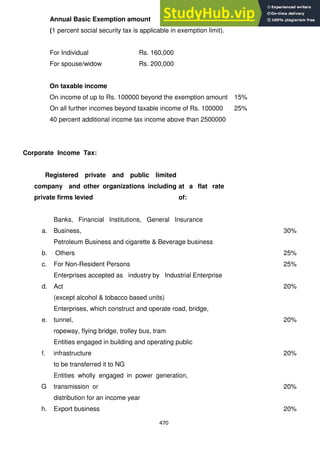
DETNORSKE VERITAS (DNV) has awarded Lomus
Pharmaceuticals the ISO 9001:2008 and ISO 14001:2004
recognising that it is not only the largest pharmceuticals
manufacturer but also quality conscious company with a factory
fitted with all the international standard infrastructure needed to
manufacture quality drugs. Our focus and ethics ever make us
conscious about providing medicine with uncompromising quality,
supply and customer service. Thus, Lomus is positioning itself to
become the healthcare market's pharmaceutical provider of
choice for high quality, reliable, cost effective pharmaceuticals.
Products include all dosage from medicine OTC as well as Life S.
Brands include tablets, capsules, liquids, cream, ointment gel.
495
Import from India: Saline Water, Chemical & Packing Materials,
Injectable drugs & Biological products, Topical skin preparations,
Methyl ergometrine, Diclofenac, Vitamin preparations and large
volume parenterals..
Export to India: Antibiotics, Antibactrials, Antifungal,
Anihistemine, Antiulcerant, Vitamins, Iron capsules & Tonics.
Barriers:
However, in terms of technical advancement, promotion
and other inputs, is a little inferior to India because of lack
of desired and accessible manpower resources.
Major problem is limited market size of Nepal pharma
industry for import-export.
Less exports of excisting medicines and a greater import
of Indian medicines could pose as a major threat to the
industry due to regulations.
Besides, the poor infrastructural facilities, lack of
metropolis except Kathmandu valley, few qualified medical
practitioners per region, the dominance of quacks and
retail chemists in medical practice and the absence of
transport in the vast geographical region of the country
have a negative impact on the growth and even more with
the healthy growth of industry.
Moreover, government policies are also not supportive.
They are not geared up for industrialisation. They are
traditional, conservative, revenue oriented and non-
transparent. Industry being a futuristics sector needs
government‘s support with regard to formulating short term
and medium term policies.
Counterfeit Drugs:
Basically, there are two reasons behind the availability of
counterfeit drugs. The first one is that we share a open
border with India and the second is that there are so many
496
unregistered medical stores all over the country. The
government monitoring system has not been effective
enough.
For export purpose approval if lab testing is much costlier
or time consuming in India.
Due to lack of less qualitative raw materials import of
qualitative materials are much costlier compare to price
from India.
Because of the demand of high quality materials duties or
tax charges are more expensive.
India‘s Government trade policy is very strict as compare
to Nepal policies restrictions.
Lack of transportation facility-routs, marketing or supply
chain facilities for multipurpose exports.
Political instability has created an uncertain environment
for foreign & private investment.
Government of Nepal is open to foreign direct investment
but implementation of its policy often distorted by
bureaucratic delays & inefficiency.
Cadila Pharmaceuticals Pvt. Ltd. (INDIA)
One of India‘s most reputed, Research based, Tech savvy
pharmaceutical companies focusing on areas . Formulations
(Human & Veterinary), New Drug Discovery, Novel Drug
Delivery, Active Pharmaceutical Ingredients, Analytical Research,
Phytochemistry, Biotechnology, Plant Tissue Culture,
Biosynthesis, Genetic Engineering, Vaccines, Immunoglobulins
the entire gamut of a True Life Sciences Company.Diversified
operations encompass Hospital Disposables & Instrumentation,
Diagnostics, Specialty Chemicals, Softgel, Pharma Machinery,
Telecommunications, Travel & Leisure.
Import Products: Generics drug material.
497
Export Products: Cardiovascular Drugs, Gastrointestinal Drugs,
Anti Inflammatory ,Analgestic Drugs, Antibiotic, Anti Infectives,
Vaccines, Immunomodulators, Anti-Diabetic Drugs, Vitamins,
Anti Allergic Drugs, Anti-Aids[Anti Retroviral] Therapy, Anti-
Cancer [Cytotoxic]Drugs, Ophthalmic Drugs, Veterinary products,
Expectorants, Bronchodilators, Anti-Asthmatic Drugs, Erectile
Dysfunction, Herbal Products.
Barriers:
Indian pharmaceutical company Cadila has sufficient at all
aspect of trade for import export but except following some
barriers:
Increasing span of price control due to government
policy. That create problem of profitability or limited
trade relations.
The expansion of capacities by certain leading
players has also fuelled competition in certain
product categories, which restricts margins of the
smaller players.
Low price erosion at competitive market at all or
market size for export is limited,
Despite the increasing expenditure on R&D, the
introduction of new molecules by Indian players has
been limited. It is, in fact, a hit-and-miss situation in
the field of discovery and developments of new
chemical entity (NCEs), where misses are more
than hits. Very few discoveries reach the final
stages of approvals, and in most of the cases, the
claim for patent gets stuck in legal battles.
Also due to rising expenditure in R&D , investment
in R&D is still low.
498
Restrictions of Patents & Intellectual Property
Rights or strict government regulatory reforms for
export – import.
Delay in order time due to lack of transportation in
Nepal
Potential For Import-Export Of Pharmaceuticals
 Opportunities for Lomus Pharma Pvt. Ltd. (Nepal)
499
 Outsourcing skilled manpower, hiring experts or
upgrade technology for domestic as well as
international trade expansion.
 Maintain low price with high quality for greater
competitiveness in global market.
 Opportunity for franchising or licensing.
 Approving post marketing surveillance & inspection
with Food & Drug Administration (FDA)
 Liberalized or upgrade government trade regulation
& policy for welcoming new global trade
opportunities.
 Develop air, truck, train or better route
transportation facility.
 Establish universities or training centre which
beneficial for semi skilled or graduates for
employment opportunities.
 Foreign direct investment through grater export.
 Opportunities for joint venture , merger with MNC‘s
for improving Good Manufacturing Practices
Standard.
 Contract Manufacturing opportunity & SEZ for
economic growth.
 Because of recent DDA policy, which made world
health organisation recommended certificate for
foreign companies to market their products in
Nepal, several of sub-standard companies of Indian
origin have to withdraw their marketing from Nepal.
This policy has given extra financial load to few of
the Nepalese companies, apart from opening
export opportunities.
 In WTO regime, technological advancement,
biodiversity and skill and power of the government
to influence and make favourable trade treaties with
500
other countries will offer potential for bringing out
the core competency.
 Opportunities for Cadila Pharmaceutical Pvt. Ltd.
(India, Gujarat):
 For more import liberalized VAT or Custom duties.
 Encouraging foreign investment due to high R&D
standard.
 Opportunity for introducing new products through
trade events.
 Expansion of more distribution channels through
imports.
 Opportunity for imports quantity of Aurvedic &
Herbs materials from Nepal.
 Reduced by harmonization of pharmaceutical,
results it also play interest of pharmaceuticals
industries because the compliance with
harmonized rules open doors to several markets
once.
 Over the counter trade opportunity.
 Export qualitative raw material in competitive
market with cheapest price for increasing market
share.
 Amalgamation opportunity to strengthen
themselves internationally.
 Low production cost give india an edge over other
generics- producing nations.
 Outsourcing IT & clinical data management
destination because of its rich talent pool,
technological innovation, creditable quality,
operational flexibility, cost effectiveness, time to
market and competitive advantage.
501
 Growing number of collaboration between Indian &
foreign firms in the domestic market, especially
involving the biotechnology sector, in a wide variety
of areas such as collaborative R&D (including drug
discovery and clinical trials), co-marketing &
manufacturing.
 Opportunity for intellectual property rights by
liberalized drug pricing policy or regulatory reforms.
 Tax benefits available for R&D also to be
applicable for clinical trials.
 An emerging trend among these enterprises has
been their involvement in clinical trials, either on
their own or on contract basis.
 New product launches, although mainly done by
large players, helps the SMEs to acquire contracts
for manufacturing and opportunities to supply APIs
and related chemicals. Moreover, a marketing
approval of generic products gives them the
opportunity to increase their product portfolio.
 Established clinical trials either them own or
contract basis or hospitals, health institutions.
 The advantage of locating in special economic
zones includes availability of developed
infrastructure, market access, exports, and excise
relief.
 Facilitated the domestic industry to attract contract
manufacturing opportunities in the rapidly growing
generics market.
 Opportunity for importing the art manufacturing
facilities.
 The opportunity to produce products under patent
in overseas markets, particularly regulated
markets, by adopting new processes.
502
 Emerging as the global hub for contract research
and manufacturing services (CRAMs) due to its low
cost advantage and world class quality standards.
Business Opportunities In Future
Opportunities
a. Favorable Government Policy
Government has categorized pharmaceutical sector as one of the
priority sectors. The government is providing monetary and fiscal
facilities and incentives to the sector for its development. It is
providing incentives to the pharmaceutical industry like levying
only one per cent customs duty for input materials, machineries,
etc. No Value Added Tax is levied for the industry.
b. Existence of Domestic Market and Export Potential
There is enough domestic market for Nepalese pharmaceutical
industries as those are catering only about 30% of the domestic
demand. Similarly, there exists export potential for Nepalese
products in non-regulatory markets and Non-WTO member
countries. Nepal lies between two big economies, India and
China, which are having large pharmaceutical markets with sizes
of US $ 9.5 billion and US $ 6.5 billion respectively. With the
increase in quality of products, domestic industries could start
looking towards the export markets and also, become a contract
manufacturer.
c. New Openings due to Provisions of WTO/TRIPS
503
As per the provisions of WTO/TRIPS, Least Developed Countries
(LDCs) are obliged to provide patent only from January 2016. As
per this provision Nepal needn‘t adhere to recognition of product
patents and therefore, has the choice of exporting the drugs
which are in patent period to other LDC and Non-WTO member
countries. The transition period would be an opportunity for the
domestic
companies to transform into vibrant pharmaceutical companies
as the opportunities in the domestic generic market itself are
enormous (i.e., domestic companies account for only 30% of the
total market). The domestic companies can introduce in the
market the new molecules that are developed by the research
based pharmaceutical companies and even can export to the
LDC countries. Thus the companies have the option of doing the
business with the least risk of investments till 2016. There are
also facilities for parallel import and compulsory license, and
Bolar‘s provision, which Nepal can exploit.
d. New Openings due to SAFTA
SAFTA has open new venues for Nepalese pharmaceuticals
industries to take benefit from the regional markets e.g. Bhutan,
22 Maldives, which depend on import of medicine and others
from SAARC members countries.
e. Restriction on Imports
The government has imposed restriction on importing
pharmaceutical products produced by industries without
WHOGMP Certification limiting competition by such industries in
domestic market.
f. Rise in Awareness about Healthcare
504
Nepalese have become more aware of healthcare needs and
modern medicine developing good market potential to industries.
Rise in literacy level among Nepalese has also increased
demand by many folds.
g. Development and Growth in Health Institutions
Gradual development and growth in public as well as private
health institutions in the country are generating good business
outlook for pharmaceutical industries.
h. Emergence of Facilitating and Supporting Institutions
Emergence of institutions to assist and support industries to
enhance their competitiveness supporting through provision of
information etc. like SAWTEE
Nepal, officially the federal democratic republic of nepal, lies
between the two most populous and fast growing economies of
the world, india and china. nepal has very good economic rapport
with her neighbors which are also excellent trading partners with
huge potentials for nepalese exports. while nepal has preferential
trading arrangement with india, she has very close economic ties
with china. other close neighbors of nepal are bangladesh and
pakistan. nepal and bangladesh have bilateral trade through land
route. nepal along with bangladesh, bhutan, india, maldives,
pakistan and sri lanka are the seven member countries of south
asian association for regional cooperation (saarc). the saarc
nations have free trade area under the saarc framework.
As a least developed country, Nepal is entitled to preferential
treatment in a number of rich markets. Two other advantages,
505
according to investors already in Nepal, are a low-cost and non-
hostile workforce and a small and accessible bureaucracy.
The natural as well as cultural assets of Nepal offer very
substantial opportunities to investors.
There is huge potential for hydropower. About 44,000 MW is
thought to be economically feasible, which may be contrasted
with about 800 MW currently being generated. Nepal has not
been able to exploit much of its potentiality and the people in
Nepal still face severe power shortages. In order to harness and
develop hydropower, the government is encouraging private
foreign investment in this sector. In the last several years, the
government under competitive basis has been awarding licenses
to private sector developers with over 5000MW of hydropower
development in various stages of progress where well known
international and domestic firms are involved. This priority sector
provides great opportunities for contractors, equipment suppliers,
and consultants alike.
There is scope for foreign investment in other areas/sectors also.
Tourism is another area with enormous potential. Nepal has
spectacular natural assets such as Mount Everest - the top of the
world - and seven other peaks of 8,000 meters and higher. It also
has a rich cultural heritage and a great diversity of ethnic groups
with distinctive traditions: Lumbini in western Nepal is the
birthplace of the Buddha, while Bhaktapur in the Kathmandu
valley is a perfectly preserved mediaeval town full of Hindu
temples. Tremendous opportunities exist in developing tourism /
hotel projects in Nepal.
Other trade opportunities include telecommunications
equipment, ICT equipment, water resources equipment, and
506
aircraft parts. The major telecom players are in expansive
mode. Other upcoming opportunities also include civil aviation
infrastructure, toll fast track roads, and railways.
Other areas like Software Development; Leather and Textile;
Pharmaceutical; Electronic and the Service Industries also carry
high possibilities of foreign investment. Other sectors such as
Medicinal and Aromatic Herbs; Flower and Vegetable Seeds;
Floriculture and Sericulture; Processing of Spices, Coffee; Fruits
and Dairy Products; Vegetable and Mushroom Farming and Tea,
also carry high possibilities of foreign investment. Minerals that
includes Stone and Limestone; Talc; Silica; Dolomite; Iron-ore;
Oil and Natural Gas needs to be further explored.
507
CONCLUSION AND RECOMMENDATIONS
Conclusion
Accession of Nepal to WTO has brought both opportunities and
challenges to Nepalese pharmaceutical industries. World market
of pharmaceutical products is now open to Nepalese industries
and simultaneously Nepalese market is open to industries
worldwide. In this context Nepalese pharmaceutical industries
need to be able to explore the opportunities and make best use
of those. In addition, those industries also need to identify the
external threats for them and make efforts to overcome the
threats. Therefore, Nepalese pharmaceutical industries have to
undertake measures that would enhance their competitiveness,
which could lead them to harness their strengths for exploiting
the opportunities before stepping into WTO/TRIPS regime in
2016. Since competitiveness of industries under the sector could
be enhanced through the enhancement of quality and
productivity of the industries, the measures to be taken in
isolation or in combination by the Nepalese pharmaceutical
industries would be to enhance quality and productivity of the
industries which would enable them to capitalize on the
opportunities and face up to the challenges. Based on the study
508
of present status; and analyses of opportunities and challenges
for Nepalese pharmaceutical industries in the wake of WTO,
recommendations are made for government, private sector
industries, and associations related to pharmaceutical industry
for enhancing the competitiveness of pharmaceutical industries.
Recommendations
Government
a. Introduction and Implementation of Act, Policies,
Programmes
The government has introduced act, regulations and others
relating to establishment, development, promotion and regulation
of pharmaceutical industries; some of which are still to be
implemented for attaining their objectives. Therefore, government
should implement those. In addition government should amend
acts and regulations making those compatible with WTO
requirements (e.g. As per WTO requirement patent should be
granted for a period of 20 years but Patent, Design and
Trademark Act of Nepal and its recent amendment grant patent
for a period of 7 years only which can be renewed 2 times for a
period of 7 years each). The government should also amend
foreign investment and technology transfer act making it
attractive for foreign direct investment in pharmaceutical sector
for research based pharmaceutical industry.
b. Establishing Promoting and Facilitating Institution
i) Research Institutions
Since majorities industries are of small and medium scale, those
cannot take certain functions of their own and therefore, the
government should encourage establishing institution(s) to carry
out such functions private sector or under public – private
509
partnership arrangements for the development of the domestic
pharmaceutical industries. For example, the government should
encourage establishing a quality research & development
laboratory of state of art for those industries, which will be a
model for the private companies of large scale to go for. The
institution should encourage interaction amongst the government,
academia and industry in the areas of process reverse
engineering, synthetic chemistry, etc. The government should
encourage also capacitate these laboratories to function as
technology assisting centres for the industry.
ii) Areas with Common Infrastructural Facilities
The government should develop specified location /areas with
common infrastructural facilities to encourage the setting-up of
pharmaceutical units in a place where the facilities like common
effluent treatment plant, common testing facilities, capital
intensive equipments, common training facilities, etc would be
readily available. Such facilities would reduce operating costs for
the industries.
iii) Information Centre
Information centre for providing information on technology, export
market, regulatory obligations, and sector related information for
developing and promoting pharmaceutical industries should be
established by the government in association with the respective
trade association by utilizing resources to be provided by
developed countries as per the provision of WTO agreement.
c. Strengthening Regulatory Bodies
Government should increase the capability of the Department of
Drug Administration to develop quality awareness and enforce
510
quality requirement in the market. Currently, there is a shortage
of manpower to fulfill its responsibilities limiting its area of
services. It should be strengthened and provided with necessary
resources to carry out regulatory and other functions. The
strengthening of regulatory body will check the presence of
unregistered and low quantity drugs in the market which is
creating an unfair competition affecting even the genuine
industries.
d. Completely Utilize Provisions of WTO
The government should utilize the assistance that would be
provided by the developed countries as per the provisions of the
WTO agreements in terms of the technological assistance,
financial assistance and creation of the domestic regulatory
environment for effective monitoring and development of the
industry so that there will be a smooth transition to the WTO
regime.Government should be effective in terms of using the
technical barriers to trade agreement for countering the imports
by introducing product label with certain information in Nepalese
language to help the consumer of the products.
e. Make Alliances/Treaties with Neighbours
The Government should enter into bilateral agreements or
treaties with the regional neighbors to provide free flow of
pharmaceutical products from Nepal. Currently, there is a higher
registration fee for the foreign companies in India in comparison
to that of Nepal. The Governments should make efforts to have
compatible fees, limiting its sales in adjoining states only.
f. Develop and Strengthen Health Institutions
511
The government health services are available to only a small
portion of the population. As Health services is a basic need for
all, therefore the government should develop/establish health
institutions in new areas and strengthen the existing ones to
provide health services to its people. The government should
necessitate those institutions to consider quality as well as price
of medicines while procuring.
g. Provision of Incentives
In order to encourage in establishment and plant up-gradation of
pharmaceutical industries in the country, the Government should
provide fiscal incentives. The industries investing in research &
development should be encouraged by providing the incentives
for investing in R&D like tax rebate for the amount invested into
R&D. Lower or even zero duty on the imports of products or
machinery that are to be used in research & development should
also be provided. Similarly, export incentives should be provided
to the exporting industries. With a view to motivate domestic
industries to promote export, Government should subsidize
registration fee charged by importing country. Since there is a
lack of highly skilled technical manpower, government should
provide subsidy of at least 50% of the human resources
development cost incurred by the industries for above purpose.
h. Extension of Time Frame
As technological base in LDCs are very low, Nepal along with
other LDCs should make efforts to extend time allocated to
create a viable technological base by additional ten years i.e.
upto January 2026.
7.2.2 Private Sector Industries
512
a. Upgrade Production Facilities
Industries should continuously upgrade their production facilities
to assure the quality of products and plant facilities. Industries
having WHO-GMP Certification should go for quality
management system and environment management system for
further assurance. The rest of the industries should also get such
certification(s). Up-gradation of the production facilities would
further increase the product quality and corporate image of the
domestic industries, leading to increase in prescriptions by the
doctors.
b. Attaining Economy of Scale
The industries should try their best to attain their economies of
scale by undertaking the following in isolation or in combination:
i. Increase Capacity Utilization
The domestic pharmaceutical companies should look for
improving their capacity utilization for better operating margins
and profits which again can be ploughed back into the growth
plans of the company like investing into process research, up
gradation of the plants, etc. In order to optimize the capacity
utilization, industries should try to provide outsourcing services to
the other industries for the benefit of both.
ii. Broaden Product Portfolio
The industries should broaden their product portfolio in terms of
range and forms instead of concentrating in me-too products
only.
513
c. Reduction in Cost of Production
i. Efficient Utilization of Inputs
Nepalese pharmaceutical industries should improve in utilization
of inputs like ingredients, utilities, labour and others. And at the
same time industries should take necessary measures to reduce
wastes.
The pharmaceutical industries should conduct audit of inputs in
regular basis to find out level of waste.
ii. Supply-Chain Management
Special consideration of supply-chain management should be
made by industries to reduce cost of production introducing
efficient and effective inventory management system.
iii. Backward Integration
The companies should produce bulk drugs or active
pharmaceutical ingredients by acquiring the process
development knowledge and skills, if possible. In case, if it is
possible to carry out in collaboration/association with others, then
to produce those and explore domestic and export potential too
The basic purposes behind such integration should be to achieve
control on costs, quality and delivery period of inputs.
iv. Common Infrastructure and Facilities
As using common infrastructure and facilities could also reduce
in cost of production and waste disposal leading to the
improvement in productivity and competitiveness, industries
514
should ask government to develop such common infrastructure
and facilities.
d. Market Expansion
i. Increase Domestic Market and Market Share
The Nepalese industries should make efforts to cater domestic
demand more by having broad product portfolio in terms of range
and forms. Those should not only to increase sales but also and
market shares. For these, industries should adopt aggressive
marketing approaches and employ innovative promotional ways
to counter the products of well established foreign companies
and products of inferior quality having price advantages.
Domestic industries will have to strongly face competition from
foreign industries and multinational companies. Franchising with
chemists and druggists should also be made to reduce
substitution of own products by them. The market share in the
domestic market should also be increased though innovative
marketing of the brands of the industry in the domestic market.
ii. Tap Export Opportunities
Tapping export markets is vital for the domestic pharmaceutical
companies, because Nepalese pharmaceutical market is
relatively very small. Although domestic market is the immediate
driver or the revenue earning market at initial stage, export
market is the one providing long term sustenance and growth for
a pharmaceutical industry. Since export market is very crucial for
industries, those should explore and tap export market. Those
should consider of not only the formulated products but also bulk
drugs. The companies should make a beginning (at least the
companies in the large scale
515
sector). These industries should first upgrade their plants to the
requirements of the market they are planning to export. Then
those should manufacture pharmaceuticals at a cost that would
be lower than the competitive products prevailing in the
international
markets.
e. Research and Development
Investment in research & development (at least process
research) is essential for the survival of a pharmaceutical
industry, because it leads to industrial growth by introducing
generic versions faster bring down the manufacturing costs. An
industry with the strong reverse engineering capability could
eventually transform into research based industry and could even
tap the contract research market. Therefore, industries should
invest in R & D.
f. Human Resources Development
Industries should continuously invest in its Human Resource
Development so that those are abreast with the latest trends in
the industry whether in production or research or marketing or
management. At least 2 to 3 percent of the sales should be
invested in human resource development.
g. Alliances/Collaboration for Competencies
The industries wherever those can attain competence and/or
acquire expertise, which are needed for long term sustenance
and growths with collaboration/alliance should go for it. Such
alliances can be for accessing product, technology and market
for the product and should bring win-win situation to both the
parties.
516
h. Develop Linkages with the Academia
The domestic industries should develop, review and maintain
linkages with the academia or the research institutions to utilize
their resources for the development of better process of
manufacturing and developing human resources.
i. Develop Work Relationship with Professional and
Business Associations
Industries should develop, review and maintain work
relationships with professional associations like NMA, and
business/trade associations FNCCI, APPON, NCDA, etc. for
fulfilling their individual and group interests.
J. Institutionalization of Industries
Nepalese industries should start institutionalization of their
industries and operate with organizational systems, procedures,
processes, and others.
7.2.3 Pharmaceutical Association
a. Strengthening of Associations
The role played by the associations like APPON is tremendous
and crucial for the success and growth of pharmaceutical
industries. It is through such facilitating bodies interests of the
517
industries are raised for solving the issues & challenges of the
industry. Therefore, APPON should be strengthened and
developed as an institution supporting industries in HRD, market,
technological regulatory and WTO related information.
b. Launching of HRD Programmes
In order to upgrade the capability of human resources involved in
the sector, APPON should regularly organize HRD programmes
on various fields.
c. Forum for Stakeholders
It should function as a forum for knowledge sharing for
stakeholder for the benefits of the industries. It should start
disseminating information on quality assurance, creating
awareness on the WHOGMP
and facilitating the technical expertise required for adhering to the
international standards of various regulatory agencies.
d. Assistance to Industries
The association should regularly assist the pharmaceutical
companies in dissemination of the information like market
opportunities in the domestic or export markets. It should closely
work with the industries in identifying problems that are being
faced by industries. Associations should act like catalysts in
building the alliances among the pharmaceutical companies in
the domestic market or with the foreign companies for accessing
technology or products or market.
518
BIBLIOGRAPHY
http://saffron.pharmabiz.com/article/detnews.asp?articleid=46071&
sectionid=50
http://pharma.financialexpress.com/20031002/marketplace01.shtml
http://www.in.kpmg.com/pdf/indian%20pharma%20outlook.pdf
http://www.dnb.co.in/pharmaceutical/overview.asp
http://www.pdfdownload.org/pdf2html/view_online.php?url=http%
3A%2F%2Fphotos.state.gov%2Flibraries%2Fnepal%2F391216%2FMis
c_%2520PDF%2F2012CCG_FINAL_.pdf
http://www.pdfdownload.org/pdf2html/view_online.php?url=http%
3A%2F%2Fwww.csas.ed.ac.uk%2F__data%2Fassets%2Fpdf_file%2F00
11%2F38828%2FGMPinPharmaIndustry.pdf
http://www.aristopharma.com/global-presence.ph
http://www.pdfdownload.org/pdf2html/view_online.php?url=http%
3A%2F%2Fwww.who.int%2Fmedicines%2Fareas%2Fcoordination%2F
nepal_pharmaceutical_profile.pdf
http://www.dda.gov.np/industry.php
http://www.cadilapharma.com/
http://www.lomus.com.np/
519
A
GLOBAL/ COUNTRY STUDY AND REPORT
On
“Nepal”
Submitted to
Sardar Patel College of Administration & Management
Approved by All India Council for Technical Education (AICTE),
New Delhi
Affiliated to Gujarat Technological University, Ahmedabad
SPEC Campus, Vidhyanagar – Vadatal Road Bakrol – 388315,
Anand (Gujarat)
IN PARTIAL FULFILLMENT OF THE
REQUIREMENT OF THE AWARD FOR THE DEGREE OF
MASTER OF BUSINESS ADMINISTRATION
In
Gujarat Technological University
UNDER THE GUIDANCE OF
Faculty Guide
Ms. Varsha Kuchara
520
Assistant Professor
Submitted by
MBA Semester IV
Sardar Patel College of Administration & Management
MBA PROGRAMME
Affiliated to Gujarat Technological University
AhmedabadJune, 2013
Students‘ Declaration
We are hereby declare that the report for Global/ Country Study
Report entitled ―NEPAL‖ is a result of our own work and our
indebtedness to other work publications, references, if any, have
been duly acknowledged.
Place : ……..
Date :
117550592163 Prajapati Pravinbhai Veljibhai
117550592164 Chauhan Haren Ramanbhai
117550592165 Khalifa Irshadbhai Gulammahammad
117550592166 Padhiyar Kirtikumar Indrajit
117550592167 Dasani Deep Bhupendra
117550592168 Sheth Khushaliben Jitendrakumar
117550592163 Prajapati Pravinbhai Veljibhai
117550592164 Chauhan Haren Ramanbhai
117550592165 Khalifa Irshadbhai Gulammahammad
117550592166 Padhiyar Kirtikumar Indrajit
117550592167 Dasani Deep Bhupendra
117550592168 Sheth Khushaliben Jitendrakumar
521
PREFACE
As a student of management, apart from theoretical
studies we need to get a deeper insight into the practical aspects
of those theories by working on various projects. So these
projects have high importance in management studies to
enhance the knowledge and skills.
Management in India is heading towards a better
profession as compared to other professions. The demand for
professional managers is increasing day by day. Working on this
project has been an enriching experience.
This project will help us a lot in the professional growth. It
has given us the confidence to prepare for ourselves as fully
fledged international marketing professional in the eminent
future
A global country report Understanding of the principle will
increases their Decision making ability and sharpening their tools
for this purpose between two country relationship. The scope of
the work under taken by us includes introduction to basic & major
things about the Impact of relation of country‘s business.
We also thank all the faculty members who always been a source
of motivation and support to all the students of SPCAM. We pay
our gratitude to Prof. Varsha Kucharaand all faculty members of
the institute without their help it would have been impossible to
conduct such a study. We must acknowledge our heartiest
thanks to them.
We have put our maximum effort to gain the information. If
any error or mistakes are found in collection data kindly ignore.
522
ACKNOWLEDGEMENT
We wish to express over grateful thanks to all those who
have helped over immensely for completion of the project.
Though we are unable to mention all of their names individually
here it will be a lapse on my part if names of certain important
personalities are not mentioned.
We are extremely thankful toVarsha Kuchara, who was my
project guide, without his invaluable guidance and advice this
project would not have been completed.
We also acknowledge my sincere thanks to Dr.
Vashishthdhar Dwivedi Managing Director, who has given me the
opportunity to undergo training on global country like ―Nepal‖ and
gain some knowledge about the global country relation and
business and opportunity.
We will be failing in my duties if we don‘t mention here the
cooperation and help that I received data collection on secondary
data.
We are thankful to the faculty members of my college,
SPCAM and one and ours guide of the helping me in one way or
other.
523
INDEX
SR,
No
PARTICULARS Page
No
Semester
STUDENT DECLARATION I
CERTIFICATE ii
PREFACE iii
ACKNOWLEDGEMENT iv
V
PART – I ECONOMIC OVERVIEW OF THE
SELECTED COUNTRY
III
1.
Demographic Profile of the Country
9
Economic Overview of the Country
10
Overview of Industries Trade and Commerce
11
Overview Different economic sectors of selected
country
12
Overviews of Business and Trade at International
14
524
Level
Present Trade Relations and Business
15
Present Trade Relations and Business Volume of
different products with India
16
PESTEL Analysis
16
PART – II INDUSTRY / SECTOR / COMPANY /
PRODUCT/ SERVICE/ NEW VENTURE SPECIFIC
STUDY
IV
2
Introduction of the selected Company / Industry /
Sector and its role in the economy of specified
country.
Structure, Functions and Business Activities of
selected Industry / Sector / Company
19
3 Comparative Position of selected Industry / Sector
/ Specific Company / Product with India and
Gujarat
28
Present Position and Trend of Business (import /
export) with India / Gujarat during last 3 to 5 years
40
525
4
Policies and Norms of selected country for
selected Industry/company for import / export
including licensing / permission, taxation etc.
59
Policies and Norms of India for Import or export to
the selected country including licensing /
permission, taxation etc.
65
Present Trade barriers for import / Export of
selected goods(if any)
68
5
Potential for import / export in India / Gujarat
Market
66
Business Opportunities in future
72
Conclusions and Suggestions
80
Bibliography 85
Annexure 86
526
527
LIST OF TABLES*/GRAPHS*/DIAGRAMS*
SR.
NO.
PARTICULARS TABLE
NOS.
PAGE
NOS.
1 Demographic Profile of Nepal &
Economic overview of Nepal
1 9
2 economic sectors in 1991 & 2001 2 12
3 Gross Domestic Products 3 14
4 Pestle analysis 4 16
5 Key economy indicator 5 22
6 Average performance of export of
Nepal
6 23
7 Indian textile size of 2010-2011 7 27
8 County profile of Nepal 8 29
9 Volume of Nepal annual trade 9 33
10 Indian top ten import from Nepal 10 34
11 Indian top ten export from Nepal 11 35
12 Extra-long staple cotton 12 60
13 Nepal trade scenario 2002-2011 13 61
14 Type of product 14 64
15 Evolution of cotton manufacture in
India
15 75
528
PART I
529
Summary of NEPAL
 Demographic Profile of Nepal & Economic
overview of Nepal:
 Population: 29,890,686 (July 2012 est.)
 Age structure
0-14 years: 34.6% (male 5,177,264/female 4,983,864)
15-64 years: 61.1% (male 8,607,338/female 9,344,537)
65 years and over: 4.4% (male 597,628/female 681,252) (2011
est.)
 Median age
Total: 21.6years
Male: 20.7years
Female: 22.5 years (2011 est.)
 Population growth rate
1.768% (2011 est.)
 Birth rate
21.85 births/1,000 population (2011 est.)
 Death rate
6.75 deaths/1,000 population (July 2011 est.)
 Net migration rate
2.58 migrant(s)/1,000 population (2011 est.)
 Urbanization
Urban population: 19% of total population (2010)
Rate of urbanization: 4.7% annual rate of change (2010-15 est.)
 Major cities - population
KATHMANDU (capital) 990,000 (2009)
 Infant mortality rate
Country 2008 2009 2010 2011 2012
Nepal 29,519,110 28,563,380 28,951,850 29,391,880 29,890,690
530
Total: 43.13 deaths/1,000 live births
Male: 43.15 deaths/1,000 live births
Female: 43.1 deaths/1,000 live births (2011 est.)
 Life expectancy at birth
Total population: 66.51 years
Male: 65.26 years
Female: 67.82 years (2011 est.)
 Total fertility rate
2.41 children born/woman (2011 est.)
 Major infectious diseases
Degree of risk: high
Food or waterborne diseases: bacterial diarrhea, hepatitis A,
and typhoid fever
Vector borne disease: Japanese encephalitis, malaria, and
dengue fever (2009)
 Nationality
Noun: Nepali (singular and plural)
Adjective: Nepali
 Ethnic groups
Chhettri 15.5%, Brahman-Hill 12.5%, Magar 7%, Tharu 6.6%,
Tamang 5.5%, Newar 5.4%, Muslim 4.2%, Kami 3.9%, Yadav
3.9%, other 32.7%, unspecified 2.8% (2001 census)
 Religions
Hindu 80.6%, Buddhist 10.7%, Muslim 4.2%, Kirant 3.6%, other
0.9% (2001 census)
 Languages
Nepali (official) 47.8%, Maithali 12.1%, Bhojpuri 7.4%, Tharu
(Dagaura/Rana) 5.8%, Tamang 5.1%, Newar 3.6%, Magar 3.3%,
Awadhi 2.4%, other 10%, unspecified 2.5% (2001 census)
Note: many in government and business also speak English
(2001 est.)
531
 Literacy
Definition: age15 and over can read and write
Total population: 48.6%
Male: 62.7%
Female: 34.9% (2001 census)
 Education expenditures
4.6% of GDP (2009)
 Health expenditures
5.8% of GDP (2009)
 Physicians density
0.21 physicians/1,000 population (2004)
 Hospital bed density
5 beds/1,000 population (2006)
 Overview of Industries Trade & Commerce:
Industrial production represents a small but growing segment of
economic activity. Most industries are small, localized operations
based on the processing of agricultural products. There are a
sawmill and a meat-processing plant, brick and tile manufacture
industry; processing of construction materials, paper, and food
grain; cigarette manufacture; cement production; and brewing of
beer. In general, there are more industrial enterprises in the
private than in the public sector, although most of these are
cottage industries. The main areas of manufacturing
concentration are Biratnagar, the Birganj–Hitaura corridor, and
the Kathmandu Valley.
For geographic and historical reasons, nearly all of Nepal‘s trade
is with India. Nepal‘s foreign trade and balance of payments have
suffered setbacks, and exports have not increased enough to pay
for imports of consumer goods and basic supplies. Nepal‘s
dependence on the Indian market for most of its imports and
532
exports and on the port of Calcutta for its access to the sea has
been the source of periodic friction between the two countries.
Domestic market in Nepal is segmented and small due to lack of
transport network and low purchasing capacity of the majority of
consumers. Due to unrestricted open border with India, market
price in Nepal in influenced by the prevailing market price of
adjoining border areas of India. Even the supply situation across
the border affects the supply of merchandise and the volume of
trade transaction in Nepal.
The internal channel of merchandise trade in Nepal is four-tiered
as listed below.
1. Farmer/Producer/Importers,
2. Wholesaler/Trading Agent/Authorized Dealer,
3. Retailer/Hawker, and
4. Ultimate consumer
To make the supply system fully oriented to development and
consumer needs, following objectives are envisaged by the
government in term of the development of internal trade:
1. Creation of conducive environment for the timely supply of
goods derived from internal as well as from external import
sources:
2. No restrictions on the movement of goods for internal
trade and the goods for exports.
533
 Overview of Different economic sectors of
Nepal:
From the perspective of economic, social and human
development indicators, Nepal stands at the bottom of list of
south Asia. Out of about 57% of the population classified as
economically active, 65.7% were engaged in agriculture in 2001
with the lowest value added per worker. The structure of
economically active industries in different economic sectors in
1991 & 2001 is as follows:
Sr. No. Description Census of
1991
Census of
2001
1 Agriculture 81.2 65.7
2 Mining & quarrying - 0.2
3 Manufacturing 2.0 8.8
4 Electricity & water 0.2 1.5
5 Construction 0.5 2.9
6 Hotel and Trade 3.5 9.9
7 Transport & com 0.7 1.6
8 Finance & real
estate
0.3 0.8
9 Social services 10.2 7.8
10 Others &
unidentified
1.4 0.8
Total Employment 100.0 100.0
534
However, the contribution of non-agriculture activities to the GDP
is slowly increasing in recent years. Percentage contribution of
agriculture to GDP has gone down to 39% in the year 2004-05
from 48% in the year 1990-91.
Gross Domestic Products by their Sources: (At 1994/95
prices)
Sr.
No.
Description 1994-95 1999-2000 2003-04
1 Agriculture 85569 100856 119016
2 Mining &
quarrying
1117 1480 1621
3 Manufacturing 19555 26646 26533
4 Electricity &
water
2862 4025 7087
5 Construction 23093 31550 32020
6 Hotel and Trade 24326 31036 30095
7 Transport & com 13995 19644 24527
8 Finance & real
estate
20534 27026 30834
9 Social services 18924 24833 31565
Total GDP 209974 267096 303298
The prevalent definitions of industrial enterprise in Nepal are as
follows:
1. Large industries: Investment of more than NRs 100
million in fixed assets
2. Medium industries : Industries with a fixed assets
between NRs. 30 million and NRs 100 million
535
3. Small industries: :Investment up to NRs 30 million in fixed
assets.
4. Cottage industries :Some specified traditional industries
utilizing specific skill or local raw materials and resources,
using less than 5 KW of electric motor and related with
national tradition, art and culture.
 Overview of Business & trade at Nepal:
Nepal may not be among the best known of trading centers in
Asia, but there are many reasons why certain businesses should
consider trade in Nepal. Since, 1951 the Nepali government has
worked hard to liberalize the country‘s economy, by improving
transportation and communication facilities, as well as industry
and agriculture. The Nepali government has tried to make the
Nepali economy more conducive to investment by entering into
various trade agreements and investment protection pacts.
The export areas that Nepal does best in are the production of
garments and carpets industry. With the European Union
accounting for approximately 47% of all garment and rug exports.
Nepal has also steadily climbed the scales in terms of ease of
doing business in, with an increase of 3 places to 107. The Nepali
economy has also been doing very well over the past few years,
with economic growth in the 2000‘s averaging between 4-6% on a
annual basis.
So the Nepali market has steadily expanded and gotten richer,
with GDP per capita increasing albeit at a slower rate, over the
536
past 30 years. However, it should be noted that there is a sever
lack of skilled labor in the country and there is little sign of this
changing, with little government investment in education. So
anything beyond basic manufacturing is likely to be difficult in
Nepal.
India is Nepal‘s largest trade partner and biggest source of foreign
investment. India accounts for about 44% of the total approved
Foreign Direct Investment (FDI) and 25.2% of the approved
ventures with foreign investment in Nepal. Indian business
ventures in Nepal cover diverse fields like Manufacturing, Services
(banking, insurance, dry port, education and telecom), Power
sector and Tourism.
 Present Trade relations & Business volume of different
products with India/ Gujarat
 Industries
Tourism, carpet, textile, small rice, jute, sugar and
oilseeds mills etc
 Export
YEAR $(In Billions)
2010 901.9
2011 896
 Export commodities
Clothing, pulses, carpets, textile, juice,
pashima,
 Import
537
YEAR $(In Billions)
2010 5.016
2011 5.4
 Import commodities
Petroleum product, machinery and equipment,
gold, electrical goods, medicine
The top ten exports of Nepal to India were textiles; ferrous
metals; chemical, rubber, plastic; crops; beverages and tobacco
product; metals; vegetables, fruits, nuts; food products; minerals;
and leather products. Basically, its primary commodities.
Meanwhile, the top ten exports of Nepal to China were wood
products; metal products; textiles; mineral products; leather
products; wearing apparel; chemical, rubber, plastic; machinery
and equipment; vegetable oils an fats; and crops. Basically, no
high value added products.
The top ten imports of Nepal from India were petroleum, coal
products; chemical, rubber, plastic; ferrous metals; machinery
and equipment; mineral products; textiles; transport equipment;
food products; motor vehicles and parts; and metals. Basically,
the imports (demand) from India are pretty much priced inelastic.
Hence, no matter what happens to the economy! Meanwhile, the
top ten imports of Nepal from China were wearing apparel;
textiles; electronic equipment; machinery and equipment; leather
products; vegetables, fruits, nuts; chemical, rubber, plastic;
manufacturers; metal products; and motor vehicles and parts.
Basically,
Nepal's imports were distributed among the following
categories
Consumer goods 7.4%
538
Food 11.6%
Fuels 16.3%
Industrial supplies 30.7%
Machinery 11.3%
Transportation 15.6%
 PESTEL analysis:
 Political analysis:
Though Nepal has witnessed great political instabilities in
the recent past, the country has a strong base of
parliamentary democracy & constitutional monarchy.
Form Parliamentary Democracy &
Constitutional Monarchy.
Head of State King
Head of
Government
Prime Minister
Legislative House of Representative(lower
house)-205 members & National
Assembly (upper house)-60 members.
Judiciary Supreme Court, Appellate Court: 11,
District court: 75
539
Administrative
Division
Development region: 5, Zone: 14,
District: 75
Capital Kathmandu
 Economic analysis:
Nepal is a developing country. The major industries in Nepal are
tourism, handicraft, agriculture and water resources.
GDP
Composition
Agriculture: 40%, Industry: 22%,
Services: 37%
GDP Real
Growth
Rate
4.9% (2000-2001)
Average
Inflation
Rate
2.1% (2000-2001)
Per Capita
Income
$ 240 (Rs 17,718) for (2000-2001), $236
(Rs 18,083) estimate for(2001-2002)
Unit of
Currency
Rupee
Labour
Force
Agriculture: 81%, Industry: 3%, Service:
11%, Other: 5%.
Export & Import of Nepal :-
EXPORT :-
IMPORT:-
- Clothing - Gold
- Leather Goods - Machinery
- Jute Goods - Equipment
 Social analysis:
Population: - 29391883 (July 2012 EST.)
540
Age Structure :-
0 – 14 Years: - 34.6% [Male 5177264, Female
498364].
15-64 Years: - 61.1% [Male 8607338, Female
9344537].
65 – Years and over: - 4.4 % [Male 597628, Female
681252].
Urbanization :-
Urban Population: - 19% of Total Population.
Rate of Urbanization :- 4.7% Annual rate of change.
 Technological Analysis:
A good example of change in technology is buses that lower
the floor for easy entry. These provide better accessibility
for disabled and elderly people. Technologically, Nepalese
transportation industries are far behind the international
transport industry
7. Telephones :- Main line in use. [371800]
8. Telephones :- Mobile Cellular . [50400]
9. Radio Broad Cast Station :- AM6 , FM5 , Short
wave 1.
10.Television :- [970000].
11.Internet Hosts :- [1100].
12.Intenet service Providers :- [ISPS] =10 Users :-
200,000.
 Environmental analysis:
The dramatic differences in elevation found in Nepal result
in a variety of biomes, from tropical savannas along the
Indian border, to subtropical broadleaf and coniferous
forests in the Hill Region, to temperate broadleaf and
541
coniferous forests on the slopes of the Himalaya, to
montane grasslands and shrublands and rock and ice at the
highest elevations.
From 1,500 to 3,000 metres (4,900 to 9,800 ft), are
temperate broadleaf forests: the eastern and western
Himalayan broadleaf forests. From 3,000 to 4,000 metres
(9,800 to 13,000 ft) are the eastern and western Himalayan
subalpine conifer forests. To 5,500 metres (18,000 ft) are
the eastern and western Himalayan alpine shrub and
meadows.
 Legal analysis:
Legal changes that affect business are closely tied up with
political ones. Many changes in the law stem from
government policy in Nepal.
Constitutional Law
Constitutional of the kingdom of Nepal
Administration [Public Law 2047 (1990).
Citizenship Act ,1964
Civil service act , 2049 (1943)
Civil service act , 2049 (1993)
Criminal law
Arms and ammunition act , 2019 ,1962
Civil war
Birth , death and other personal events
(Registration Act. 2033 (1976).
Contract Act. 2056 – 2000
Land acquisition Act. 2034 – 1977
Land Act. 2021 – 1964
Marriage registration Act. 2028 – 1971
Commercial law
542
Buffer zone management rules 2052 – 1996
Contract Act. 2056 – 2000
Land acquisition act 2034 – 1977
Land act 2021 – 1964
Tax lax
Baggage rule 2065 – 2007
543
PART II
1) “INTRODUCTION OF TEXTILE INDUSTRY
SECTOR OF ECONOMY OF NEPAL.”
During the 1950s and 1960s, Kathmandu received aid
commitments from Moscow and Beijing. During the 1960s, Soviet
and Chinese aid also supported development of a few
government-owned industries. Most of the industries established
used agricultural products such as jute, sugar, and tea as raw
materials. Other industries were dependent on various inputs
imported from other countries, mainly India.
As a result of the 1989-90 trade dispute with India, many inputs
were unavailable, causing lower capacity utilization in some
industries. During the same period, Nepal also lost India as its
traditional market for certain goods. Because of the lack of
544
industrial materials, such as coal, furnace oil, machinery, and
spare parts, there was a considerable adverse impact on
industrial production.
Industry accounted for less than 20 percent of total GDP in the
1980s. Relatively small by international standards, most of the
industries established in the 1950s and 1960s were developed
with government protection. Traditional cottage industries,
including basket-weaving as well as cotton fabric and edible oil
production, comprised approximately 60 percent of industrial
output; there also were efforts to develop cottage industries to
produce furniture, soap, and textiles. The remainder of industrial
output came from modern industries, such as jute mills, cigarette
factories, and cement plants.
Manufacturing
Among the modern industries were large manufacturing plants,
including many public sector operations. The major
manufacturing industries produced jute, sugar, cigarettes, beer,
matches, shoes, chemicals, cement, and bricks. The garment
and carpet industries, targeted at export production, have grown
rapidly since the mid1980s whereas jute production has declined.
Industrial estates were located in Patan (also called Lalitpur),
Balaju, Hetauda, Pokhara, Dharan, Butawal, and Nepalganj. The
government provided the land and buildings for the industrial
estates, but the industries themselves were mostly privately
owned.
The 1986-87 Nepal Standard Industrial Classification counted
2,054 manufacturing establishments of 10 or more persons from
51 major industry groups, employing about 125,000 workers.
That same year the total output from these industries amounted
to about Rs10 billion; value added was estimated at almost Rs3.6
billion. It was nearly Rs5.1 billion in FY 1989. By FY 1989, there
545
were 2,334 such establishments recorded, employing about
141,000 persons.
Private Industry
The history of incorporated private firms in Nepal is short. The
Nepal Companies Act of 1936 provided for the incorporation of
industrial enterprises on joint stock principle with limited liability.
The first such firm, Biratnagar Jute Mills, was a collaborative
venture of Indian and Nepalese entrepreneurs. It was formed in
1936 with initial capital of 160,000 Indian rupees.
In response to shortages of some consumer goods during World
War II (1939-45), fourteen private companies emerged in such
diverse fields as mining, electrical generation, and paper and
soap production. The initial capital invested in each of these
industries was small. In 1942 two paper mills emerged as joint
ventures of Nepalese and Indian entrepreneurs. Industrial growth
gained momentum after 1945, although the end of World War II
had reduced the scarcity of goods and caused many of these
companies to incur losses.
Under the Nepal Companies Act, there was no provision for
private limited companies. In 1951, however, a new act was
implemented with provisions for private limited companies. This
act encouraged the establishment of ninety-two new private joint
stock companies between 1952 and 1964. Most of these
companies were much smaller than existing companies. Under
the provisions of the 1951 act, public disclosure of the activities
of the firms was not required, whereas the 1936 act allowed
substantial government intervention. The Industrial Enterprises
Act of 1974 and its frequent amendments shifted the
government's emphasis on growth from the public to the private
546
sector. However, discrepancies between policy and practice were
evident, and the public sector continued to be favored.
Public Companies
Public companies also had varied success. Between 1936 and
1939, twenty public companies were formed, of which three
failed. Between 1945 and 1951, thirty-five public firms were
incorporated, six of which went out of business. Between 1936
and 1963, fiftyfour firms were incorporated, but at the end of
1963 only thirtyfour remained in operation. The success of public
companies continued to be erratic.
Minerals
Because only a few minerals were available in small quantities
for commercial utilization, the mineral industry's contribution to
the economy was small. Most mineral commodities were used for
domestic construction. The principal mineral agency was the
Department of Mines and Geology. Geological surveys
conducted in the past had indicated the possibility of major
metallic and industrial mineral deposits, but a poor infrastructure
and lack of a skilled work force inhibited further development of
the mineral industry.
The most important mineral resources exploited were limestone
for cement, clay, garnet, magnetite, and talc. Crude magnetite
production declined from a high of approximately 63,200 tons in
1986 to approximately 28,000 tons in 1989; it was projected to
decline further to 25,000 tons in 1990.
In 1990 mineral production decreased significantly, largely
because of political unrest. Production of cement fell
approximately 51 percent over 1989--from approximately
218,000 tons to about 107,200 tons. Production of clays for
547
cement manufacture dropped from 7,206 tons to 824 tons.
Lignite production decreased 19 percent, and talc production fell
73 percent. Ornamental marble production, however, increased
in 1989--by 100 percent in cut marble and 1,560 percent in
marble chips.
Nonetheless, the mining industry had the potential to become a
more important part of the economy, as new mines were being
planned or were being developed. Two cement plants already
were in operation, and a third one was being planned. It was
expected that with full production in the three plants, Nepal might
become selfsufficient in cement. A magnetite mine and
pressuring plant east of Kathmandu had completed its
construction phase and began production of chalk powder
(talcum powder) on a trial basis in 1990. A highgrade lead and
zinc mine was being developed north of Kathmandu in the region
of Ganesh Himal and was expected to become operational in the
1990s, although raising enough capital for the project was
problematic. Production of agricultural lime in 1989 doubled that
of the previous year, suggesting that progress was being made
towards meeting requirements of the agricultural sector.
2) “STRUCTURE ,FUNCTION AND BUSINESS
ACTIVITY OF TEXTILE INDUSTRY OF NEPAL”
Textile & garment industries have been known to kick-start
industrialization in many an emerging economy. They have been
known for providing the impetus for transforming strategic
industrial policies of import substitution to export promotion.
These industries, due to their labor intensive character are also
known for their large employment generation capacity. In other
words, the industry has the potential to give a turnaround to the
stagnant industrial atmosphere if opportunities are rightly
exploited.
548
The history of the garment industry in Nepal is a little over a
decade and half years old. Before that, garments in Nepal meant
traditional Nepalese garments that were exported to a limited
number of countries in limited quantities.
Located in Duhabi (Sunsari district, Nepal), Dhanlaxmi
Synthetics Limited is equipped with hi-tech state-of-the-art
German machinery from Barmag, GmbH andTerrot
Strickmaschine. The machinery suppliers also include India‘s
Himson Internationals and I.C.B.TLohia‘smachineryWe also have
available 33 KVA of Grid Power, followed by our own 100%
captive generation, which ensures uninterrupted supply of power
for continuously running manufacturing activity in our fully air-
conditioned plant.
A Research & Development division, which operates from a
modern quality control cell, ensures quality standards. Our R&D
laboratory has the latest equipment to test the yarn, Fabric &
POY as per the international quality standards.
Our products are well approved by the quality concious fabric
manufacturers.
Our customers have immense faith in us and this enables us to
maintain consistent high quality standards.We are producing 40
MT / day of POY (Partially Oriented Yarn) and the same is being
increased to 50 MT per day in order to cater to the growing
demands. We also produce approx. 30 MT per day of Polyester
Texturised Yarn (PTY) and 6 MT per day of Knitted Fabrics. For
further value addition, we have plans to produce speciality yarn.
DSL‘s technology, productivity, quality and manufacturing
processes are comparable to the best in the world.
549
Over strength :
We possess dedicated human resources, the best techniques
and concepts and most of all, a strong business experience.
Our group has an excellent reputation in the financial markets
and also shares excellent relationships with the leading financial
institutions.
We are committed to being ethical and socially responsible in all
our dealings and activities.
Our Group believes in the philosophy which states that ―Don‘t
build a well in summers because everyone does that. One should
build a well in winters because there are not many who does
that‖
Garment Industry - A brief Synopsis :
The garment industry significantly grew during the Industrial
Revolution. The demand for cloth grew, so merchants had to
compete with others for the supplies to make it. This raised a
problem for the consumer because the products were at a higher
cost. The solution was to use machinery, which was cheaper
then products made by hand (which took a long time to create),
therefore allowing the cloth to be cheaper to the consumer. The
history of the garment industry in Nepal is little over two decades
old. Before that, garments in Nepal meant traditional Nepalese
550
garments that were exported to a limited number of countries in
limited quantities.
Nepal has a unique advantage to expand exports of readymade
garments, as it has a competitive edge in the manufacture of
ready garments due to the relatively low wage rates and low
setting up costs of industry. Given theabove favorable position
Nepal could increase its exports by the diversification of both
products and markets.
Product lines could be expanded to include dresses, suits,
sweaters, children's clothing, nightwear and T-shirts.
Diversification into the manufacture of towels, bed linen and
similar items would also enable Nepal to increase exports
substantially. The markets have to be diversified with more focus
on countries such as European Union, Japan, Australia and the
emerging markets in the Newly Industrialized Countries and the
Middle-East countries.
Table – explains the status and contributions of the garment
industry to the national economy,income and employment.
Garment Industry in Nepal: Key Economic Indicators
Total number of
establishments
212
Foreign joint venture
establishments
22
Total investment Rs. 6 billion (81.08 million
US
Employment 50,000
Share in the manufacturing
sector
7.2 per cent
551
Economic aspects of the textile and clothing industry
Static aspects
Trade Textiles and clothing plays a major role in the development
and industrialization process of countries and their integration
into the world economy. The WTO (2006) notes that in 2004,
developing countries as a group (low and middle income
countries) accounted for more than half of all world exports of
textiles and clothing and that in no other category of
manufactured goods do developing countries enjoy such a large
net-exporting position.
All world regions have experienced double digit growth in the
manufactured goods sectors within the last two years.
While textiles and clothing industries account for only a small
percentage of total world manufactured exports, 4.5% in 2006,
some regions and countries rely on T&C for a much higher
percentage. Regions with an above average share include Asia,
and for clothing -South and Central America, Africa, and Asia.
Share of T&C in manufacturing and total GDP
T&C industries contribute in varying degrees to GDP directly.
Some general observations include:
•Manufacturing is on average a fifth of GDP, less in low income
countries and higher in middle income countries;
•The contribution of the T&C industry to manufacturing value
added increases with incomes but begins to fall at some level.
Value addition 35 per cent
Capacity utilization 40 per cent
552
The share of T&C in MVA is thirdin low-income countries but
around a sixth in middle income countries.
•Combined, T&C contributes 7% of GDP in low income countries.
Average performance for selected T&C developing country
exporters 2006-07
Role of Textile Industry in India
Role of Textile Industry in India GDP has been quite beneficial
in the economic life of the country. The worldwide trade of textiles
and clothing has boosted up the GDP of India to a great extent
as this sector has brought in a huge amount of revenue in the
country In the past one year, there has been a massive upsurge
in the textile industry of India.
The industry size has expanded from USD 37 billion in 2004-05
to USD 49 billion in 2006-07. During this era, the local market
County
group
MVA%
GDP
T&C AS A %
OF
MVA
T&C as a %
of GDP
Merchandise
trade as a %
of GDP
GDP PER
CAPITAL
Least
developed
countries
12.2 8.7 1.1 68.6 2710.6
Lower
income
19.4 36.3 7.0 66.9 38822.1
Lower
middle
income
24.7 13.8 3.4 67.9 6419.1
Upper
middle
income
21.2 10.5 2.2 98.8 10990.6
553
witnessed a growth of USD 7 billion, that is, from USD 23 billion
to USD 30 billion. The export market increased from USD 14
billion to USD 19 billion in the same period.
The textile industry is one of the leading sectors in the Indian
economy as it contributes nearly 14 percent to the total industrial
production. The textile industry in India is claimed to be the
biggest revenue earners in terms of foreign exchange among all
other industrial sectors in India. This industry provides direct
employment to around 35 million people, which has made it one
of the most advantageous industrial sectors in the country.
Some of the important benefits offered by the Indian textile
industry are as follows:
India covers 61 percent of the international textile market
India covers 22 percent of the global market
India is known to be the third largest manufacturer of
cotton across the globe
India claims to be the second largest manufacturer as well
as provider of cotton yarn and textiles in the world
India holds around 25 percent share in the cotton yarn
industry across the globe
India contributes to around 12 percent of the world's
production of cotton yarn and textiles
The Role of Textile Industry in India GDP had been undergoing a
moderate increase till the year 2004 to 2005. But ever since,
2005-06, Indian textiles industry has been witnessing a robust
growth and reached almost USD 17 billion during the same
period from USD 14 billion in 2004-05. At present, Indian textile
industry holds 3.5 to 4 percent share in the total textile production
across the globe and 3 percent share in the export production of
554
clothing. The growth in textile production is predicted to touch
USD 19.62 billion during 2006-07. USA is known to be the largest
purchaser of Indian textiles.
Following are the statistics calculated as per the contribution of
the sectors in Textile industry in India GDP:
India holds 22 percent share in the textile market in
Europe and 43 percent share in the apparel market of the
country. USA holds 10 percent and 32.6 percent shares in
Indian textiles and apparel.
Few other global countries apart from USA and Europe,
where India has a marked presence include UAE, Saudi
Arabia, Canada, Bangladesh, China, Turkey and Japan
Ready made garments accounts for 45 percent share
holding in the total textile exports and 8.2 percent in export
production of India
Export production of carpets has witnessed a major
growth of 42.23 percent, which apparently stands at USD
654.32 million during 2004-05 to USD 930.69 million in the
year 2006-07. India holds 36 percent share in the global
textile market as has been estimated during April-October
2007
The technical textiles market in India is assumed to touch
USD 10.63 billion by 2007-08 from USD 5.09 billion during
2005-06, which is approximately double. It is also
assumed to touch USD 19.76 billion by the year 2014-15
By 2010, India is expected to double its share in the
international technical textile market
The entire sector of technical textiles is estimated to reach
USD 29 billion during 2005-2010
The Role of Textile Industry in India GDP also includes a hike in
the investment flow both in the domestic market and the export
555
production of textiles. The investment range in the Indian textile
industry has increased from USD 2.94 billion to USD 7.85 billion
within three years, from 2004 to 2007. It has been assumed that
by the year 2012, the investment ratio in textile industry is most
likely to touch USD 38.14 billion.
Total contribution to the economy/ sales
Indian textile industry is one of largest Industries in Indian
Economy. In 2000-01, the textile and garment industries
accounted for about 4% of GDP, 14%of industrial output, 18% of
industrial employment and 27% of export earnings. Indian textile
industry is significant in global context also, ranking second to
China in the production of both cotton yarn and fabric and fifth in
the production of synthetic fibers and yarns.
The Indian textile industry constitutes 14% to industrial
production, 4% to the country's gross domestic product (GDP)
and 17% to the country's export earnings, according to the
Annual Report 2009-10 of the Ministry of Textiles.
Top leading Companies
Some of the reputed names in the Textile companies in India are:
Raymonds,
Arvind Mills,
Reliance Textiles,
Vardhaman Spinning,
Welspun India, Morarjee Mills,
Century Textiles,
556
Ginni Filaments Ltd,
Mafatlal Textiles,
S. Kumar Synfabs,
Bombay Dyeing Ltd,
BSL Ltd, Banswara Syntex,
Grasim Industries,
Oswal Knit India,
Fabindia, Laksmi Mills,
National Rayon Corp,
Mysore Silk Factory and many more.
Indian Textiles-Major Domestic Growth Driver
of Alok industry
Higher growth in urban population. The urban population is
growing gradually. The favorable demography coupled with rising
urban population and income levels will act as a key growth
factor for the Indian textile and apparel Industry
Increased us age of credit cards
SustainablerealGDPgrowthoutlookofaround8%p.a.,increasingind
ustrialoutput,risingdisposableincome,vibrantconstructionactivityet
c.,todrivedemandforhometextiles
•Hotelroomdemandisexpectedtogrowat10%p.a.fornext5yearsnec
essitatingadditionofroomcapacity–drivingdemandforhometextiles
557
•Healthcaredeliverymarkettogrowat13%p.a.overnextfewyears,cre
atingdemandformorehospitals(–
toboostdemandforhometextilesandworkwear
•Risingdisposableincomeinthehandsofruralconsumersduetorising
agricultureincomeandincreasedemploymentgenerationtodrivethe
demandofbictextileproducts
Importance of Textile Industry…to Indian economy
Second largest producer of textiles and garments after China
•Second largest producer of cotton in the world
•SecondlargestemployerinIndiaafteragriculture–
DirectEmploymentto35mn.people
•Constitutesabout12%ofIndia‘sexports
•Contributesabout14%toIndustrialproduction
•Contributesabout4%toGDP
•Investment made in Textiles
Indian Textile Industry Size 2010
558
Comparative position of textile industry with india
Present position and trade business with india 3 to
5 year
INTRODUCTION
Nepal, the landlocked multiethnic, multilingual, multi-religious
country, is situated north of India in the Himalayas, in the region
where, about 40 to 50 million years ago, the Indian subcontinent
has crashed into Asia. Because of that accident, Nepal has some
of the world's highest mountains including Sagarmatha (Mt.
Everest, 8848m, which it shares with Tibet (by now a province of
China). The highest mountain on Earth is towering above
populated valleys and forested plains.
Somewhere here in the Kapilavastu district, there is a place
called Lumbini where in about 500 B.C.E. Queen Mayadevi is
said to have given birth to Siddhartha Gautama, better known as
Buddha.
Nepal can be divided broadly into three ecological zones: the
lowland, the midland and the highland.
The altitude of the Himalayan Region (the highland) ranges
between 4877 m - 8848 m, It includes 8 of the highest 14
summits in the world, which exceed altitude of 8000 meters
including Mount Everest.
The mountain region accounts for about 64 percent of total land
area, which is formed by the Mahabharat range that soars up to
4877 m and the lower Churia range.
559
The lowland Terai occupies about 17 percent of the total land
area of the country.
Country Profile
OFFICIAL NAME
FEDERAL DEMOCRATIC REPUBLIC OF
NEPAL
CAPITAL KHATMANDU
ISO COUNTRY CODE NP
OTHER CITIES BIRATNAGAR, PATAN, POKHARA ,
BIRGANJ.
COUNTRY CALLING CODE +977
AREA 147,181 SQ KM.
POPULATION 30,485,798 AS PER 2011
GOVERNMENT TYPE REPUBLIC
LANGUAGES NEPALI(OFFICIAL) & ELEVEN OTHER
LANGUAGE LIKE TIBETO-BERMAN,
LHOTSAMKHA, TAMANG,
THARU,MAGAR.
LITREACY 48.06%
RELIGIONS
HINDU 80.6%, BUDDHIST 10.7%,
MUSLIM 4.2%, KIRANT 3.6%, OTHER
0.9%
NATRUAL RESOURCES
QUARTZ, WATER, TIMBER,
HYDROPOWER, SCENIC BEAUTY,
SMALL DEPOSITS OF LIGNITE,
COPPER, COBALT, IRON ORE.
AGRICULTURE PRODUCTS RICE, CORN, WHEAT, SUGARCANE,
560
ROOT CROPS; MILK.
INDUSTRIES TOURISM, CARPET, TEXTILE; SMALL
RICE, JUTE, SUGAR, AND OILSEED
MILLS; CIGARETTE; CEMENT AND
BRICK PRODUCTION.
CURRENCY NEPALESE RUPEE (NPR)
$1(USD)=83.31 NPR
RS1(INR)=1.60 NPR
INTRODUCTION OF TEXTILE INDUSTRY
The textile industry is primarily concerned with the production of
yarn, and cloth and the subsequent design or manufacture of
561
clothing and their distribution. The raw material may be natural,
or synthetic using products of the chemical industry.
Cotton manufacturing
Cotton is the world's most important natural fibres. In the year
2007, the global yield was 25 million tons from 35 million
hectares cultivated in more than 50 countries.
Synthetic fibres
Artificial fibres can be made by extruding a polymer, through a
spinneret into a medium where it hardens. Wet spinning (rayon)
uses a coagulating medium. In dry spinning (acetate and
triacetate), the polymer is contained in a solvent that evaporates
in the heated exit chamber. In melt spinning (nylons and
polyesters) the extruded polymer is cooled in gas or air and then
sets. All these fibres will be of great length, often kilometers
long.Artificial fibres can be processed as long fibres or batched
and cut so they can be processed like a natural fiber.
Natural fibres
Natural fibres are either from animals sheep, goat, rabbit, silk-
worm mineral asbestos or from plants cotton, flax, sisal. These
vegetable fibres can come from the seed (cotton), the stem
known as best fibres: flax, Hemp, Jute or the leaf (sisal).Without
exception, many processes are needed before a clean even
staple is obtained- each with a specific name. With the exception
of silk, each of these fibres is short being only centimeters in
length, and each has a rough surface that enables it to bond with
similar staples.
In 2002, textiles and apparel manufacturing accounted for $400
billion in global exports, representing 6% of world trade and 8%
of world trade in manufactured goods. In the early years of the
21st century, the largest importing and exporting countries were
562
developed countries, including the European Union, the United
States, Canada and Japan.The countries with the largest share
of their exports being textiles and apparel were as follows (2002).
Bangladesh: 85.9%
Macau: 84.4%
Cambodia: 72.5%
Pakistan: 72.1%
El Salvador: 60.2%
Mauritius: 56.6%
Sri Lanka: 54.3%
Dominican Republic: 50.9%
Nepal: 48.7%
TEXTILE INDUSTRY OF NEPAL
INTRODUCTION
The history of the garment industry in Nepal is a little over a
decade and half years old. Before that, garments in Nepal meant
traditional Nepalese garments that were exported to a limited
number of countries in limited quantities.
The meteoric rise of the garment industry was brought about by
the interplay of various factors, both domestic and foreign. The
much needed boost came at a time when garment exporting
industries in Asia were hit by the quota system imposed by
importers in Europe and America. This coincided with rising
labour costs in garment exporting countries undermining their low
cost advantage. Producers were forced to look for alternative,
cheaper locations. Hence, Nepal emerged as a relocation site,
especially for Indian producers who had already hit the quota
ceiling. They began pouring into Nepal to evade the quota
constraint imposed by the US Government during the late 1970s.
563
It was then, in 1984/85, that the ready-made garments can be
said to have entered the take off stage in Nepal. The Garment
industry in Nepal has grown significantly in just last decade. The
corporate development of the entire industry was commence
since 1982/83. Since 1986 the government of United States of
America imposed quota in common Garments Viz. Dress
(336/636), Men's Shirt (340) Women's shirt (341) Skirt
(342),Trouser sorts (347/48), Shirts man made fabric (640),
Blouse man made fabric (641), Skirts man made fabric (642).
This young industry's initiation was very haphazard and with no
set policies by the government, though this scenario has
changed quite a lot during the years. The government has set
some policies which are deemed friendly to this industry. As a
matter of fact, the garment industries flourished during the only
due to the continuous efforts made by the industrialist albeit
government policies aimed at developing this sector appeared
once in a while. Signals are being noticed in the country's export
industries following the change in the world trade and global shift
to liberalized economic policy. Since the garment industries being
export based and have to compete with any countries, especially
with the neighboring countries in the international market, the
policies adopted by these countries are bound to have direct
impact in the garment export of Nepal.
The statistical record of Nepal's garment export are 3.93 billion
rupees in 1992-93; 5.48 billion rupees in 1993 -94; 5.36 billion
rupees in 1994-95; 5.41 billion rupees in 1995-96 and in 1998-99
it was wired up to 8.37 billion. This also indicates the urgent need
to promote and consolidate this industry.
TEXTILE INDUSTRY OF INDIA
INTRODUCTION
564
The Textile industry in India traditionally, after agriculture, is the
only industry that has generated huge employment for both
skilled and unskilled labor in textiles.
The textile industry continues to be the second largest
employment generating sector in India. It offers direct
employment to over 35 million in the country.
The share of textiles in total exports was 11.04% during April–
July 2010, as per the Ministry of Textiles. During 2009-2010,
Indian textiles industry was pegged at US$55 billion, 64% of
which services domestic demand.
There was textile trade in India during the early centuries. A block
printed and resist-dyed fabrics, whose origin is from Gujarat is
found in tombs of Fostat, Egypt. This proves that Indian export of
cotton textiles to the Egypt or the Nile Civilization in medieval
times were to a large extent. Largequantity of north Indian silk
were traded through the silk route in Chinato the western
countries. The Indian silk were often exchanged with the western
countries for their spices in the barter system.
During the late 17th and 18th century there were large export of
the Indian cotton to the western countries to meet the need of the
European industries during industrial revolution. Consequently
there was development of nationalist movement like the famous
Swadeshi movement which was headed by the Aurobindo
Ghosh.
There was also export of Indian silk, Muslin cloth of Bengal, Bihar
and Orissa to other countries by the East Indian Company.
India is the second largest producer of fiber in the world and the
major fiber produced is cotton. Other fibres produced in India
include silk, jute, wool, and man-made fibers. 60% of the Indian
textile Industry is cotton based.
565
Nepal-India Relations
Nepal and India have a history of age-old relations in trade and
commerce. India is Nepal's largest trade partner and source of
foreign investment. Total bilateral trade has reached US $3.21
billion (NRS 257.10 billion) during Nepalese fiscal year 2009-10.
During that year, Nepal‘s imports from India amounted US $2.71
billion (NPR 217.11 billion), and exports to India remained about
US $0.50 billion (NPR 39.99 billion).
The following table shows the volume of Nepal's annual trade
with India.
2003-4 2004-5 2005-6 2006-7 2007-8 2008-9 2009-
10
Expor
t
3077.7
1
3891.6
9
4071.4
7
4172.8
8
3855.5
7
4100.5
9
3999.3
7
Import 7873.9
5
8867.5
5
10714.
31
11587.
23
14237.
65
16243.
76
21711.
43
Balan
ce
4796.2
4
4975.8
6
6642.8
4
7414.3
5
10382.
08
12143.
17
17712.
06
Volum
e
10951.
66
12759.
24
14785.
78
15760.
11
18093.
22
20344.
35
25710.
80
Share
in %
57.58 61.29 63.18 62.03 64.34 57.77 59.08
Note: Amount in Ten Million Nepalese Rupees
Source: Economic Survey 2011, Ministry of Finance, GoN.
India‟s top ten import from Nepal
566
In 2010, the top ten exports of Nepal to India were textiles;
ferrous metals; chemical, rubber, plastic; crops; beverages and
tobacco product; metals; vegetables, fruits, nuts; food products;
minerals; and leather products. Basically, its primary
commodities
(usd million)
India‟s top ten Export from Nepal
In 2010, the top ten imports of Nepal from India were petroleum,
coal products; chemical, rubber, plastic; ferrous metals;
machinery and equipment; mineral products; textiles; transport
equipment; food products; motor vehicles and parts; and metals.
Basically, the imports (demand) from India are pretty much price
inelastic.
(usd million)
0
10
20
30
40
50
60
70
80
90
100
textile ferrous metal
chemicals crops
bevrage &tobacco prds
metals
veg, fruits, nuts
food produtcs
leather produtcs
567
Present position of Nepal
GDP: purchasing power parity - $31.09 billion (2008 est.)
GDP - real growth rate: 5.6% (2008 est.)
GDP - per capita: purchasing power parity - $1,100 (2008 est.)
GDP - composition by sector:
agriculture: 40%
industry: 20%
services: 40% (2002 est.) Mt. EverstPopulation below poverty
line: 33% (2007)
Household income or consumption by percentage share:
lowest 10%: 3.2%
highest 10%: 29.8% (1995–96)
Inflation rate (consumer prices): 2.9% (2002 est.)
Labour force: 10 million (1996 est.)
note: severe lack of skilled labour
0
100
200
300
400
500
600
700
568
Labor force - by occupation: agriculture 81%, services 16%,
industry 3%
Unemployment rate: 47% (2001 est.)
Budget:
revenues: $665 million
expenditures: $1.1 billion, including capital expenditures of $NA
(FY 99/00 est.)
Industries: tourism, carpet, textile; small rice, jute, sugar, and
oilseed mills; cigarette; cement and brick production
Industrial production growth rate: 8.7% (FY 99/00):
TREND OF BUSINESS WITH INDIA
Bilateral trade was US$ 4.21 billion during Nepalese fiscal year
2010-11 (July 16 – July 15). Nepal‘s import from India amounted
to US$ 3.62 billion and exports to India aggregated US$ 599.7
million. In the first six months of fiscal year 2011-12, Nepal‘s total
trade with India was about US$ 1.93 billion; Nepal‘s exports to
India were about US$ 284.8 million; and imports from India were
about US$ 1.64 billion.
Since 1996, Nepal‘s exports to India have grown more than
eleven times and bilateral trade more than ten times; the bilateral
trade that was 29.8% of total external trade of Nepal in year
1995-96 has increased to 66.4% in 2010-11. Since 1995-96, the
total external trade of Nepal has increased from NRs. 9433
crores (IRs.5895 crores) to NRs. 45946.1 crores (IRs. 28716.3
crores). 83% of this increase is on account of increase in the
bilateral trade between India and Nepal, which grew from NRs.
2808 crores (IRs. 1755 crores) in 1995-96 to NRs. 16319.9
crores (IRs. 10199.9 crores) in first six months of 2011-12.
569
Nepal‘s exports also increased from NRs.1988 crores (IRs. 1242
crores) in 1995-96 to NRs. 3591.6 crores (IRs. 2244.7 crores) in
first six months of 2011-12. 45% of this increase was on account
of increase in Nepal‘s exports to India.
Nepal‘s main imports from India are petroleum products (28.6%),
motor vehicles and spare parts (7.8%), M. S. billet (7%),
medicines (3.7%),
Other machinery and spares (3.4%),
coldrolled sheet in coil (3.1%),
Electrical equipment (2.7%),
hotrolled sheet in coil (2%),
M. S. wires, roads,
coils and bars (1.9%),
Cement (1.5%),
Agriculture equipment and parts (1.2%),
Chemical fertilizer (1.1%),
Chemicals (1.1%) and
Thread (1%).
Nepal‘s export basket to India mainly comprises jute goods
(9.2%), zinc sheet (8.9%), textiles (8.6%), threads (7.7%),
polyester yarn (6%), juice (5.4%), catechue (4.4%), Cardamom
(4.4%), wire (3.7%), tooth paste (2.2%) and M. S. Pipe (2.1%).
570
Indian firms are the biggest investors in Nepal, accounting for
47.5% of total FDI proposals approved foreign direct investment
of IRs 42.53 billion (approx. US $ 448 million) and 23.7% of total
2108 FDI proposals approved ventures with foreign investment.
3)POLICY AND NORMS OF NEPAL FOR TEXTILE
INDUSTRY (EXPORT/IMPORT )
571
Including licensing, permission and taxation etc.
ABOUT OF NEPAL
Nepal's Textile and Garment industries contribute significantly in
the manufacturing sector of Nepal. This sector is a major source
of employment and income and has helped develop ancillary
industries and business.
Textile weaving is an age-old economic activity, which is
widespread even in the remotehilly regions of the country.
Besides organized textile mills in the formal sector, small and
cottage household weavers are also major sources of textile
production.
Readymade garment has emerged as the chief export product of
the country and has contributed 39 per cent to the total overseas
export and earned Rs. 11.5 billion (153.1 million US Dollars) in
the last fiscal year (2000-2001). The garment industry, started
during the late 1970s, has developed into one of the major
industrial activities within a span of 20 years.
The textile industry in Nepal faces severe market problems due
to the unrestricted availability of cheap smuggled fabrics mainly
from Tibet/China. Due to decreasing market share, 60 per cent of
the textile mills have closed down and the remaining mills are
operating only at 30 per cent of the capacity.
Production of textiles in the last fiscal year (2000-2001) was 20
million meters, which is only enough to meet only 5.7 per cent of
domestic demand; as Nepal's domestic demand of textile is
estimated at 350 million meters, the rest is to be supplied by
import. Import of textile in the period under review was 47.6
million meters, 13.6 per cent of the demand, and it is assumed
that balance demand for textile is supplied by smuggling. If the
572
same situation continues unabated survival of the textile industry
will be extremely difficult.
Garment industry thrived in Nepal due to quota free access to
major markets in the US and EU. Indian exporters sponsored the
manufacture of garments in Nepal to circumvent their quota
restriction. Quota is being phased out after 2005 as per the
provisions of the Agreement on Textile and Clothing under the
auspices of the Uruguay Round, and a new open trading
situation is to emerge. Nepal, having the disadvantage of high
cost of production and transportation, faces a serious threat of
losing export markets if necessary preparations and adjustments
are not undertaken at the earliest.
ABOUT OF INDIA
India Textile Industry is one of the leading textile industries in the
world. Though was predominantly unorganized industry even a
few years back, but the scenario started changing after the
economic liberalization of Indian economy in 1991. The opening
up of economy gave the much-needed thrust to the Indian textile
industry, which has now successfully become one of the largest
in the world.
India textile industry largely depends upon the textile
manufacturing and export. It also plays a major role in the
economy of the country. India earns about 27% of its total foreign
exchange through textile exports. Further, the textile industry of
India also contributes nearly 14% of the total industrial production
of the country.
It also contributes around 3% to the GDP of the country. India
textile industry is also the largest in the country in terms of
573
employment generation. It not only generates jobs in its own
industry, but also opens up scopes for the other ancillary sectors.
India textile industry currently generates employment to more
than 35 million people.
Indian textile industry can be divided into several segments,
some of which can be listed as
Below:
Cotton Textiles
Silk Textiles
Woolen Textiles
Readymade Garments
Hand-crafted Textiles
Jute and Coir
About the Study ofNepal
The Study on Textile and Clothing Sectors in Nepal was
sponsored by the United Nations Conference on Trade and
Development (UNCTAD), Geneva for Nepal's Accession to World
Trade Organization (WTO) Project in Kathmandu. The chief
objective of the study has been to examine the present status of
the textile and clothing sectors in Nepal and assess the likely
impact on the sectors after the phasing out of the garment quota
in 2005 and Nepal's accession to WTO.
The research study was undertaken between 12 December 2001
to 8 March 2002. In the course of the study, several individual
and group meetings and interactions were organized with
concerned entrepreneurs, associations, agencies of HMG and
the private sector. Relevant published reports; information and
574
data were collected and analyzed for the purpose of the study.
The study collected information and data on the major export
markets from relevant internet sites and documents published in
the recent past
About the study of India
Alok Industries Ltd. is an India-based textile manufacturing
company and was established in 1986. Alok Industries is a
private textile manufacturing company and has manufacturing
bases spread over 6 locations in Navi Mumbai in Vapi and
Silvassa, situated in Maharashtra.
Its business domain involves weaving, knitting, processing, home
textiles and ready-made garments and it‘s a diversified
manufacturer of world-class home textiles, apparel fabrics,
garments and polyester yarns. Its buyers include manufacturers,
exporters, importers, retailers, and branded apparel
manufacturers of the world. Further, it operates its embroidery
business through its sister concern, Grabal Alok Impex Ltd.
Today, Alok Industries is one of the largest.
Products of Bombay Dyeing:
Bombay Dyeing by using advanced technology has brought
about a change in the textile business. The entire production is
divided into two broad streams, weaving and spinning and
winding. The production level on a daily basis is over 300,000
meters of fabrics. Some of the important products of the
company that have already become significant in both, domestic
and export markets are:
Cotton Sheeting
Polyester Cotton Sheeting
Poly Cotton Drills
575
Shoe Lining and Duck Fabrics
Satin Furnishings
Yarn dyed fabrics
Flannel Sheeting
Dobby and Fine Count made-ups
Downproof Shells and Comforters
Towels, Table Tops and Napkins
Bombay Dyeing at present is the largest exporter of sophisticated
made-up items and also of products made of cotton and poly
cotton. Bombay Dyeing has created a sizable market in the
production of a wide range of fabrics and ready-mades. This
includes both formal and casual wear. The ready-made collection
of the Bombay Dyeing has been changing its production pattern
with the evolving fashion trends. The consumer section of
Bombay Dyeing comprise of bed linen, towels, furnishings,
suiting and shirting fabrics, and cotton and polyester blended
dresses and saris.
Technology used in Bombay Dyeing:
The technology applied in the production process in Bombay
Dyeing is of international standards. Regarding the weaving
facilities, the technology used is from one of the most
technologically advanced company of the world, Sulzer. The
automations used in weaving, spinning and winding by Bombay
Dyeing are like Sulzer Projectile Machines, Sulzer Airjet
Machines, Schlafhorst Autocore Rotors, Auto Corner Winding
Spindles and Schweiter CA - 11 Spindles.
GOVERNMENT INITIATIVES AND REGULATORY
FRAMEWORK
576
Government Initiatives
The Government of India has promoted a number of export
promotion policies for the Textile sector in the Union Budget
2011-12 and the Foreign Trade Policy 2009-14. This also
includes the various incentives under Focus Market Scheme and
Focus Product Scheme; broad basing the coverage of Market
Linked Focus Product Scheme for textile products and extension
of Market Linked Focus Product Scheme etc. to increase the
Indian shares in the global trade of textiles and clothing.
Welfare Schemes:
The Government has offered health insurance coverage and life
insurance coverage to 161.10 million weavers and ancillary
workers under the Handloom Weavers' Comprehensive Welfare
Scheme, while 733,000 artisans were provided health coverage
under the Rajiv Gandhi Shilpi Swasthya Bima Yojna.
E-Marketing:
The Central Cottage Industries Corporation of India (CCIC), and
the Handicraftsand Handlooms Export Corporation of India
(HHEC) have developed a number of e-marketing platforms to
simplify marketing issues. Also, a number of marketing initiatives
have been taken up to promote niche handloom and handicraft
products with the help of 600 events all over the country.
Skill Development:
As per the 12th Five Year Plan, the Integrated Skill Development
Scheme aims to train over 2,675,000 people within the next 5
years (this would cover over 270,000 people during the first two
years and the rest during the remaining three years). This
scheme would cover all sub sectors of the textile sector such as
Textiles and Apparel; Handicrafts; Handlooms; Jute; and
Sericulture.
577
Credit Linkages:
As per the Credit Guarantee program, over 25,000 Artisan Credit
Cards have been supplied to artisans, and 16.50 million
additional applications for issuing up credit cards have been
forwarded to banks for further consideration with regards to the
Credit Linkage scheme.
Financial package for waiver of overdues:
The Government of India has announced a package of US$
604.56 million to waive of overdue loans in the handloom sector.
This also includes the waiver of overdue loans and interest till
31st March, 2010, for loans disbursed to handloom sector. This is
expected to benefit at least 300,000 handloom weavers of the
industry and 15,000 cooperative societies.
Textiles Parks:
The Indian Government has given approval to 40 new Textiles
Parks to be set up and this would be executed over a period of
36 months. The new Textiles Parks would leverage
Recent Developments
Along with the increasing export figures in the Indian Apparel
sector in the country, Bangladesh is planning to set up two
Special Economic Zones (SEZ) for attracting Indian companies,
and duty free trade between the two countries. The two SEZs are
intended to come up on 100-acre plots of land in Kishoreganj and
Chattak, in Bangladesh. Italian luxury major Canali has entered
into a 51:49 Joint Venture with Genesis Luxury Fashion, which
currently has distribution rights of Canali-branded products in
India. The company will now sell Canali branded products in
India exclusively.
Status of Nepal's Accession to WTO
578
Nepal submitted its application for the accession to GATT in
1989 and to WTO in 1995. As required by WTO, Nepal has
already presented a Basic Memorandum and is engaged in
making necessary preparations. Preliminary rounds of meetings
and explanation of its position are also being undertaken for
accession. Nepal is participating at WTO meetings as an
observer.
With the support of UNDP and HMG Ministry of Industry,
Commerce and Supplies, a separate project called Nepal's
Accession to WTO has been established in Kathmandu for
providing technical assistance to HMG and the private sector in
preparation for the accession, and also for dissemination of
information to increase public awareness on the subject. Several
interactions
programs organized by the Project with the objective of
increasing the flow of information and public awareness have
been received very well by the target group of business
community, government officials, professionals, academicians
and the press. Contents of the Study
The study presents the status of textile and clothing industries
with a focus on production, employment, investment, technology
and foreign trade. Government policy, rules and regulation in
relation to these sectors have been reviewed. Problems,
constraints and threats have been analyzed in detail and
strategic recommendations have been presented. A
recommended plan of action is presented separately for HMG,
for specific associations and for individual enterprises.
Supply and Demand of Textile
579
Estimated domestic demand of fabric in 1999/2000, as per NTA,
was 350 million meters (calculation is based on National
Planning Commission's per capita estimated consumption of 15
meters). It is noted that domestic production was 20 million
meters and 47.6 million meters textile was imported in the period
under review. This demonstrated that out of an estimated 350
million meters, only 67.6 million meters of textile was available in
the market from the formal sources of supply the rest (282.4
million meters) of textile is believed to have met by alleged
smuggling.
Import of textile by export-oriented garment factories for
manufacturing garments for export is not included in the above
figures. As per the figure made available by the Department of
Customs, 18.4 million meters of textile were imported under bank
guarantee by garment industries making garments for export.
Export and Import of Textile
In the last fiscal year (2000-2001), garment, carpet, pashmina
and terry towel exports contributed 88.99 per cent of the total
overseas export of the country. Import of textile products covered
11.86 per cent in the total overseas import of the country in the
period under review.
Export of pashmina was negligible till 1997/98 but soared to Rs.
730 million (3.3 per cent of the total overseas export) in 1998/99,
3878 million (13.9 per cent of the total overseas export) in
1999/2000 and Rs. 5270 million (18.4 per cent of the total
overseas export) in 2000/2001. However, export of this product
has slowed down considerably in the current fiscal year.
Export of terry towel has developed as one of the main export
products of the country since 1993/94. Export of terry towel was
Rs. 31.8 million in 1993/94 which went on to increase to Rs.
580
218.9 million in 1995/96, Rs. 366.9 and Rs. 447.6 million (1.5 per
cent of the total overseas export) in 2000/01.
In 1999/2000, 21.83 million meters of textiles were imported
from India for domestic market and 8.11 million meters were
imported by garment industries for making garment for export. In
this period 3.75 million meters were imported from overseas
markets for local market and 10.32 million meters for garment
industries. Import of textiles from Tibet/China was 21.97 million
meters, higher than the import from India, and overseas. It is
observed that the import from Tibet/China has become an
increasingly important source of supply. It is also noted that
garment Industries.
Of late, several overseas markets such as Hong Kong/China,
Singapore, Dubai and Europe have emerged as major suppliers
of textiles for Nepalese garment industries. Nepalese garment
industries are importing mainly cotton fabrics from India and for
textiles other than cotton. Overseas markets are the main
sources of supply. Garment industries are also importing
accessories such as elastic, buttons, zipper, buckram and the
like from both India and overseas. Garment Industry in Nepal:
Key Economic Indicators
Total number of establishments 212
Foreign joint venture establishments 22
Total investment Rs. 6 billion (81.08 million US$)
Employment 50,000
Share in the manufacturing sector 7.2 per cent
Value addition 35 per cent
Capacity utilization 40 per cent
581
Source: Theme Paper presented at the National Seminar on
Nepalese Garment Industry, organized by GAN in
Kathmandu on 26 December 2006.
The number of registered factories reached to a peak of 1067 in
1994/95, mainly to receive more export quota. The number of
establishments declined after the quota distribution system
changed. Closure of many inefficient small enterprises also
curtailed the number of establishments. As per GAN, there are
212 registered garment factories at present and only 20 per cent
of them are in operation. Along with the decrease in the number
of factories, employment has also gone down from around 1000
thousand in the early 1990s to around 50 thousand now.
Export Price
Average per unit price of exported garment in the last fiscal year
was Rs. 263.21 (US$ 3.52). A decade ago average export price
was Rs. 122.78 (US$ 2.88). Increase in the average per unit
price over the years suggests improvement in the quality,
increase in image and goodwill and strengthening of market
networking.
Export per unit price of US$ 8.01 for W&G blouses, shirt and
shirt-blouses of textile materials, not knitted was the highest per
unit price earned in the export during 2000/2001.
Garment Export
Annual garment export from Nepal, prior to the influx of India
exporters in the late 1970s, used to be less than Rs 10 million.
Since then, garment has been one of the main exports of the
country and presently contributes about one-fifth of the total
national export and about 40 per cent of total overseas export. It
has overtaken carpet, the principal export product of the country,
582
in terms of export earning since 1999/2000. Although garment
export increased by 167 per cent in Rs. terms and 109 percent in
US Dollar terms during the one decade from 1991/92 to 2000/01,
the growth pattern is erratic. Within a span of four years, export
dropped to negative growth in 1994/95 from a phenomenal more
than cent percent growth in 1991/92. After slowing down for two
years, garment export maintained an impressive growth rate of
more than 20 per cent for two years till 1998/99. Garment export
grew only by a paltry 3.1 per cent in the last fiscal year in
comparison to substantial 35.9 per cent growth in 1999/2000.
Export has declined by 8.9 per cent in the first three months of
the current fiscal year 2001/2002.2
Backward Linkages
It is observed that use of locally produced textile by export
oriented garment industries is less than 2 per cent. Non
availability of appropriate width, irregular weaving, poor finishing
and color variation are some of the major factors restricting
garment manufacturers from using domestic garments. Width of
majority of textile produced by domestic mills is between 36 to
41" but garment factories require 44" or more. Irregular weaving
is a major problem, causing serious quality problems and
wastage. Guarantee of color-fastness has also been sought by
garment actories.
Garment factories feel that textile mills are not marketing their
product aggressively. Textile mills, as per garment
manufacturers, wish to receive production orders well in advance
so that they can plan accordingly. In an open market situation
where the required amount of textile can 28 be ordered and
procured by just making a phone call, it is not appropriate for
textile mills to expect orders months ahead of delivery.
583
It is also observed that most of the garment orders are placed as
a total package – designs are sent, source of textile and
accessories pre-determined and finished products taken back. In
this set up, garment factories cannot procure textile from their
desired sources.
Forward Linkages
Development of carpet and garment exports has contributed
significantly in the strengthening and development of the freight
forwarding business. Nepalese companies, in order to be able to
cater to increasing export cargoes, improved considerably their
professional and logistics capability and developed international
business networks and partnerships. Freight forwarding services
in Nepal have developed well and are capable of handling export
import cargoes to and from any part of the world. Transport
network service between Nepal and Kolkata port, international
network between Nepalese freight forwarding companies and
international ocean freight operators, and shipping lines have
improved considerably.
According to the Freight Forwarders Association of Nepal, the
use of sea containers for garment export has increased
significantly over the years and at present about 80 per cent of
garment export is being transported in this mode.
It is estimated that about 950 containers were employed to
transport exported garments to markets overseas in the last fiscal
year. For high value fashion garments, air cargo is used by
garment exporters. Out of 10455 MT of air cargoes cleared in the
year 2000 by Tribhuvan Airport Customs office, Kathmandu at
the country's only international airport, it is estimated that about
30 per cent cargoes were of garment.
584
Most of the major US and European buyers generally work
exclusively with specified international freight companies and
require the same company to handle their cargoes from Nepal
also. This practice has helped Nepal to develop international
business linkages and increase professional standards,
especially in the modern system of global communications.
Another sector that has receive a significant boost from the
development of the garment industry is the packaging industry.
Almost the entire requirement of packing cardboard and
polythene bags are supplied by local industry. Demand of labels
and related printed materials is also met by local industry.
Garment industry extensively uses courier and express mail
services for sending and receiving samples. Likewise,
international telephone service, air travel and hotel industry,
transport and insurance industry also receive good business from
the garment industry.
Banking services in the country have benefited handsomely
though garment manufacturing and trading activities. Interest
from project financing on garment industries and service charges
from
Export-import and bank guarantee form a significant portion of
the earnings of the banking sector. Against this background, it is
noted that the garment industry, despite its fast growth over the
years, contributed only marginally to the sale of local textile mills.
As per GAN, 40 per cent of the requirement of accessories such
as zipper, elastic, foam, buttons,buckram etc., are produced in
the country. However, most of the garment factories, to a large
extent, use imported accessories as supply is regular and
dependable, price and quality are good, and business terms are
favorable. In cases where buyers want specific quality
585
accessories, or for the production of high value garments, only
imported accessories are used.
Entrepreneurship Development and Investment
The garment industry in Nepal, started with collaboration from its
Indian counterparts since the late 1970s, has firmly established
itself as one of the important economic sectors of the Nepalese
economy. More than 70 per cent of the operating small and
medium sized garment factories are entirely owned and
managed by Nepalese entrepreneurs. Still in some bigger sized
establishments, their Indian ounterparts have the major say in the
operation. Indian collaborators are still engaged in the production
and export of garments with mutual understanding and informal
arrangement.
The role of Indian or third-country collaborators is very strong in
regard to marketing and obtaining export orders. Foreign
collaborators secure export orders from major buying houses and
arrange supply of design pattern, fabrics and accessories.
Finished products are exported through the same collaborators.
As per GAN, more than Rs. 6 billion has been invested in the
industry. Most of the established industries are operated in their
own sheds, and still quite a number of industries operate at large
residential buildings in and around Kathmandu.
Garment and textile are among the largest sectors where banks
have provided financing for project establishment and working
capital. Banks have reported that there has been delay and
request for rescheduling for the payment of loan and interest
from the garment and textile industry.
Although the garment industry has helped accessories
manufacturers to establish manufacturing units in the country, an
586
erratic trend in demand has made the industry vulnerable.
Moreover, accessories manufacturers in general carry only a
small stock of raw materials and finished materials hence they
cannot supply materials in quantity within a short period as raw
materials required for the production have to be imported. On the
contrary, supply of imported finished materials is readily
available.
Development of garment and carpet industry has contributed in
the development of the dyeing industry. Several small and
medium sized dyeing plants are successfully operating in the
country. In order to cater to export orders, dyeing plants have
upgraded their technology. They also take care of uyers'
requirements such as color fastness, shrinkage, etc., including
non use of harmful substances like AZO.
The value of US$ appreciated by almost 75.23 per cent against
the Nepalese Rs. in the decade 1991-2001. Due to this, the
export growth rate of garment is less in dollar terms. As a matter
of fact, export has declined y 2.7 per cent in 2000/01 in terms of
dollar earning.
Foreign Joint Venture
There are 22 garment industries operating under foreign joint
venture. The combined annual production capacity of these joint
venture industries is 37.62 million pieces and combined
authorized capital of these establishments is Rs. 791.69 million.
Out of 22, 12 operating industries are with Indian collaborators, 2
each with Germany and UK, 1 each with Austria, France, Hong
Kong/China, Panama, Switzerland and USA.
Joint venture garment factories have introduced modern methods
of production and technology for the production of high quality
products. Having better marketing know-how and contacts, these
587
companies have been able to maintain regular export orders,
especially from the US and EU.
One joint venture factory with Bangladesh is under construction,
10 such industries (3 from India) have been granted license and
30 companies (12 from India) have been approved. Of late,
collaborators from China have shown interest in establishing
garment industries in Nepal. With the huge success of Nepalese
Pashmina products in the world market, Chinese collaborators
are interested in harnessing the existing potential of the product.
Authorized capital of all 41 joint venture companies under
construction, licensed and approved amounts to Rs. 1176.55
million and will produce additional 58.09 million pieces annually.
3Technologies, Skill Development and Productivity Leaving aside
a few bigger mills, the majority of Nepalese textile mills employ
outdated technology. Textile mills use semi-automatic shuttle
looms,
Automatic shuttle changing and cop changing looms, shuttle less
rapier and projectile looms. Power looms are also very common
among the textile mills, half of which are semi-automatic of Indian
make. Other types of looms
Used in Nepal are automatic shuttle and shuttle-less looms,
mostly of Chinese and Japanese make. Shuttle less rapier and
projectile looms of Japanese make and Swiss projectile looms
are being used by synthetic textile mills for the production of
quality fabrics for shirting and suiting.
Under the public sector, Hetauda Textile Mills is the only modern
integrated textile mill in the country. It has spinning, weaving and
finishing facilities under one roof. Established under Chinese aid,
the mill has 14,688 ring spindles and 488 automatic shuttle
changing looms and machinery for dyeing, printing, folding, etc.
Production technology used in the mill is Chinese conventional
588
methods. However, the mill is not in operation following the
government decision to close it down.
Cottage industry and textile producers in the unorganized sector
use traditional throw shuttle hand-looms and fly shuttle.
Nepal still lacks organized vocational training to teach the
various skills required for textile and garment manufacturing
industries. There are a few privately run short term training
centers for sewing and other skills. Garment factories are thus
required to train the work force by themselves and in many
instances, workers learn the skill of trade by doing. Demand for
skilled workers is high, and many of these are recruited from
India since the manpower needed is not available in the local
labor market.
Nepal Textile Association (NTA)
Established in 1980 in Kathmandu by textile mills for the
promotion and strengthening of the sector, NTA actively
represents the collective interest of the sector and its members.
NTA regularly examines the problem and prospects of the sector
and recommends appropriate measures to the sectors concerned
including HMG and its member industries. Due to the shutdown
of several mills over the years, NTA's present membership
stands at 12. NTA has very limited physical and logistical
facilities and staff. Having limited resources, its regular functions
and programs have been severely curtailed over the years.
Garment Association of Nepal (GAN)
GAN was established by a group of garment producers in 1986.
Its present membership is 212. GAN constantly works for the
development of the garment sector and maintains constant
vigilance on the smooth operation of the industry. One of the
main services of GAN is to monitor and make recommendations
for the distribution of US and Canadian quotas.
589
GAN has recently prepared a report on the likely scenario of the
Nepalese garment industry after phasing out the MFA quota after
2004, and is actively working to devise appropriate strategies for
preparing the industry in the new changing global trading
environment. GAN is working to initiating necessary preparation
for action to obtain preferential treatment in order to have access
to the US and EU markets.
GAN maintains a full-fledged secretariat with basic physical and
logistical facilities, including staff. Off late, GAN has earned a
good reputation from garment entrepreneurs as an organization
that can look after the collective interests of the industry.
Garment Export Promotion Committee (GEPC)
Established a decade ago, GEPC is a regulatory organ of HMG
to supervise quota distribution and other related aspects for the
development of garment industry.
The Committee is chaired by the Secretary of the Ministry of
Industry, Commerce and Supplies and represented by other
Ministries and Departments concerned such as Finance and
Customs, Central Bank and private sector agencies like GAN.
The Ministry of Industry, Commerce and Supplies acts as the
secretariat of the Committee.
It has been in the past that several decisions taken by the
Committee have not been implemented effectively as other
ministries such as the Finance Ministry did not take decisions
with a mandate from HMG.
A necessary change in stature is deemed necessary to make the
functioning of GEPC more effective and relevant.
590
National Productivity and Economic Development Center
(NPEDC)
NPEDC has been assigned by HMG to monitor and distribute
quotas (visas) for garment export to the US and Canada. The
HMG Department of Commerce monitors and issues license
permits to specified type of garments for export to EU.
The Trade Promotion Center (TPC)
TPC is a national export promotion organization of HMG. It
arranges Nepal‘s' participation in a few international trade fairs
and exhibitions. TPC also organizes various market promotion
activities from time to time.
It collects and publishes export-import statistics and
organizesseminars and workshops on relevant issues. TPC does
not have effective programs in relation to development of
linkages in major export markets of the US, Canada and EU,
hence it is expected to work in this way. The Department of
Cottage and Village Industries & Cottage and Village Industry
Development Board
This organizes short-term training on vocational trade, relating to
garment and textile production. These training should be made
more professional and tailored to the need of the industries.
Others
The Federation of Nepalese Chambers of Commerce and
Industry, the Nepal Chamber of Commerce and bi-national
Chambers such as the Nepal – US Chamber of Commerce and
Industry and the Nepal German Chamber of Commerce and
Industry also undertake programs for the development of
garment and textile industries.
591
Policy
His Majesty's Government of Nepal has initiated reforms in
economic policies and laws since the early 1990s and several
major changes have been announced to liberalize trade and
investment.
Reforms in economic policies and laws have encouraged the
private sector to take a lead role ineconomic activities, and the
entire manufacturing and trading activities are the under private
sector's operation and ownership.
HMG acts as the facilitator and is not engaged in manufacturing
and trade.
Trade and industry policies of HMG advocate the promotion of
the textile and garment sectors. Accordingly, laws and
regulations have been incorporated to regulate and develop
these sectors.
The system of open general licensing, full convertibility of
Nepalese rupees in current account transaction, reduction of
tariffs and tax, simplification of procedures and documentation,
bonded warehouse facility, duty drawback scheme, liberalization
of foreign investment law and reforms in banking and finance
sector have contributed significantly to the development of the
manufacturing and export of the garment sector.
The export sector has been accorded top priority. The textile and
garment as prominent export products of the country have
received priority from HMG.3
Implementation
One of the main complaints of the entrepreneurs is poor
implementation of policies, rules and regulations by the
592
government. Industry sources indicated that the implementation
of the duty drawback system is very slow and ineffective. No
matter how liberal and favorable the policies and laws,
beneficiaries receive only little of what they are promised.
Lack of coordination among the line agencies and bureaucratic
systems are largely responsible for the poor state of affairs.
Implementation of policies and programs having implication on
tax or economic facilities are slow and ineffective.
Unstable political environment and frequent changes of
government have also helped worsen the situation as a new
government generally ignores the priorities, policy and programs
set by its predecessor.
Textile Policy
The textile industry is gradually closing down because of the
large scale smuggling of fabrics taking place in and around the
open border with India and Tibet/China. NTA says 70 per cent of
the total textile import is brought of Nepalese market through the
back door. This is the most serious threat to the rival of the
Nepalese textile mills.
As per the official import figure, 21.97 million meters of textile
were officially imported from Tibet/China. NTA estimates official
import is less than 20 per cent of what actually is brought into the
Nepalese market through smuggling. Smuggled Chinese fabrics
are available at unbelievably cheap prices.
NTA has cautioned that if the same situation continues unabated
for another year or two, the Nepalese textile industry will be
totally ruined.
Garment Policy
593
One of the major and serious constraints faced by the Nepalese
garment industry is the high cost of production. It is said that
garments manufactured in Nepal are at least 15 to 25 per cent
more expensive than in neighboring countries. High transport
cost is a major factor that escalates export prices by 12 to 15 per
cent. Project financing cost in Nepal is also high, discouraging
enterprises from investing in modernizations of the manufacturing
units.
Likewise, despite the completion of physical facilities in three
major border customs points, operation of dry ports Internal
Container Terminal) is being delayed because of procedural
matters and delay in bilateral agreement with India on networking
with the Indian Railway up to Kolkata port.
There has been a serious complaint from garment exporting
factories that the committed duty refund by the government under
the duty drawback system takes several years to materialize. The
procedure claims the refund and documentation is cumbersome
and lengthy. This has created added complications for the
garment factories.
Several factories reported that they need additional special
manpower to deal with the government office concerned and
maintain files and documentation as things are pending for
months. Delay in VAT refund on local purchase of fabrics and
accessories are also reported by the garment industries.
To qualify for the duty drawback system, factories have to
maintain bank guarantee at the customs offices till the finished
products are exported. This is another cumbersome practice,
which increases production costs.
Textile Industry
Strengths
594
1. Knowledge of local market tastes and ability to adjust as per
the demand and tastes are inherent strengths of the textile
industry. Small-scale operations enable these industries to follow
quickly changing demand and fashion trends.
2. Nepal's traditional textile product Pashmina has developed
remarkably within a very short span of time. This has
demonstrated development potentiality of the traditional product
and also capability of Nepalese entrepreneurs to harness the
potential
3. success story of Pashmina can be replicated in the
development of other traditional textiles such as Dhaka, Allo,
Khaddar, heavy cotton, Shyama, Gheri, etc.
4. Nepal could benefit from its closeness to the huge markets of
India and China where trade liberalization is taking place and the
market is expected to open up gradually.
Strengths Weakness
1. Machine labor ratio in the Nepalese garment industry is higher.
The ratio is nearly 1:2. This has deprived the industry of taking
advantage of cheap labor.
2. Most of the factories lack sound management and floor
engineering systems. Many factories still run within the rented
premises of large residential buildings.
3. Most of the industries are not getting sound economic benefits
because of their small scale operations.
4. Absence of market information/market intelligence system,
both for export and import of raw materials and accessories, has
made marketing and sale of the products dependence on third
parties.
595
This has also restricted the industry in sourcing raw materials
from most competitive sources at most favorable terms.
5. Difficulty has been experienced by small scale factories to
address provisions requested by buyers with regard to quality
audit, including eco-friendly label and effluent treatment plants,
etc.
Problems & Constraints
Most of the problems, constraints and threats experienced by
both textile and garment ndustries need to be tackled
immediately.
Otherwise the industries will suffer more severely. The textile
industry in particular is passing through very difficult times and if
concrete measures for revival are delayed, the very existence of
the industry could be at stake.
It is seen that the production as well as market strength of textile
and garment industries has been weakening since the last few
years. The situation is deteriorating faster in the textile industry
and needs to be checked urgently.
It is important to note that textile and garment industries need
immediate interventions so that the industries can gather strength
to face challenges in the new trading environment that is
expected from the planned membership of Nepal in WTO and,
more specifically, the phasing out of the MFA Quota System in
2005. The basic issue now is to ensure smooth functioning of the
textile and garment industries until 2004 so that they are
prepared to cope effectively with the challenges.
Future Outlook
596
Future outlook does not look promising for the textile and clothing
sectors in Nepal. The world trade on textile and clothing will be
liberalized after 2004 and new opportunities will be opened up for
those garment-exporting countries whose big export capacity is
being underutilized due to existing quota restrictions.
Small garment exporting countries like Nepal, where garment
export developed merely on the basis of MFA quota restrictions
on other strong suppliers, may lose market share if it cannot
compete on price, quality and delivery.
The Nepalese garment industry in order to develop their
competitive strength, is required to achieve improvement
especially in reducing high cost of production, transportation and
increasing quality.
The garment industry is also required to develop good business
linkages with the export market.
The textile industry on the other hand is even more hard pressed.
It is losing market share due to the abundance of cheap imported
or smuggled fabric from neighboring countries. Upon its
Accession into WTO. Nepal is required to lower tariffs which will
make more room for imported Fabrics.Strategic
Recommendations The textile industry in Nepal is in a grave
situation. In view of serious problems, constraints and threats,
concrete measures are needed immediately to begin the revival
process of the textile industry. It is feared that further delay in
initiating rescue measures will further disadvantage the industry
and revival will be more difficult.
The garment industry, on the other hand, has shown weaknesses
associated with production and export marketing, and needs
measures to strengthen, expand and diversify. In view of the
MFA quota phase-out, the industry is required to prepare itself to
cope with the emerging situation.
597
Textile Industry Rescue Task Force at NTA
The Nepal Textile Association does not seem to have prepared a
national strategy to rescue the industry from collapsing. It should
form a Textile Industry Rescue Task Force with a mandate to
prepare a rescue plan for an ailing industry and get endorsement
of the plan from HMG and concerned agencies. The mandate
given to the Task Force should include authorization to deal with
HMG and concerned agencies in the execution of the
Rescue plan recommended by the Association. The team must
have total backing from the industry and the team should
complete its job in a specified time schedule.
Increase Use of Locally Made Textile in Garment Export
HMG should devise a system so as to develop the usage of
locally produced fabrics by the garment industry. The garment
industry uses a sizeable amount of basic fabric like gray shetting
and even a small textile mill with basic facilities can easily
produce this fabric.
HMG should ovide priority in market promotion activities to
garment factories that use specified minimum amount of gray
shetting fabrics of local make.
The NTA should also work effectively to establish market links
with garment producers in supplying them with basic fabrics like
gray shetting. Amendment to Labor Law The present Labour Law
should be amended to develop a congenial industrial
environment in the industry.
Measures should be devised to safeguard legitimate rights of
both workers and entrepreneurs. Reward and punishment should
598
be linked with the performance and trade union should strictly be
allowed to look after only the class interests not the interest of the
political party's ideology that they share.
Vocational Training To ensure the supply of a skilled labor force,
appropriate training schemes should run in major centers. Private
sector institutions should be encouraged to run such trainings.
Garment actories should also be encouraged to work out an in-
service training scheme.
Liaison Office in Major Export Markets
For better market linkages and prompt market information. GAN
should maintain liaison offices in major export markets of the US,
Canada and EU. Competent local marketing company or
qualified Nepali nationals living in the region should be hired to
work for GAN.
Import Management Cell at GAN
GAN should establish an import management cell with
specialized experts to help industries nfinding the best sources of
supply textiles and accessories from the world market. As it is
said one rupee saved is one rupee earned – industries could
make substantial saving if they explore the best sources for their
requirements
Implementation of Government Plans and Policies
HMG must implement its announced policies and programs.
Commitment made by the government in the 1999/2000 National
Budget Speech to provide pre-shipment financing of up to 35 per
599
cent L/C value has still not been implemented. This caused
serious doubt over HMG policies and programs.
Encourage Foreign Investment
HMG should encourage foreign direct investment in textile and
garment as foreign joint venture companies could bring in much
required new technology and efficient market contact. The new
joint venture companies that are working in Nepal have
remarkably increased exports to Germany and other EU
countries.
Extension for another three years of derogation of EU's rules of
origin could attract more European investors. Nepal should
benefit from available schemes offered by bilateral or multilateral
international organizations. EU's scheme like "Asia Invest" could
help Nepal to bring in European investors, as the scheme offers
finances .
Trade Financing
HMG should introduce separate lending schemes for export-
oriented industries. As these industries need to invest more in
maintaining quality standards and meet strict deliver deadlines,
finances should be available at preferential lending rates. HMG
should issue directive to cosmmercial banks to introduce
separate preferential lending schemes to industries which earn
foreign exchange.
The existing provision for submitting bank guarantee against
import of raw materials and accessories under the duty draw
back scheme is blocking a huge amount of finances, increasing
productions costs and creating additional work loads.
Measures Suggest for Enterprises
600
Enterprises should work together in the implementation of
national policy and strategy to be worked out and executed by
GAN in cooperation with HMG. They should also provide the
required financial assistance for the programs of GAN.
4)policy and norms of india for (import/export of
india) including licenses, permission, taxation etc.
Overview:
Cotton textile manufacturing resumed in India under the
influence of Mahatma Gandhi. Mahatma Gandhi portrayed while
spinning cotton with a wheel is still an outstanding symbol in the
collective unconscious.
The first cotton fabric dates back to approximately as early
as 3,200 BC, as per evidence from the excavation and by
fragments of cloth found at the Mohenjo-Daro archaeological site
on the banks of the River Indus.
The cultivation and manufacturing of cotton fabric had
been practiced in India since pre-historic times. From India,
cotton textiles probably travelled to Mesopotamia. The trade in
cotton is assumed to have been started around Rome at the time
of Alexander the Great, in the 4th century BC.
Cotton is an important natural fiber of the 20th century.
Major growth of cotton production was observed since the end of
the Second World War (WWII). Cotton was grown in 90 countries
during the year 2007. During 2006/07, four major cotton
producing countries were China, India, the USA and Pakistan,
which accounted for approximately three-quarters of world's
cotton production.
Cotton Trade Policy
601
As India has emerged as a cotton exporter in recent years,
the Government of India has enacted a variety of trade policies to
ensure that competitively-priced adequate supplies are available
to the textile industry. India‘s national fibber policy affirms that
cotton exports should be limited to the exportable surplus.
While the shifting export policies have helped to disrupt
international and domestic markets and lower farmer prices for
cotton, the Government of India is expected to continue to try and
ration the volume of exports.
It is not clear if the March 5, 2012, export ban will
eventually be lifted before the marketing year ends or if there will
be new export control measures in 2012/13. However, given
projected ending stock levels, it seems likely that the current ban
will be in place for much of the current marketing year.
India‟s Cotton Export Policies Since 2010
Prior to April, 2010, exports of raw cotton were allowed
without any restrictions or export taxes. Export contracts
had to be registered with the Textile Commissioner‘s
Office (TCO).
On April 9, 2010, the GOI imposed an export tax of Rs.
2,500 ($5.6) per metric ton on raw cotton.
On April 19, 2010, the TCO suspended registration and
exports of raw cotton (GAIN IN1039).
On May 21, 2010, the government moved exports of raw
cotton to the restricted list, thereby imposing licensing
restrictions on exports of raw cotton. The Directorate
General of Foreign
602
Trade (DGFT) issued export licenses for the unshipped
export contracts registered with the TCO prior to April 19,
2010 (GAIN IN1049).
On August 17, 2010, the government removed licensing
restrictions on exports of raw cotton by moving it from the
restricted list to the free list and removed export tax.
However, all export contracts had to be registered with the
TCO (GAIN IN1081).
On September 18, 2010, the Empowered Group of
Ministers established an export quota of 4.3 million bales
(5.5 million Indian bales) for Indian marketing year
2010/11 (October/September).
On October 1, 2010, the TCO commenced export contract
registration and closed registration on October 10, 2010
when the quota limit was reached. The TCO issued export
authorization for 3.92 million bales to be shipped within the
period of November 1 to December 15, 2010.
On December 16, 2010, the GOI issued a notification
stating that exports of cotton were to be registered with the
DGFT instead of the TCO.
On December 16, 2010, the DGFT issued a circular
stating the modalities of registration and export of the
―unutilized‖ export quota that could not be shipped before
December 15, 2010 (GAIN IN1101).
603
In early January, the DGFT registered about 1.48 million
480 lb bales (1.9 million 170 kg bales) of export contracts
against the estimated ‗unutilized‘ cotton quota that could
not be shipped prior to December 15, 2010, for shipment
during January 27-February 26, 2011.
After February 27, 2011, no further exports of raw cotton
were allowed.
On August 2, 2011, Cotton exports were placed on OGL
(Open General License) without any quantitative limits on
exports subject to registration of export contracts with
DGFT.
In November 2011, the Government of India lifted the
import quota restrictions and allowed duty free import of
textile items from the Least Developed Member countries
(LDCs) of South Asia Free Trade
Agreement (SAFTA) including Bangladesh, Bhutan,
Maldives, Nepal and Afghanistan.
On March 5, 2012, the Ministry of Textiles issued a
notification effectively banning all raw cotton exports.
On March 12, 2012, the Ministry of Textiles issued a
notification clarifying the terms of the export ban.
Cotton Prices:
Cotton prices are currently trading at 80 cents per pound
ex-gin for medium staple varieties. The ban on cotton exports
604
has had little effect on market prices and most varieties are
trading at levels that are close to pre-ban levels.
Aided by the weaker rupee over the past six months, Indian
cotton prices often trade at a slight discount to international
markets, but tend to follow the general direction of international
prices.
Cotton Production Policy
The GOI establishes minimum support prices (MSP) for
cotton at the beginning of every marketing season.
The Cotton Corporation of India (CCI), a central
government organization, is responsible for price support
operations in all states, but is occasionally assisted by state
government marketing organizations.
Typically, market prices remain well above the MSP,
except for the MY 2008/09 when the MSP prices were hiked
significantly.
Government agencies purchase seed cotton at the MSP, and sell
the processed cotton at market prices, and the losses incurred in
the operation are borne by the government exchequer. CCI
procured a small amount of cotton in Andhra Pradesh,
but has not been involved in other procurement operations as
market prices have been well above the MSP for much of MY
2011/12. Besides the MSP operations, CCI and state marketing
organizations are also involved in purchasing cotton at open
market prices for commercial sales.
Purchases have been very limited thus far in 2011/12; CCI made
limited commercial purchases following the export ban in an
effort to support prices.
605
Various central and state government agencies and research
institutions are engaged in cotton varietal development, seed
distribution, crop surveillance, and integrated pest management,
extension and marketing activities.
In 1999, the central government launched the Technology
Mission on Cotton (TMC) to improve the availability of quality
cotton at reasonable prices.
The goal of the TMC is to focus on bringing about
improvement in the production, productivity and quality of cotton
through research, transfer of technology and improvement in the
marketing and raw cotton processing sectors.
Extra Long Staple Cotton
Unit : 480
Lbs. bales
2007/0
8
2008/0
9
2009/1
0
2010/1
1
2011/1
2
2012/1
3
Beginning
Stocks
54736 59545 15054
0
21655
0
12369
4
59806
Production 15616
2
14054
6
13273
8
17177
8
18739
4
16397
0
Imports 27328
4
34085
4
33929
4
15309
8
14693
1
16397
0
Total
supply
48118
2
54094
5
62257
1
54142
7
45801
9
38774
6
Export - - - - - -
Domestic
consumpti
42163
7
39040
5
40602
1
41773
3
39821
3
38259
7
606
on
Ending
stocks
59545 45054
0
21655
0
12369
4
59806 5149
Total
distribution
48118
2
54094
5
62257
1
54142
7
45801
9
38774
6
Nepal‘s trade scenario 2004-2011
Nepal's Trade Scenario 2004/05-2010/11 (in
NRs Billion) Year
Total Export Import
Volume percent Volum
e
Pe
2004/05 208.2 58.7 28.2 149.5
2005/06 234.0 60.2 25.7 173.8
2006/07 254.1 59.4 23.4 194.7
2007/08 281.2 59.3 21.1 221.9
2008/09 352.2 67.7 19.2 284.5
2009/10 435.2 60.8 14.0 374.3
2010/11 459.46 64.56 14.1 394.9
Nepal imports mainly petroleum products, machinery, medicines,
clinker and cement, high tech products, automobiles, electronic
and electrical products, chemicals etc. from India while it exports
mainly medicinal herbs and agricultural products, garments, raw
skin, some semi processed products, instant noodles, zinc
plates, etc. to India.
Nepal has signed three separate agreements on trade, transit
and control of unauthorized trade between the two countries to
promote trade with India.
607
Considering their close political, social and cultural relations, the
trade potentiality may be much larger.
However, the increasing trade deficit with India that accounts for
56.5 percent of the total trade deficit has created serious
problems in the balance of trade of Nepal. Nepal‘s ever-growing
dependence on a single country indicates the urgency for trade
diversification and indicates need for strengthening its
competitiveness to attain this end.
Nepal faces several problems in its foreign trade with third
countries mainly due to long transit route, long and complex
administrative procedures, SPS and TBT related issues. The big
gap between export and import is generating huge trade deficit
as well as creating foreign exchange burden to the economy.
The total value of the imports of one product, viz. petroleum
products is greater than the total value of all the commodities
exported. In addition, Nepal‘s trade, especially the export trade,
is highly concentrated on few items and few markets. Major 10
export items cover around 40percent of the total exports.
The major export products are iron and steel, textiles, woolen
carpets, garments, pashmina, tea, coffee and large cardamom.
Nepal‘s exports go to a very few countries, mainly to India, USA,
Bangladesh, Germany, UK, France, Turkey, Canada, Italy, China
and Bhutan. The export to Bangladesh and Bhutan is gradually
increasing in recent years.
Their emergence as the important export destinations, if
sustainable, will also enhance Nepal‘s trade competitiveness as
these countries are geographically nearest to it, have almost
similar economic culture and are linked with roads and railways
with fewer problems in transportation and transit.
608
Nepal‘s major imports include petroleum products, iron and steel,
machinery and parts, transport vehicles and their parts, electronic
and electrical equipment‘s, pharmaceutical products, gold,
telecommunication equipment‘s and parts, crude soybean oil,
polythene granules, and chemicals.
Nepal's ten major source countries of imports are India, China,
UAE, Indonesia, Argentina, Thailand, the Republic of Korea,
Malaysia, Japan and the USA. India is the largest trading partner
of Nepal both in terms of export as well as imports.
India absorbs 67.5 percent of total trade consisting 66.9 percent
of total exports and 67.6percent of total imports. The reasons for
this concentration of trade with India are its physical proximity,
similarity in culture, religion and language, long standing
preferential trade agreements, and 1700 kms of open border.
5)TRADE BARRIER OF IMPORT/ EXPORT OF
SELECTED GOODS AND POTENTIAL FOR
IMPORT/EXPORT IN INDIA / GUJARAT MARKET
TRADE BARRIER AND NON TRADE BARRIER OF
IMPORT/EXPORT IN INDIA
In questionnaire many operators indicated tariffs as the
most important obstacle for them. Tariffs for textiles and
clothing products subject to the EU/India market access
agreement are progressively reduced during a transition
period. However, Eu operator estimates that their level
cannot be overcome for the time being. Product that can
be imported are subject to high customs duties
609
The tariff structure follows the harmonized system. The
customs tariffs applicable in 1998. Current rates are as
follow
Tariffs and other import duties are calculated ad valorem
on the CIF value of products
The tariff is called basic duty .it is levied on the assessable
value. The assessable value is the value of the day of the
bill of entry file.
According to customs, landing charges do not exceeds 1%
TARIFFS PREDICTABILITY (BINDING)
In the Uruguay Round, India has only accepted binding
tariffs on some raw materials and a few fabrics. For fibers
and yarn, currently applied rates range for 25 to 40%. For
fabrics, rates go up to 40%. However there is no
commitment for made up goods and clothing
TARIFFS QUOTAS
There are no tariffs quotas
DUTIES AND CHARGES OTHER THAN TARIFFS
in addition, Indian customs implement various import
levies and taxes. Which make transaction more difficult
Type of product Basic duty
Yarns 0% to 40%
Fabri cs 25% to 40%
Clothing products 40%
610
and increase the overall level of duties. Many of them
consider this the most important barrier to EU export.
There are various additional import taxes. Their calculation
method is extremely complex
Indian customs authorities and the private sector
confirmed the application of the following additional taxes
to the basic duty.
There is special custom duty of 5%. It is temporarily levied
under clause 66 of finance act of 1966
The import legislation also includes three other duties
 Safeguard duty
 Antidumping duty
 Anti subsidy duty
The safeguard duty is levied as a customs duty, on the
basis of the following vale : assessable value + basic duty
+ special additional + safeguard duty. No textiles and
clothing products are subject to safeguard duties.
According to the tariff 1998, the method used by customs
is
 Basic duty value = basic duty x value of goods
 Special duty value = special duty x value of goods
 Additional duty value = additional duty x (value of
goods + basic duty value + special duty value)
 Special additional duty = (A + B+ C)
The formula does not take in to account all variables ( for
example the 1% cess for textile product or the 15 %
supplement to the additional duty)
611
The level of import duties remains prohibitive for consumer
goods or for local consumption purpose.
Non-tariff barriers today
With the exception of export subsidies and quotas, NTBs are
most similar to the tariffs. Tariffs for goods production were
reduced during the eight rounds of negotiations in the WTO and
the General Agreement on Tariffs and Trade (GATT).
After lowering of tariffs, the principle of protectionism demanded
the introduction of new NTBs such as technical barriers to trade
(TBT). According to statements made at United Nations
Conference on Trade and Development (UNCTAD, 2005), the
use of NTBs, based on the amount and control of price levels has
decreased significantly from 45% in 1994 to 15% in 2004, while
use of other NTBs increased from 55% in 1994 to 85% in 2004.
Increasing consumer demand for safe and environment friendly
products also have had their impact on increasing popularity of
TBT.
Many NTBs are governed by WTO agreements, which originated
in the Uruguay Round (the TBT Agreement, SPS Measures
Agreement, the Agreement on Textiles and Clothing), as well as
GATT articles. NTBs in the field of services have become as
important as in the field of usual trade.
Most of the NTB can be defined as protectionist measures,
unless they are related to difficulties in the market, such as
externalities and information asymmetries between consumers
and producers of goods. An example of this is safety standards
and labeling requirements.
612
The need to protect sensitive to import industries, as well as a
wide range of trade restrictions, available to the governments of
industrialized countries, forcing them to resort to use the NTB,
and putting serious obstacles to international trade and world
economic growth.
Thus, NTBs can be referred as a new of protection which has
replaced tariffs as an old form of protection.
TRADE BARRIER AND NON-TRADE BARRIER OF
IMPORT/EXPORT IN NEPAL
TRADE BARRIER
A large number of EU operator indicated that tariffs remain
too high for direct trade. The current level of customs
duties applied to the import of textile EU products is a s
follows
In the framework of the WTO Accession of Nepal the
community has requested that Nepal sharply reduce and
bind its applied tariffs for textiles and clothing as basis for
negotiation.
DUTIES AND CHARGES OTHER THAN TARIIF
According interviews realized with representatives of
customs authorities, these are the duties and charges
other than tariffs.
 VAT(17%) is collected on imported goods.
 The consumer tax applies in principle to luxury goods,
no textile product are included in the list of product
subject to consumer tax.
613
 Imported goods are also subject to an ―import
surcharge‖ equivalent to 1%.
NON TRADE BARRIERS
A pre-shipment inspection is required for some products.
For these products, the inspection must be carried out by
the Nepal commodity inspection.
The import of other product may, but is not required to,
include a pre-shipment inspection. According to Nepal
customs this does not result in speeding the import
process as the pre-shipment inspection does not give a
guarantee of conformity.
Some operator complained about delays during clearance
There is no specific requirement for the import of textile
and clothing product
MINIMUM IMPORT PRICE
As mentioned above, it is alleged that Customs Authorities
use a
Minimum import price list in order to assess the value of
the imported products. This list is frequently updated.
Type of product Applied tariffs
Yarns 25 to 50%
Fabrics 50% to 100%
Clothing products 70% to 100%
614
STATE TRADING ENTERPRISES
Import and exports of textile and clothing products are still
managed and controlled by state agencies which enjoy a
trade monopoly control on imports as well as control over
local distribution.
Import of textile product can only be made through a
government appointed foreign trade company, controlled
by MOFTEC.
Export of raw materials are still seriously affected by the
state supply monopoly. The production and the sale of raw
material are strongly regulated. The sale of these products
is made through state organism
In the case of silk, every Nepal farmer must sell 70% of its
production to an official central purchase agency, below
the market price. Then this agency sells it either to Nepal
operator. Or the official export agency that sells silk to
community operators.
The sale of textile raw material is discriminatory.
Consequently, the commission requested the elimination
of the system of exclusive state trading for milk and cotton.
Nepal should allow an alternative sale channel for raw
material between the Nepal producer and the EC operator
EXPORT RESTRICTION
According to MOFTEC and customs representatives, the
ground for the export restriction is the protection of
farmers and in particular silk farmers.
615
Purchase of raw material remains problematic for EU
producer. The existing bilateral agreement between the
EU and Nepal on some textile products opens an access
to Nepal silk.
A non automatic export license system applies to several
products, silk cotton, fibers and wool. It is applied to
around 200 product including the following textile products
: silk, cotton, fibers, wool. The export licenses will have to
be eliminated in the context of the accession to the WTO.
Operators noted difficulties with export licenses
requirement
Operator are forced to pay additional export duties which
hamper significantly the export of raw material. These fees
increase the final price of products. The EC series
complaints about the product a series of duties that are
applied to them in a discriminatory way and result in
significantly increasing the price of raw materials.
OTHERS
There are two system applicable to IPT schemes. Duty
free import is possible when the goods are imported and
processed in special economic zone. The draw back
system allows the importer to recover the duties paid on
the inputs. When the resulting goods are re-exported.
Some aspects of the IPT System have recently been
amended following the uncovering of numerous tariff
circumvention through fake IPT schemes. Until 1996 The
IPT contract had to be registered with MOFTEC AND
WITH CUSTOM. SINCE 1996, A Bank account must be
opened at the bank of Nepal and a guarantee covering the
616
duties and VAT payable on the imported goods. This new
requirement is designed to solve importers cash inflows
difficulties.
ATA document have been introduced to Nepal. They may
be obtained at the Nepal council for the promotion iof
international trade
The goods resulting form IPT be must re-exported within a
delay set according to the type of goods and of contracts.
POTENTIAL OF IMPORT/EXPORT IN INDIA/
GUJARAT MARKET
Refund of value added tax paid by cotton based units like
ginning, spinning and weaving on purchased of cotton/
cotton yarn and remission of tax collected on cotton yarn
Interest subsidy of 5% without ceiling for the period of five
years on new plant & machinery for ginning and
processing.
Power tariff concession on new investment for cotton
spinning at the rate of rs.1 per unit for 5 year period.
Interest subsidy of 7% on new plant and machinery for
cotton spinning as well as for second hand imported
cotton spinning machinery with certain conditions, without
ceiling for the period for the period of 5 year.
Stamp duty exemption to developers and units in parks
and assistance up to 50 percent with maximum ceiling of
617
10 crore of common infrastructure in parks and other
textile industry.
Minimum 150 acre land , stamp duty exemption to
developers and units, and assistant up to 50 percent with
maximum ceiling of Rs – 230 core for common
infrastructure for cotton spinning park with or without
weaving.
Power tariff concession of Re 1 per unit for the 5 year
period for weaving.
Interest subsidy of 5 percent on new plant and machinery,
without ceiling for the period of 5 year in dycing and
processing
interest subsidy of 7 percent on new plant and machinery,
without ceiling for the period of 5 year for garments and
madeups.
Refund of VAT paid by the unit on purchase of raw
material and remission of tax collected on ready made
garments, as VAT concession
6) Business opportunities in future and
Conclusion and suggestion
ECONOMY
Overview:
618
According to the 1990 constitution, the government has a
fundamental economic responsibility to create an independent
and self-reliant economy through equitable distribution of
economic resources and gains, prevention of economic
exploitation, and the advancement of private and public
enterprise.
However, according to observers, such changes require
economic reforms that have yet to materialize. Prior to 1990, the
economy, like the country, was essentially closed to the world,
and international economic relations were largely in the form of
cross-border trade with India and China.
Since 1990, the government increasingly has adopted
market-oriented policies with greater liberalization of the
domestic economy and trade.
These policies have focused on privatizing state industries
and creating joint-venture projects, particularly in financial
institutions. Liberalization policies, however, have been criticized
for benefiting primarily urban areas and rural elites. The economy
is still characterized by central planning.
Indeed, the government is the main source of domestic
investment, and five-year plans direct such investment. However,
five-year economic development plans alternately emphasize
various sectors, and as a result, development has been uneven.
The economy has been—and continues to be—characterized by
dependence on agricultural output, a poor export base but strong
reliance on trade, unbalanced regional development,
dependence on foreign aid, excessive government control and
regulation, and inefficient public enterprises and administration.
619
The agricultural sector has employed most of the labor force and
provided the largest share of gross domestic product (GDP), but
the sector‘s shares of the labor force and GDP have declined
since the 1970s.
Industry and manufacturing have provided lower portions of
GDP, employed fewer people, and expanded little. Services,
particularly those related to tourism, have grown in importance,
but the civil conflict has hurt this and other sectors.
TEXTILE INDUSTRY
The textile industry has been identified as a basic needs
industry and high priority is attached to investments in this sub-
sector. Based upon a minimum per capita consumption of 11
meters (low estimate) by the year 2000, the total requirement of
textiles is estimated at 254.8 mn. meters. Installed production
capacity at present is estimated at 70.5 mn.
meters but capacity utilization has been less than 50
percent. In order to achieve self-sufficiency in clothing it is
proposed to encourage the establishment of several textile units,
several of which would be integrated textile mills involving
spinning, weaving and finishing of textiles.
The production of cotton fabrics and sysnthetics and
blends would be in high demand. In view of the high priority
attached to this industry, investor are assured of very good
conditions for profitable investment.
620
Government of Nepal (GoN) has developed liberal foreign
investment policies to attract maximum foreign direct investment
into the country and instituted a ‗one-window‘ system to facilitate
and encourage such investments.
It has also been striving to create an investment friendly
climate to attract foreign investments and provide attractive
incentives for prospective foreign investors.
The Department of Industries (DoI), GoN is responsible for
approval and monitoring of foreign direct investment into Nepal.
Opportunities:
Tourism already plays an important role in Nepal‘s
economy. It remains one of the country‘s most promising sectors
for attracting FDI because of its incomparable natural assets,
religious sites and therapeutic treatments.
The Gone recognizes the contribution that tourism can make in
national economic development.Tourism has been a very
important sector contributing significantly to the national economy
by generating considerable amount of foreign exchange.
With varied topographical features from the snowcapped
Himalayas to wild life reserves and green valleys and the rich
cultural heritage, Nepal offers tourists with varied services from
adventure tourism to eco-tourism and religious tourism. The
government has implemented a liberal tourism development
policy aimed at attracting a larger flow of tourists.
Nepal is promoting its own brand of eco-tourism by
combining the natural scenery and trekking with other activities
621
such as rafting, yoga and meditation, and investors are
encouraged to provide these and related services.
Investment in hydropower is one of the lucrative areas for
foreign investments as Nepal‘s potential for hydropower is
estimated at 83,000 MW of which 44,000 MW is estimated to be
economically feasible.
There is already significant FDI in hydropower in Nepal
and more may be expected as there is a huge market for power
in India. In addition to the development of electricity for export,
the hydropower resources offer the prospect of developing
energy-intensive manufacturing activities.
Preliminary studies have identified potential for over half a
dozen medium and large hydroelectric projects. Some projects
are of such a size that their greatest value for Nepal will be from
the perspective of exporting hydroelectric power to neighboring
countries.
Nepal is very rich in natural and cultural assets, which
offer substantial opportunities to foreign investors. The country
conditions range from tropical to sub-arctic within a relatively
narrow band of less than 250 km at its widest, north-south. Herbs
and herbal products are showing great promise largely because
of the ideal growing conditions in the hills and mountain regions.
Nepal has hundreds of plants with medicinal and aromatic
properties. Demand for herbal products for cosmetic and health
uses is increasing in key markets such as India and in other
Asian, European and Western countries. Nepal trades most of its
medicinal and aromatic plants in crude form because cultivation
and processing are currently limited in Nepal.
INDIA‟S OPPORTUNITIES:
622
India‘s share of the global textile industry is
expected to grow from 4% to 7% by 2013-14 and the share of
apparel in the export basket is expected to increase from 48% to
60%. A Vision 2014 for textiles formulated by the government
after exhaustive interaction with the industry and Export
Promotion Councils to capitalize on the positive atmosphere aims
to increase India‘s share in world‘s textile trade from the current
4% to 8% by 2014 and to achieve export value of US $ 50 billion
in 2014.
All segments have their own place but even today cotton textiles
continue to dominate with 73% share. These technical textiles
are an emerging industry with a potential to reach a size of US $
127 billion in 2014 and hold a great promise for Indian textiles
industry.
To understand India‘s position among other textile producing the
industry contributes 9% of GDP and 35% of foreign exchange
earnings, India‘s share in global exports is only 3% compared to
China‘s 13.75% percent. Majority of Indian consumers look for
definite universal parameters like design, quality and above all
merchandizing.
The present Indian Textile and Apparel industry may grow
from current level of US$ 78Bn to US$ 220 by 2020.lndia has her
own strengths in terms of technical manpower availability, wide
fiber base and supporting government policies for modernization
and also raw material cost controls. The growing population of
Indian young purchasing class is making domestic market quite
lucrative. Innovation in product design and fabric selection,
are vital elements that add to value perception for a product. As
per a World Bank study, covering 181 economies, India‘s ranking
has enhanced marginally in 2014, on various indicators of
charisma as a business destination. However, in absolute terms
the ranking remains quite low. Significantly, India is ranked a
623
respectable 33 on the limit of protecting the interests of the
investors.
The EXIM policy provides for the establishment of export
processing zones (EPZs) and special economic zones (SEZs).
Units in the EPZs that export all of their output can import
industrial inputs free of customs duty. Looking at export shares,
Korea (6%) and Taiwan (5.5%) are ahead of India, while Turkey
(2.9%) has already caught up and others like Thailand (2.3%)
and Indonesia (2%) are not much further behind.
Textile industry of India is the Mother industry, employing over 55
mn people directly or indirectly in this sector. Adding to that the
fast growing retail apparel industry has further increased its
importance.
In the recently concluded World Textile Conference held in
Mumbai, almost every decision maker in this Industry agreed to
the fact that there will be upsurge in the activities as opportunities
which are perceived are a lot in India's favour. As everyone
knows, the manufacturing base is almost shifted to south East
Asian Countries and India as well as China is going to play very
important role in this odyssey.
624
INDIA
Cotton Textile Industry:
Evolution and Growth
The first Indian modern cotton cloth mill was established in 1818
at Fort Gloaster near Calcutta. The successful attempt made by
KGN Dabber who established the mill under the title of Bombay
Spinning and Weaving Co.í in1854 at Bombay.
In fact, this mill laid down the foundation of modern cotton textile
industry in India. Since then, a number of cotton textile mills have
come into existence and some of them are leading at the world
level successfully.
There has been a close conciliation between Indian freedom
struggle and development of cotton textile industry.
Various Movements like Anti-Bengal Partition (16th Oct. 1905),
Non-co-operation Movement (1920-22), QuitIndia Movement
(1942) etc.
Created a wave of boycotting foreign clothes and propagating the
Swadeshi clothes that helped a lot in developing this industry in
India. But the partition of India in 1947 adversely affected the
industry of the country.
Most of the Muslim weavers migrated to Pakistan and the
industry got divided into two parts. There were 394 cotton mills in
India before the partition. Out of these, 14 mills went to Pakistan
and the remaining 380 cotton mills continued to operate in India.
On the other hand, 40% of cotton producing area became the
part of Pakistan and only 60% area remained with India. That is
why India was compelled to import raw cotton to meet the input
requirements of its 380 mills.
625
Indians five-year Plans proved a boon to cotton textile industry.
During planning period, this industry not only made remarkable
development but also established milestone in international
market.
The Government, in1993 by its textile Development and
Regulation Orderí has made the industry license free (2001). In
April1951, i.e., on the inception of India is economic planning in
India, there were 378 cotton mills, and 11 millionsëInstalled
spindleí (1.84 million spinning and 9.16 million composite)
GROWTH VISION OF COTTON SECTOR IN INDIA
Production
Indian cotton sector has come a long way in achieving record
productivity, production, consumption and exports. However, the
momentum in growth is expected to be accelerated in the coming
years
There is a vast potential for increase in yield. The present
national yield of 500 kg per hectare in India works out to 3 bales
of 170 kegs per hectare with reference to total area under cotton
being 9 million hectares approximately.
This leaves a lot of potential to be exploited. Even today,
productivity in several cotton growing States in India is well
above the World average. India has the potential to increase its
yield to 4 bales of 170 kgs per hectare by 2010 and it should
reach 5 bales of 170 kgs per hectare by 2012.
Assuming the area under cotton cultivation remaining constant at
around 9 million hectares, India should achieve an yield of
around 850 kegs per hectare and a crop of about 45 million bales
626
by 2012, so as to meet the projected requirements of Textile
Industry by that time.
Export
Export would continue to be a focal point in India. In order to
further strengthen the Indian cotton economy with sustained
exports, the following thrust areas have been identified:
Accelerate contract farming and make appropriate
arrangements with farmers
Hedging facilities for farmers through cotton futures,
enabling them to choose appropriate varieties of cotton for
sowing and better price realization
Farmers to have ready access to modern production
technology, pure and good quality seeds, essential inputs
and credit through networking and link up with concerned
agencies including research and development
organizations
Adopt best pre and post harvest practices to minimize
contamination
Processing of bales in renovated, modernized factories
accredited by the Technology Mission on Cotton
Quality evaluation only through instrument testing
Delivery schedule to be strictly adhered to
Sanctity of contracts to be fully observed
Continued thrust on sustained improvement in quality
In conclusion, cotton economy in India will continue to grow at a
healthy pace with Indian cotton and textile industry set to play a
much greater role in the International markets.
627
EVOLUTION OF COTTON IN INDIA
In India, though the research on cotton was started in
early 1990s, development of variety, suitable for the Country was
attained only in late 1990s. After considerable field trials in late
1990s,
Government approval was given for cotton cultivation in
the Country by 2002 in the Central and Southern States and
approval was granted in the Northern States in 2005. The
number of varieties of cotton with Government approval now
stands at 20.
In 2003-04, almost 86,000 hectares of cotton were planted
in India, almost three times the area cultivated in 2002-03, being
the first year biotech cotton was approved for commercial
planting.
The area under Bt cotton expanded profoundly year by
year and the change was much more visible during the year
2004-05 when it expanded to more than half a million hectares.
Presently, about 40% area under cultivation is under
cotton and cultivation in India is expected to grow exponentially
to almost 70 – 75% of the total area under cotton cultivation. The
following chart illustrates the growth of cotton cultivation over the
last 5 years.
Year
Area under Cotton in
hectares
No. of Farmers
2002-03 29,307 Few only
2003-04 85,927 40,000
628
CONCLUSION AND SUGGESTION
The Government has also initiated efforts to build capacity both
within the Government agencies and in the private sector.
National Implementation Unit (NIU) has been established in
MoCS within the framework of EIF with an objective of
developing it as a fully capable unit and thereby facilitating
national capacity building.
The NIU will be engaged in preparing and implementation of EIF
Tier one and Tier two projects including capacity development. It
will also monitor the implementation of selected projects.
The Government further believes that the private sector is the
real player of trade and the Government‘s role is to regulate,
facilitate and expand trade in international markets by effective
bilateral and multilateral trade negotiations.
The Government also supports the private sector in enhancing
their capacity by providing assistance to increase their
productivity, efficiency and competitiveness.
2004-05 5,34,731 3,00,000
2005-06 12,50,833 10,00,000
2006-07 38,00,000 20,00,000
629
In order to liberalize the economy and make it private sector
friendly, it has amended the existing laws and introduced new
laws and regulations as required in a timely manner.
Similarly, it has promulgated new economic policies including
trade and industrial policies, considering the changed context of
globalization and liberalization.
It has tried to promote private sector investors, both domestic
and foreign, by providing them various incentives through the
new Industrial Policy 2010, Board of Investments Act 2011 and
other investment related policies and agreements like BIPPA and
double taxation avoidance agreement.
The Government has taken several initiatives to remove supply
side constraints and to diversify and increase the size of export
basket.
Major challenges to T-G sector workers in Nepal
Implementation of Labour laws
Social protection
Health & safety
Anti union policies of employers and management
Problem of protection of cadres & increasing
Deunionization
Workers Education and Militancy
Financial problems
Code of Conduct
630
Strength of hand garment textile
On the other hand garment industry is a newer one. The history
of garment industry in Nepal starts basically from 1985.
Its growth have been very fast and it has become the second
largest item of export in Nepal after the woolen carpet as the first
item of export with viewpoint of foreign exchange earning in
Nepal.
Organized form of textile industry has become a sick industry
with almost no possibility of revival because of easy & heavy
import of textile from neighborhoods countries – India and China.
Textile industry of the country has become extremely sick also
because of the direct import of readymade garments at very
cheap prices. It has become sick also because of no
improvement in the quality of production.
Conclusions and next steps
 Present Trade relations & Business volume of different
products with India/ Gujarat
 Industries
Tourism, carpet, textile, small rice, jute, sugar and
oilseeds mills etc
India is Nepal‘s largest trade partner and biggest source of foreign
investment. India accounts for about 44% of the total approved
Foreign Direct Investment (FDI) and 25.2% of the approved
ventures with foreign investment in Nepal.
631
Indian business ventures in Nepal cover diverse fields like
Manufacturing, Services (banking, insurance, dry port, education
and telecom), Power sector and Tourism.
The export areas that Nepal does best in are the production of
garments and carpets industry. With the European Union
accounting for approximately 47% of all garment and rug exports.
Nepal has also steadily climbed the scales in terms of ease of
doing business in, with an increase of 3 places to 107.
The Nepali economy has also been doing very well over the past
few years, with economic growth in the 2000‘s averaging between
4-6% on a annual basis.
The top ten imports of Nepal from India were petroleum, coal
products; chemical, rubber, plastic; ferrous metals; machinery
and equipment; mineral products; textiles; transport equipment;
food products; motor vehicles and parts; and metals.
Basically, the imports (demand) from India are pretty much priced
inelastic
A good example of change in technology is buses that lower the
floor for easy entry. These provide better accessibility for
disabled and elderly people.
India country summary
India has a huge but rather heterogeneous textile and clothing
industry. On one hand the big
International brand houses are present with their sourcing
activities but the huge and rapidly
632
growing domestic demand also motivates the business of the
unorganized sector producing
Bulk/mass products with typical low quality problems.
India‘s strength and weakness is the diversity of the operators.
Low cost workforce and low cost material is available, but there
are still major issues with social responsibility and environmental
issues. Many governments
Initiatives have been launched to tackle these, and also logistic
hubs are being developed and
More is being invested in training and education, also in the field
of design.
However, the import duties and tariffs are still high which is an
disadvantage making India less
Attractive for foreign companies to enter.
India would need latest technology and innovations in order to be
more competitive in niche products and materials and to increase
productivity which often is low.
Labour force may be cheap but inevitably that means also low-
skilled workers and poor understanding of process efficiency.
India‘s one weakness is overall a poor delivery performance,
again this varies hugely.
Presently, about 40% area under cultivation is under cotton and
cultivation in India is expected to grow exponentially to almost 70
– 75% of the total area under cotton cultivation.
Bibliography
633
 www.mysearch. Com
 www.dhanlaxmimill.com
 www.nepaltradeexpo.com
 Textile industry Nepal
 www.alokind.com
 www.rettextle.com
 Company report
 Annual report of dhanlaxmi
 Annual report of alokindustry
 Nepal government reform
 Nepal textile trade export/import
634
Nepal country summary
Nepal is particularly strong in carpets and woolen pashmina
products. Nepal also enjoys manyInternational development
programs and is currently in negotiations with the US on a
tradeAgreement.
This agreement would allow garments duty free acees to the US
markets. Like SriLanka, also Nepal depends heavily on imported
fabrics and raw materials. Logistically Nepal is not very favorable
because of its land-locked location and poor surface
infrastructure.
Corruption and lack of transparency in legal system are issues
for foreign companies operating in Nepal. Also the domestic
market is relatively small which makes that Nepal is neither that
attractive to foreign investment nor is the government planning
any major development initiatives for the sector.
There is rail road being built between China and Nepal which
mayPresent new opportunitiesThe production of cotton fabrics
and sysnthetics and blends would be in high demand. In view of
the high priority attached to this industry, investor is assured of
very good conditionsfor profitable investment
Some Key Features of the Nepalese Economy
Nepal with its population of 25.3 million has an annual per capita
of US $ 240 that places Nepal atOne of the poorest countries in
the world. The land-locked geo-physical location, limited
Resource-endowments, centuries of political and economic
isolation, rugged mountainous terrainAnd late start in
development endeavor, all collectively have contributed to the
social andEconomic backwardness of the Kingdom. Since 1950,
635
supported by pouring of external aid, Nepal started to divert its
public resources to economic and social development with
marked improvement in some key areas i.e., expansion of
physical infrastructure, access to school level education and safe
drinking water etc. However, development efforts so far have not
been able to alleviate poverty, especially, from rural areas, where
most of the poverty stricken people live, constituting the national
average of 32 percent people below poverty line. From the
perspective of economic, social and human development
indicators, Nepal stands at the bottom of list of South Asia. Out of
about 57 percent of the population classified as economically
active, 65.7 percent were engaged in agriculture in 2001 with the
lowest value added per worker.
Definition and category of industrial enterprises
The prevalent Industrial Enterprises Act, 1992 (TEA), which was
amended in 1997, has classified industrial enterprises into four
categories. The definitions of industrial enterprises in Nepal, like
in other countries, have undergone change over the passage of
time due to change in industrial policy and thrust in the assistance
programs. No categorization of enterprises involved in trading,
service, commercial activities and other business have yet been
made.
Role of industrial enterprises in the national economy
Industrial development in Nepal is at an initial stage with all types
of manufacturing industries contribution for not more than 10
percent of the Gross Domestic Product (GDP) and providing
employment to not more than 2 percent of the labour force.
However, small and medium enterprises (SMEs) overwhelmingly
dominate the industrial sector of Nepal. It plays a major role as
sources of employment m the manufacturing sector and
636
significantly contributes to value addition and export trade of the
country. Industrial products made in the country have reached
more than 250 items and about a dozen of them have been
included in the national list of export.
The export of manufactured and processed goods accounted for
more than 80% of total export and which is a significant
improvement when we look at the figures of 15 years back. SMEs
account for 96% of total industrial establishments and 83% of total
employment generation by industrial sector. Only SMEs have
contributed almost 9% in overall GDP.
The share of manufacturing value added to GDP increased from
5.7% in 1985 to 9.9% in 2001. Similarly, the share of
manufacturing in exports augmented from 44 percent in 1985 to
80 percent in 2001. The manufacturing export growth has been
greatly assisted by improved trade
and exchange rate policies. However, they could not be sustained
after the implementation of the major reforms.
Brief review of the existing policy for the promotion of
industrial enterprises
The change and development in industry sector can only be
achieved if the policy environment for growth is conducive and all
disadvantages and bottlenecks are removed. Considering this
reality, the government has adopted the more liberal economic
policies after the announcement of its commitment towards
market-oriented and private sector-led open economy. Although
these policy initiations have some positive impacts, the
entrepreneurship development is still constrained in the present
policy and business environment Though the new policies allow
competitiveness in the resourcing and marketing, the domestic
goods have to compete with imported good as the supplies of the
637
local industries are not given preferential treatment under the
liberalized regime.
The deregulatory regime adopted both in industrial policy and
trade policy has given the opportunity to grow with minimum
interference from the government. But policy biases in favor of
larger business and against of smaller business have created
avoid that puts growing industrial enterprises in difficulties. The
government‘s policy also biases in favor of cottage and small
industries at one end and the large and 'modern' enterprises at
the other, have created a "missing middle" where middle range
SMEs are not visible.
Basic flaws in policy measures such as inconsistent and corrupt
tax system, failure of industrial policy measures to create
conducive industrial environment and frequent uncalled for
changes in trade regulations have also impeded the growth of
industrial sector.
Economic reforms in Nepal through liberalization and deregulation
policies have certainly created a conducive environment for
trading enterprises, but the strategic policy measures enabling the
enterprises to be competitive and specialized seem to be under-
emphasized.
Implementation of government policies is always a subject of
controversy and there is always a gap between policy
commitment and policy implementation.
Incentives and facilities granted for the promotion of
industries
The existing industrial enterprises act, 1992 (with amendment in
638
1997 and 2002) has granted the following facilities and incentives
to the Industries:
Industries, other than tobacco or alcohol related ones would not
be imposed more than 20% income tax (corporate tax) on their
industrial income.
10% tax will be levied on dividends earned from investment in any
industry.
Double sales tax will not be levied on raw material and products
of any industry.
A 10% income tax exemption will be granted to industries utilizing
80% or more of local raw material and 100% local manpower.
Moreover, a 10% income tax exemption will be granted to
manufacturing industry providing direct employment to 600 or
more people in a year.
Industries (other than cigarette, bidi, and alcohol industries)
established in remote, undeveloped and underdeveloped areas
are entitled to a tax exemption of 30, 25 and 20 percent
respectively.
No income tax will be levied on profits earned through export.
Customs duties, excise duties, sales tax and premiums on raw
materials of export-oriented industries will be reimbursed within
60 days from the date of application. Similar facilities will be given
to an industry if it sells its products within the Kingdom of Nepal in
any foreign currency and to an industry, which produces
intermediate goods to be utilized for the production of exportable
goods.
639
No tax, duty or fee shall be levied on machinery, tools and raw
materials utilized by the industry established in the export-
processing zone and on exportable products. Similar facilities are
granted to an industry exporting 90% or more of its products.
Status and policy for the promotion of ancillary industries
SMEs networking, clustering and sub-contracting exchanges are
more often used by the countries to smoothen and increase
collective output, buy raw materials at better prices, efficient use
of production facilities, share training and professional's costs and
share the expenses connected with product development,
marketing and distribution. In this case, Nepal stands at very
primitive stage. In Nepal, only a few ancillary industries are
operating. Most of these industries are operating with backward
and forward linkage rather than developing the ancillary industries
in the country.
Some multinational companies such as Unilever Nepal Ltd is
concentrating on manufacturing relatively higher-value added
products, shifting the production of other items to ancillary local
enterprises. A local company. National Soap Industries now
meets its entire detergent powder requirements; and two other
local enterprises manufacture detergent bars, and pack blended
teas.
Thus, Unilever Nepal is developing partnerships with local
industries, though it does not source much of its inputs from within
Nepal. Nepal Colgate Palmolive Industries also relying on another
Indian Joint Venture Industry named as Essel Packaging
Industries for obtaining the packaging materials.
640
Policy :
To emphasize development of small, cottage and agro-based
industries in order to create the employment opportunities
particularly in rural areas.
Strategy:
To provide additional incentive to the entrepreneury reinvesting
his profit to his own industry or to other ancillary industries.
Facility:
Incase of industry which diversifies itself through the reinvestment
or expands its installed capacity by 25% or more, or modernizes
its technology or develops the ancillary industries, it may deduct
40% of new additional fixed assets from its taxable income. Such
remission may be deducted in lump sum or installment within a
period of 3 years.
Policy regarding export and import trade
The trade policy of 1992 was initiated for promoting export and
streamlining import through reforms in monetary and fiscal
spheres and simplifying a Administrative procedures. The key
measures included in the present trade policy regime are:
Reduction and restructuring of import duties
Elimination of most quantitative restriction and import licensing
requirementIntroduction of full convertibility for current account
transactions, andRemoving duties in all exported products.
Nepal maintains trade system that is relatively low tariff and is
relatively free of restrictions. A brief note on import and export
trade regime is given below:
641
Import trade regime
improving tariff classification,
eliminating tariff discrimination based on different importers and
reduce basic tariff rates to equalize effective protection between
the various sectors, and reducing additional tariff rates to reflect
the true price of imports.
The reform measures also liberalized import control in terms of
dismantling of non-tariff barriers, including elimination of
quantitative restrictions on imports and phasing out import license
auctions and replacing than with appropriate tariffs.
Export trade regime.
The government has made the following provisions to encourage
exports:
An export license is no longer required,
The export duty has been abolished except for selected
commodities, and
The tax registration certificate is required to be presented only
once in each year.
The government has incorporated the following direct promotion
measures in the Industrial Policy (1992):
Reduction of export service fees,
642
Allowing exporters to retain export earnings in convertible
currency accountsIncome tax concessions on income from
exports, andImproved duty drawback scheme and bonded
warehousing system.
At present, above mentioned those two schems are in operation
to stimulate exports.
Policy regarding technology transfer
Obtaining improved technology is one of the most important
reasons why developing countries wish to attract foreign direct
investment (FDI). The "hardware" aspect of technology embodied
in machinery and equipment has to be imported in Nepal, which
has virtually no capital goods industry. However, other aspects of
technology transfer through FDI are also relevant including.
The transfer of skills to the employed labourforce;Diffusion of
technology outside the affiliates/subsidiaries, andThe introduction
of new products.
The government has opened to transfer the foreign technology in
all types of industries (cottage, small, medium and large scale)
where as foreign investment is not permitted in cottage as well as
some selected industries of small, medium and large scale. In this
sense government is very open and liberal for transferring the
foreign technology' in the country.
.
Policy regarding exchange rate
Nepal's exchange rate policy closely reflects the economic
relation with India. This is evident from the fact that Nepalese
643
currency (NC) is pegged with Indian currency for the last 45 years
despite several shifts in Nepal's for exchange regime towards
hard currencies. Accordingly, any change in the IC -US dollar is
passed on to NC -US dollar and subsequently to NC -other
convertible currencies exchange rates.
Nepal maintains a formal foreign exchange control regime that
requires the surrender of foreign currency export proceeds.
Current account transactions are delegated to the commercial
banks whilst capital account transactions requires approval of the
Central Bank One useful concessions is the ability of exporters to
maintain foreign currency accounts at commercial banks
policy recommendations :
As environment created by globalization trend has become reality,
opportunities and safety measures envisaged under WTO regime
have to be optimally utilized for the benefit of development and
growth of SMEs in the least development country like Nepal as
well as developing countries of this economic region. For the
promotion of SMEs by developing trade relation and technical
assistance with the regional block, following measures are
recommended to be adopted:
Focused should be made on the following areas to enhance the
competitiveness among SMEs: (i) Resource endowments (ii)
Human skills (iii) Technology, and (iv) Policy environment.
Linkages should be created through policy options between
transnational companies and SMEs for enhancing access to
finance, transfer technology and effective marketing.
.
Permission should be granted to adopt the WTO compatible
subsidies in research, assistance to disadvantaged regions and
644
environmental requirements, provision of low interest for
machinery and equipment for strengthening SMEs.
Technical assistance under WTO system should be transferred
and utilized for capability enhancement of SMEs.
Cheaper ways of meeting standard, improving quality, and getting
certification for the products of SMEs should be explored and
established to meet WTO challenges of technical barriers to trade
and sanitary &phyto-sanitar agreements.
Partnership alliances should be formed for having combined
strength of government agencies, private sector and donor
communities to serve the interest of SMEs in building competitive
capability.
The situation should be created for networking and bringing
common SMEs under voluntary to help in having stronger voice
at policy level to represent for their cause and interest in national,
regional as well WTO negotiations
Human development impact of the expiry of quotas
As discussed above, the ready-made garment (RMG)
industry in the countries hit hard by the expiry of quotas (Fiji,
Maldives, Mongolia and Nepal) was established by foreign
investors whose T&C exports were bounded by the quota
system. These small exporters have the disadvantage of being
landlocked or small island economies as well supply-side
problems, as discuss later in this chapter. The expiry of quotas
triggered the closure of factories in those countries as foreign
investors shifted production back to their own countries. As a
result, thousands of jobs were lost in these countries.
645
Challenges facing developing countries
Getting a foothold in the T&C sector may not be a difficult
task, but sustaining and achieving growth may be a real
challenge for a number of developing countries. It is not
advisable to lump all the countries together because a country
with all the necessary prerequisites to become a leading exporter
of T&C products (e.g., China) faces challenges that lie more on
the demand side, or market access barriers, than on the supply
side. However, a small landlocked LDC such as Nepal faces
challenges on both the demand as well as the supply side.
Therefore, only selected and the most common challenges are
highlighted in this section, and examples from countries facing
each specific challenge have been included where available.
1. Protectionist forces
Given the existence of powerful vested interests in the T&C
industry, particularly in developed countries, the protectionist
forces are not likely to wane but rather to be further accentuated
in the future. However, the form of protection may change over
time. In the past, there was double protection to the T&C industry
– through quotas and high tariffs. In the case of China, very little
would appear to have changed even after the phasing out of
quotas.
Powerful and vocal protectionist lobbies have not only found
ways to protect their industries in connivance with their
governments, but have also managed to couch these arguments
in an altruistic fashion in order to remain ―politically correct‖.
Domestic job losses are the largest single argument made by
these interests, followed by helping weaker countries move up
the industrial ladder so as to enable them to grow out of poverty
through preferential arrangements. Therefore, when it comes to
646
the T&C industry, the normal economic rationale of the need to
prevent distortion in the economy caused by trade protection
becomes hollow. Moreover, the advice to follow a transparent
means of protection such as tariffs, should the protection be
inevitable, is also not fully heeded. This is followed by several
other near-arbitrary measures such as the imposition of trade
remedy measures and discriminatory measures in preferential
trading agree-ments. The various forms of protection in the
developed countries, some of which are truly ingenious, are
discussed below:
Tariff barriers
On average, the tariffs imposed on T&C products are four
times higher than the average industrial tariffs imposed by the
developed countries. The average post-Uruguay Round tariffs on
T&C products in three major industrial countries are 14.6 per cent
in the United States, 9.1 per cent in the European Union and 7.6
per cent in Japan, while their average industrial tariffs are 3.5 per
cent, 3.6 per cent and 1.7 per cent, respectively
Non-tariff barriers
Of the several non-tariff barriers, only two – trade remedy
measures and regulatory/standard-related barriers – are
discussed in this subsection. While the first one is a traditional
barrier that is still being actively used by both developed and
developing countries, the second one is an emerging barrier that
reduces the competi-tiveness of the T&C exporters of developing
countries. A common element in these barriers is that they can
be, and have been abused for protectionist purposes.
647
Regulatory barriers
Government regulations or industry standards for goods can
have an impact on trade in at least three ways: (a) they can
facilitate exchange by clearly defining product characteristics and
improving compatibility and usability; (b) they also advance
domestic social goals such as public health by establishing
minimum standards or prescribing safety requirements; and (c)
they can hide protectionist policies. Tariffs cannot block market
entry unless they are prohibitive. However, regulatory and
standard-related barriers could effectively foreclose the market
for the exporters if they are stringent and complex, making
compliance de facto very costly if not impossible. These are often
known as ―frictional‖ barriers in that they raise the cost to the
exporters, but do not provide any revenue to the governments
imposing such requirements.
Supply side constraints
Even if market access barriers are removed, most
developing countries still face several supply-side constraints,
which impede their competitiveness. The five most common
constraints, some of which cut across the entire manufacturing
sector, are discussed below.
Poor human capital
The lack of skilled and/or trained human resources, which
impedes productivity growth, is a major reason for the inability of
most developing countries to take full advantage of trade
liberalization, and for others the incapability of facing a threat to
their survival. While the wages paid to T&C workers in several
Asian countries are much lower than those paid in China, they
648
are not as competitive
Poor quality of infrastructure
The poor quality of infrastructure, whether dilapidated roads
or ports, antiquated telecommunications networks or power
supplies, adds to the cost of doing business. Most developing
countries face these problems, but the degree may differ from
country to country. Infrastructure is a major constraint in some
South-East Asian countries such as the Philippines and
Indonesia, and the situation in African and South Asian countries
is arguably worse.
Limited trade facilitation measures
Trade facilitation is defined as the simplification and
harmonization of interna-tional trade procedures. These
procedures encompass the activities, practices and formalities
involved in collecting, presenting, communicating and processing
data re-quired for the movement of goods in international trade.
Procedural hurdles can be corrected with adjustments in customs
rules and formalities as well as investment in computerization to
speed up the process
High costs of inputs
Except for countries with vertically integrated production
structures, most devel-oping countries have to rely on imported
fabrics and accessories in the process of production. The
absence of a vertically integrated production structure may not be
a major disadvantage provided the inputs can be obtained in a
short time at international prices. However, due to the problems
mentioned above in the section on infrastructure and trade
649
facilitation, it is not possible for most South Asian and sub-
Saharan African countries to access inputs on short order.
Limited access to finance
Access to credit, especially for small and medium-sized
enterprises, including T&C ventures, is a major problem in many
Asian and African countries that hinders the prospect of
unleashing entrepreneurial potential. Due to the time and
difficulties involved in recovering loans in the event of default,
and generally the high level of non-performing assets, financial
institutions exercise extra caution while lending. Accordingly, they
do not consider small enterprises and/or those enterprises with
limited ability to provide collateral security as creditworthy.
Emerging issues
Apart from the conventional issues discussed above, trade
in T&C products is going to be influenced by several others
emerging issues, some of which are discussed below.
Changing buyers‟ behaviour
Textiles and clothing, and particularly clothing, is a classic
example of a buyer-driven commodity chain that is characterized
by decentralized, globally dispersed production networks,
coordinated by lead firms who control design, marketing, and
branding at the retail level. Many of the most powerful branded
retailers such as Gap, Nike, Wal-Mart and Liz Claiborne own no
factories and do not necessarily ―make‖ in order to sell. Yet, by
controlling design, input sourcing, branding and distribution,
these powerful retailers capture the largest share of value added
in apparel and textiles production
650
Critical mass
Buyers will be reluctant to place orders with producers who
have a small share in the world market. According to this view,
countries with large production capacities and the ability to
deliver huge quantities are likely to be preferred by buyers, as
this keeps down the input costs of those suppliers, the
transaction costs of dealing with multiple suppliers and the
trading costs of shipping from those countries. This view is
supported by the United States Department of Commerce, which
estimates the number of countries from which major items would
be sourced by United States buyers will drop to 25 per cent of
current levels by 2010
Risk spreading
A possible scenario opposing the critical mass sentiment is
the risk-spreading argument. Buyers, desirous of maintaining
uninterrupted supply, would like to diversify the sources from
which they import T&C products. For example, according to the
United States International Trade Commission (2004): ―To
reduce the risk of sourcing from only one country, the United
States importers also plan to expand trade relation-ships with
other low-cost countries alternative to China‖.
Total solution providers
Buyers‘ preferences are likely to be tilted in favour of
suppliers who can cover all stages of the value chain in
production, ranging from product design to input sourcing,
manufacturing, packaging and shipping of the final product
(Adhikari and Yamamoto, 2005). Several East Asian
manufacturers have now moved up from assembly of cut fabric
651
into more complex operations that entail coordination, supply of
machinery and finance, and management of subcontractors.
They are now full-package suppliers for international buyers, and
are operating as transnational intermediaries receiving orders
from large retailers and subcontracting to their network of
producers, which are located in Asia, Latin America and Africa
(Hayashi, 2005). This issue is further discussed below under the
subheading ―value chain management‖.
Ethical concerns
As discussed above, pressure from consumer groups in
industrialized countries, including the boycotting of products
manufactured in sweatshops or in an environmen-tally-unfriendly
manner, has brought ethical concerns into the decision-making
matrix of the buyers. Most buyers have themselves developed a
―code of conduct‖ with which they want all their suppliers to
comply. This includes issues such as working conditions,
workers‘ health and safety, minimum wages, maximum working
hours and overtime.
Value chain networks
Large retail chains such as Wal-Mart and ―branded marketers‖
such as Nike and Reebok have been outsourcing their production
to low-wage countries but have retained control, as noted above,
over the major portion of the value chain. By keeping control over
the design and marketing functions, they also maintain close
control over the global T&C value chain through standard-setting,
often sourcing raw materials them-selves, distributing them
globally and then importing the made-up garments
652
Adjusting to the post-quota world
The temporary safeguards imposed on China have changed the
entire dynamics of the T&C trade, with several countries either
holding on to their past gains or achieving remarkable export
growth. However, many analysts believe that this situation is
short-lived (Razzaque and Raihan, 2006; Bhatt and others, 2006;
Sisouphanthong and others, 2006; and Chan and Sok, 2006).
From this point of view, the real competition in the world T&C
market will begin only after 2008 with the phasing out of these
temporary quotas.
653
A
GLOBAL/ COUNTRY STUDY AND REPORT
On
“Nepal”
Submitted to
Sardar Patel College of Administration & Management
Approved by All India Council for Technical Education (AICTE), New Delhi
Affiliated to Gujarat Technological University, Ahmedabad
SPEC Campus, Vidhyanagar – Vadatal Road Bakrol – 388315, Anand (Gujarat)
IN PARTIAL FULFILLMENT OF THE
REQUIREMENT OF THE AWARD FOR THE DEGREE OF
MASTER OF BUSINESS ADMINISTRATION
In
Gujarat Technological University
UNDER THE GUIDANCE OF
Faculty Guide
Ms. Varsha Kuchara
Assistant Professor
Submitted by
117550592169 Patel Smitkumar
Satishchandra
117550592170 Patel Nirmalben Rajeshkumar
117550592171 Ariya Sanket Ullasbhai
117550592172 Kotadia Nilam Jitendrabhai
117550592173 Parmar Sagarkumar
Chandubhai
117550592174 Shah Japan Pankajkumar
MBA Semester IV
Sardar Patel College of Administration & Management
MBA PROGRAMME
Affiliated to Gujarat Technological University
Ahmedabad
June, 2013
654
Students‟ Declaration
We are hereby declare that the report for Global/ Country Study Report entitled
―NEPAL‖ is a result of our own work and our indebtedness to other work
publications, references, if any, have been duly acknowledged.
Place : ……..
Date :
117550592169 Patel Smitkumar
Satishchandra
117550592170 Patel Nirmalben Rajeshkumar
117550592171 Ariya Sanket Ullasbhai
117550592172 Kotadia Nilam Jitendrabhai
117550592173 Parmar Sagarkumar
Chandubhai
117550592174 Shah Japan Pankajkumar
655
PREFACE
As a student of management, apart from theoretical studies we need to get a
deeper insight into the practical aspects of those theories by working on various
projects. So these projects have high importance in management studies to enhance
the knowledge and skills.
Management in India is heading towards a better profession as compared to
other professions. The demand for professional managers is increasing day by day.
Working on this project has been an enriching experience.
This project will help us a lot in the professional growth. It has given us the
confidence to prepare for ourselves as fully fledged international marketing
professional in the eminent future
A global country report understanding of the principle will increases their
Decision making ability and sharpening their tools for this purpose between two
country relationship. The scope of the work under taken by us includes introduction
to basic & major things about the Impact of relation of country‘s business.
We thank all the faculty who always been a source of motivation and support to all
the students of SPCAM. We pay our gratitude to Prof. Varsha Kuchara and all faculty
members of the institute without their help it would have been impossible to conduct
such a study. We must acknowledge our heartiest thanks to them.
We have put our maximum effort to gain the information. If any error or
mistakes are found in collection data kindly ignore.
656
ACKNOWLEDGEMENT
We wish to express over grateful thanks to all those who have helped over
immensely for completion of the project. Though we are unable to mention all of
their names individually here it will be a lapse on my part if names of certain
important personalities are not mentioned.
We are extremely thankful to MS. Varsha Kuchara who was my project guide,
without his invaluable guidance and advice this project would not have been
completed.
We also acknowledge my sincere thanks to Mr. Vashishthdhar Dwivedi,
Managing director of SPCAM, who has given me the opportunity to undergo training
on global country like ―Nepal‖ and gain some knowledge about the global country
relation and business and opportunity .
We will be failing in my duties if we don‘t mention here the cooperation and
help that I received data collection on secondary data.
We are thankful to the faculty members of my college, SPCAM and one and
ours guide of the helping me in one way or other.
INDEX
SR, PARTICULARS Page Semester
657
No No
STUDENT DECLARATION
PREFACE
ACKNOWLEDGEMENT
PART – I ECONOMIC OVERVIEW OF THE SELECTED
COUNTRY
III
1.
Demographic Profile of the Country
9
Economic Overview of the Country
11
Overview of Industries Trade and Commerce
14
Overview Different economic sectors of selected country
17
Overviews of Business and Trade at International Level
20
Present Trade Relations and Business Volume of different
products with India
24
PESTEL Analysis
26
PART – II INDUSTRY / SECTOR / COMPANY / PRODUCT/
SERVICE/ NEW VENTURE SPECIFIC STUDY
IV
658
LIST OF TABLES*/GRAPHS*/DIAGRAMS*
SR. PARTICULARS TABLE PAGE
2 Introduction of the selected Company / Industry / Sector
and its role in the economy of specified country.
Structure, Functions and Business Activities of selected
Industry / Sector / Company
31
3
Comparative Position of selected Industry / Sector /
Specific Company / Product with India and Gujarat
37
Present Position and Trend of Business (import / export)
with India / Gujarat during last 3 to 5 years
51
4 Policies and Norms of selected country for selected
Industry/company for import / export including licensing /
permission, taxation etc
53
Policies and Norms of India for Import or export to the
selected country including licensing / permission, taxation
etc
56
5
Potential for import / export in India / Gujarat Market
62
Business Opportunities in future
66
Conclusions and Suggestions
73
Bibliography 90
659
NO. NOS. NOS.
1 Demographic Profile of Nepal & Economic
overview of Nepal
1 9
2 economic sectors in 1991 & 2001 2 12
3 Gross Domestic Products 3 13
4. Nepal ‗s import data 4. 15
5. Foreign trade 5 22
6. Trade with India ( import & export data) 6 23
7. Manufacturing goods & quantity 7 24
8. Nepal import product categories 8 25
9. PESTEL analysis 9 26
10. Gross foreign exchanges 10 32
11. Tourist arrivals data 11 33
12. Transportation used (2003 to 2007) 12 45
13. Campaign : by cost 13 48
14. By reach 14 49
15. By efficiency 15 50
16. Data related FDI in tourism industry of Nepal 16 59
17. Foreign investments from India in tourism sector 17 60
18. Employment data 18 69
19. Investment opportunities 19 70
660
PART – I
661
PART – I
Economic overview of Nepal
Nepal is among the poorest and least developed countries in the world, with almost
one-quarter of its population living below the poverty line. Agriculture is the mainstay
of the economy
 Nepal Demographics Profile 2012
 Population
29,890,686 (July 2011 est.)
 Age structure
0-14 years: 34.6% (male 5,177,264/female 4,983,864)
15-64 years: 61.1% (male 8,607,338/female 9,344,537)
65 years and over: 4.4% (male 597,628/female 681,252) (2011 est.)
 Median age
Total: 21.6years
Male: 20.7 years
Female: 22.5 years (2011 est.)
 Population growth rate
1.768% (2011 est.)
 Birth rate
21.85 births/1,000 population (2011 est.)
 Death rate
6.75 deaths/1,000 population (July 2011 est.)
 Net migration rate
2.58 migrant(s)/1,000 population (2011 est.)
Country 2008 2009 2010 2011 2012
Nepal 29,519,110 28,563,380 28,951,850 29,391,880 29,890,690
662
 Urbanization
Urban population: 19% of total population (2010)
Rate of urbanization: 4.7% annual rate of change (2010-15 est.)
 Major cities - population
KATHMANDU (capital) 990,000 (2009)
 Sex ratio
At birth: 1.04 male(s)/female
Under 15 years: 1.04 male(s)/female
15-64 years: 0.93 male(s)/female
65 years and over: 0.87 male(s)/female
Total population: 0.96 male(s)/female (2011 est.)
 Infant mortality rate
Total: 43.13 deaths/1,000 live births
Male: 43.15 deaths/1,000 live births
Female: 43.1 deaths/1,000 live births (2011 est.)
 Total fertility rate
2.41 children born/woman (2011 est.)
 HIV/AIDS - adult prevalence rate
0.4% (2009 est.)
 HIV/AIDS - people living with HIV/AIDS
64,000 (2009 est.)
HIV/AIDS - deaths
4,700 (2009 est.)
 Nationality
Noun: Nepali (singular and plural)
Adjective: Nepali
 Ethnic groups
Chhettri 15.5%, Brahman-Hill 12.5%, Magar 7%, Tharu 6.6%, Tamang 5.5%, Newar
5.4%, Muslim 4.2%, Kami 3.9%, Yadav 3.9%, other 32.7%, unspecified 2.8% (2001
census)
 Religions
Hindu 80.6%, Buddhist 10.7%, Muslim 4.2%, Kirant 3.6%, other 0.9% (2001 census)
663
 Languages
Nepali (official) 47.8%, Maithali 12.1%, Bhojpuri 7.4%, Tharu (Dagaura/Rana) 5.8%,
Tamang 5.1%, Newar 3.6%, Magar 3.3%, Awadhi 2.4%, other 10%, unspecified
2.5% (2001 census)
note: many in government and business also speak English (2001 est.)
 Literacy
Definition: age 15 and over can read and write
Total population: 48.6%
Male: 62.7%
Female: 34.9% (2001 census)
 Role of tourism industry in the economy:
Nepal's Travel & Tourism sector is a major job provider with the sector
accounting for 3.3 percent of the total employment in the country in 2011. The travel
trade sector (hotels, travel agents, airlines and other passenger transportation
services) generated 412,500 direct jobs and attracted capital investment of Rs 12
billion.
The total contribution of the travel and tourism sector to the Gross Domestic
Product (GDP) stood at Rs 119.1 billion in 2011. Travel and tourism direct
contribution to employment and 127 in terms of attracting foreign visitors among 181
tourist destinations. The report further projected that the travel trade sector‘s
contribution to the country‘s total employment will rise to 3.7 percent in 2012.
The major source of foreign currency is tourism industry. The spectacular
landscape and diverse, exotic cultures of Nepal represent considerable potential for
tourism.
Tourism reaches into the varied aspects of Nepalese life and its benefits are
encompassed by diverse sectors directly and indirectly. It generates employment
opportunities and helps in the promotion and conservation of the art and culture. The
tourism industry is one of the foreign currency earners in the country and thus makes
a significant contribution to the economy.
 Effect of the tourism service sector on the economy:
664
By tourism service in Nepal they create the employment & also foreign
exchange earnings. Tourism is an important contributor to the economy, constituting
3.6 % of GDP and 26.3% of export earnings. This is also supported the industry by
building airport .Tourism will continue to represent an important renewable resource,
with government targets of a million visitors a year promoted through campaigns
such as "Visit Nepal Year 1998". Also expansion of tourism related activity such as
provision for rural infrastructure &spliced production of food.
The structure of economically active industries in different economic
sectors in 1991 & 2001 is as follows:
Sr. No. Description Census of 1991 Census of 2001
1 Agriculture 81.2 65.7
2 Mining & quarrying - 0.2
3 Manufacturing 2.0 8.8
4 Electricity & water 0.2 1.5
5 Construction 0.5 2.9
6 Hotel and Trade 3.5 9.9
7 Transport & com 0.7 1.6
8 Finance & real estate 0.3 0.8
9 Social services 10.2 7.8
10 Others & unidentified 1.4 0.8
Total Employment 100.0 100.0
However, the contribution of non-agriculture activities to the GDP is slowly
665
increasing in recentyears. Percentage contribution of agriculture to GDP has gone
down to 39 percent in the year
2004/05 from 48 percent in the year 1990/91. Hence, in terms of employment
generation as well
as GDP, Nepal still remains predominantly an agriculture country.
Gross Domestic Products by their Sources: (At 1994/95 prices)
No. Description 1994-95 1999-2000 2003-04
1 Agriculture 85569 100856 119016
2 Mining & quarrying 1117 1480 1621
3 Manufacturing 19555 26646 26533
4 Electricity & water 2862 4025 7087
5 Construction 23093 31550 32020
6 Hotel and Trade 24326 31036 30095
7 Transport & com 13995 19644 24527
8 Finance & real
estate
20534 27026 30834
9 Social services 18924 24833 31565
Total GDP 209974 267096 303298
The prevalent definitions of industrial enterprise in Nepal are as follows:
5. Large industries: Investment of more than NRs 100 million in fixed assets
6. Medium industries : Industries with a fixed assets between NRs. 30 million
and NRs 100 million
7. Small industries: Investment up to NRs 30 million in fixed assets.
8. Cottage industries:Some specified traditional industries utilizing specific skill
666
or local raw materials and resources, using less than 5 KW of electric motor
and related with national tradition, art and culture.
 Impact of tourism sector / industry on the economy their analysis
The first half of 2007 has shown the overall growth of 37.5% in total tourist
arrivals with substantial 80% increase from developing markets. The volume markets
like India & Bangladesh as well as the Value markets have also shown an
encouraging growth.
In 2011-Nepal is observing “Nepal Tourism Year 2011” with quantified
targets of:
 1 million annual international tourists are expected
 40 % are supposed to visit new tourism sites in the country.
The tourism industry is one of the foreign currency earners in the country and
thus makes a significant contribution to the economy.
 Overview of Industrial trade & Commerce:
Since 1993, India also allows movement of goods from one part of Nepal to
another through a simple process of customs undertaking. Nepal has agreed to
extend similar facility to India in the course of renewal of the transit treaty in March
2006.
India has extended Nepal direct transit routes to Bangladesh for bilateral and
third country traffic. One road route and one rail route have been notified. The road
route is through Kakarbitta-Panitanki-Phulbari-Banglabandha corridor. The rail route
is through Radhikapur-Birol interchange point on India - Bangladesh borde
Since 1996, Nepal‘s exports to India have grown more than eleven
times and bilateral trade more than ten times; the bilateral trade that was 29.8% of
total external trade of Nepal in year 1995-96 has increased to 66.4% in 2010-11.
667
Nepal‘s export basket to India mainly comprises Jute goods (9.2%), Zinc
sheet (8.9%), Textiles (8.6%),Threads (7.7%), Polyester yarn (6%), Juice (5.4%),
Catechue (4.4%), Cardamom (4.4%), Wire (3.7%), Tooth paste (2.2%) and M. S.
Pipe(2.1%)
The following table shows the volume of Nepal's annual trade with
India
Amount in Ten Million Nepalese Rupees:-
Particulars 2003-4 2004-5 2005-6 2006-7 2007-8 2008-9 2009-10
Export 3077.71 3891.69 4071.47 4172.88 3855.57 4100.59 3999.37
Import 7873.95 8867.55 10714.31 11587.23 14237.65 16243.76 21711.43
Balance 4796.24 4975.86 6642.84 7414.35 10382.08 12143.17 17712.06
Volume 10951.66 12759.24 14785.78 15760.11 18093.22 20344.35 25710.80
Share in % 57.58 61.29 63.18 62.03 64.34 57.77 59.08
Nepal‘s main imports from India are Petroleum products (28.6%), Motor
vehicles and Spare parts (7.8%), M. S. billet (7%), Medicines (3.7%), Other
machinery and Spares (3.4%), coldrolled sheet in coil (3.1%), Electrical equipment
(2.7%), Hotrolled sheet in coil (2%), M. S. wires, roads, Coils and Bars (1.9%),
Cement (1.5%), Agriculture equipment and parts (1.2%), Chemical fertilizer (1.1%),
Chemicals (1.1%) and Thread (1%).
Domestic market in Nepal is segmented and small due to lack of transport
network and low purchasing capacity of the majority of consumers. Due to
unrestricted open border with India, market price in Nepal in influenced by the
prevailing market price of adjoining border areas of India. Even the supply situation
across the border affects the supply of merchandise and the volume of trade
transaction in Nepal.
668
The internal channel of merchandise trade in Nepal is four-tiered as listed below.
5. Farmer/Producer/Importers,
6. Wholesaler/Trading Agent/Authorized Dealer,
7. Retailer/Hawker, and
8. Ultimate consumer
To make the supply system fully oriented to development and consumer needs,
following objectives are envisaged by the government in term of the development of
internal trade:
3. Creation of conducive environment for the timely supply of goods derived from
internal as well as from external import sources:
4. No restrictions on the movement of goods for internal trade and the goods for
exports
 Trends in trade and investment
Bilateral trade was US$ 4.21 billion during Nepalese fiscal year 2010-11.
Nepal‘s import from India amounted to US$ 3.62 billion and exports to India
aggregated US$ 599.7 million. Indian firms are the biggest investors in Nepal,
accounting for 47.5% of total FDI proposals approved foreign direct investment of
IRs 42.53 billion (approx. US $ 448 million) and 23.7% of total 2108 FDI proposals
approved ventures with foreign investment.
Indian ventures in Nepal are engaged in manufacturing, services (banking,
insurance, dry port, education and telecom), power sector and tourism industries.
Some large Indian investors include, ITC, Dabur India, Hindustan Unilever, VSNL,
TCIL, MTNL, State Bank of India, Punjab National Bank, Life Insurance Corporation
of India, Asian Paints.
669
 Overview of Different Economic sector of the Nepal:
NEPAL IS ONE OF THE POOREST COUNTRIES in the world and was listed
as the eleventh poorest among 121 countries in 1989. Estimates of its per capita
income for 1988 ranged from US$158 to US$180. Various factors contributed to the
economic underdevelopment--including terrain, lack of resource endowment,
landlocked position, lack of institutions for modernization, weak infrastructure, and a
lack of policies conducive to development.
 Agriculture Sectors:
Agriculture is the mainstay of Nepalese economy. It provides livelihood to
approximately 80% of the population and accounts for 45% of the Gross Domestic
Product (GDP). Due to rugged terrain, only 20 per cent of the total land is arable.
Inrecent years overall economic growth rate declined from 4.8 percent in the 1990s
to 3.2 percent during 2001-20. Nepal's agriculture is heavily inclined to food grains
production guided by food sufficiency objectives and yet the food self sufficiency has
often been in the doldrums.
 Industry sector:
Industry accounted for less than 20 percent of total GDP in the 1980s. Relatively
small by international standards, most of the industries established in the 1950s and
1960s were developed with government protection. Traditional cottage industries,
including basket-weaving as well as cotton fabric and edible oil production,
comprised approximately 60 percent of industrial output.
1. Manufacturing:
670
In 1986-87 Nepal Standard Industrial Classification counted 2,054 manufacturing
establishments of 10 or more persons from 51 major industry groups, employing
about 125,000 workers.
2. Private company:
The history of incorporated private firms in Nepal is short. The Nepal Companies Act
of 1936 provided for the incorporation of industrial enterprises on joint stock principle
with limited liability. The first such firm, Biratnagar Jute Mills, was a collaborative
venture of Indian and Nepalese entrepreneurs. It was formed in 1936 with initial
capital of 160,000 Indian rupees.
3. Public company:
Public companies also had varied success. Between 1936 and 1939, twenty public
companies were formed. Between 1936 and 1963, fifty-four firms were incorporated,
but at the end of 1963 only thirty-four remained in operation. The success of public
companies continued to be erratic.
4. Minerals:
The most important mineral resources exploited were limestone for cement, clay,
garnet, magnetite, and talc. Crude magnetite production declined from a high of
approximately 63,200 tons in 1986 to approximately 28,000 tons in 1989; it was
projected to decline further to 25,000 tons in 1990
 Service sector :
The service industry has emerged as one of the major contributors to world
GDP.The Government of Nepal is also increasing its emphasis on the services
sector, considering its importance to the Nepalese economy in terms of its
contribution to GDP, employment, international trade and balance of payments.
Tourism is the largest industry- of Nepal, attracting 15 per cent of total foreign
exchange earnings of the country. It provides direct and indirect employment to over
300,000 people in Nepal. Nepal is endowed with natural scenic beauty, rich cultural
heritage and diverse sites for sightseeing and adventure opportunities.
671
Tourism was introduced in the 1950s, which got a further boost when
restrictions on the entry of the foreign nationals were lifted. Since the Foreign trade
of Nepal is characterized by the import of manufactured.
 Strength of services sector:
A. This is an area of comparative advantage in view of geographical constraint of
the country.
B. The presence of different ecological belt and climatic conditions facilitate the
development of multiple services sector.
C. Well developed communication and telecom infrastructures.
 Challenges of service sector:
Inadequate physical infrastructures.
Lack of adequate incentives to the investors.
Low quality and standards of services.
Labor issues.
Poor governance.
 Contribution to trade in service sector:
Nepal has more open trade policy in recent year. Looking at the services
sector trade from a global perspective, the imports and exports of services in the
world economy are at about the same levels. The exports of s
A GLOBAL   COUNTRY STUDY AND REPORT.pdf

A GLOBAL COUNTRY STUDY AND REPORT.pdf

  • 1.
    A GLOBAL / COUNTRYSTUDY AND REPORT On “Agriculture sector for Nepal” Submitted to Gujarat Technological University In partial fulfillment of the Requirement of the award for the degree of Master of Business Administration In Under The Guidance Of Faculty Guide Ms. Sulabh Narayan (Assistant Professor) Submitted by Vahora Mahammad Soyeb.A. (117550592121) ParmarSwapnil.D.(117550592122) Parmar Kinjal.J. (117550592123) Gor Parth .U. (117550592124) Parmar Bharat.B. (117550592125) PatelPratik.M. (117550592126) MBA SEMESTER IV (Batch 2011-2013) -------------------------------------------------------------------------------- THE SARDAR PATEL COLLEGE OF ADMINISTRATION & MANAGEMENT, V.V. NAGAR –BAKROL, ANAND 2011-13 --------------------------------------------------------------------------------------------------------------------- 1
  • 2.
    Students’ Declaration We herebydeclare that the report for Global/ Country Study Report entitled ―Agriculture sector‖ in (Nepal) is a result of our own work and our indebtedness to other work publications, references, if any, have been duly acknowledged. I also declare for this report all information is collect for internet, Newspapers, BSE-NSE stock markets exchange and Nepal Annual Report and some Nepal web side to use for collection of works. The information mansion that for related for particular data is hone barely good effect Nepal Agriculture sector as well as Nepal economy and GDP. Also to better relationship to India and Nepal for Agriculture related all transactions and works. Place: SPCAM-MBA (Signature) Bakrol-anand We sign by: Vahora Mahammad Soyeb.A. (117550592121) ParmarSwapnil.D. (117550592122) Parmar Kinjal.J. (117550592123) Gor Parth .U. (117550592124) Parmar Bharat.B. (117550592125) Patel Pratik.M. (117550592126) 2
  • 3.
    Acknowledgement I am gladto express my profound sentiments of gratitude to all valuable help for the successful completion of this report I ―Bharat Parmar‖ student of MBA (Semi-IV) here take an opportunity to prepare a report of ―Agriculture Sector in Nepal I hereby thankful to my Faculty guide ―Sulabh Narayan (Assistant Professor)‖ for SPCAM-MBA Bakrol Anand. I also thankful at last, but not the least, I am also thankful to my parents and my friends who helped me and guided me. I hereby thanks‘ to my Director-General Mr. T.D.Diwari for SPCAM-MBA Bakrol Anand. I express my views for all necessary information provided to me for the visit at the cost of their valuable time. 3
  • 4.
  • 5.
    Table Content No. TopicPage No. 1. Introduction for Economic Overview of Nepal 6 to 10 2. A REVIEW OF TRADE AND INDUSTRIAL POLICY IN 10 to 15 NEPAL 3. PESTEL Analysis of NEPAL 16 to 22 4. Conclusion 22 to 23 5
  • 6.
    Economic Overview ofNepal Nepal initiated planned economic development with its First Five-Year Plan in 1956, with mixed economic policy as the guiding principle of the state. Nepal liberalized its economy with a wide range of economic reforms in early 1990s. Those reforms induced remarkable growth in the key areas of the economy such as industry, trade, foreign investment, finance and international transactions. Nepal was reform and restructuring process undertaken since the 1990s, has been instrumental in making the economy more investment-friendly, transparent, market-oriented and efficient. Implementation of structural reforms has created a sound base for economic development. It has encouraged establishment of joint venture banks and private financial institutions, privatization of state-owned companies and increased role of the private sector in the economy. There was a market oriented economic policies have encouraged private sector participation in economic activities, limiting the government‘s role to that of a facilitator and developer of prerequisites, which would support the private sector to become more efficient and competitive. Similarly, doing away with the licensing requirements and quantitative restrictions in industry and trade, simplification of regulatory processes, provision of current account convertibility, broadening the areas of the FDI and a host of other reform measures have created an environment for enhancing efficiency and competition in various economic activities. 6
  • 7.
    FDI in Figures Importshave risen fast from US$1.6 billion (26 percent of GDP) in FY 2000-01 to US $5.2 billion (30 percent of GDP) in FY2009-10 – largely due to thriving consumption made possible by remittances. Exports have remained under US $1 billion, and as a share of GDP, have continuously declined from 13 percent to 7 percent. Exports of readymade garments, carpets and Pashmina – the erstwhile main exports have declined. Official remittances rose from about 13.8 percent of GDP in FY 2006-07 to 22 percent of GDP in FY 2008-09. This is less than the total amount as it does not account for inflows from India and informal channels. Fueled by high remittances, monetary growth has been high in the last two years. The effects of being landlocked and of having to transit goods through India continued to be reflected in the early 1990s. As a result of the lapse of the trade and transit treaties with India in March 1989, Nepal faced shortages of certain consumer goods, raw materials, and other industrial inputs, a situation that led to a decline in industrial production.  ECONOMIC SETTING    ROLE OF GOVERNMENT    MONEY AND BANKING    AGRICULTURE    INDUSTRY    TOURISM  7
  • 8.
    Overview of IndustriesTrade and Commerce of Nepal Introduction India is Nepal‘s largest trade partner and source of foreign investment; India is also the only transit providing country for Nepal. Nepal has the largest volume of trade with India. Nepal also has the largest trade deficit with India, and this figure is increasing from year to year. Of late, it is widely felt that Nepal must concentrate heavily on import substitution and in setting up and furtherance of export-oriented industries. To achieve this, Nepal must attract direct foreign investment with more and more value additions in Nepal so that it may industrialize faster and also increase trade with India so as to reduce the trade deficits with the trading partners. Trends in trade and investment: Bilateral trade was US$ 4.21 billion during Nepalese fiscal year 2010-11 (July 16 – July 15). Nepal‘s import from India amounted to US$ 3.62 billion and exports to India aggregated US$ 599.7 million. In the first six months of fiscal year 2011-12, Nepal‘s total trade with India was about US$ 1.93 billion; Nepal‘s exports to India were about US$ 284.8 million; and imports from India were about US$ 1.64 billion. Since 1996, Nepal‘s exports to India have grown more than eleven times and bilateral trade more than ten times; the bilateral trade that was 29.8% of total external trade of Nepal in year 1995-96 has increased to 66.4% in 2010-11. Since 1995-96, the total external trade of Nepal has increased from NRs. 9433 crores (IRs.5895 crores) to NRs. 45946.1 crores (IRs. 28716.3 crores). 83% of this 8
  • 9.
    increase is onaccount of increase in the bilateral trade between India and Nepal, which grew from NRs. 2808 crores (IRs. 1755 crores) in 1995-96 to NRs. 16319.9 crores (IRs. 10199.9 crores) in first six months of 2011-12. Nepal‘s exports also increased from NRs.1988 crores (IRs. 1242 crores) in 1995-96 to NRs. 3591.6 crores (IRs. 2244.7 crores) in first six months of 2011-12. 45% of this increase was on account of increase in Nepal‘s exports to India. Overview about International Trade in Nepal Economic Overview In spite of a difficult political-economic context, the macro-economic situation of Nepal remains relatively stable. The growth of GDP in 2010 is estimated to be 3%, due to the bad agricultural performance, lower remittances and more difficult monetary conditions. The economy depends highly on the trade with India. Moreover, strong barriers to its economic development still remain, in particular the poor condition of its roads, the inadequate supply of energy and water and the lack of transparency in tax administration. In response to the crisis and as part of a macroeconomic stabilisation programme, structural reforms are planned, as well as investment in infrastructures and an improvement in fiscal policy. Priority is given to restoring fiscal balance and strengthening the financial system. In spite of a strong potential, mainly in the hydroelectric power field, Nepal remains a poor country with a high rate of unemployment. Most of its population lives on auto-subsistence and the money transfers sent by the Nepalese diaspora in the world. 9
  • 10.
     Business Tips aboutNepal We currently have no business tips posted for Nepal. Be the first to feature your expertise related to Nepal. Post any content you may have that features your expertise by clicking on the button below.  Import and Export Services in Nepal Unicrafts (P) Ltd Custom Manufacturing, Nepal Manufacturers and exporters of 70% pashmina/30% silk and 100% pashmina, 100% cotton, 100% bamboo and other nature fiber shawls, stoles... Krishna Raut, Consultant International Trade Consulting, Nepal I am innovatively efficient to facilitate foreign investors to invest money in different types of profitable business in Nepal. 10
  • 11.
     2. A REVIEWOF TRADE AND INDUSTRIAL POLICY IN NEPAL INVESTMENT POLICY The Industrial Policy of 1992 identifies foreign investment promotion as an important strategy to achieve increasing industrial production, meeting the basic needs of the people, creating employment opportunities, and paving the way for improvement in the balance of payments situation. ENVIRONMENT IN NEPAL The purpose of industrial policy is to attain economic growth by providing investors with incentives to en-gage in productive growth. An in depth review of Nepal‘s industrial policy and environment suggests that the government has been able to attain macroeconomic stability in terms of inflation, interest rates and exchange rate. However, Nepal‘s industrial policy seems unable to provide incentives for both domestic and foreign investment. SECTOR SPECIFIC POLICIES SAWTEE and Action Aid Nepal recently conducted a research study to identify goods and services with comparative advantage. The study selected three items (tea, herbs and leather) from the goods sector and two sub-sectors from the 11
  • 12.
    services sector (tourismand information and communication technology-ICT). The next section of the research brief will explore government policies and initiatives to promote the sectors and products. Tea realizing the potential of tea, the government has for-emulated policies to promote private investment in the sector. HERBS Nepal‘s forest related policies and regulations seek to create economic incentives for the local people to conserve the forest while safeguarding their traditional livelihood options. Various laws and regulations govern the production, processing and exports of herbs. One of the important policies is the Master Plan for the Forestry Sector (MPFS) of 1989. The 25 year policy and planning framework seeks to manage forest for income and employment opportunities through people‘s participation in the development, management and conservation of forest resources. LEATHER Despite Nepal‘s trade potential in leather and leather products, the government has neither formulated a policy framework nor implemented any specific programmes to promote the sector. The leather sector is hindered by a range of constraints that include sluggish growth of livestock population and inability to export higher value added finished leather and leather products. Targeted programmes in partnership with the private sector are necessary to promote the sector. In addition, livestock development should be given priority and directly linked to the development of the leather sector. 12
  • 13.
    TOURISM The potential oftour-ism in Nepal was realized as early as the First Plan (1955-60). Since then the government has formulated and implemented various plans and policies for the promotion of the sector. The ten year master plan that was prepared during the Fourth Plan is one of the most important steps taken for the development of the sector. Under the plan a number of airports and airstrips were con-strutted, and credit was extended to the private sector for the construction of hotels. In addition, the government became aware of the need to conserve wild life and national parks to promote tourism. Present Trade in Nepal Today the present trade in Nepal same geographically economically with India. That prospect for developing export markets with India and south is easy as there are minimal transportation constraints as compared to the mountainous north. Nepal's agricultural and industrial centers are concentrated in the region. In the 1950s, over 90% of the foreign trade was carried on with India but over the years the total amount of trade between India and Nepal has reduced substantially. Nevertheless, today despite several attempts to diversify foreign trade and make it less dependent on India, but India remains the main trading partner of Nepal. 13
  • 14.
    Therefore, the smoothtransit of goods over India depends on the friendly relations between the two countries. In 1950, under the Treaty of Trade and Commerce between India and Nepal, India agreed to provide transit facilities to Nepal. The 1989 stalemate in trade negotiations between the two countries, adversely affected the Nepalese economy. Nepal's exports were subjected to high tariffs and import from India also carried increased costs. There was an overall shortage of essential commodities like fire, baby food, medicines, etc. Eventually, with political changes taking place in both the countries, the trade and transit dispute was finally resolved in June 1990. In order to avoid any economy difficulties, it is therefore, important for Nepal to maintain a friendly relation with India. Relations between India and Nepal are close yet fraught with difficulties stemming from geographical location, economics, the problems inherent in big power-small power relations, and common ethnic, linguistic and cultural identities that overlap the two countries' borders. New Delhi and Katmandu initiated their intertwined relationship with the 1950 Indo-Nepal Treaty of Peace and Friendship and accompanying letters that defined security relations between the two countries, and an agreement governing both bilateral trade and trade transiting Indian soil. The 1950 treaty and letters stated that "neither government shall tolerate any threat to the security of the other by a foreign aggressor" and obligated both sides "to inform each other of any serious friction or misunderstanding with any neighboring state likely to cause any breach in the friendly relations subsisting between the two governments." These accords cemented a "special relationship" between India and Nepal that granted Nepal preferential economic treatment and provided Nepalese in India the same economic and educational opportunities as Indian citizens. Jayant Prasad is India's ambassador to Nepal. The Treaty of Peace and Friendship, signed 14
  • 15.
    between the twocountries in the year 1950, needs to be contemporized to suit current needs. As stated earlier, Nepal looks up to emerging India as an opportunity for growth in the form of easy access to technology, investment and market. Nepal hopes for greater tangible cooperation from India. New Vistas in India-Nepal Trade Relations India still possess the tag of ―Solitaire‖ in Nepal‘s international trade domain as it‘s maintain the strategic proportion of sixty one percent of Nepal‘s total trade and accounts nearly sixty seven percent of total exports as per the various data suggested in 2008. Nepal - India Relations: Current Issues Nepal-India relations are 'unique' for reasons ranging from geographical contiguity to close cultural ties, and extensive institutional and social relationships. Cultural, economic and geographical factors along with the common bond of a shared religion have had a great influence on bilateral relations. As two sovereign nations, both India and Nepal are naturally guided by their national interests. These interests are related to cultural, economic and security areas. Despite some turbulence in the past, India-Nepal relations have remained close, stable and mutually beneficial. 15
  • 16.
    3. PESTEL Analysisof NEPAL Nepal and India have a long history of Trade treaties and bilateral arrangements that have helped broaden the scope of investment and measures that contribute to sustainable economic development in Nepal. About the country: Nepal, the mid-Himalayan country of Asia has its border with India on the South, East & West and China on the North. It is located between latitude 26 degree 22 minutes North to 30 degree 27 minutes North and longitude 80 degree 4 minutes East to 88 degree 12 minutes East. Being land locked country the sea access is about 1,150 Km from the border. The largest contributor to Nepal‘s FDI is India. The Indian companies have made a significant contribution to the Nepalese economy both in terms of employment generation and by way of generation of revenue to the Nepalese exchequer. Political Analysis of Nepal Type Representative Multi-party Democracy Constitution Interim Constitution Promulgated on January 15, 2007. Constituent Assembly convened in May 2008 16
  • 17.
    to draft anew constitution. In May 2010, a deadline for drafting of the constitution was extended by 1yr. Executive President (Head of State), Prime Minister (Head of Government) Legislative The constituent assembly is a unicameral parliament, consisting of 601 members, 240 members were elected through a direct electoral process representing single member constituencies across a country, 355 members were nominated from party lists through a proportional representative system & 26 were nominated by the cabinet representative of ethnic & indigenous communities Elections Constituent assembly election held on April 10, 2008 National Days Republic day, Jestha 15(May 28), Democracy day, Falgun 7 (Mid-February), (Note: Jestha & Falgun are month of Nepalese calendar) Political party United communist party of Nepal –Maoist (UCPN- M), Formerly known as Communist party of Nepal- Maoist(CPN-M),NepaliCongress(NC), Communist party of Nepal- United Marxist Leninist (CPN-UML), Madhesi People‘s Right Forum (MPRF), Tarai Madhes Democracy Party (TMDP), Sadhbhavana Party (SP), Rastriya Prajatantra Party(RPP) 17
  • 18.
    Economic Analysis ofNepal Nepal‘s GDP Growth rate in last Five Years 2006-07 2.75 % 2007-08 5.80% 2008-09 3.77% 2009-10 3.97% 2010-11 3.47% Nepal’s GDP Per capita in last Five Years: 2006-07 $350 2007-08 $390 2008-09 $465 2009-10 $556 2010-11 $642 18
  • 19.
    Climate: Sub –Tropical in the Terai plains long the southern border, temperate in the hills along the middle belt, and alpine in the mountainous region along the northern belt. Avg. Inflation Rate (Consumer Price 11.8% Index, 2008-09) Natural Resources Water, Different Agro Climate Zones, Timber, Minerals Agriculture (33% of GDP), Products – Rice, Wheat, Maize, Sugarcane, Oilseed, Jute, Millet, Potatoes, Cultivated Land 25% Industry (15% of GDP), Type – Carpet, Pashmina, Garments, Cement, Cigarettes, Bricks, Steel, Sugar, Soap, Matches, Jute, manufactured Goods, Hydroelectric Power Minimum Wage NRs 6200 a month for Unskilled Labor (basic salary & allowances) 19
  • 20.
    Trade (2009-10) Exports-US$804Million: Carpet, Pashmina, Garments. Major Market – India, China, EU 27 & US. Import-US $4.69Billion: Petroleum Products, Manufactured goods, Major Supplies – India. Trade Deficit-US$3.89 Billion Official Exchange rate IRs 1 = NRs1.60 Fiscal Year July 16-July15 (Nepali calendar, Shrawan 1- Ashadha - 32 ) Export & Import of Nepal Export: Clothing, Leather Goods, Jute Goods Import: Gold, Machinery, Equipment, Fertilizer Social Analysis of Nepal Population 29,391,883 (July 2011 Est.) Population 1.596 (July 2011 Est.) Growth rate Age Structure 0-14 years: 34.6% (male 5,177,264/female 4,983,864) 20
  • 21.
    15-64 years: 61.1%(male 8,607,338/female 9,344,537) 65 years and over: 4.4% (male 597,628/female 681,252) (2011 est.) Language used Nepali, English is widely used in business, higher education & various professionals Ethical Groups Brahman-12.5%, Chetri – 15.5%, Newar-5.4%, Kami-3.9%, Yadav-3.9%, Magar-7%, Tamang-5.5%,Tharu-6.6%, Muslim- 4.2% & others-32.7% Religions Hindu-80.6%, Buddist-10.7%, Muslim-4.2%, Kirant-3.6%, Others-0.9% Death rate 6.81 Deaths/1000 population (July 2011 Est.) Birth Rate 22.17 Birth/1000 Population (July 2011 Est.) Urbanization Urban Population: 19% of the Total Population (2010) Rate of Urbanization: 4.7% Annual Rate of Change Technological Analysis of Nepal Telephones – Main line in Used 371800 Telephones – Mobile Cellular 50400 Radio Broadcast Station AM 6, FM 5, Shortwave 1 (January 2011) Television 970000 (2011) Internet Hosts 1100 (2011) 21
  • 22.
    Internet Service Provider(ISPs) 10 (2011) Internet Users 200000 (2011) Legal Analysis of Nepal Constitutional law Constitution of Kingdom of Nepal 2047 (1990) Administrative & Public Law Citizenship act, 1964 Civil service act, 2049 (1993) Criminal law Arms & Ammunition act, 2019-2062 Civil law Birth, Death & Other Personal Events (Registration) act, 2033 (1976) Contract act, 2056 -2000 Land acquisition act, 2021-1964 Marriage Registration act, 2028-1971 Commercial law Buffer Zone Management Rules, 2052- 1996 Contract act, 2056 -2000 Land acquisition act, 2021-1964 Marriage Registration act, 2028-1971 22
  • 23.
    4. Conclusion: Having PESTELanalysis of NEPAL we can identify that that there are immense business opportunity lies in Telecommunication services, Textile Industry, Internet Service Provider & Most important from Indian market point of view an Agriculture Sector. India needs to take advantage of such great opportunity & can enter in Nepal for doing business out there. 23
  • 24.
  • 25.
    Table Contents No. ContentPage No. 1 1.1. Introduction of the Agriculture Sector and its role in the economy of 27 to 35 Nepal. 1.2. Structure, Functions and Business Activities of Agriculture Sector. 2 2.1.Comparative Position of Agriculture Product with India and Gujarat 36 to 42 2.2. Present Position and Trend of Business (import / export) with India / Gujarat during last 3 to 5 years of Nepal Agriculture Sector. 3 Policies and Norms of Nepal Agriculture sector for import / export including 43 to 49 licensing / permission, taxation 4 Policies and Norms of India for Import or export to the Nepal licensing / 50 to 54 permission, taxation 5 Present Trade barriers for import / Export of Agriculture goods Potential for import / export in India. 55 to 64 6 6.1.Business Opportunities in future of agriculture sector to Nepal 65 to 71 6.2.Conclusions and Suggestions 71 to 74 6.3 Annexures and Bibliography 74 to 77 25
  • 26.
    PRECAPE That report totry best analysis for Agriculture sector to Nepal. Nepal Six years after the end of a Maoist insurgency and the abolition of the monarchy, political instability continues to plague Nepal. In May 2012, the Constituent Assembly was dissolved after the political parties failed to meet a deadline to form a new constitution. Interim Prime Minister Baburam Bhattarai was aiming for a resolution of the crisis by November. The reintegration of former Maoist fighters into the national army continues to be a controversial issue. Nepal is among the world‘s poorest and least developed countries and benefits from very little foreign direct investment. The main industry is agriculture, which accounts for one-third of GDP. The major activities to done in Nepal is tourism. All most Nepal is naturally environment very beautiful and real god gift to Nepal. Nepal is main Aspect to agriculture sector dependent country. 18 % part of GDP (Gross Domestic Products) is Agricultures sector. To analysis this report to agriculture major activities, products, structure and related all information to try giving best work to this our topic. Nepal overall performance of the agriculture sector and relationship to trade between India and Nepal of import-export activities. Import- export duties, taxes, permissions and term and condition between two countries. Analysis for current situation in Agriculture sector for Nepal and also find out better relationship to India for Import-Export relating to agriculture products, tools and others important area requirement fulfilled. Agriculture sector some opportunities in Nepal to try better position and improve performance increases more benefiting to GDP higher particular area. 26
  • 27.
    1. Introduction aboutagriculture sector in Nepal Introduction USAID Nepal is presently undertaking a process of economic growth assessment as a basis for designing its support to contribute to an inclusive economic growth in Nepal as the country prepares for embarking on prosperity, modernity and just society through consolidation of ongoing peace process. Fostering high economic growth and enhancing access of the poor and excluded to the benefit of growth is the basis for sustainable peace and poverty reduction. Agriculture sector is the important sector of the economy that holds the potential of such broad based and pro-poor growth. The present assessment is to complement to the overall economic growth assessment process from the perspective of agriculture sector. The purpose of this assessment is to identify key constraints and opportunities for growth in agriculture sector, review policy environment and ongoing activities of development partners in the sector to outline the scope for USAID support to help spur inclusive growth in agriculture. The present assessment was carried out involving reviews, interactions and field visits in a period of July 10 to August 2. 2. An overview of agriculture and poverty in Nepal 2.1 Sector structure Agriculture continues to provide a broad base to the Nepalese economy. Nearly four Fifths of all Nepalese households are essentially farm households, 1 who derive nearly half of income from agricultural sources consisting of farm income and agricultural wage income (Annex 1, Figure 1). Engaging two-thirds of labor force, this sector alone contributes some one-third to the GDP. As such, the growth originating in agriculture holds high potential to have relatively wider impact on poverty reduction and inclusiveness. 27
  • 28.
    Smallholders and marginalfarms predominate Nepalese agriculture with the average holding size of 0.8 ha. Nearly a half of all farms have less than 0.5 ha of land, while those with less than 1 ha of land constitute nearly three-fourths of all holdings (Annex 1, Table 1). Farms are getting smaller – average size of holding declined by 28 percent between 1961 and 2001. Landless farmers are gradually leaving agriculture as it is hard to eke out livelihood there without holding land asset. The number of holdings without land has decreased by 16.8 % from 32.1 thousand in 1991/92. The number of permanent agricultural workers declined to 179 thousand persons – down by some 41 %. 1Of the total 4.25 million households, 3.36 million constitute agricultural holdings. 1Nepal's agriculture is overwhelmed by subsistence family farms. Seventy-eight percent farm holdings have been reported to be producing mainly for home consumption. The proportion of holdings that produce mainly for sale is not even 1 percent, while little over 21% farm families use their farm produce almost equally for both sale and home consumption (CBS, WB, DFID, and ADB, 2006). Ironically, these subsistence farms are not capable of supporting the adequate subsistence of the farm families. For 60 percent holdings the annual farm production was not sufficient to feed their household until the next harvest; 40% holdings were deficient for up to 6 months while 20 percent holdings were deficient for more than half a year. Agricultural production is mostly dominated by crop sub-sector which accounts for nearly two- third of AGDP. Cereal crops account for over 80 % of annual cropped area wherein paddy alone occupies 40 percent followed by maize (about 20%) and wheat (about 17 %). Cropping intensity is low at 1.8 on the average. Farms operate in a mixed farming system of crop and livestock interfacing forest. Large livestock population provides sources of meat, milk, draft power and farm yard manure. Production of staple food grains is the choice of common priority for the farms, especially production of paddy wherever it is possible to grow. 28
  • 29.
    2.2 Sector performance Overalleconomy and agriculture is not doing well in recent years. Overall economic growth rate declined from 4.8 percent in the 1990s to 3.2 percent during 2001-2006. Agriculture virtually stagnated -- agriculture sector growth rate was 2.7 percent per annum in the 90s and 2.8 percent during 2001 to 2006. Marred by low labor productivity, agriculture is not able to contribute to the economy its due (33 percent share of GDP with 66 percent of country's labor force employed in the sector). Growth of cereals production remained weak, cash crops had mixed performance, while high value horticulture crops performed relatively better. Yields of cereals are persistently low. Yield estimates per hectare for 2007 have been reported to be at 2.77 mt for paddy, 2.16 mt for maize and 2.23 mt. for wheat. It is to be noted that this year is considered to be a good crop year due to better monsoon records (MOF, 2008). Nepal's agriculture is heavily inclined to food grains production guided by food sufficiency objectives and yet the food self-sufficiency has often been in the doldrums 2Average annual production of food grains is estimated to the tune of 7.7 million tons, of which paddy alone constitutes nearly a half. During deficit years, the food grains shortfall ranged from 22 thousand tons to 485 thousand tons while surplus during better harvest years ranged from 68 thousand tons to 213 thousand tons. Agriculture registered an impressive 5.7% growth last year 2007. Whether this rate will sustain depends largely on the monsoon pattern this year and thereafter. The economy has been apparently undergoing some structural changes with the shrinkage of agriculture relative to the secondary and tertiary sectors of the economy. Within agriculture, some commercialization and diversification have been taking place in recent years taking advantage of rapidly unfolding market opportunities created by improvement in accessibility and fuelled by growth in size of urban population. Some indicators of farm level performance in this connection have been presented in Box 2. Despite greater intensification of crop production, return from crop production declined, while return from livestock rearing 29
  • 30.
    improved. Cost --price squeeze intensified in crop agriculture. Likewise, importance of agriculture as a source of household income declined, although it still continues to be the single largest source of household income. Some framers in the better endowed and well-connected areas are getting involved in producing high value commodities for commercial purposes. Fruits, vegetables, spices, tea and livestock products are increasing and products like coffee and honey are emerging (Annex 1, Table 3). However, the pace is not very impressive. During the period 1995 to 2005, average annual growth rates for fruits, milk and meat hovered around 3 percent; only the growth rate of vegetable production was an exception at 5.1. Economy of Nepal Nepal‘s economic freedom score is 50.4, making its economy the 141st freest in the 2013 Index. Its score has increased by 0.2 point since last year, with improvements in business freedom and the control of government spending offsetting deteriorations in labor freedom and trade freedom. Nepal is ranked 31st out of 41 countries in the Asia–Pacific region, and its score remains far below world and regional averages. The Nepalese economy continues to lack the entrepreneurial dynamism needed for broad-based economic growth and sustainable long-term development. With the statist approach to the economy holding development progress far below the country‘s potential, state interference continues to hurt regulatory efficiency, and there has been little effort to open the economy or engage in world markets. Nepal‘s scores for investment and financial freedom are among the lowest in the world. Lingering political instability undercuts the government‘s ability and willingness to implement necessary institutional reforms, further undermining the already fragile foundations of economic freedom. Property rights are poorly protected by the inefficient judicial system, which is subject to substantial political influence. Systemic corruption in the non-transparent legal framework also continues to obstruct much-needed expansion of private investment and production. Nepal opened up its economy in the early 1990s with the adoption of economic reformpackage. The reform measures have since covered almost all sectors of the economy including trade and investment, fiscal and monetary policies, financial and capital markets and other economic and 30
  • 31.
    social sectors. Theimport licensing system and quantitative restrictions were eliminated and tariff rates and structure were reduced and rationalized to make the trade sector competitive. The trade weighted nominal rate of protection declined from about 80 per cent in the early 1980s to about 31 per cent in 1994. Similarly, the average rate of protection has declined from about 111 per cent in 1989 to 16 per cent in 1992. In a similar manner, the number of slabs subject to protection fell from more than 100 in the 1980s to 5 in 1996. Additional measures initiated to promote international trade include the introduction of a bonded warehouse, duty-drawback scheme, initiation of the multi-modal facility (dry port) and an export-processing zone. A new bilateral trade treaty signed with India in 1996 supported the trade reform program of Nepal. The treaty allows Nepal to export manufactured products to India free of customs duty and quantitative restrictions. Similarly, in order to improve the environment for investment, the Industrial Enterprise Act, 1992 and the Foreign Investment and Technology Transfer Act (1992) were enacted in line with the open, liberal and market-oriented policy. These Acts have further improved investment incentives. No license is required for the establishment, expansion and modernization of industries except for a few related with defense, public health and environment. In short, the environment was made more conducive to larger inflows of foreign direct investment (FDI). Financial sector reforms have also been carried out to support the trade and industrial reforms. Interest rates were deregulated and joint-venture banks were allowed to open up. Nepal also included full convertibility of the Nepalese rupees on the current account. The overvalued Nepalese currency was also corrected to improve export competitiveness of the 4 trade and industrial sectors. HMG/N has been committed towards trade liberalization through simplification of trade and tax procedures, and also through revising custom tariffs to encourage exports and ultimately attract more foreign investments.7 Furthermore; various sectoral strategies have been introduced to attract investment. The Hydropower Policy 1992 has opened up new avenues to develop the hydropower of the country by motivating national and foreign private investors in this sector. The liberalized aviation policy has contributed tourism industry significantly. Road, airport construction and telecommunication services have also been opened to the private sector in order to attract more domestic as well as foreign investments and to improve service delivery. 31
  • 32.
    Structure, Function &Business Activities of Agriculture Sector Nepal‘s economic freedom score is 50.4, making its economy the 141st freest in the 2013 Index. Its score has increased by 0.2 point since last year, with improvements in business freedom and the control of government spending offsetting deteriorations in labor freedom and trade freedom. Nepal is ranked 31st out of 41 countries in the Asia–Pacific region, and its score remains far below world and regional averages. 32
  • 33.
    The Nepalese economycontinues to lack the entrepreneurial dynamism needed for broad-based economic growth and sustainable long-term development. With the statist approach to the economy holding development progress far below the country‘s potential, state interference continues to hurt regulatory efficiency, and there has been little effort to open the economy or engage in world markets. Nepal‘s scores for investment and financial freedom are among the lowest in the world. Six years after the end of a Maoist insurgency and the abolition of the monarchy, political instability continues to plague Nepal. In May 2012, the Constituent Assembly was dissolved after the political parties failed to meet a deadline to form a new constitution. Interim Prime Minister Baburam Bhattarai was aiming for a resolution of the crisis by November. The reintegration of former Maoist fighters into the national army continues to be a controversial issue. Nepal is among the world‘s poorest and least developed countries and benefits from very little foreign direct investment. The main industry is agriculture, which accounts for one-third of GDP. Rule of Law View Methodology Property Rights 30.0 Create a Graph using this measurement Freedom from Corruption 22.0 Create a Graph using this measurement The rule of law is weak and is being further damaged by deepening polarization and factionalism. Protections for property rights are not enforced effectively. The judicial system is inefficient, with lower-level courts particularly vulnerable to political pressure. Public-sector corruption continues to be a serious concern. Effective anti-corruption measures are not in place, and government officials exploit their positions for personal gain. Limited Government View Methodology Government Spending 89.2 Create a Graph using this measurement Fiscal Freedom 85.8 Create a Graph using this measurement 33
  • 34.
    The top incomeand corporate tax rates are 25 percent. Other taxes include a value-added tax (VAT) and a property tax. The overall tax burden equals 13.2 percent of total domestic income. Government spending is 18.9 percent of GDP. The budget balance has been in deficit, with public debt hovering around 34 percent of GDP. Subsidies, particularly to state-owned enterprises like the Nepal Oil Company, continue to stretch public coffers. Regulatory Efficiency View Methodology Business Freedom 57.2 Create a Graph using this measurement Labor Freedom 44.3 Create a Graph using this measurement Monetary Freedom 75.1 Create a Graph using this measurement Despite some progress in modernizing the regulatory framework, time-consuming and costly requirements continue to reduce overall regulatory efficiency. Completing licensing requirements takes more than 100 days and costs over six times the level of annual average income. The labor market remains inefficient, and chronic unemployment and underemployment continue. Inflation has moderated but remains high. Open Markets View Methodology Trade Freedom 60.8 Create a Graph using this measurement Investment Freedom 10.0 Create a Graph using this measurement Financial Freedom 30.0 Create a Graph using this measurement Although some tariffs have been reduced, the trade-weighted average tariff rate remains high at 12.1 percent, and pervasive non-tariff barriers further restrict trade freedom. Private investment is hamstrung by political instability, and the inefficient investment regime further impedes foreign investment. The financial sector remains fragmented, and government ownership and influence in the allocation of credit remain substantial. 34
  • 35.
    Country's Score OverTime Country Comparisons 35
  • 36.
    2. Present Positions& Trade of Agriculture Business (Import-Export) with India and Nepal (2008-2013). 36
  • 37.
    Comparative Position ofAgriculture sector to Nepal Agricultural marketing support In the United States the Agricultural Marketing Service (AMS) is a division of USDA and has programs for cotton, dairy, fruit and vegetable, livestock and seed, poultry, and tobacco. These programs provide testing, standardization, grading and market news services and oversee marketing agreements and orders, administer research and promotion programs, and purchase commodities for federal food programs. The AMS also enforces certain federal laws. USDA also provides support to the Agricultural Marketing Resource Center at Iowa State University and to Penn State University. In the United Kingdom support for marketing of some commodities was provided before and after the Second World War by boards such as the Milk Marketing Board and the Egg Marketing Board, but these were closed down in the 1970s. As a colonial power Britain established marketing boards in many countries, particularly in Africa. Some continue to exist although many were closed down at the time of the introduction of structural adjustment measures in the 1990s. In recent years several developing countries have established government-sponsored marketing or agribusiness units. South Africa, for example, started the National Agricultural Marketing Council (NAMC) as a response to the deregulation of the agriculture industry and closure of marketing boards in the country. India has the long-established National Institute of Agricultural Marketing (NIAM). These are primarily research and policy organizations, but other agencies provide facilitating services for marketing channels, such as the provision of infrastructure, market information and documentation support. Examples include the National Agricultural Marketing Development Corporation (NAMDEVCO) in Trinidad and Tobago and the New Guyana Marketing Corporation. Several organizations provide support to developing countries to develop their agricultural marketing systems, including FAO's agricultural marketing unit and various donor organizations. There has also recently been considerable interest by NGOs to carry out activities to link farmers to markets. 37
  • 38.
    Agricultural marketing development Well-functioningmarketing systems necessitate a strong private sector backed up by appropriate policy and legislative frameworks and effective government support services. Such services can include provision of market infrastructure, supply of market information (as done by USDA, for example), and agricultural extension services able to advise farmers on marketing. Training in marketing at all levels is also needed. One of many problems faced in agricultural marketing in 38
  • 39.
    developing countries isthe latent hostility to the private sector and the lack of understanding of the role of the intermediary. For this reason ―middleman‖ has become very much a pejorative word. Agricultural advisory services and the market Promoting market orientation in agricultural advisory services aims to provide for the sustainable enhancement of the capabilities of the rural poor to enable them to benefit from agricultural markets and help them to adapt to factors which impact upon these. As a study by the Overseas Development Institute demonstrates, a value chain approach to advisory services indicates that the range of clients serviced should go beyond farmers to include input providers, producers, producer organizations and processors and traders. Market infrastructure Efficient marketing infrastructure such as wholesale, retail and assembly markets and storage facilities is essential for cost-effective marketing, to minimise post-harvest losses and to reduce health risks. Markets play an important role in rural development, income generation, food security, developing rural-market linkages and gender issues. Planners need to be aware of how to design markets that meet a community's social and economic needs and how to choose a suitable site for a new market. In many cases sites are chosen that are inappropriate and result in under-use or even no use of the infrastructure constructed. It is also not sufficient just to build a market: attention needs to be paid to how that market will be managed, operated and maintained. In most cases, where market improvements were only aimed at infrastructure upgrading and did not guarantee maintenance and management, most failed within a few years. Rural assembly markets are located in production areas and primarily serve as places where farmers can meet with traders to sell their products. These may be occasional (perhaps weekly) markets, such as heat bazaars in India and Nepal, or permanent. Terminal wholesale markets are located in major metropolitan areas, where produce is finally channelled to consumers through trade between wholesalers and retailers, caterers, etc. The characteristics of wholesale markets have changed considerably as retailing changes in response to urban growth, the increasing role of supermarkets and increased consumer spending capacity. These changes require responses in the way in which traditional wholesale markets are organized and managed. 39
  • 40.
    Retail marketing systemsin western countries have broadly evolved from traditional street markets through to the modern hypermarket or out-of-town shopping Centre. In developing countries, there remains considerable scope to improve agricultural marketing by constructing new retail markets, despite the growth of supermarkets, although municipalities often view markets as sources of revenue rather than infrastructure requiring development. Effective regulation of markets is essential. Inside the market, both hygiene rules and revenue collection activities have to be enforced. Of equal importance, however, is the maintenance of order outside the market. Licensed traders in a market will not be willing to cooperate in raising standards if they face competition from unlicensed operators outside who do not pay any of the costs involved in providing a proper service. Market information Efficient market information can be shown to have positive benefits for farmers and traders. Up- to-date information on prices and other market factors enables farmers to negotiate with traders and also facilitates spatial distribution of products from rural areas to towns and between markets. Most governments in developing countries have tried to provide market information services to farmers, but these have tended to experience problems of sustainability. Moreover, even when they function, the service provided is often insufficient to allow commercial decisions to be made because of time lags between data collection and dissemination. Modern communications technologies open up the possibility for market information services to improve information delivery through SMS on cell phones and the rapid growth of FM radio stations in many developing countries offers the possibility of more localized information services. In the longer run, the internet may become an effective way of delivering information to farmers. However, problems associated with the cost and accuracy of data collection still remain to be addressed. Even when they have access to market information, farmers often require assistance in interpreting that information. For example, the market price quoted on the radio may refer to a wholesale selling price and farmers may have difficulty in translating this into a realistic price at their local assembly market. Various attempts have been made in developing countries to introduce commercial market information services but these have largely been targeted at traders, commercial farmers or exporters. It is not easy to see how small, poor farmers can generate sufficient income for a commercial service to be profitable although in India a new 40
  • 41.
    service introduced byThompson Reuters was reportedly used by over 100,000 farmers in its first year of operation. Esoko in West Africa attempts to subsidize the cost of such services to farmers by charging access to a more advanced feature set of mobile-based tools to businesses. Marketing training Farmers frequently consider marketing as being their major problem. However, while they are able to identify such problems as poor prices, lack of transport and high post-harvest losses, they are often poorly equipped to identify potential solutions. Successful marketing requires learning new skills, new techniques and new ways of obtaining information. Extension officers working with ministries of agriculture or NGOs are often well-trained in horticultural production techniques but usually lack knowledge of marketing or post-harvest handling. Ways of helping them develop their knowledge of these areas, in order to be better able to advise farmers about market-oriented horticulture, need to be explored. While there is a range of generic guides and other training materials available from FAO and others, these should ideally be tailored to national circumstances to have maximum effect. Enabling environments Agricultural marketing needs to be conducted within a supportive policy, legal, institutional, macro-economic, infrastructural and bureaucratic environment. Traders and others cannot make investments in a climate of arbitrary government policy changes, such as those that restrict imports and exports or internal produce movement. Those in business cannot function if their trading activities are hampered by excessive bureaucracy. Inappropriate law can distort and reduce the efficiency of the market, increase the costs of doing business and retard the development of a competitive private sector. Poor support institutions, such as agricultural extension services, municipalities that operate markets inefficiently and export promotion bodies, can be particularly damaging. Poor roads increase the cost of doing business, reduce payments to farmers and increase prices to consumers. Finally, the ever-present problem of corruption can seriously impact on agricultural marketing efficiency in many countries by increasing the transaction costs faced by those in the marketing chain. 41
  • 42.
    Recent developments New marketinglinkages between agribusiness, large retailers and farmers are gradually being developed, e.g. through contract farming, group marketing and other forms of collective action. Donors and NGOs are paying increasing attention to ways of promoting direct linkages between farmers and buyers. The growth of supermarkets, particularly in Latin America and East and South East Asia, is having a significant impact on marketing channels for horticultural, dairy and livestock products. Nevertheless, ―spot‖ markets will continue to be important for many years, necessitating attention to infrastructure improvement such as for retail and wholesale markets. 42
  • 43.
    3. Policies andNorms of Nepal for Agriculture sector for import / export including licensing / permission, taxation Success Agriculture equipment’s in Nepal Combine harvester: It is a technology which is introduced without Government interventions. It is adopted in western and central Terai region. There are 9 combine harvesters in operation for harvesting rice and wheat. The cost of harvesting and threshing is reduced to about 50 percent after adoption of this technology. Small plot size and maintenance problems are the major hurdle for the further diffusion of this technology. Adoption of Minimum Tillage by Power Tiller Drill: Traditional wheat sowing is done through broadcasting seed on the prepared surface (mainly by animal power) and manipulating them with soil through tillage operations (ploughing 4 times and planked 5 times). Poor tilt and manual seed broadcasting cause poor plant stand. The minimum tillage by Power Tiller Drills (PTD) has been popular among small to medium scale farmers, as the drills perform three operations e.g. soil tilling, seed sowing, and planking, simultaneously. Minimum Tillage by PTD produced the highest mean grain yield of 3.5 ton/ha compared to 2.9 ton/ha by farmers‘ Practice. It was found to be the most economical and showed the mean Net Return of 25755 Rs./ha & Farmer‘s Practice showed the mean Net Return of 18060 Rs/ha. Zero-till Drill for Kidney bean, Peas, Lentil and Wheat produced the mean grain yield of 2925, 9750 (green pods), 1500, and 3725 kg/ha compared to 2350, 8375 (green pods), 900, and 3100 kg/ha by farmer‘s practice respectively. Biogas: Biogas support program(BSP) is one of the successful program in Nepal Till date 189,122 biogas plants are installed and more than 95% of constructed plants are in operation. . Favorable policy with subsidy, private sector partnership, comprehensive quality standards and strong monitoring mechanism are the major pillar of this program. 72 private Biogas Companies have been strengthened,16 Biogas appliances 43
  • 44.
    manufacturing workshops aredeveloped by this program. BSP is an ISO 9001:2000 certification holder for its strong quality management system and subsidy administration. Biogas support program has also received fund from carbon trading. Treadle Pump: Treadle pump is easy to operate, fabricated locally, recovers the investment in short duration and costs less.. It can lift water up to 22 ft, can irrigate upto 5-10 kattha and it had been tested in Terai region of Nepal during 1993/94. IDE/Nepal is supporting technically for pump fabrication, marketing and installation. To date, 100000 farmers have been benefited by the use of treadle pump in irrigating various crops and have become successful in income generation. Six private companies are fabricating through distributing local dealers. Drip Irrigation technology: IDE/Nepal, through R & D, has developed easy & low cost drip irrigation technology for Nepal. 5000 farmers have been successful to cultivate vegetable and to generate income. As field can be irrigated with less water, it is more affective in areas having water scarcity. It has been very successful in hilly region and north belt of Terai region. Improved Water Mill (IWM) Improved Water Mill Support Programme has been honored by the prestigious London based ―Ashden Award 2007‖ in recognition to upgrading over 2,400 traditional water mills in the Himalayas of Nepal and improving livelihood of millers and mill users and stemming the rise in diesel mills. It is being implemented through 16 service centers and eight Ghatta Owner's Associations (GDA) in 16 hill districts of Nepal. By end of June 2007, it had helped to install 2,767 improved water mills; 2,473 are of short shaft used for efficient grinding and 294 units are of long shaft used for other end uses such as rice mill, saw-mill, oil expeller, lokta beater, chiura making. It has replaced diesel mills directly helping to contribute in reduction of carbon dioxide emissions and hence global warming to some extent. 44
  • 45.
    Gravity Ropeway Gravity ropewaytechnology was transferred from Northern India to Nepal in collaboration with ICIMOD and private manufacturer/supplier. Couple of demonstration ropeways had been installed in Marpha and Tukche VDCs of Mustang district to facilitate apple transportation from orchards to the road heads. Afterwards, it installed Janagaon/Bishaltar ropeway in Benighat VDC, Hadikhola- Chiraudi ropeway in Kalleri VDC of Dhading, and Torisawara-Bishaltar ropeway in Jori Sawara VDC of Gorkha with financial support from the donors. Initial study showed that transportation cost of agro- based products decreased by at least 50% after being served by gravity ropeway system. It provided confidence to the villagers to supply their products (e.g. Vegetables, milk and other agri and forest products) in larger amounts, to enter the competitive market in cities. It also improved their socio-economic status and health, education and community awareness. In addition, it created employment opportunities & supporting business of local manufacturers and service providers. There could be many other places where this technology would be applicable. Other Agricultural Machineries: Some agricultural machinery developed by AED, NARC viz. Hand Maize Sheller, Coffee pulper, Millet thresher cum pearler; low cost solar dryers are commercialized and adopted by the farmers in different parts of Nepal. Hand maize Sheller is used for shelling maize which reduces the drudgery of women farmers in shelling maize. Coffee pulper is adopted in commercial scale pulping of coffee at community level which significantly (more than 50%) increased the capacity and efficiency than the wooden pulper. These coffee pullers helped the farmers to produce quality coffee parchment efficiently. Similarly for the millet farmers who are at present threshing and pearling millet manually has got an option for efficient threshing and pearling as well as reduction of drudgery. For the remote areas where other types of commercial solar dryers are costly and difficult to maintain, the low-cost solar dryer is developed and promoted by AED. 45
  • 46.
    ISSUES & CONSTRAINTSOF AGRICULTURAL MECHANIZATION: Socioeconomic Issues: Lack of Alternative Employment Opportunities Poor situation in industrialization and development of service sector has resulted very little employment opportunities in the sectors other than agriculture. The present increasing trend of young people going abroad as a labour is still a debatable issue on its contribution in the national development in long run. In this context creation of local employment opportunities in other sector viz. industries & service sector will create a favorable situation for agricultural mechanization in the country. Small and fragmented land holding Small and fragmented land holding has been one of the major constraints in slow pace on adoption of agricultural mechanization in Nepal. As about 50 % of the holdings is having land area below 0.5 ha, the mechanization program and policy should address the farmers of all categories; specially small and medium land holding size. Declining Sharing of family labor The customs of sharing family labour in the labour intensive agricultural operations like transplanting and harvesting is found to be declining in the rural areas. The farmers reported that there is lack of labour in the peak agricultural labour demanding season. Due to lack of employment opportunities in the country, huge numbers of young people are going abroad to Malaysia and Gulf to work as a labor. Hence, the agricultural operation is found to be completely dependent upon the old and female members of the family. Poor Conditions of Blacksmiths The blacksmiths which can play important role in agricultural mechanization through fabrication of agricultural tools and implements are the deprived group in the community and their indigenous skill and technology is at the verge of extinction from the community, due to lack of commercialization and modernization of their skills as well as lack of recognition of their contribution by the community and the state. 46
  • 47.
    Gender Concerns Except tillageand marketing activities in the crop production activities, in all farm activities, women farmer (labor‘s) contribution is found to be ranging from 40 percent to 64 percent. This share is even found to be increased due to our flux of male members of household to urban area and even abroad in search of job. The contribution of women in farming operation is rarely recognized and their drudgery on farm operation is not addressed. Major agricultural operations related to women‘s drudgery in Nepal are rice transplanting, weeding, harvesting, transportation , milling etc. Even though the constitution of Nepal has declared illegal to discriminate the women, the wage rate of agricultural women labor in villages is found to be only about 50 percent to that of male labor. Capital Constraints Agriculture in Nepal is dominated by subsistence level of farming communities. It is mainly due to lack of capital, technology and market. Even though, there is extension of credit institutions in Nepal, the interest rates are found to be more in rural sector than in urban sector (viz. housing loan, car loans etc.). Many co-operatives and micro credit institutions have been evolved in the villages of Terai; they need awareness and model projects on co-operative farming for intensification and commercialization of agriculture with appropriate mechanization. Technological Issues & Constraints Need of agricultural mechanization for small-holders: As the farm holding size and socio-economic background of Nepal is diverse and is mainly dominated by small farmers and poor farmers, the mechanization need to be focused on appropriate mechanization technologies addressing the needs of different category of farmers in Terai , hill and mountain. Hence the agricultural mechanization program should not be limited to promote increased use of tractor but also include improved manual tools; animal drawn implements and appropriate mechanical machinery in Terai. As the majority of the farm operation is performed by women, the tools and machinery are to be promoted by catering the needs of women farmers. The research and development on farmer friendly appropriate tools and machinery is also needed to be reoriented addressing gender concerns. 47
  • 48.
    Availability of spareparts: From the perspective of the farmers, the major technological constraints are difficulty in availability of spare parts, lack of training on operation and maintenance of farm machinery, inadequate facility for servicing and repair of farm machinery. At present, Nepal has to dependent on the imported tractor, power tiller and other farm machinery and the dealers and traders are not financially strong enough to stock all necessary spare parts. Hence the farmers have to wait for months to get the necessary spare parts. Moreover the cost of spare parts is also reported to be high. Poor condition of local agricultural machinery fabricators: Blacksmiths used to play an important role in producing and repairing hand tools and bullock drawn implements. It was estimated that more than 85 percent of hand tools and implements are made by local blacksmiths (Manandhar 1999). Due to poor economic background, lack of modernization in their technology, social system, poor education level these blacksmiths could not commercialize their skills of manufacturing agri tools and implements in the community. Enhancing the capacity of those blacksmiths through capital support, manufacturing facility upgrading, training (fabricating and repair and maintenance skill on improved agricultural machinery and entrepreneurship) etc. not only uplift the deprived section of the society but also contribute the community by supplying improved agricultural tools & implements and providing repair and maintenance facilities locally. Lack of technical and safety standards There have been no standards adopted in production and import of agricultural machinery in Nepal. There have been several accidents during use of agricultural machinery. Hence there is need of enforcing safety standards on agricultural machinery production and import. 48
  • 49.
    Policy Issues Lack ofagricultural mechanization policy: Due to lack of clear-cut policy on agricultural mechanization, the agricultural mechanization is not found to be streamlined as per the need of the farming communities and national development goals on commercialization of agriculture in Nepal. Hence there is need of clear-cut policy on agricultural mechanization and other related policy is also needed to be amended accordingly. The policy should guide for the amendment of existing unfavorable legislation and enforce favorable legislation measures; strengthen institutional setup for promotion of agricultural mechanization; focus on implementation of appropriate agril mechanization programs and projects with priority. Lack of Recognition of Farm Machinery Custom Hiring Enterprise It is evident from the land size distribution and economy of the village that each household cannot purchase full set of farm machinery for its own use. The most of the farm machinery owners in Terai, first they use in their own field after that they rent out those machineries to others. More holdings are found to be served by the tractors, threshers, sprayer & pump set. Custom hiring of farm machinery is taking place in an informal way in each village without any support from government. To improve the profitability from each agricultural machine, the operation hours is to be increased. These custom-hiring enterprises could play an important role on introduction of improved farm machinery and spread the benefit to the farmers in the community. Hence, government should recognize this custom hiring enterprise and support through training and credit. 49
  • 50.
    4. Policies andNorms of India for Import or export to the Nepal Agriculture sector including licensing / permission, taxation etc. General Provisions Regarding Imports and Exports Exports and Imports free unless regulated Exports and Imports shall be free, except in cases where they are regulated by the provisions of this Policy or any other law for the time being in force. The item wise export and import policy shall be, as specified in ITC (HS) published and notified by Director General of Foreign Trade, as amended from time to time. Interpretation of Policy If any question or doubt arises in respect of the interpretation of any provision contained in this Policy, or regarding the classification of any item in the ITC(HS) or Handbook or Handbook or Schedule Of DEPB Rate the said question or doubt shall be referred to the Director General of Foreign Trade whose decision thereon shall be final and binding. If any question or doubt arises whether a Licence/ certificate/permission has been issued in accordance with this Policy or if any question or doubt arises touching upon the scope and content of such documents, the same shall be referred to the Director General of Foreign Trade whose decision thereon shall be final and binding. Procedure The Director General of Foreign Trade may, in any case or class of cases, specify the procedure to be followed by an exporter or importer or by any licensing or any other competent authority for the purpose of implementing the provisions of the Act, the Rules and the Orders made thereunder and this Policy. Such procedures shall be included in the Handbook, Handbook, and Schedule of DEPB Rate and in ITC (HS) and published by means of a Public Notice. Such procedures may, in like manner, be amended from time to time. The Handbook is a supplement to the Foreign Trade Policy and contains relevant procedures and other details. The procedure of availing benefits under various schemes of the Policy is given in the Handbook. 50
  • 51.
    Exemption from Policy/Procedure Any request for relaxation of the provisions of this Policy or of any procedure, on the ground that there is genuine hardship to the applicant or that a strict application of the Policy or the procedure is likely to have an adverse impact on trade, may be made to the Director General of Foreign Trade for such relief as may be necessary. The Director General of Foreign Trade may pass such orders or grant such relaxation or relief, as he may deem fit and proper. The Director General of Foreign Trade may, in public interest, exempt any person or class or category of persons from any provision of this Policy or any procedure and may, while granting such exemption, impose such conditions as he may deem fit. Such request may be considered only after consulting Advance Licensing Committee (ALC) if the request is in respect of a provision of Chapter-4 (excluding any provision relating to Gem & Jewellery sector) of the Policy/ Procedure. However, any such request in respect of a provision other than Chapter-4 and Gem & Jewellery sector as given above may be considered only after consulting Policy Relaxation Committee. Restricted Goods Any goods, the export or import of which is restricted under ITC(HS) may be exported or imported only in accordance with a Licence/ certificate/ permission or a public notice issued in this behalf. Terms and Conditions of a Licence/Certificate/ Permission Every Licence/certificate/permission shall be valid for the period of validity specified in the Licence/ certificate/ permission and shall contain such terms and conditions as may be specified by the licensing authority which may include: The quantity, description and value of the goods Actual User condition Export obligation The value addition to be achieved The minimum export price 51
  • 52.
    Licence/Certificate/ Permission nota Right No person may claim a Licence/certificate/ permission as a right and the Director General of Foreign Trade or the licensing authority shall have the power to refuse to grant or renew a Licence/certificate/permission in accordance with the provisions of the Act and the Rules made there under. penalty If a Licence/certificate/permission holder violates any condition of the Licence/certificate/ permission or fails to fulfill the export obligation, he shall be liable for action in accordance with the Act, the Rules and Orders made there under, the Policy and any other law for the time being in force. Nepal's trade scenario 2004/05-2010/11 (in NRs billion) to Agriculture and others Sectors Export Import Year Total Volume Per cent Volume Per cent 2004/05 208.2 58.7 28.2 149.5 71.8 2005/06 234.0 60.2 25.7 173.8 74.3 2006/07 254.1 59.4 23.4 194.7 76.6 2007/08 281.2 59.3 21.1 221.9 78.9 2008/09 352.2 67.7 19.2 284.5 80.8 2009/10 435.2 60.8 14.0 374.3 86.0 2010/11 459.46 64.56 14.1 394.9 85.9 52
  • 53.
    Export-Import for Agriculturesector nepal v/s india 500 450 400 350 Volume 300 250 200 150 100 50 0 2004/05 2005/06 2006/07 2007/08 2008/09 2009/10 2010/11 Year Total Export Volume Export Per cent Import Volume Import Per cent Policy on agricultural mechanization 53
  • 54.
    Agricultural mechanization cancontribute to the growth of agricultural production and rural develop-ment while reducing rural poverty. Correct and timely government interventions are crucial to achieve these kinds of objectives. For example, the development of minor irrigation— particularly private, investment-based expansion of shallow tube wells—contributed to the impressive performance and expansion of boro rice in Bangladesh. This was an outcome of the government‘s market liberalization policy for irrigation equipment in the late 1980s. This policy promoted rapid expansion of irrigated boro-rice farming in the dry season (Hossain 2009). Similar interventions are needed in agricultural mechanization in Nepal. In the same vein, linking rural and agricultural mechanization with occupa-27 Tional castes of Nepal, particularly liberated Haliyas11, Kami12 and Luhar for manufacturing, importing, and marketing agricultural tools and equipment can contribute to poverty reduction in rural areas. This can be done by setting up cooperatives to increase employment opportunities, improve livelihoods, and reduce poverty. Strategies of Government of Nepal for agricultural growth and poverty reduction Nepal‘s development plans have had agriculture as a central component, and there has been a continuing evolution in agricultural plans that have all been committed to growth, development, and poverty reduction (Table 3.1). That said, there has been a lack of clarity in the formulation of policy. As a result, the agricultural plans overlap in their time frame and have the same overarching goals, while differing somewhat in their emphasis. provision of irrigation, roads, fertilizer, and technology development, as well as the development of agribusinesses agriculture with the encouragement of the private sector and cooperatives, and added the concept of sustainability through the conservation of natural resources and biodiversity . 54
  • 55.
    5. What isa Trade Barrier between India and Nepal to Agriculture Sector? Trade barriers are measures that governments or public authorities introduce to make imported goods or services less competitive than locally produced goods and services. Not everything that prevents or restricts trade can be characterized as a trade barrier. A trade barrier may be linked to the very product or service that is traded, for example technical requirements. A barrier can also be of an administrative nature, for example rules and procedures in connection with the transaction. In a number of areas, special international ground rules have been agreed, which limit the ways in which countries can regulate trade. It means that some barriers are legal while others are illegal. Trade barriers within the EU are subject to special rules that apply to the internal market of the EU. Sometimes it may also be possible to assist companies that face obstacles to trade that do not fall under the definition of actual trade barriers. Non-tariff barriers to trade Non-tariff barriers to trade (NTBs) are trade barriers that restrict imports but are not in the usual form of a tariff. Some common examples of NTB's are anti-dumping measures and countervailing duties, which, although called non-tariff barriers, have the effect of tariffs once they are enacted. Their use has risen sharply after the WTO rules led to a very significant reduction in tariff use. Some non-tariff trade barriers are expressly permitted in very limited circumstances, when they are deemed necessary to protect health, safety, sanitation, or depletable natural resources. In other forms, they are criticized as a means to evade free trade rules such as those of the World Trade Organization (WTO), the European Union (EU), or North American Free Trade Agreement (NAFTA) that restrict the use of tariffs. 55
  • 56.
    Some of non-tariffbarriers are not directly related to foreign economic regulations but nevertheless have a significant impact on foreign-economic activity and foreign trade between countries. Trade between countries is referred to trade in goods, services and factors of production. Non- tariff barriers to trade include import quotas, special licenses, unreasonable standards for the quality of goods, bureaucratic delays at customs, export restrictions, limiting the activities of state trading, export subsidies, countervailing duties, technical barriers to trade, sanitary and phyto-sanitary measures, rules of origin, etc. Sometimes in this list they include macroeconomic measures affecting trade. 1. Specific Limitations on Trade: 1. Import Licensing requirements 2. Proportion restrictions of foreign to domestic goods (local content requirements) 3. Minimum import price limits 4. Embargoes Customs and Administrative Entry Procedures: 5. Valuation systems 6. Anti-dumping practices 7. Tariff classifications 8. Documentation requirements 9. Fees Standard disparities 10. Packaging, labeling, and marking 11. Government procurement policies 12. Export subsidies 13. Countervailing duties 14. Domestic assistance programs 56
  • 57.
    Examples of Non-TariffBarriers to Trade Non-tariff barriers to trade can be the following: Import bans General or product-specific quotas Rules of Origin Quality conditions imposed by the importing country on the exporting countries Sanitary and phytosanitary conditions Packaging conditions Labeling conditions Product standards Complex regulatory environment Determination of eligibility of an exporting country by the importing country Determination of eligibility of an exporting establishment (firm, company) by the importing country. World Trade Organization and Nepalese Agriculture Introduction The World Trade Organization (WTO) is the only global international organization dealing with the rules of trade between nations. At its heart are the WTO agreements, negotiated and signed by the bulk of the world‘s trading nations and ratified in their parliaments. The goal is to help producers of goods and services, exporters, and importers conduct their business. The WTO began life on 1 January 1995, but its trading system is half a century older. Objectives of WTO The main objectives of WTO can be specified as; 1. To make transparent international trade related rules 2. To help producers and traders of goods and services 57
  • 58.
    3. To strengthenworld‘s economic situation and increase investment, employment and income Functions of WTO: The Article III of agreement establishing the multilateral Trade Organization/WTO has specified five specific functions of WTO (Bhandari, 2001). They are: Administrative Functions: Under this function of WTO facilitates the implementation, administration, operation, and advances the cause of objectives of WTO agreement, multilateral trade agreements and provides framework for the implementation, administration and operation of pluri-lateral trade agreements. Platform for negotiation: WTO works as a platform where its members joining their helping hands can advance negotiations among themselves concerning their multilateral trade relations in matters dealt under the WTO agreements and enlisted in its annexes. Execution: WTO administers the understanding on rules and procedures governing the settlement of disputes. Trade Principles of WTO The major principles of the WTO agreements are Non- discrimination Free Movement of Foreign Products, Services or Nationals Transparency Special and Differential Treatment Nepal’s Accession to the WTO Nepal‘s accession to the WTO was the result of a long and complicated process of negotiations at multilateral, bilateral and domestic level that lasted over fourteen years. On April 23, 2004 the protocol entered into force and Nepal became the 147 th member of the WTO. Nepal undertook 25 systematic commitments under the terms of its accession to WTO. 58
  • 59.
    Nepal is thefirst officially classified least developed countries (LDCs) to join since the WTO was established in 1995. According to the Nepalese government, the accession will present challenges and opportunities, particularly considering its large trade deficit Agreement related to Agriculture Sector in WTO Agreement on Agriculture (AOA) The AOA was the outcome of the Uruguay Round (UR) negotiations that started in 1986 and concluded in 1994. The long-term objectives set by the AOA are to establish a fair and market oriented agricultural trading system through substantial reductions in 1agricultural support and protection. AOA deals all the matters of tariff, domestic support and export subsidies. It is rightly identified that the root cause of distortion of international trade in agriculture is the massive domestic subsidies given by industrialized countries over the decades (WTO, 1995). In order to minimize such dumped exports and to keep their markets open for efficient agricultural producers of the world, the starting point has to be the reduction of the domestic production subsidies given by the industrialized countries, followed by reduction of export subsidies and the volume of subsidized exports, and minimum market access opportunity for foreign agricultural producers‖. Domestic Support Domestic support provides commitments to reduce agricultural subsidies and other programmes including those raise or guarantee farm gate prices and farmers‘ incomes. These supports are divided by the AOA into different boxes in tricky way. Market Access: Market access is one of the three main pillars of the AOA – the other two being domestic support measures and export competition. It deals with rules and commitments related to import of goods. Its purpose is to expand trade by preventing various non-tariff barriers and by binding and reducing tariffs. In the WTO context, market access is about both obligations and rights. Nepal‘s obligation is to provide market access to other Members in return for her right of access to 59
  • 60.
    others‘ markets forNepalese goods on multilaterally agreed terms. Thus, a balanced analysis of market access provisions would cover both obligations and rights. Export subsidies and export restrictions In common with all least developed countries (LDCs) and a majority of the developing countries, Nepal does not subsidize exports. At the time of the WTO accession, it committed not to subsidize exports in future also. One of the conclusions of the study is that this commitment is unlikely to have any negative implications for the Nepalese agriculture for two reasons. First, export subsidization is not a sound economic policy. Second, Nepal could not afford export subsidies at its low level of economic development. On the other hand, there were several instances in the past when export subsidization by other countries had some negative effects on the Nepalese agriculture. Therefore, it is in Nepal‘s interest to tighten WTO rules on export subsidy (Tiwari et al, 2004). Implication on Nepalese Agriculture: Nepal can promote exports through various incentive measures of the WTO Subsidies Agreement. Limited implications of the WTO rules on export restriction and taxation policies. Nepal is occasionally affected negatively by export subsidization by others Domestic policy issues and analytical needs General Agreement on Trade in services (GAT) This Agreement opens the door for foreign investment in different sectors while accessing the membership of WTO by Nepal, had agreed on 74 different sectors and sub-sectors for trade out of which only 2 sectors are related to agriculture. They include 1. Animal medical services 2. Technical Experiment and investigation services 60
  • 61.
    WTO and EmergingIssues in Nepalese Agriculture Keeping eyes on the benefits that can arise from the agreements of WTO; we need to address major issues in agricultural sector. The issues at hand include scale sensitivity, trade restriction at disguise, resource mobility and technology transfer (Pant, 2004 & 2007). a) Scale Sensitivity of WTO Provisions It is usually believed that the WTO Agreement on Agriculture (AOA) does not focus on addressing the development needs and concerns of the small-scale subsistence farmers in developing countries. It rather tends to emphasize on commercial agriculture and trade. For example, rules under WTO say that the fees and charges on the services from the public sector should match the amount of the service provided and not be based on the volume of transactions. b) Disguised Protection in the Name of Quality Standard The AOA commits reductions in protection measures and trade distorting subsidies. The experience shows that the agricultural trade has become more protected in the developed countries after the establishment of WTO. In Nepal the agriculture is exposed to market forces in the name of economic liberalization. c) Competitiveness The major problem in international competition is our small scale and high cost of production. Low technology production makes our product less competitive in terms of quality. In addition, our trading partners may prevent entry of our products in the name of protecting animal, plant and human health and life in their country. We have competitiveness in the products with low capital and high labour inputs. Some of such products are, for example, hybrid vegetable seeds, flower seeds, medicinal herbs, silk, honey, dry fruits and cottage cheese. 61
  • 62.
    d) Labour Mobility Nepal‘sagriculture sector is labour surplus. As the surplus labour comes out of it, farms will experience labour shortage. This will have two effects. First, wage rate in the farm will increase. That will not only make agriculture workers better of but also make technological interventions like mechanization financially viable to adopt. Second, some farms will not be able to afford for higher wage or mechanization. Such financially non-viable farms need to go for enterprise transformation for increasing productivity. This will increase the efficiency of the farm sector. e) Land Mobility There are two issues in land mobility. First, moving land from low productive enterprises to high productive enterprises is experienced for centuries. The speed is gaining in recent years. Some examples of such movements of land (generally referred as change in cropping pattern) are as follows. maize/millet farming upland is getting shifted to summer vegetables, ginger and cardamom fallow lands during winter is moved to winter vegetables pasture lands in hills are shifter to tea, coffee and fruits f) Technology Transfer in Agribusiness The TRIPS measure is expected to accelerate the pace of generation of agricultural technology. However, the royalty rights of the inventors will make the technology costlier to the users. On the other hand, the agribusiness can make better choice of technology for adoption and it will increase the productive efficiency and net gain of the agribusiness. Increase in the price of agricultural products due to reduction in the farm subsidies in developed countries will increase the demand of agricultural products from developing countries and is expected to facilitate investment in agriculture in LDCs. It ultimately will help in the modernization of agriculture sector. g) Service Sector Openings 62
  • 63.
    Nepal has openedsome services to foreign investment with some conditions like compulsory incorporation of certain portion of equity to domestic investors, and employment of local staff except a certain fraction of high level experts and managers. Among the services opened, those directly concerned with the agribusiness are (a) veterinary services, (b) research and development services and (c) technical testing and analysis services. Opening of these services is expected to attract foreign direct investment in such agribusiness. In addition, availability of the better services will help domestic agribusinesses to expand. It will also help promote the product quality for export. Market Access Barriers to Select Nepalese Agricultural Exports- imports 1.1 Nepalese agriculture and export-import trade Agriculture plays a significant role in the Nepalese economy. Despite the decline of its contribution to GDP from 47.4 per cent in 1990–91 to 39.2 per cent in 2003–04, it is still the largest sector of the economy and the main livelihood for about 80 per cent of the population (Ghimire and Dahal 2004). Nepal‘s export trade is highly concentrated, both in product and destination. While carpet, textiles and agricultural produce represent 70 per cent of total exports, three markets—the U.S., Germany and India—are its major destinations, covering more than 80 per cent of total exports. Therefore, the Challenges are to increase Nepal‘s exports in the international market by diversifying its export profile. One of the possibilities is through agricultural exports. 1.2 Objectives of the research ■ study the existing tariff and non-tariff barriers on select agricultural produce of Nepal; ■ identify problems the Nepalese agricultural exports face in the international market; and ■ propose some measures at the international and regional levels to minimize, if not eliminate, export barriers. 63
  • 64.
    1.3 Limitations ■ Thestudy looks at multilateral trade issues, but not at the preferential market access facilities nor The bilateral and regional trade issues despite their importance for Nepal, particularly in the context of its heavy trade reliance on India;2 ■ the study looks mainly at the demand side, i.e., market access barriers (tariff and non-tariff ) on select agricultural products, and does not focus on supply side; Conclusions The major provisions of WTO relating to the agribusiness are in the Agreement on Agriculture, SPS/TBT agreements and TRIPS agreements. Other agreements of WTO affect the agribusiness indirectly. Several provisions of these agreements can be used to support agricultural production, marketing and trade. For this purpose, we need to revise our domestic policies in standards setting and certification, increasing the production scale and making our resources mobile. Nepal is concerned with the food security and safeguarding rural employment, for which we need some flexibility under the provisions for domestic support. We are also questioning the extremely high subsidies and tariff walls even now being maintained by the developed countries, although they are committed to reduction of both under the Uruguay round. We are seeking better market access for our agricultural products for integration to multilateral trading system. Because of the large dependency on agriculture for employment, even minor changes in agricultural employment opportunities, commonly prices or trade conditions can have major socio-economic ramifications in Nepal. To comply with the principles of WTO without compromising our development needs and livelihood of the farmers we need some additional facilities like Maximum improvement of opportunities and terms of access (like duty free quota free access to the markets in developed countries) for agricultural products of our production potential 64
  • 65.
    Meaningful and practicalspecial and differential treatment to LDCs to enable them to take appropriate domestic policy measures to address growth and development needs in agriculture; and In the meantime, it is absolutely necessary to protect the resource poor subsistence farmers from surges of cheap subsidized imports. Nepalese farmers being small in nature they may face difficult in competing to the international market. Therefore, we need to protect major commodities like food grains, fruits, vegetables, meat and milk and their processed products for protecting the interest of our farmers 65
  • 66.
    6.1 Business opportunitiesin Nepal Agriculture and Natural Resources Sector in Nepal Nepal is enumerated as one of world's poorest countries according to GDP (Gross Domestic Product) per capita. It is a country that is interlocked between great powers like India and China and has a difficult topography, inferior infrastructure, uncertain political situation, low human capital and a historically weak economic growth. This is the negative side of Nepal but it is also possible to look at Nepal in a positive light. The difficult topography provides great opportunities for a unique tourist experience. It also creates a fantastic possibility for hydroelectric power because of the presence of gigantic mountains and numerous water courses that flow through them. After the peace treaty of 2006 which put a stop at a bloody civil war, there have been winds of change blowing over Nepal. Economic growth has accelerated and since the election that gave birth to a government dominated by the ex- guerilla, some kind of political stability has been achieved. Today, the economic growth scales around 5% - 6 % and that has been resulted due to improved agriculture, increased flow of tourists and a brisk growth in distribution and retail trade. This growth occurs through a strongly increasing inflow of capital from Nepalese people working abroad who send home money to their families. The biggest problem lies in the manufacturing industry with almost zero percent of growth which is mostly due to insecurity around legislation and a militant union movement. Agriculture is the biggest sector in the country and the official export is dominated by the textile industry. So far India has been the largest business partner but since the Maoists have come into power, doors have been opened to China and an attempt to balance these great powers against one another has been initiated. 66
  • 67.
    Business in Nepalis still much relation-based and a large contact network holds great importance. Direct investment is something that the new government has laid much hopes on but complicated rules and regulations still pose as a hindrance in the smooth turning of the wheel. Artamus in Nepal Artamus in Nepal focuses on internet marketing and on outsourcing of services. Artamus has collaboration with the majority of IT companies in the country and can therefore offer programming and development within all big programming languages. There are also several persons involved in producing texts etc. for a number of different languages. The company works even with investments in the country and helps Nepalese companies to reach bigger markets outside the country and we also offer services that makes establishment of international companies in Nepal easier and less complicated. Apart from outsourcing to Nepal, there are also few interesting areas of future investment in Nepal Hydroelectric power - there is a huge potential for international companies to be a part of the hydroelectric power in Nepal. Infrastructure - Both road infrastructure, railway and airway must be improved or better designed. Telecommunication - Like in many other countries in the region, there is an explosion of mobile phone users. Tourism within a niched area and specialized ecotourism has a strong potential in the country. 67
  • 68.
    Description Despite some declinein recent years, agriculture remains by far the largest sector in the Nepali economy, employing 71% of the population and accounting for 33% of gross domestic product in 2007. The sector is also an important source of livelihood for a majority of poor people in the country; indeed, poverty in Nepal is primarily a rural problem, one strongly associated with gender, ethnicity, caste, and religion. This study assesses ADB's assistance to Nepal‘s agriculture and natural resources sector from 1997 to 2007 to identify opportunities for improving future program performance. Overall assessment of the sector assistance is partly successful. ADB assistance to the sector reached about $228 million during 1997–2007, or about 21% of total assistance during the period of about $1.08 billion. Of this, $82.7 million went to agricultural production and marketing; $73.7 million to the agricultural and rural sector; and $50.6 million to irrigation, drainage, and flood protection. Among the findings, the study recognized ADB‘s lead position as development partner in agriculture and natural resources in Nepal, while its strategies and programs helped address poverty and inequality. Noteworthy in this regard was its support to foster inclusive development by addressing gender, caste, and ethnic discrimination through inclusive public policies. ADB is also credited with helping to improve agricultural productivity through greater use of irrigation facilities, and with advocating and providing support to diversify and commercialize agriculture. The study recommends, among other things, that ADB increase its strategic focus in supporting agriculture and natural resources by increasing investment in rural infrastructure, such as irrigation, rural roads, and market infrastructure. Agriculture Sector Performance Agriculture accounted for 40% of gross domestic product (GDP) in 1997 and, despite 68
  • 69.
    Falling to 33%by 2007 remains by far the largest sector of the economy. It employed 81% of the population in 1997, a figure that fell to 71% by 2007.7 The contribution of the sector to per Capita GDP was only around half that of other sectors, illustrating low productivity. Over the evaluation period, agricultural growth rates averaged 3.3% during the Ninth Plan (1997– 2001) but only 2.67% Farming systems distribution and characteristics The country is divided into three geographical regions: a high altitude mountain region along the northern belt with colder climatic conditions; a central hilly region with moderate climatic conditions; a low altitude Terai-plain along the southern belt with warmer climatic conditions. Its fish production is totally dependent on inland water Nepal is a land-locked country. Carp polyculture in ponds is by far the most common and viable aquaculture production system adopted in Nepal and in 2003/2004 made up about 90 percent of the total production of 18 060 tonnes. The major part of the pond fish production takes place in the southern part of the country – the Terai plain – where 94 percent of the fish ponds are located. These ponds cover over 97 percent of the water surface area and account for over 98 percent of the total pond fish production in the country. Data compiled for 2003/2004 showed an average pond fish yield of 3.00 tonnes/ha in Terai plain, which exceeded the national average of 2.96 tonnes/ha and is twice the average yield in the hills and mountains. The key to the growing popularity of the system in Terai is the warmer climatic conditions which are conducive to higher fish growth. Cage fish culture with herbivorous carps has been confined to lakes of the Pokhara valley in the western hills and the Indrasarober reservoir in the central hills of the country. The system is very popular amongst rural communities. In 2003/2004 this practice covered about 34 000 m3 of cages with an average yield of about 6 kg/m3 of cage. Carp polyculture in enclosures is practiced only in the lakes of Pokhara valley where it is a popular aquaculture activity. It has further emphasized the potential role of lakes for increasing fish production. 69
  • 70.
    Rice-fish culture isone of the earlier initiatives in Nepal and one which has potential. It is mostly practiced in the hills and valleys. It has more recently also started to become popular in the Terai. In 2003/2004 it covered an area of 218 ha. With improved management and careful planning, the practice could be expanded significantly in future. Fish culture in gholes (marginal agricultural land along irrigated areas, ditches, flood plains and swamps) has been developed for improving the livelihood of rural targeted communities. Fish production activities in such areas also help to promote the ecology of the water bodies. This practice has been mostly concentrated in the Terai. There are about 12 500 ha of gholes available in the country, of which about 1215 ha have been utilized for fish culture in 2003/2004. The corridors in the hills and mountains are potential locations for the culture of high-value cold water species such as rainbow trout (Onchorhynchus my kiss). Its technical feasibility has been proven, but the practice has not yet been introduced on a commercial scale. Agriculture Security Over 70 percent of Nepal‘s population works in the agriculture sector, accounting for 38 percent of the GDP. Nevertheless, Nepal struggles to produce an adequate supply of food for its citizens. Farmers have limited access to improved seeds, new technologies, and market opportunities. Declining agricultural production has depressed rural economies and increased widespread hunger and urban migration. Almost 50 percent of Nepal‘s population is undernourished, and nearly half of all children under 5 are chronically malnourished. Chronic malnutrition has debilitating effects, such as blindness, brain damage, and infectious diseases, which often can result in lifetime damage. Despite these difficulties, there are many opportunities to help ensure an adequate food supply for all Nepalis. The Government of Nepal has made food security a national priority. USAID-supported programs already have demonstrated impact by increasing agriculture productivity and incomes of smallholder farmers. As a focus country for the U.S. Feed the Future Initiative, Nepal 70
  • 71.
    continues to receiveUSAID support for scaling up programs that sustainably increase agricultural productivity and facilitate access to markets. USAID also will support improved nutrition by increasing the production and consumption of nutritious food products and improving hygiene and access to safe water. USAID supported over 85,000 smallholder farmers in 26 remote, conflict-affected districts to adopt improved farming techniques. USAID‘s work has increased the incomes of 430,000 rural farmers (54 percent women) by over 50 percent. USAID helped flood-affected communities improve farmer productivity and incomes, rehabilitate essential infrastructure such as irrigation systems and bridges, and build resilience against future natural disasters. For example, 4,400 vegetable farmers increased their household incomes by more than 300 percent over several crop cycles as a result of improved agricultural technologies such as integrated pest management, post-harvest storage, and marketing. USAID trained over 49,000 households on improved maize production technologies in 20 remote hill districts. USAID‘s work resulted in the production of more than 1,000 kilograms of improved maize seed covering over 50,000 hectares of land, thereby increasing incomes and food security for poor, disadvantaged farmers. Similarly, USAID supported the Government of Nepal in releasing four new drought-tolerant maize varieties, which have lowered crop loss and contributed to higher maize yields. 71
  • 72.
    6.2 Conclusion &Suggestion for Agriculture sector in Nepal Nepal is concerned with the food security and safeguarding rural employment, for which we need some flexibility under the provisions for domestic support. We are also questioning the extremely high subsidies and tariff walls even now being maintained by the developed countries, although they are committed to reduction of both under the Uruguay round. We are seeking better market access for our agricultural products for integration to multilateral trading system. Maximum improvement of opportunities and terms of access (like duty free quota free access to the markets in developed countries) for agricultural products of our production potential Meaningful and practical special and differential treatment to LDCs to enable them to take appropriate domestic policy measures to address growth and development needs in agriculture; and In the meantime, it is absolutely necessary to protect the resource poor subsistence farmers from surges of cheap subsidized imports Agriculture is the principal source of food, income, and employment for the majority, particularly the poorest. Growth in agriculture is, therefore, crucial for reducing poverty, and preliminary findings from the National Living Standards Survey indicate that despite the insurgency, the sector has made a significant contribution to poverty reduction. However, agriculture is largely based on low-value cereals and subsistence production, with a mere 13 percent of output traded in markets. The sector‘s current 40 percent share in national GDP is declining, although there is considerable scope for increasing productivity and value- added. 72
  • 73.
    1. Increasing productivityand value addition through commercialization and irrigation investments Commercialization: This will require action along several fronts, including policy support, meeting quality standards, capacity building and market information for producers, applied research, and investment in the supply chain for high value commodities. Trade can be promoted by strengthening institutions and systems for quality control and certification, and investing in laboratories, testing stations, and human resources. Irrigation and emphasis on farmer management: Irrigation infrastructure can be improved by: (a) promoting both surface and groundwater irrigation for commercial and industrial crops in the Terai, while encouraging high-value horticulture and cereal production in the Mountains and Hills; (b) developing year-round irrigation in perennial flow areas and small storage facilities in other areas; (c) building low pressure sprinklers and drips for high value crops, and shallow and deep tube wells only where profitable; and (d) investing in mini- and micro-hydro facilities, to facilitate power generation and lift irrigation in the hills . The Government should encourage farmer management of irrigation infrastructure, and support matching-grants for demand-driven farm interventions. 2. Improving the functioning of factor markets Factor markets should be reviewed based on analytical work and cross-country experience. Those can promote land redistributive policies, achieve a more accessible legal system to address land disputes, and identify market and non-market mechanisms to improve access to land. Measures should be defined to improve land administration systems, particularly cadastral and land title records, to provide greater security of ownership and reduce transactions costs. Work on rural finance should develop strategies to provide services to people in isolated areas, where the traditional Grameen model is unsuitable. 73
  • 74.
    3. Reaching outto the poor and investing in basic infrastructure Due to the protracted conflict and instability of the Government, decentralized approach to empower communities and devolve decision-making power to the local level has become the hallmark for better service delivery. The use of non-governmental agencies has become an important vehicle to facilitate access to livelihood opportunities and income generating activities, particularly for the most disadvantaged groups. A mix of local, public and private investments in roads, communication and power remain critical to improve access to assets, integration with markets, generate off-season employment, especially for the most backward areas. As political, administrative and fiscal decentralization is brought back on track, role for local government will need to be defined to meet local demands, involve communities and improve accountability. 6.3 Annexure World Trade Organization (WTO) General Agreement on Trade in services (GAT) Least developed countries (LDCs) Agreement on Agriculture (AOA) Agriculture Perspective Plan (APP) National Agricultural Policy (NAP) Gross Domestic Product (GDP) European Union (EU) North American Free Trade Agreement (NAFTA) Advance Licensing Committee (ALC) Three-Year Interim Plan (TYIP) National Agricultural Policy (NAP) 74
  • 75.
    Reference/Bibliography FNCCI, Nepal RastraBank and Trade Promotion Centre CBS (2002) Population Census 2001, NPC/CBS, 2002. FBC (2006) Feasibility Study on Agriculture Mechanization in Terai Region of Nepal. Report Submitted to Agricultural Engineering Directorate, Harihar Bhawan, and Lalitpur. Labor Policy –2056, Ministry of Labour, Kathmandu Manandhar, GB, KB Shrestha and SK Adhikary (2006). Mechanization Strategy to Commercialize Agriculture. Paper Presented at a Workshop Organized by FNCCI During Nepal Agro Mechanization and Technology Development Expo-2062. March 2-8, 2006. Biratnagar, Nepal Manandhar, GB and SK Adhikary (2006). Role of Blacksmiths in Agricultural Mechanization. Paper Presented at a National Workshop on Agricultural Mechanization in Nepal Organized by Nepalese Society of Agricultural Engineers. June 10-11, 1999. Lalitpur, Nepal MOAC (2008) Statistical Information on Nepalese Agriculture, MOAC, Singh durbar, Kathmandu, Nepal Mulki Ain (Civil Code) 2020 NSCA (2001/2) National Sample Census of Agriculture Nepal 2001/02, CBS 2004. Pariyar et al, (2001). Baseline Study on Agricultural Mechanization Needs in Nepal. Rice wheat Consortium for Indo-Gang etic Plains, New Delhi, India 75
  • 76.
    76 Rijk, A G.(1989).Agricultural Mechanization Policy and Strategy. Asian Productivity Organization, Tokyo, Japan. WECS, (2002), Water Resource Strategy, Water and Energy Commission Secretariat, Singh durbar, Kathmandu. http://www.saarcnet.com/newsaarcnet/govtpolicies http://pib.nic.in/archieve/lreleng http://commerce.nic.in/nepal.doc http://www.catmando.com/gov/industry/fipd http://www.saarcnet.org/newsaarcnet/saarclinks/publications http://www.facd.gov.np/news http://www.nepalnews.com.np/contents/englishdaily/ktmpost http://www.ncti-india.com/htdocs/aboutus.htm http://www.fncci.org. www.vyapaarasia.com/nepal http://www.meadev.nic.in/foreign http://www.fncci.org www.south-asia.com/embassy-india www.worldbank.org.np www.biswabank.org.np www.ndf2002.gov.np http://www.tradeknowledgenetwork.net www.labournepal.org www.fesnepal.org : http://www.nationsencyclopedia.com/Asia-and-Oceania/Nepal-CUSTOMS-AND- DUTIES.html#ixzz2Nuziv3ld http://www.nationsencyclopedia.com/Asia-and-Oceania/Nepal-CUSTOMS-AND-DUTIES.html 76 A GLOBAL COUNTRY REPORT ON ―NEPAL HEALTH INDSUTRY‖
  • 77.
    77 Submitted to Gujarat TechnologicalUniversity IN PARTIAL FULFILLMENT OF THE REQUIREMENT OF THE AWARD FOR THE DEGREE OF MASTER OF BUSINESS ADMINISTRATION UNDER THE GUIDANCE OF Faculty Guide Ass.Prof. SULABH NARAYAN Submitted by Barot Vandana - Enrollment No:-117550592127 Barot Vidhi - Enrollment No:-117550592128 Rami Nikita - Enrollment No:-117550592129 Darji Neel M. - Enrollment No:-117550592130 Prajapati Kinjal - Enrollment No:-117550592131 Vohra Amin - Enrollment No:-117550592132 [Batch: 2011-13,] MBA SEMESTER IV SARDAR PATEL EDUCATION CAMPUS MBA PROGRAMME Affiliated to Gujarat Technological University, Ahmedabad. April, 2013
  • 78.
  • 79.
    79 TABLE OF CONTENT Sr.Content 1. Demographic Profile & Economic Overview of Nepal 2. An Overview Of Industries Trade And Commerce Of Nepal 3. Overview Of Different Economic Sector Of Nepal 4 Present Trade Relation And Business Volume Of Different Product With India/ Gujarat 5. Environmental Factors at Public Transport Service Industry in Nepal 6. Pestl Analysis Of Nepal 7. Conclusion 1) DEMOGRAPHIC PROFILE & ECONOMIC OVERVIEW OF THE NEPAL Nepal's population has grown from 9 million people in 1950 to 26.6 million in 2011. Nepal's population increased from 23,151,423 in 2001 to 26,620,809, with a subsequent family size decline from 5.44 to 4.7 Although the population growth recorded was only 1.4 percent for the latest census period, some 1,917,903 absentee
  • 80.
    80 population was noted,over a million more than 762 thousand in 2001, most being male workers. This correlated with the drop in sex ratio from 94.41 as compared to 99.80 for 2001. The Nepalese are descendants of three major migrations from India, Tibet, and North Burma and the Chinese province of Yunnan via Assam. Even though Indo- Nepalese migrants were latecomers to Nepal relative to the migrants from the north, they have come to dominate the country not only numerically, but also socially, politically, and economically. In the Terai, a part of the Ganges Basin with 20% of the land, much of the population is physically and culturally similar to the Indo Aryans northern India. Indo-Aryan and West Asian looking mixed people live in the hill region. Indo- Aryan ancestry has been a source of prestige in Nepal for centuries, and the ruling families have been of Indo-Aryan and Hindu background. The mountainous highlands are sparsely populated. Kathmandu Valley, in the middle hill region, constitutes a small fraction of the nation's area but is the most densely populated, with almost 20% of the population. According to the World Refugee Survey 2008, published by the US Committee for Refugees and Immigrants, Nepal hosted a population of refugees and asylum seekers in 2007 numbering approximately 130,000. Of this population, approximately 109,200 persons were from Bhutan and 20,500 from People's Republic of China. The government of Nepal restricted ethnic Nepalese expelled from Bhutan to seven camps in the Jhapa and Morang districts, and refugees were not permitted to work in most professions. POPULATION STRUCTURE
  • 81.
    81 An Overview ofNepalese Economy Nepal is among the poorest and least developed countries in the world. In fact Nepal doesn't stand anywhere to its otherwise developing neighbors such as India, DATA SIZE Population 26,620,000(2011) Growth Rate 1.6% Population below 14 Years old 39% Population of age 15 to 64 57.3 % Population above 65 3.7 % The median age (Average) 20.07 % The median age (Male) 19.91 % The median age (Females) 20.24 Ratio (Male:Female) 1, 000:1,060 Life expectancy (Average) 66.16 Years Life expectancy (Male) 64.94 Life expectancy (Female) 67.44 Literacy Rate (Average) 68.2% ( According to the UNDP report 2011) Literacy Rate NA
  • 82.
    82 Pakistan and Bangladesh.Almost 45% of its population living below the poverty line, Nepal has to do much catching before being termed a Developing Economy. Agriculture is the mainstay of the economy, providing a livelihood for three-fourths of the population and accounting for 38% of GDP. Most of the agriculture activities take place in the Tarai region. The sub-standard equipments and pesticides along with the medieval mode of agriculture make it a tough affair. The industrial sector is in a dismal condition. Industrial activity mainly involves the processing of agricultural products including jute, sugarcane, tobacco, and grain. These things are hardly considered industrial activities by New-school economists. Economy of Nepal GDP (PPP) $39.14 billion GDP (OER) $6.655 billion GDP (RGR) 2.7% GDP Per capita (PPP) $1,400 GDP (By sector) Agriculture38%, Industry21% and Services 41% Unemployment rate 42% Population below poverty line 45% Inflation rate (consumer prices) 7.8% Budget Revenues: $1.153 billion Expenditures: $1.789 billion Agriculture is the mainstay of the economy, providing a livelihood for three-fourths of the population and accounting for about one-third of GDP. Industrial activity mainly involves the processing of agricultural products, including pulses, jute, sugarcane, tobacco, and grain. Nepal has considerable scope for exploiting its potential in hydropower, with an estimated 42,000 MW of feasible capacity, but political instability hampers foreign investment. Additional challenges to Nepal's
  • 83.
    83 growth include itslandlocked geographic location, civil strife and labor unrest, and its susceptibility to natural disaster. GDP (purchasing power parity): $37.74 billion (2011 est.) country comparison to the world: 100 $36.52 billion (2010 est.) $34.88 billion (2009 est.) note: data are in 2011 US dollars Agriculture - products: Pulses, rice, corn, wheat, sugarcane, jute, root crops; milk, water buffalo meat Industries: tourism, carpets, textiles; small rice, jute, sugar, and oilseed mills; cigarettes, cement and brick production . Industrial production growth rate:1.4% (FY10) Country comparison to the world: 139 Electricity - production: 3.156 billion KWh (2010 est.) Country comparison to the world: 126 Electricity - consumption: 4.833 billion KWh (2010 est.) Country comparison to the world: 114 Electricity - imports: 70 million kWh (2010 est.) Oil - consumption:20,000 bbl/day (2010 est.) country comparison to the world: 129 Oil - imports: 13,740 bbl/day (2009 est.) country comparison to the world: 135 Current account balance:-$437.9 million (2010 est.)
  • 84.
    84 country comparison tothe world: 106 $537 million (2009 est.) Exports: $896 million (2011 est.) Country comparison to the world: 157; $901.9 million (2010 est.) Exports - commodities: Clothing, pulses, carpets, textiles, juice, Pashima, jute goods Exports - partners:India 66.4%, US 6.8%, Germany 4.8%, Bangladesh 5.4% (2011) Imports: $5.4 billion (2011 est.) Country comparison to the world: 119 $5.016 billion (2010 est.) Imports - commodities: petroleum products, machinery and equipment, gold, electrical goods, medicine Imports - partners: India 65.2%, China 11.5% (2010) Debt - external:$4.5 billion (2009) country comparison to the world: 118 $3.285 billion (2008) 1) OVERVIEW OF INDUSTRIES TRADE AND COMMERCE OF NEPAL Commercial and Economic Relations: India is Nepal‘s largest trade partner and source of foreign investment; India is also the only transit providing country for Nepal. Trends in trade and investment: Bilateral trade was US$ 4.21 billion during Nepalese fiscal year 2010-11 (July 16 – July 15). Nepal‘s import from India amounted to US$ 3.62 billion and exports to India aggregated US$ 599.7 million. In the first six months of fiscal year 2011-12, Nepal‘s total trade with India was about US$ 1.93 billion; Nepal‘s exports to India were about US$ 284.8 million; and imports from India were about US$ 1.64 billion.
  • 85.
    85 Since 1996, Nepal‘sexports to India have grown more than eleven times and bilateral trade more than ten times; the bilateral trade that was 29.8% of total external trade of Nepal in year 1995-96 has increased to 66.4% in 2010-11. Since 1995-96, the total external trade of Nepal has increased from NRs. 9433 crores (IRs.5895 crores) to NRs. 45946.1 crores (IRs. 28716.3 crores). 83% of this increase is on account of increase in the bilateral trade between India and Nepal, which grew from NRs. 2808 crores (IRs. 1755 crores) in 1995-96 to NRs. 16319.9 crores (IRs. 10199.9 crores) in first six months of 2011-12. Nepal‘s exports also increased from NRs.1988 crores (IRs. 1242 crores) in 1995-96 to NRs. 3591.6 crores (IRs. 2244.7 crores) in first six months of 2011-12. 45% of this increase was on account of increase in Nepal‘s exports to India. Nepal‘s main imports from India are petroleum products (28.6%), motor vehicles and spare parts (7.8%), M. S. billet (7%), medicines (3.7%), other machinery and spares (3.4%), coldrolled sheet in coil (3.1%), electrical equipment (2.7%), hotrolled sheet in coil (2%), M. S. wires, roads, coils and bars (1.9%), cement (1.5%), agriculture equipment and parts (1.2%), chemical fertilizer (1.1%), chemicals (1.1%) and thread (1%). Nepal‘s export basket to India mainly comprises jute goods (9.2%), zinc sheet (8.9%), textiles (8.6%), threads (7.7%), polyster yarn (6%), juice (5.4%), catechue (4.4%), Cardamom (4.4%), wire (3.7%), tooth paste (2.2%) and M. S. Pipe (2.1%). 3) OVERVIEW OF DIFFERENT ECONOMIC SECTOR OF NEPAL Nepal is one of the poorest countries in the world and was listed as the eleventh poorest among 121 countries in 1989. Estimates of its per capita income for 1988 ranged from US$158 to US$180. Various factors contributed to the economic underdevelopment--including terrain, lack of resource endowment, landlocked position, lack of institutions for modernization, weak infrastructure, and a lack of policies conducive to development. Until 1951 Nepal had very little contact with countries other than India, Tibet, and Britain. Movement of goods or people from one part of the country to another usually required passage through India, making Nepal dependent on trade with or via India. The mountains to the north and the lack of economic growth in Tibet
  • 86.
    86 (China's Xizang AutonomousRegion after 1959) meant very little trade was possible with Nepal's northern neighbor. Prior to 1951, there were few all-weather roads, and the transportation of goods was difficult. Goods were able to reach Kathmandu by railroad, trucks, and ropeways, but for other parts of the country such facilities remained almost non-existent. This lack of infrastructure made it hard to expand markets and pursue economic growth. Since 1951 Nepal has tried to expand its contacts with other countries and to improve its infrastructure, although the lack of significant progress was still evident in the early 1990s. The effects of being landlocked and of having to transit goods through India continued to be reflected in the early 1990s. As a result of the lapse of the trade and transit treaties with India in March 1989, Nepal faced shortages of certain consumer goods, raw materials, and other industrial inputs, a situation that led to a decline in industrial production. 2) OVERVIEW OF BUSINESS AND TRADE AT INTERNATIONAL LEVEL Nepal may not be among the best known of trading centers in Asia, but there are many reasons why certain businesses should consider trade in Nepal. Since, 1951 the Nepali government has worked hard to liberalize the country‘s economy, by improving transportation and communication facilities, as well as industry and agriculture. The Nepali government has tried to make the Nepali economy more conducive to investment by entering into various trade agreements and investment protection pacts. The export areas that Nepal does best in are the production of garments and carpets industry. With the European Union accounting for approximately 47% of all garment and rug exports. Nepal has also steadily climbed the scales in terms of ease of doing business in, with an increase of 3 places to 107. The Nepali economy has also been doing very well over the past few years, with economic growth in the 2000‘s averaging between 4-6% on a annual basis. So the Nepali market has steadily expanded and gotten richer, with GDP per capita increasing albeit at a slower rate, over the past 30 years. However, it should be noted that there is a sever lack of skilled labor in the country and there is little sign
  • 87.
    87 of this changing,with little government investment in education. So anything beyond basic manufacturing is likely to be difficult in Nepal. Another aspect of the Nepali economy is that it is heavily reliant on the Indian economy and exports; the local market is very weak in terms of consumption potential. So if international trade conditions are poor or if the Indian economy is performing poorly, it is very likely that the Nepali economy will also be performing poorly. But that does not make it any less of a manufacturing center for garment and rug producers. In fact, overtime many manufacturers from China have been locating to Nepal in order to take advantage of its lower wages and lower costs. But once again this has been restricted mainly to basic manufacturing as opposed to any technological manufacturers. But keep in mind, there is also a level of political instability in the country that makes any large long term investing slightly difficult. 3) PRESENT TRADE RELATION AND BUSINESS VOLUME OF DIFFERENT PRODUCT WITH INDIA/GUJARAT About 95 per cent of Nepal's trade is with India, The main items of export to India are rice and other food grains, hides and skins, oilseeds, timber, ghee and medicinal herbs. The main items of import from India are cotton yarn and cloth, woolen cloth, chemicals, kerosene and salt. In recent years with the establishment of diplomatic and economic relations with an increasing number of countries, Nepal's trade is gradually becoming diversified geographically. Even so for some years to come, rapid expansion of trade with countries other than India will be difficult for certain reasons. First, Nepal is dependent upon Indian railways and ports for trade with other countries. The capacity of Indian railways and ports is, however; Inadequate even to meet the needs of the rapidly developing Indian economy. Second, the small scale of Nepal's trade makes it difficult to attract overseas businessmen,
  • 88.
    88 Third an organizedbusiness community which will make positive efforts to promote trade does not exist in Nepal today. The growth of trade associations is a recent phenomenon in Nepal. Even now only some half a dozen trade organizations arc registered with the Government and their activities are confined mostly to their respective localities. The author is Secretary to His Majesty's Government of Nepal in the Ministry of finance and Economic Affairs. This article is however, written in the author's personal capacity and does not in any way represent the official views of His Majesty's Government. 4)PESTEL ANALYSIS OF NAPAL HERE are four areas that represent the most common external influences. These are: Political and Legal factors – for example, new laws and regulations or decisions made by governments. Economic factors – changes in the economy, people's spending power, and patterns of wealth. Socio-cultural factors – changes and trends in society, for example, the number of people aged over 60 in society Technological factors – changes in techniques or equipment that can lead to the development of new goods and services or new ways of doing things.
  • 89.
    89 Political Factors The countryin the present day is in the transitional phase. The Constituent Assembly Polls being the major issue so various other matters are overlooked. The existing political instability as the constituent election has successfully completed is anticipated to be stabilize, which will certainly help the business environment to become favorable in the country. With so much of instability in Nepalese political sector, it is apparent that the rules and regulations are unstable as well. Hence, it is very important for any company to be extra cautious and adaptive to the changes in the policies regarding the laws and legislations. Economic Factors The most significant of all external forces with which a business must contend is the economic environment of the country. The general economic conditions and trends are the most crucial to the economic viability and success of the business. The economic environment consists of factors that affect consumer purchasing power and spending patterns and it depends on income level, price, savings, and availability of credit. The purchasing power of Nepalese people is very low due to political instability, higher inflation rate and unemployment. The recent slowdown economy is principally led by contraction in manufacturing and tourism industry, and steep drop in exports. Socio-cultural Factors Socio-cultural environment is composed of various class, structure, beliefs, values, social institutions, accepted patterns of behavior, customs of people and their expectations. Hence, any industry must take into consideration the socio-cultural
  • 90.
    90 environment for developingits policy and strategy. Socio-cultural environment influences the demand and supply of goods and services. Society's habits and tastes are changing. People are being educated and are more aware of the importance of the environment and healths and are becoming 'green consumers'. Green consumers prefer goods and services that are environmentally- friendly' and which have less impact on the environment and is good for health. The green consumer, for example, prefers to travel by bus or cycle. Environmental Factors at Public Transport Service Industry in Nepal: An introduction We all make use of the services provided by transportation companies. We probably have caught the bus in town or travelled on a school bus or made an intercity journey by Nepal Yatayat or Safa Tempo. Some of us have travelled on a super
  • 91.
    91 green energy-efficient Trolleybus. We know that, Nepal does not have a long history of transport service industry. Even though, with a population of 25 million, Nepal is a potential market for transport industry. Technological Factors Technological environment refers to all the technical surroundings that affect business. It includes skills, methods, systems and equipment. Technology consists of the forces that create new technologies creating innovative services and market opportunities. The most dramatic force shaping people's lives is technology. Various types of sophisticated technologies are invented and implemented in international transportation Service. Services like path navigator, wireless communication in vehicle and other safety measures are already in use in international industry but in Nepal it is lagging behind. Crowded and the unsafe module of the procedure are till we considered. That makes the capacity below the actual level and makes difficult to compete with other. It ends up with a poor working condition for the employees. Legal Factors Responsible businesses not only abide by the law, they seek to create standards above minimum requirements. Public transportation has to be aware of a number of legal factors. Legal changes that affect business are closely tied up with political ones. Many changes in the law stem from government policy. The Department of Transport Management (Dotm) government's transportation services governing body used to recommend the transportation fare. Many other laws are nation-wide, for example, the standards for bus transport emissions. Public transport must make sure that all its buses meet these requirements. It has to anticipate and prepare to meet future legal changes. From 2010 Nepal is entering in WTO, as part of an
  • 92.
    92 initiative called CarbonReduction Commitment, public transport and other companies will need to buy carbon credits. These credits will permit companies to generate specific quantities of carbon emissions. CONCLUSION In recent years Nepal‘s economic and social wellbeing have been undermined by political insecurity. The king was assassinated and his replacement was nowhere near as popular. Governments were dismissed out of hand, and for a decade at least Maoist guerillas terrorised much of the country. Pictures of the king and queen once hung in temples as well as homes and businesses. Nepal is still one of the world‘s poorest countries, and hunger, premature death, inadequate housing, and poor sanitation still characterize life in rural areas. Half the population lives below the UN poverty line of $1.25 a day. In terms of GDP Nepal is ranked 115th of the world‘s economies, and it depends heavily on foreign aid,
  • 93.
    93 and on theremittances of soldiers serving overseas and people who have gone abroad in search of employment PART- II
  • 94.
    94 TABLE OF CONTENT Ch.NoContent Page.No 1 Introduction ,Structure, Function And Business Activity 2 1.1 Introduction Of The Nepal Health Industry 3 1.2 Importance Of Nepal Health Industry 6 1.3 HISTORY OF NEPALESE HEALTH INDUSTRY 10 2 Comparative Position 21 2.1 Comparative Position Of Nepal Health Industry With Indian Health Industry 22 2.2 Present Position And Trend Of Business In Nepal Health Industry 30 3 Policies, Norms And Present Barriers Of Nepal And Indian Health Industry 36
  • 95.
    95 3.1 Policies AndNorms Of Nepal Health Industry 37 3.2 Present Barriers Of Health Industry In Nepal 41 4 Potential For Health Industry In India And Business Opportunity In Future 43 4.1 Potential For Health Industry In India 44 4.2 Business Opportunity In Future 48 5. Conclusion 54 6. Suggestion 56
  • 96.
  • 97.
    97 1.1- INTRODUCTION OFNEPAL HEALTH INDUSTRY NEPAL HEALTH INDUSTRY Modern health services initiated about 120 years ago in Nepal, with eight health facilities established in different parts of the country at a time. The pace of growth of health service was slow till 1950s and after that health sector took steady and continuous growth with establishment of more health facilities at all level and establishment of health facilities by non-governmental organizations also in different parts of the country. Government was the largest service provider followed by non-governmental organizations and the private sector had very small contribution till 1993. After restoration of democracy in 1990, the public sector also has grown with establishment of sub health posts and primary health centers and both the private for profit and not for profit (NGO and cooperative) hospitals have grown significantly. The public sector has established at least one modern health facility in every village development committee and in the rural areas it is the only agency providing health services. The private and non-governmental sector is contributing mainly in secondary and tertiary care health services and they are more concentrated in urban areas and district head quarters. The human resource for health production also has grown significantly in last 15 years with establishment of medical, nursing and allied health science institutions both in public and private sector. As a result of this there is over production of some category of human resources such as ANM, AHW etc already, though quality is an issue often raised. Similarly, the pharmaceutical industry also has grown significantly with
  • 98.
    98 establishment of 40plants of modern drugs and 18 plants of traditional drugs and currently meets one third drug need of the country. Overall growth of health sector has begun to contribute in national socio- economic development by reducing morbidity & mortality from disease & making people healthy, economically productive and live longer. The growth of health sector has also brought the challenges along with the opportunities. MAJOR INVESTMENTS IN THE SECTOR INCLUDE: Temasek Holdings, Singapore's state-owned investment company, has invested Rs 140 crore (US$ 25.92 million) in the cancer care provider HealthCare Global Enterprises (HCG) LifeCell International Pvt Ltd has won funding of Rs 35 crore (US$ 6.48 million) from Helion Venture Partners. The investment will be used to increase LifeCell's market awareness and penetration in the country, said Mr Mayur Abhaya, CEO and MD, LifeCell Spice Global has made an investment of Rs 400 crore (US$ 74.07 million) in a new healthcare foray to launch multi-speciality Saket City Hospital in the New Delhi. The hospital will have 1000 bed capacity by the end of its third and final phase, expected by mid-2016 1.2- IMPORTANCE OF HEALTH INDUSTRY The Pharmaceutical sector makes a significant contribution to European and global well-being through the availability of safe and effective medicines, economic growth and sustainable employment. Overall, EU-27 production of pharmaceuticals was estimated at €190 billion with exports equivalent to €210
  • 99.
    99 billion and importsaccounting for €161 billion (a positive trade balance of €49 billion) in 2007. The Medical devices sector covers a dynamic, innovation-driven, highly competitive industry within a global market. It covers some 10 000 types of products, from the simplest tongue depressor to the most sophisticated scanning equipment. Today's healthcare needs are dependent on the rising number of health professionals. The healthcare industry employs over fifteen million workers in both salary and wages section. It's one of the fastest growing professions, and it's also expected to generate more than three million jobs in the next decade. The healthcare industries combine several sectors that are essential for providing products and services. Among the sectors include drug manufacture, diagnostic services, biotechnology, hospital equipment and instrument, diagnostic labs and nursing homes.
  • 100.
    100 AN OVERVIEW ONNEPAL ECONOMY o The gross domestic product (GDP) of Nepal grew by 4.6% in Fiscal Year 2012 (ended in July 2012), up from 3.8% a year earlier. o Investment ratio was not encouraging due to political instability and deteriorating situation of law and order. Ultimately, it has impeded the path of economic growth and deterred poverty alleviation activities. o Banks‘ liquidity constraint eased, growth in credit was slow because there were few attractive investment opportunities.
  • 101.
    101 NEPAL HEALTH INDUSTRY TheIndian healthcare sector is estimated to reach US$ 100 billion by 2015, growing 20 per cent year-on-year (y-o-y), as per rating agency Fitch. The industry is expected to touch US$ 280 billion by 2020, on the back of increasing demand for specialised and quality healthcare facilities. India is the most competitive destination with advantages of lower cost and sophisticated treatments, highlighted the RNCOS report titled 'Indian Healthcare - New Avenues for Growth'. The report further elaborates that several key trends are backing the growth of India's healthcare sector. "India is a very important market for many reasons. The government continues to invest in healthcare. We see that healthcare is expanding across the country. There is a growth opportunity and we continue to invest very much in India. There is so much innovation in India," highlighted Mr Adam H Schechter, Executive Vice President and President, Global Human Health Division, Merck. Market Size Private equity (PE) and venture capital (VC) investments in the healthcare industry in India are increasing rapidly. In 2012, the industry absorbed US$ 1.2 billion across 48 deals, according to research firm Venture Intelligence. The hospital and diagnostic centre in India has attracted foreign direct investment (FDI) worth US$ 1,542.35 million, while drugs & pharmaceutical and medical & surgical appliances industry has registered FDI worth US$ 9,783.31 million and US$ 584.14 million, respectively during April 2000 to December
  • 102.
    102 2012, according todata provided by Department of Industrial Policy and Promotion (DIPP). Indian pharmaceutical industry is projected to show double-digit growth in near future owing to a rise in pharmaceutical outsourcing and rising investments by multinational companies, as per RNCOS report titled 'Indian Pharma Sector Forecast 2014'.The report highlighted that focus of the industry will shift towards capitalising the potential of tier-III and rural areas. Emerging sectors, such as bio-generics and pharma packaging will also pave way for the pharmaceutical market to continue its upward trend during the forecast period (FY 2012- FY 2014). Trends and Investments Healthcare providers in India plan to spend Rs 5,700 crore (US$ 1.05 billion) on IT products and services in 2013, a 7 per cent rise over 2012 revenues worth Rs 5,300 crore (US$ 981.50 million), according to a report by Gartner. It is expected to grow to 3.9 per cent to reach Rs 1,720 crore (US$ 318.52 million) in 2013, with most of this growth coming from enterprise communication equipment. Further, the hospital services market, which represents one of the most important segments of the Indian healthcare industry, is expected to be worth US$ 81.2 billion by 2015, as per a RNCOS report.
  • 103.
    103 1.3- HISTORY OFNEPALESE HEALTH INDUSTRY Public health and health care services in Nepal are provided by both the public and private sector and fares poorly by international standards. According to 2011 census, more than one third (38.17%) of the total households do not have toilet in their houses. Tap/Piped water is the main source of drinking water for 47.78% of the total households. Tube well/hand pump is the main source of drinking water for about 35% of the total households, while spout, uncovered well/kuwa and covered well/kuwa are the main source for 5.74%, 4.71% and 2.45% respectively. Based on 2010 World Health Organization (WHO) data, Nepal ranked 139 in life expectancy in 2010 with the average Nepalese living to 65.8 years. Disease prevalence is higher in Nepal than it is in other South Asian countries, especially in rural areas. Leading diseases and illnesses include diarrhea, gastrointestinal disorders, goiter, intestinal parasites, leprosy, visceral leishmaniasis and tuberculosis. About 4 out of 1,000 adults aged 15 to 49 had human immunodeficiency virus (HIV), and the HIV prevalence rate was 0.5%. Malnutrition also remains very high: about 47% of children under 5 are stunted, 15 percent wasted, and 36 percent underweight, although there has been a declining trend for these rates over the past five years, they remain alarmingly high.In spite of these figures, some improvements in health care have been made, most notable is the significant progress in maternal-child health.[105][106] Overall Nepal‘s HDI for health was 0.77 in 2011, ranking Nepal 126 out of 194 countries, up from 0.444 in 1980.
  • 104.
    104 Overview of theperformance of health sector since NDF 2004 The environment in health sector The environment in health sector is guided by health sector strategy: an agenda for reform approved by Government of Nepal in 2003. this strategy is prepared on the basis of poverty reduction strategy, health sector reform, sector wide approach, second long term health plan 1997-2017 and donor harmonization. The Interim Constitution of Nepal promulgated in January 2007 and it has established the basic health services as the fundamental right of every citizen of the country. Similarly, the child health services and reproductive health services also have been taken as the fundamental human right of the children and women. Implementation of Sector Wide Program in Health Sector Government of Nepal approved the Nepal Health Sector Program, Implementation Plan (2004-09) and health sector wide program initiated from July 2004. Joint Financing Agreement (JFA) signed for pool funding with International Development Association (IDA) and Department for International Development (DFID). With the start of sector wide program joint annual review for annual work plan and budget and performance review is done twice a year. In accordance to the sector wide program, single reporting system, account audit of the expenditures by office of the auditor general and single foreign exchange account in Nepal Rastra Bank instituted for the purpose of the pool partners. The non -pooled partners also started to align and harmonize their contributions in the sector wide program on the basis of the of ear marked projects. Some signatories of the ‗statement of intent‘ have shown interest in pool funding, however the decision is yet to come. Aid Alignment and Harmonization As part of the aid alignment and harmonization, statement of intent signed, in February 2004 by Government of Nepal and 11 external development partners
  • 105.
    105 and to institutionalizethis, health sector development partnership forum formed. This forum is chaired by health secretary and includes other representatives from other government and some non- governmental agencies despite EDPs who signed statement of intent. The three year interim national development plan of Nepal (2007-08 -2009-10) approved by Government of Nepal recently and as a part of alignment and harmonization the UN agencies e.g. UNFPA, UNICEF, WHO and UNDP also prepared three year plan as United Nations Development Assistance Framework. The agreement signed with the Government of Germany supporting health sector is also three years as above. New International Initiative: International Health Partnership This is a new international health initiative coordinated by British Government to support achieving the health sector millennium development goals using the approach of Paris Declaration on Aid Effectiveness- 2005. Nepal is one of the signatories out of the eight countries in initial phase and agencies committed to support this initiative are DFID, WHO, Norway Government, UNICEF, UNFPA, ILO, Bill and Melinda Gates Foundation, GAVI, Global Fund, World Bank etc.
  • 106.
    106 INTRODUCTION OF THECOMPANY TAJ PHARMACEUTICALS The Beginnings With a basket including personal care, health care and other products, TAJ GROUP has set up Group Companies across the world that can manage its businesses more efficiently. Given the vast range of products, sourcing, production and marketing have been divested to leading group companies that conduct their operations independently. Our company clear vision to bring Ayurveda to society in a contemporary form and to unravel the mystery behind the 5,000 year old system of medicine. This included referring to ancient ayurvedic texts, selecting indigenous herbs and subjecting the formulations to modern pharmacological, toxicological and safety tests to create new drugs and therapies. We export API, branded formulations and generic formulations to over 14 countries. Our inherent strength lies in identifying relevant API and formulations, and selling them at affordable prices across the world. All this has been possible because of our innovative and sustained marketing efforts. We are all set to spread our wings further and touch more lives across the globe. Healthy Environment As a responsible corporate citizen espoused to the cause of a better quality of life, Taj Pharmaceuticals accords high priority to Safety, Health and Environment. We are committed to protecting the environment we operate in, and ensuring the health and safety of our employees and stakeholders.
  • 107.
    107 Our Mission Our missionis to become the recognized leader in accelerating discovery and development of novel, small molecule drug therapies. The innovative application of our proprietary computational lead drug design technology provides the opportunity to substantially compress the time and cost of drug development and have a dramatic impact on important disease states. Taj Pharmaceuticals products can broadly be categorized into four main ranges Pharmaceutical Personal Care Well-being Animal Health Medicines The medicinal range broadly classified into four categories Children's Health, Men's Health, Women's Health, General Health Pure Herbal & gaributti Amalaki: Useful in treating cough, cold, sore throat and respiratory tract infections. It protects cells from free radical damage and is an excellent anti oxidant. Arjuna: This herb improves blood circulation and is used as a tonic for the heart. Ashvagandha: Commonly known as Winter Cherry, this herb acts as an ant- stress agent that imparts a sense of well-being and helps in coping with life's daily stresses. Brahmi: A well-known herb that helps in improving general alertness.
  • 108.
    108 Karela: Commonly knownas Bitter Gourd, it is known to aid in the metabolism of carbohydrates. Lasuna: Commonly referred to as Garlic, Lasuna helps in controlling the excess conversion of lipids and cholesterol. Neem: A popular herb, Neem has anti-bacterial, anti-fungal and blood purifying properties. It is very useful in skin disorders and helps maintain a healthy, beautiful and glowing skin. Shuddha Guggulu: It regulates fat metabolism and helps remove excess cholesterol from the body. Shallaki: This herb treats joint problems. Tagara: It has mild sedative properties, which are useful for insomnia and sleep disorders. Triphala: A digestive aid compound and a bowel cleanser. Tulasi: It has anti-microbial and anti-inflammatory properties, and is useful in respiratory tract infections like dry or wet cough, cold and sore throat.
  • 109.
    109 BUSINESS ACTIVITY Taj Pharmacommitted to the standards of ethics and integrity We are totally committed to improving the safety and wellbeing of all people who work with us, or come into contact with our operations and products. Introduction Business Opportunities with TAJ PHARMACEUTICALS LTD TAJ PHARMACEUTICALS LTD. (Pharmaceuticals Inc.) is a product-driven pharmaceutical company with diversified expertise. While TPL is relatively new to the US market, it is by no means a new player. As a wholly owned subsidiary of TAJ PHARMACEUTICALS LTD. Our product development and manufacturing capability, teamed with our ability to market products in many global markets, makes TPL an attractive business ally. A key part of our business strategy is to collaborate with partners with complementary skills - "A Win-Win" strategy that strengthens the position of our partners as well as TPL.
  • 110.
    110 TPL has alreadyexperienced commercial success penetrating the US health care market, and looks forward to enhanced growth and future business opportunities through collaboration and strategic alliances. API Development and Production Dosage Form Development and Manufacturing Contract Manufacturing Sales and Marketing Marketing Strategies Licensing API Development and Production For those who want to manufacture their own product or brand, without the time and costs associated with developing the API (Active Pharmaceutical Ingredient), We can provide the API, eliminating this step from your process. The key advantages of using our backwardly integrated system are: Ensuring continuity of supply Ensuring consistent quality of product Competitive costs Resources to respond in a timely fashion to meet demand Dosage Form Development and Manufacturing We experience as a global manufacturer makes us aptly suited to take on the complex process of solid or liquid dosage form development. At TAJ PHARMACEUTICALS LTD., we continually reverse engineer to improve upon our development process, enhancing the yield, with a focus on cost efficiencies.
  • 111.
    111 Contract Manufacturing To expandyour product line with minimum investment, TAJ PHARMACEUTICALS LTD. provides "LOCK KEY" manufacturing services including API and dosage form development, to allow you to focus on marketing and selling the product. This is an efficient way to increase your product line and profit margins, while taking advantage of TAJ PHARMACEUTICALS LTD.' manufacturing experience and expertise. Sales and Marketing We has set itself apart in the marketplace by the rapid growth of its product line, its willingness to emulate complex drug formulations, and its core competencies in anti-infective, gastrointestinal, cardiovascular and analgesics arenas. TAJ PHARMACEUTICALS LTD. has a commercial advantage as many of the high-profit branded drugs with expiring patents over the next few years are in the categories where we has proven its expertise. TPL has a self-contained marketing group that works to co-market products (the same chemical under different brands), and co-promote products (the same brand name carried by two different companies). TPL has marketed their services out to other companies, as they perform all of the steps in the pharmaceutical process - from development and manufacturing to distribution and sales.TPL's commitment to quickly expanding the breadth and depth of their product line has been key to their success in the marketplace. Marketing Strategies
  • 112.
    112 Our Marketing Strategiesas emphasized by the name is the department which is focused primarily on developing and establishing different strategies for the promotion/distribution of Branded/Generic as well as the OTC products for TPL. One of the key tasks for the department is to identify/look out for various opportunities in different markets or channels of distribution and to pursue those opportunities developing and establishing new relationships in the market. Managed Care / Internet marketing are few of the key areas that the department is looking to introduce into their ever expanding products portfolio. The department is headed by DR.C.R.BHATT and together with his team they are dedicated to strive and promote TPL products into the new expanding market horizon. Licensing TPL prides itself on taking a creative, mutually beneficial approach to licensing arrangements. By being open to both outward and inward licensing opportunities, TPL fulfills unmet needs in the marketplace.
  • 113.
  • 114.
    114 2.1- INDUSTRY COMPARISONS-NEPAL AND INDIA MANUFACTURING The manufacturing plant is located in the pleasing surroundings of 30000 sq. yard and with a garden providing ideal environmental conditions. The total carpet area of the plant is 3750 sq.m. which is divided into various sections for tablet and capsule manufacturing facilities. Every section has adequate space for current operations and provisions for future growth. A separate building housing Administration, Quality Control Laboratory and Quality Assurance section measures 452 sq.m. The units are built with utmost care and foresight from the design stage itself to minimize chances of cross contamination. The plant has a "U" shaped corridor to ease the internal movement of both- men and material. There are internal sectional corridors leading to the processing areas. Processing areas are separated from corridors through suitable airlocks and pressure differentials. The same level of separation and care for avoiding contamination exists for packaging also. There are suitable sized stores and quarantines to receive, quarantine and store various materials and finished products. There are two separate manufacturing facilities for beta lactam and non-beta lactam production. The Khatraj Plant produces only non-beta lactam tablets, capsules, liquid & dry powder, injectable, syrups. The plant has WHO-GMP Certification and ISO-9002 Certification and all the products can match any international standards or requirements. All the facilities conform to international standards and the company also aims to satisfy the international requirements of TGA, MCA, MCC. Apart from the manufacturing facilities, the factory building has other utility premises, Godowns, Administrative Building and an ultramodern and hi-tech R & D
  • 115.
    115 Centre. Sophisticated machineryat the manufacturing plants and the quality systems are in place with ultramodern equipment‘s. The installed capacity of our plants is: Category Installed Capacity/Annum Tablets 3000 millions Capsules 750 millions Injectable 100 millions Syrups 1.8 million litres Ointments 9 million tubes
  • 116.
    116 STORERAGE The stores aremanned by professionals to manage them rightly. The Khatraj units are dedicated to non beta lactam production. There is a separate area for antituberculars (specifically Rifampicin).Being a people driven Company, Lincoln Pharma puts highest emphasis on personal development of human skills, marketing techniques, and safety standards for its work force. They are committed to their responsibilities towards the environment, share holder family and society at large. QUALITY ASSURANCE Quality policy is mandated and supported by the Executive Management and coordinated by an independent Corporate Quality Assurance (CQA) Department.
  • 117.
    117 Financial Resources Requiredand Funding Gap There is a funding gap even in the in the current year‘s health sector budget. The funding gap will increase significantly as shown in table 6 in coming years as the ministry has to allocate more resources in the following areas- • Free essential health care services • Achievement of millennium development goals including three year interim plan–especially for scaling up of safe motherhood and neonatal care activities and HIV and AIDS control & prevention activities • Prolapse of uterus surgery • Implementation of additional nutritional interventions • Scaling up of communicable diseases and initiation of non- communicable disease interventions • Health system improvement – information system, human resource development, infrastructure development and other areas
  • 118.
    118 R & DCENTER Right from inception, Lincoln puts a major thrust on developing innovative and technology based products aiming at optimizing the use of drugs for better therapeutic purposes. The R & D center is equipped with sophisticated instruments and equipments for in-house physical, chemical and microbiological analysis of all products. A dedicated group of technocrats mans the R&D center. New product development, Quality improvement in existing products, process development and validation are undertaken here. The ceaseless efforts to develop products by using Optimized Drug Delivery – ensures greater potency & effectiveness, lesser side-effort & toxicity levels, better stability, low cost hence greater accessibility , ease of administration and best patient compliance. Increased patient‘s awareness & cutthroat competition amongst the manufacturers induces the company to develop & introduce excellence and novelty in its products.
  • 119.
    119 Lincoln‘s R&D iskeeping pace with the changing pharmaceutical technology. As a result of focused research, Lincoln has filed patent for NAMSAFE – a hepato-protective combination of Nimesulide with Recemethionine and a product patent for the protective combination of nimsulide with racemethionine and several more patent applications are in the pipeline. In the true sense Lincoln‘s R&D is committed to developing technology-based products with competitive prices for the patients.
  • 120.
    120 Tablet & CapsuleSection Newly built-up facility with installed capacity of 100 crores of tablets per annum / per single shift • No B-Lactum, Hormone and Cancer Departments. • Facilities to manufacture Sustained Release Formulation. • Three exclusive granulation shops: Dry Granulation Wet Granulation Colored Granulation • Unidirectional flow of men and material • Six compression cubicles with separate Air Handling Units. • Centralized Air condition System to maintain 40 RH and 22-Degree Temperature in granulation, compression, blending and packing cubicles areas. • Flame proof motors in granulation and coating sections. • All Non-Air Condition area fully ventilated with 5 micron filed air. • Coating facility including 48" – 150 kg NEOCOATER. • Central Dust extraction system provided with pick up at all powder generating point. • Flame proof motors in granulation and coating sections. • Water System: DM water having circulating loop to maintain 80- Degree Celsius temperature. D.M. Storage tank of SS316. • Own Deep Bore well for water. • D G Set of 250 KWT. • Stores are fully computerized.
  • 121.
    121 Potential section Sterile LiquidInjection Ampoules & Vials with capacity of 80,000 Ampoule per shift & 25,000 Vials per shift (2ml to 50ml Vial) • Sterile Area having pressure gradient: 15 Pascal in manufacturing and passage 25 Pascal in wash and sterile 40 Pascal in filling area • Multi column 80 per hour • Three Manufacturing rooms and Three separate filling areas. • Sterile Dry Power B-Lactum 40,000 Vials per shift with Separate Entry & AHU • Washing under HEPA filter. • Sterilization by Double Door Dryer. • Autoclave by Double Door Dryer. • Poly Urethane coated jointless Flooring. • Blister Packing of Ampoule and Vial. • Shrink Package of finished products.
  • 122.
    122 2.2- Present PositionAnd Trend Of Business In Nepal Health Industry Recent Research & Development Infrastructure There is a vast research and development infrastructure in the country. It comprises of research and development laboratories, institutes, professional societies and others. These are spread all over the country and carry out research and development activities in various fields, some of which are in frontier areas of science and technology. Major ones are Department of Scientific and Industrial Research which includes Council of Scientific and Industrial Research which has 38 laboratories, more than 500 Scientific and Industrial Research Organizations, Department of Science and Technology has around 20 scientific institutions, Department of Biotechnology has around 6 laboratories, Indian Council of Medical Research (ICMR) with over 25 laboratories, Indian Council of Agricultural Research with 39 laboratories, Defense Research and Development Organization (DRDO) with around 40 laboratories Department of Space with around 8 laboratories and Department of Atomic Energy with about 15 laboratories. There exists a vast network of universities, technical institutions and colleges in the country.
  • 123.
    123 A few importantones involved in industrial research are highlighted here: CSIR Laboratories The Council of Scientific and Industrial Research (CSIR) has a network of national laboratories/institutes in various parts of the country to undertake research in diverse field of science and technology and with emphasis on applied research and utilization of research results. There are, at the end of 2005-06, 38 research establishments in different parts of the country. They are in various sectors like Physical sciences, Chemical sciences, Biological sciences, Engineering sciences and Information sciences. It has a total Science and Technology staff of 15,420 at the end of 2005-06. The efforts have resulted into many innovative products, processes and services benefiting many industrial and business units including SMEs.
  • 124.
    124 Scientific and IndustrialResearch Organizations These organizations have significantly contributed to enhancing innovativeness in the country. DST, DBT and other Ministries/Departments of the Government have supported a few of these Organizations. There is a scheme of registration of such units, which is operated by the Department of Scientific and Industrial Research. Those units who have qualified scientists and researchers and have also established good infrastructure facilities, have developed innovative products, processes, procedures and technologies, qualify for recognition. At the end of 2005-06, there were 560 units in the country, in various fields.
  • 125.
    125 In-house R&D unitsof industry There are a number of companies in industry who have in-house R&D units. There is a system of recognition of such units by the DSIR. Those who are engaged in innovative research and development activities, have qualified and experienced R&D personnel and such activities are separate from other activities of the organization viz. production, quality control, qualify for recognition. At the end of 2005-06, there were 1205 recognized units in the country, in various industrial sectors. Professional Societies There are a number of professional societies in the country promoting research and development. Prominent ones are Indian Academy of Sciences, Bangalore, Indian National Academy of Engineering, New Delhi, Indian National Science Academy, New Delhi, Indian Science Congress, Kolkata and National Academy of Sciences, Allahabad. Activities of these Societies include striving excellence in the field of engineering, undertaking research projects, enhancing academia- industry interaction, operating Distinguished Visiting Professorship Scheme, organizing yearly Indian Science Congress (where grass root innovators exhibit their newly developed products) etc. The DST provides some financial and professional support to these societies. In addition, there are even larger professional societies such as Institution of Engineers, Institution of Chemical Engineers, Institution of Industrial Engineers and others. There are a number of professional Societies in the IT sector. A few important ones are Center for Materials for Electronics Technology (C-MET), Center for Development Advanced Computing (C-DAC), Society for Applied Microwave Electronics Engineering and Research (SAMEER) Electronics and Computer
  • 126.
    126 Software Export PromotionCouncil (ESC), DOEACC- for human resource development
  • 127.
    127 Centers for Technologyand Innovation Management The DSIR has initiated a process of setting up of Centers of Technology and Innovation Management at different locations in the country. The objective is to provide support to industry particularly the SMEs in this area. The activities include undertaking cluster development studies, case studies, scouting innovation, enhancing interface between academia and industry, data generation, sharing of knowledge and providing solutions to technical problems, undertaking technology and innovation related policy research studies and developing training tools and modules. Centers of Excellence in Biotechnology The DBT has a Scheme to augment and strengthen institutional research capacity for greater innovation in the area of biotechnology through support for establishment of Centers of Excellence. The Department supports centers in identified thrust areas, which would be built around gifted individuals in existing universities and national laboratories with influx of new and young scientists. Support is given to expand and develop faculty research capabilities and to enhance research infrastructure.
  • 128.
    128 3. Policies, Norms And Present Barriersof Nepal And Indian Health Industry
  • 129.
    129 3.1 POLICIES ANDNORMS OF NEPAL HEALTH INDUSTRY POLICY INITIATIVES IN HEALTH SECTOR a. Maternity Incentive Scheme In February 2005 Government of Nepal declared maternity scheme, a demand side financing to promote the maternal health and to achieve the millennium development goal no 5 - the maternal health. Under this scheme pregnant woman attending health facility for child delivery will be provided cash up to NRs 1500.00 in high mountain region, NRs 1000.00 in hilly region & NRs 500.00 in terai or plain part of Nepal as transport compensation. In case delivery attended by a trained health personnel at home, he/she will be paid NRs 300.00, but client will not get the incentive. The delivery services are provided free of cost in25 low human development index districts and in other districts the client has to pay the users fee. Currently the incentive scheme is limited to public sector health facilities and medical colleges, both public and private. Recent evaluation of this scheme has shown that the utilization of the scheme by the pregnant women is quite satisfactory, while there are some administrative problems as well. b. Pro Poor Guideline for Health Services This scheme introduced in February 2006 to increase the access of the poor in hospital services. This scheme is limited to district hospitals and primary health care centers and under this scheme ultra poor and poor will get free or subsidized services in emergency conditions and conditions that need indoor admission and treatment. Individuals needing treatment in emergency or indoor services has to pay NRs 100.00 as a registration fee, but for ultra poor, the scheme will subsidize all
  • 130.
    130 expenses including registrationfee and receive free treatment and for poor fifty percent exemption in registration fee and all treatment expenses will be covered by the scheme and well off people, no subsidy or has to pay the total charges for registration and treatment. The ultra poor has been categorized as those households whose annual income is sufficient for buying food for six months, the poor for more than six months and less than one year and well off more than one year. Evaluation is under plan and the findings can be helpful for further improvement if required especially in the context of utilization of services by the target groups. c. Free Essential Health Care Services in Health Post and Sub Health Post Some essential health services related to maternal health, child health and control of communicable diseases were free since long time and from mid January 2008, 22 items of essential drugs for sub health post and 32 essential drug items for health post also made free throughout the country and it will be expanded up to district hospitals in phases. Similarly, registration fee also abolished in these health facilities in an effort to increase the access of the people to health services and remove the financial for barrier for utilizing health services and establish health as basic fundamental human right of every citizen in accordance to the Interim Constitution of Nepal.
  • 131.
    131 d. Establishment ofNew Health facilities or Upgrading of Health Facilities After July 2004 four district hospitals established –in Dolpa, Kalikot, Mugu and Rolpa districts and two regional hospitals established in Hetauda (partnership approach) of central development region and Surkhet of mid western development region. District hospital of Dang upgraded to 50 bed general hospital and 25 primary health care centers also established in different parts of the country by upgrading health post and sub health posts. New facilities established in traditional medicine services also. e. Disaggregating Health Service Utilization Data Pilot study on disaggregating of health services data on the basis of the age, gender, caste, ethnicity and religious minority started in three districts in the current year. This will help to develop additional interventions in health services for the weaker sections of the society. f. Japanese Encephalitis Vaccine Japanese Encephalitis is responsible for 300-500 deaths and 3000-5000 cases affecting mainly children in terai and some hilly districts every year. Mass vaccination to everybody living in high risk area and routine immunization to one year child initiated in phase wise with the single dose JE vaccine. As a result of this, the number of deaths and cases due to JE dropped remarkably in 2007.
  • 132.
    132 g. Malaria Preventionby Vector Control Malaria especially the plasmodium vivax malaria is endemic in 65 districts of the Nepal, and severe type of malaria known as plasmodium falciparum malaria is endemic in certain areas of the country only. To control the vector and thereby reduce the cases, long lasting insecticide treated bed nets (LLIN) distributed in highly endemic areas focusing poor people and falciparum malaria. In the last three years 304,122 pieces of bed nets distributed in terai districts. h. Avian Flu Control Program Avian flu control and prevention program launched in 2005, as joint action between Department of Health Services and Directorate of Live Stocks under the Ministry of Agriculture. As a part of the control program, orientation, awareness campaign, capacity building and surveillance works has been started.
  • 133.
    133 3.2- PRESENT BARRIERSOF HEALTH INDUSTRY IN NEPAL Future Actions of Ministry of Health and Population in Health Sector Development Ministry of Health & Population will continue to act in the following areas- Improve deployment and retention of human resource for health Initiate production of midwife and community mid wife Scaling up of low cost high output interventions that can assist achieve MDG and three year plan Demand side financing in Kala-azar Control Strengthen patient referral system Implement quality assurance in health service and human esource production by initiating accreditation system Financial management -Ministry has identified financial management including development of early reporting system as the prioritized agenda for coordination and collaboration Develop modalities of public -private -partnership Review essential health care package in the context of basic health care Integration of adolescent and sexual health program with population activities Establish municipal health office Improve harmonization in accordance to health sector strategy: an agenda for reform Explore alternative financing scheme for urban areas Enhance health sector reform with focus of good governance, transparency and human rights if the political scenario improves
  • 134.
    134 Close coordination andcollaboration with other stakeholders working in health sector Build consensus in international health partnership strategy Continue to develop inclusive policy in health management and services Role of External Development Partners in Health Sector Development Ministry expects availability of more resources from EDPs to scale up the millennium development goals, health system improvement, and implementation of three year Interim national development plan of health sector and sustaining the ongoing reforms in health service delivery. Fulfilment of Commitments of NDF -2004 Ministry of health and population has fulfilled all the major commitments done in NDF 2004 as far as the resources and political environment allowed. The proof of this is the availability of increased resources in health sector for last four years almost doubling of health sector budget in the year 2007-08 in comparison to the year 2004-05. Similarly, the improvement of health indicators as shown by the Nepal Demographic and Health Survey 2006 is another area of fulfillment of commitments.
  • 135.
    135 4. Potential For Health Industry InIndia And Business Opportunity In Future
  • 136.
    136 4.1 POTENTIAL FORHEALTH INDUSTRY IN INDIA IMPROVEMENT IN HEALTH MANAGEMENT AND HEALTH SYSTEM 1. Infrastructure Development As the Ministry of Health & Population has low capacity in building construction, authority transferred to Department of Urban Development and Building Construction for the health facility construction and maintenance. In last three years, 387 building construction projects initiated and out of them 88 completed. The external development partners are contributing by constructing 9 district level medical stores in different districts as separate projects. Ministry of Health & Population had no maintenance plan of health facilities earlier, so building maintenance plan for health facilities prepared in 2007 and it is under implementation. 2. Human Resource Management Human resource management has improved in comparison to NDF 2004 meeting, but challenges are still there. Study carried out in 2006 by Ministry of Health & Population has shown that 76 percent of health personnel posts were fulfilled in comparison to sanctioned posts. The main problem of human resource is related to deployment and retention of physicians and one category of nurses in peripheral health facilities. But there is problem of deployment and retention of all categories of health personnel in high mountain districts.
  • 137.
    137 Ministry has implementedthe two year compulsory service scheme to physicians, who studied the medical course under the scholarship scheme of the Government of Nepal and in 2007, 141 medical doctors, who have completed the medical course in scholarship have joined Department of Health Services to work in peripheral health facilities. To improve the maternal health, 1000 maternal and child health workers working in sub health enrolled in 18 month long ANM course and all of them have graduated and now posted in their original duty stations. The vacant posts of maternal and child health workers and assistant nurse midwives fulfilled by contractual service in many districts. To improve the biomedical equipment maintenance system, one year duration biomedical equipment technician course prepared and 37 persons have already graduated in two batches. The improvement of maternal health is a major concern and ministry has approved the skilled birth attendant policy in 2007 and training of skilled birth attendants initiated to meet the target of 60% delivery by skilled birth attendants by 2015. The total number estimated is 8,000 SBA, based on geography and populations. 3. Decentralized Management of Health Facilities Ministry initiated health sector decentralization in 2002 under the local self governance act 1999 and till date hand over of 1433 sub health posts, health posts and primary health centers to local health facility management committee completed in 28 districts. Management of bigger hospitals is very challenging for local bodies, so hospital board formed in 17 hospitals and total hospitals under the board are now 52.
  • 138.
    138 To enhance thedecentralization process social block grant system to districts initiated in Jhapa, Morang, Saptari, Dhanusha, Parsa, Bhaktapur, Rupendehi, Kaski, Parbat, Dang, Banke, Jumla, Kailali and Kanchanpur districts. In administrative decentralization some of the authority of the ministry delegated to Department of Health Services and Regional Health Directorates. Studies on decentralization have shown mixed effect, but all studies have consistently shown increase in health service utilization. The main problem observed in the decentralized management of health facilities is absence of elected bodies in the local bodies and capacity to manage special sector such as health facilities. The hand over process has to be stopped since the financial year 2006-07 due to present political context and focus on constituent assembly elections. 4. Social inclusion in Health Sector Inclusive policy implemented in some areas of the health sector. The local health facility management committee is the very good example of the implementation of the inclusive policy. The committee consists of five women representatives including representative of the Janjati and Dalit. Inclusive policy introduced in under graduate courses admissions too in government scholarship in medical and dental courses by Ministry of Education and under this special quota allocated to women, Janjati and Dalit. Janakpur Nursing Campus, under theMinistry of Health is the first institution to introduce inclusive scheme on district, caste and ethnicity basis. Similarly, BP Koirala Institute of Health Science, Dharan a medical university under the Ministry of Health & Population introduced inclusive policy in al its academic programs providing special quota to Janjati, Madhesis and Dalits. This institute has also allocated special quota to residents of the remote districts. 100 Janjati, Dalit and Muslim women also completed ANM course organized by Ministry of Health & Population. Department of health services arranged general mobile clinics in all 205 electoral constituencies targeting poor
  • 139.
    139 and disadvantaged groups.Out of the total 20,000 employees under the Ministry of Health and Population, one third employees are women. 5. Effect of Conflict on Health The health sector was less affected during the ten year long conflict and health service delivery has improved after signing the peace accord by the Government of Nepal and CPN (Maoist) on 21 November 2007, though new conflict emerged in ten districts of eastern terai. Health service delivery is continuing despite some difficulties in these conflict hit districts. 6. Quality Assurance in Health Care Quality assurance is a major issue and a QA policy in health care approved by the cabinet recently. Department of Health Services has formed the district quality assurance teams in all 75 districts and training and orientation has already started. 7. HIV and AIDS Control Board National Center for AIDS & STD control could not function because of lack of capacity of the center. To improve the coordination in prevention and control activities national HIV & AIDS control board formed recently. 4.2 BUSINESS OPPORTUNITY IN FUTURE GROWTH GENERATES HEALTH CARE CHALLENGES At first blush, the basic numbers paint a grim picture. While there's a double-digit annual increase in health outlays, as many as 3.1 million people are infected with HIV and roughly 800 000 contract an infectious form of tuberculosis each year.
  • 140.
    140 The country graduates27 000 doctors each year but most want to work in major cities. Millions must walk miles to see a physician. A fee-levying private health care sector comprises 82% of overall health expenditures, while less than 1% of the population is covered by health insurance. Still, experts say that India's health care sector is both booming and moving quickly to resolve many of the endemic structural problems that the country has faced in recent decades. That the health sector is booming is evident from outlays alone. In the 1990s, Indian health care grew at a compound annual rate of 16%. Total health outlays now top US$34 billion, which translates into roughly 6% of the gross domestic product. Moreover, the government's Department of Commerce projects spending will top US$40 billion by 2012.
  • 141.
    141 Yet, the challengesare enormous. Foremost among those is one familiar to Canadians: a shortage of physicians, particularly ones who are willing to hang up a shingle in rural and remote areas of the country. ―Every year, about 27 000 graduate doctors [graduate] from Indian medical colleges. But, more than 75% of Indian doctors are based in cities, whereas about 70% of patients in this country are village-based,‖ says Dr. Swapan Jana, secretary of the Society for Social Pharmacology, an Indian nongovernmental organization.
  • 142.
    142 Current Challenges inHealth Sector The following challenges have been identified and prioritized by the ministry in view of the requirement of additional investments – 1. Prolapse of Uterus Recent studies have shown that uterine prolapse is a major problem in contrary to the earlier understanding of low prevalence. Nepal Demographic & Health Survey 2006 has shown that 7 percent women aged 15-49 years are experiencing prolapse of uterus symptoms, while the study done by UNFPA, Nepal Country Office in 2006 has also shown 600,000 women suffering from symptoms of prolapse uterus, with 186,000 suffering of complete procedontia and need surgical intervention or hysterectomy. A national strategy has been drafted and to address the problem of resources a special fund has been created. 2. HIV & AIDS Control HIV & AIDS control and prevention measures are in progress and the prevalence has begun to reverse in some high risk groups such as intravenous drug users and commercial sex workers. The current situation is concentrated epidemic only, but there is a threat that it can be general epidemic due to the migrant laborers. Problem is increasing in mid west and far west development regions as the migrant laborers, go for work in big cies of India and get infected there due to the their high risk behaviour and after returning home infect their wives. Migrant workers from rest of the country go for work outside India with very low HIV prevalence countries.
  • 143.
    143 3. Avian Flu Avianflu national action plan has been approved in 2005 and necessary control measures started jointly with Live Stock Department of Ministry of Agriculture. The World Bank has approved the grant of 15 million US dollar for the both sector. In view of the Nepal‘s strategic location in between China and India additional resources may require. 4. Nutrition Nutritional indicators found not significantly improved in the Nepal Demographic and Health Survey 2006 and current nutritional interventions in nutrition are limited to Vitamin A and albendazole tablet distribution to under five children, iron tablet distribution to pregnant women and iodization of salt. Some additional interventions such as demonstration of feeding practices at all health facilities and establishment of nutrition rehabilitation centers for managing third degree malnutrition is required. 5. Non -Communicable Diseases Mortality and morbidity from non-communicable diseases such as chronic bronchitis, diabetes, hypertension, stroke, and cancer is increasing very fast and the study done in 1999 has shown double burden of the disease in the country and no interventions implemented except establishment of separate hospitals for cancer and heart disease by public sector. In the terai region, high arsenic content has been found in the underground drinking water, which is the only source for water in many areas.
  • 144.
    144 Future Actions ofMinistry of Health and Population in Health Sector Development Ministry of Health & Population will continue to act in the following areas- Improve deployment and retention of human resource for health Initiate production of midwife and community mid wife Scaling up of low cost high output interventions that can assist achieve MDG and three year plan Demand side financing in Kala-azar Control Strengthen patient referral system Implement quality assurance in health service and human resource production by initiating accreditation system Financial management Ministry has identified financial management including development of early reporting system as the prioritized agenda for coordination and collaboration Develop modalities of public -private -partnership Review essential health care package in the context of basic health care Integration of adolescent and sexual health program with population activities Establish municipal health office Improve harmonization in accordance to health sector strategy: an agenda for reform Explore alternative financing scheme for urban areas Enhance health sector reform with focus of good governance, transparency and human rights if the political scenario improves Close coordination and collaboration with other stakeholders working in health sector Build consensus in international health partnership strategy
  • 145.
    145 Continue to developinclusive policy in health management and services Role of External Development Partners in Health Sector Development Ministry expects availability of more resources from EDPs to scale up the millennium development goals, health system improvement, implementation of three year interim national development plan of health sector and sustaining the ongoing reforms in health service delivery.
  • 146.
  • 147.
    147 CONCLUSION Health sector strategyand sector wide program contributed significantly in health sector development in Nepal. This is possible due to joint effort of government and external development partners with the spirit of close coordination and harmonization to maximize the available resources that helped to bring tangible changes in health status of people of Nepal. Ministry of Health & Population will continue to work in the same process, so that it can achieve the health sector millennium development goals and further improve the health status of the people of Nepal. External assistance is crucial at this juncture to sustain the current programs and services and implement new one and ministry will continue policy reforms in health sector as far as the current political environment allows and availability of the resources. Fulfillment of Commitments of NDF Ministry of health and population has fulfilled all the major commitments done in NDF Up to 2015 as far as the resources and political environment allowed. The proof of this is the availability of increased resources in health sector for last four years almost doubling of health sector budget in the year 2010-11 in comparison to the year 2011-12. Similarly the improvement of health indicators as shown by the Nepal Demographic and Health Survey 2011 is another area of fulfillment of commitments.
  • 148.
  • 149.
    149 SUGGESTIONS Nepalese Health sectorrequires a striking balance between potentially conflicting objectives of promoting competition and risk entailed in financial deregulation in the liberalized context. It is universally accepted that Health must be regulated and well supervised, but also needs to become more competitive. Nepal still lacks the health institutions. Developing a market and creating institutions for heath could be encouraged to widen and deepen the heath sector and avail better health services in terms of its quantity and quality. Still there are some structural and institutional weaknesses, making reform efforts less effective. However, reforms are continuous process; require sufficient time and budget, conductive environment and continuity in policy. Nepalese financial sector is still in the process of broad and comprehensive reform program. Improve deployment and retention of human resource for health. Rapid development in information and communication has brought about revolution in the financial system. Review essential health care package in the context of basic health care. Integration of adolescent and sexual health program with population activities. Establish municipal health office. INTERNET LINK
  • 150.
  • 151.
    151 Submitted for thePartial Fulfillment of MASTERS OF BUSINESS ADMINISTRATION (MBA) (2012-2013) Gujarat Technological University - Ahmadabad Under the Guidance of: MS. SULABHA NARAYAN (Assistant Professor) Submitted BY: VINIT PATEL (117550592133) JENESH INANI (117550592133) MUNIR KAPADIYA (117550592135) RAJESH VIKMA (117550592136) MOHIT PATEL (117550592137) MANAN VAGHELA (117550592138) [BATCH: 2012-13] SARDAR PATEL COLLEGE OF ADMINISTRATION AND MANAGEMENT (SPCAM M.B.A) AFFILIATED TO GUJARAT TECHNOLOGICAL UNIVERSITY, AHEMEDABAD. MAY-2013 STUDENT DECLARATION We, Bearing Enroll 117550592133; 117550592134; 117550592135; 117550592136; 117550592137; 117550592138;hereby declare that the report for Global/ Country Study Report entitled ―NEPAL AGRICULTURE SECTOR “is a result of our own work and our indebtedness to other work publications, references, if any, have been duly acknowledged.
  • 152.
    152 Place: Anand Date: 1. VINITPATEL (117550592133) 2. JENESH INANI (117550592134) 3. MUNIR KAPADIYA (117550592135) 4. RAJESH VIKMA (117550592136) 5. MOHIT PATEL (117550592137) 6. MANAN VAGHELA (117550592138) PREFACE In today‘s competitive environment, survival of the fittest is the new motto. That is why it‘s necessary that the theoretical knowledge is accompanied by practical knowledge. In an MBA programme, project study forms an important and an integral part. It helps in bridging the gap between the two main important aspects the theoretical as well practical knowledge. ―Knowledge and Human Power are synonyms‖, once said the great philosopher Francis Bacon. However based on the experience within today‘s global markets, he would probably say, ―The ability to capture, communicate & leverage knowledge to solve problems is human power‖. This raises the question how exactly one can best capture, communicate & leverage knowledge, especially within world of system engineering. As a part of this M.B.A. degree, we have to prepare a grand project, which is designed keeping the prerogative and preferences of industry. This Grand Project allows us to implement what we have learned within the four walls of classroom and implement it in this Grand Project. This Report that we are submitting intends to highlight our versatility in sustaining the pulls and pressure of day to day professional life and put to perspective the facts that we are capable enough to deliver whenever a challenge is thrown to us.
  • 153.
    153 This Report isdivided into three parts. The First Part gives the basic information about the industry. The Second Part gives the details and activities of the company. And last and third part consists of Research Analysis and Conclusion on the basis of particular Research Process. At the end we have provided a shortlist of the reference books and the sites that provided useful information during the project. ACKNOWLEDGEMENT We have taken efforts in this project. However, it would not have been possible without the kind support and help of many individuals and organizations. We would like to extend my sincere thanks to all of them. We are highly indebted to PROF. SULABHA NARAYAN for their guidance and constant supervision as well as for providing necessary information regarding the project & also for their support in completing the project. We would like to express my gratitude towards our parents & the principal DR. T. D. TIWARI sir of the SARDAR PATEL COLLEGE OF ADMINISTRATION AND MANAGEMENT for their kind co-operation and encouragement which help me in completion of this project. Our thanks and appreciations also go to our colleague and friends in developing the project and people who have willingly helped me out with their abilities. TABLE OF CONTENT
  • 154.
    154 SR. NO PARTICULAR PAGE NO PART-I 1 INTRODUCTIONDEMOGRAPHIC DETAILS 7 2 SWOT ANALYSIS OF INDIA AND NEPAL 9 3 3.1 PEST ANALYSIS 3.2 COMMERCE 11 PART-II 4 INTRODUCTION OF INDIAN AGRICULTURE SECTOR 4.1 ROLE OF AGRICULTURE SECTOR IN INDIAN ECONOMICS 4.2 IMPORTANCE OF AGRICULTURE SECTOR IN INDIA 15 5 INTRODUCTION OF NEPAL AGRICULTURE SCTOR 18 6 BUSINESS ACTIVITIES & STRUCTURE OF NEPAL & INDIA FOR AGRICULTURE SECTOR 20 7 POLICY, NORMS, TAXATION & LICENSING AGREEMENT 26 8 TRADE BARRIERS FOR IMPORT & EXPORT & BUSINESS OPPORTUNITIES IN INDIA 34 9 COMPARATIVE STUDY OF AGRICULTURE INDUSTRY 9.1 BASANT AGRI TECH LTD 9.2 RANJAN ENTERPRISES PVT. LTD. 39 10 FINDINGS & CONCLUSIONS 49 11 BILIOGRAPHY 50
  • 155.
  • 156.
    156 Introduction Nepal is knownas the land of Everest, the highest peak in the world. It is situated in the lap of the Himalayas and landlocked between India & China. It lies between the latitudes of 26°22‘ N to 30° 27‘ N and longitudes of 80° 4‘ E to 88° 12‘ E. The elevation of the country ranges from 60m above the sea level to the highest global altitude, Mount Everest, of 8848 m, all within a distance of 150 km. Nepal at a Glance Factors Nepal Land Area (square miles) 54,363 sq. miles
  • 157.
    157 Capital Kathmandu Languages Nepali(official) 47.8%, Maithali 12.1%, Bhojpuri 7.4%, Tharu (Dagaura/Rana) 5.8%, Tamang 5.1%, Newar 3.6%, Magar 3.3%, Awadhi 2.4%, other 10%, unspecified 2.5% (2001 census) Currency: Nepalese Rupee Natural resources: Nature resource - Nepal - The biggest natural museum in the world. Physical features also include green paddy terraces, wind-swept deserts, dense forests and marshy grasslands. The variety in Nepal's topography provides home to wildlife like tigers, rhinos, monkeys, bears, yaks, leopards and different species of insects and birds. Major Economic Centers Kathmandu, Pokhara, Biratnagar, Birgunj, Bhairahawa Major Export Products Readymade garments, hand-knotted woolen carpets, jute goods, pulses Major Import Products Classified finished goods, transportable and mechanical equipment Largest Trading Partners: India, Germany, USA, Japan, China Demographic Profile and Economic Overview of Country Nepali are descendants of migrants from parts of Kashmir, earlier Greater- Nepal, Tibet, India and parts of Burma &Yunnan, along with native tribal populations.
  • 158.
    158 The mountainous regionis sparsely populated above 3,000 m (9,800 ft), but in central & western Nepal ethnic Tibetans inhabit even higher semi-arid valleys north of the Himalaya. Kathmandu Valley, in the middle hill region, constitutes a small fraction of the nation's area but is the most densely populated with almost 5 percent of the nation's population. Nepali society is multilingual, multireligious and multiethnic. 1) DEMOGRAPHIC DETAILS: Factors Nepal Population 29,890,686 (July 2012 est.) Age structure 0-14 years: 33.5% (male 5,108,258/female 4,918,259) 15-24 years: 22.5% (male 3,350,311/female 3,362,958) 25-54 years: 34.1% (male 4,786,214/female 5,417,777) 55-64 years: 5.4% (male 792,775/female 835,048) 65 yr. & over: 4.4% (male 613,905/female 705,181) (2012 est.) Population growth rate 1.768% (2012 est.) Birth rate 21.85 births/1,000 population (2012 est.) Death rate 6.75 deaths/1,000 population (July 2012 est.) Net migration rate 2.58 migrant(s)/1,000 population (2012 est.) Sex ratio At birth 1.04 male(s)/female under 15 years 1.04 male(s)/female 15-64 years 0.93 male(s)/female 65 years and over 0.87 male(s)/female total population 0.96 male(s)/female (2011 est.) Urbanization Urban population 19% of total population (2010)
  • 159.
    159 Rate of urbanization4.7% annual rate of change (2010-15 est.) Major cities- population KATHMANDU (capital) 990,000 (2009) Major Industries Tourism, carpets, textiles; small rice, jute, sugar, and oilseed mills; cigarettes, cement and brick production GDP Annual growth rate 1.768% (2012 est.) Education age 15 and over can read and write Total population 60.3% Male 73% Female 48.3% (2010 census) Economic Overview of Country Nepal is among the poorest and least developed countries in the world, with almost one- quarter of its population living below the poverty line. Agriculture is the mainstay of the economy, providing a livelihood for three-fourths of the population and accounting for about one-third of GDP. Industrial activity mainly involves the processing of agricultural products, including pulses, jute, sugarcane, tobacco, and grain. Nepal has considerable scope for exploiting its potential in hydropower, with an estimated 42,000 MW of feasible capacity, but political instability hampers foreign investment. Nepal’s GDP Growth rate in last Five Years 2006-07 2.75 % 2007-08 5.80% 2008-09 3.77% 2009-10 3.97% 2010-11 3.47%
  • 160.
    160  Overview ofindustries trade and commerce The European Economic Community (EEC) was established in 1957 by 6 European countries - Belgium, France, Italy, Luxembourg, the Netherlands and then West Germany to facilitate trade among them by eliminating the existing trade barriers. The economic entity was later converted into a political establishment, the Commission of the European Communities with a view to eventually merging into a single confederation having its own parliament and its own executive organ. Its membership increased from 6-12 by the early 80s by which time Britain, Ireland, Denmark, Greece, Spain and Portugal had also joined the EEC. Austria, Finland and Sweden joined the Community in its transformed shape of the European Union in January 1995. A broad definition of exports, to include not only export of goods and services, as traditionally measured, but export of labor services (captured under ‗remittances‘) as well, the value of exports in 2008 was close to 45 per cent of GDP, with remittances representing three-fifths of the export base so defined (more on this below). This number points to the very high degree of trade integration of the Nepalese economy. Nepal Trade Integration Strategy 2010 (NTIS 2010) charts a possible course for the development of the country‘s export sector over the next three to five years, together with possible capacity development Actions and selected short- to medium-term Priorities that are supportive of ‗inclusive growth‘. Priority Export Potentials
  • 161.
    161 Sector Goods Agro-Food Cardamom,Ginger, Honey, Lentils, Tea Noodles, Medicinal herbs/essential oils Craft and Industrial Goods Handmade paper, Silver jewelry, Iron and steel Pashmina, Wool products Services Tourism, Labour services, IT and BPO services, Health services, Education, Engineering, Hydro- electricity Other Potential Export Sectors Transit trade services, Sugar, Cement, Dairy products, Transformers Strengthening the competitiveness of Nepalese exporters, including in the 19 export potentials identified in NTIS 2010, will require legal and institutional development in Nepal in a number of areas that cut across many sectors, as well as possible interventions to remove bottlenecks that are sector-specific. Through 10 reviews ‗cross- cutting‘ NTBs and other trade environment constraints, including:
  • 162.
    162 Investment environment Trade facilitation Technicalstandards Sanitary and phytosanitary measures Intellectual property rights Domestic services sectors regulations  Overview of Different Economic Sector of Nepal Agriculture is the predominant sector of the Nepalese economy. It is a major source of livelihood to about 80 % of the population. It contributes about 40%to GDP and serves as a major source of raw materials to most of the agro-based industries. The effects of being landlocked and of having to transit goods through India continued reflected in 1990s. As a result of the lapse of the trade and transit treaties with India in March 1989, Nepal faced shortages of certain consumer goods, raw materials, and other industrial inputs, a situation that led to a decline in industrial production. <> ECONOMIC SETTING <> ROLE OF GOVERNMENT <> MONEY AND BANKING
  • 163.
    163 <>LABOR <>AGRICULTURE <> LAND REFORM <>FORESTS <>INDUSTRY <>TOURISM Typeof Industries Different types of industries are established in all the industrial districts. The Industries are classified into different groups: Textile and Garment Rolling Mills and Metal Electrical and Electronics Food and Beverage Furniture Pulp, Paper and Stationary Poultry and Hatchery Machinery and Material Construction Material Rubber, plastic and Allied Products Pharmaceutical and Chemical Handicrafts and Curios Characteristics of the Nepalese Economy • Low productivity, low income and widespread poverty • High population growth rate
  • 164.
    164 • High illiteracyand low level of human capital development • Low level of capital accumulation • Small open economy heavily influenced by a single neighbour in the South (prices, exchange rates, financial sector policies) Major Issues and Problems: Industrialists are indirectly forcing the privatization of industrial estates. Disagreement on sharing of cost of repairs and maintenance of buildings, roads etc. Selling of buildings to tenant Chances of labor being united. And Land occupancy Sick or closed industries Hiring of security persons. Hesitation on the payment of service charges. Some industrial districts are not running a profit. More funds needed for repair and maintenance. Shortage and loss of water distribution.
  • 165.
    165 Some Economic Indicatorsof Nepal: *GDS (gross domestic savings), GCF (Gross Capital Formation), Total Investment and Export/GDP are expressed in percentage of GDP.  OVERVIEW OF BUSINESS & TRADE AT INTERNATIONAL LEVEL The economy depends highly on the trade with India. Moreover, strong barriers to its economic development still remain, in particular the poor condition of its roads, the inadequate supply of energy and water and the lack of transparency in tax administration. In response to the crisis and as part of a macroeconomic 1991-200 2001-2008 GDP growth 4.9 3.7 Ag. growth 2.6 3.5 Non-Ag. 6.5 3.8 GDS*/GDP 13.9 10.3 Total Investment*/GDP 23.9 20.3 Public sector‘s GCF growth (% annual) 13.8 0.4 Private Sector‘s GFC growth (% annual) 24.8 15.8 Export/GDP* 10.4 9.4 Budget Deficit/GDP* 5.6 3.9 Foreign Direct Investment (million .gross) 95.8 13.0
  • 166.
    166 programmers, structural reformsare planned, as well as investment in infrastructures and an improvement in fiscal policy. Priority is given to restoring fiscal balance and strengthening the financial system. In spite of a strong potential, mainly in the hydroelectric power field, Nepal remains a poor country with a high rate of unemployment. Most of its population lives on auto-sub sentence and the money transfers sent by the Nepalese Diaspora in the world. Prospects for further growth are affected by two recent major developments. First, Nepal completed its accession to the WTO and became the 147th member in April 2004. Being the first LDC to become a member of the multilateral trading regime, Nepal faces considerable opportunities as well as challenges in enhancing its capacity and competitiveness. The most notable ingredients of Nepal‘s accession package are: (i) agreement to bind other duties and charges at zero and phase them out within 10 years; (ii)agreement to bind average tariff at 42 percent for the agricultural products and 24 percent for all other products, and; (iii) agreement to allow up to 80 percent foreign equity participation in 70 services sub-sectors spanning distribution, retail and wholesale services and audio- visual. Second, the rescinding of Multi-Fiber Agreement quotas at the end of 2004 has dramatically changed prospects for Nepal‘s garment industry – that accounted for 18 percent of total exports in FY 2003/04 – and exports in the sector have already plummeted by 40 percent in the first ten months of 2005 compared to same period of 2004. These two issues accentuate the need for trade policy reforms to relieve critical behind-the-border constraints and improve the overall climate for investment.
  • 167.
    167 First, despite significantimprovements in customs administration, significant work remains to be done to improve duty drawback, trade facilitation, standards and quality, infrastructure and transport, and provide business support services. Second, the competitiveness of the country hinges critically on reforms in labor and financial markets with a view to facilitate efficient use of resources and eliminate barriers to entry . Finally, the existing anti-export bias inherent in the cascading structure of tariffs should be adjusted carefully.  PRESENT TRAD RELATIONS & BUSINESS VOLUME OF THE DIFFERENT PRODUCT WITH INDIA Nepal-India relations are 'unique' for reasons ranging from geographical contiguity to close cultural ties, and extensive institutional and social relationships. Cultural, economic & geographical factors along with the common bond of a shared religion have had a great influence on bilateral relations. Despite some turbulence in the past, India-Nepal relations have remained close, stable and mutually beneficial. As stated earlier, Nepal looks up to emerging India as an opportunity for growth in the form of easy access to technology, investment and market. Nepal hopes for greater tangible cooperation from India. Information and Communication Technology: During the last two decades, the ICT has made a turnaround to the extent never experienced before, taking the world into a different arena of connectivity, and the sector is emerging as the fastest growing industry in the world. If properly developed, it has a potential to emerge as an important
  • 168.
    168 trading item. Theadded advantage is that the transport and transit requirements do not hinder in any way. The Government has initiated various efforts including formulation of policies, enactment of the Electronic Transactions Act, establishing an information technology park and promoting human resources in ICT. Inadequate Trade Related Assistance: Only a few development partners have shown enthusiasm to come forward to meet Nepal‘s needs for technological and financial resources. Nepal needs to develop major trade infrastructure to facilitate trade. This would require significant investments which the Government alone will not be able to bear on its own. Customs and duties: Customs duties ranging from 0% to 140%. Most primary products, including live animals and fish, enter duty-free. Machinery and goods related to basic needs are charged 5%. Duties on agricultural imports were fixed in 2003 at 10%. Cigarettes and alcoholic beverages are charged at 100%, although alcoholic beverages with more that 60% alcohol is prohibited altogether. The modalities of the remittance scheme: India bank will send the Nepal remittances through NEFT to the Dedicated Accounting Unit (DAU) at the Payment Systems Group (PSG) of SBI in the IT Department. The IFSC Code of PSG-DAU is SBIN0004430 which should be entered in field No. 5569 of NEFT message format. Information sharing: DTAA includes provisions for ―exchange of information, assistance in collection of taxes between tax authorities and anti-abuse provisions.‖ The
  • 169.
    169 exchange of informationwill extend to exchanging bank details, and could be shared with other law enforcement agencies with the consent of the information supplying country. Political meetings: Informed sources said the Finance Minister enquired about the current political situation, peace process and constitution writing in the light of the upcoming coming expiry of the term of the Constituent Assembly (CA) on November 30. Nepali leaders briefed him about the recent seven-point peace pact, ongoing process of categorisation of Maoist combatants, formation of a State Restructuring Commission, and plans to extend the CA by another six months. PESTL ANALYSIS OF INDONESIA & INDIA country Pestle Analysis NEPAL Political The political Situation in the country is not stable. it is apparent that the rules and regulations are unstable as well.
  • 170.
    170 Economical Nepal is facingincreasing inflation day by day. The economic environment consists of factors that affect consumer purchasing power and spending patterns and it depends on income level, price, savings, and availability of credit. Socio-cultural Socio-cultural environment is composed of various class, structure, beliefs, values, social institutions, accepted patterns of behavior, customs of people and their expectations. Socio-cultural environment influences the demand and supply of goods and services. Technological Technological environment refers to all the technical surroundings that affect business. This is particularly true in transport and tourism and agricultural sector of Nepal. Legal It is apparent that the rules and regulations are unstable. Environmental In Nepal growing awareness of the potential impacts of climate change is affecting how companies operate and the products they offer, both creating new markets and diminishing or destroying existing ones for agricultural and animal related products which Nepal mainly exports to India and other countries CONCLUSIONS Nepal‘s exports growth remained below satisfactory level last decade despite continued efforts to harness benefits from the regional and multilateral trading systems. Major exportable items have witnessed decline, thereby steadily raising the trade deficit. Political instability and continued conflict further eroded Nepal‘s export performance during the period. A silver lining in the deteriorated export performances can be traced in the on-going peace and constitution-building process, which has unlocked prospects for building of New Nepal. However, the trade sector should get high priority on the countries development agenda. Hence, addressing the ‗supply-side constraints‘ is imperative for achieving the desired economic growth through export orientation.
  • 171.
  • 172.
    172 INTRODUCTION OF INDIANAGRICULTURE SECTOR Agriculture is the backbone of Indian Economy. About 65% of Indian population depends directly on agriculture and it accounts for around 22% of GDP. Agriculture derives its importance from the fact that it has vital supply and demand links with the manufacturing sector. During the past five years agriculture sector has witnessed spectacular advances in the production and productivity of food grains, oilseeds, commercial crops, fruits, vegetables, food grains, poultry and dairy. India has emerged as the second largest producer of fruits and vegetables in the world in addition to being the largest overseas exporter of cashews and spices. Further, India is the highest producer of milk in the world. In the Indian sub continent, agriculture has a long history of more than 10,000 years with majority of the population solely dependent on the industry. Consequently this sector has played a significant role in the overall socio economic development of the nation. The Annual Report 2009-2010 pertaining to this sector released by the Ministry of Agriculture has revealed that the total geographical area of India is 328.7 million hectares and about 140.3 million hectares of this is net sown area with 193.7 million hectares found to be the gross cropped area. Among all the nations of the world, India is the largest producer of fresh fruits with some of the top ones in the list including sesame seeds, ginger, turmeric, fennel, badian, jute, cashew nuts, pulses, mangoes, chillies and peppers. India has claimed the second largest population of cattle with about 281million cattle. The country also has reserved the second position in the production of commodities like cashew, garlic, cardamom, onions, tomatoes, coconut, cabbage, cotton seed, fresh vegetables, ground nut, wheat, rice sugarcane, tea, green peas, cauliflower, potato and inland fish. India has been producing tobacco, coconut, rapeseed and tomatoes in huge amount entitling itself to be called as the third largest producer of these products. The Indian Agriculture Research Institute (INRI) established in 1905 has a commendable achievement of bringing about the Indian Green Revolution of the 1970s. The Indian Council of Agricultural Research (ICAR) is today the apex body in agriculture and the
  • 173.
    173 connected arena inthe country responsible for looking after all the researches and education in the segment. The union minister of Agriculture is also the president of ICAR. Farmers confront the problems of finance. They lack adequate marketing services for selling their farm produce. However, since agriculture has been the Indian business handed over by the tradition, the future of agriculture in the nation is bright. Major Crops of India: Rice, Wheat, Sugarcane, Oilseeds, Pulses, Cotton, Jowar, Bajra, Ragi, Tea, Coffee, Coconut, Cashew, Rubber, Spices, Cauliflower, Onion, Cabbage, Mango, Banana, Sapota, Acid lime The Role of Agriculture in India Economic Development:  Agriculture constitutes the backbone of the Indian economy. It contributes around 32 per cent of the national income and provides employment to 70 per cent of Indian working force. Further, agricultural product constitutes 50 per cent of our exports and manufactures with agricultural content (cloth, sugar and manufactured jute) contributes another 20 per cent of India's export.  Thus around 70 per cent of our exports consist of agricultural product. The role of agriculture in the industrial development of the economy is no less important. Agricultural sector supplies raw materials to the agro-based industries like sugar, jute, cotton, ground-nut and oilseeds. Failure of agricultural crops spells a disaster for the Indian industries.  Agriculture also directly and indirectly provides a market for the industrial products. Directly, agricultural sector consumes industrial products like chemical fertilizers, pesticides, insecticides and small tools and equipments.  Indirectly, the success in agricultural sector increases the purchasing capacity of the people to purchase industrial products.  Thus, agriculture occupies a pivotal position in the Indian economy. And, a rapid development of the economy depends on a smooth and sustained growth in the agricultural sector
  • 174.
    174 Importance of Agriculturein Indian Economy: The following points emphasize the importance of agriculture in Indian Economy. 1) Share of Agriculture in National Income:-Agriculture has got a prime role in Indian economy. Though the share of agriculture in national income has come down, still it has a substantial share in GDP The contributory share of agriculture in Gross Domestic Product was 55.4% in 1950-51, 52% in 1960-61 and is reduced to 18.5% only at present. The share of the agricultural sector‘s capital formation in GDP declined from 2.2% in the late 1999s to 1.9% at present. (2) Important Contribution to Employment:-Agriculture sector, at present, provides livelihood to 65 to 70% of the total population. The sector provides employment to 58.4% of country‘s work force and is the single largest private sector occupation. (3) Important Source of Industrial Development: Various important industries in India find their raw material from agriculture sector -cotton and jute textile industries, sugar, vanaspati etc are directly dependent on agriculture. Handloom, spinning oil milling, rice thrashing etc are various small scale and cottage industries which are dependent on agriculture sector for their raw material. This highlights the importance of agriculture in industrial development of the nation. (4) Importance in International Trade:-India‘s foreign trade is deeply associated with agriculture sector. Agriculture accounts for about 14.7% of the total export earnings. Besides, goods made with the raw material of agriculture sector also contribute about 20% in Indian exports. INTRODUCTION OF NEPAL AGRICULTURE SECTOR: Nepal. Agriculture is the major sector of Nepalese economy. It provides employment opportunities to 66 percent of the total population and contributes about 39 percent in the GDP. Therefore, the development of agriculture sector is key for the development of national economy. The DOA bears overall responsibility for the agricultural growth and development of agriculture sector.Agriculture sector still has got prime role to play in Nepalese economy. This sector has offered employment to 66 per cent of the economically active population, 39
  • 175.
    175 percent contribution ismade to the GDP with 13 percent of the total foreign trade of the country. Keeping in view of the contribution, the agriculture sector was given priority for its development from the onset of the periodic plans till the Eighth Five Year Plan. Economic Overview According to the World Bank, agriculture is the main source of food, income, and employment for the majority. In trying to increase agricultural production and diversify the agricultural base, the government focused on irrigation, the use of fertilizers and insecticides, the introduction of new implements and new seeds of high-yield varieties, and the provision of credit. The lack of distribution of these inputs, as well as problems in obtaining supplies, however, inhibited progress. Although land reclamation and settlement were occurring in the Tarai Region, environmental degradation and ecological imbalance resulting from deforestation also prevented progress. Although new agricultural technologies helped increase food production, there still was room for further growth. Past experience indicated bottlenecks, however, in using modern technology to achieve a healthy growth. The conflicting goals of producing cash crops both for food and for industrial inputs also were problematic. The Role of Agriculture in Nepal Economic Development:- The production of crops fluctuated widely as a result of these factors as well as weather conditions. Although agricultural production grew at an average annual rate of 2.4 percent from 1974 to 1989, it did not keep pace with population growth, which increased at an average annual rate of 2.6 percent over the same period. Further, the annual average growth rate of food grain production was only 1.2 percent during the same period. There were some successes. Fertile lands in the Tarai Region and hardworking peasants in the Hill Region provided greater supplies of food staples (mostly rice and corn), increasing
  • 176.
    176 the daily caloricintake of the population locally to over 2,000 calories per capita in 1988 from about 1,900 per capita in 1965. Moreover, areas with access to irrigation facilities increased from approximately 6,200 hectares in 1956 to nearly 583,000 hectares by 1990. AGRICLUTURE BUSINESS ACTIVITIES IN INDIA AND GUJRAT The Department of Agriculture and Cooperation is responsible for the formulation and implementation of National policies and programmes aimed at achieving rapid agricultural growth through optimum utilization of the country‘s land, water, soil and plant resources. The Department undertakes all possible measures to ensure timely and adequate supply of inputs and services such as fertilizers, seeds, pesticides, agricultural implements and also to provide agricultural credit, crop insurance and ensure remunerative returns to the farmer for his agricultural produce. The Department is entrusted with the responsibility for collection and maintenance of a wide range of statistical and economic data relating to agriculture, required for development planning, organizing agricultural census, assisting and advising the States in undertaking scarcity relief measures and in management of natural calamities e.g. flood, drought, cyclone, etc. The Department is responsible for the formulation of overall cooperative policy in the country, matters relating to national cooperative organizations, cooperative training and education. The Department also participates in activities of international organizations, for fostering bilateral cooperation in agricultural and allied sectors and for promotion of export in agricultural commodities STRUCTURE OF INDIA AGRICLUTURE
  • 177.
    177 State Co-operative Bank(SCB): The structure of the co-operative credit societies in India is three-tiered and federal in character consisting of Primary Agricultural Credit Societies (PACS) at the base level, the District Central Co-operative Banks (DCCB) at the district level and the State Co-operative Banks (SCB) at the state level. SCB act as the apex bank. Farming Structure: All those activities in agriculture which are undertaken jointly and which directly influence the primary process, are included in co-operative farming. Under this system, all decisions influencing production, partly or completely, are taken by the co-operative society. These decisions may range from joint management and planning for particular purpose to the complete control of all resources. The main objectives of a co-operative farming society are to: 1. Secure increased agricultural production through more intensive programme of land improvement and agriculture. 2. Undertake improved techniques in agriculture and agro-based industries, so as to make proper utilization of land, manpower, cattle, knowledge and skill of farmers; 3. Ensure suitable and scientific crop planning and rotation of crops. 4. Secure increased and regular employment for the members. 5. Provide solutions to the pressing agrarian problems from which the country is suffering. AGRICLUTURE IN NEPAL BUSINESS ACTIVITIES Rice is the most important cereal crop. In 1966 total rice production amounted to a little more than 1 million tons; by 1989 more than 3 million tons were produced. Fluctuation in rice production was very common because of changes in rainfall; overall, however, rice production had increased following the introduction of new cultivation techniques as well as increases in cultivated land. By 1988 approximately 3.9 million hectares of land were under paddy cultivation. Many people in Nepal devote their lives to cultivating rice to survive. In 1966 approximately 500,000 tons of corn, the second major food crop, were produced. By 1989 production had increased to over 1 million tons. Other food crops included wheat, millet, barley, and coffee, but their contribution to the agricultural sector was small. Increased production of cash crops, used as input to new industries, dominated in the early 1970s. Sugarcane and tobacco also showed considerable
  • 178.
    178 increases in productionfrom the 1970s to the l980s. Potatoes and oilseed production had shown moderate growth since 1980. Medicinal herbs were grown in the north on the slopes of the Himalayas, but increases in production were limited by continued environmental degradation. According to government statistics, production of milk, meat, and fruit had improved but as of the late 1980s still had not reached a point where nutritionally balanced food was available to most people. Additionally, the increases in meat and milk production had not met the desired level of output as of 1989. Nepal has more than 50% of people engaged in agriculture. Food grains contributed 76 percent of total crop production in 1988-89. In 1989-90 despite poor weather conditions and a lack of agricultural inputs, particularly fertilizer, there was a production increase of 5 percent. In fact, severe weather fluctuations often affected production levels. Some of the gains in production through the 1980s were due to increased productivity of the work force (about 7 percent over fifteen years); other gains were due to increased land use and favorable weather conditions. According to Statistical Information on Nepalese Agriculture (2008/2009) only 65.6% of people depends on agriculture and 21% of land is cultivated whereas 6.99% of land is uncultivated. STRUCTURE OF NEPAL AGRICLUTURE Agriculture is the main source of food, income, and employment for the majority. Nepal increase agricultural production and diversify the agricultural base, the government focused on irrigation, the use offertilizers and insecticides, the introduction of new implements and new seeds of high-yield varieties, and the provision of credit. The lack of distribution of these inputs, as well as problems in obtaining supplies, however, inhibited progress. Although land reclamation and settlement were occurring in the Tarai Region, environmental degradation and ecological imbalance resulting from deforestation also prevented progress. Although new agricultural technologies helped increase food production, there still was room for further growth. Past experience indicated bottlenecks, however, in using modern technology to achieve a healthy growth. The conflicting goals of producing cash crops both for food and for industrial inputs also were problematic. The production of crops fluctuated widely as a result of these factors as well as weather conditions. Although agricultural production grew at an average annual rate of 2.4 percent from 1974 to 1989, it did not keep pace with population growth, which increased at an
  • 179.
    179 average annual rateof 2.6 percent over the same period.[1] Further, the annual average growth rate of food grain production was only 1.2 percent during the same period. There were some successes. Fertile lands in the Tarai Region and hardworking peasants in the Hill Region provided greater supplies of food staples (mostly rice and corn), increasing the daily caloric intake of the population locally to over 2,000 calories per capita Overview of Nepal policy: Nepal‘s export were goods and services grew from US$57.1 million in 1965 to US$712 million in 2004 and increased as a percentage of gross domestic product from 7.8 percent to 16.8 percent, averaging 13.2 percent for the period. There was export earned the foreign exchange that permitted Nepal‘s to purchase petroleum products, palm oil, and machinery necessary for industrial production and growth. During the World Bank and Nepal government data indicate that from 1960 to 2004 total GDP grew from US$1.4 billion to US$6.2 billion, averaging 3.6 percent annual growth for the period. Although garments was the most impotent export included agricultural product such as rice, wheat and sugarcane etc. export commodities in Nepal was clothing, pluses, carpets, textiles, juice, pashima, jute goods and export partners was a India 57.4%, Germany 5.4% and U S 9.6%. Nepalolian economy was poorest and least developed countries in the world,with about one-quarter of its population living below the poverty line. The country has to face several challenges, like the high external debt and inflation rate. Agriculture is the mainstay of the economy, providing a live lihood for three- fourths of the population and accounting for a little over one -third of GDP.there was agriculture GDP 75%, Industry GDP 7% and Services GDP 18%. So Nepal‘s GDP was agriculture product and 75% population depend in agriculture.
  • 180.
    180 Agricultural exports: Agriculture playsa significant role in the Nepalese economy. Nepal‘s major agricultural exports consist of products of Tea, Coffee, Rice and wheat are the main food crops including maize, sugarcane, oilseed, jute, millet, pulses and root crops. Nepal has also had some success at diversifying into higher valued and good qulity of Rice and Wheat was export. The lowland Terai region produces an agricultural surplus, agricultural in 75 percent of the population and accounting for 33 percent of GDP. The two product for main export in agricultural exports. Major Exports: Metal statues Tea & coffee Filigree goods Wooden crafts Woolen garment & Accessories Polyester yarn Jute bags Jute cutting Textiles Vegetable ghee Pipe Herbs Oil cakes Tooth paste Handicraft goods Carpets Clothes Major Imports: Oil Gold
  • 181.
    181 Iron & Steel Pharmaceuticalproduct Cement Electronic appliances Food Vehicles NORMS OF AGRICULTURE Against this backdrop, this paper aims at highlighting and articulating a host of major issues and suggesting some policy prescriptions. Section I enumerates major issues that continue to constrain the growth of Indian agriculture. Section II recounts the policy intentions relating to agriculture encapsulated in the recently announced, Common Minimum Program (CMP). In the light of the assessment of the situation in agriculture and the CMP, the following two sections, Section III and Section IV offer some policy prescriptions – both for immediate future as well as for medium-term consideration. Import & Export Licensing Permission Terms and Conditions of a Licence/Certificate/ Permission: Every licence/certificate/permission shall be valid for the period of validity specified in the licence/ certificate/ permission and shall contain such terms and conditions as may be specified by the licensing authority which may include: (a) The quantity, description and value of the goods; (b) Actual User condition; (c) Export obligation;
  • 182.
    182 (d) The valueaddition to be achieved; and (e) The minimum export price. Licence/Certificate/ Permission not a Right: No person may claim a licence/certificate/ permission as a right and the Director General of Foreign Trade or the licensing authority shall have the power to refuse to grant or renew a licence/certificate/permission in accordance with the provisions of the Act and the Rules made there under. Restricted Goods: Any goods, the export or import of which is restricted under ITC(HS) may be exported or imported only in accordance with a licence/ certificate/ permission or a public notice issued in this behalf.Any goods, the export or import of which is restricted under ITC(HS) may be exported or imported only in accordance with a licence/ certificate/ permission or a public notice issued in this behalf. Procedure : The Director General of Foreign Trade may, in any case or class of cases, specify the procedure to be followed by an exporter or importer or by any licensing or any other competent authority for the purpose of implementing the provisions of the Act, the Rules and the Orders made thereunder and this Policy. Such procedures shall be included in the Handbook , Handbook , Schedule of DEPB Rate and in ITC and published by means of a Public Notice. Such procedures may, in like manner, be amended from time to time. The supplement to the Foreign Trade Policy and contains relevant procedures and other details. The procedure of availing benefits under various schemes of the Policy. Exports and Imports free unless regulated:
  • 183.
    183 Exports and Importsshall be free, except in cases where they are regulated by the provisions of this Policy or any other law for the time being in force. The item wise export and import policy shall be, as specified in ITC(HS) published and notified by Director General of Foreign Trade, as amended from time to time. AGRICULTURAL TAXATION IN INDIA  Agricultural property and some agricultural income were being taxed in the early 1990s, but the revenue from these taxes was negligible. In the early 1950s, however, land revenue agricultural property taxes were a significant form of government income, providing just under 10 percent of the tax revenue of the central, state, and union territory governments. At the end of the 1980s, that proportion was less than 1 percent because land revenue had been fixed. For instance, land revenue was an average of Rs28 per hectare in Kerala and Rs23 per hectare in Uttar Pradesh, the two states with the highest assessment rates. The national average was Rs16.50 per hectare. Agricultural property also was subject to stamp duties and registration fees. (All property transactions have to be made on official, stamped forms, and registration fees have to be paid to register transactions.)  Provide project import status with a concessional import duty of 5 percent for the setting up of mechanized handling systems and pallet racking systems in ‗mandis‘ or warehouses for food grains and sugar as well as full exemption from service tax for the installation and commissioning of such equipment.  Provide project import status at a concessional customs duty of 5 per cent with full exemption from service tax to the initial setting up and expansion of Cold storage, cold room including farm pre-coolers for preservation or storage of agriculture and related sectors produce ; andProcessing units for such produce. Provide full exemption from customs duty refrigeration units required for the manufacture of refrigerated vans or trucks.
  • 184.
    184  Provide concessionalcustoms duty of 5 per cent to specified agricultural machinery not manufactured in India;  Provide central excise exemption to specified equipment for preservation, storage and processing of agriculture and related sectors and exemption from service tax to the storage and warehousing of their produce; and Provide full exemption from excise duty to trailers and semi-trailers used in agriculture.  Concessional import duty to specified machinery for use in the plantation sector to be, extended up to March 31, 2011 along with a CVD exemption.  To exempt the testing and certification of agricultural seeds from service tax.  The transportation by road of cereals, and pulses to be exempted from service tax.  Transportation by rail to remain exempt.  To ease the cash flow position for small-scale manufacturers, they would be permitted to take full credit of Central Excise duty paid on capital goods in a single installment in the year of their receipt. Secondly, they would be permitted to pay Central Excise duty on a quarterly, rather than monthly, basis.  Tax concessions are proposed to assist the growth of agriculture and associated industries  Estimated agriculture sector growth at 5.4 per cent during this fiscal year  Export taxes. Syria‘s legislation an agricultural production tax is levied on all agricultural commodities which are exported. Effectively this constitutes an export tax.  Generally, this tax ranges between 9.5 and 12% of the production value. The products can be categorized as follows:  Products on which an production tax of 12% of their average price at the time of export is levied. This product group includes fresh and processed vegetables and fruits, olives, olive oil and other products made from olives (a total of 88 commodities).  Products on which an export tax of 9-9.5% of their average price at the time of exports is levied (see Table A- xx in the Appendix).] EXIM policy of Indian country-
  • 185.
    185 A developing countrysuch as India needs to import technology and capital goods. To offset these imports, the government of India provides export promotion schemes. The Indian government also uses import quotas; import licensing and import duties to help balance the import-export trade in India. The EXIM Policy of India has been updated several times in recent years. The most recent version covers the period from 2009 to 2014. The short term objective for this revision to the EXIM policy is to halt and reverse the declines in India trade within a volatile world market. Tactics used to achieve this objective include: increase market access, diversify the export markets, provide fiscal incentives, reduce procedures, and change to institutions. EXIM POLICY 2009 TO 2014 HIGHLIGHTS Some key highlights of this EXIM policy 2009 to 2014 revisions are:  Market Access and Export Market Diversification: Incentive schemes have been expand to cover new markets and new product categories. New markets, sixteen from Latin America and ten from Asia-Oceania have been added as part of the Focus Market Scheme. The incentives available have increased from 2.5% to 3% for these new markets.  New Product Incentive Scheme: This covers a wide variety of products ranging from engineering, plastics, textiles, Green technology, Jute & Siscal, technical textiles, project goods, vegetable textiles and some electronics. The incentives increased from 1.25% to 2%.  Technology Upgrades: For companies in certain sectors such as engineering and electronic products who want to upgrade their technology, zero duty will be assessed.  Gems & Jewelry Sector: Gold Jewelry exports will be permitted to receive Duty Drawbacks. This is where the duty collected on the export will refunded.
  • 186.
    186  Value addedManufacturing: To increase Value added Manufacturing exports, a 15% minimum value addition on imported inputs has now been prescribed.  Procedure Simplification: Increase from 15 to 50, the number of sample pieces allowed to be imported by exporters at duty free rates. Given the recent downward turn in the global economy, India's exports have also been shrinking. It is hope that some of the latest EXIM policy promotion schemes will help to accelerated India's import-export industry again.  Objectives:  To accelerate the economy from low level of economic activities to high level of economic activities by making it a globally oriented vibrant economy and to derive maximum benefits from expanding global market opportunities.  To stimulate sustained economic growth by providing access to essential raw materials, intermediates, components,' consumables and capital goods required for augmenting production.  To enhance the techno local strength and efficiency of Indian agriculture, industry and services, thereby, improving their competitiveness.  To generate new employment.  Opportunities and encourage the attainment of internationally accepted standards of quality.  To provide quality consumer products at reasonable prices.
  • 187.
    187 LICENSES / CERTIFICATIONOF AGRICULTURE SECTOR OF INDIA
  • 188.
  • 189.
    189 TRADE BARRIERS Trade barriersare government-induced restrictions on international trade. The barriers can take many forms, including the following: Tariffs Non-tariff barriers to trade o Import licenses o Export licenses o Import quotas o Subsidies o Voluntary Export Restraints o Local content requirements o Embargo o Currency devaluation Examples of free trade areas: North American Free Trade Agreement (NAFTA) South Asia Free Trade Agreement (SAFTA) European Free Trade Association European Union (EU) Union of South American Nations New West Partnership (An internal free-trade zone in Canada between Alberta, British Columbia, and Saskatchewan) Gulf Cooperation Council common market Nepal‟s Trade Regulation Agreements
  • 190.
    190 Nepal is partof many different Trade Agreements with countries around the world. These is the General Agreement on Tariffs and Trades (GATT), Nepal has been adopting an open and market oriented trade policy for the last two decades with expectations that such policy generates positive impacts on the resource mobilization, economic development and poverty alleviation. Due to joining the GATT Nepal was required to reduce subsidies and tariffs on imported goods in the hope to increase world trade and stimulate the world‘s economy. Nepal has also joined in different regional agreements such as Asia-Pacific Economic Cooperation (APEC) and ASEAN Free Trade Area (AFTA). APEC and AFTA both allow for member economies to grow and strength due to the decreasing and elimination of tariffs and non-tariff barriers to trade. These international agreements that Nepal has entered into have allowed for many different countries to have easier trade with Nepal on all matter of goods. Import tariffs are generally assessed on an ad valorem basis, with duties ranging from 0% to 140%. Most primary products, including live animals and fish, enter duty-free. Machinery and goods related to basic needs are charged 5%. Duties on agricultural imports were fixed in 2003 at 10%. Cigarettes and alcoholic beverages are charged at 100%, although alcoholic beverages with more that 60% alcohol are prohibited altogether. Other prohibited imports include narcotic drugs and beef and beef products. Valuable metals and jewelry are prohibited except under bag and baggage regulations. Nepal's weighted average tariff rate in 2000, the most recent data available, was 17.7%. This average probably increased in 2001 and 2002 because of "security surcharges" levied on most imports. No special fee was assessed on goods with tariff rates less than 2.5%. For goods with charged duties up to 5%, the surcharge was 1%, and for all those with duties above 5%, the surcharge was 3%. Import Restriction:
  • 191.
    191 Nepal has fewremaining items that are prohibited due to the general trade agreements it has come to with many countries. According to the Nation Agency for Export Development (NAFED) imports that are still prohibited include: acids, batteries, berare document, bio produt, chemicals, tobacco, paint, perfume, poission, liquider etc. these products many of these goods are prohibited from being imported because they are created within the borders of Nepal and as such are viewed as being crucial to economic stability within Nepal. Export restrictions: Nepal‘s exports are not acceptable for carriage to any international destinations unless otherwise indicated. Restrictions may apply depending on destination. Various regulatory clearances in addition to customs clearance may be required for certain commodities, thereby extending the transit time. APO/FPO addresses. C.O.D. shipments. Human corpses, human organs or body parts, human and animal embryos, or cremated or disinterred human remains. Explosives are acceptable for carriage to Canada, Germany, France, Japan, United Arab Emirates and United Kingdom. Firearms, weaponry and their parts .. Perishable foodstuffs and foods and beverages requiring refrigeration or other environmental control. Live animals including insects, except as provided in the Live Animals section in the FedEx Service Guide. Plants and plant material, including cut flowers. Lottery tickets and gambling devices where prohibited by law. Money example coins, cash, currency, paper money and negotiable instruments equivalent to cash such as endorsed stocks, bonds and cash letters. Pornographic and/or obscene material. Shipment restrictions.
  • 192.
    192 Which states thatall good either entering or leaving the country must be carried on Nepolian vessels. Other restrictions deal with more specific items. Some plants for both import and export will require approval from the Ministry of Agriculture before they are allowable. Some animals may require an inspection from the Nepolian Veterinary Service before import or export is allowable. All food items will require a health inspection certificate from the country of origin before being allowed into Nepal Items produced locally will have to adhere to all import and export standards and in some cases higher standards. Import/Export barriers in India Tariff and non-tariff barriers. In 1991, India initiated economic reforms to tide over the budget deficit, balance of payments problems and structural imbalances in several industry sectors of the economy. In successive years, India has made the trade regime increasingly more transparent. However, India's tariffs are still high by international standards, and many quantitative restrictions on imports still exist. These high tariffs and import restrictions have constrained U.S. firms from selling in this market and U.S. investors from importing competitive inputs in several industries. Principles of Restriction: DGFT may, through a notification, adopt and enforce any measure necessary for:- Protection of public morals. Protection of human, animal or plant life or health. Protection of patents, trademarks and copyrights and the prevention of deceptive practices. Prevention of prison labor. Protection of national treasures of artistic, historic or archaeological value. Conservation of exhaustible natural resources. Protection of trade of fissionable material or material from which they are derived; and Prevention of traffic in arms, ammunition and implements of war.
  • 193.
    193 Import Restrictions : Indiahas few remaining items that are prohibited due to the general trade agreements it has come to with many countries. Imports that are still prohibited include: agriculture products many of these goods are prohibited from being imported because they are created within the borders of India and as such are viewed as being crucial to economic stability within India. Export Restrictions: India has few items are export restriction. India has employed some type of restriction on cotton export. When an exporting country institutes border restriction, the expected impact is for world price to be pushed higher while internal price are pressured lower. Based on reported price data, policy decisions by India have added to the volatility and uncertainty in the world cotton market. India announces that all registration of cotton export will be suspended until further orders. Shipment of previously registered export contracts are stopped with an immediate effort cotton prices in Gujarat. COMPARATIVE STUDY OF AGRICULTURE OF INDUSTRY (FERTILIZER COMPANY) Indian fertilizer company information: Basant Agro Tech India Ltd
  • 194.
    194 Basant Agro TechIndia registered a net profit of ` 99.10 lakhs in 2001- 2002. In 2002- 2003, the net profit stood at ` 85.80 lakhs, in 2003-2004 it was ` 90.41 lakhs, and in 2004- 2005, it amounted to ` 122.70 lakh. This shows that the profit level of the company has risen in the last couple of years. The Basant agro tech India limited company is a leading fertilizers manufacturing company in India's western region. The company have a brand name Krishi Sanjivani and this is a registered trademark. Its fertilizers are sold mainly in the states of Maharashtra, Chattisgarh, Andhra Pradesh, and Madhya Pradesh. Basant Agro Tech India's product portfolio includes fertilizers of various grades, agricultural inputs, and seeds. The company specializes in the manufacture of nitrogen, phosphate, potash (NPK) mixture, and granulated fertilizers. It also has a plant with the capacity of 60,000 TPA. The company is also quite well-known for its production of single super phosphate for which it has a production capacity of 83,000 TPA. In 2005, Basant Agro Tech India manufactured 60,919 MT of SSP fertilizers and 39,194 MT of NPK mixture fertilizers. Basant Agro Tech India Limited has registered significant growth in the last few years. Efforts must be made by the fertilizer industry of private sector in India and the government of India so that it continues to grow. Location of Plant Capacity (MTS) Type of Fertilizer Kaulkhed Akola ( M.S) 60,000 T.P.A. NPK Granulated Mixed Fertilizers. Kanheri Akola (M.S ) 1,20,000 T.P.A. 75, 000 T.P.A Single Super Phosphate (SSP) powder SSP/NPK Granulation Sangli (M.S) 30,000 T.P.A. NPK Granulated Mixed Fertilizers. Hospet ( Karnataka ) 45,000 T.P.A. Single Super Phosphate (SSP) NPK Granulated Mixed
  • 195.
    195 Fertilizers. Neemuch ( M.P) 75.000 T.P.A 30,000 T.P.A Single Super Phosphate (SSP) Powder NPK Granulated Mixed fertilizers  Financial Analysis: Capital Structure - Basant Agro Tech (India) Ltd. Period Instrument Authorized Capital Issued Capital - P A I D U P - From To (Rs. cr) (Rs. cr) Shares (nos) Face Value Capital (Rs. Cr) 2011 2012 Equity Share 20.00 9.06 90627500 1.0 9.6 2010 2011 Equity Share 25.0 8.4 83627500 1.0 8.4 2009 2010 Equity Share 25.0 8.4 83627500 1.0 8.4 2008 2009 Equity Share 25.0 8.4 8362750 10.0 8.4 2007 2008 Equity Share 25.0 8.4 8362750 10.0 8.4 2006 2007 Equity Share 10.0 8.0 7962750 10.0 8.0 2005 2006 Equity Share 10.0 3.2 3185100 10.0 3.2
  • 196.
    196 2004 2005 Equity Share 10.03.2 3185100 10.0 3.2 2003 2004 Equity Share 10.0 3.2 3185100 10.0 3.2 2002 2003 Equity Share 10.0 3.2 3185100 10.0 3.2 2001 2002 Equity Share 10.0 3.2 3185100 10.0 3.2 2000 2001 Equity Share 10.0 3.2 3185100 10.0 3.2 1999 2000 Equity Share 10.0 3.2 3185100 10.0 3.2 1996 1999 Equity Share 10.0 3.2 3185100 10.0 3.2 1994 1996 Equity Share 5.0 3.2 3185100 10.0 3.2 1993 1994 Equity Share 5.0 .7 660000 10.0 .7 Profit & Loss - Basant Agro Tech (India) Ltd. Mar'12 Mar'11 Mar'10 Mar'09 Mar'08 Mar'07 12 Months 12 Months 12 Months 12 Months 12 Months 12 Months INCOME: Sales Turnover 277.99 168.71 130.74 128.52 109.37 92.41 Excise Duty 1.54 0.00 0.00 0.00 0.00 0.00 NET SALES 276.45 168.71 130.74 128.52 109.37 92.41 Other Income 0.68 0.00 0.00 0.00 0.00 0.00 TOTAL INCOME 268.30 168.88 131.58 128.91 109.84 92.87
  • 197.
    197 EXPENDITURE: Manufacturing Expenses 16.45 5.73 4.913.98 3.37 2.98 Material Consumed 217.12 131.30 97.51 98.81 83.55 71.04 Personal Expenses 4.50 3.33 2.52 2.22 1.56 1.26 Selling Expenses 0.00 0.00 7.63 7.68 8.11 7.64 Administrative Expenses 19.62 12.29 4.31 4.00 3.29 2.67 Expenses Capitalised 0.00 0.00 0.00 0.00 0.00 0.00 Provisions Made 0.00 0.00 0.00 0.00 0.00 0.00 TOTAL EXPENDITURE 257.69 152.65 116.88 116.69 99.88 85.59 Operating Profit 23.79 16.06 13.86 11.82 9.49 6.82 EBITDA 24.47 16.23 14.70 12.22 9.97 7.28 Depreciation 4.39 2.95 3.23 2.40 1.77 1.52 Other Write- offs 0.00 0.00 0.00 0.00 0.00 0.00 EBIT 20.08 13.28 11.47 9.82 8.19 5.76 Interest 8.31 6.19 4.93 3.50 2.59 1.74 EBT 11.76 7.09 6.54 6.32 5.60 4.03 Taxes 4.18 1.02 0.97 0.88 0.61 0.46 Profit and Loss for the Year 7.58 6.08 5.57 5.44 4.99 3.57 Non Recurring Items 0.00 0.00 -0.0 -0.0 -0.0 -0.0 Other Non Cash Adjustments 0.10 -0.1 -0.0 -0.0 0.00 0.00
  • 198.
    198 Other Adjustments 0.00 0.16 0.080.05 0.00 0.00 REPORTED PAT 7.68 6.08 5.54 5.43 4.97 3.56 KEY ITEMS Preference Dividend 0.00 0.00 0.00 0.00 0.00 0.00 Equity Dividend 0.72 0.59 0.50 0.67 0.50 0.72 Equity Dividend (%) 7.99 7.00 6.00 7.99 6.00 8.99 Shares in Issue (Lakhs) 906.28 836.28 836.28 83.63 83.63 79.63 EPS - Annualised (Rs) 0.85 0.73 0.66 6.49 5.94 4.47
  • 199.
    199  Fertilizer companyin Nepal : Company Profile Ranjan Enterprises activities are chemicals, water treatment, special chemicals for petrochemical, fertilizer and sugar factory. Balancesheet - Basant Agro Tech (India) Ltd. Particulars Mar'12 Mar'11 Mar'10 Mar'09 Mar'08 Mar'07 Liabilities 12 Months 12 Months 12 Months 12 Months 12 Months 12 Months Share Capital 9.06 9.76 8.36 8.36 8.36 7.96 Reserves & Surplus 51.48 39.91 34.68 29.81 25.21 19.13 Net Worth 60.54 49.68 43.05 38.17 33.57 27.10 Secured Loans 69.61 47.16 32.04 28.46 22.43 15.45 Unsecured Loans 21.12 16.66 10.05 9.55 5.01 7.52 TOTAL LIABILITIES 151.28 113.49 85.13 76.18 61.01 50.07 Assets Gross Block 73.93 59.02 50.83 48.02 36.61 27.53 (-) Acc. Depreciation 22.50 18.22 15.38 12.21 9.93 8.26 Net Block 51.43 40.81 35.45 35.81 26.68 19.27 Capital Work in Progress. 6.86 4.78 2.98 0.64 0.36 2.84 Investments. 0.00 0.04 0.04 0.04 0.04 0.07 Inventories 76.44 54.71 40.27 26.00 26.78 15.59 Sundry Debtors 64.20 36.81 25.43 20.54 14.66 17.28 Cash And Bank 1.76 1.58 2.60 3.17 4.88 4.55 Loans And Advances 11.49 10.35 8.87 7.74 5.31 3.89 Total Current Assets 153.88 103.45 77.18 57.44 51.63 41.31 Current Liabilities 55.53 34.02 28.08 15.45 16.04 11.97 Provisions 5.36 1.55 2.44 2.30 1.65 1.44 Total Current Liabilities 60.89 35.57 30.51 17.75 17.69 13.41 NET CURRENT ASSETS 92.99 67.87 46.66 39.69 33.94 27.90 Misc. Expenses 0.00 0.00 0.00 0.00 0.00 0.00 TOTAL ASSETS 151.28 113.49 85.13 76.18 61.01 50.07
  • 200.
    200 Most of OurCustomer is Fertilizer and Sugar Factories in Nepal since 1985. Ranjan Enterprises also became distributor for Sulphuric Acid and Complex Fertilizer from one of biggest manufacture in a for west side part of Nepal. Now, Ranjan Enterprises expand their business in Boiler. Ranjan Enterprises has 2 office : Kathmandu Ranjan Enterprises provide engineer who has experience more than 20 years and young engineer who has a good achievment spirit. [ Buying Categories ] - Other Inorganic Chemicals >> Chemicals - Other Organic Chemicals >> Chemicals - Fertilizer >> Agriculture - Timber >> Construction & Real Estate - Water Treatment >> Environment [ keyword ] Chemicals , environment , boiler Registration Date 2006/08/12 (Year/Month/Date) Buyer / Seller in EC21 Buyer Business Type Agent Year established 1998 Employees total 11 – 50 Annual revenue USD 1,000,001 - 2,000,000 Contact Information Company Ranjan Enterprises Pvt. Ltd. Address 7/144 Resham Kothi Road No. 2 Birgunj 44301
  • 201.
    201 Phone +977-51-521379 Fax (00977-1)4487567 Duty Structure on fertilizer products in India The Indian fertilizer sector in general and Urea producers in particular have benefited from increased availability of natural gas while the entire sector also benefited from timely payment of fertilizer subsidy in cash. Implementation of partial de-control of fertilizer regime as recommended by the group of ministers (GOM) to let rates of non-urea fertilizers be determined by the market will help in product innovation and improved efficiency among the phosphatic fertilizer manufacturers. The actual subsidy burden of the government is set to be relatively lower in FY 2009-10 over the previous year with drastic 48% fall in urea prices, 62% fall in DAP prices and 23% fall in potassium chloride (Muriate of Potash) in April 2009-January 2010 over the corresponding previous year period. But urea prices have hardened from $233.90 per tonne in October 2009 to $275.75 per tonne in January 2010, while DAP prices have rebounded from $290.25 in November 2009 to $427.50 in January 2010.
  • 202.
    202 If global pricescontinue to harden, then the relative benefit of lower fertilizer subsidy will no longer be available. So, the government cannot postpone the hike in fertilizer prices for too long. FINDINGS & CONCLUSIONS  The country‘s GDP has been increasing over the years and it reached a whopping in 2009, while the share of agriculture, livestock, forestry and fishery contributed 15.29% of total GDP.  This report also includes the market trends and outlook of Nepal‘s agriculture industry. Under the Agriculture Plan, 2010-2014, the government allocated national budget that amounted to the Ministry of Agriculture (MOA). In order to become one of the major agricultural commodity exporters, Nepal will push for the development in Papua, where expansion works will be carried out on a 1.6mn hectare area located in Kathmandu..  Also, this report provides a ranking of the leading players in the agriculture industry as well as their respective financial highlights. In 2009, the top players in the country‘s agriculture industry were smart is one of the leading palm-based companies in the country with net sales that amounted to in 2009.  As compare to India the Nepal fertilizer has a financially in these sector is weak but their achievement in these sector are not in compare to the Indian fertilizer industry it also includes that a data that included highest in compare with the the Nepal that I found to the whole that is founding the India is the highest in the agriculture & fertilizers sector in compare with the Nepal.  The products & services related with the agriculture food products that also are the most important in comparing in both the countries. That India exported to the Nepal of the agriculture related products & also it includes the whole products & services. in compare with the Nepalion company also is the most important in data finding.
  • 203.
    203 BIBILIOGRAPHY Resources 1. http://www.business.gov/industries/agribusiness 2. http://www.eicc.org/mcc/ag/faqs.html 3.http://www.asf.org.pk/faqs.php 4. http://www.centad.org/relatedinfo22.asp 5. http://india.gov.in/citizen/agriculture/faq 6. http://www.entrepreneurswebsite.com/2011/02/26/agriculture-industry-of-india/ 7. http://india.gov.in/citizen/agriculture/index.php?id=52 8. http://internationalbusiness.wikia.com/wiki/Indonesia's_Import/Export_restrictions-_AAH 9. http://www.rediff.com/money/report/budget-2010-sme-fertilizers-cut-customs-duty-on- inputs/20100211.htm 10.http://www.gbgnepal.com/en/agriculture/article/2011/agriculture_overview_of nepal .php 11.,http://www.indianchild.com/agricultural_credit_india.htm ,http://www.banknetindia.com/banking /budget1019.htm http://taxguru.in/income-tax/major-highlights-of-union-budget-2010- 11.html 12.http://www.caclubindia.com/articles/key-features-of-budget-2010-2011-4783.asp 13.http://trak.in/tags/business/2010/02/26/india-budget-highlights-2010-tax-benefits-direct- indirect/ 14.http://www.livemint.com/2010/02/26150449/Key-Features-of-Budget-201020.html 15.http://www.authorstream.com/Presentation/pratm_18-494439-union-budget-2010-2011/ 16.http://www.asiatradehub.com/indonesia/tradepolicy.asp 17.2%http://www.caclubindia.com/news/full-exemption-from-excise-duty-to-trailers-amp-semi- trailers5708.
  • 204.
    204 A GLOBAL COUNTRY STUDYREPORT ON NEPAL SUBMITTED TO SARDAR PATEL COLLEGE OF ADMINISTRATION & MANAGEMENT (SPCAM-MBA) IN PARTIAL FULLLILLMENT OF THE REQUIREMENT OF THE AWARD FOR THE DEGREE OF MASTER OF BUSINESS ADMINISTRATION IN GUJARAT TECHNOLOGICAL UNIVERSITY FACULTY GUIDE NAITIK RAMI ASSISTANT PROFESSOR – (SPCAM-MBA) SUBMITTED BY:- 117550592139 PATEL AMISHBEN DILIPBHAI
  • 205.
    205 117550592140 PATEL KINJALVINODBHAI 117550592141 GOHIL PRUTHVA NARENDRASINH 117550592142 PATEL HINESHBEN AJAYKUMAR 117550592143 PARMAR PRITIBEN BHANUBHAI 117550592144 TRIVEDI SUBHASHKUMAR A MBA SEMESTER-III SARDAR PATEL COLLEGE OF ADMINISTRATION & MANAGEMENT (SPCAM-MBA) AFFILIATED TO GUJARAT TECHNOLOGICAL UNIVERSITY. AHMEDABAD. PART – 01 SEM. – 03 Demographic profile of Nepal Nepali or Nepalese are descendants of migrants from parts of Kashmir, earlier Greater Nepal, Tibet, India, and parts of Burma and Yunnan, along with native tribal populations. Indo-Aryans and East Asian looking mixed people live in the hill region. The mountainous region is sparsely populated above 3,000 m (9,800 ft), but in central and western Nepal, ethnic Tibetans inhabit even higher semi-arid valleys north of the Himalaya. Kathmandu Valley, in the middle hill region, constitutes a small fraction of the nation's area but it is the most densely populated, with almost 5 percent of the nation's population. Nepali society is multilingual, multi-religious and multiethnic. The population of Nepal is estimated at 26,630,809 people in census of 2011, with a population growth rate of 1.596% and a median age of 21.6 years. Female median age is estimated at 22.5 years, and male median age at 20.7 years. Only 4.4% of the population is estimated to be more than 65 years old, comprising 681,252 females and 597,628 males, whereas 61.1% of the population is between 15 and 64 years old, and 34.6% is estimated at younger than 14 years. Birth rate is estimated at 22.17 births/1,000 population with an infant mortality rate at 44.54 deaths per 1,000 live births. Life expectancy at birth is estimated at 67.44 years for females and 64.94 years for males. Death rate is estimated at 681 deaths per 100,000 people. Net migration rate is estimated at 61 migrants per 100,000 people. According to the 2001 census, only 48.6% of the total population is literate, of which 62.7% are male and 34.9% are female.
  • 206.
    206 Selected ethnic groupsof Nepal are Bhotia, Sherpa, Thakali, Gurung, Kiranti, Rai, Limbu, Newari, Pahari and Tamang. Nepal's 2001 census enumerated 102 castes and ethnic groups Both Indo-Aryan and Mixed Indo-Mongoloid comprise 80% who consist of Chetri, Bahun, Newar, etc. While the Mongoloids including Magar, Gurung and Rai comprise 17% of the population. The main religions of Nepal are Hindu 80.6%, Buddhist 10.7%, Muslim 4.2%, Kirant 3.6%, other 0.9%. The language of Nepal are Nepali (official) 47.8%, Maithali 12.1%, Bhojpuri 7.4%, Tharu (Dagaura/Rana) 5.8%, Tamang 5.1%, Newar 3.6%, Magar 3.3%, Awadhi 2.4%, other 10%, unspecified 2.5% (2001 census). (according to EBS Documentary 'World Travel with a Theme' made in 2010.) Peoples: Indigenous peoples include Gurung, Limbu, Newar, Rai, Sherpa, Tamang and Tharu with diverse smaller groups. Major caste groups are the Brahmins and Chhetris. Large numbers of Indians and some Tibetans make their home in the country. Language(s): Nepali 58% (official language), Newari 3%, mainly in Kathmandu. Tibeto- Burman languages (20%) mainly in the hill areas, and Indian-related languages (20%) mainly in the Terai areas bordering India. Nepal has over 30 Languages and over a hundred dialects. Religion(s): Officially 90% Hindu, 8% Buddhist and 4% Muslim – but accurate figures are not available. Hinduism and Buddhism overlap considerably in Nepal. Estimates suggest that there are some 400,000 Christians in the country. Currency: Nepalese Rupee (NPR) which is pegged to the Indian Rupee. Major political parties: Unified Communist Party of Nepal – Maoist (Chairman – Pushpa Kamal Dahal AKA ‗Prachanda‘), Nepali Congress (President - Sushil Koirala), Communist Party of Nepal-Unified Marxist-Leninist (CPN-UML) (Chairman - Jhalanath Khanal), Madhesi People's Rights Forum-Democratic (MJF-D) (Chairman – Bijay Gachchhadar) Economic overview of Nepal The purchasing power parity of Nepal is $31.09 billion .The real growth rate of Nepal is 5.6% and per capita purchasing power parity of Nepal is $1,100. GDP - composition by sector is: agriculture: 40% industry: 20% services: 40% (2002 est.) Population below poverty line: 33% (2007)
  • 207.
    207 Household income orconsumption by percentage share: lowest 10%: 3.2% highest 10%: 29.8% (1995–96) Inflation rate (consumer prices): 2.9% (2002 est.) Labour force: 10 million (1996 est.) Labor force - by occupation: agriculture 81%, services 16%, industry 3% Unemployment rate: 47% (2001 est.) Budget: revenues: $665 million expenditures: $1.1 billion, including capital expenditures of $NA (FY 99/00 est.) Industries: tourism, carpet, textile; small rice, jute, sugar, and oilseed mills; cigarette; cement and brick production Industrial production growth rate: 8.7% (FY 99/00): Electricity - production: 1,755 GWh (2001) Electricity - production by source: fossil fuel: 8.5% hydro: 91.5% nuclear: 0% other: 0% (2001) Electricity - consumption: 1,764 GWh (2001) Electricity - exports: 95 GWh (2001) Electricity - imports: 227 GWh (2001) Oil - production: 0 barrels per day (0 m3 /d) (2001 est.) Oil - consumption: 16,000 barrels per day (2,500 m3 /d) 2001 Agriculture - products: rice, maize, wheat, sugarcane, root crops; milk, domestic buffalo meat Economic aid - recipient: $424 million (FY 00/01) Currency: 1 Nepalese rupee (NPR) = 100 paisa Exchange rates : Nepalese rupees (NPR) per USD 1 – 64.20 (2007), 78.88 (2002), 74.95 (2001), 68.253 (1999), 65.976 (1998), 58.010 (1997), 56.692 (1996), 51.890 (1995). Household income or consumption by percentage share: lowest 10%: 3.2% highest 10%: 29.5% (2011) Distribution of family income - Gini index: 47.2 (2008) 36.7 (1996) Budget: revenues: $3.9 billion expenditures: $5.3 billion (FY11) Taxes and other revenues: 21% of GDP (FY11) Budget surplus (+) or deficit (-): -7.5% of GDP (FY11) Inflation rate (consumer prices): 9.1% (2011 est.) 10% (2010 est.) Commercial bank prime lending rate: 7.5% (31 December 2011 est.) 8% (31 December 2010 est.)
  • 208.
    208 Central bank discountrate: 6% (31 December 2010 est.) 6.5% (31 December 2009 est.) Stock of narrow money: $2.696 billion (31 December 2011 est.) $2.93 billion (31 December 2010 est.) Stock of broad money: $12.12 billion (31 December 2011 est.) $10.34 billion (31 December 2010 est.) Stock of money: $2.53 billion (31 July 2009) $2.106 billion (31 December 2008) Stock of quasi money: $7.49 billion (1 April 2009) $6.99 billion (31 December 2008) Stock of domestic credit: $11.42 billion (31 December 2011 est.) $11.17 billion (31 December 2010 est.) Market value of publicly traded shares: $4.529 billion (31 December 2011 est.) $4.843 billion (31 December 2010) $5.485 billion (31 December 2009 est.) Agriculture - products: pulses, rice, corn, wheat, sugarcane, jute, root crops; milk, water buffalo meat Industries: tourism, carpets, textiles; small rice, jute, sugar, and oilseed mills; cigarettes, cement and brick production Exports: $896 million (2011 est.) $901.8 million (2010 est.) Imports: $5.4 billion (2011 est.) $5.017 billion (2010 est.) Overview of Industrial trade and commerce of Nepal Manufacturing Industries: Production and packing of photographic film roll by cutting, slitting, confecting, perforating, spooling and capping from Jumbo roll; production of cinematographic film, medical and industrial x-ray film, graphic art film, photographic paper by cutting, slitting process from imported Jumbo role and pan cake industry. Production (having less processing activities) of cut to length sheet, photo film slitting, photo paper slitting, tissue paper slitting, ball bearing assembly; Repacking of imported goods in bulk quantity. Agro and Forest – based Industries: Business mainly based on agriculture or forest products such as integrated sericulture and silk production, horticulture and fruit processing, animal husbandry, dairy industry, poultry farming, fishery, tea gardening and processing, coffee farming and processing,
  • 209.
    209 herb culture andherb processing, vegetable seed farming; bee-keeping, honey production, rubber farming, floriculture and production, and forestry related businesses such as lease-hold forests, agro-forestry etc. Mushroom, vegetable farming or vegetable processing, tissue-culture, green house. Cotton farming, production and processing of cotton seeds. Horticulture and cash crop farming; Cane and bamboo farming & their products; Hatchery; Establishment, protection and management of botanical garden. Tourism Industries: Tourist lodging, motel, hotel, restaurant, resort, travel agency, skiing, gliding, water rafting, cable car complex, pony-trekking, trekking, hot air ballooning, Para sailing, golf-course, polo, horse-riding; Construction & operation of amusement park, Rural tourism and Other Adventurous tourism. Service Industries: Workshop, printing press, consultancy service, ginning and bailing business, cinematography, construction business, public transportation business, photography, hospital, nursing home, educational and training institution, laboratory, air services, cold storage. Security service business providing security to bank and financial institutions, industry, hotel, office complex, diplomatic institutions and residential complex. Overview of Business and Trade at International Level World Trade : The effect of fall in domestic demand in developed countries is visible also in the world trade. In comparison to 2010, the volume of globally traded goods and services has hugely declined in 2011. For instance, the volume of total goods traded in 2011 increased by 5.8 percent as compared to 12.9 percent increase in 2010. Both the global export and import have declined. Such shrink in trading activities of developed countries, however, has helped improve balance of trade of the emerging and developing economies. World Economic Growth Rate: The growth rate of global output has decreased in 2011 compared to 2010. The world economy that grew by 5.3 percent in 2010 got contained to a growth of 3.9 percent only in 2011, which was lower than 4.5 percent, IMF had projected for the year. Especially, the European debt crisis; natural disaster in Japan; recession in European real estate business; the slowed down economic growth rates in countries like China and India; Decreased economic growth in largecountries like Brazil and Mexico can be attributed for decline in the world economic growth. Likewise, rise in unemployment rate in USA and Europe also helped in slowing down the world economic growth. IMF has projected the world GDP to grow by 3.5 percent and 4.1 percent in 2012 and 2013 respectively. Economic growth rate of developed and emerging economies for the year 2012 is estimated at 1.4 percent and 5.7 percent respectively World Economic Growth Rate (Annual percentage Change) Forecast 2009 2010 2011 2012 2013 2014
  • 210.
    210 Growth rate ofNepal‘s neighboring countries especially that of South Asian nations, has also slowed down in comparison to 2010. Average growth rate of South Asian countries that was 7.3 percent in 2010 got contained to 5.8 percent in 2011. IMF has estimated to remain the economic growth rate at the same level in 2012 also. Only the two South Asian countries namely Maldives and Sri Lanka maintained higher growth rate in 2012. India and China, that had attained double digit growth rates of 10.6 and 10.4 percent respectively in 2010 also registered lower growth rate of 7.2 and 9.2 percent respectively in 2011 Net Aggregate Domestic Demand : The decreasing net aggregate demand of developed and industrialized countries indicates of the global economy not yet heading towards positive direction. Fall In post global recession (2007-09) production and employment in developed and industrialized countries has adversely affected the growth of net aggregate demand Nepal Business and Trade Overview: Nepal is a low income developing nation: GDP growth rate (FY 2010/11): 3.48 percent; Population: 26.62 million; Per capita annual income: $642. More than 75 percent of the population is under the age of 40. Political instability, a landlocked location, challenging topography, poor infrastructure, a weak human capital base and a long history of public intervention in the economy are some of the impediments to economic growth. Agriculture accounts for 35 percent of GDP and 73.9 percent of employment. However, there has been significant migration from rural to urban areas and overseas. An estimated 10 percent of the population is working abroad, primarily in India, the Gulf countries, and Asia. Nepal received at least $3.5 billion in remittances in 2010, equivalent to nearly a quarter of GDP. India accounts for 66.4 percent of Nepal‘s total trade. World Output -0.6 5.3 3.9 3.5 4.1 4.7 Advanced Economies -3.6 3.2 1.6 1.4 2.0 2.7 Emerging and developing Economies 2.8 7.5 6.2 5.7 6.0 6.3 Developing Asia 7.1 9.7 7.8 7.3 7.9 7.9 Middle-East and North African Countries 2.7 4.9 3.5 4.2 3.7 4.4 Central and East European Countries -3.6 4.5 5.3 1.9 2.9 4.0 EU member countries -4.2 2.0 1.6 0.0 1.3 2.1 Forcast Country 2009 2010 2011 2012 2013 2014 Afghanistan 21.0 8.4 5.7 7.2 5.8 6.6 Bangladesh 5.9 6.4 6.1 5.9 6.4 7.3 Bhutan 6.7 10.6 5.9 7.0 9.9 4.0 India 6.6 10.6 7.2 6.9 7.3 8.1 Maldives 4.7 5.7 7.4 4.4 3.5 3.5 Nepal 4.4 4.6 3.5 4.2 3.8 3.9 Pakistan 1.7 3.8 2.4 3.4 3.5 3.5 Sri-Lanka 3.5 8.0 8.2 7.5 7.0 6.2 China 9.2 10.4 9.2 8.2 8.8 8.5
  • 211.
    211 In FY 2010/11,Nepal exported $895.8 million worth of goods, mainly woollen carpet, pulses, readymade garments, polyester yarn, textile, zinc sheets and agricultural products. Nepal‘s annual imports are about $5.45 billion, mainly from India, China, and UAE. The main imports are petroleum products, construction materials, vehicles and spare parts. Gradual structural change can be observed in the Nepalese economy. A trend of decreasing contribution of agriculture and industry sectors and increasing that of services sector to GDP is clearly visible.Nepal started planned development efforts more than 50 years ago. Despite its long planned development efforts, Nepal still remained low –income developing country in the world.Its neighbors have become emerging economies. China recorded continuous double digit growth since 2005 and India is about to achieve double digit growth.India is the main trade partner of Nepal. India occupies around 70 percent of Nepal's total trade. Trade deficit with India has been increasing over time.The end of quota system for developing countries in January, 2005 resulted in decrease in export. It has further pushed the overall trade deficit and reached to 22.6 percent of GDP in 2008. The recent global financial turmoil indirectly affected Nepal through record exchange rate depreciation of Nepalese currency, it being pegged with Indian currency. The recent sharp fall in oil prices has not been realized in Nepal because of depreciation of currency. Currency depreciation will not benefit Nepal rather hurt in terms of expensive import and external debt servicing International Environment for Business and Trade: Foreign investments could not be attracted as desired despite appropriate policies in place. Though the country has entered into Bilateral Investment Promotion and Protection Agreement (BIPPA) and Double Taxation Avoidance Agreement (DTAA) with some countries for the promotion of investment, investment has not been made as projected. As a landlocked nation, Nepal is heavily dependent on India economically. The industrial sector employs only 3 percent of the population, while the successful cottage industries that produce carpets and garments bring in up to 80 percent of foreign exchange earnings from countries other than India. Exports consist largely of primary produce sent to India, and trade with nations other than India is expanding. Imports include industrial and agricultural inputs such as machinery, fertilizers, petroleum products, and additional primary produce. Agriculture constitutes most of Nepal's economy, with 81 percent of the population engaged in farming activities that account for over 40 percent of gross domestic product (GDP).While efforts to develop the Nepalese economy systematically through the implementation of the govern-ment's 5- year plans have established a basic infrastructure, the benefits have been reaped by the urbanized, educated minority of Nepalese rather than by the rural poor Macro-Economic situation of Nepal:
  • 212.
    212 In spite ofa difficult political-economic context, the macro-economic situation of Nepal remains stable. The growth of GDP in 2011 is estimated to be 4%, due to bad agricultural performance, lower remittances more difficult monetary conditions. The economy depends highly on the trade with India. Moreover strong barriers to its economic development still remain, in particular the poor condition of its road, the inadequate supply of energy and water and lack of transparency in tax administration.in response to the crisis and as part of a macroeconomic stabilization programme, structural reforms as planned, as well as investment in infrastructure and an improvement in fiscal policy. Priority is given to restoring fiscal balance strengthening the financial system. Although Nepal has an untapped potential in hydropower and tourism. Corruption, occasional political violence, bureaucracy, insufficient infrastructure, unskilled workforce and a low level of transparency in the legal system tend to discourage investors, such as India, China and the USA which are the first positions.Forigen trade represented more than 50% of the Nepalese GDP in 2011. Although the state policies have been modified with the change of government, the country a seems to be very egar to open its economy. The Nepalese government is showing a special interest in establishing an export- oriented economy. Companies exporting more than 90% of their goods are exempted from custom duties, excise duties and sales taxes. There are major barriers to the development of the trade, such as lack of skilled labour force, low level of advance technology, geographical accessibility, limited domestic market and high import duty. Nepal‘s main trading partners are India, china and the USA. The country mainly exports clothing, carpets, lether and jute products, vegetables and cereals towards India, US and Bangladesh. Openness to Foreign Investment: Since the April 2008 Constituent Assembly election, Nepal has seen four governments. The current government, formed in August 2011, is led by the Unified Communist Party of Nepal-Maoist, supported by a coalition of regional parties. As with previous governments, the current Government of Nepal has continued its liberal trade and investment policies and states in its public proclamations to foreign investors that Nepal is open for business. However, political instability, labour unrest, continuing bureaucratic delays and inefficiencies, pervasive corruption, and perennial power shortages create an uncertain environment for foreign and private investment. Nepal policy for Foreign-Trade Zones/Free Ports :
  • 213.
    213 Nepal currently hasno Foreign Trade Zones or Free Trade Zones. However, in its annual budget for FY 2008/09, the GON announced its intention to set up Special Economic Zones in 10 different locations – Jhapa, Dhanusha, Birgunj, Dhangadhi, Bahiaraha, Nuwakot, Jumla, Banepa, Mahendranagar, and Panchkhal – the latter three strictly for the information technology sector. Special Economic Zone (SEZ) legislation is currently being drafted. Under the draft act, an industry exporting 75 percent or more of its products would be entitled to apply for a space in a SEZ and import of raw materials and capital goods without paying custom duties, excise taxes or sales taxes. An Industry located in the Special Economic Zone shall be exempted fully from the income tax for five years from the date of commencement of commercial transaction or production, and fifty percent subsequently. The Licensee shall be entitled to full exemption from Value Added Tax chargeable while importing machinery, equipment, spare parts of machine, and necessary raw material. State Owned Enterprises : There are 30 state owned enterprises in Nepal. Since 1993, Nepal has initiated numerous market policy and regulatory regime reforms in an effort to open eligible government-controlled sectors to domestic and foreign private investment. The result has been that the majority of private investment has been made into manufacturing and tourism, sectors where there was either very little government interest or the existing state-owned enterprises performed miserably. However, even though some sectors have opened for foreign investment, a large part remains under state monopoly of some form. For instance, regulatory changes allowed 100 percent foreign direct investment in hydropower generation, but distribution of electricity remained under state monopoly, effectively limiting the ability of the private sector to sell electricity. Investors face the added burden of passing through a maze of regulatory requirements and negotiating with multiple agencies in India, while the state- owned Nepal Electrical Authority enjoyed the advantage of using GON influence to negotiate a deal with various Indian agencies. The Telecommunications Act 1997 and other policies enacted subsequently opened the sector to private investment, but the state-owned Nepal Telecommunications Company often used its influence to deny certain privileges to private sector telecom service operators and indirectly blocked them from expanding their services. The Privatization Act of 1994 generally does not discriminate between national and foreign investors; however, in cases where proposals from two or more investors are identical, the government gives priority to Nepali investors. Nepal Market Challenges: Nepal is a landlocked state, which makes market access a challenge. Surface transport into and out of Nepal is constrained, and there is only one reliable road route from India to the Kathmandu Valley. Unrest and general strikes have disrupted movement of goods in and out of Nepal, although the situation has improved over the past two years. The only seaport for entry of goods bound for Nepal is Kolkata, India, about 650 miles from the Nepal-India border. Political instability, including 20 governments in the past 20 years, has created an uncertain environment for foreign and private investment .
  • 214.
    214 Government of Nepal(GON) is open to foreign direct investment, but implementation of its policies is often distorted by bureaucratic delays and inefficiency. Foreign investors frequently complain about complex government procedures and a working-level attitude that is more hostile than accommodating. Foreign investors must deal with a non-transparent legal system, where basic legal procedures are neither quick nor routine. The bureaucracy is generally reluctant to accept legal precedents, and businesses are often forced to re- litigate issues that had been previously settled. Legislation limiting foreign investment in financial, legal, and accounting services has made it difficult for investors to cut through regulatory red tape. Foreign investors have identified corruption as an obstacle to maintaining and expanding direct investment in Nepal. There are frequent allegations of corruption by Nepali government officials in the distribution of permits and approvals, procurement of goods and services, and award of contracts. Qualified workers are in short supply. Nepal produces technical manpower but high unemployment and low wages compel many workers to seek jobs overseas. PRESENT TRADE RELATION AND BUSINESS VOLUME OF DIFFERENT PRODUCT WITH INDIA/GUJARAT Nepal Present trade relation business volume of different product with India Nepal's geographical location and historical ties have linked the Nepalese economy irrevocably with India. The prospect for developing export markets with India towards south is easy as there are minimal transportation constraints as compared to the mountainous north. Moreover, many of Nepal's agricultural and industrial centers are concentrated in the Terai region. In the 1950s, over 90% of the foreign trade was carried on with India but over the years the total amount of trade between India and Nepal has reduced substantially. Nevertheless, despite several attempts to diversify foreign trade and make it less dependent on India, India remains the main trading partner of Nepal. Most of Nepal's basic consumer goods and industrial machinery and equipment are imported from India whereas agricultural goods are exported to India. Apart from the legal trade between the two countries, there is a huge unrecorded trade, which is carried on between the two countries. Nepal's trade with other countries other than India involves the transit of goods to and from foreign countries through Indian territory.
  • 215.
    215 Therefore, the smoothtransit of goods over India depends on the friendly relations between the two countries. In 1950, under the Treaty of Trade and Commerce between India and Nepal, India agreed to provide transit facilities to Nepal. Subsequently, custom duties on goods transited through India was waived, 21 border transit points provided and a warehouse in Calcutta port was made available to Nepal for storing goods in transit. India and Nepal signed of Trade and Transit treaties in 1960 and in 1971. These treaties provided for most favoured nation status to each other on a reciprocal basis and also extension of some preferences by India on a nonreciprocal basis. In 1978, separate treaties for trade and transit were signed between the two governments. In March 1983, this treaty was renewed, which subsequently expired in March 1988. Since a new treaty could not be agreed upon between the two countries, India closed all but two border entry points to Nepal. The 1989 stalemate in trade negotiations between the two countries, adversely affected the Nepalese economy. Nepal's exports were subjected to high tariffs and import from India also carried increased costs. There was an overall shortage of essential commodities like fire, baby food, medicines, etc. Eventually, with political changes taking place in both the countries, the trade and transit dispute was finally resolved in June 1990. In order to avoid any economy difficulties, it is therefore, important for Nepal to maintain a friendly relation with India. Present Trade Relation: Export in recent years has decreased.a It is due to internal conflict, restrictions from Indian side and phasing out of Quota from 1 January 2005. Exports during the first eight months of the current fiscal year rose by 14.1 percent reaching Rs. 48.56 billion, and at the same time imports also rose by 16.6 percent totaling 295.24 billion. Rates of growth in export and import in the previous fiscal year were 5.9 and 1.3 percent respectively. As such, total trade deficit at Mid-March of 2012 totaled Rs. 246.68 billion with an increase of 17.1 percent in this period, compared to just 0.3 percent growth occurred in the same period of the previous fiscal year. Rise in imports, price rise of petroleum (POL) products, and exchange rate depreciation of Nepalese currency against US Dollar have been the major causes behind such rise in trade deficit. The major trade partners of Nepal are India, USA, Germany, Belgium, France, Japan, Bangladesh, Republic of China, Italy and Singapore. India is the single
  • 216.
    216 largest trade partnersince ancient times. India occupies more than 98 percent of trade share (export as well as import) of Nepal in SAARC countries. Trade with Bangladesh is roughly about one percent. Trade with other SAARC countries are negligible or even no trade with some countries. Nepal has never experienced trade balance. Nepal has only certain items to export so far such as cotton, readymade garments, Pasmina, pulses, hides and skins, gold and silver ornaments, handicrafts, tea, Cardamom, Niger seeds, perfume oils and Woolen Carpets etc. Most of the exports are of the raw material in nature, large volume and low profitable, although Nepal's export has changed from agriculture goods in 1980s to manufactured goods after 1990s. As compared to imports, export is decreasing over time. Flow of remittance has increased the imports especially of vehicles, electronics, petroleum products etc whereas, instability and insecurity has decreased the export. Furthermore, abolishment of export quota in 2005 further worsened the trade gap. Trade deficit in the year 2007/08 has reached 22.6 percent of GDP. Nepal’s export is confined both in terms of product diversification and destination. Nepal exports very few goods such as Carpet, garments, paper, vegetable fat, yarn, handy-crafts, tea, coffee, leather products etc. The main destination of Nepalese export is mainly India, USA and European Union. Among SAARC countries, India is the biggest export market for Nepalese exporters. Other countries of the region have only two percent market. Percentage of Export to Different Destinations: Destination 2006/07 2007/08 2008/09 2009/10 2010/11 India 52.9 57 66.6 68.1 70.9 Other Asia 6.18 7.61 6.3 5.02 5.65 Arica 0.2 0.99 0.07 0.21 0.5 America 26.02 19 13.94 12.9 10.58 EU 13.7 14 11.85 12.26 10.96 Europe 0.8 1.2 1.03 1.21 1.01 Oceania 0.2 0.2 0.21 0.3 0.4 Total 100 100 100 100 100 Export to India and overseas countries in above mentioned table shows the trend from 2006/07 to 2010/11. The export to India continuously increased and that of overseas countries continuously decreased. The share of export to India and overseas was 53 and 47 percent in 2006/07, it reached to 71 and 29 percent in 2009/10 respectively in a period of five years. Among SAARC countries, India occupies almost 98 percent market. In 2009/10, export to India was 97.7 percent followed by Bangladesh 1.2 percent, Bhutan 0.8 percent and
  • 217.
    217 Pakistan 0.3 percent.The export to America sharply decreased from 26.02 percent in 2002/03 to 10.58 percent in 2009/10. Similarly, export to European Union decreased from 13.7 percent to 10.96 percent during the same period. Nepal has a limited number of items to export. The major items are woolen carpet, readymade garments, polyester yarn etc. The figure below shows the export items in 2009/10. Nepal Improt Trend:- Over the years, Nepalese imports have increased substantially and undergone major structural changes. Capital goods, industrial raw materials and consumer goods are the major import items.Total imports in the period mid-July 2009 to mid-March 2010 grew by 43.9 percent touching NRs 253.74 billion as compared to 26.3 percent growth in the corresponding period of the previous year. Of the total imports, the share of India shrunk slightly from the previous year’s 56.3 percent to 54.2 percent while that of other countries grew from 43.7 percent to 45.8 percent during this period.In US Dollar term, growth of imports, which stood at 6.6 percent in the previous fiscal year, grew by 45.4percent this year. Imports from India recorded an increase of 38.5 percent in the period mid-July 2009 to mid-March 2010 reaching NRs 137.41 billion (NRs 116.33 billion from countries other than India). Imports had recorded a normal growth of 12.1 percent in the same period of the previous year. Total value of goods imported from India through 1st Qtr 61% Woolen carpet and Pasmina 13% Reaymade Garment 8% Vegitable Fat 7% Jute Goods 5% Polyester Yarn 4% Cardmom 1% Cateshu 1% Percantage of Export Iteam 2009/10
  • 218.
    218 payments of convertibleforeign currency during the above period reached NRs 18.26 billion with a recorded growth of 40 percent. Analysis of group-wise structure of imports of primary and manufactured items from India remains at 36.9 percent and 63.1 percent respectively in the aboveperiod while they stood at 42.2 percent and 57.8 percentrespectively in the same period of the previous year. Economic Environment: Economic environment is the important component to affect business organization. If the economic environment is good, the business organization can get simple opportunities. If it is adverse, they have to face different challenges. Government of Nepal has been trying to make the economic environment favorable to the business organization. The economic environment of Nepal at present can be found as follows: Economic condition: Nepal is an agriculture country. About 80 present of its population is engaged in agriculture. So, the Nepalese economic system has depended on agriculture. Nepal lies in the list of very poor countries. The per capita income of a Nepal is 230 US dollars. There is also a great inequality in the distribution of national income. 42.7 percent population is compelled to live below the poverty line; Nepal has adopted mixed economic system. There are socialist model business organizations operated and controlled by the state and there are also capitalist model business organizations operated and controlled by the private entrepreneurs. Nepal's economy has not become fully independent as yet greater part of annual budget depends on foreign aids. Nepal gets aids in soft loan and donations. It is very a backward country in capital formation through collections of saving funds and its effective mobilization. Therefore, Nepal's financial market is in miserable conduct. A lot of effort is needed to improve such miserable economic condition of Nepal. Trade and Transit policy: Government of Nepal has implemented trade policy 2049 to simplify and regularize the foreign trade. The objectives of the trade policy 2049 are to create open and liberal environment, to increase domestic and international trade through increasing participation of private sector as to boost up the contribution of this sector to the national economy, to develop trade in sustainable way by gradually reducing trade imbalance, to expand employment oriented trade and link it to the other sectors, to export trade and make it competitive and sustainable. Along with this, proper import and export policy, arrangement for foreign exchange and internal trade policy have been implemented. Nepal has become a member of World Trade Organization- WTO.
  • 219.
    219 Government of Nepalhas claimed that Nepal should get unobstructed transit facilities. Till now, it has used Kolkata port as its transit point. Since this route is long and expensive, TU Golden Jubilee Souvenir 147 Nepal has talked with India to give consent to use FoolbariBagalabanda route. As a result of several talks with Indian government, an agreement was signed in June,1997. Since that agreement, Nepal has been using FoolbariBagalabanda route. But some unexpected difficulties have appeared in the use of this route. Industrial policy : A proper and suitable industrial policy should be adopted to industrialize the country. So Government of Nepal has adopted Industrial Policy 2049, According to this policy government can gradually handover state ownedenterprises to private sector and it shall not nationalize the private sector companies. The government has adopted the policy to invest in the sectors necessary for the national economy to which the private sectors are not attracted. The government has also forwarded the policy to encourage private sectors to take part in the development and management of community and private forest, small hydropower and road, bridge, tunnel, ropeway, hospital, etc. The industrial policy 2049 has also aimed at reducing unemployment problems by developing employment generating industries, utilizing local resources, giving priority to export oriented industry, amplifying industrial production and productivity to increase contribution of this sector to the national economy. The government has adopted the policy of industrialization for balanced development of the nation. Privatization policy: Nepal has adopted mixed economy policy. Due to the failure of state owned public enterprises to give reasonable return of the investment and failure to contribute to the gross domestic product as expected, the government has lost its hope towards them since the 1980s. The sixth plan has mentioned to involve private sector in management of public enterprises. The seven plan declared to handover all the sectors to private sectors except the defense and very important and basic services. The industrial policy 2049 incorporated provision for privatizing all the other sectors except very important enterprises related to public utility and defensesectors. The policy of privatization was developed in BS 2048 and privatization law was enacted in BS 2050 by the parliament. The privatization policy was adopted and implemented with the objective to lessen the financial and administrative burden on the government, to raise productivity by increasing efficiency of public enterprise, to provide capital to the government for alternative use, to raise economic growth rate of country enhancing public participation on industry, and so on. The government has adopted the policy to invest by itself in the sectors to which the private sector is not attracted and in the sectors related to basic needs, public utility, and defense, and nationally very important. The government has no policy to
  • 220.
    220 nationalize the privateindustries. Rather it is encouraging private sectors and has given priority to free and liberal economic system
  • 221.
    221 Trade and agreementof co-operation between Government of india and Nepal: The Cabinet approved the Revision of Treaty of Trade and Agreement of Co- operation between India and Nepal in the meeting held on 1st October 2009. Subsequently, the Treaty of Trade and the Agreement of Cooperation between the two countries was signed on 27th October, 2009 at Kathmandu, Nepal, by Shri Anand Sharma, Commerce & Industry Minister, and Shri Rajendra Mahato, Minister for Commerce & Supplies, Government of Nepal. The Treaty aims at improving bilateral trade between the two countries by increasing the mutually agreed points of trade, expansion in the list of items included for preferential trade, simplification of trade procedures, improving Nepalese supply capacities, provision of two level institutional mechanisms for problem resolution etc. Salient features of the Revised Treaty of Trade between Government of India and the Government of Nepal are given below:- Several new items of export interest to Nepal have been added to the list of primary products giving these items duty free access to India without any quantitative restrictions. These include floriculture products, atta, bran, husk, bristles, herbs, stone aggregates, boulders, sand and gravel. In the case of industrial goods produced in Nepal, article V of the treaty provides for duty free and quota free access (on a non reciprocal basis) except in the case of Vanaspati, Acrylic yarn, Copper products and Zinc oxide where a quota of 10,00,00 tonnes, 10,000 tonnes, 10,000 tonnes and 2,500 tonnes has been provided to provide protection to domestic industry. Criterion for calculating value addition for granting preferential access to India has been changed from ex-factory basis to FOB basis. Four additional Land Customs Stations (LCSs) will be established to facilitate bilateral trade, namely Maheshpur/Thutibari, Sikta-Bhiswabazar, Laukha-Thadi, and Guleria-Murtia. International Airport Routes connected by direct flights between Nepal and India (Kathmandu/Delhi, Mumbai, Kolkata and Chennai). India would assist Nepal to increase its capacity to trade through improvement in technical standards, quarantine & testing facilities and human resource capacities. The time limit for temporary import of machinery and equipment into India for repair and maintenance would be enhanced from three to 10 Years. Cross-border flow of trade would be facilitated through simplification and harmonization of custom, transport and other trade-related procedures and development of border infrastructure. Removal of discrimination in claiming tax rebates by Indian importers from Nepal on the basis of payment modalities/currencies used for
  • 222.
    222 payment of tradedgoods. This is expected to bring Indian currency at par in treatment with any other currency being used and once in operation and will make the duty refund procedure simpler. Inter-governmental institutional mechanisms at the level of Secretaries to the Government and Joint Secretaries to be set up. Revised Treaty and agreement of cooperation to control unauthorized trade for a period of 7 years for renewal as against five years earlier. Re-export of goods imported by One Contracting Party from the Other Contracting Party to third Countries to be allowed even if no manufacturing activity is carried out by the importing Party. Bilateral Trade with Nepal (Value in US $ million) Year Exports Imports Total Trade Balance of Trade 2005-06 859.97 379.85 1239.82 480.12 2006-07 927.40 306.02 1233.42 621.38 2007-08 1507.42 628.56 2135.98 878.86 2008-09 1570.15 496.04 2066.19 1074.11 2008-09 (April-Sept.) 870.48 276.40 1146.88 594.08 2009-10 (April-Sept.)* 557.45 286.60 844.05 270.85 A Treaty of Trade and the Agreement of Cooperation between the two countries was signed on 27th October, 2009 at Kathmandu, Nepal, by Shri Anand Sharma, Commerce & Industry Minister, and Shri Rajendra Mahato, Minister for Commerce & Supplies, Government of Nepal. The Treaty aims at improving bilateral trade between the two countries by increasing the mutually agreed points of trade, expansion in the list of items included for preferential trade, simplification of trade procedures, improving Nepalese supply capacities, provision of two level institutional mechanisms for problem resolution etc. An Inter-Governmental Committee (IGC) meeting on Trade, Transit and Cooperation to control unauthorised trade was held on 27-28 January 2010. The Indian delegation was led by Shri Rahul Khullar, Commerce Secretary. Both sides held detailed discussion on various bilateral issues. India’s trade with Nepal has increased substantially from US$ 1239.82million in 2005-06 to US$1985.92 million in 2009-10. The trend in trade between India and Nepal is given in Table 7.10. Bilateral Trade with Nepal (Value in US$ million)
  • 223.
    223 Year Exports ImportsTotal Trade Balance of Trade 2005-06 859.97 379.85 1239.82 480.12 2006-07 927.40 306.02 1233.42 621.38 2007-08 1507.42 628.56 2135.98 878.86 2008-09 1570.15 496.04 2066.19 1074.11 2009-10 1533.31 452.61 1985.92 1080.70 2009-10 (April-Sept.) 689.16 233.81 922.97 455.35 2010-11 (April- Sept.)* 974.02 242.23 1216.25 731.79 PESTEL analysis Political Factors The mass movement of April 2006 in Nepal sought to restore parliament for the democratic process to continue and to initiate a peace process for the end of a ten-year long armed conflict. This required the Communist Party of Nepal (Maoist) to join democratic competition which in turn necessitated the devising of a constitution to manage root causes of conflicts afflicting the nation. Hence, a Constituent Assembly (CA) election, that would pave the way for an inclusive state responsive of social diversity and sustainable peace, was seen as the compromise solution among all the political forces. A train of processes and events was thus set off resulting in the advent of current Nepalese politics. A Comprehensive Peace Agreement (CPA) was signed between an alliance of the seven political parties (six after the merger of Nepali Congress and Nepali Congress- Democratic) and the CPN (Maoist) on November 21, 2006. An Interim Constitution drafted and the restored parliament dissolved to pave the way for an interim legislature and interim government that included the CPN (Maoist) in 2007. The ruling seven-party alliance (SPA) announced substantive structural reforms, such as declaration of the country secular, federal and republican. Civilian control of Nepal Army (NA), nationalization of royal property, empowerment of the Premier as head of state, abolition of the national unification day and substitution of the national anthem were announced as time went by. There were also reform measures such as greater inclusiveness regarding marginalized people in the CA, the bureaucracy and police. However, all these measures have allowed a neo-patrimonial regime to incubate, sapping the political will necessary to alter the policy and strategic development vital to transform the "structural causes of conflicts". This has hindered efforts for cultural,
  • 224.
    224 social, economic andpolitical transformation needed to establish a well-organized virtuous state capable of instituting sound democratic governance. The political transition has remained highly turbulent due to the open-ended nature of the conflict system. It is, therefore, hard to say whether Nepal has actually entered a post-conflict phase. The continuation of high political dynamics in the country now indicates a steady erosion of the writ of state and the low level of constitutional and government's stability. This has resulted in a new bargaining environment for armed non-state actors and movement-oriented ethno- regional forces thus further limiting the scope for complex reforms, both involving long-term institutional restructuring and short-term policy interventions. The weakness of state institutions has further spoiled efforts to promote relief to vulnerable sections of the population and address conflict residues. Social movements of marginalized groups-- women, Dalits (untouchable underclass), Janajatis (ethnic groups), Aadibasis (indigenous groups) and Madhesis (people living in the southern plains) -- for identity, proportional representation, federalism and self- determination and insurrectionary activities of two-dozen non-state armed actors have upset the coherence of state-society relations in an unprecedented manner. While the mainstream parties have interest in restructuring the state, the social forces favor restructuring political parties to expand the social base of politics. As a result, the SPA has missed three deadlines (June 14 and 20 and November 22) for the CA elections to draft a new constitution. It was forced to amend the Interim Constitution three times in eight months-(May 9, June 14 and December 18) to give in to rising demands that the political process was exacting and to give in to the voice of various agitating groups. Among the provisions included in the amendments the more significant ones empower the parliament to abolish the monarchy, if found plotting against the CA elections, and declare the country a federal democratic republic, subject to ratification by the elected CA, or even before that by a two-thirds legislators if the King poses a threat to the elections. Despite voices emerging for a space for monarchy and efforts of CPN (Maoist), NC and CPN-UML to woo its supporters, King Gynendra remains aloof from the power struggle. All this has not changed the political dynamics for the better. The Madhesi People's Rights Forum (MPRF), a group which organized violent protests in the Tarai where scores of people were killed last year, is demanding a fourth revision of the constitution to address the grievances of the Madhesis. The peace process kept in limbo by the political events appears to have been finally taken up with the 23-point accord reached among the SPA constituents on 23 December. It finally decided that it would establish a high level Peace Council and the six basic pillars of peace within a month. Accordingly, the National Human Rights Commission of Nepal has been assigned to probe into rights violations during past emergency rule, managing cantonments and providing remuneration to Maoist combatants, return of illegally seized public property, end to forced donation by Maoists, etc. It vows to hold the CA elections by April 10, 2008, has increased the number of seats for CA from 497 to 601 and began a common process of electoral socialization through joint mass meetings. The process is marred by mutual accusations. On January 16, Minister for Peace and Reconstruction R. C. Paudel, made a public call
  • 225.
    225 on all theagitating groups for dialogue and facilitate CA elections. He has to be more strategic with the ability to strike a balance between achieving the human rights protection objective and responding to changing narratives of discourse, contexts, actors, issues, rules and political priorities. The country in the present day is in the transitional phase. The Constituent Assembly Polls being the major issue so various other matters are overlooked. The existing political instability as the constituent election has successfully completed is anticipated to be stabilize, which will certainly help the business environment to become favorable in the country. With so much of instability in Nepalese political sector, it is apparent that the rules and regulations are unstable as well. To sum up, because of the unorganized political sectors it is pretty hard for business bodies to carry on the plans within the specified time frame. Thus, the unnecessary red tape and the bureaucratic systems of the government have been creating an intense problem for the service sector to grow. Economic factors Nepal is facing increasing inflation day by day. The economic environment consists of factors that affect consumer purchasing power and spending patterns and it depends on income level, price, savings, and availability of credit. The purchasing power of Nepalese people is very low due to political instability, higher inflation rate and unemployment. The recent slowdown economy is principally led by contraction in manufacturing and tourism industry, and steep drop in exports. Nepal has a very weak middle class and poor mediating agencies to protect the rights and welfare of the poor. Tax contributes 12 percent to GDP and the contribution of public sector output to GDP is only about 7 percent. Foreign aid constitutes 70 percent of development outlays. Domestic revenue raising capacity is very poor. Easy borrowing from international institutions has established the government's autonomy from their tax paying citizens. As a result, the government is less concerned with institutional capacity of the state to deliver governance goals. The substantial contribution of remittance to GDP (17 percent) too has detrimental effect on the accountability of government. GDP growth rate of 2.3 percent hardly balances out the population growth of 2.2 percent. The daily per capita income of $ 1 puts Nepal's human security condition at the bottom of world development statistics. Feudalism, caste hierarchy and patriarchy have suppressed social mobility of the underclass. This lack of social and economic security has made Nepal's politics highly inflammable amidst radical appeals and growing frustration. Nepal's bureaucracy, police and public institutions are highly politicized along partisan lines, de-motivated, show poor esprit de corps and weak to enforce rule of law and deliver essential public services. "The rulers have no trust in the constitution, leading to
  • 226.
    226 its failure," Chairmanof the Constitution Drafting Committee, Laxman Aryal said on January 15. To him, the constitution emerged as a compromise among SPA constituents for the transition politics until the CA election is conducted. It, therefore, does not hold the principles of constitutionalism. He added, "We saw nothing during its first year, but chaos and deterioration of law and order." This condition has made national integrity system ineffective in controlling crime, corruption and impunity. Public institutions and enterprises are still monopolized by ruling parties. Sense of public trust in the authority, assuming that the government is trustworthy and acting in the public interest, is sharply declining. Lack of a boundary between leaders' personal and institutional interests has given birth to a political culture of clientalism although new social movements of women, youth, Dalits, indigenous people and ethnic groups are increasingly challenging the position of authority fixed at birth, lineage and patronage. They are seeking to remold the pre-modern political culture of mutual distrust, betrayal and revenge and into post-conflict modern culture of a shared future based on social justice, democracy and peace. Socio-cultural factors Socio-cultural environment is composed of various class, structure, beliefs, values, social institutions, accepted patterns of behavior, customs of people and their expectations.Socio-cultural environment influences the demand and supply of goods and services. The trend of leaving the country and staying abroad is arising due to better lifestyle and to enhance their living condition. Lack of opportunity for youth, political instability, insurgency and educational purposes are major reasons for leaving the country. Due to this, the income level of families has rise. Society's habits and tastes are changing. People are being educated and are more aware of the importance of the environment and health and prefers environmentally-friendly' products. The media and the political leaders have generated unrealistic expectations among the population that the CA is the panacea that will fulfill all their needs and desires. It was important to cast the message that CA is meant to frame a draft of the constitution and the necessary laws for governance. People at the grassroots level are expecting informed and reason-based knowledge about the constitution-making process, the suitability of the election system, improvement in security and are concerned about political stability, cooperation from outside, avoidance of unnecessary foreign intervention, knowledge about the modern state, functions of political systems, government, political parties and leadership, enfranchisement of citizens and their stake-holding in public institutions, social cohesion, support in education, health and economic activities and social justice. Minorities are increasingly questioning about their human rights in a majority dominated federal state. They want to know about their role in the multi-staged negotiation with the CA, suitability of federalism, concept of a republic and the vision of a New Nepal. Ordinary people also ask about the mixed election system that has been adopted and which presents a new challenge- what with the twin-ballot paper for voters and administration.
  • 227.
    227 FES training serieson civic education has created a synergy as demands for such activities from various quarters have increased, advocacy documents have been utilized by all sides, resource persons interviewed by the media and published in the local papers. They were even involved in non-partners' activities with the same advocacy resources. In general, our programs have strengthened the civic competence of citizens as they can debate on equal terms with their leaders and contest their view points. In many conflict-hit places, our activities provided space for dialogue among heterogeneous participants and directly contributed to building public opinion, democratic will-formation and reconciliation. We also tried to encourage participants to speak up and share their views rather than just receiving top-down dissemination of knowledge and information. In many places, they suggested to us to provide training to central level leadership and demanded more seminars in the districts and villages so that dialogues across diverse communities can build trust between conflict-torn societal groups and improve their relations with the state. Technological Factors Technological environment refers to all the technical surroundings that affect business. It includes skills, methods, systems and equipment. Businesses are continually developing new technologies to provide the best solutions for the market place. Intelligent companies find out what the most appropriate technologies are for their businesses and use them. This is particularly true in transport and tourism and agricultural sector of Nepal. Environmental factors Environmental factors include ecological and environmental aspects such as weather, climate, and climate change, which may especially affect industries such as tourism, farming, and insurance which is the backbone of Nepal‘s economy.. Furthermore, growing awareness of the potential impacts of climate change is affecting how companies operate and the products they offer, both creating new markets and diminishing or destroying existing ones for agricultural and animal related products which Nepal mainly exports to India and other countries. Legal factor The Nepalese army has expressed its commitment to democracy and a nationally- owned security sector reforms. But, Chief of Army Staff, Gen. R. Katawal clearly said "No" to integrate the CPN (Maoist) combatants. The UN has verified 19,602 politically indoctrinated People's Liberation Army (PLA) out of its total force of over 32,000. Premier G. P Koirala agrees with the army's viewpoint and has given options to Maoists- to integrate the PLA into industrial security groups or give them priority in foreign employment. Nepal's total strength of security forces stands at 165,000-- NA (92,000), the civilian police (48,000) and Armed Police Force (25,000). The NA is holed up inside barracks as per the peace accord. The existence of these two adversarial structures does not provide any incentive for confidence building and to pursue a viable peace process for the future. Similarly, without disarming all autonomous armed groups
  • 228.
    228 and improving civil-militaryrelations, the chances of free and fair elections remain fragile. Erosion of state monopoly on power, taxation and loyalty of citizens, growth of competitive violence and failure of statehood in governance have confiscated the state's capacity to provide security in the country. As a result the ability of the political system to maintain balance of power between different governance organs is severely undermined which is telling on its capacity to enforce rule of law, provide service delivery and resolve the multi-layered conflict. SPA's control over the legislature, the executive control over the judiciary and a lack of legitimate opposition have established monopoly rule. There is an absence of institutions protecting property rights and promotion of collective goods. With so much of instability in Nepalese political sector, it is apparent that the rules and regulations are unstable as well. Hence, it is very important for any company to be extra cautious and adaptive to the changes in the policies regarding the laws and legislations. From 2010 Nepal is entering in WTO, as part of an initiative called Carbon Reduction Commitment, These credits will permit companies to generate specific quantities of carbon emissions. PART – 02 SEM. – 04 BANKING INDUSTRY: NEPAL BANK LIMITED AND STATE BANK OF INDIA Introduction Nepal Bank Limited, The first bank of Nepal was established in November 15, 1937 A.D (Kartik, 30, 1994). It was formed under the principle of Joint venture (Joint venture between govt. & general public). NBL's authorized capital was Rs. 10 million & issued capital Rs. 2.5 million of which paid-up capital was Rs. 842 thousand with 10 shareholders. The bank has been providing banking through its branch offices in the different geographical locations of the country. Objectives: Nepal Bank Limited has the following objectives: Focus on building the positive net worth and meeting minimum capital requirement over the coming five years. Focus on increasing the customer base and market share. Maximize the potential/efficency of bank's staff.
  • 229.
    229 Focus on minimizingthe risk associated with the business. Focus on providing the world class business solutions. Focus on increasing the sustainable profit. NBL Network Overview Region wise branches No of Branches Kathmandu Region 28 Biratnagar Region 28 Birgunj Region 19 Pokhara Region 21 Nepalgunj Region 16 Total no of Branches* 112 No. of Staff: 2815 (As of Nov 14, 2011) Financial position of the Bank
  • 230.
    230 Present Capital Structureof NBL Table of Financial Indicators: Particulars 060/61 061/62 62/63 Paid up Capital 380,383 380,383 380,383 Core Capital -9,252,399 -7,522,269 -6,374,479 Capital Fund -8,901,430 -7,127,284 -5,853,918 Total Loan & Advances 17,937,658 16,866,546 12,441,554 Total Investment 11,004,820 14,199,216 14,490,247 NPL 9,640,082 8,372,108 2,262,183 Total Deposit 35,735,044 35,934,164 35,829,765 Saving 22,198,772 23,482,868 24,113,875 Current 5,357,137 5,649,052 5,880,370 Fixed 7,809,759 6,185,066 5,216,038 Foreign Currency 191,630 203,980 172,379 Other 177,746 413,197 447,103 Net worth Per Share (2) (2) (2) Earning Per Share (Rs) 187 455 317 Loan Loss Provision 113,096 381,437 483,683 Return to Assets (%) 2 5 3 Return to Equity Net Profit/Loss 710,391 1,730,130 1,207,265
  • 231.
    231 State Bank OfIndia: SBI (State Bank Of India) is the largest bank of India. It is considered as 29th most reputable company in the world according to Forbes. It is one of big four banks of India with ICICI bank, Axis bank and HDFC Bank. State Bank of India (SBI) was nationalized in July 1955 under the SBI Act of 1955. Seven banks of SBI formed subsidiary and was nationalized on 19th July, 1960. The State Bank of India is India's largest commercial bank, as already said above. It serves 90 million customers through a network of 9,000 branches. It has largest ATM network all over India. There are six associate banks that fall under SBI, and together these six banks constitute the State Bank Group. All use the same logo of a blue keyhole and all the associates use the "State Bank of" name followed by the regional headquarters' name. SBI Bank India has 52 Foreign Offices in 34 countries. SBI India serves the international needs of its foreign customers, in addition to conducting retail operations. The focus of the offices of SBI is India- related business. Few of the countries where SBI Bank has branches are as under: 1. Australia 2. Bahamas 3. Bahrain 4. Bangladesh 5. Belgium 6. Bhutan 7. Canada 8. France 9. Germany And also other than these are USA, UK, South Africa and Sri Lanka. Functions of SBI: What are major functions of State Bank of India that are served? Let's try to find answer of that question then we will continue to discuss about its contribution to industrial development of India. As it comes under the category of Public/Nationalized banks, so it has directly link with public and other banks too. The State bank of India acts as an agent of the Reserve Bank of India and performs the following functions: 1. It borrows money from the public by accepting deposits such as current account deposits, fixed deposits and saving deposits. 2. It lends money to merchants and manufacturers for short periods. It also lends to farmers and co-operative institutions. 3. It acts actually as the banker's bank. In discharging this responsibility, the bank provides loans to commercial bank when required and also re-discount their bill. It also acts as the clearing house of the commercial bank. 4. State Bank of India also acts as an agent of Reserve bank of India. As an agent, the State bank of India maintains the treasuries of the State Government.
  • 232.
    232 5. It alsoperforms various subsidiary services also. It collects checks, drafts, bills of exchange, dividends interest, salaries and pensions on behalf of its customers. So these are some of the functions that are performed by SBI. INTRODUCTION The State Bank of India is the oldest and largest bank in India, with more than $250 billion (USD) in Assets . It is the second-largest bank in the world in number of branches; it opened its 10,000th branch in 2008. The bank has 84 international branches located in 32 countries and approximately 8,500 ATMs . Additionally, SBI has controlling or complete interest in a number of affiliate banks, resulting in the availability of banking services at more than 14,600 branches and nearly 10,000 ATMs . SBI traces its heritage to the 1806 formation of the Bank of Calcutta. The bank was renamed the Bank of Bengal in 1809 and operated as one of the three premier "presidency" banks (the presidency banks had the exclusive rights to manage and circulate currency and were provided capital to establish branch networks). In 1921, the government consolidated the three presidency banks into the Imperial Bank of India. The Imperial Bank of India continued until 1955, when India's • The State Ba k of I dia SBI , the largest a d oldest a k i I dia, had o puterized its branches in the 1990s, but it was losing market share to private-sector banks that had implemented more modern centralized core processing systems. • To re ai o petiti e ith its pri ate-sector counterparts, in 2002, SBI began the largest implementation of a centralized core system ever undertaken in the banking industry. • The State Ba k of I dia sele ted Tata Co sulta y Ser i es to usto ize the soft are, implement the new core system, and provide ongoing operational support for its centralized information technology. • Although SBI i itially pla ed to o ert o ly 3,300 of its ra hes, it as so su essful that it expanded the project to include all of the more than 14,600 SBI and affiliate bank branches. • The State Ba k of I dia has a hie ed its goal of offering its full range of products and services
  • 233.
    233 to all itsbranches and customers, spreading economic growth to rural areas and providing financial inclusion for all of India's citizens of MasterCard Worldwide and operates as a separate business entity with complete editorial independence. MasterCard Worldwide is not responsible for and does not necessarily endorse any opinions, statements, or other content presented by TowerGroup. 1central bank, the Reserve Bank of India, acquired the majority interest in the bank and changed its name to the State Bank of India (SBI). In 1959, the Indian government passed the State Bank of India Act, resulting in the acquisition (majority shareholding) of eight state-affiliated banks and the creation of the State Bank of India Group (SBI Group). The SBI itself is now majority owned by the Indian government, which purchased the shares held by the Reserve Bank of India. Critical Success Factors Large-scale core systems implementations are typically the most costly and risky IT projects undertaken by banks. Failures of core systems projects are not uncommon at large banks and result in both financial impact and lost business opportunities. Further, failed projects lead other banks to delay needed core systems replacements because they measure the risk of failure against
  • 234.
    234 the potential benefitsof a new system. TowerGroup believes that several critical factors contributed to the success of the SBI core implementation effort: • Se ior a age e t o it e t. The project was driven by the chairman of SBI, who met every month with the information technology (IT) and the business sector heads. The chairman monitored the overall status and ensured that sufficient resources were allocated to the project. TCS senior managers were thoroughly committed to the project as well and periodically met with the SBI chairman to review the project status. • Staffi g a d e po er e t of proje t tea . The ore a ki g tea o sisted of the a k's managing director of IT acting as team head and 75 business and IT people selected by the bank. TCS also staffed the project with approximately 300 IT professionals trained on the BaNCS system. Importantly, the SBI business people were viewed not just as contributors to a key project but as future bank leaders. This team reported to the SBI chairman and was empowered with all decision-making authority. • O ership y usi ess heads. The regional business line heads were responsible for the success of conversion of their respective branches and reported the status to the chairman. Thus, the business heads' objectives were aligned with those of the project team. • Focus on training. SBI used its network of 58 training centers across India to train employees on the new system. TCS personnel first educated approximately 100 SBI professional trainers, who then trained 100,000 SBI employees at the centers; the remaining employe trained at their respective job sites. Present position of SBI Structure Current Board of Directors As on 14 January 2013, there are fifteen members in the SBI board of directors:- Pratip Chaudhuri (Chairman) Hemant G. Contractor (Managing Director) Diwakar Gupta (Managing Director) A. Krishna Kumar (Managing Director) S. Visvanathan (Managing Director) S. Venkatachalam (Director)
  • 235.
    235 D. Sundaram (Director) ParthasarathyIyengar (Director) Thomas Mathew (Director) S.K. Mukherjee (Officer Employee Director) Rajiv Kumar (Director) Jyoti Bhushan Mohapatra (Workmen Employee Director) Deepak Amin (Director) Harichandra Bahadur Singh (Director) D. K. Mittal (Director) Logo and slogan The logo of the State Bank of India is a blue circle with a small cut in the bottom that depicts perfection and the small man the common man - being the center of the bank's business. Slogans: "PURE BANKING, NOTHING ELSE", "WITH YOU - ALL THE WAY", "A BANK OF THE COMMON MAN", "THE BANKER TO EVERY INDIAN", "THE NATION BANKS ON US". Recent awards and recognitions Best Online Banking Award, Best Customer Initiative Award & Best Risk Management Award (Runner Up) by IBA Banking Technology Awards 2010 The Bank of the year 2009, India (won the second year in a row) by The Banker Magazine Best Bank – Large and Most Socially Responsible Bank by the Business Bank Awards 2009 Best Bank 2009 by Business India The Most Trusted Brand 2009 by The Economic Times Most Preferred Bank & Most preferred Home loan provider by CNBC Visionaries of Financial Inclusion By FINO Technology Bank of the Year by IBA Banking Technology Awards SKOCH Award 2010 for Virtual co Major competitor Some of the major competitors for SBI in the banking sector are ICICI Bank, HDFC Bank, Axis Bank, Punjab National Bank and Bank of Baroda. However in terms of average market share, SBI is by far the largest player in the market.
  • 236.
    236 Currant Scenario OfNepal Banking Industry Today, the banking sector is more liberalized and modernized and systematic managed. There are various types of bank working in modern banking system in Nepal. EVOLUTION OF NEPAL BANKING INDUSTRY TRIGGE INTRODUCTION Beginning of the institutionalbanking 1877A.D PHASE 1 First institutional development of banking -‗Tejrath Adda‘ fully subscribed first bank by the government in Kathmandu - Provide credit or loans to the general public cheap interest rate Financial sector liberalization 1980s PHASE 2 First modern bank PHASE 3 Period of increasing liberalization Nepal Bank Ltd 1937s Nepal Rastra Bank Act,Central bank of Nepal 1956s - Expansion of banking industy in country - Entrance of foreign banks - Increasing the life standard of the people MAJOR CHANGES PHASE
  • 237.
    237 It includes central,development, commercial, financial, co-operative and Micro Credit (Grameen) banks. Technology is changing day by day. Changed technology affects the traditional method of the service of bank.Banking software, ATM, E-banking, Mobile Banking, Debit Card, Credit Card, Prepaid Card etc. services are available in banking system in Nepal. It helps both customer and banks to operate and conduct activities more efficiently and effectively. For the development of banking system in Nepal, NRB refresh and change in financial sector policies, regulations and institutional developments in 1980 A.D. Government emphasized the role of the private sector for the investment in the financial sector. These policies opened the doors for foreigners to enter into banking sector in Nepal under joint venture. Some foreign ventures are also established in Nepal such as Nepal Bangladesh Bank, Standard Chartered Bank, Nepal Arab Bank, State Bank of India, ICICI Bank, Everest Bank, Himalayan Bank, Bank of Kathmandu, Nepal Indo-Suez Bank and Nepal Sri Lanka Merchant Bank etc. Currently banking industry expanded rapidly in different region of Nepal. Chart no. shows the number of branches region wise in Nepal. Structure of Nepal Banking Industry The establishment of Nepal Rastra Bank was, thus, a landmark in the history of financial development of Nepal. Banking and financial system could attain certain shape and evolved with structural changes. It developed necessary financial mechanism within the financial system. The role of different types of financial institutions was important to link the savers and investors and promote entrepreneurship in the economy. Realizing the importance of saving mobilization for economic development, Nepal Rastra Bank has followed the supply leading approach (Patrick, 1966) of finance for the ‗start-up‘ as well as expansion of economic activities. Thus, the creation of financial institutions was motivated to the supply of more financial assets, which were crucial on the efforts of planned development. Chart no. Structure of Banking Industry
  • 238.
    238 NEPAL RASTRA BANK:OBJECTIVES AND FUNCTIONS Nepal Rastra Bank, the apex financial institution was established under the Nepal Rastra Bank Act, 1955. The act had envisaged the objectives as managing the issue of Nepalese currency; encouraging economic activities by developing banking and financial system; maintaining exchange rate and price stability and acting as the banker to the government. At the time of establishment, eliminating the dual currency system and development of the financial system were great challenges. The Bank has played crucial role on maintaining interest rate and exchange rate stability for the overall growth and stability of the economy. On behalf of the government, the bank has established its relationship with regional and international financial institutions, like SEACEN, SEANZA, APRACA, Asian Development Bank, International Monetary Fund, and the World Bank etc. The bank has been playing developmental and promotional functions for the institutionalization of savings through the cultivation of banking habit among people at large, extension of banking services, Nepal Rastriya Bank Reserve bank of Nepal OBIs (Other Banking Institution) Commercial Bank Domestic Private Bank Joint Venture Bank Public sector Bank Development Bank Postal Bank Co-operative Bank Finance Company l Bank Financial NGOs l Bank
  • 239.
    239 establishment of specializedfinancial institutions, particularly in the rural areas of the country. Further, the Banks and Financial Institutions Ordinance (2003) has provided more authority to the bank, in order to regulate and supervise the banks and financial institutions and ensure a sound, healthy, competitive and efficient financial system, ultimately to contribute for the expansion of economic activities. Objectives of Bank Nepal Rastra Bank Act, 2002 has specified following objectives of the Bank to maintain price, exchange rate and financial stability and efficient payment system. To formulate necessary monetary and foreign exchange policies in order to maintain the stability of price and balance of payment for sustainable development of economy, and manage it To promote stability and liquidity required in banking and financial sector; To develop a secure, healthy and efficient system of payment; To regulate, inspect, supervise and monitor the banking and financial system; To promote entire banking and financial system of the Kingdom of Nepal and to enhance its public credibility. Functions of Nepal Rastra Bank In order to accomplish above-mentioned objectives, Nepal Rastra Bank has classified its functions in four functional groups such as monetary and foreign exchange policy, banking operation, regulation and supervision and support service. Nepal Rastra Bank Act 2002 has provided the Bank with adequate authority as well as independence from the government in order to carry out its functions more effectively and more efficiently. Formulation and implementation of monetary and exchange rate policy is the major function of Nepal Rastra Bank so as to ensure price and exchange rate stability. It is the bank‘s responsibility to ensure money and credit are available to expand long term potential growth trend under conditions of relatively low level of inflation.
  • 240.
    240 Supervision and regulationof the financial system is directed at promoting the safety and soundness of the depository institutions. It ensures the banks are operated prudently in accordance with statues and regulations. The offsite surveillance and on site supervision ensures the financial condition of individual banks and financial institutions and compliance with existing regulations. Banks are required to submit reports of their activities and financial conditions on a regular basis and to publish their financial statements and interest rates on lending and deposits. It is the responsibilities of the banks and financial institutions to comply NRB rules and regulations. Regulations protect the customers, depositors, investors as well as owners of the banks. NRB ensures the compliance of such regulations through effective supervision. In order to undertake these responsibilities the NRB monitors over the financial institutions, investigates customers‘ complaints, reviews accounting standards and requires banks and financial institutions to report their financial activities on a regular basis. Payment system is the major part of a financial system. Financial system necessarily eases the inconveniencies in payment of goods and services to settle financial deeds and in turn, acquire financial securities. Any disruption in the payment mechanism may seriously affect the economy as a whole. Development and upholding of a safe and efficient payments system is the responsibility of a central bank. The NRB facilitates the financial system with adequate supply of currency and coins as well as clearing cheques. As the fiscal agent of the government, and bank to the government Nepal Rastra Bank furnishes banking services to the government. It issues the treasury bills, redeems government securities, and provides financial services. Nepal Rastra Bank maintains financial relationship with foreign government, International Financial Institutions (IFIs) and foreign central banks. Ownership and Control On the basis of ownership, the commercial banks in Nepal can be categorized as public and private banks. As of mid July 2011 there are 3 public sector banks and 28 private sector banks. Rastriya Banijya Bank Limited is the largest bank of Nepal in terms of deposit mobilization and is fully owned by the government of Nepal. The Government of Nepal owns 40.50 percent ownership in the equity capital of Nepal Bank Limited, the next Public Sector Bank. The Government of Nepal now owns 53.5 percent shares of Agriculture Development Bank Limited that was initially established
  • 241.
    241 as a developmentbank with 100 percent government ownership and was upgraded to commercial bank in 2006. Moreover, the Government of Nepal invested Rs. 6.7 billion in irredeemable preference shares and Rs.2.3 billion in redeemable preference shares issued by Agriculture Development Bank Limited. The financial health of public banks was very poor and thus a reform program was initiated in these banks under the Financial Sector Reform Project with the technical assistance of the World Bank and DFID. The private sector banks in Nepal can be further re-grouped into the local private banks and foreign joint-venture banks. The banks with the local private investment are local private banks while the banks with joint investment of both foreign institutions and local investors are joint-venture banks. As at mid July 2011, there were seven private joint venture banks, and 21 locally owned banks. Business Activity of Nepal Banking Industry Depository Institutions Depository institutions are comprised of commercial banks and other banking institutions that are involved in deposit mobilization and credit allocation. Other banking institutions include finance companies and development banks. Saving and credit co-operatives (FINCOOP) and Non-Governmental Organizations authorized for limited banking transactions are also grouped into depository institutions. Large portions of the liabilities issued by these financial intermediaries are deposits. Market shares of deposit taking banks and financial institutions are given in following table. The NRB classify the institutions into ―A‖ ―B‖ ―C‖ ―D‖ groups on the basis of the minimum paid-up capital and provide the suitable license to the bank or financial institution. Group ‗A‘
  • 242.
    242 is for commercialbank, ‗B‘ for the development bank, ‗C‘ for the financial institution and ‗D‘ for the Micro Finance Development Banks. Classification Financial Institutions in Nepal S.N. Type of financial Institutions Class 2009 2010 2011 1 Commercial Banks A 26 27 31 2 Development Banks B 63 79 87 3 Finance Companies C 77 79 79 4 Micro Finance Development Banks D 15 18 21 5 Saving and Credit Co-operatives Non- classified 16 15 16 6 Non-Government Organizations Non- classified 45 45 38 Total 242 263 272 Commercial Banks The commercial banks are currently regarded as key driver of financial institutions of Nepal. Financial services sector had commenced with the establishment of Nepal Bank Limited in 1937 (Baral, 2005). After the liberalization in the mid 1980s, the government permitted the opening of commercial banks in joint venture with foreign banks. Since then, the Nepalese financial system has undergone rapid structural changes, with a large number of financial institutions expose and display of financial products and services. There are presently 263 financial institutions among them 31 are commercial banks .The market size of both the joint venture and domestic private banks has been increasing at the
  • 243.
    243 expense of thepublic sector banks, which are shrinking over time. The commercial banks are divided into three separate groups based on ownership namely,  Public sector banks  Joint venture banks  Domestic private banks. COMPARATIVE POSITION NEPAL BANKING INDUSTRY Nepal International Relation Constitutionally Nepalese foreign policy is guided by ―the principles of the United Nations Charter, nonalignment, Panchasheel (five principles of peaceful coexistence), international law and the value of world peace.‖ The fundamental objective of the foreign policy is to enhance the dignity of Nepal in the international arena by maintaining the sovereignty, integrity and independence of the country. Before 1951, Nepal‘s foreign relation was limited with four countries; namely – India, United Kingdom, USA and France. After membership of the United Nations in 1955, extension of diplomatic relations with various countries of the world increased considerably, with the diplomatic relationship to 118 countries around the world up to 2010. Membership and active participation on regional and international forums and organizations such as SAARC, BIMSTEC, WTO, World Bank, Asian Development Bank and UN Agencies is making Nepalese foreign relation effective and broad. CROSS COUNTRY COMPARISONS OF NEPAL BANKING INDUSTRY o An efficient banking system is recognized as basic requirement for the economic development of any economy. o Cross-country comparisons can reveal trends and norms that might be useful in debates about national banking and financial policies, and an awareness of banking and financial systems in other countries can promote the realization that national financial policies are likely to have an impact across borders.
  • 244.
    244 o Especially developingcountries, the banking system is the dominant component of the financial system. o Cross-country comparisons can add insight into basic issues in banking that may not emerge, or are only partially discernible, from single-country analyses. o In context of this cross country comparison of banking industry help lot. For Nepal,Indian banking industry is immediate to compare, although India is greater than Nepal geographically, population and infrastructure wise. o Comparisons of banking industry mainly on key factors, which as follow: . BANKING INDUSTRY COMPARISONS- NEPAL AND INDIA Financial Growth Prior to the 1990s, relatively little research was directed to the financial system fostered economic growth. The prevailing view was that economic growth leads financial sector growth, which responded to the wider and deeper development of markets for goods and services. o Indian economy has been witnessing a phenomenal growth since the last decade. The GDP growth rate in 2011-12 was 6.5% in 2011 as compared to 8.6% in 2010-11, 7.4 % in 2009-10 and 6.7% in 2008-09. The economic growth in 2011-12 has been broad based on the raise in foreign trade. Today, India is seen as a vibrant economy and there are ample business opportunities to do business in India. India offers huge investment potential in several sectors like infrastructure, retail, real estate, automobiles, food processing, information technology, knowledge process outsourcing, business process outsourcing, healthcare, telecom among many others. With the policy regime being increasingly liberalized, India is able to woo the investors from across the globe. o While Nepal economy grew by only 3.8 % in 2008-2009, 4 % in 2009-10 and 3.5 per cent in 2010-11. The country‘s economy witnessed slower growth last year due to decrease in remittances, correction in the real estate market and volatile political environment. According to Nepal Economic Outlook 2012, Nepal‘s economy will grow rate was of 4.6 % in 2011-12. Fiscal year 2011/12 offered mixed results for Nepalese as the per capita income jumped to $742 while the per capita debt burden expanded
  • 245.
    245 by over 21% to almost $238. Economic Survey 2012 showed the country‘s debt to GDP ratio jumped to 32.7 per cent from 30.3 per cent of a year ago. The report also confirmed that the government failed to meet the economic growth rate target despite record cereal production, which improved the food availability situation at the grass- roots level. The year 2012 is critical to economy due to prolonged instability and uncertain politics, according to entrepreneurs. Meanwhile, Nepal‘s government has recently announced a partial budget only for four months of the fiscal year 2012-13 amounting to Rs161.02 billion, which is just the one-third of the total estimated budget. This is just the one third of the total estimated government budget for the new fiscal year beginning July 16. While announcing the new budget, the Nepalese Finance Minister claimed the economic growth in 2011-12 was the highest in three years and that the government would continue big projects in Nepal despite the announcement of partial budget. The country is currently passing through a deeper political crisis. Ownership of Banking The ownership of banks is a key structural characteristic of banking. Two facets in particular have received attention: the degree of government vs. private sector ownership of banks and foreign vs. domestic ownership of banks. The international banking crises of the mid-to-late 1990s, analysts and policy-makers developed a keen interest in the degree to which the government is involved in a banking system. In general, government ownership of banks is likely to short-circuit market pressures on banks to make credit extension and investment decisions based on economic assessments of risk and return. Foreign banks may perform differently in economies at different income levels, and hence their overall impact on the host economy may vary Foreign bank entry tends to benefit the host country, particularly in emerging markets. o The Indian banking sector has two kinds of scheduled banks i.e. scheduled commercial banks and scheduled co-operative banks. Under the first category of scheduled banks, four types of entities have found based on their establishments and legal obligations. They are 28 Public banks, 25 Private Banks, 29 Foreign Banks working in India , 91 Regional Rural Banks. The second category of scheduled cooperative banks consists of 55 Scheduled Urban Co-operative banks and 16 Scheduled State Co-operative Banks.
  • 246.
    246 o On thebasis of ownership, the commercial banks in Nepal can be categorized as public and private banks. As of mid July 2011 there are 3 public sector banks and 28 private sector banks. Rastriya Banijya Bank Limited is the largest bank of Nepal in terms of deposit mobilization and is fully owned by the government of Nepal. The Government of Nepal owns 40.50 percent ownership in the equity capital of Nepal Bank Limited, the next Public Sector Bank. The Government of Nepal now owns 53.5 percent shares of Agriculture Development Bank Limited that was initially established as a development bank with 100 percent government ownership and was upgraded to commercial bank in 2006. The private sector banks in Nepal can be further re-grouped into the local private banks and foreign joint-venture banks. The banks with the local private investment are local private banks while the banks with joint investment of both foreign institutions and local investors are joint-venture banks. As at mid July 2011, there were seven private joint venture banks, and 21 locally owned banks. Regulator and Supervisor of Banking Industry The banking industry is regarded as being different from other industries. The reasoning for regarding banks as ―special‖ are provide transactions services and administer the payments system, supply backup liquidity, are the conduit through which monetary policy is administered. Therefore being backbone of economy a strong regulatory and supervisory authority to watch on banking industry. o India banking industry regulate by Reserve Bank of India (RBI). It was established in April 1935 with a share capital of Rs. 5 crores on the basis of the recommendations of the Hilton Young Commission. Under Section 22 of the Reserve Bank of India Act, the Bank has the sole right to issue bank notes of all denominations. The distribution of one rupee notes and coins and small coins all over the country is undertaken by the Reserve Bank as agent of the Government. The Reserve Bank has a separate Issue Department which is entrusted with the issue of currency notes. The assets and liabilities of the Issue Department are kept separate from those of the Banking Department. The Reserve Bank Act, 1934, and the Banking Regulation Act, 1949 have given the RBI wide powers of supervision and control over commercial and co- operative banks, relating to licensing and establishments, branch expansion, liquidity of their assets, management and methods of working, amalgamation, reconstruction, and liquidation. The RBI is authorised to carry out periodical inspections of the banks and to call for returns and necessary information from them. The nationalisation of 14
  • 247.
    247 major Indian scheduledbanks in July 1969 has imposed new responsibilities on the RBI for directing the growth of banking and credit policies towards more rapid development of the economy and realisation of certain desired social objectives. The supervisory functions of the RBI have helped a great deal in improving the standard of banking in India to develop on sound lines and to improve the methods of their operation. o The NRB Act, 2002, has made NRB an autonomous institution empowered to regulate and supervise Nepal‘s banking industry. As a regulator, it issues various policies, directives and circulars that are in line with international standards but also customized to match the local. As a supervisor, it supervises the activities of the banks and financial institutions based on the existing legal framework and guiding polices. At present there are four supervisory departments within NRB, viz, Bank Supervision Department, Development Bank Supervision Department, Finance Company Supervision Department and Micro Finance Promotion and Supervision Department. These departments have been established with the purpose of supervising the activities of the concerned bank and financial institutions. These supervision departments basically monitor compliance to rules, regulations and directives. Performance of Banks: Cross-Country Comparison As with banking structure, there are noteworthy differences across countries in banking industry performance. Table 2 shows several measures of banking performance across Nepal and India countries using data for 2011-12. Two measures of bank profitability are included: return on assets (ROA) etc. Both measures show wide variation across countries, and although they do not necessarily run in tandem, countries stand in roughly the same position relative to each other by either measure lowest. Competition in Banking A key aspect of banking structure that has received a good deal of attention traditionally in single-country studies is the degree of competition in banking. Recently, there has been a growing interest in cross-country comparisons of competition in banking. This is because of the rapid growth and standardization of banking industry in world. o Competition in Indian banking industry is very high, the reason behind is country sound financial infrastructure. At present in banking industry grow rapidly in
  • 248.
    248 comparison of developedcountry of world. The major role in competition is result of constant grow of private sector banking industry. Key player of banking namely HDFC Bank, Axis Bank, and IDBI Bank Recently, RBI invites application from NBFC for banking licence, which add to the current competition in India. o Since 1993, Nepal has initiated numerous market policy and regulatory regime reforms in an effort to open eligible government-controlled sectors to domestic and foreign private investment. The result has been that the majority of private investment has been made into manufacturing and tourism, sectors where there was either very little government interest or the existing state-owned enterprises performed miserably. However, even though some sectors have opened for foreign investment, a large part remains under state monopoly of some form. Due to liberalisation in banking industry many foreign base bank are attracted to Nepal. o The liberalisation of financial services and competition has improved the level of customer service up to some extent in the commercial banks in India. RBI has been issuing guidelines from time to time to facilitate bank‘s focus on service to the common man. The expansion of banking services and diversification of ownership has led to both enhanced efficiency and systematic resilience in the banking sector. With the RBI‘s initiative, the Indian Banks Association has prepared a model ―Fair Practices Code‖ which is a public document enlisting thing that a customer can expect from the concerned bank. o Nepal banks also understand the focus on the customer related services. NRB also state this in NRB Act 2003, and also supervise the services provided by banks. Expansion of the branches in the country also demands the good service demand nationwide. Due to entrance of foreign banks in Nepal banking industry service of banking industry become more sound. Apart from this customers of Nepal is not much acquainted with the banking services. Technological comparisons In recent time, global banking industry has been consistently working towards the development of technological changes and its usage in the banking operations for the improvement of their efficiency. With the application of new and improved technologies banks expected to reduce costs, time and give customer satisfaction. Core banking has changed the face of banking by offering value added services. Core banking applications
  • 249.
    249 helps to providecomplete front and backend automation of banks. Technological developments would render flow of information and data faster leading to faster appraisal and decision-making. This would enable banks to make credit management more effective, besides leading to an appreciable reduction in transaction cost. o Technologically in India banking sector is grew in last two decades. In mid-July 2011, 28 of the 31 commercial banks were offering Internet banking services. There were 1,47,833 Internet banking users of commercial banks in mid-July 2011, which is 23.48% higher than that in mid-July 2010. In mid-July 2011, 26 banks were offering SMS banking services. The number of SMS banking users in mid-July 2011 was 2,67,426, a 23.25 percent increase compared to that of July 2010. The number of debit card users increased by 37.43 percent compared to that in mid-July 2010. Very few Nepalese banks offer credit card services. o Nepal can be grouped into communicative and transactional services. In mid-July 2011, 28 of the 31 commercial banks were offering Internet banking services. Among them 23 banks were offering transactional services, and five using Internet only or communications. There were 1,47,833 Internet banking users of commercial banks in mid-July 2011, which is 23.48% higher than that in mid-July 2010. In mid-July 2011, 26 banks were offering SMS banking services. The number of SMS banking users in mid-July 2011 was 2,67,426, a 23.25 percent increase compared to that of July 2010. In Nepal, all commercial banks, except ADBL provide debit card services. The number of debit card users increased by 37.43 percent compared to that in mid-July 2010. Himalayan Bank Limited introduced the first ATM in Nepal in 1995. As on mid-July 2011. Total number of ATMs in the country increased by 27.26 percent compared to mid July 2010. NABIL Bank Limited is the first one that introduced credit card in Nepal in the early 1990s. Very few Nepalese banks offer credit card services PRSENT POSITION AND TREND OF BANKING INDUSTRY IN NEPAL Growth of Banks
  • 250.
    250 As the Nepalesefinancial sector expanded, financial institutions felt a need to differentiate from each other. As a result, the degree of homogeneity in the market gradually declined. The expansion of financial market can be credited to some major forces at work. ―Technical change has reduced the cost of communication and computation, as well as the cost of acquiring, processing, and storing information. Deregulation has removed artificial barriers preventing entry or competition between products, institutions, markets and jurisdictions. Finally, the process of institutional change has created new entities within the financial sector‖. Increasing diversity in the activities of financial institutions, the Ministry of Finance has divided the financial sector into two groups based on their primary functions: banking sector and non-banking sector. Banking sector is composed of NRB, the central bank and all the commercial banks. The Ministry of Finance has made its top priority to increase accessibility of financial services to all parts of the country. To promote outreach of financial services to every nook and corner of Nepal, the Cooperative Act was promulgated in 1992. As it stands now, there are 10558 saving and credit cooperatives which have contributed immensely in supplying loans to needy borrowers in underprivileged regions and also mobilized savings in promising investment sectors. The financial liberalization could not spread financial services to all the regions as expected. Policymakers have realized and acknowledged the importance and the potential of micro-finance in financial outreach. They set up an independent Micro-finance Development Fund to cater to the needs of the deprived. As already proven in neighbouring countries like India and Bangladesh, micro- finance successfully provides the channel to make financial services available to people of underprivileged class, region, and gender. Hence, Micro-finance Authority Act is in the pipeline to be fully embraced by the Government of Nepal. Credit Expansion As the banking sector expanded and new avenues opened up in the financial market, there was rapid credit growth especially from the year 2006-07 to 2009-10. It is no coincidence that the increase in number of financial institutions such as development banks and finance companies occurred at the same time as the increase in credit. Large number of banks popped in the later years to compete for the rising amount of remittance flowing to the country. As the income flowing
  • 251.
    251 from outside thecountry increased, the financial sector opened up to new levels to exploit hot money and make profits. Detailed analysis about the impact of surge of remittance to the financial sector will be done in later section. As it can be observed, the number of development banks increased by astonishing 1030% from 2000 to 2010.  POLICIES AND PERMISSION OF SELECTED INDUSTRY NEPAL Regarding Paid up capital Requirements o To establish a new commercial bank of national level, the paid up capital of such bank must be at Rs. 1000 million. o In general, the share capital of commercial banks will be available for the promoters up to 70 percent and 30 percent to general public. The foreign banks and financial institutions could have a maximum of 75 percent share investment on the commercial banks of national level. In order to provide adequate opportunity for investment to Nepali promoters in National level banks, only 20 percent of total share capital will be made available to general public on the condition that the foreign bank and financial institution are going to acquire 50 percent of total share. o Banks that are already in operation and those who have already obtained letter of intent before the enforcement of these provisions have to bring their capital level within seven years. In order to increase in the capital such increase should be at a rate of 10 percent per annum at the minimum. o Banks to be established with foreign promoter‘s participation have also to be registered fulfilling all the legal processes prescribed by the revalent Nepal laws. o To establish the commercial banks in all the places in the kingdom other than in the Kathmandu valley, the paid up capital must be Rs. 250 million. In this case, the commercial banks to be established outside Kathmandu Valley, share investment of promoters and general public should stand at 70 percent and 30 percent respectively. o Banks to be established outside Kathmandu Valley could be allowed to operate throughout the kingdom including Kathmandu Valley only on the condition that they have operated satisfactorily at least for a period of three years and they have brought their paid up capital level up to Rs. 1000 million and also fulfilled other prescribed conditions. Unless and until such banks do not get licence to
  • 252.
    252 operate throughout thekingdom, they will not be allowed to open any office in Kathmandu Valley. o Of the total committed share capital, the promoters has to deposit in NRB an amount equal to 20 percent along with the application and another 30 percent at the time of receiving the letter of intent on the interest free basis. The bank should put into operation within one year of receiving the letter of intent. The promoters have to pay fully the remaining balance of committed total share capital before the banks comes into operation. Normally, within 4 months from the date of filing of the application, NRB should give its decision on the establishment of the bank whether it is in favor or against it. If it declines to issue license, it has to inform in writing with reasons to the concern body. Regarding Promoters Qualification o Action on the promoters' application will not be initiated by the Nepal Rasta Bank if it is proved that their collateral has been put on auction by the bank and financial institution as a result of non-payment of loans in the past, who have not cleared such loans or those in the black list of the Credit Information Bureau and five years have not elapsed from the date of removal of their name from such list. The application will be deemed automatically cancelled irrespective of it being on any stage of process of license issuance if the above events are proved. o Of the total promoters, one-third should be its Chartered accountants or at least a graduate of Tribhuvan University or recognized institutions with major in economics or accountancy, finance, law, banking or statistics. Likewise, at least 25 percent of promoters group should have the work experience of the bank or financial institution or similar professional experience. o An individual, who is already serving as a director in one of the bank and financial institutions licensed by Nepal Rastra Bank, cannot be considered eligible to become the director in other banks or financial institutions. o Stockbrokers, market makers, or any individual/institution - involved as an auditor of the bank and institution carrying on financial transactions - cannot be a director. Regarding the Sale of Promoters' Share o Promoter group's share can be disposed or transferred only on the condition that the bank has been brought in operation, the share allotted to the general
  • 253.
    253 public has beenfloated in the market and after completion of three year from the date it has been registered in the Stock Exchange. Prior to the disposal of such shares, it is mandatory to get approval from the Nepal Rastra Bank. o The share allotted to the general public has to be issued and sold within three years from the date the bank has come into operation. Failing to fulfill such provisions, the bank cannot issue bonus share or declare and distribute dividends. o Shareholders of the promoters group and their family members cannot have access to loans or facilities from the same institution. For this purpose, the meaning of the family members will comprise of husband, wife, son, daughter, adopted-son, adopted-daughter ,father, mother, step-mother and depended brother and sister. Regarding Branch Expansion Policy The Commercial banks established with a head office in Kathmandu will initially be authorized to open a main branch office in the Valley and thereafter, they will be authorised to open one more branch in Kathmandu Valley only after they have opened two branches outside Kathmandu Valley. Procedural Aspects for Establishing a Commercial Bank: The following documents should be submitted sequentially while applying for the establishment of a Commercial Bank. Following documents are required to be submitted along with the application to establish a commercial bank:  Application  Bio-data of promoters  Feasibility Study Report on the proposed commercial bank in the form prescribed by the Nepal Rasta Bank.  Attested photocopies of the minutes within the promoters to organize the bank.  Promoters agreement relating to operation of the bank  Copies of Articles of Association and Memorandum in the prescribed format in the Company Act, 1996.  The memorandum should compulsorily include, inter alia, the provision that no person, firm, company and related group of company will be allowed to hold beyond the 10 percent stake on the issued capital in one bank and altogether 15 percent stake in all the commercial banks.
  • 254.
    254 Requirements in thecase of participation of the firm established in Nepal  Photocopy of firm registration certificate  Broad resolution stating the amount to be invested in the proposed bank  Certified photocopies of Articles of Association and Meminvesting firm.  List of Directors and proportion of their share ownership  Tax clearance Certificate of the firm and its directors Certified documents on prescribed amount deposited in the Nepal Rastra Bank Commitment document of the collaborating foreign bank and financial institutions providing Technical Service Agreement in the case of proposed national level commercial bank to be established in the Kathmandu valley. Additional requirements in the case of joint venture of foreign banks  Certified minute of the board of directors of the foreign bank with a commitment of the amount to invest on the proposed bank establishing in Nepal.  Clearance letter from the regulatory authority or the central bank of the collaborating foreign bank.  Last three year's audited balance sheet, profit and loss statem statements.  Certified copies of joint venture agreement with Nepalese prom in the proposed bank.  A statement, in the case of the joint venture foreign bank has a holding bank and financial institution or a branch office or a representative office or liaison office in Nepal.  A justification, in the case of the joint venture foreign bank already has a joint venture in any bank or financial institution in Nepal. o Nepal Rasta bank will provide the letter of intent to the applicants to establish a bank within the four months of period the promoters of the proposed commercial banks necessary documents and after the study and analysis of such documents only if it would be appropriate to incorporate the bank. o For this, to obtain a the Letter of Intent form the Nepal Rasta Bank, the certified do that the prescribed amount has been deposited, should be produced. If the bank is not appropriate the applicant will be notified by such information. o The Nepal Rastra Bank will also provide the required period to make the bank operation while granting bank will not come into the operation within such time period,
  • 255.
    255 it can cancelprovided to such bank. Providing of letter of intent shall not be regarded as the approval to conduct the banking transaction. o After obtaining the letter of intent, following additional documents should be produced to the Nepal Rastra Bank seeking the approval to conduct banking transactions:  An Application  Technical service agreement in case of foreign joint venture  Certified documents stating that the committed amount by promoters has been deposited fully in the Nepal Rastra Bank.  The agreement document, if the bank premises are in rent, and the site plan of the bank building along with necessary layout required for bank operation.  Information on recruitments of Staffs  Statements on Software Application  Credit Policy Guidelines (CPG) of the Bank  Employees by-laws  Information on all the physical infrastructure that are required to operate a bank. o The operating license will be provided only after the conformation that all the statements and documents are complete and on the basis of physical infrastructure inspection report submitted by physical inspection team comprising of members from Bank Operations Department, Inspection and supervision Department and Information Technology Department of this Bank. In country licensing policies and procedures regarding foreign bank branches 1. There are a number of required documents to be submitted by a foreign bank for opening a foreign bank branch. RBI scrutinizes the applications with reference to the following: 2. Financial soundness of the parent foreign bank 3. International and home country ranking of the parent foreign bank 4. Rating of the foreign bank by international rating agencies 5. Quality and spread of its international presence 6. Economic and political relations between India and the home country of the foreign bank
  • 256.
    256 7. The foreignbank should be under consolidated supervision of the home country regulators and RBI should be satisfied with the standards of supervision of the home country regulator 8. The country of incorporation of the foreign bank should not be discriminated against by Indian banks 9. The foreign bank must obtain the home country regulator's approval for opening the branch. 10.The certificate from supervisory authority that the applicant bank is duly authorized as a bank is of good standing and it is under consolidated supervision; 11. The approval/authorization given by the home country supervisor/regulator permitting to open a branch in India. Required to submit Financial Status o Highlights of financial position of the bank based on last three years financial statements; o Capital adequacy ratio as per BIS standards indicating Tier-I and Tier II capital separately; o Ranking in home country and global ranking; and Credit ratings by international credit rating agencies. The main regulation is regarding capital requirement o Since 1993, a foreign bank opening the first branch in India is required to bring in US $10 million as an assigned capital. o The capital requirement is stepped up to US $ 20 million when the second branch is opened and further to US $ 25 million when the third branch is opened. o Permission to open second and subsequent branch is granted taking into account, inter alia, the policy prevailing at that time. Second branch is allowed after watching performance of the first branch. o It is ensured that the required capital has been brought before commencement of business in India.
  • 257.
    257 o The unimpairedcapital has to be maintained on an ongoing basis. India continues to be Nepal‘s largest trade partner, source of foreign investment and tourist arrivals India also remains Nepal‘s largest source of foreign investment and Indian investments in Nepal amount to Rs.2175.5 crores with 525 FDI projects. India accounts for 46% of the total foreign investments in Nepal. In October-November 2011 the two countries have also concluded the Bilateral Investment Protection & Promotion Agreement (BIPPA) and the Double Taxation Avoidance Agreement (DTAA) which provide legal framework for enhancing Indian investment into Nepal and further integrating the two economies. India had played a leading role Sixth industrial nation in the world, India is one of the biggest development partners of Nepal over the last fifty years sharing common religion, philosophy, culture and long territorial boundary between the two countries. India is 22 times greater in size, 42 times bigger in population, 89 times higher in GDP and 1.9 times higher the GNI per capita of Nepal. India‘s share in world GDP is 4.4 percent and Gross National Income (GNI) is estimated to be US$ 474 billion against Nepal‘s US$ 6 billion. GNI per capita of India is found to be US$ 460, while for Nepal it is only US$ 250 (World Development Report, 2003), one of the lowest in the world during the period. Although overall economic status of Nepal is far below India, there are vast areas of economic cooperation that must be identified particularly in the field of investment in joint ventures and transfer of technology ensuring benefits to both countries what is known as ―Win-Win‖ effect. India's cooperation to Nepal is essential in a greater scale in future not only to sustain its development activities but also for poverty alleviation. India's cooperation in comparison to overseas assistance especially in the field of investment in joint ventures will have significant bearing on Nepal's economic development. Here lies the significance of this kind of study.  PRESENT TRADE BARRIERS OF BANKING INDUSTRY NEPAL
  • 258.
    258 Developing countries likeNepal, still has a huge number of people who do not have access to banking services due to scattered and fragmented locations. But if we talk about those people who are availing banking services, their expectations are raising as the level of services are increasing due to the emergence of Information Technology and competition. Since, foreign banks are playing in Nepal market, the number of services offered has increased and banks have laid emphasis on meeting the customer expectations. Now, the existing situation has created various challenges and opportunity for Nepal Commercial Banks. In order to encounter the general scenario of banking industry we need to understand the challenges and opportunities lying with banking industry of Nepal.
  • 259.
    259 Change is theonly constant feature in this dynamic world and banking is not an exception. The changes staring in the face of bankers relates to the fundamental way of banking-which is going through rapid transformation in the world of today. Adjust, adapt and change should be the key mantra. The major challenge faced by banks today is the ever rising customer expectation as well as risk management and maintaining growth rate. Following are the results of the biggest challenge faced by the banking industry as declared by our respondents Rural Market Banking in Nepal is generally fairly mature in terms of supply, product range and reach, even though reach in rural Nepal still remains a challenge for the private sector and foreign banks. In terms of quality of assets and capital adequacy, Indian banks are considered to have clean, strong and transparent balance sheets relative to other banks in comparable economies in its region. Management of Risks o The growing competition increases the competitiveness among banks. But, existing global banking scenario is seriously posing threats for Nepal banking industry. We have already witnessed the bankruptcy of some foreign banks. o There is a positive association between changes in risk and capital. Research studied the large sample of banks and results reveal that regulation was partially effective during the period covered. Moreover, it was concluded that changes in bank capital over the period studied was risk-based. The Merger and acquisition activity among financial firms. The author focused bank supervisors in context with success of mergers, risk management, financial system stability and market liquidity. The risk management practices and techniques indealing with different types of risk. o Moreover, they compared risk management practices between the two sets of banks. The study found the three most important types of risk i.e. commercial banks foreign exchange risk, followed by credit risk, and operating risk.
  • 260.
    260 o Accounting ratiosas risk management variables and attempted to gauge the overall risk management capability of banks. They used multivariate statistical techniques to summarize these accounting ratios. Researchers found that Nepal banks' risk management capabilities have been improving over time. Returns on the banks' stocks appeared to be sensitive to risk management capability of banks. The study suggest that banks want to enhance shareholder wealth will have to focus on successfully managing various risks. Market Discipline and Transparency According to Fernando (2011) transparency and disclosure norms as part of internationally accepted corporate governance practices are assuming greater importance in the emerging environment. Banks are expected to be more responsive and accountable to the investors. Banks have to disclose in their balance sheets a plethora of information on the maturity profiles of asset and liabilities, lending to sensitive sectors, movements in NPAs, capital, provisions, shareholdings of the government, value of investment in India and abroad, operating and profitability indicators the total investments made in the equity share, units of mutual funds, bonds, debentures aggregate advances against shares and so on. Human Resource o Relationships between human resource management (HRM), work climate, and organizational performance in the branch network of a retail bank. Significant correlations were found between work climate, human resource practices, and business performance. The results showed that the correlations between climate and performance cannot be explained by their common dependence on HRM factors, and that the data are consistent with a mediation model in which the effects of HRM practices on business performance are partially mediated by work climate. o Commercial banks employed 9369 people in mid-July 2011. The number of staffs at the public sector banks was sizable (9111), which is explained by their low use of information and communication technology (ICT) and reliance on manual systems. In mid-July 2010, the public sector banks had 9263 employees while the private banks employed 9005 people. The staff number in private banks increased to 13291 and that of public sector banks to 9111 in 2011.
  • 261.
    261 The basic causeof the Barriers of the Nepal banking industry o Lack of commitment by the Government to change its basic mindset towards the state-owned banks, including a much stronger emphasis on commercial orientation and on preparation for eventual privatization; o Nepal is a landlocked state, which makes market access a challenge. o Political instability, including 20 governments in the past 20 years, has created an uncertain environment for foreign and private investment. o Government of Nepal (GON) is open to foreign direct investment, but implementation of its policies is often distorted by bureaucratic delays and inefficiency. Foreign investors frequently complain about complex and opaque government procedures and a working-level attitude that is more hostile than accommodating. o Foreign investors must deal with a non-transparent legal system, where basic legal procedures are neither quick nor routine. The bureaucracy is generally reluctant to accept legal precedents, and businesses are often forced to re-litigate issues that had been previously settled. Legislation limiting foreign investment in financial, legal, and accounting services has made it difficult for investors to cut through regulatory red tape o Corruption, including bribery, raises the costs and risks of doing business. Corruption has a corrosive impact on both market opportunities overseas for U.S. companies and the broader business climate. According to the Corruption Perception Index 2011 released by Transparency International (TI) in December 2011, Nepal ranked 154th and fell in the range of ―highly corrupt‖ countries. o The most distinguishing features of labor in Nepal are the shortage of skilled, educated workers. The overall literacy rate is 55.6 percent, with literacy rate for males at 74.7 percent and 53.1 percent for females.
  • 262.
    262  Potential forbanking business in India India has always been in the limelight in terms of the business opportunities available. The India business opportunity is huge in possibly every sector - financial services, telecom, IT, automobiles, media, real estate and alike. India is still considered to be one of the most enviable destinations for doing business. Presently it is counted among those nations which has been least affected by the global recession – thus it clearly proves that India‘s business potential is huge. India's extensive band of engineers, scientists, technicians, managers and skilled manpower are among the best in the world. The Indian business market is large and bubbling with newer opportunities. Increased purchasing power and consumerism is what drives the business scenario in India. Thus, there is an opportunity for competitive advantage (low cost sourcing of products and services). It has been observed that investments in India have been capable of yielding lucrative returns and thus companies have started to capture the domestic market business opportunities. The large talent pool of India also offers extensive opportunities to the Multi National corporations (MNCs). Global Scenario & Indian Banking Industry Since the Lehman Brothers declared bankruptcy in 2008, incidences, every now & then, have sustained the concerns over l financial stability. While most emerging market economies (EMEs), includingIndia, have recovered from global financial crisis, advanced countries continue to be plagued with growth figures looking dismal. Euro zone crisis seems to be spreading across the EU countries following ripple effect, political turmoil persists in Middle East & North African (MENA) region, economic stagnation in US augurs no imminent respite from the worsening global situation. Indian banks, however, not only emerged unscathed from the global financial crisis but continued to manage growth with nce during 2010-11. Presently, domestic demand stays constrained on account of slower pace of growth & high level of commodity prices but favorable demographics & growth potential of Indian economy are expected to mitigate the dampening effect in the long run. As per Census 2011, about 40 % of households still do not avail banking facilities . Banks
  • 263.
    263 with their forwardlooking strategies, improved customer relationship, diversification of revenue sources etc are expected to continue their impressive performance. Performance of Banking Sector Since the introduction of financial sectorreforms about two decades ago, Indian Banking Industry has grown tremendouslyvolume & has become increasingly competitive. Considering assets & liabilities as an tor of the scale of operations, impressive growth has been seen during the last decade except for the Financial Corporations. In fact, State Financial Corporations recorded a decline of about 7 per cent during the last decade. However, on the average, at least threefold increase was observed in case of RBI, SBI , IDBI and other Banks with SBI recording increase in asset & liabilities in 2011 by about four times of those at 2001 and the banks excluding SBI an increase by more than six times. BUSINESS OPPORTUNITIES OF SBI BANK IN NEPAL: VISION AND MISSION Over the years, we have grown larger and stronger - in terms of business, geography and resources. This was achieved by relying on the fundamentals. Our achievements are founded on basic banking norms - quality, consistency and transparency of capital base, sound liquidity, a robust risk management framework coupled with the practice of good corporate governance and above all the tireless focus on customer satisfaction. INTRODUCTION Nepal SBI Bank Ltd. is a subsidiary of State Bank of India which has 55 percent of ownership and rest is held by a local partner viz. Employee Provident Fund (15%) and general public (30%). In terms of the Technical Services Agreement between SBI and the NSBL, the former provides management support to the bank through its expatriate officers including Managing Director who is also the CEO of the Bank. Central Management Committee (CENMAC) consisting of the Managing Director, Chief Operating Officer, Chief Financial Officer and Chief Credit Officer oversee the overall banking operations in the Bank. The Bank was established in July 1993 & is now having 538 Nepalese employees working in 50 branches, 6 extension counters, 2 Regional Offices & the Corporate Office.
  • 264.
    264 State Bank ofIndia (SBl), with a 200 year history, is the largest commercial bank in India in terms of assets, deposits, profits, branches, customers and employees. The Government of India is the single largest shareholder of this Fortune 500 entity with 61.58% ownership. SBl is ranked 60th in the list of Top 1000 Banks in the world by ―The Banker‖ in July 2012. The origins of State Bank of India date back to 1806 when the Bank of Calcutta (later called the Bank of Bengal) was established. In 1921, the Bank of Bengal and two other banks (Bank of Madras and Bank of Bombay) were amalgamated to form the Imperial Bank of India. In 1955, the Reserve Bank of India acquired the controlling interests of the Imperial Bank of India and SBI was created by an act of Parliament to succeed the Imperial Bank of India. The SBI group, consists of SBl and five associate banks. The group has an extensive network, with over 20000 plus branches in India and another 173 offices in 34 countries across the world. As of 31st March 2012, the group had assets worth USD 359 billion, deposits of USD 278 billion and capital & reserves in excess of USD 20.88 billion. The group commands over 22% share of the domestic Indian banking market. SBl's non- banking subsidiaries / Joint ventures are market leaders in their respective areas and provide wide ranging services, which include life insurance, merchant banking, mutual funds, credit cards, factoring services, security trading and primary dealership, making the SBl Group a truly large financial supermarket and India's financial icon. SBI has arrangements with over 1500 various international / local banks to exchange financial messages through SWIFT in all business centers of the world to facilitate trade related banking business, reinforced by dedicated and highly skilled teams of professionals. NEPAL SBI REMIT Nepal SBI Remit is a customer focused Money Transfer product enabled by state of art web-based technology and is brought to you by Nepal SBI Bank Limited, a leading bank of Nepal. We offer a secure online and an efficient remittance service which helps you transfer funds from virtually any part of the world to your relatives in Nepal. Using safe and quick remit channels like online money transfer through various exchange houses and international money transfer operators, banks, Nepal SBI Bank provides an unparalleled level of service and convenience.
  • 265.
    265 The Bank hasa wide network covering all major cities, towns and villages of the country and is capable of paying at more than 50 branch locations across Nepal. However, we will be adding more payout agents to cover all parts of Nepal very shortly. Procedure for Sending Money o Customers should visit the nearest outlet of our Remittance partners o A remittance sending form including their full name, address, amount as well as details of beneficiary etc needs to be submitted to the agent . o You will receive a unique secret NSR number that should be given to the person receiving money in Nepal Procedure for Receiving Money o You can collect your money on the same day by visiting any of our branches and/or agents . o You should fill a remittance payment form mentioning NSR number given to you by the remitter as well as other general details. o You should also present the original passport, citizenship certificate, or any other identification issued by The Government of Nepal. REMITTANCE FROM INDIA SBI-NEPAL EXPRESS REMITTANCE Nepal SBI Bank Limited, jointly with State Bank of India, has introduced a robust Electronic Fund transfer Mechanism (EFT) namely "SBI-Nepal Express Remit" to provide faster and convenient mode of remittance facility for the Nepali migrants in India by disbursing cash for such remittances to the beneficiaries residing all across Nepal through Electronic Fund Transfer Mechanism (EFT). This service can be availed from all branches of State Bank of India Features:
  • 266.
    266 o Faster andConvenient, o Minimum Charge, o Direct Credit to beneficiary's Account with NSBL, o Less Service Charge to remitter if beneficiary has an account with NSBL, o Cash payment through NSBL branches or any outlet of Prabhu Money Transfer in case the beneficiary does not have account with us, o No Service Charge from Beneficiary maintaining account with NSBL and/or cash disbursement through Prabhu Money Transfer, INDO-NEPAL REMITTANCE Considering the importance of establishing a formal remittance system between India and Nepal, the modalities of an Electronic Funds Transfer System have since been worked out by Reserve Bank of India (RBI) in consultation with Nepal Rastra Bank(NRB). The system is designed to ensure faster remittances from India to any part of Nepal with safety and security. The salient features of the remittance system are as under. o The Scheme is introduced on 15.05.2008 o The remittances will be routed through the Payment System Group (PSG) of State Bank of India (SBI) in India and Nepal SBI Bank Ltd (NSBL) in Nepal. o 44000 branches of Indian Banks on Core Banking Platform linked to NEFT system of RBI are enabled to process the remittances. o The maximum amount of remittance under the scheme will be INR.50000/- o The commission on such remittances is kept very low. Up to INR5000/- the commission will be at INR70/- and above INR.5000/- the commission amount will be at INR95/-. o Commission of only INR20.00 per remittance up to INR 50,000.00 will be charged in case of A/C holder at Nepal SBI Bank Ltd. o Other than NSBL account credit the cash remittances will be handed over to the Money Transfer Agency appointed by the NSBL (Prabhu Money Transfer). REMITTANCE TO INDIA
  • 267.
    267 BHARAT YATRA CARD oCan be instantly purchased from Nepal SBI Bank Branches. o Minimum Deposit of NRs 1,000. o Maximum Usage of the card on a daily basis is NRs 10,000 for cash withdrawals and NRs 1,00,000 for purchases. o Card can be used at any ATM across Nepal and India that accepts Visa Card. DOMESTIC REMITTANCE With a view to increase local remittance transaction for facilitating our geographically diversified customers with easy, convenient and safe money transfer service inside Nepal, we have entered into arrangements with Prabhu Money Transfer Limited (PMT) to facilitate delivery of local remittance to the beneficiaries residing in different parts of the country in connection with the local remittance within Nepal. CORPORATE AND BUSINESS LOANS The bank offers corporate and business loan to large corporate and institutional customers including public sector entities and service them with offerings ranges from loans to meet operational funding requirements as well as service related to strategic expansions, syndications, project finance etc. SME LOANS This is a tailor made loan product devised with special focus on the needs of Small and Medium Sized Enterprises to meet their financing requirements in a convenient manner. PERSONAL LOANS
  • 268.
    268 Retails loans largelycomprise of auto finance, home loan and credit for consumer durables. Credit card is not in offer yet. Other personal loans like Mortagage and Mortgage Plus are personal credit given to individuals on the basis of their income level. MORTAGE LOAN SCHEME Margin: The borrower has to offer immovable property whose value on distress is at least 200% of the loan amount. The loan will be restricted to 50% of the distress sale value of the property offered as security subject to a ceiling of Rs. 20,00,000/- for the proposals up to the sanctioning power of Chief Credit Officer. Repayment: The repayment by way of indicative Equated Monthly instalments on the basis of contracted rate of interest would be fixed for a maximum period of 60 months. LOAN SERVICE CONTACT For availing our loan service, customers may contact any of our Branch Offices. Please locate the branches in our Outlet Locator. or for corporate loans, please contact our Commercial Branch Commercial Branch Prabhu Complex,Fifth Floor, Lainchour Phone: 01-4024024 Fax: +977-1-4024023 Email: commercial@nsbl.com.np
  • 269.
    269 EDUCATION LOAN EDUCATION LOAN oMaximum loan amount : Rs. 40.00 lacs. o Student eligibility o Should be a Nepalese citizen. o The student should have at least intermediate/higher secondary level (plus two) academic qualification. o The student‘s parents/guardian should have sufficient regular income to service interest. Their uncommitted monthly income should be at least 1.33 times of the interest payable. o Should be between the age of 16 years to 35 years o Eligible Courses o Graduate / Masters and above o Professional courses (graduate and above) o Expenses considered o Fees payable to College /Hostel (Admission fee, tuition fee, examination fee, laboratory fee, library fee) o Purchase of books, equipments, instruments required for the course. o Cost of passage (for studies abroad) o Boarding and lodging expenses (Recognized hostels by the institution) o Pricing o Processing fee: 0.5% of the loan amount or Rs. 5000.00 whichever is higher. o Prepayment charge: A prepayment charge at the rate of 2% on the prepaid amount shall be recovered. If loan is repaid after 12 months of the date of sanction, the prepayment charge shall be 1%. o Commitment fee: A commitment fee at the rate of 0.25% of unutilized loan shall be charged. o CIC report fee: Rs. 500.00 and Rs. 250.00 per additional page.
  • 270.
    270 o Repayment Programme Moratorium: A maximum period of 5 years or the completion of course designated, whichever is earlier. Repayment : The loan shall be repaid in 5 years after the moratorium period on EMI basis. Interest during moratorium period : The parents/guardian of the student shall pay the interest during the moratorium period on quarterly basis as per Nepali calendar. o Security o Land and building having value133% of loan amount. o Loan upto 95% of Fixed Deposit/Government securities. o Supporting documents required o Duly filled Loan Application form o Mark sheet of last qualifying examination o Copies of Letter Conferring scholarship, if any o Proof of admission to the course o Schedule of expenses for the course o Two copies of recent passport size photograph of the students and their parents/guardian/guarantor o Copies of foreign exchange permit, where required. o Copies of citizenship/pass port of the students and their parents/guardian/guarantor. o Statement of regular income sources of parents/guardian, along with supporting documents where required. o Brief statement of assets and liabilities of parents/guardian o Copies of ownership certificates of the proposed property to be mortgaged or Government Securities/FDRs to be pledged. HOUSING LOAN
  • 271.
    271 HOUSING LOAN SCHEME Thepurpose of Housing Loan Scheme is i. To help purchase or construct a new house/flat, or extend an existing house ii. To help purchase an existing house/flat iii. To help repair or renovate an exiting house/flat . iv. For taking over the existing housing loans from Banks/Financial Institutions. Margin: Minimum 25% of the project cost. Moratorium: Maximum 1 year period from date of the first disbursement or one month after the completion of the house whichever is earlier Repayment Period: the Housing Loan shall be repaid in equated monthly installments within 15 years excluding the moratorium period. Prepayment charges: 1% of the amount being prepaid if the borrower repays from his own source. Prepayment charge at the rate of 2% shall be levied if the loan is being swapped. INTEREST RATES - LOANS Loan Types (Effective from 6th Falgun, 2069) Interest Rate(p.a) Corporate Customers Prime Customers Other Customers Trust Receipt - Up to 120 days 12.00% 12.50% 13.00% Export Credit -in FCY -in NRS/IRS 6.50% 11.00% 7.50% 11.50% 8.50% 12.00%
  • 272.
    272 Cash Credit/Overdraft 13.00%13.50% 14.00% Short Term Loan/DL 12.50% 13.00% 13.50% Loan Against Share 13.50% 14.00% 14.50% Term Loan 13.25% 13.75% 14.25% Loan Against Bank Guarantee 10.50% 11.00% 12.00% Loan Against Govt.& Other Bonds 10.50% 11.00% 12.00% Priority Sector Loan - - - Loan Against Bank's own FD( > 10%) +1.50 % of FD rate +2.00% of FD rate +2.00% of FD rate Loan Against Bank's own FD(<= 10%) +1.00% of FD rate +2.00% of FD rate +2.00% of FD rate Loan in NRS against US$ FD 9.00% Deprived Sector Loans -institutional -individual 9.00% 11.00% Home Loan -Up to 5 years -Beyond 5 years upto 10 years 13.00% 14.00% Land Loan Up to 10 years 14.00% Education Loan 13.50% -Mortgage Loan & Mortgage Plus Scheme -Convenient Loan 14.50% 14.00% Bhu. Pu. Loan 13.50%
  • 273.
    273 Vehicle Loan - PrivateVehicle - Other Commercial Vehicle 13.50% 14.00% o Rates for export credit in US$ will be as per NRB Directives. o Rates for consortium loans will be as per consortium agreement. o Above Rates will not be applicable to defaulting accounts. NEPAL SBI BANK SHARE TRANSACTIONS SUSPENDED The Nepal Stock Exchange Authority has suspended transaction of shares belonging to Nepal SBI Bank, a joint venture of State Bank of India, the Employees Provident Fund and Agricultural Development Bank of Nepal, for distributing extra bonus to shareholders. The Stock Exchange has ordered halting transactions of shares of the joint venture bank following the bank‘s decision to distribute 25 per cent bonus shares to shareholders without going through procedures, which is taking shareholders‘ approval. The bank had earlier decided to distribute one share for two to shareholders under a rights issue. However, Nepal SBI Bank Chief Financial Officer Vinod Mishra says the bank has only proposed the bonus share after coming under tremendous pressure from shareholders and the decision is subject to approval from the Nepal Rashtra Bank, the apex bank of Nepal. He hoped that the suspension on transactions will be withdrawn in a day or two after a clarification is submitted to the stock exchange authorities. NEPAL BANK LTD.
  • 274.
    274 HISTORY His Majesty KingTribhuvan inaugurated Nepal Bank Limited on Kartik 30,1994 Bikram Sambat. This maarked the beginning of an era of formal banking in Nepal. Until then all monetary tractions were carried out by private dealers and trading center. Then Prime Minister Maharaja Juddha Shumsher J.B.R. speaking on the occasion with the kind permission of His Majesty the King stated this work which is being done in the larger interest of the nation is a great moment for me. Until today a bank could not be opened in Nepal. Therefore this bank, which is being established under the name of Nepal Bank Limited to fill that, need and to be inaugurated by His Majesty the King, is a moment of great joy and happiness. The Bank's objectives to render service to the people whether rich or poor and to contribute to the nation's development will also need the support and best wishes of all, which I am confident will be forthcoming. In that era, very few understood or had confidence in this new concept of formal banking. Rising equity shares were not easy and mobilization of deposits even more difficult. This was evident when the bank floated equity shares worth NRs. 2,500,000, but was successful only in raising NRs. 842,000. "In the absence of any bank in Nepal the economic progress of the country was being hampered and causing inconvenience to the people and therefore with the objective of fulfilling that need by providing service to the people and for the betterment of the country, this law in hereby promulgated for the establishment of the Bank and its operation" The total deposits for the first year was NRs. 17,02,025 where current deposits was about NRs. 12,98,898 fixed was about NRs. 3,88,964 and saving was NRs. 14,163. Loan disbursed and outstanding at the end of the first year was NRs. 1,985,000. From the very conception and its creation, Nepal Bank Ltd, was as joint venture between the government and the private sector. Out of 2500 equity shares of NRs. 100 face value, 40% was subscribed by the government and the balanced i.e. 60% was offered for the sale to private sector. There were only 10 shareholders when the bank first started.
  • 275.
    275 INTRODUCTION Nepal Bank Limited,The first bank of Nepal was established in November 15, 1937 A.D (Kartik, 30, 1994). It was formed under the principle of Joint venture (Joint venture between govt. & general public). NBL's authorized capital was Rs. 10 million & issued capital Rs. 2.5 million of which paid-up capital was Rs. 842 thousand with 10 shareholders. The bank has been providing banking through its branch offices in the different geographical locations of the country. Corporate Vision: "Pioneer Bank with complete banking solution" Mission Statement: NEW Network for inclusion: Use bank's network to increase its reach all over the country from urban areas to rural areas and help in improving the lifestyle of rural population and in turn become the bank of choice of corporate, medium businesses and rural market Enhancing the value: To employees, shareholders, government and customers World class banking services: Provide world class banking services by achieving excellence in customer service and adopting high level technology standards Values Statement: SPIRIT Segmented business approach: For risk management and enhancement of efficiency Partnership: With all stakeholders including the Government, employees, shareholders and customer Innovation: Of business areas and processes for providing Advanced banking services, and enhance competitiveness Responsiveness: responding to the changing need of the market/society/business on timely basis Integrity: Uphold trustworthiness and business ethics in the business process Total banking solutions: To cater the need of all sections of society Objectives: Nepal Bank Limited has the following objectives:
  • 276.
    276 Focus on buildingthe positive net worth and meeting minimum capital requirement over the coming five years. Focus on increasing the customer base and market share. Maximize the potential/efficency of bank's staff. Focus on minimizing the risk associated with the business. Focus on providing the world class business solutions. Focus on increasing the sustainable profit. CONCLUSION Landlocked in between two giant economies of the world, India and China, Nepal has limited agrarian economy, lacks industrialization and possesses few natural resources.
  • 277.
    277 Difficult topography, subsistencefarming practices, lack of adequate credit facilities and poor irrigation facilities has adverse effect on the poor performance of agricultural sector resulting a slow growth of overall economy. The widening trade deficit depicts the inferior proportion of export comprising basically semi-finished goods and raw materials. However, import has always been essential for machinery, equipments, medicines and other capital goods. Although trade concentration with India is gradually declining over the years, it is still very high. It has seriously affected both the service sector and production sector. Total population was 42.1 million in 2012, out of which 85.8 percent resides in rural area. Out of total economically active population, 65.6 percent are employed in agriculture, 8.8 percent in manufacturing, and 8.7 percent in trading sectors. Open border between India and Nepal allows free mobility of labour, capital and goods with unlimited convertibility of Nepalese rupee with Indian rupee. Nepalese economy can be characterized by stagnated growth, mass poverty, deprivation and illiteracy. As in 2003, there was a wide fiscal and trade deficits of 2.5 percent, 15.5 percent of GDP respectively. In spite of continuous efforts to mobilize revenue is a great challenge. Further, regular expenditure has been increasing over the years in order to maintain law and order situation (and debt servicing and other social obligations as well). As a result, development expenditure has been declined sharply. Investment ratio is not encouraging. Despite of endless efforts to develop agricultural sector, its performance is not satisfactory and so is the manufacturing sector. In addition, the service sector is also small and highly sensitive. Deteriorating law and order situation and political instability seriously affected the service sector as well as the industrial sector and consequently has impeded the path of economic growth and deterred poverty alleviation activities. Financial sector reforms have aimed at improving efficiency in this process. After the introduction of reforms, Nepalese financial sector has been observed a quantum expansion
  • 278.
    278 in terms ofthe number of new financial institution and instruments and payment system has been improved a lot. It has led Nepalese financial system toward an electronic era. Efforts on capital market development have been made rigorously,however it is infant yet. Since 1980s there is significant change in Nepal banking industry. At present Commercial banks are the largest financial institutions dominant in the financial system occupying 68 percent of the total financial assets. The banks in the public sector were suffering with severe problems making the system absolute and unproductive. Public sector banks are found responsible for the deterioration of financial system as they hold a dominant position in terms of deposit taking, credit lending and asset holding. The performance of the banking system is not satisfactory in terms of profitability. The ratio simply indicates that joint venture banks and domestic private banks are strong whereas public sector banks are very unsatisfactory. The Ratio of Net Interest Margin does not indicate the strong position for any banks rather show fair for joint venture banks, unsatisfactory for domestic private banks and very unsatisfactory position for public sector banks. Liquidity ratio shows that banks in Nepalese financial system are competent enough in terms of liquidity. The liquidity ratios for public sector banks, joint venture banks and domestic private banks clearly indicate strong position. However, non-performing loans has been chronic in Nepalese banking sector and particularly in public sector banks. The profitability ratios and some other ratios comparison with India have clearly indicated for an alarming situation. There was no other option except to strengthen the financial health and soundness of the existing financial institution with the introduction of financial sector reforms. Hence, in the beginning restructuring was initiated in these banks following financial sector reforms. It has certainly drawn many positive results in terms of safety and soundness of the system.
  • 279.
    279 A GLOBAL COUNTRY STUDYREPORT ON NEPAL SUBMITTED TO SARDAR PATEL COLLEGE OF ADMINISTRATION & MANAGEMENT (SPCAM-MBA) IN PARTIAL FULLLILLMENT OF THE REQUIREMENT OF THE AWARD FOR THE DEGREE OF MASTER OF BUSINESS ADMINISTRATION IN GUJARAT TECHNOLOGICAL UNIVERSITY FACULTY GUIDE NAITIK RAMI ASSISTANT PROFESSOR – (SPCAM-MBA) SUBMITTED BY:- 117550592145 PATEL KINJAL BHUPENDRABHAI 117550592146 BORICHA VIVEK NARENDRABHAI 117550592147 PATEL JAYRAJ KAUSHIKBHAI 117550592148 PATEL DAXAKUMARI SOMABHAI 117550592149 VALAND KAUSHIKKUMAR DHANESHBHAI 117550592150 VAYEDA MILIND JAYESHKUMAR MBA SEMESTER-III SARDAR PATEL COLLEGE OF ADMINISTRATION & MANAGEMENT (SPCAM-MBA) AFFILIATED TO GUJARAT TECHNOLOGICAL UNIVERSITY.
  • 280.
    280 AHMEDABAD. PART – 01SEM. – 03 Demographic Profile Of NepalNepali or Nepalese are descendants of migrants from parts of Kashmir, earlier Nepal, Tibet, India and parts of Burma and Yunnan, along with native tribal populations. Indo-Aryans and East Asian looking mixed people live in the hill region. The mountainous region is sparsely populated above 3,000 m (9,800 ft), but in central and western Nepal ethnic Tibetans inhabit even higher semi-arid valleys north of the Himalaya. Kathmandu Valley, in the middle hill region, constitutes a small fraction of the nation's area but is the most densely populated, with almost 5 percent of the nation's population. Demographic profile includes:- o Population:-29,890,686 it is for July 2011. o Age structure I. 0-14 years: 34.6% - male 5,177,264 - female 4,983,864 II. 15-64 years: 61.1% -male 8,607,338 - female 9,344,537 III. 65 years and over: 4.4% -male 597,628 -female 681,252 (2011) o Median age:- Total: 21.6 years -Male: 20.7 years - Female: 22.5 years (2011) o Population growth rate:- 1.768% (2011) o Birth rate :-Out of 1,000 population, 21.85 births in 2011. o Death rate:-Out of 1,000 population, 6.75 deaths in July 2011.
  • 281.
    281 o Literacy:- Age15 and over. - The total population is 48.6% from them male: 62.7% &female: 34.9% from 2001 census o Urbanization:-Urban population is 19% of total population (2010)& Rate of urbanization is 4.7% annual rate of change (2010-15). o Sex ratio:-At birth: 1.04 male‘s &female from that (a) Under 15 years is 1.04 male(s) &female. (b) 15-64 years is 0.93 male(s)&female. (c) 65 years and over: 0.87 male(s)/female. (d) Total population is 0.96 male(s)/female in 2011. o Religions:- The religion demographic profile of Nepal are as:- Hindu 80.6%, Buddhist 10.7%, Muslim 4.2%, Kirant 3.6%, other 0.9% (2001 census). o Education expenditures:-4.6% of GDP in 2009. o Languages:- The language of Nepal is are as Nepali (official) 47.8%, Maithali 12.1%, Bhojpuri 7.4%, Tharu (Dagaura/Rana) 5.8%, Tamang 5.1%, Newar 3.6%, Magar 3.3%, Awadhi 2.4%, other 10%, unspecified 2.5% (2001 census). Economic overview of Nepal Nepal is among the poorest and least developed countries in the world, with almost one- quarter of its population living below the poverty line. Agriculture is the main stay of the economy, providing a livelihood for three-fourths of the population and accounting for about one-third of GDP. Industrial activity mainly involves the processing of agricultural products, including pulses, jute, sugarcane, tobacco, and grain. Nepal has considerable scope for exploiting its potential in hydropower, with an estimated 42,000 MW of feasible capacity, but political instability hampers foreign investment.Economic overview includes:- o GDP (purchasing power parity):- $37.74 billion in 2011 est. $36.52 billion in 2010 est. $34.88 billion in 2009 est. Data are in 2011 US dollars. o GDP (official exchange rate):- $18.3 billion in 2011 est. o GDP - real growth rate:-3.5% in 2011 est. 4.6% in 2010 est. 4.4% in2009 est. o GDP - per capita (PPP):- $1,300 in 2011 est. $1,300 in 2010 est. $1,200 in 2009 est. Data are in 2011 US dollars o Inflation rate:-10.5% estimate in 2011.
  • 282.
    282 o Major Industries:- The industries are as Tourism, Carpets, Textiles & Handicrafts, Small Rice,Jute, Sugar & Oilseeds Mills, Cigarettes, Cement & Brick Production. o Major Trading Partners :-Its Partners are as India 64%, EU 27 11%,Bangladesh 7% & China 3% WTO o Unemployment rate:-46% in 2008 est. 42% in 2004 est. o Exchange rate:-Nepalese rupees (NPR) per US dollar - 83.31 in 2011 est. 73.15 in 2010 est. 77.44 in 2009 65.21 in 2008 70.35 in 2007 o Fiscal year:-16 July - 15 July OVERVIEW OF INDUSTRIES TRADE AND COMMERCE OF NEPAL : Introduction : With more than 30 per cent of Nepal‘s population living below the poverty line and despite recent improvements, poverty reduction remains the greatest challenge for national development. Poverty reduction will require ‗inclusive growth‘, which is predicated in part on improvements in political stability and governance. But ‗inclusive growth‘ is itself a prerequisite to consolidating peace and security. Using a broad definition of exports, to include not only export of goods and services, as traditionally measured, but export of labour services (captured under ‗remittances‘) as well, the value of exports in 2008 was close to 45 per cent of GDP—with remittances representing three-fifths of the export base so defined (more on this below). This number points to the very high degree of trade integration of the Nepalese economy. Looking forward, it also points to the fact that future trade integration and expansion has to be one of the key drivers of ‗inclusive growth‘ in Nepal. ‗Building a New Nepal‘ will require generating new jobs and new income for all, most importantly, among the most disenfranchised populations and regions. Nepal‘s strategy for the development of its export sector over the next five to ten years must be geared towards meeting this pressing need for inclusive growth Industry Nepal is still at an early stage of industrial development, the share of the industrial sector in the economy is approximately 15%. The contribution of the manufacturing
  • 283.
    283 sector to GDPis around 9 percent. 4310 industries (large, medium and small scale) were registered with the Department of Industries (DoI) as of July 16, 2010. Classifications of Industries (As per Industrial Enterprises Act, 1992) Category wise a. Manufacturing Industries: - Industries which produce goods by utilizing or processing raw materials, semi-processed materials, by-products or waste products or any other goods. - Production and packing of photographic film roll by cutting, slitting, confecting, perforating, spooling and capping from Jumbo roll; production of cinematographic film, medical and industrial x-ray film, graphic art film, photographic paper by cutting, slitting process from imported Jumbo role and pan cake industry. b. Energy-based Industries: - Industries generating energy from water resources, wind, solar, coal, natural oil and gas, biogas or any other sources. c. Agro and Forest – based Industries: - Business mainly based on agriculture or forest products such as integrated sericulture and silk production, horticulture and fruit processing, animal husbandry, dairy industry, poultry farming, fishery, tea gardening and processing, coffee farming and processing, herb culture and herb processing, vegetable seed farming; bee-keeping, honey production, rubber farming, floriculture and production, and forestry related businesses such as lease-hold forests, agro-forestry etc. - Mushroom, vegetable farming or vegetable processing, tissue-culture, green house. - Cotton farming, production and processing of cotton seeds. - Horticulture and cash crop farming; Cane and bamboo farming & their products; Hatchery; Establishment, protection and management of botanical garden. d. Mineral Industries: - Mineral excavation or processing thereof. e. Tourism Industries: - Tourist lodging, motel, hotel, restaurant, resort, travel agency, skiing, gliding, water rafting, cable car complex, pony-trekking, trekking, hot air ballooning, Para sailing, golf-course, polo, horse-riding; - Construction & operation of amusement park - Rural tourism - Other Adventurous tourism f. Service Industries: - Workshop, printing press, consultancy service, ginning and bailing business, cinematography, construction business, public transportation business, photography, hospital, nursing home, educational and training institution, laboratory, air services, cold
  • 284.
    284 storage. - Production (havingless processing activities) of cut to length sheet, photo film slitting, photo paper slitting, tissue paper slitting, ball bearing assembly; Repacking of imported goods in bulk quantity. - Housing complex business; Telephone service (cellular telephone, mobile telephone, pager service), Television broadcasting (satellite television and cable television); Textile & yarndying, yarn sizing and textile printing (except for textile knitting industries using for their own product) - Development of Computer Software - Public transport (Three or four wheelers) operated by electricity or battery; Battery charging for those electrical vehicles - Security service business providing security to bank and financial institutions, industry, hotel, office complex, diplomatic institutions and residential complex.; Advertising agency;Publications house ; L P gas refilling for domestic use; Mapping business by digitations process (Digital mapping services); Production of teledrama, telefilm advertisement, health education programme and other documentary films broadcasting on television; L.P.gas refilling depot on vehicles (motorcar and tempo); Construction of radio station and broadcasting service - Cargo business - Public carrier transport service - Shipping business; Packaging and refilling; Courier, telephone system; Dry-cleaners; Catering; Video- audio recording; V-sat; Internet; Beauty parlour; Milling, grinding and extracting of grain on commercial basis; Interior decoration; CD Rom recording - Operation and management of Inland clearance depot - Renting, repairing and operating service of construction heavy equipment; Veterinary medical service; Diagnostic services to human health (Clinic); Operation of conference & auditorium hall, drainage and wastage/garbage collection and processing thereof, water supply, pipelining of fuel, fuel related gas supply, warehousing and storage, airport, sports complex, rope way, road, Irrigation, energy house, railway and maintenance there of - Transportation service by animal. f. Construction Industries: Road, bridge, ropeway, railway, trolley bus, tunnel, flying bridge and industrial, commercial and residential complex construction and operation. - Office and residential complex construction and operation. - Sports complex, swimming pool, airport, film studio construction and operation. - Infrastructure building of auditorium and conference hall; drainage system; water supply system (pipelining), fuel and gas supply system (pipelining); irrigation system, energy house (power house) and energy distribution system (transmission line) and operation and management thereof. Scale wise:
  • 285.
    285 a. Cottage Industries:The traditional industries utilizing specific skill or local raw materials and resources, and labour intensive and related with national tradition, art and culture as mentioned overleaf. b. Small Industries: Industries with fixed assets of up to an amount of thirty million rupees. c. Medium Industries: Industries with fixed assets between thirty million rupees and one hundred million rupees. d. Large Industries: Industries with a fixed asset of more than one hundred million rupees.Source: Industrial Enterprises Act, 1992 and various amendment and Nepal Gazette notified by The Government of Nepal from time to time. Capacity development objective Building a successful, competitive export sector in Nepal will require addressing four major challenges at once: Ensuring proper market access. Increasingly, this will require Nepalese negotiators to address issues related to non-tariff barriers (NTBs) and related regulatory and business environment issues that may affect Nepalese exports in importing markets. The importance of tariff negotiations will continue to decline as tariffs shrink for goods and lose their relevance for fast-growing service exports; Building domestic support institutions that can create a more friendly business environment and help Nepalese exporters address the challenges of the NTBs; Taking steps to strengthen the supply capacity of exporters, especially in sectors where they can enjoy a competitive advantage, be it in terms of production costs, quality of products, and/or productivity; Mobilizing Overseas Development Assistance (ODA) to assist in developing pertinent capacity. Objective 1: Strengthen trade negotiations (especially bilateral). The study identifies a list of 19 possible priority export potential sectors—goods and services—and priority attractive markets for such export potentials (more on this later). Nepalese trade negotiators need to ensure that proper market access conditions for such export potentials prevail in their respective attractive markets. Bilateral market access negotiations are likely to be required in quite a few cases, though negotiations with and within regional groupings are also likely to play an important role. Some strengthening of policy research capacity especially in relation to trade negotiations may be required. Objective 2: Strengthen the technical capacity of domestic non-tariff barrier (NTB) and other business environment supportive institutions. Building a competitive, exportable supply capacity of goods and services from Nepal has become increasingly dependent upon the ability of the country‘s producers to meet the NTB market entry requirements of importing countries. Doing so requires putting in place a supportive domestic support infrastructure in areas of technical standards, sanitary and phytosanitary standards, trade facilitation, investment environment, intellectual property rights (IPRs), domestic service regulations, and others. Objective 3: Strengthen the export capacity of „Inclusive‟ export potential goods and services. Nepalese policymakers might want to prioritize their attention on the 19 goods and services sectors identified as potential export sectors and ensure their success in their current or
  • 286.
    286 potential attractive destinationmarkets. Doing so may require carrying out in-depth analyses of the individual sectors presented in the NTIS and ensuring those sectors benefit from proper sector-specific supportive measures. This, in turn, suggests that the Government‘s and private sector‘s initial focus under Objectives 1 and 2 will also need to target the areas of trade negotiations, trade-related policy reform or NTB institution-building that are most immediately pertinent to supporting those export potentials. Objective 4: Strengthen the GoN‟s capacity to coordinate and manage Trade-Related Technical Assistance (TRTA) and Aid for Trade (AfT) and to implement the NTIS. Progressing on Strategic Objectives 1, 2, and 3 will require resources from both the GoN and development partners. Under the terms of the 2005 Paris Declaration on Aid Effectiveness and the 2008 Accra Agenda for Action, much of the leadership for aid coordination and management is being shifted to the governments of beneficiary countries. This applies to the TRTA and AfT as well. The MoCS, on behalf of the GoN, needs to put in place a set of ‗implementation arrangements‘ that will assist in formulating projects in support of the NTIS objectives, in securing, coordinating, and managing the TRTA resources and in monitoring results. The Ministry has already secured resources from the Enhanced Integrated Framework‘s Tier 1 funding to support the establishment of such arrangements. Coordination and management of aid in the trade sector are quite complex as they involve not simply coordinating and managing with and among development partners but also among the various line Ministries and agencies directly or indirectly involved in trade development. Experience from other least developed countries (LDCs) suggests that the shift to the new paradigm of aid coordination and management requires a large amount of capacity-building in the new implementation arrangements and that this need should not be underestimated. Enhancing the Role of Trade in Development About 20% of Nepalese export is related to agriculture and the country has large potential of expanding it.Recognising the role of trade in economic development, the government moved for liberal and market oriented trade policy since the mid-1980s. Trade policy reform marked a fundamental departure from the earlier restrictive approach. As a result, there has been gradual increase in Nepal‘s international trade, and change in the structure of the trade. The PRSP aims at mainstreaming trade with poverty reduction initiatives. Transit point development between India and Chain through Nepal is a recent initiative being promoted by the country at present. Policy towards developing appropriate route and related services is under way. Nepal has become the full-fledged member of WTO on 23 April 2004. Nepal is also a member of two regional trading arrangements: SAFTA and BIMST-EC. This would help integrate the Nepalese trade at the regional and global level. However, challenge is to prepare herself to be able to take the advantage specifically by increasing quality production and by preparing infrastructure for meeting certification standards. Nepal has recently reduced tariff on various commodities supporting the principles of SAFTA and BIMST-EC. The average tariff has been brought down to 8% from about 12 % in 2001. Although the expiry of the multi-fibre agreement has affected the Nepalese garment entrepreneurs, the provision of duty free and quota free (to 97%) access for the 32 LDCs in the developed countries‘ market concluded in the 6th Ministerial Conference at Hong Kong recently has opened up opportunities for export. However, the country has to develop both supply side arrangement and transit framework to take full advantage of it.
  • 287.
    287 Capacity Development Actionsand Proposed Short- to Medium-term Priorities Actions identified by the NTIS team to support the four capacity development objectives are consolidated in Action Matrix (Part I and Part II), presented at the end of this Executive Summary. As suggested by Action Matrix, the business of developing a competitive export supply for the future can be wide-ranging and demanding. Many areas of capacity development are needed. But capacity development can be time-consuming as well as resource (human and financial) -intensive. Furthermore, resources needed to develop capacity—be they domestic or from ODA—are limited; therefore, their use must be prioritized. The multiplicity of required actions may lead to confusion as to where to begin. And the risk is that confusion may lead to inaction. And, yet, policymakers are under pressure to respond to short-term needs of income and job creation. Ultimately, it is for Nepalese policymakers to chart a course through a rather rich agenda of actions, weighing in some of those factors and others as well. Nevertheless, the background studies prepared under the NTIS do suggest a possible short- to medium-term strategic course that would prioritize some key actions or areas of action, as follows: 1. Nepal should focus its short- to medium-term efforts on the proposed list of 19 export potential goods and services—and among those, possibly even more so, on the groups of agro-food and services exports; 2. Nepalese trade negotiators should gain deeper knowledge of the attractive destination markets identified for each of the 19 export potentials in the NTIS and ensure favourable market access conditions in those markets. In most cases, this would include enhanced bilateral negotiations (possibly regional also). An appropriate agenda for such would need to be developed, with supportive analytical work as required. India and other SAARC countries, China, selected Gulf and Middle East countries should be priority targets; 3. Efforts to build a competitive export supply capacity in agro-food could initially focus on setting up a number of Good Agricultural Practices (GAPs), Integrated Pest Management (IPM) and Quality Management System (QMS) in selected agricultural commodities, to be accompanied by Third Party Certification (TPC) programmes to enhance the quality and quantity of supply and lower the current burden of SPS certification for exports. NTIS 2010 proposes four sectors that could become initial targets for such programmes: tea, lentils, cardamom, and ginger. Such efforts could be supported by the introduction of Geographical
  • 288.
    288 Indications (GIs) forsome of those commodities. Progress on regulations under the new Plant Protection Act, on amending the current Food Act, and on reviewing the Pesticides Act and Pesticides Rules should also be accelerated; 4. The creation of a Board of Investment (BoI) should be accelerated. Nepal is missing out on opportunities to attract FDIs, including the FDIs aimed at potential export sectors. There should be some alignment between the targeted sectors for investment campaigns and potential export sectors promoted under the NTIS; 5. Except for businesses located in the Kathmandu valley, trade information and trade support services trickle down rather poorly to businesses in most regions, including those in the export potential sectors that should be targeted. A Trade Support Network (TSN) should be organized and developed with an initial strong focus on building the capacity of product associations in the export potential sectors. A re-definition of TEPC‘s functions and mission and its restructuring should be accelerated as part of this effort; 6. To further build up export potential in the services sectors, efforts could focus on consolidating the gains from export of temporary labour services, including through strengthened agreements with labour importing countries, as well as capturing opportunities to move up the value chain by expanding supply capacity in the areas of information technology (IT) and business process outsourcing (BPO) services, engineering services, education services, and health services. This could be done by implementing a number of recommendations suggested in the individual profiles for those sectors. These efforts should be deployed in addition to the efforts currently underway in tourism, including Nepal‘s 2011 Year of Tourism campaign—a critical component of Nepal‘s export base. Establishment of a ‗service export champion‘, currently sorely lacking, should also be considered; 7. The Nepal Business Forum should be established as soon as possible and its proposed Trade Sector Working Group used as an accountability mechanism for the GoN and the Nepalese business sector to monitor the implementation of the NTIS and the effectiveness of its results; 8. Mechanisms for strengthened coordination and management capacity of AfT and TRTA should be put in place in the GoN to ensure more effective mobilization and management of the ODA resources for trade. Commitment of the GoN to the NTIS objectives should be reflected in the forthcoming Nepal Development Plan (NDP) and Nepal Development Forum (NDF) and endorsed by the Council of Ministers. NTIS should be recognized by the GoN, the Nepalese business sector and DPs as a shared strategy to be used as a basis for future technical assistance support. Initial actions that could be prioritized to support this short- to medium-term strategic course are highlighted in yellow in the action matrix.
  • 289.
    289 Nepal - DifferentEconomic sectors NEPAL IS ONE OF THE POOREST COUNTRIES in the world and was listed as the eleventh poorest among 121 countries in 1989. Estimates of its per capita income for 1988 ranged from US$158 to US$180. Various factors contributed to the economic underdevelopment--including terrain, lack of resource endowment, landlocked position, lack of institutions for modernization, weak infrastructure, and a lack of policies conducive to development. Until 1951 Nepal had very little contact with countries other than India, Tibet, and Britain. Movement of goods or people from one part of the country to another usually required passage through India, making Nepal dependent on trade with or via India. The mountains to the north and the lack of economic growth in Tibet (China's Xizang Autonomous Region after 1959) meant very little trade was possible with Nepal's northern neighbor. Prior to 1951, there were few all-weather roads, and the transportation of goods was difficult. Goods were able to reach Kathmandu by railroad, trucks, and ropeways, but for other parts of the country such facilities remained almost non-existent. This lack of infrastructure made it hard to expand markets and pursue economic growth. Since 1951 Nepal has tried to expand its contacts with other countries and to improve its infrastructure, although the lack of significant progress was still evident in the early 1990s. The effects of being landlocked and of having to transit goods through India continued to be reflected in the early 1990s. As a result of the lapse of the trade and transit treaties with India in March 1989, Nepal faced shortages of certain consumer goods, raw materials, and other industrial inputs, a situation that led to a decline in industrial production. <>ECONOMIC SETTING <>ROLE OF GOVERNMENT <>MONEY AND BANKING <>AGRICULTURE <>INDUSTRY <>TOURISM ECONOMIC SETTING Nepal's economy is irrevocably tied to India. Nepal's geographical position and the scarcity of natural resources used in the production of industrial goods meant that its economy was subject to fluctuations resulting from changes in its relationship with India. Trade and transit rights affected the movement of goods and increased transportation costs, although Nepal also engaged in unrecorded border trade with India. Real economic growth averaged 4 percent annually in the 1980s, but the 1989 trade and transit dispute with India adversely affected economic progress, and economic growth declined to only 1.5 percent that year as the availability of imported raw materials for export industries was disrupted. The Nepalese rupee was linked to the Indian rupee. Since the late 1960s, the universal currency has been Nepalese, although as of 1991 Indian currency still was used as convertible currency. During the trade and transit dispute of 1989, however, Kathmandu made convertibility of the Indian rupee more difficult. Agricultural domination of the economy had not changed by 1991. What little industrial activity there was largely involved the processing of agricultural products. Since the 1960s, investment in the agricultural sector has not had a parallel effect in productivity per unit of
  • 290.
    290 land. Agricultural productioncontinued to be influenced by weather conditions and the lack of arable land and has not always kept pace with population growth. Nepal suffered from an underdeveloped infrastructure. This problem was exacerbated by a weak public investment program and ineffective administrative services. Economic development plans sought to improve the infrastructure but were implemented at the expense of investment in direct production and resulted in a slow growth rate. Further, economic growth did not keep pace with population growth. Largely dependent on agriculture, economic growth also was undermined by poor harvests. The growth of public expenditures during the first half of the 1980s doubled the current account deficit of the balance of payments and caused a serious decline in international reserves. ROLE OF GOVERNMENT IN THE ECONOMY Government participation (or interference) in the economy was very strong, beginning with the Rana period, which lasted from the mid-nineteenth century until the mid- twentieth century. During Rana rule, there were very few industries other than cottage type, and they were under strict government supervision. After the fall of the Ranas in 1950-51, economic planning as an approach to development was discussed. Finally, in 1956 the First Five-Year Plan (1956-61) was announced. The Five-Year Plans Economic plans generally strove to increase output and employment; develop the infrastructure; attain economic stability; promote industry, commerce, and international trade; establish administrative and public service institutions to support economic development; and introduce labor-intensive production techniques to alleviate underemployment. The social goals of the plans were improving health and education as well as encouraging equitable income distribution. Although each plan had different development priorities, the allocation of resources did not always reflect these priorities. The first four plans concentrated on infrastructure--to make it possible to facilitate the movement of goods and services--and to increase the size of the market. Each of the five-year plans depended heavily on foreign assistance in the forms of grants and loans. The First Five-Year Plan (1956-61) allocated about Rs576 million for development expenditures. Transportation and communications received top priority with over 36 percent of the budget allocations. Agriculture, including village development and irrigation, took second priority with about 20 percent of budget expenditures. The plan, which also focused on collecting statistics, was not well conceived, however, and resulted in actual expenditures of about Rs382.9 million--two-thirds the budgeted amount. In most cases, targets were missed by a wide margin. For example, although approximately 1,450 kilometers of highways were targeted for construction, only about 565 kilometers were built. After Parliament, which had been established under the 1959 constitution, was suspended in 1960, the Second Plan failed to materialize on schedule. A new plan was not introduced until 1962 and covered only three years, 1962-65. The Second Plan had expenditures of almost Rs615 million. Transportation and communication again received top priority with about 39 percent of budget expenditures. Industry, tourism, and social services were the second priority. Although targets again were missed, there were improvements in industrial production, road construction, telephone installations, irrigation, and education. However, only the organizational improvement area of the target was met.
  • 291.
    291 The first twoplans were developed with very little research and a minimal data base. Neither plan was detailed, and both contained only general terms. The administrative machinery with which to execute these plans also was inadequate. The National Planning Commission, which formulated the second plan, noted the difficulty of preparing plans in the absence of statistical data. Further, as was the case with the first plan, the bulk of the development budget depended on foreign aid--mostly in the form of grants. The failure of these plans was indicated by the government's inability to spend the budgeted amounts. The Third Five-Year Plan (1965-70) increased the involvement of local panchayat. It also focused on transport, communications, and industrial and agricultural development. Total planned expenditures were more than Rs1.6 billion. The Fourth Five-Year Plan (1970-75) increased proposed expenditures to more than Rs3.3 billion. Transportation and communications again were the top priority, receiving 41.2 percent of expenditures, followed by agriculture, which was allocated 26 percent of the budget. Although the third and fourth plans increased the involvement of the panchayat in the development process, the central government continued to carry most of the responsibilities. The Fifth Five-Year Plan (1975-80) proposed expenditures of more than Rs8.8 billion. For the first time, the problem of poverty was addressed in a five-year plan, although no specific goals were mentioned. Top priority was given to agricultural development, and emphasis was placed on increasing food production and cash crops such as sugar cane and tobacco. Increased industrial production and social services also were targeted. Controlling population growth was considered a priority. The Sixth Five-Year Plan (1980-85) proposed an outlay of more than Rs22 billion. Agriculture remained the top priority; increased social services were second. The budget share allocated to transportation and communication was less than that allocated in the previous plan; it was felt that the transportation network had reached a point where it was more beneficial to increase spending on agriculture and industry. The Seventh Five-Year Plan (1985-90) proposed expenditures of Rs29 billion. It encouraged private sector participation in the economy (less than Rs22 billion) and local government participation (Rs2 billion). The plan targeted increasing productivity of all sectors, expanding opportunity for productive employment, and fulfilling the minimum basic needs of the people. For the first time since the plans were devised, specific goals were set for meeting basic needs. The availability of food, clothing, fuelwood, drinking water, primary health care, sanitation, primary and skillbased education, and minimum rural transport facilities was emphasized. Because of the political upheavals in mid-1990, the new government postponed formulating the next plan. The July 1990 budget speech of the minister of finance, however, implied that for the interim, the goals of the seventh plan were being followed. Foreign aid as a percentage of development averaged around 66 percent. The government continually failed to use all committed foreign aid, however, probably as a result of inefficiency. In the Rs26.6 billion budget presented in July 1991, approximately Rs11.8 billion, or 44.4 percent of the budget, was expected to be derived from foreign loans or grants. MONEY AND BANKING Nepal's first commercial bank, the Nepal Bank Limited, was established in 1937. The government owned 51 percent of the shares in the bank and controlled its operations to a
  • 292.
    292 large extent. NepalBank Limited was headquartered in Kathmandu and had branches in other parts of the country. There were other government banking institutions. Rastriya Banijya Bank (National Commercial Bank), a state-owned commercial bank, was established in 1966. The Land Reform Savings Corporation was established in 1966 to deal with finances related to land reforms. There were two other specialized financial institutions. Nepal Industrial Development Corporation, a state-owned development finance organization headquartered in Kathmandu, was established in 1959 with United States assistance to offer financial and technical assistance to private industry. Although the government invested in the corporation, representatives from the private business sector also sat on the board of directors. The Co- operative Bank, which became the Agricultural Development Bank in 1967, was the main source of financing for small agribusinesses and cooperatives. Almost 75 percent of the bank was state-owned; 21 percent was owned by the Nepal Rastra Bank, and 5 percent by cooperatives and private individuals. The Agricultural Development Bank also served as the government's implementing agency for small farmers' group development projects assisted by the Asian Development Bank and financed by the United Nations Development Programme. The Ministry of Finance reported in 1990 that the Agricultural Development Bank, which is vested with the leading role in agricultural loan investment, had granted loans to only 9 percent of the total number of farming families since 1965. Since the 1960s, both commercial and specialized banks have expanded. More businesses and households had better access to the credit market although the credit market had not expanded. In the mid-1980s, three foreign commercial banks opened branches in Nepal. The Nepal Arab Bank was co-owned by the Emirates Bank International Limited (Dubai), the Nepalese government, and the Nepalese public. The Nepal Indosuez Bank was jointly owned by the French Banque Indosuez, Rastriya Banijya Bank, Rastriya Beema Sansthan (National Insurance Corporation), and the Nepalese public. Nepal Grindlays Bank was co-owned by a British firm called Grindlays Bank, local financial interests, and the Nepalese public. Nepal Rastra Bank was created in 1956 as the central bank. Its function was to supervise commercial banks and to guide the basic monetary policy of the nation. Its major aims were to regulate the issue of paper money; secure countrywide circulation of Nepalese currency and achieve stability in its exchange rates; mobilize capital for economic development and for trade and industry growth; develop the banking system in the country, thereby ensuring the existence of banking facilities; and maintain the economic interests of the general public. Nepal Rastra Bank also was to oversee foreign exchange rates and foreign exchange reserves. Prior to the establishment of Nepal Rastra Bank, Kathmandu had little control over its foreign currency holdings. Indian rupees were the prevalent medium of exchange in most parts of the country. Nepalese currency was used mostly in the Kathmandu Valley and the surrounding hill areas. The existence of a dual currency system made it hard for the government to know the status of Indian currency holdings in Nepal. The exchange rates between Indian and Nepalese rupees were determined in the marketplace. Between 1932 and 1955, the value of 100 Indian rupees varied between Rs71 and Rs177. The government entered the currency market with a form of fixed exchange rate between the two currencies in 1958. An act passed in 1960 sought to regulate foreign exchange transactions. Beginning in the 1960s, the government made special efforts to use Nepalese currency inside the country as a medium of exchange.
  • 293.
    293 It was onlyafter the signing of the 1960 Trade and Transit Treaty with India that Nepal had full access to foreign currencies other than the Indian rupee. Prior to the treaty, all foreign exchange earnings went to the Central Bank of India, and all foreign currency needs were provided by the Indian government. After 1960 Nepal had full access to all foreign currency transactions and directly controlled its exports and imports with countries other than India. As a result of the treaty, the government had to separate Indian currency (convertible currency because of free convertibility) from other currencies (nonconvertible currency because it was directly controlled by Nepal Rastra Bank). In 1991 government statistics still separated trade with India from trade with other countries. Tables showing international reserves listed convertible and nonconvertible foreign exchange reserves separately. AGRICULTURE Agriculture dominated the economy. In the late 1980s, it was the livelihood for more than 90 percent of the population--although only approximately 20 percent of the total land area was cultivable--and accounted for, on average, about 60 percent of the GDP and approximately 75 percent of exports. Since the formulation of the Fifth Five-Year Plan (1975-80), agriculture has been the highest priority because economic growth was dependent on both increasing the productivity of existing crops and diversifying the agricultural base for use as industrial inputs. In trying to increase agricultural production and diversify the agricultural base, the government focused on irrigation, the use of fertilizers and insecticides, the introduction of new implements and new seeds of high-yield varieties, and the provision of credit. The lack of distribution of these inputs, as well as problems in obtaining supplies, however, inhibited progress. Although land reclamation and settlement were occurring in the Tarai Region, environmental degradation--ecological imbalance resulting from deforestation--also prevented progress. Although new agricultural technologies helped increase food production, there still was room for further growth. Past experience indicated bottlenecks, however, in using modern technology to achieve a healthy growth. The conflicting goals of producing cash crops both for food and for industrial inputs also were problematic. The production of crops fluctuated widely as a result of these factors as well as weather conditions. Although agricultural production grew at an average annual rate of 2.4 percent from 1974 to 1989, it did not keep pace with population growth, which increased at an average annual rate of 2.6 percent over the same period. Further, the annual average growth rate of food grain production was only 1.2 percent during the same period. There were some successes. Fertile lands in the Tarai Region and hardworking peasants in the Hill Region provided greater supplies of food staples (mostly rice and corn), increasing the daily caloric intake of the population locally to over 2,000 calories per capita in 1988 from about 1,900 per capita in 1965. Moreover, areas with access to irrigation facilities increased from approximately 6,200 hectares in 1956 to nearly 583,000 hectares by 1990. Rice was the most important cereal crop. In 1966 total rice production amounted to a little more than 1 million tons; by 1989 more than 3 million tons were produced. Fluctuation in rice production was very common because of changes in rainfall; overall, however, rice production had increased following the introduction of new cultivation techniques as well as increases in cultivated land. By 1988 approximately 3.9 million hectares of land were under paddy cultivation. In 1966 approximately 500,000 tons of corn, the second major food crop, were produced. By 1989 corn production had increased to over 1 million tons.
  • 294.
    294 Other food cropsincluded wheat, millet, and barley, but their contribution to the agricultural sector was small. Increased production of cash crops--used as input to new industries-- dominated in the early 1970s. Sugarcane and tobacco also showed considerable increases in production from the 1970s to the l980s. Potatoes and oilseed production had shown moderate growth since 1980. Medicinal herbs were grown in the north on the slopes of the Himalayas, but increases in production were limited by continued environmental degradation. According to government statistics, production of milk, meat, and fruit had improved but as of the late 1980s still had not reached a point where nutritionally balanced food was available to most people. Additionally, the increases in meat and milk production had not met the desired level of output as of 1989. Food grains contributed 76 percent of total crop production in 1988-89. In 1989-90 despite poor weather conditions and a lack of agricultural inputs--particularly fertilizer--there was a production increase of 5 percent. In fact, severe weather fluctuations often affected production levels. Some of the gains in production through the 1980s were due to increased productivity of the work force (about 7 percent over fifteen years); other gains were due to increased land use and favorable weather conditions. INDUSTRY During the 1950s and 1960s, Kathmandu received aid commitments from Moscow and Beijing. During the 1960s, Soviet and Chinese aid also supported development of a few government-owned industries. Most of the industries established used agricultural products such as jute, sugar, and tea as raw materials. Other industries were dependent on various inputs imported from other countries, mainly India. As a result of the 1989-90 trade dispute with India, many inputs were unavailable, causing lower capacity utilization in some industries. During the same period, Nepal also lost India as its traditional market for certain goods. Because of the lack of industrial materials, such as coal, furnace oil, machinery, and spare parts, there was a considerable adverse impact on industrial production. Industry accounted for less than 20 percent of total GDP in the 1980s. Relatively small by international standards, most of the industries established in the 1950s and 1960s were developed with government protection. Traditional cottage industries, including basket- weaving as well as cotton fabric and edible oil production, comprised approximately 60 percent of industrial output; there also were efforts to develop cottage industries to produce furniture, soap, and textiles. The remainder of industrial output came from modern industries, such as jute mills, cigarette factories, and cement plants. Private Industry The history of incorporated private firms in Nepal is short. The Nepal Companies Act of 1936 provided for the incorporation of industrial enterprises on joint stock principle with limited liability. The first such firm, Biratnagar Jute Mills, was a collaborative venture of Indian and Nepalese entrepreneurs. It was formed in 1936 with initial capital of 160,000 Indian rupees. In response to shortages of some consumer goods during World War II (1939-45), fourteen private companies emerged in such diverse fields as mining, electrical generation, and paper and soap production. The initial capital invested in each of these industries was small. In 1942 two paper mills emerged as joint ventures of Nepalese and Indian entrepreneurs. Industrial growth gained momentum after 1945, although the end of World War II had reduced the scarcity of goods and caused many of these companies to incur losses.
  • 295.
    295 Under the NepalCompanies Act, there was no provision for private limited companies. In 1951, however, a new act was implemented with provisions for private limited companies. This act encouraged the establishment of ninety-two new private joint stock companies between 1952 and 1964. Most of these companies were much smaller than existing companies. Under the provisions of the 1951 act, public disclosure of the activities of the firms was not required, whereas the 1936 act allowed substantial government intervention. The Industrial Enterprises Act of 1974 and its frequent amendments shifted the government's emphasis on growth from the public to the private sector. However, discrepancies between policy and practice were evident, and the public sector continued to be favored. Public Companies Public companies also had varied success. Between 1936 and 1939, twenty public companies were formed, of which three failed. Between 1945 and 1951, thirty-five public firms were incorporated, six of which went out of business. Between 1936 and 1963, fifty four firms were incorporated, but at the end of 1963 only thirty four remained in operation. The success of public companies continued to be erratic. TOURISM Tourism was a major source of foreign exchange earnings. Especially since Mount Everest (Sagarmatha in Nepali) was first climbed by Sir Edmund Hillary and Tensing Sherpa in 1953, the Himalayas have attracted foreigners to Nepal. Mountaineering and hiking were of considerable interest as were rafting, canoeing, and hang gliding. Tourism was facilitated with the opening of airways to Kathmandu and other parts of the country and the easing of travel restrictions. In the 1950s, there was a shortage of hotels. Beginning in the 1960s, the government encouraged the building of hotels and other tourist facilities through loans. According to government statistics, between 1985 and 1988 the number of hotel rooms increased from under 22,000 to more than 27,000. Prior to the trade impasse with India beginning in March 1989, tourism had grown by more than 10 percent per year for most of the 1980s. Between 1985 and 1988, the number of tourists increased from approximately 181,000 to about 266,000. More than 80 percent of the tourists arrived in the country by air. In FY 1985, more than US$40 million worth of foreign exchange was earned through tourism. By FY 1988, this amount had increased to more than US$64 million. In FY 1989, tourism accounted for more than 3.5 percent of GDP and about 25 percent of total foreign exchange earnings. The 1989 trade and transit impasse with India negatively affected tourism because the transport and service sectors of the economy lacked supplies. Beginning in FY 1990, however, Kathmandu initiated a policy to allocate fuel on a priority basis to tour operators and hotels Overview of business and trade at international level KATHMANDU is the globe capital or foreign exchange trading. The daily maximum volume is count in trillions in NEPAL, is happen when HETAUDA enters the trade. NEPAL‘s currency is Nepalese Rupee authentic and it is represent by the symbol NPR The NEPAL RASTRA BANK is the central bank, which is issuing
  • 296.
    296 currency. Banks inBirgunj and Pokhara retain the right to concern their own notes, subject on the road to retaining enough Bank of NEPAL notes in reserve to cover the issue. Nepalese rupee sterling be also used as a reserve currency by other government and institution, and is the 108-highest institution.  Electricity consumption = 145.8 trillion  Electricity exports = 272 Million  Electricity imports = 1.29 Million  Agriculture products cereals,oilseed,potatoes,vegetables, Cattle,sheep,poultry,fish  Exported commodities Manufactured good, fuels, chemicals Food, beverages (notably whisky), tobacco.  Imported commodities Manufactured goods, machinery Fuels, foodstuffs  Import and Export Done By NEPAL in Other Country  Export Rs. 128.6 billion(2010)  Export Goods Manufactured supplies, fuels, chemicals, food stuff, beverages, tobacco, clothes, Cars, military equipment, entertainment, steel, computer programming, finance, Banking, electrical goods, machinery, pharmaceutical products.  Main Export Partner India 14.3%, Bangladesh 10.5%, Myanmar 8.0%, Bhutan 7.2 %, China 7.2% ,UK 7.0%
  • 297.
    297  Import 177.9 billion(2010)  Import Goods Manufactured goods, machinery, fuels; foodstuffs  International Trade by NEPAL International trade is the exchange of capital, goods, and services across international borders or territories. In most countries, trade is represented a significant share of gross domestic product (GDP). Industrialization, advanced transportation, globalization, multinational corporations, and outsourcing are all having a major impact on the international trade system. International trade is increasing crucially to the continuance in globalization. One report in 2010 suggested that international trade was increased when a country hosted a network of immigrant, but the trade effect was weakened when the immigrants became assimilated into their new country. Foreign trade represented more than 50% of the Nepalese GDP in 2009. Although state policies have been modified with the changes of government, the country seems to be very eager to open its economy. As a matter of fact, the Nepalese government is showing a special interest in establishing an export-oriented economy. Companies exporting more than 90% of their goods are exempted from custom duties, excise duties and sales taxes. However, there are major barriers to the development of trade, such as lack of skilled labor force, low level of advanced technology, difficult geographical accessibility, limited domestic market and high import duties (which can reach 140%). Historically, for many years Nepal's trade balance has been in deficit. Even if the exports have not been greatly hurt by the global economic crisis, the deficit has been deepening following an increase in imports. Nepal's main trading partners are India, Nepal and the USA. The country mainly exports clothing, carpets, leather and jute products, vegetables and cereals towards India, the United States and Bangladesh. Nepal imports oil products, machinery & equipment and electronics from India, Nepal and Saudi Arabia. Present Trade Relations between India and Nepal Relations between India and Nepal are close yet fraught with difficulties stemming from geographical location, economics, the problems inherent in big power-small power relations, and common ethnic, linguistic and cultural identities that overlap the two countries' borders. New Delhi and Kathmandu initiated their intertwined relationship with the 1950 Indo-Nepal Treaty of Peace and Friendship and accompanying letters that defined security relations between the two countries, and an agreement governing both bilateral trade and trade transiting Indian soil. The 1950
  • 298.
    298 treaty and lettersstated that "neither government shall tolerate any threat to the security of the other by a foreign aggressor" and obligated both sides "to inform each other of any serious friction or misunderstanding with any neighboring state likely to cause any breach in the friendly relations subsisting between the two governments." These accords cemented a "special relationship" between India and Nepal that granted Nepal preferential economic treatment and provided Nepalese in India the same economic and educational opportunities as Indian citizens. Jayant Prasad is India's ambassador to Nepal. Economy - overview: Nepal is among the poorest and least developed countries in the world, with almost one-quarter of its population living below the poverty line. Agriculture is the mainstay of the economy, providing a livelihood for three-fourths of the population and accounting for about one-third of GDP. Industrial activity mainly involves the processing of agricultural products, including pulses, jute, sugarcane, tobacco, and grain. Nepal has considerable scope for exploiting its potential in hydropower, with an estimated 42,000 MW of feasible capacity, but political instability hampers foreign investment. Additional challenges to Nepal's growth include its landlocked geographic location, civil strife and labor unrest, and its susceptibility to natural disaster. 21st century Nepal remains poor and deprived in 21st century while India has acquired a central place in the world with a very high development rate.In 2005, after King Gyanendra took over, Nepalese relations with India soured. However, after the restoration of democracy, in 2008,Prachanda, the Prime Minister of Nepal, visited India, in September 2008. He spoke about a new dawn, in the bilateral relations, between the two countries. He said, "I am going back to Nepal as a satisfied person. I will tell Nepali citizens back home that a new era has dawned. Time has come to effect a revolutionary change in bilateral relations. On behalf of the new government, I assure you that we are committed to make a fresh start." He met Indian Prime minister, Manmohan Singh, and Foreign Minister, Pranab Mukherjee. He asked India to help Nepal frame a new constitution, and to invest in Nepal's infrastructure, and its tourism industry. In 2008, Indo-Nepali ties got a further boost with an agreement to resume water talks after a 4 year hiatus. The Nepalese Water Resources Secretary Shanker Prasad Koirala said the Nepal-India Joint Committee on Water Resources meet decided to start the reconstruction of breached Kosi embankment after the water level goes down. During the Nepal PM's visit to New Delhi in September the two Prime Ministers expressed satisfaction at the age-old close, cordial and extensive relationships between their states and expressed their support and cooperation to further consolidate the relationship. The two issued a 22-point statement highlighting the need to review, adjust and update the 1950 Treaty of Peace and Friendship, amongst other agreements. India would also provide a credit line of up to 150 crore rupees to Nepal to ensure uninterrupted supplies of petroleum products, as well as lift bans on the export of rice, wheat, maize, sugar and sucrose for quantities agreed to with Nepal. India would also provide 20 crore as immediate flood relief. In return, Nepal will take measures for the "promotion of investor friendly, enabling business environment to encourage Indian investments in Nepal." In 2010 India extended Line of credit worth $ 250 millions & 80,000 tonnes of foodgrains.Furthermore, a three-tier mechanism at the level of ministerial, secretary and technical levels will be built to push forward discussions on the development of water resources between the two sides.Politically, India acknowledged a willingness to promote efforts towards peace in Nepal. Indian External affairs minister Pranab Mukherjee promised the Nepali Prime Minister Prachanda that he would "extend all possible help for peace and development."
  • 299.
    299 In 2008, theBollywood film Chandni Chowk to China was banned in Nepal, because of a scene suggesting the Gautama Buddha was born in India.Some protesters called for commercial boycott of all Indian films. Border disputes So far as the Indo-Nepal border demarcation is concerned, Nepal-India Joint Technical Level Boundary Committee is working for the last 21 years (since 15 November 1981). But the boundary business is not yet completed. There may be so many reasons the boundary business not to be completed in due time, though it has the target to complete it by 2003. However, this type of target had been fixed many times in the past as in 1993, 1998 and 2001. But the target was not materialized. The main reasons and issues of the boundary business with India is the border encroachments, disputes on certain segments, divergence of opinion on basic materials . Exports $849 million (2009) f.o.b.; note - does not include unrecorded border trade with India (2008) Export goods carpets, clothing, leather goods, jute goods, grain, herbs, tea Main export partners European Union 42.5%, United States8%, Bangladesh 6.04%, Germany 5% (2009) Imports $5.26 billion f.o.b. (2008) Import goods Petroleum Products, Gold, Machinery Main import partners India 57%, China 13% (2009) PRODUCTS IMPORT FROM NEPAL Agricultural, horticultural, floricultural and forest produce; Minerals which have not undergone any processing; Rice, pulses, flour, atta, bran and husk; Timber; Jaggery (gur and shakkar); Livestock, poultry bird and fish; Bees, bees-wax and honey; Raw wool, goat hair ,bristles and bones as are used in the manufacture of bone-meal; Milk, home-made products of milk and eggs; Ghani-produced oil and oil-cakes;
  • 300.
    300 Herbs, Ayurvedic andherbal medicines including essential oils and its extracts; Articles produced by village artisans as are mainly used in villages; Pestel analysis Environmental Analysis of Public Transport Service Industry in Nepal Introduction We all make use of the services provided by transportation companies. We probably have caught the bus in town or travelled on a school bus or made an intercity journey by Nepal Yatayat or Safa Tempo. Some of us have travelled on a super green energy- efficient Trolley bus. We know that, Nepal does not have a long history of transport service industry. Even though, with a population of 25 million, Nepal is a potential market for transport industry. Public transport is popular as a cheap, easy and reliable access of transportation in the country. Sajha Yatayat was established as first public transport industry in Nepal. It was established on B.S.2018,Chaitra 3rd as per the cooperative act B.S. 2016. On Shrawan 1, 2019, Sajha Yatayat started providing services with 6 buses and 14 employees. It was successful in its early days and created its brand image as good service provider. Besides the Sajha Yatayat, the trolley bus also provides the service as public transport in the Kathmandu valley. At present other private entrepreneur are attracted in public transport industry. Now popular public transport services in Nepal are Nepal Yatayat, Makalu Yatayat, Agni Yatayat etc. External influences Running a business would be simple if the chief executive only had to think about what went on inside the business. They could concentrate on internal decisions, such as determining routes, timetables and operating buses. However, a business planner has to understand what goes on outside the business. Businesses are able to identify external changes that may affect it by carrying out a PESTEL analysis. This is a business tool in which each of the letters in PESTEL describes a type of change that takes place in the external business environment. Many of these external changes may be outside the control of the company, for example, new government legislation. Some changes may present a threat to the business, such as a Competitor using new or improved technology. Social changes may bring opportunities, for example, migrant workers bringing new skills to the service market. Environmental impacts, such as those caused by carbon dioxide (CO2) emissions or the management of waste, are of particular concern to businesses. A business must assess what external changes are likely and which it needs to react to or take advantage of. Business planners can then create strategies to help the business respond effectively. Economic factor The most significant of all external forces with which a business must contend is the economic environment of the country. The general economic conditions and trends
  • 301.
    301 are the mostcrucial to the economic viability and success of the business. The economic environment consists of factors that affect consumer purchasing power and spending patterns and it depends on income level, price, savings, and availability of credit. The purchasing power of Nepalese people is very low due to political instability, higher inflation rate and unemployment. The recent slowdown economy is principally led by contraction in manufacturing and tourism industry, and steep drop in exports. Businesses need to make money to continue to exist. They do this by listening to customers to ensure they keep their customers and attract new ones with good services that customers want and need. It is extremely important for businesses to respond to changes in demand from customers. Market research showed that Nepalese passenger wanted cheaper and safer transportation services and public transportation fulfill the public demand. Another economic factor affecting the transport service is increasing fuel price. High fuel price encourages passenger to switch from using private vehicle to more economical public transport. Overcrowding in cities like Kathmandu also encourage people to switch to other forms of transport. For example, in major cities where parking is inconvenient, cheaper and wide available public transports are easy. Legal factor Responsible businesses not only abide by the law, they seek to create standards above minimum requirements. Public transportation has to be aware of a number of legal factors. Legal changes that affect business are closely tied up with political ones. Many changes in the law stem from government policy. The Department of Transport Management (Dotm) government's transportation services governing body used to recommend the transportation fare. Many other laws are nation-wide, for example, the standards for bus transport emissions. Public transport must make sure that all its buses meet these requirements. It has to anticipate and prepare to meet future legal changes. From 2010 Nepal is entering in WTO, as part of an initiative called Carbon Reduction Commitment, public transport and other companies will need to buy carbon credits. These credits will permit companies to generate specific quantities of carbon emissions Political Factors The country in the present day is in the transitional phase. The Constituent Assembly Polls being the major issue so various other matters are overlooked. The existing political instability as the constituent election has successfully completed is anticipated to be stabilize, which will certainly help the business environment to become favorable in the country. With so much of instability in Nepalese political sector, it is apparent that the rules and regulations are unstable as well. Hence, it is very important for any company to be extra cautious and adaptive to the changes in the policies regarding the laws and legislations.
  • 302.
    302 To sum up,because of the unorganized political sectors it is pretty hard for business bodies to carry on the plans within the specified time frame. Thus, the unnecessary red tape and the bureaucratic systems of the government have been creating an intense problem for the service sector to grow. Nepal is facing increasing inflation day by day. The purchasing power of people hence, has become much less. People cannot afford to own private vehicle so there is a need of much cheaper mean of transportation to travel. Public transportation service therefore must identify and grab the market by establishing brand, service at a low cost, reliable and convenient method to travel and cater the needs of deprived Nepalese all over the country. However beside private owned transport services, government protected public transport service is in loss due to excess political influence. These organizations have become a recruitment centre of political party. Due to over politicization the problem of over staffing, mismanagement and lack of leadership occurs which were the factors responsible for its loss. So these organizations instead of making a profit are running into irrecoverable losses Technological Factors Technological environment refers to all the technical surroundings that affect business. It includes skills, methods, systems and equipment. Technology consists of the forces that create new technologies creating innovative services and market opportunities. The most dramatic force shaping people's lives is technology. Businesses are continually developing new technologies to provide the best solutions for the market place. Intelligent companies find out what the most appropriate technologies are for their businesses and use them. This is particularly true in transport. A good example of change in technology is buses that lower the floor for easy entry. These provide better accessibility for disabled and elderly people. Technologically, Nepalese transportation industries are far behind the international transport industry Various types of sophisticated technologies are invented and implemented in international transportation Service. Services like path navigator, wireless communication in vehicle and other safety measures are already in use in international industry but in Nepal it is lagging behind. Crowded and the unsafe module of the procedure are till we considered. That makes the capacity below the actual level and makes difficult to compete with other. It ends up with a poor working condition for the employees Socio-cultural Factors Socio-cultural environment is composed of various class, structure, beliefs, values, social institutions, accepted patterns of behavior, customs of people and their expectations. Hence, any industry must take into consideration the socio-cultural environment for developing its policy and strategy. Socio-cultural environment influences the demand and supply of goods and services.
  • 303.
    303 Social trends areone of the key factors affecting a business. People's buying patterns and service utilizing pattern are determined by trends. Just as the demand for some popular clothes are determined by fashion, demand for mean of transport is determined by social trend and income level. Transportation means are always changing. The trend of leaving the country and staying abroad is arising for better lifestyle and to enhance their living condition. Lack of opportunity for youth, political instability, insurgency and educational purposes are major reasons for leaving the country. Due to this the income level of families has rise. Currently most medium class people are attracted towards car and motorbikes. But due to highly increased fuel price and shortage of fuel, people are shifting towards public transportation. Society's habits and tastes are changing. People are being educated and are more aware of the importance of the environment and healths and are becoming 'green consumers'. Green consumers prefer goods and services that are environmentally- friendly' and which have less impact on the environment and is good for health. The green consumer, for example, prefers to travel by bus or cycle. PART – 02 SEM. – 04 Nepal Airlines Introduction Of Nepal Airlines The aviation history of Nepal started in early 1950's.Initially, neighboring Indian aircraft used to land on a mere cow grazing place called Gaucharan in Kathmandu. There are tales that a pilot waiting to land there had to buzz the airfield several times to shoo the cows off it before landing. Until 1951, only a few foreigners had penetrated into Nepal. They were mainly British officers of the Gurkha troops, a few stray scholars and friends of the Royal family. Later on, Indian air companies started their operation for business purposes, and connected Nepal with Indian cities. After the
  • 304.
    304 establishment of thenational flag carrier, the RNA, the route expansion of civil aviation made extensive progress domestically and internationally. The civil aviation service started in Nepal in 1953 with three old American -made DC-3 Dakotas belonging to an Indian company. After five years, Nepal established her own registered airline, Royal Nepal Airlines Corporation in July 1958 with one DC-3. There were only 96 personnel then. At the beginning, its service was limited to Indian cities like Patna, Calcutta and Delhi in the International Sector and to Simara, Pokhara and Biratnagar in the Domestic Sector. The facilities provided at that time were limited. Royal Nepal took over an international schedule in 1960. Starting with a fleet of Douglas DC-3's, the airline quickly moved on to the turboprop Fokker F-27. The commissioning of the remarkable Twin Otter and Pilatus Porter aircraft into the Royal Nepal Airlines fleet in 1970s brought about a quick and easy way of accessing many of the remote regions of the kingdom. By the early 1970s the airline had introduced Hawker Siddeley HS-748 turboprops, and Boeing 727 jet airliners were introduced in 1972 after Kathmandu's runway had been extended for medium sized jet operations. The Boeing 727s were gradually replaced by Boeing 757s. At present NAC operates 6 international destinations namely Delhi in India, Bangkok, Hong Kong, and Kuala Lumpur in South East /Far East Asia and Dubai and Doha in Middle East. Direct flights to and from Dubai were resumed from June 17, 2002 and flight Kuala Lumpur are recently operated from March, 31st, 2003. In Domestic operations it connects more than 25 destinations inside Nepal. More than 90 percent of Nepal's area is covered by mountains. Moreover, Nepal is also landlocked. Without the use of air transport, remote places are cut off from point of view of tourism, food supply and other essential requirement. There are places in Nepal where there are airports, where even though that particular district does not have even a decent road to use bicycles. The transport system being the main factor for the economic development of the country, and NAC is a strong vehicle for national integration and has proved to be a symbol of freedom movement, both within and outside the country. It is the pride of Nepal. Economy of Nepal Nepal Airlines Quality Is Pride With the rising number of national and international carriers joining the aviation field today, Nepal Airlines has tough days ahead. The operating costs have increased manifold due to the hike in fuel prices in the international market. This has posed another big challenge to it to survive in the present day market as competition in the domestic and foreign sky has intensified lately. Nepal Airlines needs to have a sufficient number of modern aircraft to sustain and grow in the future. The insufficient
  • 305.
    305 number of aircrafthad been a major reason behind the corporation‘s inability to revive its business and withstand competition. In order to thrive, the corporation immediately needs at least two big aircraft and an equal number of turbo (50-60 seater) medium-sized planes so that Nepal Airlines can fly to more internal and external destinations, which are waiting to be tapped and can be a rich source for in-bound tourists. It has bilateral agreements with 35 international airlines to share the air business. And there are a number of international destinations coming up that can help generate profit for Nepal Airlines. All it requires is better infrastructure. Nepal Airlines has come a long way since it came into being in 1958. It is the same fleet that presently connects Kathmandu with six major hubs from Kuala Lumpur in the east to Doha in the west and also with the rest of the country. Only after Nepal Airlines Corporation began to stretch its wings in the international arena in the early 70‘s did travel and tourism begin to take root in the country. Triumphs and tragedies During its five decades of unstinted service, the airline has experienced triumphs and tragedies, hope and despair, and upheavals and successes. It is still surviving today even with a few aircraft in hand and many responsibilities on its shoulder. As a state-owned carrier, it provides services to the people of the remote areas, but it has not been producing sound financial results. Nepal Airlines, once labelled as a financially bankrupt institution, has slowly been generating profits for the last two years. Although the organisation has been facing a very long history of financial and other difficulties, it is now slowly becoming a profitable public enterprise. The sales activities of Nepal Airlines clearly show that it is in a safe position. The airlines carried 418,345 international passengers in 2008/09 - up from 381,226 in 2007/08. With a total government investment of Rs. 379 million, Nepal Airlines with 1,205 employees has an annual turnover of around Rs. 5.65 billion. It has already paid all installments of the loans it took back in 1990 to purchase two B-757 jet aircraft. This must be held as an achievement for a state-run carrier. And this is what Nepal Airlines prides itself in and stands out from the rest in that none of the private carriers have been able to cater to the transportation needs of people from the far-flung areas. Business transaction in the current fiscal year is not as discouraging as spelt out in the rumours floated in the market. Revenue statistics produced by the corporation for F/Y 2008/09 is yet to be audited. But in the last two years, the corporation earned over Rs. 650 million in profits. It has made timely progress and managed to decrease its debts gradually. With a liability of Rs. 1.5 billion, it holds
  • 306.
    306 assets worth aroundRs. 11 billion. This, however, does not mean that NAC is in a comfortable situation. It can run but is unable to add more aircraft to its fleet. Hindrances created in acquiring new aircraft by government agencies have stunted the growth of the airline. Despite a shortage of aircraft and its subsequent impact, Nepal Airlines is still able to retain its popularity among the customers. People have shown close attachment and affection towards the national carrier as it is willing to provide services for a very nominal fare, considering the economic status of the Nepalese people. Unlike the private airlines, the national flag carrier is driven by service motive rather than be engaged solely in profit-oriented activities. It is the same carrier that operates many flights on non-profitable routes, causing revenue loss in the domestic areas. The losses caused by operating non-profitable flights and continuing decline in tourist arrivals have adversely affected the overall financial condition of Nepal Airlines. But, importantly, the impressive increment in the movement of Nepali labourers to foreign countries has helped to contain the financial loss. As far as the share of the international market is concerned, the corporation makes up around 25 per cent of the total market. And in terms of reliability and punctuality of the flights, the operations have been up to the mark, and the quality of services is at par with global standards. This has further encouraged it to work for the betterment of the nation and national carrier with its two Boeing 757s (190-seater) that are in operation on the international routes and three, out of the seven Twin-otters (19-seater), flying to 28 domestic destinations. Considering the role of Nepal Airlines and its social obligation towards the nation, the government must extend financial support to the national carrier as it has done for other sick and weak industries. The capital base should be increased with the changing business atmosphere as the survival of air carriers is becoming more challenging these days. The overall tourism performance in the current fiscal year does not seem encouraging on which the airline‘s business depends so crucially. Current flight occupancy in Nepal Airlines is about 80 per cent excluding the Indo-Nepal sector. But the Kuala Lumpur and Gulf routes have cent percent occupancy with its reasonable fare. Better future So to ensure a better and brighter future for Nepal Airlines, a third aircraft is a must. Either the government should stand as a guarantor or it should allow Nepal Airlines to collect the requisite budget for purchasing the much-needed aircraft so that routine maintenance of its aged aircraft does not hamper its regular flights and it can contribute more to increasing the quality of service that it
  • 307.
    307 provides. The concernedauthorities, therefore, should be clear on a long-term policy perspective and ensure a sustainable policy based on a set of sound principles. (Manandhar is a manager of Nepal Airlines). Functions And Business Activities Of Nepal Airlines Ramp Handling Aircraft Loading & Unloading Aircraft Marshalling Aircraft Push Back/Towing Baggage Handling ACU GPU Air-Start Toilet and Water Servicing (on process) G E Operations Passengers Handling Passenger Check-In and Ticketing Passenger Arrivals & Departure Handling Wheelchair Assistance, Meet & Assist, and other special services Excess Baggage Baggage Services/Lost and Found Interline Baggage Handling Weight & Balance/Load Control Cabin Services Cabin Cleaning, complete cleaning of Aircraft Interiors Cargo Handling Services Loading & Unloading of Cargo to-from aircraft Transfer cargo to-from cargo terminal GSE Maintenance Well equipped dedicated maintenance facility to upkeep ramp equipment Preventive maintenance programme to ensure high serviceability rate of GSE Air India Introduction of Air India
  • 308.
    308 Air India isthe flag carrier airline of India. It is part of the government owned Air India Limited (AIL). The airline operates a fleet of Airbus andBoeing aircraft serving Asia, the United States, and Europe. Its corporate office is located at the Indian Airlines House, in the parliament street ofNew Delhi.Air India has two major domestic hubs at Indira Gandhi International Airport and ChhatrapatiShivaji International Airport. The airline formerly operated a hub at Frankfurt Airport which was terminated on account of high costs.However, another international hub is being planned at the Dubai International Airport. Following economic losses in 2012, Air India has slipped to fourth place in the Indian domestic aviation sector from being the largest operator in the Indian subcontinent, behind low cost carriers like IndiGo, Spicejet, and its full service rival Jet Airways. Following its merger with Indian Airlines, Air India has faced multiple problems, including escalating financial losses,Between September 2007 and May 2011, Air India's domestic market share declined from 19.2% to 14%, primarily because of stiff competition from private Indian carriers. In August 2011, Air India's invitation to join Star Alliance was suspended as a result of its failure to meet the minimum standards for the membership.] In October 2011, talks between the airline and Star Alliance have resumed.In April 2012, the Indian government granted another bailout package to Air India, including 300 billion (US$5.5 billion) of subsidies. In order to raise funds for reconstruction, Air India decided to sell and lease back all its dreamliners. Air India remains as a state-owned company through Air India Limited. However, government ownership of the airline has subsequently led to multiple problems, such as enormous market share losses, declining profits, and escalating labour disputes. Historically, there have been numerous attempts to privatize Air India in hopes of a better future, but political interference has since prevented this goal from being achieved. Furthermore, it is also believed that mismanagement and corruption have impacted Air India's financial performance. Economy of India Air India has upgraded its economy offering in recent years as competition has increased. On long- haul services, there is a choice of western or Indian food, always with a vegetarian choice and free alcoholic drinks. However, most aircraft do not have personal entertainment systems. Economy seat pitch on Boeing 747s is 31-34 inches. On A310s it is 31-33 inches and on Boeing 777- 200 Long Range aircraft it is a standard 34 inches. However, there are variations within individual aircraft types, so check the seat plan. Air India has decided to add more economy class seats by reducing business class seats in its 24 narrow body aircraft as the airline has been witnessing more passengers in that class. The national carrier has decided to reconfigure 24 newly acquired narrow body aircraft - 20 Airbus321 and four Airbus320, which are part of 43 newly acquired A320 aircraft - by reducing two rows of business class and increasing the economy class seating by two or three rows, KC Venugopal, Minister of State in the Ministry of Civil Aviation informed LokSabha today. Air India has reconfigured 14 out of 18 of its old Airbus 320 aircraft from two class configuration to a single class configuration of 168 all economy seats.
  • 309.
    309 Functions And BusinessActivities of Air India Functions: The main aim of vigilance department is to initiate steps to curb corruption and malpractices in the organisation. The prime functions to achieve this are as below: 1. Investigation of complaints having vigilance angle against all categories of employees / travel agencies / handling agencies 2. Monitor progress of action recommended by Vigilance against such employees 3. Study and examine Systems & Procedures followed in various departments, identify corruption prone areas and suggest remedial measures to minimise scope for corruption or malpractices 4. Maintain Surveillance on personnel posted in sensitive / corruption prone areas 5. Draw and ensure implementation of Action Plan on anti-corruption measures. 6. Organise,conduct surprise checks in sensitive & corruption prone areas 7. Prepare list of employees of doubtful integrity 8. Maintain Surveillance on employees of doubtful integrity 9. Implementation of guidelines issued by CVC as contained in the Vigilance Manual, Special Chapter on Vigilance Management in PSU‘s and amendments / circulars issued by the CVC from time to time http://www.cvc.nic.in 10. Ensure speedy processing of vigilance cases at all stages. 11.Ensure that there is no delay in the appointment of the Inquiring Officer, and that no dilatory tactics are adopted by the accused officer or the Presenting Officer 12. Ensure that the processing of the Inquiry Officer's Report for final orders of the Disciplinary Authority is done properly and quickly; 13. Scrutinise final orders passed by the Disciplinary Authorities subordinate to the Ministry/Department, with a view to see whether a case for review is made out or not 14. Assistance to the C.B.I. in the investigation of cases entrusted to them or started by them on their own source of information 15. Ensure that the competent disciplinary authorities do not adopt a dilatory or law attitude in processing vigilance cases, thus knowingly otherwise helping the subject employees/officials, particularly in cases of officers due to retire 16. Ensure that cases against the employees on the verge of retirement do not lapse due to time-limit for reasons such as misplacement of files etc. and that the orders passed in the cases of retiring officers are implemented in time. Business Activities Cabin The Boeing 777-300ER aircraft has three classes of service: first class, business class, and economy class. Being a full service airline, meals are served on all classes of travel. Air India's first class is available on their Boeing 747-400 and 777-300ER aircraft. Each seat has a 180-degree recline, sleeperette. The First Class cabin
  • 310.
    310 seats just 12passengers and has a two-abreast seating pattern. All passengers aboard first class are served with cocktails and meals are served on Royal Doulton tableware. Passengers can chose from Grilled Lamb Chops and Parmesan Cheese Omelets to Chicken MalaiKabab and the Shahi Korma. Champagne is also served. In-flight entertainment Air India's Airbus A320family aircraft are all equipped with Thales i3000 in-flight entertainment system. Passengers can choose from five channels, airing both newer as well as classic Hindi movies, Hollywood action movies, Indian television soap operas, and Bollywood music videos. Air India's leased Airbus A330s have widescreen displays in Business and Economy classes but no personal IFEs. The Boeing 777-200LR/-300ER, Boeing 747–400 and the airline's newly acquired Boeing 787 aircraft use the Thales i4000, i5000, and i8000 audio-video on demand in-flight entertainment systems respectively. Passengers can choose from a wide range of English, Hindi and other regional language movies in India. Showtime is the name of the entertainment guide Air India has made available on all of its flights. Apart from that, Air India also runs an in-flight magazine called SuhbhYatra, which in Sanskrit, means Happy Journey. ShubhYatra is a bilingual magazine. It is published in both English and Hindi. The magazine covers a variety of issues from travel and culture to lifestyle and entertainment. Frequent flyer programme Flying Returns is Air India's frequent flyer programme. It is India‘s first frequent flyer programme and is claimed to be one of the most rewarding programmes in the region. The programme is also shared by all other Air India Limited carriers. A member can earn mileage points and redeem them for award travel. On higher fares, such as full fare economy, and on Business/First Class, passengers will also earn bonus miles, and clock mileage points. The points can also be used for awards travel on Lufthansa and Singapore Airlines. COMPARATIVE POSITION OF NEPAL AIRLINES AND AIRINDIA Corporate Overview of Nepal Air lines: The aviation history of Nepal started in early 1950's.Initially, neighboring Indian aircraft used to land on a mere cow grazing place called Gaucharan in Kathmandu. There are tales that a pilot waiting to land there had to buzz the airfield several times to shoo the cows off it before landing. Until 1951, only a few foreigners had penetrated into Nepal. They were mainly British officers of the Gurkha troops, a few stray scholars and friends of the Royal family. Later on, Indian air companies started their operation for business purposes, and connected Nepal with Indian cities. After the
  • 311.
    311 establishment of thenational flag carrier, the RNA, the route expansion of civil aviation made extensive progress domestically and internationally. The civil aviation service started in Nepal in 1953 with three old American -made DC-3 Dakotas belonging to an Indian company. After five years, Nepal established her own registered airline, Royal Nepal Airlines Corporation in July 1958 with one DC-3. There were only 96 personnel then. At the beginning, its service was limited to Indian cities like Patna, Calcutta and Delhi in the International Sector and to Simara, Pokhara and Biratnagar in the Domestic Sector. The facilities provided at that time were limited. Royal Nepal took over an international schedule in 1960. Starting with a fleet of Douglas DC-3's, the airline quickly moved on to the turboprop Fokker F-27. The commissioning of the remarkable Twin Otter and Pilatus Porter aircraft into the Royal Nepal Airlines fleet in 1970s brought about a quick and easy way of accessing many of the remote regions of the kingdom. By the early 1970s the airline had introduced Hawker Siddeley HS-748 turboprops, and Boeing 727 jet airliners were introduced in 1972 after Kathmandu's runway had been extended for medium sized jet operations. The Boeing 727s were gradually replaced by Boeing 757s. At present NAC operates 6 international destinations namely Delhi in India, Bangkok, Hong Kong, and Kuala Lumpur in South East /Far East Asia and Dubai and Doha in Middle East. Direct flights to and from Dubai were resumed from June 17, 2002 and flight Kuala Lumpur are recently operated from March, 31st, 2003. In Domestic operations it connects more than 25 destinations inside Nepal. More than 90 percent of Nepal's area is covered by mountains. Moreover, Nepal is also landlocked. Without the use of air transport, remote places are cut off from point of view of tourism, food supply and other essential requirement. There are places in Nepal where there are airports, where even though that particular district does not have even a decent road to use bicycles. The transport system being the main factor for the economic development of the country, and NAC is a strong vehicle for national integration and has proved to be a symbol of freedom movement, both within and outside the country. It is the pride of Nepal.
  • 312.
    312 Brief History Nepal AirlinesCorporation (NAC) was incorporated on 1 July 1958 through enactment of Nepal Airlines Corporation Act. 2019 with the following main objective: to provide air transport service to any person, agency or organization who need such service for transportation of men or materials from one airport to another either within or outside the country. Profile of Aircrafts used in NAC services. Douglas DC-3 Dakota 28-seater Dakota, NAC‗s very first aircraft, has become an icon of Nepal‗s aviation history. In many parts of the Kingdom, the people‗s initial encounter with the modern world was the DC-3, long before the cars got here. The last of these planes flew into the sunset in 1973. Fong Shu Harvester AN-2 This 12-seater Chinese plane joined the fleet in 1963. Nepal Airlines had two of them which were in service for a brief period. They flew on domestic route till 1965.
  • 313.
    313 Pilatus Porter PC-6 Thissingle-engine air craft entered service in 1961. Manufactured in Switzerland, it seated six persons. The plane proved extremely suitable for Nepal‗s mountainous terrain where STOL capability was put to full use. NAC was flying one till 1998. Fokker Friendship F-27 The Fokker launched Nepal into the turboprop era. In operation from 1966 to 1970, it carried 44 passengers and flew to NAC‗s international destinations. A lot of prestige was attached to travelling in a Fokker in those days. Hawker Siddley HS-748 Avro Nepal Airlines obtained its first Avro in 1970. The 44-seater planes were utilized on domestic and international sectors. The immensely popular sight-seeing excursion -the Mountain Flight -were also conducted by Avros. Twin Otter DHC-6
  • 314.
    314 The arrival ofthe Twin Otter was another turning point in the Kingdom‗s aviation scenario. Brought into service in 1971, this 19-seater Canadian plane was instrumental in opening up the mountainous interior. It could land and take off from small and rough airstrips. And suddenly, far- flung villages and remote trail-heads were only minutes away. Boeing 727 The nation became the proud possessor of a jet plane carrier with the induction of a Boeing 727 in 1972. People would rush to their roof -tops to watch in awe as the sleek craft came in screaming from beyond the hills. Carrying 123 passengers, it connected Kathmandu with regional destinations and remained in service till 1993. Boeing 757 The first of Nepal Airlines‗ two 757s arrived in 1987. Flying on long-haul routes and displaying the national flag at world airports, they helped Nepal make its presence felt in the international aviation scene. The 757 holds 190 passengers. Nepal Airlines Services Ground Support Ramp Handling Aircraft Loading & Unloading Aircraft Marshalling Aircraft Push Back/Towing Baggage Handling ACU GPU Air-Start
  • 315.
    315 Toilet and WaterServicing (on process) G E Operations Passengers Handling Passenger Check-In and Ticketing Passenger Arrivals & Departure Handling Wheelchair Assistance, Meet & Assist, and other special services Excess Baggage Baggage Services/Lost and Found Interline Baggage Handling Weight & Balance/Load Control Cabin Services Cabin Cleaning, complete cleaning of Aircraft Interiors Cargo Handling Services Loading & Unloading of Cargo to-from aircraft Transfer cargo to-from cargo terminal GSE Maintenance Well equipped dedicated maintenance facility to upkeep ramp equipment Preventive maintenance programme to ensure high serviceability rate of GSE Economy Class Comfort Economy Travel is equally comfortable on Nepal Airlines.Special fares are available in some sectors. Passengers should contact their nearest local agent for these fares. Depending upon availability, in some sectors upgrade to Shangrila Class is also available on payment of certain charge. Meals On – Board On our Economy Class we serve exclusive meals specially prepared by chefs of renowned five-star hotels in Kathmandu for the gastronomic delight of our passengers. You can also
  • 316.
    316 choose from anarrray of drinks. There is something for everybody -cocktails, wine and a range of soft drinks. Our meals served on board is either chicken, fish or mutton based. Vegetarian meals are available on special request at the time of reservation. Baggages Our Economy Class passengers are given a personalized service which ensures that your baggage is handled swiftly and carefully. All Economy Passengers enjoy baggage allowance of 30 Kilograms on all destinations except for HongKong sector which is 25Kgs. Business class As a Shangri-La Class or Business Class passenger of Nepal Airlines, you are entitled to an array of benefits and privileges, and personalized service on board the flight. Our business class passengers are offered special check-in, priority baggage handling, a wide range of reading materials, comfortable wide seats, and a choice of fine cuisine along with a top class selection ofwines MORE SPACE, MORE COMFORT Our Business Class has a 16 seat configuration; you don't have to worry about sitting in the middle because there is no middle seat. The two-seats-in-a-row arrangement ensures more leg room and comfort. WINE AND GOURMET MEAL We serve exclusive meals specially prepared by chefs of renowned five-star hotels in Kathmandu for the gastronomic delight of our Business Class passengers. You can also choose form an array of drinks. There is something for everybody-cocktails, whisky, gin vodka, brandy, wine, and a range of soft drinks including Diet 7-Up and Diet Coke. The three-course gourmet meal served on board is either chicken, fish of mutton based. Vegetarian meals are available on special request at the time of reservation. All food and drinks are served on exquisite China and crystal ware. PRIVILEGES COME IN BIG BAGGAGE Our Business Class passengers are given a personalized baggage handling. You will also enjoy the privilege of an extra 10 kilogram baggage allowance. Now who says good things only come in small packages? LOUNGE FACILITY Lounge facility is available to our business class passengers, who have paid Business Class fare. EASY COME, EASY GO Business Class passengers are directed to the appropriate boarding gate by the ground staff. Since the Business Class is located right behind the cockpit, time is saved during entry and exit.
  • 317.
    317 IN TOUCH WITHTHE WORLD Magazines of international repute and local newspapers are available on board. OTHER SPECIAL SERVICES Our cabin attendants are there on stand-by to take care of your needs. There is a closet to hang your coats and hat. A comfortable pillow and a blanket are also provided to our Business Class passengers. LET US KNOW We constantly monitor passenger feedback and re-examine service procedures in order to further improve the service we provide. If you have any suggestions or comments regarding Business Class service, please feel free to talk to our cabin crew or ground staff. Air India Airlines AIR INDIA ON THE UPSWING- LARGER FLEET AND EXPANDED NETWORK Air India is India's finest flying Ambassador. The urge to excel and the enthusiasm, which characterized Air India's first flight, way back on October 15, 1932, is quintessential even today - thanks to Air Indians who have kept alive the tradition of flying high. The merger of Air India and Indian, the country‘s leader in the domestic sector, has helped the airline to emerge as a major force in the airline industry. The re-branding exercise is currently underway and passengers are getting to see the unified face of the new invigorated Air India. The merged entity, which presently has a fleet of 124 aircraft, offers passengers seamless travel across domestic and international routes. New Thrust Air India now has a younger fleet comprising eight B777-200LRs and 12 B777-300ERs, 20 Airbus A-321s and 19 A-319s. On the international network Air India now operates 28 weekly services to three destinations in the USA - New York, Newark and Chicago including a daily Non Stop flight between Mumbai-New York and Delhi-New York following the induction of brand new Boeing 777-200LR in its fleet. With a fleet of 124 aircraft, Air India has been gradually expanding its network to cover new destinations in India and abroad.
  • 318.
    318 NonStop Flights B777-200LR The discerningpassenger of today looks for speed and comfort. With the induction of the state-of-the-art B777-200LR aircraft, Air India now offers both speed and comfort through its nonstop services to New York, New Jersey, Chicago and Toronto, comfortable seats, 23 inch screen to watch 250 hours of video programming, mood lighting and gourmet food. The eight-seat First Class cabin has been designed to offer the passenger comfort and luxury with exclusivity. Each First Class seat can be transformed into a fully horizontal flat bed, 77 inches long and 31 inches wide. A passenger travelling First Class has the facility of convenio service i.e. meals at times preferred by a passenger. The 35-seat Executive Class cabin too has spacious and comfortable seats. Each seat can be transformed into a 72-inch long flat bed. The 195 Economy Class seats are ergonomically designed for comfort during the long haul flight. Mood Lighting – the entire aircraft cabin has the facility of mood lighting in soft shades of mauve, green and pink to soothe and relax passengers. B777-300ER Air India‘s B777-300ERs operated on Mumbai/Delhi – London sectors have a total of 342 seats in three-class configuration – four First Class, 35 Executive Class and 303 Economy Class seats. TheFirst Class with 1-2-1 seating is designed to offer the premium traveler luxury, comfort and privacy and an extensive range of facilities. Each First Class seat is an individual cabin by itself. The seat, which is 23‖ wide and has a seat pitch of 80 inches, converts into 31-inch wide full flat bed. The seat offers lumbar support, a massage system and a large bi-folding meal table which slides and swivels, giving the passenger flexibility to move easily from his/her seat when the table is deployed. In Executive Class the 2-3-2 abreast 19.5 inches wide seats with a pitch of 76 inches, transform into 26.5 inch full flat beds. The seats have a large back shell and a divider between seats for privacy. The four- way movable leather headrest provides for greater comfort. In Economy Class the 3-3-3 abreast seats with a pitch of 33 inches and a 6-inch recline are 18 inches wide. All the seats, except those in the front row, have a roller type therapeutic leg rest installed in front for added comfort. Inflight Entertainment - Passengers can enjoy 350 hours of audio video on demand. There is something for each and every passenger – movies, games, news and music. State-of-the-art Thales i500 inflight entertainment system, which provides high noise immunity, makes travelling on the long haul flights a pleasure. A USB port in all classes enables passengers to connect electronic devices, e.g. digital camera, keyboard, MP3 player and mobile phone. Refurbished B747-400
  • 319.
    319 Air India hasalso revamped its First Class on all its long haul Boeing 747-400s, deployed on the Mumbai-Frankfurt-Newark sector by retrofitting 180-degrees flat-bed seats in the First Class. The plush, new seats, offering highly innovative standards in design, safety, reliability and appearance, are equipped for work, sleep or rest in accordance with the passengers' preference. The re-configured First Class seats only 12, instead of 16 earlier. Network In its ever-growing quest for providing direct services from various points in India, Air India currently operates international flights from Mumbai and 14 other Indian cities, viz. Ahmedabad, Amritsar, Bangalore, Chennai, Delhi, Goa, Hyderabad, Kochi, Kolkata, Kozhikode, Lucknow, Varanasi, Gaya and Thiruvananthapuram. Commencement of international operations from these cities has obviated, to a very large extent, the need for passengers from these regions to necessarily travel to Mumbai and Delhi, the traditional gateways, for taking international flights. Passengers boarding or deplaning in these cities can now complete their immigration and custom formalities at their city airport, both at the time of departure and arrival. Air India‘s global network currently, region-wise, is: Europe: London, Frankfurt, Paris Asia Pacific: Bangkok, Hong Kong, Osaka, Seoul, Shanghai, Singapore, and Tokyo. Gulf & Middle East: Abu Dhabi, Dammam, Dubai, Jeddah, Kuwait, Muscat, Riyadh and Sharjah South Asia: Colombo, Kabul, Kathmandu, Yangon and Male USA & Canada: Chicago, New Jersey, New York and Toronto. Domestic Operations On the domestic front we operate to 62 stations out of which 17 are connected to our international destinations. The 172-seater Airbus A321 aircraft connects all major metros, including all flights on the Delhi-Mumbai sector. Spacious cabin, comfortable seats and the luxury of in-flight entertainment make this a superior product that travellers look forward to. As more and more A321s and A319s join the fleet, they will gradually replace the A320s which are currently deployed on many domestic sectors.
  • 320.
    320 Convenient connectivity hasbeen provided to/from major metros like Chennai, Kolkata, Hyderabad and Bangalore for passengers booked on the Non Stop flights. Increasing occupancy levels on the Non Stop flights is testimony to the popularity of this premium product. The Regional operations cover the following stations: Northern Region: Amritsar, Allahabad, Bhopal, Chandigarh, Dehradun, Delhi, Gwalior, Jaipur, Jabalpur, Jammu, Jodhpur, Kanpur, Khajuraho, Kulu, Leh, Lucknow, Ludhiana, Raipur, Srinagar, Udaipur and Varanasi. Eastern Region: Agartala, Aizwal, Bagdogra, Bhubaneshwar, Dibrugarh, Dimapur, Gaya, Guwahati, Imphal, Jorhat, Kolkatta, Lilabari, Patna, Port Blair, Ranchi, Shillong, Silchar and Tezpur. Western Region: Ahmedabad, Aurangabad, Goa, Indore, Jamnagar, Mumbai, Nagpur, Pune, Rajkot, Surat and Vadodara. Southern Region: Agati, Bangalore, Chennai, Coimbatore, Hyderabad, Kochi, Kozhikode, Madurai, Mangalore, Thiruvananthapuram, Tirupati and Vishakapatnam. Accolades Air India has been adjudged as the ‗Best Airline MRO in India‘ and ‗Best Engine MRO in India‘ by Indian Aviation and Stat Trade Times at India‘s first international exhibition and conference on maintenance, repair and overhaul (MRO) held in Mumbai in March 2011. Air India was also ranked as the Most Trusted Brand in the aviation sector in the country in the Economic Times Brand Equity Survey 2010. This is for the fifth year that the airline has won the top honour. Air India has won the Galileo Express Travel World Award 2008 for the Best Short-Haul International Airline. Air India has previously been a recipient of the Galileo Express TravelWorld Award for the ―Best International West Bound Airline out of India‖ for three successive years as well as for launching the ―Best Corporate Social Responsibility Initiative.‖
  • 321.
    321 Air India wasalso conferred the prestigious Amity Corporate Excellence Award instituted by the Amity International Business School, Noida, Uttar Pradesh to honour Corporates with distinct vision, innovation, competitiveness and sustenance. It also won the Special category Award which recognizes the Most significant corporate Social Responsibility initiative (CSR) taken by an organization. Air India had won four other prestigious awards in 2006: 1) Dun and Bradstreet (D&B) which ranked the airline as the first in terms of revenue out of the top airline companies out of India; 2) Reader‘s Digest Trusted Brand Award; 3) CNBC Awaaz Consumer Award 2006; and ‗Best South Asian Airline‘ award by readers of TTG Asia, TTG China, TTG Mice and TTG-BT Mice China, all renowned Mice and business travel publications. The awards are an eloquent testimony to passengers‘ faith in Air India and the airline‘s continued effort to ensure consumer satisfaction. From standing by the nation during any crisis, reflecting the tradition and culture of the country, or showcasing the strength of emerging India – Air India has always been identified with India. Sports & sportspersons have enjoyed a pride of place in the organisation. India‘s hockey and cricket teams have won many laurels for the country. Air India has always been committed to its Corporate Social Responsibility through pioneering efforts in preserving environment. A series of awareness raising activities related to environmental issues won it the prestigious Montreal Protocol Public Awareness Award presented by the United Nations Environmental Programme (UNEP) in 2007.
  • 322.
    322 Executive Class A havenfor business & leisure travelers • Spacious cabins & plush seats • Aisle or window seats for every passenger on 747 aircraft • Delectable entrees accompanied by wine • Exclusive check-in facility • Lounge facility • Amenity kit in an elegant pouch Economy Class For our budget minded travelers • Choice of Continental or Indian cuisine -Non-veg/ veg. • Complimentary liquor/ wine. • Well positioned movie screens for cinematic viewing pleasure. • Selection of meals. • Improved illumination & temperature control systems. • Facility to book seat at the time of reservation when traveling on India, Europe/US sector flights. Comparison of Air India & Nepal Royal Airlines
  • 323.
    323 Check-In Options ofAir India Now AIR INDIA (IC) offers various options of check-in besides the counter check-in at the airport. You may now avoid airport queues with our real time check-in options. Select preferred seat & print your Boarding Card with our Web and Kiosk check-in options. Or you may check-in at our select cities in the booking office or on telephone. The various check-in options are: Tele Check-In If you have a confirmed seat and plan to travel with hand baggage only on a domestic flight, you can Tele check-in for the flights operating on the same day or next day and report at the Tele check-in counter at least thirty minutes prior to the flight departure. (Only for Executive Class & FFP Members). This facility is available in the six metros - Delhi, Mumbai, Calcutta, Chennai, Bangalore & Hyderabad. Passengers can contact either our designated tele check-in numbers or call centre number. We are available on 24x7 basis across India on both Toll Free and paid numbers. Users of service providers such as MTNL/BSNL and Reliance could us on Toll Free number 1800-180-1407. You may also contact us on short code number 1407 while in Delhi, Mumbai, Kolkata, Chennai, Bangalore and Hyderabad. Should you be in any othe city, you may contact us on 1407 by pre-fixing the STD code of any these cities. I-Check-In (Web Check-In) AIR INDIA (IC) has introduced I-check-in facility (web based check-in facility) whereby a passenger holding E-ticket, Net ticket, Dial-a-ticket or bid-n-fly ticket can check-in on AIR INDIA (IC) website and make selection of his seat on line and print boarding pass in the convenience of his office, residence etc. This facilitates you to report directly for the security check without reporting at check-in counters unless you have baggage to deposit with the airline, for which you are requested to report one hour prior to departure to deposit the baggage. This facility is available for purely domestic flights only for both Economy & Executive Class passengers. Return & onward check-in is also permitted for same & next day departure. Self Check-In Kiosks Self Service check-in Kiosks have been installed at select locations / airports to enable you to check-in yourself & obtain boarding pass from the Kiosk machine without interface with check-in staff. This facility is available for purely domestic flights. This facility is available up
  • 324.
    324 to thirty minutesbefore departure time. Through this facility you can select seat of your choice too. City Check-In Now you can check-in at the AIR INDIA (IC) city booking office for not just the same day flights but also for the next day. Only passengers holding confirmed reservations on the flight ex. that station qualify for the same. This facility is available for passengers traveling with only hand baggage. City check- in is permitted up to two hrs. before the scheduled departure time & you should report at the airport at least thirty minutes prior to departure. This facility is available in the six metros - Delhi, Mumbai, Calcutta, Chennai, Hyderabad & Bangalore for domestic flights only. Return Check-In Now you can return check-in if your flight is on the same day or the next. Collect your return boarding card from the originating station and report to the airport just 30 minutes before departure if you're travelling with hand baggage only. This facility is available for domestic flights only. Through Check-In You may through check-in from AIR INDIA (IC) to AIR INDIA (IC) domestic & international flights. Similarly this facility is available to you if you are travelling on AIR INDIA (IC) domestic and connecting on to AIR INDIA (AI) (or select other airlines) international flight. In other words you can through check-in along with your baggage up to New York, if you are travelling Kolkata / Delhi / New York. This facility is available on the reverse direction too. Special transfer desks have been established in the arrival halls of major metro airports, where you would be facilitated and assistance provided to connect you on to your next flight. Please ask our check-in counter staff for through check-in. http://www.airindia.com/SBCMS/Webpages/Check-In-Options.aspx Different Forms For Different Facilities in Air India Desh Videsh Scheme Redemption form Student Fare Form
  • 325.
    325 Flying Returns Form MarineUnit Senior Citizen Concession Form Standard Medical Information Unaccompanied Minor Request For Carriage Form Cancer Patient Form MEDIF Form for Stretcher Cases http://airindia.in/SBCMS/Webpages/Quick-Links---Form- Downloads.aspx?MID=27# Key Features of Forms of Air India You can accrue miles on tickets purchased in any currency and in any country. You can accrue miles on all fare-paying tickets, and earn miles depending on the booking class. On full-fare Economy tickets, and on Business/First Class fares, you earn bonus miles. Air India code-share flights with other airlines qualify for accrual of miles, not for redemption into award tickets. You can pool your miles with those of your spouse to avail of award tickets, provided your spouse is also a member of Flying Returns. You can also purchase bonus miles from Flying Returns programme. Award tickets may be issued for the member or any other person nominated by the member.
  • 326.
    326 Privileges You are alsoentitled to a host of special privileges. More award tickets on lesser flights Seamless redemption of award tickets online through www.flyingreturns.co.in Across the counter redemption and retro credit facility. Separate check-in counters for members available at select domestic airports Members travelling with only hand baggage in Executive or Economy class can avail the Tele Check-in facility at Delhi, Mumbai, Kolkata, Chennai, Hyderabad and Bangalore. Flying Returns members can carry up to 10 kgs additional baggage allowance on AI designated flights, both on domestic and international flights. Additional baggage allowance is not admissible for flights undertaken to/ from US/Canada, and on ATR- 42, CRJ and Do-228 flights. https://www.flyingreturns.co.in/html/jn.php
  • 327.
    327 Following is thelist of Types of Meals Offered by AirIndia. Vegetarian Hindu Meal/Asian Vegetarian/Hindu Vegetarian Baby Meal/Infant Food (Vegetarian/Non-Vegetarian) Bland Meal (Vegetarian/Non-Vegetarian) Child Meal (Vegetarian/Non-Vegetarian) Diabetic Meal (Vegetarian/Non-Vegetarian) Fruit Platter Meal Gluten Intolerant Meal (Vegetarian/Non-Vegetarian)Hindu Meal Hindu Meal Kosher Meal Low Calorie Meal (Vegetarian/Non-Vegetarian) Low Fat Meal (Vegetarian/Non-Vegetarian) Low Salt Meal (Vegetarian/Non-Vegetarian) Moslem Meal Low Lactose Meal (Vegetarian/Non-Vegetarian) Vegetarian Raw Meal Seafood Meal Special Meal Vegetarian Vegan Meal Vegetarian Jain Meal Vegetarian Lacto-Ovo Meal Vegetarian Oriental Meal http://www.airindia.com/SBCMS/Webpages/Types-of-Meals-Offered.aspx
  • 328.
    328 Royal Nepal AirlinesFacilities in International Flight The multi-award winning Royal Nepal Airlines Airlines is Brunei‘s main air carrier, with flights throughout Asia, Europe, Australasia and the Middle East. All classes Seating Selected Royal Nepal Airlines Airlines flights offer passengers comfortable SkyDreamer sleeper seats that are 75-inches long once extended. Seats feature ‗podded‘ shells and personal privacy screens, along with power connectors and personal 10.4-inch TVs. Other Royal Nepal Airlines Airlines aircraft have retrofitted seats for Business and Economy Class guests with a 32-inch pitch, adjustable footrests and ‗winglet‘ headrests, along with personal 8.4-inch TVs. Passengers should confirm the seating facilities when they book flights on Royal Nepal Airlines Airlines. Dining Royal Nepal Airlines meal options are generally healthy, light choices. The ‗Dine Upon Request‘ concept is available for passengers with Business Class Royal Nepal Airlines Airlines flight bookings, allowing long-haul guests the option of dining when they choose. Special meals can also be prepared but should be requested at least 24 before flight departure. Entertainment There are various entertainment choices for Royal Nepal Airlines Airlines‘ passengers, including on-demand videos, broadcast videos, games, audio-on-demand and a selection of audio channels in various languages. Selected routes also offer a personal entertainment system, SkyShow, available throughout the cabin. Clubs, lounges & alliances Royal Nepal Airlines Airlines is proud of its premium lounge, located at the Brunei International Airport. SkyLounge accommodates around 120 people and was specifically styled and furnished to provide optimal comfort and relaxation opportunities to Premium Class passengers. Guests have access to various refreshments, massage chairs, shower facilities, workstations – including free Internet access – and plasma TVs. Prayer and ablution areas are available for Muslim passengers. The last word
  • 329.
    329 Regular Royal NepalAirlines Airlines flyers are rewarded for their loyalty with a host of generous benefits through the Royal Skies reward programme. Royal Skies partners include accommodation, dining, communications, vehicle, lifestyle and banking services. http://www.myadventurestore.com/airlines/international/royal-nepal- airlines
  • 330.
    330 Royal Nepal AirlineServices Ground Support Ramp Handling Aircraft Loading & Unloading Aircraft Marshalling Aircraft Push Back/Towing Baggage Handling ACU GPU Air-Start Toilet and Water Servicing (on process) G E Operations Passengers Handling Passenger Check-In and Ticketing Passenger Arrivals & Departure Handling Wheelchair Assistance, Meet & Assist, and other special services Excess Baggage Baggage Services/Lost and Found Interline Baggage Handling Weight & Balance/Load Control Cabin Services Cabin Cleaning, complete cleaning of Aircraft Interiors Cargo Handling Services Loading & Unloading of Cargo to-from aircraft Transfer cargo to-from cargo terminal GSE Maintenance Well equipped dedicated maintenance facility to upkeep ramp equipment Preventive maintenance programme to ensure high serviceability rate of GSE. Economy Class
  • 331.
    331 Comfort Economy Travel isequally comfortable on Nepal Airlines.Special fares are available in some sectors. Passengers should contact their nearest local agent for these fares. Depending upon availability, in some sectors upgrade to Shangrila Class is also available on payment of certain charge. Meals On - Board On our Economy Class we serve exclusive meals specially prepared by chefs of renowned five-star hotels in Kathmandu for the gastronomic delight of our passengers. You can also choose from an arrray of drinks. There is something for everybody -cocktails, wine and a range of soft drinks. Our meals served on board is either chicken, fish or mutton based. Vegetarian meals are available on special request at the time of reservation. Baggages Our Economy Class passengers are given a personalized service which ensures that your baggage is handled swiftly and carefully. All Economy Passengers enjoy baggage allowance of 30 Kilograms on all destinations except for HongKong sector which is 25Kgs. Business class As a Shangri-La Class or Business Class passenger of Nepal Airlines, you are entitled to an array of benefits and privileges, and personalized service on board the flight. Our business class passengers are offered special check-in, priority baggage handling, a wide range of reading materials, comfortable wide seats, and a choice of fine cuisine along with a top class selection of wines. MORE SPACE, MORE COMFORT Our Business Class has a 16 seat configuration; you don't have to worry about sitting in the middle because there is no middle seat. The two-seats-in-a-row arrangement ensures more leg room and comfort. WINE AND GOURMET MEAL We serve exclusive meals specially prepared by chefs of renowned five-star hotels in Kathmandu for the gastronomic delight of our Business Class passengers. You can also choose form an array of drinks. There is something for everybody-cocktails, whisky, gin vodka, brandy, wine, and a range of soft drinks including Diet 7-Up and Diet Coke. The
  • 332.
    332 three-course gourmet mealserved on board is either chicken, fish of mutton based. Vegetarian meals are available on special request at the time of reservation. All food and drinks are served on exquisite China and crystal ware. PRIVILEGES COME IN BIG BAGGAGE Our Business Class passengers are given a personalized baggage handling. You will also enjoy the privilege of an extra 10 kilogram baggage allowance. Now who says good things only come in small packages? LOUNGE FACILITY Lounge facility is available to our business class passengers, who have paid Business Class fare. EASY COME, EASY GO Business Class passengers are directed to the appropriate boarding gate by the ground staff. Since the Business Class is located right behind the cockpit, time is saved during entry and exit. IN TOUCH WITH THE WORLD Magazines of international repute and local newspapers are available on board. OTHER SPECIAL SERVICES Our cabin attendants are there on stand-by to take care of your needs. There is a closet to hang your coats and hat. A comfortable pillow and a blanket are also provided to our Business Class passengers. Reservations In order to provide additional facility to our valued customers we are pleased to announce RA sales and reservation office in Kathmandu will remain open from 0900- 1800 hrs local time. For Flight and Reservation information please dial our toll free number 16600110787 Reservations
  • 333.
    333 We recommend youmake an early seat reservation through any NAC ticketing offices, our authorized GSAs or Travel Agents in Nepal and around the world. When you make a reservation, please note the following: Ticketing Time Limit Please ensure that you have your ticket issued before the expiry of your ticketing time limit/ deadline. Otherwise, your booking will be automatically cancelled. This is a procedure followed worldwide by all airlines. Your reservation agent will advise you of your time limit at the time of reservation. Booking Reference Number / Passenger Name Record (PNR) You will need your booking reference number (PNR) every time you get in touch with our reservations or ticketing staff. Our Reservation / Ticketing Agent will need your PNR if you need to change your travel plan. Changing Reservations You can call our reservation office to change your travel itinerary irrespective if the ticket is purchased or not. Once the ticket has been issued, you can change your reservation by contacting our reservation offices or ticketing counters. This is also possible even if the ticket is purchased from a travel agent. Always check for the conditions on your ticket like ticket validity, restriction to travel on a specific flight / period, cancellation fees conditions, etc before purchasing your ticket. In case you have made a change in your travel itinerary, you are advised to get your ticket stickered / revalidated from your travel agent or NAC ticketing counters so that your ticket will reflect your latest flight itinerary. Carry on Baggage All passengers, except infants, are allowed one piece of hand baggage suitable for placing in the closed rack or under the seat in front without extra charge. For security and safety reasons, its dimensions must be not larger than 20"x15"x10" weighing not more than 15 lbs. The following additional items are also permitted: one small size handbag/purse, one coat or cap or blanket, one umbrella or walking stick, one pair of crutches and one small camera or binocular. An infant's wheelchair, which are transported free of charge, but will normally be carried in the cargo hold.
  • 334.
    334 Unaccompanied Minors Children whentraveling alone, we will ensure that they are under constant care. A request has to be made at the time of reservation. The unaccompanied minor will be taken care of by our special handling unit. The guardian can hand over the unaccompanied minor to the ground staff along with the necessary documents. The ground staff will do the needful and once the child boards the plane, he/she will be taken care of by the cabin crew. Once the aircraft reaches the destination, our ground staff will take over the child and hand him/her over to the receiving guardian after examining the documents properly. Present Trade barriers for import / Export of selected goods between india - nepal Customs and duties are a principle source of domestic revenue. Import tariffs are generally assessed on an ad valorem basis, with duties ranging from 0% to 140%. Most primary products, including live animals and fish, enter duty-free. Machinery and goods related to basic needs are charged 5%. Duties on agricultural imports were fixed in 2003 at 10%. Cigarettes and alcoholic beverages are charged at 100%, although alcoholic beverages with more that 60% alcohol are prohibited altogether. Other prohibited imports include narcotic drugs and beef and beef products. Products that may be imported only under special licenses include arms, ammunition, and explosives; and communication equipment, including computers, TVs, VCRs, and walkie-talkies. Valuable metals and jewelry are prohibited except under bag and baggage regulations. According to the World Bank, Nepal's weighted average tariff rate in 2000, the most recent data available, was 17.7%. This average probably increased in 2001 and 2002 because of "security surcharges" levied on most imports. No special fee was assessed on goods with tariff rates less than 2.5%. For goods with charged duties up to 5%, the surcharge was 1%, and for all those with duties above 5%, the surcharge was 3%. The export service charge is 0.5% and there are export duties on vegetable ghee and plastic goods of 2 to 10%. Prohibited exports include archeological and religious artifacts; controlled wildlife; narcotics; arms, ammunition and explosives; industrial raw materials; imported raw materials, parts and capital goods; and timber and logs. Since 1960, under the duty refund procedure (DRP), India has refunded to Nepal the excise duties levied on its exports to Nepal. Goods imported from India are granted a rebate of the application of ad valorem of 10% in tariff rates up to 40% and of 7% on rates above 40%.
  • 335.
    335 Nepal, under bilateraltrade agreements with India, has in past been afforded duty-free or preferential entry. However, the most recent India-Nepal Treaty of Trade, signed March 2002, while it continues to allow Nepali manufactures to enter the India market on a non-reciprocal, preferential or duty-free basis, with rules of origin less restrictive than the international norm (Nepal's manufacturers can have up to 70% foreign content instead of a international norm of less than 50%), India placed quotas on four sensitive imports: vegetable fats, acrylic yarn, copper products, and ferro oxide, all at volumes lower than recent Nepali exports to India. In 1995, Nepal joined the seven-member South Asia Association for Regional Cooperation (SAARC), and has ratified SAARC's South Asia Preferential Trading Arrangement (SAPTA). Under SAPTA, members have agreed to about 5000 tariff reductions among two or more of the members. However, plans to establish a free trade area by 2002 have been delayed. Nepal has applied for accession to the World Trade Organization and submitted the required memorandum on its foreign trade regime in June 1998. The first meeting of the Working Party was in May 2000 and market access negotiations began in September 2000. A second meeting of the Working Party was held in September 2002, but expectations for accession to the WTO by the end of 2002 have not been realized. Smuggling is substantial across the Indian border, especially on lumber goods, labor, construction equipment, currency and weapons. Gold smuggling is thought to be particularly large. Official records show substantial imports of gold, but few gold exports, even though it is well known that most of the gold imports are intended for the Indian market. Recent efforts to combat smuggling appear to have at least changed the dominant mode from men driving trucks and buses to individuals, many women and children, driving bicycles. The Customs Act of 1997 sought to simplify custom procedures, but there have been persistent complaints about the gap between policy and practice, particularly in terms of delays and arbitrary assessments. Under the program of economic reforms for FY 2002/03, the government has announced an intention to introduce a post-clearance audit as a means of reducing complaints about customs evaluation. Read more: http://www.nationsencyclopedia.com/Asia-and-Oceania/Nepal-CUSTOMS-AND- DUTIES.html#ixzz1NLcBGjVF BYLAND: All visitors coming to Nepal by land must enter only through one of these entry points (1) Kakarbhitta (2) Birgunj (3) Belhiya, Bhairahawa (4) Nepalgunj (5) Dhangadi and (6) Mahendranagar in the Nepal-
  • 336.
    336 India border and(7) Kodari in the Nepal-China border. The overland tourists entering the country with their vehicles must possess an international carnet or complete customs formalities. Customs: All baggage must be declared and cleared through the customs on arrival at the port of entry. Passengers arriving at Tribhuvan International Airport (TIA) without any dutiable goods can proceed through the Green Channel for quick clearance without a baggage check. If you are carrying dutiable articles, you have to pass through the Red Channel for detailed customs clearance. Import: Apart from used personal belongings, visitors are allowed to bring to Nepal free of duty cigarette (200) or cigars (50), distilled liquor (one 1.15 liter bottle), and film (15 rolls). You can also bring in the following articles free of duty on condition that you take them out with you when you leave: binoculars, movie or video camera, still camera, laptop computer, and portable music system. Export: It is illegal to export objects over 100 years old (sacred images, paintings, manuscripts) that are valued for culture and religious reasons. Visitors are advised not to purchase such items as they are Nepal's cultural heritage and belong here. The Department of Archaeology (tel: 4213701, 4213702) at Ramshah Path near Singha Durbar has to certify all metal statues, sacred paintings and similar objects before they are allowed to be sent or carried out of the country. Handicraft dealers and travel agents are able to assist you in this process. For more information on customs matters, contact the Chief Customs Administrator, TIA Customs Office; tel: 4470110, 4472266. Airport Tax: Effective form January 14,2005 ,the tourists would be levied NRS. 565(including VAT) at the departure terminal along with the Passenger Service Charge (airport tax). Note:The new Airport Tax is equally applicable to Nepalese as well as non-Nepalese citizens flying from Nepal. ttp://www.tourismkathmandu.com/visitors_info/getting_to_kathmandu The Evolution of Nepal's International Boundary with India Like most of the countries of the world, the existence of Nepal had been recognised even before the international boundaries had been fully and finally established. Mention of Nepal is found in the ancient history of both China and India. Nepal-China boundary is as old as the history of the two countries, but in contrast to the very ancient cultural, social, political and economic relations, Nepal- India boundary has a comparatively recent origin and its present boundary demarcation and delimitation took place after the Anglo-Nepal War of 1814-16. In contrast to Nepal's boundary with
  • 337.
    337 India on threesides: west, south and east, the boundary between Nepal and China lies in the north only. However, the demarcation of Nepal-China boundary had been a problem in the past, because more than 90 percent of the frontiers run through high altitudes with rocks and snow, glaciers and ice fields which are entirely uninhabited. Both countries have respected and continue to respect the existing traditional and customary boundary line and have lived in amity. No remarkable or noticeable territorial dispute has existed between Nepal and China. The few territorial disputes that existed were over rival claims for the settlements of Kimathanka in the Sankhuwasabha and Taplejung districts, the area adjoining the border of Rasuwa, and Nara Nangla of Humla district with the origin of dispute dating back to 1815, 1818 and 1834 respectively (Nepali, 1964:1).:These disputes were resolved by the Nepal-China Joint Boundary Commission on October 5, 1961. The ruggedness of Nepal-China boundary is clearly revealed by its length which is 1415 kilometres, while Nepal-India boundary which runs along three sides of Nepal is only 1850 kilometers, 465 kilometers longer than Nepal-China boundary. The 1415 kilometre length of Nepal-China boundary is based on measurement in the maps ( for details on Nepal-China Boundary see Annex). If the actual measurement is made on the ground along the slopes and ridges of the mountains, the length of the boundary will be more than that indicated by the measurement in the maps. So far as Nepal-India boundary is concerned, the mountainous portions of the boundary lie in Sikkim State and Darjeeling district of West Bengal State in the east, while rest of the boundary runs along the plains in the south and along the Mahakali River in the west The Main Trade and Transit Points along the Nepal India Border The development of market towns took place along the Nepal India border, mostly near the Indian railway heads since the early twentieth century. These towns along the Tarai emerged as trade routes between Nepal and India with some trade points located in the hills along border in the east and the west. The development of numerous transit points emerged during different period after 1951. The following are the mutually agreed main trade routes for trade between Nepal and India and transit points for access to sea from Calcutta port. Agreed routes for Mutual Trade Transit points to Calcutta Port 1. Pashupatinagar / Sukhia Pokhari 1. Sukhia Pokhari 2. Kakarbhitta / Naxalbari 2. Naxalbari (Panitanki) 3. Bhadrapur / Galgalia 3. Galgalia 4. Biratnagar / Jogbani 4. Jogbani 5. Setobandha / Bhimnagar 5. Bhimnagar 6. Rajbiraj / Kunauli http://www.nepaldemocracy.org/documents/treaties_agreements/nep_india_open_border.htm Potential for import / export in India / Gujarat Market export of nepal airlines from indai
  • 338.
    338 ฀ 5 November1960- RNA Douglas C-47A-80-DL (9N-AAD) crashed on take-off at Bhairawa Airport and caught fire. All four crew members were killed. There were no passengers on board.[10] ฀ 1 August 1962- RNA Douglas C-47A-DL (9N-AAH) en route from Kathmandu-Gaucher Airport to New Delhi, radio contact was lost and the aircraft crashed near Tulachan Dhuri. The wreckage was found on 9 August 1962 on a mountain top at 11,200 feet. All four crew and six passengers were killed.[10] ฀ 12 July 1969- RNA Douglas DC-3D (9N-AAP) collided with a tree while flying over a cloud covered ridge at 7,300 feet at Hitauda, Nepal. All four crew and 31 passengers were killed.[10] ฀ 25 January 1970- RNA Fokker F27-200 (9N-AAR) after a flight from Kathmandu, was caught in severe thunderstorms with turbulence and down draughts on final approach to Delhi (Palam Airport). The pilot couldn't control the aircraft and crashed short of the runway. Of the five crew and 18 passengers only one crew member was killed.[10] ฀ 10 June 1973- RNA De Havilland Canada DHC-6 Twin Otter on a flight from Biratnagar to Kathmandu, was taken over by three hijackers of Nepali Congress party who demanded money and escaped after landing in Bihar, India. None of the three crew and 18 passengers were injured.[10] ฀ 15 October 1973- RNA De Havilland Canada DHC-6 Twin Otter 300 (9N-ABG) was damaged beyond repair at Lukla Airport. the three crew and three passengers were unhurt.[10] ฀ 22 December 1984- RNA De Havilland Canada DHC-6 Twin Otter 300 (9N-ABH) crashed off course near Bhojpur, Nepal. Bad weather and pilot error could have been the cause. All three crew were killed as well as 12 of the 20 passengers.[10] ฀ 9 June 1991- RNA De Havilland Canada DHC-6 Twin Otter 300 (9N-ABA), after a flight from Kathmandu, crashed on landing at Lukla Airport following an unstabilized approach in bad weather. All three crew and 14 passengers were killed.[10] ฀ 5 July 1992- RNA De Havilland Canada DHC-6 Twin Otter 300 (9N-ABB), lost directional control on takeoff from Jumla Airport on a flight to Surkhet. The aircraft ran off the runway and struck the airport perimeter fence. None of the three crew were injured and there were no passengers on board.[10] ฀ 17 January 1995- RNA De Havilland Canada DHC-6 Twin Otter 300 (9N-ABI), flight RA133 from Kathmandu to Rumjatar, had problems getting airborne at Tribhuvan International Airport, struck the airfield perimeter fence and plunged into fields. Of three crew and 21 passengers, one crew member and one passenger were killed.[10] ฀ 25 April 1996- RNA BAe 748 Series 2B (9N-ABR) overran the runway at Meghauli Airport, after a flight from Kathmandu, when landing in rain on the grass airstrip. The aircraft ran across some ditches, causing the nosegear to collapse. None of the 4 crew and 27 passengers were injured.[10] ฀ 27 July 2000- RNA De Havilland Canada DHC-6 Twin Otter 300 (9N-ABP), on a flight from Bajhang to Dhangadhi, collided with trees on the 4,300 feet Jarayakhali hill on the Churia mountain range before catching fire. All 3 crew and 22 passengers were killed.[10] ฀ 19 April 2010- RNA De Havilland Canada DHC-6 Twin Otter 300 (9N-ABX) on a flight from Kathmandu (KTM) to Phaplu Airport (PPL) (with Kangel Danda as designated alternate airport). The
  • 339.
    339 aircraft was unableto land at Phaplu due to poor weather. The crew decided to divert to their alternate airport at Kangel Danda. The airplane touched down on its nose gear first and suffered some minor damage to the nose section.[1 http://en.wikipedia.org/wiki/Nepal_Airlines Potential import / export in India / Gujarat Market epal's gross domestic product (GDP) for the year 2005 was estimated at just over US$39 billion (adjusted to Purchasing Power Parity), making it the 83rd-largest economy in the world. Agriculture accounts for about 40% of Nepal's GDP, services comprise 41% and industry 22%. Agriculture employs 76% of the workforce, services 18% and manufacturing/craft-based industry 6%. Agricultural produce—mostly grown in the Terai region bordering India—includes tea, rice, corn, wheat, sugarcane, root crops, milk, and water buffalo meat. Industry mainly involves the processing of agricultural produce, including jute, sugarcane, tobacco, and grain. Its workforce of about 10 million suffers from a severe shortage of skilled labour. The spectacular landscape and diverse, exotic cultures of Nepal represent considerable potential for tourism, but growth in this hospitality industry has been stifled by recent political events. The rate of unemployment and underemployment approaches half of the working-age population. Thus many Nepali citizens move to India in search of work; the Gulf countries and Malaysia being new sources of work. Nepal receives US$50 million a year through the Gurkha soldiers who serve in the Indian and British armies and are highly esteemed for their skill and bravery. The total remittance value is worth around 1 billion USD, including money sent from Persian Gulf and Malaysia, who combined employ around 700,000 Nepali citizens. A long-standing economic agreement underpins a close relationship with India. The country receives foreign aid from India, Japan, the United Kingdom, the United States, the European Union, China, Switzerland, and Scandinavian countries. Poverty is acute; per-capita income is less than US$ 470. The distribution of wealth among the Nepalis is consistent with that in many developed and developing countries: the highest 10% of households control 39.1% of the national wealth and the lowest 10% control only 2.6%. The government's budget is about US$1.153 billion, with expenditures of $1.789bn (FY05/06). The Nepalese rupee has been tied to the Indian Rupee at an exchange rate of 1.6 for many years. Since the loosening of exchange rate controls in the early 1990s, the black market for foreign exchange has all but disappeared. The inflation rate has dropped to 2.9% after a period of higher inflation during the 1990s. Nepal's exports of mainly carpets, clothing, leather goods, jute goods and grain total $822 million.
  • 340.
    340 Import commodities ofmainly gold, machinery and equipment, petroleum products and fertilizer total US$2 bn. India (53.7%), the US (17.4%), and Germany (7.1%) are its main export partners. Nepal's import partners include India (47.5%), the United Arab Emirates (11.2%), China (10.7%), Saudi Arabia (4.9%), and Singapore (4%). Nepal remains isolated from the world‘s major land, air and sea transport routes although, within the country, aviation is in a better state, with 48 airports, ten of them with paved runways; flights are frequent and supp ort a sizeable traffic. Hilly and mountainous terrain in the northern two-thirds of the country has made the building of roads and other infrastructure difficult and expensive. There were just over 8,500 km of paved roads, and one 59 km railway line in the south in 2003. There is only one reliable road route from India to the Kathmandu Valley. The only practical seaport of entry for goods bound for Kathmandu is Calcutta in India. Internally, the poor state of development of the road system (22 of 75 administrative districts lack road links) makes volume distribution unrealistic. Besides having landlocked, rugged geography, few tangible natural resources and poor infrastructure, the long- running civil war is also a factor in stunting the economic growth. There is less than one telephone per 19 people. Landline telephone services are not adequate nationwide but are concentrated in cities and district headquarters. Mobile telephony is in a reasonable state in most parts of the country with increased accessibility and affordability; there were around 175,000 Internet connections in 2005. After the imposition of the "state of emergency", intermittent losses of service-signals were reported, but uninterrupted Internet connections have resumed after Nepal's second major people's revolution to overthrow the King's absolute power. BUSINESS OPPORTUNITY OF ROYAL AIRLINES IN NEPAL The Royal Nepal Airlines Corporation (RNAC) used to have a monopoly of all civil domestic air services within Nepal. Royal Nepal Airlines (domestic) operates domestic services by a fleet of 10 twin others and one HS 748. aircraft at present. There are 44 domestic airports some of which are all weather and some fair weather airports. The GDP growth rate it Nepal has averaged 4.8% per year during the past decade. This is lower than the 6% targeted in the Ninth Five Year Plan (1997-2002) but higher than the 4.5% recorded during the 1980s. In 2001, the growth rate was 4.8% but declined to 0.8% in 2002 owing to the sharp decline in exports and tourist arrivals following the global economic slowdown. This was further exacerbated by the events of 11 September 2001 in the United States and heightened Maoist insurgency in Nepal. The Asian Development Bank expects
  • 341.
    341 the rate torebound to 5% in 2003 if a variety of not improbable conditions are satisfied: political unrest in Nepal ends, the global economic slowdown is modest, the Indian economy grows at about 5-6%, and the weather in Nepal and neighbouring areas remains favourable. Nepal has been changing very slowly from being an agriculture economy to one that has an increasing share of other sectors such as energy, industry, construction, transport and communication in its GDP. Despite the problems of the insurgency, dwindling tourist arrivals and a slowdown in other business activities, macroeconomic fundamentals have remained healthy in Nepal. Inflation measured by the consumer price index was 3.6% as of mid March 2002 according to the Central Bank's regular survey. Though this rate is much higher than the 1.4% recorded in the same period the previous year, it is well below the ceiling of 5% set for 2002. In 1990 around 255000 tourists visited Nepal. Tourists arrival in 1996 increased to 393613. Asian region and Western Europe continue to be the prime tourist market followed by North America, Australia and the pacific. Recent projections made on tourists' arrivals indicate a very steady growth to reach 625000 in 2000, 761000 in 2005 and 953000 by the year 2010. The number of star and non star hotels is increasing rapidly. The quality and services of these hotels have been improving. BY the year 1994 the number of hotels reached to 394 and the beds to 17730. BY mid January 1998 the number of tourist hotels and tourist beds had increased to 706 and 27612 respectively. While considering the projected arrivals and exiting stock of hotel rooms, it is estimated that there will be a big shortfall of rooms of 4 and 5 star standard by 2010 in Kathmandu and high-class hotels in Pokhara which is becoming an important tourist destination. The tourism industry is growing very rapidly and Nepal has tremendous potential for tourism development because of its unique natural and cultural heritage. A major strategy in meeting the demand for hotel rooms in Nepal is to encourage increased private investment in popular tourist activities and recreation would be successful undertaking. Foreign investment will be encouraged in capital intensive tourism industries such as hotels, resorts and areas which transfer modern technology and skills. Agro and Forest Based Industries Medicinal And Aromatic Plants Due to the varied agro-climatic environment, Nepal is very rich in medicinal and aromatic plants with over 700 plants species. The collection os such plants from wild sources has been practiced since ancient times. With the establishment of the Royal Drugs Research Laboratory in 1962 the commercial utilization of medicinal plants has been encouraged. More than 300 species have been screened and studied and extraction of
  • 342.
    342 Diogenes, reserpine, alkaloidsof belladonna, glycogen of digitals, lemon grass oil, rosin, turpentine and menthol has commenced. Nepal, a traditional exporter of crude herbs, is now gradually emerging as a exporter of processed herbs and aromatic plants. In recent times commercial cultivation of medicinal plants such as atropa belladonna and aromatic plants such as palmarosa, lemon grass, citronella and menthe ardencies have assumed importance. Recent studies also indicate good prospects for the cultivation and processing of chrysanthemum cineraria folium (pyrethrum), clavicles pursuer (Ergot), digitalis lantana, eucalyptus camaldulenisis, glycyrrhizin flare, macula preens, piper longue and valerian wall chi The medicinal and aromatic plants can be exploited for the production of following: essential oils from lemongrass, citronella, Palmaris and mint, oleoresin from ginger, large cardamoms, timur and tejpat; turpentine oil and rosin from chirr pine; medicines from valerian Wallachia, calms across and nardostachye jatamanshi. During Fiscal Year 1997/98 hides an skins worth Rs. 414 million were exported to overseas countries only. The technologies that are well established in tanneries have not yet reached to Nepalese tanneries. The Government had opted for gradual swift over for accomplishing increased production of crust and/or finished leather. There exists ample opportunities for enhancing productivity of the existing tanneries as well as establishing new tanneries with modern technologies. With regard to leather goods producing industries in the country about one hundred leather based industries are in operation. Of which one fourth are producing leather goods and the rest are on footwear. However, most of the leather based industries are operating on micro scale using traditional skills and technologies. During Fiscal Year 1997/98 leather goods worth Rs. 31.24 million were exported to overseas countries. Taking into consideration the availability of raw materials within the country, there exist greater prospects for the development of leather based industries in Nepal. especially of the most popular tourist routes, are frequently full with load factors of 70-90 percent. The Government has embarked on open-sky policy permitting private airlines to operate domestic as well as some international air services. Many private airlines including Necon Air and Buddha Air have been catering services to the native passengers as well as foreign tourists. Private helicopter services are also confined up in joint venture. For new airlines the flight routes and their frequency will have to be negotiated and agreed upon with the Civil Aviation Authority.
  • 343.
    343  Areas ofopportunity Nepal is endowed with an exceptional variety of agriculture terrains by its range of altitudes, rainfall patterns and other natural diversity, the high Himalayan mountains, the hill and ridges through which flow some 6,000 rivers and rivulets sites of the Hindus and the Buddhists are among the natural and cultural resources that can attract both tourists and investors. Agriculture and agro-processing, tourism and hydropower generation are the major priority areas for development in Nepal. Additional opportunities may also be found in IT-related services, health services, pharmaceuticals and light manufacturing. Abundant reserves of limestone and a number of other minerals in various parts of the Country offer prospects for the cement and other mineral-based industries as well. Air transport Nepal has only one international airport, located in Kathmandu. A feasibility study is under way on a second international airport outside Kathmandu, possibly at Bhairahawa, which adjoins Lumbini, the birthplace of the Buddha. The Country has a fair number (44) of domestic airfields. This is important because, in a mountainous Country, air transport is the only available means of modern transport is the only available means of modern transport to reach remote areas, where many of the tourism destinations are located and which are the source of valuable herbs and minerals. Four airports (Nepalgunj, Bhairahawa, Pokhara and Biratnagar) are categorized as hub- airports and have concrete runways. Of the six classified as tourist traffic airports, three (all situated in the mountains region) have recently acquired concrete runways and the rest are in the process of doing so. Five additional airports are under construction, all in the hills and mountains. There are also 120 helipads certified by the Civil Aviation Authority of Nepal (CAAN). The civil aviation sector in Nepal has been liberalized and nearly 30 Companies, including the State owned Royal Nepal Airlines Corporation (RNAC), are licensed to operate domestic air services. Only about 19 of these are actually providing services. Some of the private airlines are on the verge of closing down, but this is considered normal in the consolidation stage of such an industry. The RNAC, the privately owned Necon Air and nearly a dozen foreign airlines operate regular flights into Nepal, connection to a number of Indian cities and to Hong Kong (China),
  • 344.
    344 Dubai, Osaka, Shanghai,Lhasa, Dhaka, Karachi and London. Major airlines flying into Nepal include Thai Airways, Qatar Airways, Austrian Air, Indian Airlines, Gulf Air, Pakistan International Airlines and China South West Airlines. Nepal currently has bilateral air service agreements with 31 Countries. • Current business conditions • Future growth drivers • Evolving airline strategies Refocusing on growth • Ongoing capital investment in fleets, airports and other services infrastructure • Recruitment and training of skilled workforce
  • 345.
    345 • Airfares donot keep pace with general price inflation • Constant focus on productivity improvements and reducing unit costs • Manage risks including currency and oil price volatility customer service leadership • Asian carriers are global leaders in service quality with world-class premium product offerings • Premium cabins generate 27% of total international passenger revenue • Continuous innovation in seat comfort, cabin ambience, in-flight entertainment, food and beverage, cabin crew, customer service Structural reform • Progressive liberalization of traffic rights has supported growth but led to highly fragmented industry structure • Restrictive national ownership and control rules stand in the way of necessary restructuring and international consolidation • Domestic markets remain closed to foreign investment and competition
  • 346.
    346 CONCLUSION Nepal is agrowing economy and having good position in SAARC economic integration. In 2004, Nepal has become member of World Trade Organization (WTO). Before 2000, Nepal was much closed economy. The foreign direct investment was very low due to restriction and barriers in trade. After it becoming member of WTO and advised by WTO president, Nepal has liberalized its economy to some extent for FDI. Royal Nepal Airlines is the only one domestic airline player which operates internationally. There are many short and long distance domestic airlines operate by domestic players. So there is very low opportunity to invest in domestic airlines but there is very good opportunity in international airlines. The only one International airport (i.e. Tribhuvan International Airport) situated in Kathmandu surrounded by mountains and having smooth air traffic. The number daily international travellers are more as Nepal is famous for tourism. There will be good future for international player in Aviation Industry of Nepal
  • 347.
    347 A GLOBAL COUNTRY STUDYREPORT ON NEPAL SUBMITTED TO SARDAR PATEL COLLEGE OF ADMINISTRATION & MANAGEMENT (SPCAM-MBA) IN PARTIAL FULLLILLMENT OF THE
  • 348.
    348 REQUIREMENT OF THEAWARD FOR THE DEGREE OF MASTER OF BUSINESS ADMINISTRATION IN GUJARAT TECHNOLOGICAL UNIVERSITY FACULTY GUIDE NAITIK RAMI ASSISTANT PROFESSOR – (SPCAM-MBA) SUBMITTED BY:- 117550592151 RANA TWINKALBEN BHUPENDRAKUMAR 117550592152 PANJABI PRIYANKABEN HARISHBHAI 117550592153 SADHU MANSIBAHEN JANAKKUMAR 117550592154 PARMAR PRITESHKUMAR JASHAVANTBHAI 117550592155 MISTRY NILESHKUMAR HARESHKUMAR 117550592156 MORI MANOJBHAI PRATAPBHAI MBA SEMESTER-III SARDAR PATEL COLLEGE OF ADMINISTRATION & MANAGEMENT (SPCAM-MBA) AFFILIATED TO GUJARAT TECHNOLOGICAL UNIVERSITY. AHMEDABAD. PART – 01 SEM. – 03 Demographic profile of Nepal In 1951, the Nepali monarch ended the century-old system of rule by hereditary premiers and instituted a cabinet system of government. Reforms in 1990 established a multiparty democracy within the framework of a constitutional monarchy. An insurgency led by Maoist extremists broke out in 1996. The ensuing 10-year civil war between insurgents and government forces witnessed the dissolution of the cabinet and parliament and assumption of absolute power by the king. Several weeks of mass protests in April 2006 were followed by several months of peace negotiations between the Maoists and government officials, and culminated in a November 2006 peace accord and the promulgation of an interim constitution. Following a nation-wide election in April
  • 349.
    349 2008, the newlyformed Constituent Assembly declared Nepal a federal democratic republic and abolished the monarchy at its first meeting the following month. The Constituent Assembly elected the country's first president in July. Between 2008 and 2011 there have been four different coalition governments, led twice by the United Communist Party of Nepal-Maoist, which received a plurality of votes in the Constituent Assembly election, and twice by the Communist Party of Nepal-United Marxist-Leninist. In November 2011, Maoist Prime Minister Baburam BHATTARAI, who was elected in August 2011, and the leaders of the main political parties signed an agreement seeking to conclude the peace process and recommit the Constituent Assembly to finish drafting the constitution by a May 2012 deadline. Population: 29,890,686 (July 2012 est.) PROFILE OF NEPAL:- Area: Approximately 147,000 sq km, stretching 800km from east to west and from 90 to 230km north to south. Population:29 million (World Bank). Capital city: Kathmandu. Population of about 990,000 in the city itself. Believed to be approximately 1.8m in the fertile Kathmandu Valley. (from World Gazetteer 2010) Peoples: Indigenous peoples include Gurung, Limbu, Newar, Rai, Sherpa, Tamang and Tharu with diverse smaller groups. Major caste groups are the Brahmins and Chhetris. Large numbers of Indians and some Tibetans make their home in the country. Language(s): Nepali 58% (official language), Newari 3%, mainly in Kathmandu. Tibeto- Burman languages (20%) mainly in the hill areas, and Indian-related languages (20%) mainly in the Terai areas bordering India. Nepal has over 30 Languages and over a hundred dialects. Religion(s): Officially 90% Hindu, 8% Buddhist and 4% Muslim – but accurate figures are not available. Hinduism and Buddhism overlap considerably in Nepal. Estimates suggest that there are some 400,000 Christians in the country. Currency: Nepalese Rupee (NPR) which is pegged to the Indian Rupee. Major political parties: Unified Communist Party of Nepal – Maoist (Chairman – Pushpa Kamal Dahal AKA ‗Prachanda‘), Nepali Congress (President - Sushil
  • 350.
    350 Koirala), Communist Partyof Nepal-Unified Marxist-Leninist (CPN-UML) (Chairman - Jhalanath Khanal), Madhesi People's Rights Forum-Democratic (MJF-D) (Chairman – Bijay Gachchhadar) Government: : Nepal is a parliamentary democracy with a largely ceremonial President as Head of State and a Prime Minister as Head of Government. The Prime Minister currently leads a coalition government. The last elections were held on 10 April 2008 for a 601-seat Constituent Assembly cum legislature. The extended term of the Assembly finally expired on 27 May 2012 without promulgating a new constitution- the task it was elected to complete. New elections have been announced for November 2012. Head of State: President Dr Ram Baran Yadav (originally with Nepali Congress. He left the party soon after being electedPresident.) Prime Minister: Dr Baburam Bhattarai (UCPN-Maoist) Minister for Foreign Affairs: Narayan Kaji Shrestha (and Deputy Prime Minister) Membership of international groupings/organisations: United Nations, South Asian Association for Regional Co-operation (SAARC), Council of Democracies. Democracy's return Democratic politics was introduced in 1991 after popular protests, but was marked by frequent changes of government. The last king of Nepal, Gyanendra, twice assumed executive powers - in 2002 and 2005 Maoist rebels waged a decade-long campaign against the monarchy, leaving more than 12,000 people dead and 100,000 people displaced according to UN figures. When King Gyanendra's direct rule ended under public pressure in April 2006, the rebels entered talks with the parliamentary government on how to end the civil war. A peace deal was agreed in November, although the Maoists continued to press for abolition of the monarchy. Parliament agreed to the condition in December 2007, and the Maoists emerged as the largest parliamentary party after elections in April 2008.
  • 351.
    351 Politics: Historic electionsin April 2008 led to abolition of centuries-old monarchy Economy: Civil strife wrecked the economy and Nepal is dependent on aid; tourism is a key foreign exchange earner But political instability has plagued Nepal since the end of the civil war. Politicians have yet to agree on a new constitution - a key part of the peace deal with the Maoists - and are at odds over proposals to divide Nepal into states, along ethnic lines. Nepal has been at odds with neighbouring Bhutan over the repatriation of thousands of Bhutanese refugees of Nepalese descent who fled violence in Bhutan in the early 1990s. Nepal has a flourishing tourism industry, but faces problems of deforestation and encroachment on animal habitats. Most of the population depend on agriculture, and the UN estimates that about 40% of Nepalis live in poverty Economy - overview Nepal is among the poorest and least developed countries in the world, with almost one-quarter of its population living below the poverty line. Agriculture is the mainstay of the economy, providing a livelihood for three-fourths of the population and accounting for about one-third of GDP. Industrial activity mainly involves the processing of agricultural products, including pulses, jute, sugarcane, tobacco, and grain. Nepal has considerable scope for exploiting its potential in hydropower, with an estimated 42,000 MW of feasible capacity, but political instability hampers foreign investment. Additional challenges to Nepal's growth include its landlocked geographic location, civil strife and labor unrest, and its susceptibility to natural disaster. This entry briefly describes the type of economy, including the degree of market orientation, the level of economic development, the most important natural resources, and the unique areas of specialization. It also charac -terizes major economic events and policy changes in the most recent 12 months and may include a statement about one or two key future macroe -conomic trends. The economy is dominated by agriculture and remittances from Nepalis working overseas, each of which account for around a third of GDP. Remittances are crucial to Nepal‘s economy, and bring in more foreign exchange than exports. Tourism accounts for around 7% of GDP. The global financial crisis had a delayed effect on Nepal, as growth in
  • 352.
    352 remittances slowed andexports declined fell in 2010. Funding from the IMF increased boosted confidence in the currency peg and the economy as a whole, preventing capital flight. The banking sector remains vulnerable as the rapid growth in credit has strained the Central Bank‘s supervisory capacity. Asset prices have boomed in recent years, particularly in real estate. The UK‘s trade with Nepal has not grown significantly in recent years. Nepal enjoys tariff-free access to the EU market under the ‗Everything But Arms‘ regulation, but goods exports to the UK still only represent a small share of total Nepalese exports (around 2% in 2009). GDP (purchasing power parity): $38.28 billion (2011 est.) $36.99 billion (2010 est.) $35.38 billion (2009 est.) This entry gives the gross domestic product (GDP) or value of all final goods and services produced within a nation in a given year. A nation's GDP at purchasing power parity (PPP) exchange rates is the sum value of all goods and services produced in the country valued at prices prevailing in the United States. This is the measure most economists prefer when looking at per-capita welfare and when comparing living conditions or use of resources across countries. The measure is difficult to compute, as a US dollar value has to be assigned to all goods and services in the country regardless of whether these goods and services have a direct equivalent in the United States (for example, the value of an ox-cart or non-US military equipment); as a result, PPP estimates for some countries are based on a small and sometimes different set of goods and services. In addition, many countries do not formally participate in the World Bank's PPP project that calculates these measures, so the resulting GDP estimates for these countries may lack precision. For many developing countries, PPP-based GDP measures are multiples of the official exchange rate (OER) measure. The difference between the OER- and PPP-denominated GDP values for most of the wealthy industrialized countries are generally much smaller. Household income or consumption by percentage share: lowest 10%: 3.2% highest 10%: 29.5% (2011) Distribution of family income - Gini index: 47.2 (2008) 36.7 (1996) Budget: revenues: $3.9 billion expenditures: $5.3 billion (FY11) Taxes and other revenues: 21% of GDP (FY11) Budget surplus (+) or deficit (-): -7.5% of GDP (FY11)
  • 353.
    353 Inflation rate (consumerprices): 9.1% (2011 est.) 10% (2010 est.) Commercial bank prime lending rate: 7.5% (31 December 2011 est.) 8% (31 December 2010 est.) Central bank discount rate: 6% (31 December 2010 est.) 6.5% (31 December 2009 est.) Stock of narrow money: $2.696 billion (31 December 2011 est.) $2.93 billion (31 December 2010 est.) Stock of broad money: $12.12 billion (31 December 2011 est.) $10.34 billion (31 December 2010 est.) Stock of money: $2.53 billion (31 July 2009) $2.106 billion (31 December 2008) Stock of quasi money: $7.49 billion (1 April 2009) $6.99 billion (31 December 2008) Stock of domestic credit: $11.42 billion (31 December 2011 est.) $11.17 billion (31 December 2010 est.) Market value of publicly traded shares: $4.529 billion (31 December 2011 est.) $4.843 billion (31 December 2010) $5.485 billion (31 December 2009 est.) Agriculture - products: pulses, rice, corn, wheat, sugarcane, jute, root crops; milk, water buffalo meat Industries: tourism, carpets, textiles; small rice, jute, sugar, and oilseed mills; cigarettes, cement and brick production Exports: $896 million (2011 est.) $901.8 million (2010 est.) Imports: $5.4 billion (2011 est.) $5.017 billion (2010 est.) Politics Under the terms of the Comprehensive Peace Accord the Nepali Army and Maoist fighters are confined to barracks and cantonments. Both sides agreed a permanent ceasefire and an arms management arrangement. Until January 2011 this arrangement was monitored by the United Nations Mission in Nepal (UNMIN). Elections to a Constituent Assembly (CA) were held on 10 April 2008. Despite some violence and intimidation, these were considered to be largely
  • 354.
    354 free and fair.In a surprising result, the Maoists were confirmed as the largest party with 237 seats in a 601-seat assembly. The first session of the CA was held on 28 May 2008 and declared Nepal a republic, thus ending a 240-year old monarchy. Maoist Chairman Pushpa Kamal Dahal ‗Prachanda‘ formed a majority, coalition government in August 2008. On 4 May 2009 Pushpa Kamal Dahal resigned as Prime Minister over the President's decision to overturn his decision to sack the Chief of Army Staff. On 25 May, Madhav Kumar Nepal, a leading figure in the Communist Party of Nepal - United Marxist Leninist (CPN-UML), was sworn in as Prime Minister. Amid intense pressure from the main opposition, Prime Minister Nepal resigned in June 2010. He remained in office as head of a caretaker administration until 2 February 2011 when the CA finally succeeded in electing a successor, Jhalanath Khanal (UML), who formed a coalition with the Maoists and MJF-N. On 28 May 2011 Nepal's Parliament amended the Interim Constitution in order to extend the mandate of the CA by three months. On 28 August 2011 UCPN-M Vice-Chairman Baburam Bhattarai was elected as Prime Minister. This was followed on 29 August by a convincing vote in the Constituent Assembly (CA) to extend its term to the end of November.2011. On 1 November the main political parties reached a seven point deal on most of the long-standing contentious issues left over from the Compre -hensive Peace Accord, including the key issue of the integration and rehabilitation of former Maoist combatants. The agreement was signed by the leaders of all the UCPN-Maoist, Nepali Congress, UML and MJF (with the consent of the other Madhesi parties).The agreement committed to the preparation of a draft constitution within the month. However, on 26 November, the Supreme Court agreed to a further and final extension of the Constituent Assembly (CA) for a maximum period of six months, stipulating that the Chairperson of the CA and Government of Nepal must complete the task of writing the new constitution within that timeframe or the CA would automatically cease. On 27th May the Constituent Assembly (CA) was dissolved after failing to agree on a draft constitution, leaving Nepal facing a constitutional and political crisis. The dissolution, without the finalisation of a new constitution, is a major setback in Nepal‘s attempts to achieve political stability and peace, as set out in the 2006 Comprehensive Peace Accord. A number of significant challenges remain to be resolved, including the integration of a number of former Maoist combatants into the Nepal Army, federalism, and the need to tackle impunity. Following the failure of the CA to finalise a constitution, Prime Minister Bhattarai, who continues to head the Government in a caretaker capacity, announced fresh elections for November 2012. On 30 July 2012 the Election Commission formally announced that elections in November 2012 would not be viable due to constitutional and legal hurdles.
  • 355.
    355 Overview of industrialtrade and commerce in Nepal India is Nepal‘s largest trade partner and source of foreign investment; India is also the only transit providing country for Nepal. Bilateral Framework The bilateral framework for trade is provided by the India-Nepal Treaty of Trade and Agreement of Co-operation to Control Unauthorised Trade 2009. A new Trade Treaty, valid for seven years was signed on October 27, 2009 after successful conclusion of bilateral consultations, which began in August 2006. The main features of the previous Trade Treaty retained in the 2009 Treaty are as follows: Duty free access to each other‘s primary products as per agreed list, which has been expanded in 2009 Treaty. Nepalese manufactured products are allowed non-reciprocal access to the Indian market, free of basic customs duty, on the basis of Certificate of Origin issued by a GoN designated authority – FNCCI, if the goods are manufactured in Nepal with Nepalese and/or Indian inputs; or, with at least 30% local value addition, if third country inputs are used; and, involves substantial manufacturing process leading to change in HS classification at four-digit level; Annual quotas for duty free access in respect of four items – vegetable fats (100,000 tonnes) acrylic yarn (10,000 tonnes), copper products (10,000 tonnes) and zinc oxide (2,500 tonnes); MFN list of three items – cigarettes, alcohol (excluding beer) and cosmetics with non-Nepalese and non-Indian brands; Nepalese goods attract Countervailing Duty (CVD) equal to excise duty on similar products in India; Goods manufactured by small scale units in Nepal enjoy the same benefits as SSIs in India with regard to tax exemption; The exports and imports of goods not subject to prohibitions or duties are also allowed to move through the traditional routes on common border. (Nepal has established customs stations called Chhoti Bhansars on some of these traditional routes.) The main changes introduced in the 2009 Trade Treaty are as under: The validity of the Treaty has been increased from five to seven years, along with the provision of automatic extension for further periods of seven years at a time. This will provide more stable framework for bilateral trade and promote investments in Nepal based on preferential access provided by the Treaty to Nepalese products. No discrimination will be made in respect of tax, including central excise, rebate and other benefits to exports merely on the basis of payment modality and currency of payment of trade. This will bring the bilateral trade conducted in Indian Rupees at par with trade in convertible
  • 356.
    356 currency and hasended the existing mechanism of duty refund procedure which was procedurally cumbersome. It has provide Nepal a direct control on the customs duty revenues on import of manufactured goods from India. It also allows Indian exports to avail benefit of export promotion schemes prevailing in India, making these products more competitive in Nepal either for sale or for further value addition. [This change has came into effect from 1st March 2012] The time limit for temporary import of machinery and equipment for repair and maintenance has been raised from 3 to 10 years. • Several new items of export interest to Nepal have been added to the list of primary products giving these items duty free access to India without any quantitative restrictions. These include floriculture products, atta, bran, husk, bristles, herbs, stone aggregates, boulders, sand and gravel. Criterion for calculating value addition for gaining preferential access to India has been changed from ex-factory basis to FOB basis. India has agreed to consider waiver, on request from GON, of any additional duty that may be levied over and above CVD. Both sides have agreed to exempt exports of goods, which are already covered under forward contract, from imposition of restrictions on exports. Both sides will grant recognition to the sanitary and phyto-sanitary certificates issued by the competent authority of the exporting country based on assessment of their capabilities. Articles manufactured in Nepal, which do not fulfill the criteria for preferential access will be provided MFN access to the Indian market. The certificate of origin in case of such exports has been prescribed. The provisions regarding safeguard measures in case of serious injury to the domestic industry have been streamlined. A joint mechanism, comprising local authorities has been established to resolve problems arising in clearance of perishable goods. An Inter-Governmental Sub-Committee (IGSC) at the joint secretary-level has been established. Existing Inter-Governmental Committee (IGC) at the Secretary level will meet once in six months and the IGSC will meet at the interval of the two IGC meetings. Four additional Land Customs Stations (LCSs) will be established to facilitate bilateral trade: Maheshpur/Thutibari (Nawalparasi); Sikta-Bhiswabazar; Laukha-Thadi; and Guleria/Murtia, bringing the total number of Stations to 26. For the first time, bilateral trade will be allowed by air through international airports connected by direct flights between Nepal and India (Kathmandu/Delhi, Mumbai, Kolkata and Chennai).
  • 357.
    357 The Indian sidehas agreed to review and simplify the existing administrative arrangements for operationalisation of fixed quota for acrylic yarn, copper products and zinc oxide. India has agreed to consider several additional products as wholly produced or manufactured in Nepal for the purpose of gaining preferential access to the Indian market. It includes articles collected in Nepal fit only for recovery of raw materials and waste and scrap resulting from manufacturing operations in Nepal. It also includes products taken from seabed/ ocean floor/ sub-soil for which Nepal has exclusive rights under UNCLOS. India has agreed to assist Nepal to increase its capacity to trade through improvement in technical standards, quarantine and testing facilities and related human resource capacities. Bilateral trade takes place either in Indian rupees or convertible currency. Nepal's central bank (Nepal Rashtra Bank) maintains a list of items that can be imported from India in convertible currency. Currently, 135 items are in the list. Since 1993, the Nepal Rastra Bank maintains a fixed exchange rate with Indian Rupee (1 INR = 1.6 NPR). India and Nepal have a treaty of transit, which confers transit rights through each other‘s territory through mutually agreed routes and modalities. The treaty was last renewed for seven years in March 2006. The key features are: India offers 22 transit routes from Kolkata/Haldia to Nepal for its third country trade. Goods can move by road or rail. The creation of ICD in Birgunj and extension of railway line from Raxaul to Birgunj has facilitated direct movement of goods in transit by rail to Nepal. A simple customs procedure has been put in place for Nepal‘s third country traffic. Since 1993, India also allows movement of goods from one part of Nepal to another through a simple process of customs undertaking. Nepal has agreed to extend similar facility to India in the course of renewal of the transit treaty in March 2006. India has extended Nepal direct transit routes to Bangladesh for bilateral and third country traffic. One road route and one rail route have been notified. The road route is through Kakarbitta-Panitanki-Phulbari-Banglabandha corridor. The rail route is through Radhikapur- Birol interchange point on India - Bangladesh border. Trends in trade and investment: Bilateral trade was US$ 4.21 billion during Nepalese fiscal year 2010-11 (July 16 – July 15). Nepal‘s import from India amounted to US$ 3.62 billion and exports to India aggregated US$ 599.7 million. In the first six months of fiscal year 2011-12, Nepal‘s total trade with India was
  • 358.
    358 about US$ 1.93billion; Nepal‘s exports to India were about US$ 284.8 million; and imports from India were about US$ 1.64 billion. Since 1996, Nepal‘s exports to India have grown more than eleven times and bilateral trade more than ten times; the bilateral trade that was 29.8% of total external trade of Nepal in year 1995-96 has increased to 66.4% in 2010-11. Since 1995-96, the total external trade of Nepal has increased from NRs. 9433 crores (IRs.5895 crores) to NRs. 45946.1 crores (IRs. 28716.3 crores). 83% of this increase is on account of increase in the bilateral trade between India and Nepal, which grew from NRs. 2808 crores (IRs. 1755 crores) in 1995-96 to NRs. 16319.9 crores (IRs. 10199.9 crores) in first six months of 2011-12. Nepal‘s exports also increased from NRs.1988 crores (IRs. 1242 crores) in 1995-96 to NRs. 3591.6 crores (IRs. 2244.7 crores) in first six months of 2011-12. 45% of this increase was on account of increase in Nepal‘s exports to India. Nepal‘s main imports from India are petroleum products (28.6%), motor vehicles and spare parts (7.8%), M. S. billet (7%), medicines (3.7%), other machinery and spares (3.4%), coldrolled sheet in coil (3.1%), electrical equipment (2.7%), hotrolled sheet in coil (2%), M. S. wires, roads, coils and bars (1.9%), cement (1.5%), agriculture equipment and parts (1.2%), chemical fertilizer (1.1%), chemicals (1.1%) and thread (1%). Nepal‘s export basket to India mainly comprises jute goods (9.2%), zinc sheet (8.9%),textiles (8.6%),threads (7.7%), polyster yarn (6%), juice (5.4%), catechue (4.4%), Cardamom (4.4%), wire (3.7%), tooth paste (2.2%) and M. S. Pipe (2.1%). Indian firms are the biggest investors in Nepal, accounting for 47.5% of total FDI proposals approved foreign direct investment of IRs 42.53 billion (approx. US $ 448 million) and 23.7% of total 2108 FDI proposals approved ventures with foreign investment. Indian ventures in Nepal are engaged in manufacturing, services (banking, insurance, dry port, education and telecom), power sector and tourism industries. Some large Indian investors include, ITC, Dabur India, Hindustan Unilever, VSNL, TCIL, MTNL, State Bank of India, Punjab National Bank, Life Insurance Corporation of India, Asian Paints, CONCOR, GMR India, IL&FS , Manipal Group, MIT Group Holdings, Nupur International, Transworld Group, Patel Engineering, Bhilwara Energy, Bhushan Group, Feedback Ventures, R J Corp, KSK Energy, Berger Paints, Essel Infra Projects Limited and Tata Projects, etc. In recent years, Hydropwer sector has emerged as an attractive sector for Indian investments. Government of Nepal has issued 28 survey licenses for hydropower projects in Nepal having generation capacity of 8249 MW to Indian companies/ joint ventures. These include Satluj Jal Vidyut Nigam Limited (900 MW Arun III); GMR (900MW Upper Karnali and 600 MW Upper Marsyangdi); Everest Power (184 MW Upper Karnali St-1); Bhilwara Energy Limited (120
  • 359.
    359 MW Likhu-4, 50MW Balephi, 194 MW Mugu Karnali-1 & 274 MW Humla Karnali-1); Patel Engineering Ltd (130 MW Budhi Gandaki ka & 260 MW Budhi Gandaki kha); PES Energy Pvt. Ltd. (210 MW Phulkot Karnali & 216 MW Upper Trishuli-1); LANCO Infratech Limited (303 MW Namlan Project, 200 MW Karnali-7 & 100 MW Kaligandaki Gorge); Jindal Power Limited (454 MW Chainpur - Seti Project); KSK Energy Pvt. Ltd. (400 MW Tila-1, 420 MW Tila-2, 212 MW Bheri-1, 180 MW Bheri-2, 174 MW Bheri-3, 130 MW Manang Marsyangdi & 150 MW Upper Marsyangdi); Avanti Feeds Ltd. (80 MW Seti Nadi-3), Maytas Estates Pvt. Ltd.( 138 MW Dudhkoshi-2); Nanda Devi Agro Farms P. Ltd.(350 MW Dudhkoshi-4); Essel Infraprojects Limited (40 MW Lower Solu); and Tata Power (880 MW Tamakoshi – 3). Several other companies are awaiting decision on their survey license applications or are negotiating with the local license holders. Nepal‘s transit trade is routed through twenty two designated routes from India-Nepal border to the port of Kolkatta/Haldia. In addition, Nepal‘s trade with and through Bangladesh also transits through India. Government of India is providing assistance for development of cross-border trade related infrastructure. It includes upgradation of four major custom checkpoints at Birgunj-Raxaul, Biratnagar-Jogbani, Bhairahawa-Sunauli and Nepalgunj-Rupediya to international standards; upgrading approach highways to the border on the Indian side; upgrading and expanding the road network in the Terai region of Nepal; and, broad gauging and extending rail links to Nepal. Overview of Different Economic sectors of Nepal Economy of Nepal Nepal Rastra Bank in Janakpur Currency 1 Nepalese Rupee (NPR) = 100 paisa
  • 360.
    360 Fiscal year 16July - 15 July Trade organizations WTO Statistics GDP $35.81 billion (2010 est.) GDP growth 4.6% (2010 est.) GDP per capita $1,200 (2010 est.) GDP by sector agriculture (40%), industry (20%), services(40%) (2002 est.) Inflation (CPI) 8.6% (September 2010 est.), 10.6% (October 2011 est. source: myrepublica.com) Population belowpoverty line 24.7% (2008 est.) Main industries Tourism, garment, food and beverages, metal manufactures, herbs. Ease of Doing Business Rank 107th[1] External Exports $849 million (2009) f.o.b.; note - does not include unrecorded border trade with India (2008) Export goods carpets, clothing, leather goods, jute goods, grain, herbs, tea Main export partners European Union 42.5%, United States 8%,Bangladesh 6.04%, Germany 5% (2009) Imports $5.26 billion f.o.b. (2008) Import goods Petroleum Products, Gold, Machinery Main import partners India 57%, China 13% (2009) Public finances Revenues $3 billion (FY 2010) Expenses $4.6 billion (FY 2010) Main data source: CIA World Fact Book
  • 361.
    361 All values, unlessotherwise stated, are in US dollars An isolated, agrarian society until the mid-20th century, Nepal entered the modern era in 1951 without schools, hospitals, roads, telecommunications, electric power, industry, or civil service. The country has, however, made progress toward sustainable economic growth since the 1950s and is committed to a program of economic liberalization. Nepal has used a series of five-year plans in an attempt to make progress in economic development. It completed its ninth economic development plan in 2002; its currency has been made convertible, and 17 state enterprises have been privatized. Foreign aid accounts for more than half of the development budget. Government priorities over the years have been the development of transportation and communication facilities, agriculture, and industry. Since 1975, improved government administration and rural development efforts have been emphasized. Agriculture remains Nepal's principal economic activity, employing 80% of the population and providing 37% of GDP. Only about 20% of the total area is cultivable; another 33% is forested; most of the rest is mountainous. Rice and wheat are the main food crops. The lowland Terai region produces an agricultural surplus, part of which supplies the food-deficient hill areas. Economic development in social services and infrastructure has not made dramatic progress due to GDP dependency on India. A countrywide primary education system is under development, and Tribhuvan University has several campuses. Please see Education in Nepal for further details. Although eradication efforts continue, malaria had been controlled in the fertile but previously uninhabitable Terai region in the south. Kathmandu is linked to India and nearby hill regions by road and an expanding highway network. The capital was almost out of fuel and transport of supplies caused by a crippling general strike in southern Nepal on February 17, 2012 Major towns are connected to the capital by telephone and domestic air services. The export-oriented carpet and garment industries have grown rapidly in recent years and together now account for approximately 70% of merchandise exports. Nepal was ranked 54th worst of 81 ranked countries (those with GHI > 5.0) on the Global Hunger Index in 2011, between Cambodia andTogo. Nepal's current score of 19.9 is better than in 2010 (20.0) and much improved than its score of 27.5 in 1990. Contents 1 Foreign Investments and Taxation 2 Imports/Exports 3 Resources 4 Macro-economic trend
  • 362.
    362 Foreign Investments andTaxation Nepal entered into agreement for avoidance of double taxation (all in credit method) with 10 countries (PSRD) since 1987. Similarly, it has Investment protection agreement with 5 countries (PSRD) since 1983. Imports/Exports . Nepal's merchandise trade balance has improved somewhat since 2000 with the growth of the carpet and garment industries. In FY 2000-01 exports posted a greater increase (14%) than imports (4.5%), helping bring the trade deficit down by 4% from the previous year to $749 million. Recently, the European Union has become the largest buyer of Nepali ready made garments (RMG). Exports to the EU accounted for "46.13 percent of the country‘s total garment exports. The annual monsoon rain, or lack of it, strongly influences economic growth. From 1996 to 1999, real GDP growth averaged less than 4%. The growth rate recovered in 1999, rising to 6% before slipping slightly in 2001 to 5.5%. Strong export performance, including earnings from tourism, and external aid have helped improve the overall balance-of-payments situation and increase international reserves. Nepal receives substantial amounts of external assistance from the United Kingdom, the United States, Japan,Germany, and the Scandinavian countries. Several multilateral organizations, such as the World Bank, the Asian Development Bank, and the UN Development Programme also provide assistance. In June 1998, Nepal submitted its memorandum on a foreign trade regime to the World Trade Organization and in May 2000 began direct negotiations on its accession. Resources Progress has been made in exploiting Nepal's natural resources, tourism and hydroelectricity. With eight of the world's 10 highest mountain peaks, including Mount Everest at 8,848 m. In the early 1990s, one large public sector project and a number of private projects were planned; some have been completed. The
  • 363.
    363 most significant privatesector financed hydroelectric projects currently in operation are the Khimti Khola (60 MW) and the Bhote Koshi Project (36 MW).The project is still undergoing and has dependency on India to take the further steps. The environmental impact of Nepal's hydroelectric projects has been limited by the fact that most are "run-of-the-river" with only one storage project undertaken to date. The largest under active consideration is the private sectorWest Seti (750 MW) storage project which is dedicated to exports. Negotiations with India for a power purchase agreement have been underway for several years, but agreement on pricing and capital financing remains a problem. Currently demand for electricity is increasing at 8%-10% a year whereas Nepal's option to have agreement with India will make this fulfillment against demand. Population pressure on natural resources is increasing. Over-population is already straining the "carrying capacity" of the middle hill areas, particularly the Kathmandu Valley, resulting in the depletion of forest cover for crops, fuel, and fodder and contributing to erosion and flooding. Although steep mountain terrain makes exploitation difficult, mineral surveys have found small deposits of limestone, magnesite, zinc, copper, iron, mica, lead, and cobalt. The development of hydroelectric power projects also cause some tension with local indigenous groups, recently empowered by Nepal's ratification. Macro-economic trend This is a chart of trend of gross domestic product of Nepal at market prices estimated by the International Monetary Fund and EconStats with figures in millions of Nepalese Rupees. OVERVIEWS OF BUSINESS AND TRADE AT INTERNATIONAL LEVEL Country Profile Nepal, the Himalayan country of Asia has its border with Nepal on the North and India on South, East & West. It is located between latitude 26 degree 22 minutes North to 30 degree 27 minutes North and longitude 80 degree 4 minutes East to 88 degree 12 minutes East. Being land locked country the sea access is about 1150 Km. from the border. Ecologically the country is divided into three regions running east to west i.e. the Mountains, the Hills & the Terai . The Mountain area lies at an altitude ranging from 4877 meters to 8848 meters above the sea level. It constitutes the 15% total area of Nepal. Most of the high snow capped mountains including worlds highest peak Mt. Everest (Mr. Sagarmatha) are located in this region. The Hills the middle region that covers the 64% of total area lies between the altitude ranging between 610 meters and 4877 meters above the sea level. This regions has numerous attractive valleys, basins, lakes and hills. The Terai region that is low flat land situated along the southern side of the country. Most of the fertile lands and dense forest area of the country are located in this regions. This region covers 17.1% areas of the country.
  • 364.
    364 Climate: The climate ofthe country varies with its topography. The climate ranges from tropical to arctic varying with the altitude. The Himalayan Mountain region with an altitude above 3353 meter has alpine climate with considerably low temperature in winter. The mid land region are pleasant all the year. The Terai region has hot humid climate. Nepal has four seasons: Spring-March, April, May Summer-June, July, August Autumn-September, October, November Winter-December, January, February Administrative Division: The country is administratively divided into 5 Development Regions, 14 Zones and 75 Districts. OVERVIEWS OF BUSINESS AND TRADE AT INTERNATIONAL LEVEL Volume of NEPAL KATHMANDU is the globe capital or foreign exchange trading. The daily maximum volume is count in trillions in NEPAL, is happen when HETAUDA enters the trade. NEPAL‘s currency is Nepalese Rupee authentic and it is represent by the symbol NPR The NEPAL RASTRA BANK is the central bank, which is issuing currency. Banks in Birgunj and Pokhara retain the right to concern their own notes, subject on the road to retaining enough Bank of NEPAL notes in reserve to cover the issue. Nepalese rupee sterling be also used as a reserve currency by other government and institution, and is the 108-highest institution.  Electricity consumption = 145.8 trillion  Electricity exports = 272 Million  Electricity imports = 1.29 Million  Agriculture products cereals,oilseed,potatoes,vegetables, Cattle,sheep,poultry,fish  Exported commodities Manufactured good, fuels, chemicals Food, beverages (notably whisky), tobacco.
  • 365.
    365  Imported commodities Manufacturedgoods, machinery Fuels, foodstuffs  Import and Export Done By NEPAL in Other Country  Export Rs. 128.6 billion(2010)  Export Goods Manufactured supplies, fuels, chemicals, food stuff, beverages, tobacco, clothes, Cars, military equipment, entertainment, steel, computer programming, finance, Banking, electrical goods, machinery, pharmaceutical products.  Main Export Partner India 14.3%, Bangladesh 10.5%, Myanmar 8.0%, Bhutan 7.2 %, China 7.2% ,UK 7.0%  Import 177.9 billion (2010)  Import Goods Manufactured goods, machinery, fuels; foodstuffs  International Trade by NEPAL International trade is the exchange of capital, goods, and services across international borders or territories. In most countries, trade is represented a significant share of gross domestic product (GDP). Industrialization, advanced transportation, globalization, multinational corporations, and outsourcing are all having a major impact on the international trade system. International trade is increasing crucially to the continuance in globalization. One report in 2010 suggested that international trade was increased when a country hosted a network of immigrant, but the trade effect was weakened when the immigrants became assimilated into their new country. Overview About International Trade in Nepal Economic Overview In spite of a difficult political-economic context, the macro-economic situation of Nepal remains relatively stable. The growth of GDP in 2010 is estimated to be 3%, due to the bad agricultural performance, lower remittances and more difficult monetary conditions. The economy depends highly on the trade with India. Moreover, strong barriers to its economic development still remain, in particular the poor condition of its roads, the inadequate supply of energy and water and the lack of transparency in tax administration. In response to the crisis and as part of a macroeconomic stabilisation programme, structural reforms are planned, as well as investment in infrastructures and an improvement in fiscal policy. Priority is given to restoring fiscal balance and strenghtening the financial system. In spite of a strong potential, mainly in the hydroelectric power field, Nepal remains a poor country with a high rate of unemployment. Most of its population lives on auto-subsistence and the money transfers sent by the Nepalese diaspora in the world.
  • 366.
    366 FDI in Figures Thestocks of foreign investment received by Nepal are low in relation to the country's potential. The FDI influx has risen in 2009 and should continue to rise slowly. The country has an untapped potential in hydropower and tourism. Corruption, occasional political violence, bureaucracy, insufficient infrastructure, unskilled workforce and a low level of transparency in the legal system tend to discourage investors, such as India, Nepal and the USA which are in first positions. Foreign Trade Overview Foreign trade represented more than 50% of the Nepalese GDP in 2009. Although state policies have been modified with the changes of government, the country seems to be very eager to open its economy. As a matter of fact, the Nepalese government is showing a special interest in establishing an export-oriented economy. Companies exporting more than 90% of their goods are exempted from custom duties, excise duties and sales taxes. However, there are major barriers to the development of trade, such as lack of skilled labor force, low level of advanced technology, difficult geographical accessibility, limited domestic market and high import duties (which can reach 140%). Historically, for many years Nepal's trade balance has been in deficit. Even if the exports have not been greatly hurt by the global economic crisis, the deficit has been deepening following an increase in imports. Nepal's main trading partners are India, Nepal and the USA. The country mainly exports clothing, carpets, leather and jute products, vegetables and cereals towards India, the United States and Bangladesh. Nepal imports oil products, machinery & equipment and electronics from India, Nepal and Saudi Arabia. Direction of Foreign Trade Before 1950, altogether 95 percent trade was with British India. Since 1950 to 1970 the trade with India counted for 90 percent. Since 1970 the share of India gradually declined and the trade with third countries increased to 82 percent in 1995.There was a turn around since 1996 and the export to India increased by eight fold between 1996 and 2001. There was nominal growth of Nepalese export to India between 2002 and 2007 which started declining after the year. However, India occupies around 60 percent of Nepalese trade in recent years. This basically draws two inferences; one imports from India is increasing at a faster pace and secondly, the export to third country is decreasing. Direction of Foreign Trade (Billion NPR) Direction 2000-01 2006-07 2007-08 2008-09 2009-10 2010-11 Export ALL ROW Total 26.03 29.21 55.24 41.7 17.2 58.9 38.5 19.9 58.4 43.6 24.9 68.5 39.9 21.04 60.94 42.9 21.6 64.5 Import 45.21 115.9 142.4 165.1 214.3 259.2
  • 367.
    367 ALL ROW Total 73.52 118.73 80.0 195.9 94.6 137.0 125.8 190.9 161.3 375.6 138.3 397.5 Total Trade ALL ROW 71.24 102.73 157.6 97.2 180.9 114.5 208.7 150.7 254.2 182.34 302.1 159.9 Total 173.97 254.8 259.4359.4 436.54 462.0 Import / Export License System The import and export license system is an important administrative measure in Nepal's foreign trade management. In 1950, the Central People's Government issued the "Interim Regulations on Foreign Trade Management,'' in which it was stated, " While importing and exporting any goods, the importer and exporter must apply to their local foreign trade administrative department for an import and export license." This represents the beginning of the import and export license system after the founding of the People's Republic. From 1959 to 1979, all imports and exports were put in the hands of the special national import and export companies under the former Ministry of Foreign Trade and their branch companies. These companies handled imports and exports in strict accordance with state plans, thus the role of import and export licenses was reduced. During this period, the import and export license system was mainly directed at those departments outside of foreign trade enterprises, which, with the approval of the state, wanted to import a small amount of equipment and goods for scientific research, educational, cultural, sport and publish health purposes, and export a small amount of non-trade commodities. Since adopting the policy for reform and opening to the outside world, Nepal's foreign trade has witnessed continuous development, and the operation of import and export business had expanded the specific national import and export companies under of Ministry of Foreign Trade and Economic Relations to the foreign trade companies in various localities and under various ministries. While bringing some vitality to the work of foreign trade, this had also resulted in some confusion in the normal order of foreign trade and incurred certain losses to the state. Therefore, the government again decided to re-institute and strengthen the import and export license system. In June 1980, the Ministry of Foreign Trade and Economic Relations enacted the" Interim Rules on the Export License System." The document stipulated that firms that engage in export business must file in advance applications to the Ministry of Foreign Trade and Economic Relations or the foreign trade administrative departments under in the various provinces, autonomous regions and municipalities directly under the central government that have been authorized by Ministry of Foreign Trade and Economic Relations. Having been approved, they must register with the local foreign trade administrative departments and the relevant customs houses while presenting the documents of approval. Only then could they engage in export business. In January 1984, the State Council issued
  • 368.
    368 the "Interim Regulationsof the People's Republic of Nepal on License System for Imported and Exported Goods." It stated that for the import of all goods that need licenses to import according to state regulations, it is necessary to apply for import licenses beforehand and only then orders could be placed with the relevant foreign trade companies. It also stipulated that that the Ministry of Foreign Trade and Economic Relations was responsible to draft and adjust the list of goods whose import calls for licenses. In this period, the control was enforced on all foreign trade enterprises dealing with import and export business. Since 1992, Nepal gradually relaxed the control over import. For instance, it abolished or reduced the range of import licenses, import quotas as well as import control. In January 1994, the Ministry of Foreign Trade and Economic Relations again issued the "Interim Provisions Regarding Import Quota Control over Commonplace Commodities." It marked that Nepal's import management system was reformed in line with the relevant regulations of GATT. In 1998, Nepal removed control by import licenses and import quotas over the overwhelming majority of commodities that needed licenses to be imported formerly, while only continuing to enforce import license control over the products of a smallnumber of infant industries that call for special protection. Nepal Import Requirements As a move to liberalize trade, Nepal has continued to reduce administrative barriers to trade. By end- 1997, the categories of import commodities subject to licensing controls were reduced to 35 (including 374 items), and most commodities, except 16 crucial ones which are currently under state monopoly, were open to all enterprises given the import & export rights. The Chinese government has also gradually abolished the state monopoly of foreign trade and liberalize its foreign trading system. By end-June 1999, Nepal had more than185,000 foreign trade enterprises, including 13,224 foreign trade and economic cooperation companies, 12,143 local manufacturing enterprises and scientific research institutes, and 160,000 foreign-invested enterprises having import & export rights. In January- February 1999, 61 private-owned enterprises were given the import & export rights. According to the Chinese government, the average tariff on imports of industrial products will be lowered to 15% by year 2000 and 10% by year 2005. At present, the average tariff rate is less than 17%.In April 1997, Nepal announced its first anti-dumping and anti-subsidy regulation senacted to maintain order and fair competition in foreign trade and protect relevant domestic industries. Under the new regulations, Nepal can impose anti-dumping duties on foreign goods if there is evidence showing that they are sold at dumping prices. Nepal uses both tariff and non-tariff measures to regulate imports. Tariffs imposed include import duty (applied on the import CIF value and a few specific and compound duties on the volume imported), value added tax (VAT) and consumption tax; non-tariff measures include import licenses, quota control, restricted import list, etc. In general, tariff rates on raw materials and industrial supplies are relatively low, less than 20% (inmost cases), higher on consumer goods mostly 20-50% and can reach 100% in a few selected luxury items. The specific duties are calculated by multiplying the number of units of the imported goods by tax payable per unit; while the compound duties are amixture of ad valorem tariff and specific duty. Both Kathmandu and countries which have concluded trade treaties or reciprocal favourable tariff treatment agreements with Nepal can enjoy the preferential rate tariff duty; while other the general rate. Value added tax (VAT) is imposed on all commodities in addition to import tariffs. The basic rate is 17% and 13% on the following commodities: food and edible vegetable oil; drinking water, heating, natural gas, coal gas, liquefied petroleum gas; books, newspapers and magazines; feedstuffs, chemical fertilizer, pesticides, agricultural machinery and agricultural plastic sheeting .In addition, 11 categories of goods are also subject to consumption tax when entering Nepal. These include: cigarettes, liquor, cosmetics, skin- and hair-care products,
  • 369.
    369 jewellery, firecrackers andfireworks, petroleum, diesel, motor vehicle tyres, motorcycles and small motor vehicles. The tax rates range between 3% and 45%. Current policies regarding imports of equipment by foreign-invested enterprises For enterprises approved on or before 31 Mar 96, the original preferential policy applies until contract expires. However, imports of 20 specified categories such as vehicles and office supplies are subject to their relevant tariffs and regulations. For enterprises approved between 1 Apr 96-31 Dec 97, as "encouraged" or "restricted (II)" in the "Catalogue of Industries for Guiding Foreign Investment", production equipment imported are exempted from import duties, except those listed in "Catalogue of Non-Duty-Free Commodities to be Imported for Foreign-Funded Projects". As of 1 January 1998, equipment imported by foreign-invested enterprises which are engaged in projects classified as "encouraged" or "restricted (II)" in the "Catalogue of Industries Guiding Foreign Investment" as contribution to their investment are exempted from import duties upon presentation of a letter of project confirmation except for those listed in the "Catalogue of Non-Duty-Free Commodities to be Imported for Foreign-Funded Projects". Customs tariff, VAT and consumption tax may be imposed on the following 20commodities if applicable, regardless of the form of trade, geographical location or entry of imports, namely: television set, video camera, video cassette recorder, video cassette player, hi-fi system, air-conditioner, refrigerator, washing machine, camera, copying machine, programme-controlled telephone switch, micro-computer, telephone, radiopager, fax machine, electronic calculator, typewriter and word-processor, furniture, lighting fixture and foodstuffs. PRESENT TRADE RELATION AND BUSINESS VOLUME OF DIFFERENT PRODUCT WITH INDIA AND GUJARAT Relations between India and Nepal are close yet fraught with difficulties stemming from geographical location, economics, the problems inherent in big power-small power relations, and common ethnic, linguistic and cultural identities that overlap the two countries' borders. New Delhi and Kathmandu initiated their intertwined relationship with the 1950 Indo-Nepal Treaty of Peace and Friendship and accompanying letters that defined security relations between the two countries, and an agreement governing both bilateral trade and trade transiting Indian soil. The 1950 treaty and letters stated that "neither government shall tolerate any threat to the security of the other by a foreign aggressor" and obligated both sides "to inform each other of any serious friction or misunderstanding with any neighboring state likely to cause any breach in the friendly relations subsisting between the two governments." These accords cemented a "special relationship" between India and Nepal that granted Nepal preferential economic treatment and provided Nepalese in India the same economic and educational opportunities as Indian citizens. Jayant Prasad is India's ambassador to Nepal. TRADE RELATION BETWEEN INDIA AND NEPAL Nepal's geographical location and historical ties have linked the Nepalese economy irrevocably with India. The prospect for developing export markets with India towards south is easy as there are minimal transportation constraints as compared to the mountainous north.
  • 370.
    370 Moreover, many ofNepal's agricultural and industrial centers are concentrated in the Terai region. In the 1950s, over 90% of the foreign trade was carried on with India but over the years the total amount of trade between India and Nepal has reduced substantially. Nevertheless, despite several attempts to diversify foreign trade and make it less dependent on India, India remains the main trading partner of Nepal. Most of Nepal's basic consumer goods and industrial machinery and equipment are imported from India whereas agricultural goods are exported to India. Apart from the legal trade between the two countries, there is a huge unrecorded trade, which is carried on between the two countries. Nepal's trade with other countries other than India involves the transit of goods to and from foreign countries through Indian territory. Therefore, the smooth transit of goods over India depends on the friendly relations between the two countries. In 1950, under the Treaty of Trade and Commerce between India and Nepal, India agreed to provide transit facilities to Nepal. Subsequently, custom duties on goods transited through India was waived, 21 border transit points provided and a warehouse in Calcutta port was made available to Nepal for storing goods in transit. India and Nepal signed of Trade and Transit treaties in 1960 and in 1971. These treaties provided for most favoured nation status to each other on a reciprocal basis and also extension of some preferences by India on a nonreciprocal basis. In 1978, separate treaties for trade and transit were signed between the two governments. In March 1983, this treaty was renewed, which subsequently expired in March 1988. Since a new treaty could not be agreed upon between the two countries, India closed all but two border entry points to Nepal. The 1989 stalemate in trade negotiations between the two countries, adversely affected the Nepalese economy. Nepal's exports were subjected to high tariffs and import from India also carried increased costs. There was an overall shortage of essential commodities like fire, baby food, medicines, etc. Eventually, with political changes taking place in both the countries, the trade and transit dispute was finally resolved in June 1990. In order to avoid any economy difficulties, it is therefore, important for Nepal to maintain a friendly relation with India. 1.1. Economic Relationship between Nepal and India Economic relationship between Nepal and India is unique. There are historical, geographical, cultural, linguistic, ethnic, social and family links between people living in India and Nepal. Institutions relating to government and the economic activities are also more or less similar. Therefore, the trade and other related relationship between Nepal and India has its own significance. Trade relationship between these two countries often goes beyond the economic reason significantly influenced by the social-ethical norms and values. Research and studies reveal that both the countries have comparative cost advantages in trading amongst themselves for several reasons. Historic trade relation, geographical proximity, identical culture, similar agriculture productions are cited few examples quite repeatedly. Economical transport cost is seen as another important factor determining the volume of trade between these countries. In view of the rising energy costs, it often considered that the transport costs are likely to rise so that the transport cost advantage to both these countries trading with each other is likely to increase in future. This would further increase the potential for trade between these countries.1 Timilsina (2000), on the other hand, notes that the economic cooperation between Nepal and India is based on the movements of goods and services across Nepal-India border of about 1,600 km. The movement is free and spontaneous. This movement further accelerated by the movement of people for economic pursuits, social and marriage relations. The cultural ties and non-existence of visa system have created better
  • 371.
    371 environment for theconduction of free trade between the two countries.2 Indo-Nepal trade has its own importance for the economic development of both these countries. Trade relation with India is rather crucial to Nepal particularly due to her landlocked geographic characteristics. Trade statistics show an increasing trend of trade in both the exports and imports. However, it is noteworthy that the trade balance is not in favour of Nepal. As such, it does not present a convincing picture in the macro-economic performance of Nepal. Both the countries have realized the significance of bilateral trade. Trade with India is likely to play further a key role in trade and industrial fronts in the future as well. Trade and transit treaties held between the two countries are continuously reflecting the fact. And, these treaties have increasingly guided the trade direction, more specifically in the case of Nepal. Taking into account these factors, this study has made an attempt to analyze some of the key issues related with Indo-Nepal trade relation and scope for improving trade relationship between these countries in the future. 2.2.1. Historical Perspective Indo-Nepalese trade relations can be traced back to ancient times. Kautilya (400 B.C.), great economist of that time, mentions Nepal as the principal exporter of woolen goods. Increased trade activities were seen between northern India and Nepal during the golden age of Guptas (beginning in 320 A.D.). During the Nepal-Tibet war of 1791, the East India Company proposed a 7-clause treaty under which imports and exports of goods between India and British India would be subject to 2.25 per cent customs duty. A peace treaty of Sugauli in 1816 enabled the British to enter the Nepalese markets.3 In the early days, foreign trade of Nepal was limited mainly with India and Tibet. The only trade route in between India and Tibet was through Nepal. It had helped very much in developing trade of Nepal. However, major proportion of the Nepalese trade was with India. Trade with Tibet was focused for meeting the basic requirements in the Himalayan and hilly region, whereas trade with India consisted of export and import of several agricultural, mineral and forest products. Before the nineteenth century, imports from India consisted of a few items of which scrap metals, precious stones, spices, tobacco etc. were among them. Whereas Nepal exported most of her primary products like timber, rice, ghee etc. Nepal‘s trade with India continued till 1923 without having a trade agreement with British India. Prior to the signing of this trade agreement, British East India Company was interested to have trade relations with Nepal, for expansion of its own exports. The opening of direct India -Tibet route via Gyantse routes further promoted Nepal to develop trade with India. Moreover, the development of good transportation system and the creation of many trade centers in the northern India further helped to enhance the trade turnover between Nepal and India. The Article VI of the first Trade Treaty between Nepal and India signed in 1923 provided that ―No customs duty shall be levied at British Indian Ports as goods imported on behalf of the Nepal government for immediate transport to that country.‖ Provision of this Article in Trade Treaty 1923 led to the development of Nepal-British trade freely through the port of British India for Nepal could not import goods from other overseas countries. Nepal was compelled to purchase goods manufactured in Britain.4 Nepal was very much isolated from other countries, especially from the developed Western countries prior to the political change of 1951. Before 1950, Nepal had an open interaction with Tibet where Nepalese currency was on circulation. Trading arrangements between Nepal and Tibet too was unrestricted. As a result there was an easy movement of man and materials. There appeared a break in all these, however, after 1951 when Nepal tilted more towards the southern India.5 The pattern of Nepal‘s trade with India remained more or less the same during the 19th century and first half of the 20th century. Exports to India mainly consisted of food grains, raw jute, wool, cotton, hides and skins, musk, medicinal herbs, cardamom, metal goods, ghee, tobacco etc. Imports from India used to consist of mainly the agricultural products such as wheat, rice, gram and pulses, iron, bras, copper, cotton goods, salt and live animals besides
  • 372.
    372 others. India has,thus, been a major trade partner of Nepal since a long time back. 2.3. Foreign Trade of Nepal and India: Growth and Trends Nepal and India shares some common characteristics. Both the countries are developing and are members of SAARC. Both of them have adopted economic liberalization policy for achieving economic development at a desired level. Moreover, both the countries are committed towards diversifying trade related activities through trade liberalization policy. India has already become the member of World Trade Organization (WTO) to seek advantages of trade specialization and competitive international trade. Nepal, on the other hand, has already applied for the membership of WTO and is expected to become a member in the near future. Nepal and India, being neighboring countries and situated in the South Asian region (SAR), are facing identical problems in many respects and also the problem of achieving an accelerated economic growth. Furthermore, both the countries are facing the problem of negative trade balance. As such, they often struggle with the management of foreign currency, which depends much upon their respective foreign trade structure i.e. the quantum of export and import and their growth. And it is noteworthy that trade relation depends much more on the structure and growth of a country‘s trade. 2.3.2. Regional Foreign Trade of Nepal and India: A Comparison The regional foreign trade of the both countries, Nepal and India, is changing its structure. Specifically the regional export and import trade of Nepal has been drastically changed. (Table 13) Out of the total export of Nepal, 88.3 per cent was exported in the industrial countries whereas 11.7 per cent was exported to the developing countries in 1991. But the export to the developing countries significantly increased in 1999 and reached to 38.7 per cent. Exports to industrial countries came down to 59.8 per cent in the same year. This trend is also seen in Nepal‘s import. In 1991, imports from the industrial countries comprised of 44 per cent and 56 per cent from the developing countries. By the end of 1999, imports from industrial countries dropped and stands at 10.6 per cent whereas imports from the developing countries rose significantly and reached 87.9 per cent. Most of the import and export trade of Nepal have been with USA, EU and Japan among the industrial countries whereas South Asia, East Asia and China among the developing countries. PESTEL analysis Political Factors The country in the present day is in the transitional phase. The Constituent Assembly Polls being the major issue so various other matters are overlooked. The existing political instability as the constituent election has successfully completed is anticipated to be stabilize, which will certainly help the business environment to become favorable in the country. With so much of instability in Nepalese political sector, it is apparent that the rules and regulations are unstable as well. Hence, it is very important for any company to be extra cautious and adaptive to the changes in the policies regarding the laws and legislations. To sum up, because of the unorganized political sectors it is pretty hard for business bodies to carry on the plans within the specified time frame. Thus, the unnecessary red tape and the bureaucratic systems of the government have been creating an intense problem for the service sector to grow. Nepal is facing increasing inflation day by day. The purchasing power of people hence, has become much less. People cannot afford to own private vehicle so there is a need of much cheaper mean of transportation to travel. Public transportation service therefore must identify and
  • 373.
    373 grab the marketby establishing brand, service at a low cost, reliable and convenient method to travel and cater the needs of deprived Nepalese all over the country. However beside private owned transport services, government protected public transport service is in loss due to excess political influence. These organizations have become a recruitment centre of political party. Due to over politicization the problem of over staffing, mismanagement and lack of leadership occurs which were the factors responsible for its loss. So these organizations instead of making a profit are running into irrecoverable losses Economic factor The most significant of all external forces with which a business must contend is the economic environment of the country. The general economic conditions and trends are the most crucial to the economic viability and success of the business. The economic environment consists of factors that affect consumer purchasing power and spending patterns and it depends on income level, price, savings, and availability of credit. The purchasing power of Nepalese people is very low due to political instability, higher inflation rate and unemployment. The recent slowdown economy is principally led by contraction in manufacturing and tourism industry, and steep drop in exports. Businesses need to make money to continue to exist. They do this by listening to customers to ensure they keep their customers and attract new ones with good services that customers want and need. It is extremely important for businesses to respond to changes in demand from customers. Market research showed that Nepalese passenger wanted cheaper and safer transportation services and public transportation fulfill the public demand. Another economic factor affecting the transport service is increasing fuel price. High fuel price encourages passenger to switch from using private vehicle to more economical public transport. Overcrowding in cities like Kathmandu also encourage people to switch to other forms of transport. For example, in major cities where parking is inconvenient, cheaper and wide available public transports are easy. Legal factor Responsible businesses not only abide by the law, they seek to create standards above minimum requirements. Public transportation has to be aware of a number of legal factors. Legal changes that affect business are closely tied up with political ones. Many changes in the law stem from government policy. The Department of Transport Management (Dotm) government's transportation services governing body used to recommend the transportation fare. Many other laws are nation-wide, for example, the standards for bus transport emissions. Public transport must make sure that all its buses meet these requirements. It has to anticipate and prepare to meet future legal changes. From 2010 Nepal is entering in WTO, as part of an initiative called Carbon Reduction Commitment, public transport and other
  • 374.
    374 companies will needto buy carbon credits. These credits will permit companies to generate specific quantities of carbon emissions Technological Factors Technological environment refers to all the technical surroundings that affect business. It includes skills, methods, systems and equipment. Technology consists of the forces that create new technologies creating innovative services and market opportunities. The most dramatic force shaping people's lives is technology. Businesses are continually developing new technologies to provide the best solutions for the market place. Intelligent companies find out what the most appropriate technologies are for their businesses and use them. This is particularly true in transport. Various types of sophisticated technologies are invented and implemented in international transportation Service. Services like path navigator, wireless communication in vehicle and other safety measures are already in use in international industry but in Nepal it is lagging behind. Crowded and the unsafe module of the procedure are till we considered. That makes the capacity below the actual level and makes difficult to compete with other. It ends up with a poor working condition for the employees Socio-cultural Factors Socio-cultural environment is composed of various class, structure, beliefs, values, social institutions, accepted patterns of behavior, customs of people and their expectations. Hence, any industry must take into consideration the socio-cultural environment for developing its policy and strategy. Socio-cultural environment influences the demand and supply of goods and services. Social trends are one of the key factors affecting a business. People's buying patterns and service utilizing pattern are determined by trends. Just as the demand for some popular clothes are determined by fashion, demand for mean of transport is determined by social trend and income level. Transportation means are always changing. The trend of leaving the country and staying abroad is arising for better lifestyle and to enhance their living condition. Lack of opportunity for youth, political instability, insurgency and educational purposes are major reasons for leaving the country. Due to this the income level of families has rise. Currently most medium class people are attracted towards car and motorbikes. But due to highly increased fuel price and shortage of fuel, people are shifting towards public transportation. Society's habits and tastes are changing. People are being educated and are more aware of the importance of the environment and healths and are becoming 'green consumers'. Green consumers prefer goods and services that are environmentally- friendly' and which have less impact on the environment and is good for health. The green consumer, for example, prefers to travel by bus or cycle.
  • 375.
    375 PART – 02SEM. – 04 HULAS MOTERS LTD AND TATA MOTERS PVT LTD INTRODUCTION OF TATA MOTORS Tata Motors Limited (formerly TELCO) is an Indian multinational automotive manufacturing company headquartered in Mumbai, Maharashtra, India and a subsidiary of the Tata Group. Its products include passenger cars, trucks, vans, coaches, buses and military vehicles. It is the world's eighteenth-largest motor vehicle manufacturing company, fourth-largest truck manufacturer and second-largest bus manufacturer by volume.[3] Tata Motors has auto manufacturing and assembly plants in Jamshedpur, Pantnagar, Lucknow, Sanand, Dharwad and Pune, India, and in Argentina, South Africa, Thailand and the United Kingdom. It has research and development centres in Pune, Jamshedpur, Lucknow and Dharwad, India, and in South Korea, Spain, and the United Kingdom. It has a bus manufacturing joint venture with Marco polo S.A., Tata Marco polo, and a construction equipment manufacturing joint venture with Hitachi, Telcon Construction Solutions. Founded in 1945 as a manufacturer of locomotives, the company manufactured its first commercial vehicle in 1954 in collaboration with Daimler-Benz AG, which ended in 1969.[4] Tata Motors entered the passenger vehicle market in 1991 with the launch of
  • 376.
    376 the Tata Sierraand in 1998 launched the first fully indigenous Indian passenger car, the Indica. Tata Motors acquired the South Korean truck manufacturer Daewoo Commercial Vehicles Company in 2004 and the British premium car maker Jaguar Land Rover in 2008. Tata Motors is listed on the Bombay Stock Exchange, where it is a constituent of the BSE SENSEX index, the National Stock Exchange of India and the New York Stock Exchange. Tata Motors is ranked 314th in the 2012 Fortune Global 500 ranking of the world's biggest corporations. Reuters Market Eye - Tata Motors Ltd (TAMO.BO) is the best performer among Sensex stocks in 2012, helped by hopes for a turnaround in the performance of luxury unit Jaguar Land Rover. Infosys Ltd (INFY.BO) earns the worst performer status among blue chips, given the persistent concerns about global demand for software services. GAIL, down over 9 percent and Bharti Airtel, down 7 percent, are among other losers. Among other gainers, ICICI, L&T and Maruti shares surged more than 60 percent, while HDFC Bank and Sun Pharma rose more than 50 percent. (For graphic, click link.reuters.com/gar84t) Lenders were the top performers among sectors, with the BSE banking index up nearly 57 percent. Real estate and fast-moving consumer goods (FMCG) were the next best sectoral performers. The RBI has held interest rates steady after a 50 basis points rate cut in April, but eased the cash reserve ratio by 175 basis points in 2012, helping banks improve margins. The RBI is also expected to cut the repo rate more aggressively next year
  • 377.
    377 The Role ofTata Motors in India Tata Motors, the number one automobile company in India, holds a position of prestige also in the international market. Apart from India the company has its operations is many international markets such as South Korea, Thailand and Spain. It was established in India, in the year 1945; and with the passage of time the company grew larger and larger to become a part of the global arena (Tata Motors, n.d.). Among other factors, a well balanced human resource management is one that helped the company to attain such heights. Tata Motors is a subsidiary of Tata Groups. The parent concern is a well diversified business group which has existence in engineering sector, energy sector, chemical industry and hospitality as well as financial service sector. Tata group is a century old business established in 1874 by Jamsedhji Nusserwanji Tata (Goldstein, 2008, p.6). Tata Group is a conglomerate like many others in developing nations. The diagram provided below will better illustrate the structure on which the company operates. At present the chairman of Tata Group is Ratan Tata, who is the grandson of the founder of the Tata Group. The changing business strategy has compelled the company to shift its management focus from traditional to more contemporary style. This change is adopted to make the company more competitive in the long run. This report gives a fair idea regarding various factors related to the human resource management. These factors include human resource planning, job evaluation, motivation, rewards, criteria for redundancy etc. The report includes relevant theories and their possible application in the context of Tata corp. Function of Tata motors ET has learnt that the company has come out with a common vision statement for its two verticals commercial vehicles and passenger cars instead of its earlier norm of a separate vision statement for both. The new vision and the mission statement are called One Team One Vision. And the core to this new statement is an internally coined term called ACES, which stands for Accountability, Customer and Product Focus, Excellence, Speed, which are currently being streamlined.
  • 378.
    378 These are thetop cultural priorities at Tata Motors, said people close to the development. To lead the product onslaught, the company has appointed Girish Wagh as the head of product planning, the key person who led the team to conceptualize Tata Nano and Tata Ace. Moving towards a strategy to integrate sourcing within the two business verticals, Tata Motors recently appointed M Venkatram for global sourcing from General Motors, South Korea, in addition to appointing Ranjit Yadav as head of passenger vehicle business, which was earlier the country head for IT & Mobile products at Samsung India. Ravi Pisharodys appointment as head of commercial vehicle business was made in 2012. The change in organizational stance was alluded to by Motile Oswald, a leading equity brokerage in a research report titled 'Rolling up sleeves', by analysts Jinesh Gandhi and Chirag Jain, where they alluded to key structural changes undertaken by the company, including creating strategic decision making function, programmer planning function and a global sourcing function. The research report said Tata Motors further plans to improve synergies between its four engineering centers (in India, the UK, Italy and South Korea) and integrate backend services with JLR on designing, engineering and sourcing, etc. In an interaction with analysts, perhaps the first after he took over the reins, Slym shared with them the vision and mission statement of Tata Motors and its key weakness areas and its strategy to change. Based on the feedback from customers, dealers and vendors, the new management has realized that lack of new or refreshed products, poor perception of quality of products, higher acceptance of Tata Motors passenger vehicles in fleet impact consumer behavior, the report said. As a result of this, the new team is focusing on investing in product development, the fruits of which will take at least two years. The company is leveraging on parents brand equity to build product branding and restructure existing branding (if necessary),building excellence in buying and servicing process, with an objective to improve consumer perception of the products and enhancing consumer experience in sales and service in a distribution and service network, which Tata Motors believes is strong at the present Company Overview Tata Motors Limited (Tata Motors) is the largest automobile company, based in India. The company principally manufactures passenger cars, utility vehicles, trucks, buses and defense vehicles. Through its subsidiaries, it is also into engineering and automotive solutions, construction equipment manufacturing, automotive vehicle components manufacturing and supply chain activities. Tata Motors also produces machine tools and factory automation solutions, high-precision tooling, plastic and electronic components for automotive and computer applications. It also distributes and markets Fiat branded cars in India. The company exports its vehicles to Europe, Africa,
  • 379.
    379 the Middle East,South and Southeast Asia and South America. Tata Motors is headquartered in Mumbai, India. Top Competitors Toyota Motor Corporation Ford Motor Company Swaraj Mazda Limited Daimler AG Suzuki Motor Corporation Hyundai Motor Company Mitsubishi Motors Corporation INTRODUCTION OF HULAS MOTORS Hulas Motors Pvt. Ltd. is the leading and the only commercial vehicle manufacturer in Nepal manufacturing Light commercial vehicle (LCV) as well as Mini Utility Vehicle (MUV). Hulas Motors Pvt Ltd was established in the year 1996 (B. S. 2054). It is a sister concern of Golchha Organization one of the biggest organization in Nepal. The design of Sherpa, Mustang and Mini V all are indigenous. The complete R&D is done in house. Hulas Motors has strategic alliance with its sister concern, Hulas Steel Industries which provides it engineering and mechanical support. More than 1000 Sherpa and Mustang vehicles are running on roads of Nepal till date. The current Prime Minister of Nepal Dr. Baburam Bhattarai uses the Hulas Motors made Mustang as his official Vehicle. Prime Minister's Mustang Company Profile Basic Information Company Name: Hulas Motors Pvt Ltd Business Type: Manufacturer
  • 380.
    380 Main Products: ProducerOf Lcv (Light Commercial Vehicle) Number of Employees: 101 - 200 People AliExpress.com Store: Trade & Market Main Markets: Southeast Asia Total Annual Sales Volume: US$1 Million - US$2.5 Million Factory Information Number of R&D Staff: 5 - 10 People We are manufacturer of automobile and deals in automobile sales and services. We are interested in purchasing the rexine for the interior aesthetic improvement of the vehicle manufactured by us. Hulas Motors Pvt Ltd is the leading and the only commercial vehicle manufacturer in Nepal manufacturing Light commercial vehicle (LCV) as well as Mini Utility Vehicle (MUV). Hulas Motors Pvt Ltd was established in the year 1996 (B. S. 2054). It is a sister concern of Golchha Organization one of the biggest organization in Nepal. The design of Sherpa, Mustang and Mini V is indigenous. The complete R&D is done in house. In addition to having our team of experienced and qualified technical staff and infrastructure, we have strategic alliance with our sister concern, Hulas Steel Industries who provides us an engineering & mechanical support. Hulas steel industries have a team of dedicated and experienced full time mechanical engineers in addition they also provide us with technical information for the use of laboratories and engineering software such as RISA 3 D & Auto CAD. At present more than 1000 Sherpa and Mustang vehicles are running on Nepalese road. Last year we introduced a range of products using our new electronic building system: LEGO Power Functions. This new electronic building system will open up a lot of possibilities now and in the future. One of the new things we offer now is modular remote control. In the process of designing the Power Functions RC system we did a mapping of different RC functionalities. This mapping formed the basis of the Power
  • 381.
    381 Functions RC protocoland most of this is built into the Power Functions RC Receiver. The RC Handset launched now provides direct 'bang-bang' control, but the RC Receiver supports much more functionality like PWM speed control and single pin operation. Now that the Power Functions elements are available at the LEGO Shop online we have decided to release the Power Functions RC protocol as open source. Please feel free to use any information from the protocol document for personal, non- commercial use only, provided you keep intact copyright, trademarks and other proprietary rights of the LEGO Company - have fun. Engine function: Car Engine Pistons: Most common engines have 4, 6, or 8 pistons, which move up and down in the cylinders. On the upper side of the piston is what is called the combustion chamber where the petrol and air mix before ignited. On the other side is the crankcase, which is full of oil. Pistons have rings which serve to keep the oil out of the combustion chamber and the fuel and air out of the oil. Car Engine Crankshaft: The crankshaft is connected to the pistons via a connecting rod. As the piston moves up and down in the cylinder it rotates the crankshaft and converts the straight line motion into rotary motion. Engine Pistons: Remember I talked about the rings, which seal the combustion chamber from the crankcase. The rings over time tend to wear out. When they wear they allow the petrol and air to enter into the oil and dilute it. This dilution reduces the oils ability to lubricate your engine and can cause premature wear. Also if the rings wear down they can allow oil from the crankcase to enter the combustion chambers. This will result in oil being burned and exiting your tailpipe as grayish/white smoke. If your car spews grayish white smoke and it does not go stop in the first few minutes after start-up you might have warn rings. If the smoke goes away after start-up look to the valve train section. Valve train: Remember the oil smoke problem mentioned above in the piston sections. If your car only smokes grayish/white smoke at start-up you may have leaking valve seals. Valve seals keep oil from above the valve from leaking into the combustion chamber. When
  • 382.
    382 they wear, theycan allow oil to seep into the combustion chamber and collect there until your start the engine again. You generally do not get oil leaking past the valve seals while the engine is running since the seals expand with the heat of the engine and plug the leak. Another common problem is the timing chain or belt will slip or even break causing the cam shaft to stop rotating. Remember the camshaft tells the valves when to open and if it stops spinning then the valves stop opening and closing. No valve moving, no engine running :-) A term you will here when talking about timing chains and belts is "interference engine". When an engine is an "interference engine" the pistons and valves are so close together that if the valves were to stop moving (broken belt or chain) and the crankshaft kept spinning they would crash into the piston. (That‘s the interference) This crash tends to do bad things to an engine, breaking valve, bending pushrods, and even cracking pistons. This is why most manufacturers recommend changing the timing chain or belt every 60,000 miles. Timing belts dry out, stretch and deteriorate over time so even if you do not have 60,000 miles on the cars think about changing the belt after its 6 years old. Policy on exposure norms OBJECTIVE Keeping in view the prudential norms issued by Reserve Bank of India for Systemically Important non deposit taking Non- Banking Financial Companies (NBFC - ND- SI), the policy of the company for exposure norms has been formulated. THE POLICIES 1. These exposure norms are intended to align the loan / investment amounts to the repayment capacity /servicing ability of the borrower spread the exposures over a large number of borrowers/ entities and to contain the impact of market, economic and other movements on the portfolio. 2. No exposure will be taken against Tata Motors Finance‘s (the Company) own shares i.e. the company will not grant any loan/ advance/ overdraft or any other credit facility by whatever name, against its own shares. No exposure on partly paid shares or shares held in materialized form shall be considered. 3. Shares issued by the Company will not also be accepted either as primary or collateral security for any other facilities granted by the company. 4. Exposure means and includes both funds based and non -fund based facilities.
  • 383.
    383 5. The companyshall maintain the ceiling on concentration to single or group borrowers as under: A) Lend to any single borrower not exceeding fifteen per cent of its owned fund; and any single group of borrowers not exceeding twenty five per cent of its owned fund; B) Invest in the shares of another company not exceeding fifteen per cent of its owned fund; and the shares of a single group of companies not exceeding twenty five per cent of its owned fund; C) Lend & invest ( taken together) not exceeding twenty five per cent of its owned fund to a single party; and not exceeding forty per cent of its owned fund to a single group of parties. 6. Subject to the overall ceiling narrated under point 5, Individual product policy/ program shall specify the minimum and maximum loan quantum that may be granted under the product. These ceilings may be reviewed depending upon the business exigencies however in conformity with the product specific ceiling if any prescribed by RBI. 7. The Company may exceed the concentration of credit / investment by 5% for a single party and by 10% for a single group of parties, on account of infrastructure loan and / or investment. These additional exposures would be in accordance with the latest ceilings prescribed by the RBI from time to time. 8. Wherever necessary, the product policy/ program will also specify the manner/ method of computing the exposure amount / quantum of the loan that a borrower / group are eligible under that product. 9. While computing the exposures against single/ group borrowers, cash collaterals/ margins held if any shall be netted off. 10. The exposure in debentures if any shall be treated as lending and not as investments for this purpose as advised by RBI through its Master circular. 11. The ceilings mentioned in point 5 above shall be applicable for the company to companies/ firms in its own group as well as to the borrowers/ Investee Company's group. 12. The term "group" would have the same meaning as defined under section 370(1B) of the Companies Act, 1956 as the "Companies under the same management". 13. Off - balance sheet exposures, if any, shall be converted into credit exposure by applying the respective conversion factors as may be advised by RBI from time to time. 14. Company shall take into account any exemptions / relaxations as may specified in the RBI guidelines in vogue while computing the exposures against single or group borrowers.
  • 384.
    384 15. For calculatingthe ceiling on exposures, the latest audited balance sheet shall be considered as the basis. 16. The company shall also take in to cognizance the relevant & extant provisions under Companies Act / SEBI Laws while considering investments/ inter corporate loans and advances/ Loans against shares / exposures to directors & others having substantial interest. 17. Exposures to capital market shall be properly classified so and shall be reported to RBI on demand or pursuant to any circular, guidelines etc., issued by RBI from time to Time. REVIEW OF THE POLICES The management Committee of the Board should oversee the implementation of the system and review its functionality periodically. his policy y:- Export Import India Imports Indian Import Policy Import is the antonym of export. In the terms of economics, import is any commodity brought into one country from another country in a legal way. The economic needs of the country, effective use of foreign currency are the basic factors which influence India's import policy. There are mainly 3 basic objectives of the Indian import policy: To make the goods easily available. To simplify importing license. To promote efficient imp Ort substitution. Current Scenario of Imports in India There are few goods which cannot be imported namely tallow fat, animal rennet, wild animals, unprocessed ivory etc. Most of the restrictions are on the ground of security, health, environment protection etc. Imports are allowed free of duty for export production. Input output norms have been specified for more than 4200 items. The norms tell about the amount of duty free import of inputs allowed for specified products. There are no restrictions on imports of capital goods. Import of second hand capital goods whose minimum residual life is of five years is permitted. Export
  • 385.
    385 Promotion Capital Goods(EPCG) scheme provides exporters to import capital goods at a concessionary custom rates. In the past 30 years Indian imports have risen quite dramatically. At present imports accounts for 17% of the GDP. Capital goods have been continued to be imported and in the last three years, their share has fallen from 25% to 22%. Major Indian Imports There are facilities available for the service industries to enjoy the facility of zero import duty under EPCG scheme. Some of the major imports of India are edible oil, newsprint, petroleum and crude products, crude rubber, fabrics, electronic goods etc. Problems due to Large Import of Products the recent trend of imports is of some concern. The regular imports of oil reflect upon the fact that India is not able to produce the quantity of oil required in India. Moreover the increase in the imports of products also highlights the fact that the Indian domestic industries need to be developed. High cost of imports also put pressure on the foreign exchange reserves. India Exports Export means the transferring of any good from one country to another country in a legal way for the purpose of trade. Export goods are provided to the foreign consumers by the domestic producers. Indian Exports: A History The history of Indian exports is very old. During ancient times India exported spices to the other parts of the world. India was also famous for its textiles which were a chief item for export in the 16th century. Textiles and cotton were exported to the Arab countries from Gujarat. During the Mughal era India exported various precious stones such as ivory, pearls, tortoise stones etc. But during the British era, Indian exports declined as the East India Company took control of foreign trade. Markets Though India has seen some product diversification in its export basket, it has not expanded significantly in the two big markets-Africa and Latin America. India‘s business with South Asian countries is also negligible. This region has not been integrated with the global economy, though political and economic initiatives have been taken in the recent past in this direction.
  • 386.
    386 Leading Export Itemsof India in the past ten years, Indian exports have grown at a rate of nearly 22%. Some commodities have enjoyed faster export growth than others. Some of India's main export items are cotton, textiles, jute goods, tea, coffee, cocoa products, rice, wheat, pickles, mango pulp, juices, jams, preserved vegetables etc. India exports its goods to some of the leading countries of the world such as UK, Belgium, USA, China, Russia etc. Restriction on the Exports of Items However there are some restrictions on the export of goods. Under sub section (d) of section 111 and sub section (d) of section 113, any good exported or attempted to be exported, contrary to any prohibition imposed by or under the customs act or any other law is liable for confiscation. Export Trends If the Indian economy grows at the same pace, India would most definitely export goods worth US $500 billion by 2015 and may supersede the exports of other large developing countries like Brazil. The Way Ahead India needs the right mix of policy formulation sector focus and industry led initiatives to move up the value chain in the global export basket The Opportunity It is very clear that Indian exports have still not achieved their true potential and there exists immense opportunities for expanding the basket of India‘s exports. With a strategic attention on the new markets that are evolving due to free trade, India is witnessing a boom in both manufacturing and services. Problems of the Indian Export Sector There are few problems which need to be solved before India makes a mark for itself in the export sector. The Indian goods have to be of superior quality. The packaging and branding should be such that countries are interested to export from India. At the same time India must look for potential market to sell their goods. The government should frame policies which gives boost to the exports. Directional Change in Exports India has seen massive directional change in the context of origin of demand for Indian products. Till 2001-02 North America and the EU markets shared nearly 21% and 23.2 % respectively of total exports and the remaining to the rest of the globe. By 2006-07,
  • 387.
    387 North America hada share of only 16% of the total exports and the EU's share was 21.2%. India exports almost all types of vehicles; among the major categories of export items, in 2007-08, two wheelers accounted for around two-third share in total vehicles exports, in terms of number of units. Infect, two wheelers have, over the years, been the top most export item among the various automobile segments, in terms of number of units. Passenger vehicles, three wheelers and commercial vehicles account for 17.6%, 11.3% and 4.7% share, respectively in India‘s total vehicle exports in volume terms. The export orientation of the industry has been continuously growing; from a level of 3.5% in 2001-02 to over 11% in 2007-08. During the period 2001-02 to 200708, the automobile exports from India witnessed a CAGR of over 31%. Nearly half of the two- wheeler exports in 2007-08 were to Asia region. While a sizeable volume of passenger vehicles were exported to Europe, other regions such as Africa and Latin America were also the target regions for export of passenger vehicles by India. Following the global financial meltdown and recessionary trends in world economy, there has been a slowdown in demand and supply of vehicles. This has also reflected in the production, domestic sales and exports of vehicles from India. During the period April-November 2008, though there has been over 6.5% growth in vehicles production (from 7.21 million units during April- November 2007 to 7.68 million units during April- November 2008), domestic sales have grown by only 2% (from 6.46 million units during April-November 2007 to 6.60 million units during April-November 2008). EXPORT COMPETITIVENESS OF THE INDUSTRY The year-on-year growth rates in vehicles production achieved by the Indian automobile industry have been outstanding as compared to the growth rate achieved by the global automobile industry. In the year 2007, the automobile production growth rate in India stood at around 14% as compared to the world production growth rate of 5.4%. Except in the year 2000, When there was a slump, the Indian automobile industry has performed better than the global average, at the back of both domestic as well as global demand. In the auto- components segment, steered by the country‘s high engineering skills, established production lines, and competitive manufacturing costs, global auto majors are increasingly ramping up the value of components they source from India. Over 20 OEMs have set up their International Purchase Offices (IPOs) in India to source their global component requirements. These include firms like General Motors, Ford Motors, Cummins International, Bosch, Volkswagen, BMW, MAN (trucks) and JCB (earthmoving equipment), among others. This number is expected to double by the year 2010. The auto component industry was estimated to
  • 388.
    388 achieve an exportlevel of around US $ 5 billion in 2008-09. However, the slowdown in demand for automobiles, both in India and in its export markets, may downsize the projections marginally. In such a scenario, it may be pertinent to analyse the export competitiveness of India in the international market. In this chapter, an attempt has been made to analyse the export competitiveness of India in order to identify potential markets for Indian automotive industry in select markets / regions. The markets / regions identified for this purpose were USA and Europe for auto-components, And developing countries of Africa, Asia and Latin America for automobiles. The competitiveness Of Indian automotive industry in the identified markets have been analysed using some of the Competitiveness indicators, such as penetration index, contribution index, and specialization index. Automobiles The analysis of international competitiveness of Indian automobile sector in Africa market Reveal that the penetration index has grown over the years, between 2001 and 2006, for sub-segments such as tractors, motor cars, transport vehicles for goods, special purpose vehicles, and chassis fitted with engines. The growth in penetration index, however, has not been much for public transport type passenger vehicles, while it has come down for motorcycles. The contribution index has also increased in these sub-categories (except the public transport type Passenger vehicles, and motorcycles), indicating growing share of these categories in India‘s Exports to Africa. The share of import of identified categories of vehicles in total import of Africa has also increased over the years indicating growing African market. As a result of these trends, the specialization index has grown for all types of vehicles, except public transport type passenger vehicles and motorcycles. India‘s automobile penetration into the Latin American region is slowly gaining momentum. The Analysis of international competitiveness of Indian automobile sector in Latin America region reveals that the penetration index has grown, between 2001 and 2006, for sub- segments such as tractors, motor cars, and motor cycles. The growth in penetration index, however, has not been much for public transport type passenger vehicles, and special purpose motor vehicles, while it has come down for motor vehicles for goods transport and chassis fitted with engines. The contribution index has also increased in the sub-categories where penetration index has grown (and vice versa), indicating growing share of these categories in India‘s exports to Latin America. The share of
  • 389.
    389 import of identifiedcategories of vehicles in total import of Latin America has also increased over the years in most of the sub-categories, indicating growing Latin American vehicles market. As a result of these trends, the specialization index has grown for all types of vehicles, except motor vehicles for transport of goods, chassis fitted with engines, and Motorcycles. India‘s automobile penetration in the developing Asian market has been quite modest across all the segments. This could be seen from the growing penetration index during the analysed period (years 2001 and 2006), in almost all segments. The contribution index has also grown in All vehicle segments (except motor vehicles for transport of goods, which has remained constant), indicating growing share of these vehicle segments in India‘s exports to developing Asia. However, the share of import of identified categories of vehicles in total import of developing Asia has declined over the analysed period, in most of the sub-categories, indicating growing manufacturing and self-sufficiency in the region. In spite of such a trend, the specialization index has grown for all types of vehicles, with some categories, such as tractors, and chassis fitted with engines, well pronounced than the others. Trade There was a steady increase in global trade of automotive products throughout the world during the analysed period. According to the data collated by the WTO, world exports of automotive products in the year 2007 were valued at nearly US $ 1.2 trillion. Global exports Grew by around 17% in the year 2007, over the previous year; with the CAGR during the period 2000-2007 being around 11%. Region-wise data on export of automotive products indicate that Europe‘s share in world‘s exports has increased from around 50% in 2000 to over 55% in 2007. The share of automotive products in EU‘s total merchandise exports remained at over 11% in 2007, without much change from the share witnessed in the year 2000. A large chunk of exports is intra-Europe constituting 78% of total in 2007. Exports from Europe to other regions (and their corresponding share) include North America (9.6%), Asia (4.6%), CIS (2.6%) and Africa (2.4%). The annual percentage change in export of automotive products from Europe stood at 9% over the previous year. Asia exported automotive products valued at around US $ 265 billion in 2007. Asia‘s share in world automotive exports has increased from 19.9% in 2000 to 22% in 2007. North America has been a major importer of automotive products from Asia. The Asian market has largely been dominated by Japan with exports worth US $ 158.6 billion in 2007. Though the share of Japan in world exports have been around 13.4% in 2007, it
  • 390.
    390 has decreased fromthe year 2000, when its share had been around 15.3%. North America‘s export of automotive products was worth at around US $ 219.9 billion in 2007, with a share of 19%. Exports were mainly confined as intra-regional, with a share of nearly 77%. EU, as a bloc, was one of the largest importers of automotive products in the world with a share of almost 46% in the year 2007, with import in value terms being US$ 543 billion. In terms of individual countries, USA was the largest importer with a share of 19%, valued at US$ 221 billion, in 2007, followed by Canada, at a distant second position, with imports worth US $ 67 billion, with a share of 5.6%. Other top importers of automotive products were Russian Federation (2.8%), Mexico (2.5%), China (2%), Australia (1.6%) and Japan (1.3%). Domestic Sales of Automobiles Domestic sales of automobiles in India have followed an increasing trend over the past few years, except a marginal dip in sales in the year 2007-08. The buoyant economy, rising income, easy availability of finance, together with several other factors had contributed to the growth in automobile sales in India during the analysed period. This sales growth trend may not be continuing in the year 2008-09 due to slowdown in overall economic activity in the world and in India. It may be noted that during the period April-November 2008, domestic sales of vehicles have grown by over 2% (from 6.46 million units during April November 2007 to 6.60 million units during April- November 2008). During the period 2002-03 to 2007-08, there has been an increasing trend in the sales of all categories of automobiles, except in the year 2007-08, wherein a dip in sales has been witnessed by most of the categories (except passenger vehicles). The sales in commercial vehicles have witnessed a marginal growth during the analysed period, though in the later few years the growth rate has accelerated. The sales of two wheelers have increased almost linearly in the last five years. The year 2007-08 remained sluggish due to model fatigue and uninviting rates. The two-wheeler ended the year with a decline of about 8% in sales compared to the previous year; sales of three wheeled goods carriers in 2007-08 fell as much as 20% on a year-on-year basis. The passenger car segment Was the only bright spot, which grew by about 12%; moderation from 22% growth witnessed in 2006-07? During the period April November 2008, there was decline in domestic sales in all vehicle sub-categories (viz., commercial vehicles (by -9.23%), three-wheelers (by -3.37%) and passenger vehicles (by -0.5%) except two-wheelers, which witnessed a growth of 3.76%. Trends in Production, Domestic Sales and Exports
  • 391.
    391 During the period2002-03 to 200708, the production and domestic sales of various categories of automobiles have grown slowly and steadily. In the year 2007-08, exports were around 1.2 million units. Exports as a percentage of production have also increased consistently during the analyzed period. If we look at the past trends, all the three parameters, viz., production, domestic sales and exports, have registered a continuous growth in the last few years, except the year 2007-08. Exports as a percentage of production has also increased during the analysed period; the improvement in exports as a percentage of production from 4.89% in 2001-02 to 11.43% in 2007- 08 shows the growing capability of the Indian automobile industry to meet the international norms and standards, and increasing acceptance of automobiles manufactured from India in the global market. AUTOMOBILES Indian automobile industry has evolved into a transnational player both in exports as also setting up of assembly and manufacturing operations abroad. India is an exporter of all kinds of vehicles. The export orientation of the industry has grown over the analysed period, from a level of 3.5% in 2001-02 to over 11% in 2007-08. During the period 200102 to 2007-08, the automobile exports from India witnessed a CAGR of over 31%. This shows India‘s capacity in catering to the demand of not only the domestic market but also the demand of other countries as well. The increase in exports from India corroborates the industry‘s efforts to upgrade the production process, adoption of high- end technologies, and meeting the international quality standards. Category-Wise Exports India exports almost all types of vehicles; among the major categories of export items, in 2007-08, two wheelers accounted for around two-third share in total vehicles exports, in terms of number of units. Infect, two wheelers have, over the years, been the top most exported item Among the various automobile segments, in terms of number of units. Passenger vehicles, three Wheelers and commercial vehicles account for 17.6%, 11.3% and 4.7% share, respectively. Nearly half of the two-wheeler exports in 2007-08 were to Asia region. While a sizeable volume of passenger vehicles were exported to Europe, other regions such as Africa and Latin America were also the target regions for export of passenger vehicles by India. In value terms, passenger cars (Motor cars & other motor vehicles for transport of persons – HS Code 8703) are the largest export item, followed by tractors (HS Code
  • 392.
    392 8701), motorcycles (includingmopeds) (HS Code 8711), other motor vehicles for transport of goods (motor vehicles For transport of goods – HS Code 8704) and buses (Public-transport type passenger motor vehicles – HS Code 8702). During the last few years, passenger cars have consistently been the largest export item among India‘s vehicle exports, in value terms, followed by two wheelers and tractors. India is not a major exporter of automobiles in the world; however, India‘s automobile exports have grown during the analysed period. India is ranked at seventh position in the world with regard to export of chassis fitted with engines (HS code 8706); tenth position with regard to export of work trucks (HS code 8709), eleventh position with regard to export of motor cycles And mopeds (HS code 8711), fifteenth position with regard to export of public transport passenger vehicles (HS code 8702), and seventeenth position with regard to export of tractors (HS code 8701). Vehicle exports of India (in most of the sub-categories) are directed towards developing countries of Asia, Africa and Latin America. For example, about 90% of India‘s export of public transport type vehicles (HS code 8702), special purpose vehicles (HS code 8705), motor cycles (HS code 8711), and goods transport vehicles (HS code 8704); nearly three-fourth of India‘s export of chassis (HS code 8706), and bodies and parts of vehicles (HS code 8707); and over 50% of India‘s export of passenger cars are directed towards these countries. Developed country markets, such as USA and Europe, are principal markets for tractors and passenger cars, accounting for a share of over 50% and 40% respectively. Thus, in this study, analyses have been carried out on the export competitiveness of India‘s automobile exports to the developing country regions of Latin America, Africa and Asia. Highlights of Indian Automobile Industries India is the world's largest two wheel manufacturer. India is the world's second largest tractor manufacturer. India has the fourth largest car market in Asia. India has the world's largest three wheeler market. The Future The Indian automobile industry is expected to grow to US$ 40 billion by 2015 from the current level of US$ 7 billion in 2008. By the year 2016 the industry is expected to contribute 10% of the nation‘s GDP. The industry manufacturers over 11 million vehicles a year, employing more than three million people. The greatest challenge and competition would be from the Chinese automobile industry. The Chinese automobile industry has been able to give stiff completion
  • 393.
    393 to India interms of productivity, cost of manufacturing and technology. Again the present trend of excess manufacturing capability, reduced margins put additional pressure on the industry. The global recession has had a dampener effect on the growth of the industry, but market experts believe it is only a short term phenomenon and are confident of the industry bouncing back. On the positive side, India‘s strength in software sector, combined with skilled labour and low cost of manufacturing should place it in a favourable position globally. Recently Ratan Tata, Chairman (Tata Motors) created history by launching the world's cheapest car NANO. The cars pricing is around one lakh, gaining instant recognition in the automobile industry across the globe. It heralded the coming to age of the Indian Automobile Industry. The Registration and Licensing of Industrial Undertakings Rules, 1952 1. *S.R.O. 1141 dated the 9 th July, 1952. - In exercise of the powers conferred by section 30 read with sections 10 and 11, sub-section (2) of section 12 and sections 13 and 14 of the Industries (Development and Regulation) Act, 1951 (LXV of 1951), the Central Government hereby makes the following Rules, the same having been previously published as required under sub-section (1) of section 30 of the Act, namely:- 1. Short Title: These rules may be called the Registration and Licensing of Industrial Undertakings Rules, 1952. 2. Definitions: In these rules, unless there is anything repugnant in the subject or context:- (I) ―the Act‖ means the Industries (Development and Regulation) Act 1951 (LXV of 1951), (ii) ―Effective steps‖ shall mean one or more of the following:- 2*[(a) that 60 per cent or more of the capital issued for an industrial undertaking which is a public company within the meaning of the Indian Companies Act, 1913 (VII of 1913) has been paid up;] (b) That a substantial part of the factory building has been constructed; (c) That a firm order has been placed for a substantial part of the plant and machinery required for the undertaking. 3. Application for Registration: 3*[“(1) An application for the registration of an existing industrial undertaking shall be made to the Ministry of Industry (Department of
  • 394.
    394 Industrial Development), Governmentof India, New Delhi, at least three months before the expiry of the period fixed under sub-section (1) of section 10 of the Act in relation to that undertaking in such form and with such number of copies thereof as may be specified by the said Ministry: Provided that an application which is not made in time may be entertained by the said Ministry, if the applicant satisfies that Ministry that there was sufficient cause for not making the application in time‖.] 2* [(1A) Where an application for the registration of an industrial undertaking is pending at the commencement of the Industries (Development & Regulation) Amendment Act, 1953, no fresh application for such registration shall be necessary under the rule and any such pending application shall be disposed of in accordance with the provisions of these Rules]. 2*[ (2) Each application shall be accompanied by a crossed demand draft for Rs. 2500 drawn on the State Bank of India, Nirman Bhavan, New Delhi, in favour of the Pay and Accounts Officer, Ministry of Industry, (Department of Industrial Development), Government of India, New Delhi.] 4. Acknowledgement of Application: On receipt of application, the receiving officer shall note thereon the date of its receipts, and shall send to the applicant an acknowledgement stating the date of receipt. 5. Power of Central Government to ask for Additional Information: The 3*[Ministry of Industrial Development] or the authority appointed by it 4*[in this behalf] may require the applicant to furnish within a period to be specified by it, such additional information as it may consider necessary for the purpose of registration. 6. Grant of Registration Certificate: If an application made under sub-rule (1) of rule 3 falls within the scope of that rule, the 3*[Ministry of Industrial Development], shall after such investigation as it may consider necessary, grant to the applicant, before the [expiry of the period fixed under section 10 of the Act], a certificate of registration in Form C appended to these rules. If an application made under sub-rule (1) of rule 3 does not fall within the scope of that rule, the 4*[Ministry of Industrial Development] 5***shall inform the applicant accordingly. 7. Application for License :-( 1) an application for a license or permission for the establishment of a new industrial undertaking or any substantial expansion of [or the production or manufacture of any new article in] an industrial undertaking shall be made before taking any of the following steps: (a) Raising from the public any part of the capital required for the undertaking or expansion [or the production or manufacture of the new article]. (b) Commencing the construction of any part of the factory building for the undertaking or expansion [or the production or manufacture of the new article].
  • 395.
    395 (a) Placing orderfor any part of the plant and machinery required for the undertaking or expansion (or the production or manufacture of the new article). 1[(1A) an application for a license or permission for changing the location of the whole or any part of an industrial undertaking which has been registered 2[or in respect of which a license or permission has been issued] shall be made before taking any of the following steps: (a) The acquisition of land or the construction of premises for the purpose of housing the industrial undertaking at the proposed new site; (b) The dismantling of any part of the plant and machinery at the existing site) 4[(3) Each application shall be accompanied by a crossed demand draft for Rs. 2500 drawn on the State Bank of India, Nirman Bhavan, New Delhi, in favour of Pay and Accounts Officer, Ministry of Industry, (Department of Industrial Development), Government of India, New Delhi.] 8. Acknowledgement of Application: On receipt of the application, the receiving officer shall note thereon the date of its receipt, and shall send to the applicant an acknowledgement stating the date of receipt. 9. Power to call for Additional Information: The 6[Ministry of (Industrial Development)] or the authority appointed by it [in this behalf] may require the applicant to furnish, within a period to be specified by it, such additional information as it may consider necessary. 10. Application to be referred to Committee: (1) The Ministry of Industrial Development shall refer the application to a Committee appointed under sub-rule (2)[―(Provided that where an application relates to the extension of the period of validity of an industrial license or to the issue of a carry-on-business license or to diversification within the existing licensed capacity in respect of such schedule industries as may, from time to time be decided by the Central Government, having regard to the maximization of production, better utilization of existing plant and machinery and other factors, the Ministries concerned may dispose of such application without reference to the Committee)‖]. (2). The Central Government may, by notification in the Official Gazette, appoint one or more Committees, consisting of such number of members as it may think fit to represent the Ministries of the Central Government dealing with (I) the industry specified in the First Schedule to the Act; (ii) Finance; (iii) Science and Technology; (iv) Environment, Forests and Wildlife; (v) Small Scale Industries.
  • 396.
    396 Provided that theCentral Government may, if it deems fit, include in such committee any other member to represent any other Ministry. (3) A Committee appointed under sub-rule (2) may co-opt one or more representatives of other Ministries of the Central Government or of any State Government concerned, wherever it is necessary. 11. Submission of Report by the Committee: After such investigation as may be necessary, the Committee to which an application has been referred under rule 10 shall submit a report to the Ministry of Industrial Development.] 12. Contents of the Report: In making the report under Rule 11, [the Committee] shall have regard to the approved plans, if any, of the Central Government for the development of the scheduled industry concerned and, where no such plans exist, to the existing capacity of the scheduled industry, the demand and supply position, availability of raw materials and plant and machinery. The report should, among other matters, contain recommendations regarding capital and its structure, suitability of the location proposed from the point of view of the approved plans for the industry, capacity of the plant to be installed, availability of rail-transport capacity, availability of technical and other skilled personnel required, and collaboration, if any, with foreign manufacturers. 13. Recommendation regarding Public Enquiry: If [the Committee referred to in rule 11] is of the opinion that a public enquiry is necessary in respect of any application it may recommend such a step to the [Ministry of (Industrial Development)] 14. Invitation of Applications: (1) The [Ministry of Industrial Development] or the authority appointed by it [in this behalf] may , where it considers necessary, invite, by means of a notice published in the Gazette of India, applications for the grant of Licenses for the establishment of new industrial undertakings in any scheduled industry. 15. Grant of License or Permission: (1) The ¹[Ministry of Industrial Development] shall consider the report submitted to it under rule 11, and where it decides that a license or permission, as the case may be, should be granted it shall inform the applicant accordingly, not later than 3 months from the date of receipt of the application, or the date on which additional information under rule 9 is furnished, whichever is later. (2) Where the [Ministry of Industrial Development] considers that certain conditions should be attached to the license or permission or that the license or permission should be refused, it shall not later than three months from the date of receipt of the application or the date on which additional information under rule 9 is furnished, whichever is later, give an opportunity to the applicant to state his case, before reaching decision. (3) Where a license or permission has been refused the applicant shall be informed of the reasons for such refusal.
  • 397.
    397 (4) Licenses orpermissions shall be in Form F appended to these rules. 16. Variation or Amendment of Licenses: (1) Any owner of an industrial undertaking in respect of which a license has been granted, who desires any variation or amendment in his license shall apply to the [Ministry of Industrial Development] ²* * *giving the reasons for the variation or amendment. (2) The [Ministry of Industrial Development] after carrying out such investigation as it may consider necessary, may vary or amend the license. The Ministry of Commerce and Industry may also consult the Licensing Committee before coming to a decision. 17. Revocation of Licenses: The [Ministry of Industrial Development] ²* * *shall, before exercising its power of revocation of a license under sub-section (1) of section 12 of the Act, give an opportunity to the license to state his case. 18. Review of Licenses by a Sub-committee: A sub-committee of the Central Advisory Council shall be constituted which will review all licenses issued, refused, varied, amended or revoked from time to time, and advice Government on the general principles to be followed in the issue of licenses for establishing new undertakings or substantial expansion of the existing undertakings. The results of the review shall be reported to the Central Advisory council. 19. Submission of Returns: [(1)] Every owner of an industrial undertaking in respect of which a license or permission has been granted ²[under the Act] shall send every half year ending 30 th June and 31 st December, commencing from the date of grant of the license or permission, as the case may be, till such time as the industrial undertaking commences production a return (with five spare copies), in Form G appended to these rules, to the [Ministry of Industrial Development], Government of India, New Delhi, [or to any authority appointed by it in this behalf]. The return relating to every half year shall be sent within one month after the expiry of that half year. (2) Whether any condition has been attached to a license or permission granted in respect of an industrial undertaking to the effect that certain steps should be taken within a period specified therein every owner of such an undertaking shall send a return, with five spare copies, in Form G appended to these rules, to the [Ministry of industrial Development], Government of India, New Delhi (or to any authority appointed by it in this behalf)showing the progress made in taking such steps at the expiry of the period so specified. The return shall be sent within a period of seven days from the expiry of the period so specified.] (3) Every owner of an industrial undertaking which has been registered by reason of effective steps having been taken for the establishment of that undertaking before the commencement of the Act shall send, every half year ending on the 30 th June and the 31 st December, and commencing from the 31 st December 1953, till such time as the industrial undertaking commences production a return, with five spare copies, in Form
  • 398.
    398 G appended tothese rules, to the [Ministry of industrial Development], Government of India, New Delhi, or to any authority appointed by it in this behalf. The return relating to every half year shall be sent within one month of the expiry of that half year]. 19A. Notice of certain facts to be given.-(1) If there is any change in the name of registered industrial undertaking or an undertaking in respect of which a license or permission has been granted under the Act the owner thereof, shall within fourteen days from the date of such change, give notice in writing of the fact to the [Ministry of Industrial Development], Government of India, New Delhi and forward the registration certificate or the license as the case may be, to that Ministry for endorsing thereon the change in the name of the undertaking. (2) If there is any change in the owner of a registered industrial undertaking or an undertaking in respect of which a license or permission has been granted the new owner thereof shall, within fourteen days from the date of such change, give notice in writing of the fact to the [Ministry of Industrial Development], Government of India, New Delhi; and forward the registration certificate or the license, as the case may be to that Ministry for endorsing thereon the change in the owner of the industrial undertaking. (3) If by reason of (a) reduction in the number of workers employed; (b) discontinuation of the production of articles falling within the scope of the Act; or (c) any other reason, all or any of the provisions of the Act become inapplicable to a registered industrial undertaking or an undertaking in respect of which a license or permission has been granted to be so in-applicable for a period of six months, the owner thereof shall, within fourteen days of the expiry of the said period of six months give notice in writing of the fact to the [Ministry of Industrial Development], Government of India, New Delhi; (4) If a registered industrial undertaking or an industrial undertaking in respect of which a license or permission has been granted, has been closed for a period exceeding thirty days, the owner thereof shall within seven days of the expiry of the said period of thirty days, give notice in writing of the fact to the [Ministry of Industrial Development], Government of India, New Delhi. (5) If any decision has been taken by a competent authority that a registered industrial undertaking or an industrial undertaking in respect of which a license or permission has been granted shall be liquidated, the owner thereof shall, within fourteen days from the date of such a decision, give notice in writing of that fact to the [Ministry of Industrial Development], Government of India, New Delhi ²[and return the registration certificate or the license as the case may be to that Ministry]. 19B. Loss of Registration Certificate or License, etc.: Where a registration certificate, a license or a permission granted under these rules is lost, destroyed or mutilated, a duplicate copy may be granted in receipt of a crossed demand draft for Rs. 25 drawn on the State Bank of India, Nirman Bhavan, New Delhi, in favour of the Pay
  • 399.
    399 and Accounts Officer,Ministry of Industry (Department of Industrial Development), Government of India, New Delhi.] 20. Penalty for Contravention of Rules: Whosoever contravenes or attempts to contravene or abates the contravention of any of these rules shall be punishable under section 24 of the Act. 21. Allotment of Controlled Commodities to Licensed Undertakings: The owner of an industrial undertaking in respect of which a license or permission has been granted shall be eligible to the allotment of controlled commodities required by him for the construction or operation or for both construction and operation of his undertakings on such preferential basis as the Central Government may determine from time to time. In determining such preference the Central Government shall have due regard to the requirements of existing industrial undertakings. 22. Concession in the Grant of Import Licences to Undertakings: The owner of an industrial undertaking in respect of which a license or permission has been granted shall be eligible for the issue of licences for the import of goods required by him for the construction or operation or for both construction and operation of his undertaking on such preferential basis as the Central Government may determine from time to time. In determining this preference which may include such concession as the submission of one consolidated application in respect of the requirements from each currency area for all items shown as licensable to actual users, submission of separate application for highly specialised items even though such items may not be shown as licensable to actual users and priority in the matter of import from different currency areas, the Central Government shall have due regard to the requirements of existing Industrial undertakings. Policies and Norms of India for Import or export to the NEPAL including licensing / permission, taxation etc. General Provisions Regarding Imports and Exports Exports and Imports free unless regulated Exports and Imports shall be free, except in cases where they are regulated by the provisions of this Policy or any other law for the time being in force. The item wise export and import policy shall be, as specified in ITC (HS) published and notified by Director General of Foreign Trade, as amended from time to time. Interpretation of Policy If any question or doubt arises in respect of the interpretation of any provision contained in this Policy, or regarding the classification of any item in the ITC(HS) or Handbook (Vol.1) or Handbook (Vol.2), or Schedule Of DEPB Rate the said question or doubt shall be referred to the Director General of Foreign Trade whose decision thereon shall be final and binding. If any question or doubt arises whether a licence/ certificate/permission has been issued in
  • 400.
    400 accordance with thisPolicy or if any question or doubt arises touching upon the scope and content of such documents, the same shall be referred to the Director General of Foreign Trade whose decision thereon shall be final and binding. Procedure The Director General of Foreign Trade may, in any case or class of cases, specify the procedure to be followed by an exporter or importer or by any licensing or any other competent authority for the purpose of implementing the provisions of the Act, the Rules and the Orders made thereunder and this Policy. Such procedures shall be included in the Handbook, Handbook, and Schedule of DEPB Rate and in ITC (HS) and published by means of a Public Notice. Such procedures may, in like manner, be amended from time to time. The Handbook is a supplement to the Foreign Trade Policy and contains relevant procedures and other details. The procedure of availing benefits under various schemes of the Policy is given in the Handbook. Exemption from Policy/ Procedure Any request for relaxation of the provisions of this Policy or of any procedure, on the ground that there is genuine hardship to the applicant or that a strict application of the Policy or the procedure is likely to have an adverse impact on trade, may be made to the Director General of Foreign Trade for such relief as may be necessary. The Director General of Foreign Trade may pass such orders or grant such relaxation or relief, as he may deem fit and proper. The Director General of Foreign Trade may, in public interest, exempt any person or class or category of persons from any provision of this Policy or any procedure and may, while granting such exemption, impose such conditions as he may deem fit. Such request may be considered only after consulting Advance Licensing Committee (ALC) if the request is in respect of a provision of Chapter-4 (excluding any provision relating to Gem & Jewellery sector) of the Policy/ Procedure. However, any such request in respect of a provision other than Chapter-4 and Gem & Jewellery sector as given above may be considered only after consulting Policy Relaxation Committee. Restricted Goods Any goods, the export or import of which is restricted under ITC(HS) may be exported or imported only in accordance with a Licence/ certificate/ permission or a public notice issued in this behalf. Terms and Conditions of a Licence/Certificate/ Permission Every Licence/certificate/permission shall be valid for the period of validity specified in the Licence/ certificate/ permission and shall contain such terms and conditions as may be specified by the licensing authority which may include: ฀ The quantity, description and value of the goods  Actual User condition  Export obligation  The value addition to be achieved  The minimum export price Import / Export License System In Nepal
  • 401.
    401 The import andexport license system is an important administrative measure in Nepal's foreign trade management. In 1950, the Central People's Government issued the "Interim Regulations on Foreign Trade Management,'' in which it was stated, " While importing and exporting any goods, the importer and exporter must apply to their local foreign trade administrative department for an import and export license." This represents the beginning of the import and export license system after the founding of the People's Republic. From 1959 to 1979, all imports and exports were put in the hands of the special national import and export companies under the former Ministry of Foreign Trade and their branch companies. These companies handled imports and exports in strict accordance with state plans, thus the role of import and export licenses was reduced. During this period, the import and export license system was mainly directed at those departments outside of foreign trade enterprises, which, with the approval of the state, wanted to import a small amount of equipment and goods for scientific research, educational, cultural, sport and publish health purposes, and export a small amount of non-trade commodities. Since adopting the policy for reform and opening to the outside world, Nepal's foreign trade has witnessed continuous development, and the operation of import and export business had expanded the specific national import and export companies under of Ministry of Foreign Trade and Economic Relations to the foreign trade companies in various localities and under various ministries. While bringing some vitality to the work of foreign trade, this had also resulted in some confusion in the normal order of foreign trade and incurred certain losses to the state. Therefore, the government again decided to re-institute and strengthen the import and export license system. In June 1980, the Ministry of Foreign Trade and Economic Relations enacted the" Interim Rules on the Export License System." The document stipulated that firms that engage in export business must file in advance applications to the Ministry of Foreign Trade and Economic Relations or the foreign trade administrative departments under in the various provinces, autonomous regions and municipalities directly under the central government that have been authorized by Ministry of Foreign Trade and Economic Relations. Having been approved, they must register with the local foreign trade administrative departments and the relevant customs houses while presenting the documents of approval. Only then could they engage in export business. In January 1984, the State Council issued the "Interim Regulations of the People's Republic of Nepal on License System for Imported and Exported Goods." It stated that for the import of all goods that need licenses to import according to state regulations, it is necessary to apply for import licenses beforehand and only then orders could be placed with the relevant foreign trade companies. It also stipulated that that the Ministry of Foreign Trade and Economic Relations was responsible to draft and adjust the list of goods whose import calls for licenses. In this period, the control was enforced on all foreign trade enterprises dealing with import and export business. Since 1992, Nepal gradually relaxed the control over import. For instance, it abolished or reduced the range of import licenses, import quotas as well as import control. In January 1994, the Ministry of Foreign Trade and Economic Relations again issued the "Interim Provisions Regarding Import Quota Control over Commonplace Commodities." It marked that Nepal's import management system was reformed in line with the relevant regulations of GATT. In 1998, Nepal removed control by import licenses and import quotas over the overwhelming majority of commodities that needed licenses to be imported formerly, while only continuing to
  • 402.
    402 enforce import licensecontrol over the products of a smallnumber of infant industries that call for special protection. Nepal Import Requirements As a move to liberalize trade, Nepal has continued to reduce administrative barriers to trade. By end-1997, the categories of import commodities subject to licensing controls were reduced to 35 (including 374 items), and most commodities, except 16 crucial ones which are currently under state monopoly, were open to all enterprises given the import & export rights. The Chinese government has also gradually abolished the state monopoly of foreign trade and liberalize its foreign trading system. By end-June 1999, Nepal had more than185,000 foreign trade enterprises, including 13,224 foreign trade and economic cooperation companies, 12,143 local manufacturing enterprises and scientific research institutes, and 160,000 foreign-invested enterprises having import & export rights. In January-February 1999, 61 private-owned enterprises were given the import & export rights. According to the Chinese government, the average tariff on imports of industrial products will be lowered to 15% by year 2000 and 10% by year 2005. At present, the average tariff rate is less than 17%.In April 1997, Nepal announced its first anti-dumping and anti-subsidy regulation senacted to maintain order and fair competition in foreign trade and protect relevant domestic industries. Under the new regulations, Nepal can impose anti-dumping duties on foreign goods if there is evidence showing that they are sold at dumping prices. Nepal uses both tariff and non-tariff measures to regulate imports. Tariffs imposed include import duty (applied on the import CIF value and a few specific and compound duties on the volume imported), value added tax (VAT) and consumption tax; non-tariff measures include import licenses, quota control, restricted import list, etc. In general, tariff rates on raw materials and industrial supplies are relatively low, less than 20% (inmost cases), higher on consumer goods mostly 20-50% and can reach 100% in a few selected luxury items. The specific duties are calculated by multiplying the number of units of the imported goods by tax payable per unit; while the compound duties are amixture of ad valorem tariff and specific duty. Both Kathmandu and countries which have concluded trade treaties or reciprocal favourable tariff treatment agreements with Nepal can enjoy the preferential rate tariff duty; while other the general rate. Value added tax (VAT) is imposed on all commodities in addition to import tariffs. The basic rate is 17% and 13% on the following commodities: food and edible vegetable oil; drinking water, heating, natural gas, coal gas, liquefied petroleum gas; books, newspapers and magazines; feedstuffs, chemical fertilizer, pesticides, agricultural machinery and agricultural plastic sheeting .In addition, 11 categories of goods are also subject to consumption tax when entering Nepal. These include: cigarettes, liquor, cosmetics, skin- and hair-care products, jewellery, firecrackers and fireworks, petroleum,
  • 403.
    403 diesel, motor vehicletyres, motorcycles and small motor vehicles. The tax rates range between 3% and 45%. Current policies regarding imports of equipment by foreign-invested enterprises For enterprises approved on or before 31 Mar 96, the original preferential policy applies until contract expires. However, imports of 20 specified categories such as vehicles and office supplies are subject to their relevant tariffs and regulations. For enterprises approved between 1 Apr 96-31 Dec 97, as "encouraged" or "restricted (II)" in the "Catalogue of Industries for Guiding Foreign Investment", production equipment imported are exempted from import duties, except those listed in "Catalogue of Non-Duty-Free Commodities to be Imported for Foreign-Funded Projects". As of 1 January 1998, equipment imported by foreign-invested enterprises which are engaged in projects classified as "encouraged" or "restricted (II)" in the "Catalogue of Industries Guiding Foreign Investment" as contribution to their investment are exempted from import duties upon presentation of a letter of project confirmation except for those listed in the "Catalogue of Non-Duty-Free Commodities to be Imported for Foreign-Funded Projects". Customs tariff, VAT and consumption tax may be imposed on the following 20commodities if applicable, regardless of the form of trade, geographical location or entry of imports, namely: television set, video camera, video cassette recorder, video cassette player, hi-fi system, air- conditioner, refrigerator, washing machine, camera, copying machine, programme-controlled telephone switch, micro-computer, telephone, radiopager, fax machine, electronic calculator, typewriter and word-processor, furniture, lighting fixture and foodstuffs. Licence/Certificate/ Permission not a Right No person may claim a Licence/certificate/ permission as a right and the Director General of Foreign Trade or the licensing authority shall have the power to refuse to grant or renew a Licence/certificate/permission in accordance with the provisions of the Act and the Rules made there under. Penalty If a Licence/certificate/permission holder violates any condition of the Licence/certificate/ permission or fails to fulfill the export obligation, he shall be liable for action in accordance with the Act, the Rules and Orders made there under, the Policy and any other law for the time being in force. TAXATION Huge number of Small Foreign Investment comes to Nepal via the Non Resident Nepali, who are investing in Shopping Mall, Plaza, Real Estate Business, Tourism etc. Nepal has huge capacity of Hydroelectricity due to which huge number of foreign companies in line but the political instability has stop the process at the same time its growing own its own. Nepal entered into agreement for avoidance of double taxation (all in credit method) with 10 countries (PSRD) since 1987. Similarly, it has Investment protection agreement with 5 countries (PSRD) since 1983.
  • 404.
    404 History of HulasMotors Hulas Motors Pvt Ltd is the leading and the only commercial vehicle manufacturer in Nepal manufacturing Light commercial vehicle (LCV) as well as Mini Utility Vehicle (MUV). Hulas Motors Pvt Ltd was established in the year 1996 (B. S. 2054). It is a sister concern of Golchha Organization one of the biggest organization in Nepal. The design of Sherpa, Mustang and Mini V is indigenous. The complete R&D is done in house. In addition to having our team of experienced and qualified technical staff and infrastructure, we have strategic alliance with our sister concern, Hulas Steel Industries who provides us a engineering & mechanical support. Hulas steel industries have a team of dedicated and experienced full time mechanical engineers in addition they also provide us with technical information for the use of laboratories and engineering software such as RISA 3 D & Auto CAD. At present more than 1000 Sherpa and Mustang vehicles are running on Nepalese road. The world's cheapest car Tata Nano is set to roll out in Nepal where it was launched today, but priced at Nepalese Rs 8,00,000, over three times its price in India. After an addition of 240 per cent customs and other duties and insurance charges, the car that is priced at Rs 1,51,000 in India, will come at a cost of NRs 7,98,000 (roughly Rs 5 lakh) in Nepal, Tata Motors' international business head Johny Oommen said. Tata Nano has introduced three brands of Tata Nano, the standard version of Tata Nano, Tata Nano CX and Tata Nano LX in Nepal. Expressing confidence, Oommen said, the car with its comfort, performance and maneuverability will prove to be an ideal car for the discerning customers of Nepal and will win their hearts. The booking of the car has already started with NRs 10,000 deposit per vehicle in Kathmandu and other major cities. EXPORTS VOLUMES Business Unit Q1FY112 Q1FY11 Y-o-Y Change Commercial Vehicles 12,783 9,725 31.4% Passenger Vehicles 2,108 2,535 - 16.8% Total Exports 14,891 12,260 21.5% HIGHLIGHTS _ Tata export volumes increased Y-o-Y 21% in Q1 FY 12 _ Exports to Bangladesh, Sri Lanka & Bhutan continued showed strong growth. _ NANO exports to Sri Lanka and Nepal commenced. Expect to extend the export potential of the NANO Present trade Barriers of Entry Barriers to entry in this industry is high
  • 405.
    405 These barriers arestudy The cost of developing high volume production facilities. The ability to gain access to technology of major global operators. The relatively high competition between established domestic companies and foreign companies. The automobile manufacturing sector is characterised by a high cyclical growth patterns, high fixed cost and break-even point levels, and an excessive number of participants. Barriers to entry into automobile manufacturing activity are formidable. Some of the barriers that need to be overcome by a new entrant include: the cost of developing high volume production facilities, in order to benefit from economies of scale; and the ability to gain access to technology of major operators, as the present incumbents include some of the largest multinationals, that have considerable claims to new technology. The relative large size of domestic market, together with high competition, has already seen significant rationalisation of this industry. Taxation India has a well developed tax structure. The power to levy taxes and duties is distributed among the three tiers of Government, in accordance with the provisions of the Indian Constitution. The main taxes/duties that the Union Government is empowered to levy are:- Income Tax (except tax on agricultural income, which the State Governments can levy), Customs duties, Central Excise and Sales Tax and Service Tax. The principal taxes levied by the State Governments are:- Sales Tax (tax on intra-State sale of goods), Stamp Duty (duty on transfer of property), State Excise (duty on manufacture of alcohol), Land Revenue (levy on land used for agricultural/non-agricultural purposes), Duty on Entertainment and Tax on Professions & Callings. The Local Bodies are empowered to levy tax on properties (buildings, etc.), Octroi (tax on entry of goods for use/consumption within areas of the Local Bodies), Tax on Markets and Tax/User Charges for utilities. Excise Duty Central Excise duty is an indirect tax levied on those automobiles which are manufactured in India and are meant for home consumption. The taxable event is 'manufacture' and the liability of central excise duty arises as soon as the automobiles are manufactured. It is a tax on manufacturing, which is paid by a manufacturer, who passes its incidence on to the customers. Types of Excise Duties Basic Excise Duty: This is the duty leviable under First Schedule to the Central Excise Tariff Act, 1985 at the rates mentioned in the said Schedule. Special Excise Duty: This is the duty leviable under Second Schedule to the Central Excise Tariff Act, 1985 at the rates mentioned in the said Schedule. At present this is leviable on very few items. Basic Central VAT (CENVAT) or Excise Tax Structure for Automobiles Year Commercial Vehicles MUVs Cars 2 Wheelers 3 Wheelers Unit ≤ 75 CC > 75CC
  • 406.
    406 2001-02 16 3232 16 16 16 % 2002-03 16 32 32 16 16 16 % 2003-04 16 24+1* 24+1* 16+1* 16+1* 16 % 2004-05 16 24+1* 24+1* 16+1* 16+1* 16 % 2005-06 16 24+1* 24+1* 16+1* 16+1* 16 % 2006-07 16 24+1* 24/16**+1* 16+1* 16+1* 16 % 2007-08¹ 16 24+1* 24/16**+1* 16+1* 16+1* 16 % Source: Society of Indian Automotive Manufacturing (SIAM) - Based on Government of India Notifications, ¹ Additional higher & Secondary Education Cess of 1%, *National Calamity Contingent Duty (NCCD) of 1 %, **16% on cars (up to 4000mm in length &1200cc for petrol & up to 4000mm in length & 1500cc for diesel) and 24% for rest National Calamity Contingent Duty (NCCD): Normally known as NCCD. This duty is levied as per section 136 of the Finance Act, 2001, as a surcharge on specified goods. Excise Duties and Cesses Leviable under Miscellaneous Act:On certain specified goods, in addition to the aforesaid duties, prescribed rate of excise duty and cess is also leviable. Education Cesson excisable goods is levied in addition to any other duties of excise chargeable on such goods, under the Central Excise Act, 1944 or any other law for the time being in force. MODVAT and CENVAT Taxation of inputs, like raw materials, components and other intermediaries has a number of limitations. In production process, raw material passes through various processes stages till a final product emerges. Thus, output of the first manufacturer becomes input for second manufacturer and so on. When the inputs are used in the manufacture of product `A', the cost of the final product increases not only on account of the cost of the inputs, but also on account of the duty paid on such inputs. As the duty on the final product is on ad valorem basis and the final cost of product `A' includes the cost of inputs, inclusive of the duty paid, duty charged on product `A' meant doubly taxing raw materials. In other words, the tax burden goes on increasing as raw material and final product passes from one stage to other because, each subsequent purchaser has to pay tax again and again on the material which has already suffered tax. This is called cascading effect or double taxation. This very often distorted the production structure and did not allow the correct assessment of the tax incidence. Therefore, the Government tried to remove these defects of the Central Excise System by progressively relieving inputs from excise and countervailing duties. An ideal system to realize this objective would have been to adopt value added taxation (VAT). However, on account of some practical difficulties it was not possible to fully adopt the value added taxation. Hence, Government evolved a new scheme, `MODVAT' (Modified Value Added Tax). MODVAT Scheme which essentially follows VAT Scheme of taxation. i.e. if a manufacturer A purchases certain components(raw materials) from another manufacturer B for use in its product. B would have paid excise duty on components manufactured by it and would have recovered that excise duty in its sales price from A. Now, A has to pay excise duty on product manufactured by it as well as bear the excise duty paid by the supplier of raw material B. Under the MODVAT scheme, an Original Equipment Manufacturer can take credit of excise duty paid by First Tier and Second Tier suppliers. It amounts to excise duty only on additions in value by each manufacturer at each stage.
  • 407.
    407 MODVAT Scheme ensuresthe revenue of the same order and at same time the price of the final product could be lower. Apart from reducing the costs through elimination of cascade effect, and bringing in greater rationalization in tax structure and also bringing in certainty in the amount of tax leviable on the final product, this scheme will help the consumer to understand precisely the impact of taxation on the cost of any product. Subsequently, MODVAT scheme was restructured into CENVAT (Central Value Added Tax) scheme. A new set of rules 57AA to 57AK , under The CENVAT Credit Rules, 2004, were framed and whatever restrictions were there in MODVAT Scheme were put to an end and comparatively, a free hand was given to the assesses. Under the CENVAT Scheme, a manufacturer of final product or provider of taxable service shall be allowed to take credit of duty of excise as well as of service tax paid on any input received in the factory or any input service received by manufacturer of final product. Inputs include goods used in the manufacture of capital goods which are further used in the factory of the manufacturer. Customs Duty Customs Duty (Import duty and Export tax) is a type of indirect tax levied on goods imported into India as well as on goods exported from India. Taxable event is import into or export from India. In India, the basic law for levy and collection of customs duty is Customs Act 1962. It provides for levy and collection of duty on imports and exports, import/export procedures, prohibitions on importation and exportation of goods, penalties, offences, etc. Basic Customs Tax Structure for Automobiles Year CVs1 MUVs2 Cars Two Wheelers Three Wheelers Unit 2001-02 35 105/60/35 105/60/35 105/60/35 105/60/35 % 2002-03 30 105/60/35 105/60/35 105/60/35 105/60/35 % 2003-04 25 105/60/35 105/60/35 105/60/35 105/60/35 % 2004-05 20 105/60/35 105/60/35 105/60/35 105/60/35 % 2005-06 15 100/60/15 100/60/15 100/60/15 100/60/15 % 2006-07 12.5 100/60/12.5 100/60/12.5 100/60/12.5 100/60/12.5 % 2007-08 10 100/60/10 100/60/10 100/60/10 100/60/10 % ―Currently, we are exporting around 2% of our total production or around 300 units annually. The Kharagpur plant would be the export hub for the neighbouring countries like Bangladesh, Nepal and Sri Lanka and other developing regions like Africa and West Asia,‖ said Mitsuhiro Tabei, vice president and executive officer at Hitachi Construction Machinery Company of Japan, which now owns 60% stake in the company. Tata Motors owns the balance 40% stake in the joint venture, which was today rechristened Tata Hitachi Construction Machinery Company Ltd.
  • 408.
    408 The Kharagpur plant,spread across 250 acres, has the capacity to produce 6,000 units annually which includes excavators, wheel loaders and dump trucks. Currently, only 35% of capacity is being utilised due to slowdown in construction equipment market, which the company expects to pick up with greater exposure to export market. Exports India exports automobiles in about 203 countries. The total revenues from exports of automobiles, in the year 2008-2009 were USD 6,001.81 million with a growth of 33.85% from the previous year. The total exports from India in the year 2008-2009 were USD 185,295.36 million and in the year 2007-2008 were USD 163,132.18 million. The automobile industry in India contributes 3.24% of total exports in the year 2008-2009 compared to 2.75% in the year 2007-2008. Top 20 Export destinations in 2007-2008 and growth from previous year Rank Country Value in USD Millions Percentage Growth 2007-2008 2008-2009 1 United States of America 593.64 525.24 -11.52 2 Italy 332.35 359.68 8.22 3 Sri Lanka 249.14 216.11 -13.26 4 South Africa 224.93 188.57 -15.79 5 United Kingdom 165.57 246.32 48.77 6 United Arab Emirates 164.44 192.74 17.21 7 Algeria 147.34 265.63 80.28 8 Bangladesh 137.26 164.86 20.11 9 Egypt 134.43 143.54 5.99 10 Germany 133.52 409.63 206.8 11 Colombia 118.88 120.71 1.54 12 Nepal 111.33 98.13 -11.86 13 Mexico 93.80 94.10 0.32 14 Turkey 83.53 73.82 -11.63 15 Spain 81.01 56.96 -29.69 16 France 76.77 134.21 74.83 17 Nigeria 66.01 148.74 125.03 18 Greece 65.75 127.63 94.1 19 Netherland 65.19 163.66 151.05 20 Ghana 59.91 38.30 -36.07 Source: Ministry of Commerce and Industry
  • 409.
    409 BUSINESS OPPORTUNITIES INFUTURE Tata Motors launched the much-awaited Tata Nano officially in Nepal from today with an introductory price of Rs 798,000 for the standard model. One can book standard model of Nano at Rs 10,000 and get financing facility too. For those who wish to buy on installment, it will come to an Equated Monthly Installments (EMI) of Rs 11,111. The company is also opening bookings for Nano CX and Nano LX at Rs 20,000 and Rs 30,000, respectively. "We at Sipradi are proud to bring Tata Nano to Nepal," executive chairman of Sipradi Trading Siddhartha SJB Rana said, adding that customers can now experience the joy and benefit of a stylish feature rich small car. Sipradi Trading will be the Tata Nano distributor in Nepal. Opportunities Product launches: Tata Motors has launched various new products during the last two year period (2007–08). For instance in December 2007, Tata Motors introduced its new range of Medium and Heavy Commercial Vehicles. In March 2008, Tata Motors (Thailand) launched theTata Xenon 1-ton pickup truck at the annual Bangkok International Motor Show. In FY2008, the company launched the Indigo sedan and Indica with the Direct Injection Common Rail (DICOR)and Sumo Grande. Furthermore, the launch of its small car, ‗NANO‘ in January 2008 wouldfurther fuel its presence in the passenger vehicle. TATA Nano- Conceived in 2003, Tata Motors hadlaunched the much- hyped 'cheapest' car in India inMar‘09. The car has cost over Rs 2,000 crore to thecompany. The car is expected to boost the Indianeconomy, create entrepreneurial-opportunities acrossIndia, as well as expand the Indian car market by 65%.The car was envisioned by Ratan Tata, Chairman of the Tata Group and Tata Motors, who has described itas an eco-friendly "people's car". For the first time,thanks to Tata's Nano, India has been established as anR&D leader, and not just a low- cost hub known for cheap labor. It has shown to the world that India can be a technology leader. It is a great innovation, because innovation is all about thinking of thenext decade and not the next quarter.The Tata Nano will certainly find big takers in India. However, it can have a market in theUS, as well. If the car is enriched with high technology functions to make it an intelligent car,many in the US will look forward to own it. An intelligent car at $3000 would be a goodbargain after all, for many Americans. Tata's Nano shows that there is a huge opportunity For Indian companies to build profitable low-cost products and then take them to the US.
  • 410.
    410 Future Plans: Tata Motorswill be launching it in Nigeria within the next year and a half. In Nigeria, the Nano will cost 357,480 NGN (Rs 1.16 lakh), almost the same as its cost in India, making itcheaper than even used cars in the country. According to TATA Motors officials, Nano willgreatly benefit Nigerians as there is no proper public transport system in the country.Company is yet to decide whether the car would be assembled in Nigeria itself or if it would be made available as a Completely Built Unit (CBU). The company is planning to market Nano in other countries, but timelines, modes and countries are yet to be finalized. Earlier this year, the Tata Nano Europa (the European version of the Nano) was unveiled at theGeneva Auto Show. The Nano Europa will be launched in 2011
  • 411.
    411 A GLOBAL/ COUNTRY STUDYAND REPORT On “Nepal” Submitted to Sardar Patel College of Administration & Management Approved by All India Council for Technical Education (AICTE), New Delhi Affiliated to Gujarat Technological University, Ahmedabad SPEC Campus, Vidhyanagar – Vadatal Road, Bakrol – 388315, Anand (Gujarat) IN PARTIAL FULFILLMENT OF THE REQUIREMENT OF THE AWARD FOR THE DEGREE OF MASTER OF BUSINESS ADMINISTRATION In Gujarat Technological University UNDER THE GUIDANCE OF Faculty Guide Ms. Varsha Kuchara Assistant Professor Submitted by 117550592157 Bhatt Hemangkumar Rajendrabhai 117550592158 Patel Jigneshkumar Rameshbhai 117550592159 Patel Niravkumar Chandrakant 117550592160 Bhatt Viralkumar Prafulchandra 117550592161 Adesara Dipakkumar Rajeshbhai 117550592181 Sachapara Bharatbhai Labhubhai MBA Semester IV Sardar Patel College of Administration & Management MBA PROGRAMME Affiliated to Gujarat Technological University, Ahmedabad, June 2013
  • 412.
    412 Students’ Declaration We, allare, hereby declare that the report for Global/ Country Study And Report entitled ―Study Of Pharmaceutical (Health) Industry‖ in Nepal-India is a result of our own work and our indebtedness to other work publications, references, if any, have been duly acknowledged. 117550592157 Bhatt Hemangkumar Rajendrabhai 117550592158 Patel Jigneshkumar Rameshbhai 117550592159 Patel Niravkumar Chandrakant 117550592160 Bhatt Viralkumar Prafulchandra 117550592161 Adesara Dipakkumar Rajeshbhai 117550592181 Sachapara Bharatbhai Labhubhai Place : Date :
  • 413.
    413 PREFACE Knowledge is onepart of the management program and business. Students can get experience by this type of study . And with the help of experience students can expand their theoretical knowledge. By the report study students can get skills of how it applies in business ability. Being a student of M.B.A. it is very necessary to understand the administration of business matters, for which practical study is of prime importance. One of the important parts of this practical study is the global country study in Nepal, which explains actual or existing study in Nepal Health Industry. The industrial concepts in real business world, this helped me to understand the practical aspects of business management in a better way. GLOBAL / COUNTRY STUDY AND REPORT ON ― NEPAL HEALTH INDUSTRY, turned out for us a true opportunity to have a practical understanding of the concepts that are taught within the walls of classroom, it gave a real understanding of practical exposure and its importance in today‘s modern educational world.
  • 414.
    414 ACKNOWLEDGEMENT We wish toexpress over grateful thanks to all those who have helped over immensely for completion of the project report. Though we are unable to mention all of their names individually here it will be a lapse on my part if names of certain important personalities are not mentioned. We are extremely thankful to Ms. Varsha Kuchara, Assistant Professor of SPCAM who was our project guide, without his invaluable guidance and advice this project would not have been completed. We also acknowledge my sincere thanks to GTU & Mr. Vashishthdhar Dwivedi, Managing director of SPCAM, who has given me the opportunity to study on global country ―Nepal‖ and gain some knowledge about the global country relation and business and opportunity . We will be failing in my duties if we don‘t mention here the cooperation and help that we received data collection on secondary data. We are thankful to the faculty members of college, SPCAM and one and ours guide of the helping me in one way or other.
  • 415.
    415 EXECUTIVE SUMMERY Nepalese pharmaceuticalmarket is estimated at Rs 8649 million and is growing at a compounded annual growth rate of 10% percent. The market is highly import driven (about 70 %) with the highest per capita of brands. Imports from India make for highest share of total imports. Off late, the domestic manufacturers have made their presence felt in the market with sizable presence in the top five therapeutic segments namely anti-invectives, respiratory, vitamins/minerals, gastro intestinal and pain/analgesic segments. The domestic players import all the raw materials needed for production of formulations. Among the domestic producers as per the industrial classification, there are five players in the small scale, 29 in the medium scale and the rest five in the large scale. All of these are catering domestic demand and none is exporting its products at present The major issues and challenges of the domestic pharmaceutical industry identified are high dependence on imports, low tariff barrier for imports, high proliferation of brands, unregistered drugs in border market, lack of reverse engineering skills, low research & development investment, high costs of production, poor healthcare infrastructure, security concerns inhibiting the rural drug consumption, constraints to export, etc. The strengths, the industry possesses are suitable production facilities, good quality product, well qualified and experienced human resources, knowledge of market, and high level of private participation. Similarly the weaknesses it has are poor capacity utilization, poor financial return hampering investment for future development and growth, lack of highly skilled technical personnel, low level of institutionalization, poor supply-chain management, ineffective business linkages and others. The Nepalese pharmaceutical industries have good business outlook due to favorable government policies, existing and potential markets both domestic and export, new openings due to provisions of SAFTA and WTO/TRIPS, growth in health institutions and health awareness, and others. The major threats identified are emergence of competition; absence of institutions for support and facilitation for quality assurance and R & D, restriction to produce generic versions of patented products, poor implementation of policies and regulations, etc. The critical core success factors for pharmaceutical industries are noticed to be marketing, product quality; product portfolio; possession of quality certifications, demand fulfilling capability, economy of scale, and research and development.
  • 416.
    416 Competitiveness of industriesunder could be enhanced through the enhancement of quality and productivity of the sector or its industries. Therefore, the steps to be taken by the Nepalese pharmaceutical industries to enable them to capitalize on the opportunities and face up to the challenges would be those measures, which would enhance quality and productivity of the industries in isolation or in combination. The steps identified enhancing competitiveness are: a) quality enhancement through plant facility certification (WHO-GMP Certification) Quality Management System (QMS) and Environment Management System (EMS), and stringent adoption of quality standards; b) enhancing productivity through attaining economy of scale, reduction in costs, improving effectiveness; and c) innovation through research & development, institutionalization, and collaboration. As a strategy, the industries should look to upgrade production facilities, attain economy of scale, reduce production costs, use common facilities, expand market, undertake research & development, develop human resources, develop alliances, develop work relationships, and initiate institutionalization process within the industries.The government is recommended to introduce and implement acts, regulations and policies productively, establish supportive and facilitative institutions for pharmaceutical industries, build capability of regulatory bodies, utilize provisions of WTO productively, make trade alliance with other countries, develop and expand health facilities, and provide incentives to industries, and make efforts to extend the time frame by a decade.. Similarly, pharmaceutical association is recommended to strengthen its capability to serve the industries; launch HRD programmes; assist industries with information on WTO and others. It is also strongly recommended that a detailed study should be undertaken this theme.
  • 417.
    417 TABLE OF CONTENTS SR.PARTICULARS PAGE NO PART-1 ECONOMIC OVERVIEW OF THE COUNTRY 1 Demographic Profile Of Nepal 11 Economic Overview of Nepal 13 Overview of Industries, Trade at Nepal 13 Overview Different economic sectors of Nepal 15 Overviews of Business and Trade At International Level 16 Present Trade Relations and Business Volume of Different products with India 17 PESTEL Analysis 29 PART-II STUDY OF NEPAL‟S PHARMACEUTICAL INDUSRY 2 Introduction of Lomus Pharmaceutical Nepal 23 Role of Lomus Pharmaceutical in economy 25 Business structure & activities of Lomus pharmaceutical 27 Introduction of Cadila Pharmaceuticals Ltd. India 31 Role of Cadila Pharmaceuticals Ltd. In Economy 32 Business structure & activities of Cadila Pharmaceuticals Ltd. 34 Comparative Position of Health Industry- Lomus and Cadila Company / Product with India and Gujarat 38 Present Position and Trend of Business (import / export) with India / Gujarat 46 Policies and Norms of Nepal Pharmaceutical industry for import- export 53 Policies and Norms Of Indian Pharmaceutical Industry For Import-Export 70 Present Trade Barriers for Import-Export of Pharmaceutical Goods 78 Potential For Import-Export Of Pharmaceuticals 81 Business Opportunities In Future 83 Conclusion And Recommendations 87 Bibliography 95
  • 418.
    418 LIST OF TABLES SR.NO. PARTICULARS PAGE NOS. 1 Ecconomics Of Nepal 19 2 Lomus‘s production capacity 27 3 Cadia‘s production capacity 35 4 Projects identified by the Government for Investment in Biotech Sector 40 5 Export Custom Tariff from SAARC countries 54 6 Corporate income tax rates of private firms 58 7 Classification, Pooling and Rates of Depreciable Assets 62 8 Nepal‘s import categories distribution in 2000 76 9 Principal trading partners in 2000 76
  • 419.
    419 LIST OF FIGURES PARTICULARSPAGE NOS. State-wise number of pharmaceutical manufacturing units in India 46 Concentration of pharmaceutical manufacturing units in India (%) 47 Export of drugs and pharmaceuticals from India 48 Import of drugs and pharmaceuticals into India 49
  • 420.
    420 FDI inflow inthe drugs and pharmaceutical industry 51
  • 421.
    421 PART – I ECONOMICOVERVIEW OF NEPAL Demographic Profile & Economic Overview of Nepal Population: 30.5 million (UN, 2011) Capital: Kathmandu Major Language: Nepali Major Religions: Hindusim, Buddhism Life Expectancy: 68 Years (Men), 70 Years (Women) (UN) Monetary Unit: 1 Nepalese Rupee = 100 Paisa Ethical Group of Nepal: Bhotia, Sherpa, Thakali, Gurung, Kiranti, Rai, Limbu, Newari, Pahari,Tamang Elderly Limbu, Chong woman Area: 147,181 sq km (56,827 sq miles)
  • 422.
    422 Religions: Hindu 80.6%,Buddhist 10.7%, Muslim 4.2%, Kirant 3.6%, other 0.9% (2001) Literacy rate: 48.6% Age Structure: 0-14 years: 34.6% (male 5,177,264/female 4,983,864) 15-64 years: 61.1% (male 8,607,338/female 9,344,537) 65 years and over: 4.4% (male 597,628/female 681,252) (2011 est.) Median Birth Intervals (Median Number of Months since Preceding Birth): Total: 36.2 Rural: 35.9 Urban: 40.3 Urbanization: Urban Population: 19% of Total population (2010) Rate of Urbanization: 4.7% Annual rate of change (2010 – 15 Est.) Migration Literacy: 61 Migrate per 1,00,000 people, out of which 62.7% Male & 34.9% Female Sex ratio : At birth: 1.04 male(s)/female Under 15 years: 1.04 male(s)/female 15-64 years: 0.93 male(s)/female 65 years and over: 0.87 male(s)/female Total population: 0.96 male(s)/female (2012 est.) Nepali or Nepalese are descendants of migrants from parts of Kashmir, earlier Greater Nepal, Tibet, India, and parts of Burma and Yunnan, along with native tribal populations. A significantly high universal marriage rate, particularly amongst reformed Hindus drives Nepal's annual population growth rate in excess of two percent. The result of this is that the marriage rate has caused the population to double about every 30 years.
  • 423.
    423 Overview of Industries& Trade at Nepal Since 1993, India also allows movement of goods from one part of Nepal to another through a simple process of customs undertaking. Nepal has agreed to extend similar facility to India in the course of renewal of the transit treaty in March 2006. India has extended Nepal direct transit routes to Bangladesh for bilateral and third country traffic. One road route and one rail route have been notified. The road route is through Kakarbitta-Panitanki-Phulbari-Banglabandha corridor. The rail route is through Radhikapur- Birol interchange point on India - Bangladesh border. India has agreed to assist Nepal to increase its capacity to trade through improvement in technical standards, quarantine and testing facilities and related human resource capacities.
  • 424.
    424 Bilateral trade takesplace either in Indian rupees or convertible currency. Nepal's central bank (Nepal Rashtra Bank) maintains a list of items that can be imported from India in convertible currency. Currently, 135 items are in the list. Since 1993, the Nepal Rastra Bank maintains a fixed exchange rate with Indian Rupee (1 INR = 1.6 NPR). India is Nepal‘s largest trade partner and source of foreign investment; India is also the only transit providing country for Nepal. Bilateral trade was US$ 4.21 billion during Nepalese fiscal year 2010-11 (July 16 – July 15). Nepal‘s import from India amounted to US$ 3.62 billion and exports to India aggregated US$ 599.7 million. In the first six months of fiscal year 2011-12, Nepal‘s total trade with India was about US$ 1.93 billion; Nepal‘s exports to India were about US$ 284.8 million; and imports from India were about US$ 1.64 billion. Nepal‘s main imports from India are petroleum products (28.6%), motor vehicles and spare parts (7.8%), M. S. billet (7%), medicines (3.7%), other machinery and spares (3.4%), coldrolled sheet in coil (3.1%), electrical equipment (2.7%), hotrolled sheet in coil (2%), M. S. wires, roads, coils and bars (1.9%), cement (1.5%), agriculture equipment and parts (1.2%), chemical fertilizer (1.1%), chemicals (1.1%) and thread (1%). Nepal‘s export basket to India mainly comprises jute goods (9.2%), zinc sheet (8.9%),textiles (8.6%),threads (7.7%), polyster yarn (6%), juice (5.4%), catechue (4.4%), Cardamom (4.4%), wire (3.7%), tooth paste (2.2%) and M. S. Pipe (2.1%). Indian firms are the biggest investors in Nepal, accounting for 47.5% of total FDI proposals approved foreign direct investment of IRs 42.53 billion (approx. US $ 448 million) and 23.7% of total 2108 FDI proposals approved ventures with foreign investment. Indian firms are the biggest investors in Nepal, accounting for 47.5% of total FDI proposals approved foreign direct investment of IRs 42.53 billion (approx. US $ 448 million) and 23.7% of total 2108 FDI proposals approved ventures with foreign investment. In response to further request from Government of Nepal, the Government of India has agreed to extend another line of credit of US$ 250 million from EXIM Bank of India to GoN at similar terms and conditions as the existing LoC. The contract agreement between Government of Nepal and Exim Bank was signed on 21st October 2011 in New Delhi during the visit Hon'ble Prime Minister of Nepal Dr. BaburamBhattarai.
  • 425.
    425 Overview of differenteconomic sectors of Nepal‟s Agriculture is probably Nepal‘s most important economic sector. According to available data, since at least the 1960s this sector has often provided nearly half of the gross domestic product (GDP) and employed most of the population. However, the sector‘s contribution to the economy has declined. According to World Bank data, from 1965 to 2011 the agricultural sector declined from 65.5 percent of GDP to nearly 40.3 percent. Moreover, the percentage of the labor force employed in agriculture fell from 94.4 percent in 1971 to approximately 65.7 percent in 2001. Manufacturing is often regarded as sluggish in both output and growth, and the limited industrial base relies on agricultural products and imported inputs, particularly from India.
  • 426.
    426 Services grew from23.5 percent of gross domestic product in 1965 to 36.7 percent in 2011. Average annual growth in services was 4.9 percent from 1965 to 2000 but 6.2 percent in the 1990s. Furthermore, the percentage of the labor force employed in the services sector increased substantially, from 4.4 percent in 1971 to 18.3 percent in 2001. No particular industry accounts for a great percentage of the overall services sector‘s total value. Nepal‘s imports of goods and services (in current U.S. dollars) grew steadily from US$102.4 million in 1965 to US$1.8 billion in 2011, and increases in oil costs have been a major contributor to growth in imports. Exports of goods and services (in current U.S. dollars) grew from US$57.1 million in 1965 to US$712 million in 2011 and increased as a percentage of gross domestic product from 7.8 percent to 16.8 percent, averaging 13.2 percent for the period. Overview of Business & trade at international level Since, 1951 the Nepali government has worked hard to liberalize the country‘s economy, by improving transportation and communication facilities, as well as industry and agriculture. The Nepali government has tried to make the Nepali economy more conducive to investment by entering into various trade agreements and investment protection pacts. The export areas that Nepal does best in is the production of garments and carpets industry. With the European Union accounting for approximately 47% of all garment and rug exports. Nepal has also steadily climbed the scales in terms of ease of doing business in, with an increase of 3 places to 107. The Nepali economy has also been doing very well over the past few years, with economic growth in the 2000‘s averaging between 4-6% on a annual basis.
  • 427.
    427 Another aspect ofthe Nepali economy, is that it is heavily reliant on the Indian economy and exports, the local market is very weak in terms of consumption potential. So if international trade conditions are poor or if the Indian economy is performing poorly, it is very likely that the Nepali economy will also be performing poorly. But that does not make it any less of a manufacturing center for garment and rug producers. With the current democratic government being established in 2008. While Nepal might have had a period of turmoil, the current democratic government is committed to attracting foreign investment by creating a much more friendly business environment. So in the foreseeable future there is likely to be a greater stable climate for investment in Nepal and at that time, trade in Nepal may be a better investment. The tourism industry is also another great area for investment, since Nepal has a growing number of international visitors. Currently there is also a low level of inflation, ranging from 2-3%, so the currency is likely to be more stable. Present trade relations & business volume of different products with India Nepal and India signed the revised 2009 India-Nepal Treaty of Trade and Agreement of Cooperation to Control Unauthorized Trade today in Kathmandu. As per the agreement India would provide a credit line of up to 150 crore rupees to Nepal to ensure uninterrupted supplies of petroleum products, as well as lift bans on the export of rice, wheat, maize, sugar and sucrose for quantities agreed to with Nepal. India would also provide 20 crore as immediate flood relief. In return, Nepal will take measures for the "promotion of investor friendly, enabling business environment to encourage Indian investments in Nepal. India still possess the tag of ―Solitaire‖ in Nepal‘s international trade domain as it‘s maintain the strategic proportion of sixty one percent of Nepal‘s total trade and accounts nearly sixty
  • 428.
    428 seven percent oftotal exports as per the various data suggested in 2008. Nepal has huge hydro-power potential of 44,000 MW, which is economically feasible, yet its power deficient and a net importer of power from India; till now very few initiatives have made much progress in this area. According to Federation of Nepalese Chambers of Commerce and Industry (FNCCI) in year 2007(August}.Indian companies like SBI (Nepal SBI Bank Ltd, share 50%), PNB (Everest Bank Ltd, share 20%), Alpic Finance Ltd( Alpic Everest Finance Ltd, share 55%), National insurance and Oriental insurance company Ltd having solid base inside the financial sector of Nepal. In recent time numbers of joint ventures business with India ( April 2008, FNCCI) has been considerably increased as 120 companies are operating. Major export products between India & Nepal: Woollen carpets and pashmina products, hides and skin, lentils, metal and wooden handicrafts, agro- and forest-based primary and secondary goods, leather, raw jute, large cardamom, ginger, tea and medicinal herbs, Coffee, honey, terry towels, micro transformers, blankets and buttons, the upcoming export items are mushroom, saffron and floriculture products,Vegetable seeds, orthodox and CTC tea, niger seeds, essential oils from medicinal and aromatic plants, leather goods, woollen goods, silver jewellery and silverware, gold jewellery. Major import products between India & Nepal: The major import items include petroleum products, machinery and spare parts, transport equipment, pharmaceuticals, textiles, chemicals, electrical goods, vehicles and spare parts, medicines and medicinal equipment, raw wool, betel nuts, aircraft and spares parts, raw silk, threads, fertilizers, telecommunication equipment, etc. Indian firms are the biggest investors in Nepal, accounting for 47.5% of total FDI proposals approved foreign direct investment of IRs 42.53 billion (approx. US $ 448 million) and 23.7% of total 2108 FDI proposals approved ventures with foreign investment. Indian ventures in
  • 429.
    429 Nepal are engagedin manufacturing, services (banking, insurance, dry port, education and telecom), power sector and tourism industries. PESTEL Analysis Politics of Nepal: The Politics of Nepal function within a framework of a republic with a multi-party system. Currently, the position of President (head of state) is occupied by Dr. Ram Baran Yadav. The position of Prime Minister (head of government) is held by Dr. Baburam Bhattarai.[1] Executive power is exercised by the Prime Minister and his cabinet, while legislative power is vested in the Constituent Assembly. Though Nepal has witnessed great political instabilities in the recent past, the country has a strong base of parliamentary democracy & constitutional monarchy.
  • 430.
    430 Economics of Nepal: GDPComposition Agriculture: 40%, Industry: 22%, Services: 37% GDP Real Growth Rate 4.9% (2000-2001) Average Inflation Rate 2.1% (2000-2001) Per Capita Income $ 240 (Rs 17,718) for (2000-2001), $236 (Rs 18,083) estimate for(2001-2002) Unit of Currency Rupee Labour Force Agriculture: 81%, Industry: 3%, Service: 11%, Other: 5%. Social Analysis of Nepal: Population: - 29391883 (July 2012 EST.) Population Growth Rate :- 1.596% Birth Rate :- 22.17 Birth / as per 1000 Population. Death Rate :- 6.81 Death / as per 1000 Population URBANIZATION :- Urban Population: - 19% of Total Population. Rate of Urbanization :- 4.7% Annual rate of change. Technology of Nepal: Businesses are continually developing new technologies to provide the best solutions for the market place. Intelligent companies find out what the most appropriate technologies are for their businesses and use them. This is particularly true in transport. A good example of change in technology is buses that lower the floor for easy entry. These provide better accessibility for disabled and elderly people. Technologically, Nepalese transportation industries are far behind the international transport industry. 1. Telephones :- Main line in use. [371800] 2. Telephones :- Mobile Cellular . [50400] 3. Radio Broad Cast Station :- AM6 , FM5 , Short wave 1. 4. Television :- [970000]. 5. Internet Hosts :- [1100].
  • 431.
    431 6. Internet serviceProviders :- [ISPS] =10 Users :- 200,000. Environmental analysis of Nepal: The dramatic differences in elevation found in Nepal result in a variety of biomes, from tropical savannas along the Indian border, to subtropical broadleaf and coniferous forests in the Hill Region, to temperate broadleaf and coniferous forests on the slopes of the Himalaya, to montane grasslands and shrublands and rock and ice at the highest elevations. At the lowest elevations is the Terai-Duar savanna and grasslands ecoregion. These form a mosaic with the Himalayan subtropical broadleaf forests, which occur from 500 to 1,000 metres (1,600 to 3,300 ft) and include the Inner Terai Valleys. Himalayan subtropical pine forests occur between 1,000 and 2,000 metres (3,300 and 6,600 ft). Above these elevations, the biogeography of Nepal is generally divided from east to west by the Gandaki River. Ecoregions to the east tend to receive more precipitation and to be more species-rich. Those to the west are drier with fewer species. Legalization of Nepal: Responsible businesses not only abide by the law, they seek to create standards above minimum requirements. Public transportation has to be aware of a number of legal factors. Legal changes that affect business are closely tied up with political ones. Many changes in the law stem from government policy. Constitutional Law Constitutional of the kingdom of Nepal Administration [Public Law 2047 (1990). Citizenship Act ,1964 Civil service act , 2049 (1943) Civil service act , 2049 (1993) Criminal law
  • 432.
    432 Contract Act. 2056– 2000 Tax law PART – II
  • 433.
    433 STUDY OF NEPAL‟S PHARMACEUTICAL INDUSTRY (SECTOR,COMPANY, SERVICES OR PRODUCTS) Introduction of Lomus Pharmaceutical Nepal
  • 434.
    434 LOMUS PHARMACEUTICAL With thedistinct vision, to serve the nation by providing quality drugs our journey started from 1986. Continuous collaborative efforts that we did in last few years make us stand and prove that we truly serve the nation in medical field. Our focus and ethics ever make us conscious about providing medicine with uncompromising quality, supply and customer service. DETNORSKE VERITAS (DNV) has awarded Lomus Pharmaceuticals the ISO 9001:2008 and ISO 14001:2004 recognizing that it is not only the largest pharmaceuticals manufacturer but also quality conscious company with a factory fitted. LOMUS is a pharmaceutical company named as per tribute to Rishi who was expert on many therapies during the Duapar age of Rama Regime. Lomus is dedicated to the development of innovative drugs targeting huge diversified medical needy patients. For the best and broad range medicines Lomus ever utilizing its resources in the production in terms of quality and quantity. For the market based service Lomus stands with its three divisions, namely Lomus, Lomus II and Nimbus. Thus, Lomus is positioning itself to become the healthcare market's pharmaceutical provider of choice for high quality, reliable, cost effective pharmaceuticals. The entire international standard infrastructure needed to manufacture quality drugs.
  • 435.
    435 LOMUS - aword unknown to many of us is the name of the Rishi who was expert on much therapy during the Duapar age of Rama Regime. LOMUS – WHO standard ISO 9001 and ISO 14001 certified private Limited company was established in 1986 as a small scale pharmaceutical manufacturing unit and developed rapidly during nineties. With the active co-operations of the concerns outside and dedicated team work efforts inside the company, rapid growth of LOMUS place the company on the top position in the national market since 2002. In viewing that the total share of national company in the domestic market is still below 30 percent and we are totally dependent for most of the emergency medicines to Indian manufacturers, there is a sobering realization that some pharmaceutical entrepreneurs have to take the challenge to provide that categories of pharmaceutical finish formulations and LOMUS took the initiative in this direction by constructing a new WHO GMP complying manufacturing premises at Gothatar VDC of Kathmandu district having the following salient features: • Extra ordinary premises that can cope 10% of the national requirement with today's minimum operating capacity, • Segretated HORMONE manufacturing unit with separate AHU and primary packaging, • Nepal 's first unit with separate PENICILLIN manufacturing building that comply the WHO Class – A GMP requirement, • To date best water treatment plant in the country with RO and ultra filtration installed for the generation of more than 5000 liters per day of dematerialization water as a universal solvent of the industry. • Instant auto power back up for all AHUs within two seconds of normal power failure, • 3500 sq. ft. Quality Assurance Lab with class 100 and 100000 areas for sterility testing and full range of in-house microbiological testing facility. • 400 sq ft. Product Development Lab with R & D model Rapid Mixture Granulator (RMG), FBD, Tray Dryer, Multi Mill, Shifter, ICH Standard Stability Chambers and 16 station Rotary Tablet Compression Machine.
  • 436.
    436 Recent years havewitnessed a burgeoning concern with pharmaceutical ethics, both on the part of lay public and of government. New technological developments pose complex ethical questions hereto for unknown to pharmacy practitioners, industrial entrepreneurs and governmental agencies. One critical factor in the growth of contemporary pharmaceutical consumerism is the change in the nature of illness that has occurred in the twenty first century. Then is a decline in the prevalence of infectious diseases and marked increase in the chronic conditions like diabetes, CVS diseases, arthritis and kidney disease among the well beings of urban areas and still terrible prevalence of infectious diseases among the poor villagers. LOMUS consciously addressed both these situations by lunching safe and affordable antimicrobials as well as latest molecules for diabetes and CVS diseases. Low volumes inject able that are coming with priority to cope the necessity of emergency medicines. Commercially less viable Eye/Ear drops and other necessary less moving formulations are manufactured to serve the public health of the nation. We have emerged as one of the leading pharmaceutical company in Nepal with a share of rapidly growing national market. It enjoys an inevitable reputation amongst the medical fraternity for its high standard of ethics and quality. Although hundred percent success is hardly achievable we are creating learning for the best to provide the zero defect brands in the market. LOMUS is the first national company to operate the separate penicillin building to comply the Class-A GMP requirements of World Health Organization. We have installed the segregated Hormones production facility with separate AHU and primary packing with dedicated blister packing machine. Role of Lomus Pharmaceutical in economy We appreciate people for their dedication, hard work which in turn give the organization its identity and make an endeavor to succeed. It is therefore a constant effort to provide the best working environment, attractive remuneration package and recruit a team that take the organization to places. There is a focus on building our human resources and energizing our people to think radically in finding new avenues for growth and development. Professional development and interpersonal relationship are accord a high priority while creating a more congenial and people oriented milieu across the organization. Continuous training program for
  • 437.
    437 skill enhancement furtherensure that all employees at manufacturing locations are kept updated on latest changes of GMP requirements. We strongly believe that to look at others and/or follow the data only cannot make us competent until and unless we do not take the challenge to formulate the new products that are not yet available in the neighboring market. The driving fuel of any pharmaceutical manufacturing unit is the team work. This feeling is realized from the top management to the floor workers of the company. Energized by one passion to provide uncompromising quality conforming to internationally accepted WHO-GMP practices. Lomus' unceasing commitment has resulted in making its manufacturing facilities amongst the best to the country. To encourage "speed to market" by reducing the time span between production and distribution of the product, supply chain of the company being strengthened with a new division "NIMBUS". This division is the umbrella for the aggressive ethical marketing of latest molecules for CVS diseases, diabetes and psychotropic. The world class manufacturing facilities at LOMUS bears testimony to its unflinching commitment to quality.
  • 438.
    438 Business structure &activities of Lomus pharmaceutical Considering all above mention facts LOMUS install the following manufacturing capacity in the new WHO GMP comply manufacturing unit at Gothatar VDC of Kathmandu district: S.N. Section Per shift Per day 1. Tablet (Common) 1.5 million 3.0 million 2. Tablet (CVS/Psychotropic) 0.5 million 1.0 million 3. Tablet (Hormones) 0.5 million 1.0 million 4. Liquid orals 15,000 bottles of 100ml 30,000 bottles 5. Capsule (Non-penicillin) 0.3 million 0.6 million 6. Capsule (Penicillin) 0.1 million 0.2 million 7. Capsule (Cephalosporin) 0.25 million 0.5 million 8. Cream/Ointment/Gel 10,000 tubes of 20g 20,000 tubes 9. Liquid externals 5,000 bottles of 100ml 10,000 bottles 10. Injectable low volume 15,000 ampoules 30,000 ampoules 11. Injectable Vials 10,000 vials 20,000 vials
  • 439.
    439 Lomus labs-a trueapproach towards the quality assurance: LOMUS new quality assurance department having 3500 sq ft. area with Class 100 and 100000 areas for sterility testing is well equipped with all latest sophisticated testing facilities like FTIR, HPLC, UV-Visible Spectrophotometers, Latest models of self calibrating electronic as well as moisture balances and all necessary testing facilities to cope the perfect in-house testing of all company brands. With strong economic backup and latest technical know-how completely supported with dedicated manpower, the company posses enormous confidence and looks forward to become a leader pharmaceutical company producing the quality that can compete with any similar international brands. Future Foreword Keeping ahead of the pack, we envision ourselves as a well managed and change controlled based national pharmaceutical company. This vision is based on our fundamental goals: INNOVATION, PRODUCTIVITY ENHANCEMENT, and STRATEGIC ALLAIANCE AND GLOBAL REACH. Lomus is gearing up to exploit the ever expanding market. The future looks bright and we are ready to take the challenge of it. "Organizational satisfaction is directly proportional to the consumer-satisfaction and people work for the people and twenty first century demands strong leadership that moves towards the health care and motivates every individual performance toward the excellence."
  • 440.
    440 ABOUT LOMUS GROUP LomusGroup, mainly involved in Pharmaceuticals, Cement manufacturing (grinding unit), Banking, Non Life Insurance, Finance, media and Trading. Lomus Pharmaceuticals Pvt. Ltd. established in 1986, is a WHO-GMP standard largest manufacturer of Pharmaceuticals products of Nepal with ISO 9001 and ISO 14001 certification. Lomus pharmaceuticals produces more than 250 products in form of capsules, tablets ointments and liquids is number one company as per ORG-Marg report since last four years. New herbal branch is established to produce herbal medicine target mainly export market named Herbanaria. Cosmos cement Industry is ISO 9001 certified 300 TPD closed circuit grinding unit located in Central Nepal which is established in 1999. Cosmos cement is expanding with its clinkerization unit of 1000 – 1500 TPD in near future since demand of cement is growing rapidly in this part of the region. Lomus group is also involved in Shikhar Insurance Company, Citizen Bank International, Kamana Publication Group (Publisher of Daily Nepali Newspaper) and International Leasing and Finance Company Limited (joint venture with KDB Korea)
  • 441.
    441 Research and development LOMUSbelieves that sustained growth in the industry can be achieved only through continuous pursuit of formulation innovations. 3500 sq ft. Quality Control Lab with Class 100 / 100000 areas for sterility testing and full range of in-house microbiological testing facility as well as 4000 sq ft. Product Development Lab with R & D model, Rapid Mixture Granulator (RMG), FBD, Tray Dryer, Multi Mill, Shifter, ICH standard Stability Chambers ensures the confidence and quality of Lomus brands. Lomus put efforts for the essential drugs that are presently not manufactured in the country. Such perception facilitates are the evolution of common strategy directed towards the safeguarding the interest of the suffering people. Drug Information Center With the serving glory of LOMUS pharmaceutical of 25 years we dedicate our all resources of drug information to make you feel free and confident regarding prescribing information. Hereby, establishing a Lomus Drug Information Center is the cap of the prestigious Lomus Pharmaceutical Pvt. Ltd.
  • 442.
    442 Introduction of CadilaPharmaceuticals Ltd. India Cadila Agro-Division today is Asia‘s most reputed and preferred company when it comes to production and supply of quality Bio-Formulation based on Mycorrhiza and Aspergillus Niger. We also specialize in common liquid growth promoter based on Gelatin derived Amino Acid, Humic Acid, multi activity growth promoter, natural postash 14% for overall health , Brassinolide based plant activity enhancer, non-ionic surfactant a sticking agent etc. Company‘s vision is to up-lift the rural community of Gujarat State and the Nation as a whole by providing high quality farming inputs to the farmers. Today Cadila happens to be the major institutional supplier of the above products in various states in India. The company is confident about its quality products and excellent Customer Services and foresees a high level of growth in technology benefiting the rural India.
  • 443.
    443 Eminent Certificates Plant TissueCulture facility of the company is accredited from ―Department of Biotechnology‖, Ministry of Science and Technology, New Delhi, Govt. of India. While our Agro Input Products have been certified as ―Approved for use in organic agriculture‖ by ―INDOCERT‖ Aluva. Cadila has to its credit a prestigious membership of IFOAM (International Federation for Organic Agriculture Movement), Germany. Our Network Cadila has already set up an extensive Agro distribution channel in 10 states in India. The long-term vision is to participate in complete value chain of Agro Product. The company has successfully developed a vast network of agents across the Globe, which includes India, Australia, Africa, USA, etc. Our proficient agents aid us in establishing the effective business relationships with the clients and thus help us attain the unbeatable position in the Industry. Role of Cadila Pharmaceuticals Ltd. In Economy Our Vision and Mission  Vision To be a leading agriculture input company in India by providing high quality, affordable and innovative solutions in the field of Agriculture.  Mission  We will develop and successfully market crops and products for floriculture, horticulture and agriculture.  We shall provide total customer satisfaction and achieve leadership in chosen markets, products and services across the globe, through excellence in technology based on world-class research & development and extensive distribution network.  We are responsible to the society. We shall be good corporate citizens driven by high ethical values in our practices.
  • 444.
    444  Objective  Consistentlyprovide high quality products needed and accepted among farming community.  Utilization of state of the art production facility with an ultimate focus of satisfying customer requirement.  Strives for best possible solutions through wide range of products.  Provide strong technical support to our customers. Growth Drivers  Brand Image Agro Division being one of the most trusted player in agri business, is consistently providing high quality products, has set a bench mark in the acceptance of its products among the farming community.  Product Quality Over the years we have endeavored to set the standards for providing the highest quality products through the utilization of state of the art production techniques with an ultimate focus of satisfying the requirements and need of our customers.  Technical Support We provide strong technical support to our clients through the help of qualified, experienced and dedicated technical team, including doctorates and agriculture post graduates and graduates. Our technical team remains in contact of the farmers and provide them complete package of practices to get optimum and quality production.  Product Range In order to cater the requirements of the farming community, agro division strives to provide best possible solutions through wide range of products in Tissue culture and Bio-fertilizers
  • 445.
    445 Business structure &activities of Cadila Pharmaceuticals Ltd. Tissue Cultured Products We are known as the chief Manufacturer, Exporter and Supplier of the best Tissue Culture Raised Plants in India. Our Tissue Culture Raised Plants are highly acclaimed by the national as well as international clients, owing to the quality. We offer a wide variety of Tissue Culture Raised Plants at the market leading prices to the clients. Our variety of Tissue Culture Raised Plants includes Banana, Pomegranate, Sugarcane, Teak and Gourd. Facilities The state-of-the-art production facility is situated at Hirapur approx 15 km from Ahmedabad, Gujarat and is spread over 62 acres of land.This facility came into operation in 1992. Today the production facility is at par with the international standards. The facility is dedicated to production of various Tissue Culture Plants & Agro Inputs (Bio formulation) to meet the domestic and international demand. The plant is commitment towards quality product and safety parameters.
  • 446.
    446 Production Capacities Tissue CulturePlants 10 Million Plants / Annum Inputs Sr. Product Monthly Production Capacity* 1. PSB (Mycorrhiza) 30 tonnes 2. Mycorrhiza – Tablet 10,00,000 no. 3. Aspergillus niger 30 tonnes 4. Protein Hydrolysate – Liq. 2000 liters 5. Protein Hydrolysate –Granule 30 tonnes 6. Potassium Humate – Powder 1000 kg 7. Potassium Humate – Liquid 2000 liters 8. Potassium Humate – Granule 30 tonnes 9. Natural Potash 10000 tonnes 10. Brassinolide (Fruit Growth Enhancer) 1000 liters 11. Efficiency Improver 3000 liters 12. Natural Sulphur 2000 liters 13. Bentonite Sulphur 30 tonnes 14. Trichoderma viride 1000 tonnes Research & Development Research and development is a back bone of any strong biological company. With his presence and popularity in need based product development, Cadila‘s Agro Division Research & Development Centre, was commissioned with the aim of having “Center of Excellence” in Tissue Culture & Bio products with new products and processes which helps to serve the customer more effectively.
  • 447.
    447 Agro Division‘s Researchand Development Centre strives to provide advantages of latest technologies of agriculture to doorstep of farmers for better agriculture and livelihood through products which gives more scope of higher yields and protection from various diseases. With this frame of mind and activities, Cadila is able to offer variety of products in large number for almost all agricultural zones of India. About Research facilities: The facility has modern, latest equipments, air controlled rooms and high-end machinery to support experimentation of new product and process development. The activities are planned, executed and concluded by highly qualified and experienced technocrats. Before release of new product, it is duly tested in local as well on farmers‘ fields as demonstration for the performance check. Research and Development (R&D) team to develop precise and result oriented product based on need of farming community. Research and Development is also engaged in to develop cost effective production processes to set new industrial benchmarks of production. The R & D laboratories supports the activities required for Quality Assurance for in house production and maintain production procedure to get third party accreditations and certifications. As social responsibilities, student of bachelors and masters are trained in the concern area for commercial aspects of university course contains. Such trainees have more focus on commercial applications of bioscience and cad serve society in better way. About New Products development: Plant Tissue Culture: The numbers of new products under development in tissue culture included Agricultural crops, Horticultural crops, Forest species, Foliages and Herbal plants. Biofertilizer: New Products under Development: Bio-fertilizers : Product to facilitate better root development and establishment.
  • 448.
    448 Botanical input: Organicnutrient supplements, seed dresser, facilitate better post-harvest storage, etc. System Improvement: F & D team of bio-fertilizer unit continuously works on improving the efficacy of existing products and also to develop new delivery mechanisms that would facilitate easy application and logistics. Careers Cadila Pharmaceuticals is large enough a company for you to realize your dreams. We believe that our people are our most valuable assets for us. We look the people who are result oriented and take ownership for the work, Commitment focusing on Learning, Delivering and Growing and ensure speed in action to have timely results. Our human resource development strategies consistently focus on improvement of professional and interpersonal skills and abilities, development team spirit and enhancing the knowledge base of our employees. Through several training and development programs, we continuously invest in our people to bring the best out of them. You can expect to get enough exposure, challenging assignments, and opportunities that will sharpen your talents and help you embrace new capabilities in our organization. Needless to say, Cadila Pharmaceuticals Group is an equal opportunity employer. We are committed to being an employer of choice; offering the best performers a career path beating the normal line of the industry.
  • 449.
    449 Comparative Position ofHealth Industry- Lomus and Cadila Company / Product with India and Gujarat Pharmaceuticals and Chemicals Background The state of Gujarat accounts for 40 percent of India‘s total pharmaceutical production and 17 percent of its exports. Gujarat‘s pharma industry is valued at USD 3.6 billion. There exist over 3,000 drug manufacturing units. The State houses several established companies such as Torrent Pharma, Zydus Cadila, Alembic Pharma, Sun Pharma and Dishman Pharmaceuticals, which have operations in the world‘s major pharma markets. The State contributes to around 20 percent of India‘s total chemical production. It produces about 98 percent of total soda ash, 90 percent of liquid chlorine and 66 percent of phosphatic fertilizers. Gujarat also houses India‘s only chemical port terminal, which has a capacity of 3 million metric tonnes. Enablers Several factors have contributed to Gujarat‘s well established pharmaceutical industry. Gujarat is a strong pharmaceutical manufacturing hub having a large number of small and medium manufacturing units. Its rich base of supply of active pharmaceutical ingredients has attracted several multinational players such asWyeth, Sanofi-Aventis and Abbott to set up facilities in Gujarat. There are several pharma clusters around Ahmedabad, Baroda, and Vapi. Over 300 large projects in the sector have already been commissioned; while over 100 are under implementation. Gujarat has a strong base of diversified chemical industry, with approximately 700 large and medium scale units and 31,000 small scale and other factory sector units. Over 1,300 projects of the chemical and allied sectors have been commissioned.
  • 450.
    450 Gujarat has astrong infrastructure backing with good connectivity of road, rail, air and water. The well established linkages with raw material and machinery suppliers are significant growth drivers for the industry. Constraints Over the last couple of years, Gujarat has witnessed an exodus of several small and medium scale manufacturing units to other states, which offer more attractive fiscal benefits. Lack of adequate fiscal sops compared to other states can pose a serious threat to this industry in Gujarat. At a time when companies, especially foreign players are looking at setting up operations in India (specifically) in the area of clinical research, there is limited enrolment of medical students in comparison to other states. Biotechnology Introduction Biotechnology is defined as a set of techniques for industrial exploitation of biological systems or processes. It encompasses any technique that uses living organisms to make or modify products, to improve plants or animals or to develop microorganisms for specific uses and involves applying molecular and cellular biology, plant, animal and human genetics and immunology in order to create new products. Conventional techniques of producing biotechnology products, using traditional microbiological fermentation, have evolved, with the development of modern technologies. Modern biotechnology entails use of cell fusion techniques, bio-informatics (use of information technology for documenting bio-diversity and study DNA structures), genetic engineering, structure based molecular design and recombinant DNA technology (insertion of foreign gene) and hybridoma technology (fusing and multiplying cells). Biotechnology has transformed many parts of the chemical industry, agriculture, and medicine.
  • 451.
    451 After becoming anIT bellwether, India is now shifting its focus to the next promising industry, biotechnology. Numerous companies have sprung up to take a piece of the exponentially growing biotech market. The ever-decreasing physical boundaries enable biotech companies to tap large markets around the world. India to this extent holds a good advantage over other countries. The Biotech Industry is progressing at a rapid growth rate of nearly 40 per cent, with an annual turnover of US$ 1.07 Billion in 2005. It is estimated that the consumption of biotech products in India could grow to the tune of US$ 4270 million by the year 2010. Today, the Indian biotech sector stands fourth in terms of volume and thirteenth in terms of value. Biotechnology in Gujarat Gujarat's thriving Pharmaceutical and agricultural sectors are driving its biotech industry, which already has a strong foundation in the state and is well supported by academic and research institutes. Further, specialized biotech park, skilled workforce, government support and ethnic diversity provide the investor with the ideal platform for clinical and contract research, application in agriculture, food and marine technology. The state government of Gujarat, in its resolve and continued efforts for socio-economic up liftment of the society, has identified biotechnology as single most potential tool of development. The state intends to promote biotechnology sector by building appropriate image, encouraging entrepreneurship, strengthening organizational colorations and forecasting business partnerships. For facilitating the development of biotechnology in the State, Government of Gujarat has constituted Gujarat State Biotechnology Mission, under the aegis of Department of Science and Technology. Summary of Projects identified by the Government for Investment in Biotech Sector Sr. No Project Suggested Location Proposed Investment 1 Pharmaceutical Enzymes Manufacturing Unit Proposed Biotech Park at Vadodara USD 4 million 2 Animal Vaccine ManufacturingProposed Biotech Park atUSD 6.7 million
  • 452.
    452 Plant Vadodara 3 HumanVaccine Manufacturing Plant Proposed Biotech Park at Vadodara, Ahmedabad USD 7.8 million 4 Diagnostic Kits Proposed Biotech Park, Vadodara, Surat, Ahmedabad USD 3.3 million 5 Contract Research Organisation (Pre-Clinical) Proposed Biotech Park at Vadodara, Ahmedabad, Gandhinagar, Vapi, Surat USD 6.7 million 6 Contract Research Organisation (Clinical) Proposed Biotech Park at Vadodara, Surat, Gandhinagar, Ahmedabad USD 12.2 million 7 Bio-IT Software Company Proposed Biotech Park at Vadodara, Gandhinagar USD 13.5 million 8 Bioactive Compounds derived from Marine Organisms Proposed Marine Biotechnology Park USD 5.6 million 9 Contract Farming of Genetically Modified (GM) Crops Saurashtra-Kachchh Belt USD 2.3 million 10 Biofertilisers Manufacturing Unit Proposed Biotech Park at Vadodara, Bharuch, Surat, Valsad, Kaira USD 6 million 11 Bioinsecticides Manufacturing Unit Proposed Biotech Park at Vadodara, Bharuch, Surat, Valsad, Kaira USD 6 million 12 Biofuel Plant based on Ethanol Proposed Biotech Park at Vadodara, Surat, Valsad, Bharuch USD 22.4 million
  • 453.
    453 13 Industrial Enzymes (UsingMarine Organisms) Proposed Biotech Park at Vadodara USD 3.3 million 14 Industrial Enzymes Manufacturing Plant Proposed Biotech Park at Vadodara USD 4.5 million 15 Bioremediation Solutions Facility Ahmedabad, Rajkot, Jamnagar, Surat USD 10.2 million 16 Aquaculture (Feed & Solutions) Project Proposed Marine Biotechnology Park USD 6 million 17 Biodegradable Plastics Manufacturing Unit Proposed Biotech Park at Vadodara, Surat, Ahmedabad USD 10.2 million 18 Bio-IT Training & Education Institute Proposed Biotech Park at Vadodra, Gandhinagar USD 3.3 million 19 Centre for Biotechnology Education & Training Proposed Biotech Park at Vadodara, Gandhinagar USD 3.3 million 20 Marine Biotechnology Park Bhavnagar, Jamnagar USD 11.2 million 21 Biotech Park at Vadodara Vadodara USD 20 million 22 Bioparmaceuticals Packaging Unit Proposed Biotech Park at Vadodara USD 3.3 million 23 National Institute of Nanobiotechnology Proposed Biotech Park at Vadodara USD 8.9 million 24 Bio- Nutraceuticals Manufacturing Unit Proposed Biotech Park at Vadodara, Ahmedabad, Surat USD 6.7 million 25 Biodiesel Plant based on Jatropha Banaskantha, Surendranagar, Rajkot USD 17 million Agriculture Biotechnology
  • 454.
    454 The agricultural biotechnologyindustry is gaining importance in Gujarat due to its sizeable agrarian economy, which contributes significantly to the country's GDP. A higher percentage of the agricultural land is used for cultivation in the Central Gujarat. While, Valsad has become India's first integrated horticulture district, Kaira, Baroda, Bharuch and Surat districts are the main contributors to the agricultural production of the State. Stakeholders representing industry, NGOs, Government PSUs and Government laboratories, have played a significant role in the growth of the agri-biotech segment in Gujarat. The corporate scene has presence of players both of national and international origin, the value chain focus being manufacture of bio-agri inputs. In terms of R&D activity, ICAR funded labs namely NRCMAP and NRCG have created valuable knowledge repositories in terms of the research projects undertaken by the scientists and well-trained researchers at these labs. The State was amongst the first ones to allow field trials of Bt cotton in the country. With the growing R&D spend of the global agri-biotech companies and enhanced clarity on the IPR issues, the country at large and Gujarat in particular, can leverage the diverse agro climatic topography to play a significant role in the agri-biotech scene. The agricultural biotechnology industry is gaining importance in Gujarat due to its sizeable. The major thrust areas of the corporate players in Gujarat agri-biotech industry include tissue culture, bio-fertilizers and bio- pesticides. Food Biotechnology and Nutraceuticals Food biotechnology refers to the use of biotechnology to enhance the production, nutritional value, safety, and taste of edible products. It is being recognized that genetic modification is indeed a more efficient and precise way to achieve the benefits of food improvement. Often referred to as phytochemicals, the nutraceuticals and natural extract market includes nutritional supplements, functional foods, natural products and herbs. Together they constitute the "Wellness Industry". Functional foods and vitamins, minerals and supplements (VMS) sub segments constitute the key focus areas. The State's enormous success in the dairy industry is exemplified by the presence of one of the country's premier food company viz. AMUL. The Company has been a role model for the cooperative sector in India. With its constant zest for innovation, the Company has the widest range of dairy based food products. It has a strong R&D team backed by a competitive marketing and branding team. Vadilal, an established brand in the processed food segment processes and markets a wide variety of fruits, vegetables and ready-to-serve Indian Foods.
  • 455.
    455 Over the lastdecade the Company has acquired a prominent position in India and established itself as one of India's leading manufacturers / exporters in this sector. Gujarat also has a large unorganized natural extracts and nutraceuticals segment base, constituting several small-scale manufacturers and trading outfits. These companies are engaged in producing herb-based dyes, cosmetics, spices and other consumables. The State has about 240 ayurved pharmaceutical companies of which about 29 have GMP certified facilities. Ahmedabad, Vadodara, Valsad, Surat, Rajkot and Mehsana have a significant presence of natural extract based industry. Companies such as Unique Pharmaceuticals, JB Chemical, Cadila Pharmaceuticals, Paras Pharmaceuticals and Vasu Pharmaceuticals, which are based in Gujarat, have international linkages in terms of import and export of natural extract products. Marine Biotechnology Marine biotechnology is the discovery and application of products and processes derived from marine organisms. It finds wide range of applications in various industries to develop new class of pharmaceuticals, industrial products and processes, vaccines, diagnostics and analytical reagents. It provides new tools and approaches to understand the ecological relationships among marine organisms farmer community in particular and the society at large. Gujarat has1600 km long coastline considered the longest in the country, which includes two gulf areas Gulf of Kachchh and Gulf of Khambat. Given the longest coastline and the rich marine resources it preserves, the Government of Gujarat is focusing on developing marine biotechnology as a fore area of the biotech sector in the State. Gujarat is India's first State to establish a Marine National Park located 30 kms from Jamnagar in the Gulf of Kachchh region. Industrial Biotechnology Gujarat has developed strengths in the industrial enzymes segment over the years. This segment is dominated by entrepreneur led organizations, which initially started as conservative fermentation based outfits and have today evolved as preferred vendors/service providers for multinational companies. The State has been able to leverage its manufacturing strengths in the industrial biotech segment.
  • 456.
    456 Pharmaceutical Industry Introduction The Indianpharmaceutical industry valued at $12 billion has portrayed tremendous progress with reference to infrastructure development, technology base creation and a wide range of production. The domestic market in India is estimated to be at US$ 12 billion by 2010.The pharmaceutical industry produces bulk drugs belonging to major therapy groups. India ranks 4th worldwide accounting for 8 per cent of the world's production (In terms of Volume) and 1.5 per cent (In terms of value). The industry has developed Good Manufacturing Practices (GMP) facilities for the production of different dosage forms. The pharma industry exports drugs and pharmaceuticals worth over $ 3.8 billion. It ranks 17th in terms of export value of bulk actives and dosage. Indian exports cover more than 200 countries including the highly regulated markets of USA, Europe, Japan and Australia. Pharmaceutical Industry in Gujarat Gujarat boasts of high investment levels in the pharmaceutical sector worth over US$ 2.25 billion indicating significant opportunities for investors. Gujarat offers distinct economic advantages to large pharmaceutical companies who are looking to reduce their time-to- market on new products and save costs within the same period. These include: Cost-competitive research base Large and skilled workforce Skills in process chemistry Globally harmonized regulations CGMP compliance of international standards and FDA approved manufacturing facilities 100 companies with WHO compliant manufacturing units The state of Gujarat houses a number of renowned foreign and domestic firms in the pharmaceutical and drug sector. The leading multinational corporations having operations in the state include Wyeth, Sanofi Aventis, Abbott, Sidmak laboratories, Mission Pharma Logistics and Transpek-Silos industry. On the domestic front, several large players such as
  • 457.
    457 Zydus Cadila, CadilaPharma, Alembic Pharma, Torrent Pharma, Sun Pharma and Intas Pharma have made their presence in the state. Present Position and Trend of Business (import / export) with India / Gujarat Introduction India's pharmaceutical sector is expected to touch US$ 74 billion in sales by 2020 from the current US$ 11 billion, according to a PricewaterhouseCoopers (PwC) report. The Indian pharmaceutical market is expected to grow at a compound annual growth rate (CAGR) of 14-17 per cent over 2012-16. India is now among the top five pharmaceutical emerging markets. The outlook on the Indian pharmaceutical industry remains favourable, according to a report by ICRA and Moody's. Domestic formulation market stood at Rs 58,300 crore (US$ 10.88 billion) and has been ranked third in terms of volume and tenth in terms of value, globally. State-wise number of pharmaceutical manufacturing units in India
  • 458.
    458 Sector Structure/ MarketSize On back of increasing sales of generic medicines, continued growth in chronic therapies and a greater penetration in rural markets, the domestic pharmaceutical market is expected to register a strong double-digit growth of 13-14 per cent in 2013. The year 2012 closed with a growth of 12 per cent, according to data from research firm IMS Health. The cumulative drugs and pharmaceuticals sector attracted foreign direct investments (FDI) worth US$ 9,776 million between April 2000 to November 2012, according to the latest data published by Department of Industrial Policy and Promotion (DIPP). Recruitment in India during 2013 is expected to be driven by the information technology (IT) and pharmaceutical/ life sciences sectors, according to executive job search and career portal, HeadHonchos.com. Concentration of pharmaceutical manufacturing units in India (%)
  • 459.
    459 Exports India's exports ofdrugs, pharmaceutical and fine chemicals grew by 27 per cent to Rs 60,000 crore (US$ 11.19 billion) for the year ended March 2012, according to data compiled by Pharmaceutical Exports Council of India (Pharmexcil). The Ministry of Commerce has proposed an ambitious Strategy Plan to double pharmaceutical exports from US$ 10.4 billion in 2009-10 to US$ 25 billion by 2013-14. The Government has also planned a 'Pharma India' brand promotion action plan spanning over a three-year period to give an impetus to generic exports. Gujarat-based small and medium-sized pharmaceutical manufacturers are focussing on export markets, especially to emerging economies such as African and Latin American nations. Small and medium sized enterprises (SMEs) based in Gujarat exported pharma products worth Rs 400-Rs 500 crore (US$ 74.63-US$ 93.28 million) in 2011-12. Of the net exports by SMEs, the share of emerging markets is 50-60 per cent, and it is rising yearly by 30-35 per cent, as per an Indian Drug Manufacturers' Association (IDMA) official.
  • 460.
    460 Export of drugsand pharmaceuticals from India Import of drugs and pharmaceuticals into India
  • 461.
    461 Growth India will seethe largest number of merger and acquisitions (M&As) in the pharmaceutical and healthcare sector, according to consulting firm Grant Thornton. A survey conducted across 100 companies has revealed that one- fourth of the respondents were optimistic about acquisitions in the pharmaceutical sector. The Indian pharmaceutical market is expected to grow at a CAGR of 15.3 per cent during 2011-12 to 2013-14, according to a Barclays Capital Equity Research report on India Healthcare & Pharmaceuticals. Generics Generics will continue to dominate the market while patent-protected products are likely to constitute 10 per cent of the pie till 2015, according to McKinsey report 'India Pharma 2015 - Unlocking the potential of Indian Pharmaceuticals market'. Dr Reddy's Laboratories Ltd has launched Finasteride tablets, a bio-equivalent generic version of Propecia (Finasteride) tablets, in the US market. The tablets are used for treating male pattern hair loss. Diagnostics Outsourcing/ Clinical Trials "The Indian healthcare devices market is part of our focus on emerging markets. The Hyderabad centre will enable us to improve product time to market and create valued- innovation," highlighted Mr Robert Frechette, Vice-President (Engineering Services), Covidien. The value of the Indian medical devices market is estimated at US$ 4 billion, and is clocking a growth rate of 15 per cent annually, added Mr Frechette. Glenmark Pharmaceuticals S A (GPSA) has entered into an agreement with Forest Laboratories, Inc, to collaborate on the development of inhibitors to treat chronic inflammatory conditions, including pain. Under the terms of the agreement, latter is to make a US$ 6 million upfront payment to Glenmark and provide an additional US$ 3 million to support the next phase of work.
  • 462.
    462 Contract research firmGVK Biosciences and the US-based Onconova Therapeutics have entered into a novel joint partnership to develop new drugs for cancer. Wockhardt has received US Food and Drug Administration (USFDA) approval to launch 25 mg, 50 mg, 100 mg, 200 mg and 300 mg extended release tablets of Lamotrigine in the US. The drug is used for the treatment of epilepsy. Investments Israel-based Teva Pharmaceuticals in collaboration with Procter & Gamble (P&G) plans to set up world's largest over-the-counter (OTC) medicine facility at Sanand, Gujarat. GlaxoSmithKline (GSK) and the Hyderabad-based Biological E Ltd have teamed up for early stage research and development (R&D) of a six-in-one combination pediatric vaccine against polio and other infectious diseases. Claris Lifesciences Ltd has entered into joint venture (JV) agreement with two Japan- based drug makers Otsuka Pharmaceutical and Mitsui & Co Ltd for its injectable business in India and other emerging markets. Nipro Corporation has set up India's first dialyser manufacturing facility at Shirwal near Pune, with an investment of Rs 700 crore (US$ 130.60 million) Aurobindo Pharma Ltd has received approval from the US Food and Drug Administration (USFDA) to manufacture and market various medicines namely Oxacillin injections and Rizatriptan Benzoate tablets in the US, besides Nafcillin and Ondansetron injection Eli Lilly and Strides Arcolab have inked a pact to increase delivery of cancer medicines in emerging markets. Agila Specialties, the specialties division of Strides Arcolab, will make cancer medicines and Eli Lilly will market them in emerging geographies FDI inflow in the drugs and pharmaceutical industry (US$ mn)
  • 463.
    463 Government Initiatives The UnionBudget for 2012-13 was announced by Mr Pranab Mukherjee, the Union Finance Minister. Highlights of Union Budget 2012-13: It is proposed to extend concessional basic customs duty of 5 per cent with full exemption from excise duty/CVD to six specified life-saving drugs/ vaccines. These are used for the treatment or prevention of ailments such as HIV-AIDS, renal cancer, etc. Probiotics are a cost-effective means of combating bacterial infections. It is proposed to reduce the basic customs duty on this item from 10 per cent to 5 per cent. Basic customs duty and excise duty reduced on Soya products to address protein deficiency among women and children. Basic customs duty and excise duty reduced on Iodine. Marking a new trend of investments from foreign players in the Indian pharma sector, the need for overseas investors to get a no-objection from their JV partner before venturing out on their own or roping in another local firm has been removed by the Pharmaceuticals Export Promotion Council (Pharmexcil). It is expected that this measure will promote the competitiveness of India as an investment destination and be instrumental in attracting higher levels of FDI and technology inflows into the country. The Department of Pharmaceuticals has prepared a 'Pharma Vision 2020' document for making India one of the leading destinations for end-to-end drug discovery and innovation and for that purpose, the department provides requisite support by way of world class
  • 464.
    464 infrastructure, internationally competitivescientific manpower for pharma research and development (R&D), venture fund for research in the public and private domain and such other measures. Road Ahead The Ramanbhai Foundation 6th International Symposium on 'Advances in New Drug Discovery Technologies & Translational Research' began at Zydus Research Centre. The symposium addressed various aspects related to new drug discovery with a focus on cancer, inflammation, cardio-metabolic and infectious diseases. Growth of Indian pharma companies will be driven by the fastest growing molecules in the diabetes, skincare and eye care segment, as per a report by research firm, Credit Suisse. In addition, the pharmaceutical companies such as Cipla, Ranbaxy, Dr Reddy's Labs and Lupin might soon be part of the government's ambitious 'Jan Aushadhi' project. In an attempt to commercialize the project, the Government is likely to rope in the private sector to bulk- procure generic drugs from them. Policies and Norms of Nepal Pharmaceutical industry for import-export ฀ TRADE POLICY Public sector works as a catalyst and facilitator to expand the role of private sector. No Licenses required for Exports and Export of any products other than banned or quantitatively restricted items, Banned and quantitatively restricted items. The duty drawback scheme available for the refund of Export duty paid on Exported raw materials and intermediate goods required for the production of Exportable products. Export Promotion Zone (EPZ) and Special Economic Zone (SEZ) are being established in different location.
  • 465.
    465 No Duty leviedon raw materials and auxiliaries Exported by industries in EPZ./SEZ Foreign currency required for Export will be made available by the commercial banks at the market rate. Exporters allowed retaining their Export earnings in their own foreign currency account. No quantitative restrictions on the Exportable products carried by tourists while returning from Nepal. EXPORT 1. Almost all goods are in OGL 2. The customs value is calculated on CIF basis (Cost Insurance and Freight) on Export. 3. Nepal has adopted General Agreement on Tariff and Trade (GATT) valuation system 4. Principle of lower rate of customs duty on the Export of raw materials compared to finished goods is in use. 5. Prevailing custom duty rates are 80%, 30%, 20 %, 15%, 10% , 5%.and 0 % . Export Custom Tariff from SAARC countries (Except Negative List) Prevailing tariff Rate (1 Chargeable tariff Rate on Export from
  • 466.
    466 January,2006) SAARC Countries 5 %5% 10% 7% 15% 9.25% 25% 13.75% 35% 17.5% 40% 17.5% 80% 17.5% 2.2 Goods Exported from India into Nepal are granted a rebate in the chargeable advalorem (except specific) rate of customs duty by 5% ad-volorem duty in above than 30 percent custom duty and 7 % below than 30 percent . 2.3 Goods produced in China and Exported from Tibet are granted a rebate in the chargeable advalorem (except specific) rate of customs duty by 4%.
  • 467.
    467 FEES ON EXPORT 1.Agriculture Development fee of 5% is levied on Export value on Exported agricultural goods. 2. NRs.600 as customs service fee is charged per custom declaration form on Export and Rs 500 on Export at custom point EXPORT 1. Export is generally free of custom duty. 2. Custom duty on Export is levied on the basis of FOB price determined by calculating the cost incurred including in transporting the goods up to custom point when Exporting the goods. 3. No licensees required for Exports of any product other than banned or quantitatively restricted items 4. Generalized System of Preferences (GSP) is available to Nepal's Export as a Least Developed Country. B. INDUSTRIAL POLICY INDUSTRIES REQUIRING PERMISSION Industries producing explosives including arms, ammunition and gunpowder, security printing, bank notes and coin industries. Cigarettes, bidi, cigar, chewing tobacco, khaini industries and industries producing goods of a similar nature utilizing tobacco as the basic raw material and alcohol or beer producing industries.
  • 468.
    468 C. FOREIGN INVESTMENT -Permission will not be granted for foreign investment in the industries specified in Annexure 5. Rest of the industries a permission is required. - Foreign investments will be permitted up to 100 percent except the negative list. - Repatriation of capital & profits is allowed. - No intervention will be made in fixing prices of the products of any industry. - Business visas shall be granted to foreign investors or their dependent family members or authorized representatives and their dependent family members to stay in the kingdom of Nepal so long as they maintain their foreign investment. Provided that a Foreign Investor, who makes a lump sum investment of at lest US$ 100,000, or an equivalent amount in any convertible foreign currency, and his dependent family members shall be granted residential visas so long as he maintains his investment D. INCENTIVES AND FACILITIES ฀ After an industry comes into operation, 10 percent of the gross profit shall be allowed as a deduction against taxable income on account of expenses related with technology, product development and efficiency improvement. If any other industry utilizes locally available raw materials, chemicals and packing materials, etc. on which excise duty is already imposed, the excise duty shall be reimbursed to the industry utilizing such raw materials chemicals and packing materials. The amount to be so reimbursed shall be refunded within sixty days after an application to that effect has been duly submitted. The customs duty & excise duty on raw materials and auxiliary raw materials, etc. utilized by any industry in connection with its product during its production shall be
  • 469.
    469 reimbursed on thebasis of the quantity of the Export. Any industry sells its products in the Export Promotion House, the customs duties levied on the raw materials Exported for producing the products and the excise duty levied on the products shall be reimbursed for concerned industry on the basis of the quantity of sale and Export. If an industry sells its product within the country in any foreign currency, the excise duty and custom duty on such product and customs duty, excise duty levied on the raw materials and auxiliary raw materials, etc. utilized in such product shall be reimbursed. The customs duties and excise duty on the production materials of intermediate goods to be utilized for the production of Exportable industrial goods and excise duty levied on the product shall be reimbursed to the concerned industry producing the intermediate goods, on the basis of the quantity of Export. If an industry producing intermediate goods sells its products to any other industry producing finished goods, the custom duty and excise duty to be levied on such products will be allowed to be adjusted on the basis of the quantity utilized by the industry producing the finished goods. No royalty shall be imposed if any industry generates electricity for its use. E. TAX SYSTEM AND TAX RATES: 1. INCOME TAX: − Nepalese income tax system generally follows the prevailing international practices − Resident taxpayers (Individual or entities) are taxed on worldwide income while Non-resident taxpayers are taxed only on their income earned in Nepal. 1.1 TAX RATES FOR INDIVIDUAL & FAMILY
  • 470.
    470 Annual Basic Exemptionamount (1 percent social security tax is applicable in exemption limit). For Individual Rs. 160,000 For spouse/widow Rs. 200,000 On taxable income On income of up to Rs. 100000 beyond the exemption amount 15% On all further incomes beyond taxable income of Rs. 100000 25% 40 percent additional income tax income above than 2500000 Corporate Income Tax: Registered private and public limited company and other organizations including private firms levied at a flat rate of: a. Banks, Financial Institutions, General Insurance Business, 30% Petroleum Business and cigarette & Beverage business b. Others 25% c. For Non-Resident Persons 25% d. Enterprises accepted as industry by Industrial Enterprise Act 20% (except alcohol & tobacco based units) e. Enterprises, which construct and operate road, bridge, tunnel, 20% ropeway, flying bridge, trolley bus, tram f. Entities engaged in building and operating public infrastructure 20% to be transferred it to NG G Entities wholly engaged in power generation, transmission or 20% distribution for an income year h. Export business 20%
  • 471.
    471 i. Dividend Tax5 % j. Capital Gain Tax - For Entities Normal - For Natural person 10 % Income derived from shipping, air transport or telecommunication 2% by non-resident persons The repatriated income of a foreign permanent establishment of a non-resident persons 10% Concession and Facilities for Industrial Sector According to Income Tax Act 2002: All business related expenses are deductible from taxable income including expenses occurred to reduce pollution and minimizes the adverse environment effects and research & development expenditure. Information technology industries or Manufacturing industry providing employment to 300 or more Nepali citizens during the whole year gets additional facilities of income tax rebate at the rate of 10% on the applicable tax and industry provides employment 1200 or more citizens during the whole year gets rebate at the rate of 20 percent on prevailing rate. Industries established in certain underdeveloped, remote and semi-developed areas are given rebates on income tax. The rebate may range from 50 - 25% of the applicable tax depending on the level of development of the district. Information technology industries or Industries which providing employment to more than 100 Nepali citizens including 33 percent women, dalit and disable person during the whole year gets income rebate of 20 percent. • Ten years income tax holiday for Industries established in certain underdeveloped areas. ( 22 districts)
  • 472.
    472 • 5 yearstax holiday for Industries established in Special Economic Zone (SEZ) or Export Processing Zone (EPZ) and 50 percent income rebate on the applicable tax rate after 5 years. • 10 years income tax holiday industries established in hilly region and prescribed special economic zone of mountain region and 50 percent income tax rebate on the applicable tax rate after 10 years. Fifty percent income tax rebate in income of Foreign investor generated from industry established in special economic zone providing services such as foreign technology , management fee and royalty • 40 percent income tax rebate for the Enterprises, which construct and operate road, bridge, tunnel, ropeway, flying bridge, trolley bus, tram • 25 percent income tax rebate for commodity Export industry on prevailing tax rate. • 50 percent income rebates on income from Export of Intellectual property, sale and transfer. • 7 years tax holiday and 50 percent tax rebate for 3 years after 7 years from the operation date for industry involved in investigation of petroleum product and natural gas. • Any hydropower industry start construction before 2071 Bhadra 7 (B.s) and starts commercial transaction before chaitra 2075 will get 10 years tax holiday and 50 income tax rebate for 5 year after 10 years from the date of starting commercial transaction. Depreciation: • Depreciation of depreciable assets owned and used by taxpayer during the year in the production of the taxpayer‘s income (business or Investment) is deductible from taxable income.
  • 473.
    473 • Depreciation canbe charged only in Diminishing Balance Method value of pool of assets basis. • One third additional rate of depreciation can be charged for manufacturing industry, Export business and public infrastructure entities.
  • 474.
    474 Classification, Pooling andRates of Depreciable Assets: Class Assets Rates A Building structure & similar work of permanent 5 percent Nature B Computer data handling equipment, fixture, 25 percent office furniture & office equipment C Automobiles, minibus & buses 20 percent D Construction & earth moving equipment and 15 percent depreciable assets not included in other class E Intangible assets others than class D Divided on depreciable assets useful life Loss Recovery o Business loss can be carried forward up to 7 succeeding years from any source of income. o Investment losses can be forwarded up to 7 succeeding years from any investment income o Infrastructure development project and petroleum business can forward losses up to 12 succeeding years. o In case of long term contract, loss can be carried back as per the notice of the Internal Revenue Department
  • 475.
    475 VALUE ADDED TAX(VAT): 1. A firm whose annual turnover of goods and services is less than Rs.2 million needs not be registered with the VAT office and collect VAT on sales. But they can register voluntarily. 2. VAT is levied at a single rate of 13 percent. In certain cases, the rate may be zero and certain goods and services are exempted from VAT. 3. Value Added Tax is collected at every (manufacturing, distribution, wholesale and retail) stage of selling goods and services. 4. Exports of taxable goods are zero rated. 5. A firm registered with the VAT Office may claim credit on tax paid on inputs / purchases. 6. VAT paid on inputs can be adjusted while collecting the VAT on finished products. 7. Industries that Exported more than 80 percent of total sales in past twelve months and which have a minimum of twenty percent of value addition can Export raw materials providing bank guarantee on account of the payable VAT. 8. Certain products such as primary food stuffs, primary agricultural products, and industrial machineries are exempted from VAT. 9. VAT Exempted Goods and Services a. Basic Agricultural Products b. Goods of Basic needs c. Live animals, animal product ,animals feed and feed supplements d. Agricultural inputs
  • 476.
    476 e. Education services f.Transport service g. Health Services h. Raw materials for pharmaceutical industries i. Books, Newspapers and Publications j. Industrial machinery k. Cultural and Artistic goods and Services l. Specified personal & Professional Services m. Others goods and services such as postal service, financial & insurance service, buying & selling of real estate. 10. Zero Rated goods and services a. Goods Exported or services provided abroad b. Goods & Services Exported by accredited diplomats EXCISE DUTY − Excise duty is levied on certain goods (tobacco, alcohol, plastic, cement, vehicles,marble) produced in and Exported to Nepal. The rates may be advalorem as well as specific.
  • 477.
    477 PRODUCTS BANNED FOREXPORTS 1. Articles of Archaeological and Religious Exportance 1.1 National and foreign coins of archaeological value. 1.2 Idols of gods and goddesses, palm leaf inscription (Tad Patra), plant leaf inscription (Bhoj Patra). 1.3 Scroll (Thanka paintings) of historical Exportance. 2. Conserved wildlife and Related Articles Wild animals. Bile and any part of wild animals. Musk. Snake skin, Lizard skin. 3. Narcotic Drugs Narcotic Marijuana, Opium, Hashish (as defined in the Single Convention on Narcotics, 1961). 4. Articles of Industrial Exportance 4.1 Explosives material and fuse or materials needed there for. 4.2 Materials used in the production of arms and ammunition. 5. Industrial Raw Materials 5.1Raw hides and skin (including dry salted). 5.2Raw wool. 5.3All Exported raw materials, parts and capital goods.
  • 478.
    478 Other products Mamira. Log andtimber. PRODUCTS BANNED FOR EXPORTS 1. Products injurious to health (a) Narcotic drugs like, opium and morphine (b) Liquor containing more than 60 percent alcohol 2. Arms and ammunitions and explosives (except under Export license of Government of Nepal) (a) Materials used in production of arms and ammunition (b) Guns and cartridges (c) Capes without paper (d) Arms and ammunitions, and other explosives 3. Communication equipment: wireless, walkie-talkie, and similar other audio communication equipment's (except under Export license of Government of Nepal) 4. Valuable Metals and Jewelleries (except permitted under baggage rules) 5. Beef and beef products 6. Any other product notified by Government of Nepal Gazette.
  • 479.
    479 Pharmaceuticals Foreign pharmaceutical firmshave concerns regarding implementation of data protection regulations that are being developed in connection with Nepal‟ s accession to the WTO and government calls to support development of a domestic pharmaceutical industry. In 2010, Nepal passed amendments to the Law on the Circulation of Medicines that provide six years of regulatory data protection, but that protection will not come into effect until Nepal becomes a WTO Member. Nepal government officials have called for more local production of pharmaceuticals, including with foreign active ingredients and formulations. The government‟ s long-term pharmaceutical industry development plan calls for Nepaln manufacturers to account for at least 50 percent of total sales (based on value) by 2020. A new federal law on the Fundamentals of Health Protection took effect on January 1, 2012. Although the law initially included a proposal to restrict communications between pharmaceutical and medical equipment companies with medical practitioners that would have disadvantaged new entrants into the Nepaln market, following a joint effort by industry and the U.S. Government, the draft legislation was amended to allow for a more balanced approach, permitting contact for informational and educational purposes. Cadila Pharmaceuticals Exporting Products Cadila Pharmaceuticals Ltd. is the largest pharmaceutical company in India, which is privately held. Headquarter of this pharmacy is situated in Ahmedabad (Gujarat). This company manufactures medicines from the last five decades and also provides the Exporting and distributing facility of the drugs over 50 countries around the world. It is an incorporated healthcare
  • 480.
    480 solution provider whichprovides the superior quality products to the pharmaceutical industry. These medicines are widely used over 50 therapeutic areas that include: Cardiovascular Gastrointestinal Analgesics Haematinics Anti- infectives and antibiotics Respiratory agents Antidiabetics Immunologicals EXPORT POLICIES Although Nepal has eliminated Export duties on a few products, it maintains Export duties on 240 types of products for both revenue and policy purposes. For example, a variety of agricultural products are subject to Export tariffs, such as certain fish products, oilseeds, fertilizers, and wood products. Nepal has indicated that it intends to eliminate gradually most of these duties, except for products deemed as strategic, such as hydrocarbons and scrap metals. In April 2011, the Nepaln government introduced a progressive scale of Export duties on nickel that is linked to the London Metal Exchange nickel price. This floating rate replaced a flat 10 percent Export duty. Nepal has also announced plans to peg its Export tariff for copper, currently fixed at 10 percent of the customs value of the metal, to London Metal Exchange prices. As part of its WTO accession, however, Nepal agreed to
  • 481.
    481 eliminate Export dutieson nickel, copper and aluminum within four years of joining the WTO. During the transition period, Nepal will establish Export duties of 5 percent on nickel and 10 percent on copper, while reserving the right to introduce a 5 percent Export duty on aluminum. Nepal will cut Export duties on ferrous waste and scrap from the lower of 15 percent or €15 per ton in the year of accession to 5 percent or €5 per ton over 5 years. Historically, Nepal‟ s government has established high Export duties on crude oil to encourage domestic refining. However, priority fields in Eastern Siberia and the Caspian Sea enjoy a significant discount on the crude oil Export duty. In October 2011, the Nepal government announced a new system of duties on oil Exports that lowered Export duties of crude oil from 65 percent to 60 percent and increased the Export tax rate for heavy fuel oil and other refined products. Separately, the government maintains a 90 percent Export duty on gasoline. These changes are intended to spur production by making it more profitable for oil exploration and extraction, to ensure adequate gasoline supplies to the Nepal market, and to encourage the development of domestic refining capacity by raising the cost of Exporting heavy fuel. At the end of 2010, following intense negotiations with the EU, Nepal agreed to postpone through 2011 a planned increase in Export duties on raw timber from the current rate of 25 percent to 80 percent. Initially, the primary objective of the measure was to stimulate the development of a domestic wood processing industry and to encourage the Export of sawn lumber and value- added wood products. The government has indicated that it will continue its moratorium on increasing Export tariffs on coniferous logs and round wood in 2012. Upon accession to the WTO, Nepal is expected to decrease Export duties on timber to levels between 5 percent and 15 percent.
  • 482.
    482 Pharma-Export In the recentyears, despite the slowdown witnessed in the global economy, Exports from the pharmaceutical industry in India have shown good buoyancy in growth. Export has become an Exportant driving force for growth in this industry with more than 50 % revenue coming from the overseas markets. For the financial year 2008-09 the Export of drugs is estimated to be $8.25 billion as per the Pharmaceutical Export Council of India, which is an organization, set up by the Government of India. A survey undertaken by FICCI, the oldest industry chamber in India has predicted 16% growth in the Export of India's pharmaceutical growth during 2009-2010.
  • 483.
    483 Policies and NormsOf Indian Pharmaceutical Industry For Import-Export GENERAL PROVISIONS REGARDING IMPORTS AND EXPORTS Trade with Neighboring Countries The Director General of Foreign Trade may issue, from time to time, such instructions or frame such schemes as may be required to promote trade and strengthen economic ties with neighboring countries. Exports and Imports free unless regulated Exports and Imports shall be free, except in cases where they are regulated by the provisions of this Policy or any other law for the time being in force. The item wise export and import policy shall be, as specified in ITC (HS) published and notified by Director General of Foreign Trade, as amended from time to time. Compliance with Laws Every exporter or importer shall comply with the provisions of the Foreign Trade (Development and Regulation) Act, 1992, the Rules and Orders made there under, the provisions of this Policy and the terms and conditions of any license/certificate/permission granted to him, as well as provisions of any other law for the time
  • 484.
    484 being in force.All imported goods shall also be subject to domestic Laws, Rules, Orders, Regulations, technical specifications, environmental and safety norms as applicable to domestically produced goods. No import or export of rough diamonds shall be permitted unless the shipment parcel is accompanied by Kimberley Process (KP) Certificate required under the procedure specified by the Gem & Jewellery Export Promotion Council (GJEPC). Procedure The Director General of Foreign Trade may, in any case or class of cases, specify the procedure to be followed by an exporter or importer or by any licensing or any other competent authority for the purpose of implementing the provisions of the Act, the Rules and the Orders made thereunder and this Policy. Such procedures shall be included in the Handbook (Vol.1), Handbook (Vol.2), Schedule of DEPB Rate and in ITC(HS) and published by means of a Public Notice. Such procedures may, in like manner, be amended from time to time. The Handbook (Vol.1) is a supplement to the Foreign Trade Policy and contains relevant procedures and other details. The procedure of availing benefits under various schemes of the Policy are given in the Handbook (Vol.1). Exemption from Policy/ Procedure Any request for relaxation of the provisions of this Policy or of any procedure, on the ground that there is genuine hardship to the applicant or that a strict application of the Policy or the procedure is likely to have an adverse impact on trade, may be made to the Director General of Foreign Trade for such relief as may be necessary. The Director General of Foreign Trade may pass such orders or grant such relaxation or relief, as he may deem fit and proper. The Director General of Foreign Trade may,
  • 485.
    485 in public interest,exempt any person or class or category of persons from any provision of this Policy or any procedure and may, while granting such exemption, impose such conditions as he may deem fit. Such request may be considered only after consulting Advance Licensing Committee (ALC) if the request is in respect of a provision of Chapter-4 (excluding any provision relating to Gem & Jewellery sector) of the Policy/ Procedure. However, any such request in respect of a provision other than Chapter-4 and Gem & Jewellery sector as given above may be considered only after consulting Policy Relaxation Committee. Restricted Goods Any goods, the export or import of which is restricted under ITC(HS) may be exported or imported only in accordance with a licence/ certificate/ permission or a public notice issued in this behalf. Terms and Conditions of a Licence/Certificate/ Permission Every licence/certificate/permission shall be valid for the period of validity specified in the license/ certificate/ permission and shall contain such terms and conditions as may be specified by the licensing authority which may include: (a) The quantity, description and value of the goods; (b) Actual User condition; (c) Export obligation; (d) The value addition to be achieved; and (e) The minimum export price. License/Certificate/ Permission not a Right
  • 486.
    486 No person mayclaim a license/certificate/ permission as a right and the Director General of Foreign Trade or the licensing authority shall have the power to refuse to grant or renew a license/certificate/permission in accordance with the provisions of the Act and the Rules made there under. Penalty If a license/certificate/permission holder violates any condition of the license/certificate/ permission or fails to fulfill the export obligation, he shall be liable for action in accordance with the Act, the Rules and Orders made there under, the Policy and any other law for the time being in force. Second Hand Goods All second hand goods, excepting second hand capital goods, shall be restricted for imports and may be imported only in accordance with the provisions of this Policy, ITC(HS), Handbook, Public Notice or a license/certificate/permission issued in this behalf. Import of second hand capital goods, including refurbished/ reconditioned spares, shall be allowed freely. Import of Gifts Import of gifts shall be permitted where such goods are otherwise freely importable under this Policy. In other cases, a Customs Clearance Permit (CCP) shall be required from the DGFT. Re-import of goods repaired abroad Capital goods, equipments, components, parts and accessories, whether imported or indigenous, except those restricted under ITC (HS) may be sent abroad for repairs, testing, and quality
  • 487.
    487 improvement up gradationor standardization of technology and re-imported without a license/certificate/permission. Clearance of Goods from Customs The goods already imported/shipped/arrived, in advance, but not cleared from Customs may also be cleared against the license/ certificate/ permission issued subsequently. Regularization of EO default and settlement of customs duty and interest through Settlement Commission With a view to providing assistance to firms who have defaulted under the Foreign Trade Policy for reasons beyond their control as also facilitating the merger, acquisition and rehabilitation of sick units, it has been decided to empower the Settlement Commission in the Central Board of Excise and Customs to decide such cases also with effect from 01.04.2005. Easing of documentation requirements Pending the finalization of Single Common Document (SCD) for international trade, the government departments dealing with exports and imports will honour the permission/ licence/ certificate issued by the other government departments based on the verification of the export documents like shipping bill, bank realization certificate, packing list, bill of lading etc and will not insist upon fresh submission of these documents. Nepal - Customs and Duties Customs and duties are a principle source of domestic revenue. Import tariffs are generally assessed on an ad valorem basis, with duties ranging from 0% to 140%. Most primary products, including live animals and fish, enter duty-free. Machinery and
  • 488.
    488 goods related tobasic needs are charged 5%. Duties on agricultural imports were fixed in 2003 at 10%. Cigarettes and alcoholic beverages are charged at 100%, although alcoholic beverages with more that 60% alcohol are prohibited altogether. Other prohibited imports include narcotic drugs and beef and beef products. Products that may be imported only under special licenses include arms, ammunition, and explosives; and communication equipment, including computers, TVs, VCRs, and walkie-talkies. Valuable metals and jewellary are prohibited except under bag and baggage regulations. According to the World Bank, Nepal's weighted average tariff rate in 2000, the most recent data available, was 17.7%. This average probably increased in 2001 and 2002 because of "security surcharges" levied on most imports. No special fee was assessed on goods with tariff rates less than 2.5%. For goods with charged duties up to 5%, the surcharge was 1%, and for all those with duties above 5%, the surcharge was 3%. The export service charge is 0.5% and there are export duties on vegetable ghee and plastic goods of 2 to 10%. Prohibited exports include archeological and religious artifacts; controlled wildlife; narcotics; arms, ammunition and explosives; industrial raw materials; imported raw materials, parts and capital goods; and timber and logs. Since 1960, under the duty refund procedure (DRP), India has refunded to Nepal the excise duties levied on its exports to Nepal. Goods imported from India are granted a rebate of the application of ad valorem of 10% in tariff rates up to 40% and of 7% on rates above 40%. Nepal, under bilateral trade agreements with India, has in past been afforded duty-free or preferential entry. However, the most recent India-Nepal Treaty of Trade, signed March 2002, while it continues to allow Nepali manufactures to enter the India market on a non-reciprocal, preferential or duty-free basis, with rules of
  • 489.
    489 origin less restrictivethan the international norm (Nepal's manufacturers can have up to 70% foreign content instead of a international norm of less than 50%), India placed quotas on four sensitive imports: vegetable fats, acrylic yarn, copper products, and feroxide, all at volumes lower than recent Nepali exports to India. In 1995, Nepal joined the seven-member South Asia Association for Regional Cooperation (SAARC), and has ratified SAARC's South Asia Preferential Trading Arrangement (SAPTA). Under SAPTA, members have agreed to about 5000 tariff reductions among two or more of the members. However, plans to establish a free trade area by 2002 have been delayed. Nepal has applied for accession to the World Trade Organization and submitted the required memorandum on its foreign trade regime in June 1998. The first meeting of the Working Party was in May 2000 and market access negotiations began in September 2000. A second meeting of the Working Party was held in September 2002, but expectations for accession to the WTO by the end of 2002 have not been realized. Smuggling is substantial across the Indian border, especially on lumber goods, labor, construction equipment, currency and weapons. Gold smuggling is thought to be particularly large. Official records show substantial imports of gold, but few gold exports, even though it is well known that most of the gold imports are intended for the Indian market. Recent efforts to combat smuggling appear to have at least changed the dominant mode from men driving trucks and buses to individuals, many women and children, driving bicycles. The Customs Act of 1997 sought to simplify custom procedures, but there have been persistent complaints about the gap between policy and practice, particularly in terms of delays and
  • 490.
    490 arbitrary assessments. Underthe program of economic reforms for FY 2002/03, the government has announced an intention to introduce a post-clearance audit as a means of reducing complaints about customs evaluation. Traditionally, Nepal's foreign trade was limited to Tibet and India. After 1956, Nepalese trading agencies in Tibet were confined to Xigaze, Gyirong, and Nyalam, with Lhasa, Xigaze, Gyangze, and Yadong specified as markets for trade. In 1980, however, Nepal and China agreed to open 21 new trade routes across the Tibetan frontier. Treaty arrangements with China strictly regulate the passage of both traders and pilgrims in either direction across the border. Up until 1989, treaty agreements between India and Nepal allowed for unrestricted commerce across 21 customs posts along the border, and duty-free transit of Nepalese goods intended for third-party countries through India. In 1989, a breakdown in the treaty renewal negotiations resulted in retaliatory actions on both sides. India's share of Nepali exports plummeted from 38% in 1986/87 to 9% in 1989/90. India's share of the country's imports declined by about 25% to 50%. Despite the severe shock sustained by the Nepali economy, the signing of a new interim agreement in 1990 prevented a prolonged crisis, helping to fuel a robust recovery in export growth as exports increased by 28% in 1990/91 over 1989/90, and again by 35% in 1991/92. Under the renewal of the bilateral trade treaty with India in 1997, Nepali goods entered India essentially duty free and quota free. As a result, exports to India grew for four years, from 1997 to 2001, at an average rate of 42% a year. The most recent India- Nepal Treaty of Trade, signed in March 2002, continues to allow Nepali manufactures to enter the Indian market on a nonreciprocal, preferential, or duty-free basis, with rules of origin less restrictive than the international norm (Nepal's manufactures
  • 491.
    491 can have upto 70% foreign content instead of the international norm of less than 50%). However, it places quotas on four sensitive imports: vegetable fats, acrylic yarn, copper products, and ferro oxide, all at volumes lower than recent Nepali exports to India. The imposition of some non-tariff barriers (NTBs) by India is just one factor in the estimated recent decline in the growth rate of Nepal's exports. Other factors are the damage to production caused by the intensification of the country's Maoist insurgency in 2001, the global economic slowdown, and a rapid decline in demand from Nepal's main third-country destinations, the United States and Germany, in the post-9/11 atmosphere. The end of the 1990s saw robust growth in Nepal's exports, which increased nearly 12% in 1997/98, nearly 18% in 1998/99 and 37.4% in 1999/2000. The export growth rate fell, however, to 4.6% in 2000/01, according to the IMF. In 2001/02, exports are estimated to have actually declined by 15%. The CIA reports that for 2000/01, recorded exports from Nepal were an estimated $757 million (f.o.b.) and that imports for this period were $1,600 million, indicating an apparently unsustainable merchandise trade deficit of $843 million, or 111.5% of exports. However, the figure for exports does not include unrecorded border trade with India, including substantial gold smuggling. The major export destinations in 2000/01 were India (48%), the United States (26%), and Germany (11%). Over the past decade, exports to India, while continuing to account for about half of Nepal's exports, have soared in value and become increasingly diversified as Nepal's manufactures have carved out niches in the Indian market. Exports to the United States consist mainly of apparel, including pashmina (the Indian name for cashmere) products, whereas exports to Germany are dominated by woolen
  • 492.
    492 carpets. In thewake of 9/11, exports to the United States declined 15% in 2001, after an increase if 30% in 2000. For 2001/02, the IMF estimates that exports to countries other than India declined more than 40% due to the combination of external slowdown and internal supply disruptions. The major import sources in 2000/01 were India (39%), Singapore (10%), and China/Hong Kong (9%). Leading imports were gold, machinery and equipment, petroleum products, and fertilizer. After increasing about 23% between 1998/99 and 1999/2000, the import growth rate slowed to 3.6% in 2000/01. The IMF estimates that imports declined 9% in 2001/01. In 2000 Nepal's imports were distributed among the following categories: Consumer goods 7.4% Food 11.6% Fuels 16.3% Industrial supplies 30.7% Machinery 11.3% Transportation 15.6% Principal trading partners in 2000 (in millions of US dollars) were as follows: COUNTRY EXPORTS IMPORTS BALANCE India 318 576 -258 United States 192 24 168
  • 493.
    493 COUNTRY EXPORTS IMPORTSBALANCE Germany 106 21 85 Japan 10 41 -31 China (inc. Hong Kong) 7 213 -206 Switzerland 6 143 -137 Singapore 3 113 -1 Korea 1 39 -38 United Arab Emirates n.a. 28 n.a. Thailand n.a. 31 n.a. The Nepalese pharma market is continuing its growth journey under all disturbed political, legal and social conditions. At present, Nepalese pharmaceutical market is mainly influenced and shared by Indian companies. The total pharma market in Nepal is estimated at around Rs 9 billion with an estimated growth rate of 27 per cent per year. The Nepalese companies are enjoying approximately 35 per cent market share, while the rest is mostly dominated by Indian or multinational pharma companies. If we are to believe available figures, around 7727 brands are prevalent in Nepalese pharma market, which are either produced locally or imported from India and abroad. At present there are no bulk drug companies in Nepal. Hence, raw materials are either imported from third countries or India depending upon the quantity required. The study revealed that about 65 per cent of medicines consumption was met through import by public and private sector, while 35 per cent of medicines consumption was met through domestic companies.
  • 494.
    494 Present Trade Barriersfor Import-Export of Pharmaceutical Goods Lomus Pharma Pvt. Ltd. (NEPAL) DETNORSKE VERITAS (DNV) has awarded Lomus Pharmaceuticals the ISO 9001:2008 and ISO 14001:2004 recognising that it is not only the largest pharmceuticals manufacturer but also quality conscious company with a factory fitted with all the international standard infrastructure needed to manufacture quality drugs. Our focus and ethics ever make us conscious about providing medicine with uncompromising quality, supply and customer service. Thus, Lomus is positioning itself to become the healthcare market's pharmaceutical provider of choice for high quality, reliable, cost effective pharmaceuticals. Products include all dosage from medicine OTC as well as Life S. Brands include tablets, capsules, liquids, cream, ointment gel.
  • 495.
    495 Import from India:Saline Water, Chemical & Packing Materials, Injectable drugs & Biological products, Topical skin preparations, Methyl ergometrine, Diclofenac, Vitamin preparations and large volume parenterals.. Export to India: Antibiotics, Antibactrials, Antifungal, Anihistemine, Antiulcerant, Vitamins, Iron capsules & Tonics. Barriers: However, in terms of technical advancement, promotion and other inputs, is a little inferior to India because of lack of desired and accessible manpower resources. Major problem is limited market size of Nepal pharma industry for import-export. Less exports of excisting medicines and a greater import of Indian medicines could pose as a major threat to the industry due to regulations. Besides, the poor infrastructural facilities, lack of metropolis except Kathmandu valley, few qualified medical practitioners per region, the dominance of quacks and retail chemists in medical practice and the absence of transport in the vast geographical region of the country have a negative impact on the growth and even more with the healthy growth of industry. Moreover, government policies are also not supportive. They are not geared up for industrialisation. They are traditional, conservative, revenue oriented and non- transparent. Industry being a futuristics sector needs government‘s support with regard to formulating short term and medium term policies. Counterfeit Drugs: Basically, there are two reasons behind the availability of counterfeit drugs. The first one is that we share a open border with India and the second is that there are so many
  • 496.
    496 unregistered medical storesall over the country. The government monitoring system has not been effective enough. For export purpose approval if lab testing is much costlier or time consuming in India. Due to lack of less qualitative raw materials import of qualitative materials are much costlier compare to price from India. Because of the demand of high quality materials duties or tax charges are more expensive. India‘s Government trade policy is very strict as compare to Nepal policies restrictions. Lack of transportation facility-routs, marketing or supply chain facilities for multipurpose exports. Political instability has created an uncertain environment for foreign & private investment. Government of Nepal is open to foreign direct investment but implementation of its policy often distorted by bureaucratic delays & inefficiency. Cadila Pharmaceuticals Pvt. Ltd. (INDIA) One of India‘s most reputed, Research based, Tech savvy pharmaceutical companies focusing on areas . Formulations (Human & Veterinary), New Drug Discovery, Novel Drug Delivery, Active Pharmaceutical Ingredients, Analytical Research, Phytochemistry, Biotechnology, Plant Tissue Culture, Biosynthesis, Genetic Engineering, Vaccines, Immunoglobulins the entire gamut of a True Life Sciences Company.Diversified operations encompass Hospital Disposables & Instrumentation, Diagnostics, Specialty Chemicals, Softgel, Pharma Machinery, Telecommunications, Travel & Leisure. Import Products: Generics drug material.
  • 497.
    497 Export Products: CardiovascularDrugs, Gastrointestinal Drugs, Anti Inflammatory ,Analgestic Drugs, Antibiotic, Anti Infectives, Vaccines, Immunomodulators, Anti-Diabetic Drugs, Vitamins, Anti Allergic Drugs, Anti-Aids[Anti Retroviral] Therapy, Anti- Cancer [Cytotoxic]Drugs, Ophthalmic Drugs, Veterinary products, Expectorants, Bronchodilators, Anti-Asthmatic Drugs, Erectile Dysfunction, Herbal Products. Barriers: Indian pharmaceutical company Cadila has sufficient at all aspect of trade for import export but except following some barriers: Increasing span of price control due to government policy. That create problem of profitability or limited trade relations. The expansion of capacities by certain leading players has also fuelled competition in certain product categories, which restricts margins of the smaller players. Low price erosion at competitive market at all or market size for export is limited, Despite the increasing expenditure on R&D, the introduction of new molecules by Indian players has been limited. It is, in fact, a hit-and-miss situation in the field of discovery and developments of new chemical entity (NCEs), where misses are more than hits. Very few discoveries reach the final stages of approvals, and in most of the cases, the claim for patent gets stuck in legal battles. Also due to rising expenditure in R&D , investment in R&D is still low.
  • 498.
    498 Restrictions of Patents& Intellectual Property Rights or strict government regulatory reforms for export – import. Delay in order time due to lack of transportation in Nepal Potential For Import-Export Of Pharmaceuticals  Opportunities for Lomus Pharma Pvt. Ltd. (Nepal)
  • 499.
    499  Outsourcing skilledmanpower, hiring experts or upgrade technology for domestic as well as international trade expansion.  Maintain low price with high quality for greater competitiveness in global market.  Opportunity for franchising or licensing.  Approving post marketing surveillance & inspection with Food & Drug Administration (FDA)  Liberalized or upgrade government trade regulation & policy for welcoming new global trade opportunities.  Develop air, truck, train or better route transportation facility.  Establish universities or training centre which beneficial for semi skilled or graduates for employment opportunities.  Foreign direct investment through grater export.  Opportunities for joint venture , merger with MNC‘s for improving Good Manufacturing Practices Standard.  Contract Manufacturing opportunity & SEZ for economic growth.  Because of recent DDA policy, which made world health organisation recommended certificate for foreign companies to market their products in Nepal, several of sub-standard companies of Indian origin have to withdraw their marketing from Nepal. This policy has given extra financial load to few of the Nepalese companies, apart from opening export opportunities.  In WTO regime, technological advancement, biodiversity and skill and power of the government to influence and make favourable trade treaties with
  • 500.
    500 other countries willoffer potential for bringing out the core competency.  Opportunities for Cadila Pharmaceutical Pvt. Ltd. (India, Gujarat):  For more import liberalized VAT or Custom duties.  Encouraging foreign investment due to high R&D standard.  Opportunity for introducing new products through trade events.  Expansion of more distribution channels through imports.  Opportunity for imports quantity of Aurvedic & Herbs materials from Nepal.  Reduced by harmonization of pharmaceutical, results it also play interest of pharmaceuticals industries because the compliance with harmonized rules open doors to several markets once.  Over the counter trade opportunity.  Export qualitative raw material in competitive market with cheapest price for increasing market share.  Amalgamation opportunity to strengthen themselves internationally.  Low production cost give india an edge over other generics- producing nations.  Outsourcing IT & clinical data management destination because of its rich talent pool, technological innovation, creditable quality, operational flexibility, cost effectiveness, time to market and competitive advantage.
  • 501.
    501  Growing numberof collaboration between Indian & foreign firms in the domestic market, especially involving the biotechnology sector, in a wide variety of areas such as collaborative R&D (including drug discovery and clinical trials), co-marketing & manufacturing.  Opportunity for intellectual property rights by liberalized drug pricing policy or regulatory reforms.  Tax benefits available for R&D also to be applicable for clinical trials.  An emerging trend among these enterprises has been their involvement in clinical trials, either on their own or on contract basis.  New product launches, although mainly done by large players, helps the SMEs to acquire contracts for manufacturing and opportunities to supply APIs and related chemicals. Moreover, a marketing approval of generic products gives them the opportunity to increase their product portfolio.  Established clinical trials either them own or contract basis or hospitals, health institutions.  The advantage of locating in special economic zones includes availability of developed infrastructure, market access, exports, and excise relief.  Facilitated the domestic industry to attract contract manufacturing opportunities in the rapidly growing generics market.  Opportunity for importing the art manufacturing facilities.  The opportunity to produce products under patent in overseas markets, particularly regulated markets, by adopting new processes.
  • 502.
    502  Emerging asthe global hub for contract research and manufacturing services (CRAMs) due to its low cost advantage and world class quality standards. Business Opportunities In Future Opportunities a. Favorable Government Policy Government has categorized pharmaceutical sector as one of the priority sectors. The government is providing monetary and fiscal facilities and incentives to the sector for its development. It is providing incentives to the pharmaceutical industry like levying only one per cent customs duty for input materials, machineries, etc. No Value Added Tax is levied for the industry. b. Existence of Domestic Market and Export Potential There is enough domestic market for Nepalese pharmaceutical industries as those are catering only about 30% of the domestic demand. Similarly, there exists export potential for Nepalese products in non-regulatory markets and Non-WTO member countries. Nepal lies between two big economies, India and China, which are having large pharmaceutical markets with sizes of US $ 9.5 billion and US $ 6.5 billion respectively. With the increase in quality of products, domestic industries could start looking towards the export markets and also, become a contract manufacturer. c. New Openings due to Provisions of WTO/TRIPS
  • 503.
    503 As per theprovisions of WTO/TRIPS, Least Developed Countries (LDCs) are obliged to provide patent only from January 2016. As per this provision Nepal needn‘t adhere to recognition of product patents and therefore, has the choice of exporting the drugs which are in patent period to other LDC and Non-WTO member countries. The transition period would be an opportunity for the domestic companies to transform into vibrant pharmaceutical companies as the opportunities in the domestic generic market itself are enormous (i.e., domestic companies account for only 30% of the total market). The domestic companies can introduce in the market the new molecules that are developed by the research based pharmaceutical companies and even can export to the LDC countries. Thus the companies have the option of doing the business with the least risk of investments till 2016. There are also facilities for parallel import and compulsory license, and Bolar‘s provision, which Nepal can exploit. d. New Openings due to SAFTA SAFTA has open new venues for Nepalese pharmaceuticals industries to take benefit from the regional markets e.g. Bhutan, 22 Maldives, which depend on import of medicine and others from SAARC members countries. e. Restriction on Imports The government has imposed restriction on importing pharmaceutical products produced by industries without WHOGMP Certification limiting competition by such industries in domestic market. f. Rise in Awareness about Healthcare
  • 504.
    504 Nepalese have becomemore aware of healthcare needs and modern medicine developing good market potential to industries. Rise in literacy level among Nepalese has also increased demand by many folds. g. Development and Growth in Health Institutions Gradual development and growth in public as well as private health institutions in the country are generating good business outlook for pharmaceutical industries. h. Emergence of Facilitating and Supporting Institutions Emergence of institutions to assist and support industries to enhance their competitiveness supporting through provision of information etc. like SAWTEE Nepal, officially the federal democratic republic of nepal, lies between the two most populous and fast growing economies of the world, india and china. nepal has very good economic rapport with her neighbors which are also excellent trading partners with huge potentials for nepalese exports. while nepal has preferential trading arrangement with india, she has very close economic ties with china. other close neighbors of nepal are bangladesh and pakistan. nepal and bangladesh have bilateral trade through land route. nepal along with bangladesh, bhutan, india, maldives, pakistan and sri lanka are the seven member countries of south asian association for regional cooperation (saarc). the saarc nations have free trade area under the saarc framework. As a least developed country, Nepal is entitled to preferential treatment in a number of rich markets. Two other advantages,
  • 505.
    505 according to investorsalready in Nepal, are a low-cost and non- hostile workforce and a small and accessible bureaucracy. The natural as well as cultural assets of Nepal offer very substantial opportunities to investors. There is huge potential for hydropower. About 44,000 MW is thought to be economically feasible, which may be contrasted with about 800 MW currently being generated. Nepal has not been able to exploit much of its potentiality and the people in Nepal still face severe power shortages. In order to harness and develop hydropower, the government is encouraging private foreign investment in this sector. In the last several years, the government under competitive basis has been awarding licenses to private sector developers with over 5000MW of hydropower development in various stages of progress where well known international and domestic firms are involved. This priority sector provides great opportunities for contractors, equipment suppliers, and consultants alike. There is scope for foreign investment in other areas/sectors also. Tourism is another area with enormous potential. Nepal has spectacular natural assets such as Mount Everest - the top of the world - and seven other peaks of 8,000 meters and higher. It also has a rich cultural heritage and a great diversity of ethnic groups with distinctive traditions: Lumbini in western Nepal is the birthplace of the Buddha, while Bhaktapur in the Kathmandu valley is a perfectly preserved mediaeval town full of Hindu temples. Tremendous opportunities exist in developing tourism / hotel projects in Nepal. Other trade opportunities include telecommunications equipment, ICT equipment, water resources equipment, and
  • 506.
    506 aircraft parts. Themajor telecom players are in expansive mode. Other upcoming opportunities also include civil aviation infrastructure, toll fast track roads, and railways. Other areas like Software Development; Leather and Textile; Pharmaceutical; Electronic and the Service Industries also carry high possibilities of foreign investment. Other sectors such as Medicinal and Aromatic Herbs; Flower and Vegetable Seeds; Floriculture and Sericulture; Processing of Spices, Coffee; Fruits and Dairy Products; Vegetable and Mushroom Farming and Tea, also carry high possibilities of foreign investment. Minerals that includes Stone and Limestone; Talc; Silica; Dolomite; Iron-ore; Oil and Natural Gas needs to be further explored.
  • 507.
    507 CONCLUSION AND RECOMMENDATIONS Conclusion Accessionof Nepal to WTO has brought both opportunities and challenges to Nepalese pharmaceutical industries. World market of pharmaceutical products is now open to Nepalese industries and simultaneously Nepalese market is open to industries worldwide. In this context Nepalese pharmaceutical industries need to be able to explore the opportunities and make best use of those. In addition, those industries also need to identify the external threats for them and make efforts to overcome the threats. Therefore, Nepalese pharmaceutical industries have to undertake measures that would enhance their competitiveness, which could lead them to harness their strengths for exploiting the opportunities before stepping into WTO/TRIPS regime in 2016. Since competitiveness of industries under the sector could be enhanced through the enhancement of quality and productivity of the industries, the measures to be taken in isolation or in combination by the Nepalese pharmaceutical industries would be to enhance quality and productivity of the industries which would enable them to capitalize on the opportunities and face up to the challenges. Based on the study
  • 508.
    508 of present status;and analyses of opportunities and challenges for Nepalese pharmaceutical industries in the wake of WTO, recommendations are made for government, private sector industries, and associations related to pharmaceutical industry for enhancing the competitiveness of pharmaceutical industries. Recommendations Government a. Introduction and Implementation of Act, Policies, Programmes The government has introduced act, regulations and others relating to establishment, development, promotion and regulation of pharmaceutical industries; some of which are still to be implemented for attaining their objectives. Therefore, government should implement those. In addition government should amend acts and regulations making those compatible with WTO requirements (e.g. As per WTO requirement patent should be granted for a period of 20 years but Patent, Design and Trademark Act of Nepal and its recent amendment grant patent for a period of 7 years only which can be renewed 2 times for a period of 7 years each). The government should also amend foreign investment and technology transfer act making it attractive for foreign direct investment in pharmaceutical sector for research based pharmaceutical industry. b. Establishing Promoting and Facilitating Institution i) Research Institutions Since majorities industries are of small and medium scale, those cannot take certain functions of their own and therefore, the government should encourage establishing institution(s) to carry out such functions private sector or under public – private
  • 509.
    509 partnership arrangements forthe development of the domestic pharmaceutical industries. For example, the government should encourage establishing a quality research & development laboratory of state of art for those industries, which will be a model for the private companies of large scale to go for. The institution should encourage interaction amongst the government, academia and industry in the areas of process reverse engineering, synthetic chemistry, etc. The government should encourage also capacitate these laboratories to function as technology assisting centres for the industry. ii) Areas with Common Infrastructural Facilities The government should develop specified location /areas with common infrastructural facilities to encourage the setting-up of pharmaceutical units in a place where the facilities like common effluent treatment plant, common testing facilities, capital intensive equipments, common training facilities, etc would be readily available. Such facilities would reduce operating costs for the industries. iii) Information Centre Information centre for providing information on technology, export market, regulatory obligations, and sector related information for developing and promoting pharmaceutical industries should be established by the government in association with the respective trade association by utilizing resources to be provided by developed countries as per the provision of WTO agreement. c. Strengthening Regulatory Bodies Government should increase the capability of the Department of Drug Administration to develop quality awareness and enforce
  • 510.
    510 quality requirement inthe market. Currently, there is a shortage of manpower to fulfill its responsibilities limiting its area of services. It should be strengthened and provided with necessary resources to carry out regulatory and other functions. The strengthening of regulatory body will check the presence of unregistered and low quantity drugs in the market which is creating an unfair competition affecting even the genuine industries. d. Completely Utilize Provisions of WTO The government should utilize the assistance that would be provided by the developed countries as per the provisions of the WTO agreements in terms of the technological assistance, financial assistance and creation of the domestic regulatory environment for effective monitoring and development of the industry so that there will be a smooth transition to the WTO regime.Government should be effective in terms of using the technical barriers to trade agreement for countering the imports by introducing product label with certain information in Nepalese language to help the consumer of the products. e. Make Alliances/Treaties with Neighbours The Government should enter into bilateral agreements or treaties with the regional neighbors to provide free flow of pharmaceutical products from Nepal. Currently, there is a higher registration fee for the foreign companies in India in comparison to that of Nepal. The Governments should make efforts to have compatible fees, limiting its sales in adjoining states only. f. Develop and Strengthen Health Institutions
  • 511.
    511 The government healthservices are available to only a small portion of the population. As Health services is a basic need for all, therefore the government should develop/establish health institutions in new areas and strengthen the existing ones to provide health services to its people. The government should necessitate those institutions to consider quality as well as price of medicines while procuring. g. Provision of Incentives In order to encourage in establishment and plant up-gradation of pharmaceutical industries in the country, the Government should provide fiscal incentives. The industries investing in research & development should be encouraged by providing the incentives for investing in R&D like tax rebate for the amount invested into R&D. Lower or even zero duty on the imports of products or machinery that are to be used in research & development should also be provided. Similarly, export incentives should be provided to the exporting industries. With a view to motivate domestic industries to promote export, Government should subsidize registration fee charged by importing country. Since there is a lack of highly skilled technical manpower, government should provide subsidy of at least 50% of the human resources development cost incurred by the industries for above purpose. h. Extension of Time Frame As technological base in LDCs are very low, Nepal along with other LDCs should make efforts to extend time allocated to create a viable technological base by additional ten years i.e. upto January 2026. 7.2.2 Private Sector Industries
  • 512.
    512 a. Upgrade ProductionFacilities Industries should continuously upgrade their production facilities to assure the quality of products and plant facilities. Industries having WHO-GMP Certification should go for quality management system and environment management system for further assurance. The rest of the industries should also get such certification(s). Up-gradation of the production facilities would further increase the product quality and corporate image of the domestic industries, leading to increase in prescriptions by the doctors. b. Attaining Economy of Scale The industries should try their best to attain their economies of scale by undertaking the following in isolation or in combination: i. Increase Capacity Utilization The domestic pharmaceutical companies should look for improving their capacity utilization for better operating margins and profits which again can be ploughed back into the growth plans of the company like investing into process research, up gradation of the plants, etc. In order to optimize the capacity utilization, industries should try to provide outsourcing services to the other industries for the benefit of both. ii. Broaden Product Portfolio The industries should broaden their product portfolio in terms of range and forms instead of concentrating in me-too products only.
  • 513.
    513 c. Reduction inCost of Production i. Efficient Utilization of Inputs Nepalese pharmaceutical industries should improve in utilization of inputs like ingredients, utilities, labour and others. And at the same time industries should take necessary measures to reduce wastes. The pharmaceutical industries should conduct audit of inputs in regular basis to find out level of waste. ii. Supply-Chain Management Special consideration of supply-chain management should be made by industries to reduce cost of production introducing efficient and effective inventory management system. iii. Backward Integration The companies should produce bulk drugs or active pharmaceutical ingredients by acquiring the process development knowledge and skills, if possible. In case, if it is possible to carry out in collaboration/association with others, then to produce those and explore domestic and export potential too The basic purposes behind such integration should be to achieve control on costs, quality and delivery period of inputs. iv. Common Infrastructure and Facilities As using common infrastructure and facilities could also reduce in cost of production and waste disposal leading to the improvement in productivity and competitiveness, industries
  • 514.
    514 should ask governmentto develop such common infrastructure and facilities. d. Market Expansion i. Increase Domestic Market and Market Share The Nepalese industries should make efforts to cater domestic demand more by having broad product portfolio in terms of range and forms. Those should not only to increase sales but also and market shares. For these, industries should adopt aggressive marketing approaches and employ innovative promotional ways to counter the products of well established foreign companies and products of inferior quality having price advantages. Domestic industries will have to strongly face competition from foreign industries and multinational companies. Franchising with chemists and druggists should also be made to reduce substitution of own products by them. The market share in the domestic market should also be increased though innovative marketing of the brands of the industry in the domestic market. ii. Tap Export Opportunities Tapping export markets is vital for the domestic pharmaceutical companies, because Nepalese pharmaceutical market is relatively very small. Although domestic market is the immediate driver or the revenue earning market at initial stage, export market is the one providing long term sustenance and growth for a pharmaceutical industry. Since export market is very crucial for industries, those should explore and tap export market. Those should consider of not only the formulated products but also bulk drugs. The companies should make a beginning (at least the companies in the large scale
  • 515.
    515 sector). These industriesshould first upgrade their plants to the requirements of the market they are planning to export. Then those should manufacture pharmaceuticals at a cost that would be lower than the competitive products prevailing in the international markets. e. Research and Development Investment in research & development (at least process research) is essential for the survival of a pharmaceutical industry, because it leads to industrial growth by introducing generic versions faster bring down the manufacturing costs. An industry with the strong reverse engineering capability could eventually transform into research based industry and could even tap the contract research market. Therefore, industries should invest in R & D. f. Human Resources Development Industries should continuously invest in its Human Resource Development so that those are abreast with the latest trends in the industry whether in production or research or marketing or management. At least 2 to 3 percent of the sales should be invested in human resource development. g. Alliances/Collaboration for Competencies The industries wherever those can attain competence and/or acquire expertise, which are needed for long term sustenance and growths with collaboration/alliance should go for it. Such alliances can be for accessing product, technology and market for the product and should bring win-win situation to both the parties.
  • 516.
    516 h. Develop Linkageswith the Academia The domestic industries should develop, review and maintain linkages with the academia or the research institutions to utilize their resources for the development of better process of manufacturing and developing human resources. i. Develop Work Relationship with Professional and Business Associations Industries should develop, review and maintain work relationships with professional associations like NMA, and business/trade associations FNCCI, APPON, NCDA, etc. for fulfilling their individual and group interests. J. Institutionalization of Industries Nepalese industries should start institutionalization of their industries and operate with organizational systems, procedures, processes, and others. 7.2.3 Pharmaceutical Association a. Strengthening of Associations The role played by the associations like APPON is tremendous and crucial for the success and growth of pharmaceutical industries. It is through such facilitating bodies interests of the
  • 517.
    517 industries are raisedfor solving the issues & challenges of the industry. Therefore, APPON should be strengthened and developed as an institution supporting industries in HRD, market, technological regulatory and WTO related information. b. Launching of HRD Programmes In order to upgrade the capability of human resources involved in the sector, APPON should regularly organize HRD programmes on various fields. c. Forum for Stakeholders It should function as a forum for knowledge sharing for stakeholder for the benefits of the industries. It should start disseminating information on quality assurance, creating awareness on the WHOGMP and facilitating the technical expertise required for adhering to the international standards of various regulatory agencies. d. Assistance to Industries The association should regularly assist the pharmaceutical companies in dissemination of the information like market opportunities in the domestic or export markets. It should closely work with the industries in identifying problems that are being faced by industries. Associations should act like catalysts in building the alliances among the pharmaceutical companies in the domestic market or with the foreign companies for accessing technology or products or market.
  • 518.
    518 BIBLIOGRAPHY http://saffron.pharmabiz.com/article/detnews.asp?articleid=46071& sectionid=50 http://pharma.financialexpress.com/20031002/marketplace01.shtml http://www.in.kpmg.com/pdf/indian%20pharma%20outlook.pdf http://www.dnb.co.in/pharmaceutical/overview.asp http://www.pdfdownload.org/pdf2html/view_online.php?url=http% 3A%2F%2Fphotos.state.gov%2Flibraries%2Fnepal%2F391216%2FMis c_%2520PDF%2F2012CCG_FINAL_.pdf http://www.pdfdownload.org/pdf2html/view_online.php?url=http% 3A%2F%2Fwww.csas.ed.ac.uk%2F__data%2Fassets%2Fpdf_file%2F00 11%2F38828%2FGMPinPharmaIndustry.pdf http://www.aristopharma.com/global-presence.ph http://www.pdfdownload.org/pdf2html/view_online.php?url=http% 3A%2F%2Fwww.who.int%2Fmedicines%2Fareas%2Fcoordination%2F nepal_pharmaceutical_profile.pdf http://www.dda.gov.np/industry.php http://www.cadilapharma.com/ http://www.lomus.com.np/
  • 519.
    519 A GLOBAL/ COUNTRY STUDYAND REPORT On “Nepal” Submitted to Sardar Patel College of Administration & Management Approved by All India Council for Technical Education (AICTE), New Delhi Affiliated to Gujarat Technological University, Ahmedabad SPEC Campus, Vidhyanagar – Vadatal Road Bakrol – 388315, Anand (Gujarat) IN PARTIAL FULFILLMENT OF THE REQUIREMENT OF THE AWARD FOR THE DEGREE OF MASTER OF BUSINESS ADMINISTRATION In Gujarat Technological University UNDER THE GUIDANCE OF Faculty Guide Ms. Varsha Kuchara
  • 520.
    520 Assistant Professor Submitted by MBASemester IV Sardar Patel College of Administration & Management MBA PROGRAMME Affiliated to Gujarat Technological University AhmedabadJune, 2013 Students‘ Declaration We are hereby declare that the report for Global/ Country Study Report entitled ―NEPAL‖ is a result of our own work and our indebtedness to other work publications, references, if any, have been duly acknowledged. Place : …….. Date : 117550592163 Prajapati Pravinbhai Veljibhai 117550592164 Chauhan Haren Ramanbhai 117550592165 Khalifa Irshadbhai Gulammahammad 117550592166 Padhiyar Kirtikumar Indrajit 117550592167 Dasani Deep Bhupendra 117550592168 Sheth Khushaliben Jitendrakumar 117550592163 Prajapati Pravinbhai Veljibhai 117550592164 Chauhan Haren Ramanbhai 117550592165 Khalifa Irshadbhai Gulammahammad 117550592166 Padhiyar Kirtikumar Indrajit 117550592167 Dasani Deep Bhupendra 117550592168 Sheth Khushaliben Jitendrakumar
  • 521.
    521 PREFACE As a studentof management, apart from theoretical studies we need to get a deeper insight into the practical aspects of those theories by working on various projects. So these projects have high importance in management studies to enhance the knowledge and skills. Management in India is heading towards a better profession as compared to other professions. The demand for professional managers is increasing day by day. Working on this project has been an enriching experience. This project will help us a lot in the professional growth. It has given us the confidence to prepare for ourselves as fully fledged international marketing professional in the eminent future A global country report Understanding of the principle will increases their Decision making ability and sharpening their tools for this purpose between two country relationship. The scope of the work under taken by us includes introduction to basic & major things about the Impact of relation of country‘s business. We also thank all the faculty members who always been a source of motivation and support to all the students of SPCAM. We pay our gratitude to Prof. Varsha Kucharaand all faculty members of the institute without their help it would have been impossible to conduct such a study. We must acknowledge our heartiest thanks to them. We have put our maximum effort to gain the information. If any error or mistakes are found in collection data kindly ignore.
  • 522.
    522 ACKNOWLEDGEMENT We wish toexpress over grateful thanks to all those who have helped over immensely for completion of the project. Though we are unable to mention all of their names individually here it will be a lapse on my part if names of certain important personalities are not mentioned. We are extremely thankful toVarsha Kuchara, who was my project guide, without his invaluable guidance and advice this project would not have been completed. We also acknowledge my sincere thanks to Dr. Vashishthdhar Dwivedi Managing Director, who has given me the opportunity to undergo training on global country like ―Nepal‖ and gain some knowledge about the global country relation and business and opportunity. We will be failing in my duties if we don‘t mention here the cooperation and help that I received data collection on secondary data. We are thankful to the faculty members of my college, SPCAM and one and ours guide of the helping me in one way or other.
  • 523.
    523 INDEX SR, No PARTICULARS Page No Semester STUDENT DECLARATIONI CERTIFICATE ii PREFACE iii ACKNOWLEDGEMENT iv V PART – I ECONOMIC OVERVIEW OF THE SELECTED COUNTRY III 1. Demographic Profile of the Country 9 Economic Overview of the Country 10 Overview of Industries Trade and Commerce 11 Overview Different economic sectors of selected country 12 Overviews of Business and Trade at International 14
  • 524.
    524 Level Present Trade Relationsand Business 15 Present Trade Relations and Business Volume of different products with India 16 PESTEL Analysis 16 PART – II INDUSTRY / SECTOR / COMPANY / PRODUCT/ SERVICE/ NEW VENTURE SPECIFIC STUDY IV 2 Introduction of the selected Company / Industry / Sector and its role in the economy of specified country. Structure, Functions and Business Activities of selected Industry / Sector / Company 19 3 Comparative Position of selected Industry / Sector / Specific Company / Product with India and Gujarat 28 Present Position and Trend of Business (import / export) with India / Gujarat during last 3 to 5 years 40
  • 525.
    525 4 Policies and Normsof selected country for selected Industry/company for import / export including licensing / permission, taxation etc. 59 Policies and Norms of India for Import or export to the selected country including licensing / permission, taxation etc. 65 Present Trade barriers for import / Export of selected goods(if any) 68 5 Potential for import / export in India / Gujarat Market 66 Business Opportunities in future 72 Conclusions and Suggestions 80 Bibliography 85 Annexure 86
  • 526.
  • 527.
    527 LIST OF TABLES*/GRAPHS*/DIAGRAMS* SR. NO. PARTICULARSTABLE NOS. PAGE NOS. 1 Demographic Profile of Nepal & Economic overview of Nepal 1 9 2 economic sectors in 1991 & 2001 2 12 3 Gross Domestic Products 3 14 4 Pestle analysis 4 16 5 Key economy indicator 5 22 6 Average performance of export of Nepal 6 23 7 Indian textile size of 2010-2011 7 27 8 County profile of Nepal 8 29 9 Volume of Nepal annual trade 9 33 10 Indian top ten import from Nepal 10 34 11 Indian top ten export from Nepal 11 35 12 Extra-long staple cotton 12 60 13 Nepal trade scenario 2002-2011 13 61 14 Type of product 14 64 15 Evolution of cotton manufacture in India 15 75
  • 528.
  • 529.
    529 Summary of NEPAL Demographic Profile of Nepal & Economic overview of Nepal:  Population: 29,890,686 (July 2012 est.)  Age structure 0-14 years: 34.6% (male 5,177,264/female 4,983,864) 15-64 years: 61.1% (male 8,607,338/female 9,344,537) 65 years and over: 4.4% (male 597,628/female 681,252) (2011 est.)  Median age Total: 21.6years Male: 20.7years Female: 22.5 years (2011 est.)  Population growth rate 1.768% (2011 est.)  Birth rate 21.85 births/1,000 population (2011 est.)  Death rate 6.75 deaths/1,000 population (July 2011 est.)  Net migration rate 2.58 migrant(s)/1,000 population (2011 est.)  Urbanization Urban population: 19% of total population (2010) Rate of urbanization: 4.7% annual rate of change (2010-15 est.)  Major cities - population KATHMANDU (capital) 990,000 (2009)  Infant mortality rate Country 2008 2009 2010 2011 2012 Nepal 29,519,110 28,563,380 28,951,850 29,391,880 29,890,690
  • 530.
    530 Total: 43.13 deaths/1,000live births Male: 43.15 deaths/1,000 live births Female: 43.1 deaths/1,000 live births (2011 est.)  Life expectancy at birth Total population: 66.51 years Male: 65.26 years Female: 67.82 years (2011 est.)  Total fertility rate 2.41 children born/woman (2011 est.)  Major infectious diseases Degree of risk: high Food or waterborne diseases: bacterial diarrhea, hepatitis A, and typhoid fever Vector borne disease: Japanese encephalitis, malaria, and dengue fever (2009)  Nationality Noun: Nepali (singular and plural) Adjective: Nepali  Ethnic groups Chhettri 15.5%, Brahman-Hill 12.5%, Magar 7%, Tharu 6.6%, Tamang 5.5%, Newar 5.4%, Muslim 4.2%, Kami 3.9%, Yadav 3.9%, other 32.7%, unspecified 2.8% (2001 census)  Religions Hindu 80.6%, Buddhist 10.7%, Muslim 4.2%, Kirant 3.6%, other 0.9% (2001 census)  Languages Nepali (official) 47.8%, Maithali 12.1%, Bhojpuri 7.4%, Tharu (Dagaura/Rana) 5.8%, Tamang 5.1%, Newar 3.6%, Magar 3.3%, Awadhi 2.4%, other 10%, unspecified 2.5% (2001 census) Note: many in government and business also speak English (2001 est.)
  • 531.
    531  Literacy Definition: age15and over can read and write Total population: 48.6% Male: 62.7% Female: 34.9% (2001 census)  Education expenditures 4.6% of GDP (2009)  Health expenditures 5.8% of GDP (2009)  Physicians density 0.21 physicians/1,000 population (2004)  Hospital bed density 5 beds/1,000 population (2006)  Overview of Industries Trade & Commerce: Industrial production represents a small but growing segment of economic activity. Most industries are small, localized operations based on the processing of agricultural products. There are a sawmill and a meat-processing plant, brick and tile manufacture industry; processing of construction materials, paper, and food grain; cigarette manufacture; cement production; and brewing of beer. In general, there are more industrial enterprises in the private than in the public sector, although most of these are cottage industries. The main areas of manufacturing concentration are Biratnagar, the Birganj–Hitaura corridor, and the Kathmandu Valley. For geographic and historical reasons, nearly all of Nepal‘s trade is with India. Nepal‘s foreign trade and balance of payments have suffered setbacks, and exports have not increased enough to pay for imports of consumer goods and basic supplies. Nepal‘s dependence on the Indian market for most of its imports and
  • 532.
    532 exports and onthe port of Calcutta for its access to the sea has been the source of periodic friction between the two countries. Domestic market in Nepal is segmented and small due to lack of transport network and low purchasing capacity of the majority of consumers. Due to unrestricted open border with India, market price in Nepal in influenced by the prevailing market price of adjoining border areas of India. Even the supply situation across the border affects the supply of merchandise and the volume of trade transaction in Nepal. The internal channel of merchandise trade in Nepal is four-tiered as listed below. 1. Farmer/Producer/Importers, 2. Wholesaler/Trading Agent/Authorized Dealer, 3. Retailer/Hawker, and 4. Ultimate consumer To make the supply system fully oriented to development and consumer needs, following objectives are envisaged by the government in term of the development of internal trade: 1. Creation of conducive environment for the timely supply of goods derived from internal as well as from external import sources: 2. No restrictions on the movement of goods for internal trade and the goods for exports.
  • 533.
    533  Overview ofDifferent economic sectors of Nepal: From the perspective of economic, social and human development indicators, Nepal stands at the bottom of list of south Asia. Out of about 57% of the population classified as economically active, 65.7% were engaged in agriculture in 2001 with the lowest value added per worker. The structure of economically active industries in different economic sectors in 1991 & 2001 is as follows: Sr. No. Description Census of 1991 Census of 2001 1 Agriculture 81.2 65.7 2 Mining & quarrying - 0.2 3 Manufacturing 2.0 8.8 4 Electricity & water 0.2 1.5 5 Construction 0.5 2.9 6 Hotel and Trade 3.5 9.9 7 Transport & com 0.7 1.6 8 Finance & real estate 0.3 0.8 9 Social services 10.2 7.8 10 Others & unidentified 1.4 0.8 Total Employment 100.0 100.0
  • 534.
    534 However, the contributionof non-agriculture activities to the GDP is slowly increasing in recent years. Percentage contribution of agriculture to GDP has gone down to 39% in the year 2004-05 from 48% in the year 1990-91. Gross Domestic Products by their Sources: (At 1994/95 prices) Sr. No. Description 1994-95 1999-2000 2003-04 1 Agriculture 85569 100856 119016 2 Mining & quarrying 1117 1480 1621 3 Manufacturing 19555 26646 26533 4 Electricity & water 2862 4025 7087 5 Construction 23093 31550 32020 6 Hotel and Trade 24326 31036 30095 7 Transport & com 13995 19644 24527 8 Finance & real estate 20534 27026 30834 9 Social services 18924 24833 31565 Total GDP 209974 267096 303298 The prevalent definitions of industrial enterprise in Nepal are as follows: 1. Large industries: Investment of more than NRs 100 million in fixed assets 2. Medium industries : Industries with a fixed assets between NRs. 30 million and NRs 100 million
  • 535.
    535 3. Small industries::Investment up to NRs 30 million in fixed assets. 4. Cottage industries :Some specified traditional industries utilizing specific skill or local raw materials and resources, using less than 5 KW of electric motor and related with national tradition, art and culture.  Overview of Business & trade at Nepal: Nepal may not be among the best known of trading centers in Asia, but there are many reasons why certain businesses should consider trade in Nepal. Since, 1951 the Nepali government has worked hard to liberalize the country‘s economy, by improving transportation and communication facilities, as well as industry and agriculture. The Nepali government has tried to make the Nepali economy more conducive to investment by entering into various trade agreements and investment protection pacts. The export areas that Nepal does best in are the production of garments and carpets industry. With the European Union accounting for approximately 47% of all garment and rug exports. Nepal has also steadily climbed the scales in terms of ease of doing business in, with an increase of 3 places to 107. The Nepali economy has also been doing very well over the past few years, with economic growth in the 2000‘s averaging between 4-6% on a annual basis. So the Nepali market has steadily expanded and gotten richer, with GDP per capita increasing albeit at a slower rate, over the
  • 536.
    536 past 30 years.However, it should be noted that there is a sever lack of skilled labor in the country and there is little sign of this changing, with little government investment in education. So anything beyond basic manufacturing is likely to be difficult in Nepal. India is Nepal‘s largest trade partner and biggest source of foreign investment. India accounts for about 44% of the total approved Foreign Direct Investment (FDI) and 25.2% of the approved ventures with foreign investment in Nepal. Indian business ventures in Nepal cover diverse fields like Manufacturing, Services (banking, insurance, dry port, education and telecom), Power sector and Tourism.  Present Trade relations & Business volume of different products with India/ Gujarat  Industries Tourism, carpet, textile, small rice, jute, sugar and oilseeds mills etc  Export YEAR $(In Billions) 2010 901.9 2011 896  Export commodities Clothing, pulses, carpets, textile, juice, pashima,  Import
  • 537.
    537 YEAR $(In Billions) 20105.016 2011 5.4  Import commodities Petroleum product, machinery and equipment, gold, electrical goods, medicine The top ten exports of Nepal to India were textiles; ferrous metals; chemical, rubber, plastic; crops; beverages and tobacco product; metals; vegetables, fruits, nuts; food products; minerals; and leather products. Basically, its primary commodities. Meanwhile, the top ten exports of Nepal to China were wood products; metal products; textiles; mineral products; leather products; wearing apparel; chemical, rubber, plastic; machinery and equipment; vegetable oils an fats; and crops. Basically, no high value added products. The top ten imports of Nepal from India were petroleum, coal products; chemical, rubber, plastic; ferrous metals; machinery and equipment; mineral products; textiles; transport equipment; food products; motor vehicles and parts; and metals. Basically, the imports (demand) from India are pretty much priced inelastic. Hence, no matter what happens to the economy! Meanwhile, the top ten imports of Nepal from China were wearing apparel; textiles; electronic equipment; machinery and equipment; leather products; vegetables, fruits, nuts; chemical, rubber, plastic; manufacturers; metal products; and motor vehicles and parts. Basically, Nepal's imports were distributed among the following categories Consumer goods 7.4%
  • 538.
    538 Food 11.6% Fuels 16.3% Industrialsupplies 30.7% Machinery 11.3% Transportation 15.6%  PESTEL analysis:  Political analysis: Though Nepal has witnessed great political instabilities in the recent past, the country has a strong base of parliamentary democracy & constitutional monarchy. Form Parliamentary Democracy & Constitutional Monarchy. Head of State King Head of Government Prime Minister Legislative House of Representative(lower house)-205 members & National Assembly (upper house)-60 members. Judiciary Supreme Court, Appellate Court: 11, District court: 75
  • 539.
    539 Administrative Division Development region: 5,Zone: 14, District: 75 Capital Kathmandu  Economic analysis: Nepal is a developing country. The major industries in Nepal are tourism, handicraft, agriculture and water resources. GDP Composition Agriculture: 40%, Industry: 22%, Services: 37% GDP Real Growth Rate 4.9% (2000-2001) Average Inflation Rate 2.1% (2000-2001) Per Capita Income $ 240 (Rs 17,718) for (2000-2001), $236 (Rs 18,083) estimate for(2001-2002) Unit of Currency Rupee Labour Force Agriculture: 81%, Industry: 3%, Service: 11%, Other: 5%. Export & Import of Nepal :- EXPORT :- IMPORT:- - Clothing - Gold - Leather Goods - Machinery - Jute Goods - Equipment  Social analysis: Population: - 29391883 (July 2012 EST.)
  • 540.
    540 Age Structure :- 0– 14 Years: - 34.6% [Male 5177264, Female 498364]. 15-64 Years: - 61.1% [Male 8607338, Female 9344537]. 65 – Years and over: - 4.4 % [Male 597628, Female 681252]. Urbanization :- Urban Population: - 19% of Total Population. Rate of Urbanization :- 4.7% Annual rate of change.  Technological Analysis: A good example of change in technology is buses that lower the floor for easy entry. These provide better accessibility for disabled and elderly people. Technologically, Nepalese transportation industries are far behind the international transport industry 7. Telephones :- Main line in use. [371800] 8. Telephones :- Mobile Cellular . [50400] 9. Radio Broad Cast Station :- AM6 , FM5 , Short wave 1. 10.Television :- [970000]. 11.Internet Hosts :- [1100]. 12.Intenet service Providers :- [ISPS] =10 Users :- 200,000.  Environmental analysis: The dramatic differences in elevation found in Nepal result in a variety of biomes, from tropical savannas along the Indian border, to subtropical broadleaf and coniferous forests in the Hill Region, to temperate broadleaf and
  • 541.
    541 coniferous forests onthe slopes of the Himalaya, to montane grasslands and shrublands and rock and ice at the highest elevations. From 1,500 to 3,000 metres (4,900 to 9,800 ft), are temperate broadleaf forests: the eastern and western Himalayan broadleaf forests. From 3,000 to 4,000 metres (9,800 to 13,000 ft) are the eastern and western Himalayan subalpine conifer forests. To 5,500 metres (18,000 ft) are the eastern and western Himalayan alpine shrub and meadows.  Legal analysis: Legal changes that affect business are closely tied up with political ones. Many changes in the law stem from government policy in Nepal. Constitutional Law Constitutional of the kingdom of Nepal Administration [Public Law 2047 (1990). Citizenship Act ,1964 Civil service act , 2049 (1943) Civil service act , 2049 (1993) Criminal law Arms and ammunition act , 2019 ,1962 Civil war Birth , death and other personal events (Registration Act. 2033 (1976). Contract Act. 2056 – 2000 Land acquisition Act. 2034 – 1977 Land Act. 2021 – 1964 Marriage registration Act. 2028 – 1971 Commercial law
  • 542.
    542 Buffer zone managementrules 2052 – 1996 Contract Act. 2056 – 2000 Land acquisition act 2034 – 1977 Land act 2021 – 1964 Tax lax Baggage rule 2065 – 2007
  • 543.
    543 PART II 1) “INTRODUCTIONOF TEXTILE INDUSTRY SECTOR OF ECONOMY OF NEPAL.” During the 1950s and 1960s, Kathmandu received aid commitments from Moscow and Beijing. During the 1960s, Soviet and Chinese aid also supported development of a few government-owned industries. Most of the industries established used agricultural products such as jute, sugar, and tea as raw materials. Other industries were dependent on various inputs imported from other countries, mainly India. As a result of the 1989-90 trade dispute with India, many inputs were unavailable, causing lower capacity utilization in some industries. During the same period, Nepal also lost India as its traditional market for certain goods. Because of the lack of
  • 544.
    544 industrial materials, suchas coal, furnace oil, machinery, and spare parts, there was a considerable adverse impact on industrial production. Industry accounted for less than 20 percent of total GDP in the 1980s. Relatively small by international standards, most of the industries established in the 1950s and 1960s were developed with government protection. Traditional cottage industries, including basket-weaving as well as cotton fabric and edible oil production, comprised approximately 60 percent of industrial output; there also were efforts to develop cottage industries to produce furniture, soap, and textiles. The remainder of industrial output came from modern industries, such as jute mills, cigarette factories, and cement plants. Manufacturing Among the modern industries were large manufacturing plants, including many public sector operations. The major manufacturing industries produced jute, sugar, cigarettes, beer, matches, shoes, chemicals, cement, and bricks. The garment and carpet industries, targeted at export production, have grown rapidly since the mid1980s whereas jute production has declined. Industrial estates were located in Patan (also called Lalitpur), Balaju, Hetauda, Pokhara, Dharan, Butawal, and Nepalganj. The government provided the land and buildings for the industrial estates, but the industries themselves were mostly privately owned. The 1986-87 Nepal Standard Industrial Classification counted 2,054 manufacturing establishments of 10 or more persons from 51 major industry groups, employing about 125,000 workers. That same year the total output from these industries amounted to about Rs10 billion; value added was estimated at almost Rs3.6 billion. It was nearly Rs5.1 billion in FY 1989. By FY 1989, there
  • 545.
    545 were 2,334 suchestablishments recorded, employing about 141,000 persons. Private Industry The history of incorporated private firms in Nepal is short. The Nepal Companies Act of 1936 provided for the incorporation of industrial enterprises on joint stock principle with limited liability. The first such firm, Biratnagar Jute Mills, was a collaborative venture of Indian and Nepalese entrepreneurs. It was formed in 1936 with initial capital of 160,000 Indian rupees. In response to shortages of some consumer goods during World War II (1939-45), fourteen private companies emerged in such diverse fields as mining, electrical generation, and paper and soap production. The initial capital invested in each of these industries was small. In 1942 two paper mills emerged as joint ventures of Nepalese and Indian entrepreneurs. Industrial growth gained momentum after 1945, although the end of World War II had reduced the scarcity of goods and caused many of these companies to incur losses. Under the Nepal Companies Act, there was no provision for private limited companies. In 1951, however, a new act was implemented with provisions for private limited companies. This act encouraged the establishment of ninety-two new private joint stock companies between 1952 and 1964. Most of these companies were much smaller than existing companies. Under the provisions of the 1951 act, public disclosure of the activities of the firms was not required, whereas the 1936 act allowed substantial government intervention. The Industrial Enterprises Act of 1974 and its frequent amendments shifted the government's emphasis on growth from the public to the private
  • 546.
    546 sector. However, discrepanciesbetween policy and practice were evident, and the public sector continued to be favored. Public Companies Public companies also had varied success. Between 1936 and 1939, twenty public companies were formed, of which three failed. Between 1945 and 1951, thirty-five public firms were incorporated, six of which went out of business. Between 1936 and 1963, fiftyfour firms were incorporated, but at the end of 1963 only thirtyfour remained in operation. The success of public companies continued to be erratic. Minerals Because only a few minerals were available in small quantities for commercial utilization, the mineral industry's contribution to the economy was small. Most mineral commodities were used for domestic construction. The principal mineral agency was the Department of Mines and Geology. Geological surveys conducted in the past had indicated the possibility of major metallic and industrial mineral deposits, but a poor infrastructure and lack of a skilled work force inhibited further development of the mineral industry. The most important mineral resources exploited were limestone for cement, clay, garnet, magnetite, and talc. Crude magnetite production declined from a high of approximately 63,200 tons in 1986 to approximately 28,000 tons in 1989; it was projected to decline further to 25,000 tons in 1990. In 1990 mineral production decreased significantly, largely because of political unrest. Production of cement fell approximately 51 percent over 1989--from approximately 218,000 tons to about 107,200 tons. Production of clays for
  • 547.
    547 cement manufacture droppedfrom 7,206 tons to 824 tons. Lignite production decreased 19 percent, and talc production fell 73 percent. Ornamental marble production, however, increased in 1989--by 100 percent in cut marble and 1,560 percent in marble chips. Nonetheless, the mining industry had the potential to become a more important part of the economy, as new mines were being planned or were being developed. Two cement plants already were in operation, and a third one was being planned. It was expected that with full production in the three plants, Nepal might become selfsufficient in cement. A magnetite mine and pressuring plant east of Kathmandu had completed its construction phase and began production of chalk powder (talcum powder) on a trial basis in 1990. A highgrade lead and zinc mine was being developed north of Kathmandu in the region of Ganesh Himal and was expected to become operational in the 1990s, although raising enough capital for the project was problematic. Production of agricultural lime in 1989 doubled that of the previous year, suggesting that progress was being made towards meeting requirements of the agricultural sector. 2) “STRUCTURE ,FUNCTION AND BUSINESS ACTIVITY OF TEXTILE INDUSTRY OF NEPAL” Textile & garment industries have been known to kick-start industrialization in many an emerging economy. They have been known for providing the impetus for transforming strategic industrial policies of import substitution to export promotion. These industries, due to their labor intensive character are also known for their large employment generation capacity. In other words, the industry has the potential to give a turnaround to the stagnant industrial atmosphere if opportunities are rightly exploited.
  • 548.
    548 The history ofthe garment industry in Nepal is a little over a decade and half years old. Before that, garments in Nepal meant traditional Nepalese garments that were exported to a limited number of countries in limited quantities. Located in Duhabi (Sunsari district, Nepal), Dhanlaxmi Synthetics Limited is equipped with hi-tech state-of-the-art German machinery from Barmag, GmbH andTerrot Strickmaschine. The machinery suppliers also include India‘s Himson Internationals and I.C.B.TLohia‘smachineryWe also have available 33 KVA of Grid Power, followed by our own 100% captive generation, which ensures uninterrupted supply of power for continuously running manufacturing activity in our fully air- conditioned plant. A Research & Development division, which operates from a modern quality control cell, ensures quality standards. Our R&D laboratory has the latest equipment to test the yarn, Fabric & POY as per the international quality standards. Our products are well approved by the quality concious fabric manufacturers. Our customers have immense faith in us and this enables us to maintain consistent high quality standards.We are producing 40 MT / day of POY (Partially Oriented Yarn) and the same is being increased to 50 MT per day in order to cater to the growing demands. We also produce approx. 30 MT per day of Polyester Texturised Yarn (PTY) and 6 MT per day of Knitted Fabrics. For further value addition, we have plans to produce speciality yarn. DSL‘s technology, productivity, quality and manufacturing processes are comparable to the best in the world.
  • 549.
    549 Over strength : Wepossess dedicated human resources, the best techniques and concepts and most of all, a strong business experience. Our group has an excellent reputation in the financial markets and also shares excellent relationships with the leading financial institutions. We are committed to being ethical and socially responsible in all our dealings and activities. Our Group believes in the philosophy which states that ―Don‘t build a well in summers because everyone does that. One should build a well in winters because there are not many who does that‖ Garment Industry - A brief Synopsis : The garment industry significantly grew during the Industrial Revolution. The demand for cloth grew, so merchants had to compete with others for the supplies to make it. This raised a problem for the consumer because the products were at a higher cost. The solution was to use machinery, which was cheaper then products made by hand (which took a long time to create), therefore allowing the cloth to be cheaper to the consumer. The history of the garment industry in Nepal is little over two decades old. Before that, garments in Nepal meant traditional Nepalese
  • 550.
    550 garments that wereexported to a limited number of countries in limited quantities. Nepal has a unique advantage to expand exports of readymade garments, as it has a competitive edge in the manufacture of ready garments due to the relatively low wage rates and low setting up costs of industry. Given theabove favorable position Nepal could increase its exports by the diversification of both products and markets. Product lines could be expanded to include dresses, suits, sweaters, children's clothing, nightwear and T-shirts. Diversification into the manufacture of towels, bed linen and similar items would also enable Nepal to increase exports substantially. The markets have to be diversified with more focus on countries such as European Union, Japan, Australia and the emerging markets in the Newly Industrialized Countries and the Middle-East countries. Table – explains the status and contributions of the garment industry to the national economy,income and employment. Garment Industry in Nepal: Key Economic Indicators Total number of establishments 212 Foreign joint venture establishments 22 Total investment Rs. 6 billion (81.08 million US Employment 50,000 Share in the manufacturing sector 7.2 per cent
  • 551.
    551 Economic aspects ofthe textile and clothing industry Static aspects Trade Textiles and clothing plays a major role in the development and industrialization process of countries and their integration into the world economy. The WTO (2006) notes that in 2004, developing countries as a group (low and middle income countries) accounted for more than half of all world exports of textiles and clothing and that in no other category of manufactured goods do developing countries enjoy such a large net-exporting position. All world regions have experienced double digit growth in the manufactured goods sectors within the last two years. While textiles and clothing industries account for only a small percentage of total world manufactured exports, 4.5% in 2006, some regions and countries rely on T&C for a much higher percentage. Regions with an above average share include Asia, and for clothing -South and Central America, Africa, and Asia. Share of T&C in manufacturing and total GDP T&C industries contribute in varying degrees to GDP directly. Some general observations include: •Manufacturing is on average a fifth of GDP, less in low income countries and higher in middle income countries; •The contribution of the T&C industry to manufacturing value added increases with incomes but begins to fall at some level. Value addition 35 per cent Capacity utilization 40 per cent
  • 552.
    552 The share ofT&C in MVA is thirdin low-income countries but around a sixth in middle income countries. •Combined, T&C contributes 7% of GDP in low income countries. Average performance for selected T&C developing country exporters 2006-07 Role of Textile Industry in India Role of Textile Industry in India GDP has been quite beneficial in the economic life of the country. The worldwide trade of textiles and clothing has boosted up the GDP of India to a great extent as this sector has brought in a huge amount of revenue in the country In the past one year, there has been a massive upsurge in the textile industry of India. The industry size has expanded from USD 37 billion in 2004-05 to USD 49 billion in 2006-07. During this era, the local market County group MVA% GDP T&C AS A % OF MVA T&C as a % of GDP Merchandise trade as a % of GDP GDP PER CAPITAL Least developed countries 12.2 8.7 1.1 68.6 2710.6 Lower income 19.4 36.3 7.0 66.9 38822.1 Lower middle income 24.7 13.8 3.4 67.9 6419.1 Upper middle income 21.2 10.5 2.2 98.8 10990.6
  • 553.
    553 witnessed a growthof USD 7 billion, that is, from USD 23 billion to USD 30 billion. The export market increased from USD 14 billion to USD 19 billion in the same period. The textile industry is one of the leading sectors in the Indian economy as it contributes nearly 14 percent to the total industrial production. The textile industry in India is claimed to be the biggest revenue earners in terms of foreign exchange among all other industrial sectors in India. This industry provides direct employment to around 35 million people, which has made it one of the most advantageous industrial sectors in the country. Some of the important benefits offered by the Indian textile industry are as follows: India covers 61 percent of the international textile market India covers 22 percent of the global market India is known to be the third largest manufacturer of cotton across the globe India claims to be the second largest manufacturer as well as provider of cotton yarn and textiles in the world India holds around 25 percent share in the cotton yarn industry across the globe India contributes to around 12 percent of the world's production of cotton yarn and textiles The Role of Textile Industry in India GDP had been undergoing a moderate increase till the year 2004 to 2005. But ever since, 2005-06, Indian textiles industry has been witnessing a robust growth and reached almost USD 17 billion during the same period from USD 14 billion in 2004-05. At present, Indian textile industry holds 3.5 to 4 percent share in the total textile production across the globe and 3 percent share in the export production of
  • 554.
    554 clothing. The growthin textile production is predicted to touch USD 19.62 billion during 2006-07. USA is known to be the largest purchaser of Indian textiles. Following are the statistics calculated as per the contribution of the sectors in Textile industry in India GDP: India holds 22 percent share in the textile market in Europe and 43 percent share in the apparel market of the country. USA holds 10 percent and 32.6 percent shares in Indian textiles and apparel. Few other global countries apart from USA and Europe, where India has a marked presence include UAE, Saudi Arabia, Canada, Bangladesh, China, Turkey and Japan Ready made garments accounts for 45 percent share holding in the total textile exports and 8.2 percent in export production of India Export production of carpets has witnessed a major growth of 42.23 percent, which apparently stands at USD 654.32 million during 2004-05 to USD 930.69 million in the year 2006-07. India holds 36 percent share in the global textile market as has been estimated during April-October 2007 The technical textiles market in India is assumed to touch USD 10.63 billion by 2007-08 from USD 5.09 billion during 2005-06, which is approximately double. It is also assumed to touch USD 19.76 billion by the year 2014-15 By 2010, India is expected to double its share in the international technical textile market The entire sector of technical textiles is estimated to reach USD 29 billion during 2005-2010 The Role of Textile Industry in India GDP also includes a hike in the investment flow both in the domestic market and the export
  • 555.
    555 production of textiles.The investment range in the Indian textile industry has increased from USD 2.94 billion to USD 7.85 billion within three years, from 2004 to 2007. It has been assumed that by the year 2012, the investment ratio in textile industry is most likely to touch USD 38.14 billion. Total contribution to the economy/ sales Indian textile industry is one of largest Industries in Indian Economy. In 2000-01, the textile and garment industries accounted for about 4% of GDP, 14%of industrial output, 18% of industrial employment and 27% of export earnings. Indian textile industry is significant in global context also, ranking second to China in the production of both cotton yarn and fabric and fifth in the production of synthetic fibers and yarns. The Indian textile industry constitutes 14% to industrial production, 4% to the country's gross domestic product (GDP) and 17% to the country's export earnings, according to the Annual Report 2009-10 of the Ministry of Textiles. Top leading Companies Some of the reputed names in the Textile companies in India are: Raymonds, Arvind Mills, Reliance Textiles, Vardhaman Spinning, Welspun India, Morarjee Mills, Century Textiles,
  • 556.
    556 Ginni Filaments Ltd, MafatlalTextiles, S. Kumar Synfabs, Bombay Dyeing Ltd, BSL Ltd, Banswara Syntex, Grasim Industries, Oswal Knit India, Fabindia, Laksmi Mills, National Rayon Corp, Mysore Silk Factory and many more. Indian Textiles-Major Domestic Growth Driver of Alok industry Higher growth in urban population. The urban population is growing gradually. The favorable demography coupled with rising urban population and income levels will act as a key growth factor for the Indian textile and apparel Industry Increased us age of credit cards SustainablerealGDPgrowthoutlookofaround8%p.a.,increasingind ustrialoutput,risingdisposableincome,vibrantconstructionactivityet c.,todrivedemandforhometextiles •Hotelroomdemandisexpectedtogrowat10%p.a.fornext5yearsnec essitatingadditionofroomcapacity–drivingdemandforhometextiles
  • 557.
    557 •Healthcaredeliverymarkettogrowat13%p.a.overnextfewyears,cre atingdemandformorehospitals(– toboostdemandforhometextilesandworkwear •Risingdisposableincomeinthehandsofruralconsumersduetorising agricultureincomeandincreasedemploymentgenerationtodrivethe demandofbictextileproducts Importance of TextileIndustry…to Indian economy Second largest producer of textiles and garments after China •Second largest producer of cotton in the world •SecondlargestemployerinIndiaafteragriculture– DirectEmploymentto35mn.people •Constitutesabout12%ofIndia‘sexports •Contributesabout14%toIndustrialproduction •Contributesabout4%toGDP •Investment made in Textiles Indian Textile Industry Size 2010
  • 558.
    558 Comparative position oftextile industry with india Present position and trade business with india 3 to 5 year INTRODUCTION Nepal, the landlocked multiethnic, multilingual, multi-religious country, is situated north of India in the Himalayas, in the region where, about 40 to 50 million years ago, the Indian subcontinent has crashed into Asia. Because of that accident, Nepal has some of the world's highest mountains including Sagarmatha (Mt. Everest, 8848m, which it shares with Tibet (by now a province of China). The highest mountain on Earth is towering above populated valleys and forested plains. Somewhere here in the Kapilavastu district, there is a place called Lumbini where in about 500 B.C.E. Queen Mayadevi is said to have given birth to Siddhartha Gautama, better known as Buddha. Nepal can be divided broadly into three ecological zones: the lowland, the midland and the highland. The altitude of the Himalayan Region (the highland) ranges between 4877 m - 8848 m, It includes 8 of the highest 14 summits in the world, which exceed altitude of 8000 meters including Mount Everest. The mountain region accounts for about 64 percent of total land area, which is formed by the Mahabharat range that soars up to 4877 m and the lower Churia range.
  • 559.
    559 The lowland Teraioccupies about 17 percent of the total land area of the country. Country Profile OFFICIAL NAME FEDERAL DEMOCRATIC REPUBLIC OF NEPAL CAPITAL KHATMANDU ISO COUNTRY CODE NP OTHER CITIES BIRATNAGAR, PATAN, POKHARA , BIRGANJ. COUNTRY CALLING CODE +977 AREA 147,181 SQ KM. POPULATION 30,485,798 AS PER 2011 GOVERNMENT TYPE REPUBLIC LANGUAGES NEPALI(OFFICIAL) & ELEVEN OTHER LANGUAGE LIKE TIBETO-BERMAN, LHOTSAMKHA, TAMANG, THARU,MAGAR. LITREACY 48.06% RELIGIONS HINDU 80.6%, BUDDHIST 10.7%, MUSLIM 4.2%, KIRANT 3.6%, OTHER 0.9% NATRUAL RESOURCES QUARTZ, WATER, TIMBER, HYDROPOWER, SCENIC BEAUTY, SMALL DEPOSITS OF LIGNITE, COPPER, COBALT, IRON ORE. AGRICULTURE PRODUCTS RICE, CORN, WHEAT, SUGARCANE,
  • 560.
    560 ROOT CROPS; MILK. INDUSTRIESTOURISM, CARPET, TEXTILE; SMALL RICE, JUTE, SUGAR, AND OILSEED MILLS; CIGARETTE; CEMENT AND BRICK PRODUCTION. CURRENCY NEPALESE RUPEE (NPR) $1(USD)=83.31 NPR RS1(INR)=1.60 NPR INTRODUCTION OF TEXTILE INDUSTRY The textile industry is primarily concerned with the production of yarn, and cloth and the subsequent design or manufacture of
  • 561.
    561 clothing and theirdistribution. The raw material may be natural, or synthetic using products of the chemical industry. Cotton manufacturing Cotton is the world's most important natural fibres. In the year 2007, the global yield was 25 million tons from 35 million hectares cultivated in more than 50 countries. Synthetic fibres Artificial fibres can be made by extruding a polymer, through a spinneret into a medium where it hardens. Wet spinning (rayon) uses a coagulating medium. In dry spinning (acetate and triacetate), the polymer is contained in a solvent that evaporates in the heated exit chamber. In melt spinning (nylons and polyesters) the extruded polymer is cooled in gas or air and then sets. All these fibres will be of great length, often kilometers long.Artificial fibres can be processed as long fibres or batched and cut so they can be processed like a natural fiber. Natural fibres Natural fibres are either from animals sheep, goat, rabbit, silk- worm mineral asbestos or from plants cotton, flax, sisal. These vegetable fibres can come from the seed (cotton), the stem known as best fibres: flax, Hemp, Jute or the leaf (sisal).Without exception, many processes are needed before a clean even staple is obtained- each with a specific name. With the exception of silk, each of these fibres is short being only centimeters in length, and each has a rough surface that enables it to bond with similar staples. In 2002, textiles and apparel manufacturing accounted for $400 billion in global exports, representing 6% of world trade and 8% of world trade in manufactured goods. In the early years of the 21st century, the largest importing and exporting countries were
  • 562.
    562 developed countries, includingthe European Union, the United States, Canada and Japan.The countries with the largest share of their exports being textiles and apparel were as follows (2002). Bangladesh: 85.9% Macau: 84.4% Cambodia: 72.5% Pakistan: 72.1% El Salvador: 60.2% Mauritius: 56.6% Sri Lanka: 54.3% Dominican Republic: 50.9% Nepal: 48.7% TEXTILE INDUSTRY OF NEPAL INTRODUCTION The history of the garment industry in Nepal is a little over a decade and half years old. Before that, garments in Nepal meant traditional Nepalese garments that were exported to a limited number of countries in limited quantities. The meteoric rise of the garment industry was brought about by the interplay of various factors, both domestic and foreign. The much needed boost came at a time when garment exporting industries in Asia were hit by the quota system imposed by importers in Europe and America. This coincided with rising labour costs in garment exporting countries undermining their low cost advantage. Producers were forced to look for alternative, cheaper locations. Hence, Nepal emerged as a relocation site, especially for Indian producers who had already hit the quota ceiling. They began pouring into Nepal to evade the quota constraint imposed by the US Government during the late 1970s.
  • 563.
    563 It was then,in 1984/85, that the ready-made garments can be said to have entered the take off stage in Nepal. The Garment industry in Nepal has grown significantly in just last decade. The corporate development of the entire industry was commence since 1982/83. Since 1986 the government of United States of America imposed quota in common Garments Viz. Dress (336/636), Men's Shirt (340) Women's shirt (341) Skirt (342),Trouser sorts (347/48), Shirts man made fabric (640), Blouse man made fabric (641), Skirts man made fabric (642). This young industry's initiation was very haphazard and with no set policies by the government, though this scenario has changed quite a lot during the years. The government has set some policies which are deemed friendly to this industry. As a matter of fact, the garment industries flourished during the only due to the continuous efforts made by the industrialist albeit government policies aimed at developing this sector appeared once in a while. Signals are being noticed in the country's export industries following the change in the world trade and global shift to liberalized economic policy. Since the garment industries being export based and have to compete with any countries, especially with the neighboring countries in the international market, the policies adopted by these countries are bound to have direct impact in the garment export of Nepal. The statistical record of Nepal's garment export are 3.93 billion rupees in 1992-93; 5.48 billion rupees in 1993 -94; 5.36 billion rupees in 1994-95; 5.41 billion rupees in 1995-96 and in 1998-99 it was wired up to 8.37 billion. This also indicates the urgent need to promote and consolidate this industry. TEXTILE INDUSTRY OF INDIA INTRODUCTION
  • 564.
    564 The Textile industryin India traditionally, after agriculture, is the only industry that has generated huge employment for both skilled and unskilled labor in textiles. The textile industry continues to be the second largest employment generating sector in India. It offers direct employment to over 35 million in the country. The share of textiles in total exports was 11.04% during April– July 2010, as per the Ministry of Textiles. During 2009-2010, Indian textiles industry was pegged at US$55 billion, 64% of which services domestic demand. There was textile trade in India during the early centuries. A block printed and resist-dyed fabrics, whose origin is from Gujarat is found in tombs of Fostat, Egypt. This proves that Indian export of cotton textiles to the Egypt or the Nile Civilization in medieval times were to a large extent. Largequantity of north Indian silk were traded through the silk route in Chinato the western countries. The Indian silk were often exchanged with the western countries for their spices in the barter system. During the late 17th and 18th century there were large export of the Indian cotton to the western countries to meet the need of the European industries during industrial revolution. Consequently there was development of nationalist movement like the famous Swadeshi movement which was headed by the Aurobindo Ghosh. There was also export of Indian silk, Muslin cloth of Bengal, Bihar and Orissa to other countries by the East Indian Company. India is the second largest producer of fiber in the world and the major fiber produced is cotton. Other fibres produced in India include silk, jute, wool, and man-made fibers. 60% of the Indian textile Industry is cotton based.
  • 565.
    565 Nepal-India Relations Nepal andIndia have a history of age-old relations in trade and commerce. India is Nepal's largest trade partner and source of foreign investment. Total bilateral trade has reached US $3.21 billion (NRS 257.10 billion) during Nepalese fiscal year 2009-10. During that year, Nepal‘s imports from India amounted US $2.71 billion (NPR 217.11 billion), and exports to India remained about US $0.50 billion (NPR 39.99 billion). The following table shows the volume of Nepal's annual trade with India. 2003-4 2004-5 2005-6 2006-7 2007-8 2008-9 2009- 10 Expor t 3077.7 1 3891.6 9 4071.4 7 4172.8 8 3855.5 7 4100.5 9 3999.3 7 Import 7873.9 5 8867.5 5 10714. 31 11587. 23 14237. 65 16243. 76 21711. 43 Balan ce 4796.2 4 4975.8 6 6642.8 4 7414.3 5 10382. 08 12143. 17 17712. 06 Volum e 10951. 66 12759. 24 14785. 78 15760. 11 18093. 22 20344. 35 25710. 80 Share in % 57.58 61.29 63.18 62.03 64.34 57.77 59.08 Note: Amount in Ten Million Nepalese Rupees Source: Economic Survey 2011, Ministry of Finance, GoN. India‟s top ten import from Nepal
  • 566.
    566 In 2010, thetop ten exports of Nepal to India were textiles; ferrous metals; chemical, rubber, plastic; crops; beverages and tobacco product; metals; vegetables, fruits, nuts; food products; minerals; and leather products. Basically, its primary commodities (usd million) India‟s top ten Export from Nepal In 2010, the top ten imports of Nepal from India were petroleum, coal products; chemical, rubber, plastic; ferrous metals; machinery and equipment; mineral products; textiles; transport equipment; food products; motor vehicles and parts; and metals. Basically, the imports (demand) from India are pretty much price inelastic. (usd million) 0 10 20 30 40 50 60 70 80 90 100 textile ferrous metal chemicals crops bevrage &tobacco prds metals veg, fruits, nuts food produtcs leather produtcs
  • 567.
    567 Present position ofNepal GDP: purchasing power parity - $31.09 billion (2008 est.) GDP - real growth rate: 5.6% (2008 est.) GDP - per capita: purchasing power parity - $1,100 (2008 est.) GDP - composition by sector: agriculture: 40% industry: 20% services: 40% (2002 est.) Mt. EverstPopulation below poverty line: 33% (2007) Household income or consumption by percentage share: lowest 10%: 3.2% highest 10%: 29.8% (1995–96) Inflation rate (consumer prices): 2.9% (2002 est.) Labour force: 10 million (1996 est.) note: severe lack of skilled labour 0 100 200 300 400 500 600 700
  • 568.
    568 Labor force -by occupation: agriculture 81%, services 16%, industry 3% Unemployment rate: 47% (2001 est.) Budget: revenues: $665 million expenditures: $1.1 billion, including capital expenditures of $NA (FY 99/00 est.) Industries: tourism, carpet, textile; small rice, jute, sugar, and oilseed mills; cigarette; cement and brick production Industrial production growth rate: 8.7% (FY 99/00): TREND OF BUSINESS WITH INDIA Bilateral trade was US$ 4.21 billion during Nepalese fiscal year 2010-11 (July 16 – July 15). Nepal‘s import from India amounted to US$ 3.62 billion and exports to India aggregated US$ 599.7 million. In the first six months of fiscal year 2011-12, Nepal‘s total trade with India was about US$ 1.93 billion; Nepal‘s exports to India were about US$ 284.8 million; and imports from India were about US$ 1.64 billion. Since 1996, Nepal‘s exports to India have grown more than eleven times and bilateral trade more than ten times; the bilateral trade that was 29.8% of total external trade of Nepal in year 1995-96 has increased to 66.4% in 2010-11. Since 1995-96, the total external trade of Nepal has increased from NRs. 9433 crores (IRs.5895 crores) to NRs. 45946.1 crores (IRs. 28716.3 crores). 83% of this increase is on account of increase in the bilateral trade between India and Nepal, which grew from NRs. 2808 crores (IRs. 1755 crores) in 1995-96 to NRs. 16319.9 crores (IRs. 10199.9 crores) in first six months of 2011-12.
  • 569.
    569 Nepal‘s exports alsoincreased from NRs.1988 crores (IRs. 1242 crores) in 1995-96 to NRs. 3591.6 crores (IRs. 2244.7 crores) in first six months of 2011-12. 45% of this increase was on account of increase in Nepal‘s exports to India. Nepal‘s main imports from India are petroleum products (28.6%), motor vehicles and spare parts (7.8%), M. S. billet (7%), medicines (3.7%), Other machinery and spares (3.4%), coldrolled sheet in coil (3.1%), Electrical equipment (2.7%), hotrolled sheet in coil (2%), M. S. wires, roads, coils and bars (1.9%), Cement (1.5%), Agriculture equipment and parts (1.2%), Chemical fertilizer (1.1%), Chemicals (1.1%) and Thread (1%). Nepal‘s export basket to India mainly comprises jute goods (9.2%), zinc sheet (8.9%), textiles (8.6%), threads (7.7%), polyester yarn (6%), juice (5.4%), catechue (4.4%), Cardamom (4.4%), wire (3.7%), tooth paste (2.2%) and M. S. Pipe (2.1%).
  • 570.
    570 Indian firms arethe biggest investors in Nepal, accounting for 47.5% of total FDI proposals approved foreign direct investment of IRs 42.53 billion (approx. US $ 448 million) and 23.7% of total 2108 FDI proposals approved ventures with foreign investment. 3)POLICY AND NORMS OF NEPAL FOR TEXTILE INDUSTRY (EXPORT/IMPORT )
  • 571.
    571 Including licensing, permissionand taxation etc. ABOUT OF NEPAL Nepal's Textile and Garment industries contribute significantly in the manufacturing sector of Nepal. This sector is a major source of employment and income and has helped develop ancillary industries and business. Textile weaving is an age-old economic activity, which is widespread even in the remotehilly regions of the country. Besides organized textile mills in the formal sector, small and cottage household weavers are also major sources of textile production. Readymade garment has emerged as the chief export product of the country and has contributed 39 per cent to the total overseas export and earned Rs. 11.5 billion (153.1 million US Dollars) in the last fiscal year (2000-2001). The garment industry, started during the late 1970s, has developed into one of the major industrial activities within a span of 20 years. The textile industry in Nepal faces severe market problems due to the unrestricted availability of cheap smuggled fabrics mainly from Tibet/China. Due to decreasing market share, 60 per cent of the textile mills have closed down and the remaining mills are operating only at 30 per cent of the capacity. Production of textiles in the last fiscal year (2000-2001) was 20 million meters, which is only enough to meet only 5.7 per cent of domestic demand; as Nepal's domestic demand of textile is estimated at 350 million meters, the rest is to be supplied by import. Import of textile in the period under review was 47.6 million meters, 13.6 per cent of the demand, and it is assumed that balance demand for textile is supplied by smuggling. If the
  • 572.
    572 same situation continuesunabated survival of the textile industry will be extremely difficult. Garment industry thrived in Nepal due to quota free access to major markets in the US and EU. Indian exporters sponsored the manufacture of garments in Nepal to circumvent their quota restriction. Quota is being phased out after 2005 as per the provisions of the Agreement on Textile and Clothing under the auspices of the Uruguay Round, and a new open trading situation is to emerge. Nepal, having the disadvantage of high cost of production and transportation, faces a serious threat of losing export markets if necessary preparations and adjustments are not undertaken at the earliest. ABOUT OF INDIA India Textile Industry is one of the leading textile industries in the world. Though was predominantly unorganized industry even a few years back, but the scenario started changing after the economic liberalization of Indian economy in 1991. The opening up of economy gave the much-needed thrust to the Indian textile industry, which has now successfully become one of the largest in the world. India textile industry largely depends upon the textile manufacturing and export. It also plays a major role in the economy of the country. India earns about 27% of its total foreign exchange through textile exports. Further, the textile industry of India also contributes nearly 14% of the total industrial production of the country. It also contributes around 3% to the GDP of the country. India textile industry is also the largest in the country in terms of
  • 573.
    573 employment generation. Itnot only generates jobs in its own industry, but also opens up scopes for the other ancillary sectors. India textile industry currently generates employment to more than 35 million people. Indian textile industry can be divided into several segments, some of which can be listed as Below: Cotton Textiles Silk Textiles Woolen Textiles Readymade Garments Hand-crafted Textiles Jute and Coir About the Study ofNepal The Study on Textile and Clothing Sectors in Nepal was sponsored by the United Nations Conference on Trade and Development (UNCTAD), Geneva for Nepal's Accession to World Trade Organization (WTO) Project in Kathmandu. The chief objective of the study has been to examine the present status of the textile and clothing sectors in Nepal and assess the likely impact on the sectors after the phasing out of the garment quota in 2005 and Nepal's accession to WTO. The research study was undertaken between 12 December 2001 to 8 March 2002. In the course of the study, several individual and group meetings and interactions were organized with concerned entrepreneurs, associations, agencies of HMG and the private sector. Relevant published reports; information and
  • 574.
    574 data were collectedand analyzed for the purpose of the study. The study collected information and data on the major export markets from relevant internet sites and documents published in the recent past About the study of India Alok Industries Ltd. is an India-based textile manufacturing company and was established in 1986. Alok Industries is a private textile manufacturing company and has manufacturing bases spread over 6 locations in Navi Mumbai in Vapi and Silvassa, situated in Maharashtra. Its business domain involves weaving, knitting, processing, home textiles and ready-made garments and it‘s a diversified manufacturer of world-class home textiles, apparel fabrics, garments and polyester yarns. Its buyers include manufacturers, exporters, importers, retailers, and branded apparel manufacturers of the world. Further, it operates its embroidery business through its sister concern, Grabal Alok Impex Ltd. Today, Alok Industries is one of the largest. Products of Bombay Dyeing: Bombay Dyeing by using advanced technology has brought about a change in the textile business. The entire production is divided into two broad streams, weaving and spinning and winding. The production level on a daily basis is over 300,000 meters of fabrics. Some of the important products of the company that have already become significant in both, domestic and export markets are: Cotton Sheeting Polyester Cotton Sheeting Poly Cotton Drills
  • 575.
    575 Shoe Lining andDuck Fabrics Satin Furnishings Yarn dyed fabrics Flannel Sheeting Dobby and Fine Count made-ups Downproof Shells and Comforters Towels, Table Tops and Napkins Bombay Dyeing at present is the largest exporter of sophisticated made-up items and also of products made of cotton and poly cotton. Bombay Dyeing has created a sizable market in the production of a wide range of fabrics and ready-mades. This includes both formal and casual wear. The ready-made collection of the Bombay Dyeing has been changing its production pattern with the evolving fashion trends. The consumer section of Bombay Dyeing comprise of bed linen, towels, furnishings, suiting and shirting fabrics, and cotton and polyester blended dresses and saris. Technology used in Bombay Dyeing: The technology applied in the production process in Bombay Dyeing is of international standards. Regarding the weaving facilities, the technology used is from one of the most technologically advanced company of the world, Sulzer. The automations used in weaving, spinning and winding by Bombay Dyeing are like Sulzer Projectile Machines, Sulzer Airjet Machines, Schlafhorst Autocore Rotors, Auto Corner Winding Spindles and Schweiter CA - 11 Spindles. GOVERNMENT INITIATIVES AND REGULATORY FRAMEWORK
  • 576.
    576 Government Initiatives The Governmentof India has promoted a number of export promotion policies for the Textile sector in the Union Budget 2011-12 and the Foreign Trade Policy 2009-14. This also includes the various incentives under Focus Market Scheme and Focus Product Scheme; broad basing the coverage of Market Linked Focus Product Scheme for textile products and extension of Market Linked Focus Product Scheme etc. to increase the Indian shares in the global trade of textiles and clothing. Welfare Schemes: The Government has offered health insurance coverage and life insurance coverage to 161.10 million weavers and ancillary workers under the Handloom Weavers' Comprehensive Welfare Scheme, while 733,000 artisans were provided health coverage under the Rajiv Gandhi Shilpi Swasthya Bima Yojna. E-Marketing: The Central Cottage Industries Corporation of India (CCIC), and the Handicraftsand Handlooms Export Corporation of India (HHEC) have developed a number of e-marketing platforms to simplify marketing issues. Also, a number of marketing initiatives have been taken up to promote niche handloom and handicraft products with the help of 600 events all over the country. Skill Development: As per the 12th Five Year Plan, the Integrated Skill Development Scheme aims to train over 2,675,000 people within the next 5 years (this would cover over 270,000 people during the first two years and the rest during the remaining three years). This scheme would cover all sub sectors of the textile sector such as Textiles and Apparel; Handicrafts; Handlooms; Jute; and Sericulture.
  • 577.
    577 Credit Linkages: As perthe Credit Guarantee program, over 25,000 Artisan Credit Cards have been supplied to artisans, and 16.50 million additional applications for issuing up credit cards have been forwarded to banks for further consideration with regards to the Credit Linkage scheme. Financial package for waiver of overdues: The Government of India has announced a package of US$ 604.56 million to waive of overdue loans in the handloom sector. This also includes the waiver of overdue loans and interest till 31st March, 2010, for loans disbursed to handloom sector. This is expected to benefit at least 300,000 handloom weavers of the industry and 15,000 cooperative societies. Textiles Parks: The Indian Government has given approval to 40 new Textiles Parks to be set up and this would be executed over a period of 36 months. The new Textiles Parks would leverage Recent Developments Along with the increasing export figures in the Indian Apparel sector in the country, Bangladesh is planning to set up two Special Economic Zones (SEZ) for attracting Indian companies, and duty free trade between the two countries. The two SEZs are intended to come up on 100-acre plots of land in Kishoreganj and Chattak, in Bangladesh. Italian luxury major Canali has entered into a 51:49 Joint Venture with Genesis Luxury Fashion, which currently has distribution rights of Canali-branded products in India. The company will now sell Canali branded products in India exclusively. Status of Nepal's Accession to WTO
  • 578.
    578 Nepal submitted itsapplication for the accession to GATT in 1989 and to WTO in 1995. As required by WTO, Nepal has already presented a Basic Memorandum and is engaged in making necessary preparations. Preliminary rounds of meetings and explanation of its position are also being undertaken for accession. Nepal is participating at WTO meetings as an observer. With the support of UNDP and HMG Ministry of Industry, Commerce and Supplies, a separate project called Nepal's Accession to WTO has been established in Kathmandu for providing technical assistance to HMG and the private sector in preparation for the accession, and also for dissemination of information to increase public awareness on the subject. Several interactions programs organized by the Project with the objective of increasing the flow of information and public awareness have been received very well by the target group of business community, government officials, professionals, academicians and the press. Contents of the Study The study presents the status of textile and clothing industries with a focus on production, employment, investment, technology and foreign trade. Government policy, rules and regulation in relation to these sectors have been reviewed. Problems, constraints and threats have been analyzed in detail and strategic recommendations have been presented. A recommended plan of action is presented separately for HMG, for specific associations and for individual enterprises. Supply and Demand of Textile
  • 579.
    579 Estimated domestic demandof fabric in 1999/2000, as per NTA, was 350 million meters (calculation is based on National Planning Commission's per capita estimated consumption of 15 meters). It is noted that domestic production was 20 million meters and 47.6 million meters textile was imported in the period under review. This demonstrated that out of an estimated 350 million meters, only 67.6 million meters of textile was available in the market from the formal sources of supply the rest (282.4 million meters) of textile is believed to have met by alleged smuggling. Import of textile by export-oriented garment factories for manufacturing garments for export is not included in the above figures. As per the figure made available by the Department of Customs, 18.4 million meters of textile were imported under bank guarantee by garment industries making garments for export. Export and Import of Textile In the last fiscal year (2000-2001), garment, carpet, pashmina and terry towel exports contributed 88.99 per cent of the total overseas export of the country. Import of textile products covered 11.86 per cent in the total overseas import of the country in the period under review. Export of pashmina was negligible till 1997/98 but soared to Rs. 730 million (3.3 per cent of the total overseas export) in 1998/99, 3878 million (13.9 per cent of the total overseas export) in 1999/2000 and Rs. 5270 million (18.4 per cent of the total overseas export) in 2000/2001. However, export of this product has slowed down considerably in the current fiscal year. Export of terry towel has developed as one of the main export products of the country since 1993/94. Export of terry towel was Rs. 31.8 million in 1993/94 which went on to increase to Rs.
  • 580.
    580 218.9 million in1995/96, Rs. 366.9 and Rs. 447.6 million (1.5 per cent of the total overseas export) in 2000/01. In 1999/2000, 21.83 million meters of textiles were imported from India for domestic market and 8.11 million meters were imported by garment industries for making garment for export. In this period 3.75 million meters were imported from overseas markets for local market and 10.32 million meters for garment industries. Import of textiles from Tibet/China was 21.97 million meters, higher than the import from India, and overseas. It is observed that the import from Tibet/China has become an increasingly important source of supply. It is also noted that garment Industries. Of late, several overseas markets such as Hong Kong/China, Singapore, Dubai and Europe have emerged as major suppliers of textiles for Nepalese garment industries. Nepalese garment industries are importing mainly cotton fabrics from India and for textiles other than cotton. Overseas markets are the main sources of supply. Garment industries are also importing accessories such as elastic, buttons, zipper, buckram and the like from both India and overseas. Garment Industry in Nepal: Key Economic Indicators Total number of establishments 212 Foreign joint venture establishments 22 Total investment Rs. 6 billion (81.08 million US$) Employment 50,000 Share in the manufacturing sector 7.2 per cent Value addition 35 per cent Capacity utilization 40 per cent
  • 581.
    581 Source: Theme Paperpresented at the National Seminar on Nepalese Garment Industry, organized by GAN in Kathmandu on 26 December 2006. The number of registered factories reached to a peak of 1067 in 1994/95, mainly to receive more export quota. The number of establishments declined after the quota distribution system changed. Closure of many inefficient small enterprises also curtailed the number of establishments. As per GAN, there are 212 registered garment factories at present and only 20 per cent of them are in operation. Along with the decrease in the number of factories, employment has also gone down from around 1000 thousand in the early 1990s to around 50 thousand now. Export Price Average per unit price of exported garment in the last fiscal year was Rs. 263.21 (US$ 3.52). A decade ago average export price was Rs. 122.78 (US$ 2.88). Increase in the average per unit price over the years suggests improvement in the quality, increase in image and goodwill and strengthening of market networking. Export per unit price of US$ 8.01 for W&G blouses, shirt and shirt-blouses of textile materials, not knitted was the highest per unit price earned in the export during 2000/2001. Garment Export Annual garment export from Nepal, prior to the influx of India exporters in the late 1970s, used to be less than Rs 10 million. Since then, garment has been one of the main exports of the country and presently contributes about one-fifth of the total national export and about 40 per cent of total overseas export. It has overtaken carpet, the principal export product of the country,
  • 582.
    582 in terms ofexport earning since 1999/2000. Although garment export increased by 167 per cent in Rs. terms and 109 percent in US Dollar terms during the one decade from 1991/92 to 2000/01, the growth pattern is erratic. Within a span of four years, export dropped to negative growth in 1994/95 from a phenomenal more than cent percent growth in 1991/92. After slowing down for two years, garment export maintained an impressive growth rate of more than 20 per cent for two years till 1998/99. Garment export grew only by a paltry 3.1 per cent in the last fiscal year in comparison to substantial 35.9 per cent growth in 1999/2000. Export has declined by 8.9 per cent in the first three months of the current fiscal year 2001/2002.2 Backward Linkages It is observed that use of locally produced textile by export oriented garment industries is less than 2 per cent. Non availability of appropriate width, irregular weaving, poor finishing and color variation are some of the major factors restricting garment manufacturers from using domestic garments. Width of majority of textile produced by domestic mills is between 36 to 41" but garment factories require 44" or more. Irregular weaving is a major problem, causing serious quality problems and wastage. Guarantee of color-fastness has also been sought by garment actories. Garment factories feel that textile mills are not marketing their product aggressively. Textile mills, as per garment manufacturers, wish to receive production orders well in advance so that they can plan accordingly. In an open market situation where the required amount of textile can 28 be ordered and procured by just making a phone call, it is not appropriate for textile mills to expect orders months ahead of delivery.
  • 583.
    583 It is alsoobserved that most of the garment orders are placed as a total package – designs are sent, source of textile and accessories pre-determined and finished products taken back. In this set up, garment factories cannot procure textile from their desired sources. Forward Linkages Development of carpet and garment exports has contributed significantly in the strengthening and development of the freight forwarding business. Nepalese companies, in order to be able to cater to increasing export cargoes, improved considerably their professional and logistics capability and developed international business networks and partnerships. Freight forwarding services in Nepal have developed well and are capable of handling export import cargoes to and from any part of the world. Transport network service between Nepal and Kolkata port, international network between Nepalese freight forwarding companies and international ocean freight operators, and shipping lines have improved considerably. According to the Freight Forwarders Association of Nepal, the use of sea containers for garment export has increased significantly over the years and at present about 80 per cent of garment export is being transported in this mode. It is estimated that about 950 containers were employed to transport exported garments to markets overseas in the last fiscal year. For high value fashion garments, air cargo is used by garment exporters. Out of 10455 MT of air cargoes cleared in the year 2000 by Tribhuvan Airport Customs office, Kathmandu at the country's only international airport, it is estimated that about 30 per cent cargoes were of garment.
  • 584.
    584 Most of themajor US and European buyers generally work exclusively with specified international freight companies and require the same company to handle their cargoes from Nepal also. This practice has helped Nepal to develop international business linkages and increase professional standards, especially in the modern system of global communications. Another sector that has receive a significant boost from the development of the garment industry is the packaging industry. Almost the entire requirement of packing cardboard and polythene bags are supplied by local industry. Demand of labels and related printed materials is also met by local industry. Garment industry extensively uses courier and express mail services for sending and receiving samples. Likewise, international telephone service, air travel and hotel industry, transport and insurance industry also receive good business from the garment industry. Banking services in the country have benefited handsomely though garment manufacturing and trading activities. Interest from project financing on garment industries and service charges from Export-import and bank guarantee form a significant portion of the earnings of the banking sector. Against this background, it is noted that the garment industry, despite its fast growth over the years, contributed only marginally to the sale of local textile mills. As per GAN, 40 per cent of the requirement of accessories such as zipper, elastic, foam, buttons,buckram etc., are produced in the country. However, most of the garment factories, to a large extent, use imported accessories as supply is regular and dependable, price and quality are good, and business terms are favorable. In cases where buyers want specific quality
  • 585.
    585 accessories, or forthe production of high value garments, only imported accessories are used. Entrepreneurship Development and Investment The garment industry in Nepal, started with collaboration from its Indian counterparts since the late 1970s, has firmly established itself as one of the important economic sectors of the Nepalese economy. More than 70 per cent of the operating small and medium sized garment factories are entirely owned and managed by Nepalese entrepreneurs. Still in some bigger sized establishments, their Indian ounterparts have the major say in the operation. Indian collaborators are still engaged in the production and export of garments with mutual understanding and informal arrangement. The role of Indian or third-country collaborators is very strong in regard to marketing and obtaining export orders. Foreign collaborators secure export orders from major buying houses and arrange supply of design pattern, fabrics and accessories. Finished products are exported through the same collaborators. As per GAN, more than Rs. 6 billion has been invested in the industry. Most of the established industries are operated in their own sheds, and still quite a number of industries operate at large residential buildings in and around Kathmandu. Garment and textile are among the largest sectors where banks have provided financing for project establishment and working capital. Banks have reported that there has been delay and request for rescheduling for the payment of loan and interest from the garment and textile industry. Although the garment industry has helped accessories manufacturers to establish manufacturing units in the country, an
  • 586.
    586 erratic trend indemand has made the industry vulnerable. Moreover, accessories manufacturers in general carry only a small stock of raw materials and finished materials hence they cannot supply materials in quantity within a short period as raw materials required for the production have to be imported. On the contrary, supply of imported finished materials is readily available. Development of garment and carpet industry has contributed in the development of the dyeing industry. Several small and medium sized dyeing plants are successfully operating in the country. In order to cater to export orders, dyeing plants have upgraded their technology. They also take care of uyers' requirements such as color fastness, shrinkage, etc., including non use of harmful substances like AZO. The value of US$ appreciated by almost 75.23 per cent against the Nepalese Rs. in the decade 1991-2001. Due to this, the export growth rate of garment is less in dollar terms. As a matter of fact, export has declined y 2.7 per cent in 2000/01 in terms of dollar earning. Foreign Joint Venture There are 22 garment industries operating under foreign joint venture. The combined annual production capacity of these joint venture industries is 37.62 million pieces and combined authorized capital of these establishments is Rs. 791.69 million. Out of 22, 12 operating industries are with Indian collaborators, 2 each with Germany and UK, 1 each with Austria, France, Hong Kong/China, Panama, Switzerland and USA. Joint venture garment factories have introduced modern methods of production and technology for the production of high quality products. Having better marketing know-how and contacts, these
  • 587.
    587 companies have beenable to maintain regular export orders, especially from the US and EU. One joint venture factory with Bangladesh is under construction, 10 such industries (3 from India) have been granted license and 30 companies (12 from India) have been approved. Of late, collaborators from China have shown interest in establishing garment industries in Nepal. With the huge success of Nepalese Pashmina products in the world market, Chinese collaborators are interested in harnessing the existing potential of the product. Authorized capital of all 41 joint venture companies under construction, licensed and approved amounts to Rs. 1176.55 million and will produce additional 58.09 million pieces annually. 3Technologies, Skill Development and Productivity Leaving aside a few bigger mills, the majority of Nepalese textile mills employ outdated technology. Textile mills use semi-automatic shuttle looms, Automatic shuttle changing and cop changing looms, shuttle less rapier and projectile looms. Power looms are also very common among the textile mills, half of which are semi-automatic of Indian make. Other types of looms Used in Nepal are automatic shuttle and shuttle-less looms, mostly of Chinese and Japanese make. Shuttle less rapier and projectile looms of Japanese make and Swiss projectile looms are being used by synthetic textile mills for the production of quality fabrics for shirting and suiting. Under the public sector, Hetauda Textile Mills is the only modern integrated textile mill in the country. It has spinning, weaving and finishing facilities under one roof. Established under Chinese aid, the mill has 14,688 ring spindles and 488 automatic shuttle changing looms and machinery for dyeing, printing, folding, etc. Production technology used in the mill is Chinese conventional
  • 588.
    588 methods. However, themill is not in operation following the government decision to close it down. Cottage industry and textile producers in the unorganized sector use traditional throw shuttle hand-looms and fly shuttle. Nepal still lacks organized vocational training to teach the various skills required for textile and garment manufacturing industries. There are a few privately run short term training centers for sewing and other skills. Garment factories are thus required to train the work force by themselves and in many instances, workers learn the skill of trade by doing. Demand for skilled workers is high, and many of these are recruited from India since the manpower needed is not available in the local labor market. Nepal Textile Association (NTA) Established in 1980 in Kathmandu by textile mills for the promotion and strengthening of the sector, NTA actively represents the collective interest of the sector and its members. NTA regularly examines the problem and prospects of the sector and recommends appropriate measures to the sectors concerned including HMG and its member industries. Due to the shutdown of several mills over the years, NTA's present membership stands at 12. NTA has very limited physical and logistical facilities and staff. Having limited resources, its regular functions and programs have been severely curtailed over the years. Garment Association of Nepal (GAN) GAN was established by a group of garment producers in 1986. Its present membership is 212. GAN constantly works for the development of the garment sector and maintains constant vigilance on the smooth operation of the industry. One of the main services of GAN is to monitor and make recommendations for the distribution of US and Canadian quotas.
  • 589.
    589 GAN has recentlyprepared a report on the likely scenario of the Nepalese garment industry after phasing out the MFA quota after 2004, and is actively working to devise appropriate strategies for preparing the industry in the new changing global trading environment. GAN is working to initiating necessary preparation for action to obtain preferential treatment in order to have access to the US and EU markets. GAN maintains a full-fledged secretariat with basic physical and logistical facilities, including staff. Off late, GAN has earned a good reputation from garment entrepreneurs as an organization that can look after the collective interests of the industry. Garment Export Promotion Committee (GEPC) Established a decade ago, GEPC is a regulatory organ of HMG to supervise quota distribution and other related aspects for the development of garment industry. The Committee is chaired by the Secretary of the Ministry of Industry, Commerce and Supplies and represented by other Ministries and Departments concerned such as Finance and Customs, Central Bank and private sector agencies like GAN. The Ministry of Industry, Commerce and Supplies acts as the secretariat of the Committee. It has been in the past that several decisions taken by the Committee have not been implemented effectively as other ministries such as the Finance Ministry did not take decisions with a mandate from HMG. A necessary change in stature is deemed necessary to make the functioning of GEPC more effective and relevant.
  • 590.
    590 National Productivity andEconomic Development Center (NPEDC) NPEDC has been assigned by HMG to monitor and distribute quotas (visas) for garment export to the US and Canada. The HMG Department of Commerce monitors and issues license permits to specified type of garments for export to EU. The Trade Promotion Center (TPC) TPC is a national export promotion organization of HMG. It arranges Nepal‘s' participation in a few international trade fairs and exhibitions. TPC also organizes various market promotion activities from time to time. It collects and publishes export-import statistics and organizesseminars and workshops on relevant issues. TPC does not have effective programs in relation to development of linkages in major export markets of the US, Canada and EU, hence it is expected to work in this way. The Department of Cottage and Village Industries & Cottage and Village Industry Development Board This organizes short-term training on vocational trade, relating to garment and textile production. These training should be made more professional and tailored to the need of the industries. Others The Federation of Nepalese Chambers of Commerce and Industry, the Nepal Chamber of Commerce and bi-national Chambers such as the Nepal – US Chamber of Commerce and Industry and the Nepal German Chamber of Commerce and Industry also undertake programs for the development of garment and textile industries.
  • 591.
    591 Policy His Majesty's Governmentof Nepal has initiated reforms in economic policies and laws since the early 1990s and several major changes have been announced to liberalize trade and investment. Reforms in economic policies and laws have encouraged the private sector to take a lead role ineconomic activities, and the entire manufacturing and trading activities are the under private sector's operation and ownership. HMG acts as the facilitator and is not engaged in manufacturing and trade. Trade and industry policies of HMG advocate the promotion of the textile and garment sectors. Accordingly, laws and regulations have been incorporated to regulate and develop these sectors. The system of open general licensing, full convertibility of Nepalese rupees in current account transaction, reduction of tariffs and tax, simplification of procedures and documentation, bonded warehouse facility, duty drawback scheme, liberalization of foreign investment law and reforms in banking and finance sector have contributed significantly to the development of the manufacturing and export of the garment sector. The export sector has been accorded top priority. The textile and garment as prominent export products of the country have received priority from HMG.3 Implementation One of the main complaints of the entrepreneurs is poor implementation of policies, rules and regulations by the
  • 592.
    592 government. Industry sourcesindicated that the implementation of the duty drawback system is very slow and ineffective. No matter how liberal and favorable the policies and laws, beneficiaries receive only little of what they are promised. Lack of coordination among the line agencies and bureaucratic systems are largely responsible for the poor state of affairs. Implementation of policies and programs having implication on tax or economic facilities are slow and ineffective. Unstable political environment and frequent changes of government have also helped worsen the situation as a new government generally ignores the priorities, policy and programs set by its predecessor. Textile Policy The textile industry is gradually closing down because of the large scale smuggling of fabrics taking place in and around the open border with India and Tibet/China. NTA says 70 per cent of the total textile import is brought of Nepalese market through the back door. This is the most serious threat to the rival of the Nepalese textile mills. As per the official import figure, 21.97 million meters of textile were officially imported from Tibet/China. NTA estimates official import is less than 20 per cent of what actually is brought into the Nepalese market through smuggling. Smuggled Chinese fabrics are available at unbelievably cheap prices. NTA has cautioned that if the same situation continues unabated for another year or two, the Nepalese textile industry will be totally ruined. Garment Policy
  • 593.
    593 One of themajor and serious constraints faced by the Nepalese garment industry is the high cost of production. It is said that garments manufactured in Nepal are at least 15 to 25 per cent more expensive than in neighboring countries. High transport cost is a major factor that escalates export prices by 12 to 15 per cent. Project financing cost in Nepal is also high, discouraging enterprises from investing in modernizations of the manufacturing units. Likewise, despite the completion of physical facilities in three major border customs points, operation of dry ports Internal Container Terminal) is being delayed because of procedural matters and delay in bilateral agreement with India on networking with the Indian Railway up to Kolkata port. There has been a serious complaint from garment exporting factories that the committed duty refund by the government under the duty drawback system takes several years to materialize. The procedure claims the refund and documentation is cumbersome and lengthy. This has created added complications for the garment factories. Several factories reported that they need additional special manpower to deal with the government office concerned and maintain files and documentation as things are pending for months. Delay in VAT refund on local purchase of fabrics and accessories are also reported by the garment industries. To qualify for the duty drawback system, factories have to maintain bank guarantee at the customs offices till the finished products are exported. This is another cumbersome practice, which increases production costs. Textile Industry Strengths
  • 594.
    594 1. Knowledge oflocal market tastes and ability to adjust as per the demand and tastes are inherent strengths of the textile industry. Small-scale operations enable these industries to follow quickly changing demand and fashion trends. 2. Nepal's traditional textile product Pashmina has developed remarkably within a very short span of time. This has demonstrated development potentiality of the traditional product and also capability of Nepalese entrepreneurs to harness the potential 3. success story of Pashmina can be replicated in the development of other traditional textiles such as Dhaka, Allo, Khaddar, heavy cotton, Shyama, Gheri, etc. 4. Nepal could benefit from its closeness to the huge markets of India and China where trade liberalization is taking place and the market is expected to open up gradually. Strengths Weakness 1. Machine labor ratio in the Nepalese garment industry is higher. The ratio is nearly 1:2. This has deprived the industry of taking advantage of cheap labor. 2. Most of the factories lack sound management and floor engineering systems. Many factories still run within the rented premises of large residential buildings. 3. Most of the industries are not getting sound economic benefits because of their small scale operations. 4. Absence of market information/market intelligence system, both for export and import of raw materials and accessories, has made marketing and sale of the products dependence on third parties.
  • 595.
    595 This has alsorestricted the industry in sourcing raw materials from most competitive sources at most favorable terms. 5. Difficulty has been experienced by small scale factories to address provisions requested by buyers with regard to quality audit, including eco-friendly label and effluent treatment plants, etc. Problems & Constraints Most of the problems, constraints and threats experienced by both textile and garment ndustries need to be tackled immediately. Otherwise the industries will suffer more severely. The textile industry in particular is passing through very difficult times and if concrete measures for revival are delayed, the very existence of the industry could be at stake. It is seen that the production as well as market strength of textile and garment industries has been weakening since the last few years. The situation is deteriorating faster in the textile industry and needs to be checked urgently. It is important to note that textile and garment industries need immediate interventions so that the industries can gather strength to face challenges in the new trading environment that is expected from the planned membership of Nepal in WTO and, more specifically, the phasing out of the MFA Quota System in 2005. The basic issue now is to ensure smooth functioning of the textile and garment industries until 2004 so that they are prepared to cope effectively with the challenges. Future Outlook
  • 596.
    596 Future outlook doesnot look promising for the textile and clothing sectors in Nepal. The world trade on textile and clothing will be liberalized after 2004 and new opportunities will be opened up for those garment-exporting countries whose big export capacity is being underutilized due to existing quota restrictions. Small garment exporting countries like Nepal, where garment export developed merely on the basis of MFA quota restrictions on other strong suppliers, may lose market share if it cannot compete on price, quality and delivery. The Nepalese garment industry in order to develop their competitive strength, is required to achieve improvement especially in reducing high cost of production, transportation and increasing quality. The garment industry is also required to develop good business linkages with the export market. The textile industry on the other hand is even more hard pressed. It is losing market share due to the abundance of cheap imported or smuggled fabric from neighboring countries. Upon its Accession into WTO. Nepal is required to lower tariffs which will make more room for imported Fabrics.Strategic Recommendations The textile industry in Nepal is in a grave situation. In view of serious problems, constraints and threats, concrete measures are needed immediately to begin the revival process of the textile industry. It is feared that further delay in initiating rescue measures will further disadvantage the industry and revival will be more difficult. The garment industry, on the other hand, has shown weaknesses associated with production and export marketing, and needs measures to strengthen, expand and diversify. In view of the MFA quota phase-out, the industry is required to prepare itself to cope with the emerging situation.
  • 597.
    597 Textile Industry RescueTask Force at NTA The Nepal Textile Association does not seem to have prepared a national strategy to rescue the industry from collapsing. It should form a Textile Industry Rescue Task Force with a mandate to prepare a rescue plan for an ailing industry and get endorsement of the plan from HMG and concerned agencies. The mandate given to the Task Force should include authorization to deal with HMG and concerned agencies in the execution of the Rescue plan recommended by the Association. The team must have total backing from the industry and the team should complete its job in a specified time schedule. Increase Use of Locally Made Textile in Garment Export HMG should devise a system so as to develop the usage of locally produced fabrics by the garment industry. The garment industry uses a sizeable amount of basic fabric like gray shetting and even a small textile mill with basic facilities can easily produce this fabric. HMG should ovide priority in market promotion activities to garment factories that use specified minimum amount of gray shetting fabrics of local make. The NTA should also work effectively to establish market links with garment producers in supplying them with basic fabrics like gray shetting. Amendment to Labor Law The present Labour Law should be amended to develop a congenial industrial environment in the industry. Measures should be devised to safeguard legitimate rights of both workers and entrepreneurs. Reward and punishment should
  • 598.
    598 be linked withthe performance and trade union should strictly be allowed to look after only the class interests not the interest of the political party's ideology that they share. Vocational Training To ensure the supply of a skilled labor force, appropriate training schemes should run in major centers. Private sector institutions should be encouraged to run such trainings. Garment actories should also be encouraged to work out an in- service training scheme. Liaison Office in Major Export Markets For better market linkages and prompt market information. GAN should maintain liaison offices in major export markets of the US, Canada and EU. Competent local marketing company or qualified Nepali nationals living in the region should be hired to work for GAN. Import Management Cell at GAN GAN should establish an import management cell with specialized experts to help industries nfinding the best sources of supply textiles and accessories from the world market. As it is said one rupee saved is one rupee earned – industries could make substantial saving if they explore the best sources for their requirements Implementation of Government Plans and Policies HMG must implement its announced policies and programs. Commitment made by the government in the 1999/2000 National Budget Speech to provide pre-shipment financing of up to 35 per
  • 599.
    599 cent L/C valuehas still not been implemented. This caused serious doubt over HMG policies and programs. Encourage Foreign Investment HMG should encourage foreign direct investment in textile and garment as foreign joint venture companies could bring in much required new technology and efficient market contact. The new joint venture companies that are working in Nepal have remarkably increased exports to Germany and other EU countries. Extension for another three years of derogation of EU's rules of origin could attract more European investors. Nepal should benefit from available schemes offered by bilateral or multilateral international organizations. EU's scheme like "Asia Invest" could help Nepal to bring in European investors, as the scheme offers finances . Trade Financing HMG should introduce separate lending schemes for export- oriented industries. As these industries need to invest more in maintaining quality standards and meet strict deliver deadlines, finances should be available at preferential lending rates. HMG should issue directive to cosmmercial banks to introduce separate preferential lending schemes to industries which earn foreign exchange. The existing provision for submitting bank guarantee against import of raw materials and accessories under the duty draw back scheme is blocking a huge amount of finances, increasing productions costs and creating additional work loads. Measures Suggest for Enterprises
  • 600.
    600 Enterprises should worktogether in the implementation of national policy and strategy to be worked out and executed by GAN in cooperation with HMG. They should also provide the required financial assistance for the programs of GAN. 4)policy and norms of india for (import/export of india) including licenses, permission, taxation etc. Overview: Cotton textile manufacturing resumed in India under the influence of Mahatma Gandhi. Mahatma Gandhi portrayed while spinning cotton with a wheel is still an outstanding symbol in the collective unconscious. The first cotton fabric dates back to approximately as early as 3,200 BC, as per evidence from the excavation and by fragments of cloth found at the Mohenjo-Daro archaeological site on the banks of the River Indus. The cultivation and manufacturing of cotton fabric had been practiced in India since pre-historic times. From India, cotton textiles probably travelled to Mesopotamia. The trade in cotton is assumed to have been started around Rome at the time of Alexander the Great, in the 4th century BC. Cotton is an important natural fiber of the 20th century. Major growth of cotton production was observed since the end of the Second World War (WWII). Cotton was grown in 90 countries during the year 2007. During 2006/07, four major cotton producing countries were China, India, the USA and Pakistan, which accounted for approximately three-quarters of world's cotton production. Cotton Trade Policy
  • 601.
    601 As India hasemerged as a cotton exporter in recent years, the Government of India has enacted a variety of trade policies to ensure that competitively-priced adequate supplies are available to the textile industry. India‘s national fibber policy affirms that cotton exports should be limited to the exportable surplus. While the shifting export policies have helped to disrupt international and domestic markets and lower farmer prices for cotton, the Government of India is expected to continue to try and ration the volume of exports. It is not clear if the March 5, 2012, export ban will eventually be lifted before the marketing year ends or if there will be new export control measures in 2012/13. However, given projected ending stock levels, it seems likely that the current ban will be in place for much of the current marketing year. India‟s Cotton Export Policies Since 2010 Prior to April, 2010, exports of raw cotton were allowed without any restrictions or export taxes. Export contracts had to be registered with the Textile Commissioner‘s Office (TCO). On April 9, 2010, the GOI imposed an export tax of Rs. 2,500 ($5.6) per metric ton on raw cotton. On April 19, 2010, the TCO suspended registration and exports of raw cotton (GAIN IN1039). On May 21, 2010, the government moved exports of raw cotton to the restricted list, thereby imposing licensing restrictions on exports of raw cotton. The Directorate General of Foreign
  • 602.
    602 Trade (DGFT) issuedexport licenses for the unshipped export contracts registered with the TCO prior to April 19, 2010 (GAIN IN1049). On August 17, 2010, the government removed licensing restrictions on exports of raw cotton by moving it from the restricted list to the free list and removed export tax. However, all export contracts had to be registered with the TCO (GAIN IN1081). On September 18, 2010, the Empowered Group of Ministers established an export quota of 4.3 million bales (5.5 million Indian bales) for Indian marketing year 2010/11 (October/September). On October 1, 2010, the TCO commenced export contract registration and closed registration on October 10, 2010 when the quota limit was reached. The TCO issued export authorization for 3.92 million bales to be shipped within the period of November 1 to December 15, 2010. On December 16, 2010, the GOI issued a notification stating that exports of cotton were to be registered with the DGFT instead of the TCO. On December 16, 2010, the DGFT issued a circular stating the modalities of registration and export of the ―unutilized‖ export quota that could not be shipped before December 15, 2010 (GAIN IN1101).
  • 603.
    603 In early January,the DGFT registered about 1.48 million 480 lb bales (1.9 million 170 kg bales) of export contracts against the estimated ‗unutilized‘ cotton quota that could not be shipped prior to December 15, 2010, for shipment during January 27-February 26, 2011. After February 27, 2011, no further exports of raw cotton were allowed. On August 2, 2011, Cotton exports were placed on OGL (Open General License) without any quantitative limits on exports subject to registration of export contracts with DGFT. In November 2011, the Government of India lifted the import quota restrictions and allowed duty free import of textile items from the Least Developed Member countries (LDCs) of South Asia Free Trade Agreement (SAFTA) including Bangladesh, Bhutan, Maldives, Nepal and Afghanistan. On March 5, 2012, the Ministry of Textiles issued a notification effectively banning all raw cotton exports. On March 12, 2012, the Ministry of Textiles issued a notification clarifying the terms of the export ban. Cotton Prices: Cotton prices are currently trading at 80 cents per pound ex-gin for medium staple varieties. The ban on cotton exports
  • 604.
    604 has had littleeffect on market prices and most varieties are trading at levels that are close to pre-ban levels. Aided by the weaker rupee over the past six months, Indian cotton prices often trade at a slight discount to international markets, but tend to follow the general direction of international prices. Cotton Production Policy The GOI establishes minimum support prices (MSP) for cotton at the beginning of every marketing season. The Cotton Corporation of India (CCI), a central government organization, is responsible for price support operations in all states, but is occasionally assisted by state government marketing organizations. Typically, market prices remain well above the MSP, except for the MY 2008/09 when the MSP prices were hiked significantly. Government agencies purchase seed cotton at the MSP, and sell the processed cotton at market prices, and the losses incurred in the operation are borne by the government exchequer. CCI procured a small amount of cotton in Andhra Pradesh, but has not been involved in other procurement operations as market prices have been well above the MSP for much of MY 2011/12. Besides the MSP operations, CCI and state marketing organizations are also involved in purchasing cotton at open market prices for commercial sales. Purchases have been very limited thus far in 2011/12; CCI made limited commercial purchases following the export ban in an effort to support prices.
  • 605.
    605 Various central andstate government agencies and research institutions are engaged in cotton varietal development, seed distribution, crop surveillance, and integrated pest management, extension and marketing activities. In 1999, the central government launched the Technology Mission on Cotton (TMC) to improve the availability of quality cotton at reasonable prices. The goal of the TMC is to focus on bringing about improvement in the production, productivity and quality of cotton through research, transfer of technology and improvement in the marketing and raw cotton processing sectors. Extra Long Staple Cotton Unit : 480 Lbs. bales 2007/0 8 2008/0 9 2009/1 0 2010/1 1 2011/1 2 2012/1 3 Beginning Stocks 54736 59545 15054 0 21655 0 12369 4 59806 Production 15616 2 14054 6 13273 8 17177 8 18739 4 16397 0 Imports 27328 4 34085 4 33929 4 15309 8 14693 1 16397 0 Total supply 48118 2 54094 5 62257 1 54142 7 45801 9 38774 6 Export - - - - - - Domestic consumpti 42163 7 39040 5 40602 1 41773 3 39821 3 38259 7
  • 606.
    606 on Ending stocks 59545 45054 0 21655 0 12369 4 59806 5149 Total distribution 48118 2 54094 5 62257 1 54142 7 45801 9 38774 6 Nepal‘strade scenario 2004-2011 Nepal's Trade Scenario 2004/05-2010/11 (in NRs Billion) Year Total Export Import Volume percent Volum e Pe 2004/05 208.2 58.7 28.2 149.5 2005/06 234.0 60.2 25.7 173.8 2006/07 254.1 59.4 23.4 194.7 2007/08 281.2 59.3 21.1 221.9 2008/09 352.2 67.7 19.2 284.5 2009/10 435.2 60.8 14.0 374.3 2010/11 459.46 64.56 14.1 394.9 Nepal imports mainly petroleum products, machinery, medicines, clinker and cement, high tech products, automobiles, electronic and electrical products, chemicals etc. from India while it exports mainly medicinal herbs and agricultural products, garments, raw skin, some semi processed products, instant noodles, zinc plates, etc. to India. Nepal has signed three separate agreements on trade, transit and control of unauthorized trade between the two countries to promote trade with India.
  • 607.
    607 Considering their closepolitical, social and cultural relations, the trade potentiality may be much larger. However, the increasing trade deficit with India that accounts for 56.5 percent of the total trade deficit has created serious problems in the balance of trade of Nepal. Nepal‘s ever-growing dependence on a single country indicates the urgency for trade diversification and indicates need for strengthening its competitiveness to attain this end. Nepal faces several problems in its foreign trade with third countries mainly due to long transit route, long and complex administrative procedures, SPS and TBT related issues. The big gap between export and import is generating huge trade deficit as well as creating foreign exchange burden to the economy. The total value of the imports of one product, viz. petroleum products is greater than the total value of all the commodities exported. In addition, Nepal‘s trade, especially the export trade, is highly concentrated on few items and few markets. Major 10 export items cover around 40percent of the total exports. The major export products are iron and steel, textiles, woolen carpets, garments, pashmina, tea, coffee and large cardamom. Nepal‘s exports go to a very few countries, mainly to India, USA, Bangladesh, Germany, UK, France, Turkey, Canada, Italy, China and Bhutan. The export to Bangladesh and Bhutan is gradually increasing in recent years. Their emergence as the important export destinations, if sustainable, will also enhance Nepal‘s trade competitiveness as these countries are geographically nearest to it, have almost similar economic culture and are linked with roads and railways with fewer problems in transportation and transit.
  • 608.
    608 Nepal‘s major importsinclude petroleum products, iron and steel, machinery and parts, transport vehicles and their parts, electronic and electrical equipment‘s, pharmaceutical products, gold, telecommunication equipment‘s and parts, crude soybean oil, polythene granules, and chemicals. Nepal's ten major source countries of imports are India, China, UAE, Indonesia, Argentina, Thailand, the Republic of Korea, Malaysia, Japan and the USA. India is the largest trading partner of Nepal both in terms of export as well as imports. India absorbs 67.5 percent of total trade consisting 66.9 percent of total exports and 67.6percent of total imports. The reasons for this concentration of trade with India are its physical proximity, similarity in culture, religion and language, long standing preferential trade agreements, and 1700 kms of open border. 5)TRADE BARRIER OF IMPORT/ EXPORT OF SELECTED GOODS AND POTENTIAL FOR IMPORT/EXPORT IN INDIA / GUJARAT MARKET TRADE BARRIER AND NON TRADE BARRIER OF IMPORT/EXPORT IN INDIA In questionnaire many operators indicated tariffs as the most important obstacle for them. Tariffs for textiles and clothing products subject to the EU/India market access agreement are progressively reduced during a transition period. However, Eu operator estimates that their level cannot be overcome for the time being. Product that can be imported are subject to high customs duties
  • 609.
    609 The tariff structurefollows the harmonized system. The customs tariffs applicable in 1998. Current rates are as follow Tariffs and other import duties are calculated ad valorem on the CIF value of products The tariff is called basic duty .it is levied on the assessable value. The assessable value is the value of the day of the bill of entry file. According to customs, landing charges do not exceeds 1% TARIFFS PREDICTABILITY (BINDING) In the Uruguay Round, India has only accepted binding tariffs on some raw materials and a few fabrics. For fibers and yarn, currently applied rates range for 25 to 40%. For fabrics, rates go up to 40%. However there is no commitment for made up goods and clothing TARIFFS QUOTAS There are no tariffs quotas DUTIES AND CHARGES OTHER THAN TARIFFS in addition, Indian customs implement various import levies and taxes. Which make transaction more difficult Type of product Basic duty Yarns 0% to 40% Fabri cs 25% to 40% Clothing products 40%
  • 610.
    610 and increase theoverall level of duties. Many of them consider this the most important barrier to EU export. There are various additional import taxes. Their calculation method is extremely complex Indian customs authorities and the private sector confirmed the application of the following additional taxes to the basic duty. There is special custom duty of 5%. It is temporarily levied under clause 66 of finance act of 1966 The import legislation also includes three other duties  Safeguard duty  Antidumping duty  Anti subsidy duty The safeguard duty is levied as a customs duty, on the basis of the following vale : assessable value + basic duty + special additional + safeguard duty. No textiles and clothing products are subject to safeguard duties. According to the tariff 1998, the method used by customs is  Basic duty value = basic duty x value of goods  Special duty value = special duty x value of goods  Additional duty value = additional duty x (value of goods + basic duty value + special duty value)  Special additional duty = (A + B+ C) The formula does not take in to account all variables ( for example the 1% cess for textile product or the 15 % supplement to the additional duty)
  • 611.
    611 The level ofimport duties remains prohibitive for consumer goods or for local consumption purpose. Non-tariff barriers today With the exception of export subsidies and quotas, NTBs are most similar to the tariffs. Tariffs for goods production were reduced during the eight rounds of negotiations in the WTO and the General Agreement on Tariffs and Trade (GATT). After lowering of tariffs, the principle of protectionism demanded the introduction of new NTBs such as technical barriers to trade (TBT). According to statements made at United Nations Conference on Trade and Development (UNCTAD, 2005), the use of NTBs, based on the amount and control of price levels has decreased significantly from 45% in 1994 to 15% in 2004, while use of other NTBs increased from 55% in 1994 to 85% in 2004. Increasing consumer demand for safe and environment friendly products also have had their impact on increasing popularity of TBT. Many NTBs are governed by WTO agreements, which originated in the Uruguay Round (the TBT Agreement, SPS Measures Agreement, the Agreement on Textiles and Clothing), as well as GATT articles. NTBs in the field of services have become as important as in the field of usual trade. Most of the NTB can be defined as protectionist measures, unless they are related to difficulties in the market, such as externalities and information asymmetries between consumers and producers of goods. An example of this is safety standards and labeling requirements.
  • 612.
    612 The need toprotect sensitive to import industries, as well as a wide range of trade restrictions, available to the governments of industrialized countries, forcing them to resort to use the NTB, and putting serious obstacles to international trade and world economic growth. Thus, NTBs can be referred as a new of protection which has replaced tariffs as an old form of protection. TRADE BARRIER AND NON-TRADE BARRIER OF IMPORT/EXPORT IN NEPAL TRADE BARRIER A large number of EU operator indicated that tariffs remain too high for direct trade. The current level of customs duties applied to the import of textile EU products is a s follows In the framework of the WTO Accession of Nepal the community has requested that Nepal sharply reduce and bind its applied tariffs for textiles and clothing as basis for negotiation. DUTIES AND CHARGES OTHER THAN TARIIF According interviews realized with representatives of customs authorities, these are the duties and charges other than tariffs.  VAT(17%) is collected on imported goods.  The consumer tax applies in principle to luxury goods, no textile product are included in the list of product subject to consumer tax.
  • 613.
    613  Imported goodsare also subject to an ―import surcharge‖ equivalent to 1%. NON TRADE BARRIERS A pre-shipment inspection is required for some products. For these products, the inspection must be carried out by the Nepal commodity inspection. The import of other product may, but is not required to, include a pre-shipment inspection. According to Nepal customs this does not result in speeding the import process as the pre-shipment inspection does not give a guarantee of conformity. Some operator complained about delays during clearance There is no specific requirement for the import of textile and clothing product MINIMUM IMPORT PRICE As mentioned above, it is alleged that Customs Authorities use a Minimum import price list in order to assess the value of the imported products. This list is frequently updated. Type of product Applied tariffs Yarns 25 to 50% Fabrics 50% to 100% Clothing products 70% to 100%
  • 614.
    614 STATE TRADING ENTERPRISES Importand exports of textile and clothing products are still managed and controlled by state agencies which enjoy a trade monopoly control on imports as well as control over local distribution. Import of textile product can only be made through a government appointed foreign trade company, controlled by MOFTEC. Export of raw materials are still seriously affected by the state supply monopoly. The production and the sale of raw material are strongly regulated. The sale of these products is made through state organism In the case of silk, every Nepal farmer must sell 70% of its production to an official central purchase agency, below the market price. Then this agency sells it either to Nepal operator. Or the official export agency that sells silk to community operators. The sale of textile raw material is discriminatory. Consequently, the commission requested the elimination of the system of exclusive state trading for milk and cotton. Nepal should allow an alternative sale channel for raw material between the Nepal producer and the EC operator EXPORT RESTRICTION According to MOFTEC and customs representatives, the ground for the export restriction is the protection of farmers and in particular silk farmers.
  • 615.
    615 Purchase of rawmaterial remains problematic for EU producer. The existing bilateral agreement between the EU and Nepal on some textile products opens an access to Nepal silk. A non automatic export license system applies to several products, silk cotton, fibers and wool. It is applied to around 200 product including the following textile products : silk, cotton, fibers, wool. The export licenses will have to be eliminated in the context of the accession to the WTO. Operators noted difficulties with export licenses requirement Operator are forced to pay additional export duties which hamper significantly the export of raw material. These fees increase the final price of products. The EC series complaints about the product a series of duties that are applied to them in a discriminatory way and result in significantly increasing the price of raw materials. OTHERS There are two system applicable to IPT schemes. Duty free import is possible when the goods are imported and processed in special economic zone. The draw back system allows the importer to recover the duties paid on the inputs. When the resulting goods are re-exported. Some aspects of the IPT System have recently been amended following the uncovering of numerous tariff circumvention through fake IPT schemes. Until 1996 The IPT contract had to be registered with MOFTEC AND WITH CUSTOM. SINCE 1996, A Bank account must be opened at the bank of Nepal and a guarantee covering the
  • 616.
    616 duties and VATpayable on the imported goods. This new requirement is designed to solve importers cash inflows difficulties. ATA document have been introduced to Nepal. They may be obtained at the Nepal council for the promotion iof international trade The goods resulting form IPT be must re-exported within a delay set according to the type of goods and of contracts. POTENTIAL OF IMPORT/EXPORT IN INDIA/ GUJARAT MARKET Refund of value added tax paid by cotton based units like ginning, spinning and weaving on purchased of cotton/ cotton yarn and remission of tax collected on cotton yarn Interest subsidy of 5% without ceiling for the period of five years on new plant & machinery for ginning and processing. Power tariff concession on new investment for cotton spinning at the rate of rs.1 per unit for 5 year period. Interest subsidy of 7% on new plant and machinery for cotton spinning as well as for second hand imported cotton spinning machinery with certain conditions, without ceiling for the period for the period of 5 year. Stamp duty exemption to developers and units in parks and assistance up to 50 percent with maximum ceiling of
  • 617.
    617 10 crore ofcommon infrastructure in parks and other textile industry. Minimum 150 acre land , stamp duty exemption to developers and units, and assistant up to 50 percent with maximum ceiling of Rs – 230 core for common infrastructure for cotton spinning park with or without weaving. Power tariff concession of Re 1 per unit for the 5 year period for weaving. Interest subsidy of 5 percent on new plant and machinery, without ceiling for the period of 5 year in dycing and processing interest subsidy of 7 percent on new plant and machinery, without ceiling for the period of 5 year for garments and madeups. Refund of VAT paid by the unit on purchase of raw material and remission of tax collected on ready made garments, as VAT concession 6) Business opportunities in future and Conclusion and suggestion ECONOMY Overview:
  • 618.
    618 According to the1990 constitution, the government has a fundamental economic responsibility to create an independent and self-reliant economy through equitable distribution of economic resources and gains, prevention of economic exploitation, and the advancement of private and public enterprise. However, according to observers, such changes require economic reforms that have yet to materialize. Prior to 1990, the economy, like the country, was essentially closed to the world, and international economic relations were largely in the form of cross-border trade with India and China. Since 1990, the government increasingly has adopted market-oriented policies with greater liberalization of the domestic economy and trade. These policies have focused on privatizing state industries and creating joint-venture projects, particularly in financial institutions. Liberalization policies, however, have been criticized for benefiting primarily urban areas and rural elites. The economy is still characterized by central planning. Indeed, the government is the main source of domestic investment, and five-year plans direct such investment. However, five-year economic development plans alternately emphasize various sectors, and as a result, development has been uneven. The economy has been—and continues to be—characterized by dependence on agricultural output, a poor export base but strong reliance on trade, unbalanced regional development, dependence on foreign aid, excessive government control and regulation, and inefficient public enterprises and administration.
  • 619.
    619 The agricultural sectorhas employed most of the labor force and provided the largest share of gross domestic product (GDP), but the sector‘s shares of the labor force and GDP have declined since the 1970s. Industry and manufacturing have provided lower portions of GDP, employed fewer people, and expanded little. Services, particularly those related to tourism, have grown in importance, but the civil conflict has hurt this and other sectors. TEXTILE INDUSTRY The textile industry has been identified as a basic needs industry and high priority is attached to investments in this sub- sector. Based upon a minimum per capita consumption of 11 meters (low estimate) by the year 2000, the total requirement of textiles is estimated at 254.8 mn. meters. Installed production capacity at present is estimated at 70.5 mn. meters but capacity utilization has been less than 50 percent. In order to achieve self-sufficiency in clothing it is proposed to encourage the establishment of several textile units, several of which would be integrated textile mills involving spinning, weaving and finishing of textiles. The production of cotton fabrics and sysnthetics and blends would be in high demand. In view of the high priority attached to this industry, investor are assured of very good conditions for profitable investment.
  • 620.
    620 Government of Nepal(GoN) has developed liberal foreign investment policies to attract maximum foreign direct investment into the country and instituted a ‗one-window‘ system to facilitate and encourage such investments. It has also been striving to create an investment friendly climate to attract foreign investments and provide attractive incentives for prospective foreign investors. The Department of Industries (DoI), GoN is responsible for approval and monitoring of foreign direct investment into Nepal. Opportunities: Tourism already plays an important role in Nepal‘s economy. It remains one of the country‘s most promising sectors for attracting FDI because of its incomparable natural assets, religious sites and therapeutic treatments. The Gone recognizes the contribution that tourism can make in national economic development.Tourism has been a very important sector contributing significantly to the national economy by generating considerable amount of foreign exchange. With varied topographical features from the snowcapped Himalayas to wild life reserves and green valleys and the rich cultural heritage, Nepal offers tourists with varied services from adventure tourism to eco-tourism and religious tourism. The government has implemented a liberal tourism development policy aimed at attracting a larger flow of tourists. Nepal is promoting its own brand of eco-tourism by combining the natural scenery and trekking with other activities
  • 621.
    621 such as rafting,yoga and meditation, and investors are encouraged to provide these and related services. Investment in hydropower is one of the lucrative areas for foreign investments as Nepal‘s potential for hydropower is estimated at 83,000 MW of which 44,000 MW is estimated to be economically feasible. There is already significant FDI in hydropower in Nepal and more may be expected as there is a huge market for power in India. In addition to the development of electricity for export, the hydropower resources offer the prospect of developing energy-intensive manufacturing activities. Preliminary studies have identified potential for over half a dozen medium and large hydroelectric projects. Some projects are of such a size that their greatest value for Nepal will be from the perspective of exporting hydroelectric power to neighboring countries. Nepal is very rich in natural and cultural assets, which offer substantial opportunities to foreign investors. The country conditions range from tropical to sub-arctic within a relatively narrow band of less than 250 km at its widest, north-south. Herbs and herbal products are showing great promise largely because of the ideal growing conditions in the hills and mountain regions. Nepal has hundreds of plants with medicinal and aromatic properties. Demand for herbal products for cosmetic and health uses is increasing in key markets such as India and in other Asian, European and Western countries. Nepal trades most of its medicinal and aromatic plants in crude form because cultivation and processing are currently limited in Nepal. INDIA‟S OPPORTUNITIES:
  • 622.
    622 India‘s share ofthe global textile industry is expected to grow from 4% to 7% by 2013-14 and the share of apparel in the export basket is expected to increase from 48% to 60%. A Vision 2014 for textiles formulated by the government after exhaustive interaction with the industry and Export Promotion Councils to capitalize on the positive atmosphere aims to increase India‘s share in world‘s textile trade from the current 4% to 8% by 2014 and to achieve export value of US $ 50 billion in 2014. All segments have their own place but even today cotton textiles continue to dominate with 73% share. These technical textiles are an emerging industry with a potential to reach a size of US $ 127 billion in 2014 and hold a great promise for Indian textiles industry. To understand India‘s position among other textile producing the industry contributes 9% of GDP and 35% of foreign exchange earnings, India‘s share in global exports is only 3% compared to China‘s 13.75% percent. Majority of Indian consumers look for definite universal parameters like design, quality and above all merchandizing. The present Indian Textile and Apparel industry may grow from current level of US$ 78Bn to US$ 220 by 2020.lndia has her own strengths in terms of technical manpower availability, wide fiber base and supporting government policies for modernization and also raw material cost controls. The growing population of Indian young purchasing class is making domestic market quite lucrative. Innovation in product design and fabric selection, are vital elements that add to value perception for a product. As per a World Bank study, covering 181 economies, India‘s ranking has enhanced marginally in 2014, on various indicators of charisma as a business destination. However, in absolute terms the ranking remains quite low. Significantly, India is ranked a
  • 623.
    623 respectable 33 onthe limit of protecting the interests of the investors. The EXIM policy provides for the establishment of export processing zones (EPZs) and special economic zones (SEZs). Units in the EPZs that export all of their output can import industrial inputs free of customs duty. Looking at export shares, Korea (6%) and Taiwan (5.5%) are ahead of India, while Turkey (2.9%) has already caught up and others like Thailand (2.3%) and Indonesia (2%) are not much further behind. Textile industry of India is the Mother industry, employing over 55 mn people directly or indirectly in this sector. Adding to that the fast growing retail apparel industry has further increased its importance. In the recently concluded World Textile Conference held in Mumbai, almost every decision maker in this Industry agreed to the fact that there will be upsurge in the activities as opportunities which are perceived are a lot in India's favour. As everyone knows, the manufacturing base is almost shifted to south East Asian Countries and India as well as China is going to play very important role in this odyssey.
  • 624.
    624 INDIA Cotton Textile Industry: Evolutionand Growth The first Indian modern cotton cloth mill was established in 1818 at Fort Gloaster near Calcutta. The successful attempt made by KGN Dabber who established the mill under the title of Bombay Spinning and Weaving Co.í in1854 at Bombay. In fact, this mill laid down the foundation of modern cotton textile industry in India. Since then, a number of cotton textile mills have come into existence and some of them are leading at the world level successfully. There has been a close conciliation between Indian freedom struggle and development of cotton textile industry. Various Movements like Anti-Bengal Partition (16th Oct. 1905), Non-co-operation Movement (1920-22), QuitIndia Movement (1942) etc. Created a wave of boycotting foreign clothes and propagating the Swadeshi clothes that helped a lot in developing this industry in India. But the partition of India in 1947 adversely affected the industry of the country. Most of the Muslim weavers migrated to Pakistan and the industry got divided into two parts. There were 394 cotton mills in India before the partition. Out of these, 14 mills went to Pakistan and the remaining 380 cotton mills continued to operate in India. On the other hand, 40% of cotton producing area became the part of Pakistan and only 60% area remained with India. That is why India was compelled to import raw cotton to meet the input requirements of its 380 mills.
  • 625.
    625 Indians five-year Plansproved a boon to cotton textile industry. During planning period, this industry not only made remarkable development but also established milestone in international market. The Government, in1993 by its textile Development and Regulation Orderí has made the industry license free (2001). In April1951, i.e., on the inception of India is economic planning in India, there were 378 cotton mills, and 11 millionsëInstalled spindleí (1.84 million spinning and 9.16 million composite) GROWTH VISION OF COTTON SECTOR IN INDIA Production Indian cotton sector has come a long way in achieving record productivity, production, consumption and exports. However, the momentum in growth is expected to be accelerated in the coming years There is a vast potential for increase in yield. The present national yield of 500 kg per hectare in India works out to 3 bales of 170 kegs per hectare with reference to total area under cotton being 9 million hectares approximately. This leaves a lot of potential to be exploited. Even today, productivity in several cotton growing States in India is well above the World average. India has the potential to increase its yield to 4 bales of 170 kgs per hectare by 2010 and it should reach 5 bales of 170 kgs per hectare by 2012. Assuming the area under cotton cultivation remaining constant at around 9 million hectares, India should achieve an yield of around 850 kegs per hectare and a crop of about 45 million bales
  • 626.
    626 by 2012, soas to meet the projected requirements of Textile Industry by that time. Export Export would continue to be a focal point in India. In order to further strengthen the Indian cotton economy with sustained exports, the following thrust areas have been identified: Accelerate contract farming and make appropriate arrangements with farmers Hedging facilities for farmers through cotton futures, enabling them to choose appropriate varieties of cotton for sowing and better price realization Farmers to have ready access to modern production technology, pure and good quality seeds, essential inputs and credit through networking and link up with concerned agencies including research and development organizations Adopt best pre and post harvest practices to minimize contamination Processing of bales in renovated, modernized factories accredited by the Technology Mission on Cotton Quality evaluation only through instrument testing Delivery schedule to be strictly adhered to Sanctity of contracts to be fully observed Continued thrust on sustained improvement in quality In conclusion, cotton economy in India will continue to grow at a healthy pace with Indian cotton and textile industry set to play a much greater role in the International markets.
  • 627.
    627 EVOLUTION OF COTTONIN INDIA In India, though the research on cotton was started in early 1990s, development of variety, suitable for the Country was attained only in late 1990s. After considerable field trials in late 1990s, Government approval was given for cotton cultivation in the Country by 2002 in the Central and Southern States and approval was granted in the Northern States in 2005. The number of varieties of cotton with Government approval now stands at 20. In 2003-04, almost 86,000 hectares of cotton were planted in India, almost three times the area cultivated in 2002-03, being the first year biotech cotton was approved for commercial planting. The area under Bt cotton expanded profoundly year by year and the change was much more visible during the year 2004-05 when it expanded to more than half a million hectares. Presently, about 40% area under cultivation is under cotton and cultivation in India is expected to grow exponentially to almost 70 – 75% of the total area under cotton cultivation. The following chart illustrates the growth of cotton cultivation over the last 5 years. Year Area under Cotton in hectares No. of Farmers 2002-03 29,307 Few only 2003-04 85,927 40,000
  • 628.
    628 CONCLUSION AND SUGGESTION TheGovernment has also initiated efforts to build capacity both within the Government agencies and in the private sector. National Implementation Unit (NIU) has been established in MoCS within the framework of EIF with an objective of developing it as a fully capable unit and thereby facilitating national capacity building. The NIU will be engaged in preparing and implementation of EIF Tier one and Tier two projects including capacity development. It will also monitor the implementation of selected projects. The Government further believes that the private sector is the real player of trade and the Government‘s role is to regulate, facilitate and expand trade in international markets by effective bilateral and multilateral trade negotiations. The Government also supports the private sector in enhancing their capacity by providing assistance to increase their productivity, efficiency and competitiveness. 2004-05 5,34,731 3,00,000 2005-06 12,50,833 10,00,000 2006-07 38,00,000 20,00,000
  • 629.
    629 In order toliberalize the economy and make it private sector friendly, it has amended the existing laws and introduced new laws and regulations as required in a timely manner. Similarly, it has promulgated new economic policies including trade and industrial policies, considering the changed context of globalization and liberalization. It has tried to promote private sector investors, both domestic and foreign, by providing them various incentives through the new Industrial Policy 2010, Board of Investments Act 2011 and other investment related policies and agreements like BIPPA and double taxation avoidance agreement. The Government has taken several initiatives to remove supply side constraints and to diversify and increase the size of export basket. Major challenges to T-G sector workers in Nepal Implementation of Labour laws Social protection Health & safety Anti union policies of employers and management Problem of protection of cadres & increasing Deunionization Workers Education and Militancy Financial problems Code of Conduct
  • 630.
    630 Strength of handgarment textile On the other hand garment industry is a newer one. The history of garment industry in Nepal starts basically from 1985. Its growth have been very fast and it has become the second largest item of export in Nepal after the woolen carpet as the first item of export with viewpoint of foreign exchange earning in Nepal. Organized form of textile industry has become a sick industry with almost no possibility of revival because of easy & heavy import of textile from neighborhoods countries – India and China. Textile industry of the country has become extremely sick also because of the direct import of readymade garments at very cheap prices. It has become sick also because of no improvement in the quality of production. Conclusions and next steps  Present Trade relations & Business volume of different products with India/ Gujarat  Industries Tourism, carpet, textile, small rice, jute, sugar and oilseeds mills etc India is Nepal‘s largest trade partner and biggest source of foreign investment. India accounts for about 44% of the total approved Foreign Direct Investment (FDI) and 25.2% of the approved ventures with foreign investment in Nepal.
  • 631.
    631 Indian business venturesin Nepal cover diverse fields like Manufacturing, Services (banking, insurance, dry port, education and telecom), Power sector and Tourism. The export areas that Nepal does best in are the production of garments and carpets industry. With the European Union accounting for approximately 47% of all garment and rug exports. Nepal has also steadily climbed the scales in terms of ease of doing business in, with an increase of 3 places to 107. The Nepali economy has also been doing very well over the past few years, with economic growth in the 2000‘s averaging between 4-6% on a annual basis. The top ten imports of Nepal from India were petroleum, coal products; chemical, rubber, plastic; ferrous metals; machinery and equipment; mineral products; textiles; transport equipment; food products; motor vehicles and parts; and metals. Basically, the imports (demand) from India are pretty much priced inelastic A good example of change in technology is buses that lower the floor for easy entry. These provide better accessibility for disabled and elderly people. India country summary India has a huge but rather heterogeneous textile and clothing industry. On one hand the big International brand houses are present with their sourcing activities but the huge and rapidly
  • 632.
    632 growing domestic demandalso motivates the business of the unorganized sector producing Bulk/mass products with typical low quality problems. India‘s strength and weakness is the diversity of the operators. Low cost workforce and low cost material is available, but there are still major issues with social responsibility and environmental issues. Many governments Initiatives have been launched to tackle these, and also logistic hubs are being developed and More is being invested in training and education, also in the field of design. However, the import duties and tariffs are still high which is an disadvantage making India less Attractive for foreign companies to enter. India would need latest technology and innovations in order to be more competitive in niche products and materials and to increase productivity which often is low. Labour force may be cheap but inevitably that means also low- skilled workers and poor understanding of process efficiency. India‘s one weakness is overall a poor delivery performance, again this varies hugely. Presently, about 40% area under cultivation is under cotton and cultivation in India is expected to grow exponentially to almost 70 – 75% of the total area under cotton cultivation. Bibliography
  • 633.
    633  www.mysearch. Com www.dhanlaxmimill.com  www.nepaltradeexpo.com  Textile industry Nepal  www.alokind.com  www.rettextle.com  Company report  Annual report of dhanlaxmi  Annual report of alokindustry  Nepal government reform  Nepal textile trade export/import
  • 634.
    634 Nepal country summary Nepalis particularly strong in carpets and woolen pashmina products. Nepal also enjoys manyInternational development programs and is currently in negotiations with the US on a tradeAgreement. This agreement would allow garments duty free acees to the US markets. Like SriLanka, also Nepal depends heavily on imported fabrics and raw materials. Logistically Nepal is not very favorable because of its land-locked location and poor surface infrastructure. Corruption and lack of transparency in legal system are issues for foreign companies operating in Nepal. Also the domestic market is relatively small which makes that Nepal is neither that attractive to foreign investment nor is the government planning any major development initiatives for the sector. There is rail road being built between China and Nepal which mayPresent new opportunitiesThe production of cotton fabrics and sysnthetics and blends would be in high demand. In view of the high priority attached to this industry, investor is assured of very good conditionsfor profitable investment Some Key Features of the Nepalese Economy Nepal with its population of 25.3 million has an annual per capita of US $ 240 that places Nepal atOne of the poorest countries in the world. The land-locked geo-physical location, limited Resource-endowments, centuries of political and economic isolation, rugged mountainous terrainAnd late start in development endeavor, all collectively have contributed to the social andEconomic backwardness of the Kingdom. Since 1950,
  • 635.
    635 supported by pouringof external aid, Nepal started to divert its public resources to economic and social development with marked improvement in some key areas i.e., expansion of physical infrastructure, access to school level education and safe drinking water etc. However, development efforts so far have not been able to alleviate poverty, especially, from rural areas, where most of the poverty stricken people live, constituting the national average of 32 percent people below poverty line. From the perspective of economic, social and human development indicators, Nepal stands at the bottom of list of South Asia. Out of about 57 percent of the population classified as economically active, 65.7 percent were engaged in agriculture in 2001 with the lowest value added per worker. Definition and category of industrial enterprises The prevalent Industrial Enterprises Act, 1992 (TEA), which was amended in 1997, has classified industrial enterprises into four categories. The definitions of industrial enterprises in Nepal, like in other countries, have undergone change over the passage of time due to change in industrial policy and thrust in the assistance programs. No categorization of enterprises involved in trading, service, commercial activities and other business have yet been made. Role of industrial enterprises in the national economy Industrial development in Nepal is at an initial stage with all types of manufacturing industries contribution for not more than 10 percent of the Gross Domestic Product (GDP) and providing employment to not more than 2 percent of the labour force. However, small and medium enterprises (SMEs) overwhelmingly dominate the industrial sector of Nepal. It plays a major role as sources of employment m the manufacturing sector and
  • 636.
    636 significantly contributes tovalue addition and export trade of the country. Industrial products made in the country have reached more than 250 items and about a dozen of them have been included in the national list of export. The export of manufactured and processed goods accounted for more than 80% of total export and which is a significant improvement when we look at the figures of 15 years back. SMEs account for 96% of total industrial establishments and 83% of total employment generation by industrial sector. Only SMEs have contributed almost 9% in overall GDP. The share of manufacturing value added to GDP increased from 5.7% in 1985 to 9.9% in 2001. Similarly, the share of manufacturing in exports augmented from 44 percent in 1985 to 80 percent in 2001. The manufacturing export growth has been greatly assisted by improved trade and exchange rate policies. However, they could not be sustained after the implementation of the major reforms. Brief review of the existing policy for the promotion of industrial enterprises The change and development in industry sector can only be achieved if the policy environment for growth is conducive and all disadvantages and bottlenecks are removed. Considering this reality, the government has adopted the more liberal economic policies after the announcement of its commitment towards market-oriented and private sector-led open economy. Although these policy initiations have some positive impacts, the entrepreneurship development is still constrained in the present policy and business environment Though the new policies allow competitiveness in the resourcing and marketing, the domestic goods have to compete with imported good as the supplies of the
  • 637.
    637 local industries arenot given preferential treatment under the liberalized regime. The deregulatory regime adopted both in industrial policy and trade policy has given the opportunity to grow with minimum interference from the government. But policy biases in favor of larger business and against of smaller business have created avoid that puts growing industrial enterprises in difficulties. The government‘s policy also biases in favor of cottage and small industries at one end and the large and 'modern' enterprises at the other, have created a "missing middle" where middle range SMEs are not visible. Basic flaws in policy measures such as inconsistent and corrupt tax system, failure of industrial policy measures to create conducive industrial environment and frequent uncalled for changes in trade regulations have also impeded the growth of industrial sector. Economic reforms in Nepal through liberalization and deregulation policies have certainly created a conducive environment for trading enterprises, but the strategic policy measures enabling the enterprises to be competitive and specialized seem to be under- emphasized. Implementation of government policies is always a subject of controversy and there is always a gap between policy commitment and policy implementation. Incentives and facilities granted for the promotion of industries The existing industrial enterprises act, 1992 (with amendment in
  • 638.
    638 1997 and 2002)has granted the following facilities and incentives to the Industries: Industries, other than tobacco or alcohol related ones would not be imposed more than 20% income tax (corporate tax) on their industrial income. 10% tax will be levied on dividends earned from investment in any industry. Double sales tax will not be levied on raw material and products of any industry. A 10% income tax exemption will be granted to industries utilizing 80% or more of local raw material and 100% local manpower. Moreover, a 10% income tax exemption will be granted to manufacturing industry providing direct employment to 600 or more people in a year. Industries (other than cigarette, bidi, and alcohol industries) established in remote, undeveloped and underdeveloped areas are entitled to a tax exemption of 30, 25 and 20 percent respectively. No income tax will be levied on profits earned through export. Customs duties, excise duties, sales tax and premiums on raw materials of export-oriented industries will be reimbursed within 60 days from the date of application. Similar facilities will be given to an industry if it sells its products within the Kingdom of Nepal in any foreign currency and to an industry, which produces intermediate goods to be utilized for the production of exportable goods.
  • 639.
    639 No tax, dutyor fee shall be levied on machinery, tools and raw materials utilized by the industry established in the export- processing zone and on exportable products. Similar facilities are granted to an industry exporting 90% or more of its products. Status and policy for the promotion of ancillary industries SMEs networking, clustering and sub-contracting exchanges are more often used by the countries to smoothen and increase collective output, buy raw materials at better prices, efficient use of production facilities, share training and professional's costs and share the expenses connected with product development, marketing and distribution. In this case, Nepal stands at very primitive stage. In Nepal, only a few ancillary industries are operating. Most of these industries are operating with backward and forward linkage rather than developing the ancillary industries in the country. Some multinational companies such as Unilever Nepal Ltd is concentrating on manufacturing relatively higher-value added products, shifting the production of other items to ancillary local enterprises. A local company. National Soap Industries now meets its entire detergent powder requirements; and two other local enterprises manufacture detergent bars, and pack blended teas. Thus, Unilever Nepal is developing partnerships with local industries, though it does not source much of its inputs from within Nepal. Nepal Colgate Palmolive Industries also relying on another Indian Joint Venture Industry named as Essel Packaging Industries for obtaining the packaging materials.
  • 640.
    640 Policy : To emphasizedevelopment of small, cottage and agro-based industries in order to create the employment opportunities particularly in rural areas. Strategy: To provide additional incentive to the entrepreneury reinvesting his profit to his own industry or to other ancillary industries. Facility: Incase of industry which diversifies itself through the reinvestment or expands its installed capacity by 25% or more, or modernizes its technology or develops the ancillary industries, it may deduct 40% of new additional fixed assets from its taxable income. Such remission may be deducted in lump sum or installment within a period of 3 years. Policy regarding export and import trade The trade policy of 1992 was initiated for promoting export and streamlining import through reforms in monetary and fiscal spheres and simplifying a Administrative procedures. The key measures included in the present trade policy regime are: Reduction and restructuring of import duties Elimination of most quantitative restriction and import licensing requirementIntroduction of full convertibility for current account transactions, andRemoving duties in all exported products. Nepal maintains trade system that is relatively low tariff and is relatively free of restrictions. A brief note on import and export trade regime is given below:
  • 641.
    641 Import trade regime improvingtariff classification, eliminating tariff discrimination based on different importers and reduce basic tariff rates to equalize effective protection between the various sectors, and reducing additional tariff rates to reflect the true price of imports. The reform measures also liberalized import control in terms of dismantling of non-tariff barriers, including elimination of quantitative restrictions on imports and phasing out import license auctions and replacing than with appropriate tariffs. Export trade regime. The government has made the following provisions to encourage exports: An export license is no longer required, The export duty has been abolished except for selected commodities, and The tax registration certificate is required to be presented only once in each year. The government has incorporated the following direct promotion measures in the Industrial Policy (1992): Reduction of export service fees,
  • 642.
    642 Allowing exporters toretain export earnings in convertible currency accountsIncome tax concessions on income from exports, andImproved duty drawback scheme and bonded warehousing system. At present, above mentioned those two schems are in operation to stimulate exports. Policy regarding technology transfer Obtaining improved technology is one of the most important reasons why developing countries wish to attract foreign direct investment (FDI). The "hardware" aspect of technology embodied in machinery and equipment has to be imported in Nepal, which has virtually no capital goods industry. However, other aspects of technology transfer through FDI are also relevant including. The transfer of skills to the employed labourforce;Diffusion of technology outside the affiliates/subsidiaries, andThe introduction of new products. The government has opened to transfer the foreign technology in all types of industries (cottage, small, medium and large scale) where as foreign investment is not permitted in cottage as well as some selected industries of small, medium and large scale. In this sense government is very open and liberal for transferring the foreign technology' in the country. . Policy regarding exchange rate Nepal's exchange rate policy closely reflects the economic relation with India. This is evident from the fact that Nepalese
  • 643.
    643 currency (NC) ispegged with Indian currency for the last 45 years despite several shifts in Nepal's for exchange regime towards hard currencies. Accordingly, any change in the IC -US dollar is passed on to NC -US dollar and subsequently to NC -other convertible currencies exchange rates. Nepal maintains a formal foreign exchange control regime that requires the surrender of foreign currency export proceeds. Current account transactions are delegated to the commercial banks whilst capital account transactions requires approval of the Central Bank One useful concessions is the ability of exporters to maintain foreign currency accounts at commercial banks policy recommendations : As environment created by globalization trend has become reality, opportunities and safety measures envisaged under WTO regime have to be optimally utilized for the benefit of development and growth of SMEs in the least development country like Nepal as well as developing countries of this economic region. For the promotion of SMEs by developing trade relation and technical assistance with the regional block, following measures are recommended to be adopted: Focused should be made on the following areas to enhance the competitiveness among SMEs: (i) Resource endowments (ii) Human skills (iii) Technology, and (iv) Policy environment. Linkages should be created through policy options between transnational companies and SMEs for enhancing access to finance, transfer technology and effective marketing. . Permission should be granted to adopt the WTO compatible subsidies in research, assistance to disadvantaged regions and
  • 644.
    644 environmental requirements, provisionof low interest for machinery and equipment for strengthening SMEs. Technical assistance under WTO system should be transferred and utilized for capability enhancement of SMEs. Cheaper ways of meeting standard, improving quality, and getting certification for the products of SMEs should be explored and established to meet WTO challenges of technical barriers to trade and sanitary &phyto-sanitar agreements. Partnership alliances should be formed for having combined strength of government agencies, private sector and donor communities to serve the interest of SMEs in building competitive capability. The situation should be created for networking and bringing common SMEs under voluntary to help in having stronger voice at policy level to represent for their cause and interest in national, regional as well WTO negotiations Human development impact of the expiry of quotas As discussed above, the ready-made garment (RMG) industry in the countries hit hard by the expiry of quotas (Fiji, Maldives, Mongolia and Nepal) was established by foreign investors whose T&C exports were bounded by the quota system. These small exporters have the disadvantage of being landlocked or small island economies as well supply-side problems, as discuss later in this chapter. The expiry of quotas triggered the closure of factories in those countries as foreign investors shifted production back to their own countries. As a result, thousands of jobs were lost in these countries.
  • 645.
    645 Challenges facing developingcountries Getting a foothold in the T&C sector may not be a difficult task, but sustaining and achieving growth may be a real challenge for a number of developing countries. It is not advisable to lump all the countries together because a country with all the necessary prerequisites to become a leading exporter of T&C products (e.g., China) faces challenges that lie more on the demand side, or market access barriers, than on the supply side. However, a small landlocked LDC such as Nepal faces challenges on both the demand as well as the supply side. Therefore, only selected and the most common challenges are highlighted in this section, and examples from countries facing each specific challenge have been included where available. 1. Protectionist forces Given the existence of powerful vested interests in the T&C industry, particularly in developed countries, the protectionist forces are not likely to wane but rather to be further accentuated in the future. However, the form of protection may change over time. In the past, there was double protection to the T&C industry – through quotas and high tariffs. In the case of China, very little would appear to have changed even after the phasing out of quotas. Powerful and vocal protectionist lobbies have not only found ways to protect their industries in connivance with their governments, but have also managed to couch these arguments in an altruistic fashion in order to remain ―politically correct‖. Domestic job losses are the largest single argument made by these interests, followed by helping weaker countries move up the industrial ladder so as to enable them to grow out of poverty through preferential arrangements. Therefore, when it comes to
  • 646.
    646 the T&C industry,the normal economic rationale of the need to prevent distortion in the economy caused by trade protection becomes hollow. Moreover, the advice to follow a transparent means of protection such as tariffs, should the protection be inevitable, is also not fully heeded. This is followed by several other near-arbitrary measures such as the imposition of trade remedy measures and discriminatory measures in preferential trading agree-ments. The various forms of protection in the developed countries, some of which are truly ingenious, are discussed below: Tariff barriers On average, the tariffs imposed on T&C products are four times higher than the average industrial tariffs imposed by the developed countries. The average post-Uruguay Round tariffs on T&C products in three major industrial countries are 14.6 per cent in the United States, 9.1 per cent in the European Union and 7.6 per cent in Japan, while their average industrial tariffs are 3.5 per cent, 3.6 per cent and 1.7 per cent, respectively Non-tariff barriers Of the several non-tariff barriers, only two – trade remedy measures and regulatory/standard-related barriers – are discussed in this subsection. While the first one is a traditional barrier that is still being actively used by both developed and developing countries, the second one is an emerging barrier that reduces the competi-tiveness of the T&C exporters of developing countries. A common element in these barriers is that they can be, and have been abused for protectionist purposes.
  • 647.
    647 Regulatory barriers Government regulationsor industry standards for goods can have an impact on trade in at least three ways: (a) they can facilitate exchange by clearly defining product characteristics and improving compatibility and usability; (b) they also advance domestic social goals such as public health by establishing minimum standards or prescribing safety requirements; and (c) they can hide protectionist policies. Tariffs cannot block market entry unless they are prohibitive. However, regulatory and standard-related barriers could effectively foreclose the market for the exporters if they are stringent and complex, making compliance de facto very costly if not impossible. These are often known as ―frictional‖ barriers in that they raise the cost to the exporters, but do not provide any revenue to the governments imposing such requirements. Supply side constraints Even if market access barriers are removed, most developing countries still face several supply-side constraints, which impede their competitiveness. The five most common constraints, some of which cut across the entire manufacturing sector, are discussed below. Poor human capital The lack of skilled and/or trained human resources, which impedes productivity growth, is a major reason for the inability of most developing countries to take full advantage of trade liberalization, and for others the incapability of facing a threat to their survival. While the wages paid to T&C workers in several Asian countries are much lower than those paid in China, they
  • 648.
    648 are not ascompetitive Poor quality of infrastructure The poor quality of infrastructure, whether dilapidated roads or ports, antiquated telecommunications networks or power supplies, adds to the cost of doing business. Most developing countries face these problems, but the degree may differ from country to country. Infrastructure is a major constraint in some South-East Asian countries such as the Philippines and Indonesia, and the situation in African and South Asian countries is arguably worse. Limited trade facilitation measures Trade facilitation is defined as the simplification and harmonization of interna-tional trade procedures. These procedures encompass the activities, practices and formalities involved in collecting, presenting, communicating and processing data re-quired for the movement of goods in international trade. Procedural hurdles can be corrected with adjustments in customs rules and formalities as well as investment in computerization to speed up the process High costs of inputs Except for countries with vertically integrated production structures, most devel-oping countries have to rely on imported fabrics and accessories in the process of production. The absence of a vertically integrated production structure may not be a major disadvantage provided the inputs can be obtained in a short time at international prices. However, due to the problems mentioned above in the section on infrastructure and trade
  • 649.
    649 facilitation, it isnot possible for most South Asian and sub- Saharan African countries to access inputs on short order. Limited access to finance Access to credit, especially for small and medium-sized enterprises, including T&C ventures, is a major problem in many Asian and African countries that hinders the prospect of unleashing entrepreneurial potential. Due to the time and difficulties involved in recovering loans in the event of default, and generally the high level of non-performing assets, financial institutions exercise extra caution while lending. Accordingly, they do not consider small enterprises and/or those enterprises with limited ability to provide collateral security as creditworthy. Emerging issues Apart from the conventional issues discussed above, trade in T&C products is going to be influenced by several others emerging issues, some of which are discussed below. Changing buyers‟ behaviour Textiles and clothing, and particularly clothing, is a classic example of a buyer-driven commodity chain that is characterized by decentralized, globally dispersed production networks, coordinated by lead firms who control design, marketing, and branding at the retail level. Many of the most powerful branded retailers such as Gap, Nike, Wal-Mart and Liz Claiborne own no factories and do not necessarily ―make‖ in order to sell. Yet, by controlling design, input sourcing, branding and distribution, these powerful retailers capture the largest share of value added in apparel and textiles production
  • 650.
    650 Critical mass Buyers willbe reluctant to place orders with producers who have a small share in the world market. According to this view, countries with large production capacities and the ability to deliver huge quantities are likely to be preferred by buyers, as this keeps down the input costs of those suppliers, the transaction costs of dealing with multiple suppliers and the trading costs of shipping from those countries. This view is supported by the United States Department of Commerce, which estimates the number of countries from which major items would be sourced by United States buyers will drop to 25 per cent of current levels by 2010 Risk spreading A possible scenario opposing the critical mass sentiment is the risk-spreading argument. Buyers, desirous of maintaining uninterrupted supply, would like to diversify the sources from which they import T&C products. For example, according to the United States International Trade Commission (2004): ―To reduce the risk of sourcing from only one country, the United States importers also plan to expand trade relation-ships with other low-cost countries alternative to China‖. Total solution providers Buyers‘ preferences are likely to be tilted in favour of suppliers who can cover all stages of the value chain in production, ranging from product design to input sourcing, manufacturing, packaging and shipping of the final product (Adhikari and Yamamoto, 2005). Several East Asian manufacturers have now moved up from assembly of cut fabric
  • 651.
    651 into more complexoperations that entail coordination, supply of machinery and finance, and management of subcontractors. They are now full-package suppliers for international buyers, and are operating as transnational intermediaries receiving orders from large retailers and subcontracting to their network of producers, which are located in Asia, Latin America and Africa (Hayashi, 2005). This issue is further discussed below under the subheading ―value chain management‖. Ethical concerns As discussed above, pressure from consumer groups in industrialized countries, including the boycotting of products manufactured in sweatshops or in an environmen-tally-unfriendly manner, has brought ethical concerns into the decision-making matrix of the buyers. Most buyers have themselves developed a ―code of conduct‖ with which they want all their suppliers to comply. This includes issues such as working conditions, workers‘ health and safety, minimum wages, maximum working hours and overtime. Value chain networks Large retail chains such as Wal-Mart and ―branded marketers‖ such as Nike and Reebok have been outsourcing their production to low-wage countries but have retained control, as noted above, over the major portion of the value chain. By keeping control over the design and marketing functions, they also maintain close control over the global T&C value chain through standard-setting, often sourcing raw materials them-selves, distributing them globally and then importing the made-up garments
  • 652.
    652 Adjusting to thepost-quota world The temporary safeguards imposed on China have changed the entire dynamics of the T&C trade, with several countries either holding on to their past gains or achieving remarkable export growth. However, many analysts believe that this situation is short-lived (Razzaque and Raihan, 2006; Bhatt and others, 2006; Sisouphanthong and others, 2006; and Chan and Sok, 2006). From this point of view, the real competition in the world T&C market will begin only after 2008 with the phasing out of these temporary quotas.
  • 653.
    653 A GLOBAL/ COUNTRY STUDYAND REPORT On “Nepal” Submitted to Sardar Patel College of Administration & Management Approved by All India Council for Technical Education (AICTE), New Delhi Affiliated to Gujarat Technological University, Ahmedabad SPEC Campus, Vidhyanagar – Vadatal Road Bakrol – 388315, Anand (Gujarat) IN PARTIAL FULFILLMENT OF THE REQUIREMENT OF THE AWARD FOR THE DEGREE OF MASTER OF BUSINESS ADMINISTRATION In Gujarat Technological University UNDER THE GUIDANCE OF Faculty Guide Ms. Varsha Kuchara Assistant Professor Submitted by 117550592169 Patel Smitkumar Satishchandra 117550592170 Patel Nirmalben Rajeshkumar 117550592171 Ariya Sanket Ullasbhai 117550592172 Kotadia Nilam Jitendrabhai 117550592173 Parmar Sagarkumar Chandubhai 117550592174 Shah Japan Pankajkumar MBA Semester IV Sardar Patel College of Administration & Management MBA PROGRAMME Affiliated to Gujarat Technological University Ahmedabad June, 2013
  • 654.
    654 Students‟ Declaration We arehereby declare that the report for Global/ Country Study Report entitled ―NEPAL‖ is a result of our own work and our indebtedness to other work publications, references, if any, have been duly acknowledged. Place : …….. Date : 117550592169 Patel Smitkumar Satishchandra 117550592170 Patel Nirmalben Rajeshkumar 117550592171 Ariya Sanket Ullasbhai 117550592172 Kotadia Nilam Jitendrabhai 117550592173 Parmar Sagarkumar Chandubhai 117550592174 Shah Japan Pankajkumar
  • 655.
    655 PREFACE As a studentof management, apart from theoretical studies we need to get a deeper insight into the practical aspects of those theories by working on various projects. So these projects have high importance in management studies to enhance the knowledge and skills. Management in India is heading towards a better profession as compared to other professions. The demand for professional managers is increasing day by day. Working on this project has been an enriching experience. This project will help us a lot in the professional growth. It has given us the confidence to prepare for ourselves as fully fledged international marketing professional in the eminent future A global country report understanding of the principle will increases their Decision making ability and sharpening their tools for this purpose between two country relationship. The scope of the work under taken by us includes introduction to basic & major things about the Impact of relation of country‘s business. We thank all the faculty who always been a source of motivation and support to all the students of SPCAM. We pay our gratitude to Prof. Varsha Kuchara and all faculty members of the institute without their help it would have been impossible to conduct such a study. We must acknowledge our heartiest thanks to them. We have put our maximum effort to gain the information. If any error or mistakes are found in collection data kindly ignore.
  • 656.
    656 ACKNOWLEDGEMENT We wish toexpress over grateful thanks to all those who have helped over immensely for completion of the project. Though we are unable to mention all of their names individually here it will be a lapse on my part if names of certain important personalities are not mentioned. We are extremely thankful to MS. Varsha Kuchara who was my project guide, without his invaluable guidance and advice this project would not have been completed. We also acknowledge my sincere thanks to Mr. Vashishthdhar Dwivedi, Managing director of SPCAM, who has given me the opportunity to undergo training on global country like ―Nepal‖ and gain some knowledge about the global country relation and business and opportunity . We will be failing in my duties if we don‘t mention here the cooperation and help that I received data collection on secondary data. We are thankful to the faculty members of my college, SPCAM and one and ours guide of the helping me in one way or other. INDEX SR, PARTICULARS Page Semester
  • 657.
    657 No No STUDENT DECLARATION PREFACE ACKNOWLEDGEMENT PART– I ECONOMIC OVERVIEW OF THE SELECTED COUNTRY III 1. Demographic Profile of the Country 9 Economic Overview of the Country 11 Overview of Industries Trade and Commerce 14 Overview Different economic sectors of selected country 17 Overviews of Business and Trade at International Level 20 Present Trade Relations and Business Volume of different products with India 24 PESTEL Analysis 26 PART – II INDUSTRY / SECTOR / COMPANY / PRODUCT/ SERVICE/ NEW VENTURE SPECIFIC STUDY IV
  • 658.
    658 LIST OF TABLES*/GRAPHS*/DIAGRAMS* SR.PARTICULARS TABLE PAGE 2 Introduction of the selected Company / Industry / Sector and its role in the economy of specified country. Structure, Functions and Business Activities of selected Industry / Sector / Company 31 3 Comparative Position of selected Industry / Sector / Specific Company / Product with India and Gujarat 37 Present Position and Trend of Business (import / export) with India / Gujarat during last 3 to 5 years 51 4 Policies and Norms of selected country for selected Industry/company for import / export including licensing / permission, taxation etc 53 Policies and Norms of India for Import or export to the selected country including licensing / permission, taxation etc 56 5 Potential for import / export in India / Gujarat Market 62 Business Opportunities in future 66 Conclusions and Suggestions 73 Bibliography 90
  • 659.
    659 NO. NOS. NOS. 1Demographic Profile of Nepal & Economic overview of Nepal 1 9 2 economic sectors in 1991 & 2001 2 12 3 Gross Domestic Products 3 13 4. Nepal ‗s import data 4. 15 5. Foreign trade 5 22 6. Trade with India ( import & export data) 6 23 7. Manufacturing goods & quantity 7 24 8. Nepal import product categories 8 25 9. PESTEL analysis 9 26 10. Gross foreign exchanges 10 32 11. Tourist arrivals data 11 33 12. Transportation used (2003 to 2007) 12 45 13. Campaign : by cost 13 48 14. By reach 14 49 15. By efficiency 15 50 16. Data related FDI in tourism industry of Nepal 16 59 17. Foreign investments from India in tourism sector 17 60 18. Employment data 18 69 19. Investment opportunities 19 70
  • 660.
  • 661.
    661 PART – I Economicoverview of Nepal Nepal is among the poorest and least developed countries in the world, with almost one-quarter of its population living below the poverty line. Agriculture is the mainstay of the economy  Nepal Demographics Profile 2012  Population 29,890,686 (July 2011 est.)  Age structure 0-14 years: 34.6% (male 5,177,264/female 4,983,864) 15-64 years: 61.1% (male 8,607,338/female 9,344,537) 65 years and over: 4.4% (male 597,628/female 681,252) (2011 est.)  Median age Total: 21.6years Male: 20.7 years Female: 22.5 years (2011 est.)  Population growth rate 1.768% (2011 est.)  Birth rate 21.85 births/1,000 population (2011 est.)  Death rate 6.75 deaths/1,000 population (July 2011 est.)  Net migration rate 2.58 migrant(s)/1,000 population (2011 est.) Country 2008 2009 2010 2011 2012 Nepal 29,519,110 28,563,380 28,951,850 29,391,880 29,890,690
  • 662.
    662  Urbanization Urban population:19% of total population (2010) Rate of urbanization: 4.7% annual rate of change (2010-15 est.)  Major cities - population KATHMANDU (capital) 990,000 (2009)  Sex ratio At birth: 1.04 male(s)/female Under 15 years: 1.04 male(s)/female 15-64 years: 0.93 male(s)/female 65 years and over: 0.87 male(s)/female Total population: 0.96 male(s)/female (2011 est.)  Infant mortality rate Total: 43.13 deaths/1,000 live births Male: 43.15 deaths/1,000 live births Female: 43.1 deaths/1,000 live births (2011 est.)  Total fertility rate 2.41 children born/woman (2011 est.)  HIV/AIDS - adult prevalence rate 0.4% (2009 est.)  HIV/AIDS - people living with HIV/AIDS 64,000 (2009 est.) HIV/AIDS - deaths 4,700 (2009 est.)  Nationality Noun: Nepali (singular and plural) Adjective: Nepali  Ethnic groups Chhettri 15.5%, Brahman-Hill 12.5%, Magar 7%, Tharu 6.6%, Tamang 5.5%, Newar 5.4%, Muslim 4.2%, Kami 3.9%, Yadav 3.9%, other 32.7%, unspecified 2.8% (2001 census)  Religions Hindu 80.6%, Buddhist 10.7%, Muslim 4.2%, Kirant 3.6%, other 0.9% (2001 census)
  • 663.
    663  Languages Nepali (official)47.8%, Maithali 12.1%, Bhojpuri 7.4%, Tharu (Dagaura/Rana) 5.8%, Tamang 5.1%, Newar 3.6%, Magar 3.3%, Awadhi 2.4%, other 10%, unspecified 2.5% (2001 census) note: many in government and business also speak English (2001 est.)  Literacy Definition: age 15 and over can read and write Total population: 48.6% Male: 62.7% Female: 34.9% (2001 census)  Role of tourism industry in the economy: Nepal's Travel & Tourism sector is a major job provider with the sector accounting for 3.3 percent of the total employment in the country in 2011. The travel trade sector (hotels, travel agents, airlines and other passenger transportation services) generated 412,500 direct jobs and attracted capital investment of Rs 12 billion. The total contribution of the travel and tourism sector to the Gross Domestic Product (GDP) stood at Rs 119.1 billion in 2011. Travel and tourism direct contribution to employment and 127 in terms of attracting foreign visitors among 181 tourist destinations. The report further projected that the travel trade sector‘s contribution to the country‘s total employment will rise to 3.7 percent in 2012. The major source of foreign currency is tourism industry. The spectacular landscape and diverse, exotic cultures of Nepal represent considerable potential for tourism. Tourism reaches into the varied aspects of Nepalese life and its benefits are encompassed by diverse sectors directly and indirectly. It generates employment opportunities and helps in the promotion and conservation of the art and culture. The tourism industry is one of the foreign currency earners in the country and thus makes a significant contribution to the economy.  Effect of the tourism service sector on the economy:
  • 664.
    664 By tourism servicein Nepal they create the employment & also foreign exchange earnings. Tourism is an important contributor to the economy, constituting 3.6 % of GDP and 26.3% of export earnings. This is also supported the industry by building airport .Tourism will continue to represent an important renewable resource, with government targets of a million visitors a year promoted through campaigns such as "Visit Nepal Year 1998". Also expansion of tourism related activity such as provision for rural infrastructure &spliced production of food. The structure of economically active industries in different economic sectors in 1991 & 2001 is as follows: Sr. No. Description Census of 1991 Census of 2001 1 Agriculture 81.2 65.7 2 Mining & quarrying - 0.2 3 Manufacturing 2.0 8.8 4 Electricity & water 0.2 1.5 5 Construction 0.5 2.9 6 Hotel and Trade 3.5 9.9 7 Transport & com 0.7 1.6 8 Finance & real estate 0.3 0.8 9 Social services 10.2 7.8 10 Others & unidentified 1.4 0.8 Total Employment 100.0 100.0 However, the contribution of non-agriculture activities to the GDP is slowly
  • 665.
    665 increasing in recentyears.Percentage contribution of agriculture to GDP has gone down to 39 percent in the year 2004/05 from 48 percent in the year 1990/91. Hence, in terms of employment generation as well as GDP, Nepal still remains predominantly an agriculture country. Gross Domestic Products by their Sources: (At 1994/95 prices) No. Description 1994-95 1999-2000 2003-04 1 Agriculture 85569 100856 119016 2 Mining & quarrying 1117 1480 1621 3 Manufacturing 19555 26646 26533 4 Electricity & water 2862 4025 7087 5 Construction 23093 31550 32020 6 Hotel and Trade 24326 31036 30095 7 Transport & com 13995 19644 24527 8 Finance & real estate 20534 27026 30834 9 Social services 18924 24833 31565 Total GDP 209974 267096 303298 The prevalent definitions of industrial enterprise in Nepal are as follows: 5. Large industries: Investment of more than NRs 100 million in fixed assets 6. Medium industries : Industries with a fixed assets between NRs. 30 million and NRs 100 million 7. Small industries: Investment up to NRs 30 million in fixed assets. 8. Cottage industries:Some specified traditional industries utilizing specific skill
  • 666.
    666 or local rawmaterials and resources, using less than 5 KW of electric motor and related with national tradition, art and culture.  Impact of tourism sector / industry on the economy their analysis The first half of 2007 has shown the overall growth of 37.5% in total tourist arrivals with substantial 80% increase from developing markets. The volume markets like India & Bangladesh as well as the Value markets have also shown an encouraging growth. In 2011-Nepal is observing “Nepal Tourism Year 2011” with quantified targets of:  1 million annual international tourists are expected  40 % are supposed to visit new tourism sites in the country. The tourism industry is one of the foreign currency earners in the country and thus makes a significant contribution to the economy.  Overview of Industrial trade & Commerce: Since 1993, India also allows movement of goods from one part of Nepal to another through a simple process of customs undertaking. Nepal has agreed to extend similar facility to India in the course of renewal of the transit treaty in March 2006. India has extended Nepal direct transit routes to Bangladesh for bilateral and third country traffic. One road route and one rail route have been notified. The road route is through Kakarbitta-Panitanki-Phulbari-Banglabandha corridor. The rail route is through Radhikapur-Birol interchange point on India - Bangladesh borde Since 1996, Nepal‘s exports to India have grown more than eleven times and bilateral trade more than ten times; the bilateral trade that was 29.8% of total external trade of Nepal in year 1995-96 has increased to 66.4% in 2010-11.
  • 667.
    667 Nepal‘s export basketto India mainly comprises Jute goods (9.2%), Zinc sheet (8.9%), Textiles (8.6%),Threads (7.7%), Polyester yarn (6%), Juice (5.4%), Catechue (4.4%), Cardamom (4.4%), Wire (3.7%), Tooth paste (2.2%) and M. S. Pipe(2.1%) The following table shows the volume of Nepal's annual trade with India Amount in Ten Million Nepalese Rupees:- Particulars 2003-4 2004-5 2005-6 2006-7 2007-8 2008-9 2009-10 Export 3077.71 3891.69 4071.47 4172.88 3855.57 4100.59 3999.37 Import 7873.95 8867.55 10714.31 11587.23 14237.65 16243.76 21711.43 Balance 4796.24 4975.86 6642.84 7414.35 10382.08 12143.17 17712.06 Volume 10951.66 12759.24 14785.78 15760.11 18093.22 20344.35 25710.80 Share in % 57.58 61.29 63.18 62.03 64.34 57.77 59.08 Nepal‘s main imports from India are Petroleum products (28.6%), Motor vehicles and Spare parts (7.8%), M. S. billet (7%), Medicines (3.7%), Other machinery and Spares (3.4%), coldrolled sheet in coil (3.1%), Electrical equipment (2.7%), Hotrolled sheet in coil (2%), M. S. wires, roads, Coils and Bars (1.9%), Cement (1.5%), Agriculture equipment and parts (1.2%), Chemical fertilizer (1.1%), Chemicals (1.1%) and Thread (1%). Domestic market in Nepal is segmented and small due to lack of transport network and low purchasing capacity of the majority of consumers. Due to unrestricted open border with India, market price in Nepal in influenced by the prevailing market price of adjoining border areas of India. Even the supply situation across the border affects the supply of merchandise and the volume of trade transaction in Nepal.
  • 668.
    668 The internal channelof merchandise trade in Nepal is four-tiered as listed below. 5. Farmer/Producer/Importers, 6. Wholesaler/Trading Agent/Authorized Dealer, 7. Retailer/Hawker, and 8. Ultimate consumer To make the supply system fully oriented to development and consumer needs, following objectives are envisaged by the government in term of the development of internal trade: 3. Creation of conducive environment for the timely supply of goods derived from internal as well as from external import sources: 4. No restrictions on the movement of goods for internal trade and the goods for exports  Trends in trade and investment Bilateral trade was US$ 4.21 billion during Nepalese fiscal year 2010-11. Nepal‘s import from India amounted to US$ 3.62 billion and exports to India aggregated US$ 599.7 million. Indian firms are the biggest investors in Nepal, accounting for 47.5% of total FDI proposals approved foreign direct investment of IRs 42.53 billion (approx. US $ 448 million) and 23.7% of total 2108 FDI proposals approved ventures with foreign investment. Indian ventures in Nepal are engaged in manufacturing, services (banking, insurance, dry port, education and telecom), power sector and tourism industries. Some large Indian investors include, ITC, Dabur India, Hindustan Unilever, VSNL, TCIL, MTNL, State Bank of India, Punjab National Bank, Life Insurance Corporation of India, Asian Paints.
  • 669.
    669  Overview ofDifferent Economic sector of the Nepal: NEPAL IS ONE OF THE POOREST COUNTRIES in the world and was listed as the eleventh poorest among 121 countries in 1989. Estimates of its per capita income for 1988 ranged from US$158 to US$180. Various factors contributed to the economic underdevelopment--including terrain, lack of resource endowment, landlocked position, lack of institutions for modernization, weak infrastructure, and a lack of policies conducive to development.  Agriculture Sectors: Agriculture is the mainstay of Nepalese economy. It provides livelihood to approximately 80% of the population and accounts for 45% of the Gross Domestic Product (GDP). Due to rugged terrain, only 20 per cent of the total land is arable. Inrecent years overall economic growth rate declined from 4.8 percent in the 1990s to 3.2 percent during 2001-20. Nepal's agriculture is heavily inclined to food grains production guided by food sufficiency objectives and yet the food self sufficiency has often been in the doldrums.  Industry sector: Industry accounted for less than 20 percent of total GDP in the 1980s. Relatively small by international standards, most of the industries established in the 1950s and 1960s were developed with government protection. Traditional cottage industries, including basket-weaving as well as cotton fabric and edible oil production, comprised approximately 60 percent of industrial output. 1. Manufacturing:
  • 670.
    670 In 1986-87 NepalStandard Industrial Classification counted 2,054 manufacturing establishments of 10 or more persons from 51 major industry groups, employing about 125,000 workers. 2. Private company: The history of incorporated private firms in Nepal is short. The Nepal Companies Act of 1936 provided for the incorporation of industrial enterprises on joint stock principle with limited liability. The first such firm, Biratnagar Jute Mills, was a collaborative venture of Indian and Nepalese entrepreneurs. It was formed in 1936 with initial capital of 160,000 Indian rupees. 3. Public company: Public companies also had varied success. Between 1936 and 1939, twenty public companies were formed. Between 1936 and 1963, fifty-four firms were incorporated, but at the end of 1963 only thirty-four remained in operation. The success of public companies continued to be erratic. 4. Minerals: The most important mineral resources exploited were limestone for cement, clay, garnet, magnetite, and talc. Crude magnetite production declined from a high of approximately 63,200 tons in 1986 to approximately 28,000 tons in 1989; it was projected to decline further to 25,000 tons in 1990  Service sector : The service industry has emerged as one of the major contributors to world GDP.The Government of Nepal is also increasing its emphasis on the services sector, considering its importance to the Nepalese economy in terms of its contribution to GDP, employment, international trade and balance of payments. Tourism is the largest industry- of Nepal, attracting 15 per cent of total foreign exchange earnings of the country. It provides direct and indirect employment to over 300,000 people in Nepal. Nepal is endowed with natural scenic beauty, rich cultural heritage and diverse sites for sightseeing and adventure opportunities.
  • 671.
    671 Tourism was introducedin the 1950s, which got a further boost when restrictions on the entry of the foreign nationals were lifted. Since the Foreign trade of Nepal is characterized by the import of manufactured.  Strength of services sector: A. This is an area of comparative advantage in view of geographical constraint of the country. B. The presence of different ecological belt and climatic conditions facilitate the development of multiple services sector. C. Well developed communication and telecom infrastructures.  Challenges of service sector: Inadequate physical infrastructures. Lack of adequate incentives to the investors. Low quality and standards of services. Labor issues. Poor governance.  Contribution to trade in service sector: Nepal has more open trade policy in recent year. Looking at the services sector trade from a global perspective, the imports and exports of services in the world economy are at about the same levels. The exports of s