ECONOMIC ENVIRONMENT
• Economic Environment refers to all those
economic factors, which have a bearing on the
functioning of a business. Business depends on
the economic environment for all the needed
inputs.
• It also depends on the economic environment to
sell the finished goods. Naturally, the
dependence of business on the economic
environment is total and is not surprising
because, as it is rightly said, business is one unit
of the total economy.
IMPORTANCE OF ECONOMIC
ENVIRONMENT
• Managers assess economic environment and
forecast market trends in the effort to make better
investment choices and competitive strategies.
• Economic analysis look at several indicators of an
economic environment with emphasis given to how
local conditions require adjusting analysis and
interpratation.
• The economic environments of foreign companies
and markets can help managers predict events that
might affect the company’s future performance.
ELEMENTS OF ECONOMIC
ENVIRONMENT
• GROSS NATIONAL INCOME: The income generated
both by total domestic production as well as the
international production activities of national
companies.
GROSS DOMESTIC PRODUCT: The total value of all
final goods and services produced in a country in
a given year equal to total consumer, investment,
and government spending, plus the value of
exports, minus the value of imports.
• PER CAPITA CONVERSION:
The per capita GNI is taking GNI of a country
and converting it into a standard currency say
at US DOLLARS at prevailing market rates and
then dividing this sum by its population leads
to a Per Capita Conversion estimator.
it helps to explain an economy’s performance
in terms of people who live in that country.
3. Rate Of Change
• GDP growth rate indicates a country’s
economic potential.
• High GDP rate means rising standard of
living,Business opportunites
• Example- China has been one of the fastest
growing economies over the past 2 decades,
which attracted an immense amount of FDI.
• The developing countries like China and India
have a higher growth rate than the US
4. Purchasing Power Parity
• The purchasing power in terms of foreign exchange
• To compare markets, the per capita income is
converted into foreign terms
• Exchange rate tells how many units of currency it takes
to buy one US dollar
• Per capita income does not consider the difference in
cost of living from one country to another. Like, the
cost of living in the US and India differ, but it assumes
that the dollar of income of US and the dollar of
income of India has the same purchasing power
• The number of units of a country’s currency
required to buy the same amounts of goods
and services in the domestic market that one
unit of income would buy in the other
country.
• Estimating the value of a universal basket of
good and services that can be purchased with
one unit of a country’s currency
• Per capita income is higher in India than the
US because of the lower cost of living.
5. Human Development Index
• The actual level of development of a country
• How well a country does in terms of social
liberties, life expectancy, and literacy rates.
• 3 dimensions
Longevity : Life expectancy at birth
Knowledge : Adult Literacy Rate; Combined
primary, secondary and tertiary gross
enrollment ratio
Standard of Living : Per capita income
expressed in Purchasing Power Parity for
US Dollars
Features of Economic
Environment
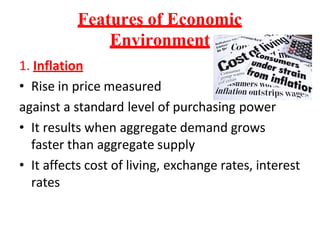
1. Inflation
• Rise in price measured
against a standard level of purchasing power
• It results when aggregate demand grows
faster than aggregate supply
• It affects cost of living, exchange rates, interest
rates
Implications of Chronic inflation
• It affects the cost of living as the rising prices
makes it more difficult for consumers to buy
products unless their income rises at same
pace.
•Customers cannot effectively
plan long term investments ,
no incentives to save
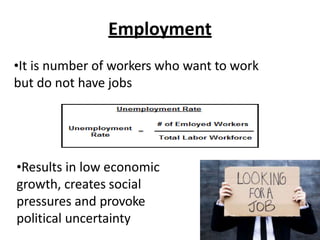
Employment
•It is number of workers who want to work
but do not have jobs
•Results in low economic
growth, creates social
pressures and provoke
political uncertainty
DEBT
• Sum of borrowing from it population, foreign
organization and government
• Larger the debt, more uncertain is the
country’s economy
• Debt of US has increased from $1 trillion in
1980 to $9.4 trillion in 2008
• Types- Internal & External
• Internal Debt- When government spends
more than it collects
o Imperfect tax system
• External Debt- When government borrows
money from foreign lenders
• Ex- Zambia and Liberia has slow economic
growth rate
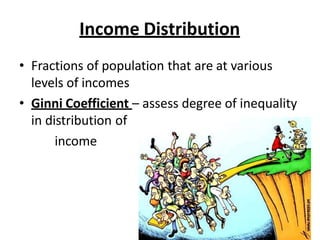
Income Distribution
• Fractions of population that are at various
levels of incomes
• Ginni Coefficient – assess degree of inequality
in distribution of
income
Income Distribution among wealthy
nations
• US has largest inequality gap
• Share of income to top 1% has increased and
decreased for the poorest 40%
• Urban vs Rural Income- In china urban income
is 7times more than rural income
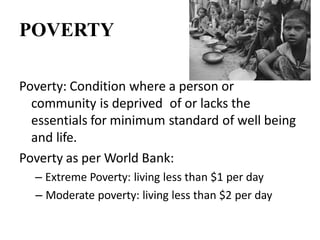
POVERTY
Poverty: Condition where a person or
community is deprived of or lacks the
essentials for minimum standard of well being
and life.
Poverty as per World Bank:
– Extreme Poverty: living less than $1 per day
– Moderate poverty: living less than $2 per day
LABOR COST
LABOR COST
– Key element of total cost.
– Companies scan the world to identify the
difference between low cost and high cost
countries.
PRODUCTIVITY
• Amount of output created per unit input
used.
• It is the efficiency with which goods and
services are produced.
BALANCE OF PAYMENTS
• Statement of country’s trade and financial
transactions created by individuals, business and
government agencies.
Components of Economic. Environment
 Growth strategy,
 Economic systems,
 Economic planning,
 Industry,
 Agriculture,
 Infrastructure,
 Financial and fiscal sectors,
 Removal of regional imbalances,
 Price and distribution controls,
 Economic reforms,
 Human resources, and
 Per capita and national income.
Economic Systems
Def. The method used by a society to produce
and distribute goods and services.
Or, How the government tells us what we can
get and how to get it!
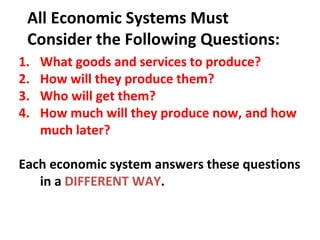
All Economic Systems Must
Consider the Following Questions:
1. What goods and services to produce?
2. How will they produce them?
3. Who will get them?
4. How much will they produce now, and how
much later?
Each economic system answers these questions
in a DIFFERENT WAY.
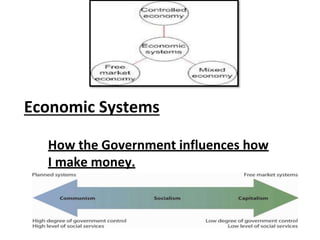
Economic Systems
How the Government influences how
I make money.
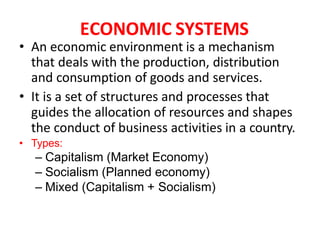
ECONOMIC SYSTEMS
• An economic environment is a mechanism
that deals with the production, distribution
and consumption of goods and services.
• It is a set of structures and processes that
guides the allocation of resources and shapes
the conduct of business activities in a country.
• Types:
– Capitalism (Market Economy)
– Socialism (Planned economy)
– Mixed (Capitalism + Socialism)
CAPITALISM/FREE MARKET ECONOMY
Free market system built on private ownership
and control.
Owners of capital have inalienable property rights
that give them right to earn a profit in return of
their effort, investment and risk.
Free Market Economy
Economic questions are answered by individual
buyers and sellers.
Supply and demand influence economy
People act out of self interest; motive for profit
(money) drives the economy
Also known as FREE ENTERPRISE or CAPITALISM
Ex. The United States, Western
Europe, Japan
COMMUNISM/COMMAND/CONTROLLED
ECONOMY
Centrally planned system built on state
ownership of economic factors of production
and control of all economic activity.
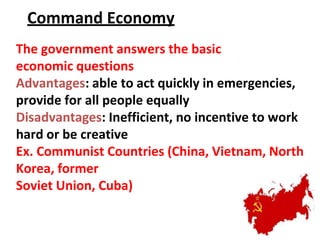
Command Economy
The government answers the basic
economic questions
Advantages: able to act quickly in emergencies,
provide for all people equally
Disadvantages: Inefficient, no incentive to work
hard or be creative
Ex. Communist Countries (China, Vietnam, North
Korea, former
Soviet Union, Cuba)
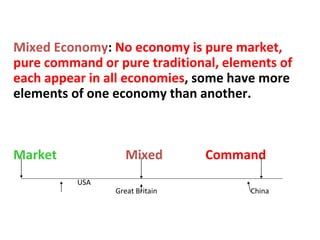
Mixed Economy: No economy is pure market,
pure command or pure traditional, elements of
each appear in all economies, some have more
elements of one economy than another.
Market Mixed Command
USA
Great Britain China
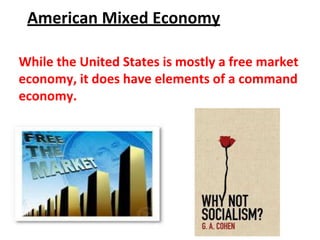
American Mixed Economy
While the United States is mostly a free market
economy, it does have elements of a command
economy.
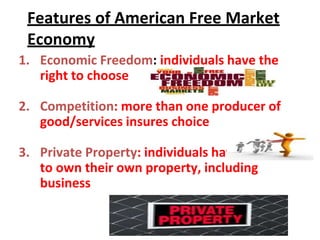
Features of American Free Market
Economy
1. Economic Freedom: individuals have the
right to choose
2. Competition: more than one producer of
good/services insures choice
3. Private Property: individuals have the right
to own their own property, including
business
Features of American Free Market
Economy (cont)
4. Self-Interest: individuals make
decisions based on what is best for them
5. Voluntary Exchange: individuals may freely
buy and sell goods
6. Profit Motive: individuals are driven by a
desire to profit (make money)
Features of American Command
Economy
1. Government regulation of some business
practices
• Ex. Wages, labor hours,
safety practice.
2. Government limits certain choices
• Ex. Cannot buy or produce certain goods/services
3. Government provides aid to the needy
• Ex. Medicare, Medicaid, welfare
• Benefits of Capitalism
• In years 1000–1820 world economy grew six-fold, in years
1820–1998 world economy grew 50-fold
• Provides Choice to customers
• Provides valuable goods and services
• Capitalism actively rewards positive traits like hard work
• Similarly, it punishes negative traits such as laziness and
theft
• Narrows the gap between common person and wealthy
• Provides opportunity to realize dreams and desires
• Capitalist societies usually do not have large black markets
• Build on democracy
• Social Good
• Major limitations/ Criticism:
• Downfall of work ethics
• Free Market + Self Interest
• Accumulation of wealth
• Encourages inequality in a society
• Business lobbying with government
• Monopolistic tendency
• Human resource exploitation
• Results in great disparities between income
of people owning the capital resources and
others
Collective ownership and democratic control of the
material means of production by the workers and the
people
•Socialism is a term applied to an economic system in which property
is held in common and not individually, and relationships are governed
by a political hierarchy. Common ownership doesn't mean decisions
are made collectively, however. Instead, individuals in positions of
authority make decisions in the name of the collective group.
•Socialists argue that socialism would allow for wealth to be
distributed based on how much one contributes to society, as
opposed to how much capital one holds.
•A primary goal of socialism is social equality and a distribution of
Wealth based on one’s contribution to society and an economic
arrangement that would serve the interests of society as a whole.
• Features of Socialism;
• Social Ownership of means of
production
• Existance of public sector
• Decisive role of Economic Planning
• Production guided by Social Benefits
• Abolition of exploitation of labour
• Benefits of Socialism
i. Better salaries
ii. Stable Environment
iii. Eliminates poverty
iv. Better Products
v. Fulfills survival need
vi. Opportunity for citizens to explore non-
economically- productive pursuits
• Criticism of Socialism
• Distorted price signals
• Suppression of economic
democracy
• Slow Technological
advancements
• Minimize self management
• Reduced incentives
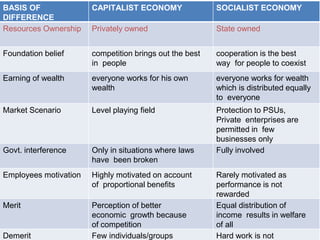
BASIS OF
DIFFERENCE
CAPITALIST ECONOMY SOCIALIST ECONOMY
Resources Ownership Privately owned State owned
Foundation belief competition brings out the best
in people
cooperation is the best
way for people to coexist
Earning of wealth everyone works for his own
wealth
everyone works for wealth
which is distributed equally
to everyone
Market Scenario Level playing field Protection to PSUs,
Private enterprises are
permitted in few
businesses only
Govt. interference Only in situations where laws
have been broken
Fully involved
Employees motivation Highly motivated on account
of proportional benefits
Rarely motivated as
performance is not
rewarded
Merit Perception of better
economic growth because
of competition
Equal distribution of
income results in welfare
of all
Demerit Few individuals/groups Hard work is not
Mixed Economy
• Any economy in which private corporate enterprises and
public sector enterprises exist side-by-side, and
decisions taken through market mechanism are
supplemented by some form of partial planning, is to be
described as a mixed economy.
• This system overcomes the disadvantages of both the
market and planned economic systems.
• Provides a clear demarcation of the boundaries of public
sector and private sector so that the core sector and
strategic sectors are invariably in the public sector.
• The government intervenes to prevent undue
concentration of economic power, and monopolistic and
restrictive trade practices
• The rights of the individual are respected and protected
subject only tothe requirements of public law and order
and morality
• Features
• Resources are owned both by the government as
well as private individuals. i.e. co-existence of
both public sector and private sector.
• Market forces prevail but are closely monitored by
the government.
• Monopolies may be existing but under
close supervision of the government.
• Advantages
• Producers and consumer have sovereignty to choose
what to produce and what to consume but production and
consumption of harmful goods and services may be
stopped by the government.
• As compared to Market economy, a mixed economy may
have less income inequality due to the role played by the
government.
• A mixed economy represents an achievable balance
between individual initiative and social goals.

Economic systems

  • 1.
    ECONOMIC ENVIRONMENT • EconomicEnvironment refers to all those economic factors, which have a bearing on the functioning of a business. Business depends on the economic environment for all the needed inputs. • It also depends on the economic environment to sell the finished goods. Naturally, the dependence of business on the economic environment is total and is not surprising because, as it is rightly said, business is one unit of the total economy.
  • 2.
    IMPORTANCE OF ECONOMIC ENVIRONMENT •Managers assess economic environment and forecast market trends in the effort to make better investment choices and competitive strategies. • Economic analysis look at several indicators of an economic environment with emphasis given to how local conditions require adjusting analysis and interpratation. • The economic environments of foreign companies and markets can help managers predict events that might affect the company’s future performance.
  • 3.
    ELEMENTS OF ECONOMIC ENVIRONMENT •GROSS NATIONAL INCOME: The income generated both by total domestic production as well as the international production activities of national companies. GROSS DOMESTIC PRODUCT: The total value of all final goods and services produced in a country in a given year equal to total consumer, investment, and government spending, plus the value of exports, minus the value of imports.
  • 4.
    • PER CAPITACONVERSION: The per capita GNI is taking GNI of a country and converting it into a standard currency say at US DOLLARS at prevailing market rates and then dividing this sum by its population leads to a Per Capita Conversion estimator. it helps to explain an economy’s performance in terms of people who live in that country.
  • 5.
    3. Rate OfChange • GDP growth rate indicates a country’s economic potential. • High GDP rate means rising standard of living,Business opportunites • Example- China has been one of the fastest growing economies over the past 2 decades, which attracted an immense amount of FDI. • The developing countries like China and India have a higher growth rate than the US
  • 6.
    4. Purchasing PowerParity • The purchasing power in terms of foreign exchange • To compare markets, the per capita income is converted into foreign terms • Exchange rate tells how many units of currency it takes to buy one US dollar • Per capita income does not consider the difference in cost of living from one country to another. Like, the cost of living in the US and India differ, but it assumes that the dollar of income of US and the dollar of income of India has the same purchasing power
  • 7.
    • The numberof units of a country’s currency required to buy the same amounts of goods and services in the domestic market that one unit of income would buy in the other country. • Estimating the value of a universal basket of good and services that can be purchased with one unit of a country’s currency • Per capita income is higher in India than the US because of the lower cost of living.
  • 8.
    5. Human DevelopmentIndex • The actual level of development of a country • How well a country does in terms of social liberties, life expectancy, and literacy rates. • 3 dimensions Longevity : Life expectancy at birth Knowledge : Adult Literacy Rate; Combined primary, secondary and tertiary gross enrollment ratio Standard of Living : Per capita income expressed in Purchasing Power Parity for US Dollars
  • 9.
    Features of Economic Environment 1.Inflation • Rise in price measured against a standard level of purchasing power • It results when aggregate demand grows faster than aggregate supply • It affects cost of living, exchange rates, interest rates
  • 10.
    Implications of Chronicinflation • It affects the cost of living as the rising prices makes it more difficult for consumers to buy products unless their income rises at same pace. •Customers cannot effectively plan long term investments , no incentives to save
  • 11.
    Employment •It is numberof workers who want to work but do not have jobs •Results in low economic growth, creates social pressures and provoke political uncertainty
  • 12.
    DEBT • Sum ofborrowing from it population, foreign organization and government • Larger the debt, more uncertain is the country’s economy • Debt of US has increased from $1 trillion in 1980 to $9.4 trillion in 2008 • Types- Internal & External
  • 13.
    • Internal Debt-When government spends more than it collects o Imperfect tax system • External Debt- When government borrows money from foreign lenders • Ex- Zambia and Liberia has slow economic growth rate
  • 14.
    Income Distribution • Fractionsof population that are at various levels of incomes • Ginni Coefficient – assess degree of inequality in distribution of income
  • 15.
    Income Distribution amongwealthy nations • US has largest inequality gap • Share of income to top 1% has increased and decreased for the poorest 40% • Urban vs Rural Income- In china urban income is 7times more than rural income
  • 16.
    POVERTY Poverty: Condition wherea person or community is deprived of or lacks the essentials for minimum standard of well being and life. Poverty as per World Bank: – Extreme Poverty: living less than $1 per day – Moderate poverty: living less than $2 per day
  • 17.
    LABOR COST LABOR COST –Key element of total cost. – Companies scan the world to identify the difference between low cost and high cost countries.
  • 18.
    PRODUCTIVITY • Amount ofoutput created per unit input used. • It is the efficiency with which goods and services are produced.
  • 19.
    BALANCE OF PAYMENTS •Statement of country’s trade and financial transactions created by individuals, business and government agencies.
  • 20.
    Components of Economic.Environment  Growth strategy,  Economic systems,  Economic planning,  Industry,  Agriculture,  Infrastructure,  Financial and fiscal sectors,  Removal of regional imbalances,  Price and distribution controls,  Economic reforms,  Human resources, and  Per capita and national income.
  • 21.
    Economic Systems Def. Themethod used by a society to produce and distribute goods and services. Or, How the government tells us what we can get and how to get it!
  • 22.
    All Economic SystemsMust Consider the Following Questions: 1. What goods and services to produce? 2. How will they produce them? 3. Who will get them? 4. How much will they produce now, and how much later? Each economic system answers these questions in a DIFFERENT WAY.
  • 23.
    Economic Systems How theGovernment influences how I make money.
  • 24.
    ECONOMIC SYSTEMS • Aneconomic environment is a mechanism that deals with the production, distribution and consumption of goods and services. • It is a set of structures and processes that guides the allocation of resources and shapes the conduct of business activities in a country. • Types: – Capitalism (Market Economy) – Socialism (Planned economy) – Mixed (Capitalism + Socialism)
  • 25.
    CAPITALISM/FREE MARKET ECONOMY Freemarket system built on private ownership and control. Owners of capital have inalienable property rights that give them right to earn a profit in return of their effort, investment and risk.
  • 26.
    Free Market Economy Economicquestions are answered by individual buyers and sellers. Supply and demand influence economy People act out of self interest; motive for profit (money) drives the economy Also known as FREE ENTERPRISE or CAPITALISM Ex. The United States, Western Europe, Japan
  • 27.
    COMMUNISM/COMMAND/CONTROLLED ECONOMY Centrally planned systembuilt on state ownership of economic factors of production and control of all economic activity.
  • 28.
    Command Economy The governmentanswers the basic economic questions Advantages: able to act quickly in emergencies, provide for all people equally Disadvantages: Inefficient, no incentive to work hard or be creative Ex. Communist Countries (China, Vietnam, North Korea, former Soviet Union, Cuba)
  • 29.
    Mixed Economy: Noeconomy is pure market, pure command or pure traditional, elements of each appear in all economies, some have more elements of one economy than another. Market Mixed Command USA Great Britain China
  • 30.
    American Mixed Economy Whilethe United States is mostly a free market economy, it does have elements of a command economy.
  • 31.
    Features of AmericanFree Market Economy 1. Economic Freedom: individuals have the right to choose 2. Competition: more than one producer of good/services insures choice 3. Private Property: individuals have the right to own their own property, including business
  • 32.
    Features of AmericanFree Market Economy (cont) 4. Self-Interest: individuals make decisions based on what is best for them 5. Voluntary Exchange: individuals may freely buy and sell goods 6. Profit Motive: individuals are driven by a desire to profit (make money)
  • 33.
    Features of AmericanCommand Economy 1. Government regulation of some business practices • Ex. Wages, labor hours, safety practice. 2. Government limits certain choices • Ex. Cannot buy or produce certain goods/services 3. Government provides aid to the needy • Ex. Medicare, Medicaid, welfare
  • 34.
    • Benefits ofCapitalism • In years 1000–1820 world economy grew six-fold, in years 1820–1998 world economy grew 50-fold • Provides Choice to customers • Provides valuable goods and services • Capitalism actively rewards positive traits like hard work • Similarly, it punishes negative traits such as laziness and theft • Narrows the gap between common person and wealthy • Provides opportunity to realize dreams and desires • Capitalist societies usually do not have large black markets • Build on democracy • Social Good
  • 35.
    • Major limitations/Criticism: • Downfall of work ethics • Free Market + Self Interest • Accumulation of wealth • Encourages inequality in a society • Business lobbying with government • Monopolistic tendency • Human resource exploitation • Results in great disparities between income of people owning the capital resources and others
  • 36.
    Collective ownership anddemocratic control of the material means of production by the workers and the people •Socialism is a term applied to an economic system in which property is held in common and not individually, and relationships are governed by a political hierarchy. Common ownership doesn't mean decisions are made collectively, however. Instead, individuals in positions of authority make decisions in the name of the collective group. •Socialists argue that socialism would allow for wealth to be distributed based on how much one contributes to society, as opposed to how much capital one holds. •A primary goal of socialism is social equality and a distribution of Wealth based on one’s contribution to society and an economic arrangement that would serve the interests of society as a whole.
  • 37.
    • Features ofSocialism; • Social Ownership of means of production • Existance of public sector • Decisive role of Economic Planning • Production guided by Social Benefits • Abolition of exploitation of labour
  • 38.
    • Benefits ofSocialism i. Better salaries ii. Stable Environment iii. Eliminates poverty iv. Better Products v. Fulfills survival need vi. Opportunity for citizens to explore non- economically- productive pursuits
  • 39.
    • Criticism ofSocialism • Distorted price signals • Suppression of economic democracy • Slow Technological advancements • Minimize self management • Reduced incentives
  • 40.
    BASIS OF DIFFERENCE CAPITALIST ECONOMYSOCIALIST ECONOMY Resources Ownership Privately owned State owned Foundation belief competition brings out the best in people cooperation is the best way for people to coexist Earning of wealth everyone works for his own wealth everyone works for wealth which is distributed equally to everyone Market Scenario Level playing field Protection to PSUs, Private enterprises are permitted in few businesses only Govt. interference Only in situations where laws have been broken Fully involved Employees motivation Highly motivated on account of proportional benefits Rarely motivated as performance is not rewarded Merit Perception of better economic growth because of competition Equal distribution of income results in welfare of all Demerit Few individuals/groups Hard work is not
  • 41.
    Mixed Economy • Anyeconomy in which private corporate enterprises and public sector enterprises exist side-by-side, and decisions taken through market mechanism are supplemented by some form of partial planning, is to be described as a mixed economy. • This system overcomes the disadvantages of both the market and planned economic systems.
  • 42.
    • Provides aclear demarcation of the boundaries of public sector and private sector so that the core sector and strategic sectors are invariably in the public sector. • The government intervenes to prevent undue concentration of economic power, and monopolistic and restrictive trade practices • The rights of the individual are respected and protected subject only tothe requirements of public law and order and morality
  • 43.
    • Features • Resourcesare owned both by the government as well as private individuals. i.e. co-existence of both public sector and private sector. • Market forces prevail but are closely monitored by the government. • Monopolies may be existing but under close supervision of the government.
  • 44.
    • Advantages • Producersand consumer have sovereignty to choose what to produce and what to consume but production and consumption of harmful goods and services may be stopped by the government. • As compared to Market economy, a mixed economy may have less income inequality due to the role played by the government. • A mixed economy represents an achievable balance between individual initiative and social goals.