“So, How do you Define Economic Development?”
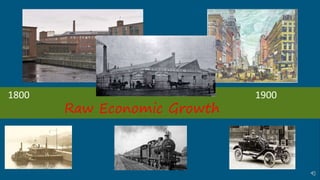
1800 1900
Raw Economic Growth
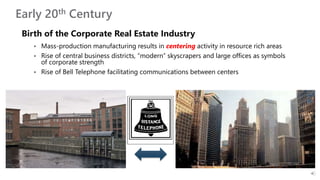
Early 20th Century
Birth of the Corporate Real Estate Industry
 Mass-production manufacturing results in centering activity in resource rich areas
 Rise of central business districts, “modern” skyscrapers and large offices as symbols
of corporate strength
 Rise of Bell Telephone facilitating communications between centers
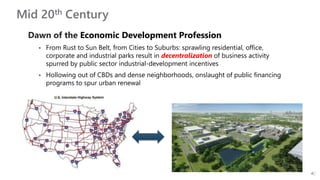
Mid 20th Century
Dawn of the Economic Development Profession
 From Rust to Sun Belt, from Cities to Suburbs: sprawling residential, office,
corporate and industrial parks result in decentralization of business activity
spurred by public sector industrial-development incentives
 Hollowing out of CBDs and dense neighborhoods, onslaught of public financing
programs to spur urban renewal
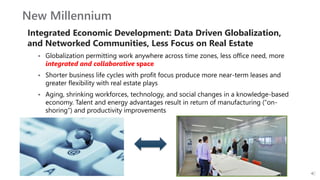
New Millennium
Integrated Economic Development: Data Driven Globalization,
and Networked Communities, Less Focus on Real Estate
 Globalization permitting work anywhere across time zones, less office need, more
integrated and collaborative space
 Shorter business life cycles with profit focus produce more near-term leases and
greater flexibility with real estate plays
 Aging, shrinking workforces, technology, and social changes in a knowledge-based
economy. Talent and energy advantages result in return of manufacturing (“on-
shoring”) and productivity improvements
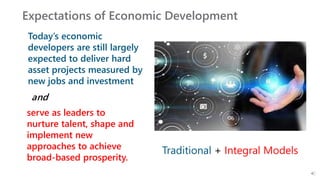
Expectations of Economic Development
Today’s economic
developers are still largely
expected to deliver hard
asset projects measured by
new jobs and investment
Traditional + Integral Models
and
serve as leaders to
nurture talent, shape and
implement new
approaches to achieve
broad-based prosperity.
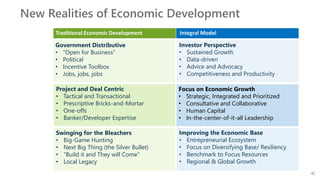
New Realities of Economic Development
Government Distributive
• “Open for Business”
• Political
• Incentive Toolbox
• Jobs, jobs, jobs
Investor Perspective
• Sustained Growth
• Data-driven
• Advice and Advocacy
• Competitiveness and Productivity
Project and Deal Centric
• Tactical and Transactional
• Prescriptive Bricks-and-Mortar
• One-offs
• Banker/Developer Expertise
Focus on Economic Growth
• Strategic, Integrated and Prioritized​
• Consultative and Collaborative​
• Human Capital​
• In-the-center-of-it-all Leadership
Swinging for the Bleachers
• Big-Game Hunting
• Next Big Thing (the Silver Bullet)
• “Build it and They will Come”
• Local Legacy
Improving the Economic Base
• Entrepreneurial Ecosystem
• Focus on Diversifying Base/ Resiliency
• Benchmark to Focus Resources
• Regional & Global Growth
Traditional Economic Development Integral Model
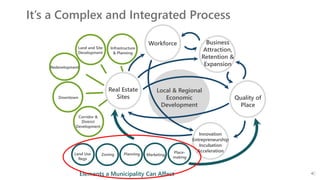
It’s a Complex and Integrated Process
Workforce Business
Attraction,
Retention &
Expansion
Local & Regional
Economic
Development
Quality of
Place
Innovation
Entrepreneurship
Incubation
Acceleration
Real Estate
Sites
Infrastructure
& Planning
Land and Site
Development
Redevelopment
Downtown
Corridor &
District
Development
Land Use
Regs
Zoning Planning Marketing
Place-
making
Elements a Municipality Can Affect
What are we trying to achieve?
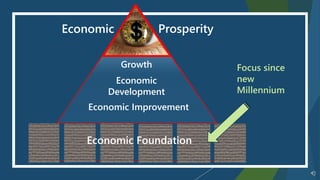
Economic
Economic
Development
Growth
Economic Improvement
Prosperity
Economic Foundation
Focus since
new
Millennium
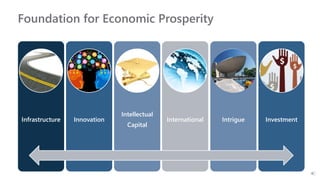
Foundation for Economic Prosperity
Infrastructure Innovation
Intellectual
Capital
International Intrigue Investment
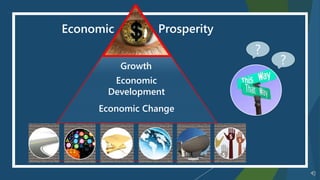
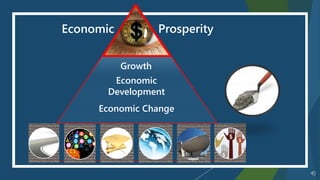
Economic
Economic
Development
Growth
Economic Change
Prosperity
?
?
Economic
Economic
Development
Growth
Economic Change
Prosperity
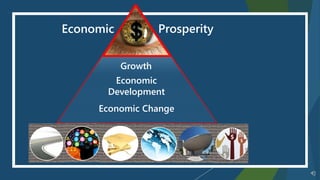
Economic
Economic
Development
Growth
Economic Change
Prosperity
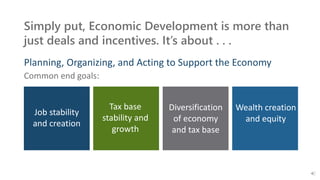
Simply put, Economic Development is more than
just deals and incentives. It’s about . . .
Job stability
and creation
Planning, Organizing, and Acting to Support the Economy
Common end goals:
Tax base
stability and
growth
Diversification
of economy
and tax base
Wealth creation
and equity
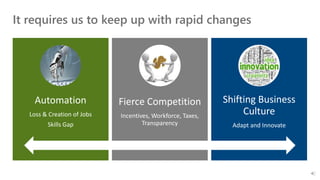
Automation
Loss & Creation of Jobs
Skills Gap
Fierce Competition
Incentives, Workforce, Taxes,
Transparency
Shifting Business
Culture
Adapt and Innovate
It requires us to keep up with rapid changes
Today’s Economic Development
What is it?
 A process that influences the growth and restructuring of local economies
How is it done?
 Understanding the dynamics of business change and taking early, proactive
business-friendly steps to help companies grow
Why—for what purpose?
 Largely to create jobs and draw new income into the regional economy that
can then be spent within the community and support non-basic employment
sectors
 Assure economic prosperity and contribute to a better quality of life
Dan Gundersen
Principal & Senior Vice President
Camoin 310 Associates
dan@camoinassociates.com

Defining Economic Development

  • 1.
    “So, How doyou Define Economic Development?”
  • 3.
  • 4.
    Early 20th Century Birthof the Corporate Real Estate Industry  Mass-production manufacturing results in centering activity in resource rich areas  Rise of central business districts, “modern” skyscrapers and large offices as symbols of corporate strength  Rise of Bell Telephone facilitating communications between centers
  • 5.
    Mid 20th Century Dawnof the Economic Development Profession  From Rust to Sun Belt, from Cities to Suburbs: sprawling residential, office, corporate and industrial parks result in decentralization of business activity spurred by public sector industrial-development incentives  Hollowing out of CBDs and dense neighborhoods, onslaught of public financing programs to spur urban renewal
  • 6.
    New Millennium Integrated EconomicDevelopment: Data Driven Globalization, and Networked Communities, Less Focus on Real Estate  Globalization permitting work anywhere across time zones, less office need, more integrated and collaborative space  Shorter business life cycles with profit focus produce more near-term leases and greater flexibility with real estate plays  Aging, shrinking workforces, technology, and social changes in a knowledge-based economy. Talent and energy advantages result in return of manufacturing (“on- shoring”) and productivity improvements
  • 7.
    Expectations of EconomicDevelopment Today’s economic developers are still largely expected to deliver hard asset projects measured by new jobs and investment Traditional + Integral Models and serve as leaders to nurture talent, shape and implement new approaches to achieve broad-based prosperity.
  • 8.
    New Realities ofEconomic Development Government Distributive • “Open for Business” • Political • Incentive Toolbox • Jobs, jobs, jobs Investor Perspective • Sustained Growth • Data-driven • Advice and Advocacy • Competitiveness and Productivity Project and Deal Centric • Tactical and Transactional • Prescriptive Bricks-and-Mortar • One-offs • Banker/Developer Expertise Focus on Economic Growth • Strategic, Integrated and Prioritized​ • Consultative and Collaborative​ • Human Capital​ • In-the-center-of-it-all Leadership Swinging for the Bleachers • Big-Game Hunting • Next Big Thing (the Silver Bullet) • “Build it and They will Come” • Local Legacy Improving the Economic Base • Entrepreneurial Ecosystem • Focus on Diversifying Base/ Resiliency • Benchmark to Focus Resources • Regional & Global Growth Traditional Economic Development Integral Model
  • 9.
    It’s a Complexand Integrated Process Workforce Business Attraction, Retention & Expansion Local & Regional Economic Development Quality of Place Innovation Entrepreneurship Incubation Acceleration Real Estate Sites Infrastructure & Planning Land and Site Development Redevelopment Downtown Corridor & District Development Land Use Regs Zoning Planning Marketing Place- making Elements a Municipality Can Affect
  • 10.
    What are wetrying to achieve?
  • 11.
  • 12.
    Foundation for EconomicProsperity Infrastructure Innovation Intellectual Capital International Intrigue Investment
  • 13.
  • 14.
  • 15.
  • 16.
    Simply put, EconomicDevelopment is more than just deals and incentives. It’s about . . . Job stability and creation Planning, Organizing, and Acting to Support the Economy Common end goals: Tax base stability and growth Diversification of economy and tax base Wealth creation and equity
  • 17.
    Automation Loss & Creationof Jobs Skills Gap Fierce Competition Incentives, Workforce, Taxes, Transparency Shifting Business Culture Adapt and Innovate It requires us to keep up with rapid changes
  • 18.
    Today’s Economic Development Whatis it?  A process that influences the growth and restructuring of local economies How is it done?  Understanding the dynamics of business change and taking early, proactive business-friendly steps to help companies grow Why—for what purpose?  Largely to create jobs and draw new income into the regional economy that can then be spent within the community and support non-basic employment sectors  Assure economic prosperity and contribute to a better quality of life
  • 19.
    Dan Gundersen Principal &Senior Vice President Camoin 310 Associates dan@camoinassociates.com

Editor's Notes

  • #4 By 1860, the value of all manufactured goods in New York State was so great that it totaled three times more than the total produced in all of the Southern states. And, at that time 10 of the 100 most populous urban areas in the entire nation were in upstate New York. The state’s first steam engine railroad ran alongside the Erie Canal from Albany to Schenectady. It began in 1831 and was known as the Mohawk & Albany.
  • #18 Continued Uncertain Environment Automation: Transition in jobs – not the death of jobs. Every sector affected – retail to professional services. IBM’s Watson. Refer to Agriculture and manufacturing downward trend, with total employment continuing to rise In 1979 the DOL and Think Tank issued a report that said we would have fewer jobs and 20 hour work weeks by 2020 – opposite has occurred. Fierce Competition: Texas & Others - 4A & 4B program CT – TIF Florida – no incentives, workforce development focus 7 States do not have an income tax Shifting Business Culture: Business disruptor Amazon Uber