Copyright ©2015 Pearson Education, Inc. All rights reserved. 1-1
Copyright ©2015 Pearson Education, Inc. All rights reserved. 1-2
Chapter 2: Comparative
Economic Development
2.1 An Introduction
2.2 What is the Developing World? Classifying Levels of
National Economic Development
2.3 Comparing Countries by Health and Education, and
the Human Development Index
2.4 Key Similarities and Differences Among Developing
Countries
2.5 Are Living Standards of Developing and Developed
Nations Converging?
2.6 Long-Run Causes of Comparative Development
2.7 Concluding Observations
Copyright ©2015 Pearson Education, Inc. All rights reserved. 2-3
2.1 An Introduction
• Developing countries: Countries primarily in Asia,
Africa, the Middle East, Latin America, eastern
Europe, and the former Soviet Union that are
presently characterized by low levels of living and
other development deficits.
• Output per worker in the United States is over eight
times higher than it is in India and more than 50
times higher than in the Democratic Republic of
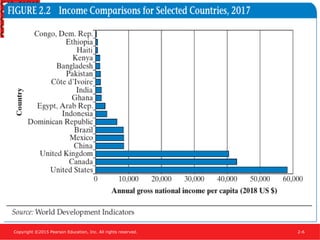
Congo (DRC). In 2017, gross national income (GNI)
per capita was $58,270 in the United States, $1,800
in India, and $460 in the DRC.
Copyright ©2015 Pearson Education, Inc. All rights reserved. 2-4
2.1 An Introduction
• Life expectancy is 78.7 years in the United States,
68.6 in India, and just 59.6 in the DRC. The
percentage of children who are underweight is less
than 2% in the United States but 36% in India and
23% in the DRC. Whereas almost all women are
literate in the United States, only 63% are in India,
and 67% in the DRC.
Copyright ©2015 Pearson Education, Inc. All rights reserved. 2-5
2.2 What is the Developing World?
Classifying Levels of National Economic
Development
• A traditional way to define levels of economic
development level is by per capita income. We then
extend country comparisons to education and health;
the United Nations.
• In 2018 there were 34 countries classified as LICs;
there were 47 LMCs and 56 UMCs. There were 81
HICs with at least $12,056 per person.
• TABLE 2.1 Pg-38
Copyright ©2015 Pearson Education, Inc. All rights reserved. 2-6
Copyright ©2015 Pearson Education, Inc. All rights reserved. 2-7
• GNI per capita is often used as a summary index of
the relative economic well-being of people in
different nations. It is calculated as the total
domestic and foreign value added claimed by a
country’s residents without making deductions for
depreciation.
• Gross domestic product (GDP) measures the total
value for final use of output produced by an
economy, by both residents and nonresidents.
2.2.2 Adjusting for Purchasing
Power Parity
Copyright ©2015 Pearson Education, Inc. All rights reserved. 2-8
• Thus, GNI comprises GDP plus the difference between
the income residents receive from abroad for factor
services (labor and capital) less payments made to
nonresidents who contribute to the domestic economy.
• Where there is a large nonresident population playing
a major role in the domestic economy (such as foreign
corporations), these differences can be significant.
• PPP is calculated using a common set of international
prices for all goods and services.
2.2.2 Adjusting for Purchasing
Power Parity
Copyright ©2015 Pearson Education, Inc. All rights reserved. 2-9
• An intuitive although imprecise way to think about
Purchasing Power Parity is the number of units of a
foreign country’s currency required to purchase the
quantity of goods and services in the local developing
country market as $1 would buy in the United States.
• In practice, adjustments are made for differing
relative prices across countries so that living
standards may be measured more accurately.
2.2.2 Adjusting for Purchasing
Power Parity
Copyright ©2015 Pearson Education, Inc. All rights reserved. 2-10
• Table 2.2 provides a comparison of exchange-rate and
PPP GNI per capita for 30 countries, ten each from
Africa, Asia, and Latin America, plus Canada, the
United Kingdom and the United States (along with
averages for three income levels).
• Pg 44
2.2.2 Adjusting for Purchasing
Power Parity
Copyright ©2015 Pearson Education, Inc. All rights reserved. 2-11
1. The G7 and G20. Two country groupings of geopolitical
significance are the group of seven largest developed
economies (G7); and an expanded group of 20 (G20)
countries that also includes the large middle-income countries.
2. Least-developed countries. This is a widely used United
Nations (UN) designation that included 47 countries as of the
end of 2018; 33 are in Africa, 9 in Asia, 4 in (Pacific) Oceana,
plus Haiti. For inclusion, a country has to meet each of three
criteria: low income, low human capital (health and
education), and high economic vulnerability.
2.2.3 Other Common Country
Classifications
Copyright ©2015 Pearson Education, Inc. All rights reserved. 2-12
3. Landlocked and small island countries. Two additional special UN
classifications are also noteworthy: the landlocked developing
countries (LLDCs, of which there are 30, with 15 of them in
Africa); and the small island developing states (SIDS, of which
there are 38)
4. Heavily indebted poor countries (HIPCs). As of 2019 there are 39
HIPC countries.
5. Newly industrialising countries (NICs)- An early stage of export-led
manufacture growth. For example, South Korea and Taiwan, and
subsequently to Thailand and Indonesia, from the 1970s to 1980s.
The term may be applied today to a country such as Vietnam.
2.2.3 Other Common Country
Classifications
Copyright ©2015 Pearson Education, Inc. All rights reserved. 2-13
2.3 Comparing Countries by Health
and Education, and the Human
Development Index
2.3.1 Comparing Health and Education Levels
Three basic indicators of average health—life expectancy
at birth, the under-5 mortality rate, and the prevalence of
undernourishment;
Two indicators of average education—the gross enrolment
ratio for secondary school, and the percent of the population
with at least some secondary education.
Copyright ©2015 Pearson Education, Inc. All rights reserved. 2-14
Indicators of Health, and Education
• Life expectancy is the average number of years newborn
children would live if subjected to the mortality risks
prevailing for their cohort at the time of their birth.
• Undernourishment means consuming too little food to
maintain normal levels of activity; High fertility can be both
a cause and a consequence of underdevelopment, so the
birth rate is reported as another basic indicator.
• Literacy is the fraction of adult males and females reported
or estimated to have basic abilities to read and write;
functional literacy is generally lower than the reported
numbers.
Copyright ©2015 Pearson Education, Inc. All rights reserved. 2-15
2.3.2 Introducing the Human
Development Index
TABLE 2.3 Commonality and Diversity:
Some Basic Indicators of Health and
Education
Copyright ©2015 Pearson Education, Inc. All rights reserved. 2-16
2.3 Holistic Measures of Living Levels
and Capabilities (HDI)
• Income
• Life Expectancy
• Education
• 0 stands for the (lowest human development)
• 1 stands for the (highest human development)
• HDI can be calculated for groups and regions in a country
– HDI varies among groups within countries
– HDI varies across regions in a country
– HDI varies between rural and urban areas
Copyright ©2015 Pearson Education, Inc. All rights reserved. 2-17
2.3 Holistic Measures of Living Levels
and Capabilities
• The Traditional Human Development Index
The HDI ranks countries into four groups:
• low human development (0.0 to 0.499),
• medium human development (0.50 to 0.799),
• high human development (0.80 to 0.90), and
• very high human development (0.90 to 1.0).
Copyright ©2015 Pearson Education, Inc. All rights reserved. 2-18
Life expectancy = Current Longevity – Minimum
index Longevity/ Maximum Longevity
– Minimum Longevity
Education index = 2/3 (adult literacy index) + 1/3 (gross
enrollment index)
Adult literacy index = Current Literacy rate – 0/ 100 - 0
Gross enrollment index = Current Enrollment rate – 0/ 100 -
0
Income index = [log (Current Income) - log (100)] /
[log (Maximum) - log(Minimum Income
100)]
Traditional Human Development Index
(UNDP, 1990-2009)
Traditional HDI = 1/3(Income Index)+ 1/3(life
Expectancy Index + 1/3 (Education Index)
Copyright ©2015 Pearson Education, Inc. All rights reserved. 2-19
Calculation Pg – Appendix
Copyright ©2015 Pearson Education, Inc. All rights reserved. 2-20
What is new in the New HDI?
1. Calculating with a geometric mean
• Probably most consequential: The index is now computed
with a geometric mean, instead of an arithmetic mean.
• A geometric mean is also used to build up the overall
education index from its two components
• Traditional HDI added the three components and divided by 3
• New HDI takes the cube root of the product of the three
component indexes
• The traditional HDI calculation assumed one component
traded off against another as perfect substitutes, a strong
assumption
• The reformulation now allows for imperfect substitutability
which development specialists widely consider a more
plausible way to frame the tradeoffs.
Copyright ©2015 Pearson Education, Inc. All rights reserved. 2-21
What is new in the New HDI?
2. Other key changes:
• Gross national income per capita replaces gross domestic
product per capita
• Revised education components: now using the average actual
educational attainment of the whole population, and the
expected attainment of today’s children.
• The maximum values in each dimension have been increased to
the observed maximum rather than given a predefined cutoff.
• The lower goalpost for income has been reduced due to new
evidence on lower possible income levels.
• Rather than using the common logarithm (log) to reflect
diminishing marginal benefit of income, the NHDI now uses the
natural log (ln).
Copyright ©2015 Pearson Education, Inc. All rights reserved. 2-22
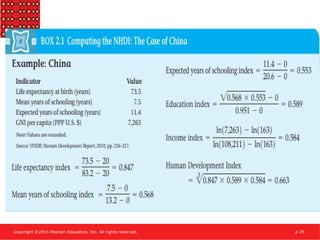
• NHDI Example
• Costa Rica
• Pg 48 13th
Edition
Copyright ©2015 Pearson Education, Inc. All rights reserved. 2-23
23
Observed Maximum Life Expectancy yrs =
85
Minimum Life Expectancy yrs =
20
Maximum average actual years of schooling =
15 Minimum average years of schooling
= 0
Maximum Expected years of schooling =
18 Minimum Expected years of schooling = 0
Maximum Income =US$
Standard Values for NHDI
Copyright ©2015 Pearson Education, Inc. All rights reserved. 2-24
Education Index = – Mini yrs (Maximum years of schooling -
Minimum years)
Income Index = ln(Current Income) – ln(Mini Income)
ln(Max Income) – ln(Mini Income)
Life expectancy index = Life expectancy at birth (years) - Minimum life
expectancy
Maximum life expectancy – Minimum life expectancy
NHDI = H1/3
E 1/3
I 1/3
or 3
H*E*I
√
New HDI (UNDP,
2010)
Copyright ©2015 Pearson Education, Inc. All rights reserved. 2-25
Copyright ©2015 Pearson Education, Inc. All rights reserved. 2-26
TABLE 2.4 2018 Human Development
Index and its Components for Selected
Countries
ABLE 2.5 HDI for Countries with Similar
Income Levels
BOX 2.1
Copyright ©2015 Pearson Education, Inc. All rights reserved. 2-27
Copyright ©2015 Pearson Education, Inc. All rights reserved. 2-28
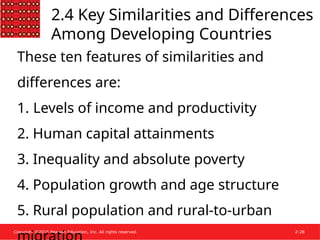
2.4 Key Similarities and Differences
Among Developing Countries
These ten features of similarities and
differences are:
1. Levels of income and productivity
2. Human capital attainments
3. Inequality and absolute poverty
4. Population growth and age structure
5. Rural population and rural-to-urban

2 COMPARATIVE ECONOMIC DEVELOPMENT (1).pptx

  • 1.
    Copyright ©2015 PearsonEducation, Inc. All rights reserved. 1-1
  • 2.
    Copyright ©2015 PearsonEducation, Inc. All rights reserved. 1-2 Chapter 2: Comparative Economic Development 2.1 An Introduction 2.2 What is the Developing World? Classifying Levels of National Economic Development 2.3 Comparing Countries by Health and Education, and the Human Development Index 2.4 Key Similarities and Differences Among Developing Countries 2.5 Are Living Standards of Developing and Developed Nations Converging? 2.6 Long-Run Causes of Comparative Development 2.7 Concluding Observations
  • 3.
    Copyright ©2015 PearsonEducation, Inc. All rights reserved. 2-3 2.1 An Introduction • Developing countries: Countries primarily in Asia, Africa, the Middle East, Latin America, eastern Europe, and the former Soviet Union that are presently characterized by low levels of living and other development deficits. • Output per worker in the United States is over eight times higher than it is in India and more than 50 times higher than in the Democratic Republic of Congo (DRC). In 2017, gross national income (GNI) per capita was $58,270 in the United States, $1,800 in India, and $460 in the DRC.
  • 4.
    Copyright ©2015 PearsonEducation, Inc. All rights reserved. 2-4 2.1 An Introduction • Life expectancy is 78.7 years in the United States, 68.6 in India, and just 59.6 in the DRC. The percentage of children who are underweight is less than 2% in the United States but 36% in India and 23% in the DRC. Whereas almost all women are literate in the United States, only 63% are in India, and 67% in the DRC.
  • 5.
    Copyright ©2015 PearsonEducation, Inc. All rights reserved. 2-5 2.2 What is the Developing World? Classifying Levels of National Economic Development • A traditional way to define levels of economic development level is by per capita income. We then extend country comparisons to education and health; the United Nations. • In 2018 there were 34 countries classified as LICs; there were 47 LMCs and 56 UMCs. There were 81 HICs with at least $12,056 per person. • TABLE 2.1 Pg-38
  • 6.
    Copyright ©2015 PearsonEducation, Inc. All rights reserved. 2-6
  • 7.
    Copyright ©2015 PearsonEducation, Inc. All rights reserved. 2-7 • GNI per capita is often used as a summary index of the relative economic well-being of people in different nations. It is calculated as the total domestic and foreign value added claimed by a country’s residents without making deductions for depreciation. • Gross domestic product (GDP) measures the total value for final use of output produced by an economy, by both residents and nonresidents. 2.2.2 Adjusting for Purchasing Power Parity
  • 8.
    Copyright ©2015 PearsonEducation, Inc. All rights reserved. 2-8 • Thus, GNI comprises GDP plus the difference between the income residents receive from abroad for factor services (labor and capital) less payments made to nonresidents who contribute to the domestic economy. • Where there is a large nonresident population playing a major role in the domestic economy (such as foreign corporations), these differences can be significant. • PPP is calculated using a common set of international prices for all goods and services. 2.2.2 Adjusting for Purchasing Power Parity
  • 9.
    Copyright ©2015 PearsonEducation, Inc. All rights reserved. 2-9 • An intuitive although imprecise way to think about Purchasing Power Parity is the number of units of a foreign country’s currency required to purchase the quantity of goods and services in the local developing country market as $1 would buy in the United States. • In practice, adjustments are made for differing relative prices across countries so that living standards may be measured more accurately. 2.2.2 Adjusting for Purchasing Power Parity
  • 10.
    Copyright ©2015 PearsonEducation, Inc. All rights reserved. 2-10 • Table 2.2 provides a comparison of exchange-rate and PPP GNI per capita for 30 countries, ten each from Africa, Asia, and Latin America, plus Canada, the United Kingdom and the United States (along with averages for three income levels). • Pg 44 2.2.2 Adjusting for Purchasing Power Parity
  • 11.
    Copyright ©2015 PearsonEducation, Inc. All rights reserved. 2-11 1. The G7 and G20. Two country groupings of geopolitical significance are the group of seven largest developed economies (G7); and an expanded group of 20 (G20) countries that also includes the large middle-income countries. 2. Least-developed countries. This is a widely used United Nations (UN) designation that included 47 countries as of the end of 2018; 33 are in Africa, 9 in Asia, 4 in (Pacific) Oceana, plus Haiti. For inclusion, a country has to meet each of three criteria: low income, low human capital (health and education), and high economic vulnerability. 2.2.3 Other Common Country Classifications
  • 12.
    Copyright ©2015 PearsonEducation, Inc. All rights reserved. 2-12 3. Landlocked and small island countries. Two additional special UN classifications are also noteworthy: the landlocked developing countries (LLDCs, of which there are 30, with 15 of them in Africa); and the small island developing states (SIDS, of which there are 38) 4. Heavily indebted poor countries (HIPCs). As of 2019 there are 39 HIPC countries. 5. Newly industrialising countries (NICs)- An early stage of export-led manufacture growth. For example, South Korea and Taiwan, and subsequently to Thailand and Indonesia, from the 1970s to 1980s. The term may be applied today to a country such as Vietnam. 2.2.3 Other Common Country Classifications
  • 13.
    Copyright ©2015 PearsonEducation, Inc. All rights reserved. 2-13 2.3 Comparing Countries by Health and Education, and the Human Development Index 2.3.1 Comparing Health and Education Levels Three basic indicators of average health—life expectancy at birth, the under-5 mortality rate, and the prevalence of undernourishment; Two indicators of average education—the gross enrolment ratio for secondary school, and the percent of the population with at least some secondary education.
  • 14.
    Copyright ©2015 PearsonEducation, Inc. All rights reserved. 2-14 Indicators of Health, and Education • Life expectancy is the average number of years newborn children would live if subjected to the mortality risks prevailing for their cohort at the time of their birth. • Undernourishment means consuming too little food to maintain normal levels of activity; High fertility can be both a cause and a consequence of underdevelopment, so the birth rate is reported as another basic indicator. • Literacy is the fraction of adult males and females reported or estimated to have basic abilities to read and write; functional literacy is generally lower than the reported numbers.
  • 15.
    Copyright ©2015 PearsonEducation, Inc. All rights reserved. 2-15 2.3.2 Introducing the Human Development Index TABLE 2.3 Commonality and Diversity: Some Basic Indicators of Health and Education
  • 16.
    Copyright ©2015 PearsonEducation, Inc. All rights reserved. 2-16 2.3 Holistic Measures of Living Levels and Capabilities (HDI) • Income • Life Expectancy • Education • 0 stands for the (lowest human development) • 1 stands for the (highest human development) • HDI can be calculated for groups and regions in a country – HDI varies among groups within countries – HDI varies across regions in a country – HDI varies between rural and urban areas
  • 17.
    Copyright ©2015 PearsonEducation, Inc. All rights reserved. 2-17 2.3 Holistic Measures of Living Levels and Capabilities • The Traditional Human Development Index The HDI ranks countries into four groups: • low human development (0.0 to 0.499), • medium human development (0.50 to 0.799), • high human development (0.80 to 0.90), and • very high human development (0.90 to 1.0).
  • 18.
    Copyright ©2015 PearsonEducation, Inc. All rights reserved. 2-18 Life expectancy = Current Longevity – Minimum index Longevity/ Maximum Longevity – Minimum Longevity Education index = 2/3 (adult literacy index) + 1/3 (gross enrollment index) Adult literacy index = Current Literacy rate – 0/ 100 - 0 Gross enrollment index = Current Enrollment rate – 0/ 100 - 0 Income index = [log (Current Income) - log (100)] / [log (Maximum) - log(Minimum Income 100)] Traditional Human Development Index (UNDP, 1990-2009) Traditional HDI = 1/3(Income Index)+ 1/3(life Expectancy Index + 1/3 (Education Index)
  • 19.
    Copyright ©2015 PearsonEducation, Inc. All rights reserved. 2-19 Calculation Pg – Appendix
  • 20.
    Copyright ©2015 PearsonEducation, Inc. All rights reserved. 2-20 What is new in the New HDI? 1. Calculating with a geometric mean • Probably most consequential: The index is now computed with a geometric mean, instead of an arithmetic mean. • A geometric mean is also used to build up the overall education index from its two components • Traditional HDI added the three components and divided by 3 • New HDI takes the cube root of the product of the three component indexes • The traditional HDI calculation assumed one component traded off against another as perfect substitutes, a strong assumption • The reformulation now allows for imperfect substitutability which development specialists widely consider a more plausible way to frame the tradeoffs.
  • 21.
    Copyright ©2015 PearsonEducation, Inc. All rights reserved. 2-21 What is new in the New HDI? 2. Other key changes: • Gross national income per capita replaces gross domestic product per capita • Revised education components: now using the average actual educational attainment of the whole population, and the expected attainment of today’s children. • The maximum values in each dimension have been increased to the observed maximum rather than given a predefined cutoff. • The lower goalpost for income has been reduced due to new evidence on lower possible income levels. • Rather than using the common logarithm (log) to reflect diminishing marginal benefit of income, the NHDI now uses the natural log (ln).
  • 22.
    Copyright ©2015 PearsonEducation, Inc. All rights reserved. 2-22 • NHDI Example • Costa Rica • Pg 48 13th Edition
  • 23.
    Copyright ©2015 PearsonEducation, Inc. All rights reserved. 2-23 23 Observed Maximum Life Expectancy yrs = 85 Minimum Life Expectancy yrs = 20 Maximum average actual years of schooling = 15 Minimum average years of schooling = 0 Maximum Expected years of schooling = 18 Minimum Expected years of schooling = 0 Maximum Income =US$ Standard Values for NHDI
  • 24.
    Copyright ©2015 PearsonEducation, Inc. All rights reserved. 2-24 Education Index = – Mini yrs (Maximum years of schooling - Minimum years) Income Index = ln(Current Income) – ln(Mini Income) ln(Max Income) – ln(Mini Income) Life expectancy index = Life expectancy at birth (years) - Minimum life expectancy Maximum life expectancy – Minimum life expectancy NHDI = H1/3 E 1/3 I 1/3 or 3 H*E*I √ New HDI (UNDP, 2010)
  • 25.
    Copyright ©2015 PearsonEducation, Inc. All rights reserved. 2-25
  • 26.
    Copyright ©2015 PearsonEducation, Inc. All rights reserved. 2-26 TABLE 2.4 2018 Human Development Index and its Components for Selected Countries ABLE 2.5 HDI for Countries with Similar Income Levels BOX 2.1
  • 27.
    Copyright ©2015 PearsonEducation, Inc. All rights reserved. 2-27
  • 28.
    Copyright ©2015 PearsonEducation, Inc. All rights reserved. 2-28 2.4 Key Similarities and Differences Among Developing Countries These ten features of similarities and differences are: 1. Levels of income and productivity 2. Human capital attainments 3. Inequality and absolute poverty 4. Population growth and age structure 5. Rural population and rural-to-urban