
By :
Aurelia A. Valerio
and
Helen Grace A. Cabuhat
Special Economic Zones (SEZ) or Ecozones
- Selected areas with highly developed agro-
industrial, industrial, tourist, recreational,
business, banking and financial investment
centers or having the potential to be developed
into either of them.
ECOZONES may contain any or all of the following :
1. Industrial estates ( IE) - are large tracts of land, subdivided and developed
based upon a comprehensive plan with provisions for infrastructure
facilities for the use of the industrial community.
2. Export Processing Zone (EPZ)- is a specialized industrial estate primarily
oriented to export production and is physically and administratively
outside of the customs territory. Capital equipment and raw materials can
be imported with free of duty.
3. Free Trade Zone - is an area adjacent to a seaport or airport of entry. In this
area imported goods could be free from duties for transshipment or storage
or repacking. But goods are subject to duties if moved to a non-free trade
area.
4. Tourist/Recreational Center - is an area within the ECOZONE where tourist
accomodation facilities susch as hotels, resorts and/or recreational
facilities are provided.
Background
1. Philippine development policy considers the
need to disperse industries from the
metropolitan capital to the different regions
throughout the country.
2. Investment priority areas outside Metro
Manila have been identified to decongest the
heavily populated cities.
3. RA 7916 or the Special Economic Zone Act of
1995 passed by Congress.
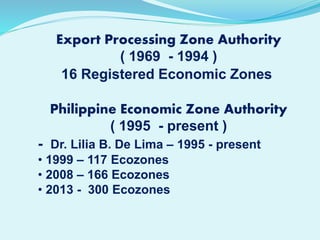
Export Processing Zone Authority
( 1969 - 1994 )
16 Registered Economic Zones
Philippine Economic Zone Authority
( 1995 - present )
- Dr. Lilia B. De Lima – 1995 - present
• 1999 – 117 Ecozones
• 2008 – 166 Ecozones
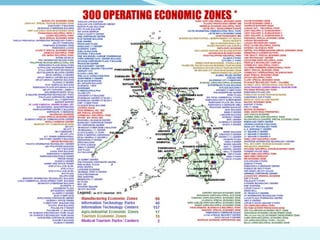
• 2013 - 300 Ecozones
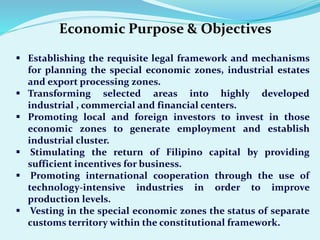
Economic Purpose & Objectives
 Establishing the requisite legal framework and mechanisms
for planning the special economic zones, industrial estates
and export processing zones.
 Transforming selected areas into highly developed
industrial , commercial and financial centers.
 Promoting local and foreign investors to invest in those
economic zones to generate employment and establish
industrial cluster.
 Stimulating the return of Filipino capital by providing
sufficient incentives for business.
 Promoting international cooperation through the use of
technology-intensive industries in order to improve
production levels.
 Vesting in the special economic zones the status of separate
customs territory within the constitutional framework.
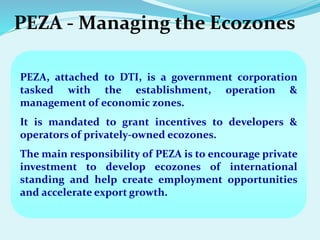
PEZA - Managing the Ecozones
PEZA, attached to DTI, is a government corporation
tasked with the establishment, operation &
management of economic zones.
It is mandated to grant incentives to developers &
operators of privately-owned ecozones.
The main responsibility of PEZA is to encourage private
investment to develop ecozones of international
standing and help create employment opportunities
and accelerate export growth.
Board Members of PEZA
Chairman: Secretary of Department of Trade and Industry
Vice Chairman: Director General and CEO of PEZA
Undersecretaries of:
– Department of Finance
– Department of Labor and Employment
– Department of Interior and Local Government
– Department of Environment and Natural Resources
– Department of Agriculture
– Department of Public Works and Highways
– Department of Science and Technology
– Department of Energy
Deputy Director General of the NEDA
One (1) representative from the labor sector
One (1) representative from the investors in the economic zone
Advisory body of PEZA
1. The president of the association of
investors in the ecozone
2. The governor of the province where the
ecozone is located
3. Mayors of towns/cities where the
ecozone is located
4. President of the accredited labor union
5. Representative of the business sector in
the zone
6. The PEZA representative
Zone Autonomy vs. Local Autonomy
Background
 The setting up of special economic zones
was primarily designed to accelerate a
balanced economic development, but the
initiative taken depends on the support of
local government whose territory is
included in the zone.
 However from the perspective of
governance, there is an apparent overlap
of jurisdiction between the zone
administration and local governments.
13
Contradictory Issues
between Zone and Local Autonomy
The local municipals are overshadowed by PEZA
and the national entities in policy-making.
More so because the criteria for the creation of
zones are already set by law without
participation of the inhabitants of the areas
concerned.
 The Local Government Code of 1991 stipulates
that the creation, division, merger, or
substantial alteration of boundaries of local
government units require the majority
plebiscitary decision of the inhabitants.
1. Legal status
14
Contradictory Issues
between Zone and Local Autonomy
The national government does not have a hand in the
development of zones on the BOT arrangement, yet the
national government must secure the area against
smuggling activities, a responsibility vested to the law
enforcement agencies of the national government.
 Securing the zones against smuggling has not been
effectively implemented. Ex.: Subic+Clark ecozones =
backdoors for smuggling; Undervalued & misdeclared goods
were seized. Transshipment-intended duty-free diverted to
local market.
 These could ruin the economy & decrease tax revenue.
2. Smuggling prevention
15
Contradictory Issues
between Zone and Local Autonomy
Defense & security is the joint
responsibilities of the national
government and PEZA, but the expenses
for maintaining the military forces are
borne by the national government.
 There is no clear-cut responsibilities of
the local police forces and the national
military forces which could result in
conflict of jurisdiction.
3. Peace & order
16
Contradictory Issues
between Zone and Local Autonomy
The law permits decentralized development with
minimum government intervention, so the ecozones can
establish directly economic relations with foreign
enterprises. Besides, the general policies are formulated
by PEZA leaving local government no choice but to
approve what PEZA has decided on, especially regarding
infrastructure, water system, etc.
 Local governments are deprived of the power to decide
on policy issues vis-à-vis development even only on a
consultative basis, since they can not effectively
participate in policy-making.
4. Local government power deprivation
17
Contradictory Issues
between Zone and Local Autonomy
PEZA can conduct investigations, issue the
subpoena, compel the production of papers and
other evidences, and even grant immunity to
persons with vital information about a case
under investigation.
 This can be a potential ground for conflict
between PEZA and local government in the
exercise of policy powers and other relevant
administrative functions.
5. Conflict of powers & administrative functions
18
Contradictory Issues
between Zone and Local Autonomy
The grant of exemption from national and local
taxes on business entities operating within the
zones is disadvantageous to businesses located
outside the zone, so this explains the
mushrooming of ecozones in order to take
advantage of tax free incentives.
 Outsiders lose their competitiveness vis-à-vis the
locators in the zones. Maybe this could be one of
the causes why the government revenue collection
falls short of as expected.
6. Tax exemption
19
Contradictory Issues
between Zone and Local Autonomy
No explicit mention of pro-environmental and pro-
sustainable development. Because ecozones are protected
from local government intervention, implementation of
environmental protection measures could be an
administrative issue between local governance and
ecozone governance.
Uncontrolled conversion of agricultural lands for non-
agricultural purposes like construction of golf courses
within or outside of the ecozone.
 The extent of concessions granted by law could provide
grounds for administrative and jurisdictional problems
and conflicts between the local government units and the
economic zones.
7. Disaccord of the governances
20
Conclusion
The ecozone law needs to be re-studied to
incorporate more specific and more clearly
defined rules and guidelines regarding
national government, LGU and ecozone
relationships, so that role conflicts and
overlapping jurisdictions in the
governance of these areas can be avoided.
Ecozones

Ecozones

  • 1.
    By : Aurelia A.Valerio and Helen Grace A. Cabuhat
  • 2.
    Special Economic Zones(SEZ) or Ecozones - Selected areas with highly developed agro- industrial, industrial, tourist, recreational, business, banking and financial investment centers or having the potential to be developed into either of them.
  • 3.
    ECOZONES may containany or all of the following : 1. Industrial estates ( IE) - are large tracts of land, subdivided and developed based upon a comprehensive plan with provisions for infrastructure facilities for the use of the industrial community. 2. Export Processing Zone (EPZ)- is a specialized industrial estate primarily oriented to export production and is physically and administratively outside of the customs territory. Capital equipment and raw materials can be imported with free of duty. 3. Free Trade Zone - is an area adjacent to a seaport or airport of entry. In this area imported goods could be free from duties for transshipment or storage or repacking. But goods are subject to duties if moved to a non-free trade area. 4. Tourist/Recreational Center - is an area within the ECOZONE where tourist accomodation facilities susch as hotels, resorts and/or recreational facilities are provided.
  • 4.
    Background 1. Philippine developmentpolicy considers the need to disperse industries from the metropolitan capital to the different regions throughout the country. 2. Investment priority areas outside Metro Manila have been identified to decongest the heavily populated cities. 3. RA 7916 or the Special Economic Zone Act of 1995 passed by Congress.
  • 5.
    Export Processing ZoneAuthority ( 1969 - 1994 ) 16 Registered Economic Zones Philippine Economic Zone Authority ( 1995 - present ) - Dr. Lilia B. De Lima – 1995 - present • 1999 – 117 Ecozones • 2008 – 166 Ecozones • 2013 - 300 Ecozones
  • 6.
    Economic Purpose &Objectives  Establishing the requisite legal framework and mechanisms for planning the special economic zones, industrial estates and export processing zones.  Transforming selected areas into highly developed industrial , commercial and financial centers.  Promoting local and foreign investors to invest in those economic zones to generate employment and establish industrial cluster.  Stimulating the return of Filipino capital by providing sufficient incentives for business.  Promoting international cooperation through the use of technology-intensive industries in order to improve production levels.  Vesting in the special economic zones the status of separate customs territory within the constitutional framework.
  • 7.
    PEZA - Managingthe Ecozones PEZA, attached to DTI, is a government corporation tasked with the establishment, operation & management of economic zones. It is mandated to grant incentives to developers & operators of privately-owned ecozones. The main responsibility of PEZA is to encourage private investment to develop ecozones of international standing and help create employment opportunities and accelerate export growth.
  • 9.
    Board Members ofPEZA Chairman: Secretary of Department of Trade and Industry Vice Chairman: Director General and CEO of PEZA Undersecretaries of: – Department of Finance – Department of Labor and Employment – Department of Interior and Local Government – Department of Environment and Natural Resources – Department of Agriculture – Department of Public Works and Highways – Department of Science and Technology – Department of Energy Deputy Director General of the NEDA One (1) representative from the labor sector One (1) representative from the investors in the economic zone
  • 10.
    Advisory body ofPEZA 1. The president of the association of investors in the ecozone 2. The governor of the province where the ecozone is located 3. Mayors of towns/cities where the ecozone is located 4. President of the accredited labor union 5. Representative of the business sector in the zone 6. The PEZA representative
  • 12.
    Zone Autonomy vs.Local Autonomy Background  The setting up of special economic zones was primarily designed to accelerate a balanced economic development, but the initiative taken depends on the support of local government whose territory is included in the zone.  However from the perspective of governance, there is an apparent overlap of jurisdiction between the zone administration and local governments.
  • 13.
    13 Contradictory Issues between Zoneand Local Autonomy The local municipals are overshadowed by PEZA and the national entities in policy-making. More so because the criteria for the creation of zones are already set by law without participation of the inhabitants of the areas concerned.  The Local Government Code of 1991 stipulates that the creation, division, merger, or substantial alteration of boundaries of local government units require the majority plebiscitary decision of the inhabitants. 1. Legal status
  • 14.
    14 Contradictory Issues between Zoneand Local Autonomy The national government does not have a hand in the development of zones on the BOT arrangement, yet the national government must secure the area against smuggling activities, a responsibility vested to the law enforcement agencies of the national government.  Securing the zones against smuggling has not been effectively implemented. Ex.: Subic+Clark ecozones = backdoors for smuggling; Undervalued & misdeclared goods were seized. Transshipment-intended duty-free diverted to local market.  These could ruin the economy & decrease tax revenue. 2. Smuggling prevention
  • 15.
    15 Contradictory Issues between Zoneand Local Autonomy Defense & security is the joint responsibilities of the national government and PEZA, but the expenses for maintaining the military forces are borne by the national government.  There is no clear-cut responsibilities of the local police forces and the national military forces which could result in conflict of jurisdiction. 3. Peace & order
  • 16.
    16 Contradictory Issues between Zoneand Local Autonomy The law permits decentralized development with minimum government intervention, so the ecozones can establish directly economic relations with foreign enterprises. Besides, the general policies are formulated by PEZA leaving local government no choice but to approve what PEZA has decided on, especially regarding infrastructure, water system, etc.  Local governments are deprived of the power to decide on policy issues vis-à-vis development even only on a consultative basis, since they can not effectively participate in policy-making. 4. Local government power deprivation
  • 17.
    17 Contradictory Issues between Zoneand Local Autonomy PEZA can conduct investigations, issue the subpoena, compel the production of papers and other evidences, and even grant immunity to persons with vital information about a case under investigation.  This can be a potential ground for conflict between PEZA and local government in the exercise of policy powers and other relevant administrative functions. 5. Conflict of powers & administrative functions
  • 18.
    18 Contradictory Issues between Zoneand Local Autonomy The grant of exemption from national and local taxes on business entities operating within the zones is disadvantageous to businesses located outside the zone, so this explains the mushrooming of ecozones in order to take advantage of tax free incentives.  Outsiders lose their competitiveness vis-à-vis the locators in the zones. Maybe this could be one of the causes why the government revenue collection falls short of as expected. 6. Tax exemption
  • 19.
    19 Contradictory Issues between Zoneand Local Autonomy No explicit mention of pro-environmental and pro- sustainable development. Because ecozones are protected from local government intervention, implementation of environmental protection measures could be an administrative issue between local governance and ecozone governance. Uncontrolled conversion of agricultural lands for non- agricultural purposes like construction of golf courses within or outside of the ecozone.  The extent of concessions granted by law could provide grounds for administrative and jurisdictional problems and conflicts between the local government units and the economic zones. 7. Disaccord of the governances
  • 20.
    20 Conclusion The ecozone lawneeds to be re-studied to incorporate more specific and more clearly defined rules and guidelines regarding national government, LGU and ecozone relationships, so that role conflicts and overlapping jurisdictions in the governance of these areas can be avoided.