Definition of E-commerce
History of E-commerce
Categories of E-commerce
Business application
Advantage of E-commerce
Disadvantage of E-commerce
1
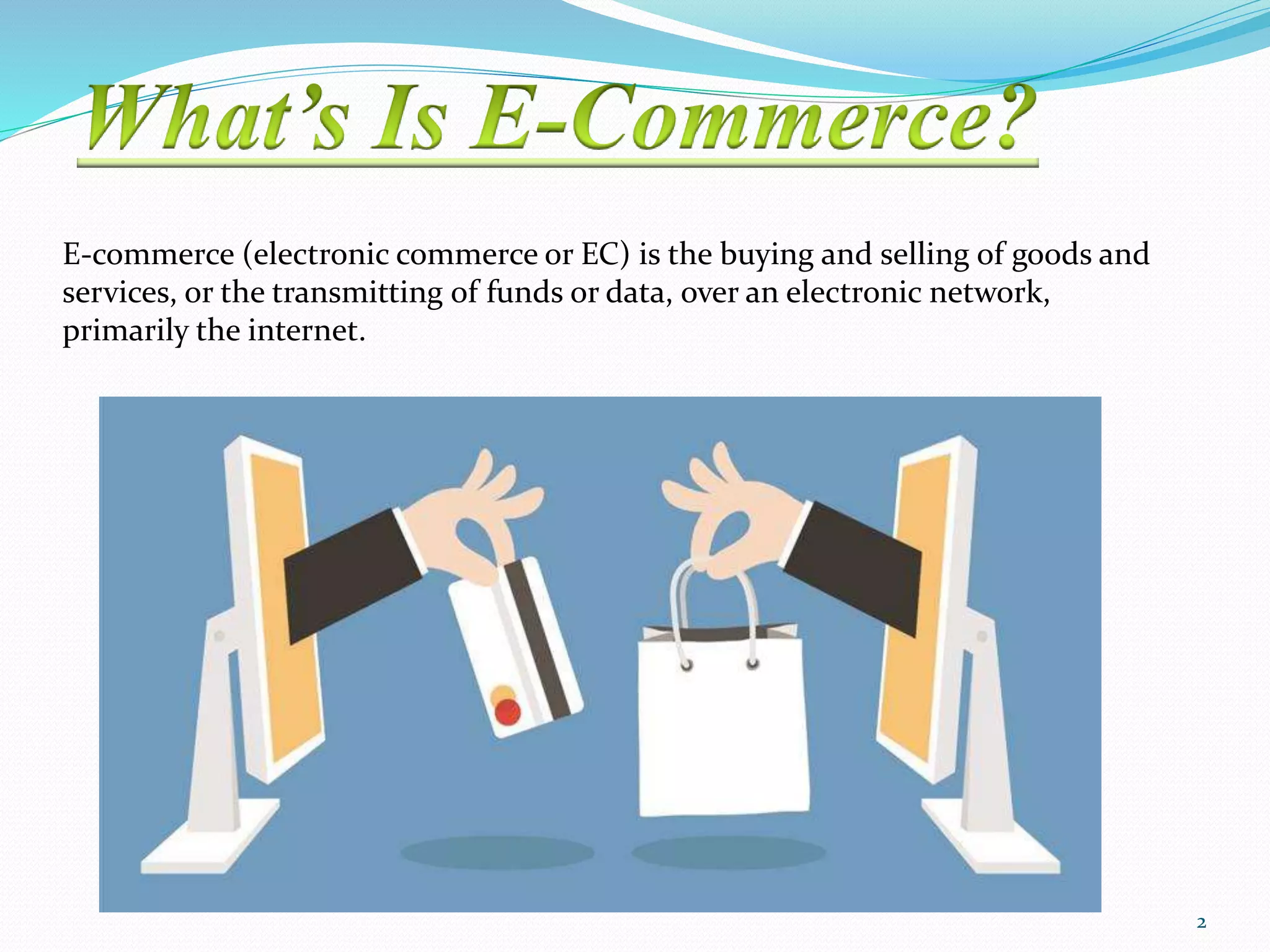
E-commerce (electronic commerce or EC) is the buying and selling of goods and
services, or the transmitting of funds or data, over an electronic network,
primarily the internet.
2
Definition of E-commerce
History of E-commerce
Categories of E-commerce
Business application
Advantage of E-commerce
Disadvantage of E-commerce
3
*The beginnings of e-commerce can be traced to the 1960s, when businesses
started using Electronic Data Interchange (EDI) to share business documents
with other companies.
*In 1979, the American National Standards Institute developed ASC X12 as a
universal standard for businesses to share documents through electronic
networks.
After the number of individual users sharing electronic documents with each
other grew in the 1980s, in the 1990s the rise of eBay
and Amazon revolutionized the e-commerce industry. Consumers can now
purchase endless amounts of items online, both from typical brick and mortar
stores with e-commerce capabilities and one another.
4
Definition of E-commerce
History of E-commerce
Categories of E-commerce
Business application
Advantage of E-commerce
Disadvantage of E-commerce
5
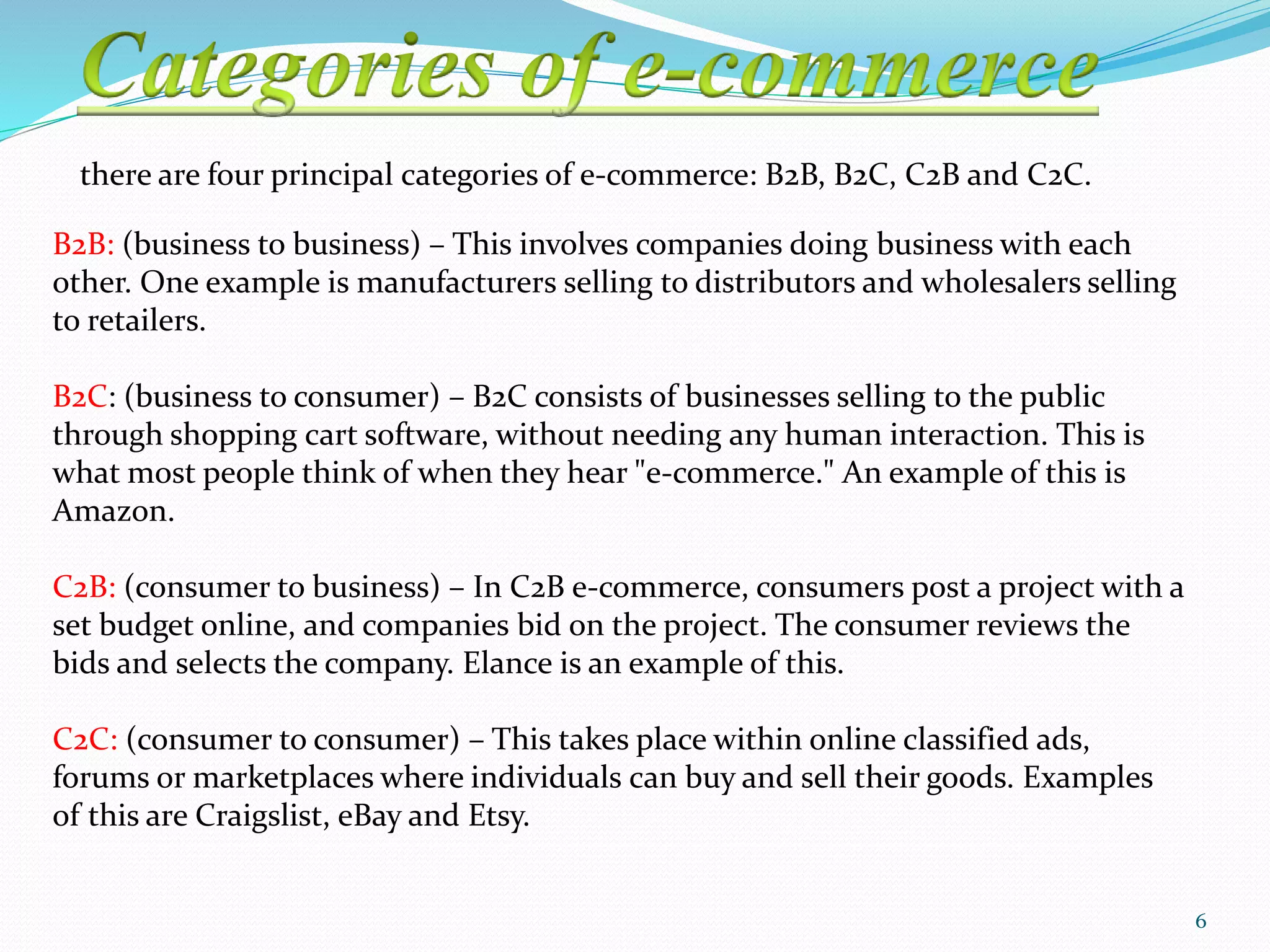
there are four principal categories of e-commerce: B2B, B2C, C2B and C2C.
B2B: (business to business) – This involves companies doing business with each
other. One example is manufacturers selling to distributors and wholesalers selling
to retailers.
B2C: (business to consumer) – B2C consists of businesses selling to the public
through shopping cart software, without needing any human interaction. This is
what most people think of when they hear "e-commerce." An example of this is
Amazon.
C2B: (consumer to business) – In C2B e-commerce, consumers post a project with a
set budget online, and companies bid on the project. The consumer reviews the
bids and selects the company. Elance is an example of this.
C2C: (consumer to consumer) – This takes place within online classified ads,
forums or marketplaces where individuals can buy and sell their goods. Examples
of this are Craigslist, eBay and Etsy.
6
Definition of E-commerce
History of E-commerce
Categories of E-commerce
Business application
Advantage of E-commerce
Disadvantage of E-commerce
7
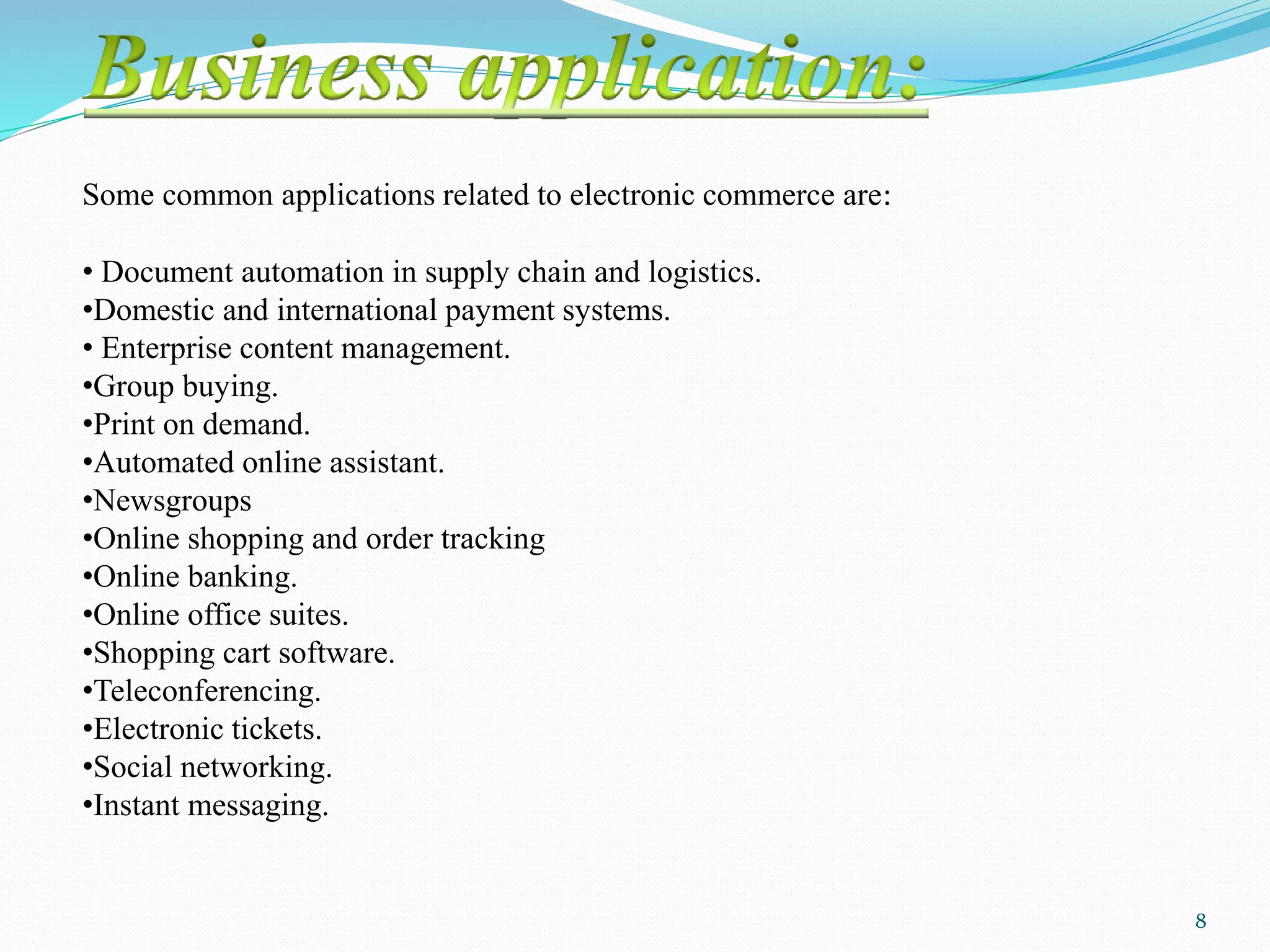
Some common applications related to electronic commerce are:
• Document automation in supply chain and logistics.
•Domestic and international payment systems.
• Enterprise content management.
•Group buying.
•Print on demand.
•Automated online assistant.
•Newsgroups
•Online shopping and order tracking
•Online banking.
•Online office suites.
•Shopping cart software.
•Teleconferencing.
•Electronic tickets.
•Social networking.
•Instant messaging.
8
Definition of E-commerce
History of E-commerce
Categories of E-commerce
Business application
Advantage of E-commerce
Disadvantage of E-commerce
9
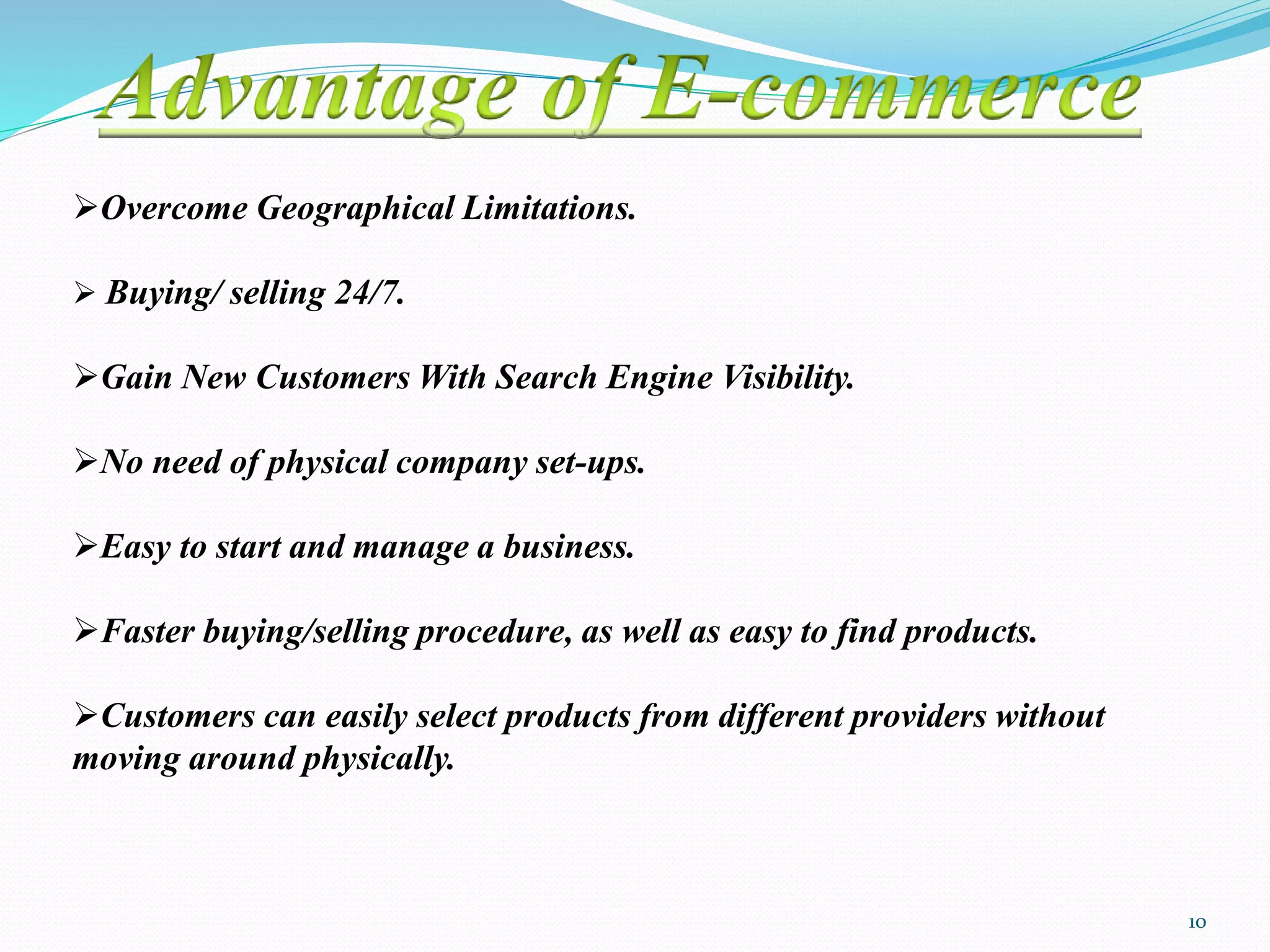
Overcome Geographical Limitations.
 Buying/ selling 24/7.
Gain New Customers With Search Engine Visibility.
No need of physical company set-ups.
Easy to start and manage a business.
Faster buying/selling procedure, as well as easy to find products.
Customers can easily select products from different providers without
moving around physically.
10
Definition of E-commerce
History of E-commerce
Categories of E-commerce
Business application
Advantage of E-commerce
Disadvantage of E-commerce
11
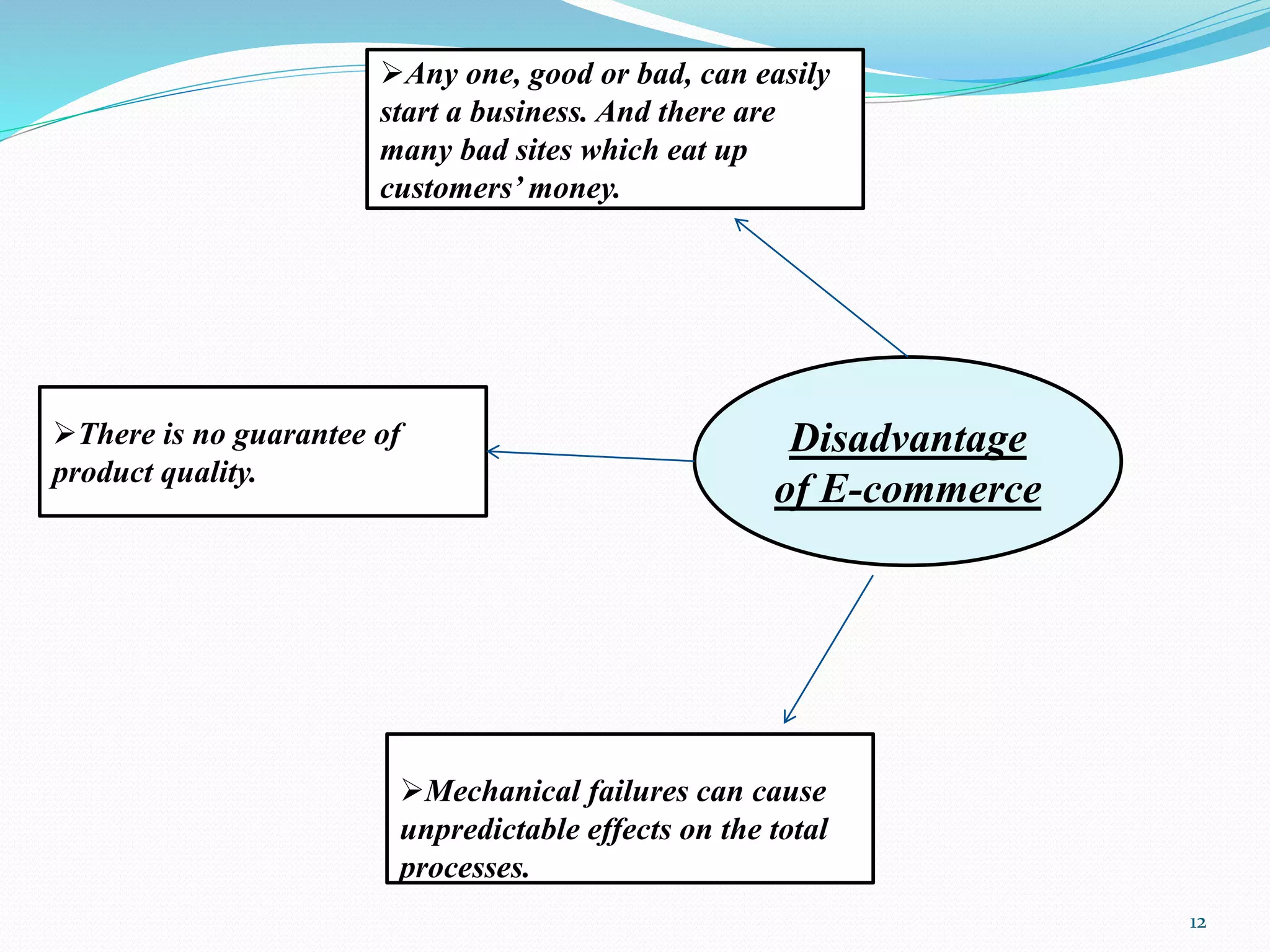
Disadvantage
of E-commerce
Any one, good or bad, can easily
start a business. And there are
many bad sites which eat up
customers’ money.
Mechanical failures can cause
unpredictable effects on the total
processes.
There is no guarantee of
product quality.
12
13

Advantage and disadvantage of e-commerce

  • 1.
    Definition of E-commerce Historyof E-commerce Categories of E-commerce Business application Advantage of E-commerce Disadvantage of E-commerce 1
  • 2.
    E-commerce (electronic commerceor EC) is the buying and selling of goods and services, or the transmitting of funds or data, over an electronic network, primarily the internet. 2
  • 3.
    Definition of E-commerce Historyof E-commerce Categories of E-commerce Business application Advantage of E-commerce Disadvantage of E-commerce 3
  • 4.
    *The beginnings ofe-commerce can be traced to the 1960s, when businesses started using Electronic Data Interchange (EDI) to share business documents with other companies. *In 1979, the American National Standards Institute developed ASC X12 as a universal standard for businesses to share documents through electronic networks. After the number of individual users sharing electronic documents with each other grew in the 1980s, in the 1990s the rise of eBay and Amazon revolutionized the e-commerce industry. Consumers can now purchase endless amounts of items online, both from typical brick and mortar stores with e-commerce capabilities and one another. 4
  • 5.
    Definition of E-commerce Historyof E-commerce Categories of E-commerce Business application Advantage of E-commerce Disadvantage of E-commerce 5
  • 6.
    there are fourprincipal categories of e-commerce: B2B, B2C, C2B and C2C. B2B: (business to business) – This involves companies doing business with each other. One example is manufacturers selling to distributors and wholesalers selling to retailers. B2C: (business to consumer) – B2C consists of businesses selling to the public through shopping cart software, without needing any human interaction. This is what most people think of when they hear "e-commerce." An example of this is Amazon. C2B: (consumer to business) – In C2B e-commerce, consumers post a project with a set budget online, and companies bid on the project. The consumer reviews the bids and selects the company. Elance is an example of this. C2C: (consumer to consumer) – This takes place within online classified ads, forums or marketplaces where individuals can buy and sell their goods. Examples of this are Craigslist, eBay and Etsy. 6
  • 7.
    Definition of E-commerce Historyof E-commerce Categories of E-commerce Business application Advantage of E-commerce Disadvantage of E-commerce 7
  • 8.
    Some common applicationsrelated to electronic commerce are: • Document automation in supply chain and logistics. •Domestic and international payment systems. • Enterprise content management. •Group buying. •Print on demand. •Automated online assistant. •Newsgroups •Online shopping and order tracking •Online banking. •Online office suites. •Shopping cart software. •Teleconferencing. •Electronic tickets. •Social networking. •Instant messaging. 8
  • 9.
    Definition of E-commerce Historyof E-commerce Categories of E-commerce Business application Advantage of E-commerce Disadvantage of E-commerce 9
  • 10.
    Overcome Geographical Limitations. Buying/ selling 24/7. Gain New Customers With Search Engine Visibility. No need of physical company set-ups. Easy to start and manage a business. Faster buying/selling procedure, as well as easy to find products. Customers can easily select products from different providers without moving around physically. 10
  • 11.
    Definition of E-commerce Historyof E-commerce Categories of E-commerce Business application Advantage of E-commerce Disadvantage of E-commerce 11
  • 12.
    Disadvantage of E-commerce Any one,good or bad, can easily start a business. And there are many bad sites which eat up customers’ money. Mechanical failures can cause unpredictable effects on the total processes. There is no guarantee of product quality. 12
  • 13.