Prof. Yogesh V. Torawane
Head Dept. of Management Studies
School of Commerce & Management
Pratap College Amalner.
CONTEXT:
 Definition of E-Commerce.
 History of E-Commerce.
 Advantages and Disadvantages
of E-Commerce.
 Types of E-Commerce.
 E-Commerce Examples.
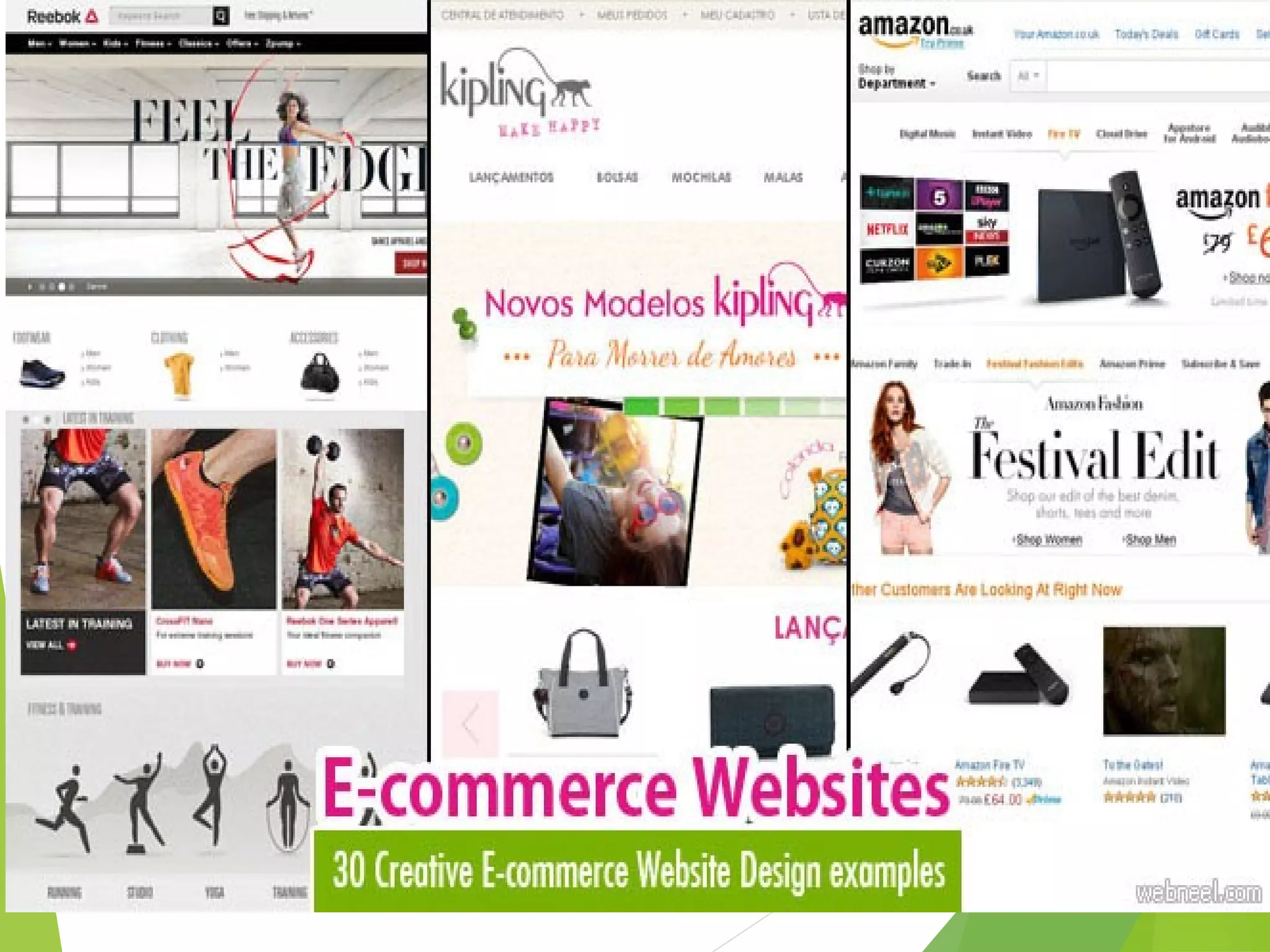
 Some of E-Commerce Websites
WHAT IS E-COMMERCE?
 E-commerce consists of the buying and selling of
products or services over electronic systems such as the
Internet and other computer networks.
 Electronic commerce commonly known as e-commerce
or eCommerce.
 Electronic commerce was identified as the facilitation
of commercial transactions electronically, using
technology such as Electronic Data Interchange (EDI)
and Electronic Funds Transfer (EFT).
 What is EDI?
 What is EFT?
Electronic Data Interchange:
Electronic Funds Transfer:
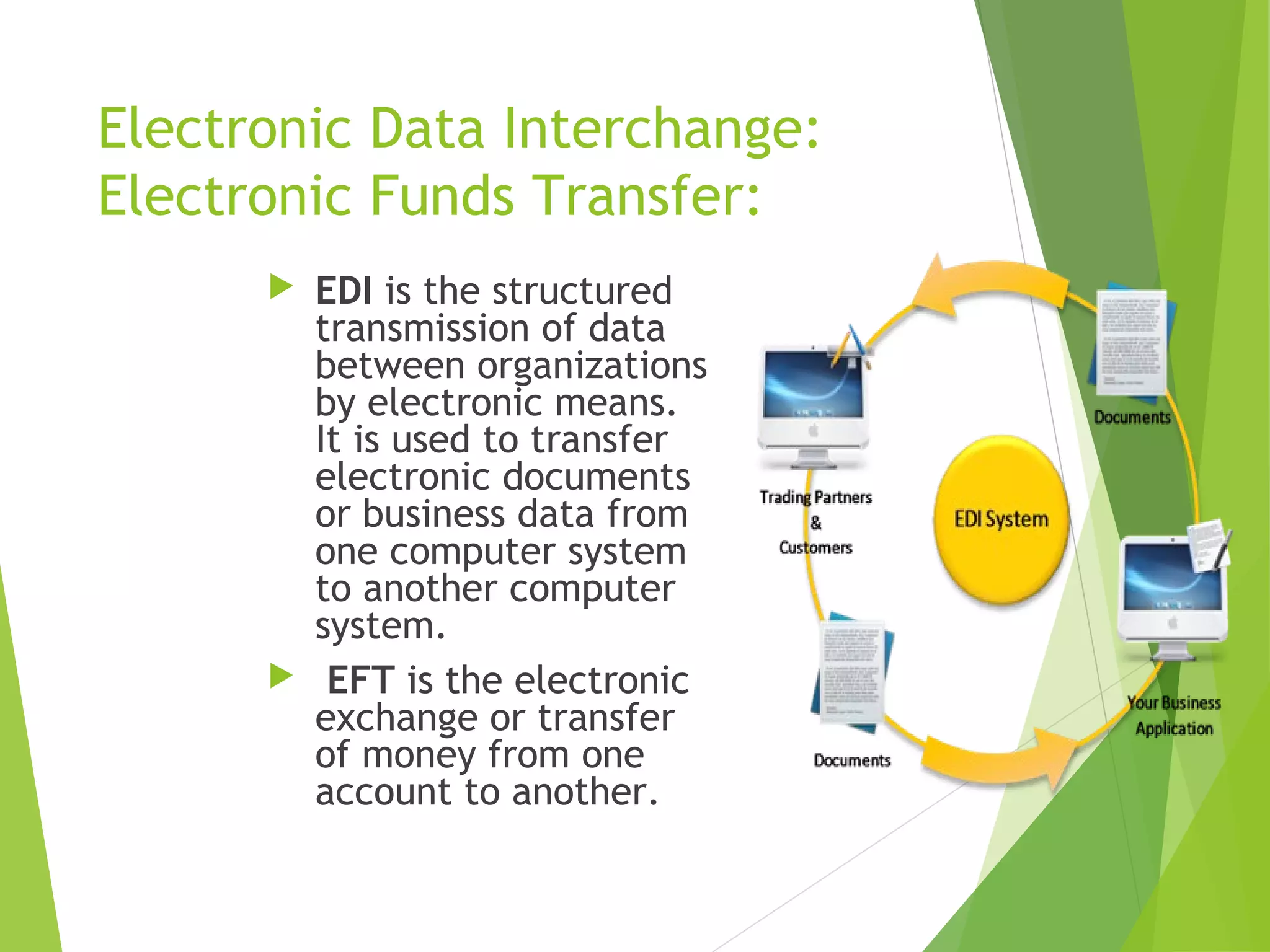
 EDI is the structured
transmission of data
between organizations
by electronic means.
It is used to transfer
electronic documents
or business data from
one computer system
to another computer
system.
 EFT is the electronic
exchange or transfer
of money from one
account to another.
History of E-Commerce
 The growth and acceptance of credit
cards, automated teller machines (ATM)
and telephone banking in the 1980s were
also forms of electronic commerce.
 Another form of E-Commerce was the
airline reservation system, for example
Sabre in the USA and Travicom in the UK.
 By the end of 2000, many European and
American business companies offered
their services through the World Wide
Web.
 Since then people began to associate a
word “E-Commerce" with the ability of
purchasing various goods through the
Internet using secure protocols and
electronic payment services.
Advantages of E-commerce
 Faster buying/selling procedure, as
well as easy to find products.
 Buying/selling 24/7.
 Low operational costs and better
quality of services.
 Easy to start and manage a business.
 No need of physical company set-ups.
 Customers can easily select products
from different providers without
moving around physically.
Disadvantages of E-commerce
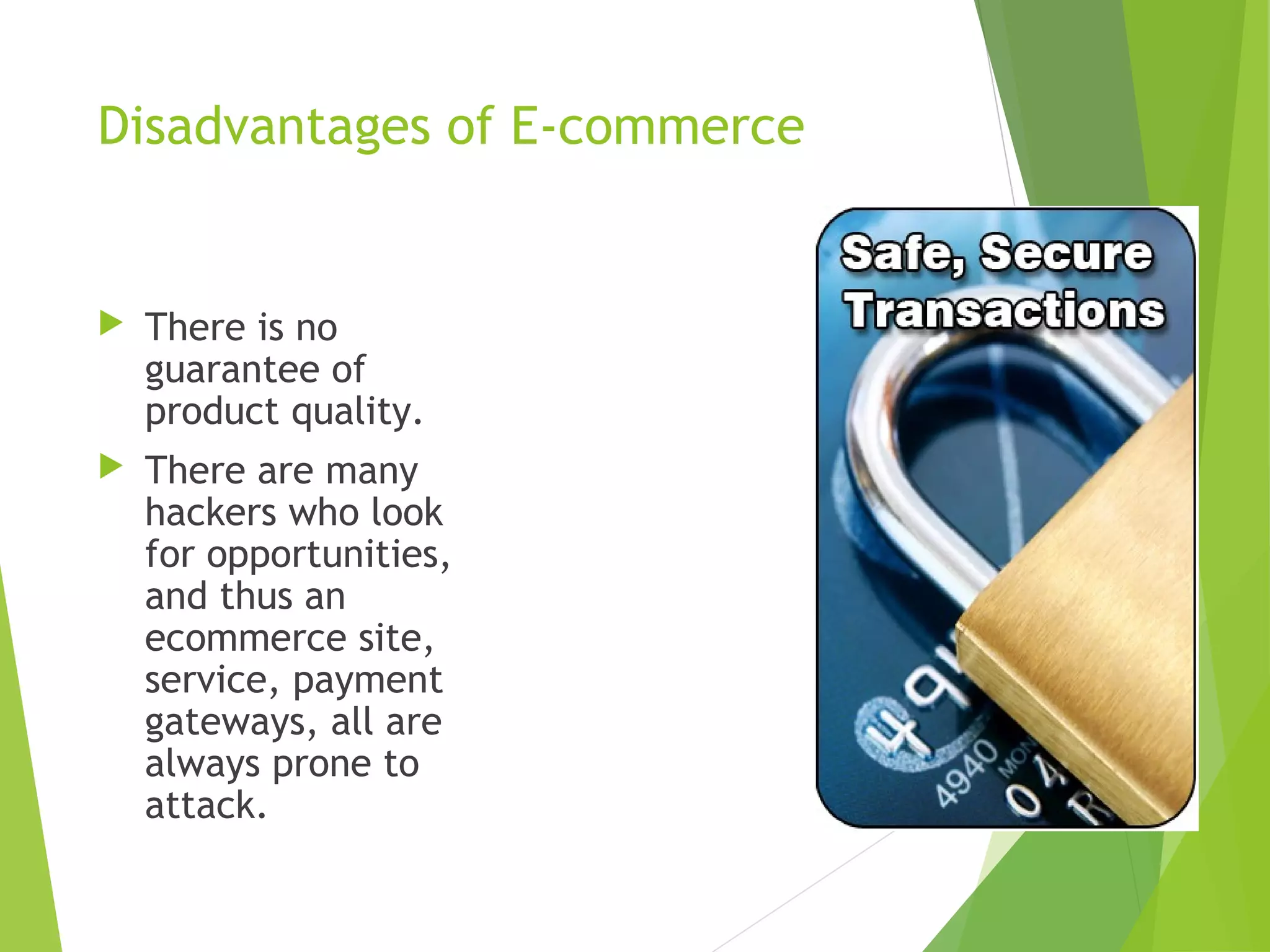
 There is no
guarantee of
product quality.
 There are many
hackers who look
for opportunities,
and thus an
ecommerce site,
service, payment
gateways, all are
always prone to
attack.
Types of E-comerce
B2B (Business-to-Business)
B2C (Business-to-Consumer)
C2B (Consumer-to-Business)
C2C (Consumer-to-Consumer)
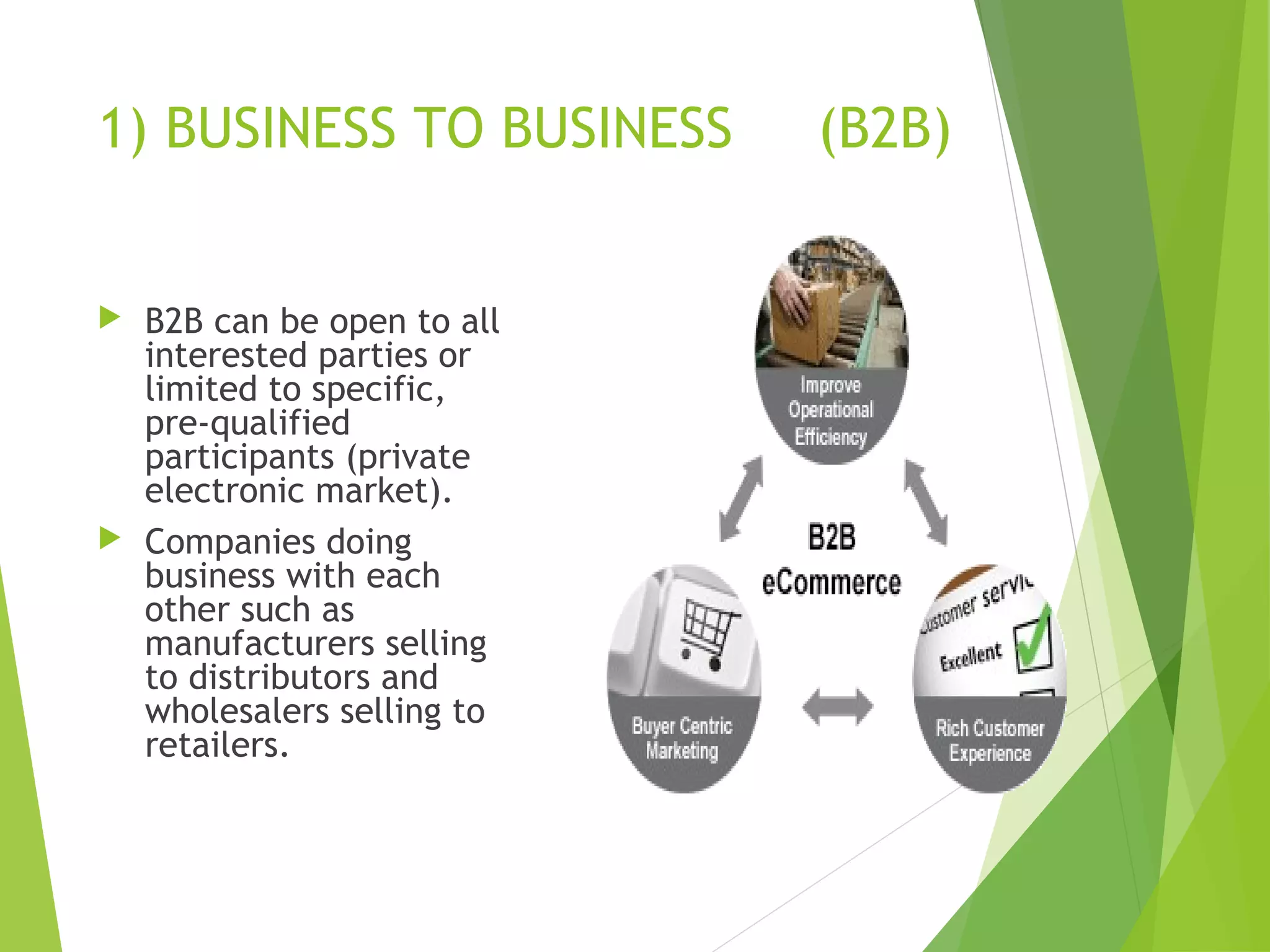
1) BUSINESS TO BUSINESS (B2B)
 B2B can be open to all
interested parties or
limited to specific,
pre-qualified
participants (private
electronic market).
 Companies doing
business with each
other such as
manufacturers selling
to distributors and
wholesalers selling to
retailers.
2) BUSINESS TO CONSUMER
(B2C)
 Businesses selling to the general public
typically through catalogs utilizing
shopping cart software.
 B2C is the indirect trade between the
company and consumers.
 It provides direct selling through online.
 If you want to sell goods and services to
customer so that anybody can purchase
any products directly from supplier’s
website.
3) CONSUMER TO BUSINESS
(C2B)
 A consumer posts his project with a
set budget online and within hours
companies review the consumer's
requirements and bid on the project.
 The consumer reviews the bids and
selects the company that will
complete the project.
 C2B empowers consumers around the
world by providing the meeting ground
and platform for such transactions.
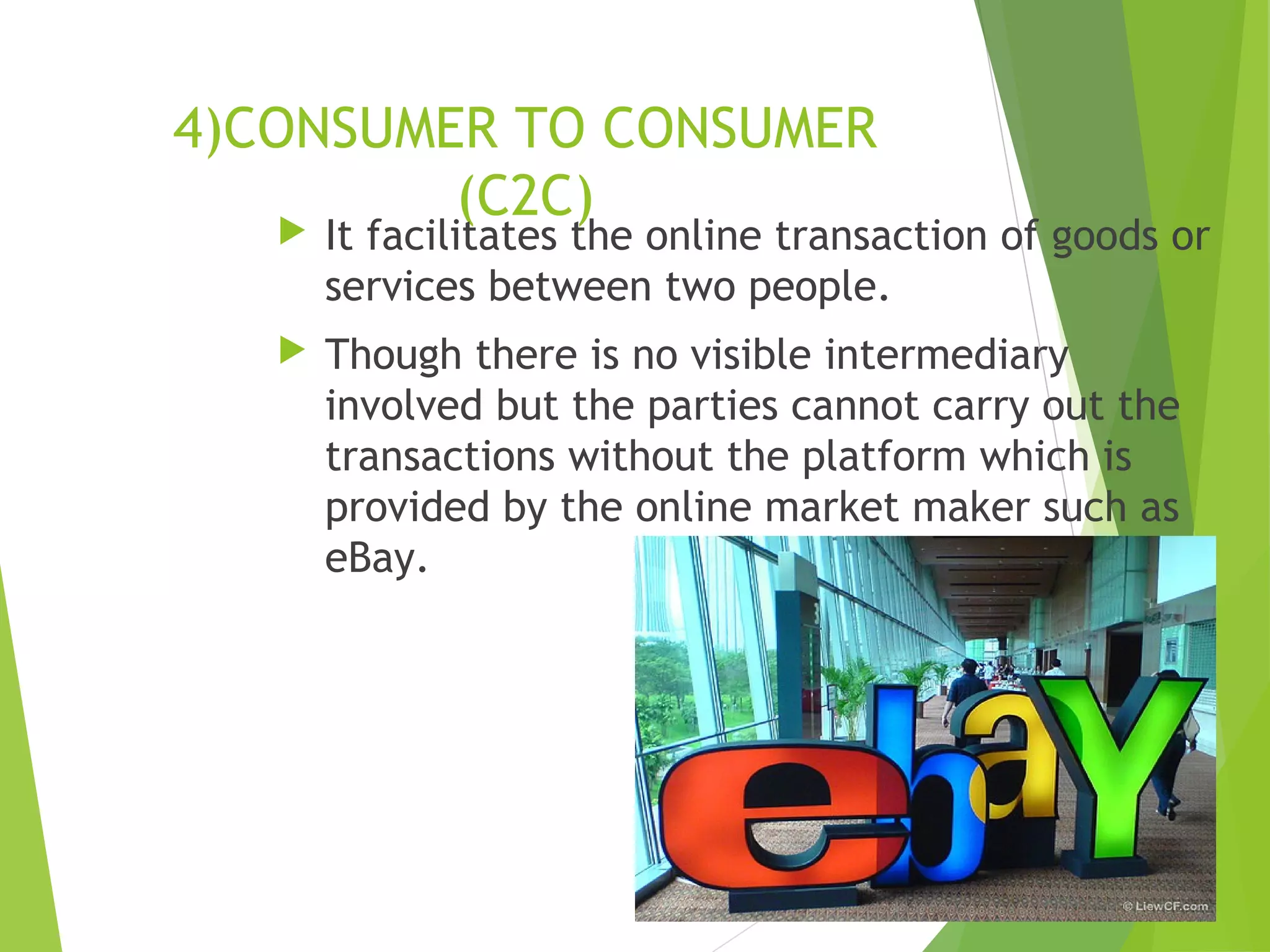
4)CONSUMER TO CONSUMER
(C2C) It facilitates the online transaction of goods or
services between two people.
 Though there is no visible intermediary
involved but the parties cannot carry out the
transactions without the platform which is
provided by the online market maker such as
eBay.
E-COMMERCE EXAMPLES:
 An individual purchases a book on the
Internet.
 A government employee reserves a
hotel room over the Internet.
 A business buys office supplies on-line
or through an electronic auction.
 A manufacturing plant orders
electronic components from another
plant within the company using the
company's intranet.
E commerce ppt.pptx
E commerce ppt.pptx
E commerce ppt.pptx
E commerce ppt.pptx
E commerce ppt.pptx

E commerce ppt.pptx

  • 1.
    Prof. Yogesh V.Torawane Head Dept. of Management Studies School of Commerce & Management Pratap College Amalner.
  • 2.
    CONTEXT:  Definition ofE-Commerce.  History of E-Commerce.  Advantages and Disadvantages of E-Commerce.  Types of E-Commerce.  E-Commerce Examples.  Some of E-Commerce Websites
  • 3.
    WHAT IS E-COMMERCE? E-commerce consists of the buying and selling of products or services over electronic systems such as the Internet and other computer networks.  Electronic commerce commonly known as e-commerce or eCommerce.
  • 4.
     Electronic commercewas identified as the facilitation of commercial transactions electronically, using technology such as Electronic Data Interchange (EDI) and Electronic Funds Transfer (EFT).  What is EDI?  What is EFT?
  • 5.
    Electronic Data Interchange: ElectronicFunds Transfer:  EDI is the structured transmission of data between organizations by electronic means. It is used to transfer electronic documents or business data from one computer system to another computer system.  EFT is the electronic exchange or transfer of money from one account to another.
  • 6.
    History of E-Commerce The growth and acceptance of credit cards, automated teller machines (ATM) and telephone banking in the 1980s were also forms of electronic commerce.  Another form of E-Commerce was the airline reservation system, for example Sabre in the USA and Travicom in the UK.
  • 7.
     By theend of 2000, many European and American business companies offered their services through the World Wide Web.  Since then people began to associate a word “E-Commerce" with the ability of purchasing various goods through the Internet using secure protocols and electronic payment services.
  • 8.
    Advantages of E-commerce Faster buying/selling procedure, as well as easy to find products.  Buying/selling 24/7.  Low operational costs and better quality of services.  Easy to start and manage a business.  No need of physical company set-ups.  Customers can easily select products from different providers without moving around physically.
  • 9.
    Disadvantages of E-commerce There is no guarantee of product quality.  There are many hackers who look for opportunities, and thus an ecommerce site, service, payment gateways, all are always prone to attack.
  • 10.
    Types of E-comerce B2B(Business-to-Business) B2C (Business-to-Consumer) C2B (Consumer-to-Business) C2C (Consumer-to-Consumer)
  • 11.
    1) BUSINESS TOBUSINESS (B2B)  B2B can be open to all interested parties or limited to specific, pre-qualified participants (private electronic market).  Companies doing business with each other such as manufacturers selling to distributors and wholesalers selling to retailers.
  • 12.
    2) BUSINESS TOCONSUMER (B2C)  Businesses selling to the general public typically through catalogs utilizing shopping cart software.  B2C is the indirect trade between the company and consumers.  It provides direct selling through online.  If you want to sell goods and services to customer so that anybody can purchase any products directly from supplier’s website.
  • 13.
    3) CONSUMER TOBUSINESS (C2B)  A consumer posts his project with a set budget online and within hours companies review the consumer's requirements and bid on the project.  The consumer reviews the bids and selects the company that will complete the project.  C2B empowers consumers around the world by providing the meeting ground and platform for such transactions.
  • 14.
    4)CONSUMER TO CONSUMER (C2C)It facilitates the online transaction of goods or services between two people.  Though there is no visible intermediary involved but the parties cannot carry out the transactions without the platform which is provided by the online market maker such as eBay.
  • 16.
    E-COMMERCE EXAMPLES:  Anindividual purchases a book on the Internet.  A government employee reserves a hotel room over the Internet.  A business buys office supplies on-line or through an electronic auction.  A manufacturing plant orders electronic components from another plant within the company using the company's intranet.