BASICS OF PLANT TISSUE CULTURE
T.Y.B.Sc.
BO345 Plant Biotechnology
Sem. IV
BY
Dr. KIRTI M. NITNAWARE
ASSISTANT PROFESSOR
DEPARTMENT OF BOTANY
HUTATMA RAJGURU MAHAVIDYALAYA, RAJGURUNAGAR
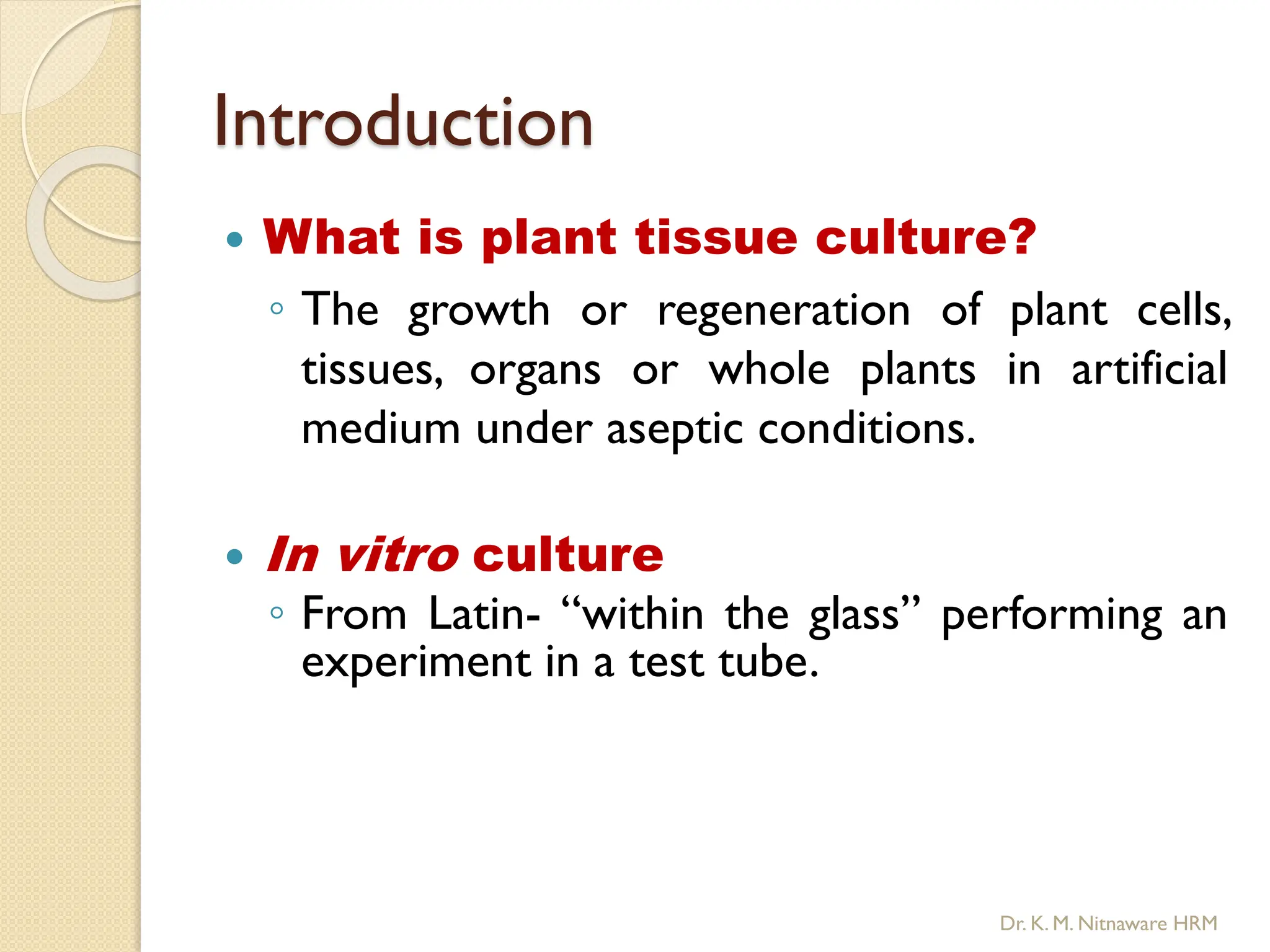
Introduction
 What is plant tissue culture?
◦ The growth or regeneration of plant cells,
tissues, organs or whole plants in artificial
medium under aseptic conditions.
 In vitro culture
◦ From Latin- “within the glass” performing an
experiment in a test tube.
Dr. K. M. Nitnaware HRM
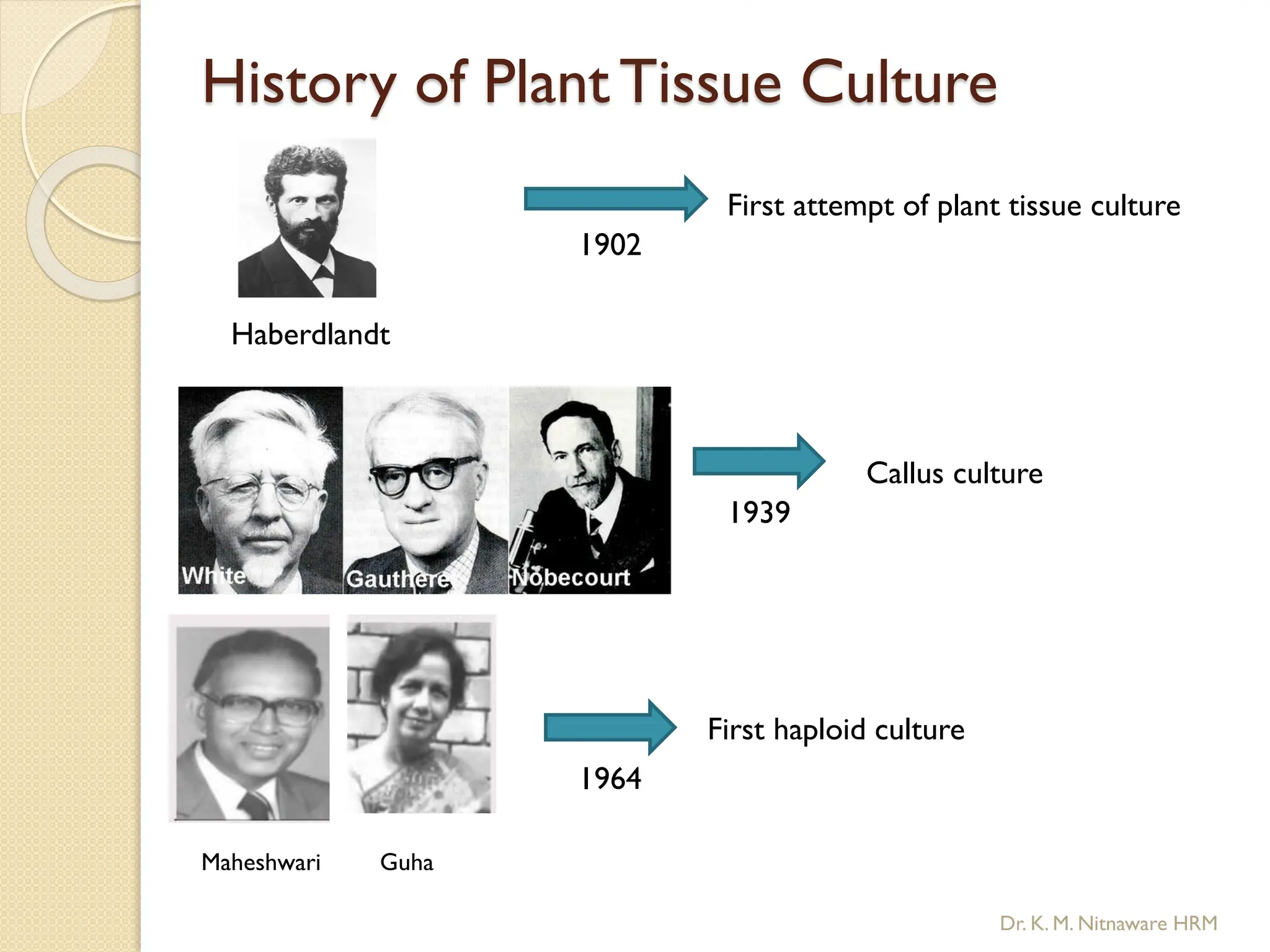
History of Plant Tissue Culture
First attempt of plant tissue culture
Callus culture
1902
1939
Haberdlandt
Maheshwari Guha
1964
First haploid culture
Dr. K. M. Nitnaware HRM
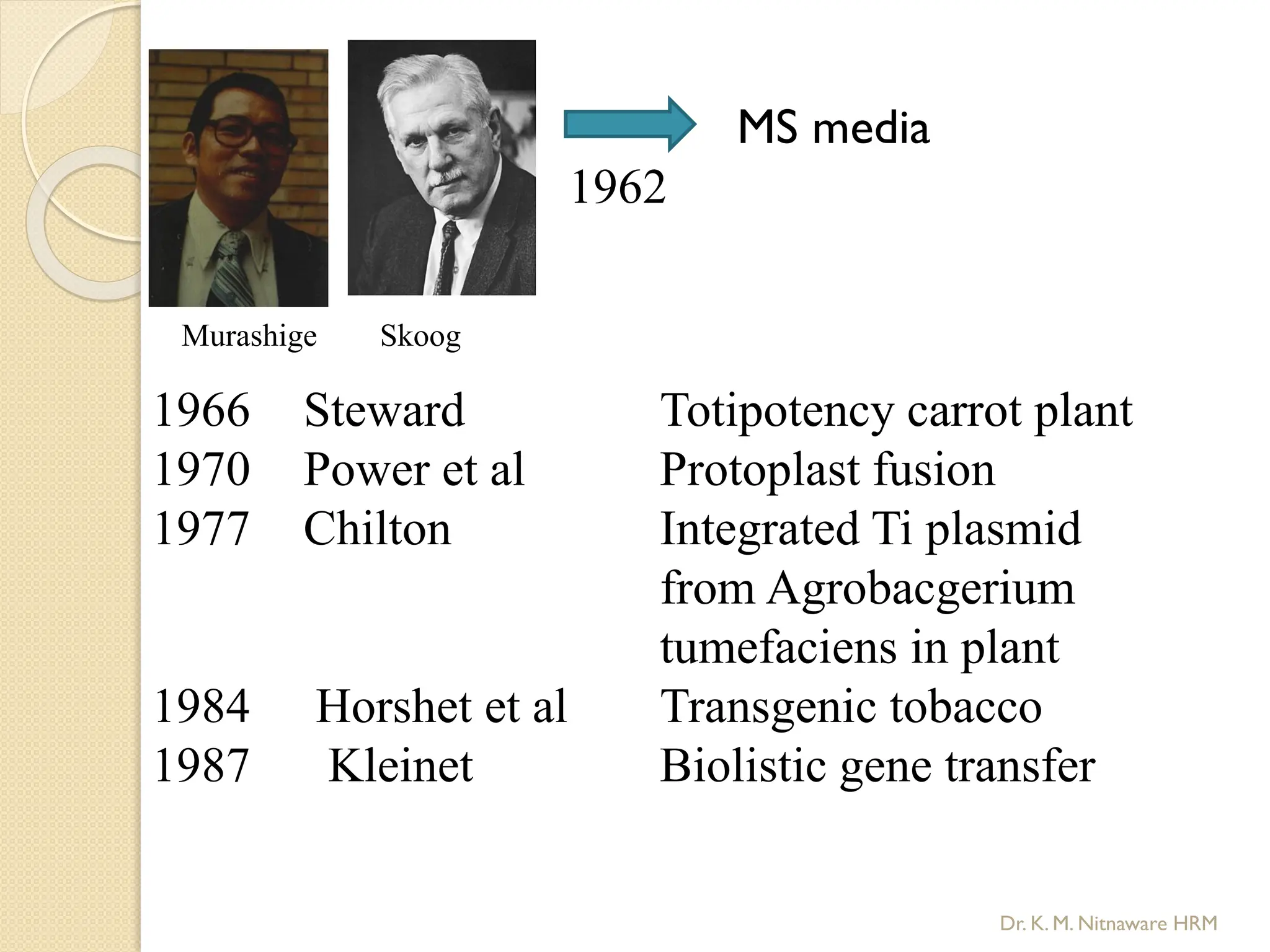
Murashige Skoog
1962
MS media
1966 Steward Totipotency carrot plant
1970 Power et al Protoplast fusion
1977 Chilton Integrated Ti plasmid
from Agrobacgerium
tumefaciens in plant
1984 Horshet et al Transgenic tobacco
1987 Kleinet Biolistic gene transfer
Dr. K. M. Nitnaware HRM
Terminology
Explant: A plant organ or piece of tissue used to initiate a culture.
Culture: Growing cells, tissue, plant, organs or whole plant in nutrient
medium under aseptic condition. Eg. cell culture, embryo culture, anther
culture
Aseptic culture : Raising cultures from a tissue or an organ after
freeing it of bacteria, fungi and other microorganism.
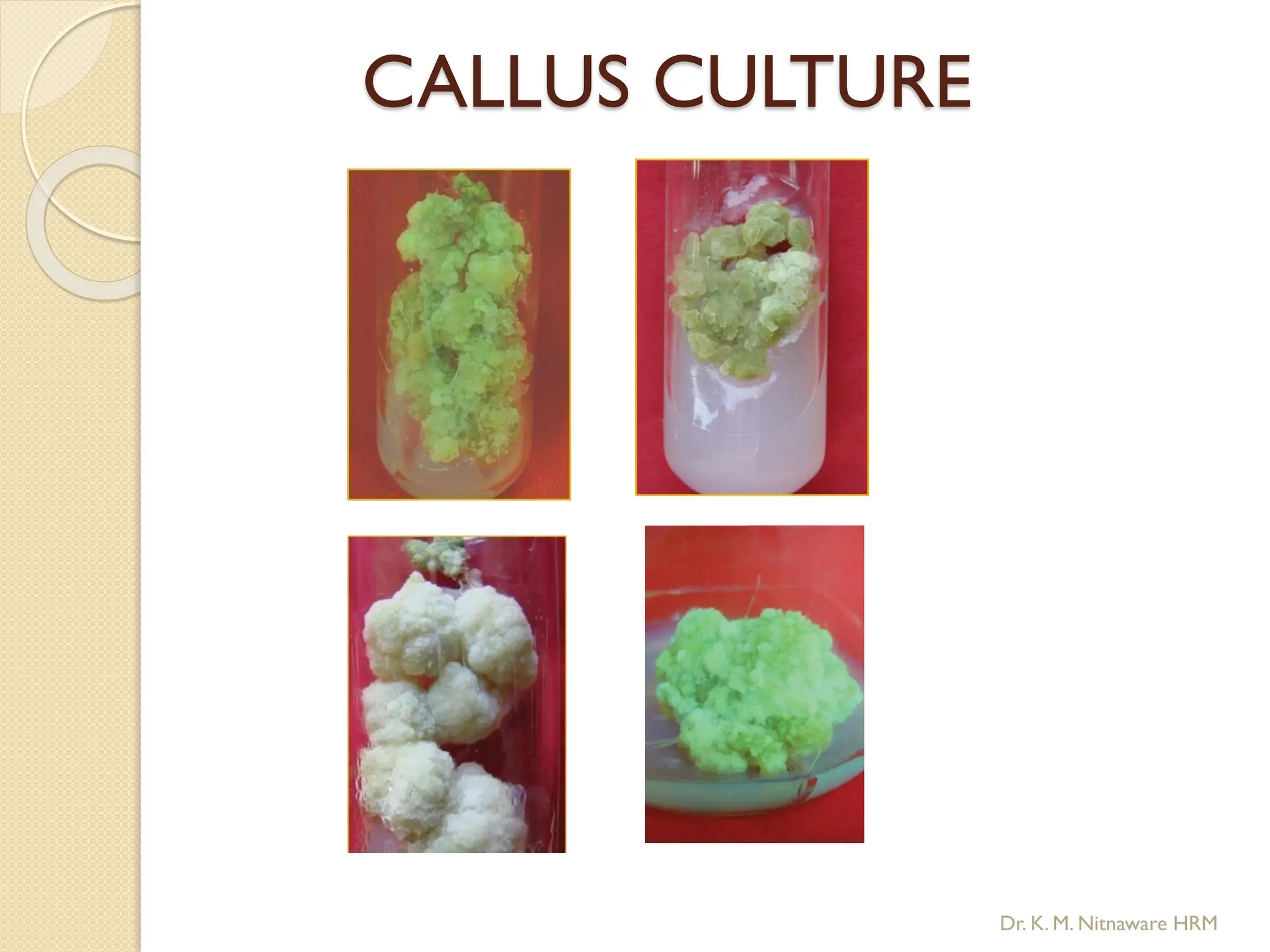
Callus: A tissue arsing from disorganized proliferation of cells either in
cultures or in nature. Plural calli
Cell culture: Culture of single cells or small groups of similar cells
Ref:PlantTissue CultureTheory and Practice,a Revised Edition S.S. Bhojwani and M.K Razdan
Dr. K. M. Nitnaware HRM
Contamination: Unwanted microorganism which may inhibit the
growth of the cells or tissues in culture.
 Subculture: Transfer of tissue or explant into fresh media
Regeneration-: In tissue cultures, a morphogenetic response that results
in the production of new organs, embryo or whole plants from cultured
explant or calli derived from them.
Dedifferentiation: Reversal of organized structures into an
undifferentiated state.
Differentiation : The development of different morphological
characteristics. In tissue culture the term is used to describe the formation
of different cell type, roots, shoots, embryos or any other orgsns in callus
or cell culture.
Ref:PlantTissue CultureTheory and Practice,a Revised Edition S.S. Bhojwani and M.K Razdan
Dr. K. M. Nitnaware HRM
Micropropagation: Asexual or vegetative propagation of plants in
vitro.
Organogenesis: Differentiation of organs from cultured cells or tissue.
Plantlet: A small rooted shoot or germinated embryo.
Somatic hybridization: The creation of hybrids by fusion of protoplast
derived from genetically different cells.
Totipotency: Potentiality or property of cell to produce a whole
organism.
Transgenic plant: Plants which have been genetically engineered to
modify certain characteristics by introducing one or a few selected genes.
Ref: PlantTissue CultureTheory and Practice,a Revised Edition S.S. Bhojwani and M.K Razdan
Dr. K. M. Nitnaware HRM
Requirement of PTC
 Appropriate tissue (Explant)
 Equipment and Glasswares
 A suitable growth medium
 Aseptic (sterile) conditions
 Culture room
 Incubation room
Dr. K. M. Nitnaware HRM
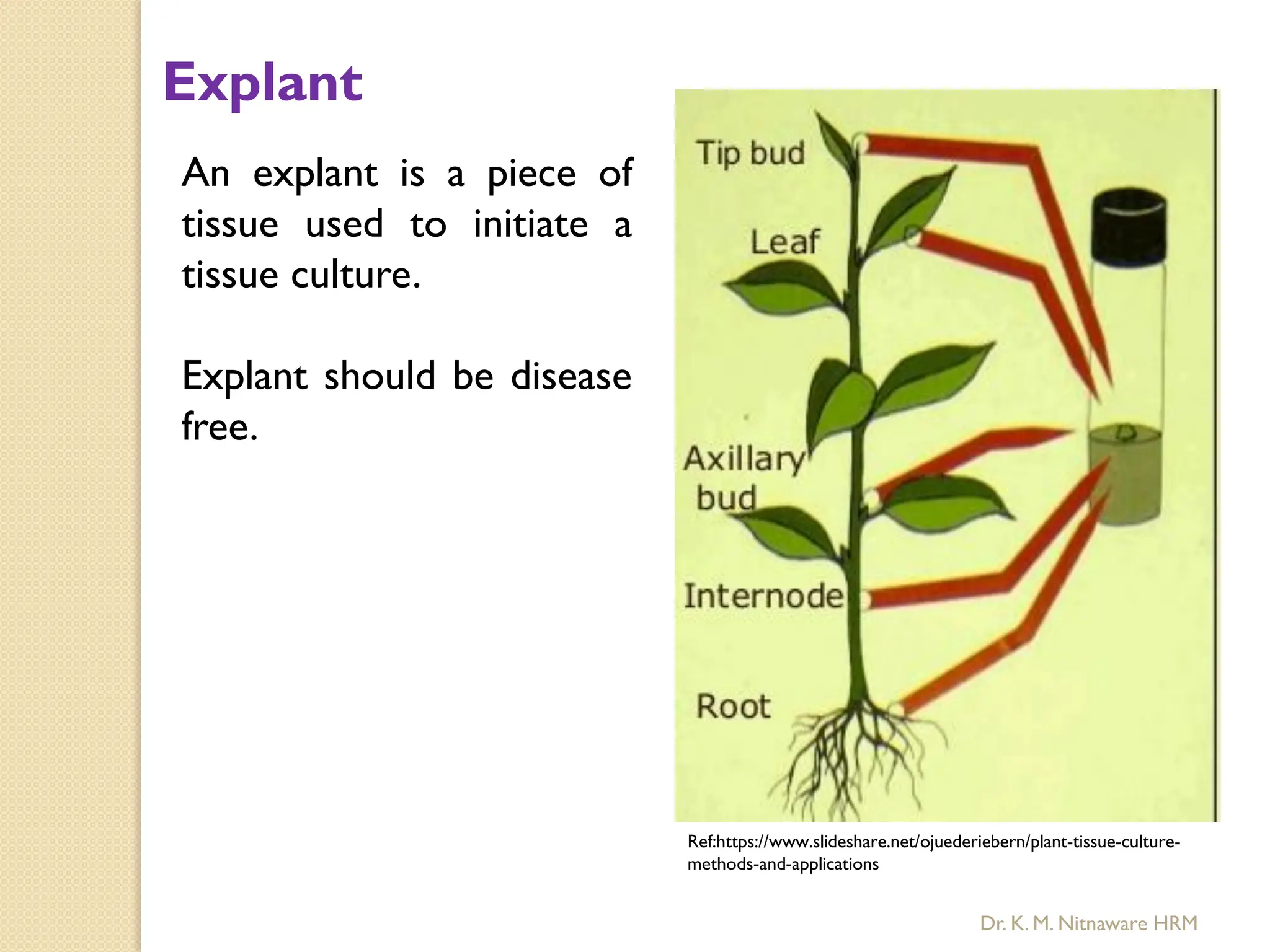
Explant
An explant is a piece of
tissue used to initiate a
tissue culture.
Explant should be disease
free.
Ref:https://www.slideshare.net/ojuederiebern/plant-tissue-culture-
methods-and-applications
Dr. K. M. Nitnaware HRM
Hot air Oven
Glasswares
kept in the
oven for drying
at 1600-2000C
 Equipment and Glasswares
Dr. K. M. Nitnaware HRM
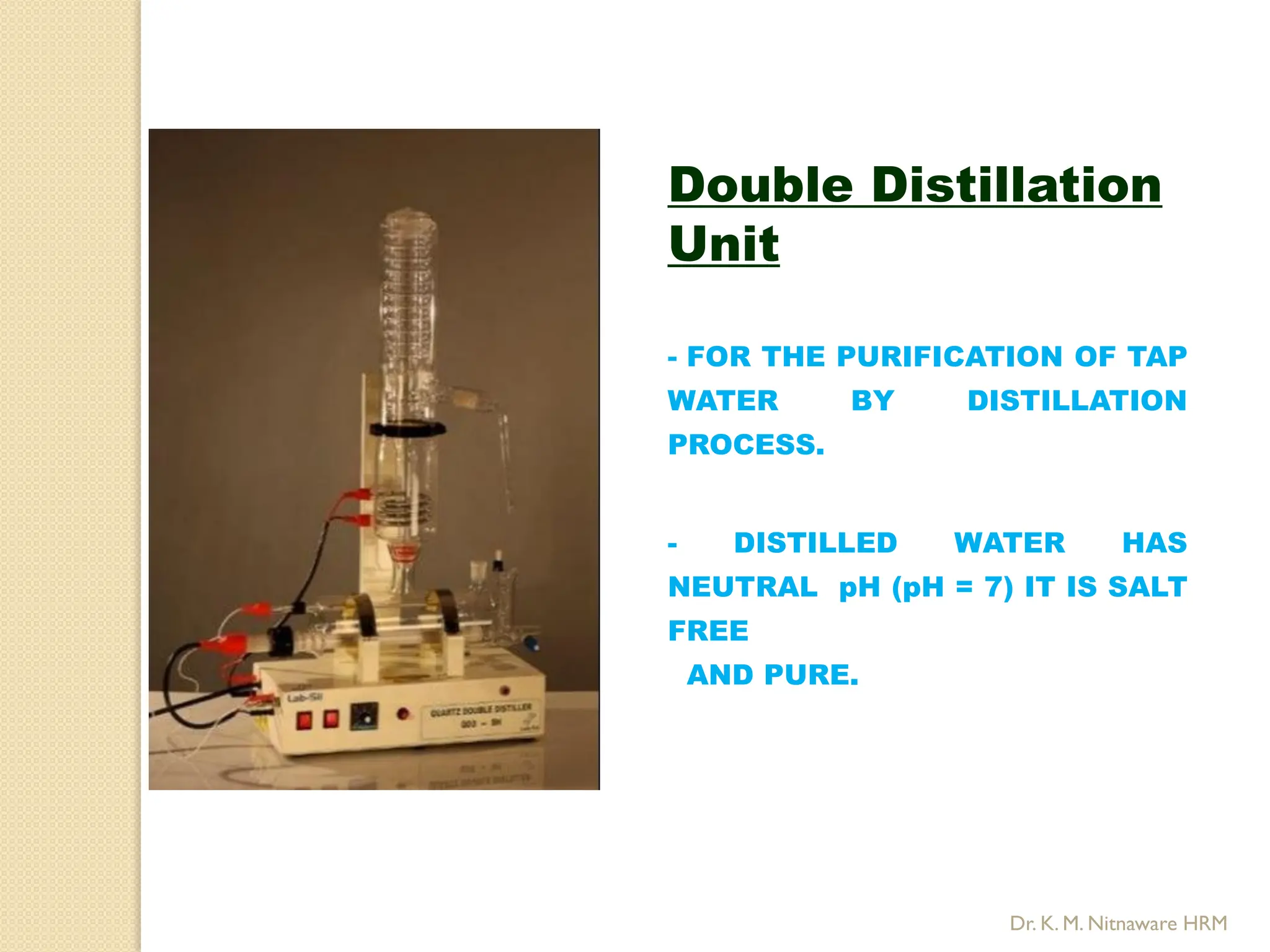
Double Distillation
Unit
- FOR THE PURIFICATION OF TAP
WATER BY DISTILLATION
PROCESS.
- DISTILLED WATER HAS
NEUTRAL pH (pH = 7) IT IS SALT
FREE
AND PURE.
Dr. K. M. Nitnaware HRM
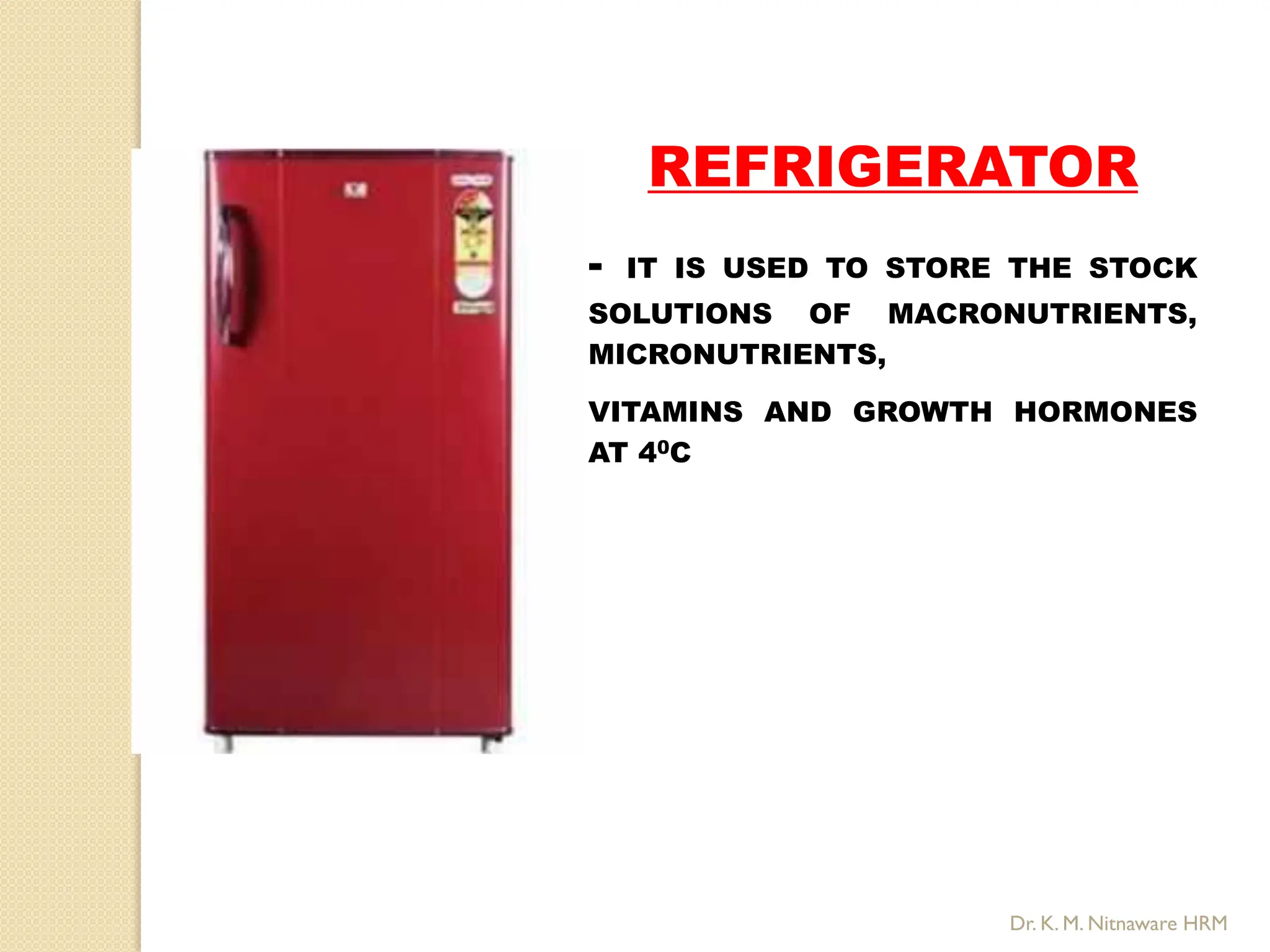
REFRIGERATOR
- IT IS USED TO STORE THE STOCK
SOLUTIONS OF MACRONUTRIENTS,
MICRONUTRIENTS,
VITAMINS AND GROWTH HORMONES
AT 40C
Dr. K. M. Nitnaware HRM
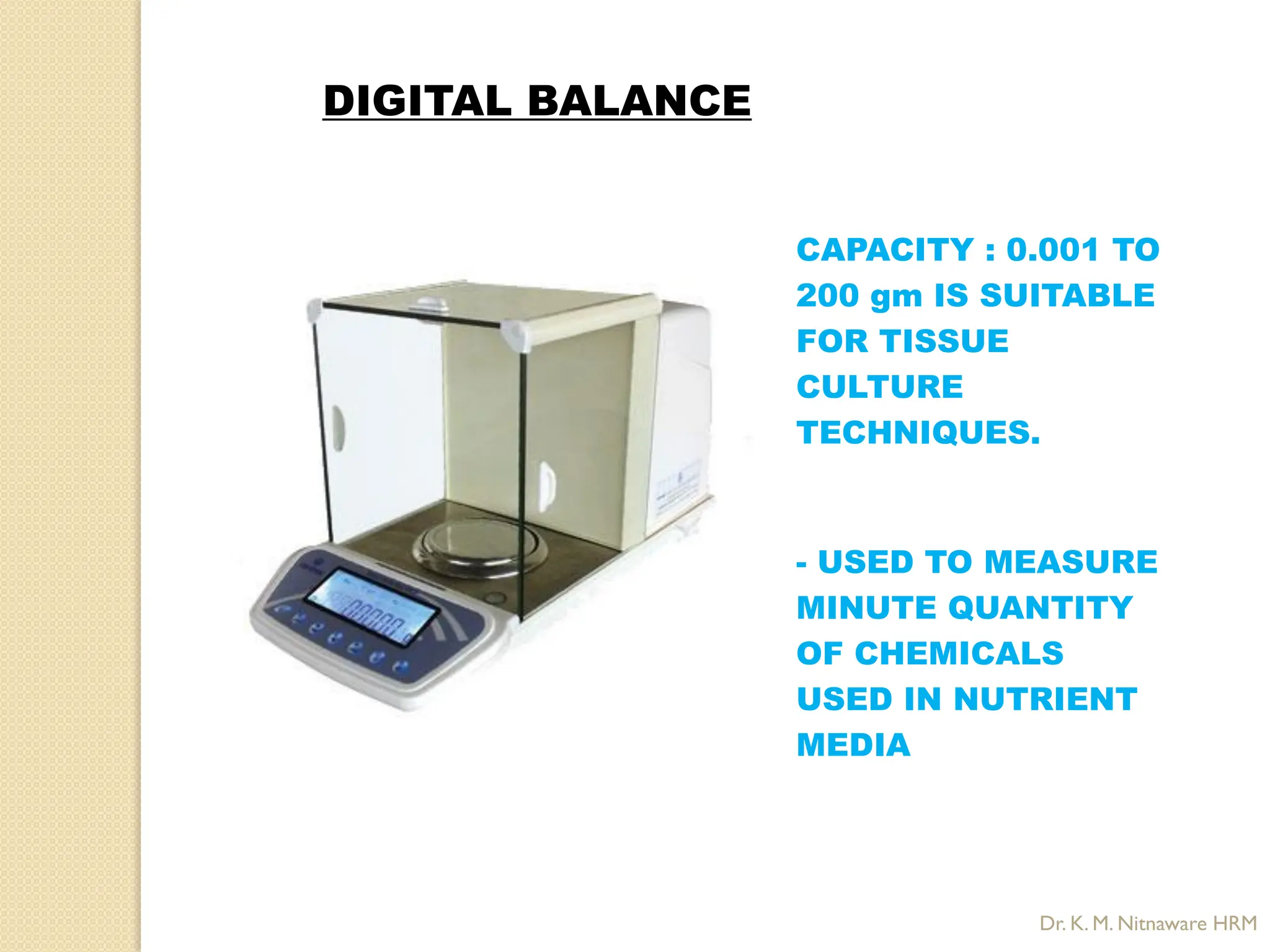
CAPACITY : 0.001 TO
200 gm IS SUITABLE
FOR TISSUE
CULTURE
TECHNIQUES.
- USED TO MEASURE
MINUTE QUANTITY
OF CHEMICALS
USED IN NUTRIENT
MEDIA
DIGITAL BALANCE
Dr. K. M. Nitnaware HRM
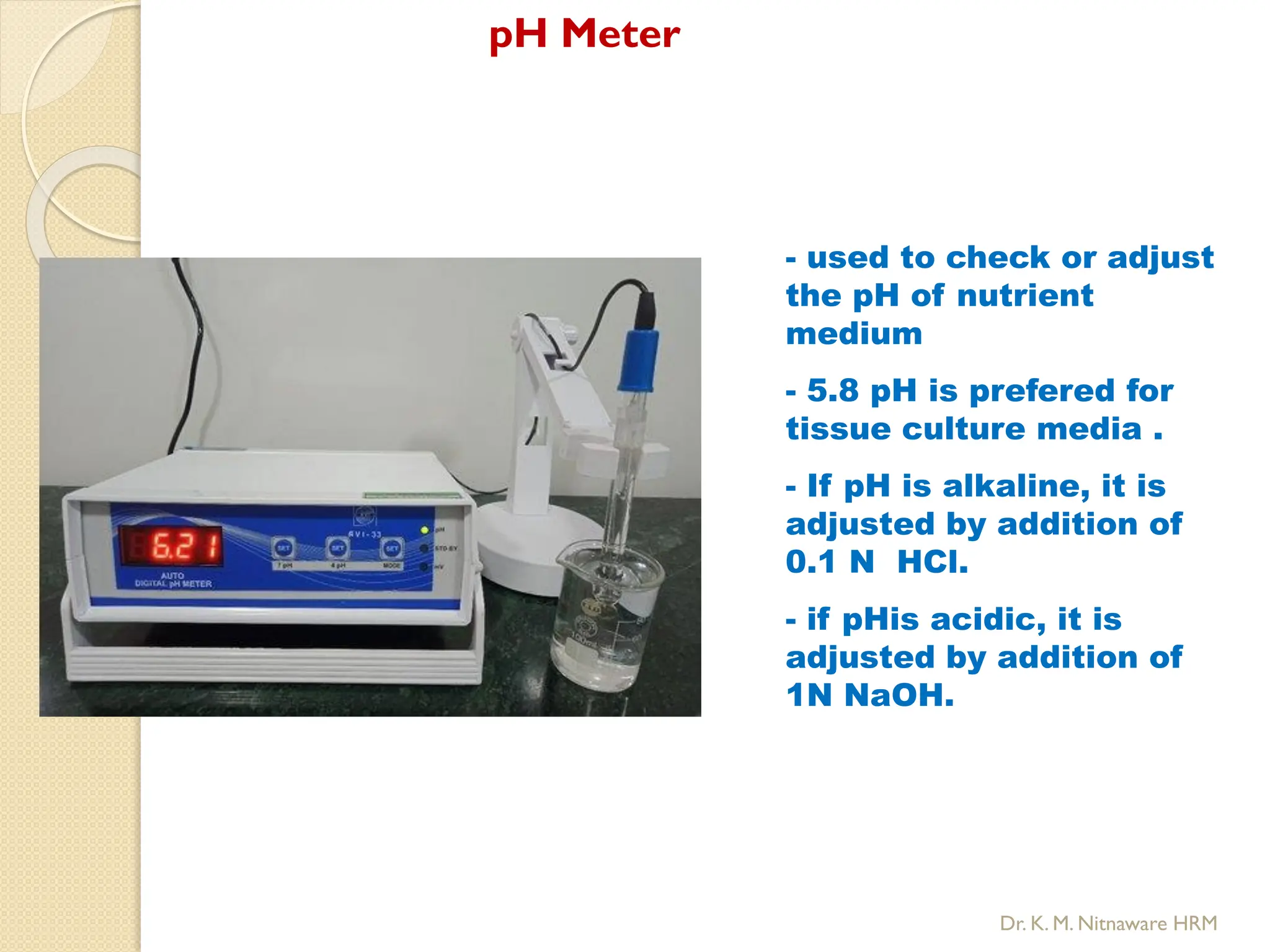
pH Meter
- used to check or adjust
the pH of nutrient
medium
- 5.8 pH is prefered for
tissue culture media .
- If pH is alkaline, it is
adjusted by addition of
0.1 N HCl.
- if pHis acidic, it is
adjusted by addition of
1N NaOH.
Dr. K. M. Nitnaware HRM
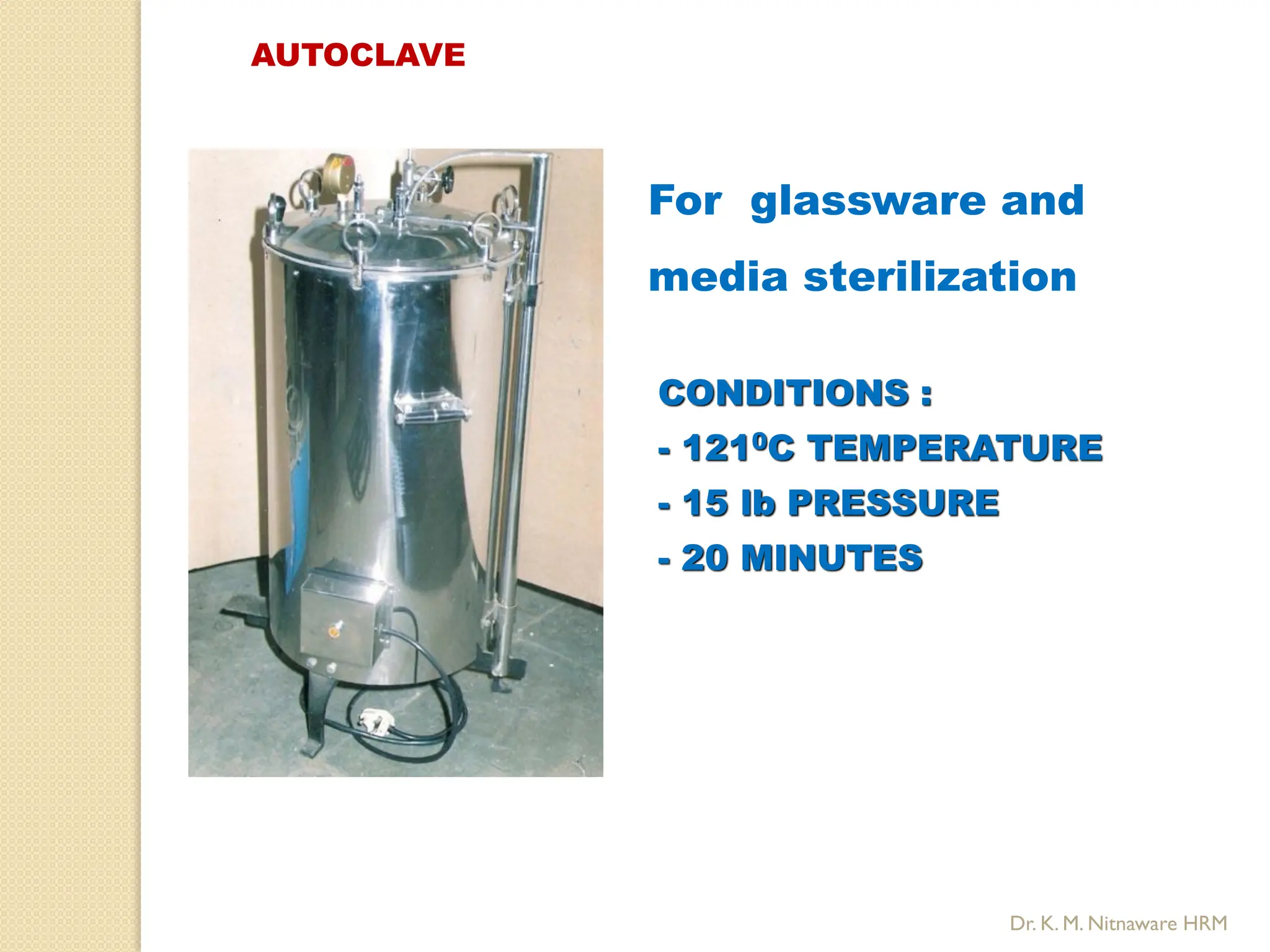
CONDITIONS :
- 1210C TEMPERATURE
- 15 lb PRESSURE
- 20 MINUTES
For glassware and
media sterilization
AUTOCLAVE
Dr. K. M. Nitnaware HRM
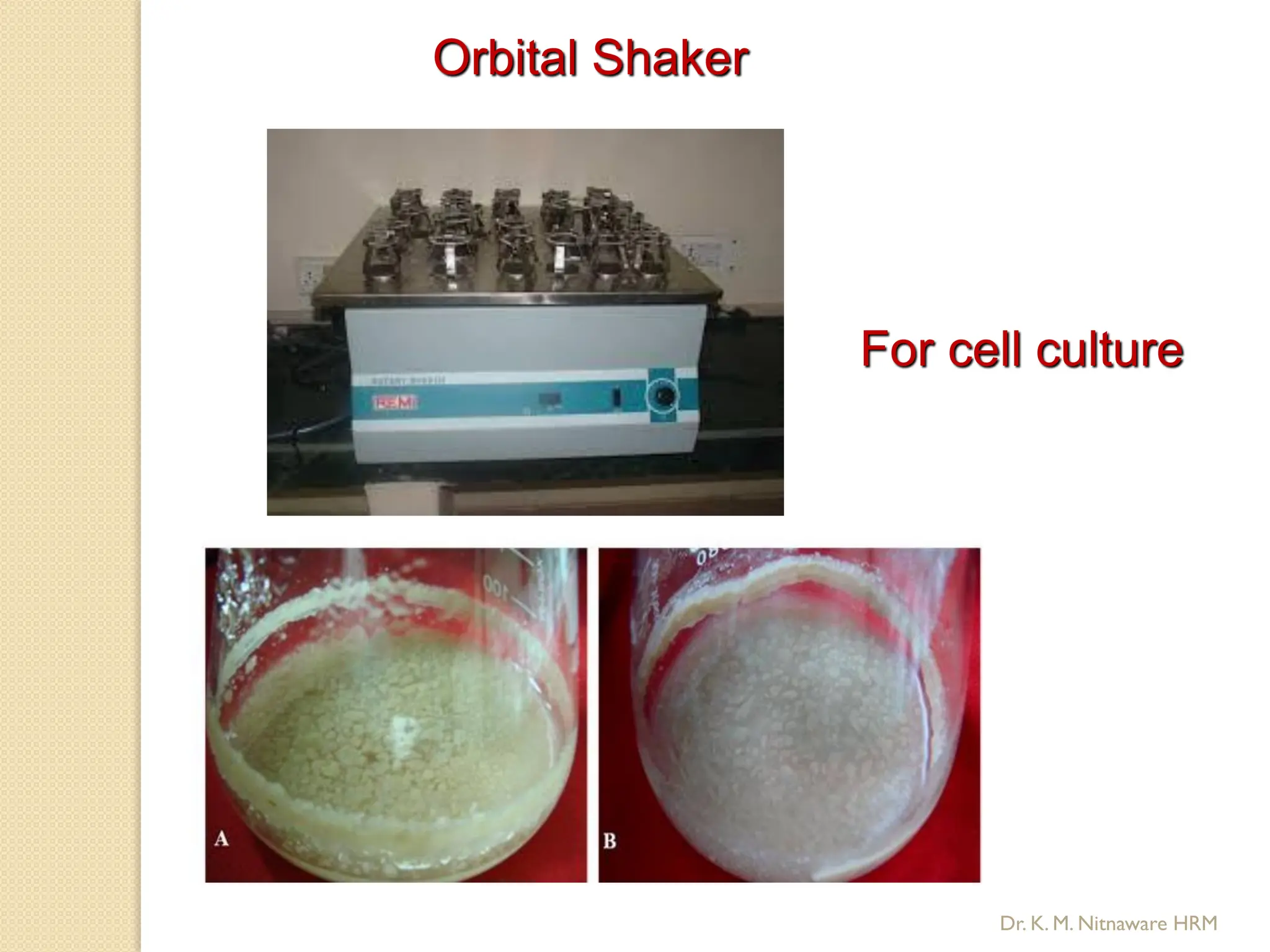
For cell culture
Orbital Shaker
Dr. K. M. Nitnaware HRM
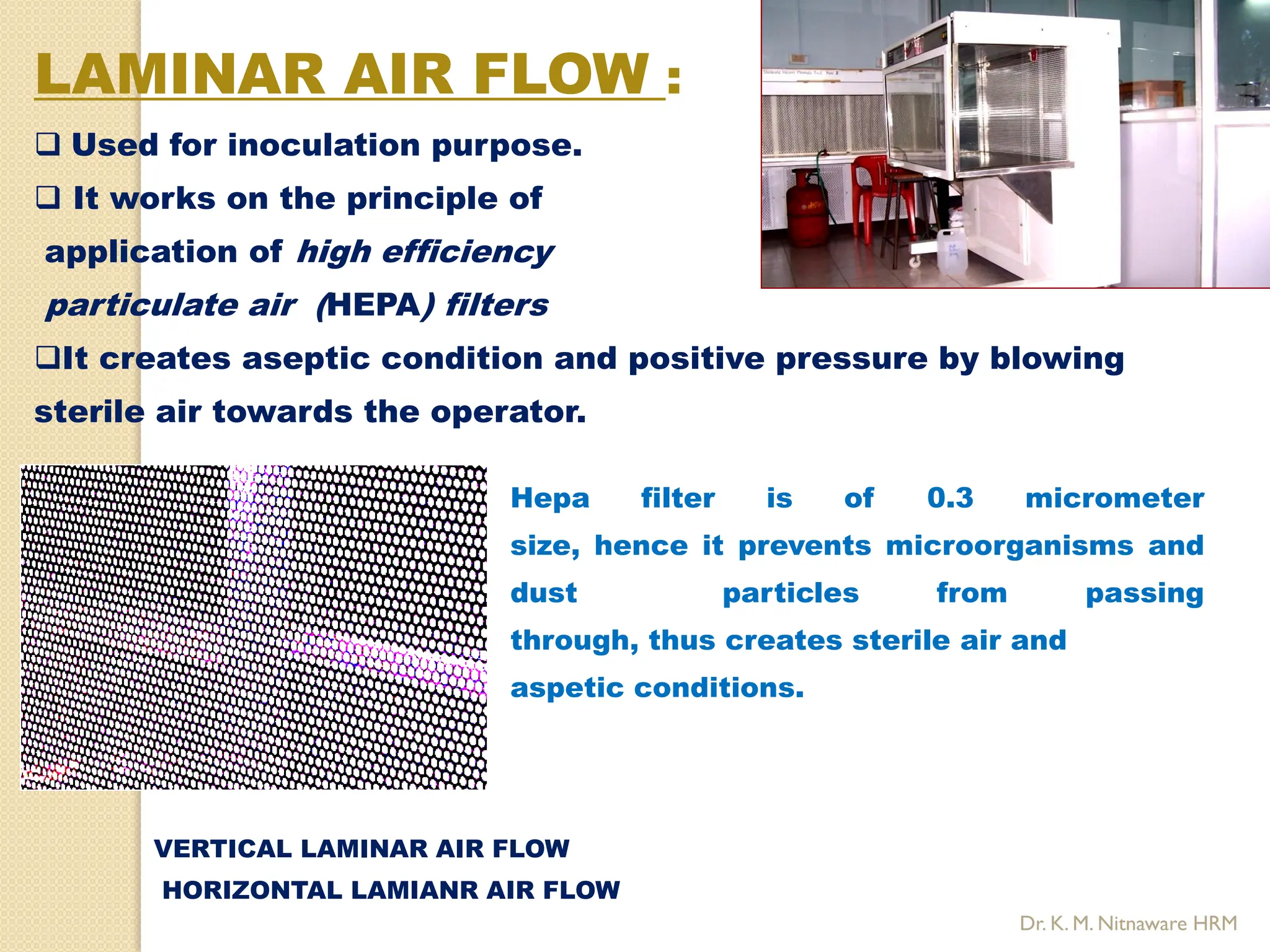
LAMINAR AIR FLOW :
 Used for inoculation purpose.
 It works on the principle of
application of high efficiency
particulate air (HEPA) filters
It creates aseptic condition and positive pressure by blowing
sterile air towards the operator.
Hepa filter is of 0.3 micrometer
size, hence it prevents microorganisms and
dust particles from passing
through, thus creates sterile air and
aspetic conditions.
VERTICAL LAMINAR AIR FLOW
HORIZONTAL LAMIANR AIR FLOW
Dr. K. M. Nitnaware HRM
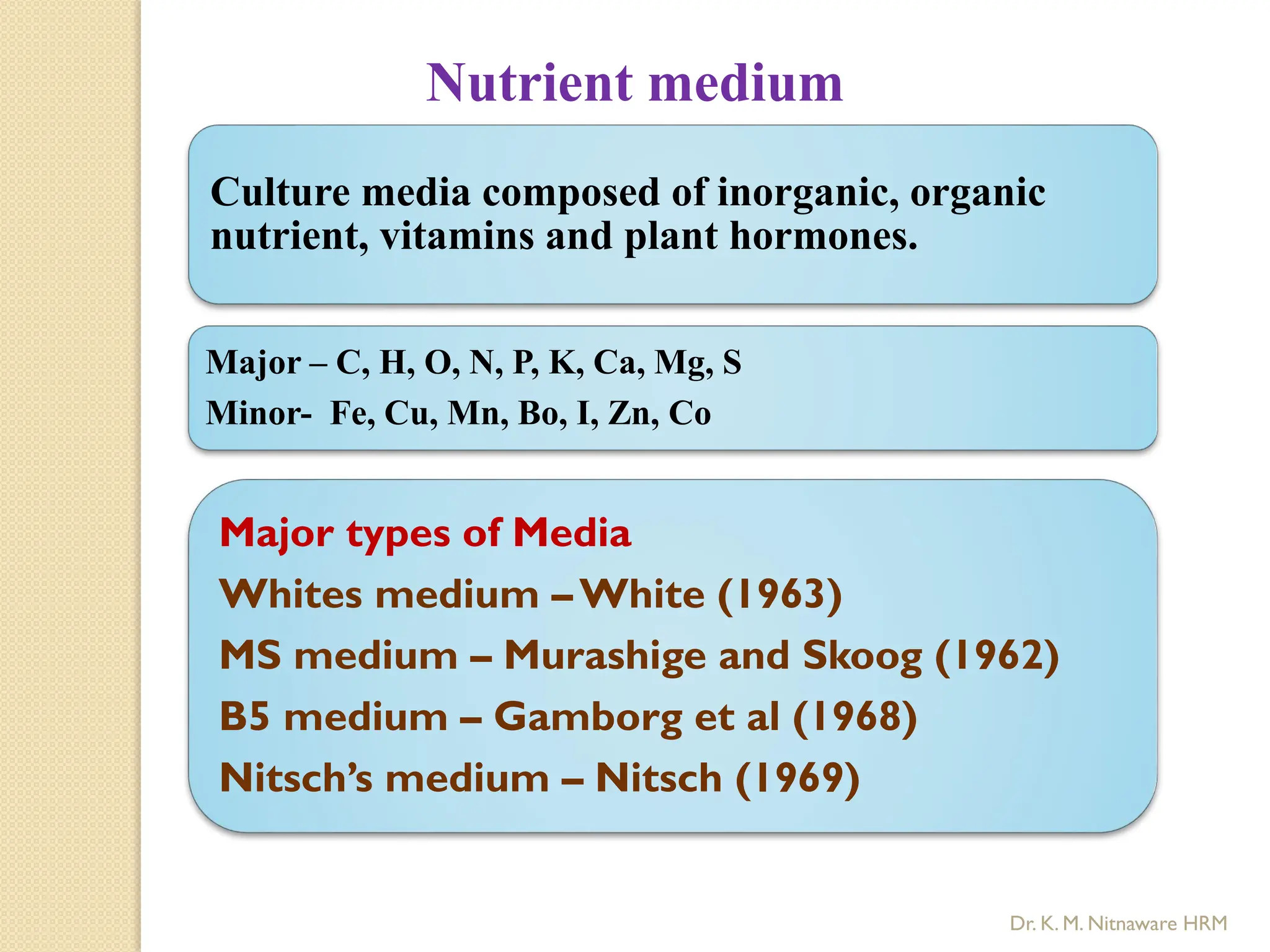
Culture media composed of inorganic, organic
nutrient, vitamins and plant hormones.
Major – C, H, O, N, P, K, Ca, Mg, S
Minor- Fe, Cu, Mn, Bo, I, Zn, Co
Major types of Media
Whites medium – White (1963)
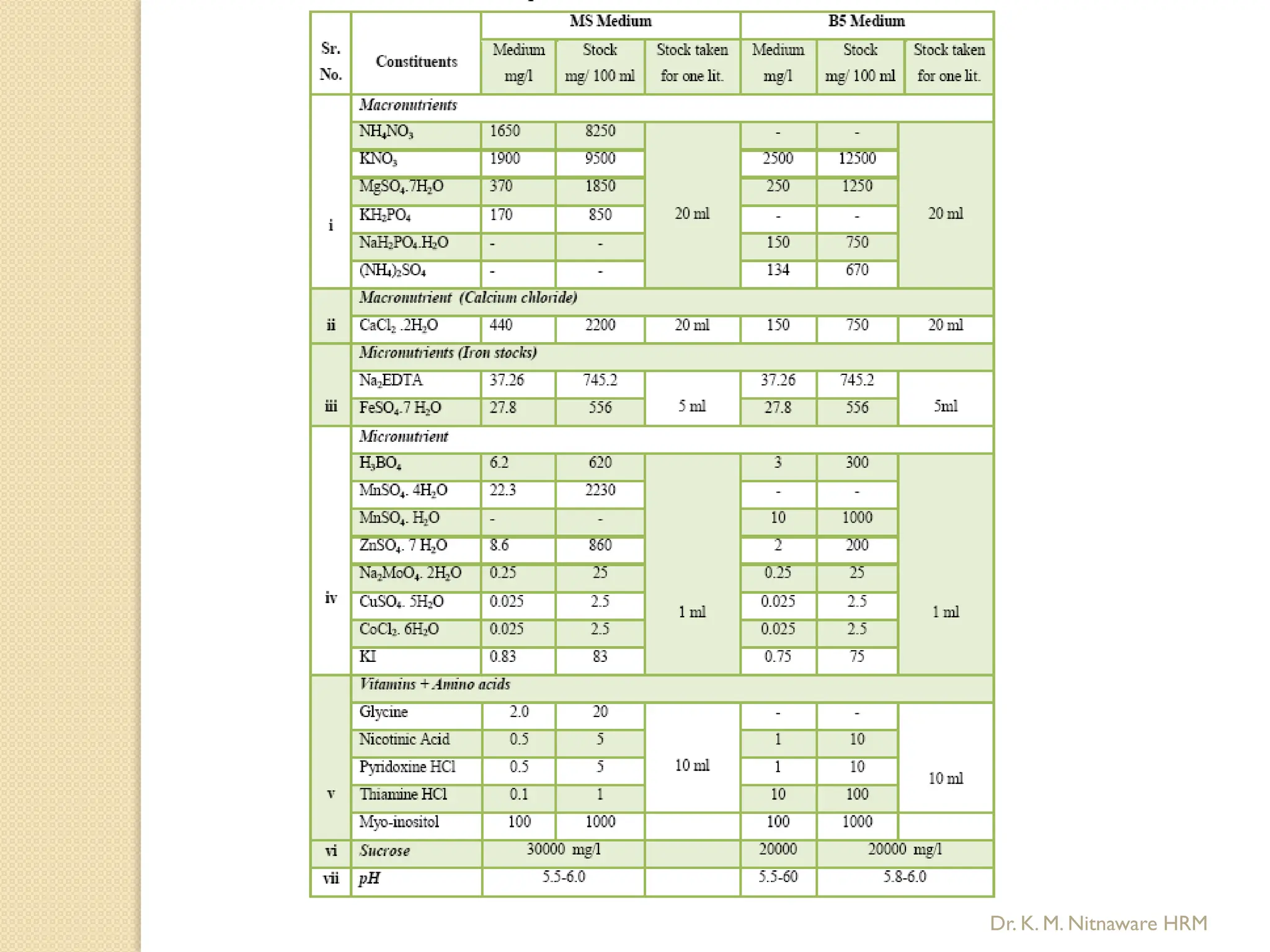
MS medium – Murashige and Skoog (1962)
B5 medium – Gamborg et al (1968)
Nitsch’s medium – Nitsch (1969)
Nutrient medium
Dr. K. M. Nitnaware HRM
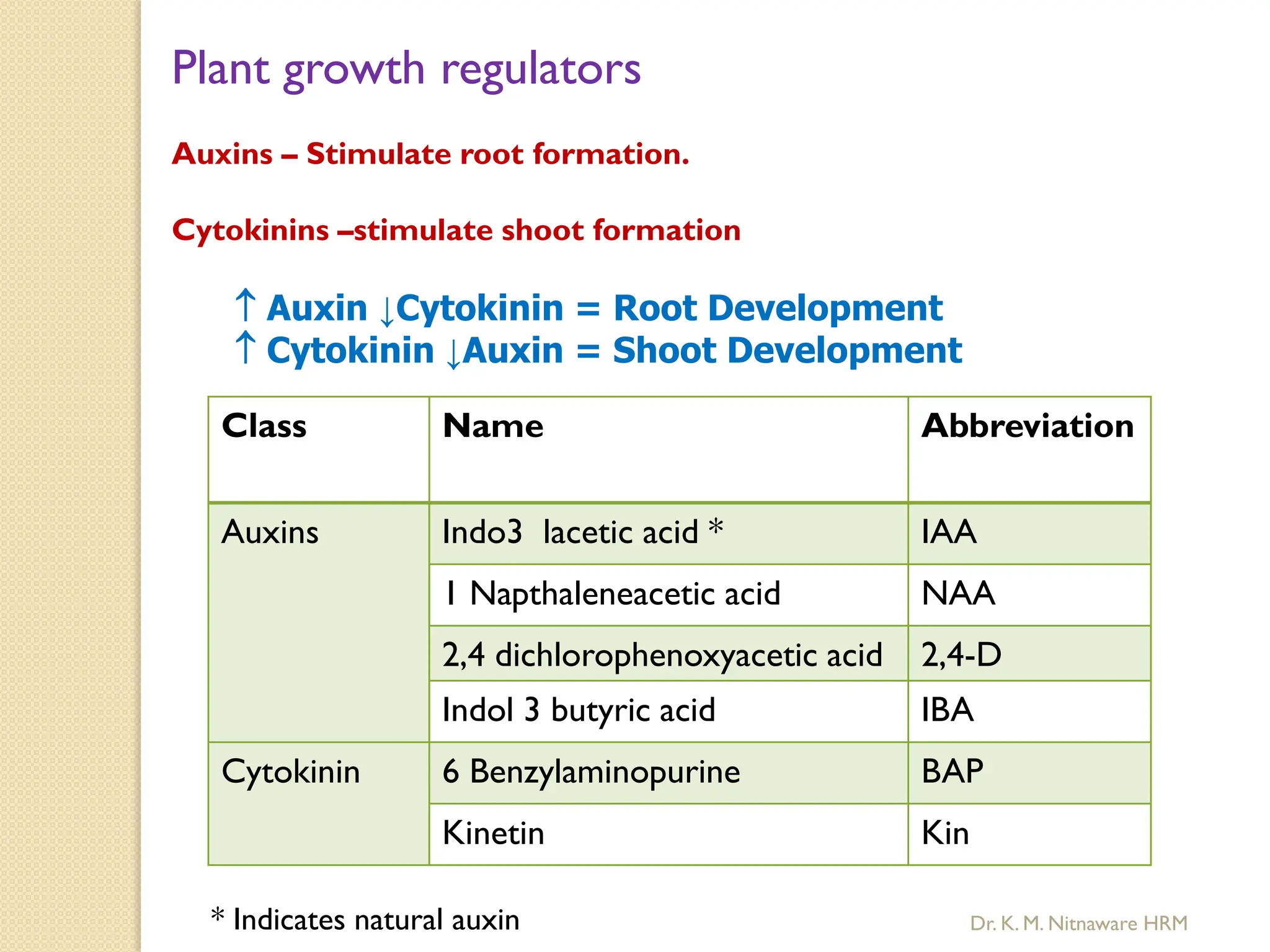
Plant growth regulators
Auxins – Stimulate root formation.
Cytokinins –stimulate shoot formation
 Auxin ↓Cytokinin = Root Development
 Cytokinin ↓Auxin = Shoot Development
Class Name Abbreviation
Auxins Indo3 lacetic acid * IAA
1 Napthaleneacetic acid NAA
2,4 dichlorophenoxyacetic acid 2,4-D
Indol 3 butyric acid IBA
Cytokinin 6 Benzylaminopurine BAP
Kinetin Kin
* Indicates natural auxin Dr. K. M. Nitnaware HRM
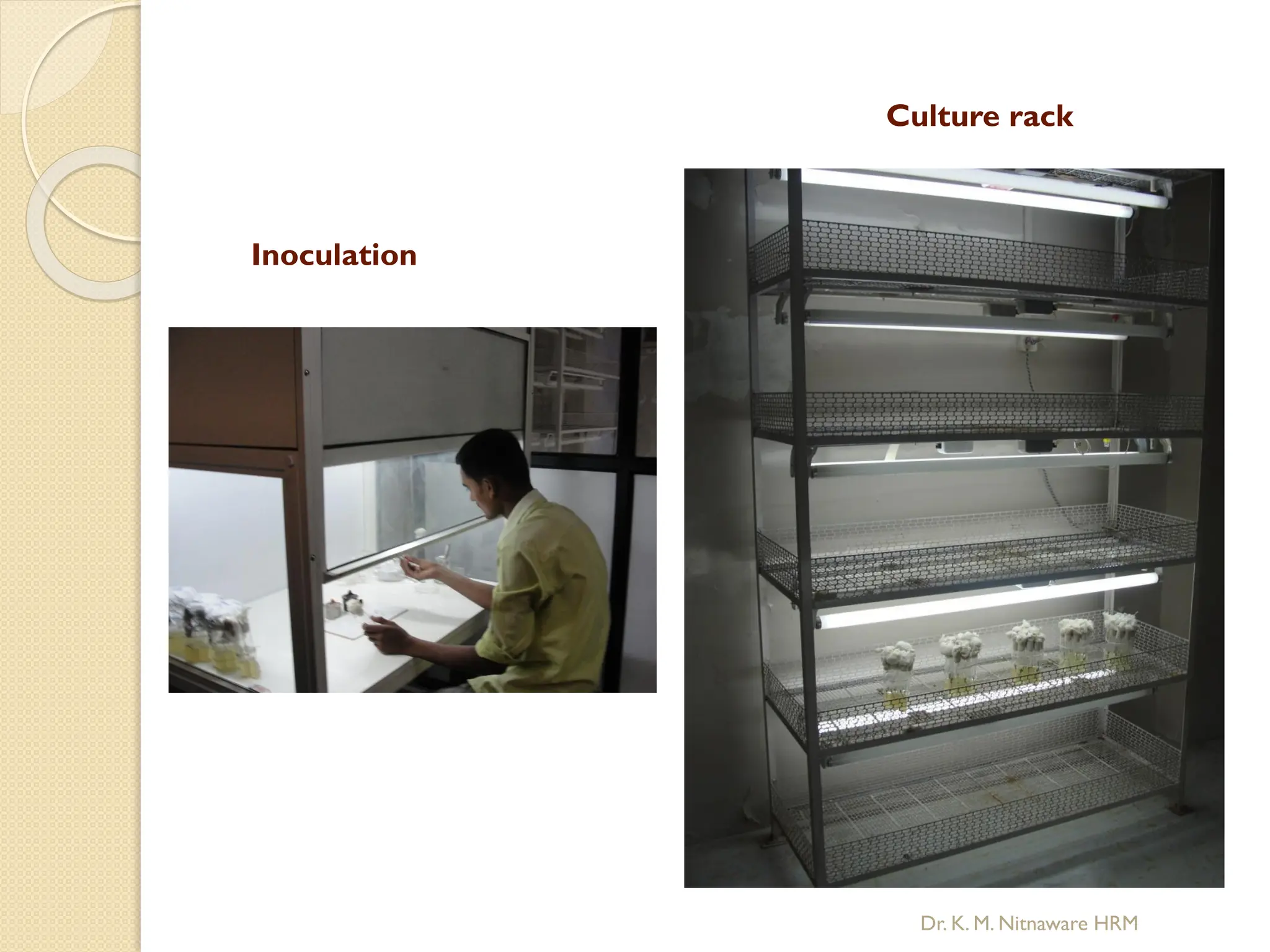
Culture rack
Inoculation
Dr. K. M. Nitnaware HRM
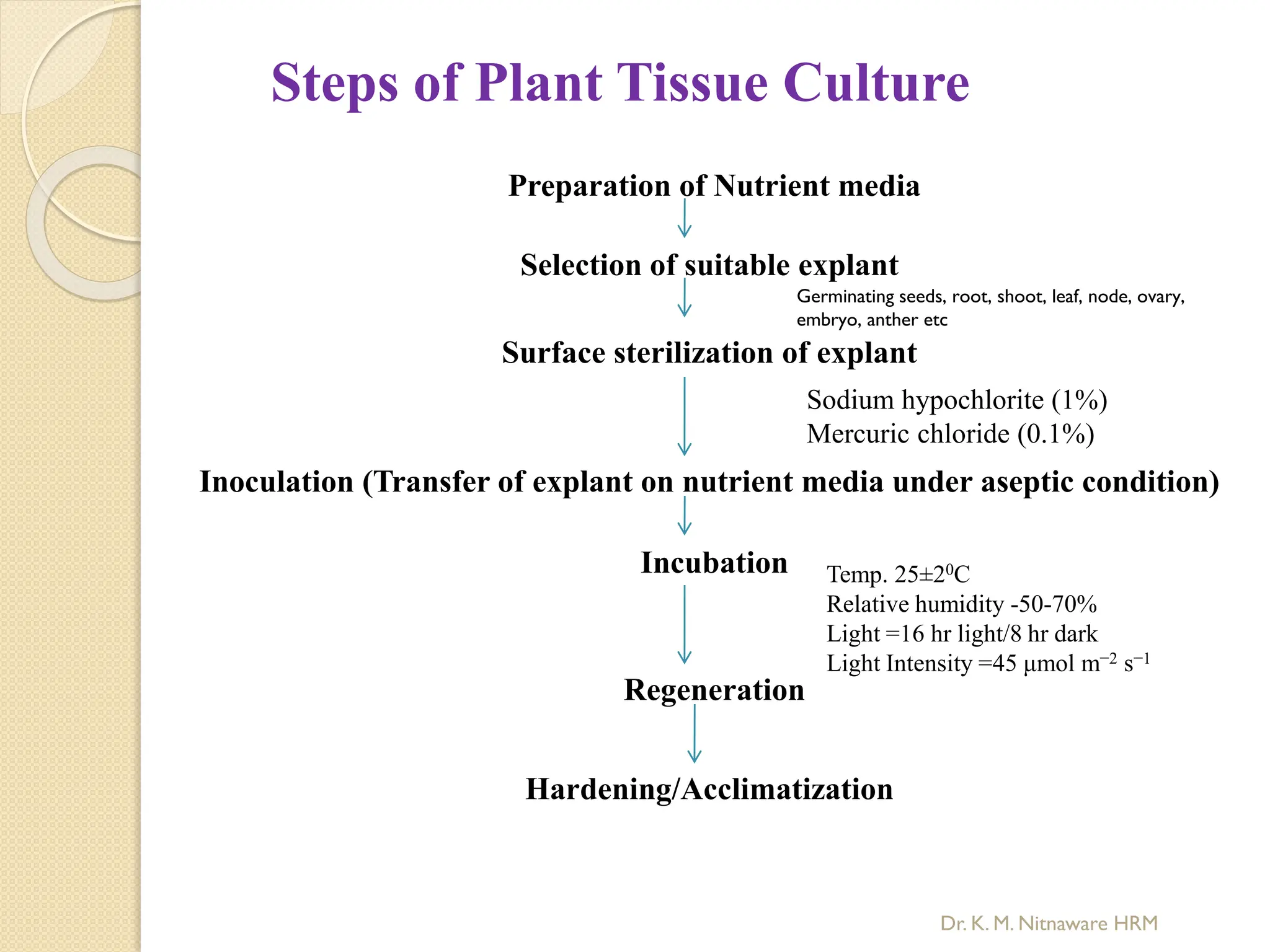
Steps of Plant Tissue Culture
Preparation of Nutrient media
Selection of suitable explant
Surface sterilization of explant
Inoculation (Transfer of explant on nutrient media under aseptic condition)
Incubation
Regeneration
Hardening/Acclimatization
Sodium hypochlorite (1%)
Mercuric chloride (0.1%)
Temp. 25±20C
Relative humidity -50-70%
Light =16 hr light/8 hr dark
Light Intensity =45 μmol m−2 s−1
Germinating seeds, root, shoot, leaf, node, ovary,
embryo, anther etc
Dr. K. M. Nitnaware HRM
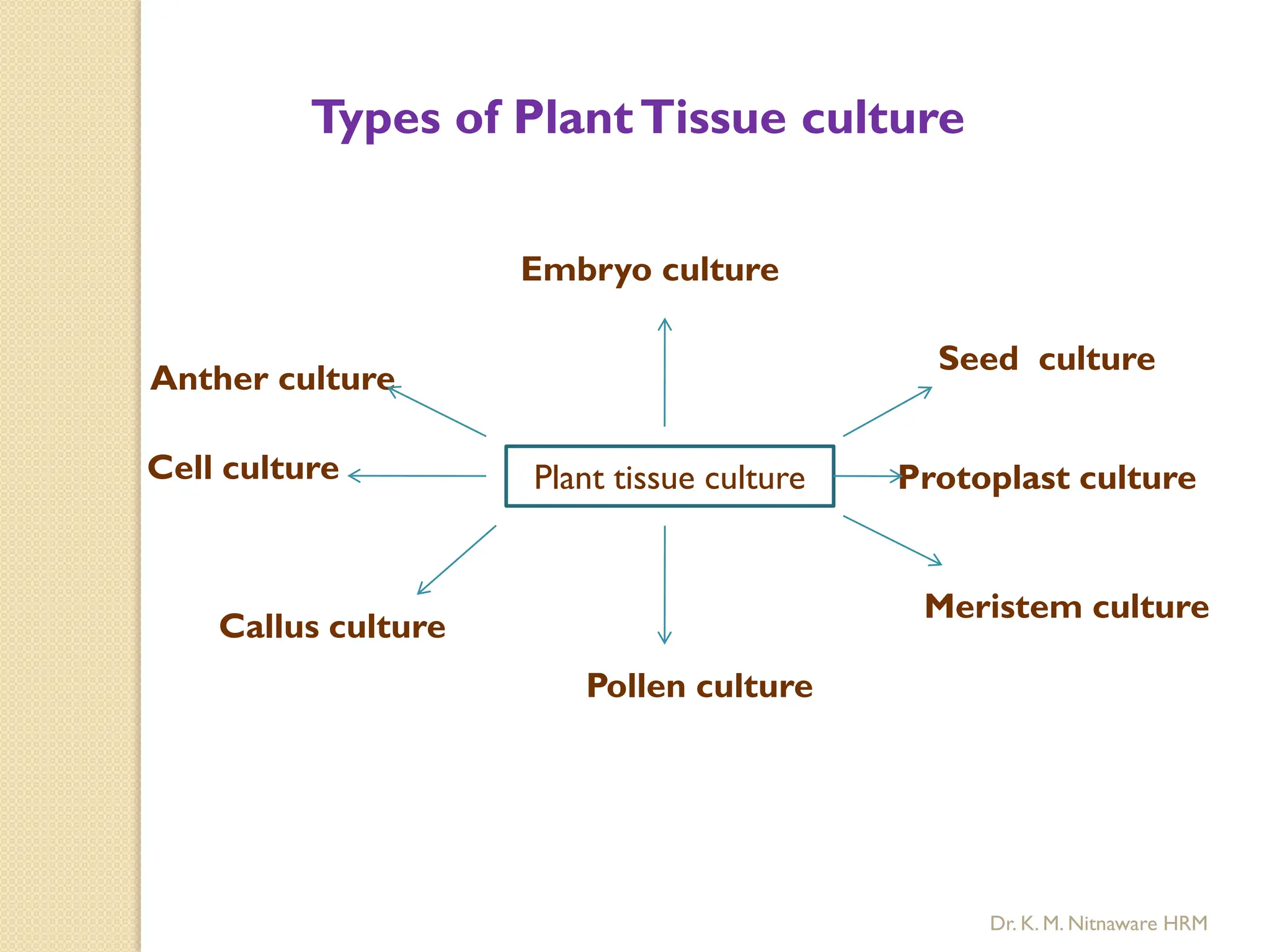
Embryo culture
Plant tissue culture
Seed culture
Protoplast culture
Pollen culture
Meristem culture
Callus culture
Cell culture
Anther culture
Types of PlantTissue culture
Dr. K. M. Nitnaware HRM
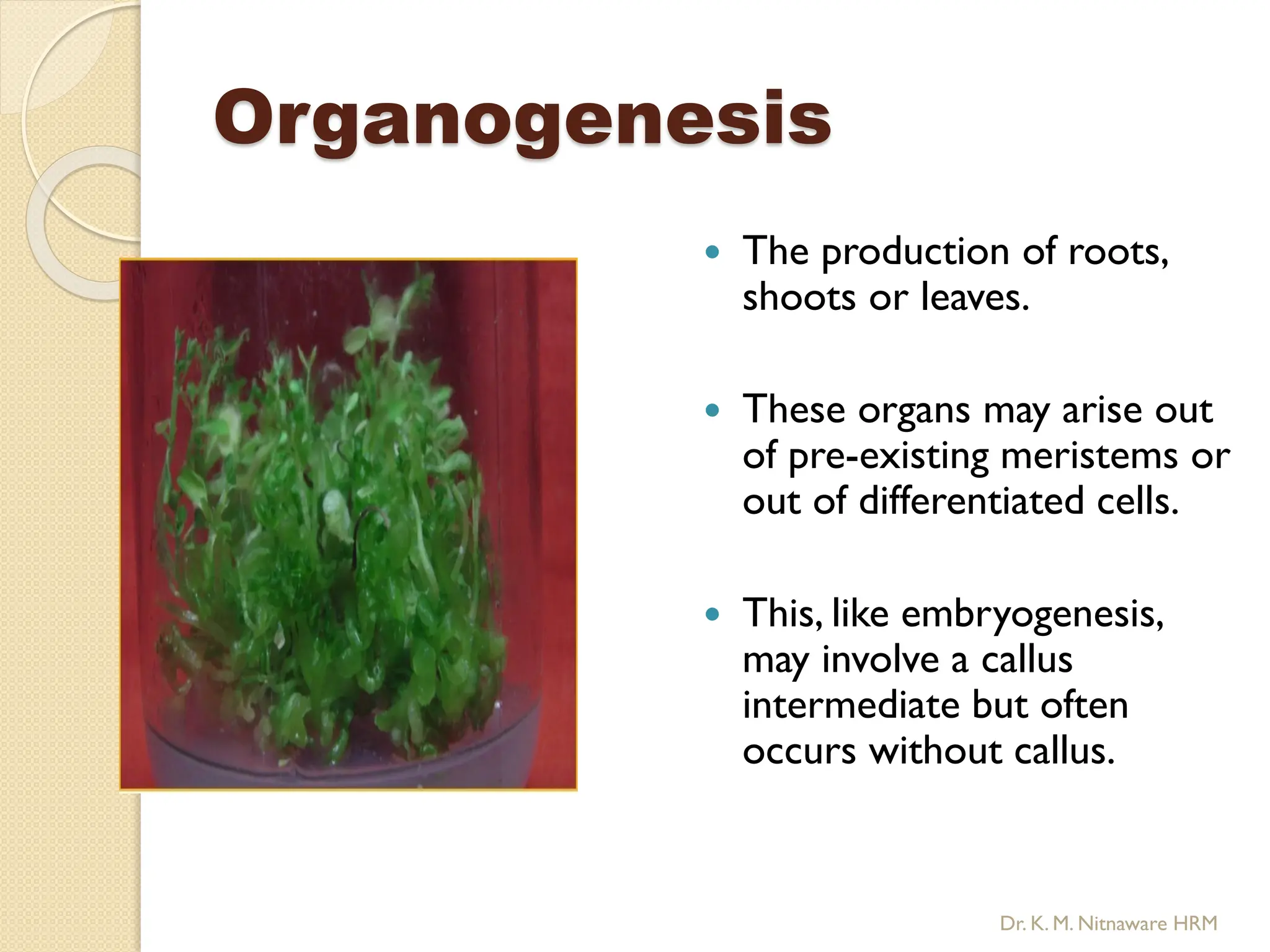
Organogenesis
 The production of roots,
shoots or leaves.
 These organs may arise out
of pre-existing meristems or
out of differentiated cells.
 This, like embryogenesis,
may involve a callus
intermediate but often
occurs without callus.
Dr. K. M. Nitnaware HRM
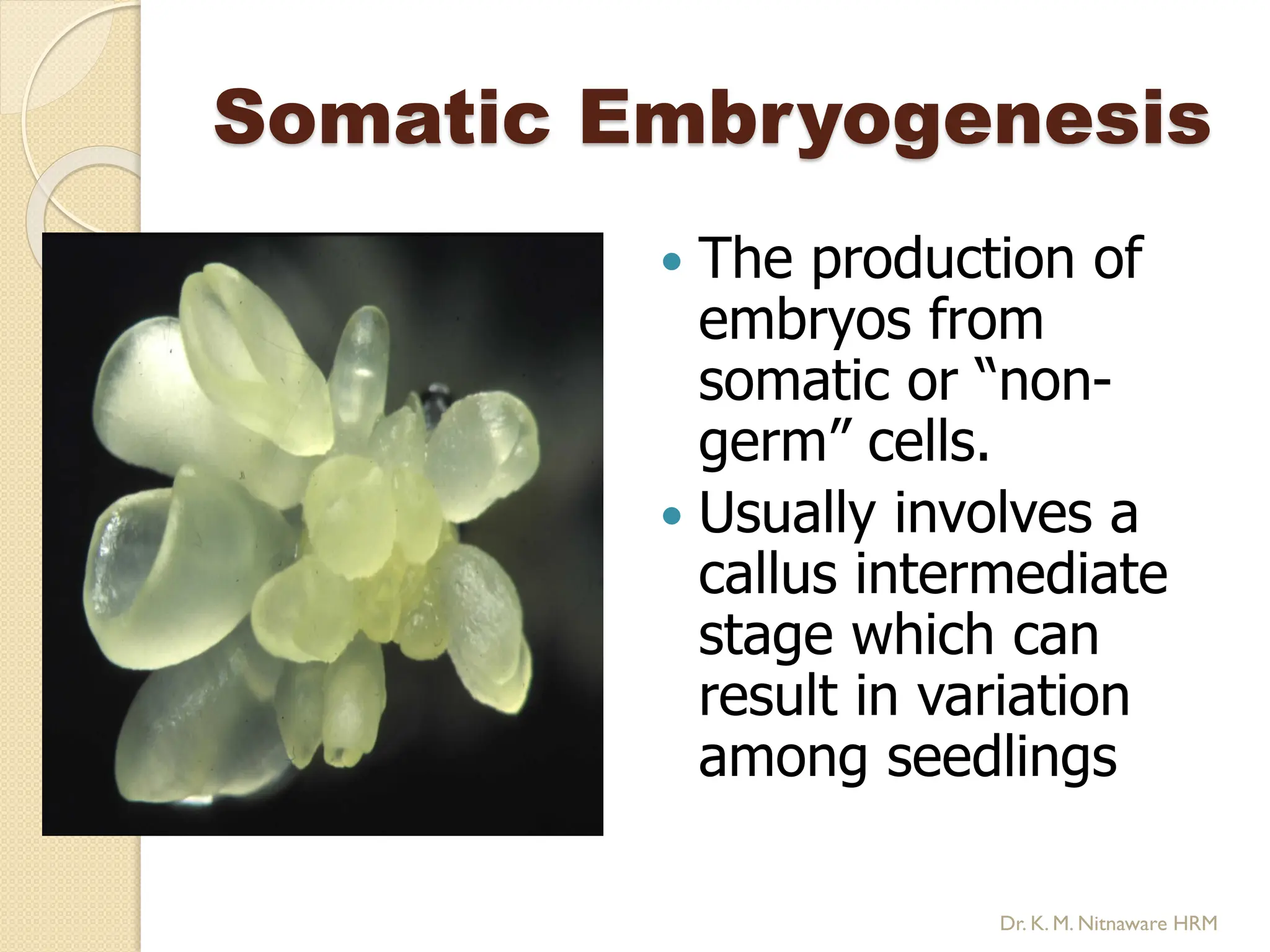
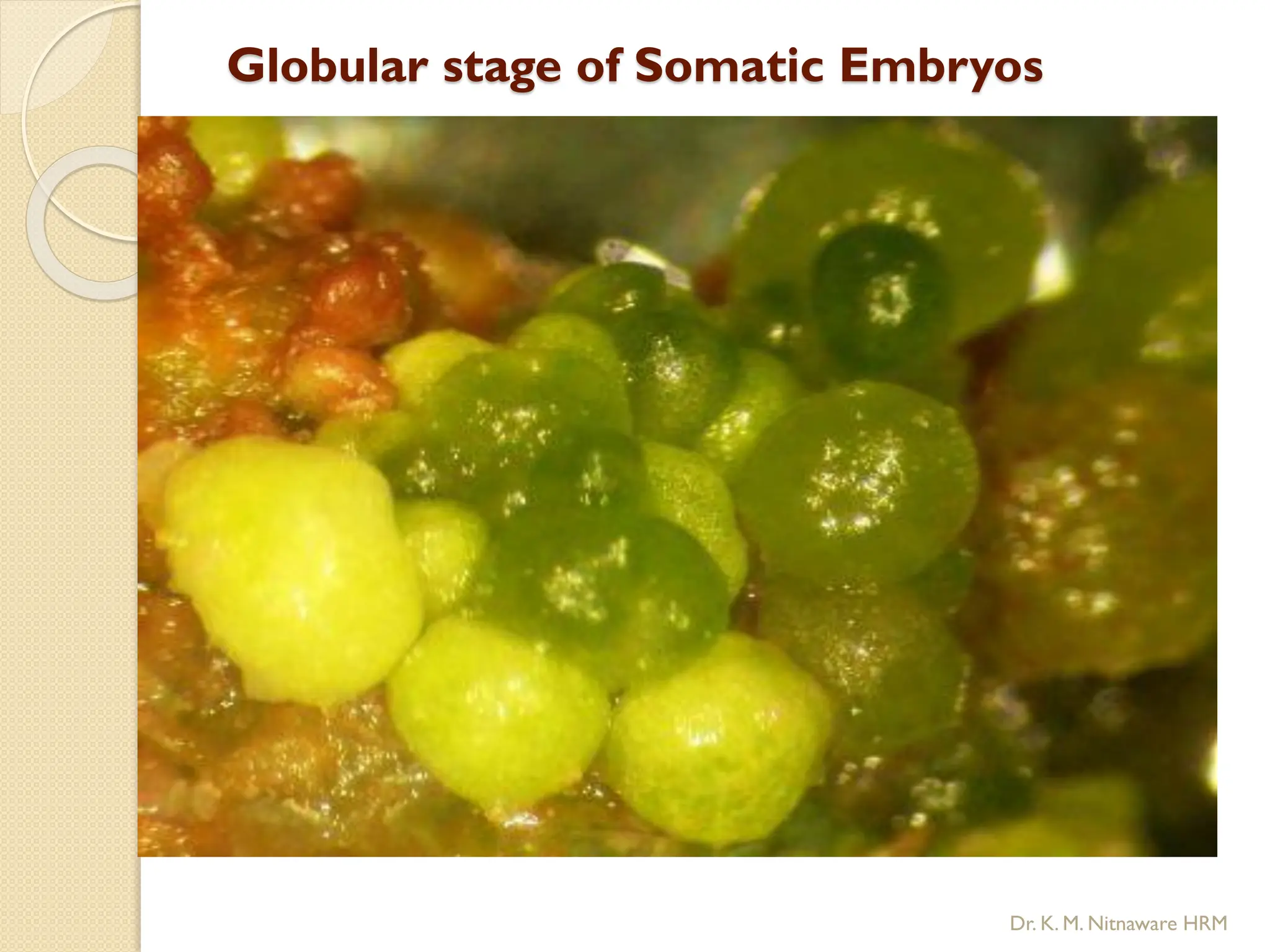
Somatic Embryogenesis
 The production of
embryos from
somatic or “non-
germ” cells.
 Usually involves a
callus intermediate
stage which can
result in variation
among seedlings
Dr. K. M. Nitnaware HRM
Globular stage of Somatic Embryos
Dr. K. M. Nitnaware HRM
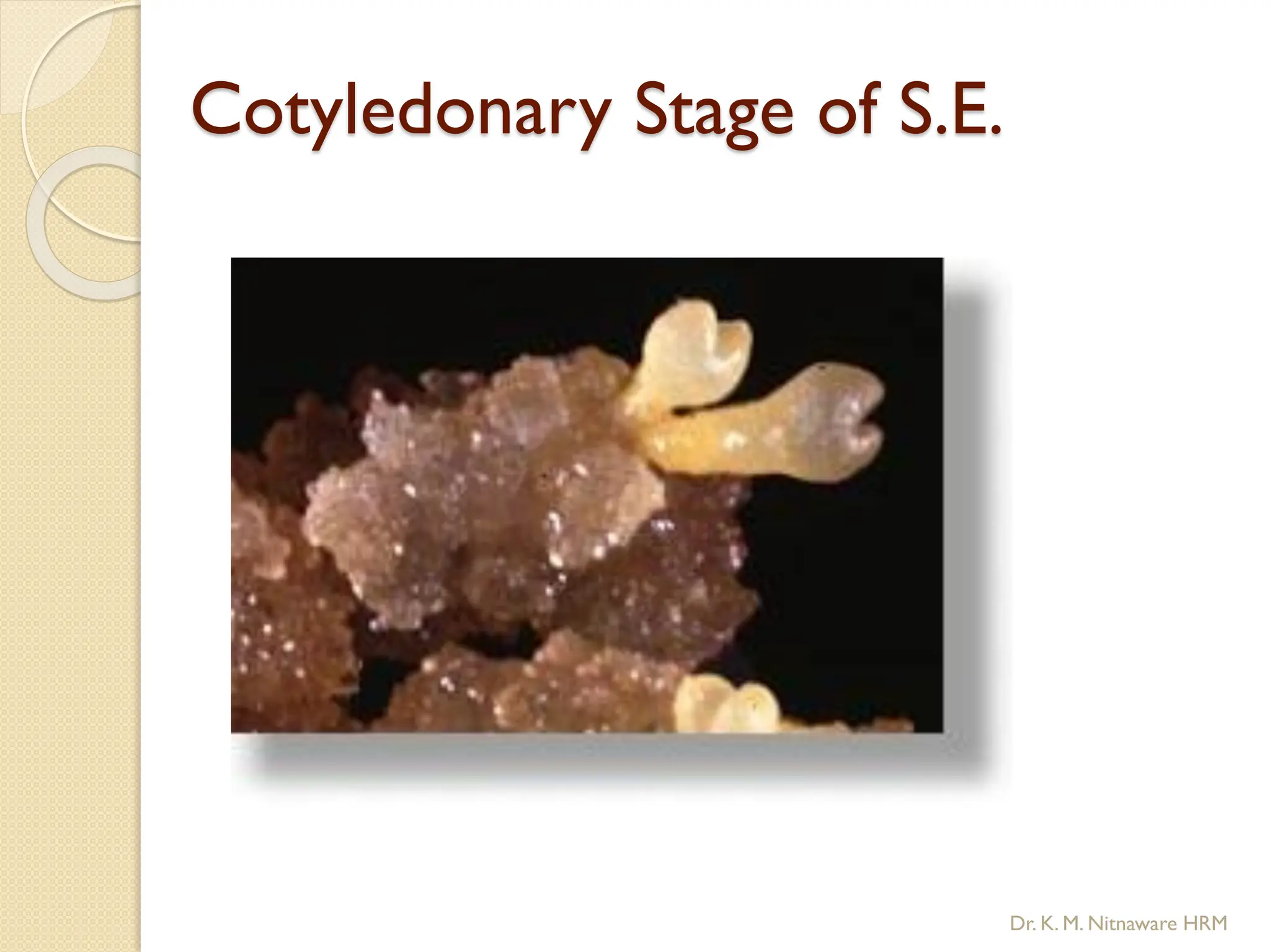
Cotyledonary Stage of S.E.
Dr. K. M. Nitnaware HRM
CALLUS CULTURE
Dr. K. M. Nitnaware HRM
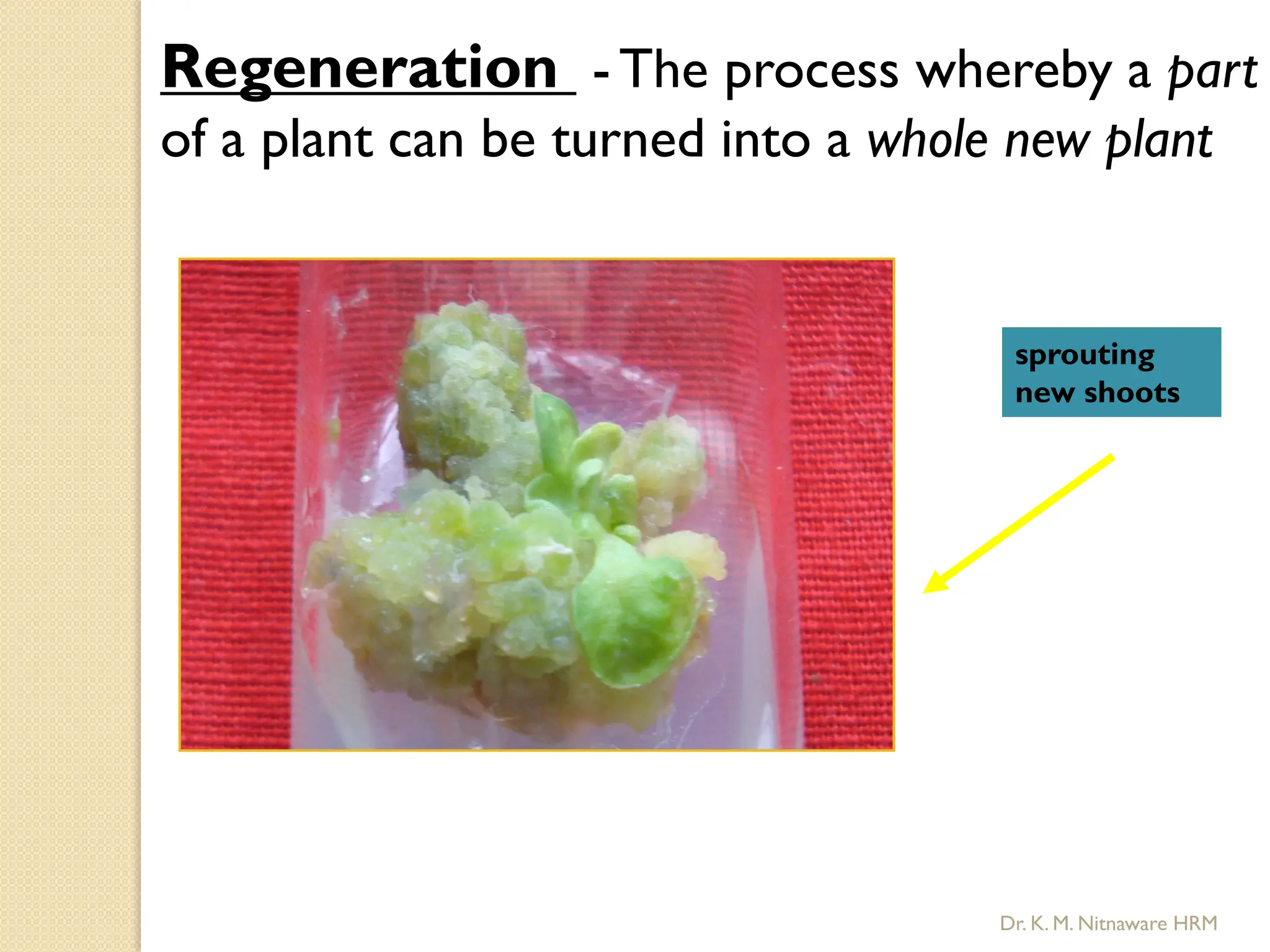
Regeneration - The process whereby a part
of a plant can be turned into a whole new plant
sprouting
new shoots
Dr. K. M. Nitnaware HRM
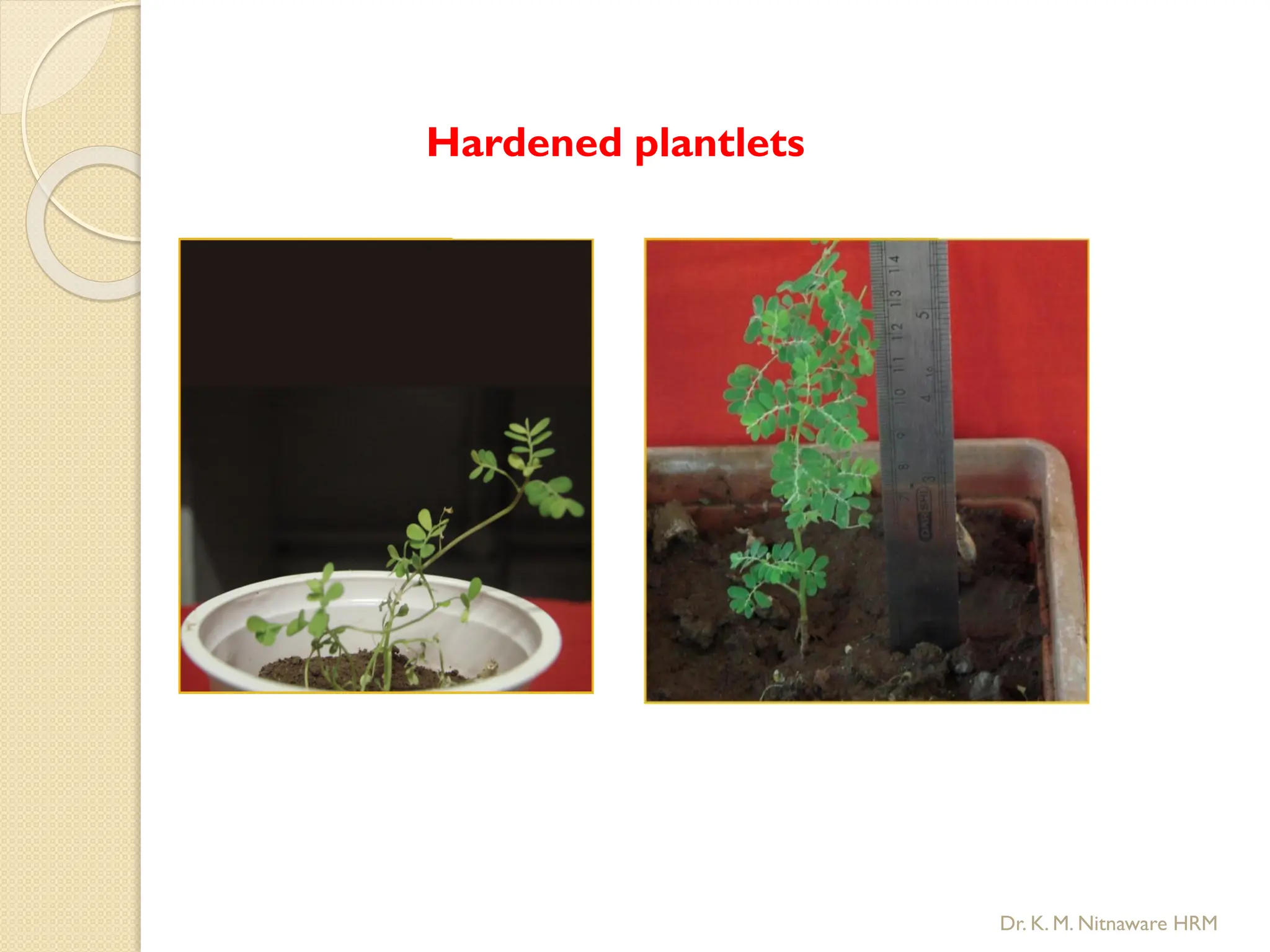
Hardened plantlets
Dr. K. M. Nitnaware HRM
Importance of plant tissue culture
 Production of improved crop varieties
Disease free and desired propagules
Production of secondary metabolites
Production of salt tolerant, drought tolerant and heat
stress tolerant variety
Biotransformation
Biosynthetic pathway
Haploid production
Dr. K. M. Nitnaware HRM
Basics of PTC (1).pdf basics of tissue culture

Basics of PTC (1).pdf basics of tissue culture

  • 1.
    BASICS OF PLANTTISSUE CULTURE T.Y.B.Sc. BO345 Plant Biotechnology Sem. IV BY Dr. KIRTI M. NITNAWARE ASSISTANT PROFESSOR DEPARTMENT OF BOTANY HUTATMA RAJGURU MAHAVIDYALAYA, RAJGURUNAGAR
  • 2.
    Introduction  What isplant tissue culture? ◦ The growth or regeneration of plant cells, tissues, organs or whole plants in artificial medium under aseptic conditions.  In vitro culture ◦ From Latin- “within the glass” performing an experiment in a test tube. Dr. K. M. Nitnaware HRM
  • 3.
    History of PlantTissue Culture First attempt of plant tissue culture Callus culture 1902 1939 Haberdlandt Maheshwari Guha 1964 First haploid culture Dr. K. M. Nitnaware HRM
  • 4.
    Murashige Skoog 1962 MS media 1966Steward Totipotency carrot plant 1970 Power et al Protoplast fusion 1977 Chilton Integrated Ti plasmid from Agrobacgerium tumefaciens in plant 1984 Horshet et al Transgenic tobacco 1987 Kleinet Biolistic gene transfer Dr. K. M. Nitnaware HRM
  • 5.
    Terminology Explant: A plantorgan or piece of tissue used to initiate a culture. Culture: Growing cells, tissue, plant, organs or whole plant in nutrient medium under aseptic condition. Eg. cell culture, embryo culture, anther culture Aseptic culture : Raising cultures from a tissue or an organ after freeing it of bacteria, fungi and other microorganism. Callus: A tissue arsing from disorganized proliferation of cells either in cultures or in nature. Plural calli Cell culture: Culture of single cells or small groups of similar cells Ref:PlantTissue CultureTheory and Practice,a Revised Edition S.S. Bhojwani and M.K Razdan Dr. K. M. Nitnaware HRM
  • 6.
    Contamination: Unwanted microorganismwhich may inhibit the growth of the cells or tissues in culture.  Subculture: Transfer of tissue or explant into fresh media Regeneration-: In tissue cultures, a morphogenetic response that results in the production of new organs, embryo or whole plants from cultured explant or calli derived from them. Dedifferentiation: Reversal of organized structures into an undifferentiated state. Differentiation : The development of different morphological characteristics. In tissue culture the term is used to describe the formation of different cell type, roots, shoots, embryos or any other orgsns in callus or cell culture. Ref:PlantTissue CultureTheory and Practice,a Revised Edition S.S. Bhojwani and M.K Razdan Dr. K. M. Nitnaware HRM
  • 7.
    Micropropagation: Asexual orvegetative propagation of plants in vitro. Organogenesis: Differentiation of organs from cultured cells or tissue. Plantlet: A small rooted shoot or germinated embryo. Somatic hybridization: The creation of hybrids by fusion of protoplast derived from genetically different cells. Totipotency: Potentiality or property of cell to produce a whole organism. Transgenic plant: Plants which have been genetically engineered to modify certain characteristics by introducing one or a few selected genes. Ref: PlantTissue CultureTheory and Practice,a Revised Edition S.S. Bhojwani and M.K Razdan Dr. K. M. Nitnaware HRM
  • 8.
    Requirement of PTC Appropriate tissue (Explant)  Equipment and Glasswares  A suitable growth medium  Aseptic (sterile) conditions  Culture room  Incubation room Dr. K. M. Nitnaware HRM
  • 9.
    Explant An explant isa piece of tissue used to initiate a tissue culture. Explant should be disease free. Ref:https://www.slideshare.net/ojuederiebern/plant-tissue-culture- methods-and-applications Dr. K. M. Nitnaware HRM
  • 10.
    Hot air Oven Glasswares keptin the oven for drying at 1600-2000C  Equipment and Glasswares Dr. K. M. Nitnaware HRM
  • 11.
    Double Distillation Unit - FORTHE PURIFICATION OF TAP WATER BY DISTILLATION PROCESS. - DISTILLED WATER HAS NEUTRAL pH (pH = 7) IT IS SALT FREE AND PURE. Dr. K. M. Nitnaware HRM
  • 12.
    REFRIGERATOR - IT ISUSED TO STORE THE STOCK SOLUTIONS OF MACRONUTRIENTS, MICRONUTRIENTS, VITAMINS AND GROWTH HORMONES AT 40C Dr. K. M. Nitnaware HRM
  • 13.
    CAPACITY : 0.001TO 200 gm IS SUITABLE FOR TISSUE CULTURE TECHNIQUES. - USED TO MEASURE MINUTE QUANTITY OF CHEMICALS USED IN NUTRIENT MEDIA DIGITAL BALANCE Dr. K. M. Nitnaware HRM
  • 14.
    pH Meter - usedto check or adjust the pH of nutrient medium - 5.8 pH is prefered for tissue culture media . - If pH is alkaline, it is adjusted by addition of 0.1 N HCl. - if pHis acidic, it is adjusted by addition of 1N NaOH. Dr. K. M. Nitnaware HRM
  • 15.
    CONDITIONS : - 1210CTEMPERATURE - 15 lb PRESSURE - 20 MINUTES For glassware and media sterilization AUTOCLAVE Dr. K. M. Nitnaware HRM
  • 16.
    For cell culture OrbitalShaker Dr. K. M. Nitnaware HRM
  • 17.
    LAMINAR AIR FLOW:  Used for inoculation purpose.  It works on the principle of application of high efficiency particulate air (HEPA) filters It creates aseptic condition and positive pressure by blowing sterile air towards the operator. Hepa filter is of 0.3 micrometer size, hence it prevents microorganisms and dust particles from passing through, thus creates sterile air and aspetic conditions. VERTICAL LAMINAR AIR FLOW HORIZONTAL LAMIANR AIR FLOW Dr. K. M. Nitnaware HRM
  • 18.
    Culture media composedof inorganic, organic nutrient, vitamins and plant hormones. Major – C, H, O, N, P, K, Ca, Mg, S Minor- Fe, Cu, Mn, Bo, I, Zn, Co Major types of Media Whites medium – White (1963) MS medium – Murashige and Skoog (1962) B5 medium – Gamborg et al (1968) Nitsch’s medium – Nitsch (1969) Nutrient medium Dr. K. M. Nitnaware HRM
  • 19.
    Dr. K. M.Nitnaware HRM
  • 20.
    Plant growth regulators Auxins– Stimulate root formation. Cytokinins –stimulate shoot formation  Auxin ↓Cytokinin = Root Development  Cytokinin ↓Auxin = Shoot Development Class Name Abbreviation Auxins Indo3 lacetic acid * IAA 1 Napthaleneacetic acid NAA 2,4 dichlorophenoxyacetic acid 2,4-D Indol 3 butyric acid IBA Cytokinin 6 Benzylaminopurine BAP Kinetin Kin * Indicates natural auxin Dr. K. M. Nitnaware HRM
  • 21.
  • 22.
    Steps of PlantTissue Culture Preparation of Nutrient media Selection of suitable explant Surface sterilization of explant Inoculation (Transfer of explant on nutrient media under aseptic condition) Incubation Regeneration Hardening/Acclimatization Sodium hypochlorite (1%) Mercuric chloride (0.1%) Temp. 25±20C Relative humidity -50-70% Light =16 hr light/8 hr dark Light Intensity =45 μmol m−2 s−1 Germinating seeds, root, shoot, leaf, node, ovary, embryo, anther etc Dr. K. M. Nitnaware HRM
  • 23.
    Embryo culture Plant tissueculture Seed culture Protoplast culture Pollen culture Meristem culture Callus culture Cell culture Anther culture Types of PlantTissue culture Dr. K. M. Nitnaware HRM
  • 24.
    Organogenesis  The productionof roots, shoots or leaves.  These organs may arise out of pre-existing meristems or out of differentiated cells.  This, like embryogenesis, may involve a callus intermediate but often occurs without callus. Dr. K. M. Nitnaware HRM
  • 25.
    Somatic Embryogenesis  Theproduction of embryos from somatic or “non- germ” cells.  Usually involves a callus intermediate stage which can result in variation among seedlings Dr. K. M. Nitnaware HRM
  • 26.
    Globular stage ofSomatic Embryos Dr. K. M. Nitnaware HRM
  • 27.
    Cotyledonary Stage ofS.E. Dr. K. M. Nitnaware HRM
  • 28.
    CALLUS CULTURE Dr. K.M. Nitnaware HRM
  • 29.
    Regeneration - Theprocess whereby a part of a plant can be turned into a whole new plant sprouting new shoots Dr. K. M. Nitnaware HRM
  • 30.
    Hardened plantlets Dr. K.M. Nitnaware HRM
  • 31.
    Importance of planttissue culture  Production of improved crop varieties Disease free and desired propagules Production of secondary metabolites Production of salt tolerant, drought tolerant and heat stress tolerant variety Biotransformation Biosynthetic pathway Haploid production Dr. K. M. Nitnaware HRM