Millisteps
Reducing the negative environmental impacts of one million people
Image: Facebook.com
Rough Agenda
• Why?
• What brings us here?
• How to measure?
• A few ideas
• Your commentary and feedback throughout
• How to impact?
• A few ideas
• Your commentary and feedback throughout
• Next Steps
About us
• What brings us here today?
Ugh…one of these pages
While I hate self-promoty bio powerpoints, I do want to let you know some of the cool places I’ve worked/things I’ve been involved in on the off
chance you have any questions/I can connect you with anyone there. Some of these were co-ops, some volunteer, some “real jobs”
• Career Skills Incubator – non-profit founder
• Canadian Standards Association – renewable energy standards, green team
• Sustainalytics – analyze companies on indicators for socially responsible investment, everything from GHG
to board of directors’ diversity, to water consumption, to transparency of reporting
• Sustainable Waterloo Region – volunteer policy analyst, strategic lead, and a bunch of other things
• Bougainvillea Beach Resorts – environmental reporting, started hotel recycling program, and Barbados’ first
community recycling program
• Northern Thailand farmer field schools to preserve local planting & seed preservation techniques, fish
habitat
• Online UWC – online course mentor & facilitator for action-oriented, internationally focused sustainability
courses
• Trails Youth Initiatives – “at risk” youth outdoor programs
• Imperial Oil – environmental assessments, environmental management plans (natural gas and in-situ oil
sands development), some carbon accounting
• BC Nature – park naturalist, also made business case to BC govt to continue nature programs
• Public Works and Government Services Canada – Waste Reduction
• Ethical Investments Club, Entrepreneurship courses at County Jails, Trash2Treasure large goods recycling
program
How to Measure?
• Most popular measures are Ecological Footprint and Carbon Footprint
Ecological Footprint
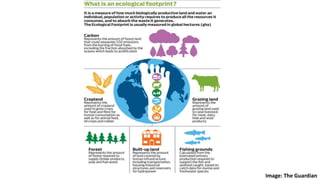
An ecological footprint measures the land and sea area people require
to produce resources that we consume. This includes our food, our
clothes, fuel we use for our cars and building materials for our homes. It
also measures how much land and water is required to deal with the
waste products of our consumption, such as carbon dioxide and
agricultural pollution. - footprint.wwf.org
Image: The Guardian
Ecological Footprint Doesn’t Include
Some pollutants - the release of materials for which the biosphere has no significant
assimilation capacity (e.g. plutonium, PCBs, dioxins, and other persistent pollutants) and
processes that damage the biosphere's future capacity (e.g. loss of biodiversity, salination
resulting from cropland irrigation, soil erosion from tilling).
Solution: Look for other forms of measurement
Fresh water: Use and availability of freshwater is not directly accounted for since
freshwater acts as a limit on the amount of biological capacity in an area but is not itself a
biologically produced good or service. Although the loss of biocapacity associated with
water appropriation or water quality degradation is reflected as a decrease in overall
biocapacity in that year, an ecological footprint of its use is not currently allocated to the
consumer of the water resource. It's also worth considering that the impact of water
consumption depends not just on the amount of water used, but where it is taken from.
The same volume of water used in an arid environment can have a far greater ecological
impact than if it was used in a relatively wet place. This makes water footprints different to
ecological and carbon footprints, for which size of footprint is what really matters.
Solution: Water footprint
http://footprint.wwf.org.uk/static/faq
Carbon Footprint
The total amount of greenhouse gases produced to directly and indirectly support human
activities, usually expressed in equivalent tons of carbon dioxide (CO2). – Timeforchange.org
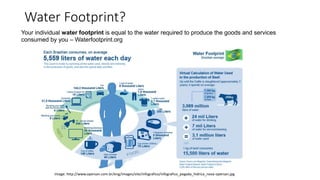
Water Footprint?
Image: http://www.opersan.com.br/eng/images/site/infografico/infografico_pegada_hidrica_nova-opersan.jpg
Your individual water footprint is equal to the water required to produce the goods and services
consumed by you – Waterfootprint.org
Human Impact =
Ecological Footprint
Carbon Footprint
Water Footprint
Other Measures (ie. Certain Pollutants)
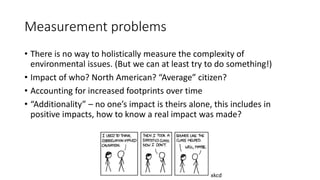
Measurement problems
• There is no way to holistically measure the complexity of
environmental issues. (But we can at least try to do something!)
• Impact of who? North American? “Average” citizen?
• Accounting for increased footprints over time
• “Additionality” – no one’s impact is theirs alone, this includes in
positive impacts, how to know a real impact was made?
xkcd
How to Impact?
• OF COURSE, MITIGATE AS MUCH AS YOU CAN IN YOUR OWN LIFE
FIRST!
• But then, if you’ve done as much as you can:
• A diversity of different projects combined (more manageable and
mitigates risk)
• Support existing projects and organizations to have greater impact
• New projects only if a need and no one else fills
Some “extreme” examples
• Click2Donate sites
• 716,481 peoples’ Ecological Footprint (land only) if 500k people clicked 10 “click
sites” daily: www.therainforestsite.org , http://www.care2.com/click-to-donate
• Energy Efficient Cook Stoves
• About 32 million cook stoves to offset carbon of 1 million people over lifetime
• Water efficient toilets in the US / factory retrofits
• In US, 2 billion gallons could be saved a day if all switched, imagine if composting
toilets!
• Environmentally responsible investing
• If convince everyone with investments to put $X into solar bonds, funding energy
efficient projects, etc
• Policy changes
• Important to partake but not as measurable
Work So Far
• Skills training and auditing for SME’s
• Train underrepresented populations in sustainability audits, basic energy, carbon,
water, etc. and calculators to make recommendations and plans for SME’s
• If works well, will create program guides to replicate around the world
• Currently pending grant funding
• Socially Responsible Investment
• Train the trainer program to encourage more “regular” investors to put into greener
investments
• Online Sustainability Course
• Mentoring students in sustainability around the world on general principles and how
they can start projects in their communities (maybe scale one together)
• Not enough yet, still hard to measure other than the first one!
Thank you!
What’s your feedback?
What are next steps?
Note: the next few slides are supplements to answer questions someone posted in the facebook
group
Feel free to connect through the facebook group or millisteps@gmail.com
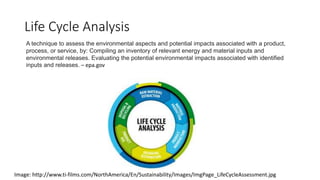
Life Cycle Analysis
A technique to assess the environmental aspects and potential impacts associated with a product,
process, or service, by: Compiling an inventory of relevant energy and material inputs and
environmental releases. Evaluating the potential environmental impacts associated with identified
inputs and releases. – epa.gov
Image: http://www.ti-films.com/NorthAmerica/En/Sustainability/Images/ImgPage_LifeCycleAssessment.jpg
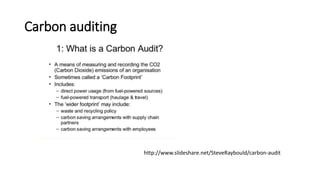
Carbon auditing
http://www.slideshare.net/SteveRaybould/carbon-audit
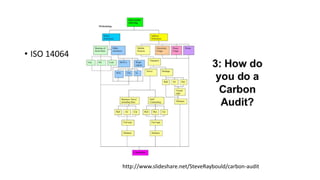
How do you do a Carbon Audit
• ISO 14064
http://www.slideshare.net/SteveRaybould/carbon-audit

One Million People

  • 1.
    Millisteps Reducing the negativeenvironmental impacts of one million people Image: Facebook.com
  • 2.
    Rough Agenda • Why? •What brings us here? • How to measure? • A few ideas • Your commentary and feedback throughout • How to impact? • A few ideas • Your commentary and feedback throughout • Next Steps
  • 3.
    About us • Whatbrings us here today?
  • 4.
    Ugh…one of thesepages While I hate self-promoty bio powerpoints, I do want to let you know some of the cool places I’ve worked/things I’ve been involved in on the off chance you have any questions/I can connect you with anyone there. Some of these were co-ops, some volunteer, some “real jobs” • Career Skills Incubator – non-profit founder • Canadian Standards Association – renewable energy standards, green team • Sustainalytics – analyze companies on indicators for socially responsible investment, everything from GHG to board of directors’ diversity, to water consumption, to transparency of reporting • Sustainable Waterloo Region – volunteer policy analyst, strategic lead, and a bunch of other things • Bougainvillea Beach Resorts – environmental reporting, started hotel recycling program, and Barbados’ first community recycling program • Northern Thailand farmer field schools to preserve local planting & seed preservation techniques, fish habitat • Online UWC – online course mentor & facilitator for action-oriented, internationally focused sustainability courses • Trails Youth Initiatives – “at risk” youth outdoor programs • Imperial Oil – environmental assessments, environmental management plans (natural gas and in-situ oil sands development), some carbon accounting • BC Nature – park naturalist, also made business case to BC govt to continue nature programs • Public Works and Government Services Canada – Waste Reduction • Ethical Investments Club, Entrepreneurship courses at County Jails, Trash2Treasure large goods recycling program
  • 5.
    How to Measure? •Most popular measures are Ecological Footprint and Carbon Footprint
  • 6.
    Ecological Footprint An ecologicalfootprint measures the land and sea area people require to produce resources that we consume. This includes our food, our clothes, fuel we use for our cars and building materials for our homes. It also measures how much land and water is required to deal with the waste products of our consumption, such as carbon dioxide and agricultural pollution. - footprint.wwf.org
  • 7.
  • 8.
    Ecological Footprint Doesn’tInclude Some pollutants - the release of materials for which the biosphere has no significant assimilation capacity (e.g. plutonium, PCBs, dioxins, and other persistent pollutants) and processes that damage the biosphere's future capacity (e.g. loss of biodiversity, salination resulting from cropland irrigation, soil erosion from tilling). Solution: Look for other forms of measurement Fresh water: Use and availability of freshwater is not directly accounted for since freshwater acts as a limit on the amount of biological capacity in an area but is not itself a biologically produced good or service. Although the loss of biocapacity associated with water appropriation or water quality degradation is reflected as a decrease in overall biocapacity in that year, an ecological footprint of its use is not currently allocated to the consumer of the water resource. It's also worth considering that the impact of water consumption depends not just on the amount of water used, but where it is taken from. The same volume of water used in an arid environment can have a far greater ecological impact than if it was used in a relatively wet place. This makes water footprints different to ecological and carbon footprints, for which size of footprint is what really matters. Solution: Water footprint http://footprint.wwf.org.uk/static/faq
  • 9.
    Carbon Footprint The totalamount of greenhouse gases produced to directly and indirectly support human activities, usually expressed in equivalent tons of carbon dioxide (CO2). – Timeforchange.org
  • 10.
    Water Footprint? Image: http://www.opersan.com.br/eng/images/site/infografico/infografico_pegada_hidrica_nova-opersan.jpg Yourindividual water footprint is equal to the water required to produce the goods and services consumed by you – Waterfootprint.org
  • 11.
    Human Impact = EcologicalFootprint Carbon Footprint Water Footprint Other Measures (ie. Certain Pollutants)
  • 12.
    Measurement problems • Thereis no way to holistically measure the complexity of environmental issues. (But we can at least try to do something!) • Impact of who? North American? “Average” citizen? • Accounting for increased footprints over time • “Additionality” – no one’s impact is theirs alone, this includes in positive impacts, how to know a real impact was made? xkcd
  • 13.
    How to Impact? •OF COURSE, MITIGATE AS MUCH AS YOU CAN IN YOUR OWN LIFE FIRST! • But then, if you’ve done as much as you can: • A diversity of different projects combined (more manageable and mitigates risk) • Support existing projects and organizations to have greater impact • New projects only if a need and no one else fills
  • 14.
    Some “extreme” examples •Click2Donate sites • 716,481 peoples’ Ecological Footprint (land only) if 500k people clicked 10 “click sites” daily: www.therainforestsite.org , http://www.care2.com/click-to-donate • Energy Efficient Cook Stoves • About 32 million cook stoves to offset carbon of 1 million people over lifetime • Water efficient toilets in the US / factory retrofits • In US, 2 billion gallons could be saved a day if all switched, imagine if composting toilets! • Environmentally responsible investing • If convince everyone with investments to put $X into solar bonds, funding energy efficient projects, etc • Policy changes • Important to partake but not as measurable
  • 15.
    Work So Far •Skills training and auditing for SME’s • Train underrepresented populations in sustainability audits, basic energy, carbon, water, etc. and calculators to make recommendations and plans for SME’s • If works well, will create program guides to replicate around the world • Currently pending grant funding • Socially Responsible Investment • Train the trainer program to encourage more “regular” investors to put into greener investments • Online Sustainability Course • Mentoring students in sustainability around the world on general principles and how they can start projects in their communities (maybe scale one together) • Not enough yet, still hard to measure other than the first one!
  • 16.
    Thank you! What’s yourfeedback? What are next steps? Note: the next few slides are supplements to answer questions someone posted in the facebook group Feel free to connect through the facebook group or millisteps@gmail.com
  • 17.
    Life Cycle Analysis Atechnique to assess the environmental aspects and potential impacts associated with a product, process, or service, by: Compiling an inventory of relevant energy and material inputs and environmental releases. Evaluating the potential environmental impacts associated with identified inputs and releases. – epa.gov Image: http://www.ti-films.com/NorthAmerica/En/Sustainability/Images/ImgPage_LifeCycleAssessment.jpg
  • 18.
  • 19.
    How do youdo a Carbon Audit • ISO 14064 http://www.slideshare.net/SteveRaybould/carbon-audit

Editor's Notes

  • #9 Although the consequences of these activities will be reflected in future ecological footprint accounts as a decrease in biocapacity they are not accounted for when you calculate your footprint
  • #12 Articles on overlap: http://www.oneplaneteconomynetwork.org/resources/programme-documents/WP8_Integrating_Ecological_Carbon_Water_Footprint.pdf http://homeguides.sfgate.com/difference-between-carbon-footprint-ecological-footprint-78732.html
  • #17 Image: http://www.ti-films.com/NorthAmerica/En/Sustainability/Images/ImgPage_LifeCycleAssessment.jpg
  • #18 Image: http://www.ti-films.com/NorthAmerica/En/Sustainability/Images/ImgPage_LifeCycleAssessment.jpg