ECONOMICS IN SOFTWARE ENGINEERING
Created By.
Parth Bhoot (Post – Graduation Student)
Government M.C.A College
Ahmedabad
introduction
• Software engineering economics, that’s provides a way to
study the attributes of software and software processes in a
systematic way that relates them to economic measures.
Software engineering economics is concerned with aligning
software technical decisions with the business goals of the
organization.
 Topics to be covered
• Economics In Software Engineering
Definition.
Fundamentals of Software Engineering Economics.
Life Cycle of Software Engineering Economics.
Risk & Uncertainty.
Software Engineering Economics Analysis Methods.
Practical Consideration.
Software engineering economics
• What is Economics ??
 Economics is the study of value, costs, resources, and their
relationship in given context or situation.
• What is Software Engineering Economics ??
 Software engineering economics is about making decisions related to
software engineering in business context. The success of a software
product, service, and solution depends on good business management. Yet,
in many companies and organizations, software business relationships to
software development and engineering remain vague.
Software Engineering Economics Fundamentals
• Finance.
• Accounting.
• Controlling.
• Cash flow.
• Decision Making Process.
• Valuation.
Cont…
Software Engineering Economics Fundamentals
• Depreciation.
• Taxation.
• Time Value Of Money.
• Efficiency.
• Effectiveness.
• productivity.
Software Engineering Economics Fundamentals
• Finance.
• Finance is the branch of economics concerned with issues such as
allocation, management, acquisition, and investment of resources.
Finance is an element of every organization, including software
engineering organizations. The field of finance deals with the concepts
of time, money, risk, and how they are interrelated.
• Accounting.
• Accounting is part of finance. It allows people whose money is being
used to run an organization to know the results of their investment: did
they get the profit they were expecting? In “for-profit” organizations,
this relates to the tangible ROI(Return Of Investment), while in “not-
for-profit” and governmental organizations as well as “for-profit”
organizations, it translates into sustainably staying in business.
Software Engineering Economics Fundamentals
• Controlling.
• Controlling is an element of finance and accounting. Controlling
involves measuring and correcting the performance of finance and
accounting. It ensures that an organization’s objectives and plans
are accomplished.
• Cash Flow.
• Cash flow is the movement of money into or out of a business,
project, or financial product over a given period. The concepts of
cash flow instances and cash flow streams are used to describe the
business perspective of a proposal.
Software Engineering Economics Fundamentals
• Decision Making Process.
• If we assume that candidate solutions solve a given technical
problem equally well, why should the organization care which one
is chosen? The answer is that there is usually a large difference in
the costs and incomes from the different solutions. A commercial,
off-the-shelf, objectrequest broker product might cost a few
thousand dollars, but the effort to develop a homegrown service that
gives the same functionality could easily cost several hundred times
that amount.
Software Engineering Economics Fundamentals
• Valuation.
• In an abstract sense, the decision-making process— be it financial
decision making or other— is about maximizing value. The
alternative that maximizes total value should always be chosen. A
financial basis for value-based comparison is comparing two or
more cash flows. Several bases of comparison are available,
including
• present worth
• future worth
• annual equivalent
• internal rate of return
• (discounted) payback period.
Software Engineering Economics Fundamentals
• Depreciation.
• Depreciation involves spreading the cost of a tangible asset across a
number of time periods; it is used to determine how investments in
capitalized assets are charged against income over several years.
Depreciation is an important part of determining after-tax cash flow,
which is critical for accurately addressing profit and taxes.
• Taxation.
• Governments charge taxes in order to finance expenses that society
needs but that no single organization would invest in. Companies
have to pay income taxes, which can take a substantial portion of a
corporation’s gross profit.
Software Engineering Economics Fundamentals
• Time – Value of Money.
• One of the most fundamental concepts in finance—and therefore, in
business decisions— is that money has time-value: its value
changes over time. A specific amount of money right now almost
always has a different value than the same amount of money at
some other time. This concept has been around since the earliest
recorded human history and is commonly known as time-value. In
order to compare proposals or portfolio elements, they should be
normalized in cost, value, and risk to the net present value.
Currency exchange variations over time need to be taken into
account based on historical data. This is particularly important in
cross-border developments of all kinds.
Software Engineering Economics Fundamentals
• Efficiency.
• Economic efficiency of a process, activity, or task is the ratio of
resources actually consumed to resources expected to be consumed
or desired to be consumed in accomplishing the process, activity, or
task. Efficiency means “doing things right.” An efficient behaviour,
like an effective behaviour, delivers results—but keeps the
necessary effort to a minimum. Factors that may affect efficiency in
software engineering include product complexity, quality requirements,
time pressure, process capability, team distribution, interrupts, feature
churn, tools, and programming language.
Software Engineering Economics Fundamentals
• Effectiveness
• Effectiveness is about having impact. It is the relationship between
achieved objectives to defined objectives. Effectiveness means
“doing the right things.” Effectiveness looks only at whether
defined objectives are reached—not at how they are reached.
• Productivity
• Productivity is the ratio of output over input from an economic
perspective. Output is the value delivered. Input covers all resources
(e.g., effort) spent to generate the output. Productivity combines
efficiency and effectiveness from a valueoriented perspective:
maximizing productivity is about generating highest value with
lowest resource consumption.
Life Cycle of Software Engineering Economics.
• Product.
• Project.
• Profile.
• Portfolio.
• Product Life Cycle.
• Project Life Cycle.
• Proposals.
• Investments Decision. Cont…
Life Cycle of Software Engineering Economics.
• Planning Horizon.
• Price and Pricing.
• Cost and Costing.
• Performance Measurements.
• Earned Values Management.
• Termination Decision.
• Replacement and Retirement Decision.
Life Cycle of Software Engineering Economics.
• Product.
• A product is an economic good (or output) that is created in a process that
transforms product factors (or inputs) to an output. When sold, a product is
a deliverable that creates both a value and an experience for its users.
• Project.
• A project is “a temporary endeavour undertaken to create a unique product,
service, or result”. In software engineering, different project types are
distinguished (e.g., product development, outsourced services, software
maintenance, service creation, and so on). During its life cycle, a software
product may require many projects. For example, during the product
conception phase, a project might be conducted to determine the customer
need and market requirements; during maintenance, a project might be
conducted to produce a next version of a product.
Life Cycle of Software Engineering Economics.
• Programme.
• A program is “a group of related projects, subprograms, and program
activities managed in a coordinated way to obtain benefits not available
from managing them individually.” Programs are often used to identify and
manage different deliveries to a single customer or market over a time
horizon of several years.
• Portfolio
• Portfolios are “projects, programs, subportfolios, and operations managed
as a group to achieve strategic objectives.” Portfolios are used to group and
then manage simultaneously all assets within a business line or
organization
Life Cycle of Software Engineering Economics.
• Product Life Cycle.
• A software product life cycle (SPLC) includes all activities needed to
define, build, operate, maintain, and retire a software product or service
and its variants.
• Project Life Cycle.
• Project life cycle activities typically involve five process groups—
Initiating, Planning, Executing, Monitoring and Controlling, and Closing.
• Proposals.
• Making a business decision begins with the notion of a proposal. Proposals
relate to reaching a business objective—at the project, product, or portfolio
level. A proposal is a single, separate option that is being considered, like
carrying out a particular software development project or not.
Life Cycle of Software Engineering Economics.
• Investment Decisions.
• Investors make investment decisions to spend money and resources on
achieving a target objective. Investors are either inside (e.g., finance,
board) or outside (e.g., banks) the organization. The target relates to some
economic criteria, such as achieving a high return on the investment,
strengthening the capabilities of the organization, or improving the value
of the company. Intangible aspects such as goodwill, culture, and
competences should be considered.
• Planning Horizon.
• When an organization chooses to invest in a particular proposal, money
gets tied up in that proposal— so-called “frozen assets.” The economic
impact of frozen assets tends to start high and decreases over time. On the
other hand, operating and maintenance costs of elements associated with
the proposal tend to start low but increase over time
Life Cycle of Software Engineering Economics.
• Price and Pricing.
• A price is what is paid in exchange for a good or service. Price is a
fundamental aspect of financial modelling and is one of the four Ps of the
marketing mix. The other three Ps are product, promotion, and place. Price
is the only revenue-generating element amongst the four Ps; the rest are
costs.
• Pricing is an element of finance and marketing. It is the process of
determining what a company will receive in exchange for its products.
Pricing factors include manufacturing cost, market placement, competition,
market condition, and quality of product.
Life Cycle of Software Engineering Economics.
• Cost and Costing.
• A cost is the value of money that has been used up to produce something
and, hence, is not available for use anymore. In economics, a cost is an
alternative that is given up as a result of a decision.
• Costing is part of finance and product management. It is the process to
determine the cost based on expenses (e.g., production, software
engineering, distribution, rework) and on the target cost to be competitive
and successful in a market. The target cost can be below the actual
estimated cost. The planning and controlling of these costs (called cost
management) is important and should always be included in costing.
Life Cycle of Software Engineering Economics.
• Performance Measurement.
• Performance measurement is the process whereby an organization
establishes and measures the parameters used to determine whether
programs, investments, and acquisitions are achieving the desired results.
It is used to evaluate whether performance objectives are actually
achieved; to control budgets, resources, progress, and decisions; and to
improve performance.
• Earned Value Management
• Earned value management (EVM) is a project management technique for
measuring progress based on created value. At a given moment, the results
achieved to date in a project are compared with the projected budget and
the planned schedule progress for that date.
Life Cycle of Software Engineering Economics.
• Termination Decision.
• Termination means to end a project or product. Termination can be pre-
planned for the end of a long product lifetime (e.g., when foreseeing that a
product will reach its lifetime) or can come rather spontaneously during
product development (e.g., when project performance targets are not
achieved). In both cases, the decision should be carefully prepared,
considering always the alternatives of continuing versus terminating. Costs
of different alternatives must be estimated—covering topics such as
replacement, information collection, suppliers, alternatives, assets, and
utilizing resources for other opportunities. Sunk costs should not be
considered in such decision making because they have been spent and will
not reappear as a value.
Life Cycle of Software Engineering Economics.
• Replacement and Retirement Decisions.
• A replacement decision is made when an organization already has a
particular asset and they are considering replacing it with something else;
for example, deciding between maintaining and supporting a legacy
software product or redeveloping it from the ground up. Replacement
decisions use the same business decision process as described above, but
there are additional challenges: sunk cost and salvage value. Retirement
decisions are also about getting out of an activity altogether, such as when
a software company considers not selling a software product anymore or a
hardware manufacturer considers not building and selling a particular
model of computer any longer. Retirement decision can be influenced by
lock-in factors such as technology dependency and high exit costs.
Risk & Uncertainty
• Goals, Estimates, and Plans.
• Estimation Techniques.
• Addressing Uncertainty.
• Prioritization.
• Decisions under Risk.
• Decisions under Uncertainty
Risk & Uncertainty
• Goals, Estimates, and Plans.
Risk & Uncertainty
• Goals, Estimates, and Plans.
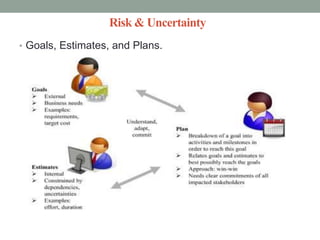
• Goals in software engineering economics are mostly business goals (or
business objectives). A business goal relates business needs (such as
increasing profitability) to investing resources (such as starting a project or
launching a product with a given budget, content, and timing).
• An estimate is a well-founded evaluation of resources and time that will be
needed to achieve stated goals (see Effort, Schedule, and Cost Estimation
in the Software Engineering Management KA and Maintenance Cost
Estimation in the Software Maintenance KA).
• A plan describes the activities and milestones that are necessary in order to
reach the goals of a project (see Software Project Planning in the Software
Engineering Management KA).
Risk & Uncertainty
• Estimation Techniques
• Estimations are used to analyze and forecast the resources or time
necessary to implement requirements (see Effort, Schedule, and Cost
Estimation in the Software Engineering Management KA and Maintenance
Cost Estimation in the Software Maintenance KA). Five families of
estimation techniques exist,
• Expert judgment
• Analogy
• Estimation by parts
• Parametric methods
• Statistical methods.
• No single estimation technique is perfect, so using multiple estimation
technique is useful.
Risk & Uncertainty
• Addressing Uncertainty
• Because of the many unknown factors during project initiation and
planning, estimates are inherently uncertain; that uncertainty should be
addressed in business decisions. Techniques for addressing uncertainty
include
• consider ranges of estimates
• analyse sensitivity to changes of assumptions
• delay final decisions.
Risk & Uncertainty
• Prioritization
• Prioritization involves ranking alternatives based on common criteria to
deliver the best possible value. In software engineering projects, software
requirements are often prioritized in order to deliver the most value to the
client within constraints of schedule, budget, resources, and technology, or
to provide for building product increments, where the first increments
provide the highest value to the customer (see Requirements Classification
and Requirements Negotiation in the Software Requirements KA and
Software Life Cycle Models in the Software Engineering Process KA).
Risk & Uncertainty
• Decisions under Risk
• Decisions under risk techniques are used when the decision maker can
assign probabilities to the different possible outcomes (see Risk
Management in the Software Engineering Management KA). The specific
techniques include
• expected value decision making
• expectation variance and decision making
• Monte Carlo analysis
• expected value of perfect information.
Risk & Uncertainty
• Decisions under Uncertainty
• Decisions under uncertainty techniques are used when the decision maker
cannot assign probabilities to the different possible outcomes because
needed information is not available (see Risk Management in the Software
Engineering Management KA). Specific techniques include
• Laplace Rule
• Maximin Rule
• Maximax Rule
• Hurwicz Rule
• Minimax Regret Rule.
Software Engineering EconomicsAnalysis Methods.
• For - Profit Decision Analysis.
• Minimum Acceptable Rate and Return.
• Return on Investment.
• Return on Capital Employed.
• Cost Benefit Analysis.
• Cost Effectiveness Analysis.
• Break Even Analysis.
• Business Case.
• Multiple Attribute Evolution.
• Optimization Analysis.
Software Engineering EconomicsAnalysis Methods.
• For - Profit Decision Analysis.
Software Engineering EconomicsAnalysis Methods.
• For - Profit Decision Analysis.
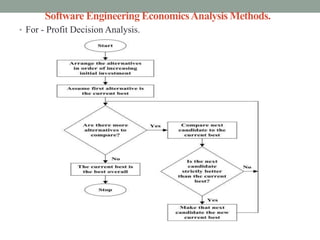
• Above Figure describes a process for identifying the best alternative from
a set of mutually exclusive alternatives. Decision criteria depend on the
business objectives and typically include ROI (see section 4.3, Return on
Investment) or Return on Capital Employed (ROCE) (see section 4.4,
Return on Capital Employed).
• For-profit decision techniques don’t apply for government and non-profit
organizations. In these cases, organizations have different goals—which
means that a different set of decision techniques are needed, such as cost-
benefit or cost-effectiveness analysis.
Software Engineering EconomicsAnalysis Methods.
• Minimum Acceptable Rate of Return
• The minimum acceptable rate of return (MARR) is the lowest internal rate
of return the organization would consider to be a good investment.
Generally speaking, it wouldn’t be smart to invest in an activity with a
return of 10% when there’s another activity that’s known to return 20%.
The MARR is a statement that an organization is confident it can achieve
at least that rate of return. The MARR represents the organization’s
opportunity cost for investments. By choosing to invest in some activity,
the organization is explicitly deciding to not invest that same money
somewhere else. If the organization is already confident it can get some
known rate of return, other alternatives should be chosen only if their rate
of return is at least that high.
Software Engineering EconomicsAnalysis Methods.
• Return on Investment
• Return on investment (ROI) is a measure of the profitability of a company
or business unit. It is defined as the ratio of money gained or lost (whether
realized or unrealized) on an investment relative to the amount of money
invested. The purpose of ROI varies and includes, for instance, providing a
rationale for future investments and acquisition decisions.
Software Engineering EconomicsAnalysis Methods.
• Return on Capital Employed
• The return on capital employed (ROCE) is a measure of the profitability of
a company or business unit. It is defined as the ratio of a gross profit
before taxes and interest (EBIT) to the total assets minus current liabilities.
It describes the return on the used capital.
• Cost-Benefit Analysis
• Cost-benefit analysis is one of the most widely used methods for
evaluating individual proposals. Any proposal with a benefit-cost ratio of
less than 1.0 can usually be rejected without further analysis because it
would cost more than the benefit.
Software Engineering EconomicsAnalysis Methods.
• Cost-Effectiveness Analysis
• Cost-effectiveness analysis is similar to cost benefit analysis. There are
two versions of cost-effectiveness analysis: the fixed-cost version
maximizes the benefit given some upper bound on cost; the fixed-
effectiveness version minimizes the cost needed to achieve a fixed goal.
• Break-Even Analysis
• Break-even analysis identifies the point where the costs of developing a
product and the revenue to be generated are equal. Such an analysis can be
used to choose between different proposals at different estimated costs and
revenue. Given estimated costs and revenue of two or more proposals,
break-even analysis helps in choosing among them.
• Business Case
• The business case is the consolidated information summarizing and
explaining a business proposal from different perspectives for a decision
maker (cost, benefit, risk, and so on).
Software Engineering EconomicsAnalysis Methods.
• Multiple Attribute Evaluation
• The topics discussed so far are used to make decisions based on a single
decision criterion: money. The alternative with the best present worth, the
best ROI, and so forth is the one selected.Break-Even Analysis
• There are two families of multiple attribute decision techniques that differ
in how they use the attributes in the decision. One family is the
“compensatory,” or single-dimensioned, techniques. This family collapses
all of the attributes onto a single figure of merit. The family is called
compensatory because, for any given alternative, a lower score in one
attribute can be compensated by—or traded off against—a higher score in
other attributes. The compensatory techniques include
• nondimensional scaling
• additive weighting
• analytic hierarchy process.
Software Engineering EconomicsAnalysis Methods.
• Multiple Attribute Evaluation
• In contrast, the other family is the “no compensatory,” or fully
dimensioned, techniques. This family does not allow trade-offs among the
attributes. Each attribute is treated as a separate entity in the decision
process. The no compensatory techniques include
• dominance
• satisficing
• lexicography.
Software Engineering EconomicsAnalysis Methods.
• Optimization Analysis
• The typical use of optimization analysis is to study a cost function over a
range of values to find the point where overall performance is best.
Software’s classic space-time trade-off is an example of optimization; an
algorithm that runs faster will often use more memory. Optimization
balances the value of the faster runtime against the cost of the additional
memory.
• Real options analysis can be used to quantify the value of project choices,
including the value of delaying a decision. Such options are difficult to
compute with precision. However, awareness that choices have a monetary
value provides insight in the timing of decisions such as increasing project
staff or lengthening time to market to improve quality.
Practical Considerations
• The “Good Enough” Principle.
• Friction-Free Money.
• Ecosystems.
• Offshoring and Outsourcing.
Practical Considerations
• The “Good Enough” Principle.
• Often software engineering projects and products are not precise about the
targets that should be achieved. Software requirements are stated, but the
marginal value of adding a bit more functionality cannot be measured. The
result could be late delivery or too-high cost. The “good enough” principle
relates marginal value to marginal cost and provides guidance to determine
criteria when a deliverable is “good enough” to be delivered. These criteria
depend on business objectives and on prioritization of different
alternatives, such as ranking software requirements, measurable quality
attributes, or relating schedule to product content and cost.
Practical Considerations
• The “Good Enough” Principle
• Agile methods are examples of “good enough” that try to optimize value
by reducing the overhead of delayed rework and the gold plating that
results from adding features that have low marginal value for the users (see
Agile Methods in the Software Engineering Models and Methods KA and
Software Life Cycle Models in the Software Engineering Process KA). In
agile methods, detailed planning and lengthy development phases are
replaced by incremental planning and frequent delivery of small
increments of a deliverable product that is tested and evaluated by user
representatives.
Practical Considerations
• Friction-Free Economy
• Economic friction is everything that keeps markets from having perfect
competition. It involves distance, cost of delivery, restrictive regulations,
and/or imperfect information. In high-friction markets, customers don’t
have many suppliers from which to choose. Having been in a business for
a while or owning a store in a good location determines the economic
position. It’s hard for new competitors to start business and compete. The
marketplace moves slowly and predictably. Friction-free markets are just
the reverse. New competitors emerge and customers are quick to respond.
The marketplace is anything but predictable. Theoretically, software and IT
are friction free.
Practical Considerations
• Ecosystems
• An ecosystem is an environment consisting of all the mutually dependent
stakeholders, business units, and companies working in a particular area.
In a typical ecosystem, there are producers and consumers, where the
consumers add value to the consumed resources. Note that a consumer is
not the end user but an organization that uses the product to enhance it. A
software ecosystem is, for instance, a supplier of an application working
with companies doing the installation and support in different regions.
Practical Considerations
• Offshoring and Outsourcing.
• Offshoring means executing a business activity beyond sales and
marketing outside the home country of an enterprise. Enterprises typically
either have their offshoring branches in low-cost countries or they ask
specialized companies abroad to execute the respective activity. Offshoring
should therefore not be confused with outsourcing. Offshoring within a
company is called captive offshoring. Outsourcing is the result-oriented
relationship with a supplier who executes business activities for an
enterprise when, traditionally, those activities were executed inside the
enterprise. Outsourcing is site-independent.
Practical Considerations
• Offshoring and Outsourcing.
• The supplier can reside in the neighbourhood of the enterprise or offshore
(outsourced offshoring). Software engineering economics provides the
basic criteria and business tools to evaluate different sourcing mechanisms
and control their performance. For instance, using an outsourcing supplier
for software development and maintenance might reduce the cost per hour
of software development, but increase the number of hours and capital
expenses due to an increased need for monitoring and communication.
CONCLUSION
• Accurate Software Economics is a primary & essential task for a
Successful Software project.
• The accuracy of Economics has to be improved.
• Data collection
• Use of tools
• Use several methods of Economics
• THANK YOU

Economics In Software Engineering

  • 1.
    ECONOMICS IN SOFTWAREENGINEERING Created By. Parth Bhoot (Post – Graduation Student) Government M.C.A College Ahmedabad
  • 2.
    introduction • Software engineeringeconomics, that’s provides a way to study the attributes of software and software processes in a systematic way that relates them to economic measures. Software engineering economics is concerned with aligning software technical decisions with the business goals of the organization.
  • 3.
     Topics tobe covered • Economics In Software Engineering Definition. Fundamentals of Software Engineering Economics. Life Cycle of Software Engineering Economics. Risk & Uncertainty. Software Engineering Economics Analysis Methods. Practical Consideration.
  • 4.
    Software engineering economics •What is Economics ??  Economics is the study of value, costs, resources, and their relationship in given context or situation. • What is Software Engineering Economics ??  Software engineering economics is about making decisions related to software engineering in business context. The success of a software product, service, and solution depends on good business management. Yet, in many companies and organizations, software business relationships to software development and engineering remain vague.
  • 5.
    Software Engineering EconomicsFundamentals • Finance. • Accounting. • Controlling. • Cash flow. • Decision Making Process. • Valuation. Cont…
  • 6.
    Software Engineering EconomicsFundamentals • Depreciation. • Taxation. • Time Value Of Money. • Efficiency. • Effectiveness. • productivity.
  • 7.
    Software Engineering EconomicsFundamentals • Finance. • Finance is the branch of economics concerned with issues such as allocation, management, acquisition, and investment of resources. Finance is an element of every organization, including software engineering organizations. The field of finance deals with the concepts of time, money, risk, and how they are interrelated. • Accounting. • Accounting is part of finance. It allows people whose money is being used to run an organization to know the results of their investment: did they get the profit they were expecting? In “for-profit” organizations, this relates to the tangible ROI(Return Of Investment), while in “not- for-profit” and governmental organizations as well as “for-profit” organizations, it translates into sustainably staying in business.
  • 8.
    Software Engineering EconomicsFundamentals • Controlling. • Controlling is an element of finance and accounting. Controlling involves measuring and correcting the performance of finance and accounting. It ensures that an organization’s objectives and plans are accomplished. • Cash Flow. • Cash flow is the movement of money into or out of a business, project, or financial product over a given period. The concepts of cash flow instances and cash flow streams are used to describe the business perspective of a proposal.
  • 9.
    Software Engineering EconomicsFundamentals • Decision Making Process. • If we assume that candidate solutions solve a given technical problem equally well, why should the organization care which one is chosen? The answer is that there is usually a large difference in the costs and incomes from the different solutions. A commercial, off-the-shelf, objectrequest broker product might cost a few thousand dollars, but the effort to develop a homegrown service that gives the same functionality could easily cost several hundred times that amount.
  • 10.
    Software Engineering EconomicsFundamentals • Valuation. • In an abstract sense, the decision-making process— be it financial decision making or other— is about maximizing value. The alternative that maximizes total value should always be chosen. A financial basis for value-based comparison is comparing two or more cash flows. Several bases of comparison are available, including • present worth • future worth • annual equivalent • internal rate of return • (discounted) payback period.
  • 11.
    Software Engineering EconomicsFundamentals • Depreciation. • Depreciation involves spreading the cost of a tangible asset across a number of time periods; it is used to determine how investments in capitalized assets are charged against income over several years. Depreciation is an important part of determining after-tax cash flow, which is critical for accurately addressing profit and taxes. • Taxation. • Governments charge taxes in order to finance expenses that society needs but that no single organization would invest in. Companies have to pay income taxes, which can take a substantial portion of a corporation’s gross profit.
  • 12.
    Software Engineering EconomicsFundamentals • Time – Value of Money. • One of the most fundamental concepts in finance—and therefore, in business decisions— is that money has time-value: its value changes over time. A specific amount of money right now almost always has a different value than the same amount of money at some other time. This concept has been around since the earliest recorded human history and is commonly known as time-value. In order to compare proposals or portfolio elements, they should be normalized in cost, value, and risk to the net present value. Currency exchange variations over time need to be taken into account based on historical data. This is particularly important in cross-border developments of all kinds.
  • 13.
    Software Engineering EconomicsFundamentals • Efficiency. • Economic efficiency of a process, activity, or task is the ratio of resources actually consumed to resources expected to be consumed or desired to be consumed in accomplishing the process, activity, or task. Efficiency means “doing things right.” An efficient behaviour, like an effective behaviour, delivers results—but keeps the necessary effort to a minimum. Factors that may affect efficiency in software engineering include product complexity, quality requirements, time pressure, process capability, team distribution, interrupts, feature churn, tools, and programming language.
  • 14.
    Software Engineering EconomicsFundamentals • Effectiveness • Effectiveness is about having impact. It is the relationship between achieved objectives to defined objectives. Effectiveness means “doing the right things.” Effectiveness looks only at whether defined objectives are reached—not at how they are reached. • Productivity • Productivity is the ratio of output over input from an economic perspective. Output is the value delivered. Input covers all resources (e.g., effort) spent to generate the output. Productivity combines efficiency and effectiveness from a valueoriented perspective: maximizing productivity is about generating highest value with lowest resource consumption.
  • 15.
    Life Cycle ofSoftware Engineering Economics. • Product. • Project. • Profile. • Portfolio. • Product Life Cycle. • Project Life Cycle. • Proposals. • Investments Decision. Cont…
  • 16.
    Life Cycle ofSoftware Engineering Economics. • Planning Horizon. • Price and Pricing. • Cost and Costing. • Performance Measurements. • Earned Values Management. • Termination Decision. • Replacement and Retirement Decision.
  • 17.
    Life Cycle ofSoftware Engineering Economics. • Product. • A product is an economic good (or output) that is created in a process that transforms product factors (or inputs) to an output. When sold, a product is a deliverable that creates both a value and an experience for its users. • Project. • A project is “a temporary endeavour undertaken to create a unique product, service, or result”. In software engineering, different project types are distinguished (e.g., product development, outsourced services, software maintenance, service creation, and so on). During its life cycle, a software product may require many projects. For example, during the product conception phase, a project might be conducted to determine the customer need and market requirements; during maintenance, a project might be conducted to produce a next version of a product.
  • 18.
    Life Cycle ofSoftware Engineering Economics. • Programme. • A program is “a group of related projects, subprograms, and program activities managed in a coordinated way to obtain benefits not available from managing them individually.” Programs are often used to identify and manage different deliveries to a single customer or market over a time horizon of several years. • Portfolio • Portfolios are “projects, programs, subportfolios, and operations managed as a group to achieve strategic objectives.” Portfolios are used to group and then manage simultaneously all assets within a business line or organization
  • 19.
    Life Cycle ofSoftware Engineering Economics. • Product Life Cycle. • A software product life cycle (SPLC) includes all activities needed to define, build, operate, maintain, and retire a software product or service and its variants. • Project Life Cycle. • Project life cycle activities typically involve five process groups— Initiating, Planning, Executing, Monitoring and Controlling, and Closing. • Proposals. • Making a business decision begins with the notion of a proposal. Proposals relate to reaching a business objective—at the project, product, or portfolio level. A proposal is a single, separate option that is being considered, like carrying out a particular software development project or not.
  • 20.
    Life Cycle ofSoftware Engineering Economics. • Investment Decisions. • Investors make investment decisions to spend money and resources on achieving a target objective. Investors are either inside (e.g., finance, board) or outside (e.g., banks) the organization. The target relates to some economic criteria, such as achieving a high return on the investment, strengthening the capabilities of the organization, or improving the value of the company. Intangible aspects such as goodwill, culture, and competences should be considered. • Planning Horizon. • When an organization chooses to invest in a particular proposal, money gets tied up in that proposal— so-called “frozen assets.” The economic impact of frozen assets tends to start high and decreases over time. On the other hand, operating and maintenance costs of elements associated with the proposal tend to start low but increase over time
  • 21.
    Life Cycle ofSoftware Engineering Economics. • Price and Pricing. • A price is what is paid in exchange for a good or service. Price is a fundamental aspect of financial modelling and is one of the four Ps of the marketing mix. The other three Ps are product, promotion, and place. Price is the only revenue-generating element amongst the four Ps; the rest are costs. • Pricing is an element of finance and marketing. It is the process of determining what a company will receive in exchange for its products. Pricing factors include manufacturing cost, market placement, competition, market condition, and quality of product.
  • 22.
    Life Cycle ofSoftware Engineering Economics. • Cost and Costing. • A cost is the value of money that has been used up to produce something and, hence, is not available for use anymore. In economics, a cost is an alternative that is given up as a result of a decision. • Costing is part of finance and product management. It is the process to determine the cost based on expenses (e.g., production, software engineering, distribution, rework) and on the target cost to be competitive and successful in a market. The target cost can be below the actual estimated cost. The planning and controlling of these costs (called cost management) is important and should always be included in costing.
  • 23.
    Life Cycle ofSoftware Engineering Economics. • Performance Measurement. • Performance measurement is the process whereby an organization establishes and measures the parameters used to determine whether programs, investments, and acquisitions are achieving the desired results. It is used to evaluate whether performance objectives are actually achieved; to control budgets, resources, progress, and decisions; and to improve performance. • Earned Value Management • Earned value management (EVM) is a project management technique for measuring progress based on created value. At a given moment, the results achieved to date in a project are compared with the projected budget and the planned schedule progress for that date.
  • 24.
    Life Cycle ofSoftware Engineering Economics. • Termination Decision. • Termination means to end a project or product. Termination can be pre- planned for the end of a long product lifetime (e.g., when foreseeing that a product will reach its lifetime) or can come rather spontaneously during product development (e.g., when project performance targets are not achieved). In both cases, the decision should be carefully prepared, considering always the alternatives of continuing versus terminating. Costs of different alternatives must be estimated—covering topics such as replacement, information collection, suppliers, alternatives, assets, and utilizing resources for other opportunities. Sunk costs should not be considered in such decision making because they have been spent and will not reappear as a value.
  • 25.
    Life Cycle ofSoftware Engineering Economics. • Replacement and Retirement Decisions. • A replacement decision is made when an organization already has a particular asset and they are considering replacing it with something else; for example, deciding between maintaining and supporting a legacy software product or redeveloping it from the ground up. Replacement decisions use the same business decision process as described above, but there are additional challenges: sunk cost and salvage value. Retirement decisions are also about getting out of an activity altogether, such as when a software company considers not selling a software product anymore or a hardware manufacturer considers not building and selling a particular model of computer any longer. Retirement decision can be influenced by lock-in factors such as technology dependency and high exit costs.
  • 26.
    Risk & Uncertainty •Goals, Estimates, and Plans. • Estimation Techniques. • Addressing Uncertainty. • Prioritization. • Decisions under Risk. • Decisions under Uncertainty
  • 27.
    Risk & Uncertainty •Goals, Estimates, and Plans.
  • 28.
    Risk & Uncertainty •Goals, Estimates, and Plans. • Goals in software engineering economics are mostly business goals (or business objectives). A business goal relates business needs (such as increasing profitability) to investing resources (such as starting a project or launching a product with a given budget, content, and timing). • An estimate is a well-founded evaluation of resources and time that will be needed to achieve stated goals (see Effort, Schedule, and Cost Estimation in the Software Engineering Management KA and Maintenance Cost Estimation in the Software Maintenance KA). • A plan describes the activities and milestones that are necessary in order to reach the goals of a project (see Software Project Planning in the Software Engineering Management KA).
  • 29.
    Risk & Uncertainty •Estimation Techniques • Estimations are used to analyze and forecast the resources or time necessary to implement requirements (see Effort, Schedule, and Cost Estimation in the Software Engineering Management KA and Maintenance Cost Estimation in the Software Maintenance KA). Five families of estimation techniques exist, • Expert judgment • Analogy • Estimation by parts • Parametric methods • Statistical methods. • No single estimation technique is perfect, so using multiple estimation technique is useful.
  • 30.
    Risk & Uncertainty •Addressing Uncertainty • Because of the many unknown factors during project initiation and planning, estimates are inherently uncertain; that uncertainty should be addressed in business decisions. Techniques for addressing uncertainty include • consider ranges of estimates • analyse sensitivity to changes of assumptions • delay final decisions.
  • 31.
    Risk & Uncertainty •Prioritization • Prioritization involves ranking alternatives based on common criteria to deliver the best possible value. In software engineering projects, software requirements are often prioritized in order to deliver the most value to the client within constraints of schedule, budget, resources, and technology, or to provide for building product increments, where the first increments provide the highest value to the customer (see Requirements Classification and Requirements Negotiation in the Software Requirements KA and Software Life Cycle Models in the Software Engineering Process KA).
  • 32.
    Risk & Uncertainty •Decisions under Risk • Decisions under risk techniques are used when the decision maker can assign probabilities to the different possible outcomes (see Risk Management in the Software Engineering Management KA). The specific techniques include • expected value decision making • expectation variance and decision making • Monte Carlo analysis • expected value of perfect information.
  • 33.
    Risk & Uncertainty •Decisions under Uncertainty • Decisions under uncertainty techniques are used when the decision maker cannot assign probabilities to the different possible outcomes because needed information is not available (see Risk Management in the Software Engineering Management KA). Specific techniques include • Laplace Rule • Maximin Rule • Maximax Rule • Hurwicz Rule • Minimax Regret Rule.
  • 34.
    Software Engineering EconomicsAnalysisMethods. • For - Profit Decision Analysis. • Minimum Acceptable Rate and Return. • Return on Investment. • Return on Capital Employed. • Cost Benefit Analysis. • Cost Effectiveness Analysis. • Break Even Analysis. • Business Case. • Multiple Attribute Evolution. • Optimization Analysis.
  • 35.
    Software Engineering EconomicsAnalysisMethods. • For - Profit Decision Analysis.
  • 36.
    Software Engineering EconomicsAnalysisMethods. • For - Profit Decision Analysis. • Above Figure describes a process for identifying the best alternative from a set of mutually exclusive alternatives. Decision criteria depend on the business objectives and typically include ROI (see section 4.3, Return on Investment) or Return on Capital Employed (ROCE) (see section 4.4, Return on Capital Employed). • For-profit decision techniques don’t apply for government and non-profit organizations. In these cases, organizations have different goals—which means that a different set of decision techniques are needed, such as cost- benefit or cost-effectiveness analysis.
  • 37.
    Software Engineering EconomicsAnalysisMethods. • Minimum Acceptable Rate of Return • The minimum acceptable rate of return (MARR) is the lowest internal rate of return the organization would consider to be a good investment. Generally speaking, it wouldn’t be smart to invest in an activity with a return of 10% when there’s another activity that’s known to return 20%. The MARR is a statement that an organization is confident it can achieve at least that rate of return. The MARR represents the organization’s opportunity cost for investments. By choosing to invest in some activity, the organization is explicitly deciding to not invest that same money somewhere else. If the organization is already confident it can get some known rate of return, other alternatives should be chosen only if their rate of return is at least that high.
  • 38.
    Software Engineering EconomicsAnalysisMethods. • Return on Investment • Return on investment (ROI) is a measure of the profitability of a company or business unit. It is defined as the ratio of money gained or lost (whether realized or unrealized) on an investment relative to the amount of money invested. The purpose of ROI varies and includes, for instance, providing a rationale for future investments and acquisition decisions.
  • 39.
    Software Engineering EconomicsAnalysisMethods. • Return on Capital Employed • The return on capital employed (ROCE) is a measure of the profitability of a company or business unit. It is defined as the ratio of a gross profit before taxes and interest (EBIT) to the total assets minus current liabilities. It describes the return on the used capital. • Cost-Benefit Analysis • Cost-benefit analysis is one of the most widely used methods for evaluating individual proposals. Any proposal with a benefit-cost ratio of less than 1.0 can usually be rejected without further analysis because it would cost more than the benefit.
  • 40.
    Software Engineering EconomicsAnalysisMethods. • Cost-Effectiveness Analysis • Cost-effectiveness analysis is similar to cost benefit analysis. There are two versions of cost-effectiveness analysis: the fixed-cost version maximizes the benefit given some upper bound on cost; the fixed- effectiveness version minimizes the cost needed to achieve a fixed goal. • Break-Even Analysis • Break-even analysis identifies the point where the costs of developing a product and the revenue to be generated are equal. Such an analysis can be used to choose between different proposals at different estimated costs and revenue. Given estimated costs and revenue of two or more proposals, break-even analysis helps in choosing among them. • Business Case • The business case is the consolidated information summarizing and explaining a business proposal from different perspectives for a decision maker (cost, benefit, risk, and so on).
  • 41.
    Software Engineering EconomicsAnalysisMethods. • Multiple Attribute Evaluation • The topics discussed so far are used to make decisions based on a single decision criterion: money. The alternative with the best present worth, the best ROI, and so forth is the one selected.Break-Even Analysis • There are two families of multiple attribute decision techniques that differ in how they use the attributes in the decision. One family is the “compensatory,” or single-dimensioned, techniques. This family collapses all of the attributes onto a single figure of merit. The family is called compensatory because, for any given alternative, a lower score in one attribute can be compensated by—or traded off against—a higher score in other attributes. The compensatory techniques include • nondimensional scaling • additive weighting • analytic hierarchy process.
  • 42.
    Software Engineering EconomicsAnalysisMethods. • Multiple Attribute Evaluation • In contrast, the other family is the “no compensatory,” or fully dimensioned, techniques. This family does not allow trade-offs among the attributes. Each attribute is treated as a separate entity in the decision process. The no compensatory techniques include • dominance • satisficing • lexicography.
  • 43.
    Software Engineering EconomicsAnalysisMethods. • Optimization Analysis • The typical use of optimization analysis is to study a cost function over a range of values to find the point where overall performance is best. Software’s classic space-time trade-off is an example of optimization; an algorithm that runs faster will often use more memory. Optimization balances the value of the faster runtime against the cost of the additional memory. • Real options analysis can be used to quantify the value of project choices, including the value of delaying a decision. Such options are difficult to compute with precision. However, awareness that choices have a monetary value provides insight in the timing of decisions such as increasing project staff or lengthening time to market to improve quality.
  • 44.
    Practical Considerations • The“Good Enough” Principle. • Friction-Free Money. • Ecosystems. • Offshoring and Outsourcing.
  • 45.
    Practical Considerations • The“Good Enough” Principle. • Often software engineering projects and products are not precise about the targets that should be achieved. Software requirements are stated, but the marginal value of adding a bit more functionality cannot be measured. The result could be late delivery or too-high cost. The “good enough” principle relates marginal value to marginal cost and provides guidance to determine criteria when a deliverable is “good enough” to be delivered. These criteria depend on business objectives and on prioritization of different alternatives, such as ranking software requirements, measurable quality attributes, or relating schedule to product content and cost.
  • 46.
    Practical Considerations • The“Good Enough” Principle • Agile methods are examples of “good enough” that try to optimize value by reducing the overhead of delayed rework and the gold plating that results from adding features that have low marginal value for the users (see Agile Methods in the Software Engineering Models and Methods KA and Software Life Cycle Models in the Software Engineering Process KA). In agile methods, detailed planning and lengthy development phases are replaced by incremental planning and frequent delivery of small increments of a deliverable product that is tested and evaluated by user representatives.
  • 47.
    Practical Considerations • Friction-FreeEconomy • Economic friction is everything that keeps markets from having perfect competition. It involves distance, cost of delivery, restrictive regulations, and/or imperfect information. In high-friction markets, customers don’t have many suppliers from which to choose. Having been in a business for a while or owning a store in a good location determines the economic position. It’s hard for new competitors to start business and compete. The marketplace moves slowly and predictably. Friction-free markets are just the reverse. New competitors emerge and customers are quick to respond. The marketplace is anything but predictable. Theoretically, software and IT are friction free.
  • 48.
    Practical Considerations • Ecosystems •An ecosystem is an environment consisting of all the mutually dependent stakeholders, business units, and companies working in a particular area. In a typical ecosystem, there are producers and consumers, where the consumers add value to the consumed resources. Note that a consumer is not the end user but an organization that uses the product to enhance it. A software ecosystem is, for instance, a supplier of an application working with companies doing the installation and support in different regions.
  • 49.
    Practical Considerations • Offshoringand Outsourcing. • Offshoring means executing a business activity beyond sales and marketing outside the home country of an enterprise. Enterprises typically either have their offshoring branches in low-cost countries or they ask specialized companies abroad to execute the respective activity. Offshoring should therefore not be confused with outsourcing. Offshoring within a company is called captive offshoring. Outsourcing is the result-oriented relationship with a supplier who executes business activities for an enterprise when, traditionally, those activities were executed inside the enterprise. Outsourcing is site-independent.
  • 50.
    Practical Considerations • Offshoringand Outsourcing. • The supplier can reside in the neighbourhood of the enterprise or offshore (outsourced offshoring). Software engineering economics provides the basic criteria and business tools to evaluate different sourcing mechanisms and control their performance. For instance, using an outsourcing supplier for software development and maintenance might reduce the cost per hour of software development, but increase the number of hours and capital expenses due to an increased need for monitoring and communication.
  • 51.
    CONCLUSION • Accurate SoftwareEconomics is a primary & essential task for a Successful Software project. • The accuracy of Economics has to be improved. • Data collection • Use of tools • Use several methods of Economics
  • 52.