School of something
FACULTY OF OTHER
Sustainability Challenges of the
Textile & Dyeing Industries –
opportunities for innovation
Centre for Technical Textiles
SUSTAINABLE MATERIALS RESEARCH GROUP
Dr. Richard Blackburn
Sustainable Materials Research Group
University of Leeds
@RichardBlackb18
Necessity for
Sustainable Products
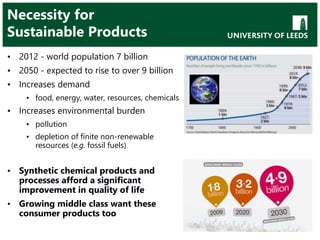
• 2012 - world population 7 billion
• 2050 - expected to rise to over 9 billion
• Increases demand
• food, energy, water, resources, chemicals
• Increases environmental burden
• pollution
• depletion of finite non-renewable
resources (e.g. fossil fuels)
• Synthetic chemical products and
processes afford a significant
improvement in quality of life
• Growing middle class want these
consumer products too
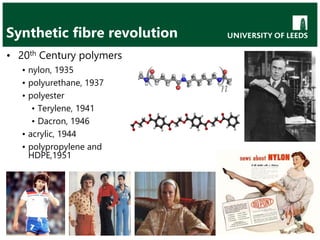
Synthetic fibre revolution
• 20th Century polymers
• nylon, 1935
• polyurethane, 1937
• polyester
• Terylene, 1941
• Dacron, 1946
• acrylic, 1944
• polypropylene and
HDPE,1951
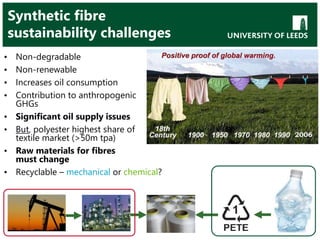
Synthetic fibre
sustainability challenges
• Non-degradable
• Non-renewable
• Increases oil consumption
• Contribution to anthropogenic
GHGs
• Significant oil supply issues
• But, polyester highest share of
textile market (>50m tpa)
• Raw materials for fibres
must change
• Recyclable – mechanical or chemical?
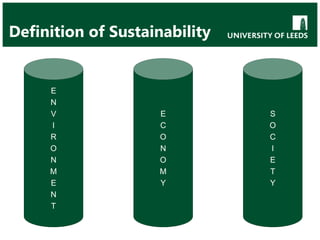
Definition of Sustainability
E
N
V
I
R
O
N
M
E
N
T
S
O
C
I
E
T
Y
E
C
O
N
O
M
Y
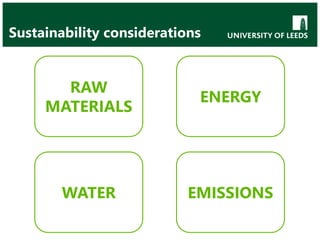
Sustainability considerations
WATER EMISSIONS
ENERGY
RAW
MATERIALS
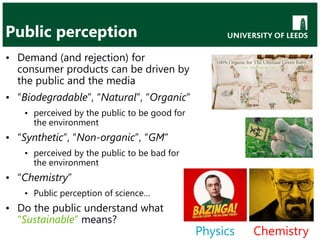
Public perception
• Demand (and rejection) for
consumer products can be driven by
the public and the media
• “Biodegradable”, “Natural”, “Organic”
• perceived by the public to be good for
the environment
• “Synthetic”, “Non-organic”, “GM”
• perceived by the public to be bad for
the environment
• “Chemistry”
• Public perception of science…
• Do the public understand what
“Sustainable” means?
Physics Chemistry
Ideal sustainable product
• Provide an equivalent function to the product it
replaces
• Performs as well as or better than the existing
product
• Be available at a competitive or lower price
• Have a minimum environmental footprint for all
the processes involved
• Be manufactured from renewable resources
• Use only ingredients that are safe to both
humans and the environment
• No negative impact on food supply or water
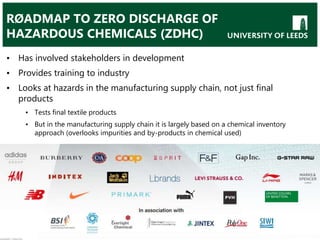
RØADMAP TO ZERO DISCHARGE OF
HAZARDOUS CHEMICALS (ZDHC)
• Has involved stakeholders in development
• Provides training to industry
• Looks at hazards in the manufacturing supply chain, not just final
products
• Tests final textile products
• But in the manufacturing supply chain it is largely based on a chemical inventory
approach (overlooks impurities and by-products in chemical used)
RØADMAP TO ZERO DISCHARGE OF
HAZARDOUS CHEMICALS (ZDHC)
• Does not actually eliminate substances of
concern to zero concentrations, but restricts to a
limit of n ppm
• Does not cover a wide range of chemicals on its
MRSL
• Only chemicals with very low limits are PFOA and
PFOS at 2 ppm
• Is the focus on these chemistries influenced by
Greenpeace (Chemistry for any weather, October
2012)?
• Creditable to reduce levels of PFOA and PFOS,
but there is more concerning chemistry issues in
the textile industry
Textile dyeing processes
• Traditional dyeing processes use 5.8 trillion
litres water p.a.
• ~3.7 billion Olympic swimming pools
• 10-20% dye remains after dyeing (plus other
chemicals), leaving potential for wastewater
pollution
• One fifth of the world's industrial water pollution
(World Bank)
• 391 billion kWh energy for dyeing processes
• Innovative technologies needed to reduce, or
eliminate, water, energy and auxiliary
chemicals in dyeing
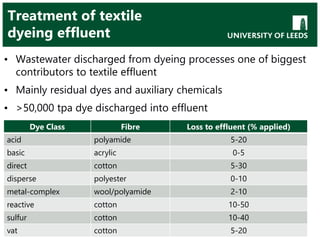
Treatment of textile
dyeing effluent
• Wastewater discharged from dyeing processes one of biggest
contributors to textile effluent
• Mainly residual dyes and auxiliary chemicals
• >50,000 tpa dye discharged into effluent
Dye Class Fibre Loss to effluent (% applied)
acid polyamide 5-20
basic acrylic 0-5
direct cotton 5-30
disperse polyester 0-10
metal-complex wool/polyamide 2-10
reactive cotton 10-50
sulfur cotton 10-40
vat cotton 5-20
Treatment of textile
dyeing effluent
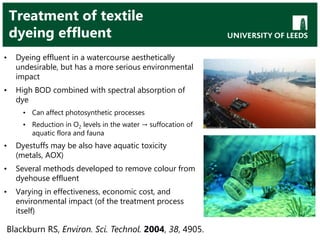
• Dyeing effluent in a watercourse aesthetically
undesirable, but has a more serious environmental
impact
• High BOD combined with spectral absorption of
dye
• Can affect photosynthetic processes
• Reduction in O2 levels in the water → suffocation of
aquatic flora and fauna
• Dyestuffs may be also have aquatic toxicity
(metals, AOX)
• Several methods developed to remove colour from
dyehouse effluent
• Varying in effectiveness, economic cost, and
environmental impact (of the treatment process
itself)
Blackburn RS, Environ. Sci. Technol. 2004, 38, 4905.
Polyester dyeing process
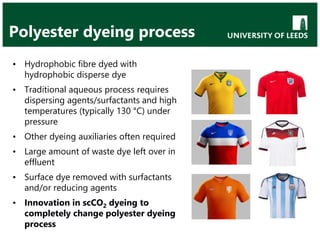
• Hydrophobic fibre dyed with
hydrophobic disperse dye
• Traditional aqueous process requires
dispersing agents/surfactants and high
temperatures (typically 130 °C) under
pressure
• Other dyeing auxiliaries often required
• Large amount of waste dye left over in
effluent
• Surface dye removed with surfactants
and/or reducing agents
• Innovation in scCO2 dyeing to
completely change polyester dyeing
process
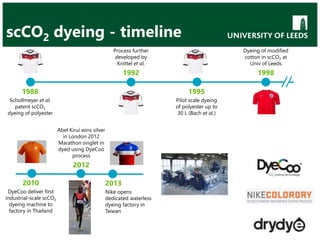
1988
Schollmeyer et al.
patent scCO2
dyeing of polyester
Process further
developed by
Knittel et al.
1992
1995
Pilot scale dyeing
of polyester up to
30 L (Bach et al.)
Dyeing of modified
cotton in scCO2 at
Univ of Leeds
1998
2010
DyeCoo deliver first
industrial-scale scCO2
dyeing machine to
factory in Thailand
Abel Kirui wins silver
in London 2012
Marathon singlet in
dyed using DyeCoo
process
2012
2013
Nike opens
dedicated waterless
dyeing factory in
Taiwan
scCO2 dyeing - timeline
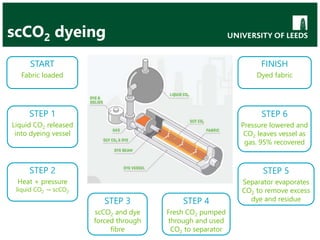
START
Fabric loaded
STEP 1
Liquid CO2 released
into dyeing vessel
STEP 2
Heat + pressure
liquid CO2 → scCO2
STEP 3
scCO2 and dye
forced through
fibre
STEP 4
Fresh CO2 pumped
through and used
CO2 to separator
STEP 5
Separator evaporates
CO2 to remove excess
dye and residue
STEP 6
Pressure lowered and
CO2 leaves vessel as
gas. 95% recovered
FINISH
Dyed fabric
scCO2 dyeing
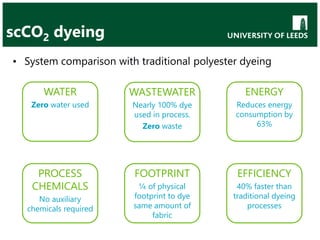
• System comparison with traditional polyester dyeing
WATER
Zero water used
WASTEWATER
Nearly 100% dye
used in process.
Zero waste
PROCESS
CHEMICALS
No auxiliary
chemicals required
FOOTPRINT
¼ of physical
footprint to dye
same amount of
fabric
EFFICIENCY
40% faster than
traditional dyeing
processes
ENERGY
Reduces energy
consumption by
63%
scCO2 dyeing
scCO2 dyeing - limitations
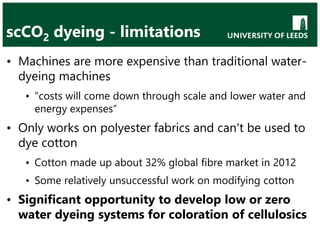
• Machines are more expensive than traditional water-
dyeing machines
• “costs will come down through scale and lower water and
energy expenses“
• Only works on polyester fabrics and can't be used to
dye cotton
• Cotton made up about 32% global fibre market in 2012
• Some relatively unsuccessful work on modifying cotton
• Significant opportunity to develop low or zero
water dyeing systems for coloration of cellulosics
Coloration of cotton
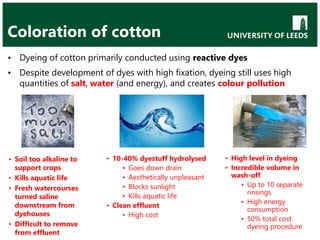
• Dyeing of cotton primarily conducted using reactive dyes
• Despite development of dyes with high fixation, dyeing still uses high
quantities of salt, water (and energy), and creates colour pollution
• Soil too alkaline to
support crops
• Kills aquatic life
• Fresh watercourses
turned saline
downstream from
dyehouses
• Difficult to remove
from effluent
• 10-40% dyestuff hydrolysed
• Goes down drain
• Aesthetically unpleasant
• Blocks sunlight
• Kills aquatic life
• Clean effluent
• High cost
• High level in dyeing
• Incredible volume in
wash-off
• Up to 10 separate
rinsings
• High energy
consumption
• 50% total cost
dyeing procedure
Wash-off of reactive
dyeings on cotton
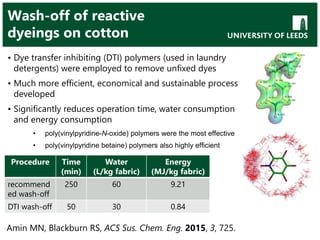
• Dye transfer inhibiting (DTI) polymers (used in laundry
detergents) were employed to remove unfixed dyes
• Much more efficient, economical and sustainable process
developed
• Significantly reduces operation time, water consumption
and energy consumption
• poly(vinylpyridine-N-oxide) polymers were the most effective
• poly(vinylpyridine betaine) polymers also highly efficient
Procedure Time
(min)
Water
(L/kg fabric)
Energy
(MJ/kg fabric)
recommend
ed wash-off
250 60 9.21
DTI wash-off 50 30 0.84
Amin MN, Blackburn RS, ACS Sus. Chem. Eng. 2015, 3, 725.
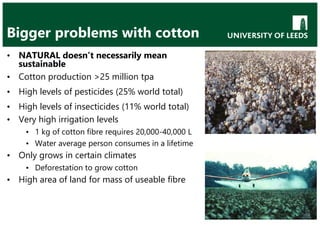
Bigger problems with cotton
• NATURAL doesn’t necessarily mean
sustainable
• Cotton production >25 million tpa
• High levels of pesticides (25% world total)
• High levels of insecticides (11% world total)
• Very high irrigation levels
• 1 kg of cotton fibre requires 20,000-40,000 L
• Water average person consumes in a lifetime
• Only grows in certain climates
• Deforestation to grow cotton
• High area of land for mass of useable fibre
Sustainable cotton?
Organic cotton
• Widely promoted as the answer to
cotton’s problems
• Global production (in over 20 countries, mainly India)
only 1.1% of world cotton production
• No genetically modified seed permitted
• No herbicides or pesticides
• Ethical labour employment standards
• Requires approximately 1.4x area of land to produce same mass of fibre
• Still has very high water consumption
• Not a viable alternative on a global scale to completely replace non-
organic cotton
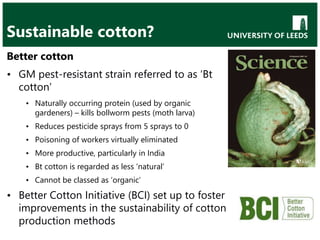
Sustainable cotton?
Better cotton
• GM pest-resistant strain referred to as ‘Bt
cotton’
• Naturally occurring protein (used by organic
gardeners) – kills bollworm pests (moth larva)
• Reduces pesticide sprays from 5 sprays to 0
• Poisoning of workers virtually eliminated
• More productive, particularly in India
• Bt cotton is regarded as less ‘natural’
• Cannot be classed as ‘organic’
• Better Cotton Initiative (BCI) set up to foster
improvements in the sustainability of cotton
production methods
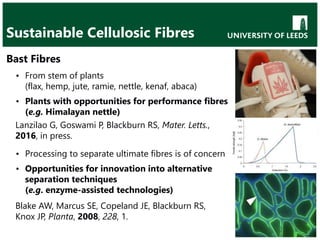
Sustainable Cellulosic Fibres
Bast Fibres
• From stem of plants
(flax, hemp, jute, ramie, nettle, kenaf, abaca)
• Plants with opportunities for performance fibres
(e.g. Himalayan nettle)
• Processing to separate ultimate fibres is of concern
• Opportunities for innovation into alternative
separation techniques
(e.g. enzyme-assisted technologies)
Blake AW, Marcus SE, Copeland JE, Blackburn RS,
Knox JP, Planta, 2008, 228, 1.
Lanzilao G, Goswami P, Blackburn RS, Mater. Letts.,
2016, in press.
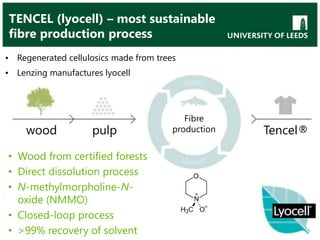
TENCEL (lyocell) – most sustainable
fibre production process
wood pulp
Fibre
production Tencel®
• Wood from certified forests
• Direct dissolution process
• N-methylmorpholine-N-
oxide (NMMO)
• Closed-loop process
• >99% recovery of solvent
• Regenerated cellulosics made from trees
• Lenzing manufactures lyocell
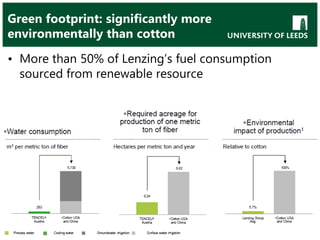
Green footprint: significantly more
environmentally than cotton
• More than 50% of Lenzing’s fuel consumption
sourced from renewable resource
Sustainability challenges for the
textiles industry
• Sustainability issues in the
textiles industry have often
been tackled in industry by
tinkering and incremental
change
• Step-change solutions are
needed to bring about truly
sustainable apparel and
footwear products
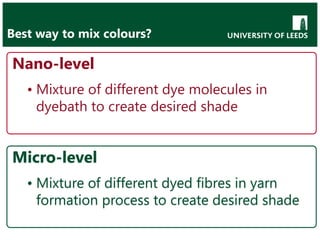
Best way to mix colours?
Nano-level
• Mixture of different dye molecules in
dyebath to create desired shade
Micro-level
• Mixture of different dyed fibres in yarn
formation process to create desired shade
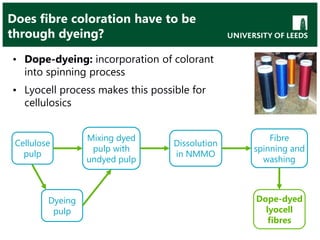
Does fibre coloration have to be
through dyeing?
• Dope-dyeing: incorporation of colorant
into spinning process
• Lyocell process makes this possible for
cellulosics
Cellulose
pulp
Dyeing
pulp
Mixing dyed
pulp with
undyed pulp
Dissolution
in NMMO
Fibre
spinning and
washing
Dope-dyed
lyocell
fibres
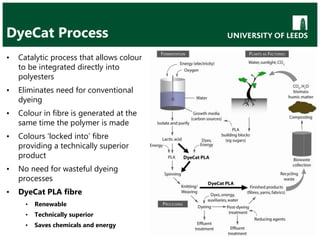
DyeCat Process
• Catalytic process that allows colour
to be integrated directly into
polyesters
• Eliminates need for conventional
dyeing
• Colour in fibre is generated at the
same time the polymer is made
• Colours ‘locked into’ fibre
providing a technically superior
product
• No need for wasteful dyeing
processes
• DyeCat PLA fibre
• Renewable
• Technically superior
• Saves chemicals and energy
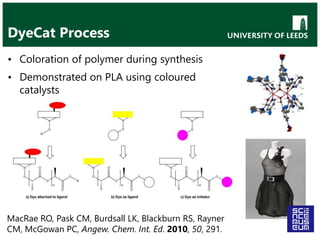
DyeCat Process
• Coloration of polymer during synthesis
• Demonstrated on PLA using coloured
catalysts
MacRae RO, Pask CM, Burdsall LK, Blackburn RS, Rayner
CM, McGowan PC, Angew. Chem. Int. Ed. 2010, 50, 291.
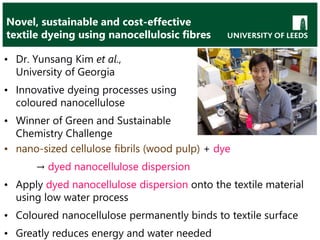
Novel, sustainable and cost-effective
textile dyeing using nanocellulosic fibres
• Dr. Yunsang Kim et al.,
University of Georgia
• Innovative dyeing processes using
coloured nanocellulose
• Winner of Green and Sustainable
Chemistry Challenge
• nano-sized cellulose fibrils (wood pulp) + dye
→ dyed nanocellulose dispersion
• Apply dyed nanocellulose dispersion onto the textile material
using low water process
• Coloured nanocellulose permanently binds to textile surface
• Greatly reduces energy and water needed
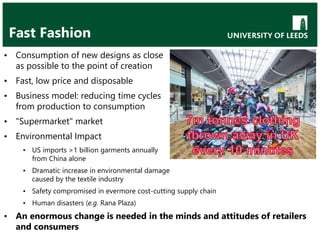
Fast Fashion
• Consumption of new designs as close
as possible to the point of creation
• Fast, low price and disposable
• Business model: reducing time cycles
from production to consumption
• "Supermarket" market
• Environmental Impact
• US imports >1 billion garments annually
from China alone
• Dramatic increase in environmental damage
caused by the textile industry
• Safety compromised in evermore cost-cutting supply chain
• Human disasters (e.g. Rana Plaza)
• An enormous change is needed in the minds and attitudes of retailers
and consumers
Sustainable Urban Living –
Textiles
• Greater use of sustainable raw materials
• Lower energy & water consumption and pollution
generation in production
• Lower impact in use
• Water, energy, chemicals in cleaning/laundering
• Design for easy disassembly/disposal/ recycling
• DESIGN FOR REDUCED CONSUMPTION AND
LONGER LIFE
• ‘Disposable’ products unsustainable
School of something
FACULTY OF OTHER
Dr. Richard S. Blackburn
r.s.blackburn@leeds.ac.uk
@RichardBlackb18
Centre for Technical Textiles
SUSTAINABLE MATERIALS RESEARCH GROUP
Thank you

GCI Lecture.pptx

  • 1.
    School of something FACULTYOF OTHER Sustainability Challenges of the Textile & Dyeing Industries – opportunities for innovation Centre for Technical Textiles SUSTAINABLE MATERIALS RESEARCH GROUP Dr. Richard Blackburn Sustainable Materials Research Group University of Leeds @RichardBlackb18
  • 2.
    Necessity for Sustainable Products •2012 - world population 7 billion • 2050 - expected to rise to over 9 billion • Increases demand • food, energy, water, resources, chemicals • Increases environmental burden • pollution • depletion of finite non-renewable resources (e.g. fossil fuels) • Synthetic chemical products and processes afford a significant improvement in quality of life • Growing middle class want these consumer products too
  • 3.
    Synthetic fibre revolution •20th Century polymers • nylon, 1935 • polyurethane, 1937 • polyester • Terylene, 1941 • Dacron, 1946 • acrylic, 1944 • polypropylene and HDPE,1951
  • 4.
    Synthetic fibre sustainability challenges •Non-degradable • Non-renewable • Increases oil consumption • Contribution to anthropogenic GHGs • Significant oil supply issues • But, polyester highest share of textile market (>50m tpa) • Raw materials for fibres must change • Recyclable – mechanical or chemical?
  • 5.
  • 6.
  • 7.
    Public perception • Demand(and rejection) for consumer products can be driven by the public and the media • “Biodegradable”, “Natural”, “Organic” • perceived by the public to be good for the environment • “Synthetic”, “Non-organic”, “GM” • perceived by the public to be bad for the environment • “Chemistry” • Public perception of science… • Do the public understand what “Sustainable” means? Physics Chemistry
  • 8.
    Ideal sustainable product •Provide an equivalent function to the product it replaces • Performs as well as or better than the existing product • Be available at a competitive or lower price • Have a minimum environmental footprint for all the processes involved • Be manufactured from renewable resources • Use only ingredients that are safe to both humans and the environment • No negative impact on food supply or water
  • 9.
    RØADMAP TO ZERODISCHARGE OF HAZARDOUS CHEMICALS (ZDHC) • Has involved stakeholders in development • Provides training to industry • Looks at hazards in the manufacturing supply chain, not just final products • Tests final textile products • But in the manufacturing supply chain it is largely based on a chemical inventory approach (overlooks impurities and by-products in chemical used)
  • 10.
    RØADMAP TO ZERODISCHARGE OF HAZARDOUS CHEMICALS (ZDHC) • Does not actually eliminate substances of concern to zero concentrations, but restricts to a limit of n ppm • Does not cover a wide range of chemicals on its MRSL • Only chemicals with very low limits are PFOA and PFOS at 2 ppm • Is the focus on these chemistries influenced by Greenpeace (Chemistry for any weather, October 2012)? • Creditable to reduce levels of PFOA and PFOS, but there is more concerning chemistry issues in the textile industry
  • 11.
    Textile dyeing processes •Traditional dyeing processes use 5.8 trillion litres water p.a. • ~3.7 billion Olympic swimming pools • 10-20% dye remains after dyeing (plus other chemicals), leaving potential for wastewater pollution • One fifth of the world's industrial water pollution (World Bank) • 391 billion kWh energy for dyeing processes • Innovative technologies needed to reduce, or eliminate, water, energy and auxiliary chemicals in dyeing
  • 12.
    Treatment of textile dyeingeffluent • Wastewater discharged from dyeing processes one of biggest contributors to textile effluent • Mainly residual dyes and auxiliary chemicals • >50,000 tpa dye discharged into effluent Dye Class Fibre Loss to effluent (% applied) acid polyamide 5-20 basic acrylic 0-5 direct cotton 5-30 disperse polyester 0-10 metal-complex wool/polyamide 2-10 reactive cotton 10-50 sulfur cotton 10-40 vat cotton 5-20
  • 13.
    Treatment of textile dyeingeffluent • Dyeing effluent in a watercourse aesthetically undesirable, but has a more serious environmental impact • High BOD combined with spectral absorption of dye • Can affect photosynthetic processes • Reduction in O2 levels in the water → suffocation of aquatic flora and fauna • Dyestuffs may be also have aquatic toxicity (metals, AOX) • Several methods developed to remove colour from dyehouse effluent • Varying in effectiveness, economic cost, and environmental impact (of the treatment process itself) Blackburn RS, Environ. Sci. Technol. 2004, 38, 4905.
  • 14.
    Polyester dyeing process •Hydrophobic fibre dyed with hydrophobic disperse dye • Traditional aqueous process requires dispersing agents/surfactants and high temperatures (typically 130 °C) under pressure • Other dyeing auxiliaries often required • Large amount of waste dye left over in effluent • Surface dye removed with surfactants and/or reducing agents • Innovation in scCO2 dyeing to completely change polyester dyeing process
  • 15.
    1988 Schollmeyer et al. patentscCO2 dyeing of polyester Process further developed by Knittel et al. 1992 1995 Pilot scale dyeing of polyester up to 30 L (Bach et al.) Dyeing of modified cotton in scCO2 at Univ of Leeds 1998 2010 DyeCoo deliver first industrial-scale scCO2 dyeing machine to factory in Thailand Abel Kirui wins silver in London 2012 Marathon singlet in dyed using DyeCoo process 2012 2013 Nike opens dedicated waterless dyeing factory in Taiwan scCO2 dyeing - timeline
  • 16.
    START Fabric loaded STEP 1 LiquidCO2 released into dyeing vessel STEP 2 Heat + pressure liquid CO2 → scCO2 STEP 3 scCO2 and dye forced through fibre STEP 4 Fresh CO2 pumped through and used CO2 to separator STEP 5 Separator evaporates CO2 to remove excess dye and residue STEP 6 Pressure lowered and CO2 leaves vessel as gas. 95% recovered FINISH Dyed fabric scCO2 dyeing
  • 17.
    • System comparisonwith traditional polyester dyeing WATER Zero water used WASTEWATER Nearly 100% dye used in process. Zero waste PROCESS CHEMICALS No auxiliary chemicals required FOOTPRINT ¼ of physical footprint to dye same amount of fabric EFFICIENCY 40% faster than traditional dyeing processes ENERGY Reduces energy consumption by 63% scCO2 dyeing
  • 18.
    scCO2 dyeing -limitations • Machines are more expensive than traditional water- dyeing machines • “costs will come down through scale and lower water and energy expenses“ • Only works on polyester fabrics and can't be used to dye cotton • Cotton made up about 32% global fibre market in 2012 • Some relatively unsuccessful work on modifying cotton • Significant opportunity to develop low or zero water dyeing systems for coloration of cellulosics
  • 19.
    Coloration of cotton •Dyeing of cotton primarily conducted using reactive dyes • Despite development of dyes with high fixation, dyeing still uses high quantities of salt, water (and energy), and creates colour pollution • Soil too alkaline to support crops • Kills aquatic life • Fresh watercourses turned saline downstream from dyehouses • Difficult to remove from effluent • 10-40% dyestuff hydrolysed • Goes down drain • Aesthetically unpleasant • Blocks sunlight • Kills aquatic life • Clean effluent • High cost • High level in dyeing • Incredible volume in wash-off • Up to 10 separate rinsings • High energy consumption • 50% total cost dyeing procedure
  • 20.
    Wash-off of reactive dyeingson cotton • Dye transfer inhibiting (DTI) polymers (used in laundry detergents) were employed to remove unfixed dyes • Much more efficient, economical and sustainable process developed • Significantly reduces operation time, water consumption and energy consumption • poly(vinylpyridine-N-oxide) polymers were the most effective • poly(vinylpyridine betaine) polymers also highly efficient Procedure Time (min) Water (L/kg fabric) Energy (MJ/kg fabric) recommend ed wash-off 250 60 9.21 DTI wash-off 50 30 0.84 Amin MN, Blackburn RS, ACS Sus. Chem. Eng. 2015, 3, 725.
  • 21.
    Bigger problems withcotton • NATURAL doesn’t necessarily mean sustainable • Cotton production >25 million tpa • High levels of pesticides (25% world total) • High levels of insecticides (11% world total) • Very high irrigation levels • 1 kg of cotton fibre requires 20,000-40,000 L • Water average person consumes in a lifetime • Only grows in certain climates • Deforestation to grow cotton • High area of land for mass of useable fibre
  • 22.
    Sustainable cotton? Organic cotton •Widely promoted as the answer to cotton’s problems • Global production (in over 20 countries, mainly India) only 1.1% of world cotton production • No genetically modified seed permitted • No herbicides or pesticides • Ethical labour employment standards • Requires approximately 1.4x area of land to produce same mass of fibre • Still has very high water consumption • Not a viable alternative on a global scale to completely replace non- organic cotton
  • 23.
    Sustainable cotton? Better cotton •GM pest-resistant strain referred to as ‘Bt cotton’ • Naturally occurring protein (used by organic gardeners) – kills bollworm pests (moth larva) • Reduces pesticide sprays from 5 sprays to 0 • Poisoning of workers virtually eliminated • More productive, particularly in India • Bt cotton is regarded as less ‘natural’ • Cannot be classed as ‘organic’ • Better Cotton Initiative (BCI) set up to foster improvements in the sustainability of cotton production methods
  • 24.
    Sustainable Cellulosic Fibres BastFibres • From stem of plants (flax, hemp, jute, ramie, nettle, kenaf, abaca) • Plants with opportunities for performance fibres (e.g. Himalayan nettle) • Processing to separate ultimate fibres is of concern • Opportunities for innovation into alternative separation techniques (e.g. enzyme-assisted technologies) Blake AW, Marcus SE, Copeland JE, Blackburn RS, Knox JP, Planta, 2008, 228, 1. Lanzilao G, Goswami P, Blackburn RS, Mater. Letts., 2016, in press.
  • 25.
    TENCEL (lyocell) –most sustainable fibre production process wood pulp Fibre production Tencel® • Wood from certified forests • Direct dissolution process • N-methylmorpholine-N- oxide (NMMO) • Closed-loop process • >99% recovery of solvent • Regenerated cellulosics made from trees • Lenzing manufactures lyocell
  • 26.
    Green footprint: significantlymore environmentally than cotton • More than 50% of Lenzing’s fuel consumption sourced from renewable resource
  • 27.
    Sustainability challenges forthe textiles industry • Sustainability issues in the textiles industry have often been tackled in industry by tinkering and incremental change • Step-change solutions are needed to bring about truly sustainable apparel and footwear products
  • 28.
    Best way tomix colours? Nano-level • Mixture of different dye molecules in dyebath to create desired shade Micro-level • Mixture of different dyed fibres in yarn formation process to create desired shade
  • 29.
    Does fibre colorationhave to be through dyeing? • Dope-dyeing: incorporation of colorant into spinning process • Lyocell process makes this possible for cellulosics Cellulose pulp Dyeing pulp Mixing dyed pulp with undyed pulp Dissolution in NMMO Fibre spinning and washing Dope-dyed lyocell fibres
  • 30.
    DyeCat Process • Catalyticprocess that allows colour to be integrated directly into polyesters • Eliminates need for conventional dyeing • Colour in fibre is generated at the same time the polymer is made • Colours ‘locked into’ fibre providing a technically superior product • No need for wasteful dyeing processes • DyeCat PLA fibre • Renewable • Technically superior • Saves chemicals and energy
  • 31.
    DyeCat Process • Colorationof polymer during synthesis • Demonstrated on PLA using coloured catalysts MacRae RO, Pask CM, Burdsall LK, Blackburn RS, Rayner CM, McGowan PC, Angew. Chem. Int. Ed. 2010, 50, 291.
  • 32.
    Novel, sustainable andcost-effective textile dyeing using nanocellulosic fibres • Dr. Yunsang Kim et al., University of Georgia • Innovative dyeing processes using coloured nanocellulose • Winner of Green and Sustainable Chemistry Challenge • nano-sized cellulose fibrils (wood pulp) + dye → dyed nanocellulose dispersion • Apply dyed nanocellulose dispersion onto the textile material using low water process • Coloured nanocellulose permanently binds to textile surface • Greatly reduces energy and water needed
  • 33.
    Fast Fashion • Consumptionof new designs as close as possible to the point of creation • Fast, low price and disposable • Business model: reducing time cycles from production to consumption • "Supermarket" market • Environmental Impact • US imports >1 billion garments annually from China alone • Dramatic increase in environmental damage caused by the textile industry • Safety compromised in evermore cost-cutting supply chain • Human disasters (e.g. Rana Plaza) • An enormous change is needed in the minds and attitudes of retailers and consumers
  • 34.
    Sustainable Urban Living– Textiles • Greater use of sustainable raw materials • Lower energy & water consumption and pollution generation in production • Lower impact in use • Water, energy, chemicals in cleaning/laundering • Design for easy disassembly/disposal/ recycling • DESIGN FOR REDUCED CONSUMPTION AND LONGER LIFE • ‘Disposable’ products unsustainable
  • 35.
    School of something FACULTYOF OTHER Dr. Richard S. Blackburn r.s.blackburn@leeds.ac.uk @RichardBlackb18 Centre for Technical Textiles SUSTAINABLE MATERIALS RESEARCH GROUP Thank you