Xavier Institute of Management,
Bhubaneswar
Sustainability practices across Industries
Sustainability in the Textile Industry
Group 9
Textile Industry
The design and production of yarn, cloth, clothing, and their distribution. The raw material may be
natural, or synthetic using products of the chemical industry.
Global Industry Analysts, Inc. (GIA) has declared that the global bazaar for textile machinery is
estimated to reach US$22.9 billion by 2017.
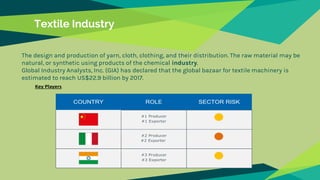
Key Players
COUNTRY ROLE SECTOR RISK
#1 Producer
#1 Exporter
#2 Producer
#2 Exporter
#3 Producer
#3 Exporter
Indian Textile Industry
The second most important economic activity in the country,
in terms of employment generation (after agriculture).
Abundant availability of raw materials such as cotton, wool,
silk and jute, as well as a skilled workforce, have made the
country a sourcing hub
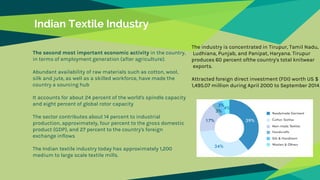
It accounts for about 24 percent of the world's spindle capacity
and eight percent of global rotor capacity
The sector contributes about 14 percent to industrial
production, approximately, four percent to the gross domestic
product (GDP), and 27 percent to the country's foreign
exchange inflows
The Indian textile industry today has approximately 1,200
medium to large scale textile mills.
The industry is concentrated in Tirupur, Tamil Nadu,
Ludhiana, Punjab, and Panipat, Haryana. Tirupur
produces 60 percent ofthe country's total knitwear
exports.
Attracted foreign direct investment (FDI) worth US $
1,495.07 million during April 2000 to September 2014.
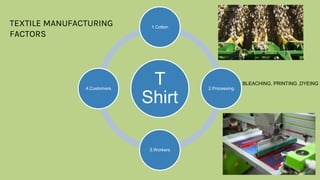
T
Shirt
1.Cotton
2.Processing
3.Workers
4.Customers
BLEACHING, PRINTING ,DYEING
TEXTILE MANUFACTURING
FACTORS
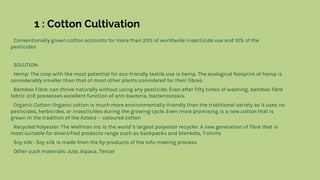
1 : Cotton Cultivation
Conventionally grown cotton accounts for more than 25% of worldwide insecticide use and 10% of the
pesticides
SOLUTION:
Hemp: The crop with the most potential for eco-friendly textile use is hemp. The ecological footprint of hemp is
considerably smaller than that of most other plants considered for their fibres.
Bamboo Fibre: can thrive naturally without using any pesticide. Even after fifty times of washing, bamboo fibre
fabric still possesses excellent function of anti-bacteria, bacteriostasis.
Organic Cotton: Organic cotton is much more environmentally-friendly than the traditional variety as it uses no
pesticides, herbicides, or insecticides during the growing cycle. Even more promising is a new cotton that is
grown in the tradition of the Aztecs -- coloured cotton
Recycled Polyester: The Wellman Inc is the world’s largest polyester recycler. A new generation of fibre that is
most suitable for diversified products range such as backpacks and blankets, T-shirts
Soy silk : Soy silk is made from the by-products of the tofu-making process.
Other such materials: Jute, Alpaca, Tencel
2. Processing
PROBLEMS:
One T-shirt requires 257 gallons of water.
On top of that, bleaching and then dyeing
the resulting fabric creates toxins that
flow into our ecosystem
Petrochemical-based products currently
in use today emit toxic chemicals
Residual dyestuffs – toxicity, colour, bio
degradability
Heavy metals contamination (Cr, Cu, Zn)
Salts in effluent which is to be re used for
land application
Heavy levels of total oxidized sulphur
(TOS)
High Chemical Oxygen Demand (COD)
and Biological Oxygen Demand (BOD)
SOLUTIONS:
Reduce water consumption during preparation ,
colouration and finishing.
Reduce energy consumption during the
operation processes of textile plants.
Reduce aqueous wastes and off gases which
pollute the environment.
Improve process efficiency of the textile plants.
Reduce exposure to hazardous waste materials
from dyes and chemicals.
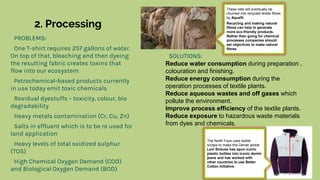
These nets will eventually be
churned into recycled textile fibres
by Aquafil.
Recycling and making natural
fibres can help to generate
more eco-friendly products.
Rather then going for chemical
processes companies should
set objectives to make natural
fibres.
The North Face uses textile
scraps to make this Denali jacket.
Levi Strauss has spun iconic
plastic bottles into iconic denim
jeans and has worked with
other countries to use Better
Cotton Initiative.
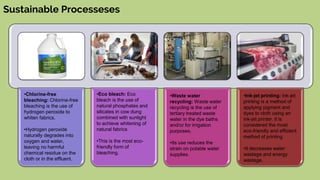
•Chlorine-free
bleaching: Chlorine-free
bleaching is the use of
hydrogen peroxide to
whiten fabrics.
•Hydrogen peroxide
naturally degrades into
oxygen and water,
leaving no harmful
chemical residue on the
cloth or in the effluent.
•Eco bleach: Eco
bleach is the use of
natural phosphates and
silicates in cow dung
combined with sunlight
to achieve whitening of
natural fabrics
•This is the most eco-
friendly form of
bleaching.
•Waste water
recycling: Waste water
recycling is the use of
tertiary treated waste
water in the dye baths
and/or for irrigation
purposes.
•Its use reduces the
strain on potable water
supplies.
Sustainable Processeses
•Ink-jet printing: Ink-jet
printing is a method of
applying pigment and
dyes to cloth using an
ink-jet printer. It is
considered the most
eco-friendly and efficient
method of printing
•It decreases water
wastage and energy
wastage.
3.Workers involved and Customer Practices
PROBLEMS
Pesticides used on cotton cause
acute poisonings and chronic
illness to farm workers worldwide
Millions of children in the US
receive up to 35% of their estimated
lifetime dose of some carcinogenic
pesticides by age five through food,
contaminated drinking water,
household use, and pesticide drift.
Poor working conditions for
workers in factories leading to child
labour, sexual harassment, etc
Disposable clothing and Fast
Shopping
SOLUTIONS:
Gender equality through proper
legislation
Fire Safety and Proper working
condition
Establish Enzyme Treatment Plants
Government should permit new
garment industries only in specific
zones and not in residential or
commercial areas.
Use of clothes for a longer time ,
Repairing and Recycling
Second hand clothes, Leasing
SUSTAINABLE PRODUCTS IN THE TEXTILE INDUSTRY
1.Hardy Organic Hemp From O Ecotextiles
100 percent long fiber hemp which is sustainably harvested by independent farmers in Romania. . No pesticides,
insecticides, fungicides, or synthetic fertilizers are used
2. Abacus From Knoll Textiles
looks like virgin wool, but in fact it is actually woven from 100 percent recycled polyester
sourced from both post-consumer (soda bottles) and post-industrial materials
(production scraps).
3. Hallingdal From Kvadrat
Stamped with the EU FLOWER designation, meaning manufacturing, chemical composition, and quality is
checked by independent bodies in order to comply to strict ecological and performance criteria.
4. Q Collection
All the fabric is completely free of toxic finishes or treatments and designed to be 100 percent biodegradable,
incorporating natural materials like abaca (banana plant stalk), bamboo, hemp, linen, organic cotton, and
wool.
5. Mezzanine From Luna Textiles
First polyester produced and dyed with all environmentally safe ingredients. Released with much
acclaim in 2001 in association with the Environmental Protection and Encouragement Agency (EPEA).
6. Across 465964 From Maharam
It is made of 100 percent post-consumer recycled polyester.
7. Climatex From Rohner Textil
Climatex Lifeguard FR is made out of wool and renewable beech wood, without harmful chemicals
8. Sensuede
The fibers come from both post-industrial and post-consumer sources, including PET soda and water
bottles. Production does not include harmful solvents or toxic waste
PATAGONIA- The Sustainability Leader
For over 30 years, Patagonia has donated 1% of their annual sales to
environmental charities and grassroots organizations
In 2010, they helped found the Sustainable Apparel Coalition, an
alliance of 30 companies from the clothing and footwear industries
Backed funds like “$20 Million and Change” to assist like-minded,
responsible start-up companies bring about positive benefit to the
environment
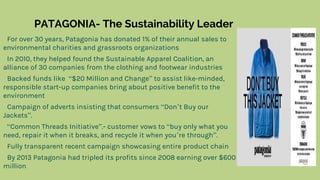
Campaign of adverts insisting that consumers “Don’t Buy our
Jackets”.
“Common Threads Initiative”.- customer vows to “buy only what you
need, repair it when it breaks, and recycle it when you’re through”.
Fully transparent recent campaign showcasing entire product chain
By 2013 Patagonia had tripled its profits since 2008 earning over $600
million
THANK YOU

(XIMB) Sustainability textile industry

  • 1.
    Xavier Institute ofManagement, Bhubaneswar Sustainability practices across Industries
  • 2.
    Sustainability in theTextile Industry Group 9
  • 3.
    Textile Industry The designand production of yarn, cloth, clothing, and their distribution. The raw material may be natural, or synthetic using products of the chemical industry. Global Industry Analysts, Inc. (GIA) has declared that the global bazaar for textile machinery is estimated to reach US$22.9 billion by 2017. Key Players COUNTRY ROLE SECTOR RISK #1 Producer #1 Exporter #2 Producer #2 Exporter #3 Producer #3 Exporter
  • 4.
    Indian Textile Industry Thesecond most important economic activity in the country, in terms of employment generation (after agriculture). Abundant availability of raw materials such as cotton, wool, silk and jute, as well as a skilled workforce, have made the country a sourcing hub It accounts for about 24 percent of the world's spindle capacity and eight percent of global rotor capacity The sector contributes about 14 percent to industrial production, approximately, four percent to the gross domestic product (GDP), and 27 percent to the country's foreign exchange inflows The Indian textile industry today has approximately 1,200 medium to large scale textile mills. The industry is concentrated in Tirupur, Tamil Nadu, Ludhiana, Punjab, and Panipat, Haryana. Tirupur produces 60 percent ofthe country's total knitwear exports. Attracted foreign direct investment (FDI) worth US $ 1,495.07 million during April 2000 to September 2014.
  • 5.
  • 6.
    1 : CottonCultivation Conventionally grown cotton accounts for more than 25% of worldwide insecticide use and 10% of the pesticides SOLUTION: Hemp: The crop with the most potential for eco-friendly textile use is hemp. The ecological footprint of hemp is considerably smaller than that of most other plants considered for their fibres. Bamboo Fibre: can thrive naturally without using any pesticide. Even after fifty times of washing, bamboo fibre fabric still possesses excellent function of anti-bacteria, bacteriostasis. Organic Cotton: Organic cotton is much more environmentally-friendly than the traditional variety as it uses no pesticides, herbicides, or insecticides during the growing cycle. Even more promising is a new cotton that is grown in the tradition of the Aztecs -- coloured cotton Recycled Polyester: The Wellman Inc is the world’s largest polyester recycler. A new generation of fibre that is most suitable for diversified products range such as backpacks and blankets, T-shirts Soy silk : Soy silk is made from the by-products of the tofu-making process. Other such materials: Jute, Alpaca, Tencel
  • 7.
    2. Processing PROBLEMS: One T-shirtrequires 257 gallons of water. On top of that, bleaching and then dyeing the resulting fabric creates toxins that flow into our ecosystem Petrochemical-based products currently in use today emit toxic chemicals Residual dyestuffs – toxicity, colour, bio degradability Heavy metals contamination (Cr, Cu, Zn) Salts in effluent which is to be re used for land application Heavy levels of total oxidized sulphur (TOS) High Chemical Oxygen Demand (COD) and Biological Oxygen Demand (BOD) SOLUTIONS: Reduce water consumption during preparation , colouration and finishing. Reduce energy consumption during the operation processes of textile plants. Reduce aqueous wastes and off gases which pollute the environment. Improve process efficiency of the textile plants. Reduce exposure to hazardous waste materials from dyes and chemicals. These nets will eventually be churned into recycled textile fibres by Aquafil. Recycling and making natural fibres can help to generate more eco-friendly products. Rather then going for chemical processes companies should set objectives to make natural fibres. The North Face uses textile scraps to make this Denali jacket. Levi Strauss has spun iconic plastic bottles into iconic denim jeans and has worked with other countries to use Better Cotton Initiative.
  • 8.
    •Chlorine-free bleaching: Chlorine-free bleaching isthe use of hydrogen peroxide to whiten fabrics. •Hydrogen peroxide naturally degrades into oxygen and water, leaving no harmful chemical residue on the cloth or in the effluent. •Eco bleach: Eco bleach is the use of natural phosphates and silicates in cow dung combined with sunlight to achieve whitening of natural fabrics •This is the most eco- friendly form of bleaching. •Waste water recycling: Waste water recycling is the use of tertiary treated waste water in the dye baths and/or for irrigation purposes. •Its use reduces the strain on potable water supplies. Sustainable Processeses •Ink-jet printing: Ink-jet printing is a method of applying pigment and dyes to cloth using an ink-jet printer. It is considered the most eco-friendly and efficient method of printing •It decreases water wastage and energy wastage.
  • 9.
    3.Workers involved andCustomer Practices PROBLEMS Pesticides used on cotton cause acute poisonings and chronic illness to farm workers worldwide Millions of children in the US receive up to 35% of their estimated lifetime dose of some carcinogenic pesticides by age five through food, contaminated drinking water, household use, and pesticide drift. Poor working conditions for workers in factories leading to child labour, sexual harassment, etc Disposable clothing and Fast Shopping SOLUTIONS: Gender equality through proper legislation Fire Safety and Proper working condition Establish Enzyme Treatment Plants Government should permit new garment industries only in specific zones and not in residential or commercial areas. Use of clothes for a longer time , Repairing and Recycling Second hand clothes, Leasing
  • 10.
    SUSTAINABLE PRODUCTS INTHE TEXTILE INDUSTRY 1.Hardy Organic Hemp From O Ecotextiles 100 percent long fiber hemp which is sustainably harvested by independent farmers in Romania. . No pesticides, insecticides, fungicides, or synthetic fertilizers are used 2. Abacus From Knoll Textiles looks like virgin wool, but in fact it is actually woven from 100 percent recycled polyester sourced from both post-consumer (soda bottles) and post-industrial materials (production scraps). 3. Hallingdal From Kvadrat Stamped with the EU FLOWER designation, meaning manufacturing, chemical composition, and quality is checked by independent bodies in order to comply to strict ecological and performance criteria. 4. Q Collection All the fabric is completely free of toxic finishes or treatments and designed to be 100 percent biodegradable, incorporating natural materials like abaca (banana plant stalk), bamboo, hemp, linen, organic cotton, and wool.
  • 11.
    5. Mezzanine FromLuna Textiles First polyester produced and dyed with all environmentally safe ingredients. Released with much acclaim in 2001 in association with the Environmental Protection and Encouragement Agency (EPEA). 6. Across 465964 From Maharam It is made of 100 percent post-consumer recycled polyester. 7. Climatex From Rohner Textil Climatex Lifeguard FR is made out of wool and renewable beech wood, without harmful chemicals 8. Sensuede The fibers come from both post-industrial and post-consumer sources, including PET soda and water bottles. Production does not include harmful solvents or toxic waste
  • 12.
    PATAGONIA- The SustainabilityLeader For over 30 years, Patagonia has donated 1% of their annual sales to environmental charities and grassroots organizations In 2010, they helped found the Sustainable Apparel Coalition, an alliance of 30 companies from the clothing and footwear industries Backed funds like “$20 Million and Change” to assist like-minded, responsible start-up companies bring about positive benefit to the environment Campaign of adverts insisting that consumers “Don’t Buy our Jackets”. “Common Threads Initiative”.- customer vows to “buy only what you need, repair it when it breaks, and recycle it when you’re through”. Fully transparent recent campaign showcasing entire product chain By 2013 Patagonia had tripled its profits since 2008 earning over $600 million
  • 13.