
ECMO IN TRAUMA
Dr Himaaldev
Consultant intensive care
Apollo hospital
Zonies D, Codner P, Park P, et al. Trauma Surg Acute Care Open 2019;4
When is ECMO use appropriate in
trauma patients?
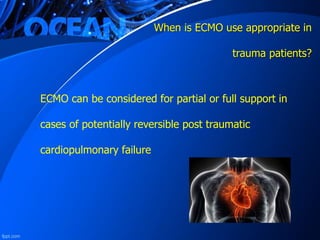
ECMO can be considered for partial or full support in
cases of potentially reversible post traumatic
cardiopulmonary failure
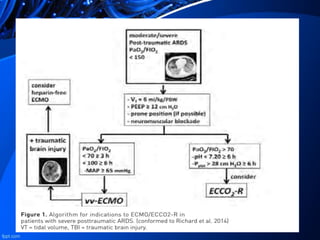
WHICH METHOD IN TRAUMA?
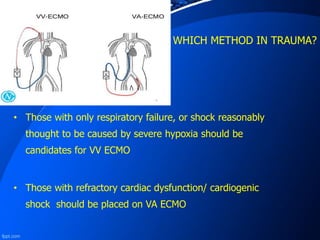
• Those with only respiratory failure, or shock reasonably
thought to be caused by severe hypoxia should be
candidates for VV ECMO
• Those with refractory cardiac dysfunction/ cardiogenic
shock should be placed on VA ECMO
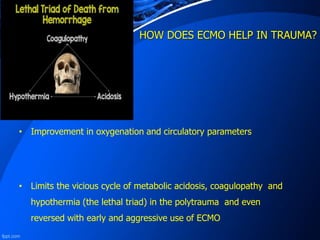
HOW DOES ECMO HELP IN TRAUMA?
• Improvement in oxygenation and circulatory parameters
• Limits the vicious cycle of metabolic acidosis, coagulopathy and
hypothermia (the lethal triad) in the polytrauma and even
reversed with early and aggressive use of ECMO
INDICATIONS AND CONTRAINDICATIONS
• Literature pertaining to trauma remains scant
• Case by case, highly individualized selection process
• Risk benefit equation
• Multidisciplinary decision making
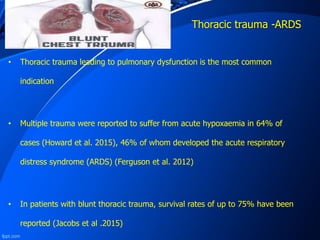
Thoracic trauma -ARDS
• Thoracic trauma leading to pulmonary dysfunction is the most common
indication
• Multiple trauma were reported to suffer from acute hypoxaemia in 64% of
cases (Howard et al. 2015), 46% of whom developed the acute respiratory
distress syndrome (ARDS) (Ferguson et al. 2012)
• In patients with blunt thoracic trauma, survival rates of up to 75% have been
reported (Jacobs et al .2015)
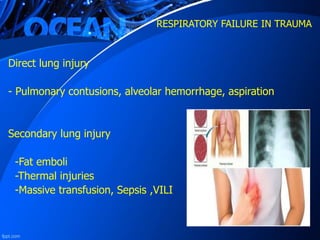
RESPIRATORY FAILURE IN TRAUMA
Direct lung injury
- Pulmonary contusions, alveolar hemorrhage, aspiration
Secondary lung injury
-Fat emboli
-Thermal injuries
-Massive transfusion, Sepsis ,VILI
Indications
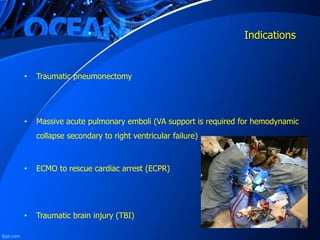
• Traumatic pneumonectomy
• Massive acute pulmonary emboli (VA support is required for hemodynamic
collapse secondary to right ventricular failure)
• ECMO to rescue cardiac arrest (ECPR)
• Traumatic brain injury (TBI)
INDICATIONS
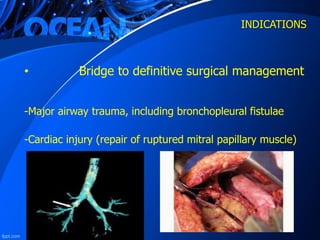
• Bridge to definitive surgical management
-Major airway trauma, including bronchopleural fistulae
-Cardiac injury (repair of ruptured mitral papillary muscle)
CONTRAINDICATIONS
• Absolute contraindications
- unrecoverable injury or terminal malignancy
• Relative contraindications
- mechanical ventilation of over 7 days
- chronic end stage organ dysfunction
- advanced age or severe frailty
- intolerance to anticoagulation
NEUROLOGIC INJURY
• Ensuring adequate tissue oxygenation remains a basic
tenet of neurologic injury management
• Prevent secondary brain injury and mitigate against
poor outcome ( hypoxia,hypercapnia)
• Simultaneous presence of significant pulmonary injury
and brain trauma
TRAUMATIC BRAIN INJURY
• TBI- anticoagulation can be safely withheld until bleeding is
stabilized
• Anticoagulation may be held from 5 days to an entire run so long
as there is minimal evidence of oxygenator clot formation
• Bedeir K, Seethala R, Kelly E. Extracorporeal life support in trauma: worth the risks? A systematic
review of published series. J Trauma Acute Care Surg 2017;82:400–6.
• Biscotti M, Gannon WD, Abrams D, Agerstrand C, Claassen J, Brodie D, Bacchetta M. Extracorporeal
membrane oxygenation use in patients with traumatic brain injury.Perfusion 2015;30:407–9.
SUPPORTING EVIDENCE
• Firstenberg et al massive pulmonary contusions, multifocal
intraparenchymal brain hemorrhages, SDH,IVH
• 10,000 units of heparin before cannulation and no heparin
thereafter
Repeat head CT scans on post trauma days 1 and 5 showed no
significant intracranial changes following the initiation of VV ECMO
Firstenberg, M.S., et al., Extracorporeal membrane oxygenation for complex multiorgan system trauma.
Case Reports in Surgery, 2012. 2012.
SUPPORTING EVIDENCE
• Muelenbach et al reported successful application of VV ECMO without continuous
anticoagulation and only heparin coated cannulas and circuits for up to 5 days in
patients with ARDS and traumatic brain injuries
• Veno venous ECMO has also been used in a patient with spinal cord injury for post
traumatic ARDS, without reported neurologic sequelae
Muellenbach, R.M., et al., Prolonged heparin‐free extracorporeal membrane oxygenation in multiple injured acute respiratory distress
syndrome patients with traumatic brain injury. The Journal of Trauma and Acute Care Surgery, 2012. 72(5): p. 1444–1447.
Stoll, M.C., et al., Veno‐venous extracorporeal membrane oxygenation therapy of a severely injured patient after secondary survey. The
American Journal of Emergency Medicine, 2014. 32(10): p. 1300
ECMO IN POLYTRAUMA
• Wen et al -VV ECMO in polytrauma with lung contusions, as well as a
grade IV liver laceration . A non heparinized VV ECMO circuit was
used for 5 days without major complications
• Skarda et al -reported on ECMO use in children with severe traumatic
injuries, including open reduction and internal fixation and endoscopic
procedures while on active extracorporeal support
Wen, P.H., et al., Non‐heparinized ECMO serves a rescue method in a multitrauma : a case report and literature review.
World Journal of Emergency Surgery, 2015. 10: p. 15
Skarda, D., J.W. Henricksen, and M. Rollins, Extracorporeal membrane oxygenation promotes survival in children with
trauma related respiratory failure. Pediatric Surgery International, 2012. 28(7): p. 711–714.
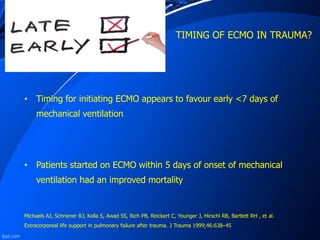
TIMING OF ECMO IN TRAUMA?
• Timing for initiating ECMO appears to favour early <7 days of
mechanical ventilation
• Patients started on ECMO within 5 days of onset of mechanical
ventilation had an improved mortality
Michaels AJ, Schriener RJ, Kolla S, Awad SS, Rich PB, Reickert C, Younger J, Hirschl RB, Bartlett RH , et al.
Extracorporeal life support in pulmonary failure after trauma. J Trauma 1999;46:638–45
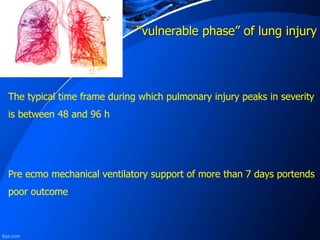
“vulnerable phase” of lung injury
The typical time frame during which pulmonary injury peaks in severity
is between 48 and 96 h
Pre ecmo mechanical ventilatory support of more than 7 days portends
poor outcome
THE EXPECTED SURVIVAL ?
• Severity of the underlying traumatic injury remains
an important determinant of survival
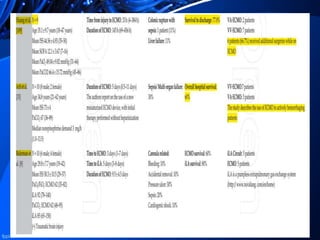
• In the largest analysis of the ELSO registry focused on trauma
patients, survival to discharge was 61% in a cohort of 279
patients. This compared favourably to non trauma indications for
ECMO
Bosarge PL et al Early initiation of extracorporeal membrane oxygenation improves survival in adult trauma Patients
with severe adult respiratory distress syndrome. J Trauma Acute Care Surg 2016;81:236–43
Burke CR, Crown A, Chan T, McMullan DM. Extracorporeal life support is safe in trauma patients. Injury
2017;48:121–6.
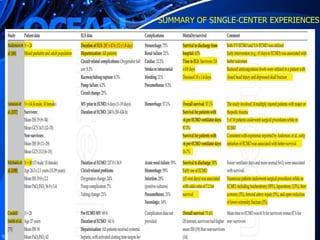
SUMMARY OF SINGLE‐CENTER EXPERIENCES
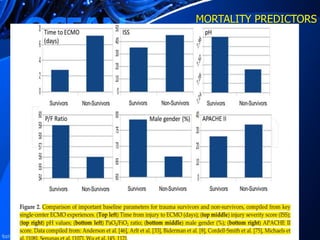
MORTALITY PREDICTORS
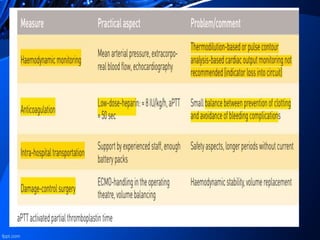
ANTICOAGULATION STRATEGY
• High flow rates in order to both maximize gas exchange capacity and
decrease the risk of thrombotic complications
• Decreased risk of circuit clotting due to the synergies between device
miniaturization and heparin bonded circuits that are more
biocompatible
Arlt, M., et al., Extracorporeal membrane oxygenation in severe trauma patients with bleeding
shock. Resuscitation, 2010. 81(7): p. 804–809
whether to use anticoagulation or not?
• Consider issues not only related to initiation and maintenance
but also weaning (e.g. ability to maintain clot free circuit with
lower flow rates)
REFERRAL TO ECMO CENTER
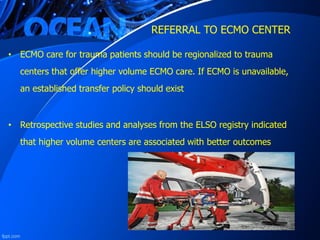
• ECMO care for trauma patients should be regionalized to trauma
centers that offer higher volume ECMO care. If ECMO is unavailable,
an established transfer policy should exist
• Retrospective studies and analyses from the ELSO registry indicated
that higher volume centers are associated with better outcomes
ORGAN DONATION
• Brain death following trauma is one of the major sources of
organs donated for transplantation
• Potential barriers to organ recovery such as cardiac arrest and
refractory cardiopulmonary collapse
• VA ECMO as a tool for organ preservation prior to organ
procurement
Balsorano, P., et al., Extracorporeal life support and multiorgan donation in a severe poly‐trauma
patient: a case report. International Journal of Surgery Case Reports, 2015. 9: p. 109–111.
Ecmo in trauma
Ecmo in trauma

Ecmo in trauma

  • 1.
    ECMO IN TRAUMA DrHimaaldev Consultant intensive care Apollo hospital
  • 2.
    Zonies D, CodnerP, Park P, et al. Trauma Surg Acute Care Open 2019;4
  • 3.
    When is ECMOuse appropriate in trauma patients? ECMO can be considered for partial or full support in cases of potentially reversible post traumatic cardiopulmonary failure
  • 4.
    WHICH METHOD INTRAUMA? • Those with only respiratory failure, or shock reasonably thought to be caused by severe hypoxia should be candidates for VV ECMO • Those with refractory cardiac dysfunction/ cardiogenic shock should be placed on VA ECMO
  • 5.
    HOW DOES ECMOHELP IN TRAUMA? • Improvement in oxygenation and circulatory parameters • Limits the vicious cycle of metabolic acidosis, coagulopathy and hypothermia (the lethal triad) in the polytrauma and even reversed with early and aggressive use of ECMO
  • 6.
    INDICATIONS AND CONTRAINDICATIONS •Literature pertaining to trauma remains scant • Case by case, highly individualized selection process • Risk benefit equation • Multidisciplinary decision making
  • 7.
    Thoracic trauma -ARDS •Thoracic trauma leading to pulmonary dysfunction is the most common indication • Multiple trauma were reported to suffer from acute hypoxaemia in 64% of cases (Howard et al. 2015), 46% of whom developed the acute respiratory distress syndrome (ARDS) (Ferguson et al. 2012) • In patients with blunt thoracic trauma, survival rates of up to 75% have been reported (Jacobs et al .2015)
  • 8.
    RESPIRATORY FAILURE INTRAUMA Direct lung injury - Pulmonary contusions, alveolar hemorrhage, aspiration Secondary lung injury -Fat emboli -Thermal injuries -Massive transfusion, Sepsis ,VILI
  • 9.
    Indications • Traumatic pneumonectomy •Massive acute pulmonary emboli (VA support is required for hemodynamic collapse secondary to right ventricular failure) • ECMO to rescue cardiac arrest (ECPR) • Traumatic brain injury (TBI)
  • 10.
    INDICATIONS • Bridge todefinitive surgical management -Major airway trauma, including bronchopleural fistulae -Cardiac injury (repair of ruptured mitral papillary muscle)
  • 11.
    CONTRAINDICATIONS • Absolute contraindications -unrecoverable injury or terminal malignancy • Relative contraindications - mechanical ventilation of over 7 days - chronic end stage organ dysfunction - advanced age or severe frailty - intolerance to anticoagulation
  • 12.
    NEUROLOGIC INJURY • Ensuringadequate tissue oxygenation remains a basic tenet of neurologic injury management • Prevent secondary brain injury and mitigate against poor outcome ( hypoxia,hypercapnia) • Simultaneous presence of significant pulmonary injury and brain trauma
  • 13.
    TRAUMATIC BRAIN INJURY •TBI- anticoagulation can be safely withheld until bleeding is stabilized • Anticoagulation may be held from 5 days to an entire run so long as there is minimal evidence of oxygenator clot formation • Bedeir K, Seethala R, Kelly E. Extracorporeal life support in trauma: worth the risks? A systematic review of published series. J Trauma Acute Care Surg 2017;82:400–6. • Biscotti M, Gannon WD, Abrams D, Agerstrand C, Claassen J, Brodie D, Bacchetta M. Extracorporeal membrane oxygenation use in patients with traumatic brain injury.Perfusion 2015;30:407–9.
  • 14.
    SUPPORTING EVIDENCE • Firstenberget al massive pulmonary contusions, multifocal intraparenchymal brain hemorrhages, SDH,IVH • 10,000 units of heparin before cannulation and no heparin thereafter Repeat head CT scans on post trauma days 1 and 5 showed no significant intracranial changes following the initiation of VV ECMO Firstenberg, M.S., et al., Extracorporeal membrane oxygenation for complex multiorgan system trauma. Case Reports in Surgery, 2012. 2012.
  • 15.
    SUPPORTING EVIDENCE • Muelenbachet al reported successful application of VV ECMO without continuous anticoagulation and only heparin coated cannulas and circuits for up to 5 days in patients with ARDS and traumatic brain injuries • Veno venous ECMO has also been used in a patient with spinal cord injury for post traumatic ARDS, without reported neurologic sequelae Muellenbach, R.M., et al., Prolonged heparin‐free extracorporeal membrane oxygenation in multiple injured acute respiratory distress syndrome patients with traumatic brain injury. The Journal of Trauma and Acute Care Surgery, 2012. 72(5): p. 1444–1447. Stoll, M.C., et al., Veno‐venous extracorporeal membrane oxygenation therapy of a severely injured patient after secondary survey. The American Journal of Emergency Medicine, 2014. 32(10): p. 1300
  • 16.
    ECMO IN POLYTRAUMA •Wen et al -VV ECMO in polytrauma with lung contusions, as well as a grade IV liver laceration . A non heparinized VV ECMO circuit was used for 5 days without major complications • Skarda et al -reported on ECMO use in children with severe traumatic injuries, including open reduction and internal fixation and endoscopic procedures while on active extracorporeal support Wen, P.H., et al., Non‐heparinized ECMO serves a rescue method in a multitrauma : a case report and literature review. World Journal of Emergency Surgery, 2015. 10: p. 15 Skarda, D., J.W. Henricksen, and M. Rollins, Extracorporeal membrane oxygenation promotes survival in children with trauma related respiratory failure. Pediatric Surgery International, 2012. 28(7): p. 711–714.
  • 17.
    TIMING OF ECMOIN TRAUMA? • Timing for initiating ECMO appears to favour early <7 days of mechanical ventilation • Patients started on ECMO within 5 days of onset of mechanical ventilation had an improved mortality Michaels AJ, Schriener RJ, Kolla S, Awad SS, Rich PB, Reickert C, Younger J, Hirschl RB, Bartlett RH , et al. Extracorporeal life support in pulmonary failure after trauma. J Trauma 1999;46:638–45
  • 18.
    “vulnerable phase” oflung injury The typical time frame during which pulmonary injury peaks in severity is between 48 and 96 h Pre ecmo mechanical ventilatory support of more than 7 days portends poor outcome
  • 19.
    THE EXPECTED SURVIVAL? • Severity of the underlying traumatic injury remains an important determinant of survival • In the largest analysis of the ELSO registry focused on trauma patients, survival to discharge was 61% in a cohort of 279 patients. This compared favourably to non trauma indications for ECMO Bosarge PL et al Early initiation of extracorporeal membrane oxygenation improves survival in adult trauma Patients with severe adult respiratory distress syndrome. J Trauma Acute Care Surg 2016;81:236–43 Burke CR, Crown A, Chan T, McMullan DM. Extracorporeal life support is safe in trauma patients. Injury 2017;48:121–6.
  • 20.
  • 23.
  • 26.
    ANTICOAGULATION STRATEGY • Highflow rates in order to both maximize gas exchange capacity and decrease the risk of thrombotic complications • Decreased risk of circuit clotting due to the synergies between device miniaturization and heparin bonded circuits that are more biocompatible Arlt, M., et al., Extracorporeal membrane oxygenation in severe trauma patients with bleeding shock. Resuscitation, 2010. 81(7): p. 804–809
  • 27.
    whether to useanticoagulation or not? • Consider issues not only related to initiation and maintenance but also weaning (e.g. ability to maintain clot free circuit with lower flow rates)
  • 28.
    REFERRAL TO ECMOCENTER • ECMO care for trauma patients should be regionalized to trauma centers that offer higher volume ECMO care. If ECMO is unavailable, an established transfer policy should exist • Retrospective studies and analyses from the ELSO registry indicated that higher volume centers are associated with better outcomes
  • 29.
    ORGAN DONATION • Braindeath following trauma is one of the major sources of organs donated for transplantation • Potential barriers to organ recovery such as cardiac arrest and refractory cardiopulmonary collapse • VA ECMO as a tool for organ preservation prior to organ procurement Balsorano, P., et al., Extracorporeal life support and multiorgan donation in a severe poly‐trauma patient: a case report. International Journal of Surgery Case Reports, 2015. 9: p. 109–111.

Editor's Notes

  • #2 Historically anticoagulation use precluded the use of ecmo, but recent evidence suggests it can be used in these cohort In 1972, the first successful use of ECMO was in a 24-year-old polytrauma patient who developed a “shock lung syndrome”.
  • #3 The American Association for the Surgery of Trauma Critical Care Committee has developed clinical consensus guides to help with practical answers based on the best evidence available. These ARE NOT MANY STUDIES AND THE levels of evidence may not be that strong and THESE are based on a combination of expert consensus and research.
  • #4 CONSENSUS RECOMMENDATION
  • #5 In trauma, VV cannulation is the most common modality of ECMO ,MOST LITERATURE ARE BASED ON THIS traumatic pneumonectomy, with the potential to cause severe acute right heart failure, potentially leading to refractory hypoxemia and very high mortality rates [29, 78]. In this setting, VV‐ECMO may be considered as a life‐ saving therapy
  • #6 The restored circulation will help normalise pH and increase lactate clearance. Also, the ECMO system makes it easy to control the patient’s temperature. So, looking at the leathal triad, ECMO corrects 2 out of 3. And the third will then follow. So ECMO might actually improve coagulation in this setting Ecmo unloads venous side --with VA ECMO, you’ll suck the right atrium/SVC/IVC almost empty, lowering the venous side pressure, thus limiting the venous bleeds further—this helps in control of diffuse venous bleeds in traums esp lungs and liver Ecmo gives u big lines for venous access and volume loading , also helps in dialysis the coagulopathy in the trauma patient might help fend off clot building. So ECMO in emergency trauma is feasible – and could be good: DILUTION OF COAGULATION FACTORS HAPPENS IN TRAUMA- ECMO RESTORES THESE FACTORS AND DECREASES BLEEDING
  • #7 1.Reversible process 2. Good neurologic outcome possible 3. Ability to tolerate anticoagulation 4. functional status – age Active bleeding – acceptable if the bleeding is reversible and not large CNS bleed CNS bleed: if small, wait 6-12 hours, repeat head CT, go on ECMO without anticoagulation for 1-3 days
  • #8  In the largest study of the Extracorporeal Life Support Organization (ELSO) registry, thoracic injury as the index trauma diagnosis leading to ECMO was most common followed by spine fractures and abdominal injury
  • #10 For patients with a high risk of bleeding, the use of ECMO with no initial anticoagulation could be considered a valid option. For patients with a moderate risk of bleeding, use of a heparin infusion keeping an ACT target shorter than 150 seconds can be appropriate.
  • #11 given advances in circuit technology and reports of successful ECMO use for up to several days without systemic anticoagulation, TBI should no longer be an automatic exclusion. literature confirms that patients with brain injury may successfully be managed acutely with ECMO
  • #12 ALSO ECMO IS USEFUL AS A PART OF DAMAGE CONTROL SURGERY
  • #13 Severe peripheral arterial disease Severe aortic regurgitation,aortic dissection Unable to cannulate
  • #15 The need for systemic anticoagulation with ECMO has historically precluded the use of this modality in patients with traumatic brain injury The usual dilemma of lung-protective(A high PEEP strategy, permissive hypercapnia, and permissive hypoxemia )versus neuroprotective ventilation creates contradictory goals. ECMO in brain-injured patient is an attractive option as it allows the combination of neuroprotective and lung-protective ventilator strategies at the same time. But as always, injury should be deemed reversible--- not like severe tbi
  • #17 frequent evaluations of the VV‐ECMO circuit every 6–8 h) were instituted, with no evidence found of clot formation within the circuit 96‐h course of VV‐ECMO, the patient underwent decannulation.
  • #18 the published case series and experimental data are limited, but don’t seem to show any increased bleed nor increases in clotting in the patients – but rather an improvement of the coagulation system. a recent trend towards initially heparin free circuitry followed by a lower-than-standard activated clotting time target range
  • #19 In another report, a patient with grade III liver laceration and blunt chest trauma complicated by endobronchial hemorrhage was treated with VV‐ECMO [99]. The patient was maintained on low‐dose heparin to maintain the activated partial thromboplastin time (aPTT) around 1.5– 2.0 times normal, with no complications noted. The reported duration of VV‐ECMO therapy in this case was 10 days
  • #20 All those studies are retrospective , less number , prolonged period of time – limitations Need more studies to define the appropriate time to initiate ECMO, proper patient selection, and outcome data , including functional and psychosocial outcomes, particularly in brain-injured patients
  • #22 In evaluating the literature on ECMO, survival rates for trauma patients range from 28% to 74.1% in small studies.
  • #23 “take‐home” messages from this cumulative body of literature. In addition to supporting the notion that in carefully selected trauma patients ECMO can improve survival, there is emerging evidence that the performance of surgical procedures on extracorporeal support is safe, including repeated damage control operations and early ecmo has better survival rates
  • #24 (heparin-coated circuits, centrifugal pump) have reduced the required doses for anticoagulation and allowed use even in severe trauma patients with bleeding shock (Arlt et al. 2010) Biderman et al- the authors were able to demonstrate clinical success of high‐flow ECMO technique without anticoagulation, especially in patients with coagulopathy or traumatic brain injury. This experience shows that even in patients with acute and active hemorrhage, meaningful benefits can be gained from utilizing ECMO all patients suffered from blunt trauma and severe thoracic injuries, with vascular and abdominal solid organ injuries being the most common. Mean ECMO support time was 9.5 days [8]. Seven patients within the group had traumatic brain injury, with four exhibiting active intracranial hemorrhage. Coagulopathy was prevalent before institution of VV‐ECMO in this group.
  • #26 Injury Severity Score (ISS) is an established medical score to assess trauma severity.It correlates with mortality, morbidity and hospitalization time after trauma. It is used to define the term major trauma. A major trauma (or polytrauma) is defined as the Injury Severity Score being greater than 15.
  • #27 Non survivors had late initiatiaon > 5 days, higher ISS, acidotic etc independent predictors of mortality in trauma patients under‐ going ECMO include ISS >63, pH <7.01 (mean of last three evaluations), and blood lactate of >14.4 mmol/L (mean of last three evaluations)
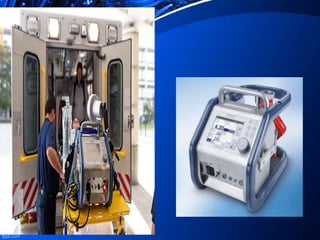
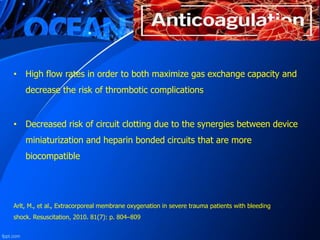
  • #28 In the early post-traumatic period patients frequently need transportation from the intensive care unit to diagnostic (e.g., CT scan, interventional radiology or therapeutic procedures (damage control surgery). In ECMO patients these transportations and procedures are at special risk of ECMO-related or general complications and they require special preparation and realisation. The following safety aspects and recommendations are given • trained accompanying staff (1 physician, 2 nurses), possibly perfusionist; • power of battery packs ≥ 2 hrs; • oxygen supply reserve; • safe mode of controlled mechanical ventilation hand crank for the case of power problems; • vasopressors, rescue drugs; • safe chest tube management; • rescue devices (unintended extubation). In the scenario of the operating theatre, the ECMO cannulae are included in a sterile covering
  • #29 Improvements in biocompatibility, miniaturization, and portability of modern ECMO circuits have increased the safety profile and clinical utility of this extracorporeal support option
  • #30 CENTIFUGAL PUMP, HOLLOW FIBRE OXYGENATOR, SHORTER CIRCUIT The minimal amount of anticoagulation should be used to support the trauma patient on ECMO. the major intracranial event rate on ECMO has historically been 10%–15%, this was markedly lower in the most recent EOLIA trial at 5%.
  • #31 the CESAR study included a small subset of trauma patients [72]. From this point forward, this chapter focuses on the use of ECMO as a supportive therapy in critically ill trauma patients with respiratory failure
  • #32 If ECMO capability is not present in the trauma center, an established transfer agreement with an ECMO center should be available. Withholding ECMO therapy for lack of capability may not be in the patient’s best interest. Venovenous extracorporeal membrane oxygenation will save perhaps a third of patients who – despite maximum ventilator support – go into end-stage respiratory failure after trauma Institutions without the available expertise and ICU capabilities should promptly refer patients with end-stage respiratory failure secondary to trauma to a tertiary care center. Venovenous ECMO [extracorporeal membrane oxygenation] life support may be their only chance for survival and should not be overlooked due to fear of complications