ECG diagnosis
Lead Position A typical ECG report shows the cardiac cycle from 12 different vantage points (I, II, III, aVR, aVL, aVF, V1-V6), like viewing the event electrically from 12 different locations (like a 3D perspective).BUT only 10 electrodes are used. Lead I represents activity that is going from the right arm to the left arm Lead II represents activity that is going from the right arm to the left leg Lead III represents activity that is going from the left arm to the left leg aVL is placed on the left arm (or shoulder) aVF is placed on the left leg (or hip) aVR is placed on the right arm (or shoulder) V1- 4th intercostal space to the right of sternum V2- 4th intercostal space to the left of sternum V3- halfway between V2 and V4 V4- 5th intercostal space in the left mid-clavicular line V5- 5th intercostal space in the left anterior axillary line V6- 5th intercostal space in the left mid axillary line
NSR
Aims 10 ECG rules Heart Rate ECG signs of M.I. Evolution of changes in M.I. Classical Appearences
QRS waveform nomenclature R r qR qRs Qrs QS Qr Rs rS qs rSr’ rSR’
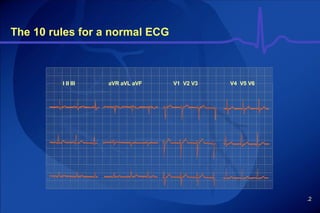
The 10 rules for a normal ECG .2 I II III aVR aVL aVF V1  V2 V3 V4  V5 V6
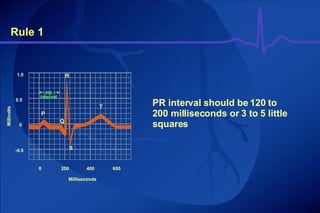
Rule 1 Millivolts Milliseconds 0 200 400 600 -0.5 0 0.5 1.0 P R T Q S PR interval should be 120 to 200 milliseconds or 3 to 5 little squares PR interval
Rule 2 Millivolts Milliseconds 0 200 400 600 -0.5 0 0.5 1.0 QRS The width of the QRS complex should not exceed 110 ms, less than 3 little squares P R T Q S
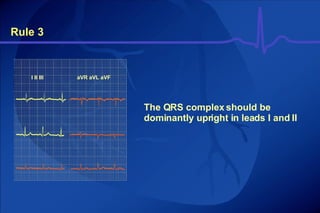
Rule 3 The QRS complex should be dominantly upright in leads I and II I II III aVR aVL aVF
Rule 4 QRS and T waves tend to have the same general direction in the limb leads I II III aVR aVL aVF
Rule 5 All waves are negative in lead aVR P Q T S
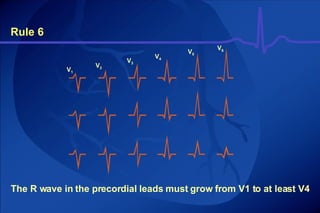
Rule 6 V 1 V 2 V 3 V 4 V 5 V 6 The R wave in the precordial leads must grow from V1 to at least V4
Rule 7 The ST segment should start isoelectric except in V1 and V2 where it may be elevated I II III aVR aVL aVF V1  V2 V3 V4  V5 V6
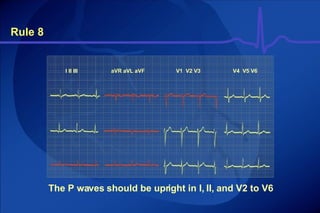
Rule 8 The P waves should be upright in I, II, and V2 to V6 I II III aVR aVL aVF V1  V2 V3 V4  V5 V6
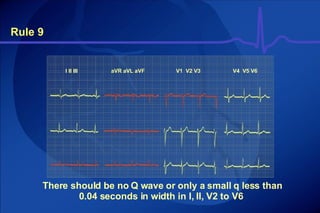
Rule 9 There should be no Q wave or only a small q less than 0.04 seconds in width in I, II, V2 to V6  I II III aVR aVL aVF V1  V2 V3 V4  V5 V6
Rule 10 The T wave must be upright in I, II, V2 to V6 I II III aVR aVL aVF V1  V2 V3 V4  V5 V6
What is the heart rate? (300 / 6) = 50 bpm www.uptodate.com
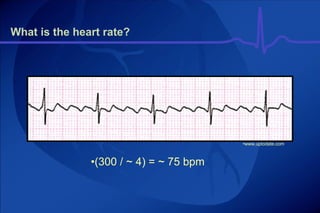
What is the heart rate? (300 / ~ 4) = ~ 75 bpm www.uptodate.com
What is the heart rate? (300 / 1.5) = 200 bpm
10 Second Rule As most EKGs record 10 seconds of rhythm per page, one can simply count the number of beats present on the EKG and multiply by 6 to get the number of beats per 60 seconds. This method works well for irregular rhythms.
What is the heart rate? 33 x 6 = 198 bpm The Alan E. Lindsay ECG Learning Center ;  http://medstat.med.utah.edu/kw/ecg/
Characteristic changes in AMI ST segment elevation over area of damage ST depression in leads opposite infarction Pathological Q waves Reduced R waves Inverted T waves
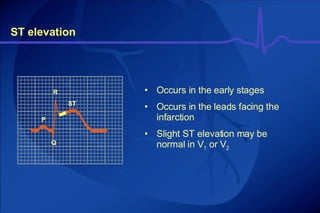
ST elevation Occurs in the early stages Occurs in the leads facing the  infarction Slight ST elevation may be normal in V 1  or V 2 R P Q ST
Deep Q wave Only diagnostic change of myocardial infarction At least 0.04 seconds in duration Depth of more than 25% of ensuing R wave R P Q T ST
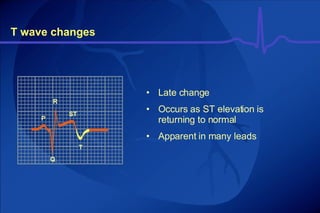
T wave changes Late change Occurs as ST elevation is returning to normal Apparent in many leads R P Q T ST
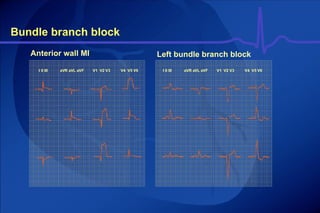
Bundle branch block I II III aVR aVL aVF V1  V2 V3 V4  V5 V6 I II III aVR aVL aVF V1  V2 V3 V4  V5 V6 Anterior wall MI Left bundle branch block
Sequence of changes in evolving AMI 1 minute after onset 1 hour or so after onset A few hours after onset A day or so after onset Later changes A few months after AMI Q R P Q T ST R P Q ST P Q T ST R P S T P Q T ST R P Q T
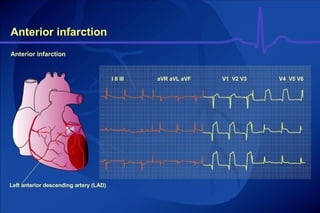
Anterior infarction Anterior infarction Left anterior descending artery (LAD) I II III aVR aVL aVF V1  V2 V3 V4  V5 V6
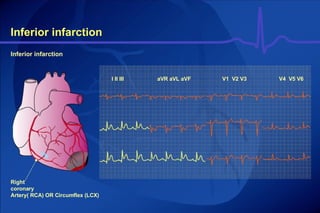
Inferior infarction Inferior infarction Right  coronary  Artery( RCA) OR Circumflex (LCX) I II III aVR aVL aVF V1  V2 V3 V4  V5 V6
Lateral infarction Lateral  infarction Left  circumflex coronary  Artery OR DAIAGONAL branch of LAD I II III aVR aVL aVF V1  V2 V3 V4  V5 V6
Location of infarct combinations aVR V1 V4 I II III LATERAL OR HIGH LATERAL INFERIOR SEPTAL ANT  ANT LAT aVL aVF V2 V3 V5 V6
Diagnostic criteria for AMI Q wave duration of more than 0.04 seconds Q wave depth of more than 25% of ensuing r wave ST elevation in leads facing infarct (or depression in opposite leads) Deep T wave inversion overlying and adjacent to infarct Cardiac arrhythmias
Hay…..   wake up we are done

Ecg Part 1

  • 1.
  • 2.
    Lead Position Atypical ECG report shows the cardiac cycle from 12 different vantage points (I, II, III, aVR, aVL, aVF, V1-V6), like viewing the event electrically from 12 different locations (like a 3D perspective).BUT only 10 electrodes are used. Lead I represents activity that is going from the right arm to the left arm Lead II represents activity that is going from the right arm to the left leg Lead III represents activity that is going from the left arm to the left leg aVL is placed on the left arm (or shoulder) aVF is placed on the left leg (or hip) aVR is placed on the right arm (or shoulder) V1- 4th intercostal space to the right of sternum V2- 4th intercostal space to the left of sternum V3- halfway between V2 and V4 V4- 5th intercostal space in the left mid-clavicular line V5- 5th intercostal space in the left anterior axillary line V6- 5th intercostal space in the left mid axillary line
  • 3.
  • 4.
    Aims 10 ECGrules Heart Rate ECG signs of M.I. Evolution of changes in M.I. Classical Appearences
  • 5.
    QRS waveform nomenclatureR r qR qRs Qrs QS Qr Rs rS qs rSr’ rSR’
  • 6.
    The 10 rulesfor a normal ECG .2 I II III aVR aVL aVF V1 V2 V3 V4 V5 V6
  • 7.
    Rule 1 MillivoltsMilliseconds 0 200 400 600 -0.5 0 0.5 1.0 P R T Q S PR interval should be 120 to 200 milliseconds or 3 to 5 little squares PR interval
  • 8.
    Rule 2 MillivoltsMilliseconds 0 200 400 600 -0.5 0 0.5 1.0 QRS The width of the QRS complex should not exceed 110 ms, less than 3 little squares P R T Q S
  • 9.
    Rule 3 TheQRS complex should be dominantly upright in leads I and II I II III aVR aVL aVF
  • 10.
    Rule 4 QRSand T waves tend to have the same general direction in the limb leads I II III aVR aVL aVF
  • 11.
    Rule 5 Allwaves are negative in lead aVR P Q T S
  • 12.
    Rule 6 V1 V 2 V 3 V 4 V 5 V 6 The R wave in the precordial leads must grow from V1 to at least V4
  • 13.
    Rule 7 TheST segment should start isoelectric except in V1 and V2 where it may be elevated I II III aVR aVL aVF V1 V2 V3 V4 V5 V6
  • 14.
    Rule 8 TheP waves should be upright in I, II, and V2 to V6 I II III aVR aVL aVF V1 V2 V3 V4 V5 V6
  • 15.
    Rule 9 Thereshould be no Q wave or only a small q less than 0.04 seconds in width in I, II, V2 to V6 I II III aVR aVL aVF V1 V2 V3 V4 V5 V6
  • 16.
    Rule 10 TheT wave must be upright in I, II, V2 to V6 I II III aVR aVL aVF V1 V2 V3 V4 V5 V6
  • 17.
    What is theheart rate? (300 / 6) = 50 bpm www.uptodate.com
  • 18.
    What is theheart rate? (300 / ~ 4) = ~ 75 bpm www.uptodate.com
  • 19.
    What is theheart rate? (300 / 1.5) = 200 bpm
  • 20.
    10 Second RuleAs most EKGs record 10 seconds of rhythm per page, one can simply count the number of beats present on the EKG and multiply by 6 to get the number of beats per 60 seconds. This method works well for irregular rhythms.
  • 21.
    What is theheart rate? 33 x 6 = 198 bpm The Alan E. Lindsay ECG Learning Center ; http://medstat.med.utah.edu/kw/ecg/
  • 22.
    Characteristic changes inAMI ST segment elevation over area of damage ST depression in leads opposite infarction Pathological Q waves Reduced R waves Inverted T waves
  • 23.
    ST elevation Occursin the early stages Occurs in the leads facing the infarction Slight ST elevation may be normal in V 1 or V 2 R P Q ST
  • 24.
    Deep Q waveOnly diagnostic change of myocardial infarction At least 0.04 seconds in duration Depth of more than 25% of ensuing R wave R P Q T ST
  • 25.
    T wave changesLate change Occurs as ST elevation is returning to normal Apparent in many leads R P Q T ST
  • 26.
    Bundle branch blockI II III aVR aVL aVF V1 V2 V3 V4 V5 V6 I II III aVR aVL aVF V1 V2 V3 V4 V5 V6 Anterior wall MI Left bundle branch block
  • 27.
    Sequence of changesin evolving AMI 1 minute after onset 1 hour or so after onset A few hours after onset A day or so after onset Later changes A few months after AMI Q R P Q T ST R P Q ST P Q T ST R P S T P Q T ST R P Q T
  • 28.
    Anterior infarction Anteriorinfarction Left anterior descending artery (LAD) I II III aVR aVL aVF V1 V2 V3 V4 V5 V6
  • 29.
    Inferior infarction Inferiorinfarction Right coronary Artery( RCA) OR Circumflex (LCX) I II III aVR aVL aVF V1 V2 V3 V4 V5 V6
  • 30.
    Lateral infarction Lateral infarction Left circumflex coronary Artery OR DAIAGONAL branch of LAD I II III aVR aVL aVF V1 V2 V3 V4 V5 V6
  • 31.
    Location of infarctcombinations aVR V1 V4 I II III LATERAL OR HIGH LATERAL INFERIOR SEPTAL ANT ANT LAT aVL aVF V2 V3 V5 V6
  • 32.
    Diagnostic criteria forAMI Q wave duration of more than 0.04 seconds Q wave depth of more than 25% of ensuing r wave ST elevation in leads facing infarct (or depression in opposite leads) Deep T wave inversion overlying and adjacent to infarct Cardiac arrhythmias
  • 33.
    Hay….. wake up we are done