Adapted Lesson Study in the 
First Weeks of Initial Teacher 
Education 
Maarten Tas (mt317@le.ac.uk) 
School of Education 
www.le.ac.uk ECER 2014
Overview 
• Background: critical partnerships 
• Lesson Study 
• Preparation for adapted lesson study for pre-service 
teachers 
• Adapted lesson study for pre-service teachers 
• Methodology and methods 
• Results 
• Improvements suggested 
• Conclusions & suggested changes 
• Cycle 2 – some notes ECER 2014
Critical partnerships 
• Self/peer support 
• Self/peer assessment 
• Effective collaboration 
• Collaborative presentations 
• Collaborative microteaching 
• Issue: all in University Sessions 
ECER 2014
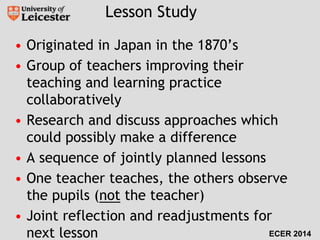
Lesson Study 
• Originated in Japan in the 1870’s 
• Group of teachers improving their 
teaching and learning practice 
collaboratively 
• Research and discuss approaches which 
could possibly make a difference 
• A sequence of jointly planned lessons 
• One teacher teaches, the others observe 
the pupils (not the teacher) 
• Joint reflection and readjustments for 
next lesson ECER 2014
Preparation for adapted lesson 
study for pre-service teachers 
• Day 1: homework for next day – explanation 
• Day 2: explanation – self and peer 
assessment (+ input from tutor) 
• Day 3: preparation for practical 
demonstration (groups of 2) 
• Day 4: practical demonstration – self and 
peer assessment (+ input from tutor) 
• Day 4: formation of critical partnerships (4 
per group) 
ECER 2014
Adapted lesson study for PGCE 
students 1 
• Day 4: 2 Critical partnership groups plan 
lesson with teacher from a local school 
• Day 5: The lesson 
– Starter: 2 teaching – 2 function as teaching 
assistant (TA) - 2 observing particular pupils as 
suggested by the teacher – 2 observing the 
teachers and TAs 
- Main activity 1: same as above but rotation – 
teachers become TAs, etc. 
- Main activity 2 
- Plenary ECER 2014
Adapted lesson study for PGCE 
students 2 
• Day 4 Week 2 
– Group reflection of the lesson from Week 1 
– Teacher gives the groups of 8 students all the 
resources for the lesson, including intended 
learning outcomes. They then need to 
prepare the lesson 
• Day 5 Week 2 
– Teach and observe the lesson as Week 1 
ECER 2014
Adapted lesson study for PGCE 
students 3 
• Day 4 Week 3 
– Group reflection of the lesson from Week 2 
– Teacher gives the groups of 8 students the 
intended learning outcomes and some ideas 
for practicals 
• Day 5 Week 3 
– Teach and observe the lesson as Week 1 and 
Week 2 
ECER 2014
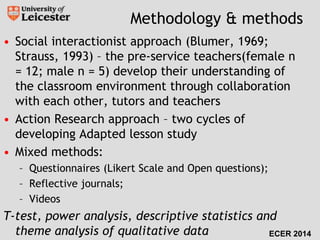
Methodology & methods 
• Social interactionist approach (Blumer, 1969; 
Strauss, 1993) – the pre-service teachers(female n 
= 12; male n = 5) develop their understanding of 
the classroom environment through collaboration 
with each other, tutors and teachers 
• Action Research approach – two cycles of 
developing Adapted lesson study 
• Mixed methods: 
– Questionnaires (Likert Scale and Open questions); 
– Reflective journals; 
– Videos 
T-test, power analysis, descriptive statistics and 
theme analysis of qualitative data ECER 2014
Questionnaires - stats 
T Test 
Test Value = 0 
t df 
Sig. (2- 
tailed) 
Mean 
Difference 
95% Confidence Interval 
of the Difference 
Lower Upper 
Average 1 25.621 16 0.000 3.0703576 2.816315 3.324400 
Average 2 39.887 16 0.000 3.5778547 3.387702 3.768008 
Power analysis 
Cohen's d 1.16288 
Effect size 0.50264 
< 0.1 = trivial effect 
0.1 - 0.3 = small effect 
0.3 - 0.5 = moderate effect 
> 0.5 = large difference effect 
Reliability Statistics 
Cronbach's Alpha N of Items 
0.923 17 
ECER 2014
Results 1 Lesson Planning 
Mean level of confidence (maximum = 5) 
4.00 
3.50 
3.00 
2.50 
2.00 
1.50 
1.00 
0.50 
0.00 
Use a pro-forma 
for 
lesson 
planning 
Plan for a 
starter 
Plan for a 
pupil 
learning 
activity 
Plan for a 
plenary 
Plan for 
good 
behaviour 
Before 
After 
‘Makes you aware of what you need to work on before you go into the classroom’ 
‘I found it helped me a lot with lesson planning and I went into school knowing 
some key areas I need to focus on’ 
ECER 2014
Results 2 Teaching 
Mean level of confidence (maximum = 5) 
4.00 
3.50 
3.00 
2.50 
2.00 
1.50 
1.00 
0.50 
0.00 
Before 
After 
‘Quite a few of us had not had the chance to actively plan and teach a lesson, and 
lead a class in a school environment before the course, even though we had 
observed in classroom environments. The Adapted Lesson Study allowed us to 
gain this valuable experience before our placements began, in a relatively low-risk, 
collaborative environment, well-supported by an experienced and helpful 
teacher’. 
ECER 2014
Results 3 Pupil focus 
Mean level of confidence (maximum = 5) 
4.30 
4.20 
4.10 
4.00 
3.90 
3.80 
3.70 
3.60 
3.50 
Helping pupils as 
TA 
Observing pupils 
with focus 
Before 
After 
‘Showed how pupils react to having a new teacher’ 
‘On reflection I think I should have gotten involved earlier on to 
help the practical along’ 
ATSE 2014
Results 4 Observation, 
Reflection and Collaboration 
Mean level of confidence (maximum = 5) 
4.50 
4.00 
3.50 
3.00 
2.50 
2.00 
1.50 
1.00 
0.50 
0.00 
Observing 
teachers with 
focus 
Reflection on 
teaching 
Working with 
another 
teacher 
Before 
After 
‘Able to see others teaching, and through this improve my practice’ 
‘You get to identify areas of the teaching standards which need improving, and 
work towards these in the next lesson’ 
‘It is helpful to get feedback, to have an idea of strengths and weaknesses 
before I began teaching’ 
‘Collaborative teaching with peers which led to the development of a 
supportive network’ 
ECER 2014
Improvements suggested by 
pre-service teachers 
• Extra time to prepare for the lesson 
• Less teachers in the classroom 
• A little more of it – three sessions was 
great, four would have been wonderful! 
• I didn’t fully understand what we were 
supposed to be doing as teaching 
assistants 
• I didn’t really understand the significance 
or relevance of having to observe pupils 
ECER 2014
Conclusions 
• Adapted lesson study help pre-service 
teachers to get a better idea about: 
– Planning; 
– Teaching; 
– Observation; 
– Working with peers and other teachers; 
– Reflection 
• Some don’t get the relevance of 
observing pupils and the role of a 
teaching assistant 
ECER 2014
Suggested changes 
• Groups of 3-4 rather than 6-8 in one class 
• Less roles within one lesson: 
– Focus on observing pupils 
– Focus on role of teaching assistant 
– Teaching with peer 
• More focus on the learning of pupils 
• Teacher will predict the learning of key 
pupils 
• Focus interview with key pupils after 
lesson 
ECER 2014
The increase of confidence after the Lesson Study cycles 
3.7 
3.6 
3.5 
3.4 
3.3 
3.2 
3.1 
3 
2.9 
2.8 
2.7 
Cycle 1 Cycle 2 
Confidence (1-5) 
Before After 
The confidence of the group of the second cycle higher, even before intervention. 
Experience of the tutors from the first cycle? 
ECER 2014
Some ideas and conclusions 
• Effect size high, but likely to be not just due to 
the intervention 
• Although the confidence seems rather high at 
this stage in ITE they have still limited 
understanding of what is needed in the 
classroom 
• Good experience to refer to in later reflections 
• Lesson Study for assignments 
• Third cycle more support from classroom 
teacher and deeper reflection at UoL sessions 
• Teachers involved seem to benefit a lot from 
this collaboration 
ECER 2014
Literature 
• Blumer, H. (1969). Symbolic Interactionism; Perspective and Method. 
Englewood Cliffs, NJ: Prentice-Hall. 
• Chokski, S. & Fernandez, C. (2004). Challenges to importing Japanese lesson 
study: Concerns, misconceptions and nuances. Phi Delta Kappan, 85(6), 520- 
525. 
• Lewis, C. (2002). Lesson study: A handbook of teacher-led instructional 
change. Philadelphia: Research for Better Schools Inc. 
• Lewis, C., & Tsuchida, I. (1997). Planned educational change in Japan: The 
case of elementary science instruction. Journal of Educational Policy, 12(5), 
313-331. 
• Strauss A.L. (1993). Continual permutations of actions. Hawthorne, New York: 
Aldine de Gruyter. 
• Tas, M. & Forsythe, S. (2014). Critical Partnerships: Collaborative Reflection 
and Commitment to Group Development in Teacher Training. Manuscript in 
Preparation. 
• Wiggins, G.& McTighe, J.(1998). Understanding by Design. Alexandria: ASCD 
ECER 2014

Ecer2014 tas-adapted lessonstudy

  • 1.
    Adapted Lesson Studyin the First Weeks of Initial Teacher Education Maarten Tas (mt317@le.ac.uk) School of Education www.le.ac.uk ECER 2014
  • 2.
    Overview • Background:critical partnerships • Lesson Study • Preparation for adapted lesson study for pre-service teachers • Adapted lesson study for pre-service teachers • Methodology and methods • Results • Improvements suggested • Conclusions & suggested changes • Cycle 2 – some notes ECER 2014
  • 3.
    Critical partnerships •Self/peer support • Self/peer assessment • Effective collaboration • Collaborative presentations • Collaborative microteaching • Issue: all in University Sessions ECER 2014
  • 4.
    Lesson Study •Originated in Japan in the 1870’s • Group of teachers improving their teaching and learning practice collaboratively • Research and discuss approaches which could possibly make a difference • A sequence of jointly planned lessons • One teacher teaches, the others observe the pupils (not the teacher) • Joint reflection and readjustments for next lesson ECER 2014
  • 5.
    Preparation for adaptedlesson study for pre-service teachers • Day 1: homework for next day – explanation • Day 2: explanation – self and peer assessment (+ input from tutor) • Day 3: preparation for practical demonstration (groups of 2) • Day 4: practical demonstration – self and peer assessment (+ input from tutor) • Day 4: formation of critical partnerships (4 per group) ECER 2014
  • 6.
    Adapted lesson studyfor PGCE students 1 • Day 4: 2 Critical partnership groups plan lesson with teacher from a local school • Day 5: The lesson – Starter: 2 teaching – 2 function as teaching assistant (TA) - 2 observing particular pupils as suggested by the teacher – 2 observing the teachers and TAs - Main activity 1: same as above but rotation – teachers become TAs, etc. - Main activity 2 - Plenary ECER 2014
  • 7.
    Adapted lesson studyfor PGCE students 2 • Day 4 Week 2 – Group reflection of the lesson from Week 1 – Teacher gives the groups of 8 students all the resources for the lesson, including intended learning outcomes. They then need to prepare the lesson • Day 5 Week 2 – Teach and observe the lesson as Week 1 ECER 2014
  • 8.
    Adapted lesson studyfor PGCE students 3 • Day 4 Week 3 – Group reflection of the lesson from Week 2 – Teacher gives the groups of 8 students the intended learning outcomes and some ideas for practicals • Day 5 Week 3 – Teach and observe the lesson as Week 1 and Week 2 ECER 2014
  • 9.
    Methodology & methods • Social interactionist approach (Blumer, 1969; Strauss, 1993) – the pre-service teachers(female n = 12; male n = 5) develop their understanding of the classroom environment through collaboration with each other, tutors and teachers • Action Research approach – two cycles of developing Adapted lesson study • Mixed methods: – Questionnaires (Likert Scale and Open questions); – Reflective journals; – Videos T-test, power analysis, descriptive statistics and theme analysis of qualitative data ECER 2014
  • 10.
    Questionnaires - stats T Test Test Value = 0 t df Sig. (2- tailed) Mean Difference 95% Confidence Interval of the Difference Lower Upper Average 1 25.621 16 0.000 3.0703576 2.816315 3.324400 Average 2 39.887 16 0.000 3.5778547 3.387702 3.768008 Power analysis Cohen's d 1.16288 Effect size 0.50264 < 0.1 = trivial effect 0.1 - 0.3 = small effect 0.3 - 0.5 = moderate effect > 0.5 = large difference effect Reliability Statistics Cronbach's Alpha N of Items 0.923 17 ECER 2014
  • 11.
    Results 1 LessonPlanning Mean level of confidence (maximum = 5) 4.00 3.50 3.00 2.50 2.00 1.50 1.00 0.50 0.00 Use a pro-forma for lesson planning Plan for a starter Plan for a pupil learning activity Plan for a plenary Plan for good behaviour Before After ‘Makes you aware of what you need to work on before you go into the classroom’ ‘I found it helped me a lot with lesson planning and I went into school knowing some key areas I need to focus on’ ECER 2014
  • 12.
    Results 2 Teaching Mean level of confidence (maximum = 5) 4.00 3.50 3.00 2.50 2.00 1.50 1.00 0.50 0.00 Before After ‘Quite a few of us had not had the chance to actively plan and teach a lesson, and lead a class in a school environment before the course, even though we had observed in classroom environments. The Adapted Lesson Study allowed us to gain this valuable experience before our placements began, in a relatively low-risk, collaborative environment, well-supported by an experienced and helpful teacher’. ECER 2014
  • 13.
    Results 3 Pupilfocus Mean level of confidence (maximum = 5) 4.30 4.20 4.10 4.00 3.90 3.80 3.70 3.60 3.50 Helping pupils as TA Observing pupils with focus Before After ‘Showed how pupils react to having a new teacher’ ‘On reflection I think I should have gotten involved earlier on to help the practical along’ ATSE 2014
  • 14.
    Results 4 Observation, Reflection and Collaboration Mean level of confidence (maximum = 5) 4.50 4.00 3.50 3.00 2.50 2.00 1.50 1.00 0.50 0.00 Observing teachers with focus Reflection on teaching Working with another teacher Before After ‘Able to see others teaching, and through this improve my practice’ ‘You get to identify areas of the teaching standards which need improving, and work towards these in the next lesson’ ‘It is helpful to get feedback, to have an idea of strengths and weaknesses before I began teaching’ ‘Collaborative teaching with peers which led to the development of a supportive network’ ECER 2014
  • 15.
    Improvements suggested by pre-service teachers • Extra time to prepare for the lesson • Less teachers in the classroom • A little more of it – three sessions was great, four would have been wonderful! • I didn’t fully understand what we were supposed to be doing as teaching assistants • I didn’t really understand the significance or relevance of having to observe pupils ECER 2014
  • 16.
    Conclusions • Adaptedlesson study help pre-service teachers to get a better idea about: – Planning; – Teaching; – Observation; – Working with peers and other teachers; – Reflection • Some don’t get the relevance of observing pupils and the role of a teaching assistant ECER 2014
  • 17.
    Suggested changes •Groups of 3-4 rather than 6-8 in one class • Less roles within one lesson: – Focus on observing pupils – Focus on role of teaching assistant – Teaching with peer • More focus on the learning of pupils • Teacher will predict the learning of key pupils • Focus interview with key pupils after lesson ECER 2014
  • 18.
    The increase ofconfidence after the Lesson Study cycles 3.7 3.6 3.5 3.4 3.3 3.2 3.1 3 2.9 2.8 2.7 Cycle 1 Cycle 2 Confidence (1-5) Before After The confidence of the group of the second cycle higher, even before intervention. Experience of the tutors from the first cycle? ECER 2014
  • 19.
    Some ideas andconclusions • Effect size high, but likely to be not just due to the intervention • Although the confidence seems rather high at this stage in ITE they have still limited understanding of what is needed in the classroom • Good experience to refer to in later reflections • Lesson Study for assignments • Third cycle more support from classroom teacher and deeper reflection at UoL sessions • Teachers involved seem to benefit a lot from this collaboration ECER 2014
  • 20.
    Literature • Blumer,H. (1969). Symbolic Interactionism; Perspective and Method. Englewood Cliffs, NJ: Prentice-Hall. • Chokski, S. & Fernandez, C. (2004). Challenges to importing Japanese lesson study: Concerns, misconceptions and nuances. Phi Delta Kappan, 85(6), 520- 525. • Lewis, C. (2002). Lesson study: A handbook of teacher-led instructional change. Philadelphia: Research for Better Schools Inc. • Lewis, C., & Tsuchida, I. (1997). Planned educational change in Japan: The case of elementary science instruction. Journal of Educational Policy, 12(5), 313-331. • Strauss A.L. (1993). Continual permutations of actions. Hawthorne, New York: Aldine de Gruyter. • Tas, M. & Forsythe, S. (2014). Critical Partnerships: Collaborative Reflection and Commitment to Group Development in Teacher Training. Manuscript in Preparation. • Wiggins, G.& McTighe, J.(1998). Understanding by Design. Alexandria: ASCD ECER 2014