
Strategies for Effective Lesson Planning
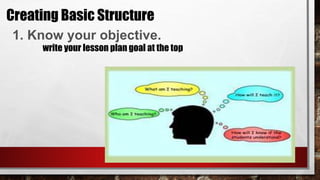
1. Know your objective.
write your lesson plan goal at the top
Creating Basic Structure
2. Outline the Learning Objectives
•What are the most important concepts, ideas, or skills I
want students to be able to grasp and apply?
•Why are they important?
•If I ran out of time, which ones could not be omitted?
•And conversely, which ones could I skip if pressed for
time?
3. Create a materials list
4. Plan your timeline
break your plan into sections that you can speed up or
slow down to accommodate changes as they happen.
We'll use a 1-hour class as an example.
•1:00-1:10: Warm up. Bring class into focus and recap yesterday's discussion on
great tragedies; relate it to Hamlet.
•1:10-1:25: Present information. Discuss Shakespearean history briefly, focusing
on his creative period 2 years before and after Hamlet.
•1:25-1:40: Guided practice. Class discussion regarding major themes in the
play.
•1:40-1:55: Freer practice. Class writes single paragraph describing current
event in Shakespearean terms. Individually encourage bright students to write 2
paragraphs, and coach slower students.
•1:55-2:00: Conclusion. Collect papers, assign homework, dismiss class.
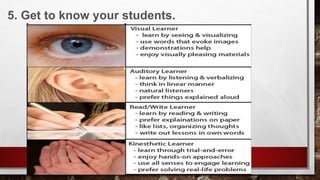
5. Get to know your students.
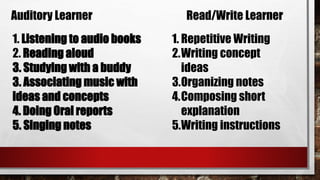
Auditory Learner
1. Listening to audio books
2. Reading aloud
3. Studying with a buddy
3. Associating music with
ideas and concepts
4. Doing Oral reports
5. Singing notes
Read/Write Learner
1. Repetitive Writing
2.Writing concept
ideas
3.Organizing notes
4.Composing short
explanation
5.Writing instructions
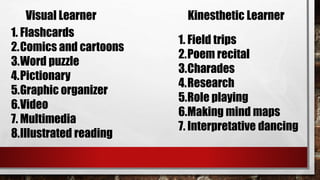
Visual Learner
1. Flashcards
2.Comics and cartoons
3.Word puzzle
4.Pictionary
5.Graphic organizer
6.Video
7. Multimedia
8.Illustrated reading
1. Field trips
2.Poem recital
3.Charades
4.Research
5.Role playing
6.Making mind maps
7. Interpretative dancing
Kinesthetic Learner
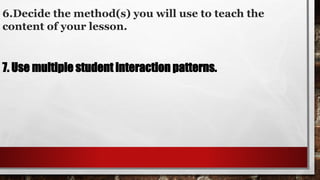
6.Decide the method(s) you will use to teach the
content of your lesson.
7. Use multiple student interaction patterns.
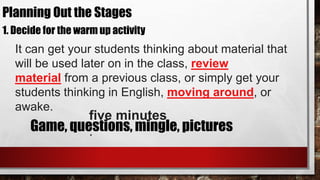
1. Decide for the warm up activity
It can get your students thinking about material that
will be used later on in the class, review
material from a previous class, or simply get your
students thinking in English, moving around, or
awake.
five minutes
.Game, questions, mingle, pictures
Planning Out the Stages
2, Present the lesson
Develop a creative Presentation to the topic to
stimulate interest and encourage thinking. You can
use a variety of approaches to engage students (e.g.,
personal anecdote, historical event, thought-
provoking dilemma, real-world example, short video
clip, practical application, probing question, etc.).
3. Discussion
•What will I do to explain the topic?
•What will I do to illustrate the topic in a different way?
•How can I engage students in the topic?
•What are some relevant real-life examples, analogies, or
situations that can help students understand the topic?
•What will students need to do to help them understand
the topic better?
4. Do a guided practice
5. Check their work and assess their progress
6. Do a freer practice
7. Leave time for questions.
8. Conclude the lesson
Being Prepared
1.If you're nervous, script it out.
2.Over-plan the class.
3.Make it so a substitute could under
4.Form a back-up plan.
References
Fink, D. L. (2005). Integrated course design. Manhattan,
KS: The IDEA Center.
Retrieved from http://ideaedu.org/wp-
content/uploads/2014/11/Idea_Paper_42.pdf

Lesson planning

  • 2.
    Strategies for EffectiveLesson Planning
  • 3.
    1. Know yourobjective. write your lesson plan goal at the top Creating Basic Structure
  • 5.
    2. Outline theLearning Objectives •What are the most important concepts, ideas, or skills I want students to be able to grasp and apply? •Why are they important? •If I ran out of time, which ones could not be omitted? •And conversely, which ones could I skip if pressed for time?
  • 6.
    3. Create amaterials list
  • 7.
    4. Plan yourtimeline break your plan into sections that you can speed up or slow down to accommodate changes as they happen. We'll use a 1-hour class as an example. •1:00-1:10: Warm up. Bring class into focus and recap yesterday's discussion on great tragedies; relate it to Hamlet. •1:10-1:25: Present information. Discuss Shakespearean history briefly, focusing on his creative period 2 years before and after Hamlet. •1:25-1:40: Guided practice. Class discussion regarding major themes in the play. •1:40-1:55: Freer practice. Class writes single paragraph describing current event in Shakespearean terms. Individually encourage bright students to write 2 paragraphs, and coach slower students. •1:55-2:00: Conclusion. Collect papers, assign homework, dismiss class.
  • 8.
    5. Get toknow your students.
  • 9.
    Auditory Learner 1. Listeningto audio books 2. Reading aloud 3. Studying with a buddy 3. Associating music with ideas and concepts 4. Doing Oral reports 5. Singing notes Read/Write Learner 1. Repetitive Writing 2.Writing concept ideas 3.Organizing notes 4.Composing short explanation 5.Writing instructions
  • 10.
    Visual Learner 1. Flashcards 2.Comicsand cartoons 3.Word puzzle 4.Pictionary 5.Graphic organizer 6.Video 7. Multimedia 8.Illustrated reading 1. Field trips 2.Poem recital 3.Charades 4.Research 5.Role playing 6.Making mind maps 7. Interpretative dancing Kinesthetic Learner
  • 11.
    6.Decide the method(s)you will use to teach the content of your lesson. 7. Use multiple student interaction patterns.
  • 12.
    1. Decide forthe warm up activity It can get your students thinking about material that will be used later on in the class, review material from a previous class, or simply get your students thinking in English, moving around, or awake. five minutes .Game, questions, mingle, pictures Planning Out the Stages
  • 13.
    2, Present thelesson Develop a creative Presentation to the topic to stimulate interest and encourage thinking. You can use a variety of approaches to engage students (e.g., personal anecdote, historical event, thought- provoking dilemma, real-world example, short video clip, practical application, probing question, etc.).
  • 14.
    3. Discussion •What willI do to explain the topic? •What will I do to illustrate the topic in a different way? •How can I engage students in the topic? •What are some relevant real-life examples, analogies, or situations that can help students understand the topic? •What will students need to do to help them understand the topic better?
  • 15.
    4. Do aguided practice 5. Check their work and assess their progress 6. Do a freer practice 7. Leave time for questions. 8. Conclude the lesson
  • 16.
    Being Prepared 1.If you'renervous, script it out. 2.Over-plan the class. 3.Make it so a substitute could under 4.Form a back-up plan.
  • 17.
    References Fink, D. L.(2005). Integrated course design. Manhattan, KS: The IDEA Center. Retrieved from http://ideaedu.org/wp- content/uploads/2014/11/Idea_Paper_42.pdf