DG7: IMPROVING TEACHER PROFESSIONAL
            DEVELOPMENT
        THROUGH LESSON STUDY

                        Co-Chairs:
   Toshiakira Fujii, Tokyo Gakugei University, Japan
     Akihiko Takahashi, DePaul University, U.S.A.
                      Team Members:
      Susie Groves, Deakin University, Australia
     Yo-An Lee, Sogang University, South Korea
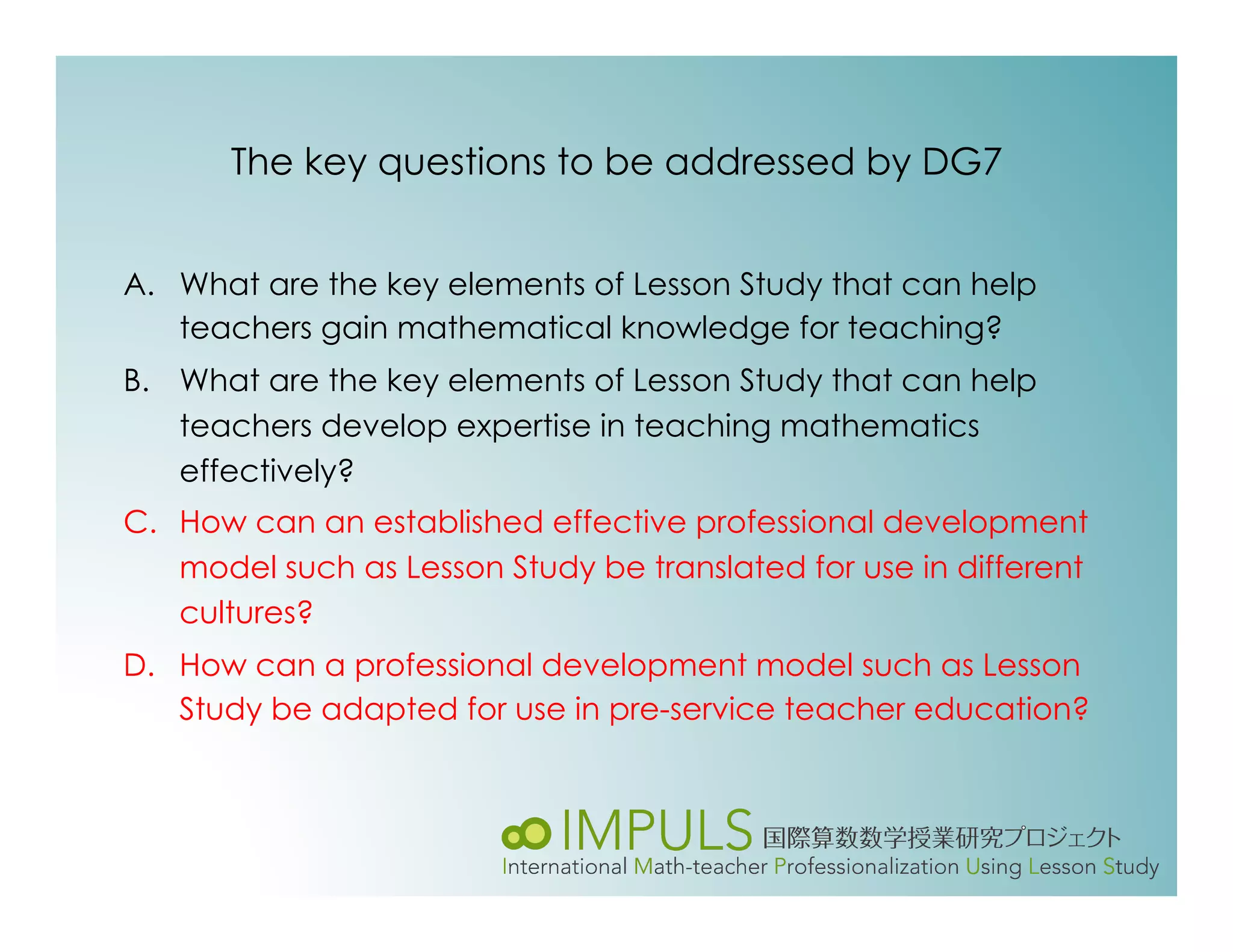
The key questions to be addressed by DG7


A.  What are the key elements of Lesson Study that can help
    teachers gain mathematical knowledge for teaching?
B.  What are the key elements of Lesson Study that can help
    teachers develop expertise in teaching mathematics
    effectively?
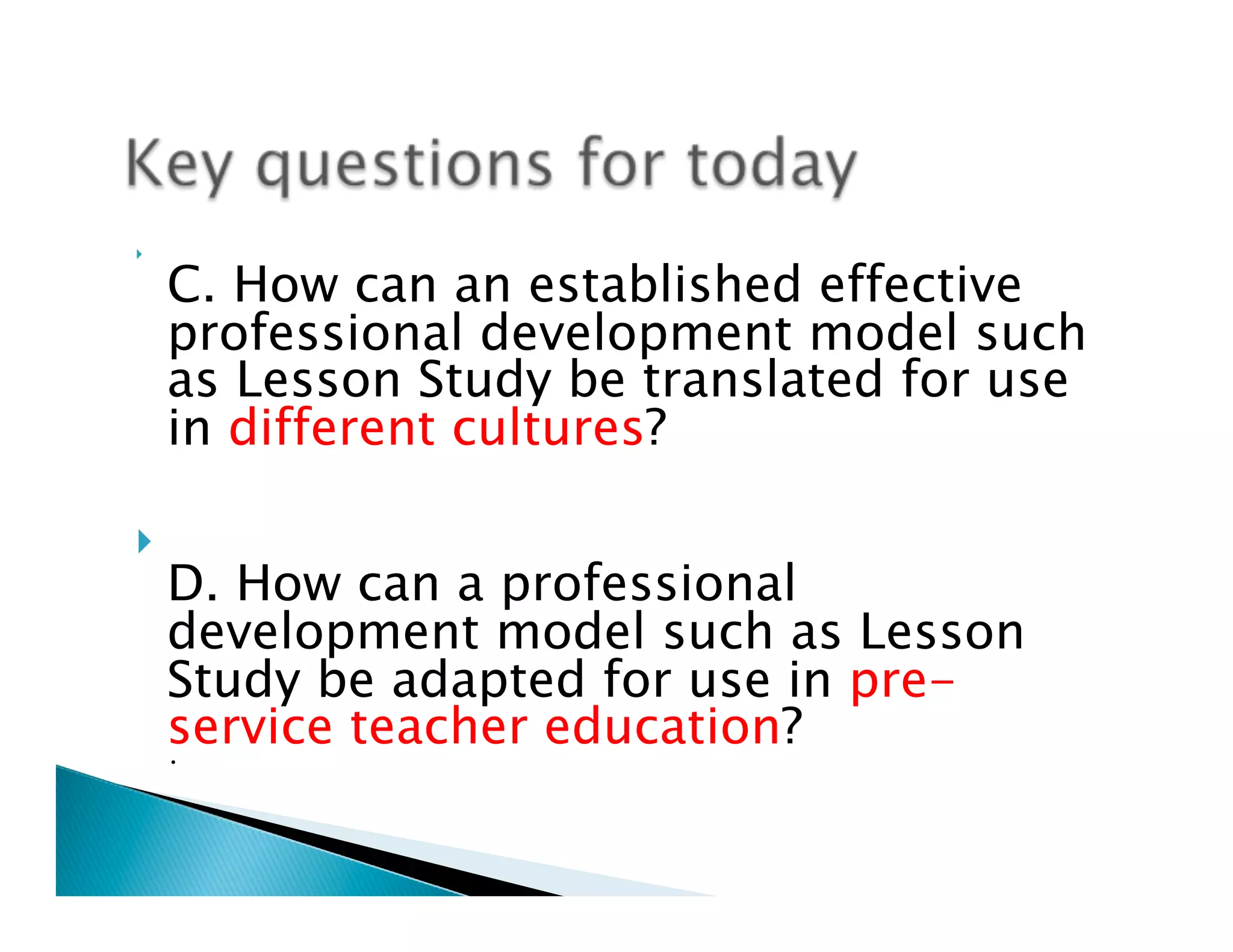
C.  How can an established effective professional development
    model such as Lesson Study be translated for use in different
    cultures?
D.  How can a professional development model such as Lesson
    Study be adapted for use in pre-service teacher education?
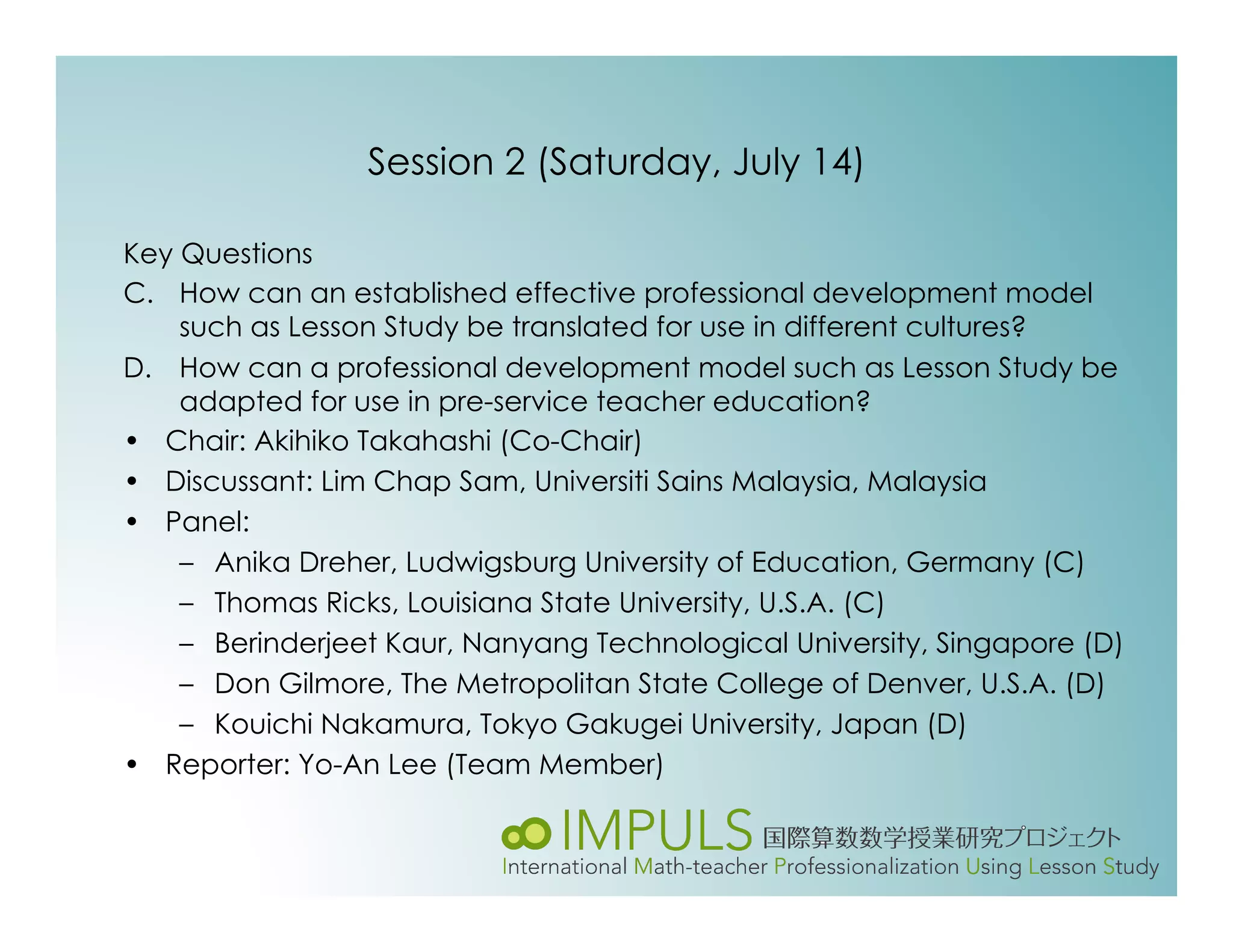
Session 2 (Saturday, July 14)

Key Questions
C.  How can an established effective professional development model
    such as Lesson Study be translated for use in different cultures?
D.  How can a professional development model such as Lesson Study be
    adapted for use in pre-service teacher education?
•  Chair: Akihiko Takahashi (Co-Chair)
•  Discussant: Lim Chap Sam, Universiti Sains Malaysia, Malaysia
•  Panel:
    –  Anika Dreher, Ludwigsburg University of Education, Germany (C)
    –  Thomas Ricks, Louisiana State University, U.S.A. (C)
    –  Berinderjeet Kaur, Nanyang Technological University, Singapore (D)
    –  Don Gilmore, The Metropolitan State College of Denver, U.S.A. (D)
    –  Kouichi Nakamura, Tokyo Gakugei University, Japan (D)
•  Reporter: Yo-An Lee (Team Member)
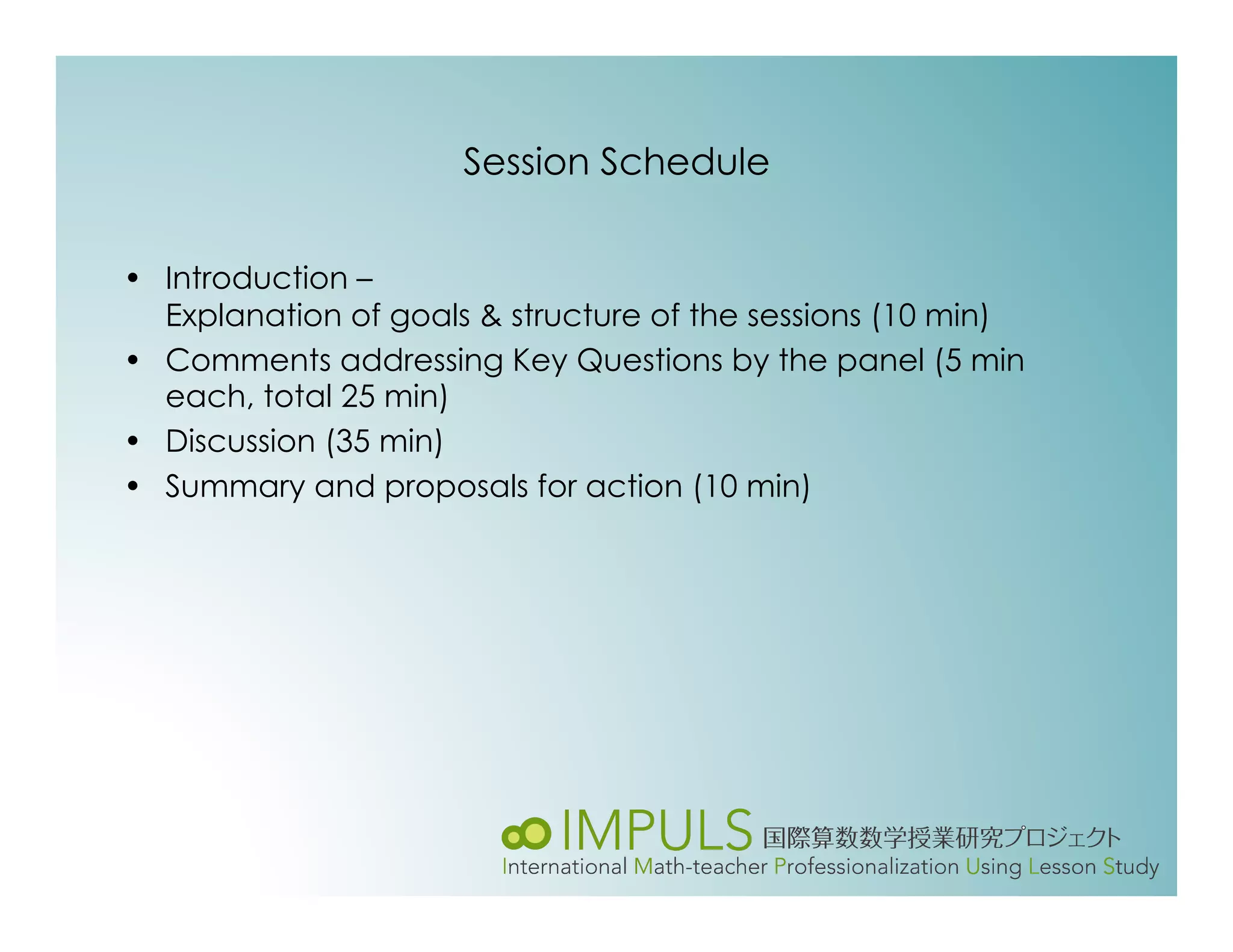
Session Schedule


•  Introduction –
   Explanation of goals & structure of the sessions (10 min)
•  Comments addressing Key Questions by the panel (5 min
   each, total 25 min)
•  Discussion (35 min)
•  Summary and proposals for action (10 min)
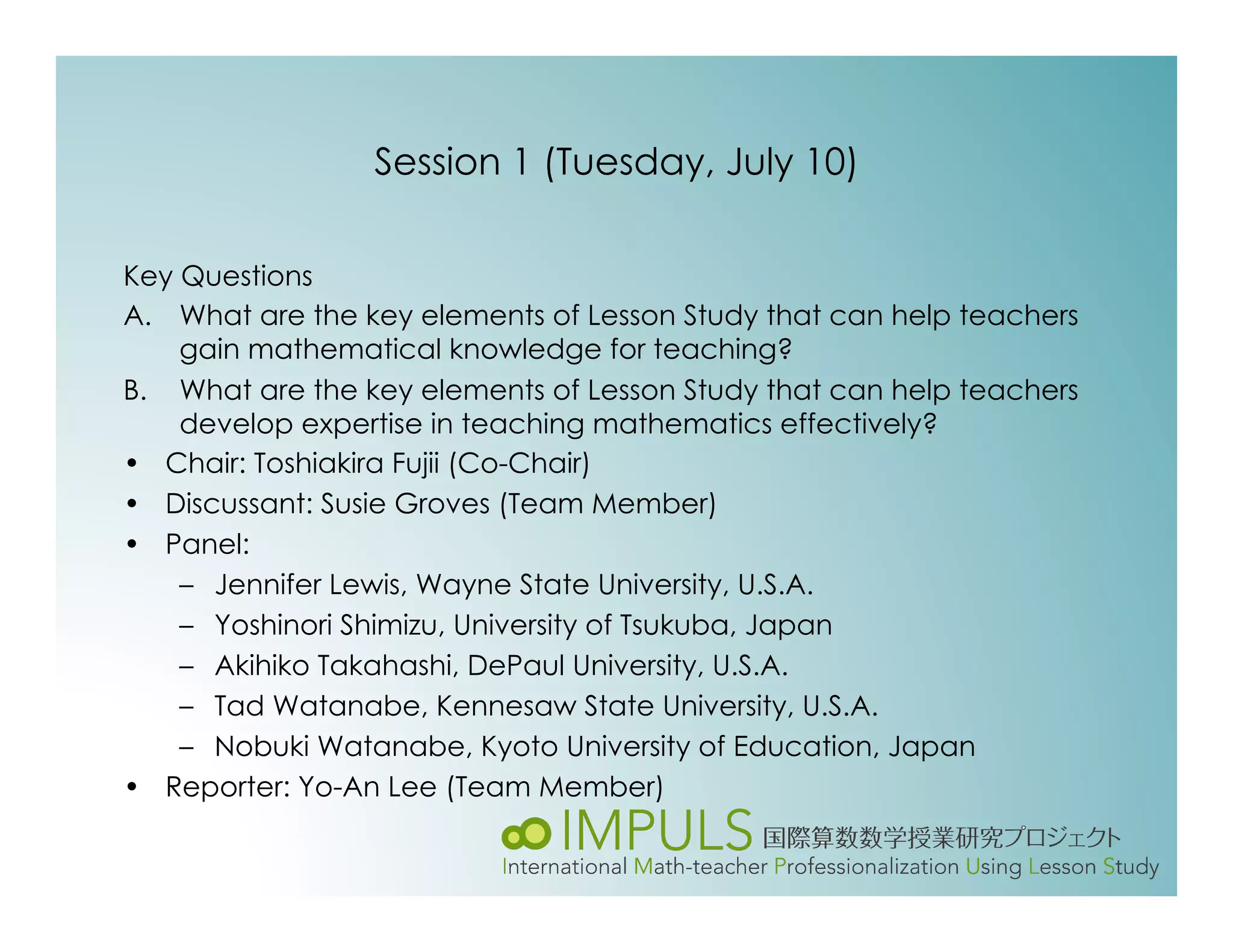
Session 1 (Tuesday, July 10)

Key Questions
A.  What are the key elements of Lesson Study that can help teachers
    gain mathematical knowledge for teaching?
B.  What are the key elements of Lesson Study that can help teachers
    develop expertise in teaching mathematics effectively?
•  Chair: Toshiakira Fujii (Co-Chair)
•  Discussant: Susie Groves (Team Member)
•  Panel:
    –  Jennifer Lewis, Wayne State University, U.S.A.
    –  Yoshinori Shimizu, University of Tsukuba, Japan
    –  Akihiko Takahashi, DePaul University, U.S.A.
    –  Tad Watanabe, Kennesaw State University, U.S.A.
    –  Nobuki Watanabe, Kyoto University of Education, Japan
•  Reporter: Yo-An Lee (Team Member)
COMMENTS ON KEY QUESTION C:

HOW CAN AN ESTABLISHED EFFECTIVE
PROFESSIONAL DEVELOPMENT MODEL SUCH
AS LESSON STUDY BE TRANSLATED
FOR USE IN DIFFERENT CULTURES?
Anika Dreher, Sebastian Kuntze
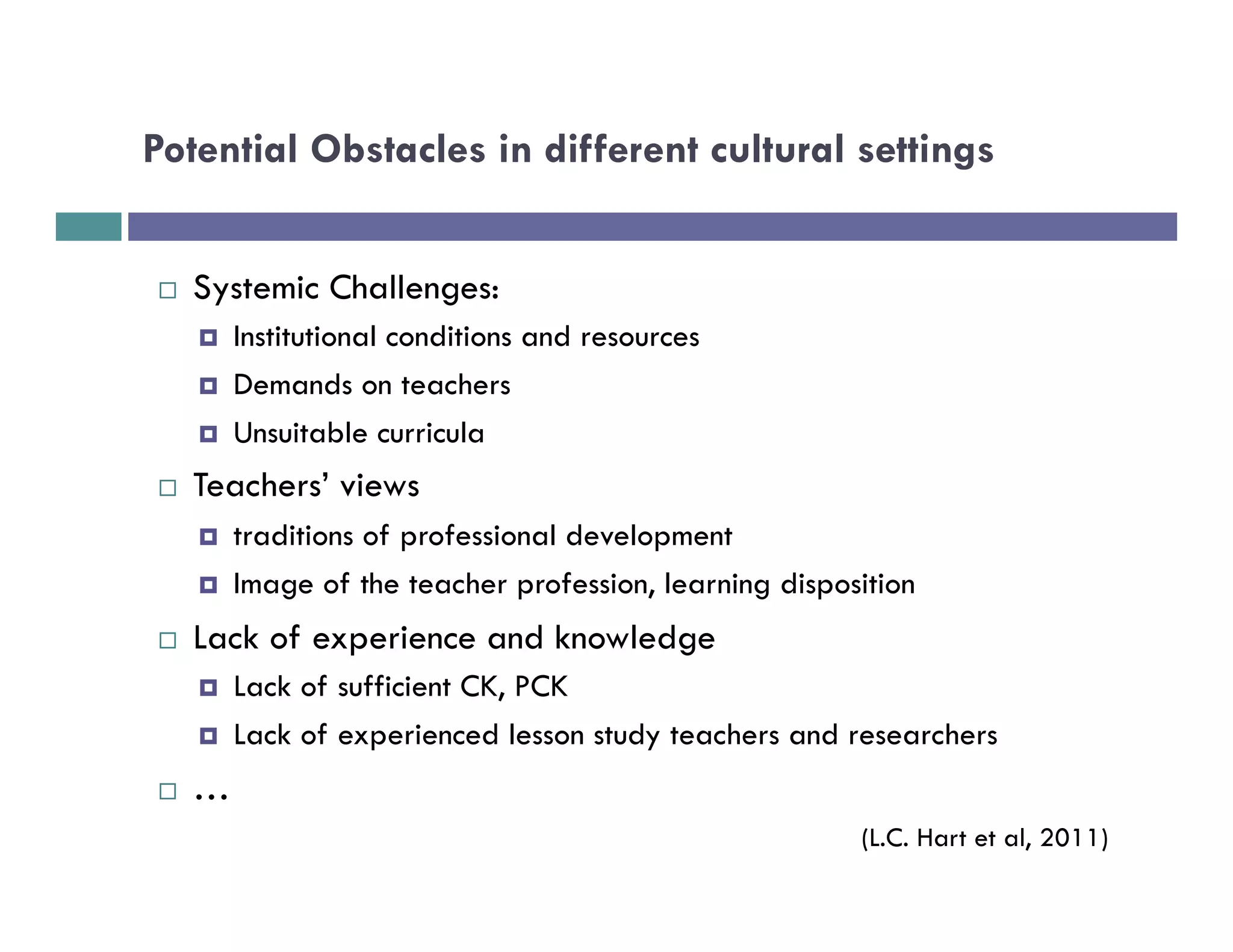
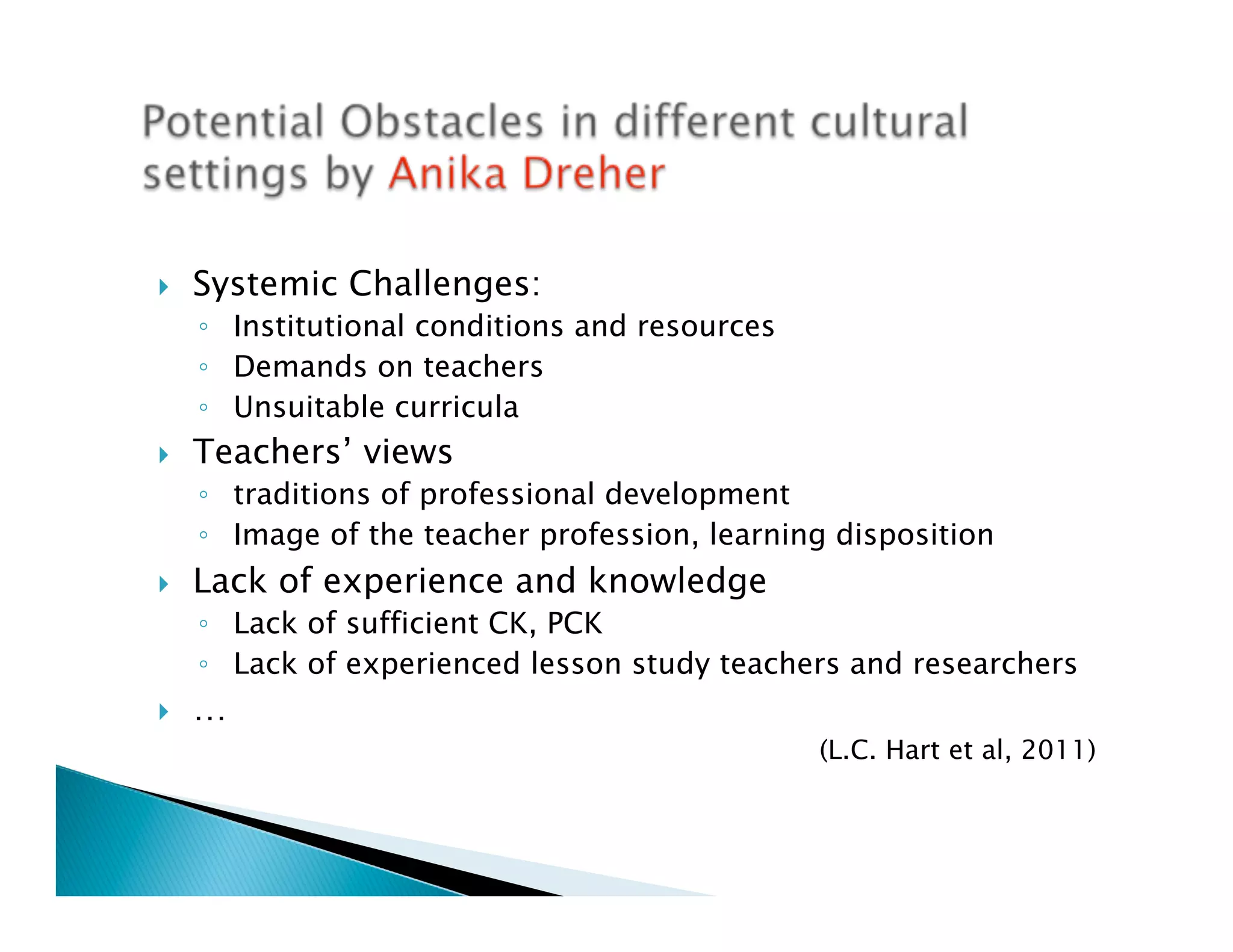
Potential Obstacles in different cultural settings


¨    Systemic Challenges:
      ¤    Institutional conditions and resources
      ¤    Demands on teachers
      ¤    Unsuitable curricula
¨    Teachers’ views
      ¤    traditions of professional development
      ¤    Image of the teacher profession, learning disposition
¨    Lack of experience and knowledge
      ¤    Lack of sufficient CK, PCK
      ¤    Lack of experienced lesson study teachers and researchers
¨    …
                                                            (L.C. Hart et al, 2011)
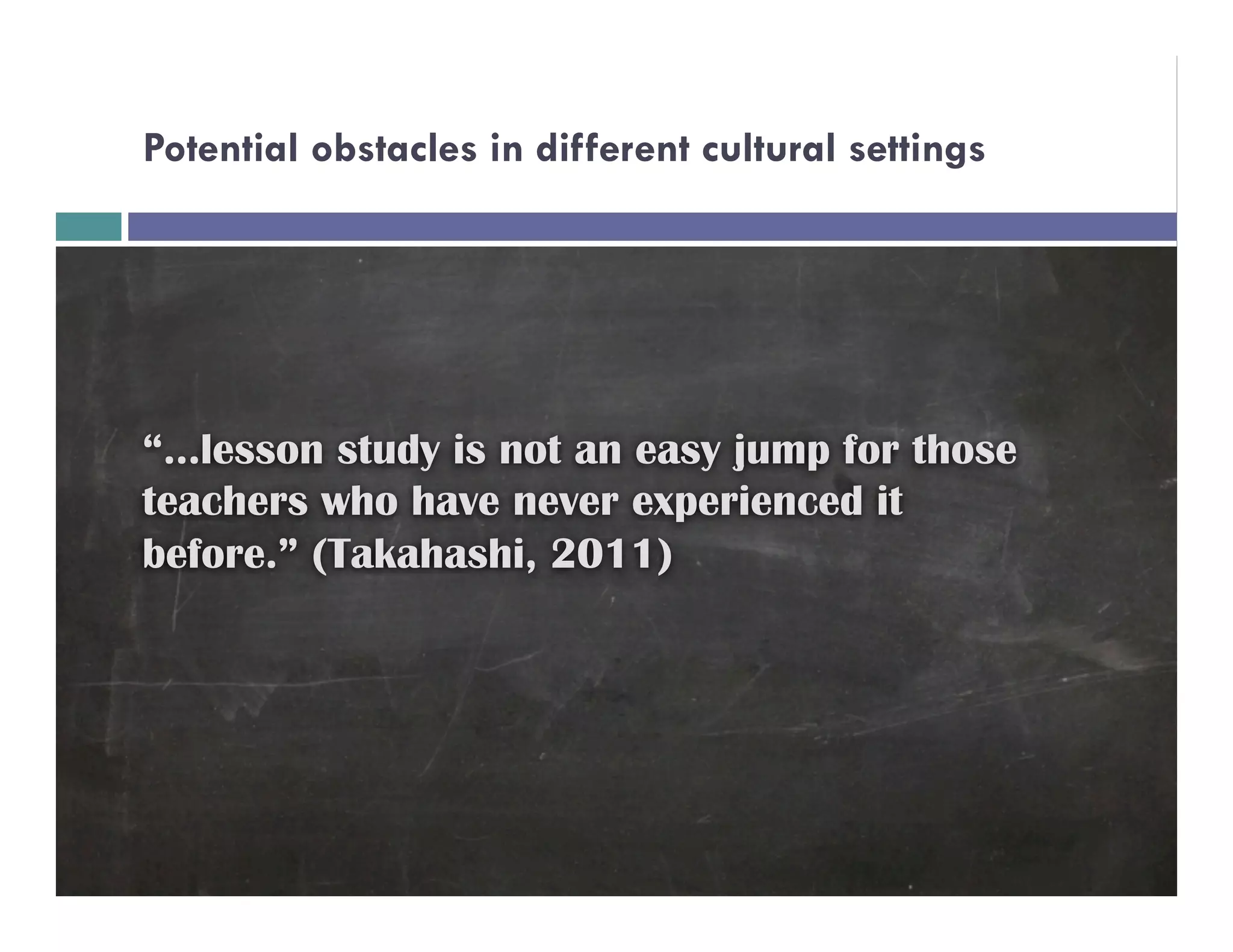
Potential obstacles in different cultural settings


“…lesson study is not an easy jump for those
teachers who have never experienced it
before.” (Takahashi, 2011)
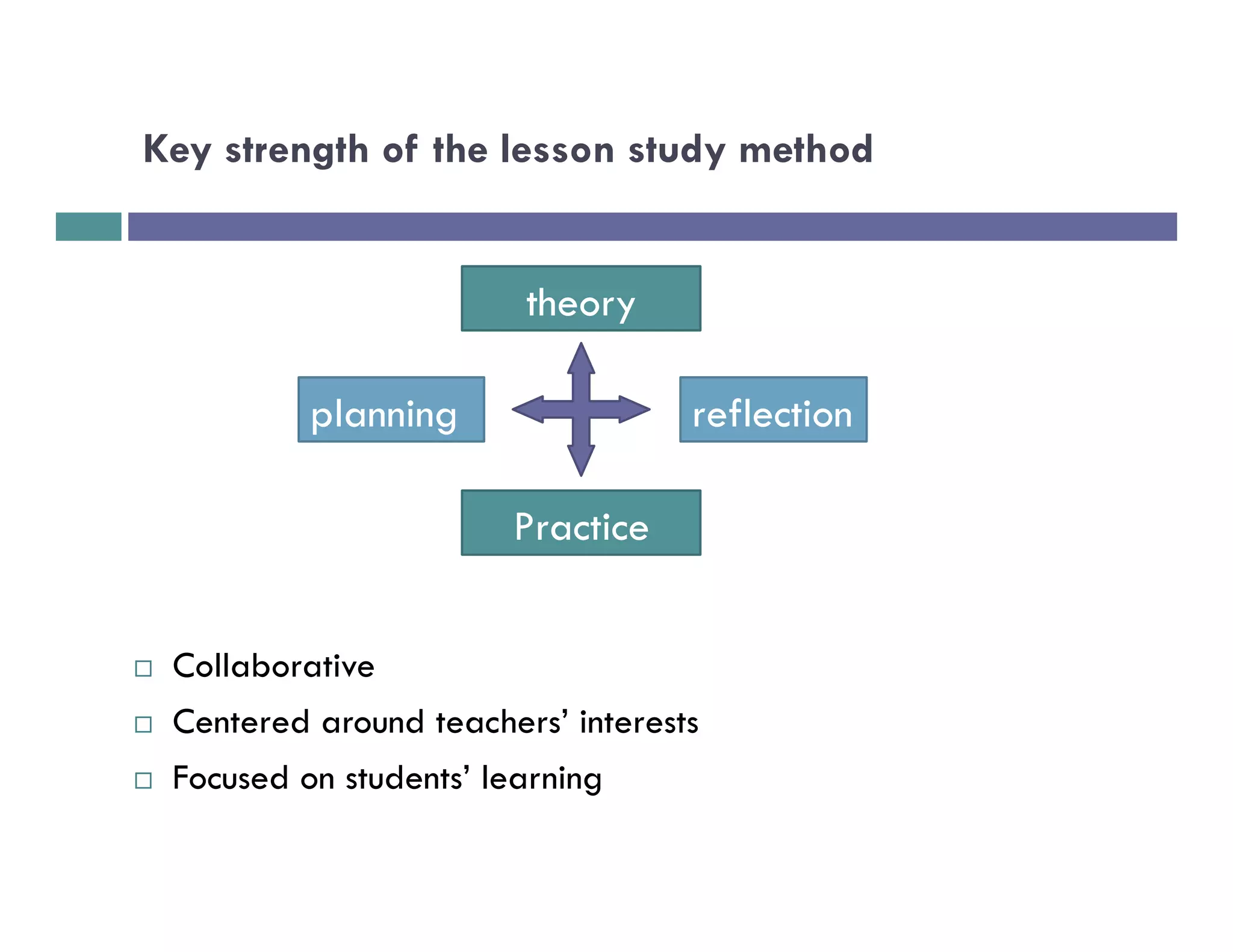
Key strength of the lesson study method


                             theory

               planning                 reflection

                            Practice


¨    Collaborative
¨    Centered around teachers’ interests
¨    Focused on students’ learning
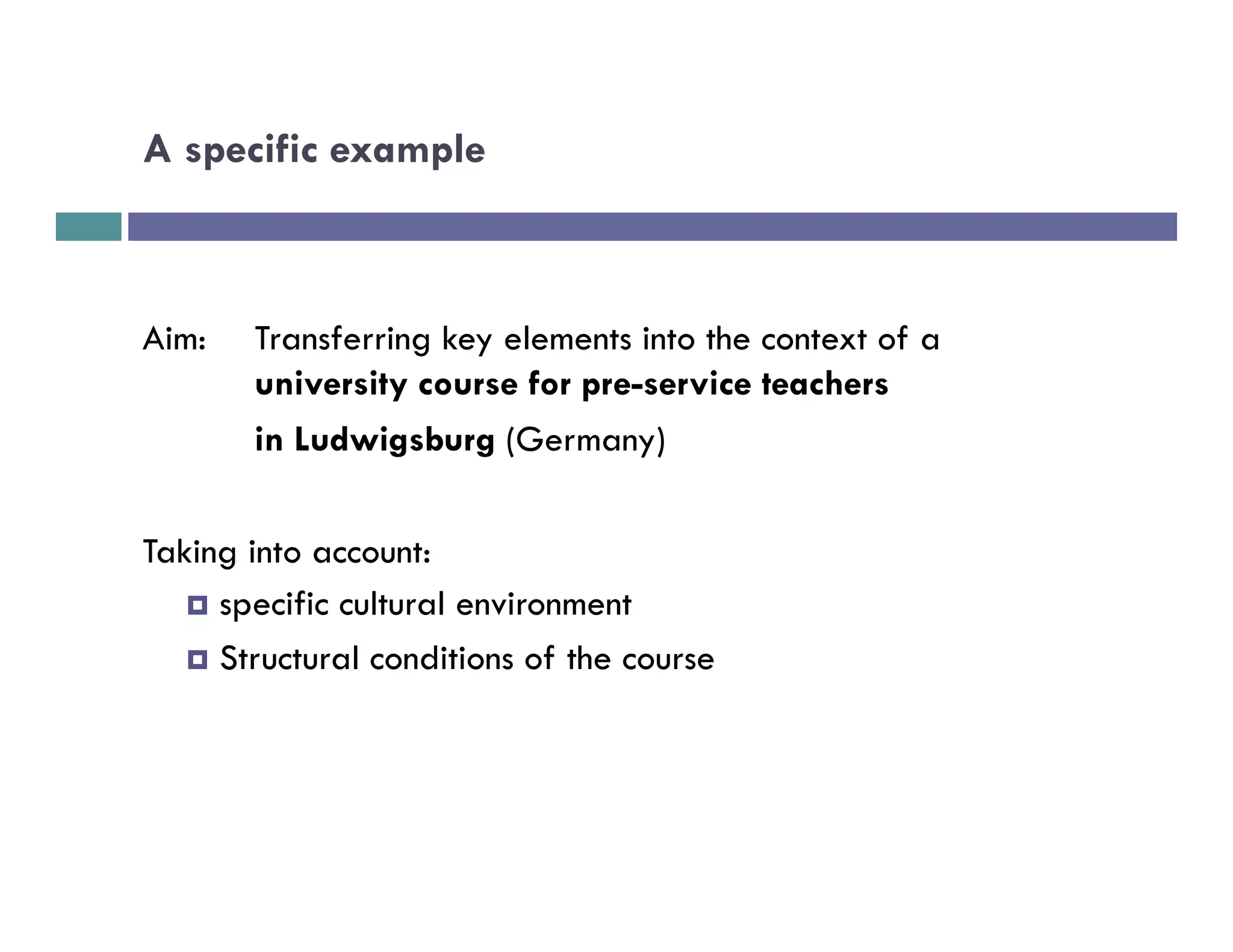
A specific example


Aim:    Transferring key elements into the context of a
        university course for pre-service teachers
        in Ludwigsburg (Germany)


Taking into account:
   ¤  specific cultural environment

   ¤  Structural conditions of the course
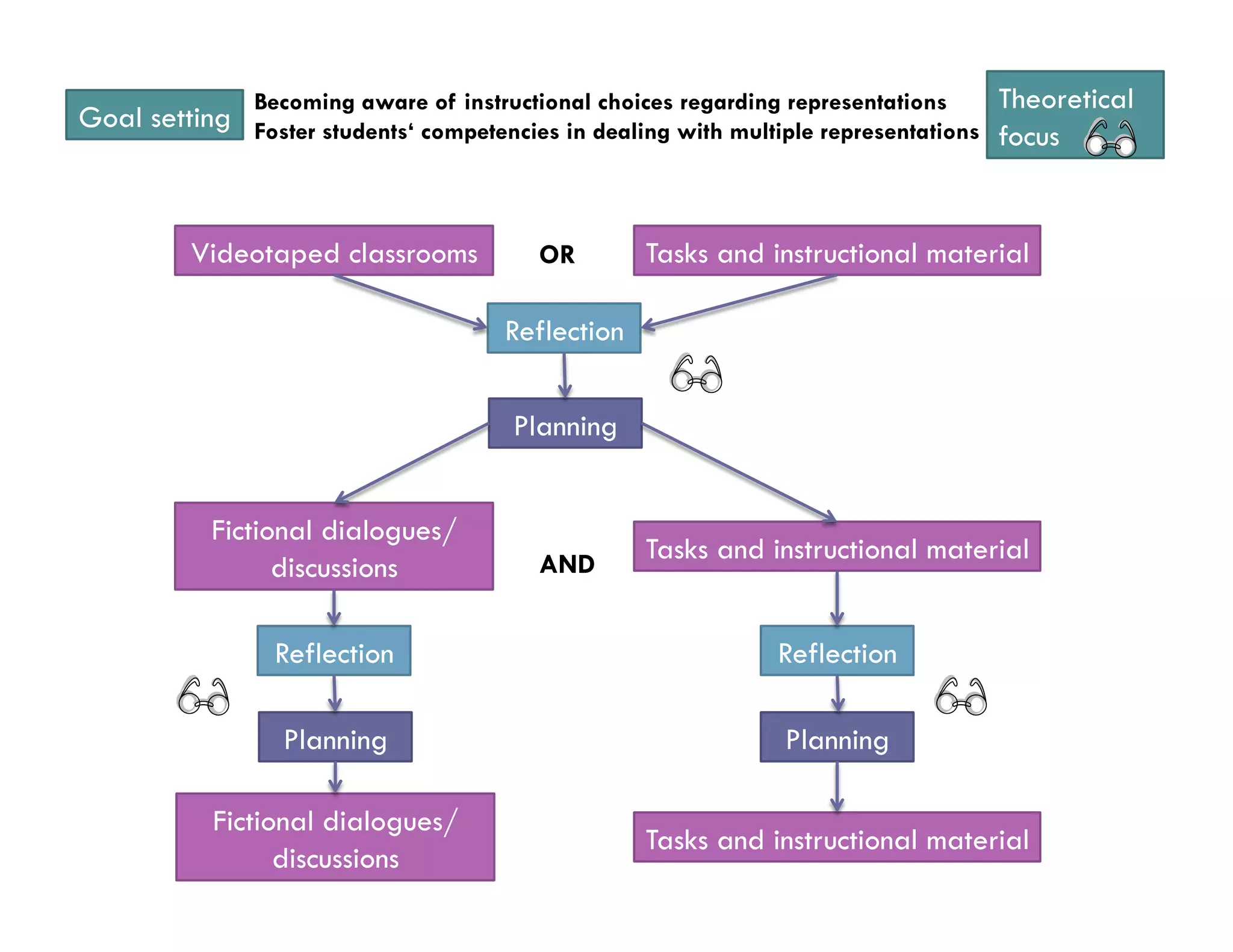
Becoming aware of instructional choices regarding representations      Theoretical
Goal setting Foster students‘ competencies in dealing with multiple representations
                                                                                    focus


          Videotaped classrooms          OR        Tasks and instructional material

                                      Reflection


                                       Planning


           Fictional dialogues/
                                         AND
                                                   Tasks and instructional material
                 discussions

                 Reflection                                   Reflection

                  Planning                                     Planning

            Fictional dialogues/
                                                   Tasks and instructional material
                  discussions
References


  ¤    Hart L, Alston A, Murata A (eds). Lesson Study Research and Practice in
        Mathematics Education. Dordrecht: Springer Science + Business Media;
        2011
  ¤    Takahashi, A. 2011, Response to part I: Jumping into lesson study –
        inservice mathematics teacher education. In: Hart L, Alston A, Murata A
        (eds). Lesson Study Research and Practice in Mathematics Education.
        Dordrecht: Springer Science + Business Media; 2011
QUESTION: How can an established effective
 professional development model such as Lesson
 Study be translated for use in different cultures?

                     Some Thoughts About

Adapting Japanese Lesson Study
For Other Cultures In Ways Harmonious With
       Its Reflective Principles

                 Thomas E. Ricks, Ph.D.
                Louisiana State University
           tomricks@lsu.edu    www.TOMRICKS.com
                    ICME2012 DiscussionGroup7
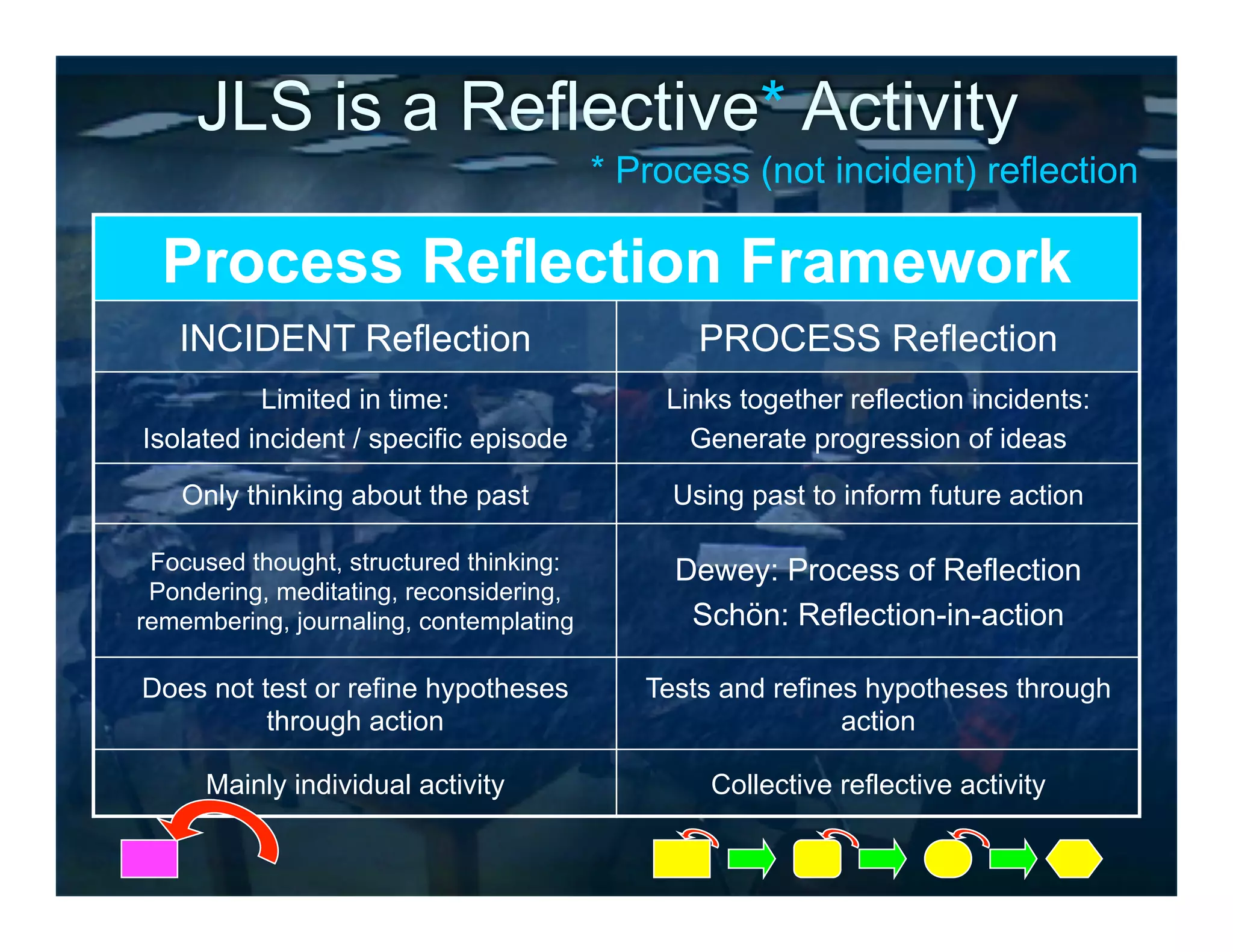
JLS is a Reflective* Activity
                                         * Process (not incident) reflection

  Process Reflection Framework
   INCIDENT Reflection                          PROCESS Reflection
          Limited in time:                   Links together reflection incidents:
Isolated incident / specific episode           Generate progression of ideas

   Only thinking about the past               Using past to inform future action

 Focused thought, structured thinking:        Dewey: Process of Reflection
 Pondering, meditating, reconsidering,
remembering, journaling, contemplating         Schön: Reflection-in-action

Does not test or refine hypotheses          Tests and refines hypotheses through
          through action                                    action

      Mainly individual activity                 Collective reflective activity
Dewey and Schön
n  Both believed reflection was a process of
    developing and testing hypotheses
    (most successfully done in collaboration)
n  Dewey’s Scientific Method of Mind:
      n    “Testing the hypothesis by overt or imaginative
            action” (Dewey, 1933, p. 107)
n    Schön’s Reflection-in-Action:
      n  (Re)Framing: “Hypothesis to be tested…. a
          ‘what if’ to be adopted in order to discover its
          consequences” (p. 149, 93)
      n  Action: “Experiment [to] test [the success] of the
          frame” (p. 166)
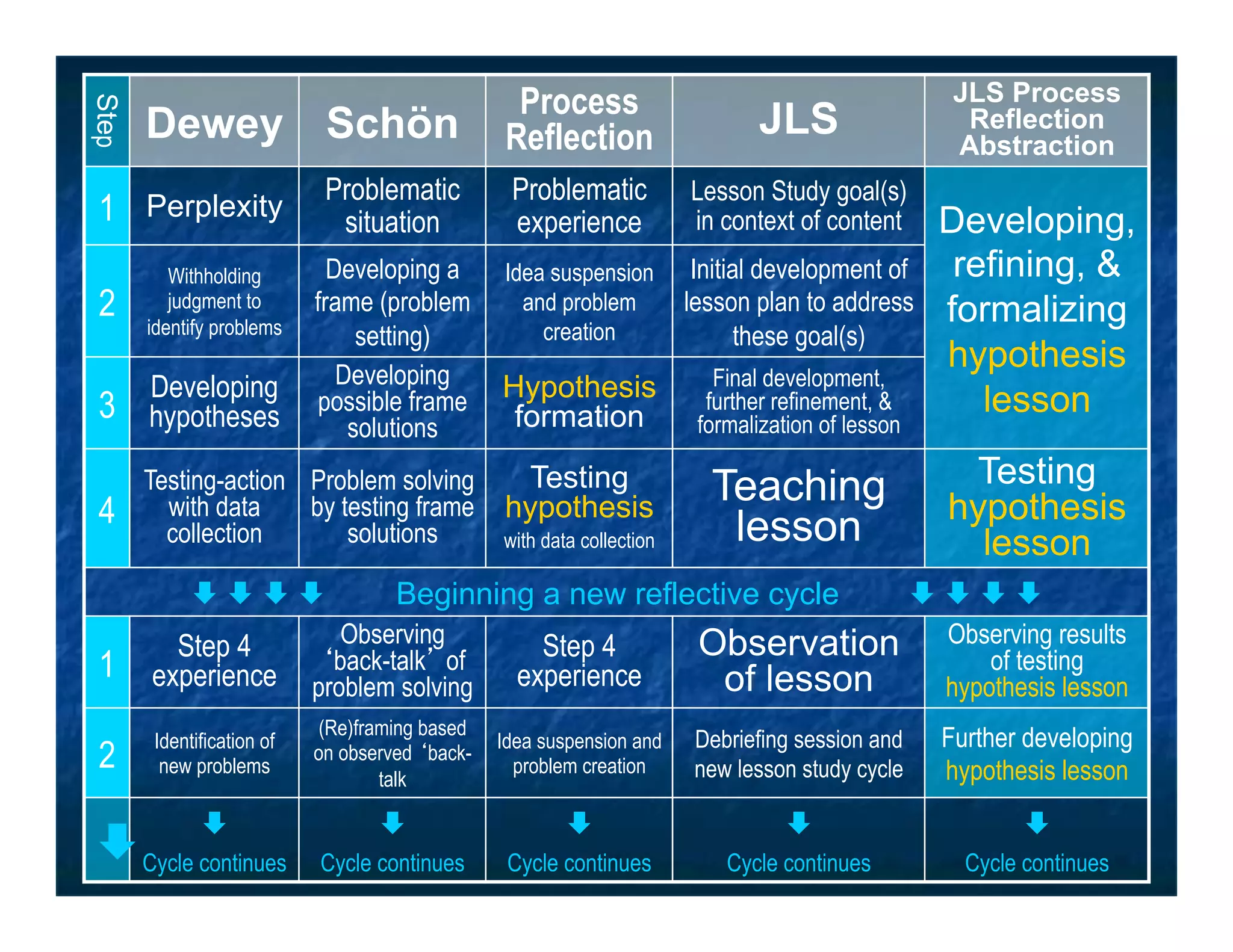
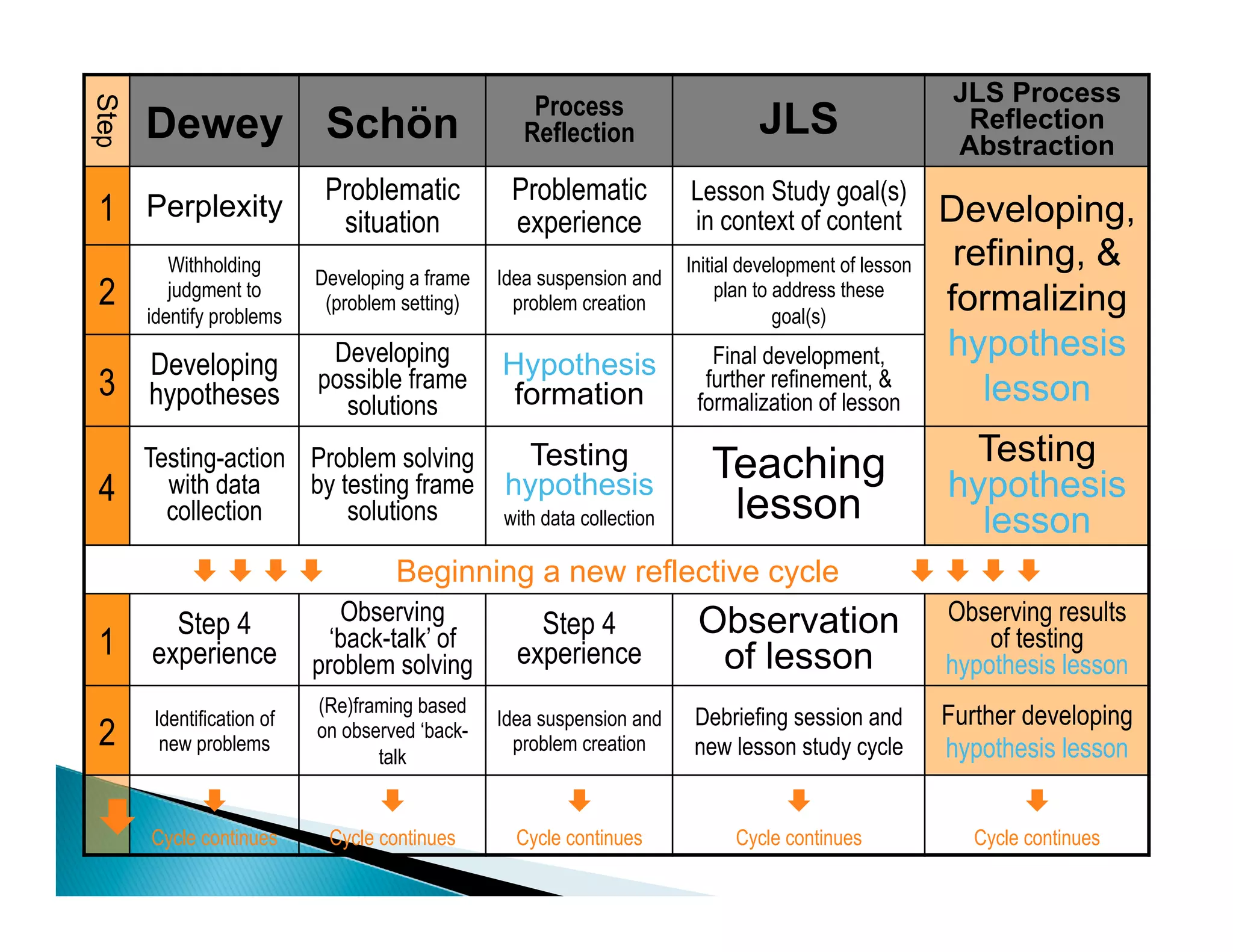
Step
                                                  Process                                             JLS Process
       Dewey Schön                               Reflection                    JLS                     Reflection
                                                                                                      Abstraction
                             Problematic          Problematic           Lesson Study goal(s)
1 Perplexity                  situation           experience            in context of content        Developing,
          Withholding         Developing a       Idea suspension         Initial development of       refining, &
2         judgment to       frame (problem         and problem          lesson plan to address       formalizing
       identify problems         setting)            creation                  these goal(s)
                               Developing
                                                                                                     hypothesis
       Developing                                Hypothesis                Final development,
3      hypotheses
                            possible frame
                                                  formation
                                                                          further refinement, &         lesson
                                solutions                                formalization of lesson

       Testing-action Problem solving             Testing                 Teaching                     Testing
4        with data    by testing frame           hypothesis                                           hypothesis
         collection       solutions              with data collection      lesson                       lesson
             È È È È             Beginning a new reflective cycle                              È È È È
         Step 4                Observing             Step 4              Observation                  Observing results
1      experience
                             ‘back-talk’ of
                                                   experience             of lesson
                                                                                                          of testing
                            problem solving                                                           hypothesis lesson
                             (Re)framing based
        Identification of                        Idea suspension and     Debriefing session and      Further developing
2        new problems
                            on observed ‘back-
                                                   problem creation      new lesson study cycle      hypothesis lesson
                                    talk

              È                   È                    È                       È                         È
È Cycle continues          Cycle continues       Cycle continues           Cycle continues            Cycle continues
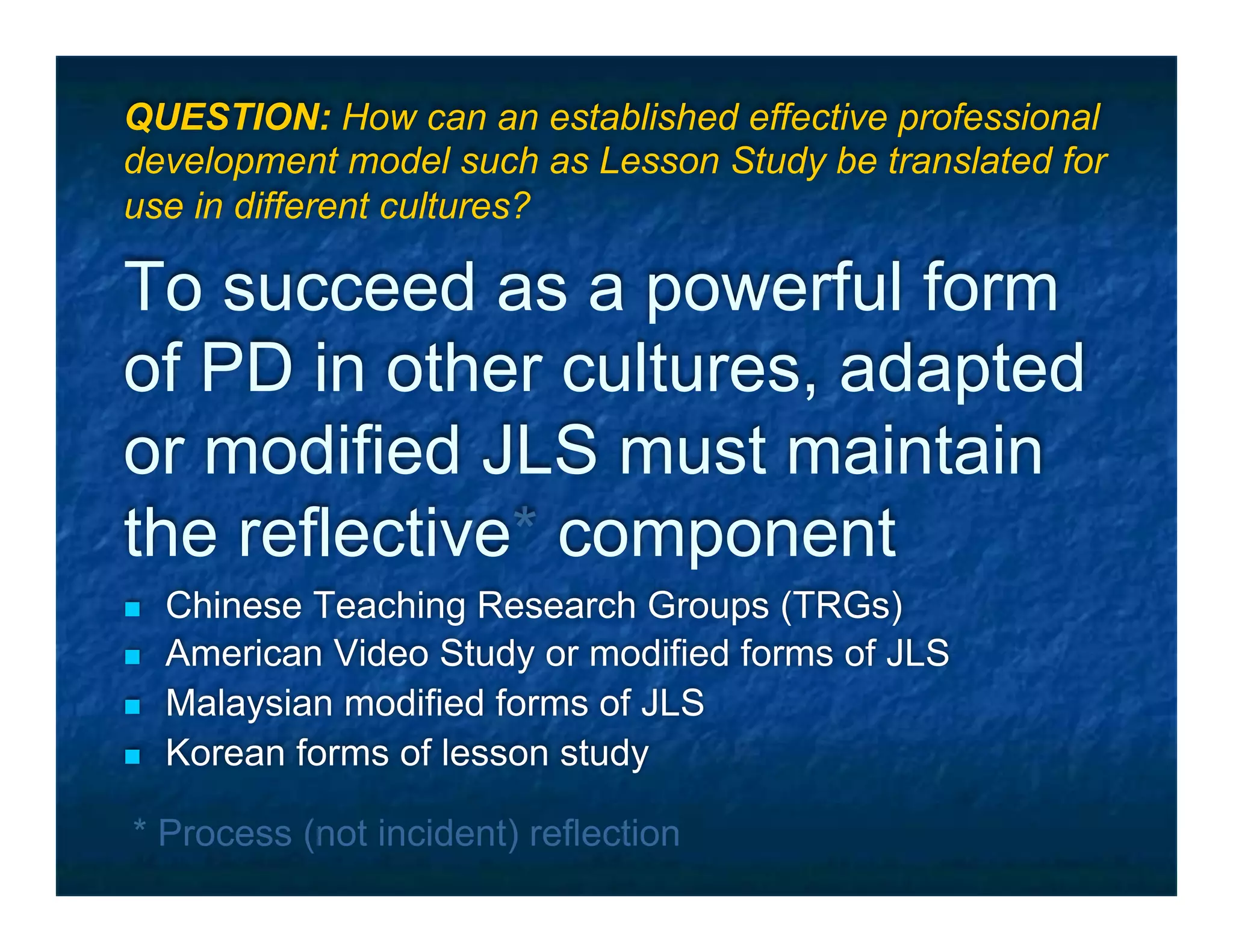
QUESTION: How can an established effective professional
development model such as Lesson Study be translated for
use in different cultures?

To succeed as a powerful form
of PD in other cultures, adapted
or modified JLS must maintain
the reflective* component
n    Chinese Teaching Research Groups (TRGs)
n    American Video Study or modified forms of JLS
n    Malaysian modified forms of JLS
n    Korean forms of lesson study

 * Process (not incident) reflection
Thank You


      tomricks@lsu.edu

     www.TOMRICKS.com
DG 7 - Question D
How can a professional development model
 such a Lesson Study be adapted for use in
             pre-service teacher education
                                Professor Berinderjeet Kaur
                 National Institute of Education, Singapore
Some key elements of Lesson Study
•  Study of curriculum.
•  Review of related research
•  Deliberation on “how best to teach” the
   lesson
•  Voices of other teachers
•  Contributions of outside expert
Adaptation of Lesson Study in pre-
   service teacher education
Infusing key elements of Lesson Study
into pre-service teacher education
•  Possible areas where infusion is possible:
- Lesson planning
- Micro-teaching
- Teaching practice
THANK YOU
Incorporating “Lesson Analysis”
   in Secondary Mathematics
       Student Teaching
                   Don Gilmore
          Metropolitan State University of Denver
 12th International Congress of Mathematical Education
                        July 2012
Conceptual Underpinnings
•  Learning, and, in particular, teacher learning,
   is situated
   Learning to teach as participation in the variety of
   communities of teaching practice through which teachers
   move during their school experiences (Lave & Wenger,
   1998)
•  Influence of Lesson Study
   – Teaching practice that is open and collaborative
   – Focus on the lesson as unit of analysis
Methods Class
•  Design, teach and observe, analyze, revise and
   re-teach two lessons in mathematics for
   elementary teachers;
•  Study lessons captured on videotape;
•  Participate as students and observers in lessons
   taught by the “methods” course instructor;
•  Participate—as members of a team that includes
   the course instructor and their mentor teachers—in
   planning, teaching and analyzing one lesson in
   their field experience classroom.
Student Teaching Model
•  Daily work as a teaching team
  – When possible, multiple placements and
    multiple mentor teachers
  – All are teachers who share responsibility for
    planning and enacting lessons
  – Consistently high quality instruction
•  Two “Research Lessons”
Research Lessons
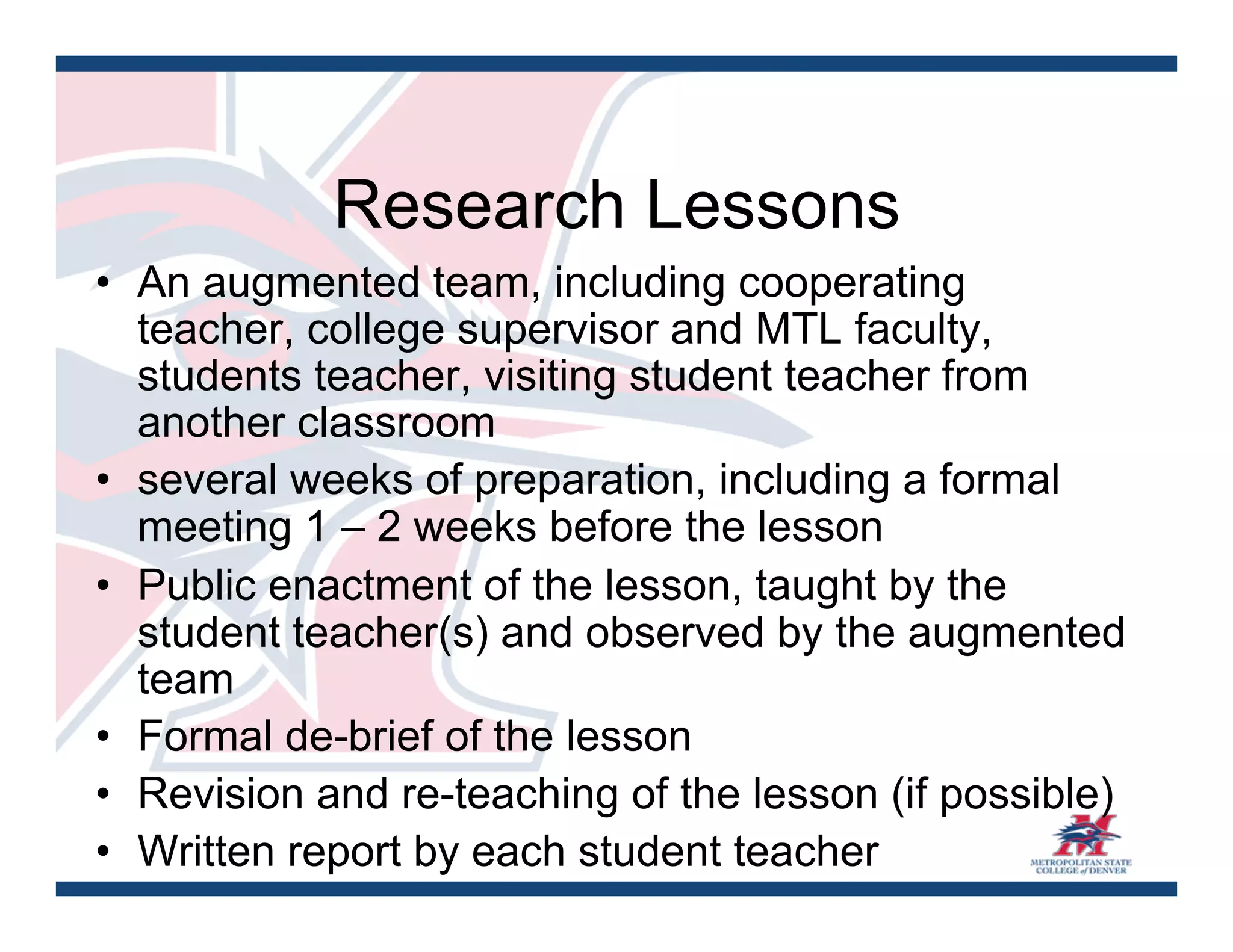
•  An augmented team, including cooperating
   teacher, college supervisor and MTL faculty,
   students teacher, visiting student teacher from
   another classroom
•  several weeks of preparation, including a formal
   meeting 1 – 2 weeks before the lesson
•  Public enactment of the lesson, taught by the
   student teacher(s) and observed by the augmented
   team
•  Formal de-brief of the lesson
•  Revision and re-teaching of the lesson (if possible)
•  Written report by each student teacher
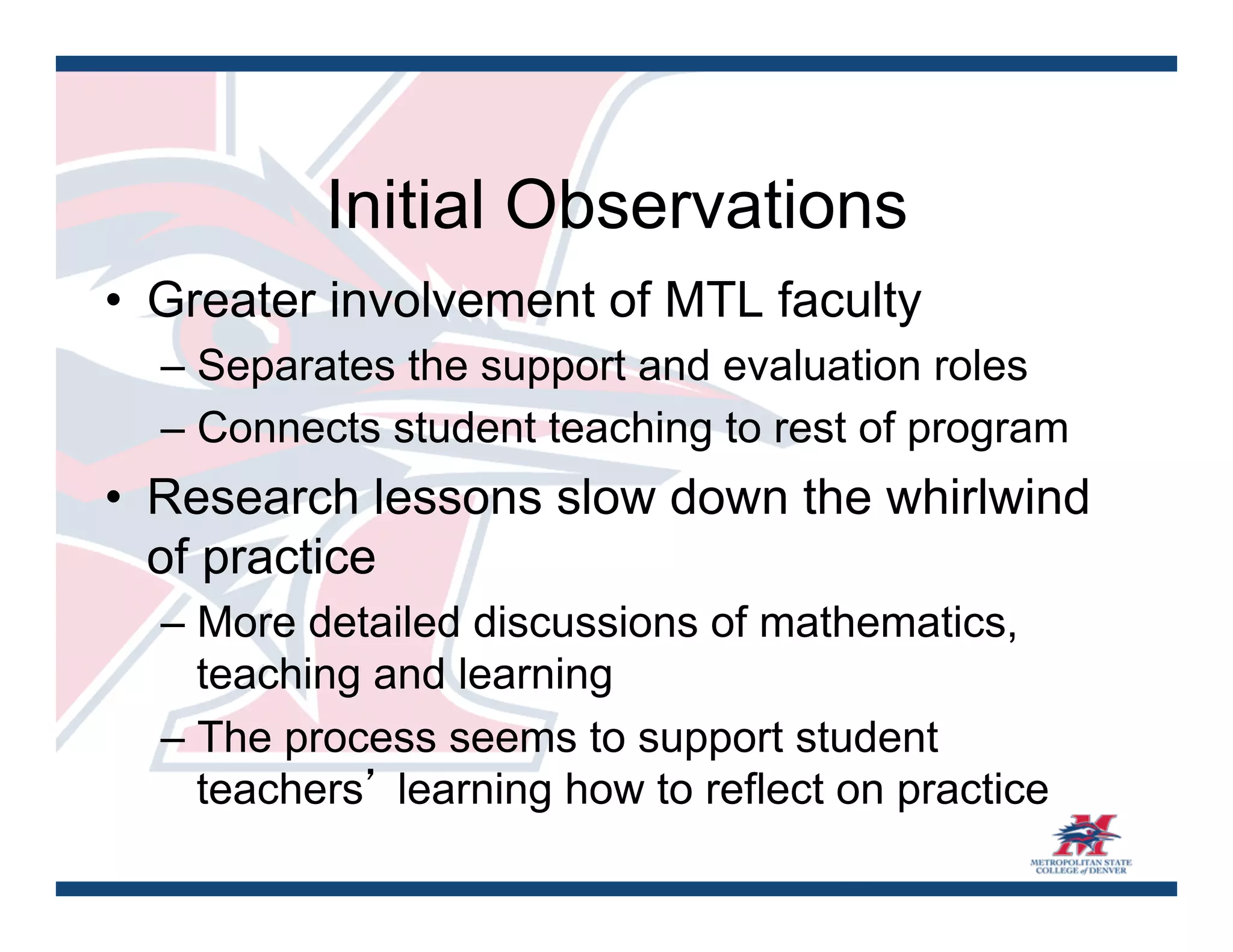
Initial Observations
•  Greater involvement of MTL faculty
  – Separates the support and evaluation roles
  – Connects student teaching to rest of program
•  Research lessons slow down the whirlwind
   of practice
  – More detailed discussions of mathematics,
    teaching and learning
  – The process seems to support student
    teachers’ learning how to reflect on practice
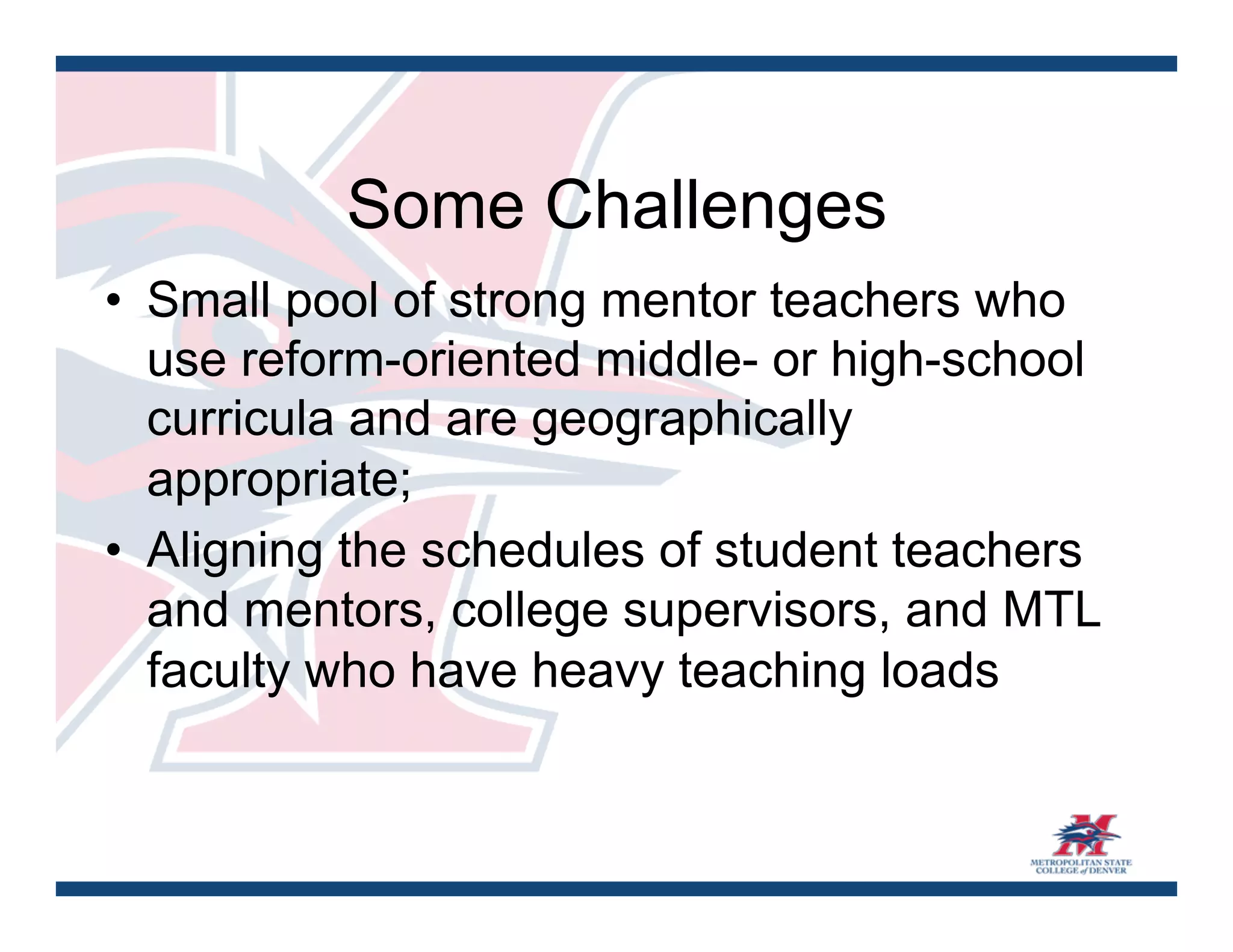
Some Challenges
•  Small pool of strong mentor teachers who
   use reform-oriented middle- or high-school
   curricula and are geographically
   appropriate;
•  Aligning the schedules of student teachers
   and mentors, college supervisors, and MTL
   faculty who have heavy teaching loads
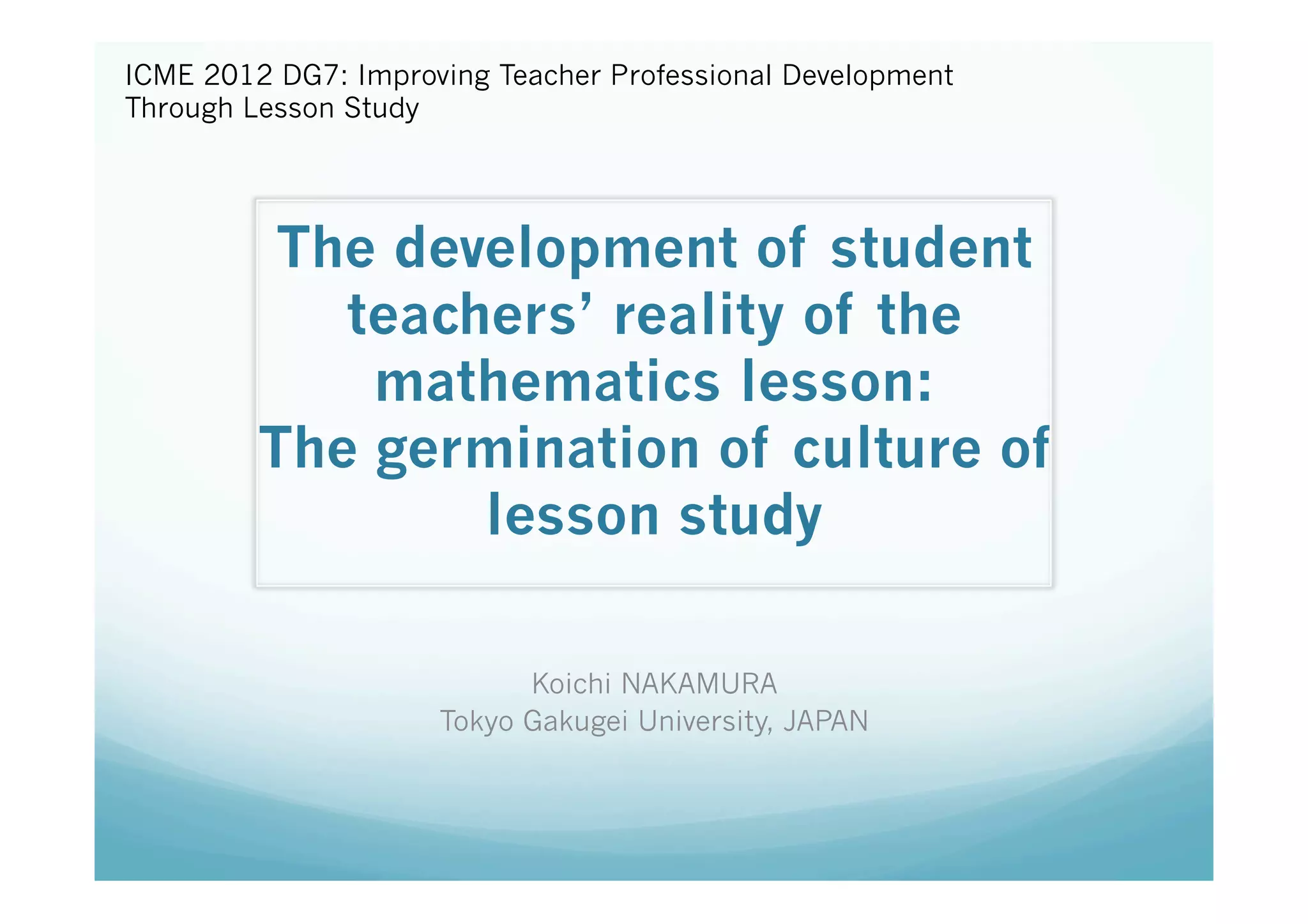
ICME 2012 DG7: Improving Teacher Professional Development
Through Lesson Study	


          The development of student
            teachers’ reality of the
             mathematics lesson:

         The germination of culture of
                 lesson study	

                           Koichi NAKAMURA	
                     Tokyo Gakugei University, JAPAN
D. How can a professional
development model such as Lesson
   Study be adapted for use in
  pre-service teacher education?	

—  In lesson study, it is important to
 develop the reality of lesson.
—  The lesson is cultural activity and the
 lesson study is also cultural activity.
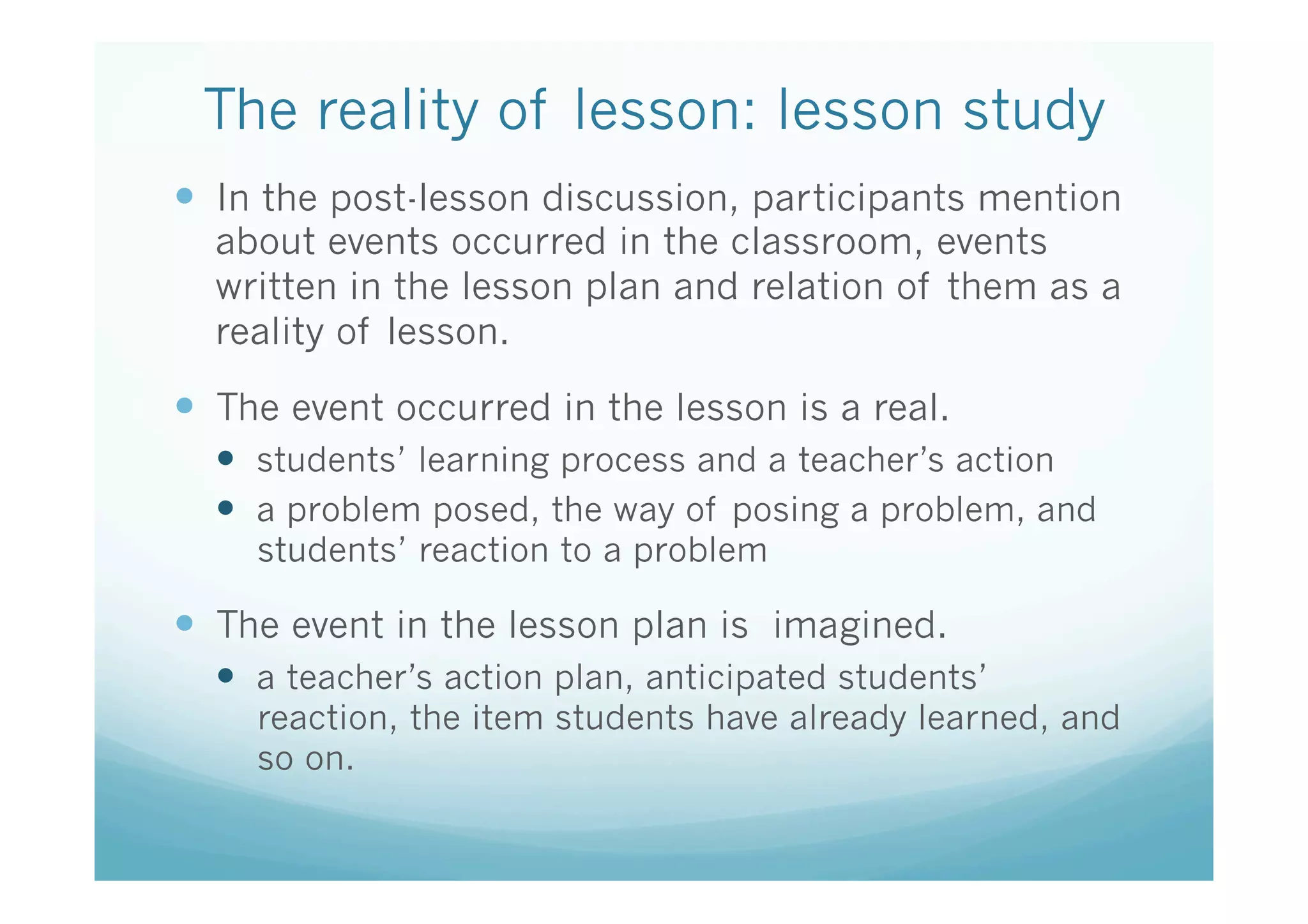
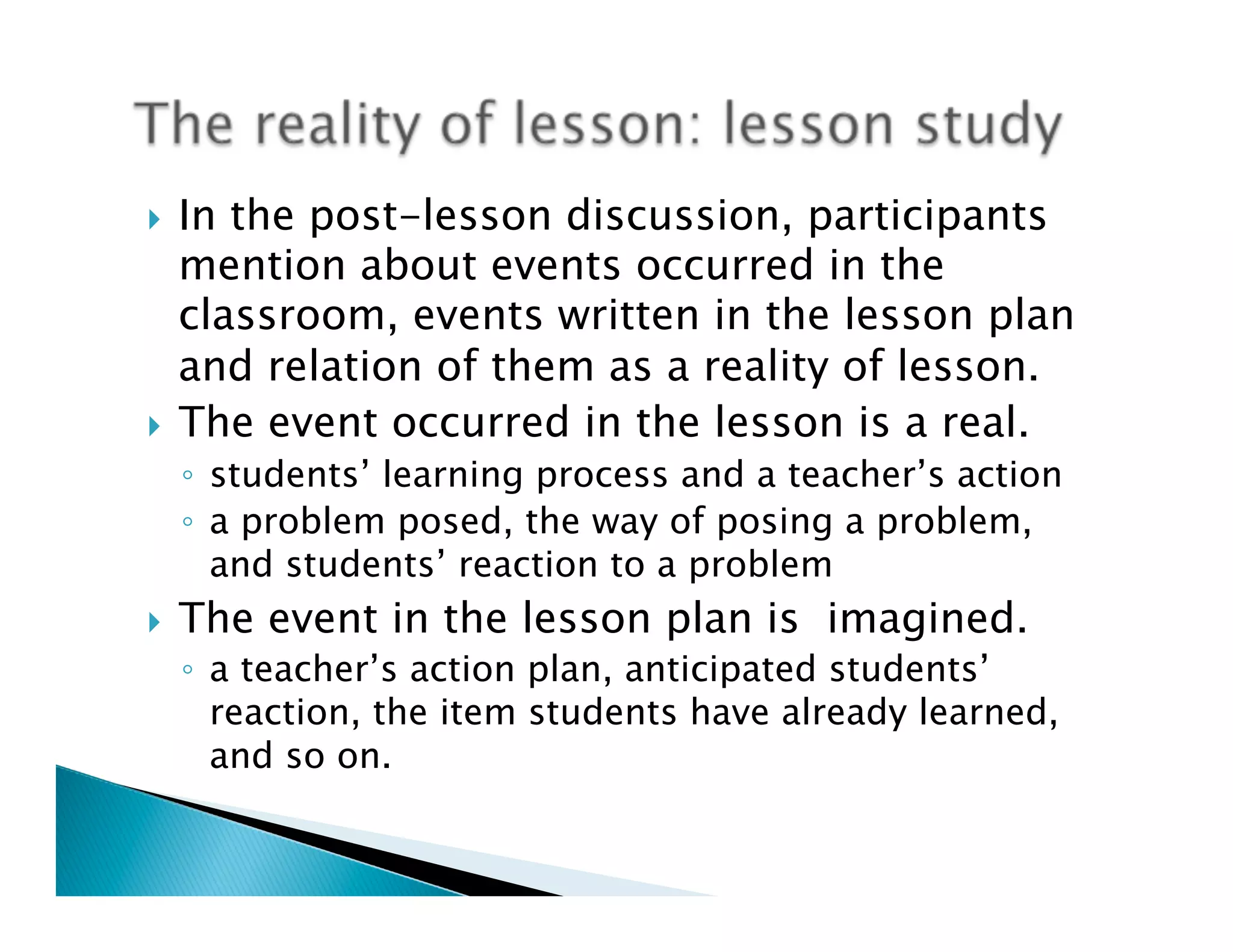
The reality of lesson: lesson study	
—  In the post-lesson discussion, participants mention
  about events occurred in the classroom, events
  written in the lesson plan and relation of them as a
  reality of lesson.

—  The event occurred in the lesson is a real.
  —  students’ learning process and a teacher’s action
  —  a problem posed, the way of posing a problem, and
     students’ reaction to a problem

—  The event in the lesson plan is imagined.	
  —  a teacher’s action plan, anticipated students’
     reaction, the item students have already learned, and
     so on.
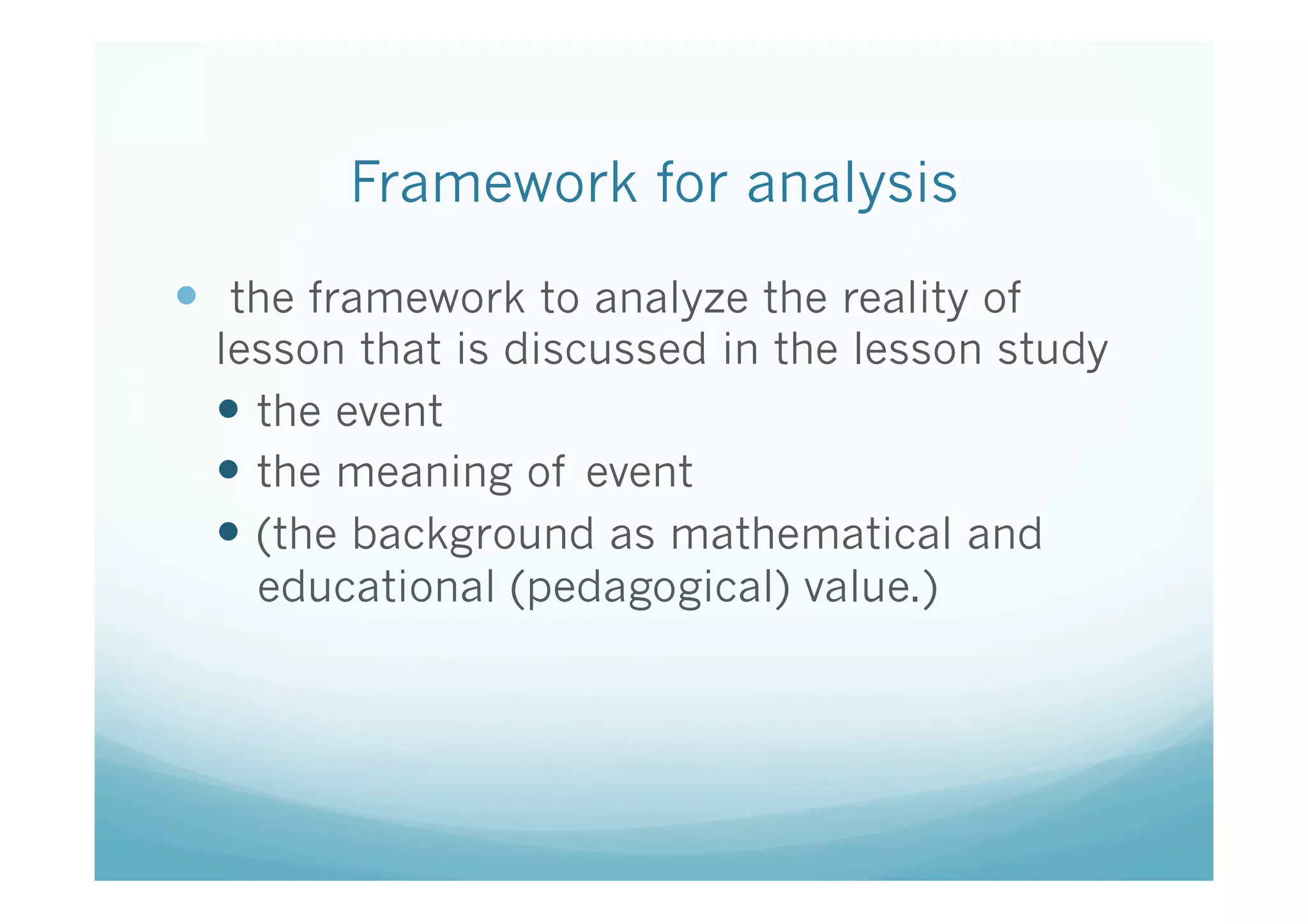
Framework for analysis	
—  the framework to analyze the reality of
  lesson that is discussed in the lesson study
  —  the event
  —  the meaning of event
  —  (the background as mathematical and
      educational (pedagogical) value.)
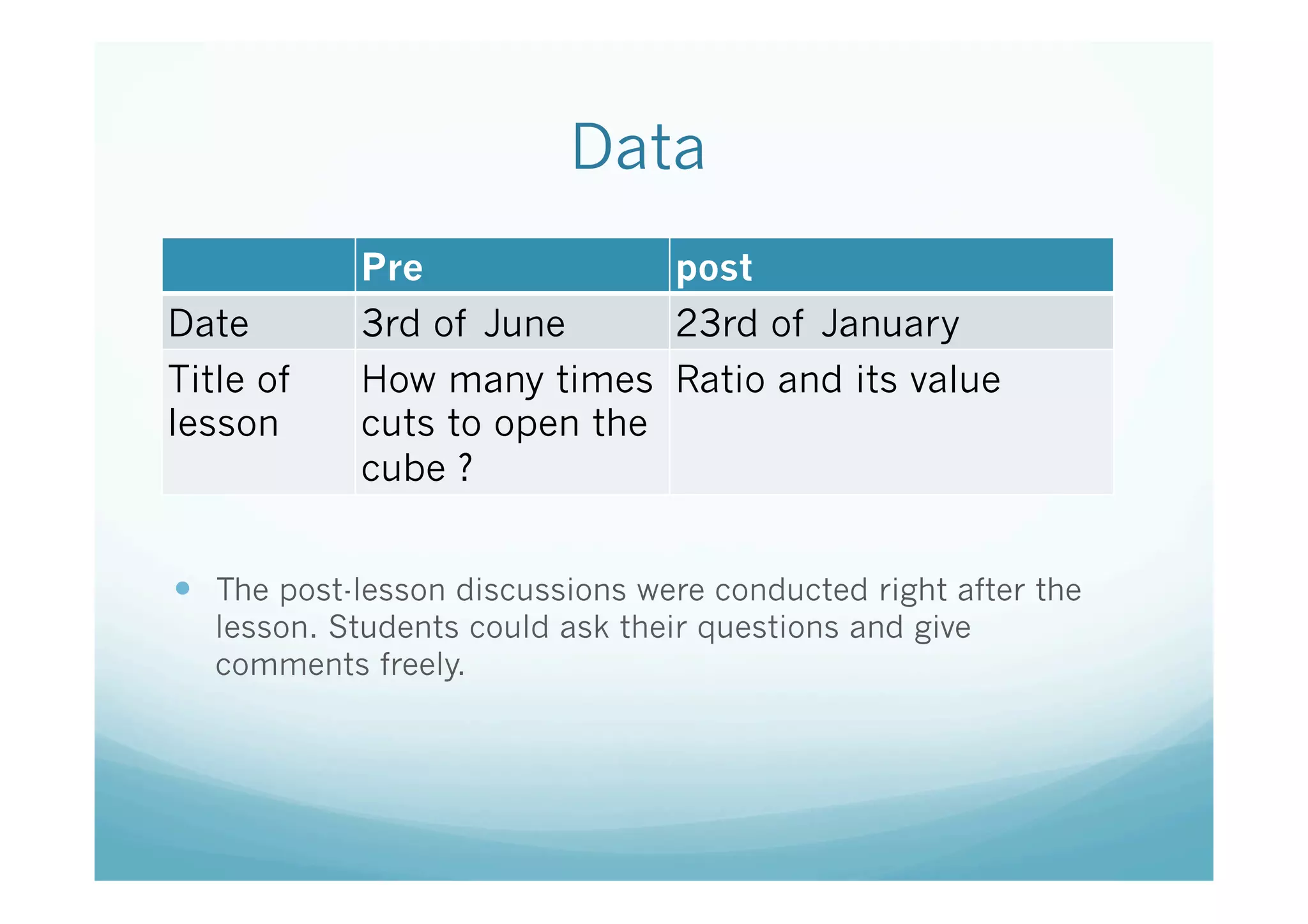
Data	
            Pre	
            post	
Date	
      3rd of June	
    23rd of January	
Title of    How many times Ratio and its value	
lesson	
    cuts to open the
            cube ? 	


—  The post-lesson discussions were conducted right after the
  lesson. Students could ask their questions and give
  comments freely.
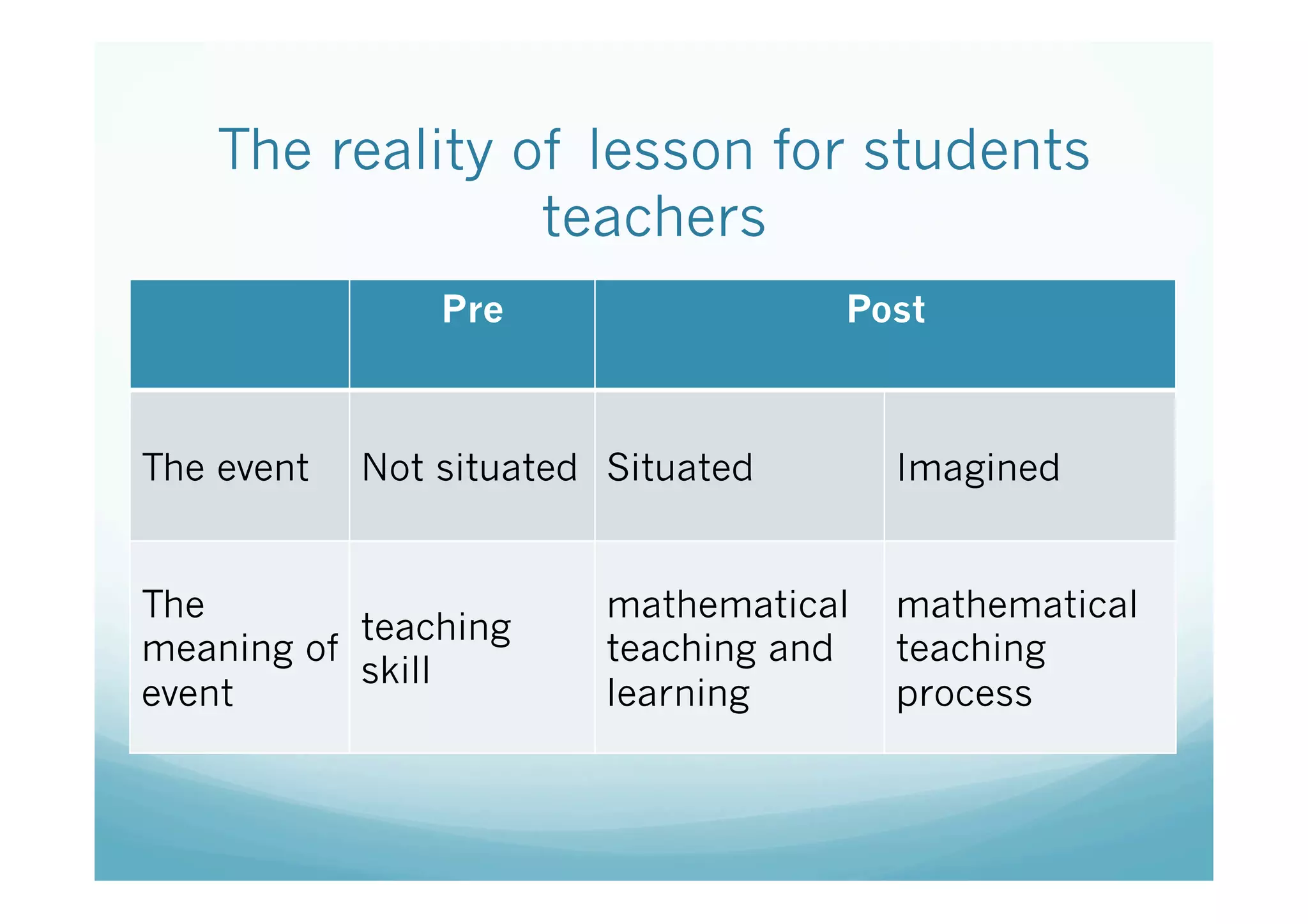
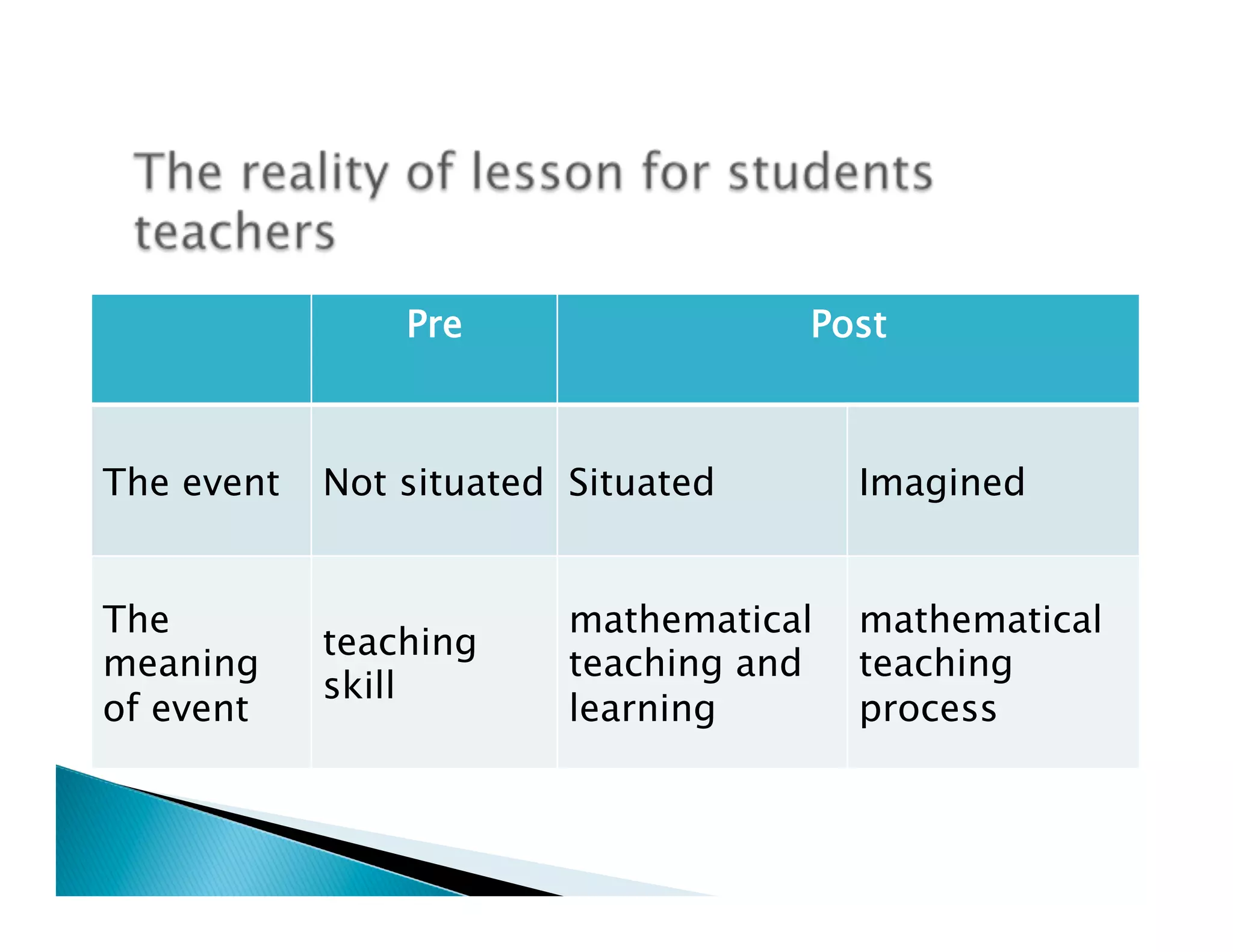
The reality of lesson for students
                 teachers	
                 Pre	
                  Post	


The event	
 Not situated	
 Situated	
      Imagined	


The                        mathematical    mathematical
           teaching
meaning of                 teaching and    teaching
           skill	
event	
                    learning	
      process
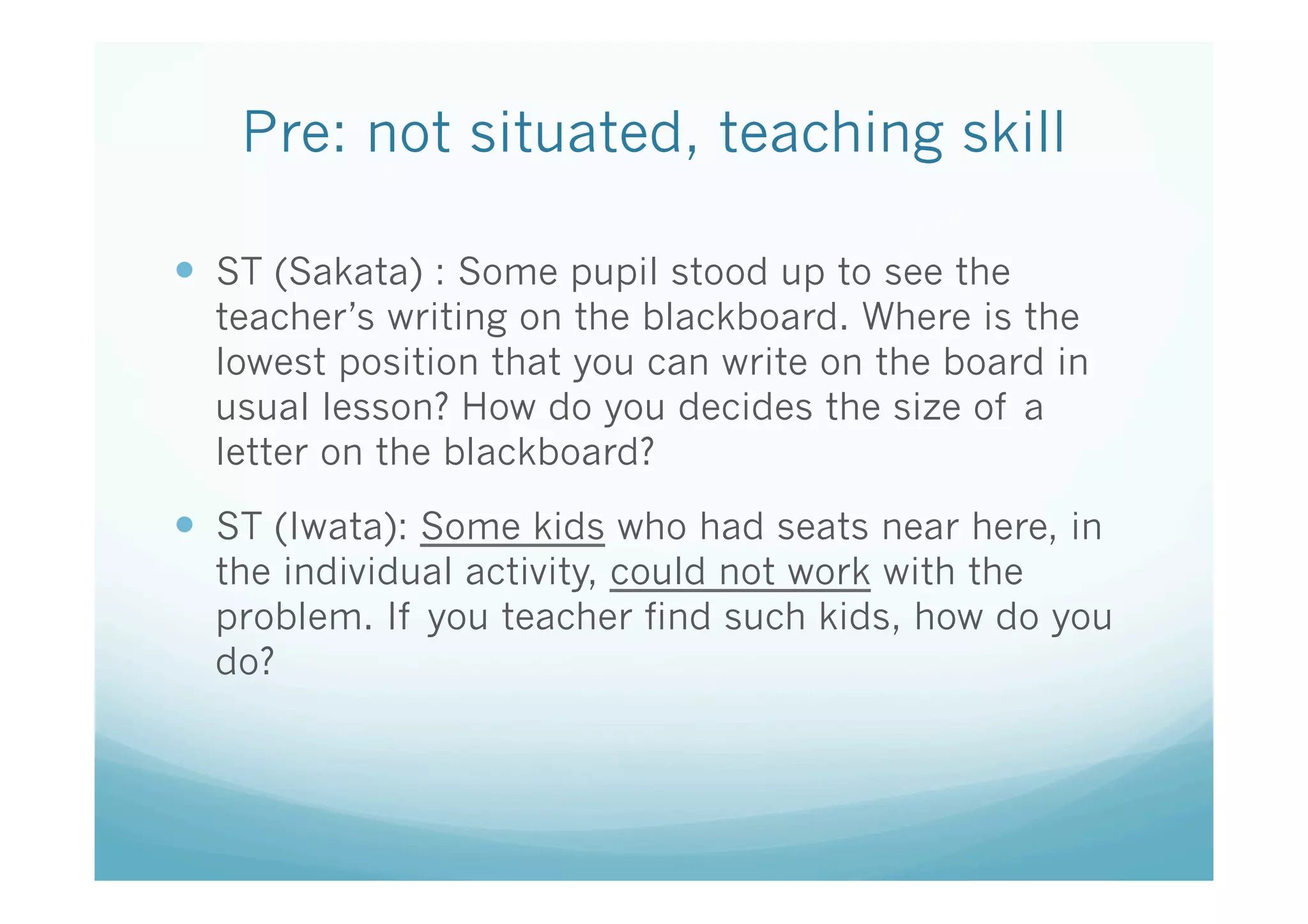
Pre: not situated, teaching skill

                  	
—  ST (Sakata) : Some pupil stood up to see the
  teacher’s writing on the blackboard. Where is the
  lowest position that you can write on the board in
  usual lesson? How do you decides the size of a
  letter on the blackboard?

—  ST (Iwata): Some kids who had seats near here, in
  the individual activity, could not work with the
  problem. If you teacher find such kids, how do you
  do?
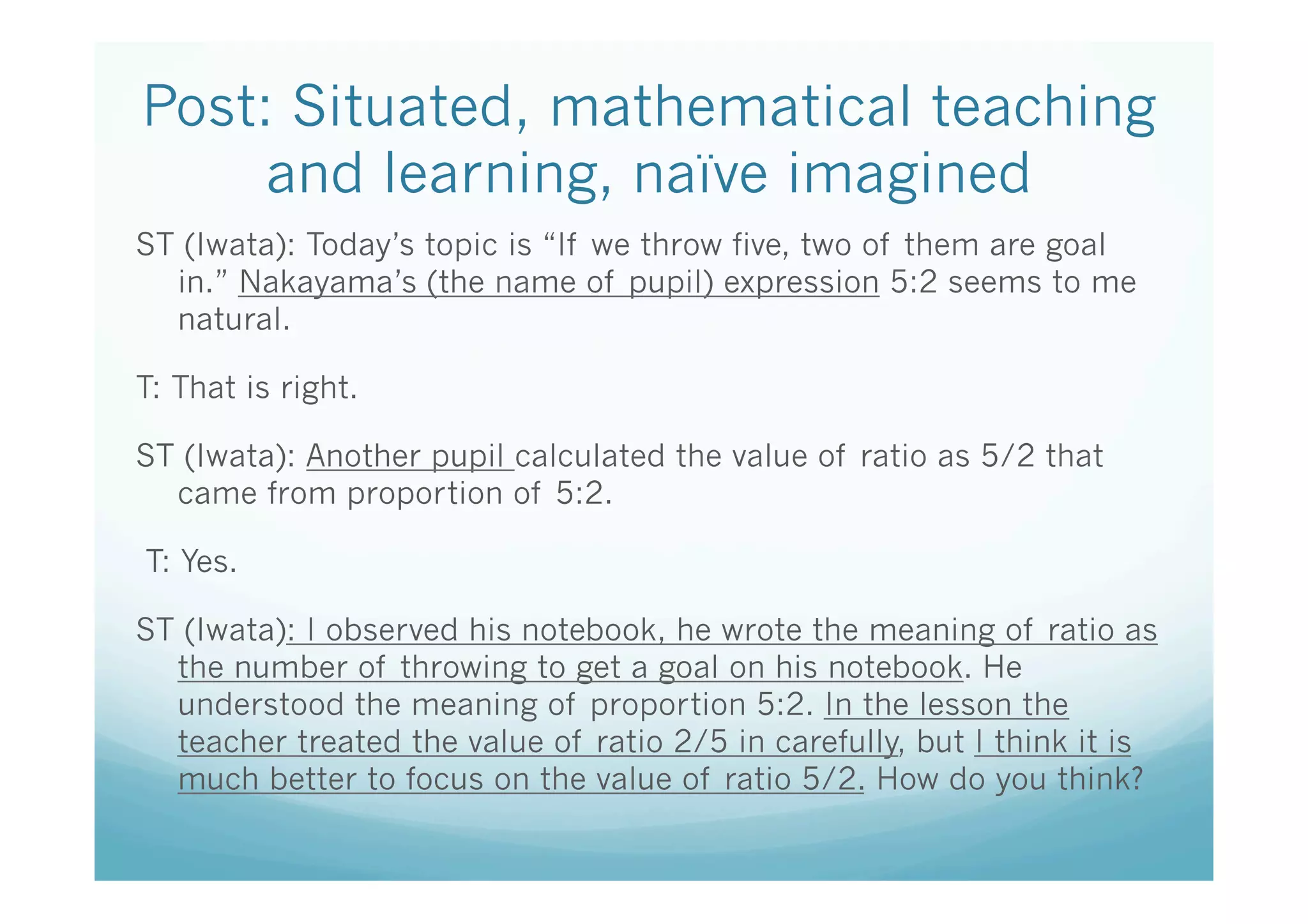
Post: Situated, mathematical teaching
     and learning, naïve imagined	
ST (Iwata): Today’s topic is “If we throw five, two of them are goal
  in.” Nakayama’s (the name of pupil) expression 5:2 seems to me
  natural.

T: That is right.

ST (Iwata): Another pupil calculated the value of ratio as 5/2 that
  came from proportion of 5:2.

 T: Yes.

ST (Iwata): I observed his notebook, he wrote the meaning of ratio as
  the number of throwing to get a goal on his notebook. He
  understood the meaning of proportion 5:2. In the lesson the
  teacher treated the value of ratio 2/5 in carefully, but I think it is
  much better to focus on the value of ratio 5/2. How do you think?
Professor Dr LIM Chap Sam
School of Educational Studies
     Universiti Sains Malaysia
               cslim@usm.my
}    


      C. How can an established effective
      professional development model such
      as Lesson Study be translated for use
      in different cultures?

}  

      D. How can a professional
      development model such as Lesson
      Study be adapted for use in pre-
      service teacher education?

      •
5 Panel members
Addressing Question C:


    -Anika Dreher, Ludwigsburg University of Education,
    Germany ©

    -Thomas E. Ricks, Louisiana State University, U.S.A. (C)


Addressing Question D

    –Berinderjeet Kaur, Nanyang Technological University,
    Singapore (D)

    –Don Gilmore, The Metropolitan State College of Denver,
    U.S.A. (D)

    –Kouichi Nakamura, Tokyo Gakugei University, Japan (D)


}        


      How can an established
      effective professional
      development model such as
      Lesson Study be translated
      for use in different cultures?

}  


      •
}    Systemic Challenges:
      ◦  Institutional conditions and resources
      ◦  Demands on teachers
      ◦  Unsuitable curricula
}    Teachers’ views
      ◦  traditions of professional development
      ◦  Image of the teacher profession, learning disposition
}    Lack of experience and knowledge
      ◦  Lack of sufficient CK, PCK
      ◦  Lack of experienced lesson study teachers and researchers
}    …
                                                  (L.C. Hart et al, 2011)
QUESTION: How can an established effective
professional development model such as
Lesson Study be translated for use in different
cultures?


                         Thomas E. Ricks, Ph.D.
                       Louisiana State University
             tomricks@lsu.edu   www.TOMRICKS.com
                                ICME2012 DiscussionGroup7
Step
                                                     Process                                             JLS Process
       Dewey Schön                                  Reflection                   JLS                      Reflection
                                                                                                         Abstraction
                             Problematic          Problematic           Lesson Study goal(s)
1 Perplexity                  situation           experience            in context of content           Developing,
          Withholding                                                   Initial development of lesson    refining, &
                            Developing a frame   Idea suspension and
2         judgment to
                             (problem setting)     problem creation
                                                                             plan to address these
                                                                                                        formalizing
       identify problems                                                             goal(s)
                             Developing                                    Final development,           hypothesis
       Developing                                Hypothesis
3      hypotheses
                            possible frame
                                                  formation
                                                                          further refinement, &
                                                                         formalization of lesson           lesson
                              solutions
       Testing-action Problem solving             Testing                  Teaching                      Testing
4        with data    by testing frame           hypothesis                                             hypothesis
         collection       solutions              with data collection       lesson                        lesson
             È È È È             Beginning a new reflective cycle                               È È È È
         Step 4                Observing             Step 4              Observation                    Observing results
1      experience
                              ‘back-talk’ of
                                                   experience             of lesson
                                                                                                            of testing
                            problem solving                                                             hypothesis lesson
                            (Re)framing based
        Identification of                        Idea suspension and     Debriefing session and         Further developing
2        new problems
                            on observed ‘back-
                                                   problem creation      new lesson study cycle         hypothesis lesson
                                   talk

              È                   È                    È                         È                          È
È Cycle continues           Cycle continues       Cycle continues            Cycle continues              Cycle continues
}    Lesson Study can be translated to use in
      different cultures, but

}    Japanese LS is part of Japanese culture, it is
      not possible to adopt a culture;

}  It is better to adapt, or integrate into our
    local culture and
}  this will take time and commitment from the
    teacher participants
}    How to get teachers (and school
      administrators) to “buy in” the idea of LS?

}    How to resolve the issues of “time for
      discussion and observation” and full
      commitment of the teacher participants?

}    An example of resolving the tension in my
      research project: SK and SJKC
}        


      How can a professional
      development model such
      as Lesson Study be
      adapted for use in pre-
      service teacher education?

      •
Berinderjeet proposed that


  Possible areas where infusion is possible:
} 
- Lesson planning
- Micro-teaching
- Teaching practice
Don Gilmore
              The Metropolitan State College of Denver
12th International Congress of Mathematical Education
                                             July 2012
}  Small pool of strong mentor teachers who use
    reform-oriented middle- or high-school
    curricula and are geographically appropriate;
}  Aligning the schedules of student teachers and
    mentors, college supervisors, and MTL faculty
    who have heavy teaching loads
ICME 2012 DG7: Improving Teacher Professional Development
Through Lesson Study	


                             Koichi NAKAMURA	
                 Tokyo Gakugei University, JAPAN
}  In the post-lesson discussion, participants
    mention about events occurred in the
    classroom, events written in the lesson plan
    and relation of them as a reality of lesson.
}  The event occurred in the lesson is a real.
      ◦  students’ learning process and a teacher’s action
      ◦  a problem posed, the way of posing a problem,
         and students’ reaction to a problem
}    The event in the lesson plan is imagined.	
      ◦  a teacher’s action plan, anticipated students’
         reaction, the item students have already learned,
         and so on.
Pre	
                  Post	


The event	
 Not situated	
 Situated	
      Imagined	


The                        mathematical    mathematical
             teaching
meaning                    teaching and    teaching
             skill	
of event	
                 learning	
      process
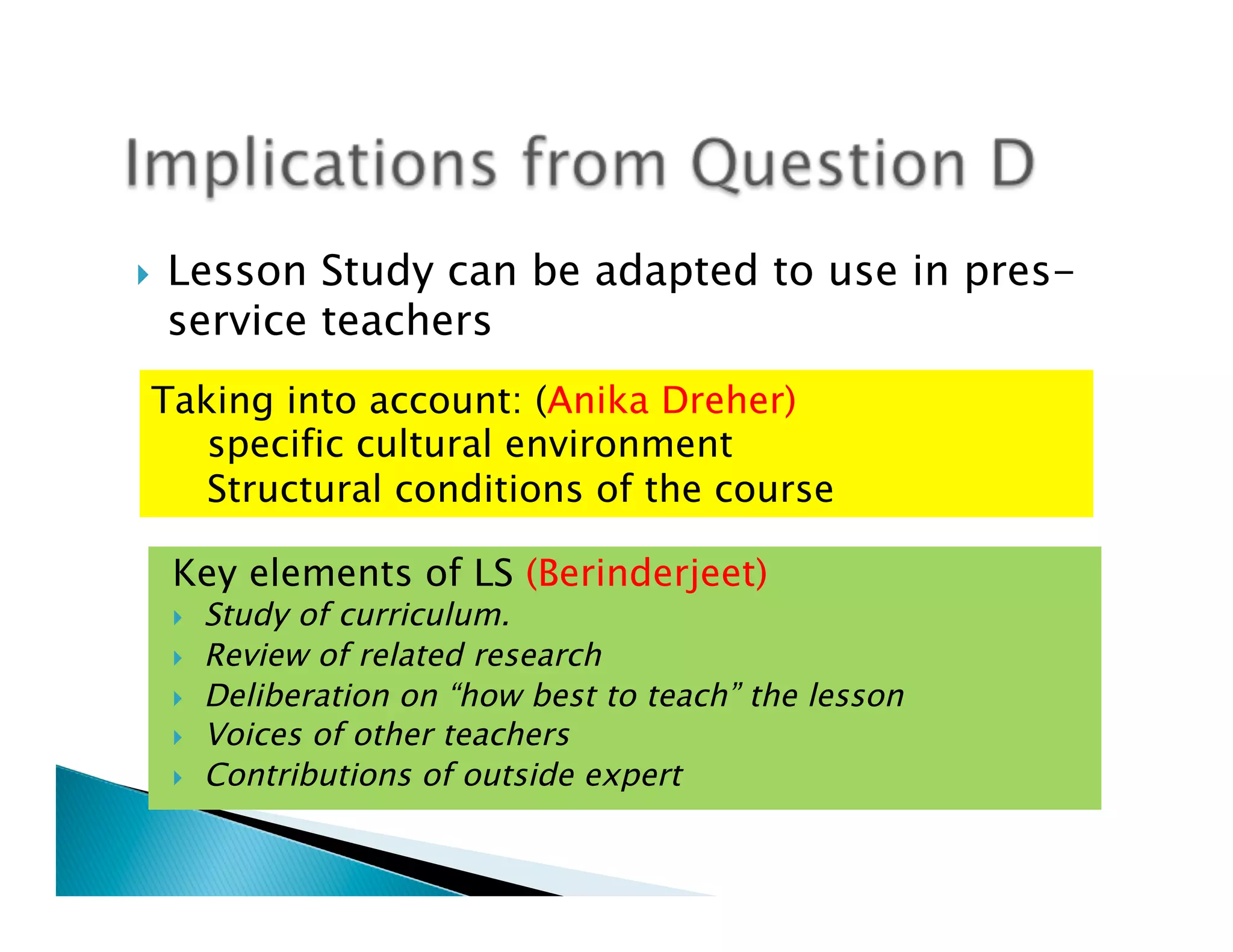
}    Lesson Study can be adapted to use in pres-
      service teachers
  Taking into account: (Anika Dreher)
     specific cultural environment
     Structural conditions of the course

      Key elements of LS (Berinderjeet)
      }    Study of curriculum.
      }    Review of related research
      }    Deliberation on “how best to teach” the lesson
      }    Voices of other teachers
      }    Contributions of outside expert

ICME12 DG7 Session2

  • 1.
    DG7: IMPROVING TEACHERPROFESSIONAL DEVELOPMENT THROUGH LESSON STUDY Co-Chairs: Toshiakira Fujii, Tokyo Gakugei University, Japan Akihiko Takahashi, DePaul University, U.S.A. Team Members: Susie Groves, Deakin University, Australia Yo-An Lee, Sogang University, South Korea
  • 2.
    The key questionsto be addressed by DG7 A.  What are the key elements of Lesson Study that can help teachers gain mathematical knowledge for teaching? B.  What are the key elements of Lesson Study that can help teachers develop expertise in teaching mathematics effectively? C.  How can an established effective professional development model such as Lesson Study be translated for use in different cultures? D.  How can a professional development model such as Lesson Study be adapted for use in pre-service teacher education?
  • 3.
    Session 2 (Saturday,July 14) Key Questions C.  How can an established effective professional development model such as Lesson Study be translated for use in different cultures? D.  How can a professional development model such as Lesson Study be adapted for use in pre-service teacher education? •  Chair: Akihiko Takahashi (Co-Chair) •  Discussant: Lim Chap Sam, Universiti Sains Malaysia, Malaysia •  Panel: –  Anika Dreher, Ludwigsburg University of Education, Germany (C) –  Thomas Ricks, Louisiana State University, U.S.A. (C) –  Berinderjeet Kaur, Nanyang Technological University, Singapore (D) –  Don Gilmore, The Metropolitan State College of Denver, U.S.A. (D) –  Kouichi Nakamura, Tokyo Gakugei University, Japan (D) •  Reporter: Yo-An Lee (Team Member)
  • 4.
    Session Schedule •  Introduction– Explanation of goals & structure of the sessions (10 min) •  Comments addressing Key Questions by the panel (5 min each, total 25 min) •  Discussion (35 min) •  Summary and proposals for action (10 min)
  • 5.
    Session 1 (Tuesday,July 10) Key Questions A.  What are the key elements of Lesson Study that can help teachers gain mathematical knowledge for teaching? B.  What are the key elements of Lesson Study that can help teachers develop expertise in teaching mathematics effectively? •  Chair: Toshiakira Fujii (Co-Chair) •  Discussant: Susie Groves (Team Member) •  Panel: –  Jennifer Lewis, Wayne State University, U.S.A. –  Yoshinori Shimizu, University of Tsukuba, Japan –  Akihiko Takahashi, DePaul University, U.S.A. –  Tad Watanabe, Kennesaw State University, U.S.A. –  Nobuki Watanabe, Kyoto University of Education, Japan •  Reporter: Yo-An Lee (Team Member)
  • 6.
    COMMENTS ON KEYQUESTION C: HOW CAN AN ESTABLISHED EFFECTIVE PROFESSIONAL DEVELOPMENT MODEL SUCH AS LESSON STUDY BE TRANSLATED FOR USE IN DIFFERENT CULTURES? Anika Dreher, Sebastian Kuntze
  • 7.
    Potential Obstacles indifferent cultural settings ¨  Systemic Challenges: ¤  Institutional conditions and resources ¤  Demands on teachers ¤  Unsuitable curricula ¨  Teachers’ views ¤  traditions of professional development ¤  Image of the teacher profession, learning disposition ¨  Lack of experience and knowledge ¤  Lack of sufficient CK, PCK ¤  Lack of experienced lesson study teachers and researchers ¨  … (L.C. Hart et al, 2011)
  • 8.
    Potential obstacles indifferent cultural settings “…lesson study is not an easy jump for those teachers who have never experienced it before.” (Takahashi, 2011)
  • 9.
    Key strength ofthe lesson study method theory planning reflection Practice ¨  Collaborative ¨  Centered around teachers’ interests ¨  Focused on students’ learning
  • 10.
    A specific example Aim: Transferring key elements into the context of a university course for pre-service teachers in Ludwigsburg (Germany) Taking into account: ¤  specific cultural environment ¤  Structural conditions of the course
  • 11.
    Becoming aware ofinstructional choices regarding representations Theoretical Goal setting Foster students‘ competencies in dealing with multiple representations focus Videotaped classrooms OR Tasks and instructional material Reflection Planning Fictional dialogues/ AND Tasks and instructional material discussions Reflection Reflection Planning Planning Fictional dialogues/ Tasks and instructional material discussions
  • 12.
    References ¤  Hart L, Alston A, Murata A (eds). Lesson Study Research and Practice in Mathematics Education. Dordrecht: Springer Science + Business Media; 2011 ¤  Takahashi, A. 2011, Response to part I: Jumping into lesson study – inservice mathematics teacher education. In: Hart L, Alston A, Murata A (eds). Lesson Study Research and Practice in Mathematics Education. Dordrecht: Springer Science + Business Media; 2011
  • 13.
    QUESTION: How canan established effective professional development model such as Lesson Study be translated for use in different cultures? Some Thoughts About Adapting Japanese Lesson Study For Other Cultures In Ways Harmonious With Its Reflective Principles Thomas E. Ricks, Ph.D. Louisiana State University tomricks@lsu.edu www.TOMRICKS.com ICME2012 DiscussionGroup7
  • 14.
    JLS is aReflective* Activity * Process (not incident) reflection Process Reflection Framework INCIDENT Reflection PROCESS Reflection Limited in time: Links together reflection incidents: Isolated incident / specific episode Generate progression of ideas Only thinking about the past Using past to inform future action Focused thought, structured thinking: Dewey: Process of Reflection Pondering, meditating, reconsidering, remembering, journaling, contemplating Schön: Reflection-in-action Does not test or refine hypotheses Tests and refines hypotheses through through action action Mainly individual activity Collective reflective activity
  • 15.
    Dewey and Schön n Both believed reflection was a process of developing and testing hypotheses (most successfully done in collaboration) n  Dewey’s Scientific Method of Mind: n  “Testing the hypothesis by overt or imaginative action” (Dewey, 1933, p. 107) n  Schön’s Reflection-in-Action: n  (Re)Framing: “Hypothesis to be tested…. a ‘what if’ to be adopted in order to discover its consequences” (p. 149, 93) n  Action: “Experiment [to] test [the success] of the frame” (p. 166)
  • 16.
    Step Process JLS Process Dewey Schön Reflection JLS Reflection Abstraction Problematic Problematic Lesson Study goal(s) 1 Perplexity situation experience in context of content Developing, Withholding Developing a Idea suspension Initial development of refining, & 2 judgment to frame (problem and problem lesson plan to address formalizing identify problems setting) creation these goal(s) Developing hypothesis Developing Hypothesis Final development, 3 hypotheses possible frame formation further refinement, & lesson solutions formalization of lesson Testing-action Problem solving Testing Teaching Testing 4 with data by testing frame hypothesis hypothesis collection solutions with data collection lesson lesson È È È È Beginning a new reflective cycle È È È È Step 4 Observing Step 4 Observation Observing results 1 experience ‘back-talk’ of experience of lesson of testing problem solving hypothesis lesson (Re)framing based Identification of Idea suspension and Debriefing session and Further developing 2 new problems on observed ‘back- problem creation new lesson study cycle hypothesis lesson talk È È È È È È Cycle continues Cycle continues Cycle continues Cycle continues Cycle continues
  • 17.
    QUESTION: How canan established effective professional development model such as Lesson Study be translated for use in different cultures? To succeed as a powerful form of PD in other cultures, adapted or modified JLS must maintain the reflective* component n  Chinese Teaching Research Groups (TRGs) n  American Video Study or modified forms of JLS n  Malaysian modified forms of JLS n  Korean forms of lesson study * Process (not incident) reflection
  • 18.
    Thank You tomricks@lsu.edu www.TOMRICKS.com
  • 19.
    DG 7 -Question D How can a professional development model such a Lesson Study be adapted for use in pre-service teacher education Professor Berinderjeet Kaur National Institute of Education, Singapore
  • 20.
    Some key elementsof Lesson Study •  Study of curriculum. •  Review of related research •  Deliberation on “how best to teach” the lesson •  Voices of other teachers •  Contributions of outside expert
  • 21.
    Adaptation of LessonStudy in pre- service teacher education
  • 22.
    Infusing key elementsof Lesson Study into pre-service teacher education •  Possible areas where infusion is possible: - Lesson planning - Micro-teaching - Teaching practice
  • 23.
  • 24.
    Incorporating “Lesson Analysis” in Secondary Mathematics Student Teaching Don Gilmore Metropolitan State University of Denver 12th International Congress of Mathematical Education July 2012
  • 25.
    Conceptual Underpinnings •  Learning,and, in particular, teacher learning, is situated Learning to teach as participation in the variety of communities of teaching practice through which teachers move during their school experiences (Lave & Wenger, 1998) •  Influence of Lesson Study – Teaching practice that is open and collaborative – Focus on the lesson as unit of analysis
  • 26.
    Methods Class •  Design,teach and observe, analyze, revise and re-teach two lessons in mathematics for elementary teachers; •  Study lessons captured on videotape; •  Participate as students and observers in lessons taught by the “methods” course instructor; •  Participate—as members of a team that includes the course instructor and their mentor teachers—in planning, teaching and analyzing one lesson in their field experience classroom.
  • 27.
    Student Teaching Model • Daily work as a teaching team – When possible, multiple placements and multiple mentor teachers – All are teachers who share responsibility for planning and enacting lessons – Consistently high quality instruction •  Two “Research Lessons”
  • 28.
    Research Lessons •  Anaugmented team, including cooperating teacher, college supervisor and MTL faculty, students teacher, visiting student teacher from another classroom •  several weeks of preparation, including a formal meeting 1 – 2 weeks before the lesson •  Public enactment of the lesson, taught by the student teacher(s) and observed by the augmented team •  Formal de-brief of the lesson •  Revision and re-teaching of the lesson (if possible) •  Written report by each student teacher
  • 29.
    Initial Observations •  Greaterinvolvement of MTL faculty – Separates the support and evaluation roles – Connects student teaching to rest of program •  Research lessons slow down the whirlwind of practice – More detailed discussions of mathematics, teaching and learning – The process seems to support student teachers’ learning how to reflect on practice
  • 30.
    Some Challenges •  Smallpool of strong mentor teachers who use reform-oriented middle- or high-school curricula and are geographically appropriate; •  Aligning the schedules of student teachers and mentors, college supervisors, and MTL faculty who have heavy teaching loads
  • 31.
    ICME 2012 DG7:Improving Teacher Professional Development Through Lesson Study The development of student teachers’ reality of the mathematics lesson:
 The germination of culture of lesson study Koichi NAKAMURA Tokyo Gakugei University, JAPAN
  • 32.
    D. How cana professional development model such as Lesson Study be adapted for use in pre-service teacher education? —  In lesson study, it is important to develop the reality of lesson. —  The lesson is cultural activity and the lesson study is also cultural activity.
  • 33.
    The reality oflesson: lesson study —  In the post-lesson discussion, participants mention about events occurred in the classroom, events written in the lesson plan and relation of them as a reality of lesson. —  The event occurred in the lesson is a real. —  students’ learning process and a teacher’s action —  a problem posed, the way of posing a problem, and students’ reaction to a problem —  The event in the lesson plan is imagined. —  a teacher’s action plan, anticipated students’ reaction, the item students have already learned, and so on.
  • 34.
    Framework for analysis — the framework to analyze the reality of lesson that is discussed in the lesson study —  the event —  the meaning of event —  (the background as mathematical and educational (pedagogical) value.)
  • 35.
    Data Pre post Date 3rd of June 23rd of January Title of How many times Ratio and its value lesson cuts to open the cube ? —  The post-lesson discussions were conducted right after the lesson. Students could ask their questions and give comments freely.
  • 36.
    The reality oflesson for students teachers Pre Post The event Not situated Situated Imagined The mathematical mathematical teaching meaning of teaching and teaching skill event learning process
  • 37.
    Pre: not situated,teaching skill
 —  ST (Sakata) : Some pupil stood up to see the teacher’s writing on the blackboard. Where is the lowest position that you can write on the board in usual lesson? How do you decides the size of a letter on the blackboard? —  ST (Iwata): Some kids who had seats near here, in the individual activity, could not work with the problem. If you teacher find such kids, how do you do?
  • 38.
    Post: Situated, mathematicalteaching and learning, naïve imagined ST (Iwata): Today’s topic is “If we throw five, two of them are goal in.” Nakayama’s (the name of pupil) expression 5:2 seems to me natural. T: That is right. ST (Iwata): Another pupil calculated the value of ratio as 5/2 that came from proportion of 5:2. T: Yes. ST (Iwata): I observed his notebook, he wrote the meaning of ratio as the number of throwing to get a goal on his notebook. He understood the meaning of proportion 5:2. In the lesson the teacher treated the value of ratio 2/5 in carefully, but I think it is much better to focus on the value of ratio 5/2. How do you think?
  • 39.
    Professor Dr LIMChap Sam School of Educational Studies Universiti Sains Malaysia cslim@usm.my
  • 40.
    }  
 C. How can an established effective professional development model such as Lesson Study be translated for use in different cultures? }  
 D. How can a professional development model such as Lesson Study be adapted for use in pre- service teacher education?
 •
  • 41.
    5 Panel members AddressingQuestion C: 
 -Anika Dreher, Ludwigsburg University of Education, Germany ©
 -Thomas E. Ricks, Louisiana State University, U.S.A. (C) Addressing Question D –Berinderjeet Kaur, Nanyang Technological University, Singapore (D)
 –Don Gilmore, The Metropolitan State College of Denver, U.S.A. (D)
 –Kouichi Nakamura, Tokyo Gakugei University, Japan (D) 
 

  • 42.
    }  
 How can an established effective professional development model such as Lesson Study be translated for use in different cultures? }  
 
 •
  • 43.
    }  Systemic Challenges: ◦  Institutional conditions and resources ◦  Demands on teachers ◦  Unsuitable curricula }  Teachers’ views ◦  traditions of professional development ◦  Image of the teacher profession, learning disposition }  Lack of experience and knowledge ◦  Lack of sufficient CK, PCK ◦  Lack of experienced lesson study teachers and researchers }  … (L.C. Hart et al, 2011)
  • 44.
    QUESTION: How canan established effective professional development model such as Lesson Study be translated for use in different cultures? Thomas E. Ricks, Ph.D. Louisiana State University tomricks@lsu.edu www.TOMRICKS.com ICME2012 DiscussionGroup7
  • 45.
    Step Process JLS Process Dewey Schön Reflection JLS Reflection Abstraction Problematic Problematic Lesson Study goal(s) 1 Perplexity situation experience in context of content Developing, Withholding Initial development of lesson refining, & Developing a frame Idea suspension and 2 judgment to (problem setting) problem creation plan to address these formalizing identify problems goal(s) Developing Final development, hypothesis Developing Hypothesis 3 hypotheses possible frame formation further refinement, & formalization of lesson lesson solutions Testing-action Problem solving Testing Teaching Testing 4 with data by testing frame hypothesis hypothesis collection solutions with data collection lesson lesson È È È È Beginning a new reflective cycle È È È È Step 4 Observing Step 4 Observation Observing results 1 experience ‘back-talk’ of experience of lesson of testing problem solving hypothesis lesson (Re)framing based Identification of Idea suspension and Debriefing session and Further developing 2 new problems on observed ‘back- problem creation new lesson study cycle hypothesis lesson talk È È È È È È Cycle continues Cycle continues Cycle continues Cycle continues Cycle continues
  • 46.
    }  Lesson Study can be translated to use in different cultures, but }  Japanese LS is part of Japanese culture, it is not possible to adopt a culture; }  It is better to adapt, or integrate into our local culture and }  this will take time and commitment from the teacher participants
  • 47.
    }  How to get teachers (and school administrators) to “buy in” the idea of LS? }  How to resolve the issues of “time for discussion and observation” and full commitment of the teacher participants? }  An example of resolving the tension in my research project: SK and SJKC
  • 48.
    }  
 
 How can a professional development model such as Lesson Study be adapted for use in pre- service teacher education?
 •
  • 49.
    Berinderjeet proposed that Possible areas where infusion is possible: }  - Lesson planning - Micro-teaching - Teaching practice
  • 50.
    Don Gilmore The Metropolitan State College of Denver 12th International Congress of Mathematical Education July 2012
  • 51.
    }  Small poolof strong mentor teachers who use reform-oriented middle- or high-school curricula and are geographically appropriate; }  Aligning the schedules of student teachers and mentors, college supervisors, and MTL faculty who have heavy teaching loads
  • 52.
    ICME 2012 DG7:Improving Teacher Professional Development Through Lesson Study Koichi NAKAMURA Tokyo Gakugei University, JAPAN
  • 53.
    }  In thepost-lesson discussion, participants mention about events occurred in the classroom, events written in the lesson plan and relation of them as a reality of lesson. }  The event occurred in the lesson is a real. ◦  students’ learning process and a teacher’s action ◦  a problem posed, the way of posing a problem, and students’ reaction to a problem }  The event in the lesson plan is imagined. ◦  a teacher’s action plan, anticipated students’ reaction, the item students have already learned, and so on.
  • 54.
    Pre Post The event Not situated Situated Imagined The mathematical mathematical teaching meaning teaching and teaching skill of event learning process
  • 55.
    }  Lesson Study can be adapted to use in pres- service teachers Taking into account: (Anika Dreher) specific cultural environment Structural conditions of the course Key elements of LS (Berinderjeet) }  Study of curriculum. }  Review of related research }  Deliberation on “how best to teach” the lesson }  Voices of other teachers }  Contributions of outside expert