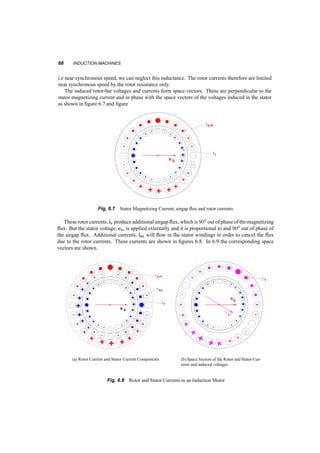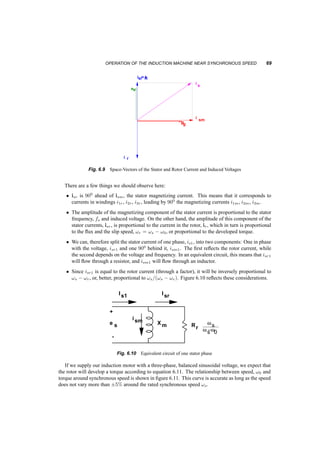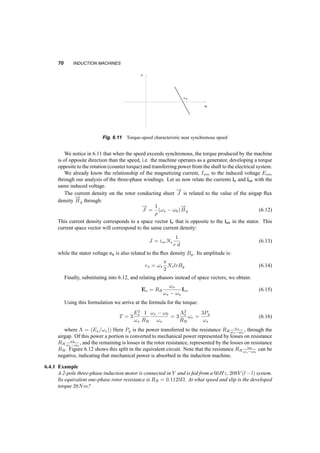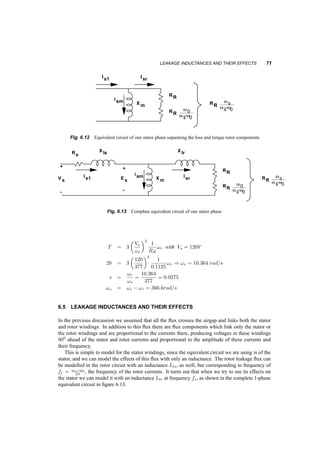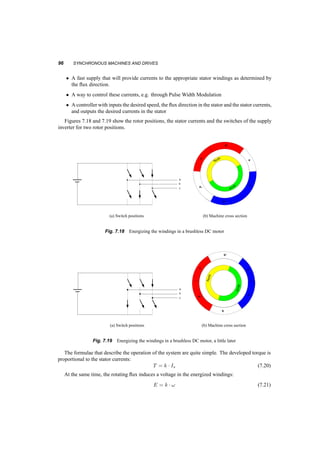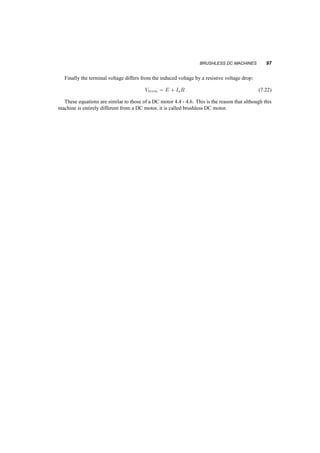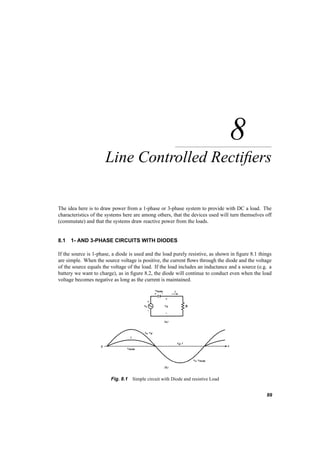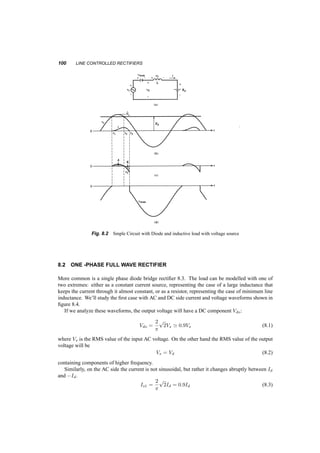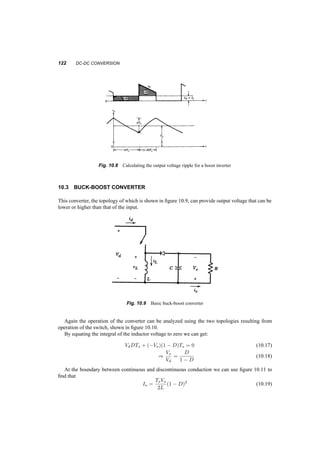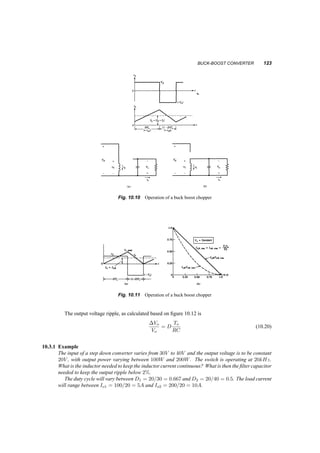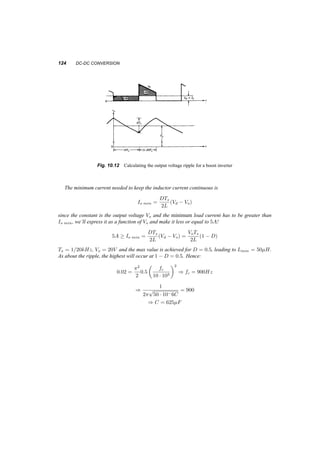


Notes 
for an Introductory Course 
On Electrical Machines 
and Drives 
E.G.Strangas 
MSU Electrical Machines and Drives Laboratory
Contents 
Preface ix 
1 Three Phase Circuits and Power 1 
1.1 Electric Power with steady state sinusoidal quantities 1 
1.2 Solving 1­phase 
problems 5 
1.3 Three­phase 
Balanced Systems 6 
1.4 Calculations in three­phase 
systems 9 
2 Magnetics 15 
2.1 Introduction 15 
2.2 The Governing Equations 15 
2.3 Saturation and Hysteresis 19 
2.4 Permanent Magnets 21 
2.5 Faraday’s Law 22 
2.6 Eddy Currents and Eddy Current Losses 25 
2.7 Torque and Force 27 
3 Transformers 29 
3.1 Description 29 
3.2 The Ideal Transformer 30 
3.3 Equivalent Circuit 32 
3.4 Losses and Ratings 36 
3.5 Per­unit 
System 37 
v
vi CONTENTS 
3.6 Transformer tests 40 
3.6.1 Open Circuit Test 41 
3.6.2 Short Circuit Test 41 
3.7 Three­phase 
Transformers 43 
3.8 Autotransformers 44 
4 Concepts of Electrical Machines; DC motors 47 
4.1 Geometry, Fields, Voltages, and Currents 47 
5 Three­phase 
Windings 53 
5.1 Current Space Vectors 53 
5.2 Stator Windings and Resulting Flux Density 55 
5.2.1 Balanced, Symmetric Three­phase 
Currents 58 
5.3 Phasors and space vectors 58 
5.4 Magnetizing current, Flux and Voltage 60 
6 Induction Machines 63 
6.1 Description 63 
6.2 Concept of Operation 64 
6.3 Torque Development 66 
6.4 Operation of the Induction Machine near Synchronous Speed 67 
6.5 Leakage Inductances and their Effects 71 
6.6 Operating characteristics 72 
6.7 Starting of Induction Motors 75 
6.8 Multiple pole pairs 76 
7 Synchronous Machines and Drives 81 
7.1 Design and Principle of Operation 81 
7.1.1 Wound Rotor Carrying DC 81 
7.1.2 Permanent Magnet Rotor 82 
7.2 Equivalent Circuit 82 
7.3 Operation of the Machine Connected to a Bus of Constant Voltage 
and Frequency 84 
7.4 Operation from a Source of Variable Frequency and Voltage 88 
7.5 Controllers for PMAC Machines 94 
7.6 Brushless DC Machines 95 
8 Line Controlled Rectifiers 99 
8.1 1­and 
3­Phase 
circuits with diodes 99 
8.2 One ­Phase 
Full Wave Rectifier 100 
8.3 Three­phase 
Diode Rectifiers 102 
8.4 Controlled rectifiers with Thyristors 103
CONTENTS vii 
8.5 One phase Controlled Rectifiers 104 
8.5.1 Inverter Mode 104 
8.6 Three­Phase 
Controlled Converters 106 
8.7 *Notes 107 
9 Inverters 109 
9.1 1­phase 
Inverter 109 
9.2 Three­phase 
Inverters 111 
10 DC­DC 
Conversion 117 
10.1 Step­Down 
or Buck Converters 117 
10.2 Step­up 
or Boost Converter 119 
10.3 Buck­boost 
Converter 122
Preface 
The purpose of these notes is be used to introduce Electrical Engineering students to Electrical 
Machines, Power Electronics and Electrical Drives. They are primarily to serve our students at 
MSU: they come to the course on Energy Conversion and Power Electronics with a solid background 
in Electric Circuits and Electromagnetics, and many want to acquire a basic working knowledge 
of the material, but plan a career in a different area (venturing as far as computer or mechanical 
engineering). Other students are interested in continuing in the study of electrical machines and 
drives, power electronics or power systems, and plan to take further courses in the field. 
Starting from basic concepts, the student is led to understand how force, torque, induced voltages 
and currents are developed in an electrical machine. Then models of the machines are developed, in 
terms of both simplified equations and of equivalent circuits, leading to the basic understanding of 
modern machines and drives. Power electronics are introduced, at the device and systems level, and 
electrical drives are discussed. 
Equations are kept to a minimum, and in the examples only the basic equations are used to solve 
simple problems. 
These notes do not aim to cover completely the subjects of Energy Conversion and Power 
Electronics, nor to be used as a reference, not even to be useful for an advanced course. They are 
meant only to be an aid for the instructor who is working with intelligent and interested students, 
who are taking their first (and perhaps their last) course on the subject. How successful this endeavor 
has been will be tested in the class and in practice. 
In the present form this text is to be used solely for the purposes of teaching the introductory 
course on Energy Conversion and Power Electronics at MSU. 
E.G.STRANGAS 
E. Lansing, Michigan and Pyrgos, Tinos 
ix
A Note on Symbols 
Throughout this text an attempt has been made to use symbols in a consistent way. Hence a script 
letter, say v denotes a scalar time varying quantity, in this case a voltage. Hence one can see 
v = 5 sin !t or v = ^v sin !t 
The same letter but capitalized denotes the rms value of the variable, assuming it is periodic. 
Hence: 
v = 
p 
2V sin!t 
The capital letter, but now bold, denotes a phasor: 
V = V ejµ 
Finally, the script letter, bold, denotes a space vector, i.e. a time dependent vector resulting from 
three time dependent scalars: 
v = v1 + v2ej° + v3ej2° 
In addition to voltages, currents, and other obvious symbols we have: 
B Magnetic flux Density (T) 
H Magnetic filed intensity (A/m) 
© Flux (Wb) (with the problem that a capital letter is used to show a time 
dependent scalar) 
¸, ¤, ¸ flux linkages (of a coil, rms, space vector) 
!s synchronous speed (in electrical degrees for machines with more than 
two­poles) 
!o rotor speed (in electrical degrees for machines with more than two­poles) 
!m rotor speed (mechanical speed no matter how many poles) 
!r angular frequency of the rotor currents and voltages (in electrical de­grees) 
T Torque (Nm) 
<(¢), =(¢) Real and Imaginary part of ¢ 
x
1 
Three Phase Circuits and Power 
Chapter Objectives 
In this chapter you will learn the following: 
² The concepts of power, (real reactive and apparent) and power factor 
² The operation of three­phase 
systems and the characteristics of balanced loads in Y and in ¢ 
² How to solve problems for three­phase 
systems 
1.1 ELECTRIC POWER WITH STEADY STATE SINUSOIDAL QUANTITIES 
We start from the basic equation for the instantaneous electric power supplied to a load as shown in 
figure 1.1 
 
 
+ 
v(t) 
i(t) 
Fig. 1.1 A simple load 
p(t) = i(t) ¢ v(t) (1.1) 
1
2 THREE PHASE CIRCUITS AND POWER 
where i(t) is the instantaneous value of current through the load and v(t) is the instantaneous value 
of the voltage across it. 
In quasi­steady 
state conditions, the current and voltage are both sinusoidal, with corresponding 
amplitudes^i 
and ^v, and initial phases, Ái and Áv, and the same frequency, ! = 2¼=T ¡ 2¼f: 
v(t) = ^v sin(!t + Áv) (1.2) 
i(t) = ^i 
sin(!t + Ái) (1.3) 
In this case the rms values of the voltage and current are: 
V = 
s 
1 
T 
Z T 
0 
^v [sin(!t + Áv)]2 dt = 
^v 
p 
2 
(1.4) 
I = 
s 
1 
T 
Z T 
0 
^i 
[sin(!t + Ái)]2 dt = 
^i 
p 
2 
(1.5) 
and these two quantities can be described by phasors, V = V 
6 Áv and I = I 
6 Ái . 
Instantaneous power becomes in this case: 
p(t) = 2V I [sin(!t + Áv) sin(!t + Ái)] 
= 2V I 
1 
2 
[cos(Áv ¡ Ái) + cos(2!t + Áv + Ái)] (1.6) 
The first part in the right hand side of equation 1.6 is independent of time, while the second part 
varies sinusoidally with twice the power frequency. The average power supplied to the load over 
an integer time of periods is the first part, since the second one averages to zero. We define as real 
power the first part: 
P = V I cos(Áv ¡ Ái) (1.7) 
If we spend a moment looking at this, we see that this power is not only proportional to the rms 
voltage and current, but also to cos(Áv ¡ Ái). The cosine of this angle we define as displacement 
factor, DF. At the same time, and in general terms (i.e. for periodic but not necessarily sinusoidal 
currents) we define as power factor the ratio: 
pf = P 
V I 
(1.8) 
and that becomes in our case (i.e. sinusoidal current and voltage): 
pf = cos(Áv ¡ Ái) (1.9) 
Note that this is not generally the case for non­sinusoidal 
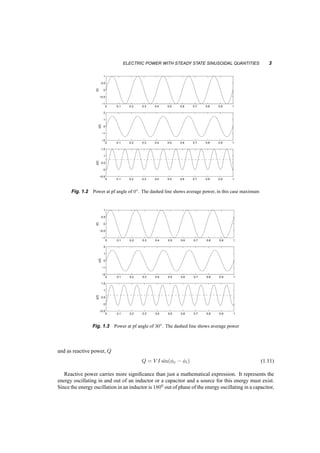
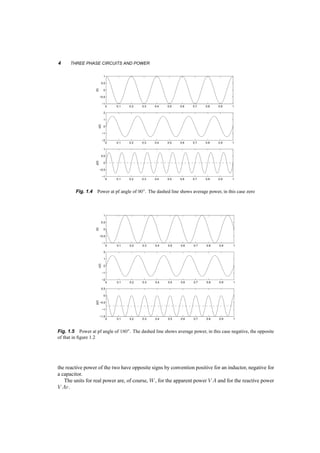
quantities. Figures 1.2 ­1.5 
show the cases 
of power at different angles between voltage and current. 
We call the power factor leading or lagging, depending on whether the current of the load leads 
or lags the voltage across it. It is clear then that for an inductive/resistive load the power factor is 
lagging, while for a capacitive/resistive load the power factor is leading. Also for a purely inductive 
or capacitive load the power factor is 0, while for a resistive load it is 1. 
We define the product of the rms values of voltage and current at a load as apparent power, S: 
S = V I (1.10)
ELECTRIC POWER WITH STEADY STATE SINUSOIDAL QUANTITIES 3 
0 0.1 0.2 0.3 0.4 0.5 0.6 0.7 0.8 0.9 1 
1 
0.5 
0 
−0.5 
−1 
i(t) 
0 0.1 0.2 0.3 0.4 0.5 0.6 0.7 0.8 0.9 1 
2 
1 
0 
−1 
−2 
u(t) 
0 0.1 0.2 0.3 0.4 0.5 0.6 0.7 0.8 0.9 1 
1.5 
1 
0.5 
0 
−0.5 
p(t) 
Fig. 1.2 Power at pf angle of 0o. The dashed line shows average power, in this case maximum 
0 0.1 0.2 0.3 0.4 0.5 0.6 0.7 0.8 0.9 1 
1 
0.5 
0 
−0.5 
−1 
i(t) 
0 0.1 0.2 0.3 0.4 0.5 0.6 0.7 0.8 0.9 1 
2 
1 
0 
−1 
−2 
u(t) 
0 0.1 0.2 0.3 0.4 0.5 0.6 0.7 0.8 0.9 1 
1.5 
1 
0.5 
0 
−0.5 
p(t) 
Fig. 1.3 Power at pf angle of 30o. The dashed line shows average power 
and as reactive power, Q 
Q = V I sin(Áv ¡ Ái) (1.11) 
Reactive power carries more significance than just a mathematical expression. It represents the 
energy oscillating in and out of an inductor or a capacitor and a source for this energy must exist. 
Since the energy oscillation in an inductor is 1800 out of phase of the energy oscillating in a capacitor,
4 THREE PHASE CIRCUITS AND POWER 
0 0.1 0.2 0.3 0.4 0.5 0.6 0.7 0.8 0.9 1 
1 
0.5 
0 
−0.5 
−1 
i(t) 
0 0.1 0.2 0.3 0.4 0.5 0.6 0.7 0.8 0.9 1 
2 
1 
0 
−1 
−2 
u(t) 
0 0.1 0.2 0.3 0.4 0.5 0.6 0.7 0.8 0.9 1 
1 
0.5 
0 
−0.5 
−1 
p(t) 
Fig. 1.4 Power at pf angle of 90o. The dashed line shows average power, in this case zero 
0 0.1 0.2 0.3 0.4 0.5 0.6 0.7 0.8 0.9 1 
1 
0.5 
0 
−0.5 
−1 
i(t) 
0 0.1 0.2 0.3 0.4 0.5 0.6 0.7 0.8 0.9 1 
2 
1 
0 
−1 
−2 
u(t) 
0 0.1 0.2 0.3 0.4 0.5 0.6 0.7 0.8 0.9 1 
0.5 
0 
−0.5 
−1 
−1.5 
p(t) 
Fig. 1.5 Power at pf angle of 180o. The dashed line shows average power, in this case negative, the opposite 
of that in figure 1.2 
the reactive power of the two have opposite signs by convention positive for an inductor, negative for 
a capacitor. 
The units for real power are, of course, W, for the apparent power V A and for the reactive power 
V Ar.
SOLVING 1­PHASE 
PROBLEMS 5 
Using phasors for the current and voltage allows us to define complex power S as: 
S = VI¤ (1.12) 
= V 
6 Áv I 
6 ¡Ái (1.13) 
and finally 
S = P + jQ (1.14) 
For example, when 
v(t) = 
p 
(2 ¢ 120 ¢ sin(377t + ¼ 
6 
)V (1.15) 
i(t) = 
p 
(2 ¢ 5 ¢ sin(377t + ¼ 
4 
)A (1.16) 
then S = V I = 120 ¢ 5 = 600W, while pf = cos(¼=6 ¡ ¼=4) = 0:966 leading. Also: 
S = VI¤ = 1206 ¼=6 56 ¡¼=4 = 579:6W ¡ j155:3V Ar (1.17) 
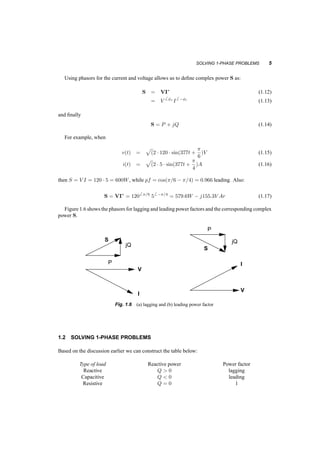
Figure 1.6 shows the phasors for lagging and leading power factors and the corresponding complex 
power S. 
S 
S 
jQ 
jQ 
P 
P 
V 
I 
V 
I 
Fig. 1.6 (a) lagging and (b) leading power factor 
1.2 SOLVING 1­PHASE 
PROBLEMS 
Based on the discussion earlier we can construct the table below: 
Type of load Reactive power Power factor 
Reactive Q  0 lagging 
Capacitive Q  0 leading 
Resistive Q = 0 1
6 THREE PHASE CIRCUITS AND POWER 
We also notice that if for a load we know any two of the four quantities, S, P, Q, pf, we can 
calculate the other two, e.g. if S = 100kV A, pf = 0:8 leading, then: 
P = S ¢ pf = 80kW 
Q = ¡S 
q 
1 ¡ pf2 = ¡60kV Ar ; or 
sin(Áv ¡ Ái) = sin [arccos 0:8] 
Q = S sin(Áv ¡ Ái) 
Notice that here Q  0, since the pf is leading, i.e. the load is capacitive. 
Generally in a system with more than one loads (or sources) real and reactive power balance, but 
not apparent power, i.e. Ptotal = 
P 
i Pi, Qtotal = 
P 
i Qi, but Stotal6= 
P 
i Si. 
In the same case, if the load voltage were VL = 2000V , the load current would be IL = S=V 
= 100 ¢ 103=2 ¢ 103 = 50A. If we use this voltage as reference, then: 
V = 20006 0V 
I = 506 Ái = 506 36:9o 
A 
S = V I¤ = 20006 0 ¢ 506 ¡36:9o = P + jQ = 80 ¢ 103W ¡ j60 ¢ 103V Ar 
1.3 THREE­PHASE 
BALANCED SYSTEMS 
Compared to single phase systems, three­phase 
systems offer definite advantages: for the same power 
and voltage there is less copper in the windings, and the total power absorbed remains constant rather 
than oscillate around its average value. 
Let us take now three sinusoidal­current 
sources that have the same amplitude and frequency, but 
their phase angles differ by 1200. They are: 
i1(t) = 
p 
2I sin(!t + Á) 
i2(t) = 
p 
2I sin(!t + Á ¡ 
2¼ 
3 
) (1.18) 
i3(t) = 
p 
2I sin(!t + Á + 
2¼ 
3 
) 
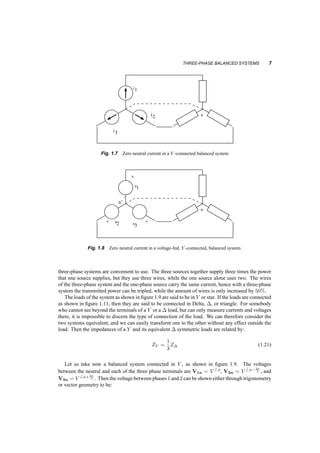
If these three current sources are connected as shown in figure 1.7, the current returning though node 
n is zero, since: 
sin(!t + Á) + sin(!t ¡ Á + 
2¼ 
3 
) + sin(!t + Á + 
2¼ 
3 
) ´ 0 (1.19) 
Let us also take three voltage sources: 
va(t) = 
p 
2V sin(!t + Á) 
vb(t) = 
p 
2V sin(!t + Á ¡ 
2¼ 
3 
) (1.20) 
vc(t) = 
p 
2V sin(!t + Á + 
2¼ 
3 
) 
connected as shown in figure 1.8. If the three impedances at the load are equal, then it is easy 
to prove that the current in the branch n ¡ n0 is zero as well. Here we have a first reason why
THREE­PHASE 
BALANCED SYSTEMS 7 
n 
i1 
i2 
i3 
Fig. 1.7 Zero neutral current in a Y ­connected 
balanced system 
n 
+ 
v 
’ 
n’ 
+ + 
v v 
1 
2 3 
Fig. 1.8 Zero neutral current in a voltage­fed, 
Y ­connected, 
balanced system. 
three­phase 
systems are convenient to use. The three sources together supply three times the power 
that one source supplies, but they use three wires, while the one source alone uses two. The wires 
of the three­phase 
system and the one­phase 
source carry the same current, hence with a three­phase 
system the transmitted power can be tripled, while the amount of wires is only increased by 50%. 
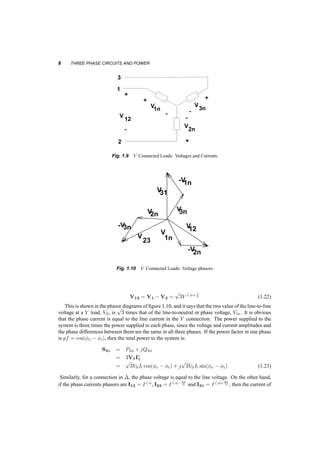
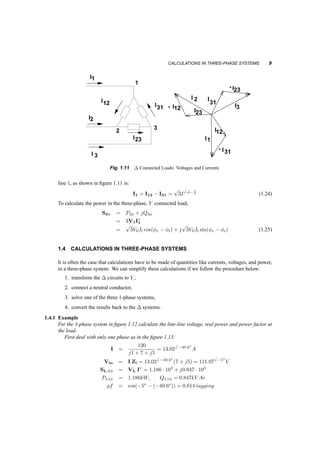
The loads of the system as shown in figure 1.9 are said to be in Y or star. If the loads are connected 
as shown in figure 1.11, then they are said to be connected in Delta, ¢, or triangle. For somebody 
who cannot see beyond the terminals of a Y or a ¢ load, but can only measure currents and voltages 
there, it is impossible to discern the type of connection of the load. We can therefore consider the 
two systems equivalent, and we can easily transform one to the other without any effect outside the 
load. Then the impedances of a Y and its equivalent ¢ symmetric loads are related by: 
ZY = 
1 
3Z¢ (1.21) 
Let us take now a balanced system connected in Y , as shown in figure 1.9. The voltages 
between the neutral and each of the three phase terminals are V1n = V 
6 Á, V2n = V 
6 Á¡2¼ 
3 , and 
V3n = V 
6 Á+2¼ 
3 . Then the voltage between phases 1 and 2 can be shown either through trigonometry 
or vector geometry to be:
8 THREE PHASE CIRCUITS AND POWER 
1 I 
2 I2 
1 
I 2 
+ + 
V 
- I31 
I 
3n 
- 
1 I 
- I12 
23 
3 
2 
+ 
+ 
12 
1 
- - 
+ + 
- 
V 
- - 
+ 
I 
I 
I 
1 
12 
23 
31 
I 3 
2 3 
I2 
- 
V1n 
2n 
I 
I23 
I 
I3 
-V1n 
- 
Fig. 1.9 Y Connected Loads: Voltages and Currents 
-V3n 
V31 
V V3n 2n 
V12 
V 
V V3n 2n 
-V2n 
12 
V 
I31 
V 
23 1n 
1 
I 2 
V 
3n 
- I12 
- 3 
2 
12 
1 
V 
+ 
I 
12 
I 3 
- 
V1n 
2n 
I 
I23 
I 
-V1n 
-V3n 
V31 
V12 
V 
-V2n 
12 
V 
I31 
V 
23 1n 
Fig. 1.10 Y Connected Loads: Voltage phasors 
V12 = V1 ¡ V2 = 
p 
3V 
6 Á+¼3 
(1.22) 
This is shown in the phasor diagrams of figure 1.10, and it says that the rms value of the line­to­line 
voltage at a Y load, Vll, is 
p 
3 times that of the line­to­neutral 
or phase voltage, Vln. It is obvious 
that the phase current is equal to the line current in the Y connection. The power supplied to the 
system is three times the power supplied to each phase, since the voltage and current amplitudes and 
the phase differences between them are the same in all three phases. If the power factor in one phase 
is pf = cos(Áv ¡ Ái), then the total power to the system is: 
S3Á = P3Á + jQ3Á 
= 3V1I¤ 
1 
= 
p 
3VllIl cos(Áv ¡ Ái) + j 
p 
3VllIl sin(Áv ¡ Ái) (1.23) 
Similarly, for a connection in ¢, the phase voltage is equal to the line voltage. On the other hand, 
if the phase currents phasors are I12 = 6 I 
Á, I23 = 6 I 
Á¡2¼ 
3 and I31 = 6 I 
Á+2¼ 
3 , then the current of
CALCULATIONS IN THREE­PHASE 
SYSTEMS 9 
+ + 
I31 
1 
- - 
V V3n 2n 
I 2 
V 
- I31 
I 
3n 
- 
1 I 
V 
- I12 
23 
- - 
- 
V 
+ 
+ 
+ 
I 
I 
I 
1 
12 
23 
31 
I 3 
2 3 
I2 
V1n 
2n 
I 
- 
I23 
I 
I3 
-V1n 
V31 
V3n -V12 
V2n 
12 
V 
1n 
1 
I 2 
V 
- I31 
I 
3n 
- 
- I12 
23 
2 
12 
1 
V 
+ 
I 
I 
I 
12 
23 
31 
I 3 
2 3 
I2 
- 
V1n 
2n 
I 
I23 
I 
I3 
-V1n 
-V3n 
V31 
V12 
V 
-V2n 
12 
V 
I31 
23 1n 
Fig. 1.11 ¢ Connected Loads: Voltages and Currents 
line 1, as shown in figure 1.11 is: 
I1 = I12 ¡ I31 = 
p 
3I 
6 Á¡¼3 
(1.24) 
To calculate the power in the three­phase, 
Y connected load, 
S3Á = P3Á + jQ3Á 
= 3V1I¤ 
1 
= 
p 
3VllIl cos(Áv ¡ Ái) + j 
p 
3VllIl sin(Áv ¡ Ái) (1.25) 
1.4 CALCULATIONS IN THREE­PHASE 
SYSTEMS 
It is often the case that calculations have to be made of quantities like currents, voltages, and power, 
in a three­phase 
system. We can simplify these calculations if we follow the procedure below: 
1. transform the ¢ circuits to Y , 
2. connect a neutral conductor, 
3. solve one of the three 1­phase 
systems, 
4. convert the results back to the ¢ systems. 
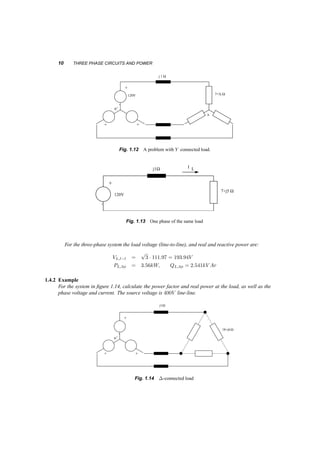
1.4.1 Example 
For the 3­phase 
system in figure 1.12 calculate the line­line 
voltage, real power and power factor at 
the load. 
First deal with only one phase as in the figure 1.13: 
I = 
120 
j1 + 7 + j5 
= 13:026 ¡40:6o 
A 
Vln = I Zl = 13:026 ¡40:6o(7 + j5) = 111:976 ¡5o 
V 
SL;1Á = VL I¤ = 1:186 ¢ 103 + j0:847 ¢ 103 
PL1Á = 1:186kW; QL1Á = 0:847kV Ar 
pf = cos(¡5o ¡ (¡40:6o)) = 0:814 lagging
10 THREE PHASE CIRCUITS AND POWER 
n 
+ 
’ 
n’ 
+ + 
j 1 
7+5j W 
W 
120V 
Fig. 1.12 A problem with Y connected load. 
+ 
’ 
W 
W I L 
120V 
j1 
7+j5 
Fig. 1.13 One phase of the same load 
For the three­phase 
system the load voltage (line­to­line), 
and real and reactive power are: 
VL;l¡l = 
p 
3 ¢ 111:97 = 193:94V 
PL;3Á = 3:56kW; QL;3Á = 2:541kV Ar 
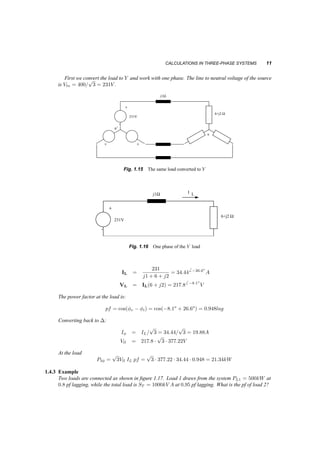
1.4.2 Example 
For the system in figure 1.14, calculate the power factor and real power at the load, as well as the 
phase voltage and current. The source voltage is 400V line­line. 
+ 
’ 
n’ 
+ + 
120V 
j1W 
18+j6W 
Fig. 1.14 ¢­connected 
load
CALCULATIONS IN THREE­PHASE 
SYSTEMS 11 
First we convert the load to Y and work with one phase. The line to neutral voltage of the source 
p 
3 = 231V . 
is Vln = 400= 
n 
+ 
’ 
n’ 
+ + 
W 
j1 
231V 
6+j2 
W 
Fig. 1.15 The same load converted to Y 
+ 
’ 
W 
j1 
231V 
6+j2 
W I L 
Fig. 1.16 One phase of the Y load 
IL = 
231 
j1 + 6 + j2 
= 34:446 ¡26:6o 
A 
VL = IL(6 + j2) = 217:86 ¡8:1o 
V 
The power factor at the load is: 
pf = cos(Áv ¡ Ái) = cos(¡8:1o + 26:6o) = 0:948lag 
Converting back to ¢: 
p 
3 = 34:44= 
IÁ = IL= 
p 
3 = 19:88A 
Vll = 217:8 ¢ 
p 
3 ¢ 377:22V 
At the load 
P3Á = 
p 
3Vll IL pf = 
p 
3 ¢ 377:22 ¢ 34:44 ¢ 0:948 = 21:34kW 
1.4.3 Example 
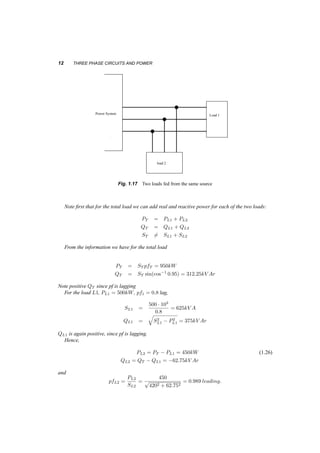
Two loads are connected as shown in figure 1.17. Load 1 draws from the system PL1 = 500kW at 
0:8 pf lagging, while the total load is ST = 1000kV A at 0:95 pf lagging. What is the pf of load 2?
12 THREE PHASE CIRCUITS AND POWER 
W 
Load 1 
load 2 
Power System 
Fig. 1.17 Two loads fed from the same source 
Note first that for the total load we can add real and reactive power for each of the two loads: 
PT = PL1 + PL2 
QT = QL1 + QL2 
ST6= SL1 + SL2 
From the information we have for the total load 
PT = ST pfT = 950kW 
QT = ST sin(cos¡1 0:95) = 312:25kV Ar 
Note positive QT since pf is lagging 
For the load L1, PL1 = 500kW, pf1 = 0:8 lag, 
SL1 = 
500 ¢ 103 
0:8 
= 625kV A 
QL1 = 
q 
S2L 
1 ¡ P2L 
1 = 375kV Ar 
QL1 is again positive, since pf is lagging. 
Hence, 
PL2 = PT ¡ PL1 = 450kW (1.26) 
QL2 = QT ¡ QL1 = ¡62:75kV Ar 
and 
pfL2 = PL2 
SL2 
= 
450 
p 
4202 + 62:752 
= 0:989 leading:
CALCULATIONS IN THREE­PHASE 
SYSTEMS 13 
Notes 
² A sinusoidal signal can be described uniquely by: 
1. as e.g. v(t) = 5 sin(2¼ft + Áv), 
2. by its graph, 
3. as a phasor and the associated frequency. 
one of these descriptions is enough to produce the other two. As an exercise, convert between 
phasor, trigonometric expression and time plots of a sinusoid waveform. 
² It is the phase difference that is important in power calculations, not phase. The phase alone of 
a sinusoidal quantity does not really matter. We need it to solve circuit problems, after we take 
one quantity (a voltage or a current) as reference, i.e. we assign to it an arbitrary value, often 
0. There is no point in giving the phase of currents and voltages as answers, and, especially 
for line­line 
voltages or currents in ¢ circuits, these numbers are often wrong and anyway 
meaningless. 
² In both 3­phase 
and 1­phase 
systems the sum of the real power and the sum of the reactive 
power of individual loads are equal respectively to the real and reactive power of the total load. 
This is not the case for apparent power and of course not for power factor. 
² Of the four quantities, real power, reactive power, apparent power and power factor, any two 
describe a load adequately. The other two can be calculated from them. 
² To calculate real reactive and apparent Power when using formulae 1.7, 1.10 1.11 we have to 
use absolute not complex values of the currents and voltages. To calculate complex power 
using 1.12 we do use complex currents and voltages and find directly both real and reactive 
power. 
² When solving a circuit to calculate currents and voltages, use complex impedances, currents 
and voltages. 
² Notice two different and equally correct formulae for 3­phase 
power.
2 
Magnetics 
Chapter Objectives 
In this chapter you will learn the following: 
² How Maxwell’s equations can be simplified to solve simple practical magnetic problems 
² The concepts of saturation and hysteresis of magnetic materials 
² The characteristics of permanent magnets and how they can be used to solve simple problems 
² How Faraday’s law can be used in simple windings and magnetic circuits 
² Power loss mechanisms in magnetic materials 
² How force and torque is developed in magnetic fields 
2.1 INTRODUCTION 
Since a good part of electromechanical energy conversion uses magnetic fields it is important early 
on to learn (or review) how to solve for the magnetic field quantities in simple geometries and under 
certain assumptions. One such assumption is that the frequency of all the variables is low enough 
to neglect all displacement currents. Another is that the media (usually air, aluminum, copper, steel 
etc.) are homogeneous and isotropic. We’ll list a few more assumptions as we move along. 
2.2 THE GOVERNING EQUATIONS 
We start with Maxwell’s equations, describing the characteristics of the magnetic field at low fre­quencies. 
First we use: 
r ¢ B = 0 (2.1) 
15
16 MAGNETICS 
the integral form of which is: 
Z 
B ¢ dA ´ 0 (2.2) 
for any path. This means that there is no source of flux, and that all of its lines are closed. 
Secondly we use I 
H¢ dl = 
Z 
A 
J ¢ dA (2.3) 
where the closed loop is defining the boundary of the surface A. Finally, we use the relationship 
between H, the strength of the magnetic field, and B, the induction or flux density. 
B = ¹r¹0H (2.4) 
where ¹0 is the permeability of free space, 4¼10¡7Tm=A, and ¹r is the relative permeability of the 
material, 1 for air or vacuum, and a few hundred thousand for magnetic steel. 
There is a variety of ways to solve a magnetic circuit problem. The equations given above, along 
with the conditions on the boundary of our geometry define a boundary value problem. Analytical 
methods are available for relatively simple geometries, and numerical methods, like Finite Elements 
Analysis, for more complex geometries. 
Here we’ll limit ourselves to very simple geometries. We’ll use the equations above, but we’ll add 
boundary conditions and some more simplifications. These stem from the assumption of existence 
of an average flux path defined within the geometry. Let’s tackle a problem to illustrate it all. In 
r 
g 
i 
airgap 
Fig. 2.1 A simple magnetic circuit 
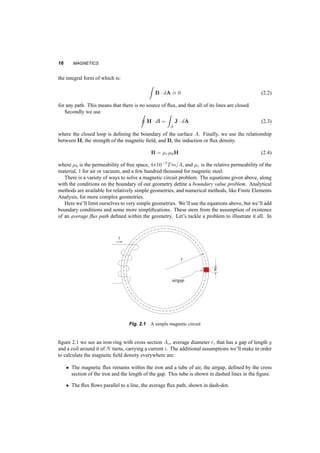
figure 2.1 we see an iron ring with cross section Ac, average diameter r, that has a gap of length g 
and a coil around it of N turns, carrying a current i. The additional assumptions we’ll make in order 
to calculate the magnetic field density everywhere are: 
² The magnetic flux remains within the iron and a tube of air, the airgap, defined by the cross 
section of the iron and the length of the gap. This tube is shown in dashed lines in the figure. 
² The flux flows parallel to a line, the average flux path, shown in dash­dot.
THE GOVERNING EQUATIONS 17 
² Flux density is uniform at any cross­section 
and perpendicular to it. 
Following one flux line, the one coinciding with the average path, we write: 
I 
H¢ dl = 
Z 
J ¢ dA (2.5) 
where the second integral extends over any surface (a bubble) terminating on the path of integration. 
But equation 2.2, together with the first assumption assures us that for any cross section of the 
geometry the flux, © = 
R 
Ac 
B¢ dA = BavgAc, is constant. Since both the cross section and the flux 
are the same in the iron and the air gap, then 
Biron = Bair 
¹ironHiron = ¹airHair 
(2.6) 
and finally 
Hiron(2¼r ¡ g) + Hgap ¢ · 
¸ 
g = Ni ¹air 
(2¼r ¡ g) + g 
Hgap = Ni 
¹iron 
l 
A 
A 
c 
y 
Hy1 Hy2 
Hr 
Hl 
g 
c 
y y 
Fig. 2.2 A slightly complex magnetic circuit 
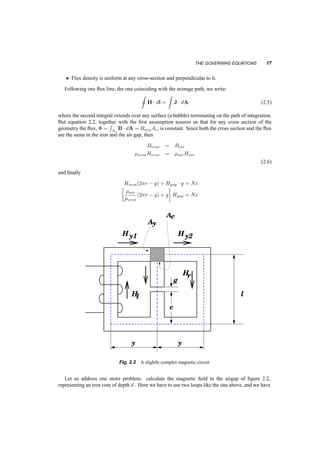
Let us address one more problem: calculate the magnetic field in the airgap of figure 2.2, 
representing an iron core of depth d . Here we have to use two loops like the one above, and we have
18 MAGNETICS 
a choice of possible three. Taking the one that includes the legs of the left and in the center, and the 
outer one, we can write: 
Hl ¢ l + Hy1 ¢ y + Hc ¢ c + Hg ¢ g + Hc ¢ c + Hy1 ¢ y = Ni (2.7) 
Hl ¢ h + 2Hy1 ¢ y + Hr ¢ l + 2Hy2 ¢ y = Ni 
Applying equation 2.3 to the closed surface shown shaded we also obtain: 
Bl Ay ¡ Bc Ac ¡ BrAy = 0 
and of course 
Bl = ¹ Hl; Bc = ¹ Hc; Br = ¹ Hr Bg = ¹0Hg 
The student can complete the problem. We notice though something interesting: a similarity 
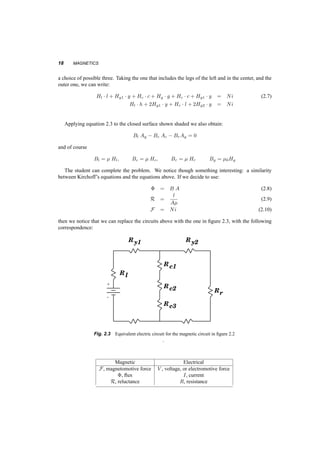
between Kirchoff’s equations and the equations above. If we decide to use: 
© = B A (2.8) 
R = l 
A¹ 
(2.9) 
F = Ni (2.10) 
then we notice that we can replace the circuits above with the one in figure 2.3, with the following 
correspondence: 
+ 
- 
R 
R 
R 
R 
R 
R 
y2 
r 
c1 
c2 
c3 
l 
Ry1 
Fig. 2.3 Equivalent electric circuit for the magnetic circuit in figure 2.2 
. 
Magnetic Electrical 
F, magnetomotive force V , voltage, or electromotive force 
©, flux I, current 
R, reluctance R, resistance
SATURATION AND HYSTERESIS 19 
This is of course a great simplification for students who have spent a lot of effort on electrical 
circuits, but there are some differences. One is the nonlinearity of the media in which the magnetic 
field lives, particularly ferrous materials. This nonlinearity makes the solution of direct problems a 
little more complex (problems of the type: for given flux find the necessary current) and the inverse 
problems more complex and sometimes impossible to solve without iterations (problems of the type: 
for given currents find the flux). 
2.3 SATURATION AND HYSTERESIS 
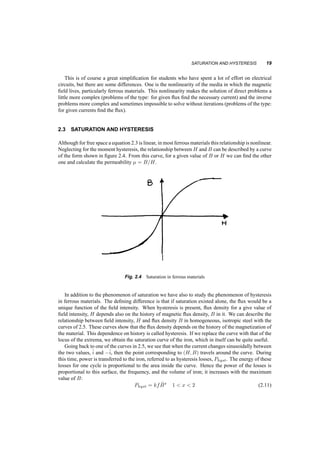
Although for free space a equation 2.3 is linear, in most ferrous materials this relationship is nonlinear. 
Neglecting for the moment hysteresis, the relationship between H and B can be described by a curve 
of the form shown in figure 2.4. From this curve, for a given value of B or H we can find the other 
one and calculate the permeability ¹ = B=H. 
Fig. 2.4 Saturation in ferrous materials 
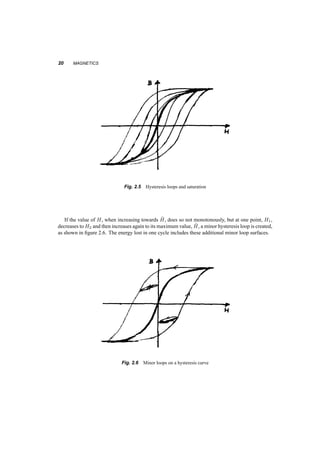
In addition to the phenomenon of saturation we have also to study the phenomenon of hysteresis 
in ferrous materials. The defining difference is that if saturation existed alone, the flux would be a 
unique function of the field intensity. When hysteresis is present, flux density for a give value of 
field intensity, H depends also on the history of magnetic flux density, B in it. We can describe the 
relationship between field intensity, H and flux density B in homogeneous, isotropic steel with the 
curves of 2.5. These curves show that the flux density depends on the history of the magnetization of 
the material. This dependence on history is called hysteresis. If we replace the curve with that of the 
locus of the extrema, we obtain the saturation curve of the iron, which in itself can be quite useful. 
Going back to one of the curves in 2.5, we see that when the current changes sinusoidally between 
the two values,^i 
and ¡^i 
, then the point corresponding to (H;B) travels around the curve. During 
this time, power is transferred to the iron, referred to as hysteresis losses, Physt. The energy of these 
losses for one cycle is proportional to the area inside the curve. Hence the power of the losses is 
proportional to this surface, the frequency, and the volume of iron; it increases with the maximum 
value of B: 
Physt = kf ^B 
x 1  x  2 (2.11)
20 MAGNETICS 
Fig. 2.5 Hysteresis loops and saturation 
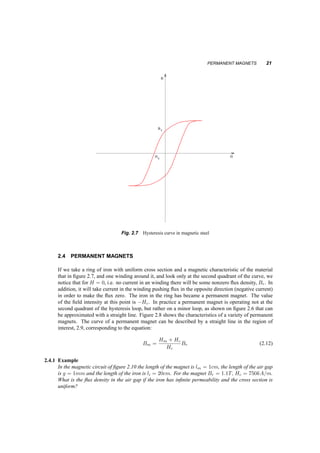
If the value of H, when increasing towards ^H 
, does so not monotonously, but at one point, H1, 
decreases toH2 and then increases again to its maximum value, ^H 
, a minor hysteresis loop is created, 
as shown in figure 2.6. The energy lost in one cycle includes these additional minor loop surfaces. 
Fig. 2.6 Minor loops on a hysteresis curve
PERMANENT MAGNETS 21 
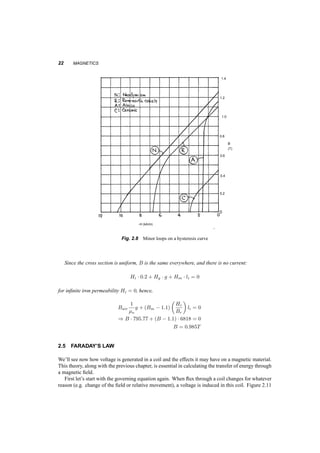
B 
Br 
Hc H 
Fig. 2.7 Hysteresis curve in magnetic steel 
2.4 PERMANENT MAGNETS 
If we take a ring of iron with uniform cross section and a magnetic characteristic of the material 
that in figure 2.7, and one winding around it, and look only at the second quadrant of the curve, we 
notice that for H = 0, i.e. no current in an winding there will be some nonzero flux density, Br. In 
addition, it will take current in the winding pushing flux in the opposite direction (negative current) 
in order to make the flux zero. The iron in the ring has became a permanent magnet. The value 
of the field intensity at this point is ¡Hc. In practice a permanent magnet is operating not at the 
second quadrant of the hysteresis loop, but rather on a minor loop, as shown on figure 2.6 that can 
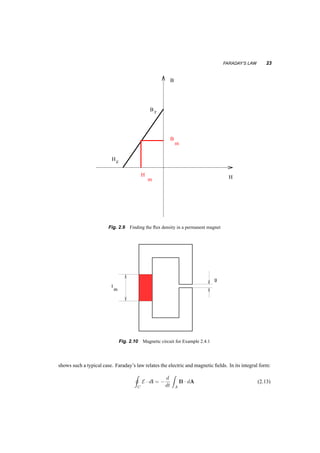
be approximated with a straight line. Figure 2.8 shows the characteristics of a variety of permanent 
magnets. The curve of a permanent magnet can be described by a straight line in the region of 
interest, 2.9, corresponding to the equation: 
Bm = Hm + Hc 
Hc 
Br (2.12) 
2.4.1 Example 
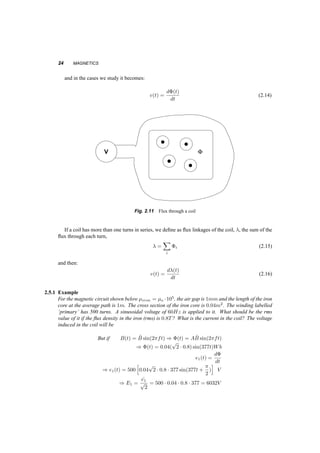
In the magnetic circuit of figure 2.10 the length of the magnet is lm = 1cm, the length of the air gap 
is g = 1mm and the length of the iron is li = 20cm. For the magnet Br = 1:1T, Hc = 750kA=m. 
What is the flux density in the air gap if the iron has infinite permeability and the cross section is 
uniform?
22 MAGNETICS 
1.4 
1.2 
1.0 
0.8 
B 
0.6 
(T) 
0.4 
0.2 
-H (kA/m) 
Fig. 2.8 Minor loops on a hysteresis curve 
Since the cross section is uniform, B is the same everywhere, and there is no current: 
Hi ¢ 0:2 + Hg ¢ g + Hm ¢ li = 0 
for infinite iron permeability Hi = 0, hence, 
Bair 
1 
¹o 
g + (Bm ¡ 1:1) 
µ 
Hc 
Br 
¶ 
li = 0 
) B ¢ 795:77 + (B ¡ 1:1) ¢ 6818 = 0 
B = 0:985T 
2.5 FARADAY’S LAW 
We’ll see now how voltage is generated in a coil and the effects it may have on a magnetic material. 
This theory, along with the previous chapter, is essential in calculating the transfer of energy through 
a magnetic field. 
First let’s start with the governing equation again. When flux through a coil changes for whatever 
reason (e.g. change of the field or relative movement), a voltage is induced in this coil. Figure 2.11
FARADAY’S LAW 23 
Br 
Hc 
H 
B 
B 
m 
H 
m 
Fig. 2.9 Finding the flux density in a permanent magnet 
m 
l 
g 
Fig. 2.10 Magnetic circuit for Example 2.4.1 
shows such a typical case. Faraday’s law relates the electric and magnetic fields. In its integral form: 
I 
C 
E ¢ dl = ¡ 
d 
dt 
Z 
A 
B ¢ dA (2.13)
24 MAGNETICS 
and in the cases we study it becomes: 
v(t) = d©(t) 
dt 
(2.14) 
V F 
Fig. 2.11 Flux through a coil 
If a coil has more than one turns in series, we define as flux linkages of the coil, ¸, the sum of the 
flux through each turn, 
¸ = 
X 
i 
©i (2.15) 
and then: 
v(t) = d¸(t) 
dt 
(2.16) 
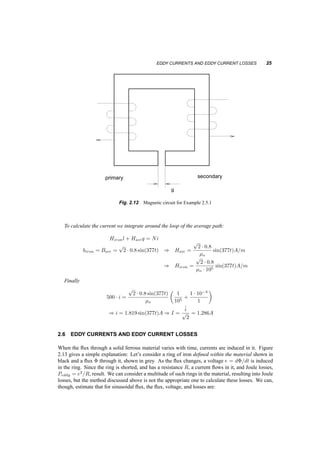
2.5.1 Example 
For the magnetic circuit shown below ¹iron = ¹o ¢ 105, the air gap is 1mmand the length of the iron 
core at the average path is 1m. The cross section of the iron core is 0:04m2. The winding labelled 
‘primary’ has 500 turns. A sinusoidal voltage of 60Hz is applied to it. What should be the rms 
value of it if the flux density in the iron (rms) is 0:8T? What is the current in the coil? The voltage 
induced in the coil will be 
But if B(t) = ^B 
sin(2¼ft) ) ©(t) = A^B 
sin(2¼ft) 
p 
2 ¢ 0:8) sin(377t)Wb 
) ©(t) = 0:04( 
e1(t) = d© 
dt 
) e1(t) = 500 
h 
0:04 
p 
2 ¢ 0:8 ¢ 377 sin(377t + ¼ 
2 
i 
) 
V 
) E1 = 
e^1 p 
2 
= 500 ¢ 0:04 ¢ 0:8 ¢ 377 = 6032V
EDDY CURRENTS AND EDDY CURRENT LOSSES 25 
primary secondary 
g 
Fig. 2.12 Magnetic circuit for Example 2.5.1 
To calculate the current we integrate around the loop of the average path: 
Hironl + Hairg = Ni 
biron = Bair = 
p 
2 ¢ 0:8 sin(377t) ) Hair = 
p 
2 ¢ 0:8 
¹o 
sin(377t)A=m 
) Hiron = 
p 
2 ¢ 0:8 
¹o ¢ 105 sin(377t)A=m 
Finally 
500 ¢ i = 
p 
2 ¢ 0:8 sin(377t) 
¹o 
µ 
1 
105 + 
1 ¢ 10¡3 
1 
¶ 
) i = 1:819 sin(377t)A ) I = 
^i 
p 
2 
= 1:286A 
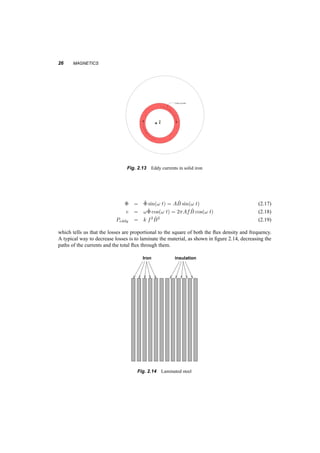
2.6 EDDY CURRENTS AND EDDY CURRENT LOSSES 
When the flux through a solid ferrous material varies with time, currents are induced in it. Figure 
2.13 gives a simple explanation: Let’s consider a ring of iron defined within the material shown in 
black and a flux © through it, shown in grey. As the flux changes, a voltage e = d©=dt is induced 
in the ring. Since the ring is shorted, and has a resistance R, a current flows in it, and Joule losses, 
Peddy = e2=R, result. We can consider a multitude of such rings in the material, resulting into Joule 
losses, but the method discussed above is not the appropriate one to calculate these losses. We can, 
though, estimate that for sinusoidal flux, the flux, voltage, and losses are:
26 MAGNETICS
Fig. 2.13 Eddy currents in solid iron 
© = ^© 
sin(! t) = A^B 
sin(! t) (2.17) 
e = !^© 
cos(! t) = 2¼Af ^B 
cos(! t) (2.18) 
Peddy = k f2^B 
2 (2.19) 
which tells us that the losses are proportional to the square of both the flux density and frequency. 
A typical way to decrease losses is to laminate the material, as shown in figure 2.14, decreasing the 
paths of the currents and the total flux through them. 
Iron insulation 
Fig. 2.14 Laminated steel
TORQUE AND FORCE 27 
2.7 TORQUE AND FORCE 
Calculating these is quite more complex, since Maxwell’s equations do not refer directly to them. 
The most reasonable approach is to start from energy balance. Then the energy in the firles Wf is 
the sum of the energy that entered through electrical and mechanical sources. 
Wf = 
X 
We + 
X 
Wm (2.20) 
This in turn can lead to the calculation of the forces since 
XK 
k=1 
fkdxk = 
XJ 
j=1 
ej ijdt ¡ dWf (2.21) 
Hence for a small movement, dxk, the energies in the equation should be evaluated and from 
these, forces (or torques), fk, calculated. 
Alternatively, although starting from the same principles, one can use the Maxwell stress tensor 
to find forces or torques on enclosed volumes, calculate forces using the Lorenz force equation, here 
F = liB, or use directly the balance of energy. Here we’ll use only this last method, e.g. balance 
the mechanical and electrical energies. 
In a mechanical system with a force F acting on a body and moving it at velocity v in its direction, 
the power Pmech is 
Pmech = F ¢ v (2.22) 
This eq. 2.22, becomes for a rotating system with torque T, rotating a body with angular velocity 
!mech: 
Pmech = T ¢ wmech (2.23) 
On the other hand, an electrical source e, supplying current i to a load provides electrical power 
Pelec 
Pelec = e ¢ i (2.24) 
Since power has to balance, if there is no change in the field energy, 
Pelec = Pmech ) T ¢ wmech = e ¢ i (2.25) 
Notes 
² It is more reasonable to solve magnetic circuits starting from the integral form of Maxwell’s 
equations than finding equivalent resistance, voltage and current. This also makes it easier to 
use saturation curves and permanent magnets. 
² Permanent magnets do not have flux density equal to BR. Equation 2.12defines the relation 
between the variables, flux density Bm and field intensity Hm in a permanent magnet. 
² There are two types of iron losses: eddy current losses that are proportional to the square of 
the frequency and the square of the flux density, and hysteresis losses that are proportional to 
the frequency and to some power x of the flux density.
3 
Transformers 
Although transformers have no moving parts, they are essential to electromechanical energy conver­sion. 
They make it possible to increase or decrease the voltage so that power can be transmitted at 
a voltage level that results in low costs, and can be distributed and used safely. In addition, they can 
provide matching of impedances, and regulate the flow of power (real or reactive) in a network. 
In this chapter we’ll start from basic concepts and build the equations and circuits corresponding 
first to an ideal transformer and then to typical transformers in use. We’ll introduce and work with 
the per unit system and will cover three­phase 
transformers as well. 
After working on this chapter, you’ll be able to: 
² Choose the correct rating and characteristics of a transformer for a specific application, 
² Calculate the losses, efficiency, and voltage regulation of a transformer under specific operating 
conditions, 
² Experimentally determine the transformer parameters given its ratings. 
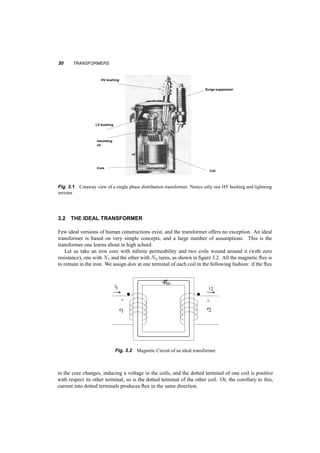
3.1 DESCRIPTION 
When we see a transformer on a utility pole all we see is a cylinder with a few wires sticking out. 
These wires enter the transformer through bushings that provide isolation between the wires and 
the tank. Inside the tank there is an iron core linking coils, most probably made with copper, and 
insulated. The system of insulation is also associated with that of cooling the core/coil assembly. 
Often the insulation is paper, and the whole assembly may be immersed in insulating oil, used to 
both increase the dielectric strength of the paper and to transfer heat from the core­coil 
assembly to 
the outer walls of the tank to the air. Figure 3.1 shows the cutout of a typical distribution transformer 
29
30 TRANSFORMERS 
Surge suppressor 
Coil 
HV bushing 
LV bushing 
Insulating 
oil 
Core 
Fig. 3.1 Cutaway view of a single phase distribution transformer. Notice only one HV bushing and lightning 
arrester 
3.2 THE IDEAL TRANSFORMER 
Few ideal versions of human constructions exist, and the transformer offers no exception. An ideal 
transformer is based on very simple concepts, and a large number of assumptions. This is the 
transformer one learns about in high school. 
Let us take an iron core with infinite permeability and two coils wound around it (with zero 
resistance), one with N1 and the other with N2 turns, as shown in figure 3.2. All the magnetic flux is 
to remain in the iron. We assign dots at one terminal of each coil in the following fashion: if the flux 
i2 
+ 
2 
m 
+ 
1 
e1 e 
i 
F 
Fig. 3.2 Magnetic Circuit of an ideal transformer 
in the core changes, inducing a voltage in the coils, and the dotted terminal of one coil is positive 
with respect its other terminal, so is the dotted terminal of the other coil. Or, the corollary to this, 
current into dotted terminals produces flux in the same direction.
THE IDEAL TRANSFORMER 31 
Assume that somehow a time varying flux, ©(t), is established in the iron. Then the flux linkages 
in each coil will be ¸1 = N1©(t) and ¸2 = N2©(t). Voltages will be induced in these two coils: 
e1(t) = d¸1 
dt 
= N1 
d© 
dt 
(3.1) 
e2(t) = d¸2 
dt 
= N2 
d© 
dt 
(3.2) 
and dividing: 
e1(t) 
e2(t) 
= N1 
N2 
(3.3) 
On the other hand, currents flowing in the coils are related to the field intensity H. If currents 
flowing in the direction shown, i1 into the dotted terminal of coil 1, and i2 out of the dotted terminal 
of coil 2, then: 
N1 ¢ i1(t) ¡ N2i2(t) = H ¢ l (3.4) 
but B = ¹ironH, and since B is finite and ¹iron is infinite, then H = 0. We recognize that this is 
practically impossible, but so is the existence of an ideal transformer. 
Finally: 
i1 
i2 
= N2 
N1 
(3.5) 
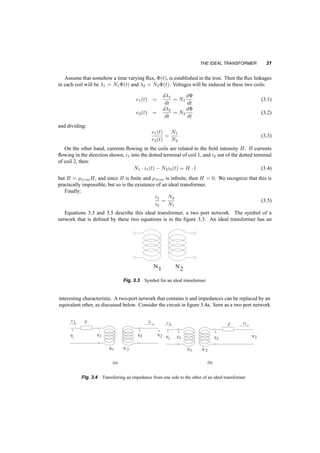
Equations 3.3 and 3.5 describe this ideal transformer, a two port network. The symbol of a 
network that is defined by these two equations is in the figure 3.3. An ideal transformer has an 
N1 N2 
Fig. 3.3 Symbol for an ideal transformer 
I 1 Z I 
+ 
interesting characteristic. A two­port 
network that contains it and impedances can be replaced by an 
equivalent other, as discussed below. Consider the circuit in figure 3.4a. Seen as a two port network 
I 1 Z I 
E1 
N N 2 
E1 E2 
+ 
V2 
+ 
1 
2 
+ 
+ 
V2 
+ 
E 
1 
V 
I 1 
+ + 
V1 
+ 
Z’ I2 
N1 N 2 
2 
(a) 
E1 
N N 2 
E1 E2 
+ 
V2 
1 
2 
+ 
+ 
V2 
+ 
E 
1 
V 
I 1 
+ + 
V1 
+ 
Z’ I2 
N1 N 2 
2 
(b) 
Fig. 3.4 Transferring an impedance from one side to the other of an ideal transformer
32 TRANSFORMERS 
with variables v1, i1, v2, i2, we can write: 
e1 = u1 ¡ i1Z (3.6) 
e2 = N2 
N1 
e1 = N2 
N1 
u1 ¡ 
N2 
N1 
i1Z (3.7) 
v2 = e2 = N2 
N1 
e1 = N2 
N1 
u1 ¡ i2 
µ 
N2 
N1 
¶2 
Z (3.8) 
which could describe the circuit in figure 3.4b. Generally a circuit on a side 1 can be transferred to 
side 2 by multiplying its component impedances by (N2=N1)2, the voltage sources by (N2=N1) and 
the current sources by (N1=N2), while keeping the topology the same. 
3.3 EQUIVALENT CIRCUIT 
To develop the equivalent circuit for a transformer we’ll gradually relax the assumptions that we had 
first imposed. First we’ll relax the assumption that the permeability of the iron is infinite. In that 
case equation 3.4 does not revert to 3.5, but rather it becomes: 
N1i1 ¡ N2i2 = R©m (3.9) 
whereRis the reluctance of the path around the core of the transformer and ©m the flux on this path. 
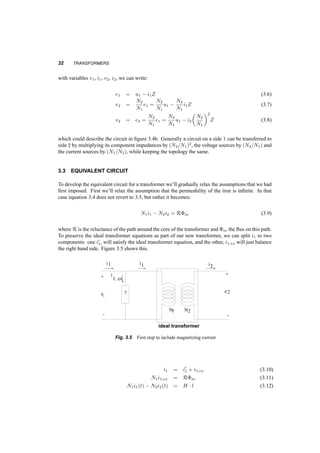
To preserve the ideal transformer equations as part of our new transformer, we can split i1 to two 
components: one i0 
1, will satisfy the ideal transformer equation, and the other, i1;ex will just balance 
the right hand side. Figure 3.5 shows this. 
1 
i 
+ 
1 i2 
i 
1, ex 
e ? 
i’ 
1 
N 
1 
+ 
2 
e 
N2 
- - 
ideal transformer 
Fig. 3.5 First step to include magnetizing current 
i1 = i0 
1 + i1;ex (3.10) 
N1i1;ex = R©m (3.11) 
N1i1(t) ¡ N2i2(t) = H ¢ l (3.12)
EQUIVALENT CIRCUIT 33 
We can replace the current source, i1;ex, with something simpler if we remember that the rate of 
change of flux ©m is related to the induced voltage e1: 
e1 = N1 
d©m 
dt 
(3.13) 
= N1 
d (N1i1;ex=R) 
dt 
(3.14) 
= 
µ 
N2 
1 
R 
¶ 
di1;ex 
dt 
(3.15) 
Since the current i1;ex flows through something, where the voltage across it is proportional to its 
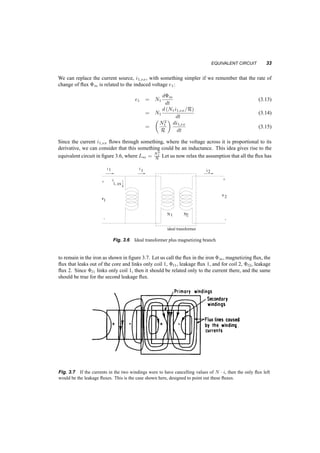
derivative, we can consider that this something could be an inductance. This idea gives rise to the 
equivalent circuit in figure 3.6, where Lm = N2 
1 
R Let us now relax the assumption that all the flux has 
i 1 i1 ’ 
+ 
e1 
i 2 
+ 
2 
- 
N1 N2 
e 
i 
1, ex 
- 
ideal transformer 
Fig. 3.6 Ideal transformer plus magnetizing branch 
to remain in the iron as shown in figure 3.7. Let us call the flux in the iron ©m, magnetizing flux, the 
flux that leaks out of the core and links only coil 1, ©l1, leakage flux 1, and for coil 2, ©l2, leakage 
flux 2. Since ©l1 links only coil 1, then it should be related only to the current there, and the same 
should be true for the second leakage flux. 
Fig. 3.7 If the currents in the two windings were to have cancelling values of N ¢ i, then the only flux left 
would be the leakage fluxes. This is the case shown here, designed to point out these fluxes.
34 TRANSFORMERS 
©l1 = N1i1=Rl1 (3.16) 
©l2 = N2i2=Rl2 (3.17) 
where Rl1 and Rl2 correspond to paths that are partially in the iron and partially in the air. As these 
currents change, so do the leakage fluxes, and a voltage is induced in each coil: 
e1 = d¸1 
dt 
= N1 
µ 
d©m 
dt 
¶ 
+ N1 
d©l1 
dt 
= e1 + 
µ 
N2 
1 
Rl1 
¶ 
di1 
dt 
(3.18) 
e2 = d¸2 
dt 
= N2 
µ 
d©m 
dt 
¶ 
+ N2 
d©l2 
dt 
= e2 + 
µ 
N2 
2 
Rl2 
¶ 
di2 
dt 
(3.19) 
If we define Ll1 
:= 
N1 
2 
Rl1 
, Ll2 
:= 
N2 
1 
Rl2 
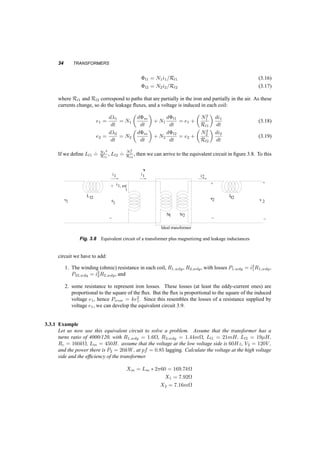
, then we can arrive to the equivalent circuit in figure 3.8. To this 
i 
+ 
1 e1 
i 
− 
i2 
+ 
e Ll2 
− 
+ 
2 
− 
1 2 
2 v 
N N 
Ideal transformer 
Ll2 
i1, ex 
v 
1 1’ 
Fig. 3.8 Equivalent circuit of a transformer plus magnetizing and leakage inductances 
circuit we have to add: 
1. The winding (ohmic) resistance in each coil, R1;wdg, R2;wdg, with losses P1;wdg = i21 
R1;wdg, 
P22;wdg = i22 
R2;wdg, and 
2. some resistance to represent iron losses. These losses (at least the eddy­current 
ones) are 
21 
proportional to the square of the flux. But the flux is proportional to the square of the induced 
voltage e1, hence Piron = ke. Since this resembles the losses of a resistance supplied by 
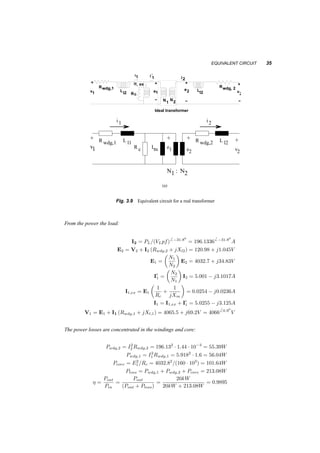
voltage e1, we can develop the equivalent circuit 3.9. 
3.3.1 Example 
Let us now use this equivalent circuit to solve a problem. Assume that the transformer has a 
turns ratio of 4000/120, with R1;wdg = 1:6­, R2;wdg = 1:44m­, Ll1 = 21mH, Ll2 = 19¹H, 
Rc = 160k­, Lm = 450H. assume that the voltage at the low voltage side is 60Hz, V2 = 120V , 
and the power there is P2 = 20kW, at pf = 0:85 lagging. Calculate the voltage at the high voltage 
side and the efficiency of the transformer. 
Xm = Lm ¤ 2¼60 = 169:7k­ 
X1 = 7:92­ 
X2 = 7:16m­
EQUIVALENT CIRCUIT 35 
2 
− 
2 
− 
+ 
v 
+ + 
i , 
1 Rc 
e 
N 
e 
Ll2 
i 
Rwdg,1 
Ll2 
1 i 
+ 
1 v 
2 
− 
Rwdg, 2 
N2 
1 
i1, ex 
Ideal transformer 
1 
i 1 i 
+ Rwdg,2 + 
+ 
wdg,1 L l1 L l2 
e2 
N1 : N2 
2 
+ 
v1 
R 
Rc Lm 
2 
e1 v 
(a) 
Fig. 3.9 Equivalent circuit for a real transformer 
From the power the load: 
I2 = PL=(VLpf)6 ¡31:80 = 196:13366 ¡31:80 
A 
E2 = V2 + I2 (Rwdg;2 + jXl2) = 120:98 + j1:045V 
E1 = 
µ 
N1 
N2 
¶ 
E2 = 4032:7 + j34:83V 
I0 
1 = 
µ 
N2 
N1 
¶ 
I2 = 5:001 ¡ j3:1017A 
I1;ex = E1 
µ 
1 
Rc 
+ 
1 
jXm 
¶ 
= 0:0254 ¡ j0:0236A 
I1 = I1;ex + I0 
1 = 5:0255 ¡ j3:125A 
V1 = E1 + I1 (Rwdg;1 + jXl;1) = 4065:5 + j69:2V = 40666 0:90 
V 
The power losses are concentrated in the windings and core: 
2Rwdg;2 = 196:132 ¢ 1:44 ¢ 10¡3 = 55:39W 
Pwdg;1 = I2 
Pwdg;2 = I2 
1Rwdg;1 = 5:9182 ¢ 1:6 = 56:04W 
Pcore = E2 
1=Rc = 4032:82=(160 ¢ 103) = 101:64W 
Ploss = Pwdg;1 + Pwdg;2 + Pcore = 213:08W 
´ = Pout 
Pin 
= Pout 
(Pout + Ploss) 
= 
20kW 
20kW + 213:08W 
= 0:9895
36 TRANSFORMERS 
3.4 LOSSES AND RATINGS 
Again for a given frequency, the power losses in the core (iron losses) increase with the voltage 
e1 (or e2). These losses cannot be allowed to exceed a limit, beyond which the temperature of the 
hottest spot in the transformer will rise above the point that will decrease dramatically the life of the 
insulation. Limits therefore are put to E1 and E2 (with a ratio of N1=N2), and these limits are the 
voltage limits of the transformer. 
Similarly, winding Joule losses have to be limited, resulting in limits to the currents I1 and I2. 
Typically a transformer is described by its rated voltages, E1N and E2N, that give both the limits 
and turns ratio. The ratio of the rated currents, I1N=I2N, is the inverse of the ratio of the voltages 
if we neglect the magnetizing current. Instead of the transformer rated currents, a transformer is 
described by its rated apparent power: 
SN = E1NI1N = E2NI2N (3.20) 
Under rated conditions, i.e. maximum current and voltage, in typical transformers the magnetizing 
current I1;ex, does not exceed 1% of the current in the transformer. Its effect therefore on the voltage 
drop on the leakage inductance and winding resistance is negligible. 
Under maximum (rated) current, total voltage drops on the winding resistances and leakage 
inductances do not exceed in typical transformers 6% of the rated voltage. The effect therefore of 
the winding current on the voltages E1 and E2 is small, and their effect on the magnetizing current 
can be neglected. 
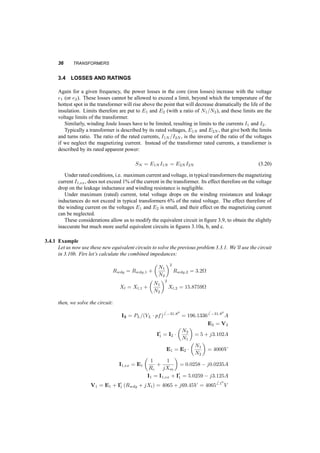
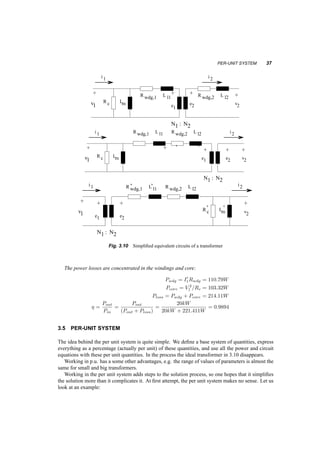
These considerations allow us to modify the equivalent circuit in figure 3.9, to obtain the slightly 
inaccurate but much more useful equivalent circuits in figures 3.10a, b, and c. 
3.4.1 Example 
Let us now use these new equivalent circuits to solve the previous problem 3.3.1. We’ll use the circuit 
in 3.10b. Firs let’s calculate the combined impedances: 
Rwdg = Rwdg;1 + 
µ 
N1 
N2 
¶2 
Rwdg;2 = 3:2­ 
Xl = Xl;1 + 
µ 
N1 
N2 
¶2 
Xl;2 = 15:8759­ 
then, we solve the circuit: 
I2 = PL=(VL ¢ pf)6 ¡31:80 = 196:13366 ¡31:80 
A 
E2 = V2 
I0 
1 = I2 ¢ 
µ 
N2 
N1 
¶ 
= 5 + j3:102A 
E1 = E2 ¢ 
µ 
N1 
N2 
¶ 
= 4000V 
I1;ex = E1 
µ 
1 
Rc 
+ 
1 
jXm 
¶ 
= 0:0258 ¡ j0:0235A 
I1 = I1;ex + I0 
1 = 5:0259 ¡ j3:125A 
1 (Rwdg + jXl) = 4065 + j69:45V = 40656 10 
V1 = E1 + I0 
V
PER­UNIT 
SYSTEM 37 
N1 : N2 
Rwdg,1 L l1 
i 1 
Rc Lm e2 
i 
+ Rwdg,2 + 
2 
L l2 
2 
v 
+ 
e1 
+ 
v1 
i 1 
Rc Lm 
N1 : N2 
+ 
v2 
i 2 
e1 e2 
+ + 
v1 
’ ’ 
’ ’’ 
+ + 
Rwdg,1 L l1 Rwdg,2 L l2 
i 1 
Rc Lm 
i 2 
+ 
v2 
+ + 
e1 e2 
N1 : N2 
R’wdg,1 L’l1 Rwdg,2 L l2 
+ 
v1 
’ 
’ ’ 
Fig. 3.10 Simplified equivalent circuits of a transformer 
The power losses are concentrated in the windings and core: 
Pwdg = I01 
Rwdg = 110:79W 
Pcore = V 2 
1 =Rc = 103:32W 
Ploss = Pwdg + Pcore = 214:11W 
´ = Pout 
Pin 
= Pout 
(Pout + Ploss) 
= 
20kW 
20kW + 221:411W 
= 0:9894 
3.5 PER­UNIT 
SYSTEM 
The idea behind the per unit system is quite simple. We define a base system of quantities, express 
everything as a percentage (actually per unit) of these quantities, and use all the power and circuit 
equations with these per unit quantities. In the process the ideal transformer in 3.10 disappears. 
Working in p.u. has a some other advantages, e.g. the range of values of parameters is almost the 
same for small and big transformers. 
Working in the per unit system adds steps to the solution process, so one hopes that it simplifies 
the solution more than it complicates it. At first attempt, the per unit system makes no sense. Let us 
look at an example:
38 TRANSFORMERS 
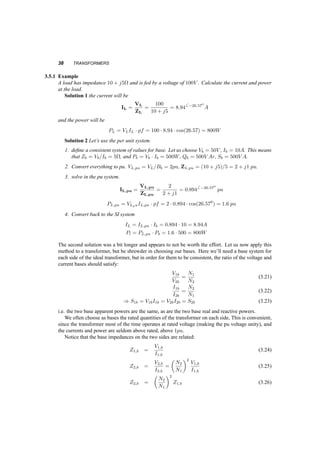
3.5.1 Example 
A load has impedance 10 + j5­ and is fed by a voltage of 100V . Calculate the current and power 
at the load. 
Solution 1 the current will be 
IL = 
VL 
ZL 
= 
100 
10 + j5 
= 8:946 ¡26:570 
A 
and the power will be 
PL = VLIL ¢ pf = 100 ¢ 8:94 ¢ cos(26:57) = 800W 
Solution 2 Let’s use the per unit system. 
1. define a consistent system of values for base. Let us choose Vb = 50V , Ib = 10A. This means 
that Zb = Vb=Ib = 5­, and Pb = Vb ¢ Ib = 500W, Qb = 500V Ar, Sb = 500V A. 
2. Convert everything to pu. VL;pu = VL=Bb = 2pu, ZL;pu = (10 + j5)=5 = 2 + j1 pu. 
3. solve in the pu system. 
IL;pu = 
VL;pu 
ZL;pu 
= 
2 
2 + j1 
= 0:8946 ¡26:570 
pu 
PL;pu = VLpuIL;pu ¢ pf = 2 ¢ 0:894 ¢ cos(26:570) = 1:6 pu 
4. Convert back to the SI system 
IL = IL;pu ¢ Ib = 0:894 ¢ 10 = 8:94A 
Pl = PL;pu ¢ Pb = 1:6 ¢ 500 = 800W 
The second solution was a bit longer and appears to not be worth the effort. Let us now apply this 
method to a transformer, but be shrewder in choosing our bases. Here we’ll need a base system for 
each side of the ideal transformer, but in order for them to be consistent, the ratio of the voltage and 
current bases should satisfy: 
V1b 
V2b 
= N1 
N2 
(3.21) 
I1b 
I2b 
= N2 
N1 
(3.22) 
) S1b = V1bI1b = V2bI2b = S2b (3.23) 
i.e. the two base apparent powers are the same, as are the two base real and reactive powers. 
We often choose as bases the rated quantities of the transformer on each side, This is convenient, 
since the transformer most of the time operates at rated voltage (making the pu voltage unity), and 
the currents and power are seldom above rated, above 1pu. 
Notice that the base impedances on the two sides are related: 
Z1;b = V1;b 
I1;b 
(3.24) 
Z2;b = V2;b 
I2;b 
= 
µ 
N2 
N1 
¶2 V1;b 
I1;b 
(3.25) 
Z2;b = 
µ 
N2 
N1 
¶2 
Z1;b (3.26)
PER­UNIT 
SYSTEM 39 
We notice that as we move impedances from the one side of the transformer to the other, they get 
multiplied or divided by the square of the turns ratio, 
³ 
N2 
N1 
´2 
, but so does the base impedance, hence 
the pu value of an impedance stays the same, regardless on which side it is. 
Also we notice, that since the ratio of the voltages of the ideal transformer is E1=E2 = N1=N2, 
is equal to the ratio of the current bases on the two sides on the ideal transformer, then 
E1;pu = E2;pu 
and similarly, 
I1;pu = I2;pu 
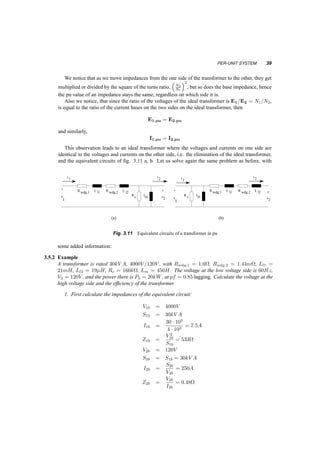
This observation leads to an ideal transformer where the voltages and currents on one side are 
identical to the voltages and currents on the other side, i.e. the elimination of the ideal transformer, 
and the equivalent circuits of fig. 3.11 a, b. Let us solve again the same problem as before, with 
Rwdg,1 L l1 Rwdg,2 L l2 
Rc Lm 
i 2 
+ 
v2 
i 1 
’ 
+ 
v 
1 
(a) 
Rwdg,1 L l1 Rwdg,2 L l2 
Rc Lm 
i 2 
+ 
v2 
i 1 
+ 
v 
1 
’ 
(b) 
Fig. 3.11 Equivalent circuits of a transformer in pu 
some added information: 
3.5.2 Example 
A transformer is rated 30kV A, 4000V=120V , with Rwdg;1 = 1:6­, Rwdg;2 = 1:44m­, Ll1 = 
21mH, Ll2 = 19¹H, Rc = 160k­, Lm = 450H. The voltage at the low voltage side is 60Hz, 
V2 = 120V , and the power there is P2 = 20kW, at pf = 0:85 lagging. Calculate the voltage at the 
high voltage side and the efficiency of the transformer. 
1. First calculate the impedances of the equivalent circuit: 
V1b = 4000V 
S1b = 30kV A 
I1b = 
30 ¢ 103 
4 ¢ 103 = 7:5A 
Z1b = V 2 
1b 
S1b 
= 533­ 
V2b = 120V 
S2b = S1b = 30kV A 
I2b = S2b 
V2b 
= 250A 
Z2b = V2b 
I2b 
= 0:48­
40 TRANSFORMERS 
2. Convert everything to per unit: First the parameters: 
Rwdg;1;pu = Rwdg;1=Z1b = 0:003 pu 
Rwdg;2;pu = Rwdg;2=Z2b = 0:003 pu 
Xl1;pu = 
2¼60Ll1 
Z1b 
= 0:015 pu 
Xl2;pu = 
2¼60Ll2 
Z2b 
= 0:0149 pu 
Rc;pu = Rc 
Z1b 
= 300 pu 
Xm;pu = 
2¼60Llm 
Z1b 
= 318pu 
Then the load: 
V2;pu = V2 
V2b 
= 1pu 
P2;pu = P2 
S2b 
= 0:6667pu 
3. Solve in the pu system. We’ll drop the pu symbol from the parameters and variables: 
I2 = 
µ 
P2 
V2 ¢ pf 
¶6 arccos(pf) 
= 0:666 ¡ j0:413pu 
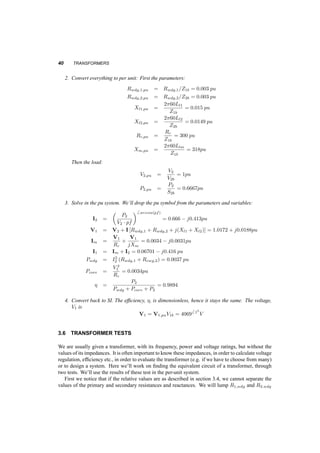
V1 = V2 + I [Rwdg;1 + Rwdg;2 + j(Xl1 + Xl2)] = 1:0172 + j0:0188pu 
Im = 
V1 
Rc 
+ 
V1 
jXm 
= 0:0034 ¡ j0:0031pu 
I1 = Im + I2 = 0:06701 ¡ j0:416 pu 
Pwdg = I2 
2 (Rwdg;1 + Rewg;2) = 0:0037 pu 
Pcore = V 2 
1 
Rc 
= 0:0034pu 
´ = P2 
Pwdg + Pcore + P2 
= 0:9894 
4. Convert back to SI. The efficiency, ´, is dimensionless, hence it stays the same. The voltage, 
V1 is 
V1 = V1;puV1b = 40696 10 
V 
3.6 TRANSFORMER TESTS 
We are usually given a transformer, with its frequency, power and voltage ratings, but without the 
values of its impedances. It is often important to know these impedances, in order to calculate voltage 
regulation, efficiency etc., in order to evaluate the transformer (e.g. if we have to choose from many) 
or to design a system. Here we’ll work on finding the equivalent circuit of a transformer, through 
two tests. We’ll use the results of these test in the per­unit 
system. 
First we notice that if the relative values are as described in section 3.4, we cannot separate the 
values of the primary and secondary resistances and reactances. We will lump R1;wdg and R2;wdg
TRANSFORMER TESTS 41 
together, as well as Xl1 and Xl2. This will leave four quantities to be determined, Rwdg, Xl, Rc and 
Xm. 
3.6.1 Open Circuit Test 
We leave one side of the transformer open circuited, while to the other we apply rated voltage (i.e. 
Voc = 1pu) and measure current and power. On the open circuited side of the transformer rated 
voltage appears, but we just have to be careful not to close the circuit ourselves. The current that 
flows is primarily determined by the impedances Xm and Rc, and it is much lower than rated. It is 
reasonable to apply this voltage to the low voltage side, since (with the ratings of the transformer in 
our example) is it easier to apply 120V , rather than 4000V . We will use these two measurements to 
calculate the values of Rc and Xm. 
Dropping the subscript pu, using the equivalent circuit of figure 3.11b and neglecting the voltage 
drop on the horizontal part of the circuit, we calculate: 
2 
Rc 
Poc = Voc 
= 
1 
Rc 
(3.27) 
Ioc = Voc 
Rc 
+ Voc 
jXm 
Ioc = 1 
s 
1 
Rc 
2 + 
1 
Xm 
2 (3.28) 
Equations 3.27 and 3.28, allow us to use the results of the short circuit test to calculate the vertical 
(core) branch of the transformer equivalent circuit. 
3.6.2 Short Circuit Test 
To calculate the remaining part of the equivalent circuit, i.e the values of Rwdg and Xl, we short 
circuit one side of the transformer and apply rated current to the other. We measure the voltage of 
that side and the power drawn. On the other side, (the short­circuited 
one) the voltage is of course 
zero, but the current is rated. We often apply voltage to the high voltage side, since a) the applied 
voltage need not be high and b) the rated current on this side is low. 
Using the equivalent circuit of figure 3.11a, we notice that: 
Psc = I2 
scRwdg = 1 ¢ Rwdg (3.29) 
Vsc = Isc (Rwdg + jXl) 
q 
Vsc = 1 ¢ 
R2w 
dg + X2 
l (3.30) 
Equations 3.29 and 3.30 can give us the values of the parameters in the horizontal part of the 
equivalent circuit of a transformer. 
3.6.1 Example 
A 60Hz transformer is rated 30kV A, 4000V=120V . The open circuit test, performed with the high 
voltage side open, gives Poc = 100W, Ioc = 1:1455A. The short circuit test, performed with the 
low voltage side shorted, gives Psc = 180W, Vsc = 129:79V . Calculate the equivalent circuit of 
the transformer in per unit.
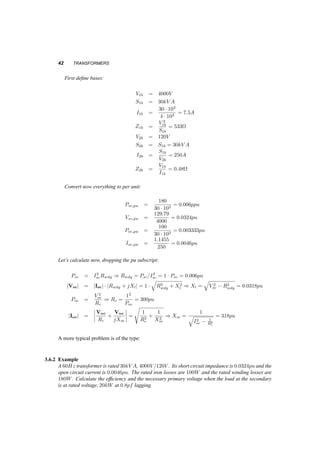
42 TRANSFORMERS 
First define bases: 
V1b = 4000V 
S1b = 30kV A 
I1b = 
30 ¢ 103 
4 ¢ 103 = 7:5A 
Z1b = V 2 
1b 
S1b 
= 533­ 
V2b = 120V 
S2b = S1b = 30kV A 
I2b = S1b 
V2b 
= 250A 
Z2b = V1b 
I1b 
= 0:48­ 
Convert now everything to per unit: 
Psc;pu = 
180 
30 ¢ 103 = 0:006ppu 
Vsc;pu = 
129:79 
4000 
= 0:0324pu 
Poc;pu = 
100 
30 ¢ 103 = 0:003333pu 
Ioc;pu = 
1:1455 
250 
= 0:0046pu 
Let’s calculate now, dropping the pu subscript: 
Psc = I2 
scRwdg ) Rwdg = Psc=I2 
sc = 1 ¢ Psc = 0:006pu 
jVscj = jIscj ¢ jRwdg + jXlj = 1 ¢ 
q 
R2w 
dg + X2 
l ) Xl = 
q 
V 2 
sc ¡ R2w 
dg = 0:0318pu 
Poc = V 2 
oc 
Rc 
) Rc = 
12 
Poc 
= 300pu 
jIocj = 
¯¯¯¯ 
Voc 
Rc 
+ 
Voc 
jXm 
¯¯¯¯ 
= 
s 
1 
R2 
c 
+ 
1 
X2m 
) Xm = 
1 
q 
I2 
oc ¡ 1 
R2 
c 
= 318pu 
A more typical problem is of the type: 
3.6.2 Example 
A 60Hz transformer is rated 30kV A, 4000V=120V . Its short circuit impedance is 0:0324pu and the 
open circuit current is 0:0046pu. The rated iron losses are 100W and the rated winding losses are 
180W. Calculate the efficiency and the necessary primary voltage when the load at the secondary 
is at rated voltage, 20kW at 0:8pf lagging.
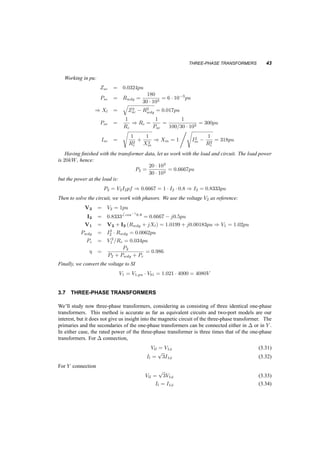
THREE­PHASE 
TRANSFORMERS 43 
Working in pu: 
Zsc = 0:0324pu 
Psc = Rwdg = 
180 
30 ¢ 103 = 6 ¢ 10¡3pu 
) Xl = 
q 
Z2 
sc ¡ R2w 
dg = 0:017pu 
Poc = 
1 
Rc 
) Rc = 
1 
Poc 
= 
1 
100=30 ¢ 103 = 300pu 
Ioc = 
s 
1 
R2 
c 
+ 
1 
X2m 
) Xm = 1 
,s 
I2 
oc ¡ 
1 
R2 
c 
= 318pu 
Having finished with the transformer data, let us work with the load and circuit. The load power 
is 20kW, hence: 
P2 = 
20 ¢ 103 
30 ¢ 103 = 0:6667pu 
but the power at the load is: 
P2 = V2I2pf ) 0:6667 = 1 ¢ I2 ¢ 0:8 ) I2 = 0:8333pu 
Then to solve the circuit, we work with phasors. We use the voltage V2 as reference: 
V2 = V2 = 1pu 
I2 = 0:83336 cos¡10:8 = 0:6667 ¡ j0:5pu 
V1 = V2 + I2 (Rwdg + jXl) = 1:0199 + j0:00183pu ) V1 = 1:02pu 
Pwdg = I2 
2 ¢ Rwdg = 0:0062pu 
Pc = V 2 
1 =Rc = 0:034pu 
´ = P2 
P2 + Pwdg + Pc 
= 0:986 
Finally, we convert the voltage to SI 
V1 = V1;pu ¢ Vb1 = 1:021 ¢ 4000 = 4080V 
3.7 THREE­PHASE 
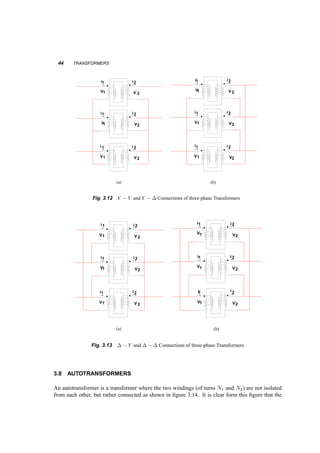
TRANSFORMERS 
We’ll study now three­phase 
transformers, considering as consisting of three identical one­phase 
transformers. This method is accurate as far as equivalent circuits and two­port 
models are our 
interest, but it does not give us insight into the magnetic circuit of the three­phase 
transformer. The 
primaries and the secondaries of the one­phase 
transformers can be connected either in ¢ or in Y . 
In either case, the rated power of the three­phase 
transformer is three times that of the one­phase 
transformers. For ¢ connection, 
Vll = V1Á (3.31) 
Il = 
p 
3I1Á (3.32) 
For Y connection 
p 
3V1Á (3.33) 
Il = I1Á (3.34) 
Vll =
44 TRANSFORMERS 
i i 
V V 
V1 2 
2 
V 
1 2 
1 
2 
2 
1 2 
1 
1 
i 
V 
i 
V 
i i 
(a) 
i i 
1 2 
V1 
V 
2 
1 
i 
V 1 
V 
i 
1 2 
2 
2 
1 2 
i 
i 
V V 
(b) 
Fig. 3.12 Y ¡ Y and Y ¡ ¢ Connections of three­phase 
Transformers 
V V 
1 2 
V V2 
2 
i i 
1 
1 2 
1 
2 
i i 
1 
V 
i i 
V 
1 2 
(a) 
i i 
1 2 
V V 
1 2 
i i 
1 2 
V 
1 2 
i 
V 
i1 2 
V V 
1 2 
(b) 
Fig. 3.13 ¢ ¡ Y and ¢ ¡ ¢ Connections of three­phase 
Transformers 
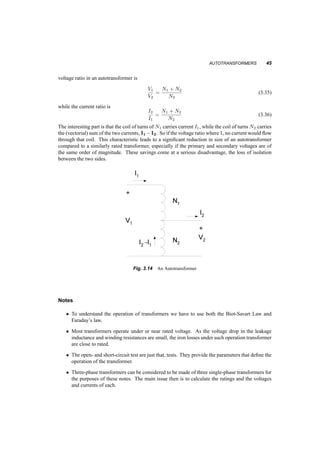
3.8 AUTOTRANSFORMERS 
An autotransformer is a transformer where the two windings (of turns N1 and N2) are not isolated 
from each other, but rather connected as shown in figure 3.14. It is clear form this figure that the
AUTOTRANSFORMERS 45 
voltage ratio in an autotransformer is 
V1 
V2 
= N1 + N2 
N2 
(3.35) 
while the current ratio is 
I2 
I1 
= N1 + N2 
N2 
(3.36) 
The interesting part is that the coil of turns of N1 carries current I1, while the coil of turns N2 carries 
the (vectorial) sum of the two currents, I1¡I2. So if the voltage ratio where 1, no current would flow 
through that coil. This characteristic leads to a significant reduction in size of an autotransformer 
compared to a similarly rated transformer, especially if the primary and secondary voltages are of 
the same order of magnitude. These savings come at a serious disadvantage, the loss of isolation 
between the two sides. 


Fig. 3.14 An Autotransformer 
Notes 
² To understand the operation of transformers we have to use both the Biot­Savart 
Law and 
Faraday’s law. 
² Most transformers operate under or near rated voltage. As the voltage drop in the leakage 
inductance and winding resistances are small, the iron losses under such operation transformer 
are close to rated. 
² The open­and 
short­circuit 
test are just that, tests. They provide the parameters that define the 
operation of the transformer. 
² Three­phase 
transformers can be considered to be made of three single­phase 
transformers for 
the purposes of these notes. The main issue then is to calculate the ratings and the voltages 
and currents of each.
46 TRANSFORMERS 
² Autotransformers are used mostly to vary the voltage a little. It is seldom that an autotrans­former 
will have a voltage ratio greater than two.
4 
Concepts of Electrical 
Machines; DC motors 
DC machines have faded from use due to their relatively high cost and increased maintenance 
requirements. Nevertheless, they remain good examples for electromechanical systems used for 
control. We’ll study DC machines here, at a conceptual level, for two reasons: 
1. DC machines although complex in construction, can be useful in establishing the concepts of 
emf and torque development, and are described by simple equations. 
2. The magnetic fields in them, along with the voltage and torque equations can be used easily to 
develop the ideas of field orientation. 
In doing so we will develop basic steady­state 
equations, again starting from fundamentals of the 
electromagnetic field. We are going to see the same equations in ‘Brushless DC’ motors, when we 
discuss synchronous AC machines. 
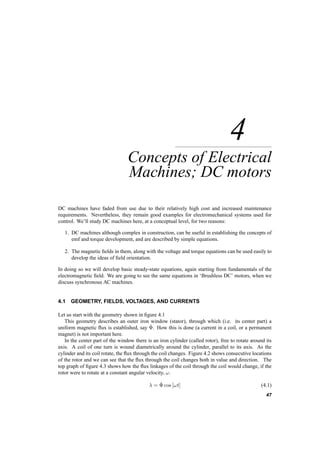
4.1 GEOMETRY, FIELDS, VOLTAGES, AND CURRENTS 
Let us start with the geometry shown in figure 4.1 
This geometry describes an outer iron window (stator), through which (i.e. its center part) a 
uniform magnetic flux is established, say ^©. How this is done (a current in a coil, or a permanent 
magnet) is not important here. 
In the center part of the window there is an iron cylinder (called rotor), free to rotate around its 
axis. A coil of one turn is wound diametrically around the cylinder, parallel to its axis. As the 
cylinder and its coil rotate, the flux through the coil changes. Figure 4.2 shows consecutive locations 
of the rotor and we can see that the flux through the coil changes both in value and direction. The 
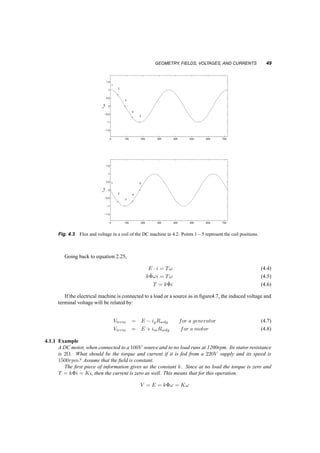
top graph of figure 4.3 shows how the flux linkages of the coil through the coil would change, if the 
rotor were to rotate at a constant angular velocity, !. 
¸ = ^© 
cos [!t] (4.1) 
47
48 CONCEPTS OF ELECTRICAL MACHINES; DC MOTORS 
+ 
+ 
+ 
+ 
+ 
1 
2 
3 
4 
5 
Fig. 4.1 Geometry of an elementary DC motor 
+ 
+ 
+ 
+ 
+ 
1 2 3 4 5 
Fig. 4.2 Flux through a coil of a rotating DC machine 
Since the flux linking the coil changes with time, then a voltage will be induced in this coil, vcoil, 
vcoil = d¸ 
dt 
= ¡^© 
! sin (!t) (4.2) 
shown in the second graph of figure 4.3. The points marked there correspond to the position of the 
rotor in figure4.2. 
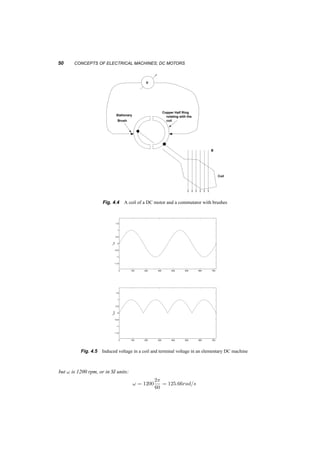
This alternating voltage has to somehow be rectified, since this is a DC machine. Although this 
can be done electronically, a very old mechanical method exists. The coil is connected not to the DC 
source or load, but to two ring segments, solidly attached to it and the rotor, and hence rotating with 
it. Two ‘brushes’, i.e. conducting pieces of material (often carbon/copper) are stationary and sliding 
on these ring segments as shown in figure 4.4 
The structure of the ring segments is called a commutator. As it rotates, the brushes make contact 
with the opposite segments just as the induced voltage goes through zero and switches sign. 
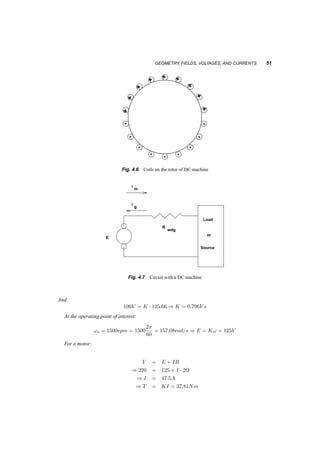
Figure 4.5 shows the induced voltage and the terminal voltage seen at the voltmeter of figure 4.4. 
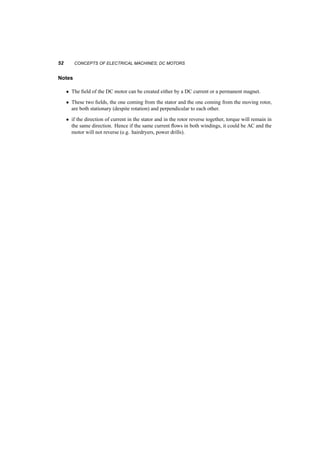
If a number of coils are placed on the rotor, as shown in figure 4.6, each connected to a commutator 
segment, the total induced voltage to the coils, E will be: 
E = k^©! (4.3) 
where k is proportional to the number of coils.
GEOMETRY, FIELDS, VOLTAGES, AND CURRENTS 49 
0 100 200 300 400 500 600 700 
1.5 
1 
0.5 
0 
lcoil 
−0.5 
−1 
−1.5 
1 
2 
3 
4 
5 
0 100 200 300 400 500 600 700 
1.5 
1 
0.5 
0 
vcoil 
−0.5 
−1 
−1.5 
1 
2 
3 
4 
5 
Fig. 4.3 Flux and voltage in a coil of the DC machine in 4.2. Points 1 – 5 represent the coil positions. 
Going back to equation 2.25, 
E ¢ i = T! (4.4) 
k^©!i = T! (4.5) 
T = k^©i (4.6) 
If the electrical machine is connected to a load or a source as in figure4.7, the induced voltage and 
terminal voltage will be related by: 
Vterm = E ¡ igRwdg for a generator (4.7) 
Vterm = E + imRwdg for a motor (4.8) 
4.1.1 Example 
A DC motor, when connected to a 100V source and to no load runs at 1200rpm. Its stator resistance 
is 2­. What should be the torque and current if it is fed from a 220V supply and its speed is 
1500rpm? Assume that the field is constant. 
The first piece of information gives us the constant k. Since at no load the torque is zero and 
T = k©i = Ki, then the current is zero as well. This means that for this operation: 
V = E = k©! = K!
50 CONCEPTS OF ELECTRICAL MACHINES; DC MOTORS 
Copper Half Ring 
Brush 
rotating with the 
coil 
V 
Stationary 
Coil 
B 
Fig. 4.4 A coil of a DC motor and a commutator with brushes 
0 100 200 300 400 500 600 700 
1.5 
1 
0.5 
0 
vcoil 
−0.5 
−1 
−1.5 
0 100 200 300 400 500 600 700 
1.5 
1 
0.5 
0 
vterm 
−0.5 
−1 
−1.5 
Fig. 4.5 Induced voltage in a coil and terminal voltage in an elementary DC machine 
but ! is 1200 rpm, or in SI units: 
! = 1200 
2¼ 
60 
= 125:66rad=s
GEOMETRY, FIELDS, VOLTAGES, AND CURRENTS 51 
+ 
+ 
+ 
+ 
+ 
+ 
+ 
+ 
+ 
- 
- 
- 
- 
- 
- 
- 
- 
- 
Fig. 4.6 Coils on the rotor of DC machine 
wdg 
R 
Load 
or 
Source 
i 
m 
g 
i 
E 
Fig. 4.7 Circuit with a DC machine 
And 
100V = K ¢ 125:66 ) K = 0:796V s 
At the operating point of interest: 
!o = 1500rpm = 1500 
2¼ 
60 
= 157:08rad=s ) E = K! = 125V 
For a motor: 
V = E + IR 
) 220 = 125 + I ¢ 2­ 
) I = 47:5A 
) T = KI = 37:81Nm
52 CONCEPTS OF ELECTRICAL MACHINES; DC MOTORS 
Notes 
² The field of the DC motor can be created either by a DC current or a permanent magnet. 
² These two fields, the one coming from the stator and the one coming from the moving rotor, 
are both stationary (despite rotation) and perpendicular to each other. 
² if the direction of current in the stator and in the rotor reverse together, torque will remain in 
the same direction. Hence if the same current flows in both windings, it could be AC and the 
motor will not reverse (e.g. hairdryers, power drills).
5 
Three­phase 
Windings 
Understanding the geometry and operation of windings in AC machines is essential in understanding 
how these machines operate. We introduce here the concept of Space Vectors, (or Space Phasors) in 
its general form, and we see how they are applied to three­phase 
windings. 
5.1 CURRENT SPACE VECTORS 
Let us assume that in a uniformly permeable space we have placed three identical windings as shown 
in figure 5.1. Each carries a time dependent current, i1(t), i2(t) and i3(t). We require that: 
i1(t) + i2(t) + i3(t) ´ 0 (5.1) 
Each current produces a flux in the direction of the coil axis, and if we assume the magnetic 
medium to be linear, we can find the total flux by adding the individual fluxes. This means that we 
could produce the same flux by having only one coil, identical to the three, but placed in the direction 
of the total flux, carrying an appropriate current. Figure 5.2 shows such a set of coils carrying for 
i1 = 5A, i2 = ¡8A and i3¡ = 3A and the resultant coil. 
To calculate the direction of the resultant one coil and the current it should carry, all we have to 
do is create three vectors, each in the direction of one coil, and of amplitude equal to the current of 
each coil. The sum of these vectors will give the direction of the total flux and hence of the one coil 
that will replace the three. The amplitude of the vectors will be that of the current of each coil. 
Let us assume that the coils are placed at angles 00, 1200 and 2400. Then their vectorial sum will 
be: 
i = i 
6 Á = i1 + i2ej1200 + i3ej2400 (5.2) 
We call i, defined thus, a space vector, and we notice that if the currents i1, i2 and i3 are functions 
of time, so will be the amplitude and the angle of i. By projecting the three constituting currents on 
the horizontal and vertical axis, we can find the real (id = [i]) and imaginary (iq = =[i]) parts of 
53
54 THREE­PHASE 
WINDINGS 
I 
3 
3 
F 2 
F 
2 
I 
I 
1 
1 
F 
Fig. 5.1 Three phase concentrated windings 
-8A 
3A 
5A 
-8A 
(a) 
3A 
5A 
__ 
2 I 
__ 
I 
__ 
I1 
3 
__ 
I 
(b) 
5A 
3A 
-8A 
F 
I1 
I2 
I3 
I 
I 
F 
(c) 
Fig. 5.2 Currents in three windings (a), Resultant space vector (b), and corresponding winding position (c) 
it. Also, from the definition of the current space vector we can reconstruct the constituent currents: 
i1(t) = 
2 
3 
[i(t)] 
i2(t) = 
2 
3 
[i(t)e¡j°] (5.3) 
i3(t) = 
2 
3 
[i(t)e¡j2°] 
° = 1200 = 
2¼ 
3 rad (5.4)
STATOR WINDINGS AND RESULTING FLUX DENSITY 55 
5.2 STATOR WINDINGS AND RESULTING FLUX DENSITY 
Fig. 5.3 A Stator Lamination 
Stator 
Stator Winding 
Airgap 
Rotor 
Fig. 5.4 A sinusoidal winding on the stator 
Assume now that these windings are placed in a fixed structure, the stator, which is surrounds a 
rotor. Figure 5.3 shows a typical stator cross­section, 
but for the present we’ll consider the stator 
as a steel tube. Figure 5.5 shows the windings in such a case. Instead of being concentrated, they 
are sinusoidally distributed as shown in figure 5.4. Sinusoidal distribution means that the number of
56 THREE­PHASE 
WINDINGS 
turns dNs covering an angle dµ at a position µ and divided by dµ is a sinusoidal function of the angle 
µ. This turns density, ns1(µ), is then: 
dns 
dµ 
= ns1(µ) = ^ns sin µ 
and for a total number of turns Ns in the winding: 
Ns = 
Z ¼ 
0 
ns1(µ)dµ ) ns1(µ) = Ns 
2 
sin µ 
We now assign to the winding we are discussing a current i1. To find the flux density in the airgap 
Current in 
negative direction 
q 
Current in 
positive direction 
Airgap 
Rotor 
Stator 
Stator winding 
Fig. 5.5 Integration path to calculate flux density in the airgap 
between rotor and stator we choose an integration path as shown in figure 5.5. This path is defined by 
the angle µ and we can notice that because of symmetry the flux density at the two airgap segments 
in the path is the same. If we assume the permeability of iron to be infinite, then Hiron = 0 and: 
2Hg1(µ)g = 
Z µ+¼ 
µ 
i1ns1(Á)dÁ 
2Bg1(µ) 
¹0 
g = i1Ns cos µ 
Bg1(µ) = i1 
Ns¹0 
2g 
cos µ (5.5) 
This means that for a given current i1 in the coil, the flux density in the air gap varies sinusoidally with 
angle, but as shown in figure 5.6 it reaches a maximum at angle µ = 0. For the same machine and 
conditions as in 5.6, 5.7 shows the plots of turns density, ns(µ) and flux density, Bg(µ) in cartesian 
coordinates with µ in the horizontal axis. 
If the current i1 were to vary sinusoidally in time, the flux density would also change in time, 
maintaining its space profile but changing only in amplitude. This would be considered a wave, as it
STATOR WINDINGS AND RESULTING FLUX DENSITY 57 
Fig. 5.6 Sketch of the flux in the airgap 
0 90 180 270 360 
1 
0 
ns(q) 
−1 
0 90 180 270 360 
1 
0 
−1 
q 
Bg(q) 
Fig. 5.7 Turns density on the stator and air gap flux density vs. µ 
changes in time and space. The nodes of the wave, where the flux density is zero, will remain at 900 
and 2700, while the extrema of the flux will remain at 00 and 1800. 
Consider now an additional winding, identical to the first, but rotated with respect to it by 1200. 
For a current in this winding we’ll get a similar airgap flux density as before, but with nodes at 
900 +1200 and at 2700 +1200. If a current i2 is flowing in this winding, then the airgap flux density
58 THREE­PHASE 
WINDINGS 
due to it will follow a form similar to equation 5.5 but rotated 1200 = 2¼ 
3 . 
Bg2(µ) = i2 
Ns¹0 
2g 
cos(µ ¡ 
2¼ 
3 
) (5.6) 
Similarly, a third winding, rotated yet another 1200 and carrying current i3, will produce airgap 
flux density: 
Bg3(µ) = i3 
Ns¹0 
2g 
cos(µ ¡ 
4¼ 
3 
) (5.7) 
Superimposing these three flux densities, we get yet another sinusoidally distributed airgap flux 
density, that could equivalently come from a winding placed at an angle Á and carrying current i: 
Bg(µ) = Bg1(µ) + Bg2(µ) + Bg3(µ) = i 
Ns¹0 
2g 
cos(µ + Á) (5.8) 
This means that as the currents change, the flux could be due instead to only one sinusoidally 
distributed winding with the same number of turns. The location, Á(t), and current, i(t), of this 
winding can be determined from the current space vector: 
i(t) = i(t)6 Á(t) = i1(t) + i2(t)ej1200 + i3(t)ej2400 
5.2.1 Balanced, Symmetric Three­phase 
Currents 
If the currents i1, i2, i3 form a balanced three­phase 
system of frequency fs = !s=2¼, then we can 
write: 
i1 = 
p 
2I cos(!st + Á1) = 
p 
2 
2 
£ 
Isej!st + Ise¡j!st¤ 
i2 = 
p 
2I cos(!st ¡ Á1 + 
2¼ 
3 
) = 
p 
2 
2 
h 
Isej(!st¡2¼=3) + Ise¡j(!st¡2¼=3) 
i 
(5.9) 
i3 = 
p 
2I cos(!st ¡ Á1 + 
4¼ 
3 
) = 
p 
2 
2 
h 
Isej(!st¡4¼=3) + Ise¡j(!st¡4¼=3) 
i 
where I is the phasor corresponding to the current in phase 1. The resultant space vector is 
is(t) = 
3 
2 
p 
2 
2 
Iej!st = 
3 
2 
p 
2 
2 Iej(!st+Á1) I = Iej(Á1+¼2 
) (5.10) 
The resulting flux density wave is then: 
B(µ; t) = 
3 
2 
p 
2I 
Ns¹0 
2g 
cos(!st + Á1 ¡ µ) (5.11) 
which shows a travelling wave, with a maximum value ^B 
= 3 
2 
p 
2I Ns 
¹0 
. This wave travels around the 
stator at a constant speed !s, as shown in figure 5.8 
5.3 PHASORS AND SPACE VECTORS 
It is easy at this point to confuse space vectors and phasors. A current phasor, I = IejÁ0 , describes 
one sinusoidally varying current, of frequency !, amplitude 
p 
2I and initial phase Á0. We can
PHASORS AND SPACE VECTORS 59 
0 90 180 270 360 
1 
0 
−1 
q 
Bgq) 
t1 t2 t3 
Fig. 5.8 Airgap flux density profile, t3  t2  t1 
reconstruct the sinusoid from the phasor: 
i(t) = 
p 
2 
2 
£ 
Iej!t + I¤e¡j!t¤ 
= 
p 
2I cos(!t + Á0) =  
¡ 
Iej!t¢ 
(5.12) 
Although rotation is implicit in the definition of the phasor, no rotation is described by it. 
On the other hand, the definition of a current space vector requires three currents that sum to 
zero. These currents are implicitly in windings symmetrically placed, but the currents themselves 
are not necessarily sinusoidal. Generally the amplitude and angle of the space vector changes with 
time, but no specific pattern is a priori defined. We can reconstruct the three currents that constitute 
the space vector from equation 5.3. 
When these constituent currents form a balanced, symmetric system, of frequency !s, then the 
resultant space vector is of constant amplitude, rotating at constant speed. In that case, the relationship 
between the phasor of one current and the space vector is shown in equation 5.10. 
5.3.1 Example 
p 
2A. Choose 
Let us take three balanced sinusoidal currents with amplitude 1, i.e. rms value of 1= 
an initial phase angle such that: 
i1(t) = 1 cos(!t)A 
i2(t) = 1 cos(!t ¡ 2¼=3)A 
i2(t) = 1 cos(!t ¡ 4¼=3)A 
When !t = 0, as shown in figure 5.9a, 
i1 = 1A 
i2 = ¡0:5A 
i3 = ¡0:5A
60 THREE­PHASE 
WINDINGS 
i = i1 + i2ej1200 + i3ej2400 = 1:56 0A 
and later, when !t = 200 = ¼=9 rad, as shown in figure 5.9b, 
i1 = 0:939A 
i2 = ¡0:766A 
i3 = ¡0:174A 
i = i1 + i2ej1200 + i3ej2400 = 1:56 200 
A 
i 
i 
3 
= -0.5A 
i 
2 
= -0.5A 
i 
1 
= 1A 
_ 
(a) 
=-0.1737A 
3 
i 
_ 
i 
i 
2 
= -0.766A 
i = 0.9397A 
1 
(b) 
Fig. 5.9 Space vector movement for sinusoidal, symmetric three­phase 
currents 
5.4 MAGNETIZING CURRENT, FLUX AND VOLTAGE 
Let us now see what results this rotating flux has on the windings, using Faraday’s law. From this 
point on we’ll use sinusoidal symmetric three­phase 
quantities. 
We look again at our three real stationary windings linked by a rotating flux. For example, when 
the current is maximum in phase 1, the flux is as shown in figure 5.10a, linking all of the turns in 
phase 1. Later, the flux has rotated as shown in figure 5.10b, resulting in lower flux linkages with 
the phase 1 windings. When the flux has rotated 900, as in 5.10c the flux linkages with the phase 1 
winding are zero. 
To calculate the flux linkages ¸ we have to take a turn of the winding, placed at angle µ, as shown 
in figure 5.11. The flux through this coil is: 
©(t; µ) = 
Z µ 
歬 
Bg(t; Á)dA = lr 
Z µ+ 
歬 
Bg(t; Á)dÁ (5.13) 
But the number of turns linked by this flux is dns(µ) = ns(µ)dµ, so the flux linkages for these turns 
are: 
d¸ = ns(µ)dµ ¢ ©(µ)
MAGNETIZING CURRENT, FLUX AND VOLTAGE 61 
(a) (b) (c) 
Fig. 5.10 Rotating flux and flux linkages with phase 1 
Fig. 5.11 Flux linkages of one turn 
To find the flux linkages ¸1 for all of the coil, we have to integrate the flux linkages over all turns of 
coil 1: 
¸1 = 
Z ¼ 
0 
¸(µ)dµ 
giving us at the end: 
¸1(t) = N2 
s lr 
8g 
3¼¹0 
p 
2I cos(!t + Á1) = LM 
p 
2I cos(!t + Á1) (5.14) 
which means that the flux linkages in coil 1 are in phase with the current in this coil and proportional 
to it. The flux linkages of the other two coils, 2 and 3, are identical to that of coil 1, and lagging in 
time by 1200 and 2400. With these three quantities we can create a flux­linkage 
space vector, ¸. 
¸ ´ ¸1 + ¸2ej1200 + ¸3ej2400 = LM i (5.15) 
Since the flux linkages of each coil vary, and in our case sinusoidally, a voltage is induced in each 
of these coils. The induced voltage in each coil is 900 ahead of the current in it, bringing to mind
62 THREE­PHASE 
WINDINGS 
the relationship of current and voltage of an inductor. Notice though, that it is not just the current in 
the winding that causes the flux linkages and the induced voltages, but rather the current in all three 
windings. Still, we call the constant LM magnetizing inductance. 
e1(t) = d¸1 
dt 
= ! 
p 
2I cos(!t + Á1 + ¼ 
2 
) 
e2(t) = d¸2 
dt 
= ! 
p 
2I cos(!t + Á1 + ¼ 
2 
¡ 
2¼ 
3 
) (5.16) 
e3(t) = d¸3 
dt 
= ! 
p 
2I cos(!t + Á1 + ¼ 
2 
¡ 
4¼ 
2 
) 
and of course we can define voltage space vectors e: 
e = e1 + e2ej1200 + e3ej2400 = j!LM i (5.17) 
Note that the flux linkage space vector ¸ is aligned with the current space vector, while the voltage 
space vector e is ahead of both by 900. This agrees with the fact that the individual phase voltages 
lead the currents by 900, as shown in figure 5.12. 
i 
wt 
e 
l 
Fig. 5.12 Magnetizing current, flux­linkage 
and induced voltage space vectors
6 
Induction Machines 
Induction machines are often described as the ‘workhorse of industry’. This clic`e reflects the reality 
of the qualities of these machines. They are cheap to manufacture, rugged and reliable and find their 
way in most possible applications. Variable speed drives require inexpensive power electronics and 
computer hardware, and allowed induction machines to become more versatile. In particular, vector 
or field­oriented 
control allows induction motors to replace DC motors in many applications 
6.1 DESCRIPTION 
The stator of an induction machine is a typical three­phase 
one, as described in the previous chapter. 
The rotor can be one of two major types. Either a) it is wound in a fashion similar to that of the stator 
with the terminals led to slip rings on the shaft, as shown in figure 6.1, or b) it is made with shorted 
Shaft 
Rings 
Rotor 
Slip 
Fig. 6.1 Wound rotor slip rings and connections 
bars. Figure 6.2 shows the rotor of such a machine, while figures 6.3 show the shorted bars and the 
laminations. 
The picture of the rotor bars is not easy to obtain, since the bars are formed by casting aluminum 
in the openings of the rotor laminations. In this case the iron laminations were chemically removed. 
63
64 INDUCTION MACHINES 
Fig. 6.2 Rotor for squirrel cage induction motor 
(a) Rotor bars and rings (b) Rotor 
Fig. 6.3 Rotor Components of a Squirrel Cage Induction Motor 
6.2 CONCEPT OF OPERATION 
As these rotor windings or bars rotate within the magnetic field created by the stator magnetizing 
currents, voltages are induced in them. If the rotor were to stand still, then the induced voltages 
would be very similar to those induced in the stator windings. In the case of squirrel cage rotor, the 
voltage induced in the bars will be slightly out of phase with the voltage in the next one, since the 
flux linkages will change in it after a short delay. 
If the rotor is moving at synchronous speed, together with the field, no voltage will be induced in 
the bars or the windings.
CONCEPT OF OPERATION 65 
B g 
1 
3 
2 
4 
5 
7 6 
13 
19 
(a) Rotor bars in the stator field 
0 90 180 270 360 
1 
0 
−1 
t 
e(t) 
bar 1 
bar 2 
bar 3 
bar 7 
(b) Voltages in rotor bars 
Fig. 6.4 
Generally when the synchronous speed is !s = 2¼fs, and the rotor speed !0, the frequency of 
the induced voltages will be fr, where 2¼fr = !s ¡ !0. Maxwell’s equation becomes here: 
¡!E 
= ¡!v 
£ 
¡! 
Bg (6.1) 
where ¡!v 
is the relative velocity of the rotor with respect to the field: 
v = (!s ¡ !0)r (6.2) 
Since a voltage is induced in the bars, and these are short­circuited, 
currents will flow in them. The 
current density 
¡!J 
(µ) will be: 
¡!J 
(µ) = 
1 
½ 
¡!E 
(6.3) 
These currents are out of phase in different bars, just like the induced voltages. To simplify the 
analysis we can consider the rotor as one winding carrying currents sinusoidally distributed in space. 
This will be clearly the case for a wound rotor. It will also be the case for uniformly distributed rotor 
bars, but now each bar, located at an angle µ will carry different current, as shown in figure 6.5 a: 
J = 
1 
½ 
(!s ¡ !0) ¢ Bg(µ) (6.4) 
J(µ) = 
1 
½ 
(!s ¡ !0)^B 
g sin(µ) (6.5) 
We can replace the bars with a conductive cylinder as shown in figure 6.5 b. 
We define as slip s the ratio: 
s = !s ¡ !0 
!s 
(6.6)
66 INDUCTION MACHINES 
+ 
B g 
+ 
+ 
+ 
+ 
+ 
+ 
+ 
+ 
+ 
+ 
(a) Currents in rotor bars 
+ 
B g 
+ 
+ 
+ 
+ 
+ 
+ 
+ 
+ 
+ 
+ 
Equivalent 
Conducting 
Sheet 
(b) Equivalent Current Sheet in Rotor 
Fig. 6.5 Current Distribution in equivalent conducting sheet 
At starting the speed is zero, hence s = 1, and at synchronous speed, !s = !0, hence s = 0. Above 
synchronous speed s  0, and when the rotor rotates in a direction opposite of the magnetic field 
s  1. 
6.2.1 Example 
The rotor of a two­pole 
3­phase 
induction machine rotates at 3300rpm, while the stator is fed by a 
three­phase 
system of voltages, at 60Hz. What are the possible frequencies of the rotor voltages? 
At 3300 rpm 
!o = 3300 
2¼ 
60 
= 345:6rad=s while !s = 377rad=s 
These two speeds can be in the opposite or the same direction, hence: 
!r = !s ¡ !o = 377 § 345:6 = 722:58rad=s or 31:43rad=s 
fr = 115Hz or = 5Hz 
6.3 TORQUE DEVELOPMENT 
We can now calculate forces and torque on the rotor. We’ll use the formulae: 
F = Bli; T = F ¢ r (6.7) 
since the flux density is perpendicular to the current. As l we’ll use the length of the conductor, i.e. 
the depth of the motor. We consider an equivalent thickness of the conducting sheet de. A is the 
cross section of all the bars. 
A = nrotor bars 
¼ 
4 d2 = 2¼rde (6.8) 
de = nrotor barsd2 
8r 
(6.9)
OPERATION OF THE INDUCTION MACHINE NEAR SYNCHRONOUS SPEED 67 
(a) (b) 
q 
q 
r 
d 
d 
e d 
Fig. 6.6 Calculation of Torque 
For a small angle dµ at an angle µ, we calculate the contribution to the total force and torque: 
dF = (JdA) ¢ Bg ¢ l; Bg = g sin(µ) 
dF = (Jder dµ)Bg 
dT = r Z dF 
µ=2¼ 
T ^B 
= 
µ=0 
dT = 
µ 
2¼r2lde 
½ 
¶ 
^B 
2 
g (!s ¡ !0) (6.10) 
Flux density in the airgap is not an easy quantity to work with, so we can use the relationship 
between flux density (or flux linkages) and rotor voltage and finally get: 
T = 
µ 
8 
¼ 
rde 
N2 
s ½l 
¶ 
¤2s 
(!s ¡ !0) where ¤s = 
µ 
Es 
!s 
¶ 
(6.11) 
Although the constants in equations 6.10 and 6.11 are important we should focus more on the 
variables. We notice that in equation 6.10 the torque is proportional to the frequency of the rotor 
currents, (!s ¡ !0) and the square of the flux density. This is so since the torque comes from the 
interaction of the flux density Bg and the rotor currents. But the rotor currents are induced (induction 
motor) due to the flux Bg and the relative speed !s ¡ !0. 
On the other hand, equation 6.11 gives us torque as a function of more accessible quantities, stator 
induced voltage Es and frequency !s. This is so, since there is a very simple and direct relationship 
between stator induced voltage, flux (or flux linkages) and frequency. 
6.4 OPERATION OF THE INDUCTION MACHINE NEAR SYNCHRONOUS SPEED 
We already determined that the voltages induced in the rotor bars are of slip frequency, fr = 
(!s ¡ !0)=(2¼). At rotor speeds near synchronous, this frequency, fr is quite small. The rotor bars 
in a squirrel cage machine possess resistance and leakage inductance, but at very low frequencies,
68 INDUCTION MACHINES 
i.e near synchronous speed, we can neglect this inductance. The rotor currents therefore are limited 
near synchronous speed by the rotor resistance only. 
The induced rotor­bar 
voltages and currents form space vectors. These are perpendicular to the 
stator magnetizing current and in phase with the space vectors of the voltages induced in the stator 
as shown in figure 6.7 and figure 
+ 
+ 
+ 
+ 
+ 
+ 
+ 
+ 
+ 
+ 
+ 
+ 
+ 
+ 
+ 
+ 
+ 
+ 
+ 
is,m 
i r 
B g 
+ 
+ 
+ 
Fig. 6.7 Stator Magnetizing Current, airgap flux and rotor currents 
These rotor currents, ir produce additional airgap flux, which is 900 out of phase of the magnetizing 
flux. But the stator voltage, es, is applied externally and it is proportional to and 900 out of phase of 
the airgap flux. Additional currents, isr will flow in the stator windings in order to cancel the flux 
due to the rotor currents. These currents are shown in figures 6.8. In 6.9 the corresponding space 
vectors are shown. 
+ 
+ 
+ 
+ 
+ 
+ 
+ 
+ 
+ 
+ 
+ 
+ 
+ 
+ 
+ 
+ 
+ 
+ 
+ 
+ 
+ 
+ 
+ 
+ 
B 
+ 
+ 
+ 
+ 
+ 
+ 
+ 
+ 
g 
s,m 
+ 
i 
i s,r 
i r 
(a) Rotor Current and Stator Current Components 
+ 
+ 
+ 
+ 
+ 
+ 
+ 
B 
i 
+ 
+ 
+ 
+ 
+ 
+ 
+ 
+ 
+ 
+ 
+ 
+ 
+ 
+ 
+ 
s 
g 
i s 
(b) Space Vectors of the Rotor and Stator Cur­rents 
and induced voltages 
Fig. 6.8 Rotor and Stator Currents in an Induction Motor
OPERATION OF THE INDUCTION MACHINE NEAR SYNCHRONOUS SPEED 69 
es 
sr= Ri 
i 
i 
Bg 
i s 
sm 
i r 
Fig. 6.9 Space­Vectors 
of the Stator and Rotor Current and Induced Voltages 
There are a few things we should observe here: 
² isr is 900 ahead of ism, the stator magnetizing current. This means that it corresponds to 
currents in windings i1r, i2r, i3r, leading by 900 the magnetizing currents i1m, i2m, i3m. 
² The amplitude of the magnetizing component of the stator current is proportional to the stator 
frequency, fs and induced voltage. On the other hand, the amplitude of this component of the 
stator currents, isr, is proportional to the current in the rotor, ir, which in turn is proportional 
to the flux and the slip speed, !r = !s ¡ !0, or proportional to the developed torque. 
² We can, therefore split the stator current of one phase, is1, into two components: One in phase 
with the voltage, isr1 and one 900 behind it, ism1. The first reflects the rotor current, while 
the second depends on the voltage and frequency. In an equivalent circuit, this means that isr1 
will flow through a resistor, and ism1 will flow through an inductor. 
² Since isr1 is equal to the rotor current (through a factor), it will be inversely proportional to 
!s ¡ !r, or, better, proportional to !s=(!s ¡ !r). Figure 6.10 reflects these considerations. 
I 
i 
I sr 
sm Xm Rr 
s1 
ws 
w s-w0 
+ 
e s 
- 
Fig. 6.10 Equivalent circuit of one stator phase 
If we supply our induction motor with a three­phase, 
balanced sinusoidal voltage, we expect that 
the rotor will develop a torque according to equation 6.11. The relationship between speed, !0 and 
torque around synchronous speed is shown in figure 6.11. This curve is accurate as long as the speed 
does not vary more than §5% around the rated synchronous speed !s.
70 INDUCTION MACHINES 
T 
w0 
w s 
Fig. 6.11 Torque­speed 
characteristic near synchronous speed 
We notice in 6.11 that when the speed exceeds synchronous, the torque produced by the machine 
is of opposite direction than the speed, i.e. the machine operates as a generator, developing a torque 
opposite to the rotation (counter torque) and transferring power from the shaft to the electrical system. 
We already know the relationship of the magnetizing current, Ism to the induced voltage Esm 
through our analysis of the three­phase 
windings. Let us now relate the currents ir and isr with the 
same induced voltage. 
The current density on the rotor conducting sheet 
¡!J 
is related to the value of the airgap flux 
density 
¡!B 
g through: 
¡!J 
= 
1 
½ 
(!s ¡ !0) 
¡!B 
g (6.12) 
This current density corresponds to a space vector ir that is opposite to the isr in the stator. This 
current space vector will correspond to the same current density: 
J = isrNs 
1 
r d 
(6.13) 
while the stator voltage es is also related to the flux density Bg. Its amplitude is: 
es = !s 
¼ 
2NslrBg (6.14) 
Finally, substituting into 6.12, and relating phasors instead of space vectors, we obtain: 
Es = RR 
!s 
!s ¡ !o 
Isr (6.15) 
Using this formulation we arrive at the formula for the torque: 
T = 3E2 
s 
!s 
1 
RR 
!s ¡ !0 
!s 
= 3 
¤2s 
RR 
!r = 
3Pg 
!s 
(6.16) 
where ¤ = (Es=!s)) Here Pg is the power transferred to the resistance RR 
!s 
!s¡!0 
, through the 
airgap. Of this power a portion is converted to mechanical power represented by losses on resistance 
RR 
!0 
!s¡!0 
, and the remaining is losses in the rotor resistance, represented by the losses on resistance 
RR. Figure 6.12 shows this split in the equivalent circuit. Note that the resistance RR 
!0 
!s¡!0 
can be 
negative, indicating that mechanical power is absorbed in the induction machine. 
6.4.1 Example 
A 2­pole 
three­phase 
induction motor is connected in Y and is fed from a 60Hz, 208V (l¡l) system. 
Its equivalent one­phase 
rotor resistance is RR = 0:1125­. At what speed and slip is the developed 
torque 28Nm?
LEAKAGE INDUCTANCES AND THEIR EFFECTS 71 
w0 
w s-w0 
RR 
RR 
s1 
Isr 
Xm sm 
i 
I 
R ws R 
w s-w0 
Fig. 6.12 Equivalent circuit of one stator phase separating the loss and torque rotor components 
ls Xlr s 
+ 
Is1 Isr 
+ 
Vs 
- 
Es 
- 
R ws R 
w s-w0 
R X 
w0 
w s-w0 
ism Xm 
RR 
R 
R 
Fig. 6.13 Complete equivalent circuit of one stator phase 
T = 3 
µ 
Vs 
!s 
¶2 1 
RR 
!r with Vs = 120V 
28 = 3 
µ 
120 
377 
¶2 1 
0:1125!r ) !r = 10:364 rad=s 
s = !r 
!s 
= 
10:364 
377 
= 0:0275 
!o = !s ¡ !r = 366:6rad=s 
6.5 LEAKAGE INDUCTANCES AND THEIR EFFECTS 
In the previous discussion we assumed that all the flux crosses the airgap and links both the stator 
and rotor windings. In addition to this flux there are flux components which link only the stator or 
the rotor windings and are proportional to the currents there, producing voltages in these windings 
900 ahead of the stator and rotor currents and proportional to the amplitude of these currents and 
their frequency. 
This is simple to model for the stator windings, since the equivalent circuit we are using is of the 
stator, and we can model the effects of this flux with only an inductance. The rotor leakage flux can 
be modelled in the rotor circuit with an inductance Lls, as well, but corresponding to frequency of 
fr = !s¡!0 
2¼ , the frequency of the rotor currents. It turns out that when we try to see its effects on 
the stator we can model it with an inductance Llr at frequency fs, as shown in the complete 1­phase 
equivalent circuit in figure 6.13.
72 INDUCTION MACHINES 
Here Es is the phasor of the voltage induced into the rotor windings from the airgap flux, while 
Vs is the phasor of the applied 1­phase 
stator voltage. The torque equations discussed earlier, 6.16, 
still hold, but give us slightly different results: We can develop torque­speed 
curves, by selecting 
speeds, solving the equivalent circuit, calculating power Pg, and using equation 6.16 for the torque. 
Figure 6.14 shows these characteristics for a wide range of speeds. 
Is T 
w 
pf 
0 wmaxT wN ws 
Fig. 6.14 Torque, current and power factor of an induction motor vs. speed 
6.6 OPERATING CHARACTERISTICS 
Figure 6.14 shows the developed torque, current, and power factor of an induction motor over a 
speed range from below zero (slip  1) to above synchronous (slip  0). It is clear that there are 
three areas of interest: 
1. For speed 0 · !o · !s the torque is of the same sign as the speed, and the machine operates 
as a motor. There are a few interesting point on this curve, and on the corresponding current 
and p.f. curves. 
2. For speed !0 · 0, torque and speed have opposite signs, and the machine is in breaking mode. 
Notice that the current is very high, resulting in high winding losses. 
3. for speed !o ¸ !s the speed and torque are of opposite signs, the machine is in generating 
mode, and the current amplitude is reasonable. 
Let us concentrate now on the region 0 · !o · !s. The machine is often designed to operate as 
a motor, and the operating point is near or exactly where the power factor is maximized. It is for this
OPERATING CHARACTERISTICS 73 
Xlr R 
Th XTh 
ws 
w s-w0 
+ 
RR 
VTh sr RR 
− 
I 
w0 
w s-w0 
RR 
Fig. 6.15 Equivalent circuit of the stator with Thevenin equivalent of the stator components 
point that the motor characteristics are given on the nameplate, rated speed, current, power factor 
and torque. When designing an application it is this point that we have to consider primarily: Will 
the torque suffice, will the efficiency and power factor be acceptable? 
A second point of interest is starting, ( slip s = 1) where the torque is not necessarily high, 
but the current often is. When selecting a motor for an application, we have to make sure that this 
starting torque is adequate to overcome the load torque, which may also include a static component. In 
addition, the starting current is often 3­5 
times the rated current of the machine. If the developed torque 
at starting is not adequately higher than the load starting torque, their difference, the accelerating 
torque will be small and it may take too long to reach the operating point. This means that the current 
will remain high for a long time, and fuses or circuit breakers may operate. 
A third point of interest is the maximum torque, Tmax, corresponding to speed !Tmax. We can 
find it by analytically calculating torque as a function of slip, and equating the derivative to 0. This 
point is interesting, since points to the right of it correspond in general to stable operating conditions, 
while point to its left correspond to unstable operating conditions. 
We can study this point if we take the Thevenin equivalent circuit of the left part of the stator 
equivalent circuit, including, Vs, Rs, Xls and Xm. This will give us the circuit in figure 6.15. 
Using the formula 6.16 we arrive at: 
T = 3 
1 
!s 
V 2 
Th 
¡RR 
s 
¢ 
¡ 
RTh + RR 
s 
¢2 + (XTh + Xlr)2 
(6.17) 
The maximum torque will develop when the airgap power, Pg, i.e. the power delivered to RR=s, 
is maximum, since the torque is proportional to it. Taking derivative of 6.17, we find that maximum 
torque will occur when: 
RR 
smaxT 
= 
q 
(RTh)2 + (XTh + Xlr)2 or (6.18) 
smaxT = q RR 
R2T 
h + (XTh + Xlr)2 
(6.19) 
giving maximum torque: 
Tmax = 3 
1 
2!s 
V 2 
Th 
RTh + 
q 
R2T 
h + (XTh + Xlr)2 
(6.20)
74 INDUCTION MACHINES 
w 
T 
RR=r1 RR=2*r1 
w 
I 
RR=r1 
RR=2*r1 
Fig. 6.16 Effect of changing rotor resistance on the torque­speed 
and current speed characteristic 
If we neglect the stator resistance we can easily show that the general formula for the torque 
becomes: 
T = Tmax 
2 
s 
sTmax 
+ sTmax 
s 
(6.21) 
If we neglect both the stator resistance and the magnetizing inductance, we can develop simple 
formulae for Tmax and !Tmax. To do so we have to assume operation near synchronous speed, 
where that value of RR 
!s 
!s¡!o 
is much larger than !sLlr. 
!Tmax = !s ¡ 
RR 
Llr + Lls 
(6.22) 
Tmax ' 
3 
2 
µ 
Vs 
!s 
¶2 1 
RR 
(!s ¡ !Tmax) = 
3 
2 
µ 
Vs 
!s 
¶2 1 
Lls + Llr 
(6.23) 
We notice here that the slip frequency at this torque, !r = !s ¡ !Tmax, for a constant flux 
¤s = Es 
!s 
is independent of frequency and proportional to the resistance RR. We already know 
that this resistance is proportional to the rotor resistance, so if the rotor resistance is increased, the 
torque­speed 
characteristic is shifted to the left, as shown in figure 6.16. 
If we have convenient ways to increase the rotor resistance, we can increase the starting torque, 
while decreasing the starting current. Increasing the rotor resistance can be easily accomplished in a 
wound­rotor 
machine, and more complex in squirrel cage motor, by using double or deep rotor bars. 
In the formulae developed we notice that the maximum torque is a function of the flux. This 
means that we can change the frequency of the stator voltage, but as long as the voltage amplitude 
changes so that the flux stays the same, the maximum torque will also stay the same. Figure 6.17 
shows this. This is called Constant Volts per Hertz Operation and it is a first approach to controlling 
the speed of the motor through its supply.
STARTING OF INDUCTION MOTORS 75 
w 
T 
fs=50Hz 
fs=35Hz 
fs=20Hz 
load 
w 
Is 
Fig. 6.17 Effect on the Torque ­Speed 
characteristic of changing frequency while keeping flux constant 
Near synchronous speed the effect of the rotor leakage inductance can be neglected, as discussed 
earlier. This assumption gives us the approximate torque­speed 
equation 6.16 discussed earlier. 
T = 3E2 
s 
!s 
1 
RR 
!s ¡ !0 
!s 
= 3 
¤2s 
!r 
RR 
= 
3Pg 
!s 
Figure 6.18 shows both exact and approximate torque­speed 
characteristics. It is important to notice 
that the torque calculated from the approximate equation is grossly incorrect away from synchronous 
speed. 
6.7 STARTING OF INDUCTION MOTORS 
To avoid the problems associated with starting (too high current, too low torque), a variety of 
techniques are available. 
An easy way to decrease the starting current is to decrease the stator terminal voltage. One can 
notice that while the stator current is proportional to the in voltage, torque will be proportional to 
its square. If a transformer is used to accomplish this, both developed torque and line current will 
decrease by the square of the turns ratio of the transformer. 
A commonly used method is to use a motor designed to operate with the stator windings connected 
in ¢, and have it connected in Y at starting. As the voltage ratio is. 
Vs;Y = 
1 
p 
3 
Vs;¢ (6.24) 
then 
Is;Y = 
1 
p 
3 
Is;¢ (6.25) 
Ts;Y = 
1 
3Ts;¢ (6.26)
76 INDUCTION MACHINES 
w 
T 
0 w ws maxT 
Fig. 6.18 Exact and approximate torque­speed 
characteristics 
- 
+ 
D V 
I 
+ 
VsY 
ll 
V 
- 
ll 
I line,Y 
sY 
s 
+ 
V 
s 
- 
I 
I 
D 
lineD 
+ 
Fig. 6.19 Y ­ 
Delta starting of an induction motor 
But in a ¢ connection, Iline = 
p 
3Iph, leading to: 
Iline;Y = 
1 
3Iline;¢ (6.27) 
Once the machine has approached the desired operating point, we can reconfigure the connection 
to ¢, and provide better efficiency. 
This decrease in current is often adequate to allow a motor to start at low load starting torque. 
Using a variable frequency and voltage supply we can comfortably increase the starting torque, as 
shown in figure 6.17, while decreasing the starting current. 
6.8 MULTIPLE POLE PAIRS 
If we consider that an induction machine will operate close to synchronous speed (3000rpm for 50Hz 
and 3600rpm for 60Hz) we may find that the speed of the machine is too high for an application. 
If we recall the pictures of the flux in AC machines we have seen, we can notice that the flux has a 
relatively long path to travel in the stator making the stator heavy and lossy.
MULTIPLE POLE PAIRS 77 
Fig. 6.20 Equivalent windings for a 6 pole induction motor 
A machine with more than one pole pair is quite similar to that with only one. The difference is 
that for example in a 4 pole machine each side of a sinusoidally distributed winding of one phase 
covers only 900 instead of 1800. A result is that there is room for four rather than two coil sides of 
each phase. Figure 6.20 shows at one instant the equivalent windings resulting from the the three 
phase windings. 
The effects of a large number of poles on the operation of the machine are easy to predict. If the 
machine has p poles, or p=2 pairs of poles, in one period of the voltage the flux will travel 2 
pws rad=s. 
Hence the rotor speed corresponding to synchronous will be !sm: 
!sm = 
2 
p 
!s (6.28) 
We introduce now the actual, mechanical speed of the rotor, !m, while we keep the term !o as 
the rotor speed of a two pole motor. We generally measure !m in rad=s, while we measure !0 in 
electrical rad=s. We retain the same definition for slip based on the electrical speed !0 . 
!m = 
2 
p 
!o (6.29) 
s = !s ¡ !0 
!s 
= 
!s ¡ p 
2!m 
!s 
(6.30) 
This means that for a 4 pole machine, supplied from a source of at 60Hz, and operating close to 
rated conditions, the speed will be near 1800rpm, while for a 6 pole machine, the speed will be near 
1200rpm. 
While increasing the number of poles results in a decrease of the synchronous and operating 
speeds of the machine, it also results in an increase of the developed torque of the machine by the 
same ratio. Hence, the corrected torque formula will be 
T = 3p 
2 
Pg 
!s 
= 3p 
2 
Pm 
!0 
(6.31) 
Similarly, the torque near the synchronous speed is: 
T = 3p 
2 
E2 
s 
!s 
1 
RR 
!s ¡ !0 
!s 
= 3p 
2 
¤2s 
!r 
RR 
= 3p 
2 
Pg 
!s
78 INDUCTION MACHINES 
while the previously developed formulas for maximum torque will become: 
Tmax = 3p 
2 
1 
2!s 
V 2 
Th 
RTh + 
q 
R2T 
h + (XTh + Xlr)2 
(6.32) 
and 
Tmax ' 
3 
2 
p 
2 
µ 
Vs 
!s 
¶2 1 
RR 
(!s ¡ !Tmax) = 
3 
2 
p 
2 
µ 
Vs 
!s 
¶2 1 
Lls + Llr 
(6.33) 
6.8.1 Example 
A 3­phase 
2­pole 
induction motor is rated 190V , 60Hz, it is connected in Y , and has Rr = 6:6­, 
Rs = 3:1­, XM = 190­, Xlr = 10­, and Xls = 3­. Calculate the motor starting torque, starting 
current and starting power factor under rated voltage. What will be the current and power factor if 
no load is connected to the shaft? 
1. At starting s = 1: 
Is = 
190 
p 
3 
= f[3:1 + j3] + j190jj(6:6 + j10)g = 7:066 ¡54:50 
A 
IR = Is 
j190 
6:6 + j10 + j190 
= 6:76 ¡52:60 
A 
T = 3Pgap 
!s 
p 
2 
= 3 
6:72 ¢ 6:6 
377 
2 
2 
= 2:36Nm 
2. Under no load the speed is synchronous and s = 0: 
Is = 110= [3:1 + j3 + j190] = 0:576 ¡89:10 
A 
Is = 0:57A 
pf = 0:016lagging 
6.8.2 Example 
A 3­phase 
2­pole 
induction motor is rated 190V , 60Hz it is connected in Y , and has Rr = 6:6­, 
Rs = 3:1­, XM = 190­, Xlr = 10­, and Xls = 3­. It is operating from a variable speed ­variable 
frequency source at a speed of 1910rpm, under a constant V=f policy and the developed 
torque is 0:8Nm. What is the voltage and frequency of the source? (Hint: Calculate first the slip). 
The ratio Vs=!s stays 110=377. 
T = p 
2 
3 
µ 
Vs 
!s 
¶2 1 
RR 
!r 
0:8 = 1 ¢ 3 
µ 
110 
377 
¶2 1 
6:6!r ) !r = 20:65 rad/s 
!s = !m 
p 
2 
+ !R = 220:66 rad 
s 
) fs = 35Hz ) Vs = 220:66 
110 
377 
= 64:4V or 110Vl¡l 
6.8.3 Example 
A 3­phase 
4­pole 
induction machine is rated 230V , 60Hz. It is connected in Y and it has Rr = 
0:191­, Rs = 0:2­, LM = 35mH, Llr = 1:5mH, and Lls = 1:2mH. It is operated as a generator
MULTIPLE POLE PAIRS 79 
connected to a variable frequency/variable voltage source. Its speed is 2036rpm, with counter­torque 
of 59Nm. What is the efficiency of this generator? (Hint: here power in is mechanical, power out 
is electrical; calculate first the slip) 
Although we do not know the voltage or the frequency, we know their ratio since it is always 
132:8=377. 
T = 3p 
2 
µ 
Vs 
!s 
¶2 1 
RR 
!r 
) ¡59 = 3 ¢ 2 
µ 
132:8 
377 
¶2 1 
0:191!r 
) !r = ¡15:14 rad/s 
Now we can find the synchronous speed, by adding slip and rotor speeds: 
!s = !m 
p 
2 
+ !r = 
2¼ ¢ 2036 
60 
2 ¡ 15:14 = 411:3 rad/s 
) fs = 65:5Hz ) Vs = 65:5 ¢ 
132 
60 
= 144V 
We have to recalculate the impedances of the equivalent circuit for the frequency of 65:5Hz: 
Xm = 35 ¢ 10¡3 ¢ 411:3 = 14:4­; Xls = 0:49­; Xlr = 0:617­ 
RR 
!r + !m 
p 
2 
!r 
= ¡5:38­ 
Is = 144= [0:2 + j0:49 + j14:4jj(0:191 ¡ 5:38 + j0:617)] = 306 ¡1480 
A 
IR = 27:26 ¡166:9A 
Notice that with generation operation RR  0. We can calculate now losses etc. 
Pm = 3 ¢ 27:225:38 = 11:941kW 
Protor;loss = 3 ¢ 27:220:191 = 423W 
Pstator;loss = 3 ¢ 3020:2 = 540W 
) Pout = Pm ¡ Protor;loss ¡ Pstator;loss = 10:980kW 
) ´ = Pout 
Pm 
= 0:919
7 
Synchronous Machines and 
Drives 
We noticed in discussing induction machines that as the rotor approaches synchronous speed, the 
frequency of the currents in the rotor decreases, as does the amplitude of these currents. The reason 
an induction motor produces no torque at synchronous speed is not that the currents are DC, but 
rather that their amplitude is zero. 
It is possible to operate a three­phase 
machine at synchronous speed if DC is externally applied 
to the rotor and the rotor is rotated at synchronous speed. In this case torque will be developed only 
at this speed, i.e. if the rotor is rotated at speeds other than synchronous, the average torque will be 
zero. 
Machines operating on this principle are called synchronous machines, and cover a great variety. 
As generators they can be quite large, rated a few hundred MV A, and almost all power generation 
is through these machines. Large synchronous motors are not very common, but can be an attractive 
alternative to induction machines. Small synchronous motors with permanent magnets in the rotor, 
rather than coils with DC, are rapidly replacing induction motors in automotive, industrial and 
residential applications. since they are more efficient and lighter. 
7.1 DESIGN AND PRINCIPLE OF OPERATION 
The stator of a synchronous machine is of the type that we have already discussed, with three 
windings carrying a three­phase 
system of currents. The rotor can be one of two distinct types: 
7.1.1 Wound Rotor Carrying DC 
In this case the rotor steel structure can be either cylindrical, like that in figure 7.1a, or salient like the 
one in 7.1b. In either of these cases the rotor winding carries DC, provided to it through slip rings, or 
through a rectified voltage of an inside­out 
synchronous generator mounted on the same shaft. Here 
we’ll limit ourselves to discussing only cylindrical rotors. 
81
82 SYNCHRONOUS MACHINES AND DRIVES 
+ 
Sinusoidally 
Distributed 
Winding 
(a) Cylindrical rotor 
+ 
Concentrated 
Winding 
(b) Salient pole rotor 
Fig. 7.1 
7.1.2 Permanent Magnet Rotor 
In this case instead of supplying DC to the rotor we create a magnetic field attached to it by adding 
magnets on the rotor. There are many ways to do this, as shown in figure 7.2, and all have the 
following effects: 
² The rotor flux can no longer be controlled externally. It is defined uniquely by the magnets 
and the geometry, 
² The machine becomes simpler to construct, at least for small sizes. 
7.2 EQUIVALENT CIRCUIT 
The flux in the air gap can be considered to be due to two sources: the stator currents, and the rotor 
currents or permanent magnet. We have discussed already how the currents in the stator produce flux. 
Remember that this flux could also be produced by one equivalent winding, rotating at synchronous 
speed and carrying current equal to the magnitude of the stator­current 
space vector. 
The rotor is itself such a winding, a real one, sinusoidally distributed, carrying DC and rotating at 
synchronous speed. It produces an airgap flux, which could also be produced by an additional set of 
three phase stator currents, giving a space vector iR. The amplitude of this space vector would be: 
jiF j = Ns 
NR 
if (7.1) 
where Ns is the number of the stator turns of the one equivalent winding and NR is the number of 
the turns in the rotor winding. Its angle ÁR would be the same as the angle of the rotor position: 
ÁR = !st + ÁR0 (7.2) 
The stator current space vector has amplitude: 
jisj = 
3 
2 
p 
2Is (7.3)
EQUIVALENT CIRCUIT 83 
Fig. 7.2 Possible magnet placements in PMAC motors 
where Is is the rms current of one phase. The stator current space vector will have an instantaneous 
angle, 
Áis = !st + Áis0 (7.4) 
The airgap flux then is produced by both these current space vectors (rotor and stator). This flux 
induces in the stator windings a voltage, es. In quasi steady­state 
everything is sinusoidal and the 
voltage space vector corresponds to three phase voltages E1, E2, E3. In this case we can create an 
equivalent circuit for the stator, 7.3. Here IF is the stator AC current, that if it were to flow in the 
stator windings would have the same effects as the rotor current, if . In our analysis we can use as 
reference either the stator voltage, Vs, or the stator current, Is. Figure 7.4. There are some angles 
to notice in this figure. We call µ the power factor angle, i.e. the angle between Is and Vs. We call 
¯, the angle between Vs and IF, and power angle, ±, that between IF and IS. 
A few relationships to notice here: 
² The space vector of the voltages induced in the stator, es, is 900 ahead of the magnetizing 
current space vector, iM. This is so since iM is what causes all the airgap flux that links the 
stator and induces es. For a given frequency, the amplitude of this voltage, es, is proportional 
to the current iM.
84 SYNCHRONOUS MACHINES AND DRIVES 
I 
S 
I M 
I 
F 
= I 
F 
b 
j X M 
+ 
V 
S 
- 
S 
E 
Fig. 7.3 Stator equivalent circuit for a synchronous machine 
V 
s 
I 
M 
I 
I 
S 
F 
q 
d 
b 
a 
Fig. 7.4 Phasor diagram of an synchronous machine 
² A permanent magnet machine can be considered equivalent to that with a winding, carrying a 
Direct Current, if , that is constant and cannot be controlled. 
There are two modes of operation of a synchronous machine, that we’ll study: 
7.3 OPERATION OF THE MACHINE CONNECTED TO A BUS OF CONSTANT 
VOLTAGE AND FREQUENCY 
This is usually the case for large synchronous generators or motors. We can consider any bus as one 
of constant voltage, by making a few modifications to the equivalent circuit as shown in figure 7.5.
+ 
OPERATION OF THE MACHINE CONNECTED TO A BUS OF CONSTANT VOLTAGE AND FREQUENCY 85 
jX S 
+ 
V 
- 
S 
j X M 
V 
S 
jX S 
V 
S 
F 
I 
+ 
jX M 
I 
b 
F 
I 
b 
F F 
(a) Original Equivalent Circuit 
with non­zero 
bus impedance 
I 
I 
S 
b 
I 
F 
VF =jX 
M 
+ 
S 
+ I M 
- 
j(X M +X 
S 
) 
I 
S 
I M 
= 
j X M 
+ 
- 
= 
j(X 
M 
+ X 
S 
) 
I 
jX S 
V 
- 
S 
j X M 
V 
S 
jX S 
V 
S 
F 
I 
jX M 
I 
b 
F 
I 
b 
F F 
I 
I 
S 
b 
I 
F 
VF =jX 
M 
+ 
S 
+ I M 
- 
j(X M +X 
S 
) 
I 
S 
I M 
= 
j X M 
+ 
- 
= 
j(X 
M 
+ X 
S 
) 
I 
(b) The same circuit with Thevenin 
Equivalent of the Synchronous Ma­chine 
jX S 
V 
- 
S 
j X M 
V 
S 
jX S 
V 
S 
F 
I 
jX M 
I 
b 
F 
I 
b 
F F 
I 
I 
S 
b 
I 
F 
VF =jX 
M 
+ 
S 
+ I M 
- 
j(X M +X 
S 
) 
I 
S 
I M 
= 
j X M 
+ 
- 
= 
j(X 
M 
+ X 
S 
) 
I 
(c) Bqack to the Norton Equivalent cir­cuit 
resulting in a modified Equivalent 
Circuit 
Fig. 7.5 Accounting for system impedance in the model of a Synchronous Machine 
Synchronous machines are very efficient, and most of the time we can neglect the stator resistance. 
All power then is converted to mechanical power and: 
P = 3VsIs cos µ = T!s 
2 
p 
(7.5) 
P = ¡3VsIF cos ¯ (7.6) 
IM = Is + IF (7.7) 
Vs = jXmIM (7.8) 
In this operation Vs and !s (and therefore speed) remain constant. The only input variables are the 
torque, T, which affects output power, Pout = T!s 
2 
p , and the field current, if , which is proportional 
to IF ; the magnetizing current IM is constant, since it is tied to the voltage Vs. 
Let us assume that the machine is operated so that the power to it varies while the frequency and 
field current remain constant. Since this is a synchronous machine, the speed will not vary with the 
load. From equation 7.6 we can see that the power, and therefore the torque, varies sinusoidally 
with the angle ¯. Remember that ¯ is the angle between the axis of the rotor winding, and the 
stator voltage space vector. Since this voltage space vector is 900 ahead of the space vector of the 
magnetizing current, ¯ ¡ 900 is the angle between the rotor axis and the magnetizing current space 
vector (same as the airgap flux). When there is no torque this angle is 0, i.e. the rotor rotates aligned 
with the flux, but when external torque is applied to the rotor in the direction of rotation the rotor 
will accelerate. As it accelerates (with the flux rotating at constant speed) the flux falls behind the 
rotor, and negative torque is developed, making the rotor slow down and rotate again at synchronous 
speed, but now ahead of the flux. 
Similarly, when load torque is applied to the rotor, the rotor decelerates; as it does so, the angle ¯ 
decreases beyond ¡900, i.e. the rotor falls behind the flux. Positive torque is developed that brings 
the rotor back to synchronous speed, but now rotating behind the stator flux. 
In both cases when the load torque on a motor or the torque of the prime mover in a generator 
increases beyond a maximum, corresponding to cos ¯ = §1, the machine cannot develop adequate 
torque and it loses synchronization. 
Let us discuss now the effect of varying the field current while keeping the power constant. From 
equation 7.6, when power and voltage are kept constant, the product IF cos ¯ remains constant as 
well. But this product is the projection of IF on the horizontal axis. This means that as the field 
current changes while power stays the same, the tip of IF travels on a vertical line, as shown in figure 
7.7a. Similarly, equation 7.5 means that at the same time the tip of Is travels on another vertical line, 
also shown in figure 7.7a.
86 SYNCHRONOUS MACHINES AND DRIVES 
Motor Generator 
b 
T 
−p −p/2 p/2 
Fig. 7.6 Torque and angle ¯ in a synchronous motor 
V 
S1 
F3 
I 
S3 
I 
S2 
I 
F2 
I 
F1 
I 
I 
M 
I 
s 
(a) Varying the field current in a Synchronous motor 
under constant Power 
S3 
I 
F2 
F3 
I 
I 
F1 
I 
M 
I 
S1 
I 
S2 
I 
s 
V 
I 
G1 
(b) Varying the field current in a Synchronous Gener­ator 
under constant Power 
Fig. 7.7 
It is clear from figure 7.7a that once the field current has exceeded a value specific to the power 
level, the power factor becomes leading and the machine produces reactive power. This is different 
from the operation of an induction machine, which always absorbs reactive power.
OPERATION OF THE MACHINE CONNECTED TO A BUS OF CONSTANT VOLTAGE AND FREQUENCY 87 
When the machine operates as a generator, the input power is negative. Figure 7.7b shows this 
operation for both leading and lagging load power factor. Here the angle between stator voltage 
and stator current defined in the direction shown in the equivalent circuit, is outside the range 
¡900  µ  900. 
7.3.1 Example 
A 3­phase 
Y ­connected 
synchronous machine is fed from a 2300V , 60Hz. The ratio of the AC stator 
equivalent current to the rotor DC is IF =if = 1:8 The magnetizing inductance of the machine is 
200mH. 
² The machine is operated as a motor and is absorbing 110kW at 0:89 p.f. leading. Calculate 
the required field current and the load angle. Draw the corresponding phasor diagrams. 
Using figure 7.8: 
I 
I 
M 
I 
s 
V 
S 
F 
-131 0 
27.10 
Fig. 7.8 
XM = 2¼60 ¢ 0:2 = 75:4­ 
Vs = 
2300 
p 
3 
= 1328V 
Is = 
110 ¢ 103=3 
1328 ¢ 0:89 
6 27:10 = 316 27:10 
A 
from the stator voltage we can calculate IM and from it IF . 
IM = 
1328 
75:4 
= 17:626 ¡900 
A 
IF = IM ¡ IS = 426 ¡1310 
A 
) if = IF 
1:8 
= 23:4A 
² Repeat for operation as generator at 110kW, 0:82 pf leading. 
Using figure 7.9:
88 SYNCHRONOUS MACHINES AND DRIVES 
M 
I 
s 
V 
I 
35 
3.56 
G 
I 
F 
0 
0 
I S 
-145 0 
Fig. 7.9 
Ig = 33:76 35A ) IS = 33:76 ¡1450 
A 
IF = IM ¡ IS = 27:666 3:560 
A 
) if = 15:37A 
² What is the maximum power the machine above can produce (or absorb) when operating as a 
generator and at the field current just calculated? 
We know that absorbed and produced power is: 
P = ¡3VsIF cos ¯ 
for if = 15:37A we have IF = 27:66A, and P becomes maximum for ¯ = 0, hence: 
P = 3 ¢ 1328 ¢ 27:66 = 110:2kW 
² If the terminal voltage remains at 2300V , 60Hz, what is the minimal field current required to 
maintain operation as a motor with load 70kW? 
Again here: 
P = 3 ¢ VsIf cos ¯ = 3 ¢ 1328 ¢ IF = 70 ¢ 103W 
) IF = 17:57A 
7.4 OPERATION FROM A SOURCE OF VARIABLE FREQUENCY AND VOLTAGE 
This operation requires that our synchronous machine is supplied by an inverter. The operation now 
is entirely different than before. We no longer have an infinite bus, but rather whatever stator voltage 
or current and frequency we desire. Moreover, with a space­vector 
controlled inverter, the phase 
of this voltage or current can be arbitrarily set at any instant i.e. we can define the stator current
OPERATION FROM A SOURCE OF VARIABLE FREQUENCY AND VOLTAGE 89 
or voltage space vector, and obtain it at will. The considerations for the motor operation are also 
different: 
² There is no concern for absorbing or supplying reactive power. Instead, there is a limit on the 
total stator current, determined by thermal considerations. 
² There is a limit to the maximum voltage the source can supply, which leads to modifications 
of the machine mode of operation at high speeds. 
Operation from source of variable frequency and voltage is most common for Permanent Magnet 
Machines, where the value of jIFj is constant. 
In simple terms, when the machine is starting as a motor the frequency applied should be zero, but 
the voltage space vector should be of such angle with respect to the rotor that torque is developed. as 
discussed in the previous section. As torque develops, the machine accelerates, and the applied stator 
currents have to create a rotating space vector leading the rotor flux. Voltage and frequency have to 
be increased, so that this torque is maintained. It is important therefore to monitor the position of the 
rotor in order to determine the location of the stator current or voltage space vector. 
Two possible control techniques are implemented: either voltage control, where the stator voltage 
space vector is determined and applied, or current control, where he stator current space vector is 
applied. 
For a fixed stator voltage and power (and torque) level, the stator losses are minimal when the 
stator voltage and current are in phase. Figure 7.10 shows this condition. 
V 
s 
I 
M 
q 
b 
IF 
I S 
Fig. 7.10 Operation of a synchronous PM drive at constant voltage and Frequency 
Notice that as the power changes with the voltage constant two things happen: 
1. The voltage space vector varies in amplitude and the magnetizing current changes with it. 
2. The amplitude of IF stays constant, but its angle with respect to the voltage changes. 
From the developed torque and speed we can calculate the frequency, the values of IM and IS, 
and the angle between the stator voltage space vector and the rotor, since 
T = 
3p 
2!s 
VsIs = 
3p 
2 LMIMIs (7.9) 
I2F 
= I2M 
+ I2 
s (7.10) 
and IF is a constant in PM machines.
90 SYNCHRONOUS MACHINES AND DRIVES 
More common though is the case when the stator voltage is not constant. Here we monitor the 
position of the rotor and since the rotor flux and rotor space current are attached to it, we are actually 
monitoring the position of IF. To make matters simple we use this current rather than the stator 
voltage as reference, as shown in figure 7.11. 
I 
V s 
IM 
F 
I s 
jI F X M 
jI s X M 
g 
q 
Fig. 7.11 Operation of a synchronous PM drive below base speed 
Although previous formulae for power and torque are still true they are not as useful. We create 
new formulae that have the stator current Is and magnetizing current IM as variables. We also use 
the angle °, between IF and Is, since we can control it. Starting from what we already know: 
Pg = [VsI¤ 
F] = [jXM(IF + Is)I¤ 
F] (7.11) 
= [jXMIFI¤ 
F] + [jXMIsI¤ 
F] (7.12) 
= XM=[IsI¤ 
F] = XMIsIF sin ° (7.13) 
For a given torque minimum losses require minimum value of the stator current. To minimize the 
value of Is with constant power and IF we choose ° = 90o and arrive at: 
Pg = XM=[IsI¤ 
F] = XMIsIF (7.14) 
T = 3p 
2 
Pg 
!s 
= 3p 
F] = 3p 
2LM=[IsI¤ 
2LMIsIF (7.15) 
which means that for constant power the projection of the stator current on an axis perpendicular to 
IM is constant. 
As the rotor speed increases, even if IM stays constant, the stator voltage Vs = !sLmIs increases. 
At some speed !sB, the required voltage exceeds the maximum the power source can provide. We 
call this speed base speed; To increase the speed beyond it we no longer keep ° = 90o. On the other 
hand at that speed we know that the voltage has reached its upper limit Vs = Vs;max, therefore the 
value of IM = Vs;max=XM is known. In this case, equations 7.9 and 7.10 become: 
T = 
3p 
2!s 
VsIs cos µ = 
3p 
2 LMIMIs cos µ (7.16) 
I2F 
= I2M 
+ I2 
s + 2IMIs sin µ (7.17)
OPERATION FROM A SOURCE OF VARIABLE FREQUENCY AND VOLTAGE 91 
I s1 
I M2 
jI F X M 
jI s1 X M 
V s1 
jI s2 X M 
q1 
q2 
V 
I 
g 
g 1 
2 
M1 
I 
s2 
s2 
I 
F 
Fig. 7.12 Field weakening of a PM AC motor. The two diagrams at are at the same frequency, but the second 
one has °  90o and lower Vs 
. 
Figure 7.12 shows such an operation with the variables having the subscript 1. Note that we 
calculate torque from power: 
P = 3XMISIF sin ° (7.18) 
T = P 
!s 
p 
2 
= 3p 
F] = 3p 
2LM=[ISI¤ 
2LMIsIF sin ° (7.19) 
7.4.1 Example 
A 3­phase, 
four pole, Y connected permanent magnet synchronous machine is rated 400V , 50Hz, 
50kV A. Its magnetizing inductance is 2:5mH and its equivalent field source current is 310A. We 
can neglect stator resistance. 
² The machine is operated as a generator at rated frequency. Determine the maximum and 
minimum values of the stator phase voltage as the load current is varied from zero to rated 
value at unity power factor. 
p 
The rated phase voltage is Vs = 400= 
3 = 231V and the rated stator current is Is = 
50 ¢ 103=3 ¢ 231 = 72:2A. With no load and at rated frequency the phase voltage is: 
Vs = !sLMIF = 2¼50 ¢ 2:5 ¢ 10¡3 ¢ 310 = 243:5V 
If the motor is operated at unity power factor, the stator current is collinear with the stator 
voltage, as in figure 7.13. 
From the current triangle: 
I2M 
= I2F 
s ) IM = 
¡ I2 
p 
3102 ¡ 72:72 = 301:5A 
and the stator voltage is: 
Vs = !sLMIM = 236:8V 
² The machine is now operated as a variable speed drive motor from a variable voltage, variable 
frequency source. What should be the voltage and frequency in order to provide torque of 
300Nm at 600rpm, if again we have unity power factor?
92 SYNCHRONOUS MACHINES AND DRIVES 
I S 
g 
I 
V 
s 
I 
M 
F 
I 
Fig. 7.13 
The machine has four poles, so 
!s = p 
2 
600 
2¼ 
60 
= 20Hz 
Torque can be expressed as a function of input power: 
T = 3p 
2 
1 
!s 
VsIspf = 3 p 
2!s 
(!sLMIM)Is = 
3p 
2 LMIMIs = 300Nm 
In addition to this equation we have from the current triangle for unity pf: 
I2F 
= I2M 
+ I2 
s = 3102 
These two equations, solved together will give 
IM = 303A Is = 66A or 
IM = 66 Is = 303A 
which leads to phase voltage and torque: 
Vs = !sLMIM = 95:1V 
Pm = 
2 
p 
!sT = 18:84kW 
7.4.2 Example 
A 2­pole, 
Y ­connected, 
3­phase 
Permanent Magnet synchronous generator is rated 230V (l­l) 
10kV A, 400Hz. Its magnetizing inductance is 0:6mH. First a test is performed: The rotor is 
externally driven at rated speed with the stator open circuited and the line­line 
voltage is measured 
at 240V . 
Based on the result of this test determine the stator voltage and power angle when the stator 
current, voltage and frequency are rated and the power factor of the load is 0:9 lagging.
OPERATION FROM A SOURCE OF VARIABLE FREQUENCY AND VOLTAGE 93 
From the test: 
XM = !sLM = 2¼400 ¢ 0:6 ¢ 10¡3 = 1:508­ 
Vs = jIMXMj = 
240 
p 
3 
) IM = 91:9A 
but at no load 
IF = IM = 91:9A and it is constant 
Now that we found IF , to the problem: At the operating point 
Is = S 
p 
3Vll 
= 
10 ¢ 103 
p 
3 ¢ 230 
= 25:102A 
pf = 0:9 ) µ = ¡25:84o 
from the geometry of the current triangle: 
I2M 
+ I2 
s ¡ 2IMIS cos 
³¼ 
2 
+ µ 
´ 
= I2F 
)) I2M 
+ 25:12 + 2 ¢ 25:1 ¢ IM ¢ 0:436 = 91:92 
) IM = 100A 


Fig. 7.14 Phasor diagram for this example 
7.4.3 Example 
A permanent magnet, Y connected, three­phase, 
2­pole 
motor has IF = 40 and XM = 0:9­ at 
100Hz. 
1. If it is absorbing P = 1:5kW at 100Hz with minimum stator current Is, calculate this current, 
the angle between Is and IF, the speed, the stator voltage (line­neutral) 
and the power factor. 
The minimum current Is will exist when ° =6 (Is; IF) = 90o. Then: 
P = 3XMIsIF ) Is = 
1500 
3 ¢ 0:9 ¢ 40 
= 13:89A 
) IM = IF + Is = 40 + 13:896 90o = 42:346 19:15o 
A 
) Vs = j!sLMIM = 38:126 109:15o 
V
94 SYNCHRONOUS MACHINES AND DRIVES 
the power factor is: 
pf = cos(109:14o ¡ 90o) = 0:946lagging 
2. It is desired to increase the motor speed to 6900rpm while keeping power the same, P = 
1:5kW, but the supplied voltage has reached its upper limit of Vs = 38:12V . Now the motor 
absorbs the same power at at the voltage calculated in the previous question, but at frequency 
115Hz; This can be accomplished by having stator current no longer at a minimum value and 
°6= 90o. Calculate again the angle between Is and IF, the speed, and the power factor. 
P = ¡3VsIF cos ¯ ) cos ¯ = ¡ 
1500 
3 ¢ 38:12 ¢ 40 
= ¡0:32 
) ¯ = ¡109:14o ) Vs = 38:126 109:14o 
A 
IM = 
Vs 
jXM 
= 
38:126 109:15o 
j 115 
1000:9 
= 36:836 19:15o 
A 
Is = IM ¡ IF = 13:166 113:18o 
A 
the power factor is now 
pf = cos(109:14o ¡ 113:18o) = 0:997leading
Fig. 7.15 Phasor diagram for this example 
7.5 CONTROLLERS FOR PMAC MACHINES 
Figure 7.16 shows a typical controller for an AC Machine. It requires a DC power supply, usually a 
rectifier fed from an AC source, an inverter and a controller. 
Figure 7.17 shows in a slightly higher detail the controller
BRUSHLESS DC MACHINES 95
!#$   
'  ( 
# 
23 3  % 
 % 
)  % 
*+ 
,  
-  
.  
/0
1 1 
  
- 
#$    
2)  % 
 
Fig. 7.16 Generic Controller for a PMAC Machine
! 
# 


Fig. 7.17 Field Oriented controller for a PMAC Machine. The calculations for Is are based on equation 7.19, 
and the calculation of i¤ 
sa, i¤ 
sb, i¤ 
sc are calculated from the space vector Is from equations 5.3 
7.6 BRUSHLESS DC MACHINES 
While it would be difficult to find the difference between a PM AC machine described above and 
a brushless DC machine by just looking at them, the concept of operation is quite different as is 
the analysis. The windings in the stator in a brushless DC machine are not sinusoidally distributed 
but instead they are concentrated, each occupying one third of the pole pitch. The flux density on 
the magnet surface and in the airgap is also not sinusoidally distributed over the magnet but almost 
uniform in the air gap. 
As the stator currents interact with the flux coming from the magnet torque is developed. It should 
be clear that for the same direction of flux, currents in opposite directions result in opposite forces, 
and therefore in reduction of total torque. This in turn makes it necessary that all the current in the 
stator above the rotor is in the same direction. To accomplish this the following are needed: 
² Sensors on the stator that sense the direction of the flux coming from the rotor,
96 SYNCHRONOUS MACHINES AND DRIVES 
² A fast supply that will provide currents to the appropriate stator windings as determined by 
the flux direction. 
² A way to control these currents, e.g. through Pulse Width Modulation 
² A controller with inputs the desired speed, the flux direction in the stator and the stator currents, 
and outputs the desired currents in the stator 
Figures 7.18 and 7.19 show the rotor positions, the stator currents and the switches of the supply 
inverter for two rotor positions. 


(a) Switch positions (b) Machine cross section 
Fig. 7.18 Energizing the windings in a brushless DC motor 


(a) Switch positions (b) Machine cross section 
Fig. 7.19 Energizing the windings in a brushless DC motor, a little later 
The formulae that describe the operation of the system are quite simple. The developed torque is 
proportional to the stator currents: 
T = k ¢ Is (7.20) 
At the same time, the rotating flux induces a voltage in the energized windings: 
E = k ¢ ! (7.21)
BRUSHLESS DC MACHINES 97 
Finally the terminal voltage differs from the induced voltage by a resistive voltage drop: 
Vterm = E + IsR (7.22) 
These equations are similar to those of a DC motor 4.4 ­4.6. 
This is the reason that although this 
machine is entirely different from a DC motor, it is called brushless DC motor.
8 
Line Controlled Rectifiers 
The idea here is to draw power from a 1­phase 
or 3­phase 
system to provide with DC a load. The 
characteristics of the systems here are among others, that the devices used will turn themselves off 
(commutate) and that the systems draw reactive power from the loads. 
8.1 1­AND 
3­PHASE 
CIRCUITS WITH DIODES 
If the source is 1­phase, 
a diode is used and the load purely resistive, as shown in figure 8.1 things 
are simple. When the source voltage is positive, the current flows through the diode and the voltage 
of the source equals the voltage of the load. If the load includes an inductance and a source (e.g. a 
battery we want to charge), as in figure 8.2, the diode will continue to conduct even when the load 
voltage becomes negative as long as the current is maintained. 
Fig. 8.1 Simple circuit with Diode and resistive Load 
99
100 LINE CONTROLLED RECTIFIERS 
Fig. 8.2 Smple Circuit with Diode and inductive load with voltage source 
8.2 ONE ­PHASE 
FULL WAVE RECTIFIER 
More common is a single phase diode bridge rectifier 8.3. The load can be modelled with one of 
two extremes: either as a constant current source, representing the case of a large inductance that 
keeps the current through it almost constant, or as a resistor, representing the case of minimum line 
inductance. We’ll study the first case with AC and DC side current and voltage waveforms shown in 
figure 8.4. 
If we analyze these waveforms, the output voltage will have a DC component Vdo: 
Vdo = 
2 
¼ 
p 
2Vs ' 0:9Vs (8.1) 
where Vs is the RMS value of the input AC voltage. On the other hand the RMS value of the output 
voltage will be 
Vs = Vd (8.2) 
containing components of higher frequency. 
Similarly, on the AC side the current is not sinusoidal, but rather it changes abruptly between Id 
and ¡Id. 
Is1 = 
2 
¼ 
p 
2Id = 0:9Id (8.3)
ONE ­PHASE 
FULL WAVE RECTIFIER 101 
Fig. 8.3 One­phase 
full wave rectifier 
Fig. 8.4 Waveforms for a one­phase 
full wave rectifier with inductive load 
and again the RMS values are the same 
Id = Is (8.4) 
Giving a total harmonic distortion 
THD = 
p 
I2 
s ¡ I2 
s1 
Is1 
»= 
48:43% (8.5) 
It is important to notice that if the source has some inductance (and it usually does) commutation 
will be delayed after the voltage has reached zero, until the current has dropped to zero as shown 
in figure 8.5. This will lead to a decrease of the output DC voltage below what is expected from 
formula 8.1.
102 LINE CONTROLLED RECTIFIERS 
Fig. 8.5 One­phase 
full wave rectifier with inductive load and source inductance 
8.3 THREE­PHASE 
DIODE RECTIFIERS 
The circuit of figure 8.3 can be modified to handle three phases, without using 12 but rather 6 diodes, 
as shown in figure 8.6. Figure 8.7 shows the AC side currents and DC side voltage for the case of 
high load inductance. Similar analysis as before shows that on the DC side the voltage is: 
Vdo = 
3 
¼ 
p 
2VLL = 1:35VLL (8.6) 
From figure 8.6 it is obvious that on the AC side the rms current, Is is 
Is = 
r 
2 
3Id = 0:816Id (8.7) 
while the fundamental current, i.e. the current at power frequency is: 
Is1 = 
1 
¼ 
p 
6Id = 0:78Id (8.8) 
Again, inductance on the AC side will delay commutation, causing a voltage loss, i.e. the DC 
voltage will be less than that predicted by equation 8.6.
CONTROLLED RECTIFIERS WITH THYRISTORS 103 
Fig. 8.6 Three­phase 
full­wave 
rectifier with diodes 
Fig. 8.7 Waveforms of a three­phase 
full­wave 
rectifier with diodes and inductive load 
8.4 CONTROLLED RECTIFIERS WITH THYRISTORS 
Thyristors give us the ability to vary the DC voltage. Remember that to make a thyristor start 
conducting, the thyristor has to be forward biased and a gate pulse provided to its gate. Also, to turn
104 LINE CONTROLLED RECTIFIERS 
off a thyristor the current through it has to reverse direction for a short period of time, trr, and return 
to zero. 
8.5 ONE PHASE CONTROLLED RECTIFIERS 
Figure 8.8 shows the same 1­phase 
bridge we have already studied, now with thyristors instead of 
diodes, and figure 8.9 shows the output voltage and input current waveforms. In this figure ® is the 
delay angle, corresponding to the time we delay triggering the thyristors after they became forward 
biased. Thyristors 1 and 2 are triggered together and of course so are 3 and 4. Each pair of thyristors 
is turned off immediately (or shortly) after the other pair is turned on by gating. Analysis similar to 
Fig. 8.8 One­phase 
full wave converter with Thyristors 
that for diode circuits will give: 
Vdo = 
2 
¼ 
p 
2Vs cos ® = 0:9Vs cos ® (8.9) 
and the relation for the currents is the same 
Is1 = 
2 
¼ 
p 
2Id = 0:9Id (8.10) 
We should notice in figure 8.9 that the current waveform on the AC side is offset i time with respect 
to the corresponding voltage by the same angle ®, hence so is the fundamental of the current, leading 
to a lagging power factor. 
On the DC side, only the DC component of the voltage carries power, since there is no harmonic 
content in the current. On the AC side the power is carried only by the fundamental, since there are 
no harmonics in the voltage. 
P = VsIs1 cos ® = VdId (8.11) 
8.5.1 Inverter Mode 
If somehow the current on the DC side is sustained even if the voltage reverses polarity, then power 
will be transferred from the DC to the AC side. The voltage on the D side can reverse polarity when
ONE PHASE CONTROLLED RECTIFIERS 105 
Fig. 8.9 Waveforms of One­phase 
full wave converter with Thyristors 
the delay angle exceeds 900, as long as the current is maintained. This can only happen when the 
load voltage is as shown in figure 8.10, e.g. a battery. 
Fig. 8.10 Operation of a one­phase 
controlled Converter as an inverter
106 LINE CONTROLLED RECTIFIERS 
8.6 THREE­PHASE 
CONTROLLED CONVERTERS 
Fig. 8.11 Schematic of a three­phase 
Full­Wave 
Converter 
Fig. 8.12 Waveforms of a Three­phase 
Full­Wave 
Converter 
As with diodes, only six thyristors are needed to accommodate three phases. Figure 8.11 shows 
the schematic of the system, and figure 8.12 shows the output voltage waveform. The delay angle ® 
is again measured from the point that a thyristor becomes forward biased, but in this case the point 
is at the intersection of the voltage waveforms of two different phases. The voltage on the DC side
*NOTES 107 
is then: 
Vdo = 
3 
¼ 
p 
2VLL cos ® = 1:35VLL cos ® (8.12) 
while the power for both the AC and the DC side is 
P = VdIdo = 1:35VllId cos ® = 
p 
3VllIs1 cos ® (8.13) 
which leads to: 
Is1 = 0:78Id (8.14) 
Again if the delay angle ® is extended beyond 900, the converter transfers power from the DC 
side to the AC side, becoming an inverter. We should keep in mind, though, that even in this case 
the converter is drawing reactive power from the AC side. 
8.7 *NOTES 
1. For both 1­phase 
and 3­phase 
controlled rectifier delay in ® creates a phase displacement of 
the phase current with respect to the phase voltage, equal to ®. The cosine of this angle is the 
power factor of the first harmonic. 
2. For both motor and generator modes the controlled rectifier absorbs reactive power from the 
three­phase 
AC system, although it can either absorb or produce real power. It also needs the 
power line to commutate the thyristors. This means that inverter operation is possible only 
when the rectifier is connected to a power line. 
3. When a DC motor or a battery is connected to the terminals of a controlled rectifier and ® 
becomes greater then 900, the terminal DC voltage changes polarity, but the direction of the 
current stays the same. This means that in order for the rectifier to draw power from battery 
or a motor that operates as a generator turning in the same direction, the terminals haver to be 
switched.
9 
Inverters 
Although the AC­to­DC 
converters we have already studied can transfer power from the DC side to 
the AC system, they require the presence of such an AC system in order to commutate the thyristors 
and provide the required reactive power. In this chapter we’ll study a similar system using devices 
that we can turn both on and off, like GTOs, BJTs IGBTs and MOSFETs, which allows the transfer 
of power from the DC source to any AC load. Figure 9.1 shows a typical application of a complete 
system, where the supply power of constant voltage and frequency is rectified, filtered and then 
inverted to provide an output of desired voltage and frequency. 
We’ll study first the operation of a single phase inverter and then we’ll expand to three­phases. 
9.1 1­PHASE 
INVERTER 
Figure 9.2 shows the operation of on leg of the inverter regardless of the number of phases. To 
illustrate the point better, the input DC voltage is divided into two equal parts. When the upper 
switch TA+ is closed, the output voltage VAo will be 1 
2Vd, and when the lower switch TA¡ is closed, 
it will be ¡1 
2Vd. Deciding which switch to close in order to obtain a certain waveform will be 
determined by the PWM comparison shown in figure 9.3. We define as the frequency modulation 
index the ratio of the frequencies of the carrier (triangular wave) to the control signal: 
mf = fs 
f1 
(9.1) 
and as amplitude modulation index: 
ma = Vcontrol 
Vtri 
(9.2) 
Two comments here: 
1. The output voltage in figure 9.3 at first look does not resemble the expected waveform (i.e. the 
control signal). Its fundamental, though, does, and one can filter out the higher harmonics. 
109
110 INVERTERS 
Fig. 9.1 Typical variable voltage and frequency system supplied from a power system 
Fig. 9.2 One leg of an inverter 
Fig. 9.3 PWM scheme to determine which switch should be closed
THREE­PHASE 
INVERTERS 111 
Fig. 9.4 One­phase 
full wave inverter 
2. The switches in the inverter can conduct only in one direction. Inductive loads, though, require 
the current to continue to flow after a switch has been turned off. Allowing this current to flow 
is the job of the antiparallel diodes. 
A full bridge inverter is shown in figure 9.4. It has four controlled switches, each with an 
antiparallel diode, and diagonally placed switches operate together. The output voltage will oscillate 
between +Vd and ¡Vd and the amplitude of the fundamental of the output voltage will be a linear 
function of the amplitude index ^ Vo = mVd as long as ma · 1. Then the rms value of the output 
voltage will be: 
Vo1 = mpa 
2 
Vd 
2 
= 0:353maVd (9.3) 
Whenma increases beyond 1, the output voltage increases also but not linearly with it, and can reach 
peak value of 4 
¼ Vd when the reference signal becomes infinite and the output a square wave. Its RMS 
value, then will be: 
Vo1 = 
p 
2 
¼ 
2 
Vd 
2 
= 0:45V d (9.4) 
Equating the power of the DC side with that of the AC side 
P = VdId0 = Vo1Io1pf (9.5) 
Hence for normal PWM 
Id0 = 0:353maIo1pf (9.6) 
and for square wave 
Id0 = 0:45Io1pf (9.7) 
9.2 THREE­PHASE 
INVERTERS 
For three­phase 
loads, it makes more sense to use a three­phase 
inverter, rather than three one­phase 
inverters. Figure 9.5 shows a schematic of this system: 
The basic PWM scheme for a three­phase 
inverter has one common carrier and three separate 
control waveforms. If the waveforms we want to achieve are sinusoidal and the frequency modulation 
index mf is low, we use a synchronized carrier signal with mf an integer and multiple of 3.
112 INVERTERS 
Fig. 9.5 Three­phase, 
full­wave 
inverter 
Fig. 9.6 Three­phase 
Pulse Width Modulation
THREE­PHASE 
INVERTERS 113 
Fig. 9.7 6­step 
operation of a PWM inverter 
As long as ma is less than 1, the rms value of the fundamental of the output voltage is a linear 
function of it: 
VLL1 = 
p 
3 
2 
p 
2 
maVd ' 0:612maVd (9.8) 
On the other hand, when the control voltage becomes infinite, the rms value of the fundamental 
of the output voltage becomes: 
VLL1 = 
p 
3 
p 
2 
4 
¼ 
Vd 
2 
' 0:78Vd (9.9) 
In this case the output voltage becomes rectangular and the operation is called 6­step 
operation, as 
shown in figure 9.7b. 
Equating the power on the DC and AC sides we obtain: Equating the power of the DC side with 
that of the AC side 
P = VdId0 = 
p 
3Vll1Io1pf (9.10) 
Hence for normal PWM 
Id0 = 1:06maIo1pf (9.11) 
and for square wave 
Id0 = 1:35Io1pf (9.12) 
Finally, there other ways to control the operation of an inverter. If it is not the output voltage 
waveform we want to control, but rather the current, we can either impose a fast controller on the 
voltage waveform, driven by the error in between the current signal and reference, or we can apply 
a hysteresis band controller, shown for one leg of the inverter in figure 9.8
114 INVERTERS 
Fig. 9.8 Current control with hysteresis band
THREE­PHASE 
INVERTERS 115 
Notes 
² With a sine­triangle 
PWM the harmonics of the output voltage s are of frequency around nfs, 
where n is an integer and fs is the frequency of the carrier (triangle) waveform. The higher 
this frequency is the easier to filter out these harmonics. On the other hand, increasing the 
switching frequency increases proportionally the switching losses. For 6­step 
operation of a 
3­phase 
inverter the harmonics are even except the triplen ones, i.e. they are of order 5, 7, 11, 
13, 17 etc. 
² When the load of an inverter is inductive the current in each phase remains positive after the 
voltage in that phase became negative, i.e. after the top switch has been turned off. The 
current then flows through the antiparallel diode of the bottom switch, returning power to the 
DC link. The same happens of course when the bottom switch is turned off and the current 
flows through the antiparallel diode of the top switch. 
9.2.1 Example 
A 3­phase 
controlled rectifier is supplying a DC motor with k = 1V s and R = 1­. The rectifier is 
fed from a 208V l ¡ l source.
Fig. 9.9 figure for 9.2.1 
1a Calculate the maximum no­load 
speed of the DC motor. 
Without load the current is zero. Hence: 
V = k! + IR = k! 
The maximum speed is then determined by the maximum DC voltage: 
Vmax = k!max 
This maximum DC voltage is provided by the controlled rectifier for ® = 0: 
Vmax = 1:35Vll = 281:8V 
hence 
!max = 280:8rad=s 
1b The motor now is producing torque of 20Nm. What is the maximum seed the motor can 
achieve? 
Now that there is load torque there is current: 
T = kI ) I = 20Nm 
Again 
! = V ¡ IR 
k 
= 
280:8 ¡ 20 ¢ 1 
1 
= 260:8rad=s
116 INVERTERS 
1c For the case in 1b calculate the total rms current the first harmonic and the power factor at 
the AC side. 
The fundamental of the AC current is 
Is1 = 0:78Id = 15:6A 
Power factor is then 1. 
1d The motor is now connected as a generator, with a counter torque of 20Nm at 1500rpm. 
What should be the delay angle and AC current? 
For a DC generator 
V = k! ¡ IR = k! ¡ 
T 
k 
R1 ¢ 1500 
2¼ 
60 
¡ 
2 
1 
1 = 137:08V 
Since this is a generator this voltage is negative for the inverter (see notes) 
¡137; 08 = 1:35 ¢ 208 cos ® ) cos ® = ¡0:488 ) ® = 119:220 
9.2.2 Example 
In the system below the AC source is constant. The load voltage is 150V (l ¡ l), 20Am 52Hz, 
0:85pf lagging. Calculate:
Fig. 9.10 figure for 9.2.2 
a The voltage on the DC side and the DC component of the current. 
For 6­step 
inverter 
Vll;1 = 0:78Vd ) Vd = 192V 
P = 
p 
3VllIlpf = VdId0 ) Id0 = 
1:35 ¢ 150 ¢ 20 ¢ 0:85 
192 
= 23A 
b Calculate the source side (208V AC) rms and fundamental current and power factor. 
For a 3­phase 
rectifier 
Vd = 1:35Vll cos ® ) 192 = 1:35 ¢ 208 ¢ cos ® ) cos ® = 0:685 
Is1 = 0:78Id = 17:94A 
pf = cos ® = 0:685 lagging
10 
DC­DC 
Conversion 
We will study DC to DC converters operating under certain conditions. The use of such converters are 
extensive in automotive applications, but also in cases where a DC voltage produced by rectification 
is used to supply secondary loads. The conversion is often associated with stabilizing, i.e. the input 
voltage is variable but the desired output voltage stays the same. The converse is also required, to 
produce a variable DC from a fixed or variable source. The issues of selecting component parameters 
and calculating the performance of the system will be addressed here. Since these converters are 
switched mode systems, they are often referred to as choppers. 
10.1 STEP­DOWN 
OR BUCK CONVERTERS 
The basic circuit of this converter is shown in figure 10.1 connected first to a purely resistive load. 
If we remove the low pass filter shown and the diode the output voltage vo(t) is equal to the input 
voltage Vd when the switch is closed and to zero when the switch is open, giving an average output 
voltage Vo: 
Vo = 
1 
TS 
Z ton 
0 
Vddt + 
Z Ts 
ton 
# 
= ton 
0dt 
Ts 
Vd (10.1) 
with ton=Ts = D, the duty ratio. 
The low pass filter attenuates the high frequencies (multiples of the switching frequency) and 
leaves almost only the DC component. The energy stored in the filter inductor (or the load inductor) 
has to be absorbed somewhere other than the switch, hence the diode, which conducts when the 
switch is open. 
We’ll study this converter in the continuous mode of operation i.e. the current through the inductor 
never becomes zero. As the switch opens and closes the circuit assumes one of the topologies of 
figure 10.2. 
117

Ece320 notes-part1 2

  • 1.
    Notes for anIntroductory Course On Electrical Machines and Drives E.G.Strangas MSU Electrical Machines and Drives Laboratory
  • 3.
    Contents Preface ix 1 Three Phase Circuits and Power 1 1.1 Electric Power with steady state sinusoidal quantities 1 1.2 Solving 1­phase problems 5 1.3 Three­phase Balanced Systems 6 1.4 Calculations in three­phase systems 9 2 Magnetics 15 2.1 Introduction 15 2.2 The Governing Equations 15 2.3 Saturation and Hysteresis 19 2.4 Permanent Magnets 21 2.5 Faraday’s Law 22 2.6 Eddy Currents and Eddy Current Losses 25 2.7 Torque and Force 27 3 Transformers 29 3.1 Description 29 3.2 The Ideal Transformer 30 3.3 Equivalent Circuit 32 3.4 Losses and Ratings 36 3.5 Per­unit System 37 v
  • 4.
    vi CONTENTS 3.6Transformer tests 40 3.6.1 Open Circuit Test 41 3.6.2 Short Circuit Test 41 3.7 Three­phase Transformers 43 3.8 Autotransformers 44 4 Concepts of Electrical Machines; DC motors 47 4.1 Geometry, Fields, Voltages, and Currents 47 5 Three­phase Windings 53 5.1 Current Space Vectors 53 5.2 Stator Windings and Resulting Flux Density 55 5.2.1 Balanced, Symmetric Three­phase Currents 58 5.3 Phasors and space vectors 58 5.4 Magnetizing current, Flux and Voltage 60 6 Induction Machines 63 6.1 Description 63 6.2 Concept of Operation 64 6.3 Torque Development 66 6.4 Operation of the Induction Machine near Synchronous Speed 67 6.5 Leakage Inductances and their Effects 71 6.6 Operating characteristics 72 6.7 Starting of Induction Motors 75 6.8 Multiple pole pairs 76 7 Synchronous Machines and Drives 81 7.1 Design and Principle of Operation 81 7.1.1 Wound Rotor Carrying DC 81 7.1.2 Permanent Magnet Rotor 82 7.2 Equivalent Circuit 82 7.3 Operation of the Machine Connected to a Bus of Constant Voltage and Frequency 84 7.4 Operation from a Source of Variable Frequency and Voltage 88 7.5 Controllers for PMAC Machines 94 7.6 Brushless DC Machines 95 8 Line Controlled Rectifiers 99 8.1 1­and 3­Phase circuits with diodes 99 8.2 One ­Phase Full Wave Rectifier 100 8.3 Three­phase Diode Rectifiers 102 8.4 Controlled rectifiers with Thyristors 103
  • 5.
    CONTENTS vii 8.5One phase Controlled Rectifiers 104 8.5.1 Inverter Mode 104 8.6 Three­Phase Controlled Converters 106 8.7 *Notes 107 9 Inverters 109 9.1 1­phase Inverter 109 9.2 Three­phase Inverters 111 10 DC­DC Conversion 117 10.1 Step­Down or Buck Converters 117 10.2 Step­up or Boost Converter 119 10.3 Buck­boost Converter 122
  • 7.
    Preface The purposeof these notes is be used to introduce Electrical Engineering students to Electrical Machines, Power Electronics and Electrical Drives. They are primarily to serve our students at MSU: they come to the course on Energy Conversion and Power Electronics with a solid background in Electric Circuits and Electromagnetics, and many want to acquire a basic working knowledge of the material, but plan a career in a different area (venturing as far as computer or mechanical engineering). Other students are interested in continuing in the study of electrical machines and drives, power electronics or power systems, and plan to take further courses in the field. Starting from basic concepts, the student is led to understand how force, torque, induced voltages and currents are developed in an electrical machine. Then models of the machines are developed, in terms of both simplified equations and of equivalent circuits, leading to the basic understanding of modern machines and drives. Power electronics are introduced, at the device and systems level, and electrical drives are discussed. Equations are kept to a minimum, and in the examples only the basic equations are used to solve simple problems. These notes do not aim to cover completely the subjects of Energy Conversion and Power Electronics, nor to be used as a reference, not even to be useful for an advanced course. They are meant only to be an aid for the instructor who is working with intelligent and interested students, who are taking their first (and perhaps their last) course on the subject. How successful this endeavor has been will be tested in the class and in practice. In the present form this text is to be used solely for the purposes of teaching the introductory course on Energy Conversion and Power Electronics at MSU. E.G.STRANGAS E. Lansing, Michigan and Pyrgos, Tinos ix
  • 8.
    A Note onSymbols Throughout this text an attempt has been made to use symbols in a consistent way. Hence a script letter, say v denotes a scalar time varying quantity, in this case a voltage. Hence one can see v = 5 sin !t or v = ^v sin !t The same letter but capitalized denotes the rms value of the variable, assuming it is periodic. Hence: v = p 2V sin!t The capital letter, but now bold, denotes a phasor: V = V ejµ Finally, the script letter, bold, denotes a space vector, i.e. a time dependent vector resulting from three time dependent scalars: v = v1 + v2ej° + v3ej2° In addition to voltages, currents, and other obvious symbols we have: B Magnetic flux Density (T) H Magnetic filed intensity (A/m) © Flux (Wb) (with the problem that a capital letter is used to show a time dependent scalar) ¸, ¤, ¸ flux linkages (of a coil, rms, space vector) !s synchronous speed (in electrical degrees for machines with more than two­poles) !o rotor speed (in electrical degrees for machines with more than two­poles) !m rotor speed (mechanical speed no matter how many poles) !r angular frequency of the rotor currents and voltages (in electrical de­grees) T Torque (Nm) <(¢), =(¢) Real and Imaginary part of ¢ x
  • 9.
    1 Three PhaseCircuits and Power Chapter Objectives In this chapter you will learn the following: ² The concepts of power, (real reactive and apparent) and power factor ² The operation of three­phase systems and the characteristics of balanced loads in Y and in ¢ ² How to solve problems for three­phase systems 1.1 ELECTRIC POWER WITH STEADY STATE SINUSOIDAL QUANTITIES We start from the basic equation for the instantaneous electric power supplied to a load as shown in figure 1.1 + v(t) i(t) Fig. 1.1 A simple load p(t) = i(t) ¢ v(t) (1.1) 1
  • 10.
    2 THREE PHASECIRCUITS AND POWER where i(t) is the instantaneous value of current through the load and v(t) is the instantaneous value of the voltage across it. In quasi­steady state conditions, the current and voltage are both sinusoidal, with corresponding amplitudes^i and ^v, and initial phases, Ái and Áv, and the same frequency, ! = 2¼=T ¡ 2¼f: v(t) = ^v sin(!t + Áv) (1.2) i(t) = ^i sin(!t + Ái) (1.3) In this case the rms values of the voltage and current are: V = s 1 T Z T 0 ^v [sin(!t + Áv)]2 dt = ^v p 2 (1.4) I = s 1 T Z T 0 ^i [sin(!t + Ái)]2 dt = ^i p 2 (1.5) and these two quantities can be described by phasors, V = V 6 Áv and I = I 6 Ái . Instantaneous power becomes in this case: p(t) = 2V I [sin(!t + Áv) sin(!t + Ái)] = 2V I 1 2 [cos(Áv ¡ Ái) + cos(2!t + Áv + Ái)] (1.6) The first part in the right hand side of equation 1.6 is independent of time, while the second part varies sinusoidally with twice the power frequency. The average power supplied to the load over an integer time of periods is the first part, since the second one averages to zero. We define as real power the first part: P = V I cos(Áv ¡ Ái) (1.7) If we spend a moment looking at this, we see that this power is not only proportional to the rms voltage and current, but also to cos(Áv ¡ Ái). The cosine of this angle we define as displacement factor, DF. At the same time, and in general terms (i.e. for periodic but not necessarily sinusoidal currents) we define as power factor the ratio: pf = P V I (1.8) and that becomes in our case (i.e. sinusoidal current and voltage): pf = cos(Áv ¡ Ái) (1.9) Note that this is not generally the case for non­sinusoidal quantities. Figures 1.2 ­1.5 show the cases of power at different angles between voltage and current. We call the power factor leading or lagging, depending on whether the current of the load leads or lags the voltage across it. It is clear then that for an inductive/resistive load the power factor is lagging, while for a capacitive/resistive load the power factor is leading. Also for a purely inductive or capacitive load the power factor is 0, while for a resistive load it is 1. We define the product of the rms values of voltage and current at a load as apparent power, S: S = V I (1.10)
  • 11.
    ELECTRIC POWER WITHSTEADY STATE SINUSOIDAL QUANTITIES 3 0 0.1 0.2 0.3 0.4 0.5 0.6 0.7 0.8 0.9 1 1 0.5 0 −0.5 −1 i(t) 0 0.1 0.2 0.3 0.4 0.5 0.6 0.7 0.8 0.9 1 2 1 0 −1 −2 u(t) 0 0.1 0.2 0.3 0.4 0.5 0.6 0.7 0.8 0.9 1 1.5 1 0.5 0 −0.5 p(t) Fig. 1.2 Power at pf angle of 0o. The dashed line shows average power, in this case maximum 0 0.1 0.2 0.3 0.4 0.5 0.6 0.7 0.8 0.9 1 1 0.5 0 −0.5 −1 i(t) 0 0.1 0.2 0.3 0.4 0.5 0.6 0.7 0.8 0.9 1 2 1 0 −1 −2 u(t) 0 0.1 0.2 0.3 0.4 0.5 0.6 0.7 0.8 0.9 1 1.5 1 0.5 0 −0.5 p(t) Fig. 1.3 Power at pf angle of 30o. The dashed line shows average power and as reactive power, Q Q = V I sin(Áv ¡ Ái) (1.11) Reactive power carries more significance than just a mathematical expression. It represents the energy oscillating in and out of an inductor or a capacitor and a source for this energy must exist. Since the energy oscillation in an inductor is 1800 out of phase of the energy oscillating in a capacitor,
  • 12.
    4 THREE PHASECIRCUITS AND POWER 0 0.1 0.2 0.3 0.4 0.5 0.6 0.7 0.8 0.9 1 1 0.5 0 −0.5 −1 i(t) 0 0.1 0.2 0.3 0.4 0.5 0.6 0.7 0.8 0.9 1 2 1 0 −1 −2 u(t) 0 0.1 0.2 0.3 0.4 0.5 0.6 0.7 0.8 0.9 1 1 0.5 0 −0.5 −1 p(t) Fig. 1.4 Power at pf angle of 90o. The dashed line shows average power, in this case zero 0 0.1 0.2 0.3 0.4 0.5 0.6 0.7 0.8 0.9 1 1 0.5 0 −0.5 −1 i(t) 0 0.1 0.2 0.3 0.4 0.5 0.6 0.7 0.8 0.9 1 2 1 0 −1 −2 u(t) 0 0.1 0.2 0.3 0.4 0.5 0.6 0.7 0.8 0.9 1 0.5 0 −0.5 −1 −1.5 p(t) Fig. 1.5 Power at pf angle of 180o. The dashed line shows average power, in this case negative, the opposite of that in figure 1.2 the reactive power of the two have opposite signs by convention positive for an inductor, negative for a capacitor. The units for real power are, of course, W, for the apparent power V A and for the reactive power V Ar.
  • 13.
    SOLVING 1­PHASE PROBLEMS5 Using phasors for the current and voltage allows us to define complex power S as: S = VI¤ (1.12) = V 6 Áv I 6 ¡Ái (1.13) and finally S = P + jQ (1.14) For example, when v(t) = p (2 ¢ 120 ¢ sin(377t + ¼ 6 )V (1.15) i(t) = p (2 ¢ 5 ¢ sin(377t + ¼ 4 )A (1.16) then S = V I = 120 ¢ 5 = 600W, while pf = cos(¼=6 ¡ ¼=4) = 0:966 leading. Also: S = VI¤ = 1206 ¼=6 56 ¡¼=4 = 579:6W ¡ j155:3V Ar (1.17) Figure 1.6 shows the phasors for lagging and leading power factors and the corresponding complex power S. S S jQ jQ P P V I V I Fig. 1.6 (a) lagging and (b) leading power factor 1.2 SOLVING 1­PHASE PROBLEMS Based on the discussion earlier we can construct the table below: Type of load Reactive power Power factor Reactive Q 0 lagging Capacitive Q 0 leading Resistive Q = 0 1
  • 14.
    6 THREE PHASECIRCUITS AND POWER We also notice that if for a load we know any two of the four quantities, S, P, Q, pf, we can calculate the other two, e.g. if S = 100kV A, pf = 0:8 leading, then: P = S ¢ pf = 80kW Q = ¡S q 1 ¡ pf2 = ¡60kV Ar ; or sin(Áv ¡ Ái) = sin [arccos 0:8] Q = S sin(Áv ¡ Ái) Notice that here Q 0, since the pf is leading, i.e. the load is capacitive. Generally in a system with more than one loads (or sources) real and reactive power balance, but not apparent power, i.e. Ptotal = P i Pi, Qtotal = P i Qi, but Stotal6= P i Si. In the same case, if the load voltage were VL = 2000V , the load current would be IL = S=V = 100 ¢ 103=2 ¢ 103 = 50A. If we use this voltage as reference, then: V = 20006 0V I = 506 Ái = 506 36:9o A S = V I¤ = 20006 0 ¢ 506 ¡36:9o = P + jQ = 80 ¢ 103W ¡ j60 ¢ 103V Ar 1.3 THREE­PHASE BALANCED SYSTEMS Compared to single phase systems, three­phase systems offer definite advantages: for the same power and voltage there is less copper in the windings, and the total power absorbed remains constant rather than oscillate around its average value. Let us take now three sinusoidal­current sources that have the same amplitude and frequency, but their phase angles differ by 1200. They are: i1(t) = p 2I sin(!t + Á) i2(t) = p 2I sin(!t + Á ¡ 2¼ 3 ) (1.18) i3(t) = p 2I sin(!t + Á + 2¼ 3 ) If these three current sources are connected as shown in figure 1.7, the current returning though node n is zero, since: sin(!t + Á) + sin(!t ¡ Á + 2¼ 3 ) + sin(!t + Á + 2¼ 3 ) ´ 0 (1.19) Let us also take three voltage sources: va(t) = p 2V sin(!t + Á) vb(t) = p 2V sin(!t + Á ¡ 2¼ 3 ) (1.20) vc(t) = p 2V sin(!t + Á + 2¼ 3 ) connected as shown in figure 1.8. If the three impedances at the load are equal, then it is easy to prove that the current in the branch n ¡ n0 is zero as well. Here we have a first reason why
  • 15.
    THREE­PHASE BALANCED SYSTEMS7 n i1 i2 i3 Fig. 1.7 Zero neutral current in a Y ­connected balanced system n + v ’ n’ + + v v 1 2 3 Fig. 1.8 Zero neutral current in a voltage­fed, Y ­connected, balanced system. three­phase systems are convenient to use. The three sources together supply three times the power that one source supplies, but they use three wires, while the one source alone uses two. The wires of the three­phase system and the one­phase source carry the same current, hence with a three­phase system the transmitted power can be tripled, while the amount of wires is only increased by 50%. The loads of the system as shown in figure 1.9 are said to be in Y or star. If the loads are connected as shown in figure 1.11, then they are said to be connected in Delta, ¢, or triangle. For somebody who cannot see beyond the terminals of a Y or a ¢ load, but can only measure currents and voltages there, it is impossible to discern the type of connection of the load. We can therefore consider the two systems equivalent, and we can easily transform one to the other without any effect outside the load. Then the impedances of a Y and its equivalent ¢ symmetric loads are related by: ZY = 1 3Z¢ (1.21) Let us take now a balanced system connected in Y , as shown in figure 1.9. The voltages between the neutral and each of the three phase terminals are V1n = V 6 Á, V2n = V 6 Á¡2¼ 3 , and V3n = V 6 Á+2¼ 3 . Then the voltage between phases 1 and 2 can be shown either through trigonometry or vector geometry to be:
  • 16.
    8 THREE PHASECIRCUITS AND POWER 1 I 2 I2 1 I 2 + + V - I31 I 3n - 1 I - I12 23 3 2 + + 12 1 - - + + - V - - + I I I 1 12 23 31 I 3 2 3 I2 - V1n 2n I I23 I I3 -V1n - Fig. 1.9 Y Connected Loads: Voltages and Currents -V3n V31 V V3n 2n V12 V V V3n 2n -V2n 12 V I31 V 23 1n 1 I 2 V 3n - I12 - 3 2 12 1 V + I 12 I 3 - V1n 2n I I23 I -V1n -V3n V31 V12 V -V2n 12 V I31 V 23 1n Fig. 1.10 Y Connected Loads: Voltage phasors V12 = V1 ¡ V2 = p 3V 6 Á+¼3 (1.22) This is shown in the phasor diagrams of figure 1.10, and it says that the rms value of the line­to­line voltage at a Y load, Vll, is p 3 times that of the line­to­neutral or phase voltage, Vln. It is obvious that the phase current is equal to the line current in the Y connection. The power supplied to the system is three times the power supplied to each phase, since the voltage and current amplitudes and the phase differences between them are the same in all three phases. If the power factor in one phase is pf = cos(Áv ¡ Ái), then the total power to the system is: S3Á = P3Á + jQ3Á = 3V1I¤ 1 = p 3VllIl cos(Áv ¡ Ái) + j p 3VllIl sin(Áv ¡ Ái) (1.23) Similarly, for a connection in ¢, the phase voltage is equal to the line voltage. On the other hand, if the phase currents phasors are I12 = 6 I Á, I23 = 6 I Á¡2¼ 3 and I31 = 6 I Á+2¼ 3 , then the current of
  • 17.
    CALCULATIONS IN THREE­PHASE SYSTEMS 9 + + I31 1 - - V V3n 2n I 2 V - I31 I 3n - 1 I V - I12 23 - - - V + + + I I I 1 12 23 31 I 3 2 3 I2 V1n 2n I - I23 I I3 -V1n V31 V3n -V12 V2n 12 V 1n 1 I 2 V - I31 I 3n - - I12 23 2 12 1 V + I I I 12 23 31 I 3 2 3 I2 - V1n 2n I I23 I I3 -V1n -V3n V31 V12 V -V2n 12 V I31 23 1n Fig. 1.11 ¢ Connected Loads: Voltages and Currents line 1, as shown in figure 1.11 is: I1 = I12 ¡ I31 = p 3I 6 Á¡¼3 (1.24) To calculate the power in the three­phase, Y connected load, S3Á = P3Á + jQ3Á = 3V1I¤ 1 = p 3VllIl cos(Áv ¡ Ái) + j p 3VllIl sin(Áv ¡ Ái) (1.25) 1.4 CALCULATIONS IN THREE­PHASE SYSTEMS It is often the case that calculations have to be made of quantities like currents, voltages, and power, in a three­phase system. We can simplify these calculations if we follow the procedure below: 1. transform the ¢ circuits to Y , 2. connect a neutral conductor, 3. solve one of the three 1­phase systems, 4. convert the results back to the ¢ systems. 1.4.1 Example For the 3­phase system in figure 1.12 calculate the line­line voltage, real power and power factor at the load. First deal with only one phase as in the figure 1.13: I = 120 j1 + 7 + j5 = 13:026 ¡40:6o A Vln = I Zl = 13:026 ¡40:6o(7 + j5) = 111:976 ¡5o V SL;1Á = VL I¤ = 1:186 ¢ 103 + j0:847 ¢ 103 PL1Á = 1:186kW; QL1Á = 0:847kV Ar pf = cos(¡5o ¡ (¡40:6o)) = 0:814 lagging
  • 18.
    10 THREE PHASECIRCUITS AND POWER n + ’ n’ + + j 1 7+5j W W 120V Fig. 1.12 A problem with Y connected load. + ’ W W I L 120V j1 7+j5 Fig. 1.13 One phase of the same load For the three­phase system the load voltage (line­to­line), and real and reactive power are: VL;l¡l = p 3 ¢ 111:97 = 193:94V PL;3Á = 3:56kW; QL;3Á = 2:541kV Ar 1.4.2 Example For the system in figure 1.14, calculate the power factor and real power at the load, as well as the phase voltage and current. The source voltage is 400V line­line. + ’ n’ + + 120V j1W 18+j6W Fig. 1.14 ¢­connected load
  • 19.
    CALCULATIONS IN THREE­PHASE SYSTEMS 11 First we convert the load to Y and work with one phase. The line to neutral voltage of the source p 3 = 231V . is Vln = 400= n + ’ n’ + + W j1 231V 6+j2 W Fig. 1.15 The same load converted to Y + ’ W j1 231V 6+j2 W I L Fig. 1.16 One phase of the Y load IL = 231 j1 + 6 + j2 = 34:446 ¡26:6o A VL = IL(6 + j2) = 217:86 ¡8:1o V The power factor at the load is: pf = cos(Áv ¡ Ái) = cos(¡8:1o + 26:6o) = 0:948lag Converting back to ¢: p 3 = 34:44= IÁ = IL= p 3 = 19:88A Vll = 217:8 ¢ p 3 ¢ 377:22V At the load P3Á = p 3Vll IL pf = p 3 ¢ 377:22 ¢ 34:44 ¢ 0:948 = 21:34kW 1.4.3 Example Two loads are connected as shown in figure 1.17. Load 1 draws from the system PL1 = 500kW at 0:8 pf lagging, while the total load is ST = 1000kV A at 0:95 pf lagging. What is the pf of load 2?
  • 20.
    12 THREE PHASECIRCUITS AND POWER W Load 1 load 2 Power System Fig. 1.17 Two loads fed from the same source Note first that for the total load we can add real and reactive power for each of the two loads: PT = PL1 + PL2 QT = QL1 + QL2 ST6= SL1 + SL2 From the information we have for the total load PT = ST pfT = 950kW QT = ST sin(cos¡1 0:95) = 312:25kV Ar Note positive QT since pf is lagging For the load L1, PL1 = 500kW, pf1 = 0:8 lag, SL1 = 500 ¢ 103 0:8 = 625kV A QL1 = q S2L 1 ¡ P2L 1 = 375kV Ar QL1 is again positive, since pf is lagging. Hence, PL2 = PT ¡ PL1 = 450kW (1.26) QL2 = QT ¡ QL1 = ¡62:75kV Ar and pfL2 = PL2 SL2 = 450 p 4202 + 62:752 = 0:989 leading:
  • 21.
    CALCULATIONS IN THREE­PHASE SYSTEMS 13 Notes ² A sinusoidal signal can be described uniquely by: 1. as e.g. v(t) = 5 sin(2¼ft + Áv), 2. by its graph, 3. as a phasor and the associated frequency. one of these descriptions is enough to produce the other two. As an exercise, convert between phasor, trigonometric expression and time plots of a sinusoid waveform. ² It is the phase difference that is important in power calculations, not phase. The phase alone of a sinusoidal quantity does not really matter. We need it to solve circuit problems, after we take one quantity (a voltage or a current) as reference, i.e. we assign to it an arbitrary value, often 0. There is no point in giving the phase of currents and voltages as answers, and, especially for line­line voltages or currents in ¢ circuits, these numbers are often wrong and anyway meaningless. ² In both 3­phase and 1­phase systems the sum of the real power and the sum of the reactive power of individual loads are equal respectively to the real and reactive power of the total load. This is not the case for apparent power and of course not for power factor. ² Of the four quantities, real power, reactive power, apparent power and power factor, any two describe a load adequately. The other two can be calculated from them. ² To calculate real reactive and apparent Power when using formulae 1.7, 1.10 1.11 we have to use absolute not complex values of the currents and voltages. To calculate complex power using 1.12 we do use complex currents and voltages and find directly both real and reactive power. ² When solving a circuit to calculate currents and voltages, use complex impedances, currents and voltages. ² Notice two different and equally correct formulae for 3­phase power.
  • 23.
    2 Magnetics ChapterObjectives In this chapter you will learn the following: ² How Maxwell’s equations can be simplified to solve simple practical magnetic problems ² The concepts of saturation and hysteresis of magnetic materials ² The characteristics of permanent magnets and how they can be used to solve simple problems ² How Faraday’s law can be used in simple windings and magnetic circuits ² Power loss mechanisms in magnetic materials ² How force and torque is developed in magnetic fields 2.1 INTRODUCTION Since a good part of electromechanical energy conversion uses magnetic fields it is important early on to learn (or review) how to solve for the magnetic field quantities in simple geometries and under certain assumptions. One such assumption is that the frequency of all the variables is low enough to neglect all displacement currents. Another is that the media (usually air, aluminum, copper, steel etc.) are homogeneous and isotropic. We’ll list a few more assumptions as we move along. 2.2 THE GOVERNING EQUATIONS We start with Maxwell’s equations, describing the characteristics of the magnetic field at low fre­quencies. First we use: r ¢ B = 0 (2.1) 15
  • 24.
    16 MAGNETICS theintegral form of which is: Z B ¢ dA ´ 0 (2.2) for any path. This means that there is no source of flux, and that all of its lines are closed. Secondly we use I H¢ dl = Z A J ¢ dA (2.3) where the closed loop is defining the boundary of the surface A. Finally, we use the relationship between H, the strength of the magnetic field, and B, the induction or flux density. B = ¹r¹0H (2.4) where ¹0 is the permeability of free space, 4¼10¡7Tm=A, and ¹r is the relative permeability of the material, 1 for air or vacuum, and a few hundred thousand for magnetic steel. There is a variety of ways to solve a magnetic circuit problem. The equations given above, along with the conditions on the boundary of our geometry define a boundary value problem. Analytical methods are available for relatively simple geometries, and numerical methods, like Finite Elements Analysis, for more complex geometries. Here we’ll limit ourselves to very simple geometries. We’ll use the equations above, but we’ll add boundary conditions and some more simplifications. These stem from the assumption of existence of an average flux path defined within the geometry. Let’s tackle a problem to illustrate it all. In r g i airgap Fig. 2.1 A simple magnetic circuit figure 2.1 we see an iron ring with cross section Ac, average diameter r, that has a gap of length g and a coil around it of N turns, carrying a current i. The additional assumptions we’ll make in order to calculate the magnetic field density everywhere are: ² The magnetic flux remains within the iron and a tube of air, the airgap, defined by the cross section of the iron and the length of the gap. This tube is shown in dashed lines in the figure. ² The flux flows parallel to a line, the average flux path, shown in dash­dot.
  • 25.
    THE GOVERNING EQUATIONS17 ² Flux density is uniform at any cross­section and perpendicular to it. Following one flux line, the one coinciding with the average path, we write: I H¢ dl = Z J ¢ dA (2.5) where the second integral extends over any surface (a bubble) terminating on the path of integration. But equation 2.2, together with the first assumption assures us that for any cross section of the geometry the flux, © = R Ac B¢ dA = BavgAc, is constant. Since both the cross section and the flux are the same in the iron and the air gap, then Biron = Bair ¹ironHiron = ¹airHair (2.6) and finally Hiron(2¼r ¡ g) + Hgap ¢ · ¸ g = Ni ¹air (2¼r ¡ g) + g Hgap = Ni ¹iron l A A c y Hy1 Hy2 Hr Hl g c y y Fig. 2.2 A slightly complex magnetic circuit Let us address one more problem: calculate the magnetic field in the airgap of figure 2.2, representing an iron core of depth d . Here we have to use two loops like the one above, and we have
  • 26.
    18 MAGNETICS achoice of possible three. Taking the one that includes the legs of the left and in the center, and the outer one, we can write: Hl ¢ l + Hy1 ¢ y + Hc ¢ c + Hg ¢ g + Hc ¢ c + Hy1 ¢ y = Ni (2.7) Hl ¢ h + 2Hy1 ¢ y + Hr ¢ l + 2Hy2 ¢ y = Ni Applying equation 2.3 to the closed surface shown shaded we also obtain: Bl Ay ¡ Bc Ac ¡ BrAy = 0 and of course Bl = ¹ Hl; Bc = ¹ Hc; Br = ¹ Hr Bg = ¹0Hg The student can complete the problem. We notice though something interesting: a similarity between Kirchoff’s equations and the equations above. If we decide to use: © = B A (2.8) R = l A¹ (2.9) F = Ni (2.10) then we notice that we can replace the circuits above with the one in figure 2.3, with the following correspondence: + - R R R R R R y2 r c1 c2 c3 l Ry1 Fig. 2.3 Equivalent electric circuit for the magnetic circuit in figure 2.2 . Magnetic Electrical F, magnetomotive force V , voltage, or electromotive force ©, flux I, current R, reluctance R, resistance
  • 27.
    SATURATION AND HYSTERESIS19 This is of course a great simplification for students who have spent a lot of effort on electrical circuits, but there are some differences. One is the nonlinearity of the media in which the magnetic field lives, particularly ferrous materials. This nonlinearity makes the solution of direct problems a little more complex (problems of the type: for given flux find the necessary current) and the inverse problems more complex and sometimes impossible to solve without iterations (problems of the type: for given currents find the flux). 2.3 SATURATION AND HYSTERESIS Although for free space a equation 2.3 is linear, in most ferrous materials this relationship is nonlinear. Neglecting for the moment hysteresis, the relationship between H and B can be described by a curve of the form shown in figure 2.4. From this curve, for a given value of B or H we can find the other one and calculate the permeability ¹ = B=H. Fig. 2.4 Saturation in ferrous materials In addition to the phenomenon of saturation we have also to study the phenomenon of hysteresis in ferrous materials. The defining difference is that if saturation existed alone, the flux would be a unique function of the field intensity. When hysteresis is present, flux density for a give value of field intensity, H depends also on the history of magnetic flux density, B in it. We can describe the relationship between field intensity, H and flux density B in homogeneous, isotropic steel with the curves of 2.5. These curves show that the flux density depends on the history of the magnetization of the material. This dependence on history is called hysteresis. If we replace the curve with that of the locus of the extrema, we obtain the saturation curve of the iron, which in itself can be quite useful. Going back to one of the curves in 2.5, we see that when the current changes sinusoidally between the two values,^i and ¡^i , then the point corresponding to (H;B) travels around the curve. During this time, power is transferred to the iron, referred to as hysteresis losses, Physt. The energy of these losses for one cycle is proportional to the area inside the curve. Hence the power of the losses is proportional to this surface, the frequency, and the volume of iron; it increases with the maximum value of B: Physt = kf ^B x 1 x 2 (2.11)
  • 28.
    20 MAGNETICS Fig.2.5 Hysteresis loops and saturation If the value of H, when increasing towards ^H , does so not monotonously, but at one point, H1, decreases toH2 and then increases again to its maximum value, ^H , a minor hysteresis loop is created, as shown in figure 2.6. The energy lost in one cycle includes these additional minor loop surfaces. Fig. 2.6 Minor loops on a hysteresis curve
  • 29.
    PERMANENT MAGNETS 21 B Br Hc H Fig. 2.7 Hysteresis curve in magnetic steel 2.4 PERMANENT MAGNETS If we take a ring of iron with uniform cross section and a magnetic characteristic of the material that in figure 2.7, and one winding around it, and look only at the second quadrant of the curve, we notice that for H = 0, i.e. no current in an winding there will be some nonzero flux density, Br. In addition, it will take current in the winding pushing flux in the opposite direction (negative current) in order to make the flux zero. The iron in the ring has became a permanent magnet. The value of the field intensity at this point is ¡Hc. In practice a permanent magnet is operating not at the second quadrant of the hysteresis loop, but rather on a minor loop, as shown on figure 2.6 that can be approximated with a straight line. Figure 2.8 shows the characteristics of a variety of permanent magnets. The curve of a permanent magnet can be described by a straight line in the region of interest, 2.9, corresponding to the equation: Bm = Hm + Hc Hc Br (2.12) 2.4.1 Example In the magnetic circuit of figure 2.10 the length of the magnet is lm = 1cm, the length of the air gap is g = 1mm and the length of the iron is li = 20cm. For the magnet Br = 1:1T, Hc = 750kA=m. What is the flux density in the air gap if the iron has infinite permeability and the cross section is uniform?
  • 30.
    22 MAGNETICS 1.4 1.2 1.0 0.8 B 0.6 (T) 0.4 0.2 -H (kA/m) Fig. 2.8 Minor loops on a hysteresis curve Since the cross section is uniform, B is the same everywhere, and there is no current: Hi ¢ 0:2 + Hg ¢ g + Hm ¢ li = 0 for infinite iron permeability Hi = 0, hence, Bair 1 ¹o g + (Bm ¡ 1:1) µ Hc Br ¶ li = 0 ) B ¢ 795:77 + (B ¡ 1:1) ¢ 6818 = 0 B = 0:985T 2.5 FARADAY’S LAW We’ll see now how voltage is generated in a coil and the effects it may have on a magnetic material. This theory, along with the previous chapter, is essential in calculating the transfer of energy through a magnetic field. First let’s start with the governing equation again. When flux through a coil changes for whatever reason (e.g. change of the field or relative movement), a voltage is induced in this coil. Figure 2.11
  • 31.
    FARADAY’S LAW 23 Br Hc H B B m H m Fig. 2.9 Finding the flux density in a permanent magnet m l g Fig. 2.10 Magnetic circuit for Example 2.4.1 shows such a typical case. Faraday’s law relates the electric and magnetic fields. In its integral form: I C E ¢ dl = ¡ d dt Z A B ¢ dA (2.13)
  • 32.
    24 MAGNETICS andin the cases we study it becomes: v(t) = d©(t) dt (2.14) V F Fig. 2.11 Flux through a coil If a coil has more than one turns in series, we define as flux linkages of the coil, ¸, the sum of the flux through each turn, ¸ = X i ©i (2.15) and then: v(t) = d¸(t) dt (2.16) 2.5.1 Example For the magnetic circuit shown below ¹iron = ¹o ¢ 105, the air gap is 1mmand the length of the iron core at the average path is 1m. The cross section of the iron core is 0:04m2. The winding labelled ‘primary’ has 500 turns. A sinusoidal voltage of 60Hz is applied to it. What should be the rms value of it if the flux density in the iron (rms) is 0:8T? What is the current in the coil? The voltage induced in the coil will be But if B(t) = ^B sin(2¼ft) ) ©(t) = A^B sin(2¼ft) p 2 ¢ 0:8) sin(377t)Wb ) ©(t) = 0:04( e1(t) = d© dt ) e1(t) = 500 h 0:04 p 2 ¢ 0:8 ¢ 377 sin(377t + ¼ 2 i ) V ) E1 = e^1 p 2 = 500 ¢ 0:04 ¢ 0:8 ¢ 377 = 6032V
  • 33.
    EDDY CURRENTS ANDEDDY CURRENT LOSSES 25 primary secondary g Fig. 2.12 Magnetic circuit for Example 2.5.1 To calculate the current we integrate around the loop of the average path: Hironl + Hairg = Ni biron = Bair = p 2 ¢ 0:8 sin(377t) ) Hair = p 2 ¢ 0:8 ¹o sin(377t)A=m ) Hiron = p 2 ¢ 0:8 ¹o ¢ 105 sin(377t)A=m Finally 500 ¢ i = p 2 ¢ 0:8 sin(377t) ¹o µ 1 105 + 1 ¢ 10¡3 1 ¶ ) i = 1:819 sin(377t)A ) I = ^i p 2 = 1:286A 2.6 EDDY CURRENTS AND EDDY CURRENT LOSSES When the flux through a solid ferrous material varies with time, currents are induced in it. Figure 2.13 gives a simple explanation: Let’s consider a ring of iron defined within the material shown in black and a flux © through it, shown in grey. As the flux changes, a voltage e = d©=dt is induced in the ring. Since the ring is shorted, and has a resistance R, a current flows in it, and Joule losses, Peddy = e2=R, result. We can consider a multitude of such rings in the material, resulting into Joule losses, but the method discussed above is not the appropriate one to calculate these losses. We can, though, estimate that for sinusoidal flux, the flux, voltage, and losses are:
  • 34.
  • 35.
    Fig. 2.13 Eddycurrents in solid iron © = ^© sin(! t) = A^B sin(! t) (2.17) e = !^© cos(! t) = 2¼Af ^B cos(! t) (2.18) Peddy = k f2^B 2 (2.19) which tells us that the losses are proportional to the square of both the flux density and frequency. A typical way to decrease losses is to laminate the material, as shown in figure 2.14, decreasing the paths of the currents and the total flux through them. Iron insulation Fig. 2.14 Laminated steel
  • 36.
    TORQUE AND FORCE27 2.7 TORQUE AND FORCE Calculating these is quite more complex, since Maxwell’s equations do not refer directly to them. The most reasonable approach is to start from energy balance. Then the energy in the firles Wf is the sum of the energy that entered through electrical and mechanical sources. Wf = X We + X Wm (2.20) This in turn can lead to the calculation of the forces since XK k=1 fkdxk = XJ j=1 ej ijdt ¡ dWf (2.21) Hence for a small movement, dxk, the energies in the equation should be evaluated and from these, forces (or torques), fk, calculated. Alternatively, although starting from the same principles, one can use the Maxwell stress tensor to find forces or torques on enclosed volumes, calculate forces using the Lorenz force equation, here F = liB, or use directly the balance of energy. Here we’ll use only this last method, e.g. balance the mechanical and electrical energies. In a mechanical system with a force F acting on a body and moving it at velocity v in its direction, the power Pmech is Pmech = F ¢ v (2.22) This eq. 2.22, becomes for a rotating system with torque T, rotating a body with angular velocity !mech: Pmech = T ¢ wmech (2.23) On the other hand, an electrical source e, supplying current i to a load provides electrical power Pelec Pelec = e ¢ i (2.24) Since power has to balance, if there is no change in the field energy, Pelec = Pmech ) T ¢ wmech = e ¢ i (2.25) Notes ² It is more reasonable to solve magnetic circuits starting from the integral form of Maxwell’s equations than finding equivalent resistance, voltage and current. This also makes it easier to use saturation curves and permanent magnets. ² Permanent magnets do not have flux density equal to BR. Equation 2.12defines the relation between the variables, flux density Bm and field intensity Hm in a permanent magnet. ² There are two types of iron losses: eddy current losses that are proportional to the square of the frequency and the square of the flux density, and hysteresis losses that are proportional to the frequency and to some power x of the flux density.
  • 38.
    3 Transformers Althoughtransformers have no moving parts, they are essential to electromechanical energy conver­sion. They make it possible to increase or decrease the voltage so that power can be transmitted at a voltage level that results in low costs, and can be distributed and used safely. In addition, they can provide matching of impedances, and regulate the flow of power (real or reactive) in a network. In this chapter we’ll start from basic concepts and build the equations and circuits corresponding first to an ideal transformer and then to typical transformers in use. We’ll introduce and work with the per unit system and will cover three­phase transformers as well. After working on this chapter, you’ll be able to: ² Choose the correct rating and characteristics of a transformer for a specific application, ² Calculate the losses, efficiency, and voltage regulation of a transformer under specific operating conditions, ² Experimentally determine the transformer parameters given its ratings. 3.1 DESCRIPTION When we see a transformer on a utility pole all we see is a cylinder with a few wires sticking out. These wires enter the transformer through bushings that provide isolation between the wires and the tank. Inside the tank there is an iron core linking coils, most probably made with copper, and insulated. The system of insulation is also associated with that of cooling the core/coil assembly. Often the insulation is paper, and the whole assembly may be immersed in insulating oil, used to both increase the dielectric strength of the paper and to transfer heat from the core­coil assembly to the outer walls of the tank to the air. Figure 3.1 shows the cutout of a typical distribution transformer 29
  • 39.
    30 TRANSFORMERS Surgesuppressor Coil HV bushing LV bushing Insulating oil Core Fig. 3.1 Cutaway view of a single phase distribution transformer. Notice only one HV bushing and lightning arrester 3.2 THE IDEAL TRANSFORMER Few ideal versions of human constructions exist, and the transformer offers no exception. An ideal transformer is based on very simple concepts, and a large number of assumptions. This is the transformer one learns about in high school. Let us take an iron core with infinite permeability and two coils wound around it (with zero resistance), one with N1 and the other with N2 turns, as shown in figure 3.2. All the magnetic flux is to remain in the iron. We assign dots at one terminal of each coil in the following fashion: if the flux i2 + 2 m + 1 e1 e i F Fig. 3.2 Magnetic Circuit of an ideal transformer in the core changes, inducing a voltage in the coils, and the dotted terminal of one coil is positive with respect its other terminal, so is the dotted terminal of the other coil. Or, the corollary to this, current into dotted terminals produces flux in the same direction.
  • 40.
    THE IDEAL TRANSFORMER31 Assume that somehow a time varying flux, ©(t), is established in the iron. Then the flux linkages in each coil will be ¸1 = N1©(t) and ¸2 = N2©(t). Voltages will be induced in these two coils: e1(t) = d¸1 dt = N1 d© dt (3.1) e2(t) = d¸2 dt = N2 d© dt (3.2) and dividing: e1(t) e2(t) = N1 N2 (3.3) On the other hand, currents flowing in the coils are related to the field intensity H. If currents flowing in the direction shown, i1 into the dotted terminal of coil 1, and i2 out of the dotted terminal of coil 2, then: N1 ¢ i1(t) ¡ N2i2(t) = H ¢ l (3.4) but B = ¹ironH, and since B is finite and ¹iron is infinite, then H = 0. We recognize that this is practically impossible, but so is the existence of an ideal transformer. Finally: i1 i2 = N2 N1 (3.5) Equations 3.3 and 3.5 describe this ideal transformer, a two port network. The symbol of a network that is defined by these two equations is in the figure 3.3. An ideal transformer has an N1 N2 Fig. 3.3 Symbol for an ideal transformer I 1 Z I + interesting characteristic. A two­port network that contains it and impedances can be replaced by an equivalent other, as discussed below. Consider the circuit in figure 3.4a. Seen as a two port network I 1 Z I E1 N N 2 E1 E2 + V2 + 1 2 + + V2 + E 1 V I 1 + + V1 + Z’ I2 N1 N 2 2 (a) E1 N N 2 E1 E2 + V2 1 2 + + V2 + E 1 V I 1 + + V1 + Z’ I2 N1 N 2 2 (b) Fig. 3.4 Transferring an impedance from one side to the other of an ideal transformer
  • 41.
    32 TRANSFORMERS withvariables v1, i1, v2, i2, we can write: e1 = u1 ¡ i1Z (3.6) e2 = N2 N1 e1 = N2 N1 u1 ¡ N2 N1 i1Z (3.7) v2 = e2 = N2 N1 e1 = N2 N1 u1 ¡ i2 µ N2 N1 ¶2 Z (3.8) which could describe the circuit in figure 3.4b. Generally a circuit on a side 1 can be transferred to side 2 by multiplying its component impedances by (N2=N1)2, the voltage sources by (N2=N1) and the current sources by (N1=N2), while keeping the topology the same. 3.3 EQUIVALENT CIRCUIT To develop the equivalent circuit for a transformer we’ll gradually relax the assumptions that we had first imposed. First we’ll relax the assumption that the permeability of the iron is infinite. In that case equation 3.4 does not revert to 3.5, but rather it becomes: N1i1 ¡ N2i2 = R©m (3.9) whereRis the reluctance of the path around the core of the transformer and ©m the flux on this path. To preserve the ideal transformer equations as part of our new transformer, we can split i1 to two components: one i0 1, will satisfy the ideal transformer equation, and the other, i1;ex will just balance the right hand side. Figure 3.5 shows this. 1 i + 1 i2 i 1, ex e ? i’ 1 N 1 + 2 e N2 - - ideal transformer Fig. 3.5 First step to include magnetizing current i1 = i0 1 + i1;ex (3.10) N1i1;ex = R©m (3.11) N1i1(t) ¡ N2i2(t) = H ¢ l (3.12)
  • 42.
    EQUIVALENT CIRCUIT 33 We can replace the current source, i1;ex, with something simpler if we remember that the rate of change of flux ©m is related to the induced voltage e1: e1 = N1 d©m dt (3.13) = N1 d (N1i1;ex=R) dt (3.14) = µ N2 1 R ¶ di1;ex dt (3.15) Since the current i1;ex flows through something, where the voltage across it is proportional to its derivative, we can consider that this something could be an inductance. This idea gives rise to the equivalent circuit in figure 3.6, where Lm = N2 1 R Let us now relax the assumption that all the flux has i 1 i1 ’ + e1 i 2 + 2 - N1 N2 e i 1, ex - ideal transformer Fig. 3.6 Ideal transformer plus magnetizing branch to remain in the iron as shown in figure 3.7. Let us call the flux in the iron ©m, magnetizing flux, the flux that leaks out of the core and links only coil 1, ©l1, leakage flux 1, and for coil 2, ©l2, leakage flux 2. Since ©l1 links only coil 1, then it should be related only to the current there, and the same should be true for the second leakage flux. Fig. 3.7 If the currents in the two windings were to have cancelling values of N ¢ i, then the only flux left would be the leakage fluxes. This is the case shown here, designed to point out these fluxes.
  • 43.
    34 TRANSFORMERS ©l1= N1i1=Rl1 (3.16) ©l2 = N2i2=Rl2 (3.17) where Rl1 and Rl2 correspond to paths that are partially in the iron and partially in the air. As these currents change, so do the leakage fluxes, and a voltage is induced in each coil: e1 = d¸1 dt = N1 µ d©m dt ¶ + N1 d©l1 dt = e1 + µ N2 1 Rl1 ¶ di1 dt (3.18) e2 = d¸2 dt = N2 µ d©m dt ¶ + N2 d©l2 dt = e2 + µ N2 2 Rl2 ¶ di2 dt (3.19) If we define Ll1 := N1 2 Rl1 , Ll2 := N2 1 Rl2 , then we can arrive to the equivalent circuit in figure 3.8. To this i + 1 e1 i − i2 + e Ll2 − + 2 − 1 2 2 v N N Ideal transformer Ll2 i1, ex v 1 1’ Fig. 3.8 Equivalent circuit of a transformer plus magnetizing and leakage inductances circuit we have to add: 1. The winding (ohmic) resistance in each coil, R1;wdg, R2;wdg, with losses P1;wdg = i21 R1;wdg, P22;wdg = i22 R2;wdg, and 2. some resistance to represent iron losses. These losses (at least the eddy­current ones) are 21 proportional to the square of the flux. But the flux is proportional to the square of the induced voltage e1, hence Piron = ke. Since this resembles the losses of a resistance supplied by voltage e1, we can develop the equivalent circuit 3.9. 3.3.1 Example Let us now use this equivalent circuit to solve a problem. Assume that the transformer has a turns ratio of 4000/120, with R1;wdg = 1:6­, R2;wdg = 1:44m­, Ll1 = 21mH, Ll2 = 19¹H, Rc = 160k­, Lm = 450H. assume that the voltage at the low voltage side is 60Hz, V2 = 120V , and the power there is P2 = 20kW, at pf = 0:85 lagging. Calculate the voltage at the high voltage side and the efficiency of the transformer. Xm = Lm ¤ 2¼60 = 169:7k­ X1 = 7:92­ X2 = 7:16m­
  • 44.
    EQUIVALENT CIRCUIT 35 2 − 2 − + v + + i , 1 Rc e N e Ll2 i Rwdg,1 Ll2 1 i + 1 v 2 − Rwdg, 2 N2 1 i1, ex Ideal transformer 1 i 1 i + Rwdg,2 + + wdg,1 L l1 L l2 e2 N1 : N2 2 + v1 R Rc Lm 2 e1 v (a) Fig. 3.9 Equivalent circuit for a real transformer From the power the load: I2 = PL=(VLpf)6 ¡31:80 = 196:13366 ¡31:80 A E2 = V2 + I2 (Rwdg;2 + jXl2) = 120:98 + j1:045V E1 = µ N1 N2 ¶ E2 = 4032:7 + j34:83V I0 1 = µ N2 N1 ¶ I2 = 5:001 ¡ j3:1017A I1;ex = E1 µ 1 Rc + 1 jXm ¶ = 0:0254 ¡ j0:0236A I1 = I1;ex + I0 1 = 5:0255 ¡ j3:125A V1 = E1 + I1 (Rwdg;1 + jXl;1) = 4065:5 + j69:2V = 40666 0:90 V The power losses are concentrated in the windings and core: 2Rwdg;2 = 196:132 ¢ 1:44 ¢ 10¡3 = 55:39W Pwdg;1 = I2 Pwdg;2 = I2 1Rwdg;1 = 5:9182 ¢ 1:6 = 56:04W Pcore = E2 1=Rc = 4032:82=(160 ¢ 103) = 101:64W Ploss = Pwdg;1 + Pwdg;2 + Pcore = 213:08W ´ = Pout Pin = Pout (Pout + Ploss) = 20kW 20kW + 213:08W = 0:9895
  • 45.
    36 TRANSFORMERS 3.4LOSSES AND RATINGS Again for a given frequency, the power losses in the core (iron losses) increase with the voltage e1 (or e2). These losses cannot be allowed to exceed a limit, beyond which the temperature of the hottest spot in the transformer will rise above the point that will decrease dramatically the life of the insulation. Limits therefore are put to E1 and E2 (with a ratio of N1=N2), and these limits are the voltage limits of the transformer. Similarly, winding Joule losses have to be limited, resulting in limits to the currents I1 and I2. Typically a transformer is described by its rated voltages, E1N and E2N, that give both the limits and turns ratio. The ratio of the rated currents, I1N=I2N, is the inverse of the ratio of the voltages if we neglect the magnetizing current. Instead of the transformer rated currents, a transformer is described by its rated apparent power: SN = E1NI1N = E2NI2N (3.20) Under rated conditions, i.e. maximum current and voltage, in typical transformers the magnetizing current I1;ex, does not exceed 1% of the current in the transformer. Its effect therefore on the voltage drop on the leakage inductance and winding resistance is negligible. Under maximum (rated) current, total voltage drops on the winding resistances and leakage inductances do not exceed in typical transformers 6% of the rated voltage. The effect therefore of the winding current on the voltages E1 and E2 is small, and their effect on the magnetizing current can be neglected. These considerations allow us to modify the equivalent circuit in figure 3.9, to obtain the slightly inaccurate but much more useful equivalent circuits in figures 3.10a, b, and c. 3.4.1 Example Let us now use these new equivalent circuits to solve the previous problem 3.3.1. We’ll use the circuit in 3.10b. Firs let’s calculate the combined impedances: Rwdg = Rwdg;1 + µ N1 N2 ¶2 Rwdg;2 = 3:2­ Xl = Xl;1 + µ N1 N2 ¶2 Xl;2 = 15:8759­ then, we solve the circuit: I2 = PL=(VL ¢ pf)6 ¡31:80 = 196:13366 ¡31:80 A E2 = V2 I0 1 = I2 ¢ µ N2 N1 ¶ = 5 + j3:102A E1 = E2 ¢ µ N1 N2 ¶ = 4000V I1;ex = E1 µ 1 Rc + 1 jXm ¶ = 0:0258 ¡ j0:0235A I1 = I1;ex + I0 1 = 5:0259 ¡ j3:125A 1 (Rwdg + jXl) = 4065 + j69:45V = 40656 10 V1 = E1 + I0 V
  • 46.
    PER­UNIT SYSTEM 37 N1 : N2 Rwdg,1 L l1 i 1 Rc Lm e2 i + Rwdg,2 + 2 L l2 2 v + e1 + v1 i 1 Rc Lm N1 : N2 + v2 i 2 e1 e2 + + v1 ’ ’ ’ ’’ + + Rwdg,1 L l1 Rwdg,2 L l2 i 1 Rc Lm i 2 + v2 + + e1 e2 N1 : N2 R’wdg,1 L’l1 Rwdg,2 L l2 + v1 ’ ’ ’ Fig. 3.10 Simplified equivalent circuits of a transformer The power losses are concentrated in the windings and core: Pwdg = I01 Rwdg = 110:79W Pcore = V 2 1 =Rc = 103:32W Ploss = Pwdg + Pcore = 214:11W ´ = Pout Pin = Pout (Pout + Ploss) = 20kW 20kW + 221:411W = 0:9894 3.5 PER­UNIT SYSTEM The idea behind the per unit system is quite simple. We define a base system of quantities, express everything as a percentage (actually per unit) of these quantities, and use all the power and circuit equations with these per unit quantities. In the process the ideal transformer in 3.10 disappears. Working in p.u. has a some other advantages, e.g. the range of values of parameters is almost the same for small and big transformers. Working in the per unit system adds steps to the solution process, so one hopes that it simplifies the solution more than it complicates it. At first attempt, the per unit system makes no sense. Let us look at an example:
  • 47.
    38 TRANSFORMERS 3.5.1Example A load has impedance 10 + j5­ and is fed by a voltage of 100V . Calculate the current and power at the load. Solution 1 the current will be IL = VL ZL = 100 10 + j5 = 8:946 ¡26:570 A and the power will be PL = VLIL ¢ pf = 100 ¢ 8:94 ¢ cos(26:57) = 800W Solution 2 Let’s use the per unit system. 1. define a consistent system of values for base. Let us choose Vb = 50V , Ib = 10A. This means that Zb = Vb=Ib = 5­, and Pb = Vb ¢ Ib = 500W, Qb = 500V Ar, Sb = 500V A. 2. Convert everything to pu. VL;pu = VL=Bb = 2pu, ZL;pu = (10 + j5)=5 = 2 + j1 pu. 3. solve in the pu system. IL;pu = VL;pu ZL;pu = 2 2 + j1 = 0:8946 ¡26:570 pu PL;pu = VLpuIL;pu ¢ pf = 2 ¢ 0:894 ¢ cos(26:570) = 1:6 pu 4. Convert back to the SI system IL = IL;pu ¢ Ib = 0:894 ¢ 10 = 8:94A Pl = PL;pu ¢ Pb = 1:6 ¢ 500 = 800W The second solution was a bit longer and appears to not be worth the effort. Let us now apply this method to a transformer, but be shrewder in choosing our bases. Here we’ll need a base system for each side of the ideal transformer, but in order for them to be consistent, the ratio of the voltage and current bases should satisfy: V1b V2b = N1 N2 (3.21) I1b I2b = N2 N1 (3.22) ) S1b = V1bI1b = V2bI2b = S2b (3.23) i.e. the two base apparent powers are the same, as are the two base real and reactive powers. We often choose as bases the rated quantities of the transformer on each side, This is convenient, since the transformer most of the time operates at rated voltage (making the pu voltage unity), and the currents and power are seldom above rated, above 1pu. Notice that the base impedances on the two sides are related: Z1;b = V1;b I1;b (3.24) Z2;b = V2;b I2;b = µ N2 N1 ¶2 V1;b I1;b (3.25) Z2;b = µ N2 N1 ¶2 Z1;b (3.26)
  • 48.
    PER­UNIT SYSTEM 39 We notice that as we move impedances from the one side of the transformer to the other, they get multiplied or divided by the square of the turns ratio, ³ N2 N1 ´2 , but so does the base impedance, hence the pu value of an impedance stays the same, regardless on which side it is. Also we notice, that since the ratio of the voltages of the ideal transformer is E1=E2 = N1=N2, is equal to the ratio of the current bases on the two sides on the ideal transformer, then E1;pu = E2;pu and similarly, I1;pu = I2;pu This observation leads to an ideal transformer where the voltages and currents on one side are identical to the voltages and currents on the other side, i.e. the elimination of the ideal transformer, and the equivalent circuits of fig. 3.11 a, b. Let us solve again the same problem as before, with Rwdg,1 L l1 Rwdg,2 L l2 Rc Lm i 2 + v2 i 1 ’ + v 1 (a) Rwdg,1 L l1 Rwdg,2 L l2 Rc Lm i 2 + v2 i 1 + v 1 ’ (b) Fig. 3.11 Equivalent circuits of a transformer in pu some added information: 3.5.2 Example A transformer is rated 30kV A, 4000V=120V , with Rwdg;1 = 1:6­, Rwdg;2 = 1:44m­, Ll1 = 21mH, Ll2 = 19¹H, Rc = 160k­, Lm = 450H. The voltage at the low voltage side is 60Hz, V2 = 120V , and the power there is P2 = 20kW, at pf = 0:85 lagging. Calculate the voltage at the high voltage side and the efficiency of the transformer. 1. First calculate the impedances of the equivalent circuit: V1b = 4000V S1b = 30kV A I1b = 30 ¢ 103 4 ¢ 103 = 7:5A Z1b = V 2 1b S1b = 533­ V2b = 120V S2b = S1b = 30kV A I2b = S2b V2b = 250A Z2b = V2b I2b = 0:48­
  • 49.
    40 TRANSFORMERS 2.Convert everything to per unit: First the parameters: Rwdg;1;pu = Rwdg;1=Z1b = 0:003 pu Rwdg;2;pu = Rwdg;2=Z2b = 0:003 pu Xl1;pu = 2¼60Ll1 Z1b = 0:015 pu Xl2;pu = 2¼60Ll2 Z2b = 0:0149 pu Rc;pu = Rc Z1b = 300 pu Xm;pu = 2¼60Llm Z1b = 318pu Then the load: V2;pu = V2 V2b = 1pu P2;pu = P2 S2b = 0:6667pu 3. Solve in the pu system. We’ll drop the pu symbol from the parameters and variables: I2 = µ P2 V2 ¢ pf ¶6 arccos(pf) = 0:666 ¡ j0:413pu V1 = V2 + I [Rwdg;1 + Rwdg;2 + j(Xl1 + Xl2)] = 1:0172 + j0:0188pu Im = V1 Rc + V1 jXm = 0:0034 ¡ j0:0031pu I1 = Im + I2 = 0:06701 ¡ j0:416 pu Pwdg = I2 2 (Rwdg;1 + Rewg;2) = 0:0037 pu Pcore = V 2 1 Rc = 0:0034pu ´ = P2 Pwdg + Pcore + P2 = 0:9894 4. Convert back to SI. The efficiency, ´, is dimensionless, hence it stays the same. The voltage, V1 is V1 = V1;puV1b = 40696 10 V 3.6 TRANSFORMER TESTS We are usually given a transformer, with its frequency, power and voltage ratings, but without the values of its impedances. It is often important to know these impedances, in order to calculate voltage regulation, efficiency etc., in order to evaluate the transformer (e.g. if we have to choose from many) or to design a system. Here we’ll work on finding the equivalent circuit of a transformer, through two tests. We’ll use the results of these test in the per­unit system. First we notice that if the relative values are as described in section 3.4, we cannot separate the values of the primary and secondary resistances and reactances. We will lump R1;wdg and R2;wdg
  • 50.
    TRANSFORMER TESTS 41 together, as well as Xl1 and Xl2. This will leave four quantities to be determined, Rwdg, Xl, Rc and Xm. 3.6.1 Open Circuit Test We leave one side of the transformer open circuited, while to the other we apply rated voltage (i.e. Voc = 1pu) and measure current and power. On the open circuited side of the transformer rated voltage appears, but we just have to be careful not to close the circuit ourselves. The current that flows is primarily determined by the impedances Xm and Rc, and it is much lower than rated. It is reasonable to apply this voltage to the low voltage side, since (with the ratings of the transformer in our example) is it easier to apply 120V , rather than 4000V . We will use these two measurements to calculate the values of Rc and Xm. Dropping the subscript pu, using the equivalent circuit of figure 3.11b and neglecting the voltage drop on the horizontal part of the circuit, we calculate: 2 Rc Poc = Voc = 1 Rc (3.27) Ioc = Voc Rc + Voc jXm Ioc = 1 s 1 Rc 2 + 1 Xm 2 (3.28) Equations 3.27 and 3.28, allow us to use the results of the short circuit test to calculate the vertical (core) branch of the transformer equivalent circuit. 3.6.2 Short Circuit Test To calculate the remaining part of the equivalent circuit, i.e the values of Rwdg and Xl, we short circuit one side of the transformer and apply rated current to the other. We measure the voltage of that side and the power drawn. On the other side, (the short­circuited one) the voltage is of course zero, but the current is rated. We often apply voltage to the high voltage side, since a) the applied voltage need not be high and b) the rated current on this side is low. Using the equivalent circuit of figure 3.11a, we notice that: Psc = I2 scRwdg = 1 ¢ Rwdg (3.29) Vsc = Isc (Rwdg + jXl) q Vsc = 1 ¢ R2w dg + X2 l (3.30) Equations 3.29 and 3.30 can give us the values of the parameters in the horizontal part of the equivalent circuit of a transformer. 3.6.1 Example A 60Hz transformer is rated 30kV A, 4000V=120V . The open circuit test, performed with the high voltage side open, gives Poc = 100W, Ioc = 1:1455A. The short circuit test, performed with the low voltage side shorted, gives Psc = 180W, Vsc = 129:79V . Calculate the equivalent circuit of the transformer in per unit.
  • 51.
    42 TRANSFORMERS Firstdefine bases: V1b = 4000V S1b = 30kV A I1b = 30 ¢ 103 4 ¢ 103 = 7:5A Z1b = V 2 1b S1b = 533­ V2b = 120V S2b = S1b = 30kV A I2b = S1b V2b = 250A Z2b = V1b I1b = 0:48­ Convert now everything to per unit: Psc;pu = 180 30 ¢ 103 = 0:006ppu Vsc;pu = 129:79 4000 = 0:0324pu Poc;pu = 100 30 ¢ 103 = 0:003333pu Ioc;pu = 1:1455 250 = 0:0046pu Let’s calculate now, dropping the pu subscript: Psc = I2 scRwdg ) Rwdg = Psc=I2 sc = 1 ¢ Psc = 0:006pu jVscj = jIscj ¢ jRwdg + jXlj = 1 ¢ q R2w dg + X2 l ) Xl = q V 2 sc ¡ R2w dg = 0:0318pu Poc = V 2 oc Rc ) Rc = 12 Poc = 300pu jIocj = ¯¯¯¯ Voc Rc + Voc jXm ¯¯¯¯ = s 1 R2 c + 1 X2m ) Xm = 1 q I2 oc ¡ 1 R2 c = 318pu A more typical problem is of the type: 3.6.2 Example A 60Hz transformer is rated 30kV A, 4000V=120V . Its short circuit impedance is 0:0324pu and the open circuit current is 0:0046pu. The rated iron losses are 100W and the rated winding losses are 180W. Calculate the efficiency and the necessary primary voltage when the load at the secondary is at rated voltage, 20kW at 0:8pf lagging.
  • 52.
    THREE­PHASE TRANSFORMERS 43 Working in pu: Zsc = 0:0324pu Psc = Rwdg = 180 30 ¢ 103 = 6 ¢ 10¡3pu ) Xl = q Z2 sc ¡ R2w dg = 0:017pu Poc = 1 Rc ) Rc = 1 Poc = 1 100=30 ¢ 103 = 300pu Ioc = s 1 R2 c + 1 X2m ) Xm = 1 ,s I2 oc ¡ 1 R2 c = 318pu Having finished with the transformer data, let us work with the load and circuit. The load power is 20kW, hence: P2 = 20 ¢ 103 30 ¢ 103 = 0:6667pu but the power at the load is: P2 = V2I2pf ) 0:6667 = 1 ¢ I2 ¢ 0:8 ) I2 = 0:8333pu Then to solve the circuit, we work with phasors. We use the voltage V2 as reference: V2 = V2 = 1pu I2 = 0:83336 cos¡10:8 = 0:6667 ¡ j0:5pu V1 = V2 + I2 (Rwdg + jXl) = 1:0199 + j0:00183pu ) V1 = 1:02pu Pwdg = I2 2 ¢ Rwdg = 0:0062pu Pc = V 2 1 =Rc = 0:034pu ´ = P2 P2 + Pwdg + Pc = 0:986 Finally, we convert the voltage to SI V1 = V1;pu ¢ Vb1 = 1:021 ¢ 4000 = 4080V 3.7 THREE­PHASE TRANSFORMERS We’ll study now three­phase transformers, considering as consisting of three identical one­phase transformers. This method is accurate as far as equivalent circuits and two­port models are our interest, but it does not give us insight into the magnetic circuit of the three­phase transformer. The primaries and the secondaries of the one­phase transformers can be connected either in ¢ or in Y . In either case, the rated power of the three­phase transformer is three times that of the one­phase transformers. For ¢ connection, Vll = V1Á (3.31) Il = p 3I1Á (3.32) For Y connection p 3V1Á (3.33) Il = I1Á (3.34) Vll =
  • 53.
    44 TRANSFORMERS ii V V V1 2 2 V 1 2 1 2 2 1 2 1 1 i V i V i i (a) i i 1 2 V1 V 2 1 i V 1 V i 1 2 2 2 1 2 i i V V (b) Fig. 3.12 Y ¡ Y and Y ¡ ¢ Connections of three­phase Transformers V V 1 2 V V2 2 i i 1 1 2 1 2 i i 1 V i i V 1 2 (a) i i 1 2 V V 1 2 i i 1 2 V 1 2 i V i1 2 V V 1 2 (b) Fig. 3.13 ¢ ¡ Y and ¢ ¡ ¢ Connections of three­phase Transformers 3.8 AUTOTRANSFORMERS An autotransformer is a transformer where the two windings (of turns N1 and N2) are not isolated from each other, but rather connected as shown in figure 3.14. It is clear form this figure that the
  • 54.
    AUTOTRANSFORMERS 45 voltageratio in an autotransformer is V1 V2 = N1 + N2 N2 (3.35) while the current ratio is I2 I1 = N1 + N2 N2 (3.36) The interesting part is that the coil of turns of N1 carries current I1, while the coil of turns N2 carries the (vectorial) sum of the two currents, I1¡I2. So if the voltage ratio where 1, no current would flow through that coil. This characteristic leads to a significant reduction in size of an autotransformer compared to a similarly rated transformer, especially if the primary and secondary voltages are of the same order of magnitude. These savings come at a serious disadvantage, the loss of isolation between the two sides. Fig. 3.14 An Autotransformer Notes ² To understand the operation of transformers we have to use both the Biot­Savart Law and Faraday’s law. ² Most transformers operate under or near rated voltage. As the voltage drop in the leakage inductance and winding resistances are small, the iron losses under such operation transformer are close to rated. ² The open­and short­circuit test are just that, tests. They provide the parameters that define the operation of the transformer. ² Three­phase transformers can be considered to be made of three single­phase transformers for the purposes of these notes. The main issue then is to calculate the ratings and the voltages and currents of each.
  • 55.
    46 TRANSFORMERS ²Autotransformers are used mostly to vary the voltage a little. It is seldom that an autotrans­former will have a voltage ratio greater than two.
  • 56.
    4 Concepts ofElectrical Machines; DC motors DC machines have faded from use due to their relatively high cost and increased maintenance requirements. Nevertheless, they remain good examples for electromechanical systems used for control. We’ll study DC machines here, at a conceptual level, for two reasons: 1. DC machines although complex in construction, can be useful in establishing the concepts of emf and torque development, and are described by simple equations. 2. The magnetic fields in them, along with the voltage and torque equations can be used easily to develop the ideas of field orientation. In doing so we will develop basic steady­state equations, again starting from fundamentals of the electromagnetic field. We are going to see the same equations in ‘Brushless DC’ motors, when we discuss synchronous AC machines. 4.1 GEOMETRY, FIELDS, VOLTAGES, AND CURRENTS Let us start with the geometry shown in figure 4.1 This geometry describes an outer iron window (stator), through which (i.e. its center part) a uniform magnetic flux is established, say ^©. How this is done (a current in a coil, or a permanent magnet) is not important here. In the center part of the window there is an iron cylinder (called rotor), free to rotate around its axis. A coil of one turn is wound diametrically around the cylinder, parallel to its axis. As the cylinder and its coil rotate, the flux through the coil changes. Figure 4.2 shows consecutive locations of the rotor and we can see that the flux through the coil changes both in value and direction. The top graph of figure 4.3 shows how the flux linkages of the coil through the coil would change, if the rotor were to rotate at a constant angular velocity, !. ¸ = ^© cos [!t] (4.1) 47
  • 57.
    48 CONCEPTS OFELECTRICAL MACHINES; DC MOTORS + + + + + 1 2 3 4 5 Fig. 4.1 Geometry of an elementary DC motor + + + + + 1 2 3 4 5 Fig. 4.2 Flux through a coil of a rotating DC machine Since the flux linking the coil changes with time, then a voltage will be induced in this coil, vcoil, vcoil = d¸ dt = ¡^© ! sin (!t) (4.2) shown in the second graph of figure 4.3. The points marked there correspond to the position of the rotor in figure4.2. This alternating voltage has to somehow be rectified, since this is a DC machine. Although this can be done electronically, a very old mechanical method exists. The coil is connected not to the DC source or load, but to two ring segments, solidly attached to it and the rotor, and hence rotating with it. Two ‘brushes’, i.e. conducting pieces of material (often carbon/copper) are stationary and sliding on these ring segments as shown in figure 4.4 The structure of the ring segments is called a commutator. As it rotates, the brushes make contact with the opposite segments just as the induced voltage goes through zero and switches sign. Figure 4.5 shows the induced voltage and the terminal voltage seen at the voltmeter of figure 4.4. If a number of coils are placed on the rotor, as shown in figure 4.6, each connected to a commutator segment, the total induced voltage to the coils, E will be: E = k^©! (4.3) where k is proportional to the number of coils.
  • 58.
    GEOMETRY, FIELDS, VOLTAGES,AND CURRENTS 49 0 100 200 300 400 500 600 700 1.5 1 0.5 0 lcoil −0.5 −1 −1.5 1 2 3 4 5 0 100 200 300 400 500 600 700 1.5 1 0.5 0 vcoil −0.5 −1 −1.5 1 2 3 4 5 Fig. 4.3 Flux and voltage in a coil of the DC machine in 4.2. Points 1 – 5 represent the coil positions. Going back to equation 2.25, E ¢ i = T! (4.4) k^©!i = T! (4.5) T = k^©i (4.6) If the electrical machine is connected to a load or a source as in figure4.7, the induced voltage and terminal voltage will be related by: Vterm = E ¡ igRwdg for a generator (4.7) Vterm = E + imRwdg for a motor (4.8) 4.1.1 Example A DC motor, when connected to a 100V source and to no load runs at 1200rpm. Its stator resistance is 2­. What should be the torque and current if it is fed from a 220V supply and its speed is 1500rpm? Assume that the field is constant. The first piece of information gives us the constant k. Since at no load the torque is zero and T = k©i = Ki, then the current is zero as well. This means that for this operation: V = E = k©! = K!
  • 59.
    50 CONCEPTS OFELECTRICAL MACHINES; DC MOTORS Copper Half Ring Brush rotating with the coil V Stationary Coil B Fig. 4.4 A coil of a DC motor and a commutator with brushes 0 100 200 300 400 500 600 700 1.5 1 0.5 0 vcoil −0.5 −1 −1.5 0 100 200 300 400 500 600 700 1.5 1 0.5 0 vterm −0.5 −1 −1.5 Fig. 4.5 Induced voltage in a coil and terminal voltage in an elementary DC machine but ! is 1200 rpm, or in SI units: ! = 1200 2¼ 60 = 125:66rad=s
  • 60.
    GEOMETRY, FIELDS, VOLTAGES,AND CURRENTS 51 + + + + + + + + + - - - - - - - - - Fig. 4.6 Coils on the rotor of DC machine wdg R Load or Source i m g i E Fig. 4.7 Circuit with a DC machine And 100V = K ¢ 125:66 ) K = 0:796V s At the operating point of interest: !o = 1500rpm = 1500 2¼ 60 = 157:08rad=s ) E = K! = 125V For a motor: V = E + IR ) 220 = 125 + I ¢ 2­ ) I = 47:5A ) T = KI = 37:81Nm
  • 61.
    52 CONCEPTS OFELECTRICAL MACHINES; DC MOTORS Notes ² The field of the DC motor can be created either by a DC current or a permanent magnet. ² These two fields, the one coming from the stator and the one coming from the moving rotor, are both stationary (despite rotation) and perpendicular to each other. ² if the direction of current in the stator and in the rotor reverse together, torque will remain in the same direction. Hence if the same current flows in both windings, it could be AC and the motor will not reverse (e.g. hairdryers, power drills).
  • 62.
    5 Three­phase Windings Understanding the geometry and operation of windings in AC machines is essential in understanding how these machines operate. We introduce here the concept of Space Vectors, (or Space Phasors) in its general form, and we see how they are applied to three­phase windings. 5.1 CURRENT SPACE VECTORS Let us assume that in a uniformly permeable space we have placed three identical windings as shown in figure 5.1. Each carries a time dependent current, i1(t), i2(t) and i3(t). We require that: i1(t) + i2(t) + i3(t) ´ 0 (5.1) Each current produces a flux in the direction of the coil axis, and if we assume the magnetic medium to be linear, we can find the total flux by adding the individual fluxes. This means that we could produce the same flux by having only one coil, identical to the three, but placed in the direction of the total flux, carrying an appropriate current. Figure 5.2 shows such a set of coils carrying for i1 = 5A, i2 = ¡8A and i3¡ = 3A and the resultant coil. To calculate the direction of the resultant one coil and the current it should carry, all we have to do is create three vectors, each in the direction of one coil, and of amplitude equal to the current of each coil. The sum of these vectors will give the direction of the total flux and hence of the one coil that will replace the three. The amplitude of the vectors will be that of the current of each coil. Let us assume that the coils are placed at angles 00, 1200 and 2400. Then their vectorial sum will be: i = i 6 Á = i1 + i2ej1200 + i3ej2400 (5.2) We call i, defined thus, a space vector, and we notice that if the currents i1, i2 and i3 are functions of time, so will be the amplitude and the angle of i. By projecting the three constituting currents on the horizontal and vertical axis, we can find the real (id = [i]) and imaginary (iq = =[i]) parts of 53
  • 63.
    54 THREE­PHASE WINDINGS I 3 3 F 2 F 2 I I 1 1 F Fig. 5.1 Three phase concentrated windings -8A 3A 5A -8A (a) 3A 5A __ 2 I __ I __ I1 3 __ I (b) 5A 3A -8A F I1 I2 I3 I I F (c) Fig. 5.2 Currents in three windings (a), Resultant space vector (b), and corresponding winding position (c) it. Also, from the definition of the current space vector we can reconstruct the constituent currents: i1(t) = 2 3 [i(t)] i2(t) = 2 3 [i(t)e¡j°] (5.3) i3(t) = 2 3 [i(t)e¡j2°] ° = 1200 = 2¼ 3 rad (5.4)
  • 64.
    STATOR WINDINGS ANDRESULTING FLUX DENSITY 55 5.2 STATOR WINDINGS AND RESULTING FLUX DENSITY Fig. 5.3 A Stator Lamination Stator Stator Winding Airgap Rotor Fig. 5.4 A sinusoidal winding on the stator Assume now that these windings are placed in a fixed structure, the stator, which is surrounds a rotor. Figure 5.3 shows a typical stator cross­section, but for the present we’ll consider the stator as a steel tube. Figure 5.5 shows the windings in such a case. Instead of being concentrated, they are sinusoidally distributed as shown in figure 5.4. Sinusoidal distribution means that the number of
  • 65.
    56 THREE­PHASE WINDINGS turns dNs covering an angle dµ at a position µ and divided by dµ is a sinusoidal function of the angle µ. This turns density, ns1(µ), is then: dns dµ = ns1(µ) = ^ns sin µ and for a total number of turns Ns in the winding: Ns = Z ¼ 0 ns1(µ)dµ ) ns1(µ) = Ns 2 sin µ We now assign to the winding we are discussing a current i1. To find the flux density in the airgap Current in negative direction q Current in positive direction Airgap Rotor Stator Stator winding Fig. 5.5 Integration path to calculate flux density in the airgap between rotor and stator we choose an integration path as shown in figure 5.5. This path is defined by the angle µ and we can notice that because of symmetry the flux density at the two airgap segments in the path is the same. If we assume the permeability of iron to be infinite, then Hiron = 0 and: 2Hg1(µ)g = Z µ+¼ µ i1ns1(Á)dÁ 2Bg1(µ) ¹0 g = i1Ns cos µ Bg1(µ) = i1 Ns¹0 2g cos µ (5.5) This means that for a given current i1 in the coil, the flux density in the air gap varies sinusoidally with angle, but as shown in figure 5.6 it reaches a maximum at angle µ = 0. For the same machine and conditions as in 5.6, 5.7 shows the plots of turns density, ns(µ) and flux density, Bg(µ) in cartesian coordinates with µ in the horizontal axis. If the current i1 were to vary sinusoidally in time, the flux density would also change in time, maintaining its space profile but changing only in amplitude. This would be considered a wave, as it
  • 66.
    STATOR WINDINGS ANDRESULTING FLUX DENSITY 57 Fig. 5.6 Sketch of the flux in the airgap 0 90 180 270 360 1 0 ns(q) −1 0 90 180 270 360 1 0 −1 q Bg(q) Fig. 5.7 Turns density on the stator and air gap flux density vs. µ changes in time and space. The nodes of the wave, where the flux density is zero, will remain at 900 and 2700, while the extrema of the flux will remain at 00 and 1800. Consider now an additional winding, identical to the first, but rotated with respect to it by 1200. For a current in this winding we’ll get a similar airgap flux density as before, but with nodes at 900 +1200 and at 2700 +1200. If a current i2 is flowing in this winding, then the airgap flux density
  • 67.
    58 THREE­PHASE WINDINGS due to it will follow a form similar to equation 5.5 but rotated 1200 = 2¼ 3 . Bg2(µ) = i2 Ns¹0 2g cos(µ ¡ 2¼ 3 ) (5.6) Similarly, a third winding, rotated yet another 1200 and carrying current i3, will produce airgap flux density: Bg3(µ) = i3 Ns¹0 2g cos(µ ¡ 4¼ 3 ) (5.7) Superimposing these three flux densities, we get yet another sinusoidally distributed airgap flux density, that could equivalently come from a winding placed at an angle Á and carrying current i: Bg(µ) = Bg1(µ) + Bg2(µ) + Bg3(µ) = i Ns¹0 2g cos(µ + Á) (5.8) This means that as the currents change, the flux could be due instead to only one sinusoidally distributed winding with the same number of turns. The location, Á(t), and current, i(t), of this winding can be determined from the current space vector: i(t) = i(t)6 Á(t) = i1(t) + i2(t)ej1200 + i3(t)ej2400 5.2.1 Balanced, Symmetric Three­phase Currents If the currents i1, i2, i3 form a balanced three­phase system of frequency fs = !s=2¼, then we can write: i1 = p 2I cos(!st + Á1) = p 2 2 £ Isej!st + Ise¡j!st¤ i2 = p 2I cos(!st ¡ Á1 + 2¼ 3 ) = p 2 2 h Isej(!st¡2¼=3) + Ise¡j(!st¡2¼=3) i (5.9) i3 = p 2I cos(!st ¡ Á1 + 4¼ 3 ) = p 2 2 h Isej(!st¡4¼=3) + Ise¡j(!st¡4¼=3) i where I is the phasor corresponding to the current in phase 1. The resultant space vector is is(t) = 3 2 p 2 2 Iej!st = 3 2 p 2 2 Iej(!st+Á1) I = Iej(Á1+¼2 ) (5.10) The resulting flux density wave is then: B(µ; t) = 3 2 p 2I Ns¹0 2g cos(!st + Á1 ¡ µ) (5.11) which shows a travelling wave, with a maximum value ^B = 3 2 p 2I Ns ¹0 . This wave travels around the stator at a constant speed !s, as shown in figure 5.8 5.3 PHASORS AND SPACE VECTORS It is easy at this point to confuse space vectors and phasors. A current phasor, I = IejÁ0 , describes one sinusoidally varying current, of frequency !, amplitude p 2I and initial phase Á0. We can
  • 68.
    PHASORS AND SPACEVECTORS 59 0 90 180 270 360 1 0 −1 q Bgq) t1 t2 t3 Fig. 5.8 Airgap flux density profile, t3 t2 t1 reconstruct the sinusoid from the phasor: i(t) = p 2 2 £ Iej!t + I¤e¡j!t¤ = p 2I cos(!t + Á0) = ¡ Iej!t¢ (5.12) Although rotation is implicit in the definition of the phasor, no rotation is described by it. On the other hand, the definition of a current space vector requires three currents that sum to zero. These currents are implicitly in windings symmetrically placed, but the currents themselves are not necessarily sinusoidal. Generally the amplitude and angle of the space vector changes with time, but no specific pattern is a priori defined. We can reconstruct the three currents that constitute the space vector from equation 5.3. When these constituent currents form a balanced, symmetric system, of frequency !s, then the resultant space vector is of constant amplitude, rotating at constant speed. In that case, the relationship between the phasor of one current and the space vector is shown in equation 5.10. 5.3.1 Example p 2A. Choose Let us take three balanced sinusoidal currents with amplitude 1, i.e. rms value of 1= an initial phase angle such that: i1(t) = 1 cos(!t)A i2(t) = 1 cos(!t ¡ 2¼=3)A i2(t) = 1 cos(!t ¡ 4¼=3)A When !t = 0, as shown in figure 5.9a, i1 = 1A i2 = ¡0:5A i3 = ¡0:5A
  • 69.
    60 THREE­PHASE WINDINGS i = i1 + i2ej1200 + i3ej2400 = 1:56 0A and later, when !t = 200 = ¼=9 rad, as shown in figure 5.9b, i1 = 0:939A i2 = ¡0:766A i3 = ¡0:174A i = i1 + i2ej1200 + i3ej2400 = 1:56 200 A i i 3 = -0.5A i 2 = -0.5A i 1 = 1A _ (a) =-0.1737A 3 i _ i i 2 = -0.766A i = 0.9397A 1 (b) Fig. 5.9 Space vector movement for sinusoidal, symmetric three­phase currents 5.4 MAGNETIZING CURRENT, FLUX AND VOLTAGE Let us now see what results this rotating flux has on the windings, using Faraday’s law. From this point on we’ll use sinusoidal symmetric three­phase quantities. We look again at our three real stationary windings linked by a rotating flux. For example, when the current is maximum in phase 1, the flux is as shown in figure 5.10a, linking all of the turns in phase 1. Later, the flux has rotated as shown in figure 5.10b, resulting in lower flux linkages with the phase 1 windings. When the flux has rotated 900, as in 5.10c the flux linkages with the phase 1 winding are zero. To calculate the flux linkages ¸ we have to take a turn of the winding, placed at angle µ, as shown in figure 5.11. The flux through this coil is: ©(t; µ) = Z µ µ¡¼ Bg(t; Á)dA = lr Z µ+ µ¡¼ Bg(t; Á)dÁ (5.13) But the number of turns linked by this flux is dns(µ) = ns(µ)dµ, so the flux linkages for these turns are: d¸ = ns(µ)dµ ¢ ©(µ)
  • 70.
    MAGNETIZING CURRENT, FLUXAND VOLTAGE 61 (a) (b) (c) Fig. 5.10 Rotating flux and flux linkages with phase 1 Fig. 5.11 Flux linkages of one turn To find the flux linkages ¸1 for all of the coil, we have to integrate the flux linkages over all turns of coil 1: ¸1 = Z ¼ 0 ¸(µ)dµ giving us at the end: ¸1(t) = N2 s lr 8g 3¼¹0 p 2I cos(!t + Á1) = LM p 2I cos(!t + Á1) (5.14) which means that the flux linkages in coil 1 are in phase with the current in this coil and proportional to it. The flux linkages of the other two coils, 2 and 3, are identical to that of coil 1, and lagging in time by 1200 and 2400. With these three quantities we can create a flux­linkage space vector, ¸. ¸ ´ ¸1 + ¸2ej1200 + ¸3ej2400 = LM i (5.15) Since the flux linkages of each coil vary, and in our case sinusoidally, a voltage is induced in each of these coils. The induced voltage in each coil is 900 ahead of the current in it, bringing to mind
  • 71.
    62 THREE­PHASE WINDINGS the relationship of current and voltage of an inductor. Notice though, that it is not just the current in the winding that causes the flux linkages and the induced voltages, but rather the current in all three windings. Still, we call the constant LM magnetizing inductance. e1(t) = d¸1 dt = ! p 2I cos(!t + Á1 + ¼ 2 ) e2(t) = d¸2 dt = ! p 2I cos(!t + Á1 + ¼ 2 ¡ 2¼ 3 ) (5.16) e3(t) = d¸3 dt = ! p 2I cos(!t + Á1 + ¼ 2 ¡ 4¼ 2 ) and of course we can define voltage space vectors e: e = e1 + e2ej1200 + e3ej2400 = j!LM i (5.17) Note that the flux linkage space vector ¸ is aligned with the current space vector, while the voltage space vector e is ahead of both by 900. This agrees with the fact that the individual phase voltages lead the currents by 900, as shown in figure 5.12. i wt e l Fig. 5.12 Magnetizing current, flux­linkage and induced voltage space vectors
  • 72.
    6 Induction Machines Induction machines are often described as the ‘workhorse of industry’. This clic`e reflects the reality of the qualities of these machines. They are cheap to manufacture, rugged and reliable and find their way in most possible applications. Variable speed drives require inexpensive power electronics and computer hardware, and allowed induction machines to become more versatile. In particular, vector or field­oriented control allows induction motors to replace DC motors in many applications 6.1 DESCRIPTION The stator of an induction machine is a typical three­phase one, as described in the previous chapter. The rotor can be one of two major types. Either a) it is wound in a fashion similar to that of the stator with the terminals led to slip rings on the shaft, as shown in figure 6.1, or b) it is made with shorted Shaft Rings Rotor Slip Fig. 6.1 Wound rotor slip rings and connections bars. Figure 6.2 shows the rotor of such a machine, while figures 6.3 show the shorted bars and the laminations. The picture of the rotor bars is not easy to obtain, since the bars are formed by casting aluminum in the openings of the rotor laminations. In this case the iron laminations were chemically removed. 63
  • 73.
    64 INDUCTION MACHINES Fig. 6.2 Rotor for squirrel cage induction motor (a) Rotor bars and rings (b) Rotor Fig. 6.3 Rotor Components of a Squirrel Cage Induction Motor 6.2 CONCEPT OF OPERATION As these rotor windings or bars rotate within the magnetic field created by the stator magnetizing currents, voltages are induced in them. If the rotor were to stand still, then the induced voltages would be very similar to those induced in the stator windings. In the case of squirrel cage rotor, the voltage induced in the bars will be slightly out of phase with the voltage in the next one, since the flux linkages will change in it after a short delay. If the rotor is moving at synchronous speed, together with the field, no voltage will be induced in the bars or the windings.
  • 74.
    CONCEPT OF OPERATION65 B g 1 3 2 4 5 7 6 13 19 (a) Rotor bars in the stator field 0 90 180 270 360 1 0 −1 t e(t) bar 1 bar 2 bar 3 bar 7 (b) Voltages in rotor bars Fig. 6.4 Generally when the synchronous speed is !s = 2¼fs, and the rotor speed !0, the frequency of the induced voltages will be fr, where 2¼fr = !s ¡ !0. Maxwell’s equation becomes here: ¡!E = ¡!v £ ¡! Bg (6.1) where ¡!v is the relative velocity of the rotor with respect to the field: v = (!s ¡ !0)r (6.2) Since a voltage is induced in the bars, and these are short­circuited, currents will flow in them. The current density ¡!J (µ) will be: ¡!J (µ) = 1 ½ ¡!E (6.3) These currents are out of phase in different bars, just like the induced voltages. To simplify the analysis we can consider the rotor as one winding carrying currents sinusoidally distributed in space. This will be clearly the case for a wound rotor. It will also be the case for uniformly distributed rotor bars, but now each bar, located at an angle µ will carry different current, as shown in figure 6.5 a: J = 1 ½ (!s ¡ !0) ¢ Bg(µ) (6.4) J(µ) = 1 ½ (!s ¡ !0)^B g sin(µ) (6.5) We can replace the bars with a conductive cylinder as shown in figure 6.5 b. We define as slip s the ratio: s = !s ¡ !0 !s (6.6)
  • 75.
    66 INDUCTION MACHINES + B g + + + + + + + + + + (a) Currents in rotor bars + B g + + + + + + + + + + Equivalent Conducting Sheet (b) Equivalent Current Sheet in Rotor Fig. 6.5 Current Distribution in equivalent conducting sheet At starting the speed is zero, hence s = 1, and at synchronous speed, !s = !0, hence s = 0. Above synchronous speed s 0, and when the rotor rotates in a direction opposite of the magnetic field s 1. 6.2.1 Example The rotor of a two­pole 3­phase induction machine rotates at 3300rpm, while the stator is fed by a three­phase system of voltages, at 60Hz. What are the possible frequencies of the rotor voltages? At 3300 rpm !o = 3300 2¼ 60 = 345:6rad=s while !s = 377rad=s These two speeds can be in the opposite or the same direction, hence: !r = !s ¡ !o = 377 § 345:6 = 722:58rad=s or 31:43rad=s fr = 115Hz or = 5Hz 6.3 TORQUE DEVELOPMENT We can now calculate forces and torque on the rotor. We’ll use the formulae: F = Bli; T = F ¢ r (6.7) since the flux density is perpendicular to the current. As l we’ll use the length of the conductor, i.e. the depth of the motor. We consider an equivalent thickness of the conducting sheet de. A is the cross section of all the bars. A = nrotor bars ¼ 4 d2 = 2¼rde (6.8) de = nrotor barsd2 8r (6.9)
  • 76.
    OPERATION OF THEINDUCTION MACHINE NEAR SYNCHRONOUS SPEED 67 (a) (b) q q r d d e d Fig. 6.6 Calculation of Torque For a small angle dµ at an angle µ, we calculate the contribution to the total force and torque: dF = (JdA) ¢ Bg ¢ l; Bg = g sin(µ) dF = (Jder dµ)Bg dT = r Z dF µ=2¼ T ^B = µ=0 dT = µ 2¼r2lde ½ ¶ ^B 2 g (!s ¡ !0) (6.10) Flux density in the airgap is not an easy quantity to work with, so we can use the relationship between flux density (or flux linkages) and rotor voltage and finally get: T = µ 8 ¼ rde N2 s ½l ¶ ¤2s (!s ¡ !0) where ¤s = µ Es !s ¶ (6.11) Although the constants in equations 6.10 and 6.11 are important we should focus more on the variables. We notice that in equation 6.10 the torque is proportional to the frequency of the rotor currents, (!s ¡ !0) and the square of the flux density. This is so since the torque comes from the interaction of the flux density Bg and the rotor currents. But the rotor currents are induced (induction motor) due to the flux Bg and the relative speed !s ¡ !0. On the other hand, equation 6.11 gives us torque as a function of more accessible quantities, stator induced voltage Es and frequency !s. This is so, since there is a very simple and direct relationship between stator induced voltage, flux (or flux linkages) and frequency. 6.4 OPERATION OF THE INDUCTION MACHINE NEAR SYNCHRONOUS SPEED We already determined that the voltages induced in the rotor bars are of slip frequency, fr = (!s ¡ !0)=(2¼). At rotor speeds near synchronous, this frequency, fr is quite small. The rotor bars in a squirrel cage machine possess resistance and leakage inductance, but at very low frequencies,
  • 77.
    68 INDUCTION MACHINES i.e near synchronous speed, we can neglect this inductance. The rotor currents therefore are limited near synchronous speed by the rotor resistance only. The induced rotor­bar voltages and currents form space vectors. These are perpendicular to the stator magnetizing current and in phase with the space vectors of the voltages induced in the stator as shown in figure 6.7 and figure + + + + + + + + + + + + + + + + + + + is,m i r B g + + + Fig. 6.7 Stator Magnetizing Current, airgap flux and rotor currents These rotor currents, ir produce additional airgap flux, which is 900 out of phase of the magnetizing flux. But the stator voltage, es, is applied externally and it is proportional to and 900 out of phase of the airgap flux. Additional currents, isr will flow in the stator windings in order to cancel the flux due to the rotor currents. These currents are shown in figures 6.8. In 6.9 the corresponding space vectors are shown. + + + + + + + + + + + + + + + + + + + + + + + + B + + + + + + + + g s,m + i i s,r i r (a) Rotor Current and Stator Current Components + + + + + + + B i + + + + + + + + + + + + + + + s g i s (b) Space Vectors of the Rotor and Stator Cur­rents and induced voltages Fig. 6.8 Rotor and Stator Currents in an Induction Motor
  • 78.
    OPERATION OF THEINDUCTION MACHINE NEAR SYNCHRONOUS SPEED 69 es sr= Ri i i Bg i s sm i r Fig. 6.9 Space­Vectors of the Stator and Rotor Current and Induced Voltages There are a few things we should observe here: ² isr is 900 ahead of ism, the stator magnetizing current. This means that it corresponds to currents in windings i1r, i2r, i3r, leading by 900 the magnetizing currents i1m, i2m, i3m. ² The amplitude of the magnetizing component of the stator current is proportional to the stator frequency, fs and induced voltage. On the other hand, the amplitude of this component of the stator currents, isr, is proportional to the current in the rotor, ir, which in turn is proportional to the flux and the slip speed, !r = !s ¡ !0, or proportional to the developed torque. ² We can, therefore split the stator current of one phase, is1, into two components: One in phase with the voltage, isr1 and one 900 behind it, ism1. The first reflects the rotor current, while the second depends on the voltage and frequency. In an equivalent circuit, this means that isr1 will flow through a resistor, and ism1 will flow through an inductor. ² Since isr1 is equal to the rotor current (through a factor), it will be inversely proportional to !s ¡ !r, or, better, proportional to !s=(!s ¡ !r). Figure 6.10 reflects these considerations. I i I sr sm Xm Rr s1 ws w s-w0 + e s - Fig. 6.10 Equivalent circuit of one stator phase If we supply our induction motor with a three­phase, balanced sinusoidal voltage, we expect that the rotor will develop a torque according to equation 6.11. The relationship between speed, !0 and torque around synchronous speed is shown in figure 6.11. This curve is accurate as long as the speed does not vary more than §5% around the rated synchronous speed !s.
  • 79.
    70 INDUCTION MACHINES T w0 w s Fig. 6.11 Torque­speed characteristic near synchronous speed We notice in 6.11 that when the speed exceeds synchronous, the torque produced by the machine is of opposite direction than the speed, i.e. the machine operates as a generator, developing a torque opposite to the rotation (counter torque) and transferring power from the shaft to the electrical system. We already know the relationship of the magnetizing current, Ism to the induced voltage Esm through our analysis of the three­phase windings. Let us now relate the currents ir and isr with the same induced voltage. The current density on the rotor conducting sheet ¡!J is related to the value of the airgap flux density ¡!B g through: ¡!J = 1 ½ (!s ¡ !0) ¡!B g (6.12) This current density corresponds to a space vector ir that is opposite to the isr in the stator. This current space vector will correspond to the same current density: J = isrNs 1 r d (6.13) while the stator voltage es is also related to the flux density Bg. Its amplitude is: es = !s ¼ 2NslrBg (6.14) Finally, substituting into 6.12, and relating phasors instead of space vectors, we obtain: Es = RR !s !s ¡ !o Isr (6.15) Using this formulation we arrive at the formula for the torque: T = 3E2 s !s 1 RR !s ¡ !0 !s = 3 ¤2s RR !r = 3Pg !s (6.16) where ¤ = (Es=!s)) Here Pg is the power transferred to the resistance RR !s !s¡!0 , through the airgap. Of this power a portion is converted to mechanical power represented by losses on resistance RR !0 !s¡!0 , and the remaining is losses in the rotor resistance, represented by the losses on resistance RR. Figure 6.12 shows this split in the equivalent circuit. Note that the resistance RR !0 !s¡!0 can be negative, indicating that mechanical power is absorbed in the induction machine. 6.4.1 Example A 2­pole three­phase induction motor is connected in Y and is fed from a 60Hz, 208V (l¡l) system. Its equivalent one­phase rotor resistance is RR = 0:1125­. At what speed and slip is the developed torque 28Nm?
  • 80.
    LEAKAGE INDUCTANCES ANDTHEIR EFFECTS 71 w0 w s-w0 RR RR s1 Isr Xm sm i I R ws R w s-w0 Fig. 6.12 Equivalent circuit of one stator phase separating the loss and torque rotor components ls Xlr s + Is1 Isr + Vs - Es - R ws R w s-w0 R X w0 w s-w0 ism Xm RR R R Fig. 6.13 Complete equivalent circuit of one stator phase T = 3 µ Vs !s ¶2 1 RR !r with Vs = 120V 28 = 3 µ 120 377 ¶2 1 0:1125!r ) !r = 10:364 rad=s s = !r !s = 10:364 377 = 0:0275 !o = !s ¡ !r = 366:6rad=s 6.5 LEAKAGE INDUCTANCES AND THEIR EFFECTS In the previous discussion we assumed that all the flux crosses the airgap and links both the stator and rotor windings. In addition to this flux there are flux components which link only the stator or the rotor windings and are proportional to the currents there, producing voltages in these windings 900 ahead of the stator and rotor currents and proportional to the amplitude of these currents and their frequency. This is simple to model for the stator windings, since the equivalent circuit we are using is of the stator, and we can model the effects of this flux with only an inductance. The rotor leakage flux can be modelled in the rotor circuit with an inductance Lls, as well, but corresponding to frequency of fr = !s¡!0 2¼ , the frequency of the rotor currents. It turns out that when we try to see its effects on the stator we can model it with an inductance Llr at frequency fs, as shown in the complete 1­phase equivalent circuit in figure 6.13.
  • 81.
    72 INDUCTION MACHINES Here Es is the phasor of the voltage induced into the rotor windings from the airgap flux, while Vs is the phasor of the applied 1­phase stator voltage. The torque equations discussed earlier, 6.16, still hold, but give us slightly different results: We can develop torque­speed curves, by selecting speeds, solving the equivalent circuit, calculating power Pg, and using equation 6.16 for the torque. Figure 6.14 shows these characteristics for a wide range of speeds. Is T w pf 0 wmaxT wN ws Fig. 6.14 Torque, current and power factor of an induction motor vs. speed 6.6 OPERATING CHARACTERISTICS Figure 6.14 shows the developed torque, current, and power factor of an induction motor over a speed range from below zero (slip 1) to above synchronous (slip 0). It is clear that there are three areas of interest: 1. For speed 0 · !o · !s the torque is of the same sign as the speed, and the machine operates as a motor. There are a few interesting point on this curve, and on the corresponding current and p.f. curves. 2. For speed !0 · 0, torque and speed have opposite signs, and the machine is in breaking mode. Notice that the current is very high, resulting in high winding losses. 3. for speed !o ¸ !s the speed and torque are of opposite signs, the machine is in generating mode, and the current amplitude is reasonable. Let us concentrate now on the region 0 · !o · !s. The machine is often designed to operate as a motor, and the operating point is near or exactly where the power factor is maximized. It is for this
  • 82.
    OPERATING CHARACTERISTICS 73 Xlr R Th XTh ws w s-w0 + RR VTh sr RR − I w0 w s-w0 RR Fig. 6.15 Equivalent circuit of the stator with Thevenin equivalent of the stator components point that the motor characteristics are given on the nameplate, rated speed, current, power factor and torque. When designing an application it is this point that we have to consider primarily: Will the torque suffice, will the efficiency and power factor be acceptable? A second point of interest is starting, ( slip s = 1) where the torque is not necessarily high, but the current often is. When selecting a motor for an application, we have to make sure that this starting torque is adequate to overcome the load torque, which may also include a static component. In addition, the starting current is often 3­5 times the rated current of the machine. If the developed torque at starting is not adequately higher than the load starting torque, their difference, the accelerating torque will be small and it may take too long to reach the operating point. This means that the current will remain high for a long time, and fuses or circuit breakers may operate. A third point of interest is the maximum torque, Tmax, corresponding to speed !Tmax. We can find it by analytically calculating torque as a function of slip, and equating the derivative to 0. This point is interesting, since points to the right of it correspond in general to stable operating conditions, while point to its left correspond to unstable operating conditions. We can study this point if we take the Thevenin equivalent circuit of the left part of the stator equivalent circuit, including, Vs, Rs, Xls and Xm. This will give us the circuit in figure 6.15. Using the formula 6.16 we arrive at: T = 3 1 !s V 2 Th ¡RR s ¢ ¡ RTh + RR s ¢2 + (XTh + Xlr)2 (6.17) The maximum torque will develop when the airgap power, Pg, i.e. the power delivered to RR=s, is maximum, since the torque is proportional to it. Taking derivative of 6.17, we find that maximum torque will occur when: RR smaxT = q (RTh)2 + (XTh + Xlr)2 or (6.18) smaxT = q RR R2T h + (XTh + Xlr)2 (6.19) giving maximum torque: Tmax = 3 1 2!s V 2 Th RTh + q R2T h + (XTh + Xlr)2 (6.20)
  • 83.
    74 INDUCTION MACHINES w T RR=r1 RR=2*r1 w I RR=r1 RR=2*r1 Fig. 6.16 Effect of changing rotor resistance on the torque­speed and current speed characteristic If we neglect the stator resistance we can easily show that the general formula for the torque becomes: T = Tmax 2 s sTmax + sTmax s (6.21) If we neglect both the stator resistance and the magnetizing inductance, we can develop simple formulae for Tmax and !Tmax. To do so we have to assume operation near synchronous speed, where that value of RR !s !s¡!o is much larger than !sLlr. !Tmax = !s ¡ RR Llr + Lls (6.22) Tmax ' 3 2 µ Vs !s ¶2 1 RR (!s ¡ !Tmax) = 3 2 µ Vs !s ¶2 1 Lls + Llr (6.23) We notice here that the slip frequency at this torque, !r = !s ¡ !Tmax, for a constant flux ¤s = Es !s is independent of frequency and proportional to the resistance RR. We already know that this resistance is proportional to the rotor resistance, so if the rotor resistance is increased, the torque­speed characteristic is shifted to the left, as shown in figure 6.16. If we have convenient ways to increase the rotor resistance, we can increase the starting torque, while decreasing the starting current. Increasing the rotor resistance can be easily accomplished in a wound­rotor machine, and more complex in squirrel cage motor, by using double or deep rotor bars. In the formulae developed we notice that the maximum torque is a function of the flux. This means that we can change the frequency of the stator voltage, but as long as the voltage amplitude changes so that the flux stays the same, the maximum torque will also stay the same. Figure 6.17 shows this. This is called Constant Volts per Hertz Operation and it is a first approach to controlling the speed of the motor through its supply.
  • 84.
    STARTING OF INDUCTIONMOTORS 75 w T fs=50Hz fs=35Hz fs=20Hz load w Is Fig. 6.17 Effect on the Torque ­Speed characteristic of changing frequency while keeping flux constant Near synchronous speed the effect of the rotor leakage inductance can be neglected, as discussed earlier. This assumption gives us the approximate torque­speed equation 6.16 discussed earlier. T = 3E2 s !s 1 RR !s ¡ !0 !s = 3 ¤2s !r RR = 3Pg !s Figure 6.18 shows both exact and approximate torque­speed characteristics. It is important to notice that the torque calculated from the approximate equation is grossly incorrect away from synchronous speed. 6.7 STARTING OF INDUCTION MOTORS To avoid the problems associated with starting (too high current, too low torque), a variety of techniques are available. An easy way to decrease the starting current is to decrease the stator terminal voltage. One can notice that while the stator current is proportional to the in voltage, torque will be proportional to its square. If a transformer is used to accomplish this, both developed torque and line current will decrease by the square of the turns ratio of the transformer. A commonly used method is to use a motor designed to operate with the stator windings connected in ¢, and have it connected in Y at starting. As the voltage ratio is. Vs;Y = 1 p 3 Vs;¢ (6.24) then Is;Y = 1 p 3 Is;¢ (6.25) Ts;Y = 1 3Ts;¢ (6.26)
  • 85.
    76 INDUCTION MACHINES w T 0 w ws maxT Fig. 6.18 Exact and approximate torque­speed characteristics - + D V I + VsY ll V - ll I line,Y sY s + V s - I I D lineD + Fig. 6.19 Y ­ Delta starting of an induction motor But in a ¢ connection, Iline = p 3Iph, leading to: Iline;Y = 1 3Iline;¢ (6.27) Once the machine has approached the desired operating point, we can reconfigure the connection to ¢, and provide better efficiency. This decrease in current is often adequate to allow a motor to start at low load starting torque. Using a variable frequency and voltage supply we can comfortably increase the starting torque, as shown in figure 6.17, while decreasing the starting current. 6.8 MULTIPLE POLE PAIRS If we consider that an induction machine will operate close to synchronous speed (3000rpm for 50Hz and 3600rpm for 60Hz) we may find that the speed of the machine is too high for an application. If we recall the pictures of the flux in AC machines we have seen, we can notice that the flux has a relatively long path to travel in the stator making the stator heavy and lossy.
  • 86.
    MULTIPLE POLE PAIRS77 Fig. 6.20 Equivalent windings for a 6 pole induction motor A machine with more than one pole pair is quite similar to that with only one. The difference is that for example in a 4 pole machine each side of a sinusoidally distributed winding of one phase covers only 900 instead of 1800. A result is that there is room for four rather than two coil sides of each phase. Figure 6.20 shows at one instant the equivalent windings resulting from the the three phase windings. The effects of a large number of poles on the operation of the machine are easy to predict. If the machine has p poles, or p=2 pairs of poles, in one period of the voltage the flux will travel 2 pws rad=s. Hence the rotor speed corresponding to synchronous will be !sm: !sm = 2 p !s (6.28) We introduce now the actual, mechanical speed of the rotor, !m, while we keep the term !o as the rotor speed of a two pole motor. We generally measure !m in rad=s, while we measure !0 in electrical rad=s. We retain the same definition for slip based on the electrical speed !0 . !m = 2 p !o (6.29) s = !s ¡ !0 !s = !s ¡ p 2!m !s (6.30) This means that for a 4 pole machine, supplied from a source of at 60Hz, and operating close to rated conditions, the speed will be near 1800rpm, while for a 6 pole machine, the speed will be near 1200rpm. While increasing the number of poles results in a decrease of the synchronous and operating speeds of the machine, it also results in an increase of the developed torque of the machine by the same ratio. Hence, the corrected torque formula will be T = 3p 2 Pg !s = 3p 2 Pm !0 (6.31) Similarly, the torque near the synchronous speed is: T = 3p 2 E2 s !s 1 RR !s ¡ !0 !s = 3p 2 ¤2s !r RR = 3p 2 Pg !s
  • 87.
    78 INDUCTION MACHINES while the previously developed formulas for maximum torque will become: Tmax = 3p 2 1 2!s V 2 Th RTh + q R2T h + (XTh + Xlr)2 (6.32) and Tmax ' 3 2 p 2 µ Vs !s ¶2 1 RR (!s ¡ !Tmax) = 3 2 p 2 µ Vs !s ¶2 1 Lls + Llr (6.33) 6.8.1 Example A 3­phase 2­pole induction motor is rated 190V , 60Hz, it is connected in Y , and has Rr = 6:6­, Rs = 3:1­, XM = 190­, Xlr = 10­, and Xls = 3­. Calculate the motor starting torque, starting current and starting power factor under rated voltage. What will be the current and power factor if no load is connected to the shaft? 1. At starting s = 1: Is = 190 p 3 = f[3:1 + j3] + j190jj(6:6 + j10)g = 7:066 ¡54:50 A IR = Is j190 6:6 + j10 + j190 = 6:76 ¡52:60 A T = 3Pgap !s p 2 = 3 6:72 ¢ 6:6 377 2 2 = 2:36Nm 2. Under no load the speed is synchronous and s = 0: Is = 110= [3:1 + j3 + j190] = 0:576 ¡89:10 A Is = 0:57A pf = 0:016lagging 6.8.2 Example A 3­phase 2­pole induction motor is rated 190V , 60Hz it is connected in Y , and has Rr = 6:6­, Rs = 3:1­, XM = 190­, Xlr = 10­, and Xls = 3­. It is operating from a variable speed ­variable frequency source at a speed of 1910rpm, under a constant V=f policy and the developed torque is 0:8Nm. What is the voltage and frequency of the source? (Hint: Calculate first the slip). The ratio Vs=!s stays 110=377. T = p 2 3 µ Vs !s ¶2 1 RR !r 0:8 = 1 ¢ 3 µ 110 377 ¶2 1 6:6!r ) !r = 20:65 rad/s !s = !m p 2 + !R = 220:66 rad s ) fs = 35Hz ) Vs = 220:66 110 377 = 64:4V or 110Vl¡l 6.8.3 Example A 3­phase 4­pole induction machine is rated 230V , 60Hz. It is connected in Y and it has Rr = 0:191­, Rs = 0:2­, LM = 35mH, Llr = 1:5mH, and Lls = 1:2mH. It is operated as a generator
  • 88.
    MULTIPLE POLE PAIRS79 connected to a variable frequency/variable voltage source. Its speed is 2036rpm, with counter­torque of 59Nm. What is the efficiency of this generator? (Hint: here power in is mechanical, power out is electrical; calculate first the slip) Although we do not know the voltage or the frequency, we know their ratio since it is always 132:8=377. T = 3p 2 µ Vs !s ¶2 1 RR !r ) ¡59 = 3 ¢ 2 µ 132:8 377 ¶2 1 0:191!r ) !r = ¡15:14 rad/s Now we can find the synchronous speed, by adding slip and rotor speeds: !s = !m p 2 + !r = 2¼ ¢ 2036 60 2 ¡ 15:14 = 411:3 rad/s ) fs = 65:5Hz ) Vs = 65:5 ¢ 132 60 = 144V We have to recalculate the impedances of the equivalent circuit for the frequency of 65:5Hz: Xm = 35 ¢ 10¡3 ¢ 411:3 = 14:4­; Xls = 0:49­; Xlr = 0:617­ RR !r + !m p 2 !r = ¡5:38­ Is = 144= [0:2 + j0:49 + j14:4jj(0:191 ¡ 5:38 + j0:617)] = 306 ¡1480 A IR = 27:26 ¡166:9A Notice that with generation operation RR 0. We can calculate now losses etc. Pm = 3 ¢ 27:225:38 = 11:941kW Protor;loss = 3 ¢ 27:220:191 = 423W Pstator;loss = 3 ¢ 3020:2 = 540W ) Pout = Pm ¡ Protor;loss ¡ Pstator;loss = 10:980kW ) ´ = Pout Pm = 0:919
  • 90.
    7 Synchronous Machinesand Drives We noticed in discussing induction machines that as the rotor approaches synchronous speed, the frequency of the currents in the rotor decreases, as does the amplitude of these currents. The reason an induction motor produces no torque at synchronous speed is not that the currents are DC, but rather that their amplitude is zero. It is possible to operate a three­phase machine at synchronous speed if DC is externally applied to the rotor and the rotor is rotated at synchronous speed. In this case torque will be developed only at this speed, i.e. if the rotor is rotated at speeds other than synchronous, the average torque will be zero. Machines operating on this principle are called synchronous machines, and cover a great variety. As generators they can be quite large, rated a few hundred MV A, and almost all power generation is through these machines. Large synchronous motors are not very common, but can be an attractive alternative to induction machines. Small synchronous motors with permanent magnets in the rotor, rather than coils with DC, are rapidly replacing induction motors in automotive, industrial and residential applications. since they are more efficient and lighter. 7.1 DESIGN AND PRINCIPLE OF OPERATION The stator of a synchronous machine is of the type that we have already discussed, with three windings carrying a three­phase system of currents. The rotor can be one of two distinct types: 7.1.1 Wound Rotor Carrying DC In this case the rotor steel structure can be either cylindrical, like that in figure 7.1a, or salient like the one in 7.1b. In either of these cases the rotor winding carries DC, provided to it through slip rings, or through a rectified voltage of an inside­out synchronous generator mounted on the same shaft. Here we’ll limit ourselves to discussing only cylindrical rotors. 81
  • 91.
    82 SYNCHRONOUS MACHINESAND DRIVES + Sinusoidally Distributed Winding (a) Cylindrical rotor + Concentrated Winding (b) Salient pole rotor Fig. 7.1 7.1.2 Permanent Magnet Rotor In this case instead of supplying DC to the rotor we create a magnetic field attached to it by adding magnets on the rotor. There are many ways to do this, as shown in figure 7.2, and all have the following effects: ² The rotor flux can no longer be controlled externally. It is defined uniquely by the magnets and the geometry, ² The machine becomes simpler to construct, at least for small sizes. 7.2 EQUIVALENT CIRCUIT The flux in the air gap can be considered to be due to two sources: the stator currents, and the rotor currents or permanent magnet. We have discussed already how the currents in the stator produce flux. Remember that this flux could also be produced by one equivalent winding, rotating at synchronous speed and carrying current equal to the magnitude of the stator­current space vector. The rotor is itself such a winding, a real one, sinusoidally distributed, carrying DC and rotating at synchronous speed. It produces an airgap flux, which could also be produced by an additional set of three phase stator currents, giving a space vector iR. The amplitude of this space vector would be: jiF j = Ns NR if (7.1) where Ns is the number of the stator turns of the one equivalent winding and NR is the number of the turns in the rotor winding. Its angle ÁR would be the same as the angle of the rotor position: ÁR = !st + ÁR0 (7.2) The stator current space vector has amplitude: jisj = 3 2 p 2Is (7.3)
  • 92.
    EQUIVALENT CIRCUIT 83 Fig. 7.2 Possible magnet placements in PMAC motors where Is is the rms current of one phase. The stator current space vector will have an instantaneous angle, Áis = !st + Áis0 (7.4) The airgap flux then is produced by both these current space vectors (rotor and stator). This flux induces in the stator windings a voltage, es. In quasi steady­state everything is sinusoidal and the voltage space vector corresponds to three phase voltages E1, E2, E3. In this case we can create an equivalent circuit for the stator, 7.3. Here IF is the stator AC current, that if it were to flow in the stator windings would have the same effects as the rotor current, if . In our analysis we can use as reference either the stator voltage, Vs, or the stator current, Is. Figure 7.4. There are some angles to notice in this figure. We call µ the power factor angle, i.e. the angle between Is and Vs. We call ¯, the angle between Vs and IF, and power angle, ±, that between IF and IS. A few relationships to notice here: ² The space vector of the voltages induced in the stator, es, is 900 ahead of the magnetizing current space vector, iM. This is so since iM is what causes all the airgap flux that links the stator and induces es. For a given frequency, the amplitude of this voltage, es, is proportional to the current iM.
  • 93.
    84 SYNCHRONOUS MACHINESAND DRIVES I S I M I F = I F b j X M + V S - S E Fig. 7.3 Stator equivalent circuit for a synchronous machine V s I M I I S F q d b a Fig. 7.4 Phasor diagram of an synchronous machine ² A permanent magnet machine can be considered equivalent to that with a winding, carrying a Direct Current, if , that is constant and cannot be controlled. There are two modes of operation of a synchronous machine, that we’ll study: 7.3 OPERATION OF THE MACHINE CONNECTED TO A BUS OF CONSTANT VOLTAGE AND FREQUENCY This is usually the case for large synchronous generators or motors. We can consider any bus as one of constant voltage, by making a few modifications to the equivalent circuit as shown in figure 7.5.
  • 94.
    + OPERATION OFTHE MACHINE CONNECTED TO A BUS OF CONSTANT VOLTAGE AND FREQUENCY 85 jX S + V - S j X M V S jX S V S F I + jX M I b F I b F F (a) Original Equivalent Circuit with non­zero bus impedance I I S b I F VF =jX M + S + I M - j(X M +X S ) I S I M = j X M + - = j(X M + X S ) I jX S V - S j X M V S jX S V S F I jX M I b F I b F F I I S b I F VF =jX M + S + I M - j(X M +X S ) I S I M = j X M + - = j(X M + X S ) I (b) The same circuit with Thevenin Equivalent of the Synchronous Ma­chine jX S V - S j X M V S jX S V S F I jX M I b F I b F F I I S b I F VF =jX M + S + I M - j(X M +X S ) I S I M = j X M + - = j(X M + X S ) I (c) Bqack to the Norton Equivalent cir­cuit resulting in a modified Equivalent Circuit Fig. 7.5 Accounting for system impedance in the model of a Synchronous Machine Synchronous machines are very efficient, and most of the time we can neglect the stator resistance. All power then is converted to mechanical power and: P = 3VsIs cos µ = T!s 2 p (7.5) P = ¡3VsIF cos ¯ (7.6) IM = Is + IF (7.7) Vs = jXmIM (7.8) In this operation Vs and !s (and therefore speed) remain constant. The only input variables are the torque, T, which affects output power, Pout = T!s 2 p , and the field current, if , which is proportional to IF ; the magnetizing current IM is constant, since it is tied to the voltage Vs. Let us assume that the machine is operated so that the power to it varies while the frequency and field current remain constant. Since this is a synchronous machine, the speed will not vary with the load. From equation 7.6 we can see that the power, and therefore the torque, varies sinusoidally with the angle ¯. Remember that ¯ is the angle between the axis of the rotor winding, and the stator voltage space vector. Since this voltage space vector is 900 ahead of the space vector of the magnetizing current, ¯ ¡ 900 is the angle between the rotor axis and the magnetizing current space vector (same as the airgap flux). When there is no torque this angle is 0, i.e. the rotor rotates aligned with the flux, but when external torque is applied to the rotor in the direction of rotation the rotor will accelerate. As it accelerates (with the flux rotating at constant speed) the flux falls behind the rotor, and negative torque is developed, making the rotor slow down and rotate again at synchronous speed, but now ahead of the flux. Similarly, when load torque is applied to the rotor, the rotor decelerates; as it does so, the angle ¯ decreases beyond ¡900, i.e. the rotor falls behind the flux. Positive torque is developed that brings the rotor back to synchronous speed, but now rotating behind the stator flux. In both cases when the load torque on a motor or the torque of the prime mover in a generator increases beyond a maximum, corresponding to cos ¯ = §1, the machine cannot develop adequate torque and it loses synchronization. Let us discuss now the effect of varying the field current while keeping the power constant. From equation 7.6, when power and voltage are kept constant, the product IF cos ¯ remains constant as well. But this product is the projection of IF on the horizontal axis. This means that as the field current changes while power stays the same, the tip of IF travels on a vertical line, as shown in figure 7.7a. Similarly, equation 7.5 means that at the same time the tip of Is travels on another vertical line, also shown in figure 7.7a.
  • 95.
    86 SYNCHRONOUS MACHINESAND DRIVES Motor Generator b T −p −p/2 p/2 Fig. 7.6 Torque and angle ¯ in a synchronous motor V S1 F3 I S3 I S2 I F2 I F1 I I M I s (a) Varying the field current in a Synchronous motor under constant Power S3 I F2 F3 I I F1 I M I S1 I S2 I s V I G1 (b) Varying the field current in a Synchronous Gener­ator under constant Power Fig. 7.7 It is clear from figure 7.7a that once the field current has exceeded a value specific to the power level, the power factor becomes leading and the machine produces reactive power. This is different from the operation of an induction machine, which always absorbs reactive power.
  • 96.
    OPERATION OF THEMACHINE CONNECTED TO A BUS OF CONSTANT VOLTAGE AND FREQUENCY 87 When the machine operates as a generator, the input power is negative. Figure 7.7b shows this operation for both leading and lagging load power factor. Here the angle between stator voltage and stator current defined in the direction shown in the equivalent circuit, is outside the range ¡900 µ 900. 7.3.1 Example A 3­phase Y ­connected synchronous machine is fed from a 2300V , 60Hz. The ratio of the AC stator equivalent current to the rotor DC is IF =if = 1:8 The magnetizing inductance of the machine is 200mH. ² The machine is operated as a motor and is absorbing 110kW at 0:89 p.f. leading. Calculate the required field current and the load angle. Draw the corresponding phasor diagrams. Using figure 7.8: I I M I s V S F -131 0 27.10 Fig. 7.8 XM = 2¼60 ¢ 0:2 = 75:4­ Vs = 2300 p 3 = 1328V Is = 110 ¢ 103=3 1328 ¢ 0:89 6 27:10 = 316 27:10 A from the stator voltage we can calculate IM and from it IF . IM = 1328 75:4 = 17:626 ¡900 A IF = IM ¡ IS = 426 ¡1310 A ) if = IF 1:8 = 23:4A ² Repeat for operation as generator at 110kW, 0:82 pf leading. Using figure 7.9:
  • 97.
    88 SYNCHRONOUS MACHINESAND DRIVES M I s V I 35 3.56 G I F 0 0 I S -145 0 Fig. 7.9 Ig = 33:76 35A ) IS = 33:76 ¡1450 A IF = IM ¡ IS = 27:666 3:560 A ) if = 15:37A ² What is the maximum power the machine above can produce (or absorb) when operating as a generator and at the field current just calculated? We know that absorbed and produced power is: P = ¡3VsIF cos ¯ for if = 15:37A we have IF = 27:66A, and P becomes maximum for ¯ = 0, hence: P = 3 ¢ 1328 ¢ 27:66 = 110:2kW ² If the terminal voltage remains at 2300V , 60Hz, what is the minimal field current required to maintain operation as a motor with load 70kW? Again here: P = 3 ¢ VsIf cos ¯ = 3 ¢ 1328 ¢ IF = 70 ¢ 103W ) IF = 17:57A 7.4 OPERATION FROM A SOURCE OF VARIABLE FREQUENCY AND VOLTAGE This operation requires that our synchronous machine is supplied by an inverter. The operation now is entirely different than before. We no longer have an infinite bus, but rather whatever stator voltage or current and frequency we desire. Moreover, with a space­vector controlled inverter, the phase of this voltage or current can be arbitrarily set at any instant i.e. we can define the stator current
  • 98.
    OPERATION FROM ASOURCE OF VARIABLE FREQUENCY AND VOLTAGE 89 or voltage space vector, and obtain it at will. The considerations for the motor operation are also different: ² There is no concern for absorbing or supplying reactive power. Instead, there is a limit on the total stator current, determined by thermal considerations. ² There is a limit to the maximum voltage the source can supply, which leads to modifications of the machine mode of operation at high speeds. Operation from source of variable frequency and voltage is most common for Permanent Magnet Machines, where the value of jIFj is constant. In simple terms, when the machine is starting as a motor the frequency applied should be zero, but the voltage space vector should be of such angle with respect to the rotor that torque is developed. as discussed in the previous section. As torque develops, the machine accelerates, and the applied stator currents have to create a rotating space vector leading the rotor flux. Voltage and frequency have to be increased, so that this torque is maintained. It is important therefore to monitor the position of the rotor in order to determine the location of the stator current or voltage space vector. Two possible control techniques are implemented: either voltage control, where the stator voltage space vector is determined and applied, or current control, where he stator current space vector is applied. For a fixed stator voltage and power (and torque) level, the stator losses are minimal when the stator voltage and current are in phase. Figure 7.10 shows this condition. V s I M q b IF I S Fig. 7.10 Operation of a synchronous PM drive at constant voltage and Frequency Notice that as the power changes with the voltage constant two things happen: 1. The voltage space vector varies in amplitude and the magnetizing current changes with it. 2. The amplitude of IF stays constant, but its angle with respect to the voltage changes. From the developed torque and speed we can calculate the frequency, the values of IM and IS, and the angle between the stator voltage space vector and the rotor, since T = 3p 2!s VsIs = 3p 2 LMIMIs (7.9) I2F = I2M + I2 s (7.10) and IF is a constant in PM machines.
  • 99.
    90 SYNCHRONOUS MACHINESAND DRIVES More common though is the case when the stator voltage is not constant. Here we monitor the position of the rotor and since the rotor flux and rotor space current are attached to it, we are actually monitoring the position of IF. To make matters simple we use this current rather than the stator voltage as reference, as shown in figure 7.11. I V s IM F I s jI F X M jI s X M g q Fig. 7.11 Operation of a synchronous PM drive below base speed Although previous formulae for power and torque are still true they are not as useful. We create new formulae that have the stator current Is and magnetizing current IM as variables. We also use the angle °, between IF and Is, since we can control it. Starting from what we already know: Pg = [VsI¤ F] = [jXM(IF + Is)I¤ F] (7.11) = [jXMIFI¤ F] + [jXMIsI¤ F] (7.12) = XM=[IsI¤ F] = XMIsIF sin ° (7.13) For a given torque minimum losses require minimum value of the stator current. To minimize the value of Is with constant power and IF we choose ° = 90o and arrive at: Pg = XM=[IsI¤ F] = XMIsIF (7.14) T = 3p 2 Pg !s = 3p F] = 3p 2LM=[IsI¤ 2LMIsIF (7.15) which means that for constant power the projection of the stator current on an axis perpendicular to IM is constant. As the rotor speed increases, even if IM stays constant, the stator voltage Vs = !sLmIs increases. At some speed !sB, the required voltage exceeds the maximum the power source can provide. We call this speed base speed; To increase the speed beyond it we no longer keep ° = 90o. On the other hand at that speed we know that the voltage has reached its upper limit Vs = Vs;max, therefore the value of IM = Vs;max=XM is known. In this case, equations 7.9 and 7.10 become: T = 3p 2!s VsIs cos µ = 3p 2 LMIMIs cos µ (7.16) I2F = I2M + I2 s + 2IMIs sin µ (7.17)
  • 100.
    OPERATION FROM ASOURCE OF VARIABLE FREQUENCY AND VOLTAGE 91 I s1 I M2 jI F X M jI s1 X M V s1 jI s2 X M q1 q2 V I g g 1 2 M1 I s2 s2 I F Fig. 7.12 Field weakening of a PM AC motor. The two diagrams at are at the same frequency, but the second one has ° 90o and lower Vs . Figure 7.12 shows such an operation with the variables having the subscript 1. Note that we calculate torque from power: P = 3XMISIF sin ° (7.18) T = P !s p 2 = 3p F] = 3p 2LM=[ISI¤ 2LMIsIF sin ° (7.19) 7.4.1 Example A 3­phase, four pole, Y connected permanent magnet synchronous machine is rated 400V , 50Hz, 50kV A. Its magnetizing inductance is 2:5mH and its equivalent field source current is 310A. We can neglect stator resistance. ² The machine is operated as a generator at rated frequency. Determine the maximum and minimum values of the stator phase voltage as the load current is varied from zero to rated value at unity power factor. p The rated phase voltage is Vs = 400= 3 = 231V and the rated stator current is Is = 50 ¢ 103=3 ¢ 231 = 72:2A. With no load and at rated frequency the phase voltage is: Vs = !sLMIF = 2¼50 ¢ 2:5 ¢ 10¡3 ¢ 310 = 243:5V If the motor is operated at unity power factor, the stator current is collinear with the stator voltage, as in figure 7.13. From the current triangle: I2M = I2F s ) IM = ¡ I2 p 3102 ¡ 72:72 = 301:5A and the stator voltage is: Vs = !sLMIM = 236:8V ² The machine is now operated as a variable speed drive motor from a variable voltage, variable frequency source. What should be the voltage and frequency in order to provide torque of 300Nm at 600rpm, if again we have unity power factor?
  • 101.
    92 SYNCHRONOUS MACHINESAND DRIVES I S g I V s I M F I Fig. 7.13 The machine has four poles, so !s = p 2 600 2¼ 60 = 20Hz Torque can be expressed as a function of input power: T = 3p 2 1 !s VsIspf = 3 p 2!s (!sLMIM)Is = 3p 2 LMIMIs = 300Nm In addition to this equation we have from the current triangle for unity pf: I2F = I2M + I2 s = 3102 These two equations, solved together will give IM = 303A Is = 66A or IM = 66 Is = 303A which leads to phase voltage and torque: Vs = !sLMIM = 95:1V Pm = 2 p !sT = 18:84kW 7.4.2 Example A 2­pole, Y ­connected, 3­phase Permanent Magnet synchronous generator is rated 230V (l­l) 10kV A, 400Hz. Its magnetizing inductance is 0:6mH. First a test is performed: The rotor is externally driven at rated speed with the stator open circuited and the line­line voltage is measured at 240V . Based on the result of this test determine the stator voltage and power angle when the stator current, voltage and frequency are rated and the power factor of the load is 0:9 lagging.
  • 102.
    OPERATION FROM ASOURCE OF VARIABLE FREQUENCY AND VOLTAGE 93 From the test: XM = !sLM = 2¼400 ¢ 0:6 ¢ 10¡3 = 1:508­ Vs = jIMXMj = 240 p 3 ) IM = 91:9A but at no load IF = IM = 91:9A and it is constant Now that we found IF , to the problem: At the operating point Is = S p 3Vll = 10 ¢ 103 p 3 ¢ 230 = 25:102A pf = 0:9 ) µ = ¡25:84o from the geometry of the current triangle: I2M + I2 s ¡ 2IMIS cos ³¼ 2 + µ ´ = I2F )) I2M + 25:12 + 2 ¢ 25:1 ¢ IM ¢ 0:436 = 91:92 ) IM = 100A Fig. 7.14 Phasor diagram for this example 7.4.3 Example A permanent magnet, Y connected, three­phase, 2­pole motor has IF = 40 and XM = 0:9­ at 100Hz. 1. If it is absorbing P = 1:5kW at 100Hz with minimum stator current Is, calculate this current, the angle between Is and IF, the speed, the stator voltage (line­neutral) and the power factor. The minimum current Is will exist when ° =6 (Is; IF) = 90o. Then: P = 3XMIsIF ) Is = 1500 3 ¢ 0:9 ¢ 40 = 13:89A ) IM = IF + Is = 40 + 13:896 90o = 42:346 19:15o A ) Vs = j!sLMIM = 38:126 109:15o V
  • 103.
    94 SYNCHRONOUS MACHINESAND DRIVES the power factor is: pf = cos(109:14o ¡ 90o) = 0:946lagging 2. It is desired to increase the motor speed to 6900rpm while keeping power the same, P = 1:5kW, but the supplied voltage has reached its upper limit of Vs = 38:12V . Now the motor absorbs the same power at at the voltage calculated in the previous question, but at frequency 115Hz; This can be accomplished by having stator current no longer at a minimum value and °6= 90o. Calculate again the angle between Is and IF, the speed, and the power factor. P = ¡3VsIF cos ¯ ) cos ¯ = ¡ 1500 3 ¢ 38:12 ¢ 40 = ¡0:32 ) ¯ = ¡109:14o ) Vs = 38:126 109:14o A IM = Vs jXM = 38:126 109:15o j 115 1000:9 = 36:836 19:15o A Is = IM ¡ IF = 13:166 113:18o A the power factor is now pf = cos(109:14o ¡ 113:18o) = 0:997leading
  • 104.
    Fig. 7.15 Phasordiagram for this example 7.5 CONTROLLERS FOR PMAC MACHINES Figure 7.16 shows a typical controller for an AC Machine. It requires a DC power supply, usually a rectifier fed from an AC source, an inverter and a controller. Figure 7.17 shows in a slightly higher detail the controller
  • 105.
  • 106.
    !#$ ' ( # 23 3 % % ) % *+ , - . /0
  • 107.
    1 1 - #$ 2) % Fig. 7.16 Generic Controller for a PMAC Machine
  • 108.
    ! # Fig. 7.17 Field Oriented controller for a PMAC Machine. The calculations for Is are based on equation 7.19, and the calculation of i¤ sa, i¤ sb, i¤ sc are calculated from the space vector Is from equations 5.3 7.6 BRUSHLESS DC MACHINES While it would be difficult to find the difference between a PM AC machine described above and a brushless DC machine by just looking at them, the concept of operation is quite different as is the analysis. The windings in the stator in a brushless DC machine are not sinusoidally distributed but instead they are concentrated, each occupying one third of the pole pitch. The flux density on the magnet surface and in the airgap is also not sinusoidally distributed over the magnet but almost uniform in the air gap. As the stator currents interact with the flux coming from the magnet torque is developed. It should be clear that for the same direction of flux, currents in opposite directions result in opposite forces, and therefore in reduction of total torque. This in turn makes it necessary that all the current in the stator above the rotor is in the same direction. To accomplish this the following are needed: ² Sensors on the stator that sense the direction of the flux coming from the rotor,
  • 109.
    96 SYNCHRONOUS MACHINESAND DRIVES ² A fast supply that will provide currents to the appropriate stator windings as determined by the flux direction. ² A way to control these currents, e.g. through Pulse Width Modulation ² A controller with inputs the desired speed, the flux direction in the stator and the stator currents, and outputs the desired currents in the stator Figures 7.18 and 7.19 show the rotor positions, the stator currents and the switches of the supply inverter for two rotor positions. (a) Switch positions (b) Machine cross section Fig. 7.18 Energizing the windings in a brushless DC motor (a) Switch positions (b) Machine cross section Fig. 7.19 Energizing the windings in a brushless DC motor, a little later The formulae that describe the operation of the system are quite simple. The developed torque is proportional to the stator currents: T = k ¢ Is (7.20) At the same time, the rotating flux induces a voltage in the energized windings: E = k ¢ ! (7.21)
  • 110.
    BRUSHLESS DC MACHINES97 Finally the terminal voltage differs from the induced voltage by a resistive voltage drop: Vterm = E + IsR (7.22) These equations are similar to those of a DC motor 4.4 ­4.6. This is the reason that although this machine is entirely different from a DC motor, it is called brushless DC motor.
  • 112.
    8 Line ControlledRectifiers The idea here is to draw power from a 1­phase or 3­phase system to provide with DC a load. The characteristics of the systems here are among others, that the devices used will turn themselves off (commutate) and that the systems draw reactive power from the loads. 8.1 1­AND 3­PHASE CIRCUITS WITH DIODES If the source is 1­phase, a diode is used and the load purely resistive, as shown in figure 8.1 things are simple. When the source voltage is positive, the current flows through the diode and the voltage of the source equals the voltage of the load. If the load includes an inductance and a source (e.g. a battery we want to charge), as in figure 8.2, the diode will continue to conduct even when the load voltage becomes negative as long as the current is maintained. Fig. 8.1 Simple circuit with Diode and resistive Load 99
  • 113.
    100 LINE CONTROLLEDRECTIFIERS Fig. 8.2 Smple Circuit with Diode and inductive load with voltage source 8.2 ONE ­PHASE FULL WAVE RECTIFIER More common is a single phase diode bridge rectifier 8.3. The load can be modelled with one of two extremes: either as a constant current source, representing the case of a large inductance that keeps the current through it almost constant, or as a resistor, representing the case of minimum line inductance. We’ll study the first case with AC and DC side current and voltage waveforms shown in figure 8.4. If we analyze these waveforms, the output voltage will have a DC component Vdo: Vdo = 2 ¼ p 2Vs ' 0:9Vs (8.1) where Vs is the RMS value of the input AC voltage. On the other hand the RMS value of the output voltage will be Vs = Vd (8.2) containing components of higher frequency. Similarly, on the AC side the current is not sinusoidal, but rather it changes abruptly between Id and ¡Id. Is1 = 2 ¼ p 2Id = 0:9Id (8.3)
  • 114.
    ONE ­PHASE FULLWAVE RECTIFIER 101 Fig. 8.3 One­phase full wave rectifier Fig. 8.4 Waveforms for a one­phase full wave rectifier with inductive load and again the RMS values are the same Id = Is (8.4) Giving a total harmonic distortion THD = p I2 s ¡ I2 s1 Is1 »= 48:43% (8.5) It is important to notice that if the source has some inductance (and it usually does) commutation will be delayed after the voltage has reached zero, until the current has dropped to zero as shown in figure 8.5. This will lead to a decrease of the output DC voltage below what is expected from formula 8.1.
  • 115.
    102 LINE CONTROLLEDRECTIFIERS Fig. 8.5 One­phase full wave rectifier with inductive load and source inductance 8.3 THREE­PHASE DIODE RECTIFIERS The circuit of figure 8.3 can be modified to handle three phases, without using 12 but rather 6 diodes, as shown in figure 8.6. Figure 8.7 shows the AC side currents and DC side voltage for the case of high load inductance. Similar analysis as before shows that on the DC side the voltage is: Vdo = 3 ¼ p 2VLL = 1:35VLL (8.6) From figure 8.6 it is obvious that on the AC side the rms current, Is is Is = r 2 3Id = 0:816Id (8.7) while the fundamental current, i.e. the current at power frequency is: Is1 = 1 ¼ p 6Id = 0:78Id (8.8) Again, inductance on the AC side will delay commutation, causing a voltage loss, i.e. the DC voltage will be less than that predicted by equation 8.6.
  • 116.
    CONTROLLED RECTIFIERS WITHTHYRISTORS 103 Fig. 8.6 Three­phase full­wave rectifier with diodes Fig. 8.7 Waveforms of a three­phase full­wave rectifier with diodes and inductive load 8.4 CONTROLLED RECTIFIERS WITH THYRISTORS Thyristors give us the ability to vary the DC voltage. Remember that to make a thyristor start conducting, the thyristor has to be forward biased and a gate pulse provided to its gate. Also, to turn
  • 117.
    104 LINE CONTROLLEDRECTIFIERS off a thyristor the current through it has to reverse direction for a short period of time, trr, and return to zero. 8.5 ONE PHASE CONTROLLED RECTIFIERS Figure 8.8 shows the same 1­phase bridge we have already studied, now with thyristors instead of diodes, and figure 8.9 shows the output voltage and input current waveforms. In this figure ® is the delay angle, corresponding to the time we delay triggering the thyristors after they became forward biased. Thyristors 1 and 2 are triggered together and of course so are 3 and 4. Each pair of thyristors is turned off immediately (or shortly) after the other pair is turned on by gating. Analysis similar to Fig. 8.8 One­phase full wave converter with Thyristors that for diode circuits will give: Vdo = 2 ¼ p 2Vs cos ® = 0:9Vs cos ® (8.9) and the relation for the currents is the same Is1 = 2 ¼ p 2Id = 0:9Id (8.10) We should notice in figure 8.9 that the current waveform on the AC side is offset i time with respect to the corresponding voltage by the same angle ®, hence so is the fundamental of the current, leading to a lagging power factor. On the DC side, only the DC component of the voltage carries power, since there is no harmonic content in the current. On the AC side the power is carried only by the fundamental, since there are no harmonics in the voltage. P = VsIs1 cos ® = VdId (8.11) 8.5.1 Inverter Mode If somehow the current on the DC side is sustained even if the voltage reverses polarity, then power will be transferred from the DC to the AC side. The voltage on the D side can reverse polarity when
  • 118.
    ONE PHASE CONTROLLEDRECTIFIERS 105 Fig. 8.9 Waveforms of One­phase full wave converter with Thyristors the delay angle exceeds 900, as long as the current is maintained. This can only happen when the load voltage is as shown in figure 8.10, e.g. a battery. Fig. 8.10 Operation of a one­phase controlled Converter as an inverter
  • 119.
    106 LINE CONTROLLEDRECTIFIERS 8.6 THREE­PHASE CONTROLLED CONVERTERS Fig. 8.11 Schematic of a three­phase Full­Wave Converter Fig. 8.12 Waveforms of a Three­phase Full­Wave Converter As with diodes, only six thyristors are needed to accommodate three phases. Figure 8.11 shows the schematic of the system, and figure 8.12 shows the output voltage waveform. The delay angle ® is again measured from the point that a thyristor becomes forward biased, but in this case the point is at the intersection of the voltage waveforms of two different phases. The voltage on the DC side
  • 120.
    *NOTES 107 isthen: Vdo = 3 ¼ p 2VLL cos ® = 1:35VLL cos ® (8.12) while the power for both the AC and the DC side is P = VdIdo = 1:35VllId cos ® = p 3VllIs1 cos ® (8.13) which leads to: Is1 = 0:78Id (8.14) Again if the delay angle ® is extended beyond 900, the converter transfers power from the DC side to the AC side, becoming an inverter. We should keep in mind, though, that even in this case the converter is drawing reactive power from the AC side. 8.7 *NOTES 1. For both 1­phase and 3­phase controlled rectifier delay in ® creates a phase displacement of the phase current with respect to the phase voltage, equal to ®. The cosine of this angle is the power factor of the first harmonic. 2. For both motor and generator modes the controlled rectifier absorbs reactive power from the three­phase AC system, although it can either absorb or produce real power. It also needs the power line to commutate the thyristors. This means that inverter operation is possible only when the rectifier is connected to a power line. 3. When a DC motor or a battery is connected to the terminals of a controlled rectifier and ® becomes greater then 900, the terminal DC voltage changes polarity, but the direction of the current stays the same. This means that in order for the rectifier to draw power from battery or a motor that operates as a generator turning in the same direction, the terminals haver to be switched.
  • 122.
    9 Inverters Althoughthe AC­to­DC converters we have already studied can transfer power from the DC side to the AC system, they require the presence of such an AC system in order to commutate the thyristors and provide the required reactive power. In this chapter we’ll study a similar system using devices that we can turn both on and off, like GTOs, BJTs IGBTs and MOSFETs, which allows the transfer of power from the DC source to any AC load. Figure 9.1 shows a typical application of a complete system, where the supply power of constant voltage and frequency is rectified, filtered and then inverted to provide an output of desired voltage and frequency. We’ll study first the operation of a single phase inverter and then we’ll expand to three­phases. 9.1 1­PHASE INVERTER Figure 9.2 shows the operation of on leg of the inverter regardless of the number of phases. To illustrate the point better, the input DC voltage is divided into two equal parts. When the upper switch TA+ is closed, the output voltage VAo will be 1 2Vd, and when the lower switch TA¡ is closed, it will be ¡1 2Vd. Deciding which switch to close in order to obtain a certain waveform will be determined by the PWM comparison shown in figure 9.3. We define as the frequency modulation index the ratio of the frequencies of the carrier (triangular wave) to the control signal: mf = fs f1 (9.1) and as amplitude modulation index: ma = Vcontrol Vtri (9.2) Two comments here: 1. The output voltage in figure 9.3 at first look does not resemble the expected waveform (i.e. the control signal). Its fundamental, though, does, and one can filter out the higher harmonics. 109
  • 123.
    110 INVERTERS Fig.9.1 Typical variable voltage and frequency system supplied from a power system Fig. 9.2 One leg of an inverter Fig. 9.3 PWM scheme to determine which switch should be closed
  • 124.
    THREE­PHASE INVERTERS 111 Fig. 9.4 One­phase full wave inverter 2. The switches in the inverter can conduct only in one direction. Inductive loads, though, require the current to continue to flow after a switch has been turned off. Allowing this current to flow is the job of the antiparallel diodes. A full bridge inverter is shown in figure 9.4. It has four controlled switches, each with an antiparallel diode, and diagonally placed switches operate together. The output voltage will oscillate between +Vd and ¡Vd and the amplitude of the fundamental of the output voltage will be a linear function of the amplitude index ^ Vo = mVd as long as ma · 1. Then the rms value of the output voltage will be: Vo1 = mpa 2 Vd 2 = 0:353maVd (9.3) Whenma increases beyond 1, the output voltage increases also but not linearly with it, and can reach peak value of 4 ¼ Vd when the reference signal becomes infinite and the output a square wave. Its RMS value, then will be: Vo1 = p 2 ¼ 2 Vd 2 = 0:45V d (9.4) Equating the power of the DC side with that of the AC side P = VdId0 = Vo1Io1pf (9.5) Hence for normal PWM Id0 = 0:353maIo1pf (9.6) and for square wave Id0 = 0:45Io1pf (9.7) 9.2 THREE­PHASE INVERTERS For three­phase loads, it makes more sense to use a three­phase inverter, rather than three one­phase inverters. Figure 9.5 shows a schematic of this system: The basic PWM scheme for a three­phase inverter has one common carrier and three separate control waveforms. If the waveforms we want to achieve are sinusoidal and the frequency modulation index mf is low, we use a synchronized carrier signal with mf an integer and multiple of 3.
  • 125.
    112 INVERTERS Fig.9.5 Three­phase, full­wave inverter Fig. 9.6 Three­phase Pulse Width Modulation
  • 126.
    THREE­PHASE INVERTERS 113 Fig. 9.7 6­step operation of a PWM inverter As long as ma is less than 1, the rms value of the fundamental of the output voltage is a linear function of it: VLL1 = p 3 2 p 2 maVd ' 0:612maVd (9.8) On the other hand, when the control voltage becomes infinite, the rms value of the fundamental of the output voltage becomes: VLL1 = p 3 p 2 4 ¼ Vd 2 ' 0:78Vd (9.9) In this case the output voltage becomes rectangular and the operation is called 6­step operation, as shown in figure 9.7b. Equating the power on the DC and AC sides we obtain: Equating the power of the DC side with that of the AC side P = VdId0 = p 3Vll1Io1pf (9.10) Hence for normal PWM Id0 = 1:06maIo1pf (9.11) and for square wave Id0 = 1:35Io1pf (9.12) Finally, there other ways to control the operation of an inverter. If it is not the output voltage waveform we want to control, but rather the current, we can either impose a fast controller on the voltage waveform, driven by the error in between the current signal and reference, or we can apply a hysteresis band controller, shown for one leg of the inverter in figure 9.8
  • 127.
    114 INVERTERS Fig.9.8 Current control with hysteresis band
  • 128.
    THREE­PHASE INVERTERS 115 Notes ² With a sine­triangle PWM the harmonics of the output voltage s are of frequency around nfs, where n is an integer and fs is the frequency of the carrier (triangle) waveform. The higher this frequency is the easier to filter out these harmonics. On the other hand, increasing the switching frequency increases proportionally the switching losses. For 6­step operation of a 3­phase inverter the harmonics are even except the triplen ones, i.e. they are of order 5, 7, 11, 13, 17 etc. ² When the load of an inverter is inductive the current in each phase remains positive after the voltage in that phase became negative, i.e. after the top switch has been turned off. The current then flows through the antiparallel diode of the bottom switch, returning power to the DC link. The same happens of course when the bottom switch is turned off and the current flows through the antiparallel diode of the top switch. 9.2.1 Example A 3­phase controlled rectifier is supplying a DC motor with k = 1V s and R = 1­. The rectifier is fed from a 208V l ¡ l source.
  • 129.
    Fig. 9.9 figurefor 9.2.1 1a Calculate the maximum no­load speed of the DC motor. Without load the current is zero. Hence: V = k! + IR = k! The maximum speed is then determined by the maximum DC voltage: Vmax = k!max This maximum DC voltage is provided by the controlled rectifier for ® = 0: Vmax = 1:35Vll = 281:8V hence !max = 280:8rad=s 1b The motor now is producing torque of 20Nm. What is the maximum seed the motor can achieve? Now that there is load torque there is current: T = kI ) I = 20Nm Again ! = V ¡ IR k = 280:8 ¡ 20 ¢ 1 1 = 260:8rad=s
  • 130.
    116 INVERTERS 1cFor the case in 1b calculate the total rms current the first harmonic and the power factor at the AC side. The fundamental of the AC current is Is1 = 0:78Id = 15:6A Power factor is then 1. 1d The motor is now connected as a generator, with a counter torque of 20Nm at 1500rpm. What should be the delay angle and AC current? For a DC generator V = k! ¡ IR = k! ¡ T k R1 ¢ 1500 2¼ 60 ¡ 2 1 1 = 137:08V Since this is a generator this voltage is negative for the inverter (see notes) ¡137; 08 = 1:35 ¢ 208 cos ® ) cos ® = ¡0:488 ) ® = 119:220 9.2.2 Example In the system below the AC source is constant. The load voltage is 150V (l ¡ l), 20Am 52Hz, 0:85pf lagging. Calculate:
  • 131.
    Fig. 9.10 figurefor 9.2.2 a The voltage on the DC side and the DC component of the current. For 6­step inverter Vll;1 = 0:78Vd ) Vd = 192V P = p 3VllIlpf = VdId0 ) Id0 = 1:35 ¢ 150 ¢ 20 ¢ 0:85 192 = 23A b Calculate the source side (208V AC) rms and fundamental current and power factor. For a 3­phase rectifier Vd = 1:35Vll cos ® ) 192 = 1:35 ¢ 208 ¢ cos ® ) cos ® = 0:685 Is1 = 0:78Id = 17:94A pf = cos ® = 0:685 lagging
  • 132.
    10 DC­DC Conversion We will study DC to DC converters operating under certain conditions. The use of such converters are extensive in automotive applications, but also in cases where a DC voltage produced by rectification is used to supply secondary loads. The conversion is often associated with stabilizing, i.e. the input voltage is variable but the desired output voltage stays the same. The converse is also required, to produce a variable DC from a fixed or variable source. The issues of selecting component parameters and calculating the performance of the system will be addressed here. Since these converters are switched mode systems, they are often referred to as choppers. 10.1 STEP­DOWN OR BUCK CONVERTERS The basic circuit of this converter is shown in figure 10.1 connected first to a purely resistive load. If we remove the low pass filter shown and the diode the output voltage vo(t) is equal to the input voltage Vd when the switch is closed and to zero when the switch is open, giving an average output voltage Vo: Vo = 1 TS Z ton 0 Vddt + Z Ts ton # = ton 0dt Ts Vd (10.1) with ton=Ts = D, the duty ratio. The low pass filter attenuates the high frequencies (multiples of the switching frequency) and leaves almost only the DC component. The energy stored in the filter inductor (or the load inductor) has to be absorbed somewhere other than the switch, hence the diode, which conducts when the switch is open. We’ll study this converter in the continuous mode of operation i.e. the current through the inductor never becomes zero. As the switch opens and closes the circuit assumes one of the topologies of figure 10.2. 117