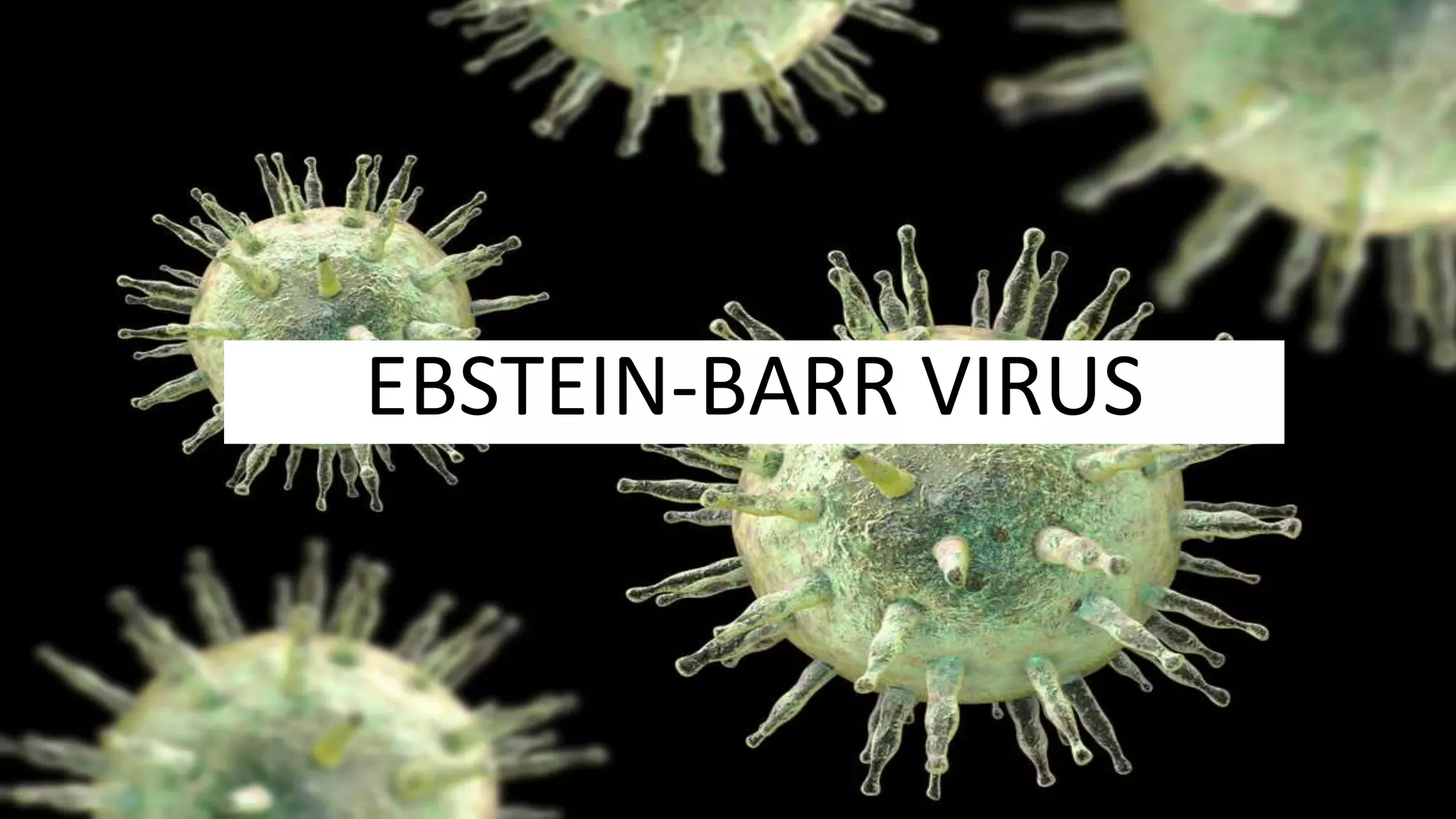
EBSTEIN-BARR VIRUS
Introduction
• Epidemiology EBV is a DNA virus in the family Herpesviridae that infects >90% of
persons by adulthood.
• EBV is spread by contact with oral secretions (e.g., by transfer of saliva during
kissing) and is shed in oropharyngeal secretions by >90% of asymptomatic
seropositive individuals.
• Infectious Mononucleosis is also called “kissing disease”.
Pathogenesis
• EBV infects the epithelium of the oropharynx and salivary glands as well as B cells
in tonsillar crypts prior to a period of viremia.
• There is polyclonal activation of B cells, and memory B cells form the reservoir
for EBV.
• Cellular immunity is more important than humoral immunity in controlling
infection. If T cell immunity is compromised, EBV-infected B cells may
proliferate—a step toward neoplastic transformation.
Clinical Manifestations
• Young children typically develop asymptomatic infections or mild pharyngitis,
adolescents and adults develop an infectious mononucleosis (IM) syndrome, and
immunocompromised pts can develop lymphoproliferative disease.
• Infectious Mononucleosis : fatigue, malaise, and myalgia may last for 1–2 weeks before
the onset of fever, exudative pharyngitis, and lymphadenopathy with tender,
symmetric, and movable nodes; splenomegaly is more prominent in the second or third
week. Lymphocytosis occurs in the second or third week, with >10% atypical
lymphocytes (enlarged cells with abundant cytoplasm and vacuoles); abnormal liver
function is common.
• Lymphoproliferative disease—i.e., infiltration of lymph nodes and multiple organs by
proliferating EBV-infected B cells—occurs in pts with deficient cellular immunity
• EBV-associated malignancies include Burkitt’s lymphoma, anaplastic nasopharyngeal
carcinoma, Hodgkin’s disease, Oral hairy leukoplakia.
Complications
• CNS disease (e.g., meningitis, encephalitis),
• Coombs-positive autoimmune hemolytic anemia,
• splenic rupture, and
• upper airway obstruction due to hypertrophy of lymphoid tissue
Investigation
• Serologic testing is the mainstay of diagnostic assessment.
• PCR analysis can be useful in monitoring EBV DNA levels in blood
• Heterophile antibodies form the basis of most rapid testing, The antibodies can persist
for up to 1 year after infection.
• EBV-specific antibody testing can be used in heterophilenegative pts and pts with
atypical disease
• Antibodies to Epstein-Barr nuclear antigen are not detected until 3–6 weeks after
symptom onset and then persist for life.
Treatment
• Supportive measures, including rest and analgesia. – Excessive physical activity should be
avoided in the first month of illness to reduce the possibility of splenic rupture, which
necessitates splenectomy.
• Administration of glucocorticoids may be indicated for some complications of IM
• Antiviral therapy (e.g., with acyclovir) is generally not effective for IM but is effective for
oral hairy leukoplakia.
• EBV lymphoproliferative syndrome is generally directed toward reduction of
immunosuppression e.g., with interferon α, antibody to CD20 (rituximab), and donor
lymphocyte infusions.

Ebstein Barr Virus

  • 1.
  • 2.
    Introduction • Epidemiology EBVis a DNA virus in the family Herpesviridae that infects >90% of persons by adulthood. • EBV is spread by contact with oral secretions (e.g., by transfer of saliva during kissing) and is shed in oropharyngeal secretions by >90% of asymptomatic seropositive individuals. • Infectious Mononucleosis is also called “kissing disease”.
  • 3.
    Pathogenesis • EBV infectsthe epithelium of the oropharynx and salivary glands as well as B cells in tonsillar crypts prior to a period of viremia. • There is polyclonal activation of B cells, and memory B cells form the reservoir for EBV. • Cellular immunity is more important than humoral immunity in controlling infection. If T cell immunity is compromised, EBV-infected B cells may proliferate—a step toward neoplastic transformation.
  • 4.
    Clinical Manifestations • Youngchildren typically develop asymptomatic infections or mild pharyngitis, adolescents and adults develop an infectious mononucleosis (IM) syndrome, and immunocompromised pts can develop lymphoproliferative disease. • Infectious Mononucleosis : fatigue, malaise, and myalgia may last for 1–2 weeks before the onset of fever, exudative pharyngitis, and lymphadenopathy with tender, symmetric, and movable nodes; splenomegaly is more prominent in the second or third week. Lymphocytosis occurs in the second or third week, with >10% atypical lymphocytes (enlarged cells with abundant cytoplasm and vacuoles); abnormal liver function is common. • Lymphoproliferative disease—i.e., infiltration of lymph nodes and multiple organs by proliferating EBV-infected B cells—occurs in pts with deficient cellular immunity • EBV-associated malignancies include Burkitt’s lymphoma, anaplastic nasopharyngeal carcinoma, Hodgkin’s disease, Oral hairy leukoplakia.
  • 5.
    Complications • CNS disease(e.g., meningitis, encephalitis), • Coombs-positive autoimmune hemolytic anemia, • splenic rupture, and • upper airway obstruction due to hypertrophy of lymphoid tissue
  • 6.
    Investigation • Serologic testingis the mainstay of diagnostic assessment. • PCR analysis can be useful in monitoring EBV DNA levels in blood • Heterophile antibodies form the basis of most rapid testing, The antibodies can persist for up to 1 year after infection. • EBV-specific antibody testing can be used in heterophilenegative pts and pts with atypical disease • Antibodies to Epstein-Barr nuclear antigen are not detected until 3–6 weeks after symptom onset and then persist for life.
  • 7.
    Treatment • Supportive measures,including rest and analgesia. – Excessive physical activity should be avoided in the first month of illness to reduce the possibility of splenic rupture, which necessitates splenectomy. • Administration of glucocorticoids may be indicated for some complications of IM • Antiviral therapy (e.g., with acyclovir) is generally not effective for IM but is effective for oral hairy leukoplakia. • EBV lymphoproliferative syndrome is generally directed toward reduction of immunosuppression e.g., with interferon α, antibody to CD20 (rituximab), and donor lymphocyte infusions.