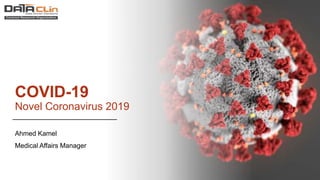
COVID-19
Novel Coronavirus 2019
Ahmed Kamel
Medical Affairs Manager
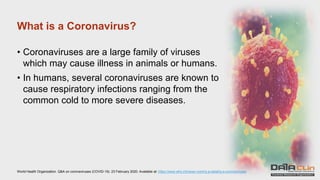
• Coronaviruses are a large family of viruses
which may cause illness in animals or humans.
• In humans, several coronaviruses are known to
cause respiratory infections ranging from the
common cold to more severe diseases.
What is a Coronavirus?
World Health Organization. Q&A on coronaviruses (COVID-19). 23 February 2020. Available at: https://www.who.int/news-room/q-a-detail/q-a-coronaviruses
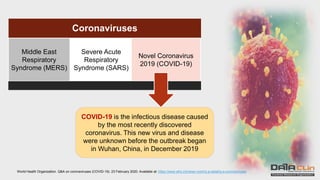
Coronaviruses
Middle East
Respiratory
Syndrome (MERS)
Severe Acute
Respiratory
Syndrome (SARS)
Novel Coronavirus
2019 (COVID-19)
COVID-19 is the infectious disease caused
by the most recently discovered
coronavirus. This new virus and disease
were unknown before the outbreak began
in Wuhan, China, in December 2019
World Health Organization. Q&A on coronaviruses (COVID-19). 23 February 2020. Available at: https://www.who.int/news-room/q-a-detail/q-a-coronaviruses
What are the symptoms of COVID-19?
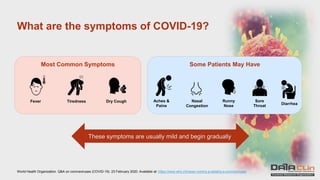
Most Common Symptoms
Fever Tiredness Dry Cough
Some Patients May Have
Aches &
Pains
Nasal
Congestion
Runny
Nose
Sore
Throat
Diarrhea
These symptoms are usually mild and begin gradually
World Health Organization. Q&A on coronaviruses (COVID-19). 23 February 2020. Available at: https://www.who.int/news-room/q-a-detail/q-a-coronaviruses
Facts & Figures
World Health Organization. Q&A on coronaviruses (COVID-19). 23 February 2020. Available at: https://www.who.int/news-room/q-a-detail/q-a-coronaviruses
Some people become infected but don’t develop any symptoms and don't feel unwell.
Most people (about 80%) recover from the disease without needing special treatment
Around 1 out of every 6 people who gets COVID-19 becomes seriously ill and develops difficulty
breathing
Older people, and those with underlying medical problems like high blood pressure, heart problems or
diabetes, are more likely to develop serious illness
People with fever, cough and difficulty breathing should seek medical attention
How does COVID-19 spread?
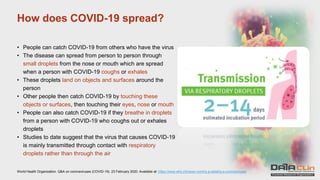
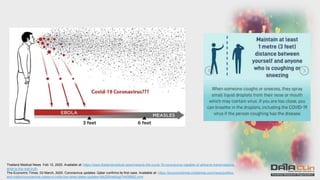
• People can catch COVID-19 from others who have the virus
• The disease can spread from person to person through
small droplets from the nose or mouth which are spread
when a person with COVID-19 coughs or exhales
• These droplets land on objects and surfaces around the
person
• Other people then catch COVID-19 by touching these
objects or surfaces, then touching their eyes, nose or mouth
• People can also catch COVID-19 if they breathe in droplets
from a person with COVID-19 who coughs out or exhales
droplets
• Studies to date suggest that the virus that causes COVID-19
is mainly transmitted through contact with respiratory
droplets rather than through the air
World Health Organization. Q&A on coronaviruses (COVID-19). 23 February 2020. Available at: https://www.who.int/news-room/q-a-detail/q-a-coronaviruses
Thailand Medical News Feb 12, 2020. Available at: https://www.thailandmedical.news/news/is-the-covid-19-coronavirus-capable-of-airborne-transmissions-
what-is-the-real-truth
The Economic Times. 03 March, 2020. Coronavirus updates: Qatar confirms its first case. Available at: https://economictimes.indiatimes.com/news/politics-
and-nation/coronavirus-cases-in-india-live-news-latest-updates-feb29/liveblog/74409982.cms
Can CoVID-19 be caught from a person
who has no symptoms?
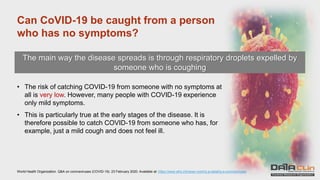
The main way the disease spreads is through respiratory droplets expelled by
someone who is coughing
• The risk of catching COVID-19 from someone with no symptoms at
all is very low. However, many people with COVID-19 experience
only mild symptoms.
• This is particularly true at the early stages of the disease. It is
therefore possible to catch COVID-19 from someone who has, for
example, just a mild cough and does not feel ill.
World Health Organization. Q&A on coronaviruses (COVID-19). 23 February 2020. Available at: https://www.who.int/news-room/q-a-detail/q-a-coronaviruses
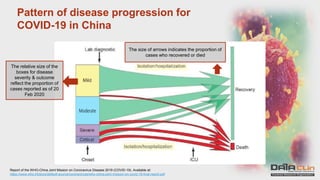
Pattern of disease progression for
COVID-19 in China
The relative size of the
boxes for disease
severity & outcome
reflect the proportion of
cases reported as of 20
Feb 2020
The size of arrows indicates the proportion of
cases who recovered or died
Report of the WHO-China Joint Mission on Coronavirus Disease 2019 (COVID-19). Available at:
https://www.who.int/docs/default-source/coronaviruse/who-china-joint-mission-on-covid-19-final-report.pdf
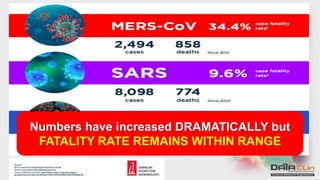
Numbers have increased DRAMATICALLY but
FATALITY RATE REMAINS WITHIN RANGE
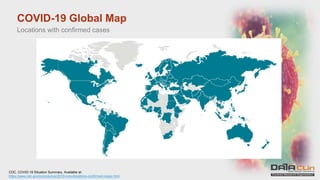
COVID-19 Global Map
CDC. COVID-19 Situation Summary. Available at:
https://www.cdc.gov/coronavirus/2019-ncov/locations-confirmed-cases.html
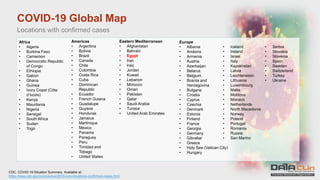
Locations with confirmed cases
Africa
• Algeria
• Burkina Faso
• Cameroon
• Democratic Republic
of Congo
• Ethiopia
• Gabon
• Ghana
• Guinea
• Ivory Coast (Côte
d’Ivoire)
• Kenya
• Mauritania
• Nigeria
• Senegal
• South Africa
• Sudan
• Togo
Americas
• Argentina
• Bolivia
• Brazil
• Canada
• Chile
• Colombia
• Costa Rica
• Cuba
• Dominican
Republic
• Ecuador
• French Guiana
• Guadalupe
• Guyana
• Honduras
• Jamaica
• Martinique
• Mexico
• Panama
• Paraguay
• Peru
• Trinidad and
Tobago
• United States
Eastern Mediterranean
• Afghanistan
• Bahrain
• Egypt
• Iran
• Iraq
• Jordan
• Kuwait
• Lebanon
• Morocco
• Oman
• Pakistan
• Qatar
• Saudi Arabia
• Tunisia
• United Arab Emirates
Europe
• Albania
• Andorra
• Armenia
• Austria
• Azerbaijan
• Belarus
• Belgium
• Bosnia and
Herzegovina
• Bulgaria
• Croatia
• Cyprus
• Czechia
• Denmark
• Estonia
• Finland
• France
• Georgia
• Germany
• Gibraltar
• Greece
• Holy See (Vatican City)
• Hungary
• Iceland
• Ireland
• Israel
• Italy
• Kazakhstan
• Latvia
• Liechtenstein
• Lithuania
• Luxembourg
• Malta
• Moldova
• Monaco
• Netherlands
• North Macedonia
• Norway
• Poland
• Portugal
• Romania
• Russia
• San Marino
• Serbia
• Slovakia
• Slovenia
• Spain
• Sweden
• Switzerland
• Turkey
• Ukraine
COVID-19 Global Map
Locations with confirmed cases
CDC. COVID-19 Situation Summary. Available at:
https://www.cdc.gov/coronavirus/2019-ncov/locations-confirmed-cases.html
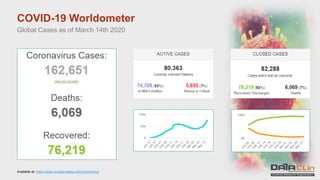
COVID-19 Worldometer
Global Cases as of March 14th 2020
Available at: https://www.worldometers.info/coronavirus/
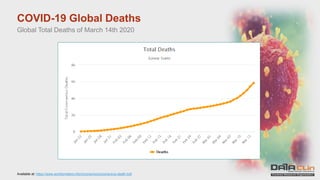
COVID-19 Global Deaths
Global Total Deaths of March 14th 2020
Available at: https://www.worldometers.info/coronavirus/coronavirus-death-toll/
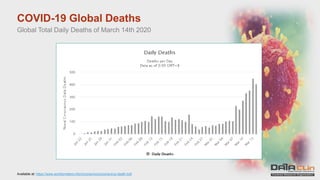
COVID-19 Global Deaths
Global Total Daily Deaths of March 14th 2020
Available at: https://www.worldometers.info/coronavirus/coronavirus-death-toll/
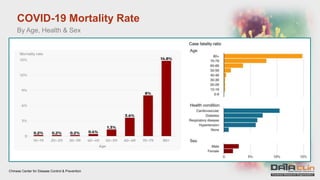
COVID-19 Mortality Rate
By Age, Health & Sex
Chinese Center for Disease Control & Prevention
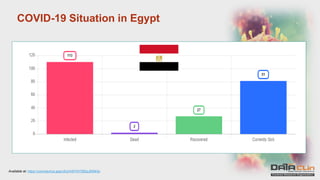
COVID-19 Situation in Egypt
Available at: https://coronavirus.app/v8JcH4FHH7BDpJlNNHjv
COVID-19 Situation in Egypt
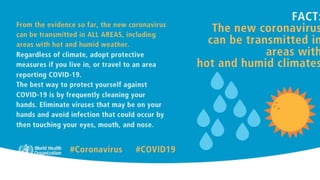
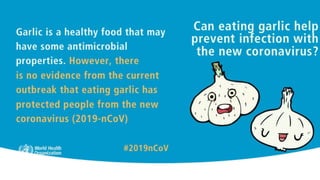
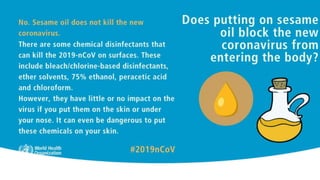
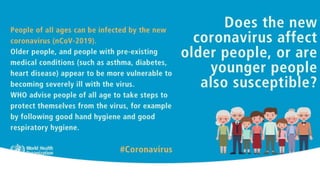
Facts About COVID-19
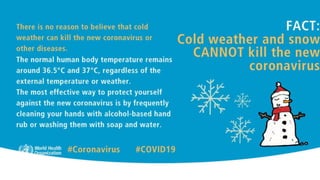
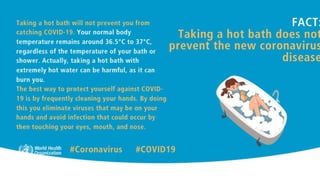
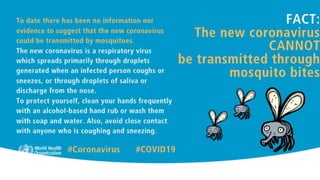
Myth Busters
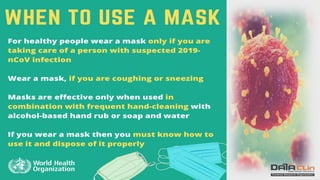
When to Use a Mask?
Protective Measures
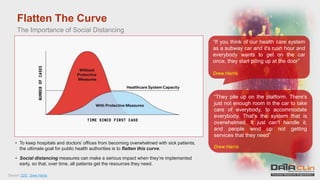
Flatten The Curve
Source: CDC, Drew Harris
“If you think of our health care system
as a subway car and it's rush hour and
everybody wants to get on the car
once, they start piling up at the door”
Drew Harris
“They pile up on the platform. There's
just not enough room in the car to take
care of everybody, to accommodate
everybody. That's the system that is
overwhelmed. It just can't handle it,
and people wind up not getting
services that they need”
Drew Harris
The Importance of Social Distancing
• To keep hospitals and doctors’ offices from becoming overwhelmed with sick patients,
the ultimate goal for public health authorities is to flatten this curve.
• Social distancing measures can make a serious impact when they’re implemented
early, so that, over time, all patients get the resources they need.
Global Efforts
Hope for a new cure
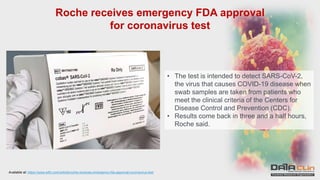
Roche receives emergency FDA approval
for coronavirus test
• The test is intended to detect SARS-CoV-2,
the virus that causes COVID-19 disease when
swab samples are taken from patients who
meet the clinical criteria of the Centers for
Disease Control and Prevention (CDC).
• Results come back in three and a half hours,
Roche said.
Available at: https://www.wthr.com/article/roche-receives-emergency-fda-approval-coronavirus-test
Keep Your Self &
Your Family Safe
Thank You

COVID-19

  • 1.
    COVID-19 Novel Coronavirus 2019 AhmedKamel Medical Affairs Manager
  • 2.
    • Coronaviruses area large family of viruses which may cause illness in animals or humans. • In humans, several coronaviruses are known to cause respiratory infections ranging from the common cold to more severe diseases. What is a Coronavirus? World Health Organization. Q&A on coronaviruses (COVID-19). 23 February 2020. Available at: https://www.who.int/news-room/q-a-detail/q-a-coronaviruses
  • 3.
    Coronaviruses Middle East Respiratory Syndrome (MERS) SevereAcute Respiratory Syndrome (SARS) Novel Coronavirus 2019 (COVID-19) COVID-19 is the infectious disease caused by the most recently discovered coronavirus. This new virus and disease were unknown before the outbreak began in Wuhan, China, in December 2019 World Health Organization. Q&A on coronaviruses (COVID-19). 23 February 2020. Available at: https://www.who.int/news-room/q-a-detail/q-a-coronaviruses
  • 4.
    What are thesymptoms of COVID-19? Most Common Symptoms Fever Tiredness Dry Cough Some Patients May Have Aches & Pains Nasal Congestion Runny Nose Sore Throat Diarrhea These symptoms are usually mild and begin gradually World Health Organization. Q&A on coronaviruses (COVID-19). 23 February 2020. Available at: https://www.who.int/news-room/q-a-detail/q-a-coronaviruses
  • 5.
    Facts & Figures WorldHealth Organization. Q&A on coronaviruses (COVID-19). 23 February 2020. Available at: https://www.who.int/news-room/q-a-detail/q-a-coronaviruses Some people become infected but don’t develop any symptoms and don't feel unwell. Most people (about 80%) recover from the disease without needing special treatment Around 1 out of every 6 people who gets COVID-19 becomes seriously ill and develops difficulty breathing Older people, and those with underlying medical problems like high blood pressure, heart problems or diabetes, are more likely to develop serious illness People with fever, cough and difficulty breathing should seek medical attention
  • 6.
    How does COVID-19spread? • People can catch COVID-19 from others who have the virus • The disease can spread from person to person through small droplets from the nose or mouth which are spread when a person with COVID-19 coughs or exhales • These droplets land on objects and surfaces around the person • Other people then catch COVID-19 by touching these objects or surfaces, then touching their eyes, nose or mouth • People can also catch COVID-19 if they breathe in droplets from a person with COVID-19 who coughs out or exhales droplets • Studies to date suggest that the virus that causes COVID-19 is mainly transmitted through contact with respiratory droplets rather than through the air World Health Organization. Q&A on coronaviruses (COVID-19). 23 February 2020. Available at: https://www.who.int/news-room/q-a-detail/q-a-coronaviruses
  • 7.
    Thailand Medical NewsFeb 12, 2020. Available at: https://www.thailandmedical.news/news/is-the-covid-19-coronavirus-capable-of-airborne-transmissions- what-is-the-real-truth The Economic Times. 03 March, 2020. Coronavirus updates: Qatar confirms its first case. Available at: https://economictimes.indiatimes.com/news/politics- and-nation/coronavirus-cases-in-india-live-news-latest-updates-feb29/liveblog/74409982.cms
  • 8.
    Can CoVID-19 becaught from a person who has no symptoms? The main way the disease spreads is through respiratory droplets expelled by someone who is coughing • The risk of catching COVID-19 from someone with no symptoms at all is very low. However, many people with COVID-19 experience only mild symptoms. • This is particularly true at the early stages of the disease. It is therefore possible to catch COVID-19 from someone who has, for example, just a mild cough and does not feel ill. World Health Organization. Q&A on coronaviruses (COVID-19). 23 February 2020. Available at: https://www.who.int/news-room/q-a-detail/q-a-coronaviruses
  • 9.
    Pattern of diseaseprogression for COVID-19 in China The relative size of the boxes for disease severity & outcome reflect the proportion of cases reported as of 20 Feb 2020 The size of arrows indicates the proportion of cases who recovered or died Report of the WHO-China Joint Mission on Coronavirus Disease 2019 (COVID-19). Available at: https://www.who.int/docs/default-source/coronaviruse/who-china-joint-mission-on-covid-19-final-report.pdf
  • 10.
    Numbers have increasedDRAMATICALLY but FATALITY RATE REMAINS WITHIN RANGE
  • 13.
    COVID-19 Global Map CDC.COVID-19 Situation Summary. Available at: https://www.cdc.gov/coronavirus/2019-ncov/locations-confirmed-cases.html Locations with confirmed cases
  • 14.
    Africa • Algeria • BurkinaFaso • Cameroon • Democratic Republic of Congo • Ethiopia • Gabon • Ghana • Guinea • Ivory Coast (Côte d’Ivoire) • Kenya • Mauritania • Nigeria • Senegal • South Africa • Sudan • Togo Americas • Argentina • Bolivia • Brazil • Canada • Chile • Colombia • Costa Rica • Cuba • Dominican Republic • Ecuador • French Guiana • Guadalupe • Guyana • Honduras • Jamaica • Martinique • Mexico • Panama • Paraguay • Peru • Trinidad and Tobago • United States Eastern Mediterranean • Afghanistan • Bahrain • Egypt • Iran • Iraq • Jordan • Kuwait • Lebanon • Morocco • Oman • Pakistan • Qatar • Saudi Arabia • Tunisia • United Arab Emirates Europe • Albania • Andorra • Armenia • Austria • Azerbaijan • Belarus • Belgium • Bosnia and Herzegovina • Bulgaria • Croatia • Cyprus • Czechia • Denmark • Estonia • Finland • France • Georgia • Germany • Gibraltar • Greece • Holy See (Vatican City) • Hungary • Iceland • Ireland • Israel • Italy • Kazakhstan • Latvia • Liechtenstein • Lithuania • Luxembourg • Malta • Moldova • Monaco • Netherlands • North Macedonia • Norway • Poland • Portugal • Romania • Russia • San Marino • Serbia • Slovakia • Slovenia • Spain • Sweden • Switzerland • Turkey • Ukraine COVID-19 Global Map Locations with confirmed cases CDC. COVID-19 Situation Summary. Available at: https://www.cdc.gov/coronavirus/2019-ncov/locations-confirmed-cases.html
  • 15.
    COVID-19 Worldometer Global Casesas of March 14th 2020 Available at: https://www.worldometers.info/coronavirus/
  • 16.
    COVID-19 Global Deaths GlobalTotal Deaths of March 14th 2020 Available at: https://www.worldometers.info/coronavirus/coronavirus-death-toll/
  • 17.
    COVID-19 Global Deaths GlobalTotal Daily Deaths of March 14th 2020 Available at: https://www.worldometers.info/coronavirus/coronavirus-death-toll/
  • 18.
    COVID-19 Mortality Rate ByAge, Health & Sex Chinese Center for Disease Control & Prevention
  • 19.
    COVID-19 Situation inEgypt Available at: https://coronavirus.app/v8JcH4FHH7BDpJlNNHjv
  • 20.
  • 21.
  • 26.
  • 40.
    When to Usea Mask?
  • 47.
  • 52.
    Flatten The Curve Source:CDC, Drew Harris “If you think of our health care system as a subway car and it's rush hour and everybody wants to get on the car once, they start piling up at the door” Drew Harris “They pile up on the platform. There's just not enough room in the car to take care of everybody, to accommodate everybody. That's the system that is overwhelmed. It just can't handle it, and people wind up not getting services that they need” Drew Harris The Importance of Social Distancing • To keep hospitals and doctors’ offices from becoming overwhelmed with sick patients, the ultimate goal for public health authorities is to flatten this curve. • Social distancing measures can make a serious impact when they’re implemented early, so that, over time, all patients get the resources they need.
  • 54.
  • 57.
    Roche receives emergencyFDA approval for coronavirus test • The test is intended to detect SARS-CoV-2, the virus that causes COVID-19 disease when swab samples are taken from patients who meet the clinical criteria of the Centers for Disease Control and Prevention (CDC). • Results come back in three and a half hours, Roche said. Available at: https://www.wthr.com/article/roche-receives-emergency-fda-approval-coronavirus-test
  • 59.
    Keep Your Self& Your Family Safe Thank You