EASTERN JAPAN GREAT
EARTHQUAKE DISASTER
Byju V
M2 Structural Engineering
Date and time Friday, March 11, 2011
02:46:23 PM - Local Time
Epicentre 38.322oN and 142.369oE
Magnitude 9
Intensity Up to VII
Peak ground
acceleration
2g to 0.34 g
Characteristics
2
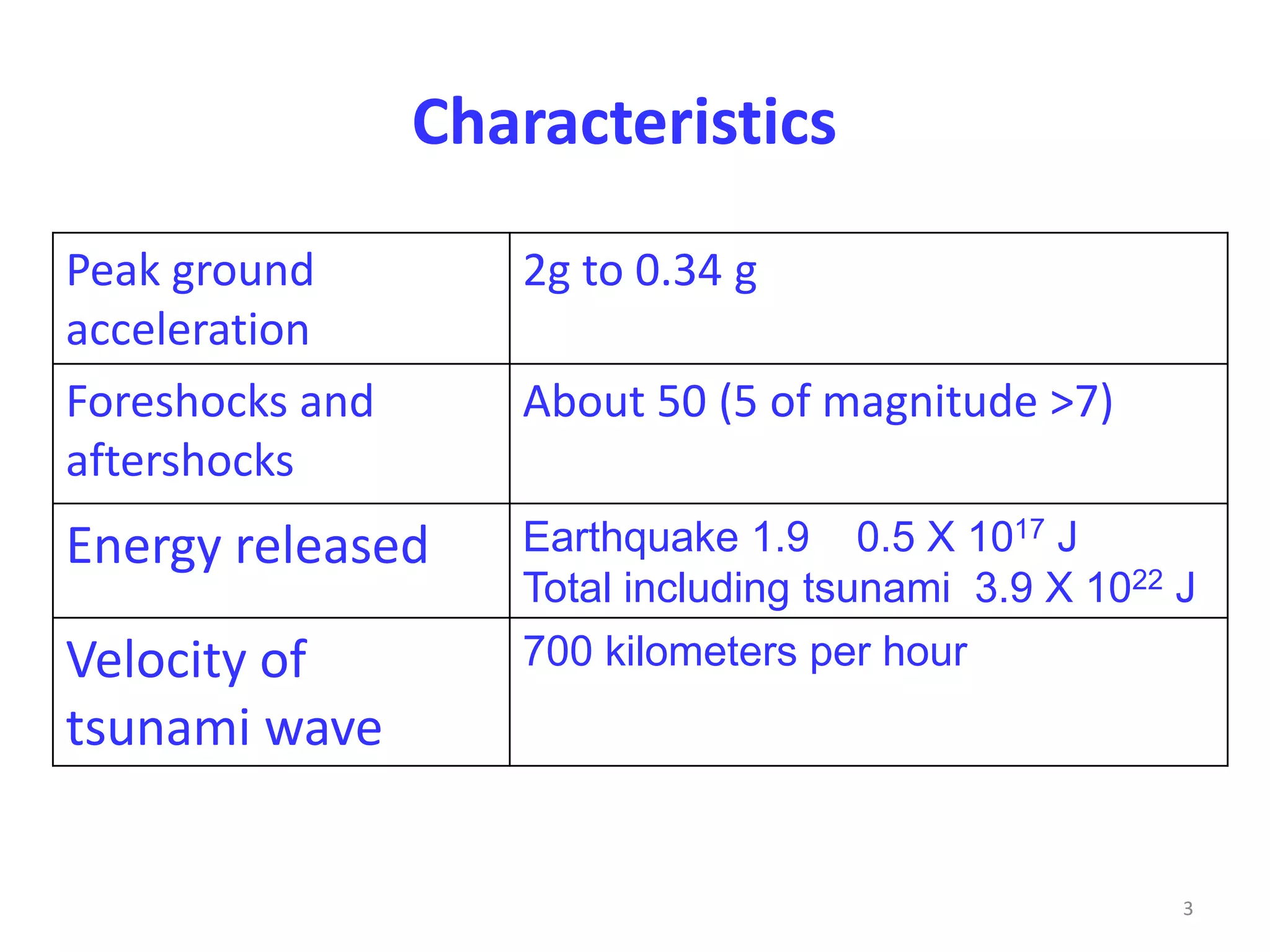
Peak ground
acceleration
2g to 0.34 g
Foreshocks and
aftershocks
About 50 (5 of magnitude >7)
Energy released Earthquake 1.9 0.5 X 10¹⁷ J
Total including tsunami 3.9 X 10²² J
Velocity of
tsunami wave
700 kilometers per hour
Characteristics
3
Ring of fire
Plate movement
Pacific plate slipped beneath Eurasian plate
It was moving a few cm every year
4
Plate movement
5
Epicentre
6
Intensity of earthquake 7
Tsunami following the quake 8
Impacts
• Humanitarian
» 13,392 deaths
» 15,133 missing
» 4896 injured
» 3,35,000 refugees
• Buildings
» 59,806 destroyed
» 12,728 damaged
» More in tsunami than earthquake
9
Impacts
• Infrastructure
» Power, nuclear, railway, air port,
ports
• Economic
» Total loss $ 171 to 183 billion
» Total cost of recovery $ 122 billion
10
Nuclear crisis
• Crisis at Fukushima
• Level 7 nuclear event
• What happened?
• The height of sea wall was insufficient
• Power system was poorly designed
• IAEA norms – Design to consider events
having probability of 1 in 10,000 years
11
Damage to structures
Prestressed Concrete Institute (PCI) report
• No widespread structural damage
• Damages mainly from tsunami, not shaking
• Major damages due to quake suffered by old
buildings built before code revisions.
• Several changes to building codes in last 40
years, after 1968 earthquake
12
Code revisions
 Review procedure for existing buildings for seismic
safety.
 Reduced the spacing of steel ties in columns to 100 mm
 Ultimate strength design for shear of beams and
columns
 More stringent requirements for shear reinforcement
 Two phase design
i. 0.08 g to 0.1 g (can occur several times)
ii. 0.3 g to 0.4 g (Can occur once in the lifetime of
building)
 Performance based seismic design introduced in 2000
13
Design flow chart
14
Preparedness
 Many measures by Japan after 1995 earthquake
 World’s first earthquake early warning system
 Rapid and systematic and calm reporting by
media
 Heavy investment in educating public about
disaster management
 One of the most stringent construction
standards
 The highest disaster risk aware population
15
• Very old timber houses are generally collapsed.
• Damage is generally limited to roof with tiles.
• Damage to timber houses built on a soft ground or
nearby creeks or rivers.
Damages to timber buildings
16
Damages to masonry buildings
o Damage is generally limited to roof with tiles.
o As the number of masonry buildings are few, no
major collapses were observed 17
Damages to RC buildings
Complete collapse of a few buildings built before
code revisions 18
19
Tilting of RC building due to liquefaction
20
Damaged Nakaminato Thermal Power Plant due to heavy liquefaction
21
Shiogama Municipal No. 2 Junior High School retrofitted using an
external precast concrete frame braced with tension ties 22
1. Okada Norio et. al. (2011), “The 2011 Eastern Japan Great
Earthquake Disaster: Overview and Comments”, Int. J.
Disaster Risk Sci., 2 (1): 34–42
2. Richard Sause et. al, “Preview of PCI’s Japan earthquake
Reconnaissance Team Report”, www.pci.org
3. Ömer Aydan and HisatakaTano (2011), Shaking – induced
damage to buildings by M 9.0 East Japan mega earthquake
on March 11, 2011
4. Ömer Aydan and HisatakaTano (2011), Liquifaction-induced
damage to buildings by M 9.0 East Japan mega earthquake
on March 11, 2011
5. www.sefindia.org
6. www.jsce-int.org
References
23

Eastern japan great earthquake disaster

  • 1.
    EASTERN JAPAN GREAT EARTHQUAKEDISASTER Byju V M2 Structural Engineering
  • 2.
    Date and timeFriday, March 11, 2011 02:46:23 PM - Local Time Epicentre 38.322oN and 142.369oE Magnitude 9 Intensity Up to VII Peak ground acceleration 2g to 0.34 g Characteristics 2
  • 3.
    Peak ground acceleration 2g to0.34 g Foreshocks and aftershocks About 50 (5 of magnitude >7) Energy released Earthquake 1.9 0.5 X 10¹⁷ J Total including tsunami 3.9 X 10²² J Velocity of tsunami wave 700 kilometers per hour Characteristics 3
  • 4.
    Ring of fire Platemovement Pacific plate slipped beneath Eurasian plate It was moving a few cm every year 4
  • 5.
  • 6.
  • 7.
  • 8.
  • 9.
    Impacts • Humanitarian » 13,392deaths » 15,133 missing » 4896 injured » 3,35,000 refugees • Buildings » 59,806 destroyed » 12,728 damaged » More in tsunami than earthquake 9
  • 10.
    Impacts • Infrastructure » Power,nuclear, railway, air port, ports • Economic » Total loss $ 171 to 183 billion » Total cost of recovery $ 122 billion 10
  • 11.
    Nuclear crisis • Crisisat Fukushima • Level 7 nuclear event • What happened? • The height of sea wall was insufficient • Power system was poorly designed • IAEA norms – Design to consider events having probability of 1 in 10,000 years 11
  • 12.
    Damage to structures PrestressedConcrete Institute (PCI) report • No widespread structural damage • Damages mainly from tsunami, not shaking • Major damages due to quake suffered by old buildings built before code revisions. • Several changes to building codes in last 40 years, after 1968 earthquake 12
  • 13.
    Code revisions  Reviewprocedure for existing buildings for seismic safety.  Reduced the spacing of steel ties in columns to 100 mm  Ultimate strength design for shear of beams and columns  More stringent requirements for shear reinforcement  Two phase design i. 0.08 g to 0.1 g (can occur several times) ii. 0.3 g to 0.4 g (Can occur once in the lifetime of building)  Performance based seismic design introduced in 2000 13
  • 14.
  • 15.
    Preparedness  Many measuresby Japan after 1995 earthquake  World’s first earthquake early warning system  Rapid and systematic and calm reporting by media  Heavy investment in educating public about disaster management  One of the most stringent construction standards  The highest disaster risk aware population 15
  • 16.
    • Very oldtimber houses are generally collapsed. • Damage is generally limited to roof with tiles. • Damage to timber houses built on a soft ground or nearby creeks or rivers. Damages to timber buildings 16
  • 17.
    Damages to masonrybuildings o Damage is generally limited to roof with tiles. o As the number of masonry buildings are few, no major collapses were observed 17
  • 18.
    Damages to RCbuildings Complete collapse of a few buildings built before code revisions 18
  • 19.
  • 20.
    Tilting of RCbuilding due to liquefaction 20
  • 21.
    Damaged Nakaminato ThermalPower Plant due to heavy liquefaction 21
  • 22.
    Shiogama Municipal No.2 Junior High School retrofitted using an external precast concrete frame braced with tension ties 22
  • 23.
    1. Okada Norioet. al. (2011), “The 2011 Eastern Japan Great Earthquake Disaster: Overview and Comments”, Int. J. Disaster Risk Sci., 2 (1): 34–42 2. Richard Sause et. al, “Preview of PCI’s Japan earthquake Reconnaissance Team Report”, www.pci.org 3. Ömer Aydan and HisatakaTano (2011), Shaking – induced damage to buildings by M 9.0 East Japan mega earthquake on March 11, 2011 4. Ömer Aydan and HisatakaTano (2011), Liquifaction-induced damage to buildings by M 9.0 East Japan mega earthquake on March 11, 2011 5. www.sefindia.org 6. www.jsce-int.org References 23