ROAD
CONSTRUCTION
METHODOLOGY
and TECHNIQUES
GENERAL PROVISION:
PROJECT ENGINEER’S primary role is to ensure contract provisions are
followed that would involve close supervision and monitoring of the
contractor’s work to execute proper construction procedure, incorporating
the use of approved quality of materials, so that a high degree of
workmanship and the specifications called for in the approved plans could
be attained. Hence, the purpose of the DPWH specifications for Highways,
Bridges & Airports, which is the foremost reference regarding technical
aspects of project implementation.
10 Roads You Would Never Want to Drive On.mp4
Introduction
A road is a structure that link barangay and cities in
the country and serve as medium in transporting
goods and commodities from one place to another
and as communication link which brings economic
development to a nation.
ROAD
CLASSIFICATIONS
 1. NATIONAL ROAD – are the main roads that connect all
major cities to the capital of the country. They run throughout
the length and breadth of the country. A minimum two-lane
road is provided for national highways.
 1.1 ARTERIAL ROAD/PRIMARY ROAD
 1.1.1 NORTH-SOUTH BACKBONE
 1.1.2 EAST-WEST LATERAL
 1.2 SECONDARY ROAD – are the second main roads that
connect significant parts of the state within it. Secondary
roads ultimately connects to the national highways.
 1.3 TERTIARY ROAD - are provided within the cities and
connect markets and production places to state and national
highways.

ROAD TYPES
 Based on Materials
 Earth roads - are laid with soil. They are cheaper than all types of
roads. This type of road is provided for fewer traffic areas or
countryside areas. A good drainage system should be provided,
which reflects excellent performance for a more extended period.
 Gravel roads - are also low-quality roads, but they are better when
compared with earth roads. A compacted mixture of gravel and
earth is used as pavement material in this case.
 Murrum roads
 Kankar roads
 WBM roads
 Bituminous roads - are prevalent roads around the world. They are
the most used roads in the world. This road types are low in cost and
suitable for driving conditions. The thickness of bituminous roads
depends upon the subgrade soil conditions.
 Concrete roads - is used to construct the pavements in case of
concrete roads. These are very popular and costlier than all other
types of roads. They are not flexible, so they require less
maintenance.
EARTHWORKS TERMINOLOGY
Embankment – earth fill below the pavement necessary
to raise the road above flood levels.
- a road, railway line or canal is normally raised onto
an embankment made of compacted soil (typically clay
or rock- based) to avoid a change in level required by the
terrain, the alternatives being either to have an
unacceptable change in level or detour to follow a
contour.
Borrow – suitable material from sources outside the
roadway prism, used for embankments.
Slope – the angle of constructed soil plane usually
expressed in proportion of length and depth.
PART I – EARTHWORKS
Earthworks - The disturbance of soil or earth by any means
including excavation (including subsurface), tunneling,
drilling, infilling, land rehabilitation or restoration, stockpiling,
dumping of soil or sand, and the construction/reconstruction
of any track, embankment, or drainage channel.
The Process of earthworks is to excavate the existing land to
a suitable level so that road construction may begin.
The earthworks can take the form of either excavation in the
form of cuts or the construction of embankments to carry an
elevated highway
PART I – EARTHWORKS
What is the meaning of excavation in construction?
Excavation is the process of moving earth, rock or other
materials with tools, equipment or explosives. It includes
earthwork, trenching, wall shafts, tunneling and
underground. Excavation has a number of important
applications including exploration, environmental restoration,
mining and construction.
What is cut and fill in construction?
In earthmoving, cut and fill is the process of constructing a
railway, road or canal whereby the amount of material
from cuts roughly matches the amount of fill needed to make
nearby embankments, so minimizing the amount of construction
labor.
PART I – EARTHWORKS
EARTHWORK TERMINOLOGY
Fill – the average depth of embankment material needed to
be placed on top of the national ground at any designated
location along the roadway to satisfy
the designed grade.
Cut – the average depth needed in excavating the natural
found at a specific location along the road traverse to satisfy
the designed grade.
Excavation – removing earth from its original position in a cut
and transporting it to a fill or to waste deposit.
Compaction – the pressing of soil particles to expel air from the
mass and filling the voids to make the material more dense.
The factors influencing amount of compaction obtained are
material gradation, soil shape, moisture content and amount
of compactive effort.
EARTHWORK TERMINOLOGY
Soil Stabilization – a tool for economic road building,
material conservation, investment protection and
roadway upgrading.
Selected Borrow – suitable native material obtained from
roadway cuts or borrow areas or other similar material
used for sub-base, roadbed material, shoulder surfacing
slope cover or other specific purposes.
Leveling Course – The layer of material placed on an
existing surface to eliminate irregularities prior to placing
an overlaying course.
The construction procedure of roads is based on the
designed typical section, which is basically in layers of, a)
earthworks, b) sub-base & base course, and c) surface
courses, either bituminous surface course or pccp, this
also included d.) drainage & slope protection, and other
e) miscellaneous structures.
Before starting the actual execution of the layers of work,
an as-stake survey should be undertaken to relocate the
reference points guided by the approved plan. To check
and establish the horizontal and vertical control, for the
profile and cross-sections, indicating slope stakes for cut &
fill, along the total length of the roadway.
TYPICAL CROSS-SECTION OF GRAVEL ROAD
Examples of BAD Gravel Roads
Examples of GOOD Gravel Roads
EARTHWORKS ACTIVITY
ROADWAY EXCAVATION
It is a process of loosening and removing earth
from its original position and transporting same for fill or to
a waste deposit.
Excavation operation should be conducted so that
material outside the limits of slope will not be disturbed.
ROADWAY EXCAVATION
ROADWAY EXCAVATION
Types of Roadway Excavation:
a. Common Excavation – involves excavation of
common materials used as embankment fill which
results from excavation along the road traverse.
b. Unsuitable Excavation – is the removal and disposal of
saturated or unsaturated mixtures of soils and organic
matter not suitable for foundation materials.
c. Rock Excavation – consists of igneous, sedimentary
and metamorphic rocks which cannot be excavated
without blasting or the use of rippers.
TYPICAL ROADWAY AT ROCK SECTIONS
ROADWAY EXCAVATION
Types of Roadway Excavation:
d. Unclassified Excavation – Excavation and disposal of
materials regardless of its nature which were not
classified and not included in the bill of quantities
under other pay items.
e. Surplus Excavation – are suitable materials excavated
along the road traverse which are disposed as
excess in the formation of embankment subgrade.
A. EARTHWORKS:
ITEM 100 – CLEARING & GRUBBING,
EQUIPMENT USE: BULLDOZER
ITEM 101 – REMOVAL OF STRUCTURES & OBSTRUCTION
EQUIPMENT USE: BULLDOZER, PAYLOADER, DUMPTRUCK
ITEM 102 – EXCAVATION
EQUIPMENT USE: BULLDOZER, PAYLOADER, DUMPTRUCK
ITEM 104 – EMBANKMENT
EQUIPMENT USE: ROAD GRADER, PAYLOADER, DUMPTRUCK,
ROAD ROLLER, WATER TRUCK
ITEM 105 – SUBGRADE PREPARATION
EQUIPMENT USE: ROAD GRADER, ROAD ROLLER
EQUIPMENT REQUIREMENTS :
EQUIPMENT USED :
GRADER
BULLDOZER DUMPTRUCK
PAYLOADER
EMBANKMENT FILL
Are suitable materials which can be common or
rock which are brought and compacted together to a
specified degree to form a stable embankment to bring
the road to a desired grade or to elevate it above flood
level.
The most desirable fill is a mixture of two or more
simple type and varying proportion of clay, silt, sand,
gravel and stones. Sand and gravel are most desirable as
embankment fill when mixed with enough clay or silt to
bind them together.
EMBANKMENT
QUARRYING AND HAULING
Fill may be obtained by quarrying with bulldozer
from borrow pits opened just to obtain the fill and
loading/hauling same using a loader and dump
trucks.
COMPACTION
Compaction trial of not less than 500m² is done to determine the
actual capability of the compaction equipment and the
compatibility of the material to be used.
The number of passes for the compaction equipment to
attain the specified degree of compaction is recorded for use as
reference in the subsequent layering works using the same material
and compaction equipment.
What do we mean by BLUE TOPS?
Blue Tops are painted sticks placed along the side
of the road traverse as guide and reference in the
elevation of the different layering requirement of the
road project.
SPREADING OF EMBANKMENT
A stable embankment is attained by spreading the
materials into a thin layer then compacted at moisture
content close to optimum.
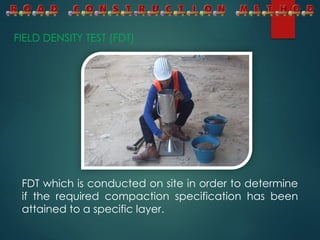
FIELD DENSITY TEST (FDT)
FDT which is conducted on site in order to determine
if the required compaction specification has been
attained to a specific layer.
TYPICAL ROAD CROSS SECTION
PART II - FORMATION OF THE SUB-GRADE
• The subgrade is the upper layer of natural soil which
may be the undisturbed local materials or soil
excavated elsewhere placed as fill.
• In forming the road subgrade, excess suitable material
located along the upper part of the designated road
profile is excavated and taken as fill to low lying areas
along the road traverse.
• Roads in rolling hills are often engineered to balance
the cuts and fills so that all the material cut out in high
spots is just enough to build up all the low spots.
• The strength of subgrade is the principal factor in
determining the thickness of pavement.
• If the material is not enough, borrow materials are
quarried and taken along as fill in order to obtain the
design elevation of the subgrade along the road
project.
• The two components in forming the subgrade
therefore are:
• Roadway excavation
• Embankment Fill
PART III – ROAD BASE PREPARATION
I. CLEARING AND GRUBBING
It means removing and disposing all surface
objects including vegetation, trees and other
protruding objects not designated to remain along
the roadway.
It is necessary as a preliminary move in
shaping the ground prior to the start of any
excavation or placing of embankment as any
growth makes earth difficult to handle and its
decay will cause future settlement of fill.
I. CLEARING AND GRUBBING
• Equipment and Labor Requirement
(Dumptruck, Bulldozer, Loader,Backhoe,
Grader, Skilled Labor)
• Removal of Trees
• Disposal of Debris
II. REMOVAL OF EXISTING OBSTRUCTION
• Prior to actual construction work, obstructions
are removed in order not to hamper the work.
• Typical Obstructions Are (Urban Areas):
• Existing pavement
• Existing drainage structures
• Underground waterline
• Electrical post and lines
• Cable and telephone lines
• Residential houses and buildings
• Fences
As Stabilizers…
• The subbase course is a structural layer which accepts
greater compressive stress than the subgrade and thus
reduces the deformation of the pavement under
traffic loading.
• The base course reduces the vertical compressive
stress induced by traffic in the subbase course and the
subgrade.
• Aggregate sub base course
• Aggregate base course
In Asphalt Pavement…
• The base and sub base courses serves to provide
structural capacity to bituminous concrete slabs.
• They carry the load and distribute it to the soil under
the layers of asphalt concrete.
What Other Purpose of Putting These Layers Below the
Surface Course?
• Aside from being stabilizing layers, it also serve for
draining purposes
What is the Difference Between the Two Stabilizing
Layers?
• Material Requirement
Item 200 Item 201
> Grading
> CBR Not less 25% Not less 80%
> Atterberg Limit
a. Plastic Limit not greater 12 not greater 6
b. Liquid Limit not more than 35 not more than 25
Fines passing 200 sieve shall not exceed
2/3 of the fraction passing # 40 sieve
Stockpile along the Roadway Side
What certain field condition dictates that materials
are first stockpiled along the roadside before it is spread
and compacted?
Spreading
• The sub base/base materials shall be
spread to the required thickness for
compaction
• If the required thickness is 150mm or
less, the material may be spread and
compacted in one layer.
Compaction
• Each layer shall be compacted to the full width
• Required degree of compaction is 100%.
1. Laying Sub-base
2. Compaction
In Asphalt Pavement…
• The base and sub base courses serves to provide
structural capacity to bituminous concrete slabs.
• They carry the load and distribute it to the soil under
the layers of asphalt concrete.
BASE COURSE
1. Cement Treated Base Course
B. SUBBASE & BASE COURSE:
ITEM 200 – AGGREGATE SUBBASE COURSE
EQUIPMENT USE : ROAD GRADER, ROAD ROLLER, WATER TRUCK
ITEM 201 – AGGREGATE BASE COURSE
EQUIPMENT USE : ROAD GRADER, ROAD ROLLER, WATER TRUCK
EQUIPMENT REQUIREMENTS :
B. SUBBASE & BASE COURSE:
A. AGGREGATE SURFACE COURSE (Gravel Road)
• A gravel road consists of a carriageway made of a layer
compacted gravel.
•The gravel used consists of irregular mixed with a waving
amount of sand, silt, and clay, which can act as binder.
Following consideration govern the construction of gravel
roads:
a.) The carriageway of the gravel road should be provided
with a camber of 1in25 to 1in30 to achieve good drainage
of the road surface.
b.) It should be composed of pebbles which are hard,
tough and durable rock particles to resist abrasion
PART IV – SURFACE COURSE
B. ASPHALT CONCRETE PAVEMENT
• It is also called flexible pavement implying its ability
to absorb stresses imposed by traffic and weather
without cracking.
•Is made of mineral aggregate mixed with asphalt
laid at a high temperature of about 275 to 300
degree F
•The thickness of a compacted asphalt concrete
pavement varies from 0.05 meter for lightly traveled
road to 0.15 meter or more for roads where traffic is
considered heavy.
Modern Road Construction & Asphalt Paving Machines!.mp4
Examples of BAD Asphalt Concrete Roads
Examples of GOOD Asphalt Concrete Road Pavement
TYPICAL CROSS SECTION OF ASPHALT CONCRETE
PAVEMENT
Methodology
a. Application of Prime Coat
 Is an application of thin bituminous material to a
porous base before putting on a surface course.
 It serves to stabilized the base and bind it to the
paving material.
 It also serves to plug the capillary voids in the
pavement in order to stop the upward movement
of moisture and to improve the adhesion between
the base and the surface course.
Methodology
b. Application of Binder Course
 It is a bituminous layer below the surface or wearing
course.
 The mix is designed primarily for stability as it is not
exposed to weather and traffic.
 Its aggregates are almost always larger that that of
the wearing course.
Methodology
 It ensure the adhesion of the surface course to
the binder course.
c. Application of Tack Coat
 Before applying tack coat, the surface must be
swept or flushed. The rate of application of either
the rapid curing cutback or the emulsified asphalt is
within the range of 0.2 to 0.7 liter per sq.m.
 The tack coat is sprayed in advance on the surface
course to permit it to dry into a tacky condition.
Methodology
d. Application of Wearing Course
 It is the climax of the whole operation.
 The only part apparent to those who use the
highway.
 It should be smooth yet skid resistant, quiet, in
contact with tires, cohesive and durable enough to
resist traffic stresses and sufficiently impermeable to
water and air to resist weathering.
1. Spraying of Tact Coat
Asphalt
2. Overlay
Asphalt
3. Overlay over Compaction
Asphalt
Overlay of Asphalt
Compaction of Asphalt
4. Potholes
Asphalt
Before repair During repair
During repair
After repair
5. Raveling
Asphalt
After Asphalt Overlay
During Asphalt Overlay
Before Asphalt Overlay
C. SURFACE COURSES:
ITEM 310 – BITUMINOUS CONCRETE SURFACE COURSE (HOT LAID)
EQUIPMENT USE : ASPHALT PAVER, PNEUMATIC ROLLER, TANDEM STEEL
ROAD ROLLER, WATER TRUCK,
EQUIPMENT REQUIREMENTS :
C. SURFACE COURSES:
EQUIPMENT REQUIREMENTS :
A pavement marking is part of a communication system
for road users – in addition to signs and signals, pavement
markings communicate to drivers where to position their
vehicles, warn about upcoming conditions, and indicate
where passing is allowed.
What is a road marking?
They can also be applied in other facilities used by
vehicles to mark parking spaces or designate areas for
other uses. Road surface markings are used on paved
roadways to provide guidance and information to drivers
and pedestrians.
PAVEMENT MARKINGS
PORTLAND CEMENT CONCRETE PAVEMENT
(PCCP)
Purpose of Concrete Pavement:
• Being the uppermost component of the
roadway, it should provide long lasting,
smooth, clean surface and should spread
the load sufficiently so that the base
material can support them.
• It protects the base against damage by
traffic and weather.
GOOD ROAD
PCCP TERMINOLOGY
Workability – concrete ability to be placed in a prepared form
without honeycomb.
Consistency – measure of fluidity of concrete. (Slump Test)
Water-cement ration – describes the compressive strength of
concrete mix.
Admixture – are substances other than aggregates water and
Portland Cement that can be added to concrete to
improve its properties and fulfill other special purposes.
Curing agent – is the treatment or protection applied to
concrete during hardening period to protect against early
shrinkage due to lose of moisture or abrupt changes in
temperature.
TYPES OF JOINT IN PCCP
a. Construction Joint
 Also called cold joint
 Is constructed when there is an interruption of more
than 30 minutes in the concreting operation which
is placed not within 1.50m of an expansion joint or
contraction joint.
b. Contraction Joint
 Also called weakened-plane joints
 Are provided to relieve the tensile stress due to
temperature, moisture and friction, thereby
controlling cracking.
 If not installed, random cracking would occur on
the surface of the pavement.
TYPES OF JOINT IN PCCP
c. Longitudinal Joint
 If the lanes are concreted separately, a
longitudinal construction joints in the
form of a key and keyway is used.
 Deformed steel tie bars of specified
length, size and spacing are placed
perpendicular to this joint.
 The spacing between longitudinal joints
is dictated by the pavement thickness.
TYPES OF JOINT IN PCCP
d. Expansion
 Provide space for the expansion of the pavement,
thereby preventing the development of
compressive stresses which can cause the
pavement to buckle.
 Are usually from 19 to 25mm wide and
extend the full depth of the slab.
 The joint space is filled with expansion
joint.
 Dowel bars are normally used in
expansion joints, and their diameter,
spacing, and length would generally be
similar to that indicated for contraction
joints.
TYPES OF RE-BARS USED IN PCCP
a. Dowels
 Are load transfer devices in joint to transfer
wheel loads from one slab to another and thus,
prevent excessive deflection at the ends of the
slabs.
 Are plain round steel bars generally coated
with a thin file of bitumen to protect them
against corrosion and to facilitate sliding in
concrete.
 Their installation midway in the slab should be
carried out accurately so as to have the dowels
run parallel to the surface of the pavement and
TYPES OF RE-BARS USED IN PCCP
b. Tie Bars
 Are deformed bars used in construction
and longitudinal joint together with keys
to tie two slabs together.
 Like the dowels, its installation must be
midway in the slab so that it runs parallel
to the surface or centerline of the
pavement.
Methodology
a. Setting of Forms
 Forms should be made of steel of an approved section and
depth equal to the thickness of pavement
 The base of the forms should be sufficient width to provide
necessary stability in all directions
 It should be installed firmly in contact with foundation with no
deviation from true lines by more than one (1) cm.
 The alignment and grade elevations of forms should be checked
prior to placing of concrete...road construction etcs
D) FORMWORKS
b. Batching of Concrete
 For large jobs, a Concrete Batching Plant is
necessary to provide a smooth flow of continuous
supply and transport of materials to the work.
 Periodic calibration of the plant is needed to
ensure that only the approved concrete mix is
used for the project.
c. Concrete Pouring
 Concrete unloaded from truck mixers in a movable
chute for proper distribution into the prepared forms.
 Workers are not allowed to walk on the freshly mixed
concrete with boots or shoes coated with earth or
foreign substances.
 Placing should be continuous and necessary hand
spreading should be done using shovels not rakes.
d. Screeding
 A screeder is used to grade concrete in such
manner as to prevent segregation.
 The screed is moved forward on top of the forms
with combined longitudinal and transversal
shearing motion.
e. Use of Concrete Vibrator
 Concrete should be thoroughly consolidated along
the faces of all forms by means of vibrators inserted
into concrete.
 Vibrators are not allowed to be operated longer
than 15 seconds in any single location.
f. Concrete Finishing
Floating – after the concrete has been struck off and consolidated it
is further smoothened by means of a longitudinal floats. Any
excess water or soupy material is wasted over the side forms on
each pass.
Brooming – is executed by producing a uniform appearance of
corrugations produced in the surface not more than 1.5mm in
depth.
g. Concrete Curing
 Is necessary for the hydration to take place so that
the concrete may harden properly and prevent
abrupt loss of moisture during the curing period.
Curing Method:
 Earth of straw may be spread over the surface of the
pavement and kept constantly wet during the curing
period.
 Burlap or cotton mats are spread over the surface. The
mats are sprinkled and kept constantly wet.
 Waterproof paper or polytelene sheets may be placed
over the slab to retain the moisture.
 Curing compound – the most popular method which
involves the spray application of light-colored fluid to
the entire area of the wet concrete. The fluid forms a
film over the pavement that prevents moisture loss.
h. Removal of Forms and Concrete Cutting
 Forms for concrete shall remain in place undisturbed within 24
hours after pouring
 Crowbars are used in removing forms pulling out of nails and pins
but cares should be exercised not to break the pavement edges.
 Concrete sawing is done within 24 hours after concrete pouring
water using cooled diamond edge saw blade.
i. Pavement Protection
Against Traffic – To protect concrete pavement at its early age, it
should be protected form passing traffic. This includes the
posting of watchman to direct traffic and the posting and
maintenance of warning signs, lights, pavement bridges and
crossovers, etc.
Against Rain – To protect newly poured concrete pavements
against rain it is required to have available at all times materials for
protection or covering materials such as burlap or cotton mats,
curing paper or plastic sheeting materials.
j. Sealing of Joints
Sealing of joints should be undertaken after the curing
period and before the pavement is opened to traffic.
Each joint should be clean and dry when the seal is
applied.
Spilling of seal on the surface of the pavement is not
allowed.
 ..road construction etcsE) PCCP Surface Course
ROAD CONSTRUCTION
TECHNIQUES
1. CONSTRUCTION STAKING
2. CLEARING AND GRUBBING OF THE CONSTRUCTION
AREA
3. SUB-GRADE CONSTRUCTION
That’s all Folks, Thank you!
CONSTRUCTION ENGINEERS
DPWH – SAMAR 1ST
ENGINEERING DISTRICT

1 - Road Construction Methods (Topics).pptx

  • 1.
    ROAD CONSTRUCTION METHODOLOGY and TECHNIQUES GENERAL PROVISION: PROJECTENGINEER’S primary role is to ensure contract provisions are followed that would involve close supervision and monitoring of the contractor’s work to execute proper construction procedure, incorporating the use of approved quality of materials, so that a high degree of workmanship and the specifications called for in the approved plans could be attained. Hence, the purpose of the DPWH specifications for Highways, Bridges & Airports, which is the foremost reference regarding technical aspects of project implementation. 10 Roads You Would Never Want to Drive On.mp4
  • 2.
    Introduction A road isa structure that link barangay and cities in the country and serve as medium in transporting goods and commodities from one place to another and as communication link which brings economic development to a nation.
  • 3.
    ROAD CLASSIFICATIONS  1. NATIONALROAD – are the main roads that connect all major cities to the capital of the country. They run throughout the length and breadth of the country. A minimum two-lane road is provided for national highways.  1.1 ARTERIAL ROAD/PRIMARY ROAD  1.1.1 NORTH-SOUTH BACKBONE  1.1.2 EAST-WEST LATERAL  1.2 SECONDARY ROAD – are the second main roads that connect significant parts of the state within it. Secondary roads ultimately connects to the national highways.  1.3 TERTIARY ROAD - are provided within the cities and connect markets and production places to state and national highways. 
  • 4.
    ROAD TYPES  Basedon Materials  Earth roads - are laid with soil. They are cheaper than all types of roads. This type of road is provided for fewer traffic areas or countryside areas. A good drainage system should be provided, which reflects excellent performance for a more extended period.  Gravel roads - are also low-quality roads, but they are better when compared with earth roads. A compacted mixture of gravel and earth is used as pavement material in this case.  Murrum roads  Kankar roads  WBM roads  Bituminous roads - are prevalent roads around the world. They are the most used roads in the world. This road types are low in cost and suitable for driving conditions. The thickness of bituminous roads depends upon the subgrade soil conditions.  Concrete roads - is used to construct the pavements in case of concrete roads. These are very popular and costlier than all other types of roads. They are not flexible, so they require less maintenance.
  • 5.
    EARTHWORKS TERMINOLOGY Embankment –earth fill below the pavement necessary to raise the road above flood levels. - a road, railway line or canal is normally raised onto an embankment made of compacted soil (typically clay or rock- based) to avoid a change in level required by the terrain, the alternatives being either to have an unacceptable change in level or detour to follow a contour. Borrow – suitable material from sources outside the roadway prism, used for embankments. Slope – the angle of constructed soil plane usually expressed in proportion of length and depth. PART I – EARTHWORKS
  • 6.
    Earthworks - Thedisturbance of soil or earth by any means including excavation (including subsurface), tunneling, drilling, infilling, land rehabilitation or restoration, stockpiling, dumping of soil or sand, and the construction/reconstruction of any track, embankment, or drainage channel. The Process of earthworks is to excavate the existing land to a suitable level so that road construction may begin. The earthworks can take the form of either excavation in the form of cuts or the construction of embankments to carry an elevated highway PART I – EARTHWORKS
  • 7.
    What is themeaning of excavation in construction? Excavation is the process of moving earth, rock or other materials with tools, equipment or explosives. It includes earthwork, trenching, wall shafts, tunneling and underground. Excavation has a number of important applications including exploration, environmental restoration, mining and construction. What is cut and fill in construction? In earthmoving, cut and fill is the process of constructing a railway, road or canal whereby the amount of material from cuts roughly matches the amount of fill needed to make nearby embankments, so minimizing the amount of construction labor. PART I – EARTHWORKS
  • 8.
    EARTHWORK TERMINOLOGY Fill –the average depth of embankment material needed to be placed on top of the national ground at any designated location along the roadway to satisfy the designed grade. Cut – the average depth needed in excavating the natural found at a specific location along the road traverse to satisfy the designed grade. Excavation – removing earth from its original position in a cut and transporting it to a fill or to waste deposit. Compaction – the pressing of soil particles to expel air from the mass and filling the voids to make the material more dense. The factors influencing amount of compaction obtained are material gradation, soil shape, moisture content and amount of compactive effort.
  • 9.
    EARTHWORK TERMINOLOGY Soil Stabilization– a tool for economic road building, material conservation, investment protection and roadway upgrading. Selected Borrow – suitable native material obtained from roadway cuts or borrow areas or other similar material used for sub-base, roadbed material, shoulder surfacing slope cover or other specific purposes. Leveling Course – The layer of material placed on an existing surface to eliminate irregularities prior to placing an overlaying course.
  • 10.
    The construction procedureof roads is based on the designed typical section, which is basically in layers of, a) earthworks, b) sub-base & base course, and c) surface courses, either bituminous surface course or pccp, this also included d.) drainage & slope protection, and other e) miscellaneous structures. Before starting the actual execution of the layers of work, an as-stake survey should be undertaken to relocate the reference points guided by the approved plan. To check and establish the horizontal and vertical control, for the profile and cross-sections, indicating slope stakes for cut & fill, along the total length of the roadway.
  • 11.
  • 12.
    Examples of BADGravel Roads
  • 13.
    Examples of GOODGravel Roads
  • 14.
  • 15.
    ROADWAY EXCAVATION It isa process of loosening and removing earth from its original position and transporting same for fill or to a waste deposit. Excavation operation should be conducted so that material outside the limits of slope will not be disturbed.
  • 16.
  • 17.
    ROADWAY EXCAVATION Types ofRoadway Excavation: a. Common Excavation – involves excavation of common materials used as embankment fill which results from excavation along the road traverse. b. Unsuitable Excavation – is the removal and disposal of saturated or unsaturated mixtures of soils and organic matter not suitable for foundation materials. c. Rock Excavation – consists of igneous, sedimentary and metamorphic rocks which cannot be excavated without blasting or the use of rippers.
  • 18.
    TYPICAL ROADWAY ATROCK SECTIONS
  • 19.
    ROADWAY EXCAVATION Types ofRoadway Excavation: d. Unclassified Excavation – Excavation and disposal of materials regardless of its nature which were not classified and not included in the bill of quantities under other pay items. e. Surplus Excavation – are suitable materials excavated along the road traverse which are disposed as excess in the formation of embankment subgrade.
  • 20.
    A. EARTHWORKS: ITEM 100– CLEARING & GRUBBING, EQUIPMENT USE: BULLDOZER ITEM 101 – REMOVAL OF STRUCTURES & OBSTRUCTION EQUIPMENT USE: BULLDOZER, PAYLOADER, DUMPTRUCK ITEM 102 – EXCAVATION EQUIPMENT USE: BULLDOZER, PAYLOADER, DUMPTRUCK ITEM 104 – EMBANKMENT EQUIPMENT USE: ROAD GRADER, PAYLOADER, DUMPTRUCK, ROAD ROLLER, WATER TRUCK ITEM 105 – SUBGRADE PREPARATION EQUIPMENT USE: ROAD GRADER, ROAD ROLLER EQUIPMENT REQUIREMENTS :
  • 21.
  • 22.
    EMBANKMENT FILL Are suitablematerials which can be common or rock which are brought and compacted together to a specified degree to form a stable embankment to bring the road to a desired grade or to elevate it above flood level. The most desirable fill is a mixture of two or more simple type and varying proportion of clay, silt, sand, gravel and stones. Sand and gravel are most desirable as embankment fill when mixed with enough clay or silt to bind them together.
  • 23.
  • 24.
    QUARRYING AND HAULING Fillmay be obtained by quarrying with bulldozer from borrow pits opened just to obtain the fill and loading/hauling same using a loader and dump trucks.
  • 25.
    COMPACTION Compaction trial ofnot less than 500m² is done to determine the actual capability of the compaction equipment and the compatibility of the material to be used. The number of passes for the compaction equipment to attain the specified degree of compaction is recorded for use as reference in the subsequent layering works using the same material and compaction equipment.
  • 26.
    What do wemean by BLUE TOPS? Blue Tops are painted sticks placed along the side of the road traverse as guide and reference in the elevation of the different layering requirement of the road project.
  • 27.
    SPREADING OF EMBANKMENT Astable embankment is attained by spreading the materials into a thin layer then compacted at moisture content close to optimum.
  • 28.
    FIELD DENSITY TEST(FDT) FDT which is conducted on site in order to determine if the required compaction specification has been attained to a specific layer.
  • 29.
  • 30.
    PART II -FORMATION OF THE SUB-GRADE • The subgrade is the upper layer of natural soil which may be the undisturbed local materials or soil excavated elsewhere placed as fill. • In forming the road subgrade, excess suitable material located along the upper part of the designated road profile is excavated and taken as fill to low lying areas along the road traverse. • Roads in rolling hills are often engineered to balance the cuts and fills so that all the material cut out in high spots is just enough to build up all the low spots. • The strength of subgrade is the principal factor in determining the thickness of pavement.
  • 31.
    • If thematerial is not enough, borrow materials are quarried and taken along as fill in order to obtain the design elevation of the subgrade along the road project. • The two components in forming the subgrade therefore are: • Roadway excavation • Embankment Fill
  • 32.
    PART III –ROAD BASE PREPARATION I. CLEARING AND GRUBBING It means removing and disposing all surface objects including vegetation, trees and other protruding objects not designated to remain along the roadway. It is necessary as a preliminary move in shaping the ground prior to the start of any excavation or placing of embankment as any growth makes earth difficult to handle and its decay will cause future settlement of fill.
  • 33.
    I. CLEARING ANDGRUBBING • Equipment and Labor Requirement (Dumptruck, Bulldozer, Loader,Backhoe, Grader, Skilled Labor) • Removal of Trees • Disposal of Debris
  • 34.
    II. REMOVAL OFEXISTING OBSTRUCTION • Prior to actual construction work, obstructions are removed in order not to hamper the work. • Typical Obstructions Are (Urban Areas): • Existing pavement • Existing drainage structures • Underground waterline • Electrical post and lines • Cable and telephone lines • Residential houses and buildings • Fences
  • 35.
    As Stabilizers… • Thesubbase course is a structural layer which accepts greater compressive stress than the subgrade and thus reduces the deformation of the pavement under traffic loading. • The base course reduces the vertical compressive stress induced by traffic in the subbase course and the subgrade.
  • 36.
    • Aggregate subbase course • Aggregate base course
  • 37.
    In Asphalt Pavement… •The base and sub base courses serves to provide structural capacity to bituminous concrete slabs. • They carry the load and distribute it to the soil under the layers of asphalt concrete.
  • 38.
    What Other Purposeof Putting These Layers Below the Surface Course? • Aside from being stabilizing layers, it also serve for draining purposes
  • 39.
    What is theDifference Between the Two Stabilizing Layers? • Material Requirement Item 200 Item 201 > Grading > CBR Not less 25% Not less 80% > Atterberg Limit a. Plastic Limit not greater 12 not greater 6 b. Liquid Limit not more than 35 not more than 25 Fines passing 200 sieve shall not exceed 2/3 of the fraction passing # 40 sieve
  • 40.
    Stockpile along theRoadway Side What certain field condition dictates that materials are first stockpiled along the roadside before it is spread and compacted?
  • 41.
    Spreading • The subbase/base materials shall be spread to the required thickness for compaction • If the required thickness is 150mm or less, the material may be spread and compacted in one layer.
  • 42.
    Compaction • Each layershall be compacted to the full width • Required degree of compaction is 100%.
  • 43.
  • 44.
    In Asphalt Pavement… •The base and sub base courses serves to provide structural capacity to bituminous concrete slabs. • They carry the load and distribute it to the soil under the layers of asphalt concrete.
  • 45.
    BASE COURSE 1. CementTreated Base Course
  • 46.
    B. SUBBASE &BASE COURSE: ITEM 200 – AGGREGATE SUBBASE COURSE EQUIPMENT USE : ROAD GRADER, ROAD ROLLER, WATER TRUCK ITEM 201 – AGGREGATE BASE COURSE EQUIPMENT USE : ROAD GRADER, ROAD ROLLER, WATER TRUCK EQUIPMENT REQUIREMENTS :
  • 47.
    EQUIPMENT REQUIREMENTS : B.SUBBASE & BASE COURSE:
  • 48.
    A. AGGREGATE SURFACECOURSE (Gravel Road) • A gravel road consists of a carriageway made of a layer compacted gravel. •The gravel used consists of irregular mixed with a waving amount of sand, silt, and clay, which can act as binder. Following consideration govern the construction of gravel roads: a.) The carriageway of the gravel road should be provided with a camber of 1in25 to 1in30 to achieve good drainage of the road surface. b.) It should be composed of pebbles which are hard, tough and durable rock particles to resist abrasion PART IV – SURFACE COURSE
  • 49.
    B. ASPHALT CONCRETEPAVEMENT • It is also called flexible pavement implying its ability to absorb stresses imposed by traffic and weather without cracking. •Is made of mineral aggregate mixed with asphalt laid at a high temperature of about 275 to 300 degree F •The thickness of a compacted asphalt concrete pavement varies from 0.05 meter for lightly traveled road to 0.15 meter or more for roads where traffic is considered heavy. Modern Road Construction & Asphalt Paving Machines!.mp4
  • 50.
    Examples of BADAsphalt Concrete Roads
  • 51.
    Examples of GOODAsphalt Concrete Road Pavement
  • 52.
    TYPICAL CROSS SECTIONOF ASPHALT CONCRETE PAVEMENT
  • 53.
    Methodology a. Application ofPrime Coat  Is an application of thin bituminous material to a porous base before putting on a surface course.  It serves to stabilized the base and bind it to the paving material.  It also serves to plug the capillary voids in the pavement in order to stop the upward movement of moisture and to improve the adhesion between the base and the surface course.
  • 54.
    Methodology b. Application ofBinder Course  It is a bituminous layer below the surface or wearing course.  The mix is designed primarily for stability as it is not exposed to weather and traffic.  Its aggregates are almost always larger that that of the wearing course.
  • 55.
    Methodology  It ensurethe adhesion of the surface course to the binder course. c. Application of Tack Coat
  • 56.
     Before applyingtack coat, the surface must be swept or flushed. The rate of application of either the rapid curing cutback or the emulsified asphalt is within the range of 0.2 to 0.7 liter per sq.m.  The tack coat is sprayed in advance on the surface course to permit it to dry into a tacky condition.
  • 57.
    Methodology d. Application ofWearing Course  It is the climax of the whole operation.  The only part apparent to those who use the highway.  It should be smooth yet skid resistant, quiet, in contact with tires, cohesive and durable enough to resist traffic stresses and sufficiently impermeable to water and air to resist weathering.
  • 58.
    1. Spraying ofTact Coat Asphalt
  • 59.
  • 60.
    3. Overlay overCompaction Asphalt
  • 61.
  • 62.
  • 63.
  • 64.
    4. Potholes Asphalt Before repairDuring repair During repair After repair
  • 65.
    5. Raveling Asphalt After AsphaltOverlay During Asphalt Overlay During Asphalt Overlay Before Asphalt Overlay
  • 66.
    C. SURFACE COURSES: ITEM310 – BITUMINOUS CONCRETE SURFACE COURSE (HOT LAID) EQUIPMENT USE : ASPHALT PAVER, PNEUMATIC ROLLER, TANDEM STEEL ROAD ROLLER, WATER TRUCK, EQUIPMENT REQUIREMENTS :
  • 67.
  • 68.
    A pavement markingis part of a communication system for road users – in addition to signs and signals, pavement markings communicate to drivers where to position their vehicles, warn about upcoming conditions, and indicate where passing is allowed. What is a road marking? They can also be applied in other facilities used by vehicles to mark parking spaces or designate areas for other uses. Road surface markings are used on paved roadways to provide guidance and information to drivers and pedestrians. PAVEMENT MARKINGS
  • 69.
    PORTLAND CEMENT CONCRETEPAVEMENT (PCCP) Purpose of Concrete Pavement: • Being the uppermost component of the roadway, it should provide long lasting, smooth, clean surface and should spread the load sufficiently so that the base material can support them. • It protects the base against damage by traffic and weather.
  • 70.
  • 71.
    PCCP TERMINOLOGY Workability –concrete ability to be placed in a prepared form without honeycomb. Consistency – measure of fluidity of concrete. (Slump Test) Water-cement ration – describes the compressive strength of concrete mix. Admixture – are substances other than aggregates water and Portland Cement that can be added to concrete to improve its properties and fulfill other special purposes. Curing agent – is the treatment or protection applied to concrete during hardening period to protect against early shrinkage due to lose of moisture or abrupt changes in temperature.
  • 72.
    TYPES OF JOINTIN PCCP a. Construction Joint  Also called cold joint  Is constructed when there is an interruption of more than 30 minutes in the concreting operation which is placed not within 1.50m of an expansion joint or contraction joint.
  • 73.
    b. Contraction Joint Also called weakened-plane joints  Are provided to relieve the tensile stress due to temperature, moisture and friction, thereby controlling cracking.  If not installed, random cracking would occur on the surface of the pavement.
  • 74.
    TYPES OF JOINTIN PCCP c. Longitudinal Joint  If the lanes are concreted separately, a longitudinal construction joints in the form of a key and keyway is used.  Deformed steel tie bars of specified length, size and spacing are placed perpendicular to this joint.  The spacing between longitudinal joints is dictated by the pavement thickness.
  • 75.
    TYPES OF JOINTIN PCCP d. Expansion  Provide space for the expansion of the pavement, thereby preventing the development of compressive stresses which can cause the pavement to buckle.
  • 76.
     Are usuallyfrom 19 to 25mm wide and extend the full depth of the slab.  The joint space is filled with expansion joint.  Dowel bars are normally used in expansion joints, and their diameter, spacing, and length would generally be similar to that indicated for contraction joints.
  • 77.
    TYPES OF RE-BARSUSED IN PCCP a. Dowels  Are load transfer devices in joint to transfer wheel loads from one slab to another and thus, prevent excessive deflection at the ends of the slabs.  Are plain round steel bars generally coated with a thin file of bitumen to protect them against corrosion and to facilitate sliding in concrete.  Their installation midway in the slab should be carried out accurately so as to have the dowels run parallel to the surface of the pavement and
  • 78.
    TYPES OF RE-BARSUSED IN PCCP b. Tie Bars  Are deformed bars used in construction and longitudinal joint together with keys to tie two slabs together.  Like the dowels, its installation must be midway in the slab so that it runs parallel to the surface or centerline of the pavement.
  • 79.
    Methodology a. Setting ofForms  Forms should be made of steel of an approved section and depth equal to the thickness of pavement  The base of the forms should be sufficient width to provide necessary stability in all directions  It should be installed firmly in contact with foundation with no deviation from true lines by more than one (1) cm.  The alignment and grade elevations of forms should be checked prior to placing of concrete...road construction etcs D) FORMWORKS
  • 80.
    b. Batching ofConcrete  For large jobs, a Concrete Batching Plant is necessary to provide a smooth flow of continuous supply and transport of materials to the work.  Periodic calibration of the plant is needed to ensure that only the approved concrete mix is used for the project.
  • 81.
    c. Concrete Pouring Concrete unloaded from truck mixers in a movable chute for proper distribution into the prepared forms.  Workers are not allowed to walk on the freshly mixed concrete with boots or shoes coated with earth or foreign substances.  Placing should be continuous and necessary hand spreading should be done using shovels not rakes.
  • 82.
    d. Screeding  Ascreeder is used to grade concrete in such manner as to prevent segregation.  The screed is moved forward on top of the forms with combined longitudinal and transversal shearing motion.
  • 83.
    e. Use ofConcrete Vibrator  Concrete should be thoroughly consolidated along the faces of all forms by means of vibrators inserted into concrete.  Vibrators are not allowed to be operated longer than 15 seconds in any single location.
  • 84.
    f. Concrete Finishing Floating– after the concrete has been struck off and consolidated it is further smoothened by means of a longitudinal floats. Any excess water or soupy material is wasted over the side forms on each pass. Brooming – is executed by producing a uniform appearance of corrugations produced in the surface not more than 1.5mm in depth.
  • 85.
    g. Concrete Curing Is necessary for the hydration to take place so that the concrete may harden properly and prevent abrupt loss of moisture during the curing period.
  • 86.
    Curing Method:  Earthof straw may be spread over the surface of the pavement and kept constantly wet during the curing period.  Burlap or cotton mats are spread over the surface. The mats are sprinkled and kept constantly wet.  Waterproof paper or polytelene sheets may be placed over the slab to retain the moisture.  Curing compound – the most popular method which involves the spray application of light-colored fluid to the entire area of the wet concrete. The fluid forms a film over the pavement that prevents moisture loss.
  • 87.
    h. Removal ofForms and Concrete Cutting  Forms for concrete shall remain in place undisturbed within 24 hours after pouring  Crowbars are used in removing forms pulling out of nails and pins but cares should be exercised not to break the pavement edges.  Concrete sawing is done within 24 hours after concrete pouring water using cooled diamond edge saw blade.
  • 88.
    i. Pavement Protection AgainstTraffic – To protect concrete pavement at its early age, it should be protected form passing traffic. This includes the posting of watchman to direct traffic and the posting and maintenance of warning signs, lights, pavement bridges and crossovers, etc. Against Rain – To protect newly poured concrete pavements against rain it is required to have available at all times materials for protection or covering materials such as burlap or cotton mats, curing paper or plastic sheeting materials.
  • 89.
    j. Sealing ofJoints Sealing of joints should be undertaken after the curing period and before the pavement is opened to traffic. Each joint should be clean and dry when the seal is applied. Spilling of seal on the surface of the pavement is not allowed.  ..road construction etcsE) PCCP Surface Course
  • 90.
    ROAD CONSTRUCTION TECHNIQUES 1. CONSTRUCTIONSTAKING 2. CLEARING AND GRUBBING OF THE CONSTRUCTION AREA 3. SUB-GRADE CONSTRUCTION
  • 91.
    That’s all Folks,Thank you! CONSTRUCTION ENGINEERS DPWH – SAMAR 1ST ENGINEERING DISTRICT