PAVAN KUMAR MEENA 1
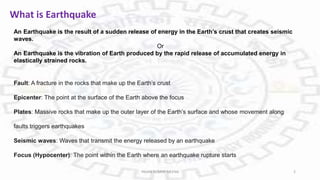
What is Earthquake
An Earthquake is the result of a sudden release of energy in the Earth’s crust that creates seismic
waves.
Or
An Earthquake is the vibration of Earth produced by the rapid release of accumulated energy in
elastically strained rocks.
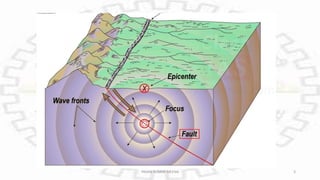
Fault: A fracture in the rocks that make up the Earth’s crust
Epicenter: The point at the surface of the Earth above the focus
Plates: Massive rocks that make up the outer layer of the Earth’s surface and whose movement along
faults triggers earthquakes
Seismic waves: Waves that transmit the energy released by an earthquake
Focus (Hypocenter): The point within the Earth where an earthquake rupture starts
PAVAN KUMAR MEENA 2
PAVAN KUMAR MEENA 3
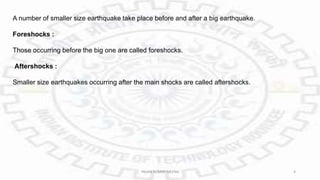
A number of smaller size earthquake take place before and after a big earthquake.
Foreshocks :
Those occurring before the big one are called foreshocks.
Aftershocks :
Smaller size earthquakes occurring after the main shocks are called aftershocks.
PAVAN KUMAR MEENA 4
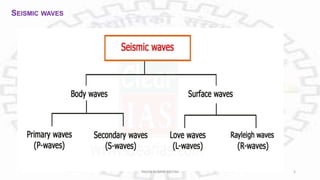
SEISMIC WAVES
PAVAN KUMAR MEENA 5
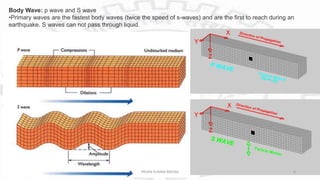
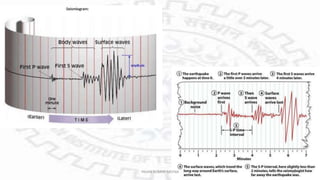
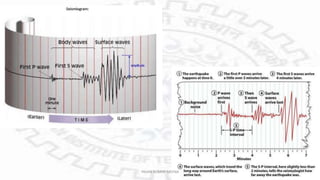
Body Wave: p wave and S wave
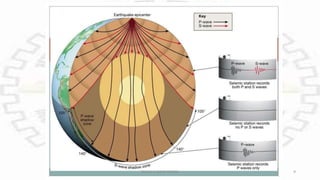
•Primary waves are the fastest body waves (twice the speed of s-waves) and are the first to reach during an
earthquake. S waves can not pass through liquid.
PAVAN KUMAR MEENA 6
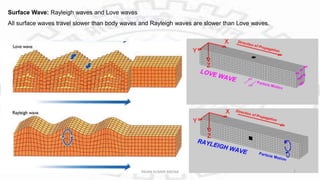
Surface Wave: Rayleigh waves and Love waves
All surface waves travel slower than body waves and Rayleigh waves are slower than Love waves.
PAVAN KUMAR MEENA 7
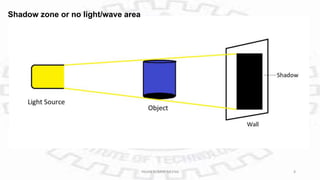
Shadow zone or no light/wave area
PAVAN KUMAR MEENA 8
PAVAN KUMAR MEENA 9
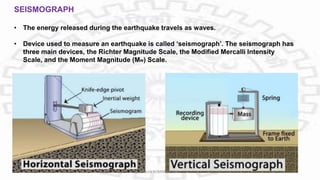
SEISMOGRAPH
• The energy released during the earthquake travels as waves.
• Device used to measure an earthquake is called ‘seismograph’. The seismograph has
three main devices, the Richter Magnitude Scale, the Modified Mercalli Intensity
Scale, and the Moment Magnitude (MW) Scale.
PAVAN KUMAR MEENA 10
PAVAN KUMAR MEENA 11
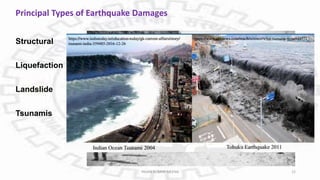
Principal Types of Earthquake Damages
Structural
Liquefaction
Landslide
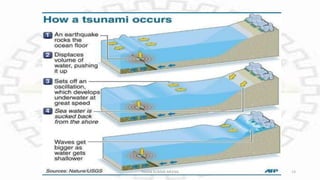
Tsunamis
PAVAN KUMAR MEENA 12
PAVAN KUMAR MEENA 13
PAVAN KUMAR MEENA 14
PAVAN KUMAR MEENA 15
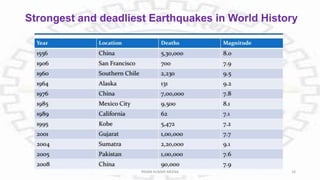
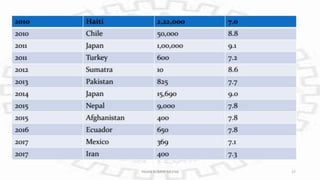
Strongest and deadliest Earthquakes in World History
PAVAN KUMAR MEENA 16
PAVAN KUMAR MEENA 17
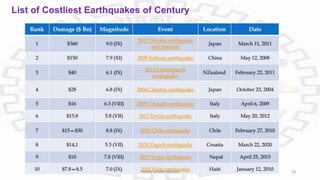
List of Costliest Earthquakes of Century
PAVAN KUMAR MEENA 18
PAVAN KUMAR MEENA 19
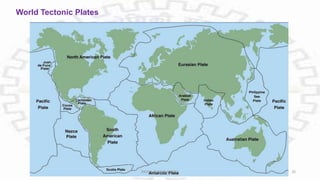
World Tectonic Plates
PAVAN KUMAR MEENA 20
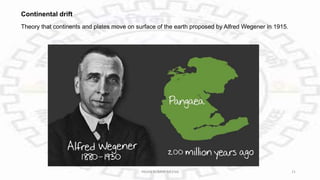
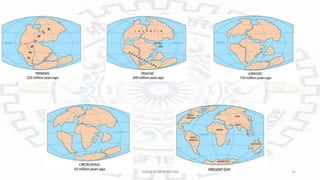
Continental drift
Theory that continents and plates move on surface of the earth proposed by Alfred Wegener in 1915.
PAVAN KUMAR MEENA 21
PAVAN KUMAR MEENA 22
PAVAN KUMAR MEENA 23
Seismology
Seismology is the branch of Geophysics concerned with the study and analysis of Earthquakes
and the science of energy propagation through the Earth’s crust.
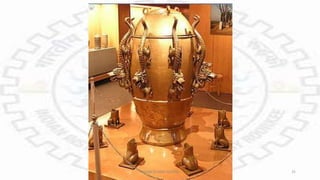
The first such earthquake measuring instrument called Di-Dong-Di was invented by Cheng
Heng (132 A.D.).
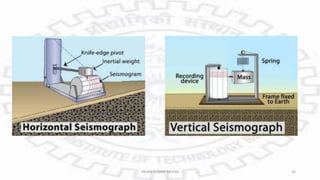
Device used to measure an earthquake is called ‘seismograph’.
The seismograph has three main devices, the Richter Magnitude Scale, the Modified Mercalli
Intensity Scale, and the Moment Magnitude Scale.
PAVAN KUMAR MEENA 24
PAVAN KUMAR MEENA 25
PAVAN KUMAR MEENA 26
PAVAN KUMAR MEENA 27
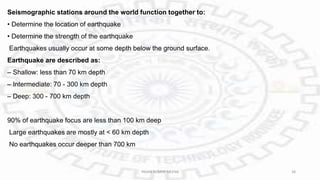
Seismographic stations around the world function together to:
• Determine the location of earthquake
• Determine the strength of the earthquake
Earthquakes usually occur at some depth below the ground surface.
Earthquake are described as:
– Shallow: less than 70 km depth
– Intermediate: 70 - 300 km depth
– Deep: 300 - 700 km depth
90% of earthquake focus are less than 100 km deep
Large earthquakes are mostly at < 60 km depth
No earthquakes occur deeper than 700 km
PAVAN KUMAR MEENA 28
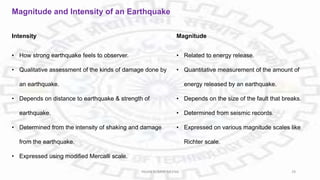
Magnitude and Intensity of an Earthquake
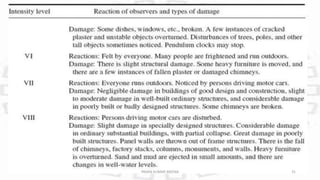
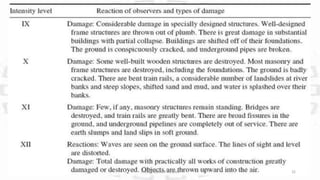
Intensity
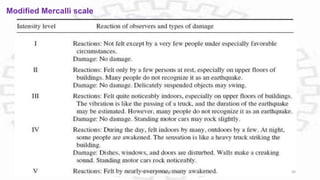
• How strong earthquake feels to observer.
• Qualitative assessment of the kinds of damage done by
an earthquake.
• Depends on distance to earthquake & strength of
earthquake.
• Determined from the intensity of shaking and damage
from the earthquake.
• Expressed using modified Mercalli scale.
Magnitude
• Related to energy release.
• Quantitative measurement of the amount of
energy released by an earthquake.
• Depends on the size of the fault that breaks.
• Determined from seismic records.
• Expressed on various magnitude scales like
Richter scale.
PAVAN KUMAR MEENA 29
Modified Mercalli scale
PAVAN KUMAR MEENA 30
PAVAN KUMAR MEENA 31
PAVAN KUMAR MEENA 32
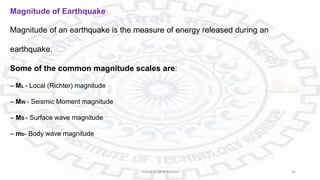
Magnitude of Earthquake
Magnitude of an earthquake is the measure of energy released during an
earthquake.
Some of the common magnitude scales are:
– ML - Local (Richter) magnitude
– MW - Seismic Moment magnitude
– MS - Surface wave magnitude
– mb- Body wave magnitude
PAVAN KUMAR MEENA 33
MW - Seismic Moment magnitude
MW= log10A + 1.66 log10 Δ +2.0
A = Maximum ground displacement in micrometers
Δ= Distance of seismograph from the epicenter, in degrees.
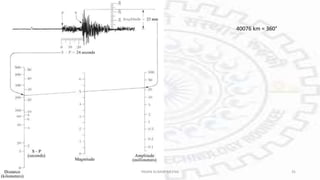
ML - Local (Richter) magnitude
ML= log10A(mm) +3 log10[8Δt (sec)]-2.93
Here A is the amplitude, in millimeters
The S-P time, in seconds, makes Δt.
mb- Body wave magnitude
mb = log10A – log10T +0.01Δ + 5.9
A = Amplitude of P-waves in micrometers
T = period of P-wave
Δ = Distance of seismograph from the epicenter, in degrees.
MW - Seismic Moment magnitude
Moment Magnitude, Mw = 2/3 [log10M0(dyne-cm) –16]
Moment Magnitude, Mw = - 6.0 + 0.67 log10M0(N.m)
M0= DAμ
where D is the average fault displacement in m,
A is the total area of the fault surface in m2, and
μ is the shear modulus of material along the fault plane in N/m2 (=
3x10¹⁰ N/m2
for surface crust and 7x10¹² N/m2 for mantle)
M0 is measured (Note: 1 dyne-cm = 1 × 10⁻⁷ newton-meter)
PAVAN KUMAR MEENA 34
40076 km = 360°
PAVAN KUMAR MEENA 35
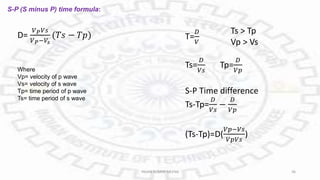
S-P (S minus P) time formula:
D=
𝑉𝑃𝑉𝑠
𝑉𝑃−𝑉𝑠
(𝑇𝑠 − 𝑇𝑝) T=
𝐷
𝑉
Ts > Tp
Vp > Vs
Ts=
𝐷
𝑉𝑠
Tp=
𝐷
𝑉𝑝
S-P Time difference
Ts-Tp=
𝐷
𝑉𝑠
−
𝐷
𝑉𝑝
(Ts-Tp)=D(
𝑉𝑝−𝑉𝑠
𝑉𝑝𝑉𝑠
)
Where
Vp= velocity of p wave
Vs= velocity of s wave
Tp= time period of p wave
Ts= time period of s wave
PAVAN KUMAR MEENA 36
THANK YOU
PAVAN KUMAR MEENA 37
PAVAN KUMAR MEENA 38

Basic Introduction to Earthquake engineering and seismology

  • 1.
  • 2.
    What is Earthquake AnEarthquake is the result of a sudden release of energy in the Earth’s crust that creates seismic waves. Or An Earthquake is the vibration of Earth produced by the rapid release of accumulated energy in elastically strained rocks. Fault: A fracture in the rocks that make up the Earth’s crust Epicenter: The point at the surface of the Earth above the focus Plates: Massive rocks that make up the outer layer of the Earth’s surface and whose movement along faults triggers earthquakes Seismic waves: Waves that transmit the energy released by an earthquake Focus (Hypocenter): The point within the Earth where an earthquake rupture starts PAVAN KUMAR MEENA 2
  • 3.
  • 4.
    A number ofsmaller size earthquake take place before and after a big earthquake. Foreshocks : Those occurring before the big one are called foreshocks. Aftershocks : Smaller size earthquakes occurring after the main shocks are called aftershocks. PAVAN KUMAR MEENA 4
  • 5.
  • 6.
    Body Wave: pwave and S wave •Primary waves are the fastest body waves (twice the speed of s-waves) and are the first to reach during an earthquake. S waves can not pass through liquid. PAVAN KUMAR MEENA 6
  • 7.
    Surface Wave: Rayleighwaves and Love waves All surface waves travel slower than body waves and Rayleigh waves are slower than Love waves. PAVAN KUMAR MEENA 7
  • 8.
    Shadow zone orno light/wave area PAVAN KUMAR MEENA 8
  • 9.
  • 10.
    SEISMOGRAPH • The energyreleased during the earthquake travels as waves. • Device used to measure an earthquake is called ‘seismograph’. The seismograph has three main devices, the Richter Magnitude Scale, the Modified Mercalli Intensity Scale, and the Moment Magnitude (MW) Scale. PAVAN KUMAR MEENA 10
  • 11.
  • 12.
    Principal Types ofEarthquake Damages Structural Liquefaction Landslide Tsunamis PAVAN KUMAR MEENA 12
  • 13.
  • 14.
  • 15.
  • 16.
    Strongest and deadliestEarthquakes in World History PAVAN KUMAR MEENA 16
  • 17.
  • 18.
    List of CostliestEarthquakes of Century PAVAN KUMAR MEENA 18
  • 19.
  • 20.
  • 21.
    Continental drift Theory thatcontinents and plates move on surface of the earth proposed by Alfred Wegener in 1915. PAVAN KUMAR MEENA 21
  • 22.
  • 23.
  • 24.
    Seismology Seismology is thebranch of Geophysics concerned with the study and analysis of Earthquakes and the science of energy propagation through the Earth’s crust. The first such earthquake measuring instrument called Di-Dong-Di was invented by Cheng Heng (132 A.D.). Device used to measure an earthquake is called ‘seismograph’. The seismograph has three main devices, the Richter Magnitude Scale, the Modified Mercalli Intensity Scale, and the Moment Magnitude Scale. PAVAN KUMAR MEENA 24
  • 25.
  • 26.
  • 27.
  • 28.
    Seismographic stations aroundthe world function together to: • Determine the location of earthquake • Determine the strength of the earthquake Earthquakes usually occur at some depth below the ground surface. Earthquake are described as: – Shallow: less than 70 km depth – Intermediate: 70 - 300 km depth – Deep: 300 - 700 km depth 90% of earthquake focus are less than 100 km deep Large earthquakes are mostly at < 60 km depth No earthquakes occur deeper than 700 km PAVAN KUMAR MEENA 28
  • 29.
    Magnitude and Intensityof an Earthquake Intensity • How strong earthquake feels to observer. • Qualitative assessment of the kinds of damage done by an earthquake. • Depends on distance to earthquake & strength of earthquake. • Determined from the intensity of shaking and damage from the earthquake. • Expressed using modified Mercalli scale. Magnitude • Related to energy release. • Quantitative measurement of the amount of energy released by an earthquake. • Depends on the size of the fault that breaks. • Determined from seismic records. • Expressed on various magnitude scales like Richter scale. PAVAN KUMAR MEENA 29
  • 30.
  • 31.
  • 32.
  • 33.
    Magnitude of Earthquake Magnitudeof an earthquake is the measure of energy released during an earthquake. Some of the common magnitude scales are: – ML - Local (Richter) magnitude – MW - Seismic Moment magnitude – MS - Surface wave magnitude – mb- Body wave magnitude PAVAN KUMAR MEENA 33
  • 34.
    MW - SeismicMoment magnitude MW= log10A + 1.66 log10 Δ +2.0 A = Maximum ground displacement in micrometers Δ= Distance of seismograph from the epicenter, in degrees. ML - Local (Richter) magnitude ML= log10A(mm) +3 log10[8Δt (sec)]-2.93 Here A is the amplitude, in millimeters The S-P time, in seconds, makes Δt. mb- Body wave magnitude mb = log10A – log10T +0.01Δ + 5.9 A = Amplitude of P-waves in micrometers T = period of P-wave Δ = Distance of seismograph from the epicenter, in degrees. MW - Seismic Moment magnitude Moment Magnitude, Mw = 2/3 [log10M0(dyne-cm) –16] Moment Magnitude, Mw = - 6.0 + 0.67 log10M0(N.m) M0= DAμ where D is the average fault displacement in m, A is the total area of the fault surface in m2, and μ is the shear modulus of material along the fault plane in N/m2 (= 3x10¹⁰ N/m2 for surface crust and 7x10¹² N/m2 for mantle) M0 is measured (Note: 1 dyne-cm = 1 × 10⁻⁷ newton-meter) PAVAN KUMAR MEENA 34
  • 35.
    40076 km =360° PAVAN KUMAR MEENA 35
  • 36.
    S-P (S minusP) time formula: D= 𝑉𝑃𝑉𝑠 𝑉𝑃−𝑉𝑠 (𝑇𝑠 − 𝑇𝑝) T= 𝐷 𝑉 Ts > Tp Vp > Vs Ts= 𝐷 𝑉𝑠 Tp= 𝐷 𝑉𝑝 S-P Time difference Ts-Tp= 𝐷 𝑉𝑠 − 𝐷 𝑉𝑝 (Ts-Tp)=D( 𝑉𝑝−𝑉𝑠 𝑉𝑝𝑉𝑠 ) Where Vp= velocity of p wave Vs= velocity of s wave Tp= time period of p wave Ts= time period of s wave PAVAN KUMAR MEENA 36
  • 37.
  • 38.