Different
art forms
of india
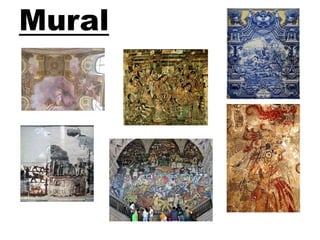
Mural
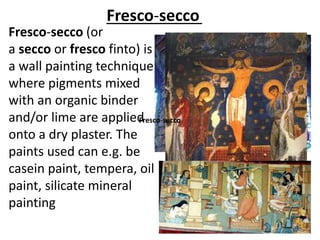
Fresco-secco (or
a secco or fresco finto) is
a wall painting technique
where pigments mixed
with an organic binder
and/or lime are applied
onto a dry plaster. The
paints used can e.g. be
casein paint, tempera, oil
paint, silicate mineral
painting
Fresco-secco
Fresco-secco
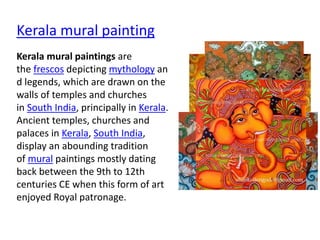
Kerala mural painting
Kerala mural paintings are
the frescos depicting mythology an
d legends, which are drawn on the
walls of temples and churches
in South India, principally in Kerala.
Ancient temples, churches and
palaces in Kerala, South India,
display an abounding tradition
of mural paintings mostly dating
back between the 9th to 12th
centuries CE when this form of art
enjoyed Royal patronage.
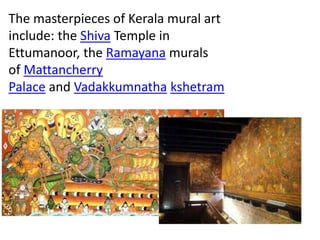
The masterpieces of Kerala mural art
include: the Shiva Temple in
Ettumanoor, the Ramayana murals
of Mattancherry
Palace and Vadakkumnatha kshetram
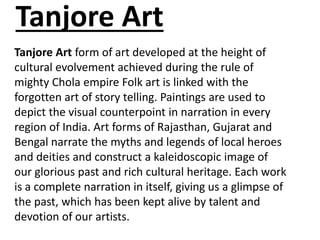
Tanjore Art
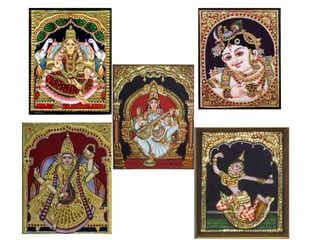
Tanjore Art form of art developed at the height of
cultural evolvement achieved during the rule of
mighty Chola empire Folk art is linked with the
forgotten art of story telling. Paintings are used to
depict the visual counterpoint in narration in every
region of India. Art forms of Rajasthan, Gujarat and
Bengal narrate the myths and legends of local heroes
and deities and construct a kaleidoscopic image of
our glorious past and rich cultural heritage. Each work
is a complete narration in itself, giving us a glimpse of
the past, which has been kept alive by talent and
devotion of our artists.
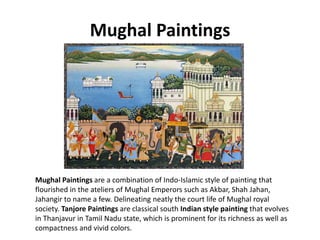
Mughal Paintings
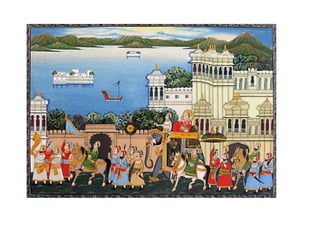
Mughal Paintings are a combination of Indo-Islamic style of painting that
flourished in the ateliers of Mughal Emperors such as Akbar, Shah Jahan,
Jahangir to name a few. Delineating neatly the court life of Mughal royal
society. Tanjore Paintings are classical south Indian style painting that evolves
in Thanjavur in Tamil Nadu state, which is prominent for its richness as well as
compactness and vivid colors.
• Mughal paintings are a particular style of South Asian
painting, generally confined to miniatures either as book
illustrations or as single works to be kept in albums, which
emerged from Persian miniature painting (itself largely
of Chinese origin), with Indian Hindu, Jain, and Buddhist
influences, and developed largely in the court of
the Mughal Empire of the 16th to 18th centuries.
• Mughal paintings later spread to other Indian courts, both
Muslim and Hindu, and later Sikh. The mingling of foreign
Persian and indigenous Indian elements was a continuation
of the patronisation of other aspects of foreign culture as
initiated by the earlier Turko-Afghan Delhi Sultanate, and
the introduction of it into the subcontinent by various
Central Asian Turkic dynasties, such as the Ghaznavids.
Pahari Paintings
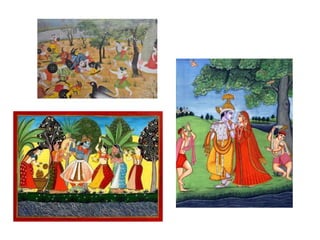
• Pahari Painting is a miniature painting depicts
the beauty of Himalaya as the backdrop.
Evolved in the hill area of Himachal Pradesh,
Jammu Kashmir, Punjab during the reign of
Rajputs, they have the quintessence of craggy
nature. It has three different schools named as
Basholi, Guler-Kangra as well as Sikhs.
Madhubani Paintings
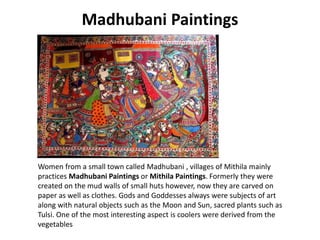
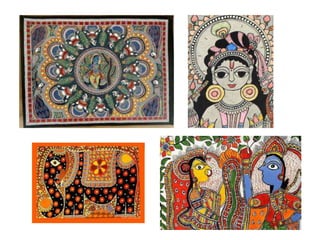
Women from a small town called Madhubani , villages of Mithila mainly
practices Madhubani Paintings or Mithila Paintings. Formerly they were
created on the mud walls of small huts however, now they are carved on
paper as well as clothes. Gods and Goddesses always were subjects of art
along with natural objects such as the Moon and Sun, sacred plants such as
Tulsi. One of the most interesting aspect is coolers were derived from the
vegetables
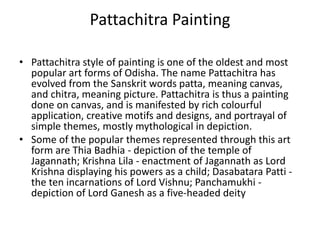
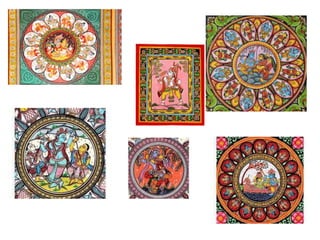
Pattachitra Painting
• Pattachitra style of painting is one of the oldest and most
popular art forms of Odisha. The name Pattachitra has
evolved from the Sanskrit words patta, meaning canvas,
and chitra, meaning picture. Pattachitra is thus a painting
done on canvas, and is manifested by rich colourful
application, creative motifs and designs, and portrayal of
simple themes, mostly mythological in depiction.
• Some of the popular themes represented through this art
form are Thia Badhia - depiction of the temple of
Jagannath; Krishna Lila - enactment of Jagannath as Lord
Krishna displaying his powers as a child; Dasabatara Patti -
the ten incarnations of Lord Vishnu; Panchamukhi -
depiction of Lord Ganesh as a five-headed deity
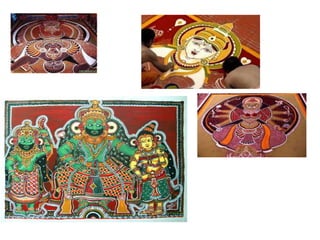
Kalamezhuthu
• Names like Rangoli, Kolam etc are not new to us, and
neither is the tradition of drawing them at the entrance
of homes and temples. In fact it is part of the domestic
routine in Hindu households, who consider it
auspicious to draw certain patterns at the doorstep and
courtyard to welcome a deity into the house. This art
form is a harmonious blend of Aryan, Dravidian and
Tribal traditions.
• Kalam (Kalamezhuthu) is unique form of this art found
in Kerala. It is essentially a ritualistic art practiced in
temples and sacred groves of Kerala where the
representation of deities like Kali and Lord Ayyappa,
are made on the floor.
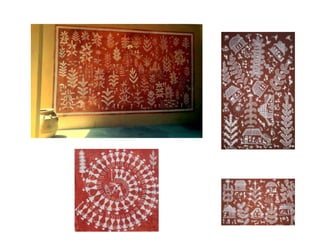
Warli Folk Painting
• Maharashtra is known for its Warli folk paintings. Warli is
the name of the largest tribe found on the northern
outskirts of Mumbai, in Western India. Despite being in
such close proximity of the largest metropolis in India,
Warli tribesmen shun all influences of modern
urbanization. Warli Art was first discovered in the early
seventies. While there are no records of the exact origins of
this art, its roots may be traced to as early as the
10th century A.D. Warli is the vivid expression of daily and
social events of the Warli tribe of Maharashtra, used by
them to embellish the walls of village houses. This was the
only means of transmitting folklore to a populace not
acquainted with the written word. This art form is simple in
comparison to the vibrant paintings of Madhubani.
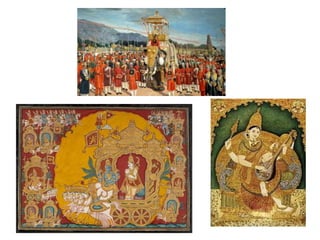
Mysore painting
• Mysore painting (Kannada: ಮೈಸೂರು ಚಿತ್ರಕಲೆ) is an important form of
classical South Indian painting that originated in and around the town
of Mysore in Karnataka encouraged and nurtured by the Mysore rulers. Painting in
Karnataka has a long and illustrious history, tracing its origins back to
the Ajanta times (2nd century B.C. to 7th century A.D.) The distinct school of
Mysore painting evolved from the paintings of Vijayanagar times during the reign
of the Vijayanagar Kings (1336-1565 AD) The rulers of Vijayanagar and their
feudatories encouraged literature, art, architecture, religious and philosophical
discussions. With the fall of the Vijayanagar empire after the Battle of Talikota the
artists who were till then under royal patronage migrated to various other places
like Mysore, Tanjore, Surpur, etc. Absorbing the local artistic traditions and
customs, the erstwhile Vijayanagar School of Painting gradually evolved into the
many styles of painting in South India, including the Mysore and Tanjore schools of
painting.
• Mysore paintings are known for their elegance, muted colours, and attention to
detail. The themes for most of these paintings are Hindu gods and goddesses and
scenes from Hindu mythology.
LINE ART
• Kattingeri Krishna Hebbar(1911–
1996)[1] better known as K.K. Hebbar was a
celebrated artist known for his India themed
artworks
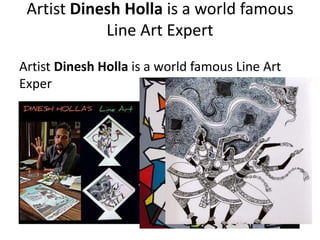
Artist Dinesh Holla is a world famous
Line Art Expert
Artist Dinesh Holla is a world famous Line Art
Exper

Different art forms of India

  • 1.
  • 2.
  • 3.
    Fresco-secco (or a seccoor fresco finto) is a wall painting technique where pigments mixed with an organic binder and/or lime are applied onto a dry plaster. The paints used can e.g. be casein paint, tempera, oil paint, silicate mineral painting Fresco-secco Fresco-secco
  • 4.
    Kerala mural painting Keralamural paintings are the frescos depicting mythology an d legends, which are drawn on the walls of temples and churches in South India, principally in Kerala. Ancient temples, churches and palaces in Kerala, South India, display an abounding tradition of mural paintings mostly dating back between the 9th to 12th centuries CE when this form of art enjoyed Royal patronage.
  • 5.
    The masterpieces ofKerala mural art include: the Shiva Temple in Ettumanoor, the Ramayana murals of Mattancherry Palace and Vadakkumnatha kshetram
  • 6.
    Tanjore Art Tanjore Artform of art developed at the height of cultural evolvement achieved during the rule of mighty Chola empire Folk art is linked with the forgotten art of story telling. Paintings are used to depict the visual counterpoint in narration in every region of India. Art forms of Rajasthan, Gujarat and Bengal narrate the myths and legends of local heroes and deities and construct a kaleidoscopic image of our glorious past and rich cultural heritage. Each work is a complete narration in itself, giving us a glimpse of the past, which has been kept alive by talent and devotion of our artists.
  • 8.
    Mughal Paintings Mughal Paintingsare a combination of Indo-Islamic style of painting that flourished in the ateliers of Mughal Emperors such as Akbar, Shah Jahan, Jahangir to name a few. Delineating neatly the court life of Mughal royal society. Tanjore Paintings are classical south Indian style painting that evolves in Thanjavur in Tamil Nadu state, which is prominent for its richness as well as compactness and vivid colors.
  • 9.
    • Mughal paintingsare a particular style of South Asian painting, generally confined to miniatures either as book illustrations or as single works to be kept in albums, which emerged from Persian miniature painting (itself largely of Chinese origin), with Indian Hindu, Jain, and Buddhist influences, and developed largely in the court of the Mughal Empire of the 16th to 18th centuries. • Mughal paintings later spread to other Indian courts, both Muslim and Hindu, and later Sikh. The mingling of foreign Persian and indigenous Indian elements was a continuation of the patronisation of other aspects of foreign culture as initiated by the earlier Turko-Afghan Delhi Sultanate, and the introduction of it into the subcontinent by various Central Asian Turkic dynasties, such as the Ghaznavids.
  • 11.
    Pahari Paintings • PahariPainting is a miniature painting depicts the beauty of Himalaya as the backdrop. Evolved in the hill area of Himachal Pradesh, Jammu Kashmir, Punjab during the reign of Rajputs, they have the quintessence of craggy nature. It has three different schools named as Basholi, Guler-Kangra as well as Sikhs.
  • 13.
    Madhubani Paintings Women froma small town called Madhubani , villages of Mithila mainly practices Madhubani Paintings or Mithila Paintings. Formerly they were created on the mud walls of small huts however, now they are carved on paper as well as clothes. Gods and Goddesses always were subjects of art along with natural objects such as the Moon and Sun, sacred plants such as Tulsi. One of the most interesting aspect is coolers were derived from the vegetables
  • 15.
    Pattachitra Painting • Pattachitrastyle of painting is one of the oldest and most popular art forms of Odisha. The name Pattachitra has evolved from the Sanskrit words patta, meaning canvas, and chitra, meaning picture. Pattachitra is thus a painting done on canvas, and is manifested by rich colourful application, creative motifs and designs, and portrayal of simple themes, mostly mythological in depiction. • Some of the popular themes represented through this art form are Thia Badhia - depiction of the temple of Jagannath; Krishna Lila - enactment of Jagannath as Lord Krishna displaying his powers as a child; Dasabatara Patti - the ten incarnations of Lord Vishnu; Panchamukhi - depiction of Lord Ganesh as a five-headed deity
  • 17.
    Kalamezhuthu • Names likeRangoli, Kolam etc are not new to us, and neither is the tradition of drawing them at the entrance of homes and temples. In fact it is part of the domestic routine in Hindu households, who consider it auspicious to draw certain patterns at the doorstep and courtyard to welcome a deity into the house. This art form is a harmonious blend of Aryan, Dravidian and Tribal traditions. • Kalam (Kalamezhuthu) is unique form of this art found in Kerala. It is essentially a ritualistic art practiced in temples and sacred groves of Kerala where the representation of deities like Kali and Lord Ayyappa, are made on the floor.
  • 19.
    Warli Folk Painting •Maharashtra is known for its Warli folk paintings. Warli is the name of the largest tribe found on the northern outskirts of Mumbai, in Western India. Despite being in such close proximity of the largest metropolis in India, Warli tribesmen shun all influences of modern urbanization. Warli Art was first discovered in the early seventies. While there are no records of the exact origins of this art, its roots may be traced to as early as the 10th century A.D. Warli is the vivid expression of daily and social events of the Warli tribe of Maharashtra, used by them to embellish the walls of village houses. This was the only means of transmitting folklore to a populace not acquainted with the written word. This art form is simple in comparison to the vibrant paintings of Madhubani.
  • 21.
    Mysore painting • Mysorepainting (Kannada: ಮೈಸೂರು ಚಿತ್ರಕಲೆ) is an important form of classical South Indian painting that originated in and around the town of Mysore in Karnataka encouraged and nurtured by the Mysore rulers. Painting in Karnataka has a long and illustrious history, tracing its origins back to the Ajanta times (2nd century B.C. to 7th century A.D.) The distinct school of Mysore painting evolved from the paintings of Vijayanagar times during the reign of the Vijayanagar Kings (1336-1565 AD) The rulers of Vijayanagar and their feudatories encouraged literature, art, architecture, religious and philosophical discussions. With the fall of the Vijayanagar empire after the Battle of Talikota the artists who were till then under royal patronage migrated to various other places like Mysore, Tanjore, Surpur, etc. Absorbing the local artistic traditions and customs, the erstwhile Vijayanagar School of Painting gradually evolved into the many styles of painting in South India, including the Mysore and Tanjore schools of painting. • Mysore paintings are known for their elegance, muted colours, and attention to detail. The themes for most of these paintings are Hindu gods and goddesses and scenes from Hindu mythology.
  • 23.
    LINE ART • KattingeriKrishna Hebbar(1911– 1996)[1] better known as K.K. Hebbar was a celebrated artist known for his India themed artworks
  • 24.
    Artist Dinesh Hollais a world famous Line Art Expert Artist Dinesh Holla is a world famous Line Art Exper