End of Year Expectations in
Reception
In Reception we use the Early Years
Foundation Stage (EYFS) framework.
This statutory framework:
*sets the standards that all early years
providers must meet to ensure that children
learn and develop well
*ensures children are kept healthy and safe
*ensures that children have the knowledge
and skills they need to start school
Assessment
During the Summer term we have to complete an
EYFS profile for each child. We assess them against
the Early Learning Goals (ELGs) set out in the
EYFS framework.
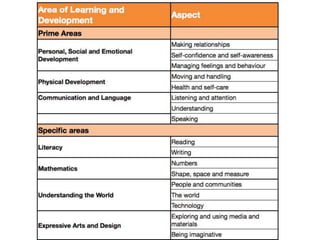
There are 17 Early Learning Goals we assess in
seven areas of learning.
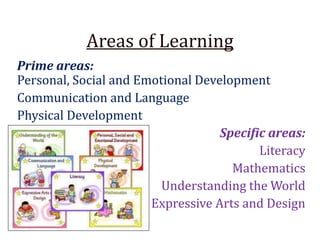
Areas of Learning
Prime areas:
Personal, Social and Emotional Development
Communication and Language
Physical Development
Specific areas:
Literacy
Mathematics
Understanding the World
Expressive Arts and Design
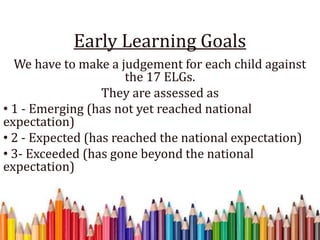
Early Learning Goals
We have to make a judgement for each child against
the 17 ELGs.
They are assessed as
• 1 - Emerging (has not yet reached national
expectation)
• 2 - Expected (has reached the national expectation)
• 3- Exceeded (has gone beyond the national
expectation)
Common struggles
Literacy
ELG - Writing
Children use their phonic knowledge to write
words in ways which match their spoken sounds.
They also write some irregular common words.
They write sentences which can be read by
themselves and others. Some words are spelt
correctly and others are phonetically plausible.
What can we do?
ELG - Writing
They write sentences which can be read by themselves and
others.
Children in Nursery should be encouraged to give meaning
to their mark making to teach them that their ‘writing’
means something and should be read.
In Reception we work hard with RWI techniques to
encourage sounding out for writing and segmenting and
blending for reading. Taking pauses after words (and
eventually sentences) to read back through what they
have written.
Common struggles
Communication and Language
ELG – Understanding
Children follow instructions involving several
ideas or actions. They answer ‘how’ and ‘why’
questions about their experiences and in
response to stories or events.
What can we do?
ELG – Understanding
They answer ‘how’ and ‘why’ questions about their
experiences and in response to stories or events.
Children in Nursery should be questioned appropriately by
adults during their play. Children should be expected to talk
about what they have been doing.
In Reception we develop children’s reasoning and encourage
them to extend their answers where necessary.
Common struggles
Communication and Language
ELG – Speaking
Children express themselves effectively, showing
awareness of listeners’ needs. They use past, present
and future forms accurately when talking about
events that have happened or are to happen in the
future. They develop their own narratives and
explanations by connecting ideas or events.
What can we do?
ELG – Speaking
They use past, present and future forms accurately when
talking about events that have happened or are to happen
in the future.
Play partnering with children and modelling use of correct
tenses. If a child uses the wrong tense, repeat what they have
said back to them using the correct tense so they can hear it.
Questioning about weekends and holidays etc so the children
are able to hear and use the language needed.
Common struggles
Mathematics
ELG - Numbers
Children count reliably with numbers from one to 20,
place them in order and say which number is one more
or one less than a given number. Using quantities and
objects, they add and subtract two single-digit numbers
and count on or back to find the answer. They solve
problems, including doubling, halving and sharing.
What can we do?
ELG - Numbers
count on or back to find the answer.
Children in Nursery should be exposed to lots of counting songs and
rhymes (forwards and backwards counting), and counting
forwards/backwards from different starting points (once counting is
secure). Making this practical and visual is of great benefit. Children
should be able to count objects using one to one correspondence.
In Reception we continue to work on this knowledge and apply it
with addition and subtraction.
Early Years

Early Years

  • 1.
    End of YearExpectations in Reception
  • 2.
    In Reception weuse the Early Years Foundation Stage (EYFS) framework. This statutory framework: *sets the standards that all early years providers must meet to ensure that children learn and develop well *ensures children are kept healthy and safe *ensures that children have the knowledge and skills they need to start school
  • 3.
    Assessment During the Summerterm we have to complete an EYFS profile for each child. We assess them against the Early Learning Goals (ELGs) set out in the EYFS framework. There are 17 Early Learning Goals we assess in seven areas of learning.
  • 4.
    Areas of Learning Primeareas: Personal, Social and Emotional Development Communication and Language Physical Development Specific areas: Literacy Mathematics Understanding the World Expressive Arts and Design
  • 6.
    Early Learning Goals Wehave to make a judgement for each child against the 17 ELGs. They are assessed as • 1 - Emerging (has not yet reached national expectation) • 2 - Expected (has reached the national expectation) • 3- Exceeded (has gone beyond the national expectation)
  • 7.
    Common struggles Literacy ELG -Writing Children use their phonic knowledge to write words in ways which match their spoken sounds. They also write some irregular common words. They write sentences which can be read by themselves and others. Some words are spelt correctly and others are phonetically plausible.
  • 8.
    What can wedo? ELG - Writing They write sentences which can be read by themselves and others. Children in Nursery should be encouraged to give meaning to their mark making to teach them that their ‘writing’ means something and should be read. In Reception we work hard with RWI techniques to encourage sounding out for writing and segmenting and blending for reading. Taking pauses after words (and eventually sentences) to read back through what they have written.
  • 9.
    Common struggles Communication andLanguage ELG – Understanding Children follow instructions involving several ideas or actions. They answer ‘how’ and ‘why’ questions about their experiences and in response to stories or events.
  • 10.
    What can wedo? ELG – Understanding They answer ‘how’ and ‘why’ questions about their experiences and in response to stories or events. Children in Nursery should be questioned appropriately by adults during their play. Children should be expected to talk about what they have been doing. In Reception we develop children’s reasoning and encourage them to extend their answers where necessary.
  • 11.
    Common struggles Communication andLanguage ELG – Speaking Children express themselves effectively, showing awareness of listeners’ needs. They use past, present and future forms accurately when talking about events that have happened or are to happen in the future. They develop their own narratives and explanations by connecting ideas or events.
  • 12.
    What can wedo? ELG – Speaking They use past, present and future forms accurately when talking about events that have happened or are to happen in the future. Play partnering with children and modelling use of correct tenses. If a child uses the wrong tense, repeat what they have said back to them using the correct tense so they can hear it. Questioning about weekends and holidays etc so the children are able to hear and use the language needed.
  • 13.
    Common struggles Mathematics ELG -Numbers Children count reliably with numbers from one to 20, place them in order and say which number is one more or one less than a given number. Using quantities and objects, they add and subtract two single-digit numbers and count on or back to find the answer. They solve problems, including doubling, halving and sharing.
  • 14.
    What can wedo? ELG - Numbers count on or back to find the answer. Children in Nursery should be exposed to lots of counting songs and rhymes (forwards and backwards counting), and counting forwards/backwards from different starting points (once counting is secure). Making this practical and visual is of great benefit. Children should be able to count objects using one to one correspondence. In Reception we continue to work on this knowledge and apply it with addition and subtraction.

Editor's Notes

  • #4 Assess using observations, work and knowledge of the child – learning journals AoLs – a bit like subjects
  • #5 AoLs are all related to each other, but divided into prime and specific areas Prime areas are fundamental, work together, and move through to support development in all other areas. The three 'prime' areas are seen as the essential 'building blocks' for securing these positive outcomes for young children in later life and into adulthood. Specific areas include essential skills and knowledge for children to participate successfully in society.
  • #6 Each AoL has aspects within it, each aspect forms an ELG – 17 in total
  • #7 Refer to ELG print out This gives children a score which indicates whether they have achieved a GLD.
  • #8 Can be frustrating – could be one statement within an ELG
  • #10 Can be frustrating – could be one statement within an ELG
  • #12 I’m sure this is a problem further up the school too!
  • #16 All children learn at different rates We have to make a judgement when there is still about a month of teaching left Some children are still 4 Great fun, come and see us!