1
Special Education
Process & IEP
Overview
Advocates for Justice and Education, Inc.
The Parent Training and Information Center for the District of Columbia
Learning Objectives
 Explain the governance of schools in D.C.
 Understand the purpose of IDEA
 Describe the steps in the Special Education Process
 List components of the Individualized Education
Program (IEP)
 Write effective and measurable IEP goals
 Articulate strategies for communicating with schools
2
School System Structure &
Governance
 In the District of Columbia the public school
system consists of:
 District of Columbia Public Schools (DCPS) –
The local traditional public school system.
and
 District of Columbia Public Charter Schools
(DCPCS) – Independent non-profits that receive
public funds to provide public education.
3
School System Structure and
Governance (cont.)
 The Office of the State Superintendent of Education
(OSSE) serves as D.C.’s state education agency.
 OSSE is responsible for:
 managing, distributing, and monitoring the use of
federal funds across DCPS and public charter
schools.
 Setting policy standards for learning, state-wide
assessments, teacher licensure requirements, etc.
4
The Special Education Process
5
IDEA
 The Individuals with Disabilities Education
Act (IDEA) is the law that provides many
benefits and protections to every eligible child
who has a disability, and to his or her parents.
 The major purpose of IDEA is to make a free,
appropriate public education (FAPE)
available to every child who has a disability
(Bateman & Herr, 2003) 6
STEP 1: Child Find
 The public school agency (DCPS, DC Public Charters, OSSE) is required to
identify, locate and evaluate all children who are disabled and in need of special
education and related services.
 The public school agency is also required to identify, locate and evaluate children
who are suspected of being disabled and in need of special education.
 A referral for evaluation of a child who may have a disability may be made by:
(1) The parent(s) or legal guardian(s);
(2) A child (self-referral) who is between the ages of 18 and 22 years;
(3) A professional staff employee of the public school agency; or
(4) A staff member of the public school agency who has direct knowledge of the child.
7
Child Find Agencies
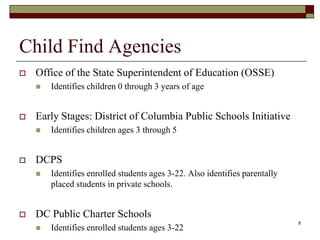
 Office of the State Superintendent of Education (OSSE)
 Identifies children 0 through 3 years of age
 Early Stages: District of Columbia Public Schools Initiative
 Identifies children ages 3 through 5
 DCPS
 Identifies enrolled students ages 3-22. Also identifies parentally
placed students in private schools.
 DC Public Charter Schools
 Identifies enrolled students ages 3-22
8
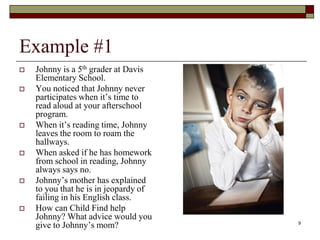
Example #1
 Johnny is a 5th grader at Davis
Elementary School.
 You noticed that Johnny never
participates when it’s time to
read aloud at your afterschool
program.
 When it’s reading time, Johnny
leaves the room to roam the
hallways.
 When asked if he has homework
from school in reading, Johnny
always says no.
 Johnny’s mother has explained
to you that he is in jeopardy of
failing in his English class.
 How can Child Find help
Johnny? What advice would you
give to Johnny’s mom? 9
STEP 2: Formal Request and Consent to
Evaluate
 A Parent or Legal Guardian must give his or her written consent before a
child can be evaluated.
 Once the parent submits the written request and consent for evaluation,
the public school agency has 120 days from that date to evaluate the
child.
10
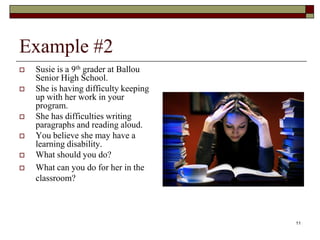
Example #2
 Susie is a 9th grader at Ballou
Senior High School.
 She is having difficulty keeping
up with her work in your
program.
 She has difficulties writing
paragraphs and reading aloud.
 You believe she may have a
learning disability.
 What should you do?
 What can you do for her in the
classroom?
11
STEP 3: Initial Evaluations
 Following the formal request
and consent for evaluation
the multidisciplinary team
(MDT) must meet to review
existing data and information
on the child and identify
what evaluations are needed.
 Including all areas related to
the suspected disability.
12
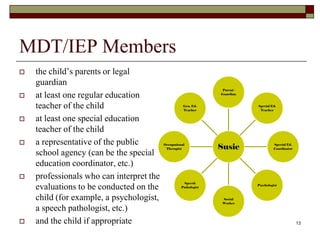
MDT/IEP Members
 the child’s parents or legal
guardian
 at least one regular education
teacher of the child
 at least one special education
teacher of the child
 a representative of the public
school agency (can be the special
education coordinator, etc.)
 professionals who can interpret the
evaluations to be conducted on the
child (for example, a psychologist,
a speech pathologist, etc.)
 and the child if appropriate 13
Susie
Parent/
Guardian
Special Ed.
Teacher
Special Ed.
Coordinator
Psychologist
Social
Worker
Speech
Pathologist
Occupational
Therapist
Gen. Ed.
Teacher
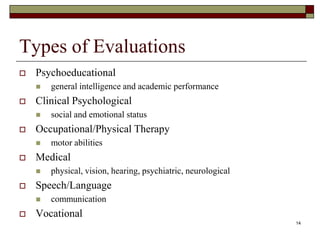
Types of Evaluations
 Psychoeducational
 general intelligence and academic performance
 Clinical Psychological
 social and emotional status
 Occupational/Physical Therapy
 motor abilities
 Medical
 physical, vision, hearing, psychiatric, neurological
 Speech/Language
 communication
 Vocational
14
STEP 4: Eligibility for Special
Education
 To be eligible for special education and
related services, a child must be between ages
three (3) and twenty-two (22) and have a
disability that adversely affects his or her
ability to learn or make progress in school.
15
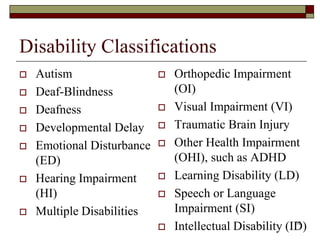
Disability Classifications
 Autism
 Deaf-Blindness
 Deafness
 Developmental Delay
 Emotional Disturbance
(ED)
 Hearing Impairment
(HI)
 Multiple Disabilities
 Orthopedic Impairment
(OI)
 Visual Impairment (VI)
 Traumatic Brain Injury
 Other Health Impairment
(OHI), such as ADHD
 Learning Disability (LD)
 Speech or Language
Impairment (SI)
 Intellectual Disability (ID)16
 The MDT must determine eligibility and disability
classification.
 In determining eligibility, the MDT must draw upon
information from a variety of sources, including aptitude and
achievement tests, parent input, teacher recommendations,
physical condition, social or cultural background, and
adaptive behavior.
 Parents have a right to challenge eligibility, classifications of
disability, and/or evaluations.
17
Eligibility
 If a child is found ineligible, the team should
consider additional options of supports and
accommodations for the child.
 Refer to 504 Team to complete eligibility for
Section 504
 504 Accommodation Plan
 Refer to the Student Support Team (SST)
 Student Support Team Plan
18
STEP 5: Individualized Education
Program
 If it is determined that a child has a disability
and needs special education and related
services, an Individual Education Program
(IEP) must be developed for the child.
 An IEP must be developed within 30-days of
determining that a child is eligible for special
education and related services.
19
What is an IEP?
The IEP is a written document that outlines
objectives, measurable goals, specialized
instruction and related services for a child’s
unique needs.
20
In developing the IEP, the team
should consider:
 the child’s strengths
 concerns of the parent
for enhancing the
education of the child
 results of the initial or
most recent evaluation
 and as appropriate, the
results of the child’s
performance on any
District-wide
assessment programs.
21
22
A Place to Start: Looking at the Present
Level of Academic Achievement/Present
Levels of Performance
 Examining evaluation data
 Classroom tests
 Assessments administered for eligibility purposes
 Observations by teachers, paraprofessionals,
administrators and parents
 OBJECTIVE DATA is necessary!
23
What do you do with this data?
 By law, this information must be written into the IEP
 The team can determine the student’s current
academic needs
 The team can also determine the student’s functional
needs
 How are the student’s needs different from expected
levels of academic and functional needs?
 Team then determines what amount of growth can be
expected within one year’s time that will
significantly close this gap
24
Next Step:
Writing Measurable Annual Goals
 These are goals that
can be reasonably
accomplished within a
year
 Broken down into
short-term objectives
or benchmarks
25
Simply stated….
The annual goals are WHAT we expect the
student to learn or be able to do and
HOW we will know when they have learned
it or can do it
26
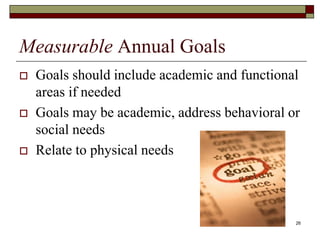
Measurable Annual Goals
 Goals should include academic and functional
areas if needed
 Goals may be academic, address behavioral or
social needs
 Relate to physical needs
Four key questions to determine if
a goal is measurable
 1)What would one do to see if the child has
accomplished this goal?
 -To measure is to do something.
 2)If several people evaluated the student’s
performance, would they come to the same
conclusion about accomplishment of this
goal?
 -If the answer is “no” then not objectively
measurable! 30 27
 3)When we measure this goal, are we able to say how
much progress has been made?
 -This requires some degree or level of quantification
 -Inserting percentages is not enough (Johnny will
read 80% better)
 4)Can this goal be measured without additional
information?
 -A measurable goal can be measured as it is written
without reference to additional, external information
28
Example: Can you tell the
difference?
Mary will count to 10 without error
versus
Mary will improve her counting skills
Which can be assessed without additional
information needed? 29
Remember…
30
 Goals can change in a year if accomplished
sooner or progress is not happening at a rate
expected by the team
Next Step: Related Services
 The IEP must list the related services to be
provided to the child or on behalf of the child.
 This includes supplementary aids and services
that the child needs.
 It also includes modifications (changes) to the
program or supports for school personnel-
such as training or professional development-
that will be provided to assist the child.
31
Transition Services
 Beginning when the child is age 16 (or
younger, if appropriate), the IEP must state
what transition services are needed to help the
child prepare for leaving school.
32
33
Extended School Year Services
 Discuss this area with the team to determine if
services should be continued beyond the
normal school year
 If team agrees then the IEP should reflect a
continuum of services
 Services must meet state standards and not be
limited based on students disability
 If you have IEP meetings in the fall, you will
need to discuss ESY later in the year. Don’t
forget!
Role of Parents
Parents must have input into the development of
the IEP and have a right to bring an advocate
or anyone else to the IEP meeting.
If there is a disagreement about the IEP, the team
should complete as much of the IEP as
possible to ensure the child gets some services
while the dispute gets resolved.
34
STEP 6: Placement
 Once the IEP Team determines the special education
and related services the child needs, the IEP Team
must determine the educational placement of the
child.
 The child’s placement must be as close as possible to
the child’s home.
 The child must be placed in the Least Restrictive
Environment (LRE). 35
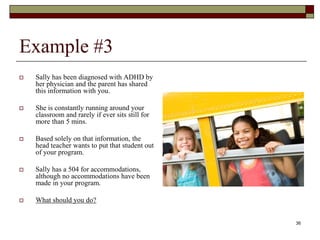
Example #3
 Sally has been diagnosed with ADHD by
her physician and the parent has shared
this information with you.
 She is constantly running around your
classroom and rarely if ever sits still for
more than 5 mins.
 Based solely on that information, the
head teacher wants to put that student out
of your program.
 Sally has a 504 for accommodations,
although no accommodations have been
made in your program.
 What should you do?
36
LRE means:
 to the maximum extent appropriate, children
with disabilities are educated with children
who are nondisabled and are removed from
the regular education class only if the nature
or severity of the child’s disability is such that
education in the regular classes, with the use
of supplementary aids and services, cannot be
achieved.
37
Placement cont.
 If the public school agency cannot provide a child
with the services required by the child’s IEP, the IEP
team can consider having the child placed into a
private placement at public expense.
 Parents have the right to challenge any proposed
placement and the child has the right to stay in his or
her last current placement while the dispute gets
resolved.
38
STEP 7: Annual Review
 A child’s IEP and placement must be reviewed at
least once a year.
 The purpose of the annual review is to determine the
child’s progress, to modify or develop a new IEP,
and to revisit the student’s disability classification
and placement level.
 Note - Parents may request a review at any time
during the year. 39
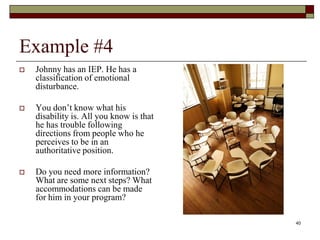
Example #4
 Johnny has an IEP. He has a
classification of emotional
disturbance.
 You don’t know what his
disability is. All you know is that
he has trouble following
directions from people who he
perceives to be in an
authoritative position.
 Do you need more information?
What are some next steps? What
accommodations can be made
for him in your program?
40
STEP 8: Triennial Review
 A child must be fully reevaluated every three (3) years, unless
the parent and the public school agency agree that a
reevaluation is not necessary
 The purpose of the triennial review is to reconfirm the child’s
disability, instruction and related service needs
 Note – Parents may request reevaluations at any time during
the three year period if there are concerns; however, a
reevaluation may not occur more than once a year unless the
parent and the public school agency agree otherwise.
41
Parent’s Permission
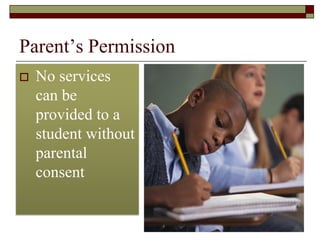
 No services
can be
provided to a
student without
parental
consent
42
43
Wrap Up
 IEP development requires
teamwork
 Goals must be measurable
 Goals can be changed
 Progress must be reported
to the parent
 Parents, know your rights
 Parents and Professionals,
know IDEA requirements
for IEPs
 As a professional working
with students, review the
students’ IEP including
PLOP.
 Provide accommodations
and modifications that are
identified in the IEP to the
student in your afterschool
program.
 Communicate with parent
frequently about the child’s
progress.
Resources
 “Writing Measurable
IEP Goals and
Objectives,” by
Barbara D. Bateman
and Cynthia M. Herr
(2003)
 www.ed.gov
 www.ldonline.org
 www.wrightslaw.com
 “Developing
Educationally
Meaningful & Legally
Sound IEPs,” by
Mitchell L. Yell, Ph.D.
44
BREAK!!!!!!!!!!
45
46
Managing Difficult Behaviors
and Developing Positive
Behavior Intervention Plans
Advocates for Justice and Education, Inc.
The Parent Training and Information Center for the District of Columbia
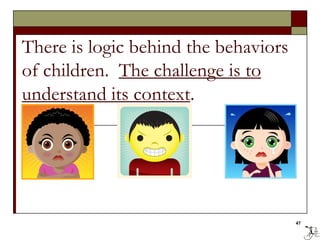
There is logic behind the behaviors
of children. The challenge is to
understand its context.
47
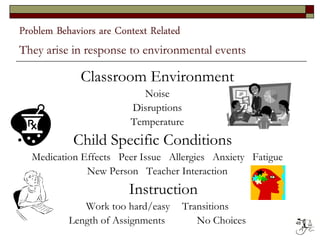
Problem Behaviors are Context Related
They arise in response to environmental events
Classroom Environment
Noise
Disruptions
Temperature
Child Specific Conditions
Medication Effects Peer Issue Allergies Anxiety Fatigue
New Person Teacher Interaction
Instruction
Work too hard/easy Transitions
Length of Assignments No Choices 48
Problem Behaviors Serve a Function
What a child does is not necessarily related to
the function of the behavior.
To get something: To escape or avoid
something:
▪Attention ▪attending school
▪Approval ▪peers or adults
▪Reward
 Power ▪doing work
 To have control 49
Whose Problem Is It?
The problem is not just with the child, but in the
relationships between the child and the
environment.
Interventions must involve the school and home
environment as a whole, not the child alone.
50
What are positive behavior interventions
and supports (PBIS)?
PBIS is:
 A research-based approach to eliminate problem behavior
based on the assumption that children and youth can
develop new behavioral skills when adults:
 TEACH the expected behaviors
 RECOGNIZE AND REWARD those behaviors
when they occur, and
 CONSISTENTLY ENFORCE MEANINGFUL
CONSEQUENCES when they don’t occur.
51
KEEP IT POSITIVE
Repeated punishment does not help children
develop appropriate behavior skills
PBIS is a better solution
A positive intervention plan is NOT the same
as a discipline plan!
52
Be sure the expectation is positive!
 “once you have finished
reading, you may move on to
art”
 “you cannot move onto art
until the reading is finished….”
53
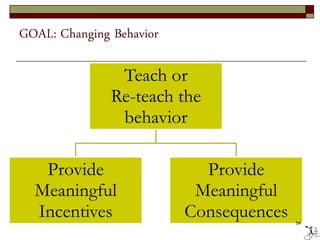
GOAL: Changing Behavior
Teach or
Re-teach the
behavior
Provide
Meaningful
Incentives
Provide
Meaningful
Consequences 54
TEACH EXPECTED BEHAVIOR
 Begin with simple, broad rules.
 Be safe, be responsible, be respectful.
 Describe what each of those means.
 Clearly state the expectation.
 Provide examples of appropriate behavior.
 Provide examples of inappropriate
behavior.
 Re-teach expectations regularly.
55
Do what you do best: Be a Teacher!
 Discuss and model the expected behaviors
to use:
 In the classroom
 In the locations where specific behavior is
expected
 Re-teach regularly and when necessary.
 Keep the expectation positive.
56
Provide Meaningful Incentives
 Teaching is not enough to change
behavior.
 Children need to be recognized and
rewarded when they meet expectations.
 Positive recognition must occur at least
four times as frequently as negative
recognition for behavior change to occur.
57
Example #5
 Bobby has some behavioral problems (frequent tantrums,
doesn’t listen, may run off)
 We are going on a field trip to the National Zoo
 Need one person to play “Bobby”
 One person to play “Teacher”
 One person to play the “Assistant Teacher”
 One person to play the “Parent”
 How do we prepare Bobby for the field trip? Do we make
mandatory for the parents to attend the trip or do we say
Bobby has to stay at home? What supports can we put in
place for Bobby?
58
Enforce Logical Consequences for Negative Behaviors
Logical Consequences should:
 Be stated clearly in advance
 Be understood
 Be enforced consistently
 Apply to all in a classroom
59
In Summary
 Changing behavior through PBIS takes the effort of a
“village.”
 Research and best practices consistently support family
involvement as a key component to school success.
 Partnership between families and schools promotes a clear
message of shared responsibility involvement.
“No matter what the demographics, students are more likely
to earn higher grades and test scores, attend school regularly,
have better social skills, graduate, and go on to post secondary
education when schools and families partner.”
(Karen Mapp, Family Involvement Equals Student Success No Matter
Background, 2006)
60
FBA and IDEA
 Under IDEA, children must be evaluated
in “all areas related to the suspected
disability”
 If a child has problem behaviors that
are not improving, the child may need
an evaluation to examine the behaviors
more closely.
61
Behavior Intervention Plan
 The child’s team develops a plan that usually
includes:
 Skills training to increase appropriate behavior
 Changes that will be made in classrooms or
other environments to reduce or eliminate
problem behaviors
 Strategies to replace problem behaviors with
appropriate behaviors that serve the same
function for the child
 Supports for the child to use the appropriate
behaviors 62
Examples of behavioral intervention strategies
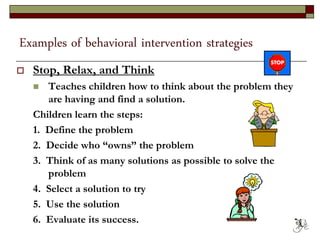
 Stop, Relax, and Think
 Teaches children how to think about the problem they
are having and find a solution.
Children learn the steps:
1. Define the problem
2. Decide who “owns” the problem
3. Think of as many solutions as possible to solve the
problem
4. Select a solution to try
5. Use the solution
6. Evaluate its success. 63
More examples…
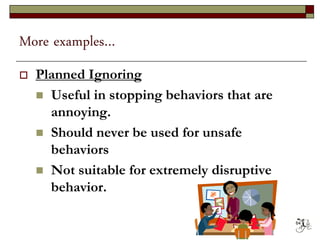
 Planned Ignoring
 Useful in stopping behaviors that are
annoying.
 Should never be used for unsafe
behaviors
 Not suitable for extremely disruptive
behavior.
64
More examples…
 Preventive Cueing (signal interference)
 Frown
 Shake their head
 Make eye contact
 Point to a seat for a wandering child
 Snap their fingers
65
More examples...
 Proximity Control
 Teacher moves closer to the child in a
gentle way
 If the teacher does not get the child’s
attention by using cues, then he or she
may move closer to the student or give
the lesson while standing near the child’s
desk
66
More examples…
 Humor
 Directed either at the teacher or the
situation—never at the child—can defuse
tensions as well as redirect children.
 Humor must never be used to demean a
child or be used in a manner that might
encourage others in the class to ridicule
the child.
67
More examples…
 Nonverbal Warnings
 Give a child the opportunity to regain control
without being singled out for a verbal
reprimand.
 For example, a teacher might place a colored
warning cue card or a note on a desk as he or
she moves through the room, or hold up the
number of fingers that corresponds to the rule
being challenged.
68
More examples…
 Discipline Privately
 Many children see it as a challenge
when teachers attempt to discipline
them in front of their peers.
 Children rarely lose these
challenges, even when adults use
negative consequences
69
Teach Children to self Manage Behavior
Homework and school work
Time management- Define and teach routines the child will use
 Provide a checklist of activities that child can mark off as
completed
 Begin on time
 Have materials ready
 Stay with task until completed
 ATTITUDE
 Be respectful (demonstrate!)
 Have materials ready for the work being addressed
70
School Discipline
 Sometimes school discipline
policies are not successful in
correcting problem behaviors
 The child does not learn what the
school staff intended through the
use of punishments such as
suspension
71
Zero-Tolerance Policies
 Defined as consistently enforced
suspension and expulsion policies in
response to weapons, drugs and violent acts
in the school setting.
 Over time, however, zero tolerance has
come to refer to school or district-wide
policies that mandate predetermined,
typically harsh consequences or
punishments (such as suspension and
expulsion) for a wide degree of rule
violation.
72
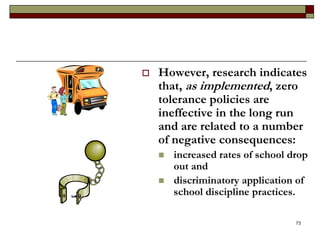
 However, research indicates
that, as implemented, zero
tolerance policies are
ineffective in the long run
and are related to a number
of negative consequences:
 increased rates of school drop
out and
 discriminatory application of
school discipline practices.
73
Take away…
 Children with disabilities SHOULD be
included in after-school activities
 If you know a student has an IEP, 504, or a
BIP you may need to incorporate this
information/strategies into your programming
in order to support the child
 Remember that it takes a village to raise a
child
74
For More Information
Visit: www.pbis.org
Website: www.aje-dc.org
Call or Visit AJE!
 The Campbell Building, 1012 Pennsylvania Avenue, SE (near Eastern Market)
 Office: (202) 678-8060
 Hours: M – F; 9am to 5pm (some Extended Library hours-see calendar)
The contents of this presentation were developed under a grant from the US Department of Education. However,
those contents do not necessarily represent the policy of the US Department of Education, and you should not
assume endorsement by the Federal Government.
75

Serving Special Education Students in Washington, DC

  • 1.
    1 Special Education Process &IEP Overview Advocates for Justice and Education, Inc. The Parent Training and Information Center for the District of Columbia
  • 2.
    Learning Objectives  Explainthe governance of schools in D.C.  Understand the purpose of IDEA  Describe the steps in the Special Education Process  List components of the Individualized Education Program (IEP)  Write effective and measurable IEP goals  Articulate strategies for communicating with schools 2
  • 3.
    School System Structure& Governance  In the District of Columbia the public school system consists of:  District of Columbia Public Schools (DCPS) – The local traditional public school system. and  District of Columbia Public Charter Schools (DCPCS) – Independent non-profits that receive public funds to provide public education. 3
  • 4.
    School System Structureand Governance (cont.)  The Office of the State Superintendent of Education (OSSE) serves as D.C.’s state education agency.  OSSE is responsible for:  managing, distributing, and monitoring the use of federal funds across DCPS and public charter schools.  Setting policy standards for learning, state-wide assessments, teacher licensure requirements, etc. 4
  • 5.
  • 6.
    IDEA  The Individualswith Disabilities Education Act (IDEA) is the law that provides many benefits and protections to every eligible child who has a disability, and to his or her parents.  The major purpose of IDEA is to make a free, appropriate public education (FAPE) available to every child who has a disability (Bateman & Herr, 2003) 6
  • 7.
    STEP 1: ChildFind  The public school agency (DCPS, DC Public Charters, OSSE) is required to identify, locate and evaluate all children who are disabled and in need of special education and related services.  The public school agency is also required to identify, locate and evaluate children who are suspected of being disabled and in need of special education.  A referral for evaluation of a child who may have a disability may be made by: (1) The parent(s) or legal guardian(s); (2) A child (self-referral) who is between the ages of 18 and 22 years; (3) A professional staff employee of the public school agency; or (4) A staff member of the public school agency who has direct knowledge of the child. 7
  • 8.
    Child Find Agencies Office of the State Superintendent of Education (OSSE)  Identifies children 0 through 3 years of age  Early Stages: District of Columbia Public Schools Initiative  Identifies children ages 3 through 5  DCPS  Identifies enrolled students ages 3-22. Also identifies parentally placed students in private schools.  DC Public Charter Schools  Identifies enrolled students ages 3-22 8
  • 9.
    Example #1  Johnnyis a 5th grader at Davis Elementary School.  You noticed that Johnny never participates when it’s time to read aloud at your afterschool program.  When it’s reading time, Johnny leaves the room to roam the hallways.  When asked if he has homework from school in reading, Johnny always says no.  Johnny’s mother has explained to you that he is in jeopardy of failing in his English class.  How can Child Find help Johnny? What advice would you give to Johnny’s mom? 9
  • 10.
    STEP 2: FormalRequest and Consent to Evaluate  A Parent or Legal Guardian must give his or her written consent before a child can be evaluated.  Once the parent submits the written request and consent for evaluation, the public school agency has 120 days from that date to evaluate the child. 10
  • 11.
    Example #2  Susieis a 9th grader at Ballou Senior High School.  She is having difficulty keeping up with her work in your program.  She has difficulties writing paragraphs and reading aloud.  You believe she may have a learning disability.  What should you do?  What can you do for her in the classroom? 11
  • 12.
    STEP 3: InitialEvaluations  Following the formal request and consent for evaluation the multidisciplinary team (MDT) must meet to review existing data and information on the child and identify what evaluations are needed.  Including all areas related to the suspected disability. 12
  • 13.
    MDT/IEP Members  thechild’s parents or legal guardian  at least one regular education teacher of the child  at least one special education teacher of the child  a representative of the public school agency (can be the special education coordinator, etc.)  professionals who can interpret the evaluations to be conducted on the child (for example, a psychologist, a speech pathologist, etc.)  and the child if appropriate 13 Susie Parent/ Guardian Special Ed. Teacher Special Ed. Coordinator Psychologist Social Worker Speech Pathologist Occupational Therapist Gen. Ed. Teacher
  • 14.
    Types of Evaluations Psychoeducational  general intelligence and academic performance  Clinical Psychological  social and emotional status  Occupational/Physical Therapy  motor abilities  Medical  physical, vision, hearing, psychiatric, neurological  Speech/Language  communication  Vocational 14
  • 15.
    STEP 4: Eligibilityfor Special Education  To be eligible for special education and related services, a child must be between ages three (3) and twenty-two (22) and have a disability that adversely affects his or her ability to learn or make progress in school. 15
  • 16.
    Disability Classifications  Autism Deaf-Blindness  Deafness  Developmental Delay  Emotional Disturbance (ED)  Hearing Impairment (HI)  Multiple Disabilities  Orthopedic Impairment (OI)  Visual Impairment (VI)  Traumatic Brain Injury  Other Health Impairment (OHI), such as ADHD  Learning Disability (LD)  Speech or Language Impairment (SI)  Intellectual Disability (ID)16
  • 17.
     The MDTmust determine eligibility and disability classification.  In determining eligibility, the MDT must draw upon information from a variety of sources, including aptitude and achievement tests, parent input, teacher recommendations, physical condition, social or cultural background, and adaptive behavior.  Parents have a right to challenge eligibility, classifications of disability, and/or evaluations. 17
  • 18.
    Eligibility  If achild is found ineligible, the team should consider additional options of supports and accommodations for the child.  Refer to 504 Team to complete eligibility for Section 504  504 Accommodation Plan  Refer to the Student Support Team (SST)  Student Support Team Plan 18
  • 19.
    STEP 5: IndividualizedEducation Program  If it is determined that a child has a disability and needs special education and related services, an Individual Education Program (IEP) must be developed for the child.  An IEP must be developed within 30-days of determining that a child is eligible for special education and related services. 19
  • 20.
    What is anIEP? The IEP is a written document that outlines objectives, measurable goals, specialized instruction and related services for a child’s unique needs. 20
  • 21.
    In developing theIEP, the team should consider:  the child’s strengths  concerns of the parent for enhancing the education of the child  results of the initial or most recent evaluation  and as appropriate, the results of the child’s performance on any District-wide assessment programs. 21
  • 22.
    22 A Place toStart: Looking at the Present Level of Academic Achievement/Present Levels of Performance  Examining evaluation data  Classroom tests  Assessments administered for eligibility purposes  Observations by teachers, paraprofessionals, administrators and parents  OBJECTIVE DATA is necessary!
  • 23.
    23 What do youdo with this data?  By law, this information must be written into the IEP  The team can determine the student’s current academic needs  The team can also determine the student’s functional needs  How are the student’s needs different from expected levels of academic and functional needs?  Team then determines what amount of growth can be expected within one year’s time that will significantly close this gap
  • 24.
    24 Next Step: Writing MeasurableAnnual Goals  These are goals that can be reasonably accomplished within a year  Broken down into short-term objectives or benchmarks
  • 25.
    25 Simply stated…. The annualgoals are WHAT we expect the student to learn or be able to do and HOW we will know when they have learned it or can do it
  • 26.
    26 Measurable Annual Goals Goals should include academic and functional areas if needed  Goals may be academic, address behavioral or social needs  Relate to physical needs
  • 27.
    Four key questionsto determine if a goal is measurable  1)What would one do to see if the child has accomplished this goal?  -To measure is to do something.  2)If several people evaluated the student’s performance, would they come to the same conclusion about accomplishment of this goal?  -If the answer is “no” then not objectively measurable! 30 27
  • 28.
     3)When wemeasure this goal, are we able to say how much progress has been made?  -This requires some degree or level of quantification  -Inserting percentages is not enough (Johnny will read 80% better)  4)Can this goal be measured without additional information?  -A measurable goal can be measured as it is written without reference to additional, external information 28
  • 29.
    Example: Can youtell the difference? Mary will count to 10 without error versus Mary will improve her counting skills Which can be assessed without additional information needed? 29
  • 30.
    Remember… 30  Goals canchange in a year if accomplished sooner or progress is not happening at a rate expected by the team
  • 31.
    Next Step: RelatedServices  The IEP must list the related services to be provided to the child or on behalf of the child.  This includes supplementary aids and services that the child needs.  It also includes modifications (changes) to the program or supports for school personnel- such as training or professional development- that will be provided to assist the child. 31
  • 32.
    Transition Services  Beginningwhen the child is age 16 (or younger, if appropriate), the IEP must state what transition services are needed to help the child prepare for leaving school. 32
  • 33.
    33 Extended School YearServices  Discuss this area with the team to determine if services should be continued beyond the normal school year  If team agrees then the IEP should reflect a continuum of services  Services must meet state standards and not be limited based on students disability  If you have IEP meetings in the fall, you will need to discuss ESY later in the year. Don’t forget!
  • 34.
    Role of Parents Parentsmust have input into the development of the IEP and have a right to bring an advocate or anyone else to the IEP meeting. If there is a disagreement about the IEP, the team should complete as much of the IEP as possible to ensure the child gets some services while the dispute gets resolved. 34
  • 35.
    STEP 6: Placement Once the IEP Team determines the special education and related services the child needs, the IEP Team must determine the educational placement of the child.  The child’s placement must be as close as possible to the child’s home.  The child must be placed in the Least Restrictive Environment (LRE). 35
  • 36.
    Example #3  Sallyhas been diagnosed with ADHD by her physician and the parent has shared this information with you.  She is constantly running around your classroom and rarely if ever sits still for more than 5 mins.  Based solely on that information, the head teacher wants to put that student out of your program.  Sally has a 504 for accommodations, although no accommodations have been made in your program.  What should you do? 36
  • 37.
    LRE means:  tothe maximum extent appropriate, children with disabilities are educated with children who are nondisabled and are removed from the regular education class only if the nature or severity of the child’s disability is such that education in the regular classes, with the use of supplementary aids and services, cannot be achieved. 37
  • 38.
    Placement cont.  Ifthe public school agency cannot provide a child with the services required by the child’s IEP, the IEP team can consider having the child placed into a private placement at public expense.  Parents have the right to challenge any proposed placement and the child has the right to stay in his or her last current placement while the dispute gets resolved. 38
  • 39.
    STEP 7: AnnualReview  A child’s IEP and placement must be reviewed at least once a year.  The purpose of the annual review is to determine the child’s progress, to modify or develop a new IEP, and to revisit the student’s disability classification and placement level.  Note - Parents may request a review at any time during the year. 39
  • 40.
    Example #4  Johnnyhas an IEP. He has a classification of emotional disturbance.  You don’t know what his disability is. All you know is that he has trouble following directions from people who he perceives to be in an authoritative position.  Do you need more information? What are some next steps? What accommodations can be made for him in your program? 40
  • 41.
    STEP 8: TriennialReview  A child must be fully reevaluated every three (3) years, unless the parent and the public school agency agree that a reevaluation is not necessary  The purpose of the triennial review is to reconfirm the child’s disability, instruction and related service needs  Note – Parents may request reevaluations at any time during the three year period if there are concerns; however, a reevaluation may not occur more than once a year unless the parent and the public school agency agree otherwise. 41
  • 42.
    Parent’s Permission  Noservices can be provided to a student without parental consent 42
  • 43.
    43 Wrap Up  IEPdevelopment requires teamwork  Goals must be measurable  Goals can be changed  Progress must be reported to the parent  Parents, know your rights  Parents and Professionals, know IDEA requirements for IEPs  As a professional working with students, review the students’ IEP including PLOP.  Provide accommodations and modifications that are identified in the IEP to the student in your afterschool program.  Communicate with parent frequently about the child’s progress.
  • 44.
    Resources  “Writing Measurable IEPGoals and Objectives,” by Barbara D. Bateman and Cynthia M. Herr (2003)  www.ed.gov  www.ldonline.org  www.wrightslaw.com  “Developing Educationally Meaningful & Legally Sound IEPs,” by Mitchell L. Yell, Ph.D. 44
  • 45.
  • 46.
    46 Managing Difficult Behaviors andDeveloping Positive Behavior Intervention Plans Advocates for Justice and Education, Inc. The Parent Training and Information Center for the District of Columbia
  • 47.
    There is logicbehind the behaviors of children. The challenge is to understand its context. 47
  • 48.
    Problem Behaviors areContext Related They arise in response to environmental events Classroom Environment Noise Disruptions Temperature Child Specific Conditions Medication Effects Peer Issue Allergies Anxiety Fatigue New Person Teacher Interaction Instruction Work too hard/easy Transitions Length of Assignments No Choices 48
  • 49.
    Problem Behaviors Servea Function What a child does is not necessarily related to the function of the behavior. To get something: To escape or avoid something: ▪Attention ▪attending school ▪Approval ▪peers or adults ▪Reward  Power ▪doing work  To have control 49
  • 50.
    Whose Problem IsIt? The problem is not just with the child, but in the relationships between the child and the environment. Interventions must involve the school and home environment as a whole, not the child alone. 50
  • 51.
    What are positivebehavior interventions and supports (PBIS)? PBIS is:  A research-based approach to eliminate problem behavior based on the assumption that children and youth can develop new behavioral skills when adults:  TEACH the expected behaviors  RECOGNIZE AND REWARD those behaviors when they occur, and  CONSISTENTLY ENFORCE MEANINGFUL CONSEQUENCES when they don’t occur. 51
  • 52.
    KEEP IT POSITIVE Repeatedpunishment does not help children develop appropriate behavior skills PBIS is a better solution A positive intervention plan is NOT the same as a discipline plan! 52
  • 53.
    Be sure theexpectation is positive!  “once you have finished reading, you may move on to art”  “you cannot move onto art until the reading is finished….” 53
  • 54.
    GOAL: Changing Behavior Teachor Re-teach the behavior Provide Meaningful Incentives Provide Meaningful Consequences 54
  • 55.
    TEACH EXPECTED BEHAVIOR Begin with simple, broad rules.  Be safe, be responsible, be respectful.  Describe what each of those means.  Clearly state the expectation.  Provide examples of appropriate behavior.  Provide examples of inappropriate behavior.  Re-teach expectations regularly. 55
  • 56.
    Do what youdo best: Be a Teacher!  Discuss and model the expected behaviors to use:  In the classroom  In the locations where specific behavior is expected  Re-teach regularly and when necessary.  Keep the expectation positive. 56
  • 57.
    Provide Meaningful Incentives Teaching is not enough to change behavior.  Children need to be recognized and rewarded when they meet expectations.  Positive recognition must occur at least four times as frequently as negative recognition for behavior change to occur. 57
  • 58.
    Example #5  Bobbyhas some behavioral problems (frequent tantrums, doesn’t listen, may run off)  We are going on a field trip to the National Zoo  Need one person to play “Bobby”  One person to play “Teacher”  One person to play the “Assistant Teacher”  One person to play the “Parent”  How do we prepare Bobby for the field trip? Do we make mandatory for the parents to attend the trip or do we say Bobby has to stay at home? What supports can we put in place for Bobby? 58
  • 59.
    Enforce Logical Consequencesfor Negative Behaviors Logical Consequences should:  Be stated clearly in advance  Be understood  Be enforced consistently  Apply to all in a classroom 59
  • 60.
    In Summary  Changingbehavior through PBIS takes the effort of a “village.”  Research and best practices consistently support family involvement as a key component to school success.  Partnership between families and schools promotes a clear message of shared responsibility involvement. “No matter what the demographics, students are more likely to earn higher grades and test scores, attend school regularly, have better social skills, graduate, and go on to post secondary education when schools and families partner.” (Karen Mapp, Family Involvement Equals Student Success No Matter Background, 2006) 60
  • 61.
    FBA and IDEA Under IDEA, children must be evaluated in “all areas related to the suspected disability”  If a child has problem behaviors that are not improving, the child may need an evaluation to examine the behaviors more closely. 61
  • 62.
    Behavior Intervention Plan The child’s team develops a plan that usually includes:  Skills training to increase appropriate behavior  Changes that will be made in classrooms or other environments to reduce or eliminate problem behaviors  Strategies to replace problem behaviors with appropriate behaviors that serve the same function for the child  Supports for the child to use the appropriate behaviors 62
  • 63.
    Examples of behavioralintervention strategies  Stop, Relax, and Think  Teaches children how to think about the problem they are having and find a solution. Children learn the steps: 1. Define the problem 2. Decide who “owns” the problem 3. Think of as many solutions as possible to solve the problem 4. Select a solution to try 5. Use the solution 6. Evaluate its success. 63
  • 64.
    More examples…  PlannedIgnoring  Useful in stopping behaviors that are annoying.  Should never be used for unsafe behaviors  Not suitable for extremely disruptive behavior. 64
  • 65.
    More examples…  PreventiveCueing (signal interference)  Frown  Shake their head  Make eye contact  Point to a seat for a wandering child  Snap their fingers 65
  • 66.
    More examples...  ProximityControl  Teacher moves closer to the child in a gentle way  If the teacher does not get the child’s attention by using cues, then he or she may move closer to the student or give the lesson while standing near the child’s desk 66
  • 67.
    More examples…  Humor Directed either at the teacher or the situation—never at the child—can defuse tensions as well as redirect children.  Humor must never be used to demean a child or be used in a manner that might encourage others in the class to ridicule the child. 67
  • 68.
    More examples…  NonverbalWarnings  Give a child the opportunity to regain control without being singled out for a verbal reprimand.  For example, a teacher might place a colored warning cue card or a note on a desk as he or she moves through the room, or hold up the number of fingers that corresponds to the rule being challenged. 68
  • 69.
    More examples…  DisciplinePrivately  Many children see it as a challenge when teachers attempt to discipline them in front of their peers.  Children rarely lose these challenges, even when adults use negative consequences 69
  • 70.
    Teach Children toself Manage Behavior Homework and school work Time management- Define and teach routines the child will use  Provide a checklist of activities that child can mark off as completed  Begin on time  Have materials ready  Stay with task until completed  ATTITUDE  Be respectful (demonstrate!)  Have materials ready for the work being addressed 70
  • 71.
    School Discipline  Sometimesschool discipline policies are not successful in correcting problem behaviors  The child does not learn what the school staff intended through the use of punishments such as suspension 71
  • 72.
    Zero-Tolerance Policies  Definedas consistently enforced suspension and expulsion policies in response to weapons, drugs and violent acts in the school setting.  Over time, however, zero tolerance has come to refer to school or district-wide policies that mandate predetermined, typically harsh consequences or punishments (such as suspension and expulsion) for a wide degree of rule violation. 72
  • 73.
     However, researchindicates that, as implemented, zero tolerance policies are ineffective in the long run and are related to a number of negative consequences:  increased rates of school drop out and  discriminatory application of school discipline practices. 73
  • 74.
    Take away…  Childrenwith disabilities SHOULD be included in after-school activities  If you know a student has an IEP, 504, or a BIP you may need to incorporate this information/strategies into your programming in order to support the child  Remember that it takes a village to raise a child 74
  • 75.
    For More Information Visit:www.pbis.org Website: www.aje-dc.org Call or Visit AJE!  The Campbell Building, 1012 Pennsylvania Avenue, SE (near Eastern Market)  Office: (202) 678-8060  Hours: M – F; 9am to 5pm (some Extended Library hours-see calendar) The contents of this presentation were developed under a grant from the US Department of Education. However, those contents do not necessarily represent the policy of the US Department of Education, and you should not assume endorsement by the Federal Government. 75