New expectations for the
end of Key Stage Two
Mathematics: main changes
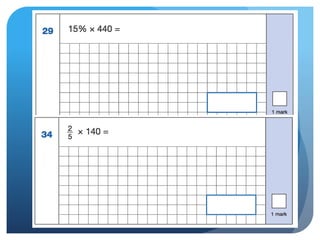
 An arithmetic paper has replaced the mental maths paper. This
consists of 36 questions in 30 minutes and is worth 40 marks.
 It requires the children to carry out formal methods quickly and
efficiently.
 There are no contextualised questions.
 Long division and multiplication.
 Addition and subtraction.
 More complex calculations with fractions.
 A good knowledge of times tables and number bonds is essential.
Mathematics: main changes
 There are two reasoning papers neither of which allow
use of a calculator.
 The difficulty of the questions has increased to
incorporate the higher expectations of the new
curriculum.
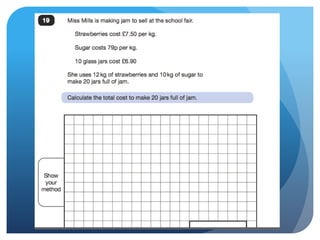
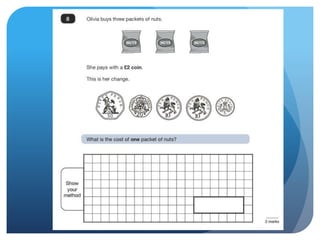
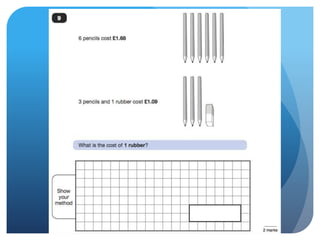
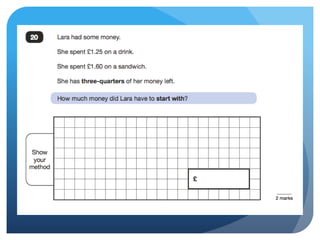
 There is a greater number of multi step word problems.
Reading test
 This test consists of a reading answer booklet and a separate
reading booklet.
 Pupils have a total of 1 hour to read the 3 texts in the reading
booklet and complete the questions at their own pace.
 Greater focus on fictional texts.
 Much more emphasis on using inference and far fewer ‘find it’
questions.
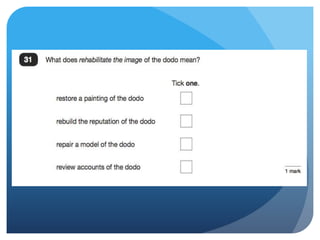
 Increased expectation to understand complex vocabulary.
 More emphasis on understanding authorial intent.
English grammar, spelling and
punctuation
 Greater emphasis on knowing and applying grammatical
terminology.
 Full range of punctuation is tested.
 Knowledge of technical grammar terms is tested.
 Includes a 20 word spelling test.
 No marks are awarded if any punctuation is missing.
Writing
 The expectation is much higher and it is no longer a
‘best fit’.
 Children have to meet every statement in the interim
framework to be awarded ‘expected’.
 If they do not achieve every statement in the ‘working
towards’ they can not achieve ‘expected’.
 Children must be able to spell ‘most’ of the year 5/6
words to achieve ‘expected’. This includes words such
as controversy, conscience, conscious, exaggerate,
parliament, privilege.
Sats

Sats

  • 1.
    New expectations forthe end of Key Stage Two
  • 2.
    Mathematics: main changes An arithmetic paper has replaced the mental maths paper. This consists of 36 questions in 30 minutes and is worth 40 marks.  It requires the children to carry out formal methods quickly and efficiently.  There are no contextualised questions.  Long division and multiplication.  Addition and subtraction.  More complex calculations with fractions.  A good knowledge of times tables and number bonds is essential.
  • 4.
    Mathematics: main changes There are two reasoning papers neither of which allow use of a calculator.  The difficulty of the questions has increased to incorporate the higher expectations of the new curriculum.  There is a greater number of multi step word problems.
  • 11.
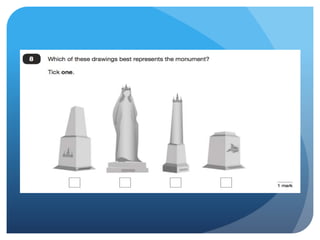
    Reading test  Thistest consists of a reading answer booklet and a separate reading booklet.  Pupils have a total of 1 hour to read the 3 texts in the reading booklet and complete the questions at their own pace.  Greater focus on fictional texts.  Much more emphasis on using inference and far fewer ‘find it’ questions.  Increased expectation to understand complex vocabulary.  More emphasis on understanding authorial intent.
  • 15.
    English grammar, spellingand punctuation  Greater emphasis on knowing and applying grammatical terminology.  Full range of punctuation is tested.  Knowledge of technical grammar terms is tested.  Includes a 20 word spelling test.  No marks are awarded if any punctuation is missing.
  • 21.
    Writing  The expectationis much higher and it is no longer a ‘best fit’.  Children have to meet every statement in the interim framework to be awarded ‘expected’.  If they do not achieve every statement in the ‘working towards’ they can not achieve ‘expected’.  Children must be able to spell ‘most’ of the year 5/6 words to achieve ‘expected’. This includes words such as controversy, conscience, conscious, exaggerate, parliament, privilege.

Editor's Notes

  • #3 Clear expectations around standard column methods to be used. Children must use the correct method.
  • #4 Important that we use a range of different ways of expressing a question. x instead of ‘of’ threw a lot of children
  • #5 For example, in the old attainment descriptors, children only had to use simple fractions. They are now required to add and subtract fractions along with a range of other fraction skills.
  • #6 Example showing typical multi step problem. Lots of different skills required – switching between £ and p. Multiplication, remembering to add the cost of the empty jars. Stamina required to get to the end. Need lots of practise at multi step problems .
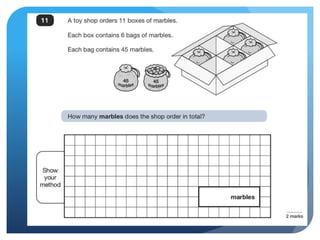
  • #7 Requires good understanding of multiplication
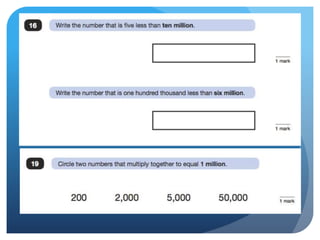
  • #11 We know that the children are expected to be working with much higher numbers in the new curriculum and this is the kind of place value they are expected to do so it is important to do lots of place value work with large numbers
  • #12 vocab in terms of words within the text but also words within the questions Have a look at the reading booklet: looks like something from the 50s. Very out of touch with the children of today. First text and questions are immediately difficult.
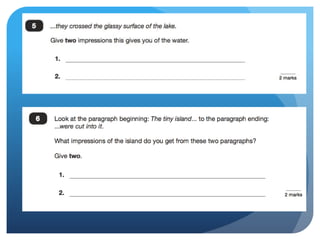
  • #13 Understanding vocabulary Authorial intent Page 5 paragraph 2 and 3
  • #14 Using inference Page 5 reading booklet
  • #15 Understanding vocabulary Page 11. Non fiction that doesn’t really look like they expect non fiction to look. Hafsa – what’s a doo doo?
  • #16 We should be strict about using full stops and capital letters even in notes etc as children often get a question correct eg they add a subordinate clause to a sentence but are then careless about finishing it with a full stop.
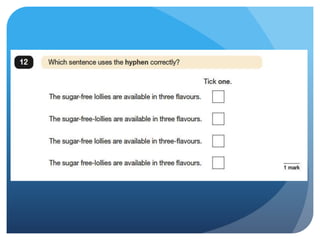
  • #17 Children have to be able to identify where hyphens are used to join more than one word to create an adjective. They also need to be able to use hyphens in their own work. One of the issues with hyphens is the children use them in the spelling test in words that don’t need them: dis-order, misplaced and lightweight and lose marks!
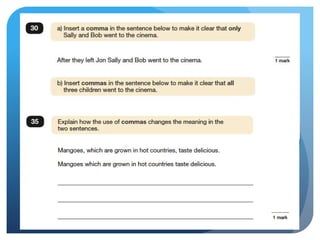
  • #18 Children need to be able to use commas to avoid ambiguity and also explain in words how commas avoid ambiguity
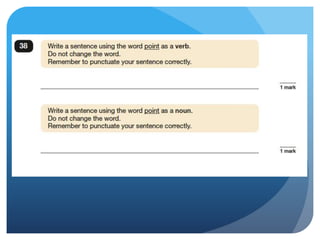
  • #19 Children are expected not just to be able to identify parts of speech but use words as different parts of speech. This is the kind of thing we can do as an exercise regularly.
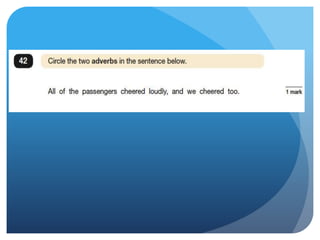
  • #20 Hammering the difference between nouns, verbs, adjectives and adverbs is so important. Ensuring children are familiar with adverbs of manner, place and time Not just ly adverbs – children need to be really clear on this early on
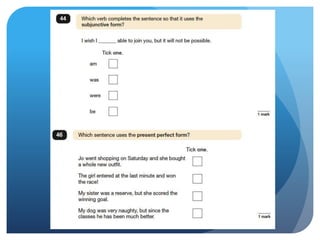
  • #21 Example of the level of terminology children are expected to use and understand