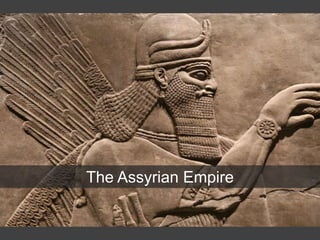

The Assyrian Empire
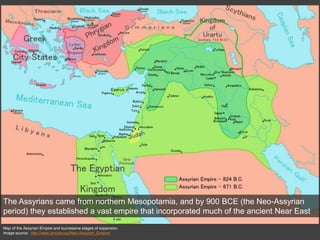
Map of the Assyrian Empire and successive stages of expansion.
Image source: http://www.ancient.eu/Neo-Assyrian_Empire/
The Assyrians came from northern Mesopotamia, and by 900 BCE (the Neo-Assyrian
period) they established a vast empire that incorporated much of the ancient Near East
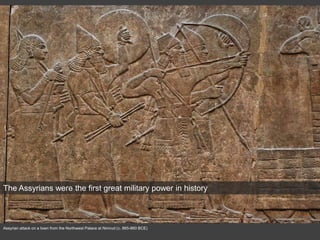
The Assyrians were the first great military power in history
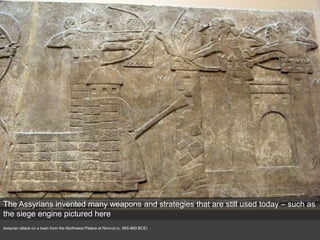
Assyrian attack on a town from the Northwest Palace at Nimrud (c. 865-860 BCE)
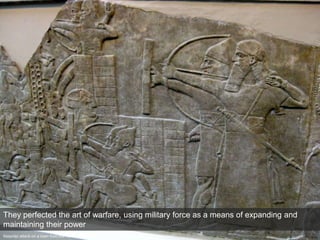
They perfected the art of warfare, using military force as a means of expanding and
maintaining their power
Assyrian attack on a town from the Northwest Palace at Nimrud (c. 865-860 BCE)
The Assyrians invented many weapons and strategies that are still used today – such as
the siege engine pictured here
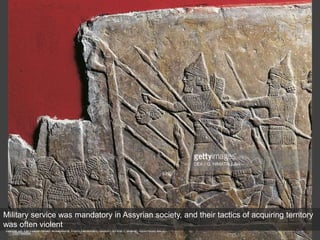
Battle of Til-Tuba relief sculpture from Nineveh, South West Palace, 660-650 BCE.
Military service was mandatory in Assyrian society, and their tactics of acquiring territory
was often violent
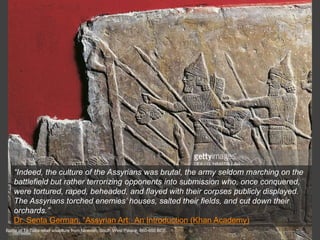
Battle of Til-Tuba relief sculpture from Nineveh, South West Palace, 660-650 BCE.
“Indeed, the culture of the Assyrians was brutal, the army seldom marching on the
battlefield but rather terrorizing opponents into submission who, once conquered,
were tortured, raped, beheaded, and flayed with their corpses publicly displayed.
The Assyrians torched enemies’ houses, salted their fields, and cut down their
orchards.”
Dr. Senta German, “Assyrian Art: An Introduction (Khan Academy)
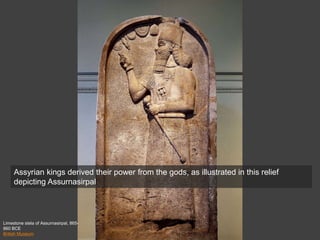
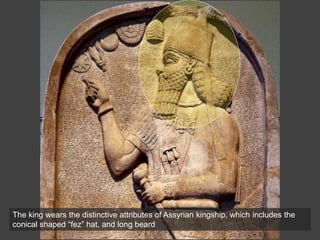
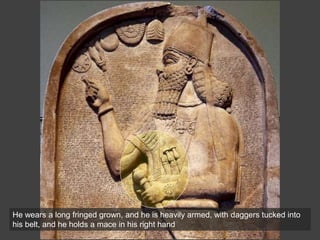
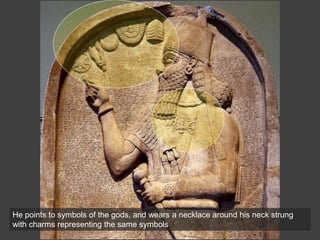
Limestone stela of Assurnasirpal, 865-
860 BCE
British Museum
Assyrian kings derived their power from the gods, as illustrated in this relief
depicting Assurnasirpal
The king wears the distinctive attributes of Assyrian kingship, which includes the
conical shaped “fez” hat, and long beard
He wears a long fringed grown, and he is heavily armed, with daggers tucked into
his belt, and he holds a mace in his right hand
He points to symbols of the gods, and wears a necklace around his neck strung
with charms representing the same symbols
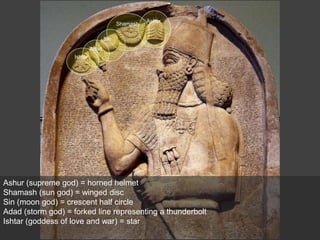
Ashur (supreme god) = horned helmet
Shamash (sun god) = winged disc
Sin (moon god) = crescent half circle
Adad (storm god) = forked line representing a thunderbolt
Ishtar (goddess of love and war) = star
Ashur
Shamash
Sin
Adad
Ishtar
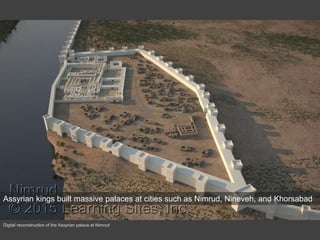
Assyrian kings built massive palaces at cities such as Nimrud, Nineveh, and Khorsabad
Digital reconstruction of the Assyrian palace at Nimrud
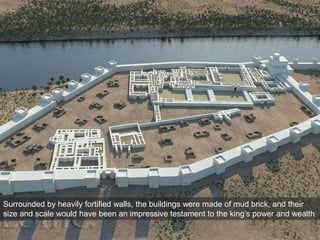
Surrounded by heavily fortified walls, the buildings were made of mud brick, and their
size and scale would have been an impressive testament to the king’s power and wealth
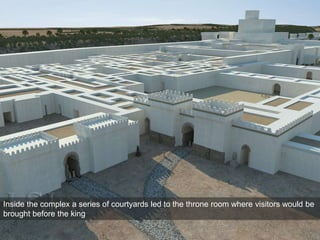
Inside the complex a series of courtyards led to the throne room where visitors would be
brought before the king
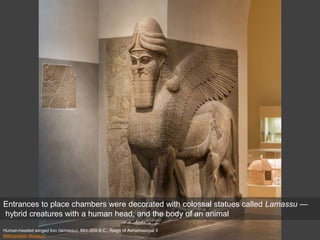
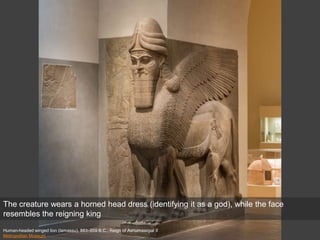
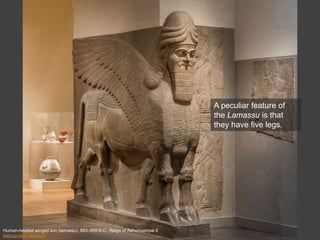
Human-headed winged lion (lamassu), 883–859 B.C.; Reign of Ashurnasirpal II
Metropolitan Museum
Entrances to place chambers were decorated with colossal statues called Lamassu —
hybrid creatures with a human head, and the body of an animal
Human-headed winged lion (lamassu), 883–859 B.C.; Reign of Ashurnasirpal II
Metropolitan Museum
The creature wears a horned head dress (identifying it as a god), while the face
resembles the reigning king
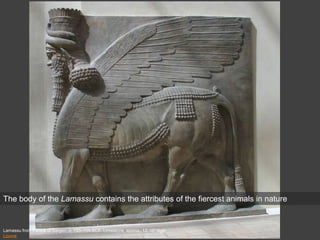
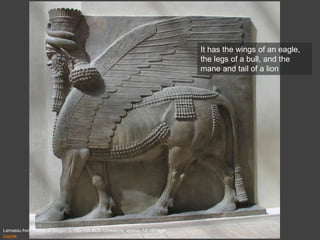
Lamassu from Palace of Sargon, c. 720–705 BCE. Limestone, approx. 13’ 10” high
Louvre
The body of the Lamassu contains the attributes of the fiercest animals in nature
Lamassu from Palace of Sargon, c. 720–705 BCE. Limestone, approx. 13’ 10” high
Louvre
It has the wings of an eagle,
the legs of a bull, and the
mane and tail of a lion
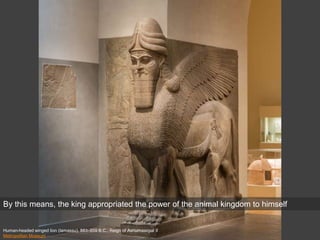
Human-headed winged lion (lamassu), 883–859 B.C.; Reign of Ashurnasirpal II
Metropolitan Museum
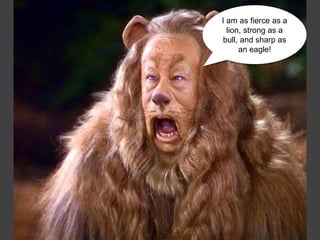
By this means, the king appropriated the power of the animal kingdom to himself
I am as fierce as a
lion, strong as a
bull, and sharp as
an eagle!
Human-headed winged lion (lamassu), 883–859 B.C.; Reign of Ashurnasirpal II
Metropolitan Museum
A peculiar feature of
the Lamassu is that
they have five legs.
Human-headed winged lion (lamassu), 883–859 B.C.; Reign of Ashurnasirpal II
Metropolitan Museum
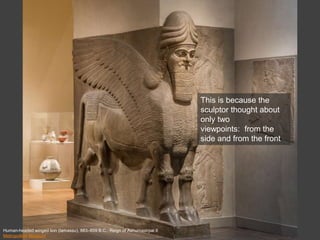
This is because the
sculptor thought about
only two
viewpoints: from the
side and from the front
Human-headed winged lion (lamassu), 883–859 B.C.; Reign of Ashurnasirpal II
Metropolitan Museum
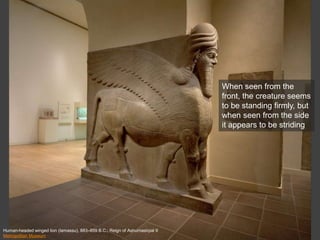
When seen from the
front, the creature seems
to be standing firmly, but
when seen from the side
it appears to be striding
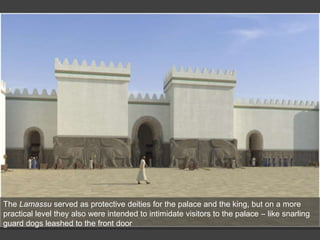
The Lamassu served as protective deities for the palace and the king, but on a more
practical level they also were intended to intimidate visitors to the palace – like snarling
guard dogs leashed to the front door
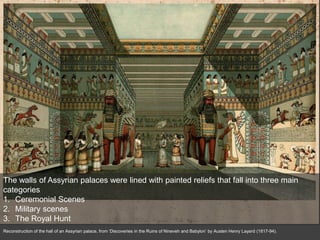
Reconstruction of the hall of an Assyrian palace, from ‘Discoveries in the Ruins of Nineveh and Babylon’ by Austen Henry Layard (1817-94).
The walls of Assyrian palaces were lined with painted reliefs that fall into three main
categories
1. Ceremonial Scenes
2. Military scenes
3. The Royal Hunt
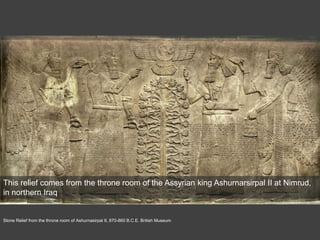
Stone Relief from the throne room of Ashurnasirpal II, 870-860 B.C.E. British Museum
This relief comes from the throne room of the Assyrian king Ashurnarsirpal II at Nimrud,
in northern Iraq
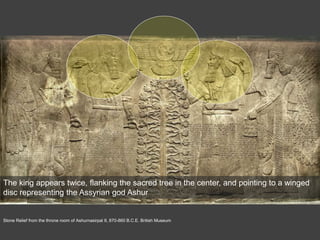
Stone Relief from the throne room of Ashurnasirpal II, 870-860 B.C.E. British Museum
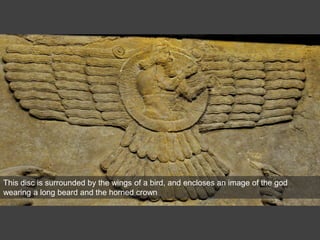
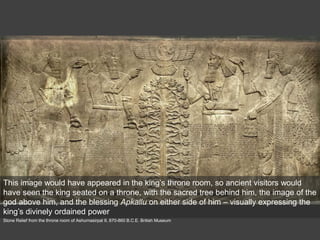
The king appears twice, flanking the sacred tree in the center, and pointing to a winged
disc representing the Assyrian god Ashur
This disc is surrounded by the wings of a bird, and encloses an image of the god
wearing a long beard and the horned crown
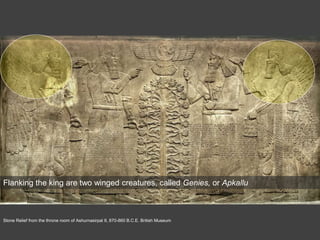
Stone Relief from the throne room of Ashurnasirpal II, 870-860 B.C.E. British Museum
Flanking the king are two winged creatures, called Genies, or Apkallu
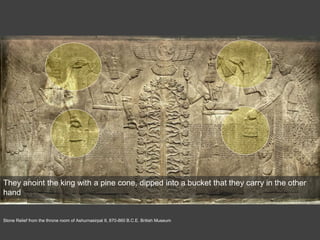
Stone Relief from the throne room of Ashurnasirpal II, 870-860 B.C.E. British Museum
They anoint the king with a pine cone, dipped into a bucket that they carry in the other
hand
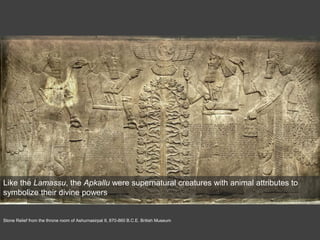
Stone Relief from the throne room of Ashurnasirpal II, 870-860 B.C.E. British Museum
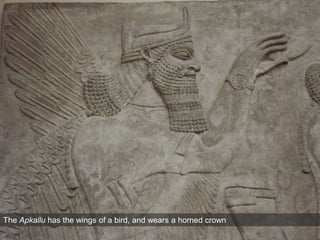
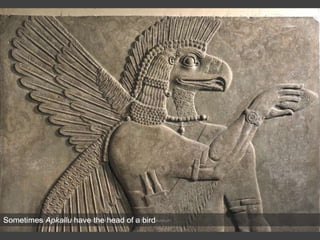
Like the Lamassu, the Apkallu were supernatural creatures with animal attributes to
symbolize their divine powers
The Apkallu has the wings of a bird, and wears a horned crown
Stone Relief from the throne room of Ashurnasirpal II, 860-860 B.C.E. British MuseumSometimes Apkallu have the head of a bird
Stone Relief from the throne room of Ashurnasirpal II, 870-860 B.C.E. British Museum
This image would have appeared in the king’s throne room, so ancient visitors would
have seen the king seated on a throne, with the sacred tree behind him, the image of the
god above him, and the blessing Apkallu on either side of him – visually expressing the
king’s divinely ordained power
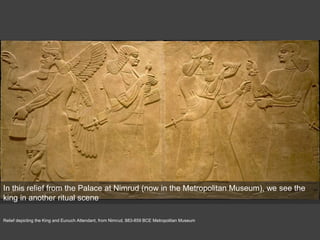
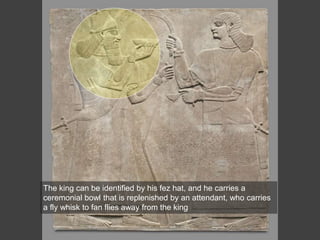
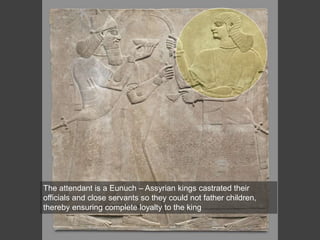
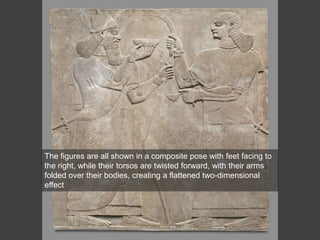
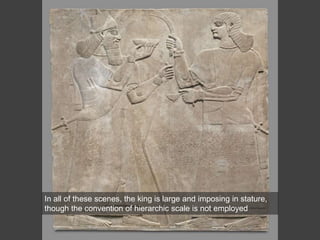
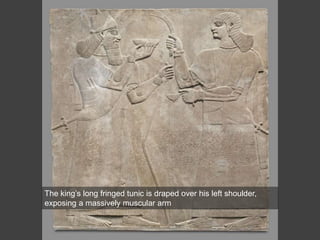
Relief depicting the King and Eunuch Attendant, from Nimrud, 883-859 BCE Metropolitan Museum
In this relief from the Palace at Nimrud (now in the Metropolitan Museum), we see the
king in another ritual scene
The king can be identified by his fez hat, and he carries a
ceremonial bowl that is replenished by an attendant, who carries
a fly whisk to fan flies away from the king
The attendant is a Eunuch – Assyrian kings castrated their
officials and close servants so they could not father children,
thereby ensuring complete loyalty to the king
The figures are all shown in a composite pose with feet facing to
the right, while their torsos are twisted forward, with their arms
folded over their bodies, creating a flattened two-dimensional
effect
In all of these scenes, the king is large and imposing in stature,
though the convention of hierarchic scale is not employed
The king’s long fringed tunic is draped over his left shoulder,
exposing a massively muscular arm
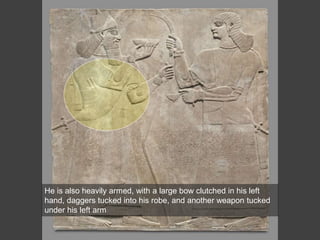
He is also heavily armed, with a large bow clutched in his left
hand, daggers tucked into his robe, and another weapon tucked
under his left arm
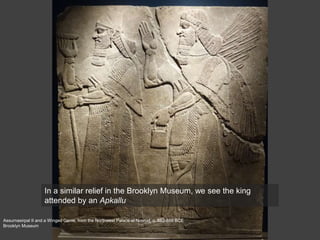
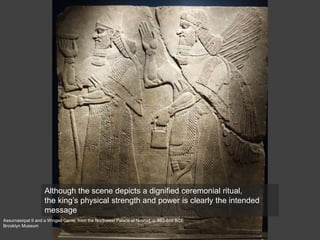
In a similar relief in the Brooklyn Museum, we see the king
attended by an Apkallu
Assurnasirpal II and a Winged Genie, from the Northwest Palace at Nimrud, c. 883-859 BCE
Brooklyn Museum
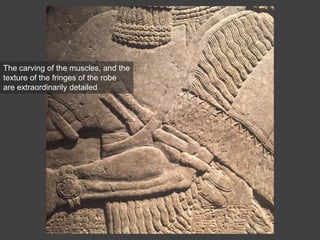
The carving of the muscles, and the
texture of the fringes of the robe
are extraordinarily detailed
Although the scene depicts a dignified ceremonial ritual,
the king’s physical strength and power is clearly the intended
message
Assurnasirpal II and a Winged Genie, from the Northwest Palace at Nimrud, c. 883-859 BCE
Brooklyn Museum
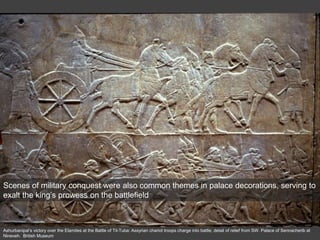
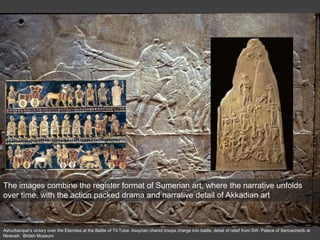
Ashurbanipal’s victory over the Elamites at the Battle of Til-Tuba: Assyrian chariot troops charge into battle, detail of relief from SW. Palace of Sennacherib at
Nineveh. British Museum
Scenes of military conquest were also common themes in palace decorations, serving to
exalt the king’s prowess on the battlefield
Ashurbanipal’s victory over the Elamites at the Battle of Til-Tuba: Assyrian chariot troops charge into battle, detail of relief from SW. Palace of Sennacherib at
Nineveh. British Museum
The images combine the register format of Sumerian art, where the narrative unfolds
over time, with the action packed drama and narrative detail of Akkadian art
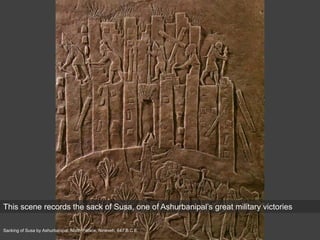
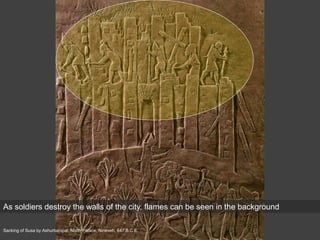
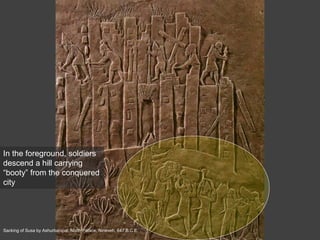
Sacking of Susa by Ashurbanipal, North Palace, Nineveh, 647 B.C.E.
This scene records the sack of Susa, one of Ashurbanipal’s great military victories
Sacking of Susa by Ashurbanipal, North Palace, Nineveh, 647 B.C.E.
As soldiers destroy the walls of the city, flames can be seen in the background
Sacking of Susa by Ashurbanipal, North Palace, Nineveh, 647 B.C.E.
In the foreground, soldiers
descend a hill carrying
“booty” from the conquered
city
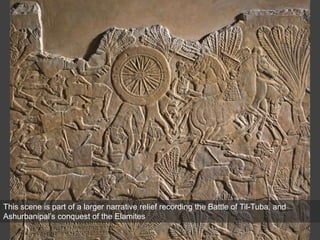
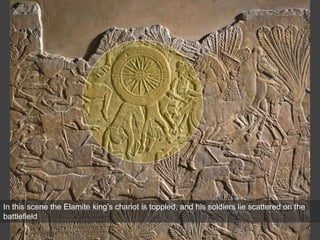
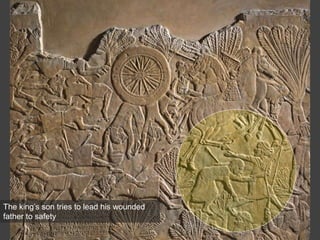
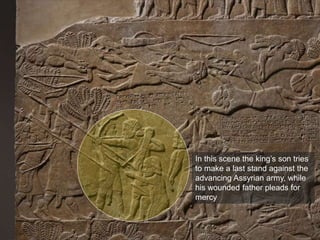
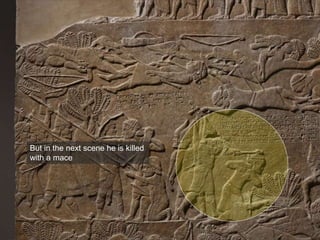
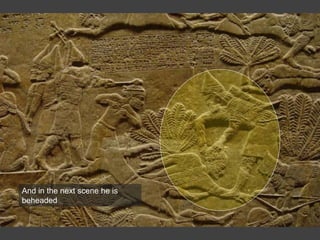
This scene is part of a larger narrative relief recording the Battle of Til-Tuba, and
Ashurbanipal’s conquest of the Elamites
In this scene the Elamite king’s chariot is toppled, and his soldiers lie scattered on the
battlefield
The king’s son tries to lead his wounded
father to safety
In this scene the king’s son tries
to make a last stand against the
advancing Assyrian army, while
his wounded father pleads for
mercy
But in the next scene he is killed
with a mace
And in the next scene he is
beheaded
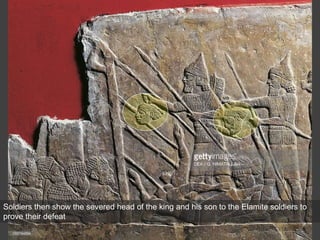
Soldiers then show the severed head of the king and his son to the Elamite soldiers to
prove their defeat
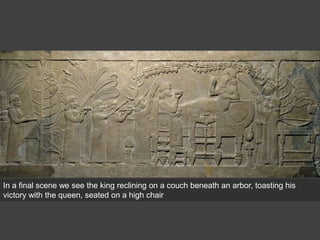
In a final scene we see the king reclining on a couch beneath an arbor, toasting his
victory with the queen, seated on a high chair
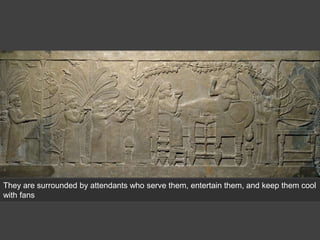
They are surrounded by attendants who serve them, entertain them, and keep them cool
with fans
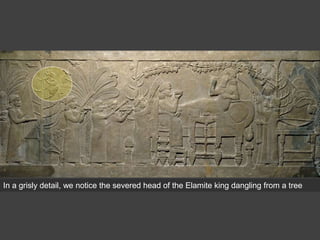
In a grisly detail, we notice the severed head of the Elamite king dangling from a tree
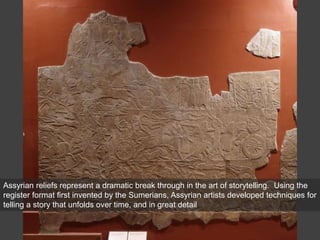
Assyrian reliefs represent a dramatic break through in the art of storytelling. Using the
register format first invented by the Sumerians, Assyrian artists developed techniques for
telling a story that unfolds over time, and in great detail
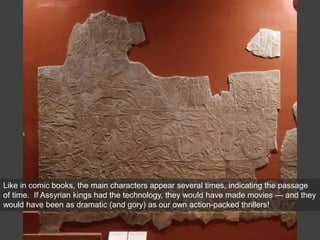
Like in comic books, the main characters appear several times, indicating the passage
of time. If Assyrian kings had the technology, they would have made movies — and they
would have been as dramatic (and gory) as our own action-packed thrillers!
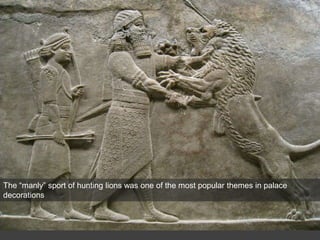
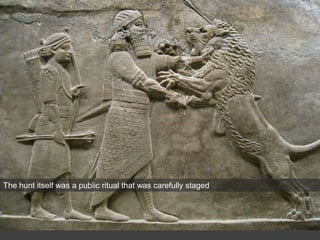
The “manly” sport of hunting lions was one of the most popular themes in palace
decorations
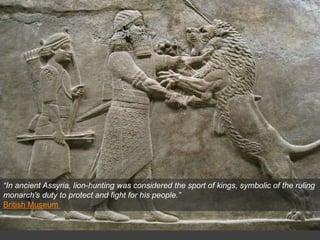
“In ancient Assyria, lion-hunting was considered the sport of kings, symbolic of the ruling
monarch’s duty to protect and fight for his people.”
British Museum
The hunt itself was a public ritual that was carefully staged
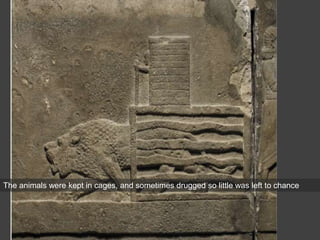
The animals were kept in cages, and sometimes drugged so little was left to chance
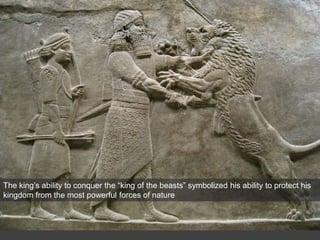
The king’s ability to conquer the “king of the beasts” symbolized his ability to protect his
kingdom from the most powerful forces of nature
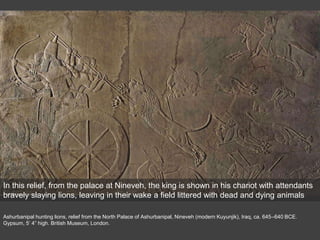
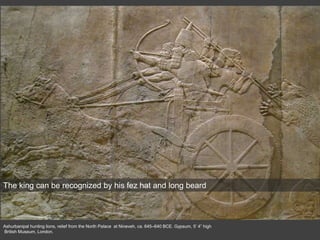
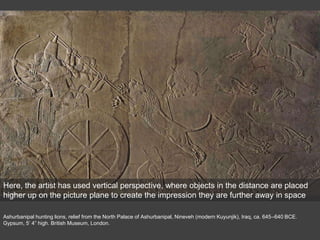
Ashurbanipal hunting lions, relief from the North Palace of Ashurbanipal, Nineveh (modern Kuyunjik), Iraq, ca. 645–640 BCE.
Gypsum, 5’ 4” high. British Museum, London.
In this relief, from the palace at Nineveh, the king is shown in his chariot with attendants
bravely slaying lions, leaving in their wake a field littered with dead and dying animals
Ashurbanipal hunting lions, relief from the North Palace at Nineveh, ca. 645–640 BCE. Gypsum, 5’ 4” high
British Museum, London.
The king can be recognized by his fez hat and long beard
Ashurbanipal hunting lions, relief from the North Palace at Nineveh, ca. 645–640 BCE. Gypsum, 5’ 4” high
British Museum, London.
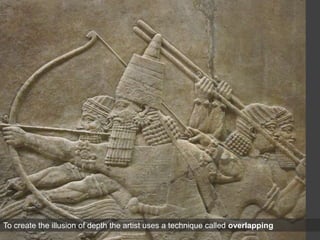
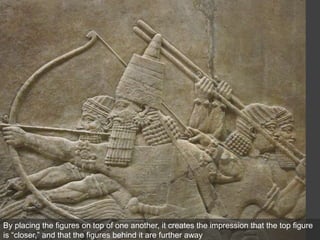
To create the illusion of depth the artist uses a technique called overlapping
Ashurbanipal hunting lions, relief from the North Palace at Nineveh, ca. 645–640 BCE. Gypsum, 5’ 4” high
British Museum, London.
By placing the figures on top of one another, it creates the impression that the top figure
is “closer,” and that the figures behind it are further away
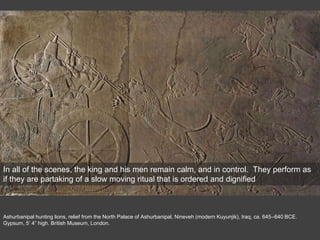
Ashurbanipal hunting lions, relief from the North Palace of Ashurbanipal, Nineveh (modern Kuyunjik), Iraq, ca. 645–640 BCE.
Gypsum, 5’ 4” high. British Museum, London.
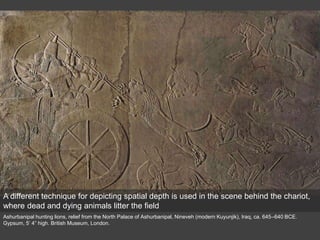
A different technique for depicting spatial depth is used in the scene behind the chariot,
where dead and dying animals litter the field
Ashurbanipal hunting lions, relief from the North Palace of Ashurbanipal, Nineveh (modern Kuyunjik), Iraq, ca. 645–640 BCE.
Gypsum, 5’ 4” high. British Museum, London.
Here, the artist has used vertical perspective, where objects in the distance are placed
higher up on the picture plane to create the impression they are further away in space
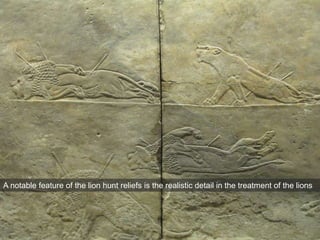
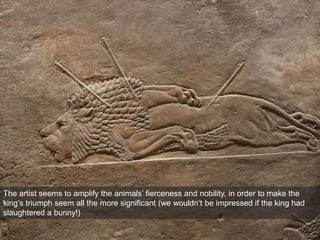
A notable feature of the lion hunt reliefs is the realistic detail in the treatment of the lions
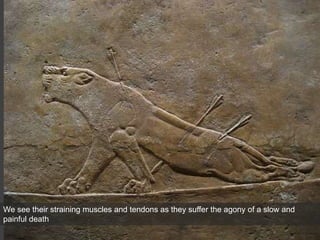
We see their straining muscles and tendons as they suffer the agony of a slow and
painful death
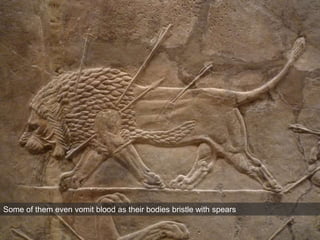
Some of them even vomit blood as their bodies bristle with spears
The artist seems to amplify the animals’ fierceness and nobility, in order to make the
king’s triumph seem all the more significant (we wouldn’t be impressed if the king had
slaughtered a bunny!)
Ashurbanipal hunting lions, relief from the North Palace of Ashurbanipal, Nineveh (modern Kuyunjik), Iraq, ca. 645–640 BCE.
Gypsum, 5’ 4” high. British Museum, London.
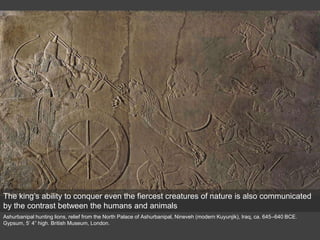
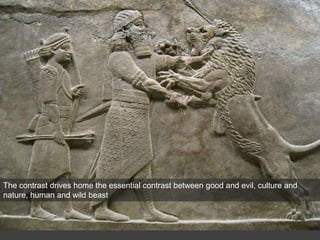
The king’s ability to conquer even the fiercest creatures of nature is also communicated
by the contrast between the humans and animals
Ashurbanipal hunting lions, relief from the North Palace of Ashurbanipal, Nineveh (modern Kuyunjik), Iraq, ca. 645–640 BCE.
Gypsum, 5’ 4” high. British Museum, London.
In all of the scenes, the king and his men remain calm, and in control. They perform as
if they are partaking of a slow moving ritual that is ordered and dignified
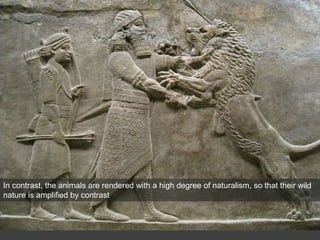
In contrast, the animals are rendered with a high degree of naturalism, so that their wild
nature is amplified by contrast
The contrast drives home the essential contrast between good and evil, culture and
nature, human and wild beast
Thanks for listening!
Next up: The Persian Empire
The Persian Empire
539-331 BCE
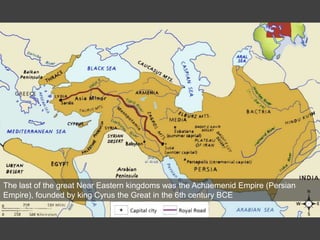
The last of the great Near Eastern kingdoms was the Achaemenid Empire (Persian
Empire), founded by king Cyrus the Great in the 6th century BCE
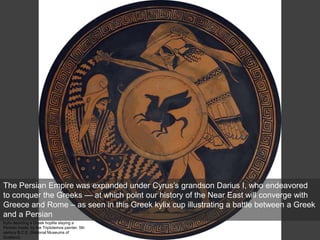
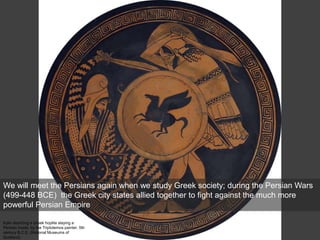
Kylix depicting a Greek hoplite slaying a
Persian inside, by the Triptolemos painter, 5th
century B.C.E. (National Museums of
Scotland)
The Persian Empire was expanded under Cyrus’s grandson Darius I, who endeavored
to conquer the Greeks — at which point our history of the Near East will converge with
Greece and Rome – as seen in this Greek kylix cup illustrating a battle between a Greek
and a Persian
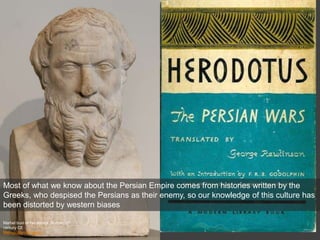
Marbel bust of Herodotos, Roman, 2nd
century CE
Metropolitan Museum
Most of what we know about the Persian Empire comes from histories written by the
Greeks, who despised the Persians as their enemy, so our knowledge of this culture has
been distorted by western biases
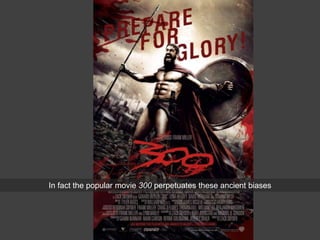
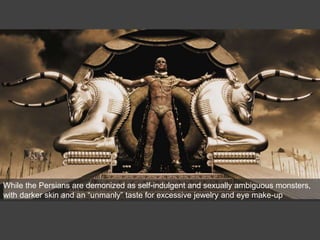
In fact the popular movie 300 perpetuates these ancient biases
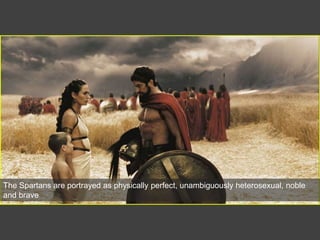
The Spartans are portrayed as physically perfect, unambiguously heterosexual, noble
and brave
While the Persians are demonized as self-indulgent and sexually ambiguous monsters,
with darker skin and an “unmanly” taste for excessive jewelry and eye make-up
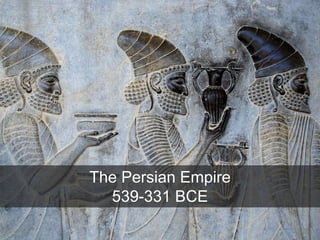
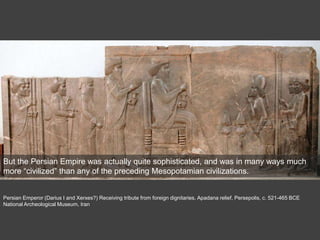
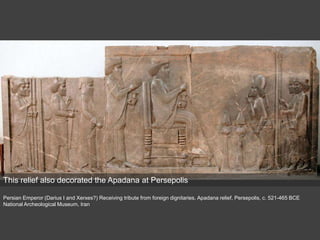
Persian Emperor (Darius I and Xerxes?) Receiving tribute from foreign dignitaries, Apadana relief, Persepolis, c. 521-465 BCE
National Archeological Museum, Iran
But the Persian Empire was actually quite sophisticated, and was in many ways much
more “civilized” than any of the preceding Mesopotamian civilizations.
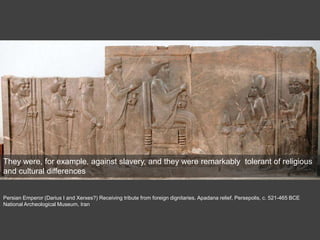
Persian Emperor (Darius I and Xerxes?) Receiving tribute from foreign dignitaries, Apadana relief, Persepolis, c. 521-465 BCE
National Archeological Museum, Iran
They were, for example, against slavery, and they were remarkably tolerant of religious
and cultural differences
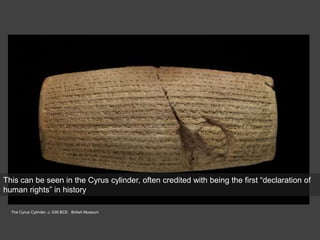
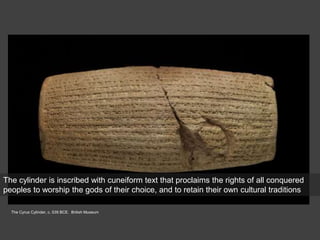
The Cyrus Cylinder, c. 539 BCE. British Museum
This can be seen in the Cyrus cylinder, often credited with being the first “declaration of
human rights” in history
The Cyrus Cylinder, c. 539 BCE. British Museum
The cylinder is inscribed with cuneiform text that proclaims the rights of all conquered
peoples to worship the gods of their choice, and to retain their own cultural traditions
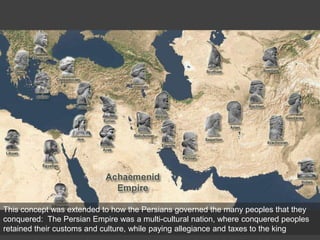
This concept was extended to how the Persians governed the many peoples that they
conquered: The Persian Empire was a multi-cultural nation, where conquered peoples
retained their customs and culture, while paying allegiance and taxes to the king
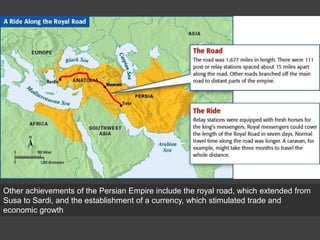
Other achievements of the Persian Empire include the royal road, which extended from
Susa to Sardi, and the establishment of a currency, which stimulated trade and
economic growth
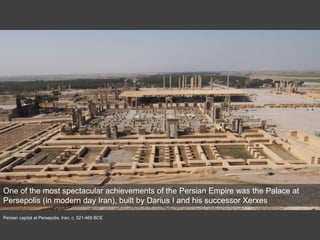
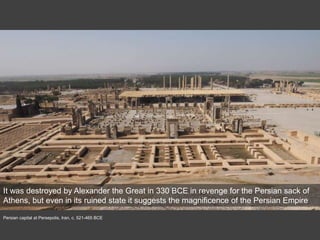
Persian capital at Persepolis, Iran, c. 521-465 BCE
One of the most spectacular achievements of the Persian Empire was the Palace at
Persepolis (in modern day Iran), built by Darius I and his successor Xerxes
Persian capital at Persepolis, Iran, c. 521-465 BCE
It was destroyed by Alexander the Great in 330 BCE in revenge for the Persian sack of
Athens, but even in its ruined state it suggests the magnificence of the Persian Empire
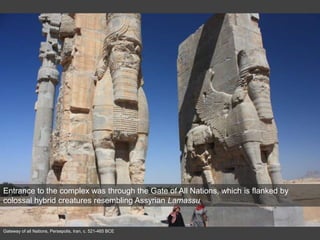
Gateway of all Nations, Persepolis, Iran, c. 521-465 BCE
Entrance to the complex was through the Gate of All Nations, which is flanked by
colossal hybrid creatures resembling Assyrian Lamassu
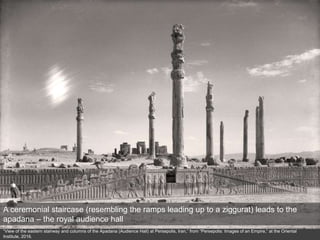
“View of the eastern stairway and columns of the Apadana (Audience Hall) at Persepolis, Iran,” from “Persepolis: Images of an Empire,” at the Oriental
Institute, 2016.
A ceremonial staircase (resembling the ramps leading up to a ziggurat) leads to the
apadana – the royal audience hall
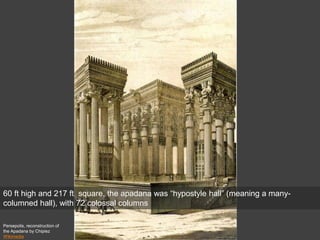
Persepolis, reconstruction of
the Apadana by Chipiez
Wikimedia
60 ft high and 217 ft square, the apadana was “hypostyle hall” (meaning a many-
columned hall), with 72 colossal columns
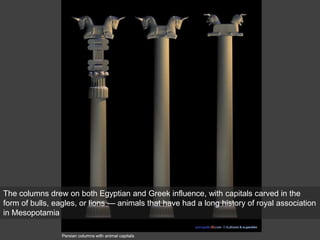
Persian columns with animal capitals
The columns drew on both Egyptian and Greek influence, with capitals carved in the
form of bulls, eagles, or lions — animals that have had a long history of royal association
in Mesopotamia
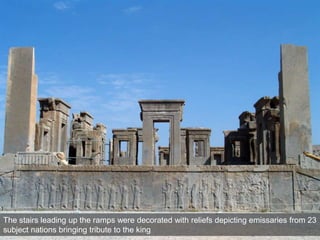
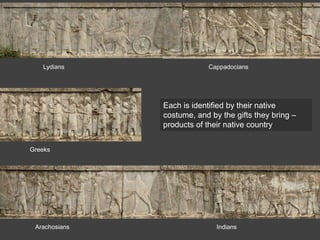
The stairs leading up the ramps were decorated with reliefs depicting emissaries from 23
subject nations bringing tribute to the king
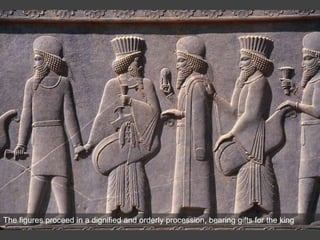
The figures proceed in a dignified and orderly procession, bearing gifts for the king
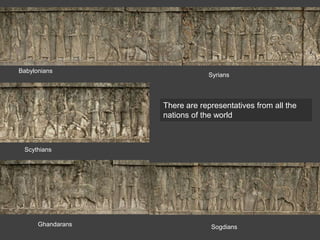
Babylonians
Syrians
Scythians
Ghandarans Sogdians
There are representatives from all the
nations of the world
Lydians Cappadocians
Greeks
IndiansArachosians
Each is identified by their native
costume, and by the gifts they bring –
products of their native country
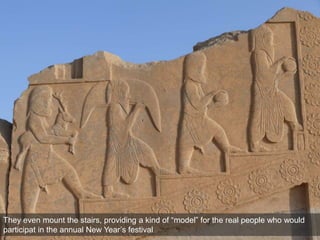
They even mount the stairs, providing a kind of “model” for the real people who would
participat in the annual New Year’s festival
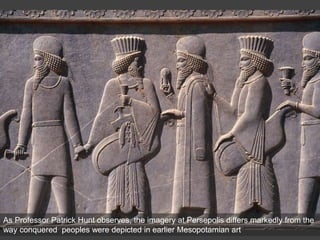
As Professor Patrick Hunt observes, the imagery at Persepolis differs markedly from the
way conquered peoples were depicted in earlier Mesopotamian art
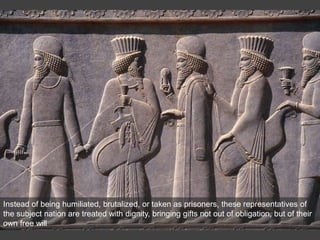
Instead of being humiliated, brutalized, or taken as prisoners, these representatives of
the subject nation are treated with dignity, bringing gifts not out of obligation, but of their
own free will
Persian Emperor (Darius I and Xerxes?) Receiving tribute from foreign dignitaries, Apadana relief, Persepolis, c. 521-465 BCE
National Archeological Museum, Iran
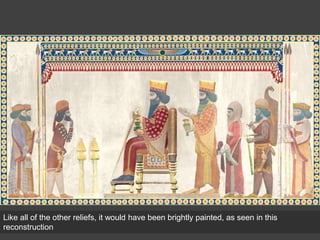
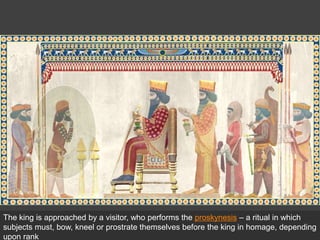
This relief also decorated the Apadana at Persepolis
Like all of the other reliefs, it would have been brightly painted, as seen in this
reconstruction
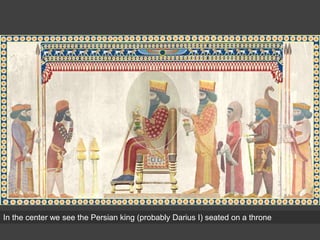
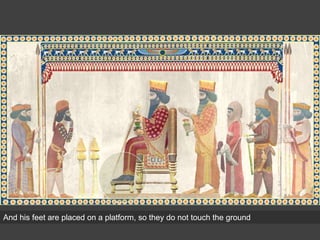
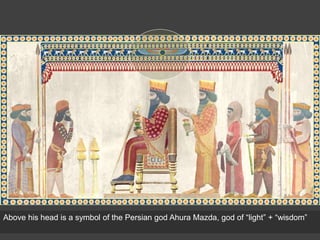
In the center we see the Persian king (probably Darius I) seated on a throne
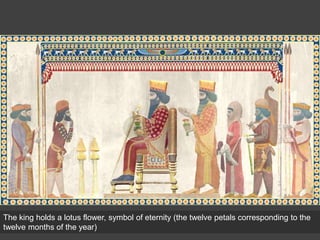
The king holds a lotus flower, symbol of eternity (the twelve petals corresponding to the
twelve months of the year)
And his feet are placed on a platform, so they do not touch the ground
Above his head is a symbol of the Persian god Ahura Mazda, god of “light” + “wisdom”
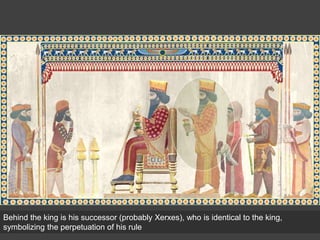
Behind the king is his successor (probably Xerxes), who is identical to the king,
symbolizing the perpetuation of his rule
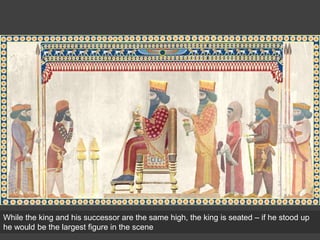
While the king and his successor are the same high, the king is seated – if he stood up
he would be the largest figure in the scene
The king is approached by a visitor, who performs the proskynesis – a ritual in which
subjects must, bow, kneel or prostrate themselves before the king in homage, depending
upon rank
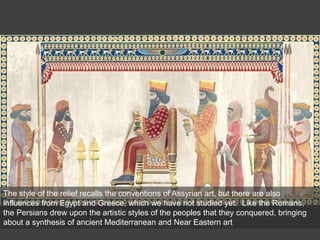
The style of the relief recalls the conventions of Assyrian art, but there are also
influences from Egypt and Greece, which we have not studied yet. Like the Romans,
the Persians drew upon the artistic styles of the peoples that they conquered, bringing
about a synthesis of ancient Mediterranean and Near Eastern art
Kylix depicting a Greek hoplite slaying a
Persian inside, by the Triptolemos painter, 5th
century B.C.E. (National Museums of
Scotland)
We will meet the Persians again when we study Greek society; during the Persian Wars
(499-448 BCE) the Greek city states allied together to fight against the much more
powerful Persian Empire
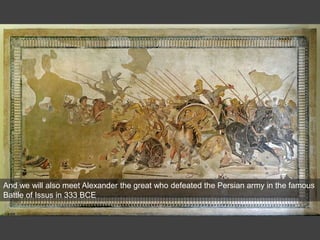
And we will also meet Alexander the great who defeated the Persian army in the famous
Battle of Issus in 333 BCE
Thanks for listening!
Next up: Egypt

Assyrian and Persian Empires

  • 1.
  • 2.
    Map of theAssyrian Empire and successive stages of expansion. Image source: http://www.ancient.eu/Neo-Assyrian_Empire/ The Assyrians came from northern Mesopotamia, and by 900 BCE (the Neo-Assyrian period) they established a vast empire that incorporated much of the ancient Near East
  • 3.
    The Assyrians werethe first great military power in history Assyrian attack on a town from the Northwest Palace at Nimrud (c. 865-860 BCE)
  • 4.
    Assyrian attack ona town from the Northwest Palace at Nimrud (c. 865-860 BCE) They perfected the art of warfare, using military force as a means of expanding and maintaining their power
  • 5.
    Assyrian attack ona town from the Northwest Palace at Nimrud (c. 865-860 BCE) The Assyrians invented many weapons and strategies that are still used today – such as the siege engine pictured here
  • 6.
    Battle of Til-Tubarelief sculpture from Nineveh, South West Palace, 660-650 BCE. Military service was mandatory in Assyrian society, and their tactics of acquiring territory was often violent
  • 7.
    Battle of Til-Tubarelief sculpture from Nineveh, South West Palace, 660-650 BCE. “Indeed, the culture of the Assyrians was brutal, the army seldom marching on the battlefield but rather terrorizing opponents into submission who, once conquered, were tortured, raped, beheaded, and flayed with their corpses publicly displayed. The Assyrians torched enemies’ houses, salted their fields, and cut down their orchards.” Dr. Senta German, “Assyrian Art: An Introduction (Khan Academy)
  • 8.
    Limestone stela ofAssurnasirpal, 865- 860 BCE British Museum Assyrian kings derived their power from the gods, as illustrated in this relief depicting Assurnasirpal
  • 9.
    The king wearsthe distinctive attributes of Assyrian kingship, which includes the conical shaped “fez” hat, and long beard
  • 10.
    He wears along fringed grown, and he is heavily armed, with daggers tucked into his belt, and he holds a mace in his right hand
  • 11.
    He points tosymbols of the gods, and wears a necklace around his neck strung with charms representing the same symbols
  • 12.
    Ashur (supreme god)= horned helmet Shamash (sun god) = winged disc Sin (moon god) = crescent half circle Adad (storm god) = forked line representing a thunderbolt Ishtar (goddess of love and war) = star Ashur Shamash Sin Adad Ishtar
  • 13.
    Assyrian kings builtmassive palaces at cities such as Nimrud, Nineveh, and Khorsabad Digital reconstruction of the Assyrian palace at Nimrud
  • 14.
    Surrounded by heavilyfortified walls, the buildings were made of mud brick, and their size and scale would have been an impressive testament to the king’s power and wealth
  • 15.
    Inside the complexa series of courtyards led to the throne room where visitors would be brought before the king
  • 16.
    Human-headed winged lion(lamassu), 883–859 B.C.; Reign of Ashurnasirpal II Metropolitan Museum Entrances to place chambers were decorated with colossal statues called Lamassu — hybrid creatures with a human head, and the body of an animal
  • 17.
    Human-headed winged lion(lamassu), 883–859 B.C.; Reign of Ashurnasirpal II Metropolitan Museum The creature wears a horned head dress (identifying it as a god), while the face resembles the reigning king
  • 18.
    Lamassu from Palaceof Sargon, c. 720–705 BCE. Limestone, approx. 13’ 10” high Louvre The body of the Lamassu contains the attributes of the fiercest animals in nature
  • 19.
    Lamassu from Palaceof Sargon, c. 720–705 BCE. Limestone, approx. 13’ 10” high Louvre It has the wings of an eagle, the legs of a bull, and the mane and tail of a lion
  • 20.
    Human-headed winged lion(lamassu), 883–859 B.C.; Reign of Ashurnasirpal II Metropolitan Museum By this means, the king appropriated the power of the animal kingdom to himself
  • 21.
    I am asfierce as a lion, strong as a bull, and sharp as an eagle!
  • 22.
    Human-headed winged lion(lamassu), 883–859 B.C.; Reign of Ashurnasirpal II Metropolitan Museum A peculiar feature of the Lamassu is that they have five legs.
  • 23.
    Human-headed winged lion(lamassu), 883–859 B.C.; Reign of Ashurnasirpal II Metropolitan Museum This is because the sculptor thought about only two viewpoints: from the side and from the front
  • 24.
    Human-headed winged lion(lamassu), 883–859 B.C.; Reign of Ashurnasirpal II Metropolitan Museum When seen from the front, the creature seems to be standing firmly, but when seen from the side it appears to be striding
  • 25.
    The Lamassu servedas protective deities for the palace and the king, but on a more practical level they also were intended to intimidate visitors to the palace – like snarling guard dogs leashed to the front door
  • 26.
    Reconstruction of thehall of an Assyrian palace, from ‘Discoveries in the Ruins of Nineveh and Babylon’ by Austen Henry Layard (1817-94). The walls of Assyrian palaces were lined with painted reliefs that fall into three main categories 1. Ceremonial Scenes 2. Military scenes 3. The Royal Hunt
  • 27.
    Stone Relief fromthe throne room of Ashurnasirpal II, 870-860 B.C.E. British Museum This relief comes from the throne room of the Assyrian king Ashurnarsirpal II at Nimrud, in northern Iraq
  • 28.
    Stone Relief fromthe throne room of Ashurnasirpal II, 870-860 B.C.E. British Museum The king appears twice, flanking the sacred tree in the center, and pointing to a winged disc representing the Assyrian god Ashur
  • 29.
    This disc issurrounded by the wings of a bird, and encloses an image of the god wearing a long beard and the horned crown
  • 30.
    Stone Relief fromthe throne room of Ashurnasirpal II, 870-860 B.C.E. British Museum Flanking the king are two winged creatures, called Genies, or Apkallu
  • 31.
    Stone Relief fromthe throne room of Ashurnasirpal II, 870-860 B.C.E. British Museum They anoint the king with a pine cone, dipped into a bucket that they carry in the other hand
  • 32.
    Stone Relief fromthe throne room of Ashurnasirpal II, 870-860 B.C.E. British Museum Like the Lamassu, the Apkallu were supernatural creatures with animal attributes to symbolize their divine powers
  • 33.
    The Apkallu hasthe wings of a bird, and wears a horned crown
  • 34.
    Stone Relief fromthe throne room of Ashurnasirpal II, 860-860 B.C.E. British MuseumSometimes Apkallu have the head of a bird
  • 35.
    Stone Relief fromthe throne room of Ashurnasirpal II, 870-860 B.C.E. British Museum This image would have appeared in the king’s throne room, so ancient visitors would have seen the king seated on a throne, with the sacred tree behind him, the image of the god above him, and the blessing Apkallu on either side of him – visually expressing the king’s divinely ordained power
  • 36.
    Relief depicting theKing and Eunuch Attendant, from Nimrud, 883-859 BCE Metropolitan Museum In this relief from the Palace at Nimrud (now in the Metropolitan Museum), we see the king in another ritual scene
  • 37.
    The king canbe identified by his fez hat, and he carries a ceremonial bowl that is replenished by an attendant, who carries a fly whisk to fan flies away from the king
  • 38.
    The attendant isa Eunuch – Assyrian kings castrated their officials and close servants so they could not father children, thereby ensuring complete loyalty to the king
  • 39.
    The figures areall shown in a composite pose with feet facing to the right, while their torsos are twisted forward, with their arms folded over their bodies, creating a flattened two-dimensional effect
  • 40.
    In all ofthese scenes, the king is large and imposing in stature, though the convention of hierarchic scale is not employed
  • 41.
    The king’s longfringed tunic is draped over his left shoulder, exposing a massively muscular arm
  • 42.
    He is alsoheavily armed, with a large bow clutched in his left hand, daggers tucked into his robe, and another weapon tucked under his left arm
  • 43.
    In a similarrelief in the Brooklyn Museum, we see the king attended by an Apkallu Assurnasirpal II and a Winged Genie, from the Northwest Palace at Nimrud, c. 883-859 BCE Brooklyn Museum
  • 44.
    The carving ofthe muscles, and the texture of the fringes of the robe are extraordinarily detailed
  • 45.
    Although the scenedepicts a dignified ceremonial ritual, the king’s physical strength and power is clearly the intended message Assurnasirpal II and a Winged Genie, from the Northwest Palace at Nimrud, c. 883-859 BCE Brooklyn Museum
  • 46.
    Ashurbanipal’s victory overthe Elamites at the Battle of Til-Tuba: Assyrian chariot troops charge into battle, detail of relief from SW. Palace of Sennacherib at Nineveh. British Museum Scenes of military conquest were also common themes in palace decorations, serving to exalt the king’s prowess on the battlefield
  • 47.
    Ashurbanipal’s victory overthe Elamites at the Battle of Til-Tuba: Assyrian chariot troops charge into battle, detail of relief from SW. Palace of Sennacherib at Nineveh. British Museum The images combine the register format of Sumerian art, where the narrative unfolds over time, with the action packed drama and narrative detail of Akkadian art
  • 48.
    Sacking of Susaby Ashurbanipal, North Palace, Nineveh, 647 B.C.E. This scene records the sack of Susa, one of Ashurbanipal’s great military victories
  • 49.
    Sacking of Susaby Ashurbanipal, North Palace, Nineveh, 647 B.C.E. As soldiers destroy the walls of the city, flames can be seen in the background
  • 50.
    Sacking of Susaby Ashurbanipal, North Palace, Nineveh, 647 B.C.E. In the foreground, soldiers descend a hill carrying “booty” from the conquered city
  • 51.
    This scene ispart of a larger narrative relief recording the Battle of Til-Tuba, and Ashurbanipal’s conquest of the Elamites
  • 52.
    In this scenethe Elamite king’s chariot is toppled, and his soldiers lie scattered on the battlefield
  • 53.
    The king’s sontries to lead his wounded father to safety
  • 54.
    In this scenethe king’s son tries to make a last stand against the advancing Assyrian army, while his wounded father pleads for mercy
  • 55.
    But in thenext scene he is killed with a mace
  • 56.
    And in thenext scene he is beheaded
  • 57.
    Soldiers then showthe severed head of the king and his son to the Elamite soldiers to prove their defeat
  • 58.
    In a finalscene we see the king reclining on a couch beneath an arbor, toasting his victory with the queen, seated on a high chair
  • 59.
    They are surroundedby attendants who serve them, entertain them, and keep them cool with fans
  • 60.
    In a grislydetail, we notice the severed head of the Elamite king dangling from a tree
  • 61.
    Assyrian reliefs representa dramatic break through in the art of storytelling. Using the register format first invented by the Sumerians, Assyrian artists developed techniques for telling a story that unfolds over time, and in great detail
  • 62.
    Like in comicbooks, the main characters appear several times, indicating the passage of time. If Assyrian kings had the technology, they would have made movies — and they would have been as dramatic (and gory) as our own action-packed thrillers!
  • 63.
    The “manly” sportof hunting lions was one of the most popular themes in palace decorations
  • 64.
    “In ancient Assyria,lion-hunting was considered the sport of kings, symbolic of the ruling monarch’s duty to protect and fight for his people.” British Museum
  • 65.
    The hunt itselfwas a public ritual that was carefully staged
  • 66.
    The animals werekept in cages, and sometimes drugged so little was left to chance
  • 67.
    The king’s abilityto conquer the “king of the beasts” symbolized his ability to protect his kingdom from the most powerful forces of nature
  • 68.
    Ashurbanipal hunting lions,relief from the North Palace of Ashurbanipal, Nineveh (modern Kuyunjik), Iraq, ca. 645–640 BCE. Gypsum, 5’ 4” high. British Museum, London. In this relief, from the palace at Nineveh, the king is shown in his chariot with attendants bravely slaying lions, leaving in their wake a field littered with dead and dying animals
  • 69.
    Ashurbanipal hunting lions,relief from the North Palace at Nineveh, ca. 645–640 BCE. Gypsum, 5’ 4” high British Museum, London. The king can be recognized by his fez hat and long beard
  • 70.
    Ashurbanipal hunting lions,relief from the North Palace at Nineveh, ca. 645–640 BCE. Gypsum, 5’ 4” high British Museum, London. To create the illusion of depth the artist uses a technique called overlapping
  • 71.
    Ashurbanipal hunting lions,relief from the North Palace at Nineveh, ca. 645–640 BCE. Gypsum, 5’ 4” high British Museum, London. By placing the figures on top of one another, it creates the impression that the top figure is “closer,” and that the figures behind it are further away
  • 72.
    Ashurbanipal hunting lions,relief from the North Palace of Ashurbanipal, Nineveh (modern Kuyunjik), Iraq, ca. 645–640 BCE. Gypsum, 5’ 4” high. British Museum, London. A different technique for depicting spatial depth is used in the scene behind the chariot, where dead and dying animals litter the field
  • 73.
    Ashurbanipal hunting lions,relief from the North Palace of Ashurbanipal, Nineveh (modern Kuyunjik), Iraq, ca. 645–640 BCE. Gypsum, 5’ 4” high. British Museum, London. Here, the artist has used vertical perspective, where objects in the distance are placed higher up on the picture plane to create the impression they are further away in space
  • 74.
    A notable featureof the lion hunt reliefs is the realistic detail in the treatment of the lions
  • 75.
    We see theirstraining muscles and tendons as they suffer the agony of a slow and painful death
  • 76.
    Some of themeven vomit blood as their bodies bristle with spears
  • 77.
    The artist seemsto amplify the animals’ fierceness and nobility, in order to make the king’s triumph seem all the more significant (we wouldn’t be impressed if the king had slaughtered a bunny!)
  • 78.
    Ashurbanipal hunting lions,relief from the North Palace of Ashurbanipal, Nineveh (modern Kuyunjik), Iraq, ca. 645–640 BCE. Gypsum, 5’ 4” high. British Museum, London. The king’s ability to conquer even the fiercest creatures of nature is also communicated by the contrast between the humans and animals
  • 79.
    Ashurbanipal hunting lions,relief from the North Palace of Ashurbanipal, Nineveh (modern Kuyunjik), Iraq, ca. 645–640 BCE. Gypsum, 5’ 4” high. British Museum, London. In all of the scenes, the king and his men remain calm, and in control. They perform as if they are partaking of a slow moving ritual that is ordered and dignified
  • 80.
    In contrast, theanimals are rendered with a high degree of naturalism, so that their wild nature is amplified by contrast
  • 81.
    The contrast driveshome the essential contrast between good and evil, culture and nature, human and wild beast
  • 82.
    Thanks for listening! Nextup: The Persian Empire
  • 83.
  • 84.
    The last ofthe great Near Eastern kingdoms was the Achaemenid Empire (Persian Empire), founded by king Cyrus the Great in the 6th century BCE
  • 85.
    Kylix depicting aGreek hoplite slaying a Persian inside, by the Triptolemos painter, 5th century B.C.E. (National Museums of Scotland) The Persian Empire was expanded under Cyrus’s grandson Darius I, who endeavored to conquer the Greeks — at which point our history of the Near East will converge with Greece and Rome – as seen in this Greek kylix cup illustrating a battle between a Greek and a Persian
  • 86.
    Marbel bust ofHerodotos, Roman, 2nd century CE Metropolitan Museum Most of what we know about the Persian Empire comes from histories written by the Greeks, who despised the Persians as their enemy, so our knowledge of this culture has been distorted by western biases
  • 87.
    In fact thepopular movie 300 perpetuates these ancient biases
  • 88.
    The Spartans areportrayed as physically perfect, unambiguously heterosexual, noble and brave
  • 89.
    While the Persiansare demonized as self-indulgent and sexually ambiguous monsters, with darker skin and an “unmanly” taste for excessive jewelry and eye make-up
  • 90.
    Persian Emperor (DariusI and Xerxes?) Receiving tribute from foreign dignitaries, Apadana relief, Persepolis, c. 521-465 BCE National Archeological Museum, Iran But the Persian Empire was actually quite sophisticated, and was in many ways much more “civilized” than any of the preceding Mesopotamian civilizations.
  • 91.
    Persian Emperor (DariusI and Xerxes?) Receiving tribute from foreign dignitaries, Apadana relief, Persepolis, c. 521-465 BCE National Archeological Museum, Iran They were, for example, against slavery, and they were remarkably tolerant of religious and cultural differences
  • 92.
    The Cyrus Cylinder,c. 539 BCE. British Museum This can be seen in the Cyrus cylinder, often credited with being the first “declaration of human rights” in history
  • 93.
    The Cyrus Cylinder,c. 539 BCE. British Museum The cylinder is inscribed with cuneiform text that proclaims the rights of all conquered peoples to worship the gods of their choice, and to retain their own cultural traditions
  • 94.
    This concept wasextended to how the Persians governed the many peoples that they conquered: The Persian Empire was a multi-cultural nation, where conquered peoples retained their customs and culture, while paying allegiance and taxes to the king
  • 95.
    Other achievements ofthe Persian Empire include the royal road, which extended from Susa to Sardi, and the establishment of a currency, which stimulated trade and economic growth
  • 96.
    Persian capital atPersepolis, Iran, c. 521-465 BCE One of the most spectacular achievements of the Persian Empire was the Palace at Persepolis (in modern day Iran), built by Darius I and his successor Xerxes
  • 97.
    Persian capital atPersepolis, Iran, c. 521-465 BCE It was destroyed by Alexander the Great in 330 BCE in revenge for the Persian sack of Athens, but even in its ruined state it suggests the magnificence of the Persian Empire
  • 98.
    Gateway of allNations, Persepolis, Iran, c. 521-465 BCE Entrance to the complex was through the Gate of All Nations, which is flanked by colossal hybrid creatures resembling Assyrian Lamassu
  • 99.
    “View of theeastern stairway and columns of the Apadana (Audience Hall) at Persepolis, Iran,” from “Persepolis: Images of an Empire,” at the Oriental Institute, 2016. A ceremonial staircase (resembling the ramps leading up to a ziggurat) leads to the apadana – the royal audience hall
  • 100.
    Persepolis, reconstruction of theApadana by Chipiez Wikimedia 60 ft high and 217 ft square, the apadana was “hypostyle hall” (meaning a many- columned hall), with 72 colossal columns
  • 101.
    Persian columns withanimal capitals The columns drew on both Egyptian and Greek influence, with capitals carved in the form of bulls, eagles, or lions — animals that have had a long history of royal association in Mesopotamia
  • 102.
    The stairs leadingup the ramps were decorated with reliefs depicting emissaries from 23 subject nations bringing tribute to the king
  • 103.
    The figures proceedin a dignified and orderly procession, bearing gifts for the king
  • 104.
    Babylonians Syrians Scythians Ghandarans Sogdians There arerepresentatives from all the nations of the world
  • 105.
    Lydians Cappadocians Greeks IndiansArachosians Each isidentified by their native costume, and by the gifts they bring – products of their native country
  • 106.
    They even mountthe stairs, providing a kind of “model” for the real people who would participat in the annual New Year’s festival
  • 107.
    As Professor PatrickHunt observes, the imagery at Persepolis differs markedly from the way conquered peoples were depicted in earlier Mesopotamian art
  • 108.
    Instead of beinghumiliated, brutalized, or taken as prisoners, these representatives of the subject nation are treated with dignity, bringing gifts not out of obligation, but of their own free will
  • 109.
    Persian Emperor (DariusI and Xerxes?) Receiving tribute from foreign dignitaries, Apadana relief, Persepolis, c. 521-465 BCE National Archeological Museum, Iran This relief also decorated the Apadana at Persepolis
  • 110.
    Like all ofthe other reliefs, it would have been brightly painted, as seen in this reconstruction
  • 111.
    In the centerwe see the Persian king (probably Darius I) seated on a throne
  • 112.
    The king holdsa lotus flower, symbol of eternity (the twelve petals corresponding to the twelve months of the year)
  • 113.
    And his feetare placed on a platform, so they do not touch the ground
  • 114.
    Above his headis a symbol of the Persian god Ahura Mazda, god of “light” + “wisdom”
  • 115.
    Behind the kingis his successor (probably Xerxes), who is identical to the king, symbolizing the perpetuation of his rule
  • 116.
    While the kingand his successor are the same high, the king is seated – if he stood up he would be the largest figure in the scene
  • 117.
    The king isapproached by a visitor, who performs the proskynesis – a ritual in which subjects must, bow, kneel or prostrate themselves before the king in homage, depending upon rank
  • 118.
    The style ofthe relief recalls the conventions of Assyrian art, but there are also influences from Egypt and Greece, which we have not studied yet. Like the Romans, the Persians drew upon the artistic styles of the peoples that they conquered, bringing about a synthesis of ancient Mediterranean and Near Eastern art
  • 119.
    Kylix depicting aGreek hoplite slaying a Persian inside, by the Triptolemos painter, 5th century B.C.E. (National Museums of Scotland) We will meet the Persians again when we study Greek society; during the Persian Wars (499-448 BCE) the Greek city states allied together to fight against the much more powerful Persian Empire
  • 120.
    And we willalso meet Alexander the great who defeated the Persian army in the famous Battle of Issus in 333 BCE
  • 121.