Dr Muhammad Salman Khan


Radiation has been described as a doubleedged sword. On the one hand, radiation itself
is a useful tool for research; medical diagnosis
and therapy and on the other hand, radiation
exposures, especially at high levels, can lead to
increased frequencies or severities of various
adverse health effects.


To produce a radiation response in humans
within a few days to months, the dose must be
substantial, such a response is called an early
effect of radiation exposure.


Early radiation responses are described as
deterministic,those that exhibit increasing
severity with increasing radiation dose.




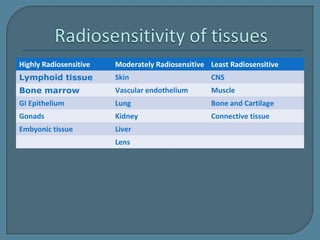
Radiosensitivity is the relative susceptibility of
cells, tissues, organs, organisms, or other
substances to the injurious action of radiation.
In general, it has been found that cell
radiosensitivity is directly proportional to the
rate of cell division and inversely proportional
to the degree of cell differentiation
Highly Radiosensitive

Moderately Radiosensitive Least Radiosensitive

Lymphoid tissue

Skin

CNS

Bone marrow

Vascular endothelium

Muscle

GI Epithelium

Lung

Bone and Cartilage

Gonads

Kidney

Connective tissue

Embyonic tissue

Liver
Lens


The sequence of events that follow high-level
radiation exposure leading to death within
days or weeks is called the acute radiation
syndrome.



There are, in fact, three separate syndromes
that are dose related and that follow a rather
distinct course of clinical responses.


These syndromes are;
-Hematologic death
-Gastrointestinal (GI) death
-Central Nervous System (CNS) death


In addition to the three lethal syndromes, two
periods are associated with acute radiation
lethality;
-Prodromal Period
-Latent Period


It consists of acute clinical symptoms that
appear within minutes to hours of total body
exposure to the radiation doses of
approximately 100 rad (1 Gy) and may last
from a few hours to a couple of days
-Anorexia, Nausea, Vomiting, Diarrhea.
-Easy Fatigability.
-Reduction in WBCs ( Leukopenia).


Effect is dose dependent;
-Varies in time of onset
-Severity
-Duration


After the period of initial radiation sickness, a
period of apparent well-being occurs, which is
called the latent period.
-extends from hrs or less(5000 rad) to
weeks(100 to 500 rad)


In this stage the symptoms depend on the
specific syndrome and last from hours up to
several months.


Most patients who do not recover will die
within a few to several months of exposure.
The recovery process lasts from several weeks
up to two years.
 Prodromal

Phase symptoms i.e nausea,
vomiting and diarrhea develops, with time of
onset from later than 1 hour to about 24 hours
after exposure and may persist for several
days.
 Latent

phase lasts up to a month, relatively
asymptomatic except for some fatigue and
weakness.
 Manifest

Illness Phase, characterized by
neutropenic fever, systemic and localized
infections, sepsis, and hemorrhage.
 Recovery

Phase begins in 2 to 4 weeks, but as
long as 6 months may be required for full
recovery.
 Death may occur as a result of generalized
infection, electrolyte imbalance, and
hemorrhage.
 Mean Survival Time is 10 to 60 days.
Pathophysiology of the GI Syndrome:
 Depletion of the epithelial cells lining lumen of
GI tract.
 Intestinal bacteria gain free access to the
body.
 Hemorrhage through denuded areas.
 Loss of absorptive capacity.




Prodromal Period: Severe nausea and vomiting
with watery diarrhea and cramps develops
within hours after exposure and may persist
for hours to as long as a day.
Latent Period of 3 to 5 days follows, during
which no symptoms are present.




Manifest Illness: Return of severe diarrhea,
vomiting with fever; progression to bloody
diarrhea, shock and death without aggressive
medical intervention may occur within 3 to 5
days.
Mean Survival Time is 4 to 10 days.






Malabsorption
Malnutrition
Fluid and Electrolyte Shifts
Dehydration,
Acute Renal Failure, Cardiovascular collapse
GI bleeding
Anaemia
Sepsis
Paralytic Ileus
Vomiting, Abdominal
distention
 Prodromal

Period: Nausea, vomiting and
burning sensation in the skin within a few
minutes of exposure.
The pt become nervous and confused with loss
of vision, balance and consciousness within
the first hour.
 Latent

Period: Lasts up to 12 hours, during
which earlier symptoms disappear.
 Manifest

Illness: Symptoms of prodromal
stage return but are more severe.
The person becomes disoriented;
loses muscle coordination;
has difficulty breathing;
may develop convulsive seizures;
loss of equilibrium, ataxia and lethargy;
lapses into coma; and dies.
 Mean Survival Time is 0 to 3 days.
 CNS

syndrome is characterized by raised
intracranial pressure, vasculitis and meningitis.
The LD50/60 is the dose
of radiation to the whole
body that causes 50%
of irradiated subjects to
die within 60 days.
LD50/60 for human is approx 350 rad
after whole body radiation.
As the whole body
radiation dose
increases, the average
time between exposure
and death decreases.


When only part of the body is irradiated, in
contrast with whole-body irradiation, a higher
dose is required to produce a response.


Every organ and tissue of the body can be
affected by partial-body irradiation.


The effect is cell death, leading to total lack of
function for that organ or tissue, or it can be
followed by recovery.


Examples of local tissues that can be affected
immediately are;
-Skin
-Gonads
-Bone Marrow


The most commonly affected tissue is the
skin.



Damage to the basal cells results in the earliest
manifestation of radiation injury to the skin.




Early Transient Erythema: Within a few hours
after single doses in excess of about 200 rad/2
Gy, an early transient erythema might occur in
a well-defined area matching the entrance site
of the X-ray beam.
The area may look much like sunburn.





This reaction peaks at about 24 hrs and
subsides after approximately 48 hrs.
It is thought to represent an early phase of
inflammation, with hyperemia and increased
permeability of the capillaries resulting from
the release of proteolytic histamine-like
enzymes.
The intensity of the erythema increases with
the dose.





Main Erythema:A second hyperemic phase,
the main erythematous reaction (main
erythema), begins about 10 days after a dose
of about 600 rad and earlier when doses are
very high.
Its intensity, which is also dose-dependent,
reaches a peak around the 14th day.
The skin becomes warm and edematous.





The patient may complain of burning,
tenderness, and itching.
The main erythema represents a secondary
inflammatory reaction to damage to the
proliferating cells at the basal cell layer of the
epidermis.
If the dose is not much greater than the
threshold, the erythema fades after 4 weeks.





Temporary Epilation (hair loss): Epilation (hair
loss) results from depletion of the germinal
layers of hair follicles.
Single doses of 300-600 rad might result in
temporary loss of hair after about 3 weeks.
Re growth occurs after approximately 8-12
weeks.


Permanent Epilation: Doses in excess of 700
rad may irreversibly damage the hair follicle,
and permanent epilation of the affected
follicles ensues.




Dry Desquamation: If the radiation dose
exceeds about 800-1200 rad, the main
erythema may progress to dry desquamation
of the skin within 25-30 days.
The erythematous skin is then covered with
scales and flakes of corneum, similar to the
aftereffects of a sunburn.


Moist Desquamation:If the radiation dose is
even higher i.e 1500-2000 rad, blistering and
sloughing of the superficial skin (moist
desquamation) occurs within 20-28 days.






Blister Formation: At radiation doses in excess
of about 1500-2500 rad, blister formation
occurs in about 15-25 days.
Ulceration (within skin): At radiation dose
above 2000 rad ulceration within the skin may
occur in 2-3 weeks.
Necrosis (deeper penetration): At radiation
dose of about 2500 rad, necrosis develops in 3
weeks.


As an example of local tissue effects, human
gonads are particularly sensitive to radiation.



Because these organs control fertility and
heredity, their response to radiation has been
studied extensively.
Testicular Dose Effect
(rad)
10-30

Temporary Oligospermia

30-50

100% temporary aspermia from 4-12 months post-exposure. Full
recovery by 48 months.

50-100

100% temporary aspermia from 3-17 months post-exposure.
Full recovery beginning 8-38 months

100-200

100% temporary aspermia from 2-15 months post-exposure. Full
recovery biginning 11-20 months

200-300

100% aspermia beginning at 1-2 months post-exposure. No recovery
observed up to 40 months
Ovarian
Dose (rad)

Effect

60

No effect

150

Some risk for ovulatory suppression in women > 40 years of age.

250-500

In women aged 15-40, 60% may suffer permanent ovulatory
suppression; remainder may suffer temporary amenorrhea. In women
> 40 years of age, 100% may have permanent ovulation suppression.
Menopause may be artificially produced.

500-800

In women aged 15-40, 60-70% may suffer permanent ovulatory
suppression; remainder may experience temporary amenorrhea.

>800

100% ovulation suppression.
 Haematopoietic

system consists mainly of;
-Lymphocytes
-Granulocytes
-Thrombocytes
-Erythrocytes


Cytogenetics is the study of the genetics of the
cells, particularly cell chromosomes.
• Single hit effects produced by radiation during G1

phase are breakage of a chromatid called
chromatid deletion.
• During S phase both the remaining chromosome
and the deletion are replicated.
• The chromosome aberration visualised at
metaphase consists of a normal looking
chromosome with material missing from the ends
of two sister chromatids and two accentric
fragments without centromere (isochromatids)





A single chromosome can sustain more
than one hit
In the G1 phase of the cycle ,ring
chromosomes are produced if the two hits
occur on the same chromosome
Dicentrics are produced when adjacent
chromosomes each suffer one hit and
recombine




These are multihit aberations
These result in no loss of genetic
material,simply rearrangement of genes
Require karyotypic analysis for detection
Formation Of Dicentric
Chromosome
Formation Of Ring
Chromosome
Procedure

Amount of Radiation (mrem)

X-Ray extremity (arm,hand,foot,leg)

1 mrem

X-Ray dental

1 mrem

X-Ray chest

6 mrem

X-Ray pelvis/hip

65 mrem

X-Ray skull/neck

20 mrem

X-Ray barium enema

405 mrem

X-Ray upper GI

245 mrem

CT-head

200 mrem

CT-abdomen

800 mrem

Nuclear medicine (e.g. thyroid scan)

14 mrem
Early effects of radiation

Early effects of radiation

  • 1.
  • 2.
     Radiation has beendescribed as a doubleedged sword. On the one hand, radiation itself is a useful tool for research; medical diagnosis and therapy and on the other hand, radiation exposures, especially at high levels, can lead to increased frequencies or severities of various adverse health effects.
  • 3.
     To produce aradiation response in humans within a few days to months, the dose must be substantial, such a response is called an early effect of radiation exposure.
  • 4.
     Early radiation responsesare described as deterministic,those that exhibit increasing severity with increasing radiation dose.
  • 5.
      Radiosensitivity is therelative susceptibility of cells, tissues, organs, organisms, or other substances to the injurious action of radiation. In general, it has been found that cell radiosensitivity is directly proportional to the rate of cell division and inversely proportional to the degree of cell differentiation
  • 6.
    Highly Radiosensitive Moderately RadiosensitiveLeast Radiosensitive Lymphoid tissue Skin CNS Bone marrow Vascular endothelium Muscle GI Epithelium Lung Bone and Cartilage Gonads Kidney Connective tissue Embyonic tissue Liver Lens
  • 7.
     The sequence ofevents that follow high-level radiation exposure leading to death within days or weeks is called the acute radiation syndrome.  There are, in fact, three separate syndromes that are dose related and that follow a rather distinct course of clinical responses.
  • 8.
     These syndromes are; -Hematologicdeath -Gastrointestinal (GI) death -Central Nervous System (CNS) death
  • 9.
     In addition tothe three lethal syndromes, two periods are associated with acute radiation lethality; -Prodromal Period -Latent Period
  • 10.
     It consists ofacute clinical symptoms that appear within minutes to hours of total body exposure to the radiation doses of approximately 100 rad (1 Gy) and may last from a few hours to a couple of days -Anorexia, Nausea, Vomiting, Diarrhea. -Easy Fatigability. -Reduction in WBCs ( Leukopenia).
  • 11.
     Effect is dosedependent; -Varies in time of onset -Severity -Duration
  • 12.
     After the periodof initial radiation sickness, a period of apparent well-being occurs, which is called the latent period. -extends from hrs or less(5000 rad) to weeks(100 to 500 rad)
  • 13.
     In this stagethe symptoms depend on the specific syndrome and last from hours up to several months.
  • 14.
     Most patients whodo not recover will die within a few to several months of exposure. The recovery process lasts from several weeks up to two years.
  • 15.
     Prodromal Phase symptomsi.e nausea, vomiting and diarrhea develops, with time of onset from later than 1 hour to about 24 hours after exposure and may persist for several days.
  • 16.
     Latent phase lastsup to a month, relatively asymptomatic except for some fatigue and weakness.
  • 17.
     Manifest Illness Phase,characterized by neutropenic fever, systemic and localized infections, sepsis, and hemorrhage.
  • 18.
     Recovery Phase beginsin 2 to 4 weeks, but as long as 6 months may be required for full recovery.  Death may occur as a result of generalized infection, electrolyte imbalance, and hemorrhage.  Mean Survival Time is 10 to 60 days.
  • 19.
    Pathophysiology of theGI Syndrome:  Depletion of the epithelial cells lining lumen of GI tract.  Intestinal bacteria gain free access to the body.  Hemorrhage through denuded areas.  Loss of absorptive capacity.
  • 20.
      Prodromal Period: Severenausea and vomiting with watery diarrhea and cramps develops within hours after exposure and may persist for hours to as long as a day. Latent Period of 3 to 5 days follows, during which no symptoms are present.
  • 21.
      Manifest Illness: Returnof severe diarrhea, vomiting with fever; progression to bloody diarrhea, shock and death without aggressive medical intervention may occur within 3 to 5 days. Mean Survival Time is 4 to 10 days.
  • 22.
         Malabsorption Malnutrition Fluid and ElectrolyteShifts Dehydration, Acute Renal Failure, Cardiovascular collapse GI bleeding Anaemia Sepsis Paralytic Ileus Vomiting, Abdominal distention
  • 23.
     Prodromal Period: Nausea,vomiting and burning sensation in the skin within a few minutes of exposure. The pt become nervous and confused with loss of vision, balance and consciousness within the first hour.
  • 24.
     Latent Period: Lastsup to 12 hours, during which earlier symptoms disappear.
  • 25.
     Manifest Illness: Symptomsof prodromal stage return but are more severe. The person becomes disoriented; loses muscle coordination; has difficulty breathing; may develop convulsive seizures; loss of equilibrium, ataxia and lethargy; lapses into coma; and dies.  Mean Survival Time is 0 to 3 days.
  • 26.
     CNS syndrome ischaracterized by raised intracranial pressure, vasculitis and meningitis.
  • 27.
    The LD50/60 isthe dose of radiation to the whole body that causes 50% of irradiated subjects to die within 60 days. LD50/60 for human is approx 350 rad after whole body radiation.
  • 28.
    As the wholebody radiation dose increases, the average time between exposure and death decreases.
  • 29.
     When only partof the body is irradiated, in contrast with whole-body irradiation, a higher dose is required to produce a response.
  • 30.
     Every organ andtissue of the body can be affected by partial-body irradiation.
  • 31.
     The effect iscell death, leading to total lack of function for that organ or tissue, or it can be followed by recovery.
  • 32.
     Examples of localtissues that can be affected immediately are; -Skin -Gonads -Bone Marrow
  • 33.
     The most commonlyaffected tissue is the skin.  Damage to the basal cells results in the earliest manifestation of radiation injury to the skin.
  • 34.
      Early Transient Erythema:Within a few hours after single doses in excess of about 200 rad/2 Gy, an early transient erythema might occur in a well-defined area matching the entrance site of the X-ray beam. The area may look much like sunburn.
  • 35.
       This reaction peaksat about 24 hrs and subsides after approximately 48 hrs. It is thought to represent an early phase of inflammation, with hyperemia and increased permeability of the capillaries resulting from the release of proteolytic histamine-like enzymes. The intensity of the erythema increases with the dose.
  • 36.
       Main Erythema:A secondhyperemic phase, the main erythematous reaction (main erythema), begins about 10 days after a dose of about 600 rad and earlier when doses are very high. Its intensity, which is also dose-dependent, reaches a peak around the 14th day. The skin becomes warm and edematous.
  • 37.
       The patient maycomplain of burning, tenderness, and itching. The main erythema represents a secondary inflammatory reaction to damage to the proliferating cells at the basal cell layer of the epidermis. If the dose is not much greater than the threshold, the erythema fades after 4 weeks.
  • 38.
       Temporary Epilation (hairloss): Epilation (hair loss) results from depletion of the germinal layers of hair follicles. Single doses of 300-600 rad might result in temporary loss of hair after about 3 weeks. Re growth occurs after approximately 8-12 weeks.
  • 39.
     Permanent Epilation: Dosesin excess of 700 rad may irreversibly damage the hair follicle, and permanent epilation of the affected follicles ensues.
  • 40.
      Dry Desquamation: Ifthe radiation dose exceeds about 800-1200 rad, the main erythema may progress to dry desquamation of the skin within 25-30 days. The erythematous skin is then covered with scales and flakes of corneum, similar to the aftereffects of a sunburn.
  • 41.
     Moist Desquamation:If theradiation dose is even higher i.e 1500-2000 rad, blistering and sloughing of the superficial skin (moist desquamation) occurs within 20-28 days.
  • 42.
       Blister Formation: Atradiation doses in excess of about 1500-2500 rad, blister formation occurs in about 15-25 days. Ulceration (within skin): At radiation dose above 2000 rad ulceration within the skin may occur in 2-3 weeks. Necrosis (deeper penetration): At radiation dose of about 2500 rad, necrosis develops in 3 weeks.
  • 43.
     As an exampleof local tissue effects, human gonads are particularly sensitive to radiation.  Because these organs control fertility and heredity, their response to radiation has been studied extensively.
  • 44.
    Testicular Dose Effect (rad) 10-30 TemporaryOligospermia 30-50 100% temporary aspermia from 4-12 months post-exposure. Full recovery by 48 months. 50-100 100% temporary aspermia from 3-17 months post-exposure. Full recovery beginning 8-38 months 100-200 100% temporary aspermia from 2-15 months post-exposure. Full recovery biginning 11-20 months 200-300 100% aspermia beginning at 1-2 months post-exposure. No recovery observed up to 40 months
  • 45.
    Ovarian Dose (rad) Effect 60 No effect 150 Somerisk for ovulatory suppression in women > 40 years of age. 250-500 In women aged 15-40, 60% may suffer permanent ovulatory suppression; remainder may suffer temporary amenorrhea. In women > 40 years of age, 100% may have permanent ovulation suppression. Menopause may be artificially produced. 500-800 In women aged 15-40, 60-70% may suffer permanent ovulatory suppression; remainder may experience temporary amenorrhea. >800 100% ovulation suppression.
  • 46.
     Haematopoietic system consistsmainly of; -Lymphocytes -Granulocytes -Thrombocytes -Erythrocytes
  • 48.
     Cytogenetics is thestudy of the genetics of the cells, particularly cell chromosomes.
  • 50.
    • Single hiteffects produced by radiation during G1 phase are breakage of a chromatid called chromatid deletion. • During S phase both the remaining chromosome and the deletion are replicated. • The chromosome aberration visualised at metaphase consists of a normal looking chromosome with material missing from the ends of two sister chromatids and two accentric fragments without centromere (isochromatids)
  • 51.
       A single chromosomecan sustain more than one hit In the G1 phase of the cycle ,ring chromosomes are produced if the two hits occur on the same chromosome Dicentrics are produced when adjacent chromosomes each suffer one hit and recombine
  • 52.
       These are multihitaberations These result in no loss of genetic material,simply rearrangement of genes Require karyotypic analysis for detection
  • 53.
  • 54.
  • 55.
    Procedure Amount of Radiation(mrem) X-Ray extremity (arm,hand,foot,leg) 1 mrem X-Ray dental 1 mrem X-Ray chest 6 mrem X-Ray pelvis/hip 65 mrem X-Ray skull/neck 20 mrem X-Ray barium enema 405 mrem X-Ray upper GI 245 mrem CT-head 200 mrem CT-abdomen 800 mrem Nuclear medicine (e.g. thyroid scan) 14 mrem