Chair person-Dr Ram S kaulgud
Student-Dr Darshan M
 Atomic isotopes with uneven numbers of protons
and neutrons are typically unstable; such
isotopes discharge particles or energy to matter
as they move to stability, a process that is
defined as radiation
 Alpha particles-consists of heavily positive
charged particles each contains 2 protons and 2
neutrons
 Less penetrable,usually does not pentrate
beyond skin.
 Low risk from exposure.
e.g Uranium and Plutonium
Beta rays
 Small,light negatively charged particles.
 Can pentrate few millimeters of skin causing
ulceration and scaring.
 Can be stopped by clothes and plastic.
 E.g radioactive iodine
Gamma and x-rays.
 Uncharged electromagnetic radiation discharged
from nucleus as wave of energy.
 Highly penetrable cause tissue and organ
damage if exposed
Neutron particles
 Uncharged and heavy are often emitted during
nuclear detonation,highly pentrable.
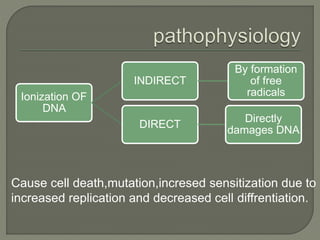
Ionization OF
DNA
INDIRECT
By formation
of free
radicals
DIRECT
Directly
damages DNA
Cause cell death,mutation,incresed sensitization due to
increased replication and decreased cell diffrentiation.
Internal contamination
 Occurs through inhalation or ingestion or through
wounds.
 The respiratory system is the main portal of entry
for internal contamination
 Causes pneumonitis and scarring.
 Lung is the organ at the greatest risk.
External contamination
That land on the body surface, clothing, skin,
and hair. This is the dominant element to
consider in the mass-casualty situation resulting
from a radioactive terrorist strike.
 The common contaminants primarily emit alpha
and beta radiation.
Localized contamination.
 close contact between a highly radioactive
source and a part of the body, with consequent
discrete damage to the skin and deeper tissues
that resembles a thermal burn.
 Later signs include epilation, erythema, moist
desquamation, ulceration, blistering,and necrosis
in proportion to exposure.
 The tissues which are more affected are
skin,gastrointestinal tract,bone marrow,adipose
tissues,thyroid kidney and liver.
 Usually cells with high mitotic activity are more
affected.
 Acute Radiation Syndrome (ARS) is an acute
illness caused by irradiation of the entire body by
a high dose of penetrating radiation in a very
short period of time).
 The major cause of this syndrome is depletion of
immature parenchymal stem cells in specific
tissues.
The required conditions for Acute Radiation
Syndrome (ARS) are:
 The radiation dose must be large (i.egreater than 0.7
Gray (Gy).
 The dose usually must be external (i.e., the source of
radiation is outside of the patient’s body).
 The radiation must be penetrating i.e., able to reach
the internal organs
 The entire body (or a significant portion of it) must
have received the dose.
 The dose must have been delivered in a short time.
The three classic ARS Syndromes are
 Bone marrow syndrome : the full syndrome will
usually occur with a dose greater than approximately
0.7
 The survival rate of patients with this syndrome
decreases with increasing dose. The primary cause of
death is the destruction of the bone marrow, resulting
in infection and hemorrhage.
 Gastrointestinal (GI) syndrome: the full syndrome
will usually occur with a dose greater than
approximately 10 Gy (1000 rads)
 Survival is extremely unlikely with this syndrome
Destructive and irreparable changes in the GI tract
and bone marrow usually cause infection,
dehydration, and electrolyte imbalance.
 Death usually occurs within 2 weeks.
 Cardiovascular (CV)/ Central Nervous System
(CNS) syndrome: the full syndrome will usually
occur with a dose greater than approximately 50
Gy
 Death occurs within 3 days.
 Death likely is due to collapse of the circulatory
system as well as increased pressure in the confining
cranial vault as the result of increased fluid content
caused by edema, vasculitis, and meningitis
The four stages of ARS are:
• Prodromal stage : The classic symptoms for this
stage are nausea, vomiting, anorexia and
possibly diarrhea, which occur from minutes to
days following exposure. The symptoms may for
minutes up to several days.
• Latent stage: In this stage, the patient looks and
feels generally healthy for a few hours or even
up to a few weeks.
• Clinical stage: In this stage, the symptoms
depend on the specific syndrome and last from
hours up to several months.
• Recovery or death: Most patients who do not
recover will die within several months of
exposure. The recovery process lasts from
several weeks up to two years.
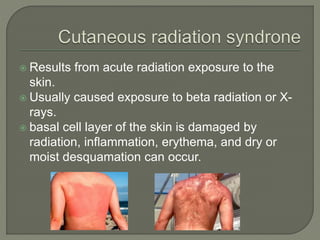
 Results from acute radiation exposure to the
skin.
 Usually caused exposure to beta radiation or X-
rays.
 basal cell layer of the skin is damaged by
radiation, inflammation, erythema, and dry or
moist desquamation can occur.
large skin doses can cause
 permanent hair loss,
 damaged sebaceous and sweat glands,
 atrophy, fibrosis, ulceration or necrosis of the
exposed tissue.
MANAGEMENT
 Secure ABCs and physiologic monitoring (blood
pressure, blood gases, electrolyte and urine
output) as appropriate.
 Treat major trauma, burns, and respiratory injury.
 Evacuation of the patient from the site.
 Blood samples required for CBC (complete blood
with attention to lymphocyte count, and HLA
(human leukocyte antigen)
 Treat contamination as needed.
 Intial management consist of primary triage and
transportation,
 Triage determines the severity of injury and level
of emergency care needed.
 Level of exposure can be determined by the
dosimeter
Decontamination
 Removal of patients clothes(reduces the
contamination by 80-90%)
 Washing of the body and hair untill no radiation
is detected.
 Wound decontamination should be
conservative,excison of the wounds should be
done only when surgically indicated.
 Protective gear should be given to the care
givers.
 Repeat CBC analysis with special attention to
the lymphocyte count every 2 to 3 hours for the
first 8 to 12 hours after exposure and every 4 to
6 hours for the following 2 or 3 days.
 If internal contamination is suspected urine and
stool samples should be obtained
Andrews Lymphocyte Nomogram-severity
• prevention and treatment of infections
• stimulation of hematopoiesis by use of growth
factors
• stem cell transfusions or platelet transfusions.
• psychological support
• confirmation of initial dose estimate using
chromosome aberration cytogenetic (best
method of dose assessment following acute
exposures.)
radionuclide treatment Mechanism of
action
adminstration
Iodine Pottasium iodide Blocks thyroid
uptake
130 milligrams po
for adults
Plutonium Ca DTPA or Zn
DTPA
Chelation 1 gram in 250 ml
NS or 5D over 60
min
Tritium water Dilution 3-4 litres of
water/day
Cesium Prussian blue Decrease GI
Uptake
1gm in 100 ml NS
3 times a day
Uranium Bicarbonate Alkanization of
urine
2 ampoules in 1l
NS at 125 ml/hr.
 only persons who are exposed to <8–10 Gy of
chance to survive.
 they are at risk of developing cataracts, sterility,
and cancers as well as lung, kidney, and bone
marrow problems.
 secondary malignancy in populations that have
been exposed are Leukemia and breast, brain,
thyroid.
 Follows after the mild radiation syndrome or
or repeated small radiation doses.
main symptoms of CRS are:
 Skin atrophy, fibrous formation of the skin after
previous burns and eye cataract.
 Usually caused by alpha and beta radiation
 Sunlight is the main source of uv rays.
 3 types-UVA ,UVB and UVC.
 UVB rays are associated with high risk of
causing skin cancer.
Eye manifestation
Harrison principles of internal medicine.
Hellenic Journal of Nuclear Medicine
Radiation emergencies-centre of disease
control
Radiation sickness

Radiation sickness

  • 1.
    Chair person-Dr RamS kaulgud Student-Dr Darshan M
  • 2.
     Atomic isotopeswith uneven numbers of protons and neutrons are typically unstable; such isotopes discharge particles or energy to matter as they move to stability, a process that is defined as radiation
  • 3.
     Alpha particles-consistsof heavily positive charged particles each contains 2 protons and 2 neutrons  Less penetrable,usually does not pentrate beyond skin.  Low risk from exposure. e.g Uranium and Plutonium
  • 4.
    Beta rays  Small,lightnegatively charged particles.  Can pentrate few millimeters of skin causing ulceration and scaring.  Can be stopped by clothes and plastic.  E.g radioactive iodine
  • 5.
    Gamma and x-rays. Uncharged electromagnetic radiation discharged from nucleus as wave of energy.  Highly penetrable cause tissue and organ damage if exposed Neutron particles  Uncharged and heavy are often emitted during nuclear detonation,highly pentrable.
  • 6.
    Ionization OF DNA INDIRECT By formation offree radicals DIRECT Directly damages DNA Cause cell death,mutation,incresed sensitization due to increased replication and decreased cell diffrentiation.
  • 7.
    Internal contamination  Occursthrough inhalation or ingestion or through wounds.  The respiratory system is the main portal of entry for internal contamination  Causes pneumonitis and scarring.  Lung is the organ at the greatest risk.
  • 8.
    External contamination That landon the body surface, clothing, skin, and hair. This is the dominant element to consider in the mass-casualty situation resulting from a radioactive terrorist strike.  The common contaminants primarily emit alpha and beta radiation.
  • 9.
    Localized contamination.  closecontact between a highly radioactive source and a part of the body, with consequent discrete damage to the skin and deeper tissues that resembles a thermal burn.  Later signs include epilation, erythema, moist desquamation, ulceration, blistering,and necrosis in proportion to exposure.
  • 10.
     The tissueswhich are more affected are skin,gastrointestinal tract,bone marrow,adipose tissues,thyroid kidney and liver.  Usually cells with high mitotic activity are more affected.
  • 11.
     Acute RadiationSyndrome (ARS) is an acute illness caused by irradiation of the entire body by a high dose of penetrating radiation in a very short period of time).  The major cause of this syndrome is depletion of immature parenchymal stem cells in specific tissues.
  • 12.
    The required conditionsfor Acute Radiation Syndrome (ARS) are:  The radiation dose must be large (i.egreater than 0.7 Gray (Gy).  The dose usually must be external (i.e., the source of radiation is outside of the patient’s body).  The radiation must be penetrating i.e., able to reach the internal organs  The entire body (or a significant portion of it) must have received the dose.  The dose must have been delivered in a short time.
  • 13.
    The three classicARS Syndromes are  Bone marrow syndrome : the full syndrome will usually occur with a dose greater than approximately 0.7  The survival rate of patients with this syndrome decreases with increasing dose. The primary cause of death is the destruction of the bone marrow, resulting in infection and hemorrhage.
  • 14.
     Gastrointestinal (GI)syndrome: the full syndrome will usually occur with a dose greater than approximately 10 Gy (1000 rads)  Survival is extremely unlikely with this syndrome Destructive and irreparable changes in the GI tract and bone marrow usually cause infection, dehydration, and electrolyte imbalance.  Death usually occurs within 2 weeks.
  • 15.
     Cardiovascular (CV)/Central Nervous System (CNS) syndrome: the full syndrome will usually occur with a dose greater than approximately 50 Gy  Death occurs within 3 days.  Death likely is due to collapse of the circulatory system as well as increased pressure in the confining cranial vault as the result of increased fluid content caused by edema, vasculitis, and meningitis
  • 16.
    The four stagesof ARS are: • Prodromal stage : The classic symptoms for this stage are nausea, vomiting, anorexia and possibly diarrhea, which occur from minutes to days following exposure. The symptoms may for minutes up to several days. • Latent stage: In this stage, the patient looks and feels generally healthy for a few hours or even up to a few weeks.
  • 17.
    • Clinical stage:In this stage, the symptoms depend on the specific syndrome and last from hours up to several months. • Recovery or death: Most patients who do not recover will die within several months of exposure. The recovery process lasts from several weeks up to two years.
  • 19.
     Results fromacute radiation exposure to the skin.  Usually caused exposure to beta radiation or X- rays.  basal cell layer of the skin is damaged by radiation, inflammation, erythema, and dry or moist desquamation can occur.
  • 20.
    large skin dosescan cause  permanent hair loss,  damaged sebaceous and sweat glands,  atrophy, fibrosis, ulceration or necrosis of the exposed tissue.
  • 21.
  • 22.
     Secure ABCsand physiologic monitoring (blood pressure, blood gases, electrolyte and urine output) as appropriate.  Treat major trauma, burns, and respiratory injury.  Evacuation of the patient from the site.  Blood samples required for CBC (complete blood with attention to lymphocyte count, and HLA (human leukocyte antigen)  Treat contamination as needed.
  • 23.
     Intial managementconsist of primary triage and transportation,  Triage determines the severity of injury and level of emergency care needed.  Level of exposure can be determined by the dosimeter
  • 24.
    Decontamination  Removal ofpatients clothes(reduces the contamination by 80-90%)  Washing of the body and hair untill no radiation is detected.  Wound decontamination should be conservative,excison of the wounds should be done only when surgically indicated.  Protective gear should be given to the care givers.
  • 26.
     Repeat CBCanalysis with special attention to the lymphocyte count every 2 to 3 hours for the first 8 to 12 hours after exposure and every 4 to 6 hours for the following 2 or 3 days.  If internal contamination is suspected urine and stool samples should be obtained
  • 28.
  • 29.
    • prevention andtreatment of infections • stimulation of hematopoiesis by use of growth factors • stem cell transfusions or platelet transfusions. • psychological support • confirmation of initial dose estimate using chromosome aberration cytogenetic (best method of dose assessment following acute exposures.)
  • 31.
    radionuclide treatment Mechanismof action adminstration Iodine Pottasium iodide Blocks thyroid uptake 130 milligrams po for adults Plutonium Ca DTPA or Zn DTPA Chelation 1 gram in 250 ml NS or 5D over 60 min Tritium water Dilution 3-4 litres of water/day Cesium Prussian blue Decrease GI Uptake 1gm in 100 ml NS 3 times a day Uranium Bicarbonate Alkanization of urine 2 ampoules in 1l NS at 125 ml/hr.
  • 32.
     only personswho are exposed to <8–10 Gy of chance to survive.  they are at risk of developing cataracts, sterility, and cancers as well as lung, kidney, and bone marrow problems.  secondary malignancy in populations that have been exposed are Leukemia and breast, brain, thyroid.
  • 33.
     Follows afterthe mild radiation syndrome or or repeated small radiation doses. main symptoms of CRS are:  Skin atrophy, fibrous formation of the skin after previous burns and eye cataract.  Usually caused by alpha and beta radiation
  • 34.
     Sunlight isthe main source of uv rays.  3 types-UVA ,UVB and UVC.  UVB rays are associated with high risk of causing skin cancer.
  • 37.
  • 38.
    Harrison principles ofinternal medicine. Hellenic Journal of Nuclear Medicine Radiation emergencies-centre of disease control