Explanatory Evaluation:
 how to better understand effects
         of interventions

                   Henk Sligte
   Kohnstamm Institute for Educational Research
             University of Amsterdam
               Henk.Sligte@UvA.NL
http://kohnstamminstituut.uva.nl/htm/english.htm
Research for
              Dutch Ministry of Education
                   • Report (in Dutch)
                   • Pater, C., Sligte, H., van Eck, E
                     (2012). Verklarende evaluatie,
                     een methodiek. Amsterdam:
                     Kohnstamm Instituut
                   • Explanatory Evaluation, a
                     methodology for policy
                     evaluation

http://www.kohnstamminstituut.uva.nl/rapporten/pdf/ki882.pdf
Evaluation

• Evidence based policy (and practice): effect
  (impact) evaluation  what works?
• Dutch Ministry: we need explanations for
  effects we need a methodology to
  complement impact evaluation
• The other side of the medal: explanatory
  evaluation what works for whom in what
  circumstances? How and why does the
  policy work (or not)? Finer granularity is
  needed
• In future: both types to be applied
Tentative question
     here and now:
     If the research
    method works in
 explaining effects of
 policy interventions,
 can it then also work
      in explaining
   interventions and
     innovations in
education, in schools?
Effect (Impact) evaluation

• Through (quasi)experiments demonstration of
  causal relation between intervention and
  found effects
  – Experiment: Controlled Randomized Trials
  – Quasi: natural experiment
  – Difference-in-difference: compare with business as
    usual (the whole population minus the
    experimental)
  Pretest-posttest model
  Compare the experimental groups with similar
    control or reference groups
  Effects can exclusively be ascribed to intervention
BUT:

• The rationale (the why) for these effects
  remains unknown: black box
• Explanatory evaluation focuses specifically
  on this and can further validate the results
  of an impact assessment (effect evaluation)
• Questions addressed:
  – How and why does an intervention work?
  – If there is no or a smaller effect than expected,
    why is that the case?
  – Which unwanted / unintended effects occur (also
    unexpected positive)?
The development of
                        the methodology
• Literature study, especially Pawson, R. &
  Tilley, N. (1997). Realistic Evaluation.
  London: SAGE Publications
• Study of two Dutch policy interventions in
  the area of early school leaving
  – VM2: prevent drop-out
  – De Wijkschool: stimulate drop-outs because of
    multiple problems (drugs, criminality, debts,
    broken families, etc) to go back to school
Effects of VM2

• VM2
  – School drop-out in first year vocational
    education enormous
  – Intervention: combine systems of preparatory
    and regular vocational education
  – Effects: compare experimental group with
    population as a whole on numbers of dropouts
  – Conclusion: less dropout… “in xx percentpoint
    of the cases a significant lower rate of dropouts
    was the result”…
  – How to find more differential effects and how to
    understand them better?
Explanatory evaluation (EE)

• Realistic Evaluation: get under the surface of the
  direct observable...
• What works for whom in what circumstances and
  how and why?
• Ex ante (before), ex durante (during), ex post (after)
• Central to answering this question is the
  reconstruction of the policy (or program) theory
• The policy theory is the sum of assumptions or
  hypotheses that explain how the policy should work
  These can be represented in statements like:
• If (intervention) ... Then ... (Outcome), and in some
  cases also conditions But (take care that…)
EE: contexts differ

• In the reconstruction of the theory, it is important to
  have an eye for the conditions and factors that play a
  role in a variety of contexts.
• The context (or conditions) can be physical, but also
  social, for example, certain groups or characteristics
  of target groups (an intervention works only for
  motivated students).
• Attention to circumstances helps explain why an
  intervention works better in one case than in the other
  case.
• The intervention works through certain mechanisms,
  mechanisms that make "things work" and can be seen
  as the driving force behind an intervention.
EE
• Analysis of policy documents
• Creation of concrete causal generative schemes
  (=hypotheses) on the basis of this analysis
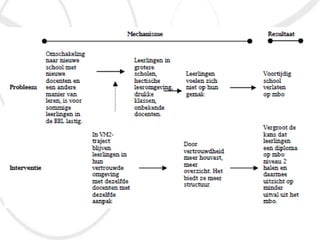
• Context-Mechanism-Outcome (CMO) schemes
   – Problem mechanisms, leading to unwanted outcomes or
     results in (parts of the) society
   – Intervention that generates Change Mechanism(s)
   – Change mechanisms overcome problem mechanisms
   – Better outcomes
• Check with staff members (at Ministry) that were
  responsible for policy intervention
• Adjust CMO-schemes, make new CMO-schemes
EE: field studies

• Test the theory, test the hypotheses (CMO)
• Enter the field studies. The researcher must
  have the different groups of actors in the
  picture.
• Consider what information to whom can be
  achieved, what should be asked from whom:
  who knows what?
• Formulate relevant questions for each (type
  of) informant to answer and think about the
  most appropriate method for each type
  involved persons.
Field studies

• Reconstruction and comparison with the
  policy theory takes place in a learning
  dialogue at different levels.
• Types (levels) of respondents:
  – Policy implementers (e.g. project leaders)
  – Intermediaries (e.g. teachers)
  – Target group (e.g. students, elderly, etc)
• Researchers: open attitude but focus on
  understanding and consensual knowledge
  (do we agree that this is what really
  happened?)
EE: Field studies

• Each actor from his own role in the
  operation of the policy can reflect on
  assumed mechanisms and give an
  explanation of (un) planned and (un)
  desired effects.
• Question to the dialogue partners is
  – whether the assumptions indeed work for them
  – are assumptions about their behaviour correct,
  – what side effects they face.
• Cyclical process: stop rules...
EE: Critical evaluation

• Here the explanations are found why the
  policy intervention has or has not the desired
  effects, the goal of an explanatory evaluation.
• If the effects of an intervention are not as
  positive as expected, the researcher may ask
  the following questions:
  –   Is the theory or policy measure(s) plausible?
  –   Was the theory sufficiently differentiated?
  –   Was implementation successful?
  –   Were necessary conditions met?
  –   What should be modified?
• Learning effects for policy makers…
Can EE work for educational
        practice?
R&D in education

• Development  interventions/innovations
• Do you measure effects (outcomes) and
  how? Pre-test/post-test?
• Compare with reference/control groups?
• What do you measure?
  – Knowledge, skills, attitudes, higher order skills
    (reflection, learn to learn, learn to see activities
    as learning), motivation? Other, new things?
• Find out what works: outcomes, effects
• Find out what works for whom in what
  contexts and why
Explanatory evaluation

• What is the theory behind the Development?
• Reconstruct the assumptions (ifthen/CMO)
• Distinguish assumptions at levels:
  – The ideas, the theories
  – The structures and systems developed and used
  – The anticipated effects on various groups of actors
• Do field research
• Evaluate whether your assumptions are shared
  with various actors at different levels: test the
  hypotheses
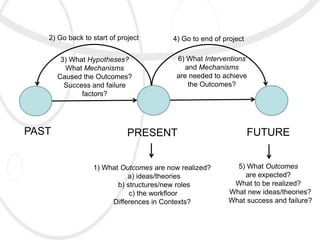
Generic interview scheme
•   THEN – NOW – LATER
•   Contexts-Mechanisms-Outcomes
•   Start with NOW
•   What Outcomes realised? Differentiate (level
    of ideas-theories, structures-systems,
    behaviour)
•   THEN: What Hypotheses? What Processes
    (mechanisms) caused the Outcomes?
•   What crucial success & failure factors?
•   LATER: what new/adjusted outcomes?
•   How to achieve the outcomes?
2) Go back to start of project       4) Go to end of project

        3) What Hypotheses?              6) What Interventions
         What Mechanisms                    and Mechanisms
       Caused the Outcomes?              are needed to achieve
         Success and failure                 the Outcomes?
              factors?


PAST                         PRESENT                              FUTURE


                 1) What Outcomes are now realized?        5) What Outcomes
                           a) ideas/theories                 are expected?
                        b) structures/new roles           What to be realized?
                            c) the workfloor             What new ideas/theories?
                      Differences in Contexts?           What success and failure?
????

 ??

EAPRIL explanatory evaluation

  • 1.
    Explanatory Evaluation: howto better understand effects of interventions Henk Sligte Kohnstamm Institute for Educational Research University of Amsterdam Henk.Sligte@UvA.NL http://kohnstamminstituut.uva.nl/htm/english.htm
  • 2.
    Research for Dutch Ministry of Education • Report (in Dutch) • Pater, C., Sligte, H., van Eck, E (2012). Verklarende evaluatie, een methodiek. Amsterdam: Kohnstamm Instituut • Explanatory Evaluation, a methodology for policy evaluation http://www.kohnstamminstituut.uva.nl/rapporten/pdf/ki882.pdf
  • 3.
    Evaluation • Evidence basedpolicy (and practice): effect (impact) evaluation  what works? • Dutch Ministry: we need explanations for effects we need a methodology to complement impact evaluation • The other side of the medal: explanatory evaluation what works for whom in what circumstances? How and why does the policy work (or not)? Finer granularity is needed • In future: both types to be applied
  • 4.
    Tentative question here and now: If the research method works in explaining effects of policy interventions, can it then also work in explaining interventions and innovations in education, in schools?
  • 5.
    Effect (Impact) evaluation •Through (quasi)experiments demonstration of causal relation between intervention and found effects – Experiment: Controlled Randomized Trials – Quasi: natural experiment – Difference-in-difference: compare with business as usual (the whole population minus the experimental) Pretest-posttest model Compare the experimental groups with similar control or reference groups Effects can exclusively be ascribed to intervention
  • 6.
    BUT: • The rationale(the why) for these effects remains unknown: black box • Explanatory evaluation focuses specifically on this and can further validate the results of an impact assessment (effect evaluation) • Questions addressed: – How and why does an intervention work? – If there is no or a smaller effect than expected, why is that the case? – Which unwanted / unintended effects occur (also unexpected positive)?
  • 7.
    The development of the methodology • Literature study, especially Pawson, R. & Tilley, N. (1997). Realistic Evaluation. London: SAGE Publications • Study of two Dutch policy interventions in the area of early school leaving – VM2: prevent drop-out – De Wijkschool: stimulate drop-outs because of multiple problems (drugs, criminality, debts, broken families, etc) to go back to school
  • 8.
    Effects of VM2 •VM2 – School drop-out in first year vocational education enormous – Intervention: combine systems of preparatory and regular vocational education – Effects: compare experimental group with population as a whole on numbers of dropouts – Conclusion: less dropout… “in xx percentpoint of the cases a significant lower rate of dropouts was the result”… – How to find more differential effects and how to understand them better?
  • 9.
    Explanatory evaluation (EE) •Realistic Evaluation: get under the surface of the direct observable... • What works for whom in what circumstances and how and why? • Ex ante (before), ex durante (during), ex post (after) • Central to answering this question is the reconstruction of the policy (or program) theory • The policy theory is the sum of assumptions or hypotheses that explain how the policy should work These can be represented in statements like: • If (intervention) ... Then ... (Outcome), and in some cases also conditions But (take care that…)
  • 10.
    EE: contexts differ •In the reconstruction of the theory, it is important to have an eye for the conditions and factors that play a role in a variety of contexts. • The context (or conditions) can be physical, but also social, for example, certain groups or characteristics of target groups (an intervention works only for motivated students). • Attention to circumstances helps explain why an intervention works better in one case than in the other case. • The intervention works through certain mechanisms, mechanisms that make "things work" and can be seen as the driving force behind an intervention.
  • 11.
    EE • Analysis ofpolicy documents • Creation of concrete causal generative schemes (=hypotheses) on the basis of this analysis • Context-Mechanism-Outcome (CMO) schemes – Problem mechanisms, leading to unwanted outcomes or results in (parts of the) society – Intervention that generates Change Mechanism(s) – Change mechanisms overcome problem mechanisms – Better outcomes • Check with staff members (at Ministry) that were responsible for policy intervention • Adjust CMO-schemes, make new CMO-schemes
  • 13.
    EE: field studies •Test the theory, test the hypotheses (CMO) • Enter the field studies. The researcher must have the different groups of actors in the picture. • Consider what information to whom can be achieved, what should be asked from whom: who knows what? • Formulate relevant questions for each (type of) informant to answer and think about the most appropriate method for each type involved persons.
  • 14.
    Field studies • Reconstructionand comparison with the policy theory takes place in a learning dialogue at different levels. • Types (levels) of respondents: – Policy implementers (e.g. project leaders) – Intermediaries (e.g. teachers) – Target group (e.g. students, elderly, etc) • Researchers: open attitude but focus on understanding and consensual knowledge (do we agree that this is what really happened?)
  • 15.
    EE: Field studies •Each actor from his own role in the operation of the policy can reflect on assumed mechanisms and give an explanation of (un) planned and (un) desired effects. • Question to the dialogue partners is – whether the assumptions indeed work for them – are assumptions about their behaviour correct, – what side effects they face. • Cyclical process: stop rules...
  • 16.
    EE: Critical evaluation •Here the explanations are found why the policy intervention has or has not the desired effects, the goal of an explanatory evaluation. • If the effects of an intervention are not as positive as expected, the researcher may ask the following questions: – Is the theory or policy measure(s) plausible? – Was the theory sufficiently differentiated? – Was implementation successful? – Were necessary conditions met? – What should be modified? • Learning effects for policy makers…
  • 17.
    Can EE workfor educational practice?
  • 18.
    R&D in education •Development  interventions/innovations • Do you measure effects (outcomes) and how? Pre-test/post-test? • Compare with reference/control groups? • What do you measure? – Knowledge, skills, attitudes, higher order skills (reflection, learn to learn, learn to see activities as learning), motivation? Other, new things? • Find out what works: outcomes, effects • Find out what works for whom in what contexts and why
  • 19.
    Explanatory evaluation • Whatis the theory behind the Development? • Reconstruct the assumptions (ifthen/CMO) • Distinguish assumptions at levels: – The ideas, the theories – The structures and systems developed and used – The anticipated effects on various groups of actors • Do field research • Evaluate whether your assumptions are shared with various actors at different levels: test the hypotheses
  • 20.
    Generic interview scheme • THEN – NOW – LATER • Contexts-Mechanisms-Outcomes • Start with NOW • What Outcomes realised? Differentiate (level of ideas-theories, structures-systems, behaviour) • THEN: What Hypotheses? What Processes (mechanisms) caused the Outcomes? • What crucial success & failure factors? • LATER: what new/adjusted outcomes? • How to achieve the outcomes?
  • 21.
    2) Go backto start of project 4) Go to end of project 3) What Hypotheses? 6) What Interventions What Mechanisms and Mechanisms Caused the Outcomes? are needed to achieve Success and failure the Outcomes? factors? PAST PRESENT FUTURE 1) What Outcomes are now realized? 5) What Outcomes a) ideas/theories are expected? b) structures/new roles What to be realized? c) the workfloor What new ideas/theories? Differences in Contexts? What success and failure?
  • 22.