
CHAPTER III
Policy Objectives
Members:
• Michelle López
• María Fernanda Mena
3.1. Educational policy aspects
ASPECTS:
 Policy dialogue → consultations between
stakeholders involved in the formulation and
implementation of the sector policy
 Policy aspects to be addressed → Important to clarify
the difference between the different levels of
objectives and the policy statements.
 Overall objective (“Goal”): final aim of a project.
 Specific objective (“Purpose”): objective which the plan
is designed to achieve, it should help the achieve the
overall objective.
 Policy: set of the goal and purposes. Defined by three
dimensions: access, quality, management.
• Education sector policies represent the
government’s commitment to the its future and
help to guide decisions in the educational
development.
• It should support the development of
programmes and projects.
• Necessary to promote the implementation of
action plans, programmes and projects.
3.1.2. Policy aspects to be addressed
List of fields in educational policy:
 Access and participation in education
 Equity
 Quality and relevance in education at different levels
 Place in which are the private sectors and local groups, in the
educational organization
 Institutional aspects
 Partnership
 Cost control
 Policy and strategies
 Regulation of students:
 Formal and non-formal education
 Public and private education
 General secondary, technical and profesional education
 Elementary, secondary and higher education
The three dimensions are addressed:
• As a whole, by programme component
• With target indicators by time-range
3.2. Formulation of policy objectives through the LFA
 This section describes how one can use the techniques of the Logical Framework
Approach (LFA) to analyze and formulate education policy objectives and alternative
strategies.
LFA: Logical Framework Approach: Is an analytical process and set of tools used to
support objectives-oriented project planning and management. It provides a set of
interlocking concepts which are used as part of an iterative process to aid structured and
systematic analysis of a project or programme idea.
3.2.1. Definitions and underlying principles of Logframe
 The Goal (Overall objective) Is a long-term objective. It is the aim toward which a plan or project is
directed. This plans or projects contribute towards a goal and, conversely, a goal is rarely achievable by
means of any one plan or project.
 The Purpose (policy target or specific objective) Is the objective which the plan or project is designed to
achieve. These are the benefits which the plan or project seeks to bring about as a result of the
outputs.
 The Outputs are the tangible products for achieving the purpose. They are the ‘deliverables’ for which
specific institutions are responsible; this outputs must be measurable and must be delivered on time.
 The Activities (actions) are the necessary actions for achieving an output. There can be one or several
activities in order to achieve each output.
 The Assumptions are the external factors which relate to the relationship between different
levels of the cause and effect chain. The more important and more risky the assumption, the
greater the need to consider: (i) redesigning the project; (ii) seeking to reduce the risk by
internalizing the problem; and (iii) preparing a contingency plan in case the worst happens.
 Indicators should be measurable. ‘Measurable’ means that there is an unambiguous
definition (quality) and specific quantities and timings, in other words Quantity, Quality and
Time (QQT).
Activity-level indicators: Activity level indicators: are
usually the actual inputs and budgets required to
implement.
Output-level indicators: Outputs are completed
achievements.
Purpose-level indicators: These are the indicators of
change/benefits (outcome) at the level of the target
population.
Goal-level indicators: These are rarely defined or
collected by an individual plan or project.
3.2.2. Analysis of Objectives
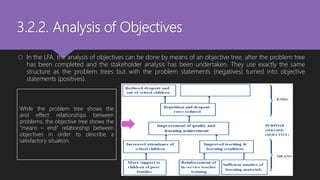
 In the LFA, the analysis of objectives can be done by means of an objective tree, after the problem tree
has been completed and the stakeholder analysis has been undertaken. They use exactly the same
structure as the problem trees but with the problem statements (negatives) turned into objective
statements (positives).
While the problem tree shows the
and effect relationships between
problems, the objective tree shows the
“means – end” relationship between
objectives in order to describe a
satisfactory situation.
The problems identified as causes in the problem tree and turned into positive statements will become means in
the objective tree. The first layer of problems that was the root causes becomes the first layer of means in the
objective tree. These means are the activities to be carried out in order to achieve the second layer of means
(outputs).
3.2.3. Analysis of alternative strategies
 Activities are developed to deliver outputs that pretend to achieve the objectives.
 Questions that might need to be asked:
 Are all the identified problems addressed?
 What is the combination of actions that are most likely to bring about the desired outputs?
 What are the likely cost implications of different possible activities, and what can be realistically afforded?
 Which strategy will most effectively support institutional capacity building?
 How can risks be best mitigated?
3.2.3. Analysis of alternative strategies
 Criteria to make a broad assessment of different options and alternatives:
 benefits to target groups
 cost implications
 technical, financial and economic feasibility
 political feasibility
 contribution to institutional capacity building
 sustainability
 compatibility of the plan with other sector or development priorities.
Reference:
 Gwang-Chol Chang, “National Education Sector- Development Plan”, Section for Education
Support Strategies, Division for Education Strategies and Capacity Building, UNESCO.

Education policy aspects

  • 1.
    CHAPTER III Policy Objectives Members: •Michelle López • María Fernanda Mena
  • 2.
    3.1. Educational policyaspects ASPECTS:  Policy dialogue → consultations between stakeholders involved in the formulation and implementation of the sector policy  Policy aspects to be addressed → Important to clarify the difference between the different levels of objectives and the policy statements.  Overall objective (“Goal”): final aim of a project.  Specific objective (“Purpose”): objective which the plan is designed to achieve, it should help the achieve the overall objective.  Policy: set of the goal and purposes. Defined by three dimensions: access, quality, management. • Education sector policies represent the government’s commitment to the its future and help to guide decisions in the educational development. • It should support the development of programmes and projects. • Necessary to promote the implementation of action plans, programmes and projects.
  • 3.
    3.1.2. Policy aspectsto be addressed List of fields in educational policy:  Access and participation in education  Equity  Quality and relevance in education at different levels  Place in which are the private sectors and local groups, in the educational organization  Institutional aspects  Partnership  Cost control  Policy and strategies  Regulation of students:  Formal and non-formal education  Public and private education  General secondary, technical and profesional education  Elementary, secondary and higher education The three dimensions are addressed: • As a whole, by programme component • With target indicators by time-range
  • 4.
    3.2. Formulation ofpolicy objectives through the LFA  This section describes how one can use the techniques of the Logical Framework Approach (LFA) to analyze and formulate education policy objectives and alternative strategies. LFA: Logical Framework Approach: Is an analytical process and set of tools used to support objectives-oriented project planning and management. It provides a set of interlocking concepts which are used as part of an iterative process to aid structured and systematic analysis of a project or programme idea.
  • 5.
    3.2.1. Definitions andunderlying principles of Logframe  The Goal (Overall objective) Is a long-term objective. It is the aim toward which a plan or project is directed. This plans or projects contribute towards a goal and, conversely, a goal is rarely achievable by means of any one plan or project.  The Purpose (policy target or specific objective) Is the objective which the plan or project is designed to achieve. These are the benefits which the plan or project seeks to bring about as a result of the outputs.  The Outputs are the tangible products for achieving the purpose. They are the ‘deliverables’ for which specific institutions are responsible; this outputs must be measurable and must be delivered on time.  The Activities (actions) are the necessary actions for achieving an output. There can be one or several activities in order to achieve each output.
  • 6.
     The Assumptionsare the external factors which relate to the relationship between different levels of the cause and effect chain. The more important and more risky the assumption, the greater the need to consider: (i) redesigning the project; (ii) seeking to reduce the risk by internalizing the problem; and (iii) preparing a contingency plan in case the worst happens.  Indicators should be measurable. ‘Measurable’ means that there is an unambiguous definition (quality) and specific quantities and timings, in other words Quantity, Quality and Time (QQT). Activity-level indicators: Activity level indicators: are usually the actual inputs and budgets required to implement. Output-level indicators: Outputs are completed achievements. Purpose-level indicators: These are the indicators of change/benefits (outcome) at the level of the target population. Goal-level indicators: These are rarely defined or collected by an individual plan or project.
  • 7.
    3.2.2. Analysis ofObjectives  In the LFA, the analysis of objectives can be done by means of an objective tree, after the problem tree has been completed and the stakeholder analysis has been undertaken. They use exactly the same structure as the problem trees but with the problem statements (negatives) turned into objective statements (positives). While the problem tree shows the and effect relationships between problems, the objective tree shows the “means – end” relationship between objectives in order to describe a satisfactory situation.
  • 8.
    The problems identifiedas causes in the problem tree and turned into positive statements will become means in the objective tree. The first layer of problems that was the root causes becomes the first layer of means in the objective tree. These means are the activities to be carried out in order to achieve the second layer of means (outputs).
  • 9.
    3.2.3. Analysis ofalternative strategies  Activities are developed to deliver outputs that pretend to achieve the objectives.  Questions that might need to be asked:  Are all the identified problems addressed?  What is the combination of actions that are most likely to bring about the desired outputs?  What are the likely cost implications of different possible activities, and what can be realistically afforded?  Which strategy will most effectively support institutional capacity building?  How can risks be best mitigated?
  • 10.
    3.2.3. Analysis ofalternative strategies  Criteria to make a broad assessment of different options and alternatives:  benefits to target groups  cost implications  technical, financial and economic feasibility  political feasibility  contribution to institutional capacity building  sustainability  compatibility of the plan with other sector or development priorities.
  • 11.
    Reference:  Gwang-Chol Chang,“National Education Sector- Development Plan”, Section for Education Support Strategies, Division for Education Strategies and Capacity Building, UNESCO.