But are we making a difference? We might be busy? LOGIC Models and Education
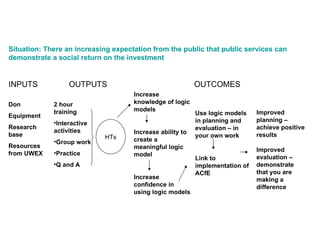
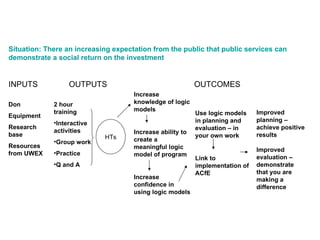
Don Equipment Research base Resources from UWEX Situation: There an increasing expectation from the public that public services can demonstrate a social return on the investment 2 hour training Interactive activities Group work Practice Q and A Increase knowledge of logic models Increase ability to create a meaningful logic model  Increase confidence in using logic models Use logic models in planning and evaluation – in your own work  Link to implementation of ACfE Improved planning –achieve positive results Improved evaluation – demonstrate that you are making a difference INPUTS OUTPUTS OUTCOMES HTs
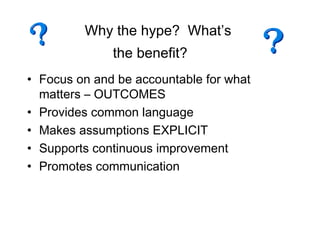
Why the hype?  What’s  the benefit?   Focus on and be accountable for what matters – OUTCOMES Provides common language Makes assumptions EXPLICIT Supports continuous improvement  Promotes communication
What does a logic model look like?   Graphic display of boxes and arrows; vertical or horizontal Relationships, linkages Any shape possible Circular, dynamic Cultural adaptations; storyboards Level of detail simple complex Multiple models
Assumptions Assumptions underlie much of what we do.  It is often these underlying assumptions that hinder success or produce less-than-expected results.  One benefit of logic modelling is that it helps us make our assumptions explicit.
Teachers cannot be trusted with something as important as curriculum innovation. There should be a uniformity of opportunity and pupil experience in all schools. Development of the curriculum is essentially a “top down process”. The key to improvement is to ensure a proper flow of information down to teachers. Teachers need to be“told” what to do. The role of Local Authorities is to promote that flow of information and to ensure proper implementation by schools. The key unit of curriculum creation are national bodies and local authorities. School leaders have a responsibility to ensure that teachers implement the programme as planned. Professional Development is based upon a deficit model whereby teachers’ perceived  lack of knowledge is addressed by providing them with materials and “instructions” for implementation. There is a need to “teacher proof”  the system by ensuring that teachers cannot interfere with the contents or the delivery model. ASSUMPTIONS ABOUT IMPLEMENTATION (1)
ASSUMPTIONS ABOUT IMPLEMENTATION (2) Teachers are professionals who want to make a positive difference to children’s lives; Where teachers are empowered to work together they can create outstanding learning environments for children and young people; Teachers naturally want to talk and learn from each other about their practice; Teachers want to engage in dialogue about their own educational practice with a view to improving their craft. The school is the key unit of curricular creation and professional development. Schools should be encouraged to create curricular models which suit their own context School leaders can create environments where teachers want to learn. Teams of teachers working collectively towards a common purpose can have a more positive impact upon practice than any other strategy. Teachers are partners in the curriculum development process.
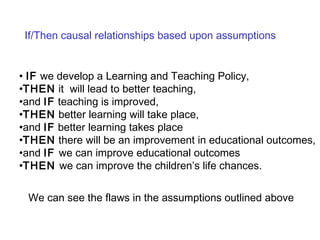
  IF  we develop a Learning and Teaching Policy,  THEN  it  will lead to better teaching,  and  IF  teaching is improved,  THEN  better learning will take place,  and  IF  better learning takes place  THEN  there will be an improvement in educational outcomes,  and  IF  we can improve educational outcomes  THEN  we can improve the children’s life chances.   If/Then causal relationships based upon assumptions We can see the flaws in the assumptions outlined above
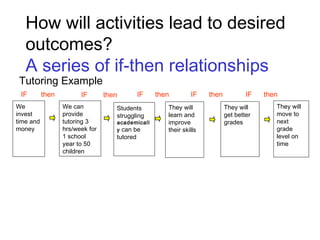
How will activities lead to desired outcomes?  A series of if-then relationships  We invest time and money Students struggling  academically   can be tutored They will learn and improve their skills They will get better grades They will move to next grade level on time IF  then IF  then IF  then IF  then We can provide tutoring 3 hrs/week for 1 school year to 50 children IF  then Tutoring Example
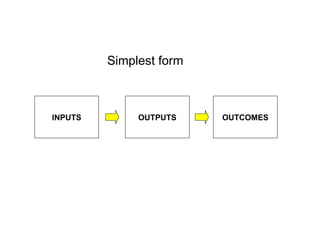
Simplest form INPUTS OUTPUTS OUTCOMES
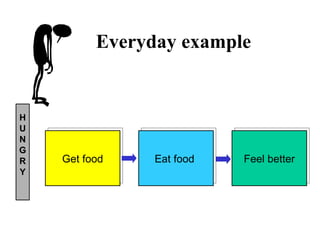
H U N G R Y Feel better Get   food Eat food  Everyday example
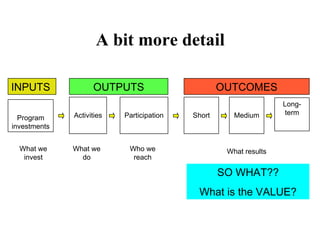
A bit more detail   INPUTS OUTPUTS OUTCOMES Program investments Activities Participation Short Medium What we invest What we do Who we reach What results SO WHAT?? What is the VALUE? Long-term
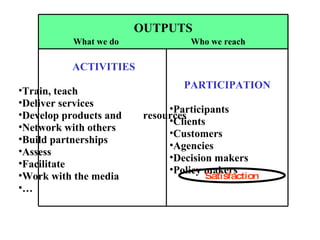
Satisfaction OUTPUTS What we do   Who we reach ACTIVITIES Train, teach Deliver services Develop products and  resources Network with others Build partnerships Assess Facilitate Work with the media … PARTICIPATION Participants Clients Customers Agencies Decision makers Policy makers
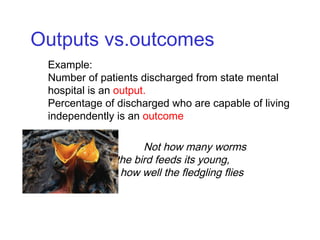
Outputs vs.outcomes   Example:  Number of patients discharged from state mental hospital is an  output.   Percentage of discharged who are capable of living independently is an  outcome Not how many worms  the bird feeds its young,  but how well the fledgling flies
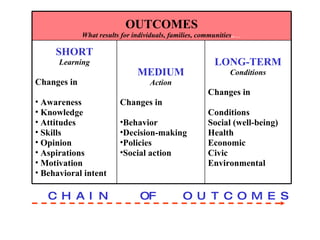
C H A I N  OF  O U T C O M E S  OUTCOMES What results for individuals, families, communities .. … SHORT Learning Changes in  Awareness Knowledge Attitudes Skills Opinion Aspirations Motivation Behavioral intent MEDIUM Action Changes in  Behavior  Decision-making Policies Social action LONG-TERM Conditions Changes in  Conditions Social (well-being) Health Economic Civic Environmental
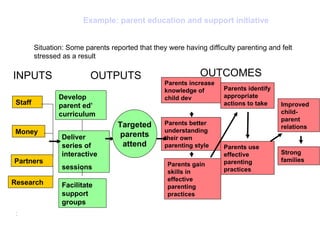
Staff Money Partners Develop parent ed’ curriculum Deliver series of  interactive sessions Parents increase knowledge of child dev Parents better understanding their own parenting style  Parents use effective parenting practices Improved child-parent relations Research INPUTS OUTPUTS OUTCOMES Facilitate support groups Parents gain skills in  effective parenting practices Example: parent education and support initiative Parents identify appropriate actions to take Strong families Targeted parents attend :   Situation: Some parents reported that they were having difficulty parenting and felt stressed as a result
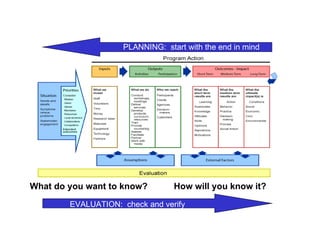
EVALUATION:  check and verify What do you want to know? How will you know it?  PLANNING:  start with the end in mind
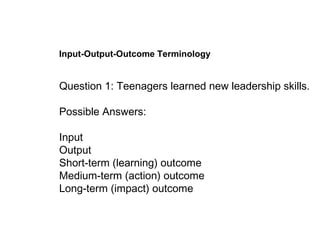
Input-Output-Outcome Terminology Question 1: Teenagers learned new leadership skills. Possible Answers:  Input  Output Short-term (learning) outcome   Medium-term (action) outcome  Long-term (impact) outcome
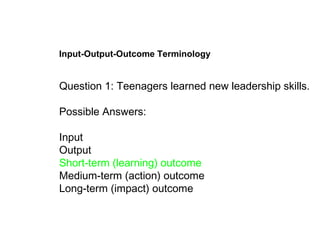
Input-Output-Outcome Terminology Question 1: Teenagers learned new leadership skills. Possible Answers:  Input  Output Short-term (learning) outcome  Medium-term (action) outcome  Long-term (impact) outcome
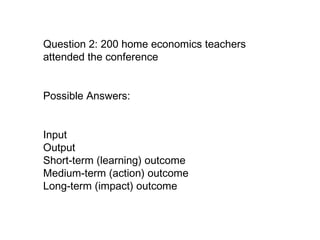
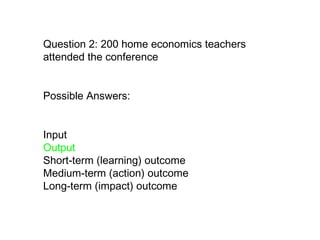
Question 2: 200 home economics teachers attended the conference Possible Answers:  Input  Output Short-term (learning) outcome  Medium-term (action) outcome  Long-term (impact) outcome
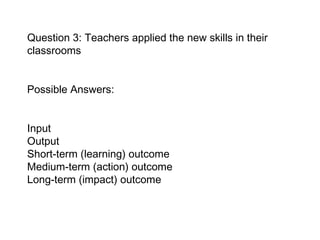
Question 3: Teachers applied the new skills in their classrooms Possible Answers:  Input  Output Short-term (learning) outcome  Medium-term (action) outcome  Long-term (impact) outcome
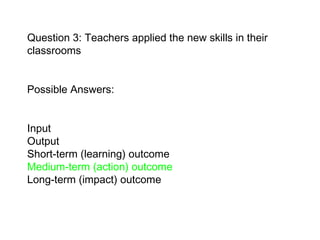
Question 3: Teachers applied the new skills in their classrooms Possible Answers:  Input  Output Short-term (learning) outcome  Medium-term (action) outcome   Long-term (impact) outcome
Question 4: Health, education and social work formed a partnership Possible Answers:  Input  Output Short-term (learning) outcome  Medium-term (action) outcome  Long-term (impact) outcome
Question 5: Headteachers who participated learned how to develop a logic model Possible Answers:  Input  Output Short-term (learning) outcome  Medium-term (action) outcome  Long-term (impact) outcome
Question 5: Headteachers who participated learned how to develop a logic model Possible Answers:  Input  Output Short-term (learning) outcome   Medium-term (action) outcome  Long-term (impact) outcome
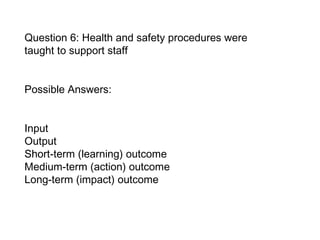
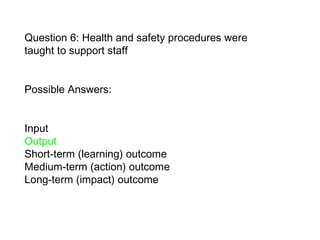
Question 6: Health and safety procedures were taught to support staff Possible Answers:  Input  Output Short-term (learning) outcome  Medium-term (action) outcome  Long-term (impact) outcome
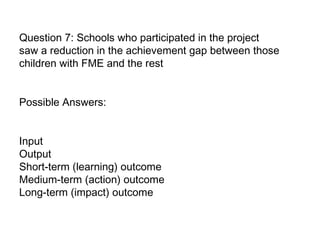
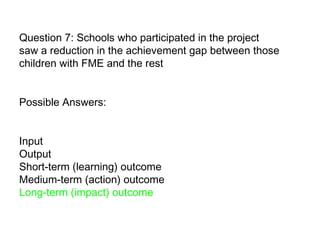
Question 7: Schools who participated in the project saw a reduction in the achievement gap between those children with FME and the rest Possible Answers:  Input  Output Short-term (learning) outcome  Medium-term (action) outcome  Long-term (impact) outcome
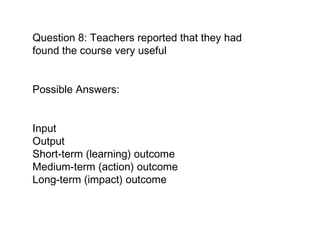
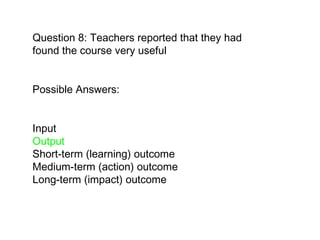
Question 8: Teachers reported that they had found the course very useful Possible Answers:  Input  Output Short-term (learning) outcome  Medium-term (action) outcome  Long-term (impact) outcome
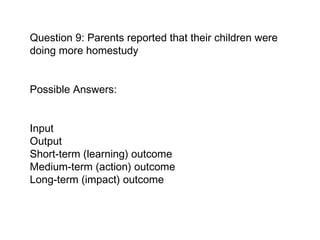
Question 9: Parents reported that their children were doing more homestudy  Possible Answers:  Input  Output Short-term (learning) outcome  Medium-term (action) outcome  Long-term (impact) outcome
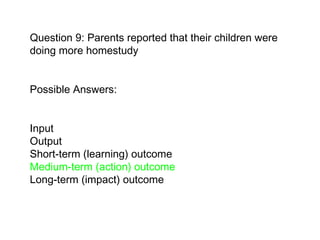
Question 9: Parents reported that their children were doing more homestudy  Possible Answers:  Input  Output Short-term (learning) outcome  Medium-term (action) outcome   Long-term (impact) outcome
Question 10: Newsletters are distributed in three languages Possible Answers:  Input  Output Short-term (learning) outcome  Medium-term (action) outcome  Long-term (impact) outcome
Logic Model…limitations Represents  reality, is not reality Focuses on  expected  outcomes Challenge of causal attribution Many factors influence process and outcomes Doesn’t address:  Are we doing the right thing?
Don Equipment Research base Resources from UWEX Situation: There an increasing expectation from the public that public services can demonstrate a social return on the investment 2 hour training Interactive activities Group work Practice Q and A Increase knowledge of logic models Increase ability to create a meaningful logic model of program  Increase confidence in using logic models Use logic models in planning and evaluation – in your own work  Link to implementation of ACfE Improved planning –achieve positive results Improved evaluation – demonstrate that you are making a difference INPUTS OUTPUTS OUTCOMES HTs
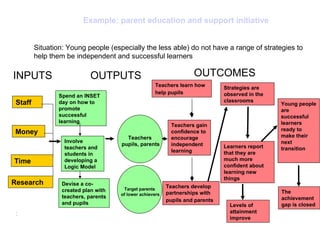
Staff Money Time Spend an INSET day on how to promote successful learning Involve teachers and students in developing a Logic Model Teachers learn how help pupils   Teachers gain confidence to encourage independent learning Learners report that they are much more confident about learning new things Young people are successful learners ready to make their next transition Research INPUTS OUTPUTS OUTCOMES Teachers develop partnerships with pupils and parents   Example: parent education and support initiative Strategies are observed in the classrooms The achievement gap is closed Target parents of lower achievers :   Situation: Young people (especially the less able) do not have a range of strategies to help them be independent and successful learners Devise a co-created plan with teachers, parents and pupils Levels of attainment improve Teachers pupils, parents
www. uwex . edu / ces / lmcourse

Logic Model and Education

  • 1.
    But are wemaking a difference? We might be busy? LOGIC Models and Education
  • 2.
    Don Equipment Researchbase Resources from UWEX Situation: There an increasing expectation from the public that public services can demonstrate a social return on the investment 2 hour training Interactive activities Group work Practice Q and A Increase knowledge of logic models Increase ability to create a meaningful logic model Increase confidence in using logic models Use logic models in planning and evaluation – in your own work Link to implementation of ACfE Improved planning –achieve positive results Improved evaluation – demonstrate that you are making a difference INPUTS OUTPUTS OUTCOMES HTs
  • 3.
    Why the hype? What’s the benefit? Focus on and be accountable for what matters – OUTCOMES Provides common language Makes assumptions EXPLICIT Supports continuous improvement Promotes communication
  • 4.
    What does alogic model look like? Graphic display of boxes and arrows; vertical or horizontal Relationships, linkages Any shape possible Circular, dynamic Cultural adaptations; storyboards Level of detail simple complex Multiple models
  • 5.
    Assumptions Assumptions underliemuch of what we do. It is often these underlying assumptions that hinder success or produce less-than-expected results. One benefit of logic modelling is that it helps us make our assumptions explicit.
  • 6.
    Teachers cannot betrusted with something as important as curriculum innovation. There should be a uniformity of opportunity and pupil experience in all schools. Development of the curriculum is essentially a “top down process”. The key to improvement is to ensure a proper flow of information down to teachers. Teachers need to be“told” what to do. The role of Local Authorities is to promote that flow of information and to ensure proper implementation by schools. The key unit of curriculum creation are national bodies and local authorities. School leaders have a responsibility to ensure that teachers implement the programme as planned. Professional Development is based upon a deficit model whereby teachers’ perceived  lack of knowledge is addressed by providing them with materials and “instructions” for implementation. There is a need to “teacher proof”  the system by ensuring that teachers cannot interfere with the contents or the delivery model. ASSUMPTIONS ABOUT IMPLEMENTATION (1)
  • 7.
    ASSUMPTIONS ABOUT IMPLEMENTATION(2) Teachers are professionals who want to make a positive difference to children’s lives; Where teachers are empowered to work together they can create outstanding learning environments for children and young people; Teachers naturally want to talk and learn from each other about their practice; Teachers want to engage in dialogue about their own educational practice with a view to improving their craft. The school is the key unit of curricular creation and professional development. Schools should be encouraged to create curricular models which suit their own context School leaders can create environments where teachers want to learn. Teams of teachers working collectively towards a common purpose can have a more positive impact upon practice than any other strategy. Teachers are partners in the curriculum development process.
  • 8.
      IF we develop a Learning and Teaching Policy, THEN it  will lead to better teaching, and IF teaching is improved, THEN  better learning will take place, and IF better learning takes place THEN there will be an improvement in educational outcomes, and IF we can improve educational outcomes THEN we can improve the children’s life chances. If/Then causal relationships based upon assumptions We can see the flaws in the assumptions outlined above
  • 9.
    How will activitieslead to desired outcomes? A series of if-then relationships We invest time and money Students struggling academically can be tutored They will learn and improve their skills They will get better grades They will move to next grade level on time IF then IF then IF then IF then We can provide tutoring 3 hrs/week for 1 school year to 50 children IF then Tutoring Example
  • 10.
    Simplest form INPUTSOUTPUTS OUTCOMES
  • 11.
    H U NG R Y Feel better Get food Eat food Everyday example
  • 12.
    A bit moredetail INPUTS OUTPUTS OUTCOMES Program investments Activities Participation Short Medium What we invest What we do Who we reach What results SO WHAT?? What is the VALUE? Long-term
  • 13.
    Satisfaction OUTPUTS Whatwe do Who we reach ACTIVITIES Train, teach Deliver services Develop products and resources Network with others Build partnerships Assess Facilitate Work with the media … PARTICIPATION Participants Clients Customers Agencies Decision makers Policy makers
  • 14.
    Outputs vs.outcomes Example: Number of patients discharged from state mental hospital is an output. Percentage of discharged who are capable of living independently is an outcome Not how many worms the bird feeds its young, but how well the fledgling flies
  • 15.
    C H AI N OF O U T C O M E S OUTCOMES What results for individuals, families, communities .. … SHORT Learning Changes in Awareness Knowledge Attitudes Skills Opinion Aspirations Motivation Behavioral intent MEDIUM Action Changes in Behavior Decision-making Policies Social action LONG-TERM Conditions Changes in Conditions Social (well-being) Health Economic Civic Environmental
  • 16.
    Staff Money PartnersDevelop parent ed’ curriculum Deliver series of interactive sessions Parents increase knowledge of child dev Parents better understanding their own parenting style Parents use effective parenting practices Improved child-parent relations Research INPUTS OUTPUTS OUTCOMES Facilitate support groups Parents gain skills in effective parenting practices Example: parent education and support initiative Parents identify appropriate actions to take Strong families Targeted parents attend : Situation: Some parents reported that they were having difficulty parenting and felt stressed as a result
  • 17.
    EVALUATION: checkand verify What do you want to know? How will you know it? PLANNING: start with the end in mind
  • 18.
    Input-Output-Outcome Terminology Question1: Teenagers learned new leadership skills. Possible Answers: Input Output Short-term (learning) outcome Medium-term (action) outcome Long-term (impact) outcome
  • 19.
    Input-Output-Outcome Terminology Question1: Teenagers learned new leadership skills. Possible Answers: Input Output Short-term (learning) outcome Medium-term (action) outcome Long-term (impact) outcome
  • 20.
    Question 2: 200home economics teachers attended the conference Possible Answers: Input Output Short-term (learning) outcome Medium-term (action) outcome Long-term (impact) outcome
  • 21.
    Question 2: 200home economics teachers attended the conference Possible Answers: Input Output Short-term (learning) outcome Medium-term (action) outcome Long-term (impact) outcome
  • 22.
    Question 3: Teachersapplied the new skills in their classrooms Possible Answers: Input Output Short-term (learning) outcome Medium-term (action) outcome Long-term (impact) outcome
  • 23.
    Question 3: Teachersapplied the new skills in their classrooms Possible Answers: Input Output Short-term (learning) outcome Medium-term (action) outcome Long-term (impact) outcome
  • 24.
    Question 4: Health,education and social work formed a partnership Possible Answers: Input Output Short-term (learning) outcome Medium-term (action) outcome Long-term (impact) outcome
  • 25.
    Question 4: Health,education and social work formed a partnership Possible Answers: Input Output Short-term (learning) outcome Medium-term (action) outcome Long-term (impact) outcome
  • 26.
    Question 5: Headteacherswho participated learned how to develop a logic model Possible Answers: Input Output Short-term (learning) outcome Medium-term (action) outcome Long-term (impact) outcome
  • 27.
    Question 5: Headteacherswho participated learned how to develop a logic model Possible Answers: Input Output Short-term (learning) outcome Medium-term (action) outcome Long-term (impact) outcome
  • 28.
    Question 6: Healthand safety procedures were taught to support staff Possible Answers: Input Output Short-term (learning) outcome Medium-term (action) outcome Long-term (impact) outcome
  • 29.
    Question 6: Healthand safety procedures were taught to support staff Possible Answers: Input Output Short-term (learning) outcome Medium-term (action) outcome Long-term (impact) outcome
  • 30.
    Question 7: Schoolswho participated in the project saw a reduction in the achievement gap between those children with FME and the rest Possible Answers: Input Output Short-term (learning) outcome Medium-term (action) outcome Long-term (impact) outcome
  • 31.
    Question 7: Schoolswho participated in the project saw a reduction in the achievement gap between those children with FME and the rest Possible Answers: Input Output Short-term (learning) outcome Medium-term (action) outcome Long-term (impact) outcome
  • 32.
    Question 8: Teachersreported that they had found the course very useful Possible Answers: Input Output Short-term (learning) outcome Medium-term (action) outcome Long-term (impact) outcome
  • 33.
    Question 8: Teachersreported that they had found the course very useful Possible Answers: Input Output Short-term (learning) outcome Medium-term (action) outcome Long-term (impact) outcome
  • 34.
    Question 9: Parentsreported that their children were doing more homestudy Possible Answers: Input Output Short-term (learning) outcome Medium-term (action) outcome Long-term (impact) outcome
  • 35.
    Question 9: Parentsreported that their children were doing more homestudy Possible Answers: Input Output Short-term (learning) outcome Medium-term (action) outcome Long-term (impact) outcome
  • 36.
    Question 10: Newslettersare distributed in three languages Possible Answers: Input Output Short-term (learning) outcome Medium-term (action) outcome Long-term (impact) outcome
  • 37.
    Question 10: Newslettersare distributed in three languages Possible Answers: Input Output Short-term (learning) outcome Medium-term (action) outcome Long-term (impact) outcome
  • 38.
    Logic Model…limitations Represents reality, is not reality Focuses on expected outcomes Challenge of causal attribution Many factors influence process and outcomes Doesn’t address: Are we doing the right thing?
  • 39.
    Don Equipment Researchbase Resources from UWEX Situation: There an increasing expectation from the public that public services can demonstrate a social return on the investment 2 hour training Interactive activities Group work Practice Q and A Increase knowledge of logic models Increase ability to create a meaningful logic model of program Increase confidence in using logic models Use logic models in planning and evaluation – in your own work Link to implementation of ACfE Improved planning –achieve positive results Improved evaluation – demonstrate that you are making a difference INPUTS OUTPUTS OUTCOMES HTs
  • 40.
    Staff Money TimeSpend an INSET day on how to promote successful learning Involve teachers and students in developing a Logic Model Teachers learn how help pupils Teachers gain confidence to encourage independent learning Learners report that they are much more confident about learning new things Young people are successful learners ready to make their next transition Research INPUTS OUTPUTS OUTCOMES Teachers develop partnerships with pupils and parents Example: parent education and support initiative Strategies are observed in the classrooms The achievement gap is closed Target parents of lower achievers : Situation: Young people (especially the less able) do not have a range of strategies to help them be independent and successful learners Devise a co-created plan with teachers, parents and pupils Levels of attainment improve Teachers pupils, parents
  • 41.
    www. uwex .edu / ces / lmcourse