Multilingualism & Pluriculturalism:
 Key E-competences For Global
            Citizenship


          THE 27TH CONFERENCE OF THE
     EUROPEAN SCHOOLS PROJECT ASSOCIATION
 Educating Global Citizens through meeting
     innovative ICT and Social Media
Henk Sligte
        University of Amsterdam
Kohnstamm Institute for Educational Research
               Henk.Sligte@UvA.NL
 http://kohnstamminstituut.uva.nl/htm/english.htm
                The Skinny Bridge Amsterdam 1840 AD
Kohnstamm Institute

• Knowledge and research centre in the field
  of education, child rearing and child welfare
• Research in all educational sectors: from
  early childhood to universities
• Improving opportunities for children and
  young people and improving the quality of
  educational systems
• ICT in education & Technology Enhanced
  Learning one of the research themes
My passion since 25++ years

• Innovation of education
• And then especially (secondary) schools
• And then especially using technology
• From the viewpoint of the educational
  researcher, not from the perspective of
  technology developer
• ICT for improving learning, making ‘new’
  learning possible, make schools better
  places
              ESP
Industrial paradigm?

1985: SOS of the SOS
Save Our Schools of the Sick Organisation
  Syndrome
• Insulitis: the island disease (time, content,
  closed classrooms)
• Technophobia: the fear for and avoidance of
  technology
 Building bridges between the islands using
  technology
 For what kind of society do we educate our
  children?
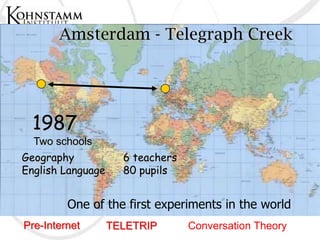
Amsterdam - Telegraph Creek


  1987
  Two schools
Geography            6 teachers
English Language     80 pupils


         One of the first experiments in the world
Pre-Internet       TELETRIP       Conversation Theory
International CSCL Projects

Making meaningful connections (bridges) between:
• Pupils, Teachers, Schools, Cultures, Glocal learning
Put clear subjects central for collaborative learning
• Make sure pupils can have interesting conversations
  on the subjects: see The Image of the Other
Use Mutual foreign languages: everyone learns
Use different (common) forms and tools of ICT and
  (social) Media:
• Asynchronous (e-mail etc)
• Synchronous (chat, videoconferencing etc)
• Integrated in environments (3D, Moodle etc)
Learning from and with the Other
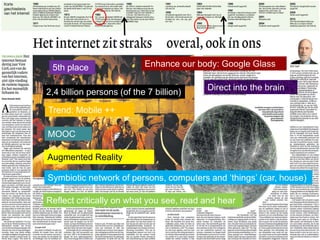
5th place                 Enhance our body: Google Glass

                                         Direct into the brain
2,4 billion persons (of the 7 billion)

Trend: Mobile ++

MOOC

Augmented Reality

Symbiotic network of persons, computers and ‘things’ (car, house)

Reflect critically on what you see, read and hear
Challenges for the school

1) Schools need continuous (ICT) innovation to
  keep in pace with the evolving global e-society
2) Schools need to remain/become high quality
  places young people like to be in for learning:
  every student’s diverse talents need
  recognition and development
3) Schools need to educate young people for
  responsible participants in society: different
  and (partly) new literacies and competences
  for participation in society
 The theme of this speech
Schools cannot do everything

• Only 20% of difference in pupil
  achievements can be explained by school
  factors (even less in urban areas)
• 80% explained by background factors of
  pupils:
  – Home environment/peer group
  – Learned Intelligence and Background Knowledge
  – Student Motivation
• Robert Marzano ‘What Works in Schools’
  based on 35 years of educational research
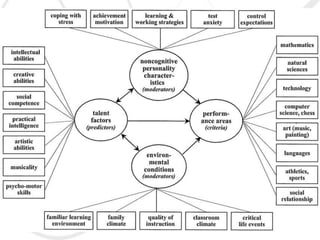
What is talent?

• Innate, is the genes? Learned?
• Something that is given (Mattheus)
   Gift – Giftedness
   Don’t let it rest– develop it
• Secret of excellence
   Deliberate practice
   Practice, 10.000 hours
   Motivation
   Talent, excellence as relative concept
 A complex concept
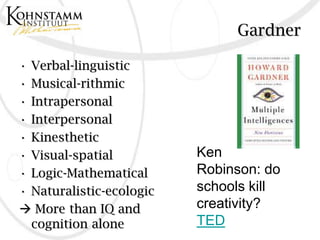
Gardner

• Verbal-linguistic
• Musical-rithmic
• Intrapersonal
• Interpersonal
• Kinesthetic
• Visual-spatial          Ken
• Logic-Mathematical      Robinson: do
• Naturalistic-ecologic   schools kill
 More than IQ and        creativity?
  cognition alone         TED
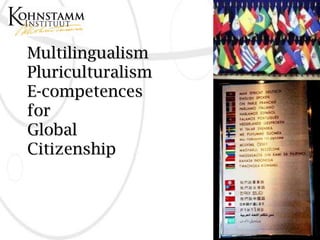
Multilingualism
Pluriculturalism
E-competences
for
Global
Citizenship
Glocal citizenship….

• The world as a global village
  – How to relate with our neighbours in the village?
• Citizenship:
  – Democracy: a way to bring together different views
    and interests and to peacefully come to solutions
  – Participation: showing responsibility for one’s living
    environment by contributing to its quality
  – Identity: norms and values from which a person
    acts in public space; what ideals, what priorities?
• Local: diversity but limited
• Global: enormous diversity….
Social relations
• ‘Glue’ in society depends on the quality of
  social relations between individuals and groups
• Social relations are both the result and the
  source of the development of an individual
• Outcomes of interactions are integrated as
  experiences or knowledge ->learning
• This learning process needs to continue by
  actively seeking new information or (human)
  resources: we need to be(come) literate
• The resources are local and, increasingly,
  distant: have to learn new forms of literacy
Four pillars of learning

•   Learning     to   know
•   Learning     to   do
•   Learning     to   be
•   Learning     to   live together
    (http://www.unesco.org/delors/)
• Developing six stages of competency
    (Richardson (2003) Developing Sustainable Ties in the
    Information Society: Social Aspects of ICT in Learning)

Competence: combinations of knowledge, skills,
 attitudes (norms, values) + the ability to reflect
 upon all these aspects
Types of literacy
                              & competence
1. Functional literacy
  • Read, write, calculate: fundamental
    communication tools; (de)code information
  • Create images of the world without its presence
2. Technical literacy
  • Use ICT to interact (non)verbally with others
  • Essential building block for adapting to
    evolution (as technology continously develops)
 Understand the direct and indirect world
 Learning to know and learning to do
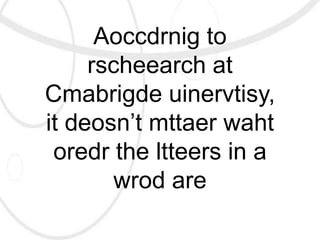
Aoccdrnig to
     rscheearch at
Cmabrigde uinervtisy,
it deosn’t mttaer waht
 oredr the ltteers in a
       wrod are
Types of literacy
                              & competence
3. Audio-visual competence
  – Critically judge the non-interactive strong &
    constant stream of audio/visual-messages
  – What’s behind: school as ‘living laboratory’ or
    playground to be aware and to reflect upon
4. Media competence
  –   Not to understand the package but the content
      and impact/use media
  –   Navigate the labyrinth, judge what is
      meaningful
• Competences to be developed throughout
  life
• Delors: Learning to be
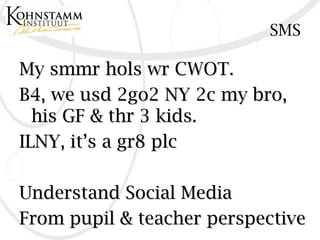
SMS

My smmr hols wr CWOT.
B4, we usd 2go2 NY 2c my bro,
  his GF & thr 3 kids.
ILNY, it’s a gr8 plc

Understand Social Media
From pupil & teacher perspective
Types of literacy
                             & competence
5. Social competence
  • Sound understanding of norms, values, rights,
    responsibilities
  • Choice to comply or not
  • Become autonomous, understand ourselves
6. Cultural literacy & competence
  –  Culmination: contextualize information,
     openness and curiosity to integrate cultural
     experience of the Other into one’s learning
  Integrate new learning that continually modifies
     our Image of the world through meta-cognition
• Learning to live together
Learning to Bridge
                         the World’s Cultures
• Starts with curiosity, wanting to learn & openness
• Stages of understanding related to the types of
  literacy and competences
• Important role for parents and educators, but:
  lifelong competence development necessary
• Understand the ‘other’ language
• Understand the ‘cultural’ differences: accept, be
  generous, with own knowledge of self and one’s
  own & other culture
• Interact for creating consensual knowledge
• Bridging Intercultural Diversity through Global
  Learning Projects (ESP)
Research needed

• Factors that influence learning (outcomes)
  when doing international CSCL-projects??
• Evaluate your projects from the start
• Do it together with your students, and with
  your partners abroad
• Focus on the process & on the outcomes
• Compare: are learning outcomes better than
  in ‘normal’ lesson activities???
• Document it for others to learn from you.
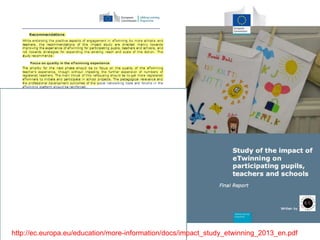
http://ec.europa.eu/education/more-information/docs/impact_study_etwinning_2013_en.pdf
http://blogs.ec.europa.eu/openeducation2030/
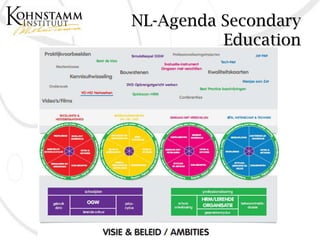
NL-Agenda Secondary
          Education
Brain and cognition

• Early development is not sign of giftedness
• In secondary education: brain still very much in
  development
• Especially metacognitive (executive) skills limited
• Connection between intelligence and maturation
  of the frontal cortex
• The more intelligent the pupil, the later the
  maturation
• Possibly: at 14 behind; at 18 ahead
• Room in schools for individual attunement to
  biological factors needed
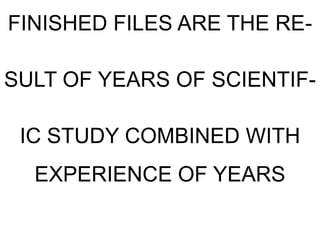
FINISHED FILES ARE THE RE-

SULT OF YEARS OF SCIENTIF-

 IC STUDY COMBINED WITH
  EXPERIENCE OF YEARS
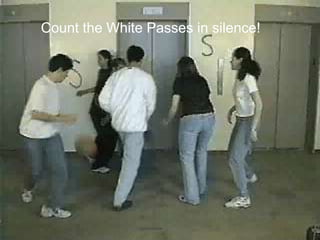
Count the White Passes in silence!
The Mind Once
  Expanded to
the Dimensions
of Larger Ideas
Never returns to
its Original Size
????
Have a Very Nice Conference

   hsligte@kohnstamm.uva.nl

Multilingualism & pluriculturalism; key e-competences for global citizenship

  • 2.
    Multilingualism & Pluriculturalism: Key E-competences For Global Citizenship THE 27TH CONFERENCE OF THE EUROPEAN SCHOOLS PROJECT ASSOCIATION Educating Global Citizens through meeting innovative ICT and Social Media
  • 3.
    Henk Sligte University of Amsterdam Kohnstamm Institute for Educational Research Henk.Sligte@UvA.NL http://kohnstamminstituut.uva.nl/htm/english.htm The Skinny Bridge Amsterdam 1840 AD
  • 4.
    Kohnstamm Institute • Knowledgeand research centre in the field of education, child rearing and child welfare • Research in all educational sectors: from early childhood to universities • Improving opportunities for children and young people and improving the quality of educational systems • ICT in education & Technology Enhanced Learning one of the research themes
  • 5.
    My passion since25++ years • Innovation of education • And then especially (secondary) schools • And then especially using technology • From the viewpoint of the educational researcher, not from the perspective of technology developer • ICT for improving learning, making ‘new’ learning possible, make schools better places ESP
  • 6.
    Industrial paradigm? 1985: SOSof the SOS Save Our Schools of the Sick Organisation Syndrome • Insulitis: the island disease (time, content, closed classrooms) • Technophobia: the fear for and avoidance of technology  Building bridges between the islands using technology  For what kind of society do we educate our children?
  • 7.
    Amsterdam - TelegraphCreek 1987 Two schools Geography 6 teachers English Language 80 pupils One of the first experiments in the world Pre-Internet TELETRIP Conversation Theory
  • 8.
    International CSCL Projects Makingmeaningful connections (bridges) between: • Pupils, Teachers, Schools, Cultures, Glocal learning Put clear subjects central for collaborative learning • Make sure pupils can have interesting conversations on the subjects: see The Image of the Other Use Mutual foreign languages: everyone learns Use different (common) forms and tools of ICT and (social) Media: • Asynchronous (e-mail etc) • Synchronous (chat, videoconferencing etc) • Integrated in environments (3D, Moodle etc) Learning from and with the Other
  • 9.
    5th place Enhance our body: Google Glass Direct into the brain 2,4 billion persons (of the 7 billion) Trend: Mobile ++ MOOC Augmented Reality Symbiotic network of persons, computers and ‘things’ (car, house) Reflect critically on what you see, read and hear
  • 10.
    Challenges for theschool 1) Schools need continuous (ICT) innovation to keep in pace with the evolving global e-society 2) Schools need to remain/become high quality places young people like to be in for learning: every student’s diverse talents need recognition and development 3) Schools need to educate young people for responsible participants in society: different and (partly) new literacies and competences for participation in society  The theme of this speech
  • 11.
    Schools cannot doeverything • Only 20% of difference in pupil achievements can be explained by school factors (even less in urban areas) • 80% explained by background factors of pupils: – Home environment/peer group – Learned Intelligence and Background Knowledge – Student Motivation • Robert Marzano ‘What Works in Schools’ based on 35 years of educational research
  • 12.
    What is talent? •Innate, is the genes? Learned? • Something that is given (Mattheus)  Gift – Giftedness  Don’t let it rest– develop it • Secret of excellence  Deliberate practice  Practice, 10.000 hours  Motivation  Talent, excellence as relative concept  A complex concept
  • 14.
    Gardner • Verbal-linguistic • Musical-rithmic •Intrapersonal • Interpersonal • Kinesthetic • Visual-spatial Ken • Logic-Mathematical Robinson: do • Naturalistic-ecologic schools kill  More than IQ and creativity? cognition alone TED
  • 15.
  • 16.
    Glocal citizenship…. • Theworld as a global village – How to relate with our neighbours in the village? • Citizenship: – Democracy: a way to bring together different views and interests and to peacefully come to solutions – Participation: showing responsibility for one’s living environment by contributing to its quality – Identity: norms and values from which a person acts in public space; what ideals, what priorities? • Local: diversity but limited • Global: enormous diversity….
  • 17.
    Social relations • ‘Glue’in society depends on the quality of social relations between individuals and groups • Social relations are both the result and the source of the development of an individual • Outcomes of interactions are integrated as experiences or knowledge ->learning • This learning process needs to continue by actively seeking new information or (human) resources: we need to be(come) literate • The resources are local and, increasingly, distant: have to learn new forms of literacy
  • 18.
    Four pillars oflearning • Learning to know • Learning to do • Learning to be • Learning to live together (http://www.unesco.org/delors/) • Developing six stages of competency (Richardson (2003) Developing Sustainable Ties in the Information Society: Social Aspects of ICT in Learning) Competence: combinations of knowledge, skills, attitudes (norms, values) + the ability to reflect upon all these aspects
  • 19.
    Types of literacy & competence 1. Functional literacy • Read, write, calculate: fundamental communication tools; (de)code information • Create images of the world without its presence 2. Technical literacy • Use ICT to interact (non)verbally with others • Essential building block for adapting to evolution (as technology continously develops)  Understand the direct and indirect world  Learning to know and learning to do
  • 20.
    Aoccdrnig to rscheearch at Cmabrigde uinervtisy, it deosn’t mttaer waht oredr the ltteers in a wrod are
  • 21.
    Types of literacy & competence 3. Audio-visual competence – Critically judge the non-interactive strong & constant stream of audio/visual-messages – What’s behind: school as ‘living laboratory’ or playground to be aware and to reflect upon 4. Media competence – Not to understand the package but the content and impact/use media – Navigate the labyrinth, judge what is meaningful • Competences to be developed throughout life • Delors: Learning to be
  • 22.
    SMS My smmr holswr CWOT. B4, we usd 2go2 NY 2c my bro, his GF & thr 3 kids. ILNY, it’s a gr8 plc Understand Social Media From pupil & teacher perspective
  • 23.
    Types of literacy & competence 5. Social competence • Sound understanding of norms, values, rights, responsibilities • Choice to comply or not • Become autonomous, understand ourselves 6. Cultural literacy & competence – Culmination: contextualize information, openness and curiosity to integrate cultural experience of the Other into one’s learning Integrate new learning that continually modifies our Image of the world through meta-cognition • Learning to live together
  • 24.
    Learning to Bridge the World’s Cultures • Starts with curiosity, wanting to learn & openness • Stages of understanding related to the types of literacy and competences • Important role for parents and educators, but: lifelong competence development necessary • Understand the ‘other’ language • Understand the ‘cultural’ differences: accept, be generous, with own knowledge of self and one’s own & other culture • Interact for creating consensual knowledge • Bridging Intercultural Diversity through Global Learning Projects (ESP)
  • 25.
    Research needed • Factorsthat influence learning (outcomes) when doing international CSCL-projects?? • Evaluate your projects from the start • Do it together with your students, and with your partners abroad • Focus on the process & on the outcomes • Compare: are learning outcomes better than in ‘normal’ lesson activities??? • Document it for others to learn from you.
  • 26.
  • 27.
  • 28.
  • 29.
    Brain and cognition •Early development is not sign of giftedness • In secondary education: brain still very much in development • Especially metacognitive (executive) skills limited • Connection between intelligence and maturation of the frontal cortex • The more intelligent the pupil, the later the maturation • Possibly: at 14 behind; at 18 ahead • Room in schools for individual attunement to biological factors needed
  • 30.
    FINISHED FILES ARETHE RE- SULT OF YEARS OF SCIENTIF- IC STUDY COMBINED WITH EXPERIENCE OF YEARS
  • 31.
    Count the WhitePasses in silence!
  • 32.
    The Mind Once Expanded to the Dimensions of Larger Ideas Never returns to its Original Size
  • 33.
  • 34.
    Have a VeryNice Conference hsligte@kohnstamm.uva.nl