TEXT
STRUCTURE
TEXT STRUCTURE
Academic texts can be articles, conference
papers, reviews and
theses/dissertations. How are academic texts
typically formed? In general, academic texts are
organized with the following characteristics:
(1) has clearly structured introduction-
body-conclusion,
(2) Formal,
(3) includes information from credible
sources which are properly cited,
(4) includes a list of references.
Have you read a
thesis or an article?
academic texts usually follow an
established structure which refers to the
internal organization of a text. It is called
Text Structure.
Text Structures refer to the organizational
patterns of a text. Generally, it is
composed of text types, parts, transition
words and phrases, patterns of
organization, sentences, and paragraphs.
TEXT TYPE
• ARGUMENTATIVE
• NARRATIVE
• INFORMATIVE
PARTS OF A TEXT
The common parts of a text pertain to the I-B-C
(Introduction, Body and Conclusion) structure. Each
part consists of sub-components that could help
readers identify the main ideas (stated or implied)
and supporting details using patterns of organization.
PATTERNS OF
ORGANIZATION
Five common patterns of organization,
1. Description
2. Order/Sequence
3. Comparison/Contrast
4. Cause and effect
5. Problem and solution
DESCRIPTION/LIST
This structure resembles an outline.
Each section opens with its main
idea, then elaborates on it,
sometimes dividing the elaboration
into subsections.
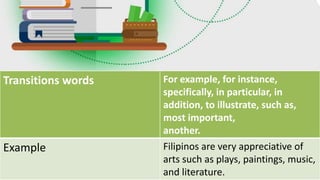
Transitions words For example, for instance,
specifically, in particular, in
addition, to illustrate, such as,
most important,
another.
Example Filipinos are very appreciative of
arts such as plays, paintings, music,
and literature.
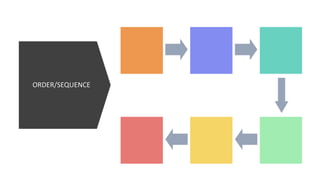
ORDER/SEQUENCE
Texts that follow this structure tell the
order in which steps in a process or series
of events occur.
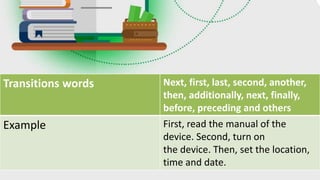
Transitions words Next, first, last, second, another,
then, additionally, next, finally,
before, preceding and others
Example First, read the manual of the
device. Second, turn on
the device. Then, set the location,
time and date.
COMPARISON/CONTRAST
Texts that follow this structure tell about
the differences and similarities of two or
more objects, places, events or ideas by
grouping their traits for comparison.
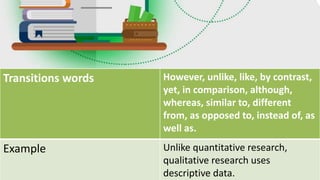
Transitions words However, unlike, like, by contrast,
yet, in comparison, although,
whereas, similar to, different
from, as opposed to, instead of, as
well as.
Example Unlike quantitative research,
qualitative research uses
descriptive data.
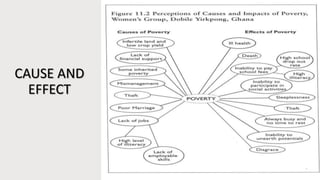
CAUSE AND EFFECT
In texts that follow this structure, the
reader is told the result of an event or
occurrence and the reasons it happened.
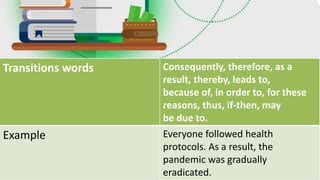
Transitions words Consequently, therefore, as a
result, thereby, leads to,
because of, in order to, for these
reasons, thus, if-then, may
be due to.
Example Everyone followed health
protocols. As a result, the
pandemic was gradually
eradicated.
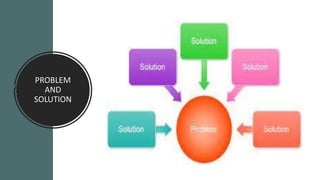
PROBLEM AND SOLUTION
This presents a problem and several
possible solutions. The author may also
describe the pros and cons of each
solution.
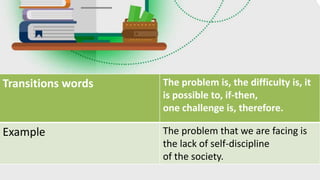
Transitions words The problem is, the difficulty is, it
is possible to, if-then,
one challenge is, therefore.
Example The problem that we are facing is
the lack of self-discipline
of the society.
SENTENCES AND PARAGRAPHS
In writing effective sentences or paragraphs, a
graphic organizer is a great help. A graphic
organizer is a visual presentation with various
shapes and connecting marks that is used to
show the organization and relationship of ideas
and parts in a text. It serves as the backbone in
writing a formal and effective academic text.
ORDER/SEQUENCE
COMPARISON
AND
CONTRAST
CAUSE AND
EFFECT
PROBLEM
AND
SOLUTION

EAPP WEEK 2.pptx

  • 1.
  • 2.
  • 3.
    Academic texts canbe articles, conference papers, reviews and theses/dissertations. How are academic texts typically formed? In general, academic texts are organized with the following characteristics:
  • 4.
    (1) has clearlystructured introduction- body-conclusion, (2) Formal,
  • 5.
    (3) includes informationfrom credible sources which are properly cited, (4) includes a list of references.
  • 6.
    Have you reada thesis or an article?
  • 7.
    academic texts usuallyfollow an established structure which refers to the internal organization of a text. It is called Text Structure.
  • 8.
    Text Structures referto the organizational patterns of a text. Generally, it is composed of text types, parts, transition words and phrases, patterns of organization, sentences, and paragraphs.
  • 9.
    TEXT TYPE • ARGUMENTATIVE •NARRATIVE • INFORMATIVE
  • 10.
  • 11.
    The common partsof a text pertain to the I-B-C (Introduction, Body and Conclusion) structure. Each part consists of sub-components that could help readers identify the main ideas (stated or implied) and supporting details using patterns of organization.
  • 12.
  • 13.
    Five common patternsof organization, 1. Description 2. Order/Sequence 3. Comparison/Contrast 4. Cause and effect 5. Problem and solution
  • 14.
    DESCRIPTION/LIST This structure resemblesan outline. Each section opens with its main idea, then elaborates on it, sometimes dividing the elaboration into subsections.
  • 15.
    Transitions words Forexample, for instance, specifically, in particular, in addition, to illustrate, such as, most important, another. Example Filipinos are very appreciative of arts such as plays, paintings, music, and literature.
  • 16.
    ORDER/SEQUENCE Texts that followthis structure tell the order in which steps in a process or series of events occur.
  • 17.
    Transitions words Next,first, last, second, another, then, additionally, next, finally, before, preceding and others Example First, read the manual of the device. Second, turn on the device. Then, set the location, time and date.
  • 18.
    COMPARISON/CONTRAST Texts that followthis structure tell about the differences and similarities of two or more objects, places, events or ideas by grouping their traits for comparison.
  • 19.
    Transitions words However,unlike, like, by contrast, yet, in comparison, although, whereas, similar to, different from, as opposed to, instead of, as well as. Example Unlike quantitative research, qualitative research uses descriptive data.
  • 20.
    CAUSE AND EFFECT Intexts that follow this structure, the reader is told the result of an event or occurrence and the reasons it happened.
  • 21.
    Transitions words Consequently,therefore, as a result, thereby, leads to, because of, in order to, for these reasons, thus, if-then, may be due to. Example Everyone followed health protocols. As a result, the pandemic was gradually eradicated.
  • 22.
    PROBLEM AND SOLUTION Thispresents a problem and several possible solutions. The author may also describe the pros and cons of each solution.
  • 23.
    Transitions words Theproblem is, the difficulty is, it is possible to, if-then, one challenge is, therefore. Example The problem that we are facing is the lack of self-discipline of the society.
  • 24.
    SENTENCES AND PARAGRAPHS Inwriting effective sentences or paragraphs, a graphic organizer is a great help. A graphic organizer is a visual presentation with various shapes and connecting marks that is used to show the organization and relationship of ideas and parts in a text. It serves as the backbone in writing a formal and effective academic text.
  • 25.
  • 26.
  • 27.
  • 28.