English for Academic Professional Purposes
Grade 12
TEXT
STRUCTURE
review 1.
2.
3.
4.
What is Academic Writing?
What is the similarities of
academic text from non-
academic text?
What are the kinds of
academic text?
What are the rules and
standards in writing an
academic text?
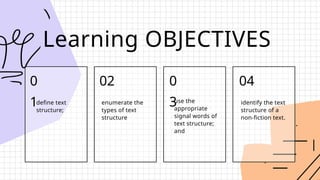
Learning OBJECTIVES
define text
structure;
0
1 enumerate the
types of text
structure
0
3 identify the text
structure of a
non-fiction text.
04
use the
appropriate
signal words of
text structure;
and
02
What word is it?
xtte
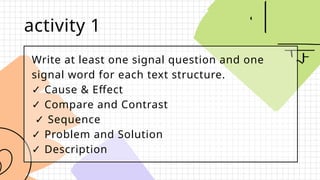
Write at least one signal question and one
signal word for each text structure.
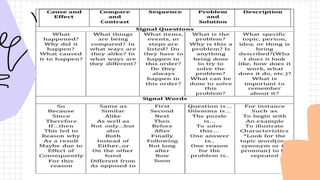
✓ Cause & Effect
✓ Compare and Contrast
✓ Sequence
✓ Problem and Solution
✓ Description
activity 1
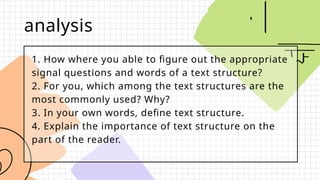
1. How where you able to figure out the appropriate
signal questions and words of a text structure?
2. For you, which among the text structures are the
most commonly used? Why?
3. In your own words, define text structure.
4. Explain the importance of text structure on the
part of the reader.
analysis
What is Text Structure?
Text structure refers to the way an author
arranges information in his writing. Text
structure enables authors to organize their
thoughts as they write. It also helps the
reader as it provides a structure in which
information can be found and understood
while it's being read.
text structure
1. Description – this type of text structure
features a detailed description of something to
give the reader a mental picture.
2. Problem and Solution- this type of structure
sets up a problem or problems, explains the
solution, and then discusses the effects of the
solution.
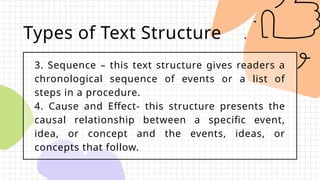
Types of Text Structure
3. Sequence – this text structure gives readers a
chronological sequence of events or a list of
steps in a procedure.
4. Cause and Effect- this structure presents the
causal relationship between a specific event,
idea, or concept and the events, ideas, or
concepts that follow.
Types of Text Structure
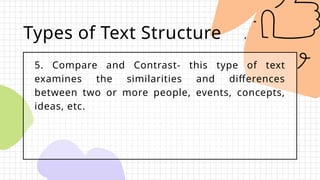
5. Compare and Contrast- this type of text
examines the similarities and differences
between two or more people, events, concepts,
ideas, etc.
Types of Text Structure
5. Compare and Contrast- this type of text
examines the similarities and differences
between two or more people, events, concepts,
ideas, etc.
Types of Text Structure
Structure
(Organization)
1. These texts explain something by
highlighting an event and detailing
the results. Science and history texts
often use this structure. Key words
to look for include “because,”
“therefore,” and “why.”
activity 2- identify the text structure
2. These texts organize events in the
order they happened. This structure
is common in current events, history
and in works of fiction or memoir.
Key words include time markers like
“first,” “next,” “then” and “finally.”
activity 2- identify the text structure
3. These texts are basically descriptive, but
deal with two or more topics to highlight
similarities and differences between them.
This structure is useful in all subjects. Key
words include “more,” “less,” “as [adjective]
as,” “than” and “however.”
activity 2- identify the text structure
4. These texts begin by laying out an
issue and then explaining how to solve or
rectify it. This structure is common is science,
math and social studies as well as a wide
range of informative articles. Key words
include “issue,” “problem,” “trouble,” “fix,”
“solve” and “how.”
activity 2- identify the text structure
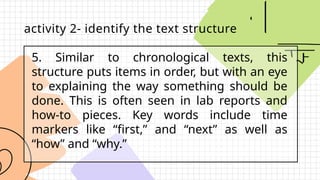
5. Similar to chronological texts, this
structure puts items in order, but with an eye
to explaining the way something should be
done. This is often seen in lab reports and
how-to pieces. Key words include time
markers like “first,” and “next” as well as
“how” and “why.”
activity 2- identify the text structure
Write your own example of text structures using the topic
“The first day of school is always an interesting day.”
 Sequence
 Description
 Compare and Contrast
 Cause and Effect
 Problem and Solution
Activity 3
1.What is a text structure?
2.Why text structure is important?
3.What are the types of text
structure?
4.What are example of signal
words?
Abstraction
1. The words, “instead of” and “as
well as” signal which structure?
A. Description
B. Comparison and Contrast
C. Cause and Effect
D. Problem and Solution
evaluation
2. The question “How does it
work?” signals which text
structure?
A. Description
B. Comparison and Contrast
C. Cause and Effect
D. Problem and Solution
evaluation
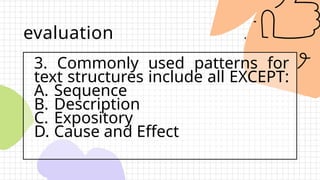
3. Commonly used patterns for
text structures include all EXCEPT:
A. Sequence
B. Description
C. Expository
D. Cause and Effect
evaluation
4. Which text structure is an author
using when he/she lists items or events
in numerical or chronological order?
A. Sequence
B. Description
C. Expository
D. Cause and Effect
evaluation
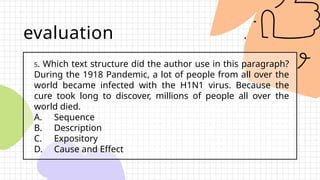
5. Which text structure did the author use in this paragraph?
During the 1918 Pandemic, a lot of people from all over the
world became infected with the H1N1 virus. Because the
cure took long to discover, millions of people all over the
world died.
A. Sequence
B. Description
C. Expository
D. Cause and Effect
evaluation
1. What signal word is used in
comparing two thing?
A. "because of"
B. "such as"
C. "in contrast to"
D. "due to"
INTERVENTION
2. If a text explains how something
works, which structure is it likely using?
A. Description
B. Cause and Effect
C. Sequence
D. Problem and Solution
INTERVENTION
3. Which pattern is NOT commonly used
in text structures?
A. Listing steps
B. Describing a topic
C. Giving an opinion
D. Explaining reasons
INTERVENTION
4. What is the text structure called when
events are described in the order they
happen?
A. Sequence
B. Cause and Effect
C. Description
D. Comparison
INTERVENTION
5. In the following sentence, which text
structure is used? "The heavy rain caused
flooding, which made travel very difficult."
A. Cause and Effect
B. Description
C. Sequence
D. Comparison
INTERVENTION
elements

LESSON 2_TEXT STRUCTURE.pptx............

  • 1.
    English for AcademicProfessional Purposes Grade 12 TEXT STRUCTURE
  • 2.
    review 1. 2. 3. 4. What isAcademic Writing? What is the similarities of academic text from non- academic text? What are the kinds of academic text? What are the rules and standards in writing an academic text?
  • 3.
    Learning OBJECTIVES define text structure; 0 1enumerate the types of text structure 0 3 identify the text structure of a non-fiction text. 04 use the appropriate signal words of text structure; and 02
  • 4.
    What word isit? xtte
  • 5.
    Write at leastone signal question and one signal word for each text structure. ✓ Cause & Effect ✓ Compare and Contrast ✓ Sequence ✓ Problem and Solution ✓ Description activity 1
  • 6.
    1. How whereyou able to figure out the appropriate signal questions and words of a text structure? 2. For you, which among the text structures are the most commonly used? Why? 3. In your own words, define text structure. 4. Explain the importance of text structure on the part of the reader. analysis
  • 7.
    What is TextStructure? Text structure refers to the way an author arranges information in his writing. Text structure enables authors to organize their thoughts as they write. It also helps the reader as it provides a structure in which information can be found and understood while it's being read. text structure
  • 8.
    1. Description –this type of text structure features a detailed description of something to give the reader a mental picture. 2. Problem and Solution- this type of structure sets up a problem or problems, explains the solution, and then discusses the effects of the solution. Types of Text Structure
  • 9.
    3. Sequence –this text structure gives readers a chronological sequence of events or a list of steps in a procedure. 4. Cause and Effect- this structure presents the causal relationship between a specific event, idea, or concept and the events, ideas, or concepts that follow. Types of Text Structure
  • 10.
    5. Compare andContrast- this type of text examines the similarities and differences between two or more people, events, concepts, ideas, etc. Types of Text Structure
  • 11.
    5. Compare andContrast- this type of text examines the similarities and differences between two or more people, events, concepts, ideas, etc. Types of Text Structure
  • 12.
  • 14.
    1. These textsexplain something by highlighting an event and detailing the results. Science and history texts often use this structure. Key words to look for include “because,” “therefore,” and “why.” activity 2- identify the text structure
  • 15.
    2. These textsorganize events in the order they happened. This structure is common in current events, history and in works of fiction or memoir. Key words include time markers like “first,” “next,” “then” and “finally.” activity 2- identify the text structure
  • 16.
    3. These textsare basically descriptive, but deal with two or more topics to highlight similarities and differences between them. This structure is useful in all subjects. Key words include “more,” “less,” “as [adjective] as,” “than” and “however.” activity 2- identify the text structure
  • 17.
    4. These textsbegin by laying out an issue and then explaining how to solve or rectify it. This structure is common is science, math and social studies as well as a wide range of informative articles. Key words include “issue,” “problem,” “trouble,” “fix,” “solve” and “how.” activity 2- identify the text structure
  • 18.
    5. Similar tochronological texts, this structure puts items in order, but with an eye to explaining the way something should be done. This is often seen in lab reports and how-to pieces. Key words include time markers like “first,” and “next” as well as “how” and “why.” activity 2- identify the text structure
  • 19.
    Write your ownexample of text structures using the topic “The first day of school is always an interesting day.”  Sequence  Description  Compare and Contrast  Cause and Effect  Problem and Solution Activity 3
  • 20.
    1.What is atext structure? 2.Why text structure is important? 3.What are the types of text structure? 4.What are example of signal words? Abstraction
  • 21.
    1. The words,“instead of” and “as well as” signal which structure? A. Description B. Comparison and Contrast C. Cause and Effect D. Problem and Solution evaluation
  • 22.
    2. The question“How does it work?” signals which text structure? A. Description B. Comparison and Contrast C. Cause and Effect D. Problem and Solution evaluation
  • 23.
    3. Commonly usedpatterns for text structures include all EXCEPT: A. Sequence B. Description C. Expository D. Cause and Effect evaluation
  • 24.
    4. Which textstructure is an author using when he/she lists items or events in numerical or chronological order? A. Sequence B. Description C. Expository D. Cause and Effect evaluation
  • 25.
    5. Which textstructure did the author use in this paragraph? During the 1918 Pandemic, a lot of people from all over the world became infected with the H1N1 virus. Because the cure took long to discover, millions of people all over the world died. A. Sequence B. Description C. Expository D. Cause and Effect evaluation
  • 26.
    1. What signalword is used in comparing two thing? A. "because of" B. "such as" C. "in contrast to" D. "due to" INTERVENTION
  • 27.
    2. If atext explains how something works, which structure is it likely using? A. Description B. Cause and Effect C. Sequence D. Problem and Solution INTERVENTION
  • 28.
    3. Which patternis NOT commonly used in text structures? A. Listing steps B. Describing a topic C. Giving an opinion D. Explaining reasons INTERVENTION
  • 29.
    4. What isthe text structure called when events are described in the order they happen? A. Sequence B. Cause and Effect C. Description D. Comparison INTERVENTION
  • 30.
    5. In thefollowing sentence, which text structure is used? "The heavy rain caused flooding, which made travel very difficult." A. Cause and Effect B. Description C. Sequence D. Comparison INTERVENTION
  • 31.