TECHNIQUES IN
SUMMARIZING
ACADEMIC TEXT
PREPARED BY:
JENNY MAE Q. CULALABE
SUBJECT TEACHER
Learning Competency
Uses various techniques
in summarizing a variety
of an academic text (S1/2
1st Quarter/ 3rd Quarter)
SUMMARIZING
A summary or a precis is a synopsis or digest of
the essence of an entire text. Usually, a
summary is included in reviews (as in a review
of a book or an academic text) or a literary
critique (as in a summary of a short story or a
novel). When summarizing, make sure that you
capture all the major points of a text, leaving
out details which may confuse the readers.
SUMMARIZING
is a brief restatement of a text’s
main points
is selecting out key features of a
text to create a shorter version
TWO AIMS OF SUMMARIZING
To reproduce the main idea and key
points of a text.
To restate these in as few words as
possible.
MAIN IDEA and KEY POINTS
MAIN IDEA is the topic of the text.
KEY POINTS are the arguments
used to explain the main idea.
BENEFITS OF SUMMARIZING
1.It helps you learn to identify key ideas of a
text and ignore irrelevant information
2.It improves our memory and by extension,
our comprehension.
3.It is an effective tool to self-evaluate what
is understood about the original text.
Guidelines in Summarizing
1. Clarify your purpose before you read.
2. 2. Read the text and understand the meaning. Do
not stop reading until you understand the message
conveyed by the author. Locate the gist or main idea
of the text, which can usually be found either at the
beginning, in the middle, or in the end.
3. 3. Select and underline or circle the key ideas and
phrases while reading; another strategy is to
annotate the text.
4. Write all the key ideas and phrases you
identified on the margins or on your
notebook in a bullet or outline form.
5. Without looking at the text, identify the
connections of these key ideas and phrases
using a concept map.
6. List your ideas in sentence form in a
concept map
7. Combine the sentences into a paragraph. Use
appropriate transitional devices to improve cohesion.
8. Ensure that you do not copy a single sentence from the
original text.
9. Refrain from adding comments about the text. Stick to
the ideas it presents.
10. Edit the draft of your summary by eliminating
redundant ideas.
11. Compare your output with the original text to ensure
accuracy
12. Record the details of the original source
(author’s name/s, date of publication, title,
publisher, place of publishing, and URL [if
online]). It is not necessary to indicate the page
number/s of the original text in citing sources in
summaries.
13. Format your summary properly. When you
combine your summaries in a paragraph, use
different formats to show variety in writing
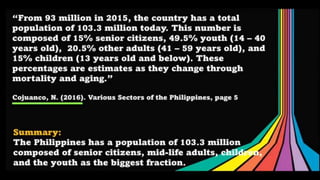
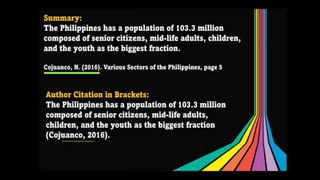
EXAMPLE 1
TECHNIQUES IN SUMMARIZING
1. REFERENCE CITATION
Reference means Source/Author
Citation means mentioning or
recognition
REFERENCE CITATION
FORMATS
FORMAT 1:
Author Citation in the Body
of the Sentence.
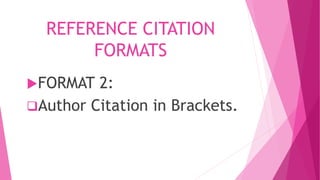
REFERENCE CITATION
FORMATS
FORMAT 2:
Author Citation in Brackets.
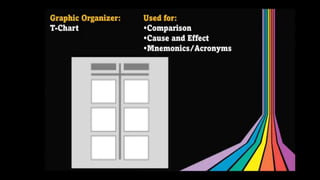
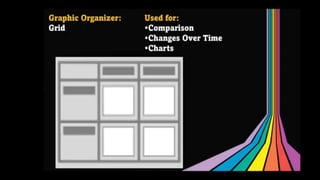
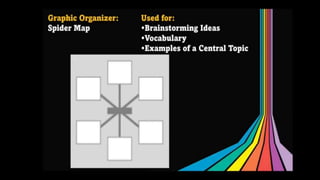
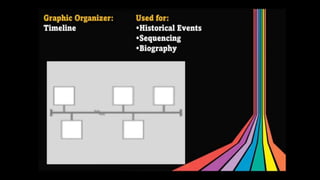
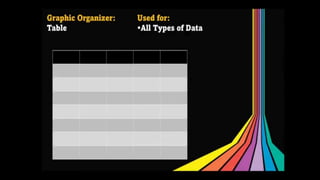
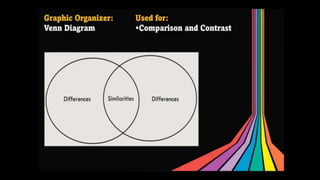
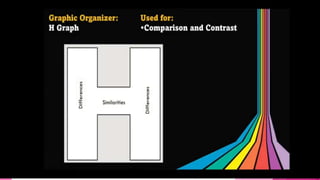
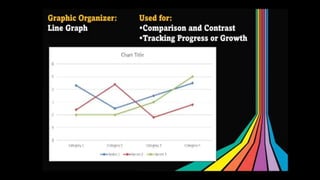
GRAPHIC ORGANIZERS
Are shapes, lines, figures,
drawings, or sketches that
are used to make a visual
display of key information
THANK YOU FOR
LISTENING!  

EAPP 3.pptx

  • 1.
    TECHNIQUES IN SUMMARIZING ACADEMIC TEXT PREPAREDBY: JENNY MAE Q. CULALABE SUBJECT TEACHER
  • 2.
    Learning Competency Uses varioustechniques in summarizing a variety of an academic text (S1/2 1st Quarter/ 3rd Quarter)
  • 3.
    SUMMARIZING A summary ora precis is a synopsis or digest of the essence of an entire text. Usually, a summary is included in reviews (as in a review of a book or an academic text) or a literary critique (as in a summary of a short story or a novel). When summarizing, make sure that you capture all the major points of a text, leaving out details which may confuse the readers.
  • 4.
    SUMMARIZING is a briefrestatement of a text’s main points is selecting out key features of a text to create a shorter version
  • 5.
    TWO AIMS OFSUMMARIZING To reproduce the main idea and key points of a text. To restate these in as few words as possible.
  • 6.
    MAIN IDEA andKEY POINTS MAIN IDEA is the topic of the text. KEY POINTS are the arguments used to explain the main idea.
  • 7.
    BENEFITS OF SUMMARIZING 1.Ithelps you learn to identify key ideas of a text and ignore irrelevant information 2.It improves our memory and by extension, our comprehension. 3.It is an effective tool to self-evaluate what is understood about the original text.
  • 8.
    Guidelines in Summarizing 1.Clarify your purpose before you read. 2. 2. Read the text and understand the meaning. Do not stop reading until you understand the message conveyed by the author. Locate the gist or main idea of the text, which can usually be found either at the beginning, in the middle, or in the end. 3. 3. Select and underline or circle the key ideas and phrases while reading; another strategy is to annotate the text.
  • 9.
    4. Write allthe key ideas and phrases you identified on the margins or on your notebook in a bullet or outline form. 5. Without looking at the text, identify the connections of these key ideas and phrases using a concept map. 6. List your ideas in sentence form in a concept map
  • 10.
    7. Combine thesentences into a paragraph. Use appropriate transitional devices to improve cohesion. 8. Ensure that you do not copy a single sentence from the original text. 9. Refrain from adding comments about the text. Stick to the ideas it presents. 10. Edit the draft of your summary by eliminating redundant ideas. 11. Compare your output with the original text to ensure accuracy
  • 11.
    12. Record thedetails of the original source (author’s name/s, date of publication, title, publisher, place of publishing, and URL [if online]). It is not necessary to indicate the page number/s of the original text in citing sources in summaries. 13. Format your summary properly. When you combine your summaries in a paragraph, use different formats to show variety in writing
  • 12.
  • 18.
    TECHNIQUES IN SUMMARIZING 1.REFERENCE CITATION Reference means Source/Author Citation means mentioning or recognition
  • 19.
    REFERENCE CITATION FORMATS FORMAT 1: AuthorCitation in the Body of the Sentence.
  • 22.
  • 25.
    GRAPHIC ORGANIZERS Are shapes,lines, figures, drawings, or sketches that are used to make a visual display of key information
  • 37.