Lesson 3:
Techniques in Summarizing
Variety of Academic Texts
EVA FE N. CAMPANADO
EAPP TEACHER
Opening Prayer:
Heavenly Father, We come to you today in prayer, asking for
your guidance and wisdom as we begin this online class. Help
us to stay focused and attentive as we learn and grow
together.
Give us the strength to stay motivated and the courage to ask
questions when needed. We thank you for the opportunity to
learn and grow in knowledge. May our minds be open to new
ideas and our hearts be filled with understanding. In Jesus’
name, Amen.
ATTENDANCE
Recall
Activity 1:
Let’s recall how much
you’ve learned in the
previous lesson. Identify the
common text structures.
1. Shows what is
in common and
what is different
2. Presents the
action and its
result
3. Explains how
to do it or how it
happens
4. Suggests
appropriate
actions to address
certain issue
5.Give the
reader a
mental picture
6. Narrates a
story or an
event
What’s New
Activity 2:
Try to recall one of the novels or short
stories you discussed in one of your
previous classes in English; choose
one selection out of the several you
tackled throughout your school life.
Then, try to share the story in class
using your own words.
• Did you find the retelling of the story
difficult? Why or why not?
• What strategies did you employ in order
to retell the story?
• Did you find these strategies helpful?
Why or why not?
What’s is it
Techniques in
Summarizing Variety
of Academic Texts
Summarizing is how we take larger selections
of text and reduce them to their bare
essentials: the gist, the key ideas, the main
points that are worth noting and remembering.
Webster's calls a summary the "general idea
in brief form"; it's the distillation,
condensation, or reduction of a larger work
into its primary notions. (“Reading Quest Strategies | Summarizing”)
Definition:
BASIC RULES
A. Erase things that don’t matter
Delete trivial material that is
unnecessary to understanding.
B. Erase things that repeat.
Delete redundant material. In note taking,
time and space is precious. If a word or
phrase says basically the same thing you
have already written down, then don’t
write it again!
C. Trade, general terms for specific names.
Substitute superordinate terms for lists
(e.g., flowers for daisies, tulips or roses).
Focus on the big picture. Long, technical
lists are hard to remember. If one word will
give you the meaning, then less is more.
D. Use your own words to write the summary.
Write the summary using your
own words but make sure to
retain the main points.
TECHNIQUES
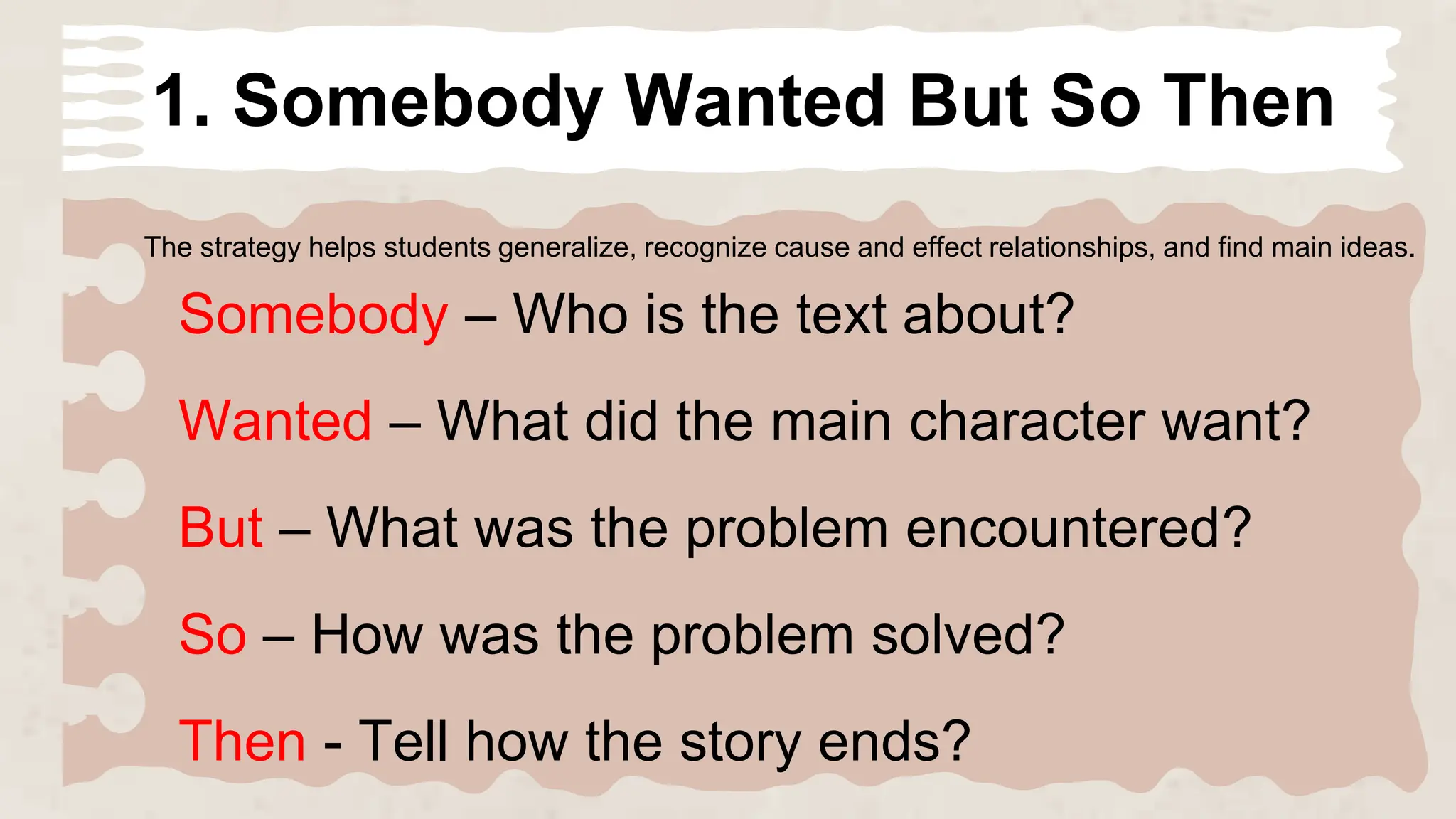
1. Somebody Wanted But So Then
The strategy helps students generalize, recognize cause and effect relationships, and find main ideas.
Somebody – Who is the text about?
Wanted – What did the main character want?
But – What was the problem encountered?
So – How was the problem solved?
Then - Tell how the story ends?
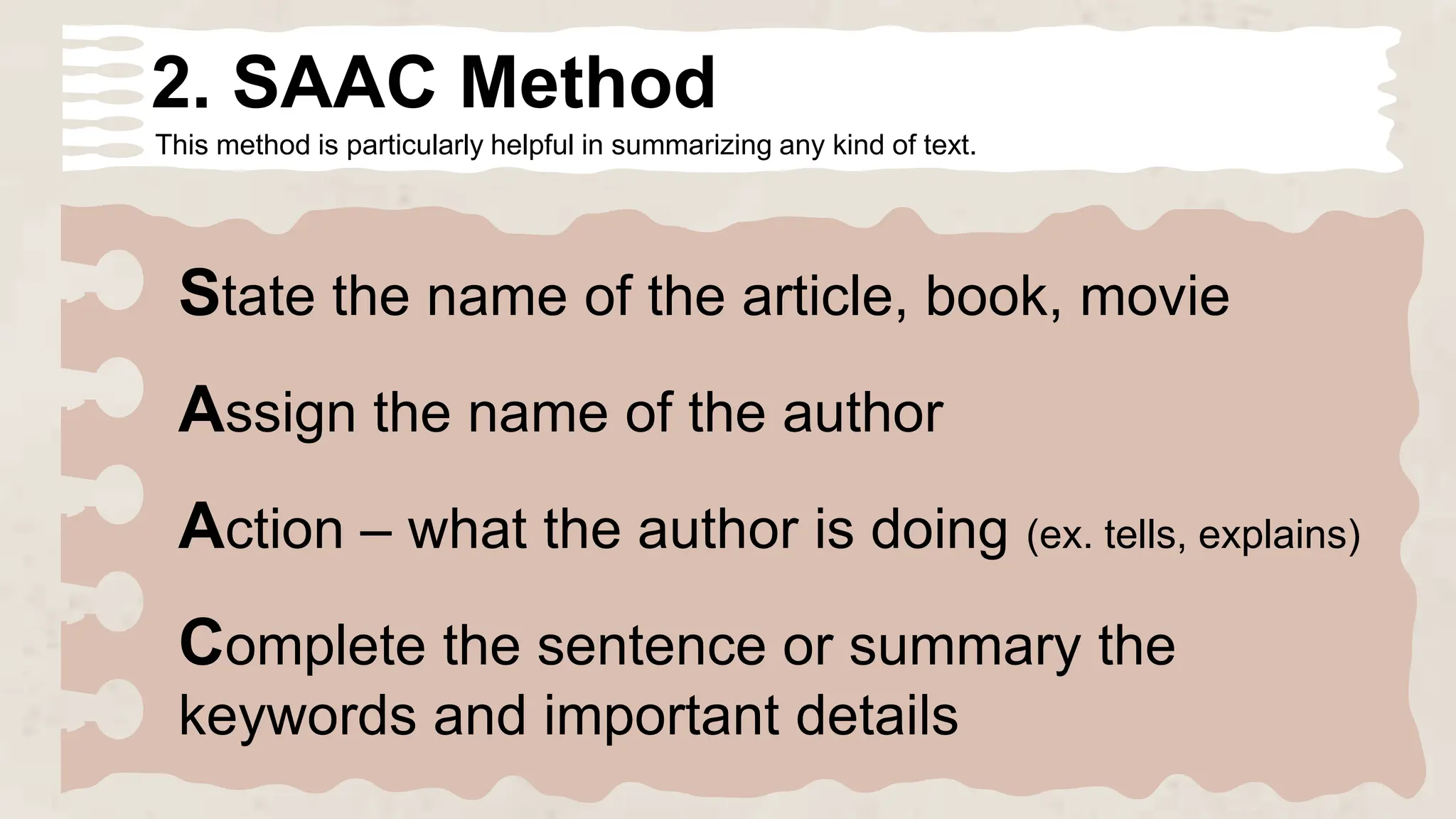
2. SAAC Method
This method is particularly helpful in summarizing any kind of text.
State the name of the article, book, movie
Assign the name of the author
Action – what the author is doing (ex. tells, explains)
Complete the sentence or summary the
keywords and important details
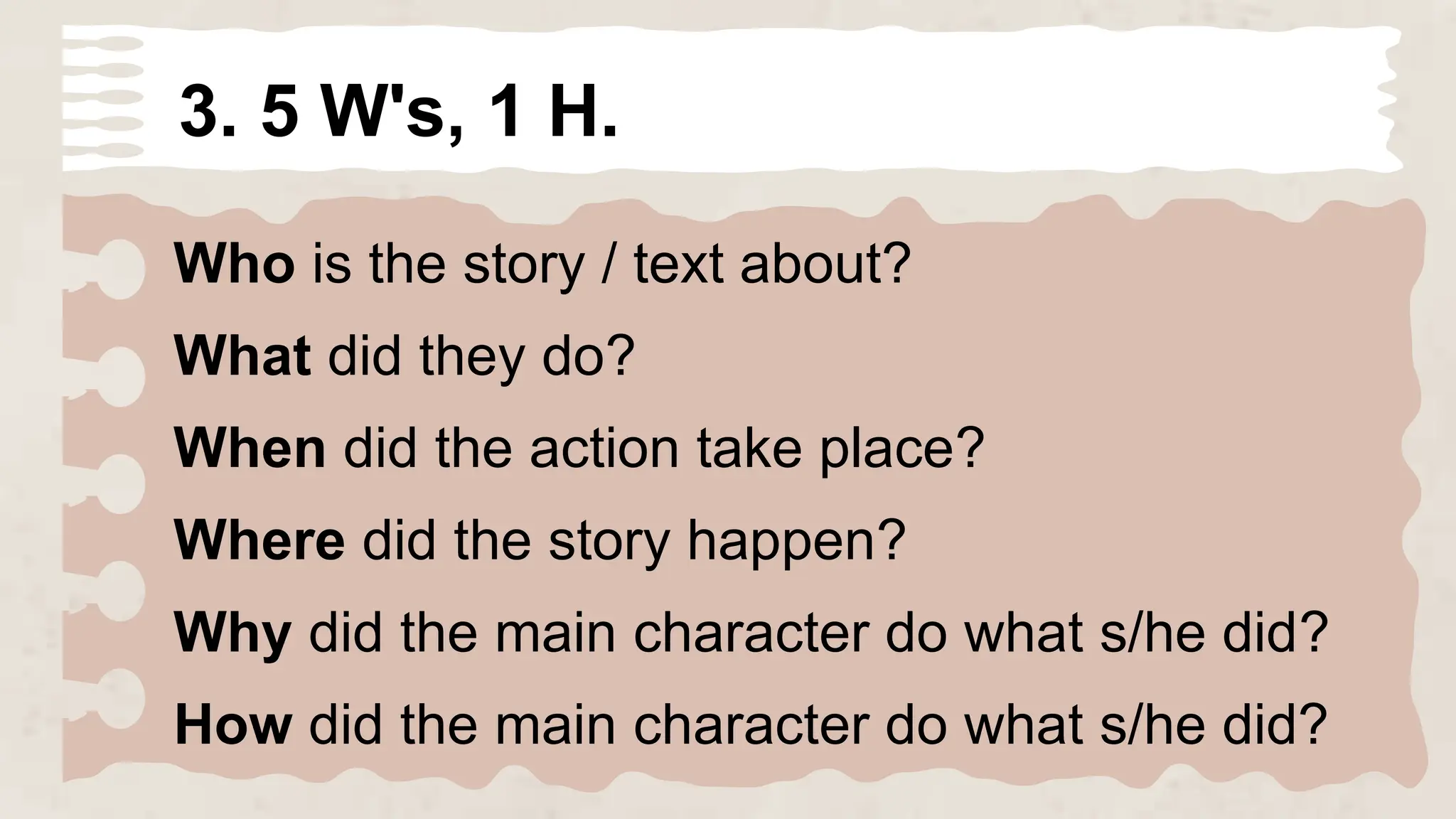
3. 5 W's, 1 H.
Who is the story / text about?
What did they do?
When did the action take place?
Where did the story happen?
Why did the main character do what s/he did?
How did the main character do what s/he did?
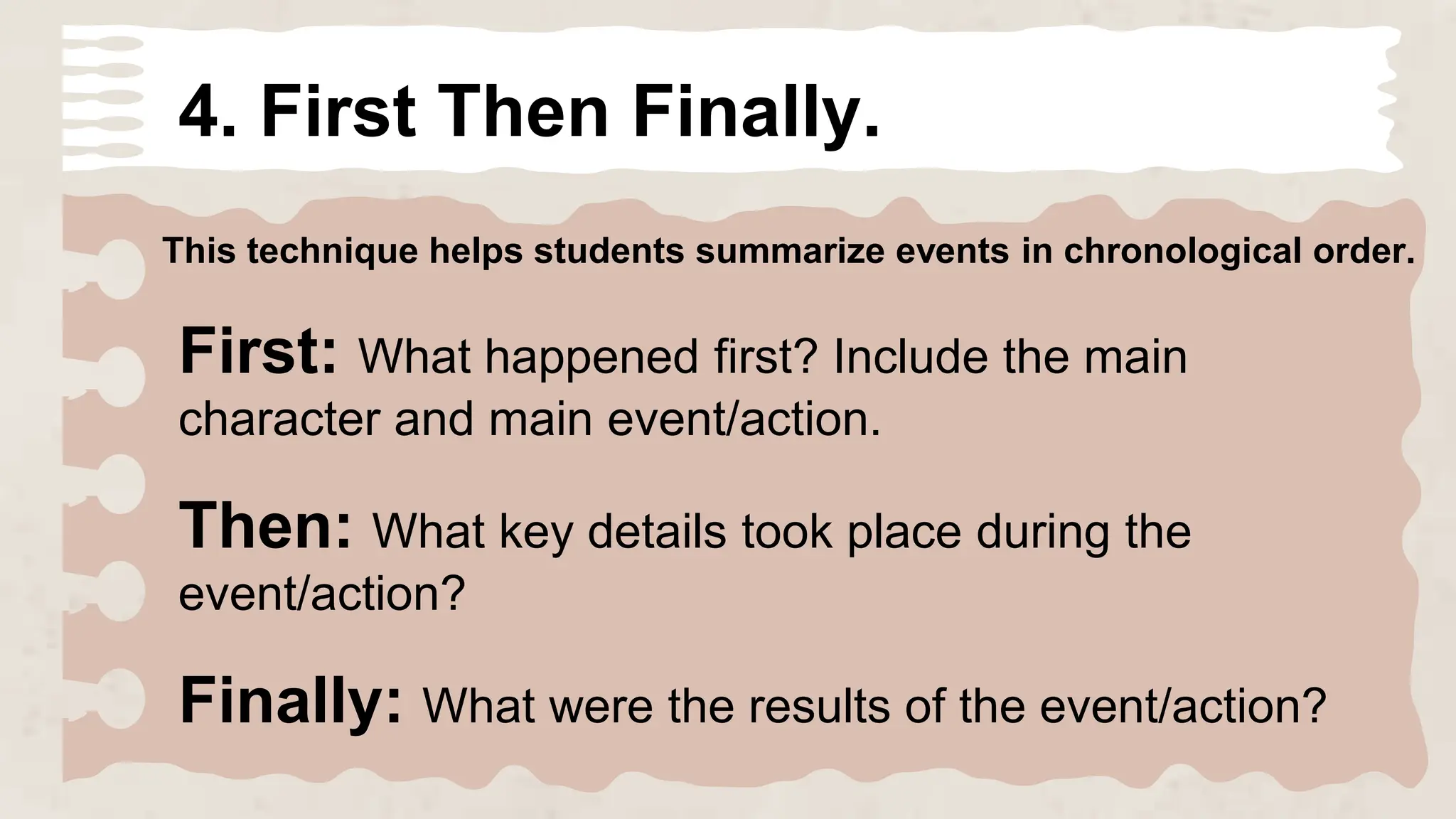
4. First Then Finally.
This technique helps students summarize events in chronological order.
First: What happened first? Include the main
character and main event/action.
Then: What key details took place during the
event/action?
Finally: What were the results of the event/action?
5. Give Me the Gist.
This type of techniques is like
giving a friend the gist of a story.
In other words, they want a
summary – not a retelling of
every detail.
What’s More
Activity 3
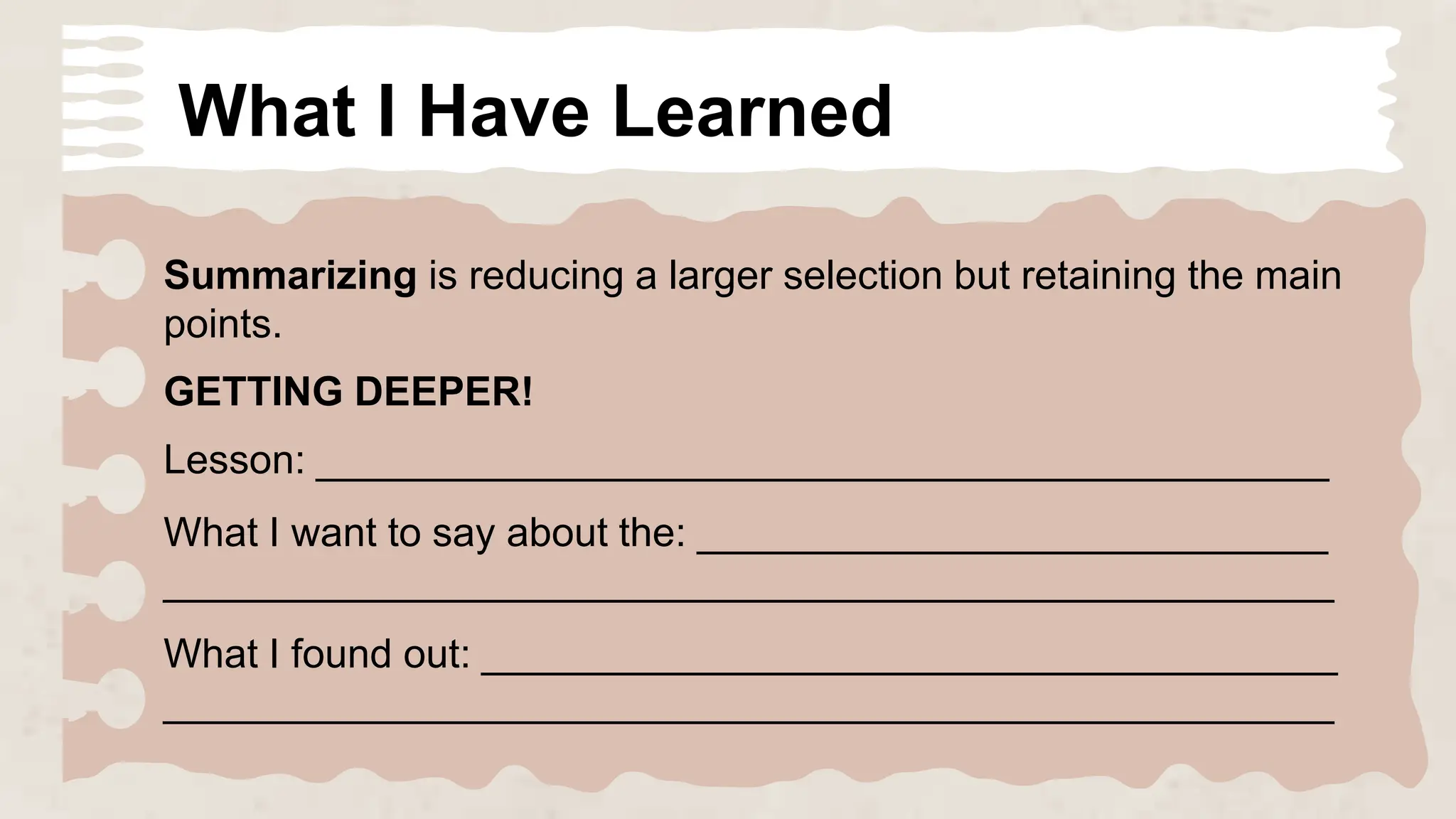
What I Have Learned
Summarizing is reducing a larger selection but retaining the main
points.
GETTING DEEPER!
Lesson: _____________________________________________
What I want to say about the: ____________________________
____________________________________________________
What I found out: ______________________________________
____________________________________________________
What Can I Do
ASSESSMENT
Thank you for
listening!

TECHNIQUES IN SUMMARIZING VARIETY OF TEXT STRUCTURE.pptx

  • 1.
    Lesson 3: Techniques inSummarizing Variety of Academic Texts EVA FE N. CAMPANADO EAPP TEACHER
  • 2.
    Opening Prayer: Heavenly Father,We come to you today in prayer, asking for your guidance and wisdom as we begin this online class. Help us to stay focused and attentive as we learn and grow together. Give us the strength to stay motivated and the courage to ask questions when needed. We thank you for the opportunity to learn and grow in knowledge. May our minds be open to new ideas and our hearts be filled with understanding. In Jesus’ name, Amen.
  • 3.
  • 4.
  • 5.
    Activity 1: Let’s recallhow much you’ve learned in the previous lesson. Identify the common text structures.
  • 6.
    1. Shows whatis in common and what is different
  • 7.
    2. Presents the actionand its result
  • 8.
    3. Explains how todo it or how it happens
  • 9.
  • 10.
  • 11.
  • 12.
  • 13.
    Activity 2: Try torecall one of the novels or short stories you discussed in one of your previous classes in English; choose one selection out of the several you tackled throughout your school life. Then, try to share the story in class using your own words.
  • 14.
    • Did youfind the retelling of the story difficult? Why or why not? • What strategies did you employ in order to retell the story? • Did you find these strategies helpful? Why or why not?
  • 15.
  • 16.
  • 17.
    Summarizing is howwe take larger selections of text and reduce them to their bare essentials: the gist, the key ideas, the main points that are worth noting and remembering. Webster's calls a summary the "general idea in brief form"; it's the distillation, condensation, or reduction of a larger work into its primary notions. (“Reading Quest Strategies | Summarizing”) Definition:
  • 18.
  • 19.
    A. Erase thingsthat don’t matter Delete trivial material that is unnecessary to understanding.
  • 20.
    B. Erase thingsthat repeat. Delete redundant material. In note taking, time and space is precious. If a word or phrase says basically the same thing you have already written down, then don’t write it again!
  • 21.
    C. Trade, generalterms for specific names. Substitute superordinate terms for lists (e.g., flowers for daisies, tulips or roses). Focus on the big picture. Long, technical lists are hard to remember. If one word will give you the meaning, then less is more.
  • 22.
    D. Use yourown words to write the summary. Write the summary using your own words but make sure to retain the main points.
  • 23.
  • 24.
    1. Somebody WantedBut So Then The strategy helps students generalize, recognize cause and effect relationships, and find main ideas. Somebody – Who is the text about? Wanted – What did the main character want? But – What was the problem encountered? So – How was the problem solved? Then - Tell how the story ends?
  • 25.
    2. SAAC Method Thismethod is particularly helpful in summarizing any kind of text. State the name of the article, book, movie Assign the name of the author Action – what the author is doing (ex. tells, explains) Complete the sentence or summary the keywords and important details
  • 26.
    3. 5 W's,1 H. Who is the story / text about? What did they do? When did the action take place? Where did the story happen? Why did the main character do what s/he did? How did the main character do what s/he did?
  • 27.
    4. First ThenFinally. This technique helps students summarize events in chronological order. First: What happened first? Include the main character and main event/action. Then: What key details took place during the event/action? Finally: What were the results of the event/action?
  • 28.
    5. Give Methe Gist. This type of techniques is like giving a friend the gist of a story. In other words, they want a summary – not a retelling of every detail.
  • 29.
  • 30.
  • 31.
    What I HaveLearned Summarizing is reducing a larger selection but retaining the main points. GETTING DEEPER! Lesson: _____________________________________________ What I want to say about the: ____________________________ ____________________________________________________ What I found out: ______________________________________ ____________________________________________________
  • 32.
  • 33.
  • 34.