Text Structures
What is a text structure?
• “Text structure” refers
to how a piece of text
or writing is built or
put together.
Authors…
• Structure their work
differently for different
types of texts.
• For example, authors of
fiction use a different text
structure than an author of
non-fiction.
Non-Fiction
Different Structures for
Different Purposes
1. Chronology
2. Compare/Contrast
3. Cause and Effect
4. Description/Categorization
5. Problem/Solution
6. Position/Reason
Objective:
REVIEW 3 TEXT STRUCTURES and
ORGANIZATIONAL PATTERNS FOR
Chronology/Sequential Order
Compare/Contrast
Cause and Effect
Text Structure Review:
Lesson 1
Chronological/Sequential Order
• Purpose:
– Nonfiction: to inform
– Fiction: to entertain
• To show events in the
order in which they
occurred or to show steps
in a process.
• Chronological: events
• Sequential: steps or
process
Chronological Order Keywords
• first, next, later, then,
and finally –can you
think of any more?
• Even dates or time
periods in history give
a sense of time.
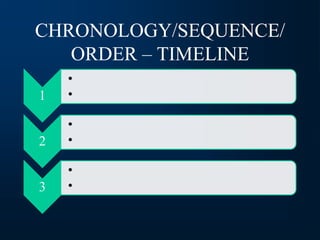
CHRONOLOGY/SEQUENCE/
ORDER – TIMELINE
1
•
•
2
•
•
3
•
•
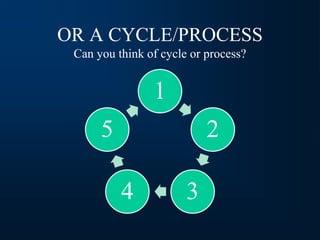
OR A CYCLE/PROCESS
Can you think of cycle or process?
1
2
3
4
5
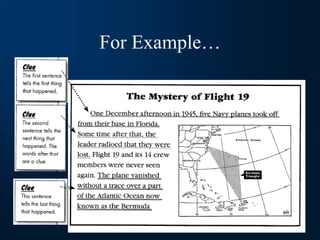
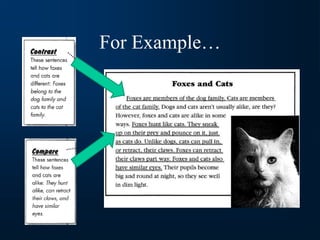
For Example…
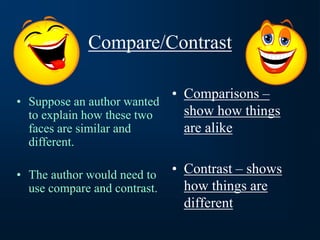
Compare/Contrast
• Comparisons –
show how things
are alike
• Contrast – shows
how things are
different
• Suppose an author wanted
to explain how these two
faces are similar and
different.
• The author would need to
use compare and contrast.
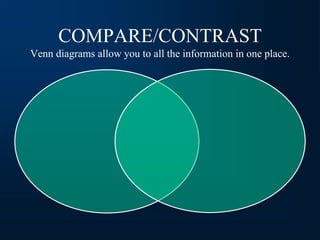
COMPARE/CONTRAST
Venn diagrams allow you to all the information in one place.
For Example…
Cause/Effect Text Structure
• Purpose: to
explain how and
why things
happen.
• How one event
leads to another
• Why decisions
are made.
Cause/Effect Keywords
cause, effect, as a
result, consequently,
and so.
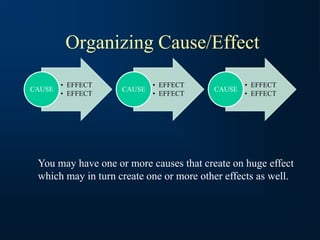
Organizing Cause/Effect
• EFFECT
• EFFECT
CAUSE
• EFFECT
• EFFECT
CAUSE
• EFFECT
• EFFECT
CAUSE
You may have one or more causes that create on huge effect
which may in turn create one or more other effects as well.
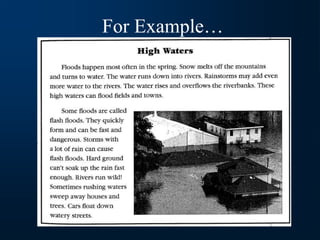
For Example…
How could your organize the
cause and effects of flooding?
• Draw your own causal chain using the
information from the passage?
• Let’s go back to the passage.
Text structures we’ve learned so
far
• Chronological Order
• Compare and Contrast
• Cause and Effect
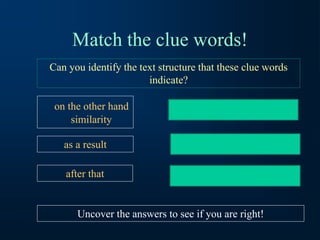
Match the clue words!
on the other hand
similarity
Can you identify the text structure that these clue words
indicate?
Compare/Contrast
as a result Cause/Effect
after that Chronological Order
Uncover the answers to see if you are right!
Problem/Solution Text Structure
• Purpose:
to explain a
problem, and
then offer one or
more solutions.
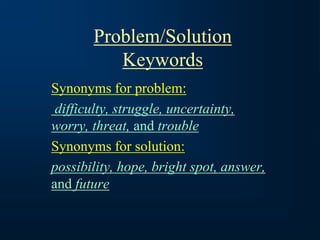
Problem/Solution
Keywords
Synonyms for problem:
difficulty, struggle, uncertainty,
worry, threat, and trouble
Synonyms for solution:
possibility, hope, bright spot, answer,
and future
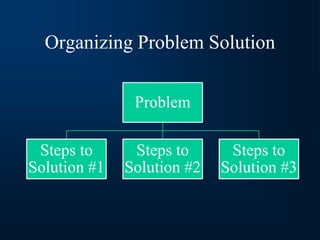
Organizing Problem Solution
Problem
Steps to
Solution #1
Steps to
Solution #2
Steps to
Solution #3
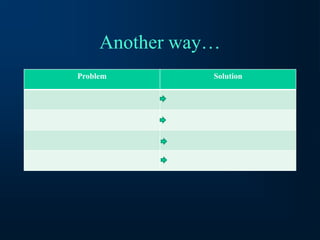
Another way…
Problem Solution
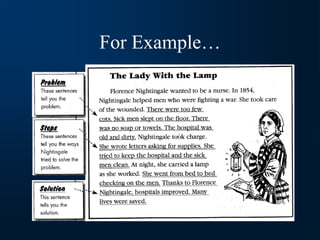
For Example…
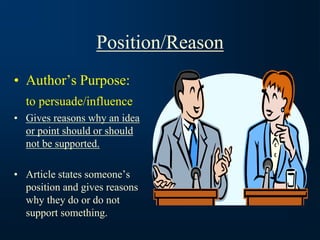
Position/Reason
• Author’s Purpose:
to persuade/influence
• Gives reasons why an idea
or point should or should
not be supported.
• Article states someone’s
position and gives reasons
why they do or do not
support something.
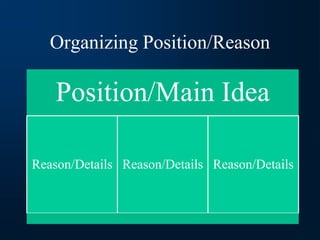
Organizing Position/Reason
Position/Main Idea
Reason/Details Reason/Details Reason/Details
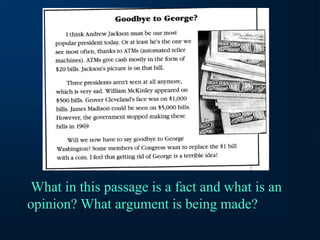
What in this passage is a fact and what is an
opinion? What argument is being made?
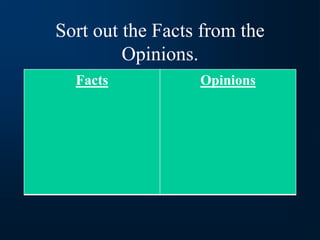
Sort out the Facts from the
Opinions.
Facts Opinions
Last One…
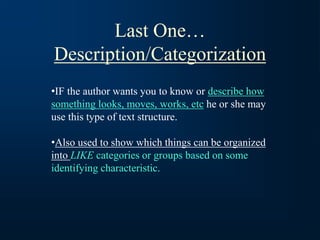
Description/Categorization
•IF the author wants you to know or describe how
something looks, moves, works, etc he or she may
use this type of text structure.
•Also used to show which things can be organized
into LIKE categories or groups based on some
identifying characteristic.
Last One…
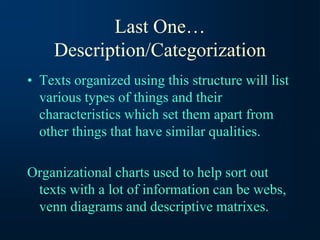
Description/Categorization
• Texts organized using this structure will list
various types of things and their
characteristics which set them apart from
other things that have similar qualities.
Organizational charts used to help sort out
texts with a lot of information can be webs,
venn diagrams and descriptive matrixes.
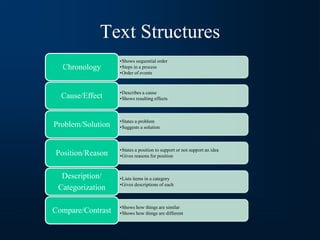
Text Structures
•Shows sequential order
•Steps in a process
•Order of events
Chronology
•Describes a cause
•Shows resulting effects
Cause/Effect
•States a problem
•Suggests a solution
Problem/Solution
•States a position to support or not support an idea
•Gives reasons for position
Position/Reason
•Lists items in a category
•Gives descriptions of each
Description/
Categorization
•Shows how things are similar
•Shows how things are different
Compare/Contrast
All Done!!!

Text Structures Review.ppt