Social collaboration

- Future
- Challenges
- Actions	

Jane McConnell

October 2013
Enterprise 2.0 Meet-up, Paris
Questions identified by the group for discussion during the meet-up:	


What is the future of the social collaboration evolution?	


What are the challenges of the approach in supporting the
cultural change?	


What are the steps to advance the approach towards an
enterprise-wide and supporting tool for collaboration and
process enhancement (aka the implementation of the digital
workplace)?
The future?	

• 
• 
• 

Will no longer be called « social collaboration »	

Will be the natural way of working for many things	

For example…	


• 
• 
• 

Community management will be part of « normal
management »	

« Management » in the traditional sense will be « leadership »	

Etc.
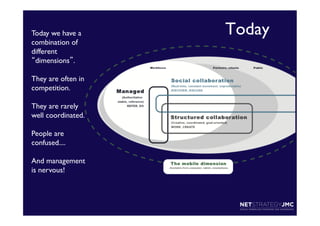
Today we have a
combination of
different
“dimensions”.	


They are often in
competition.	


They are rarely
well coordinated.	


People are
confused....	


And management
is nervous! 	


Today
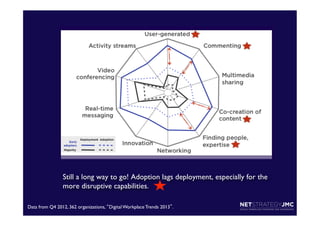
Still a long way to go! Adoption lags deployment, especially for the
more disruptive capabilities.	

Data from Q4 2012, 362 organizations, “Digital Workplace Trends 2013”.
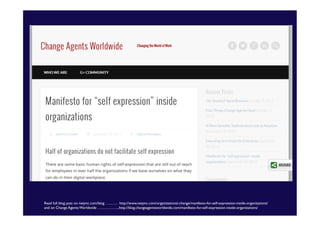
Read full blog post on netjmc.com/blog ………. http://www.netjmc.com/organizational-change/manifesto-for-self-expression-inside-organizations/	

and on Change Agents Worldwide ……………...http://blog.changeagentsworldwide.com/manifesto-for-self-expression-inside-organizations/
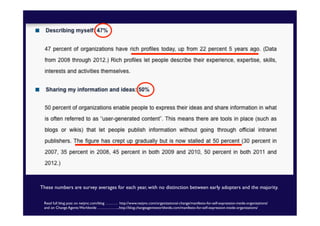
These numbers are survey averages for each year, with no distinction between early adopters and the majority. 	

Read full blog post on netjmc.com/blog ………. http://www.netjmc.com/organizational-change/manifesto-for-self-expression-inside-organizations/	

and on Change Agents Worldwide ……………...http://blog.changeagentsworldwide.com/manifesto-for-self-expression-inside-organizations/
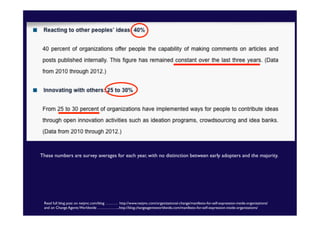
These numbers are survey averages for each year, with no distinction between early adopters and the majority. 	


Read full blog post on netjmc.com/blog ………. http://www.netjmc.com/organizational-change/manifesto-for-self-expression-inside-organizations/	

and on Change Agents Worldwide ……………...http://blog.changeagentsworldwide.com/manifesto-for-self-expression-inside-organizations/
What can we do?	

Establish a sense of urgency	

Empower people, really!	

Make « social collaboration » real
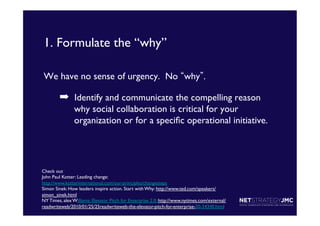
1. Formulate the “why”	

We have no sense of urgency. No why . 	


➡  Identify and communicate the compelling reason
why social collaboration is critical for your
organization or for a specific operational initiative.	


Check out 	

John Paul Kotter: Leading change:
http://www.kotterinternational.com/our-principles/changesteps	

Simon Sinek: How leaders inspire action. Start with Why: http://www.ted.com/speakers/
simon_sinek.html	

NY Times, alex Williams: Elevator Pitch for Enterprise 2.0: http://www.nytimes.com/external/
readwriteweb/2010/01/25/25readwriteweb-the-elevator-pitch-for-enterprise-20-24340.html
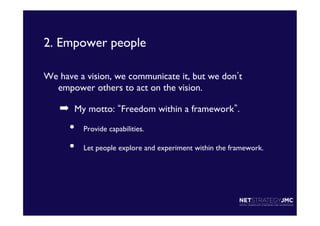
2. Empower people	

We have a vision, we communicate it, but we don t
empower others to act on the vision.	


➡  My motto: Freedom within a framework . 	


• 
• 

Provide capabilities.	

Let people explore and experiment within the framework.
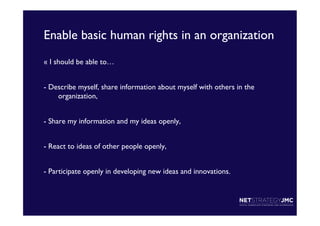
Enable basic human rights in an organization	

« I should be able to…	

- Describe myself, share information about myself with others in the
organization,	

- Share my information and my ideas openly,	

- React to ideas of other people openly,	

- Participate openly in developing new ideas and innovations.
3. Give flesh and bones to social collaboration	

Give it operational reality.	


➡  Start with operational groups, not organizational
groups. Solve pain points that exist. 	


➡  Build use cases based on real personas. Illustrate
how social collaboration can make work more
efficient, effective and satisfying.	

The factor that has the greatest influence in collaborative ways
of working is “behavior of peers and colleagues”.
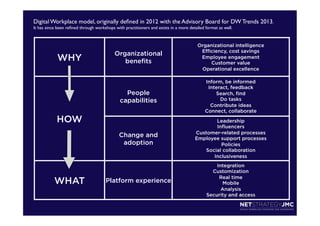
Digital Workplace model, originally defined in 2012 with the Advisory Board for DW Trends 2013. 	

It has since been refined through workshops with practitioners and exists in a more detailed format as well.	


Organizational
benefits

People
capabilities

Inform, be informed
Interact, feedback
Search, find
Do tasks
Contribute ideas
Connect, collaborate

Change and
adoption

WHY

Organizational intelligence
Efficiency, cost savings
Employee engagement
Customer value
Operational excellence

Leadership
Influencers
Customer-related processes
Employee support processes
Policies
Social collaboration
Inclusiveness

Platform experience

Integration
Customization
Real time
Mobile
Analysis
Security and access

HOW

WHAT
Thank you.

jane@netjmc.com
twitter @netjmc
www.digital-workplace-trends.com.

References: Air Liquide, Paris  -  Amadeus, Madrid  –  ArcelorMittal, Luxembourg  –  Areva, Paris   –   Arup, UK   –   Alcatel-Lucent, Paris   -  
Alstom, Paris  -   AGF, Paris   –   Bayer, France   –   Boehringer Ingelheim, Germany   –   EDF, Paris   –   EDP, Lisbon - ERDF, Paris   -  
Ericsson, Stockholm -   GDF Suez, Paris   -   Gemalto, France    -   GlaxoSmithKline, Belgium   -   IKEA, Sweden   -   Lagardère, Paris   -  
Nokia, Helsinki   -   Novartis, Switzerland   -   Océ, the Netherlands   -   OMV Petrom, Vienna   -   Pernod Ricard, Paris   -   PPR, Paris  - 
RATP, Paris  -  Groupe SEB, Lyon   -   SNCF, Paris   -   Suez Environnement, Paris   -   Telenor, Norway   -   Total, Paris   -   UPM, Helsinki

E2 meetup paris 16 0 ct-2013

  • 1.
    Social collaboration - Future -Challenges - Actions Jane McConnell October 2013 Enterprise 2.0 Meet-up, Paris
  • 2.
    Questions identified bythe group for discussion during the meet-up: What is the future of the social collaboration evolution?   What are the challenges of the approach in supporting the cultural change?   What are the steps to advance the approach towards an enterprise-wide and supporting tool for collaboration and process enhancement (aka the implementation of the digital workplace)?
  • 3.
    The future? •  •  •  Will nolonger be called « social collaboration » Will be the natural way of working for many things For example… •  •  •  Community management will be part of « normal management » « Management » in the traditional sense will be « leadership » Etc.
  • 4.
    Today we havea combination of different “dimensions”. They are often in competition. They are rarely well coordinated. People are confused.... And management is nervous! Today
  • 5.
    Still a longway to go! Adoption lags deployment, especially for the more disruptive capabilities. Data from Q4 2012, 362 organizations, “Digital Workplace Trends 2013”.
  • 6.
    Read full blogpost on netjmc.com/blog ………. http://www.netjmc.com/organizational-change/manifesto-for-self-expression-inside-organizations/ and on Change Agents Worldwide ……………...http://blog.changeagentsworldwide.com/manifesto-for-self-expression-inside-organizations/
  • 7.
    These numbers aresurvey averages for each year, with no distinction between early adopters and the majority. Read full blog post on netjmc.com/blog ………. http://www.netjmc.com/organizational-change/manifesto-for-self-expression-inside-organizations/ and on Change Agents Worldwide ……………...http://blog.changeagentsworldwide.com/manifesto-for-self-expression-inside-organizations/
  • 8.
    These numbers aresurvey averages for each year, with no distinction between early adopters and the majority. Read full blog post on netjmc.com/blog ………. http://www.netjmc.com/organizational-change/manifesto-for-self-expression-inside-organizations/ and on Change Agents Worldwide ……………...http://blog.changeagentsworldwide.com/manifesto-for-self-expression-inside-organizations/
  • 9.
    What can wedo? Establish a sense of urgency Empower people, really! Make « social collaboration » real
  • 10.
    1. Formulate the“why” We have no sense of urgency. No why . ➡  Identify and communicate the compelling reason why social collaboration is critical for your organization or for a specific operational initiative. Check out John Paul Kotter: Leading change: http://www.kotterinternational.com/our-principles/changesteps Simon Sinek: How leaders inspire action. Start with Why: http://www.ted.com/speakers/ simon_sinek.html NY Times, alex Williams: Elevator Pitch for Enterprise 2.0: http://www.nytimes.com/external/ readwriteweb/2010/01/25/25readwriteweb-the-elevator-pitch-for-enterprise-20-24340.html
  • 11.
    2. Empower people Wehave a vision, we communicate it, but we don t empower others to act on the vision. ➡  My motto: Freedom within a framework . •  •  Provide capabilities. Let people explore and experiment within the framework.
  • 12.
    Enable basic humanrights in an organization « I should be able to… - Describe myself, share information about myself with others in the organization, - Share my information and my ideas openly, - React to ideas of other people openly, - Participate openly in developing new ideas and innovations.
  • 13.
    3. Give fleshand bones to social collaboration Give it operational reality. ➡  Start with operational groups, not organizational groups. Solve pain points that exist. ➡  Build use cases based on real personas. Illustrate how social collaboration can make work more efficient, effective and satisfying. The factor that has the greatest influence in collaborative ways of working is “behavior of peers and colleagues”.
  • 14.
    Digital Workplace model,originally defined in 2012 with the Advisory Board for DW Trends 2013. It has since been refined through workshops with practitioners and exists in a more detailed format as well. Organizational benefits People capabilities Inform, be informed Interact, feedback Search, find Do tasks Contribute ideas Connect, collaborate Change and adoption WHY Organizational intelligence Efficiency, cost savings Employee engagement Customer value Operational excellence Leadership Influencers Customer-related processes Employee support processes Policies Social collaboration Inclusiveness Platform experience Integration Customization Real time Mobile Analysis Security and access HOW WHAT
  • 15.
    Thank you. jane@netjmc.com twitter @netjmc www.digital-workplace-trends.com. References:Air Liquide, Paris  -  Amadeus, Madrid  –  ArcelorMittal, Luxembourg  –  Areva, Paris   –   Arup, UK   –   Alcatel-Lucent, Paris   -   Alstom, Paris  -   AGF, Paris   –   Bayer, France   –   Boehringer Ingelheim, Germany   –   EDF, Paris   –   EDP, Lisbon - ERDF, Paris   -   Ericsson, Stockholm -   GDF Suez, Paris   -   Gemalto, France    -   GlaxoSmithKline, Belgium   -   IKEA, Sweden   -   Lagardère, Paris   -   Nokia, Helsinki   -   Novartis, Switzerland   -   Océ, the Netherlands   -   OMV Petrom, Vienna   -   Pernod Ricard, Paris   -   PPR, Paris  -  RATP, Paris  -  Groupe SEB, Lyon   -   SNCF, Paris   -   Suez Environnement, Paris   -   Telenor, Norway   -   Total, Paris   -   UPM, Helsinki