NHS England and NHS Improvement
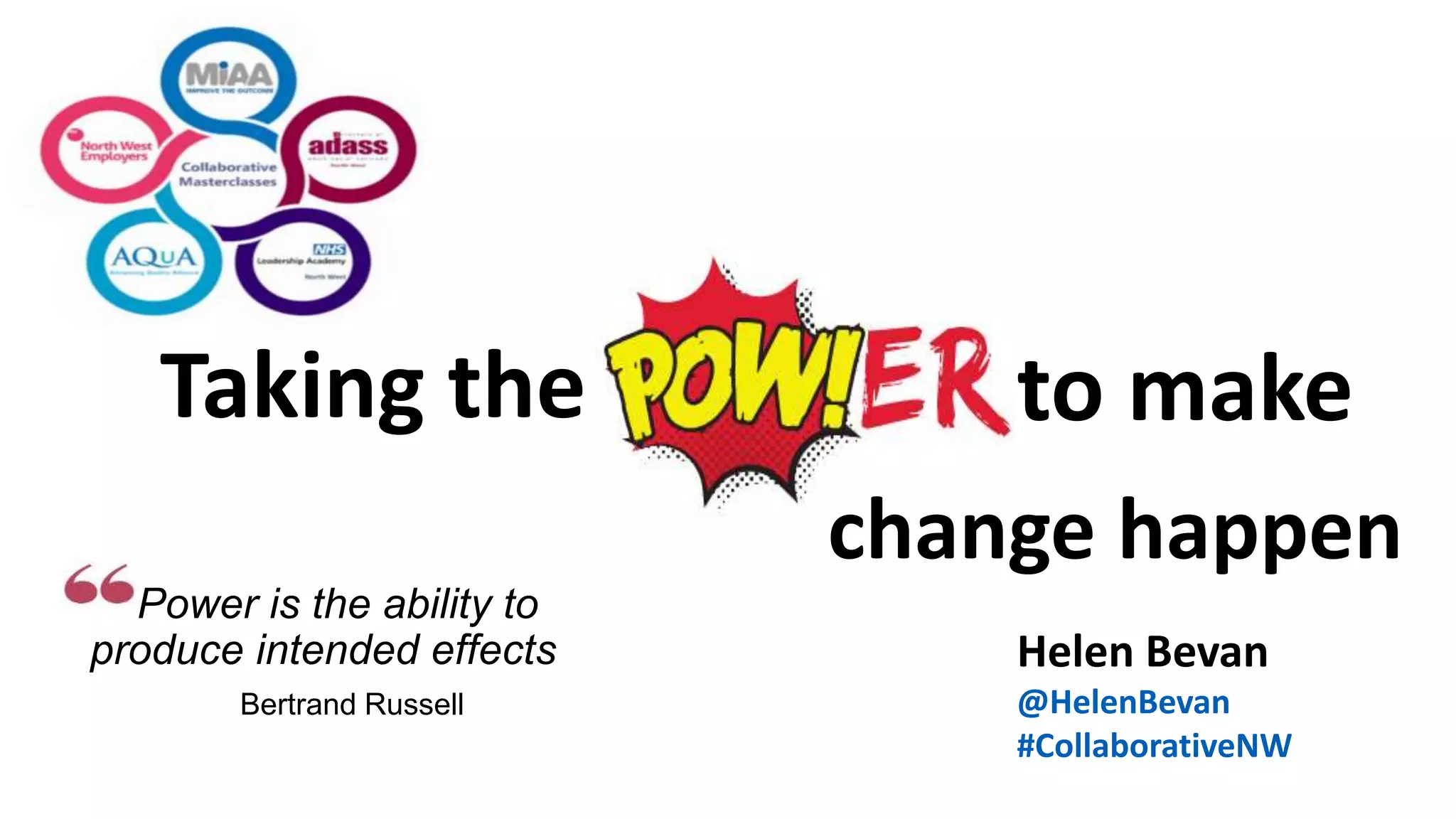
to make
Helen Bevan
@HelenBevan
#CollaborativeNW
Taking the
Power is the ability to
produce intended effects
Bertrand Russell
change happen
2 |2 |
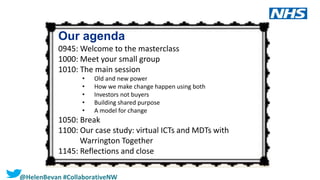
Our agenda
0945: Welcome to the masterclass
1000: Meet your small group
1010: The main session
• Old and new power
• How we make change happen using both
• Investors not buyers
• Building shared purpose
• A model for change
1050: Break
1100: Our case study: virtual ICTs and MDTs with
Warrington Together
1145: Reflections and close
@HelenBevan #CollaborativeNW
Rachel Mellor
Programme Manager
Carole Hugall
Director of Clinical Integration
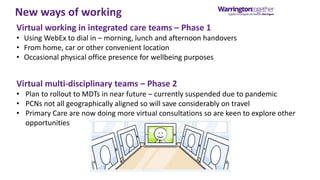
New ways of working
Virtual working in integrated care teams – Phase 1
• Using WebEx to dial in – morning, lunch and afternoon handovers
• From home, car or other convenient location
• Occasional physical office presence for wellbeing purposes
Virtual multi-disciplinary teams – Phase 2
• Plan to rollout to MDTs in near future – currently suspended due to pandemic
• PCNs not all geographically aligned so will save considerably on travel
• Primary Care are now doing more virtual consultations so are keen to explore other
opportunities
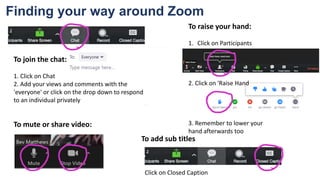
Finding your way around Zoom
To join the chat:
1. Click on Chat
2. Add your views and comments with the
'everyone' or click on the drop down to respond
to an individual privately
To mute or share video:
To raise your hand:
1. Click on Participants
2. Click on 'Raise Hand
3. Remember to lower your
hand afterwards too
To add sub titles
Click on Closed Caption
6 |
In the main
virtual room
• Unless you are a speaker
you will be muted
• Having your camera on is
optional
• Use the chat box as the
main method of
communication
• Raise your virtual hand if
you have a technical
problem
In the breakout
room
• You mute and unmute
yourself: please mute
unless you are speaking
• Have your camera on so
others can see you
• Raise your virtual hand if
you want to vote
7 |
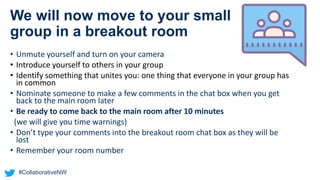
We will now move to your small
group in a breakout room
• Unmute yourself and turn on your camera
• Introduce yourself to others in your group
• Identify something that unites you: one thing that everyone in your group has
in common
• Nominate someone to make a few comments in the chat box when you get
back to the main room later
• Be ready to come back to the main room after 10 minutes
(we will give you time warnings)
• Don’t type your comments into the breakout room chat box as they will be
lost
• Remember your room number
#CollaborativeNW
8 |
Welcome back from the
breakout rooms
Please can one person from each room add “what unites
us” from your conversations to the chat box
#CollaborativeNW
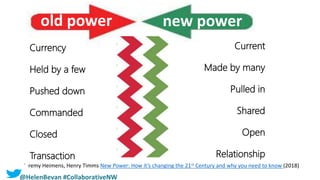
Jeremy Heimens, Henry Timms New Power: How it’s changing the 21st Century and why you need to know (2018)
new power
Current
Made by many
Pulled in
Shared
Open
Relationship
old power
Currency
Held by a few
Pushed down
Commanded
Closed
Transaction
@HelenBevan #CollaborativeNW
10 |10 |
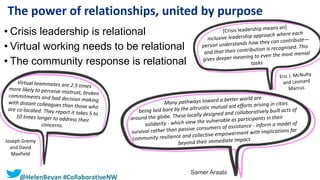
The power of relationships, united by purpose
Joseph Gremy
and David
Maxfield
• Crisis leadership is relational
• Virtual working needs to be relational
• The community response is relational
Samer Araabi
@HelenBevan #CollaborativeNW
11 |
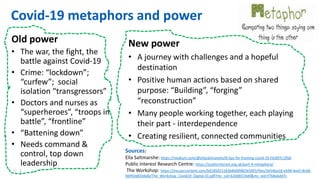
Covid-19 metaphors and power
Sources:
Ella Saltmarshe: https://medium.com/@ellasaltmarshe/8-tips-for-framing-covid-19-f3c897c1ffa6
Public Interest Research Centre: https://publicinterest.org.uk/part-4-metaphors/
The Workshop: https://mcusercontent.com/b0185015163b8400982fe50f3/files/5b54ba18-e698-4ee5-8c68-
9d950d81b6db/The_Workshop_Covid19_Digital.01.pdf?mc_cid=620d8519d0&mc_eid=f7b8a6dd7c
Old power
• The war, the fight, the
battle against Covid-19
• Crime: “lockdown”;
“curfew”; social
isolation “transgressors”
• Doctors and nurses as
“superheroes”, “troops in
battle”, “frontline”
• “Battening down”
• Needs command &
control, top down
leadership
New power
• A journey with challenges and a hopeful
destination
• Positive human actions based on shared
purpose: “Building”, “forging”
“reconstruction”
• Many people working together, each playing
their part - interdependence
• Creating resilient, connected communities
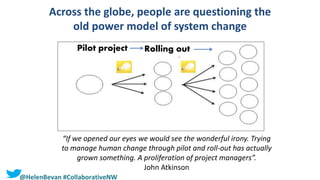
Across the globe, people are questioning the
old power model of system change
Pilot project Rolling out
“If we opened our eyes we would see the wonderful irony. Trying
to manage human change through pilot and roll-out has actually
grown something. A proliferation of project managers”.
John Atkinson
@HelenBevan #CollaborativeNW
13 |
WHO will make the change happen?
Source: adapted by Helen Bevan from Leandro
Herrera
List A
• The Delivery Board
• The programme sponsors
• The CEOS of participating
organisations
• The Programme Management Office
• The Delivery Board work streams
• The Clinical Directors
• The Change Facilitators
14 |
WHO will make the change happen?
List B
• The mavericks and rebels
• The deviants (positive). Who do
things differently and succeed
• The nonconformists who see things
differently
• The hyper-connected who spread
behaviours, role model at a scale, set
mountains on fire and multiply
anything they get their hands on
Source: adapted by Helen Bevan from Leandro
Herrera
List A
• The Delivery Board
• The programme sponsors
• The CEOS of participating
organisations
• The Programme Management Office
• The Delivery Board work streams
• The Clinical Directors
• The Change Facilitators
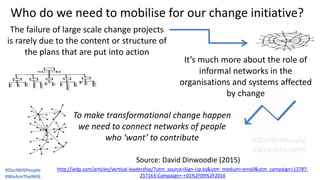
Who do we need to mobilise for our change initiative?
The failure of large scale change projects
is rarely due to the content or structure of
the plans that are put into action
To make transformational change happen
we need to connect networks of people
who ‘want’ to contribute
http://iedp.com/articles/vertical-leadership/?utm_source=Sign-Up.to&utm_medium=email&utm_campaign=13787-
257163-Campaign+-+01%2F09%2F2016
Source: David Dinwoodie (2015)
It’s much more about the role of
informal networks in the
organisations and systems affected
by change
#OurNHSPeople
#WeAreTheNHS
#OurNHSPeople
#WeAreTheNHS
People who are highly connected have
twice as much power to influence
change as people with hierarchical
power
Leandro Herrero
http://t.co/Du6zCbrDBC
@HelenBevan #CollaborativeNW
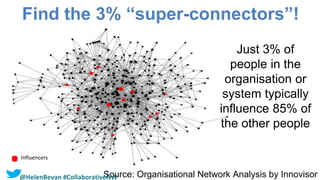
Find the 3% “super-connectors”!
Source: Organisational Network Analysis by Innovisor
Just 3% of
people in the
organisation or
system typically
influence 85% of
the other people
.Influencers
@HelenBevan #CollaborativeNW
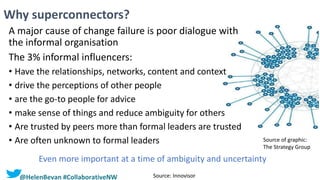
Why superconnectors?
A major cause of change failure is poor dialogue with
the informal organisation
The 3% informal influencers:
• Have the relationships, networks, content and context
• drive the perceptions of other people
• are the go-to people for advice
• make sense of things and reduce ambiguity for others
• Are trusted by peers more than formal leaders are trusted
• Are often unknown to formal leaders
Source: Innovisor
Source of graphic:
The Strategy Group
Even more important at a time of ambiguity and uncertainty
@HelenBevan #CollaborativeNW
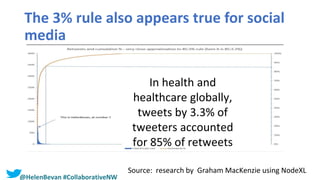
The 3% rule also appears true for social
media
Source: research by Graham MacKenzie using NodeXL
In health and
healthcare globally,
tweets by 3.3% of
tweeters accounted
for 85% of retweets
@HelenBevan #CollaborativeNW
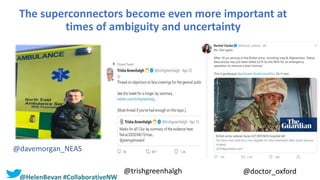
The superconnectors become even more important at
times of ambiguity and uncertainty
@davemorgan_NEAS
@trishgreenhalgh @doctor_oxford
@HelenBevan #CollaborativeNW
Innovisor Evidence-based change
McKinsey Tapping the power of hidden influencers
Mike Klein Internal influencers: actionable and no longer optional
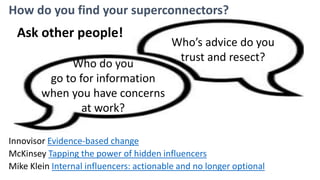
How do you find your superconnectors?
Ask other people!
Who do you
go to for information
when you have concerns
at work?
Who’s advice do you
trust and resect?
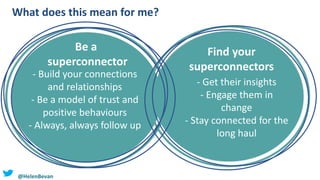
What does this mean for me?
- Build your connections
and relationships
- Be a model of trust and
positive behaviours
- Always, always follow up
Be a
superconnector
- Get their insights
- Engage them in
change
- Stay connected for the
long haul
Find your
superconnectors
@HelenBevan
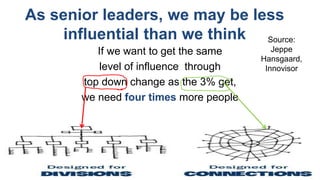
As senior leaders, we may be less
influential than we think
If we want to get the same
level of influence through
top down change as the 3% get,
we need four times more people
Source:
Jeppe
Hansgaard,
Innovisor
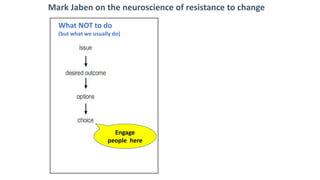
Mark Jaben on the neuroscience of resistance to change
What NOT to do
(but what we usually do)
Engage
people here
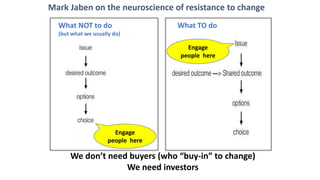
What NOT to do
(but what we usually do)
We don’t need buyers (who “buy-in” to change)
We need investors
What TO do
Engage
people here
Engage
people here
Mark Jaben on the neuroscience of resistance to change
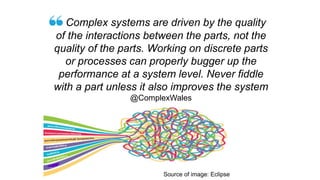
Complex systems are driven by the quality
of the interactions between the parts, not the
quality of the parts. Working on discrete parts
or processes can properly bugger up the
performance at a system level. Never fiddle
with a part unless it also improves the system
@ComplexWales
Source of image: Eclipse
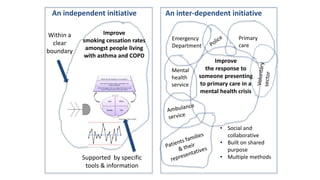
An independent initiative An inter-dependent initiative
Improve
the response to
someone presenting
to primary care in a
mental health crisis
Primary
care
Emergency
Department
Mental
health
service
Supported by specific
tools & information
• Social and
collaborative
• Built on shared
purpose
• Multiple methods
Within a
clear
boundary
Improve
smoking cessation rates
amongst people living
with asthma and COPD
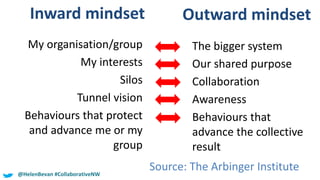
My organisation/group
My interests
Silos
Tunnel vision
Behaviours that protect
and advance me or my
group
The bigger system
Our shared purpose
Collaboration
Awareness
Behaviours that
advance the collective
result
Inward mindset Outward mindset
Source: The Arbinger Institute@HelenBevan #CollaborativeNW
Why shared purpose?
[Shared] purpose goes way deeper
than vision and mission; it goes right into
your gut and taps some part of your primal
self. I believe that if you can bring people with
similar primal-purposes together and get
them all marching in the same direction,
amazing things can be achieved.
Seth Carguilo
Improvement is
anchored in purpose
@HelenBevan #CollaborativeNW
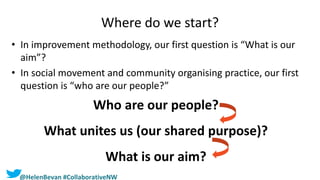
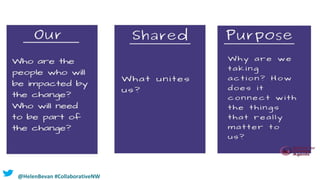
Where do we start?
• In improvement methodology, our first question is “What is our
aim”?
• In social movement and community organising practice, our first
question is “who are our people?”
Who are our people?
What unites us (our shared purpose)?
What is our aim?
@HelenBevan #CollaborativeNW
Who do we need to mobilise for change?
The first question a community organiser asks is “Who are my
people?” not “What is my issue?”
Organising is about enabling the people with the problem to
mobilise their own resources to solve it (and keep it solved).
Marshall Ganz
https://d3n8a8pro7vhmx.cloudfront.net/themes/52e6e37401925b6f9f000002/attachments/
original/1423171411/Organizers_Handbook.pdf?1423171411
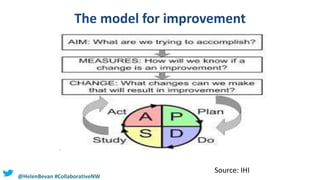
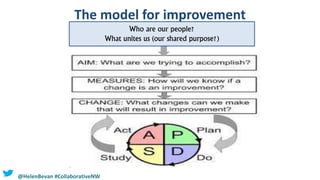
The model for improvement
Source: IHI
@HelenBevan #CollaborativeNW
The model for improvement
Who are our people?
What unites us (our shared purpose?)
@HelenBevan #CollaborativeNW
Don’t confuse PURPOSE with
AIM
• An aim is setting a determined course in order to
achieve a set goal within a specific timescale
• Purpose seeks to make explicit the reason behind
something that is being done. Purpose defines WHY we
are doing what we are doing, and WHAT we hope to
achieve from it
@HelenBevan #CollaborativeNW
We need BOTH but shared purpose comes before aim
Avoiding “de facto” purpose
Source: Delivering Public
Services That Work: The
Vanguard Method in the
Public Sector
• Shared purpose can easily be displaced by a “de
facto” purpose:
 hitting targets, standards or key performance indicators
 reducing costs
 reducing time in hospital
 complying with regulators
 completing activities within a timescale and budget
• If purpose isn’t explicit and shared, then it is very
easy for something else to become a de facto
purpose in the minds of the workforce
• De facto purpose is toxic, leads to burn out and
blocks engagement
“de facto” means
that something
exists in reality even
if it isn’t intended
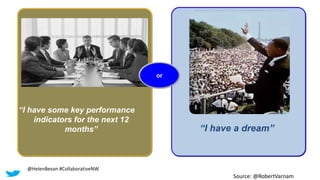
“I have some key performance
indicators for the next 12
months” “I have a dream”
Source: @RobertVarnam
@HelenBevan #CollaborativeNW
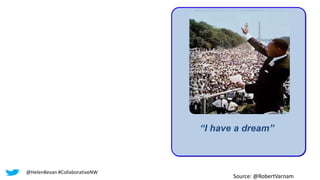
“I have some key performance
indicators for the next 12
months”
or
“I have a dream”
Source: @RobertVarnam
@HelenBevan #CollaborativeNW
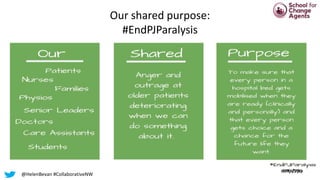
Our shared purpose:
#EndPJParalysis
@HelenBevan #CollaborativeNW
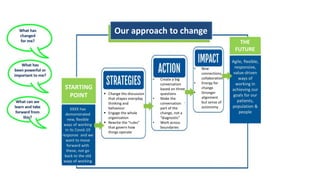
Our approach to change
STARTING
POINT
THE
FUTURE
XXXX has
demonstrated
new, flexible
ways of working
in its Covid-19
response and we
want to move
forward with
these, not go
back to the old
ways of working
 Change the discussion
that shapes everyday
thinking and
behaviour
 Engage the whole
organisation
 Rewrite the “rules”
that govern how
things operate
• Create a big
conversation
based on three
questions
• Make the
conversation
part of the
change, not a
“diagnostic”
• Work across
boundaries
• New
connections,
collaboration
• Energy for
change
• Stronger
alignment
but sense of
autonomy
Agile, flexible,
responsive,
value-driven
ways of
working in
achieving our
goals for our
patients,
population &
people
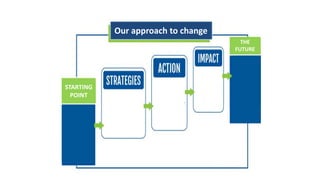
Our approach to change
STARTING
POINT
THE
FUTURE
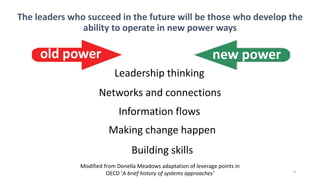
The leaders who succeed in the future will be those who develop the
ability to operate in new power ways
Building skills
Making change happen
Information flows
Networks and connections
Modified from Donella Meadows adaptation of leverage points in
OECD ‘A brief history of systems approaches’ 44
Leadership thinking
Rachel Mellor
Programme Manager
Carole Hugall
Director of Clinical Integration
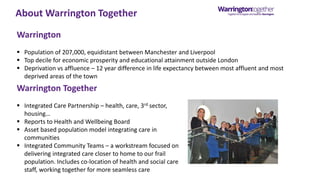
About Warrington Together
Warrington
 Population of 207,000, equidistant between Manchester and Liverpool
 Top decile for economic prosperity and educational attainment outside London
 Deprivation vs affluence – 12 year difference in life expectancy between most affluent and most
deprived areas of the town
Warrington Together
 Integrated Care Partnership – health, care, 3rd sector,
housing…
 Reports to Health and Wellbeing Board
 Asset based population model integrating care in
communities
 Integrated Community Teams – a workstream focused on
delivering integrated care closer to home to our frail
population. Includes co-location of health and social care
staff, working together for more seamless care
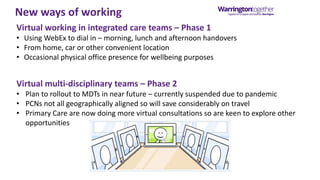
New ways of working
Virtual working in integrated care teams – Phase 1
• Using WebEx to dial in – morning, lunch and afternoon handovers
• From home, car or other convenient location
• Occasional physical office presence for wellbeing purposes
Virtual multi-disciplinary teams – Phase 2
• Plan to rollout to MDTs in near future – currently suspended due to pandemic
• PCNs not all geographically aligned so will save considerably on travel
• Primary Care are now doing more virtual consultations so are keen to explore other
opportunities
New ways of working
Our aims
• Reinstated MDTs to be held virtually by August 2020
• Nominated GP to be in attendance at 80% of MDTs
• Attendance of all professionals to be 80% at MDTs
• Reduction in travel time to MDTs by 100%
• Reduction in travel costs to MDTs by 100%
Key questions
• How do we ensure patient care is not compromised by
holding virtual MDTs?
• How can we measure success?
• How can we ensure relationships are maintained?
• How can we encourage a continuous cycle of innovation?
Reflections

Helen Bevan Masterclass

  • 1.
    NHS England andNHS Improvement to make Helen Bevan @HelenBevan #CollaborativeNW Taking the Power is the ability to produce intended effects Bertrand Russell change happen
  • 2.
    2 |2 | Ouragenda 0945: Welcome to the masterclass 1000: Meet your small group 1010: The main session • Old and new power • How we make change happen using both • Investors not buyers • Building shared purpose • A model for change 1050: Break 1100: Our case study: virtual ICTs and MDTs with Warrington Together 1145: Reflections and close @HelenBevan #CollaborativeNW
  • 3.
    Rachel Mellor Programme Manager CaroleHugall Director of Clinical Integration
  • 4.
    New ways ofworking Virtual working in integrated care teams – Phase 1 • Using WebEx to dial in – morning, lunch and afternoon handovers • From home, car or other convenient location • Occasional physical office presence for wellbeing purposes Virtual multi-disciplinary teams – Phase 2 • Plan to rollout to MDTs in near future – currently suspended due to pandemic • PCNs not all geographically aligned so will save considerably on travel • Primary Care are now doing more virtual consultations so are keen to explore other opportunities
  • 5.
    Finding your wayaround Zoom To join the chat: 1. Click on Chat 2. Add your views and comments with the 'everyone' or click on the drop down to respond to an individual privately To mute or share video: To raise your hand: 1. Click on Participants 2. Click on 'Raise Hand 3. Remember to lower your hand afterwards too To add sub titles Click on Closed Caption
  • 6.
    6 | In themain virtual room • Unless you are a speaker you will be muted • Having your camera on is optional • Use the chat box as the main method of communication • Raise your virtual hand if you have a technical problem In the breakout room • You mute and unmute yourself: please mute unless you are speaking • Have your camera on so others can see you • Raise your virtual hand if you want to vote
  • 7.
    7 | We willnow move to your small group in a breakout room • Unmute yourself and turn on your camera • Introduce yourself to others in your group • Identify something that unites you: one thing that everyone in your group has in common • Nominate someone to make a few comments in the chat box when you get back to the main room later • Be ready to come back to the main room after 10 minutes (we will give you time warnings) • Don’t type your comments into the breakout room chat box as they will be lost • Remember your room number #CollaborativeNW
  • 8.
    8 | Welcome backfrom the breakout rooms Please can one person from each room add “what unites us” from your conversations to the chat box #CollaborativeNW
  • 9.
    Jeremy Heimens, HenryTimms New Power: How it’s changing the 21st Century and why you need to know (2018) new power Current Made by many Pulled in Shared Open Relationship old power Currency Held by a few Pushed down Commanded Closed Transaction @HelenBevan #CollaborativeNW
  • 10.
    10 |10 | Thepower of relationships, united by purpose Joseph Gremy and David Maxfield • Crisis leadership is relational • Virtual working needs to be relational • The community response is relational Samer Araabi @HelenBevan #CollaborativeNW
  • 11.
    11 | Covid-19 metaphorsand power Sources: Ella Saltmarshe: https://medium.com/@ellasaltmarshe/8-tips-for-framing-covid-19-f3c897c1ffa6 Public Interest Research Centre: https://publicinterest.org.uk/part-4-metaphors/ The Workshop: https://mcusercontent.com/b0185015163b8400982fe50f3/files/5b54ba18-e698-4ee5-8c68- 9d950d81b6db/The_Workshop_Covid19_Digital.01.pdf?mc_cid=620d8519d0&mc_eid=f7b8a6dd7c Old power • The war, the fight, the battle against Covid-19 • Crime: “lockdown”; “curfew”; social isolation “transgressors” • Doctors and nurses as “superheroes”, “troops in battle”, “frontline” • “Battening down” • Needs command & control, top down leadership New power • A journey with challenges and a hopeful destination • Positive human actions based on shared purpose: “Building”, “forging” “reconstruction” • Many people working together, each playing their part - interdependence • Creating resilient, connected communities
  • 12.
    Across the globe,people are questioning the old power model of system change Pilot project Rolling out “If we opened our eyes we would see the wonderful irony. Trying to manage human change through pilot and roll-out has actually grown something. A proliferation of project managers”. John Atkinson @HelenBevan #CollaborativeNW
  • 13.
    13 | WHO willmake the change happen? Source: adapted by Helen Bevan from Leandro Herrera List A • The Delivery Board • The programme sponsors • The CEOS of participating organisations • The Programme Management Office • The Delivery Board work streams • The Clinical Directors • The Change Facilitators
  • 14.
    14 | WHO willmake the change happen? List B • The mavericks and rebels • The deviants (positive). Who do things differently and succeed • The nonconformists who see things differently • The hyper-connected who spread behaviours, role model at a scale, set mountains on fire and multiply anything they get their hands on Source: adapted by Helen Bevan from Leandro Herrera List A • The Delivery Board • The programme sponsors • The CEOS of participating organisations • The Programme Management Office • The Delivery Board work streams • The Clinical Directors • The Change Facilitators
  • 15.
    Who do weneed to mobilise for our change initiative? The failure of large scale change projects is rarely due to the content or structure of the plans that are put into action To make transformational change happen we need to connect networks of people who ‘want’ to contribute http://iedp.com/articles/vertical-leadership/?utm_source=Sign-Up.to&utm_medium=email&utm_campaign=13787- 257163-Campaign+-+01%2F09%2F2016 Source: David Dinwoodie (2015) It’s much more about the role of informal networks in the organisations and systems affected by change #OurNHSPeople #WeAreTheNHS #OurNHSPeople #WeAreTheNHS
  • 16.
    People who arehighly connected have twice as much power to influence change as people with hierarchical power Leandro Herrero http://t.co/Du6zCbrDBC @HelenBevan #CollaborativeNW
  • 17.
    Find the 3%“super-connectors”! Source: Organisational Network Analysis by Innovisor Just 3% of people in the organisation or system typically influence 85% of the other people .Influencers @HelenBevan #CollaborativeNW
  • 18.
    Why superconnectors? A majorcause of change failure is poor dialogue with the informal organisation The 3% informal influencers: • Have the relationships, networks, content and context • drive the perceptions of other people • are the go-to people for advice • make sense of things and reduce ambiguity for others • Are trusted by peers more than formal leaders are trusted • Are often unknown to formal leaders Source: Innovisor Source of graphic: The Strategy Group Even more important at a time of ambiguity and uncertainty @HelenBevan #CollaborativeNW
  • 19.
    The 3% rulealso appears true for social media Source: research by Graham MacKenzie using NodeXL In health and healthcare globally, tweets by 3.3% of tweeters accounted for 85% of retweets @HelenBevan #CollaborativeNW
  • 20.
    The superconnectors becomeeven more important at times of ambiguity and uncertainty @davemorgan_NEAS @trishgreenhalgh @doctor_oxford @HelenBevan #CollaborativeNW
  • 21.
    Innovisor Evidence-based change McKinseyTapping the power of hidden influencers Mike Klein Internal influencers: actionable and no longer optional How do you find your superconnectors? Ask other people! Who do you go to for information when you have concerns at work? Who’s advice do you trust and resect?
  • 22.
    What does thismean for me? - Build your connections and relationships - Be a model of trust and positive behaviours - Always, always follow up Be a superconnector - Get their insights - Engage them in change - Stay connected for the long haul Find your superconnectors @HelenBevan
  • 23.
    As senior leaders,we may be less influential than we think If we want to get the same level of influence through top down change as the 3% get, we need four times more people Source: Jeppe Hansgaard, Innovisor
  • 24.
    Mark Jaben onthe neuroscience of resistance to change What NOT to do (but what we usually do) Engage people here
  • 25.
    What NOT todo (but what we usually do) We don’t need buyers (who “buy-in” to change) We need investors What TO do Engage people here Engage people here Mark Jaben on the neuroscience of resistance to change
  • 26.
    Complex systems aredriven by the quality of the interactions between the parts, not the quality of the parts. Working on discrete parts or processes can properly bugger up the performance at a system level. Never fiddle with a part unless it also improves the system @ComplexWales Source of image: Eclipse
  • 27.
    An independent initiativeAn inter-dependent initiative Improve the response to someone presenting to primary care in a mental health crisis Primary care Emergency Department Mental health service Supported by specific tools & information • Social and collaborative • Built on shared purpose • Multiple methods Within a clear boundary Improve smoking cessation rates amongst people living with asthma and COPD
  • 28.
    My organisation/group My interests Silos Tunnelvision Behaviours that protect and advance me or my group The bigger system Our shared purpose Collaboration Awareness Behaviours that advance the collective result Inward mindset Outward mindset Source: The Arbinger Institute@HelenBevan #CollaborativeNW
  • 29.
    Why shared purpose? [Shared]purpose goes way deeper than vision and mission; it goes right into your gut and taps some part of your primal self. I believe that if you can bring people with similar primal-purposes together and get them all marching in the same direction, amazing things can be achieved. Seth Carguilo
  • 30.
    Improvement is anchored inpurpose @HelenBevan #CollaborativeNW
  • 31.
    Where do westart? • In improvement methodology, our first question is “What is our aim”? • In social movement and community organising practice, our first question is “who are our people?” Who are our people? What unites us (our shared purpose)? What is our aim? @HelenBevan #CollaborativeNW
  • 32.
    Who do weneed to mobilise for change? The first question a community organiser asks is “Who are my people?” not “What is my issue?” Organising is about enabling the people with the problem to mobilise their own resources to solve it (and keep it solved). Marshall Ganz https://d3n8a8pro7vhmx.cloudfront.net/themes/52e6e37401925b6f9f000002/attachments/ original/1423171411/Organizers_Handbook.pdf?1423171411
  • 33.
    The model forimprovement Source: IHI @HelenBevan #CollaborativeNW
  • 34.
    The model forimprovement Who are our people? What unites us (our shared purpose?) @HelenBevan #CollaborativeNW
  • 35.
    Don’t confuse PURPOSEwith AIM • An aim is setting a determined course in order to achieve a set goal within a specific timescale • Purpose seeks to make explicit the reason behind something that is being done. Purpose defines WHY we are doing what we are doing, and WHAT we hope to achieve from it @HelenBevan #CollaborativeNW We need BOTH but shared purpose comes before aim
  • 36.
    Avoiding “de facto”purpose Source: Delivering Public Services That Work: The Vanguard Method in the Public Sector • Shared purpose can easily be displaced by a “de facto” purpose:  hitting targets, standards or key performance indicators  reducing costs  reducing time in hospital  complying with regulators  completing activities within a timescale and budget • If purpose isn’t explicit and shared, then it is very easy for something else to become a de facto purpose in the minds of the workforce • De facto purpose is toxic, leads to burn out and blocks engagement “de facto” means that something exists in reality even if it isn’t intended
  • 37.
    “I have somekey performance indicators for the next 12 months” “I have a dream” Source: @RobertVarnam @HelenBevan #CollaborativeNW
  • 38.
    “I have somekey performance indicators for the next 12 months” or “I have a dream” Source: @RobertVarnam @HelenBevan #CollaborativeNW
  • 39.
  • 40.
  • 42.
    Our approach tochange STARTING POINT THE FUTURE XXXX has demonstrated new, flexible ways of working in its Covid-19 response and we want to move forward with these, not go back to the old ways of working  Change the discussion that shapes everyday thinking and behaviour  Engage the whole organisation  Rewrite the “rules” that govern how things operate • Create a big conversation based on three questions • Make the conversation part of the change, not a “diagnostic” • Work across boundaries • New connections, collaboration • Energy for change • Stronger alignment but sense of autonomy Agile, flexible, responsive, value-driven ways of working in achieving our goals for our patients, population & people
  • 43.
    Our approach tochange STARTING POINT THE FUTURE
  • 44.
    The leaders whosucceed in the future will be those who develop the ability to operate in new power ways Building skills Making change happen Information flows Networks and connections Modified from Donella Meadows adaptation of leverage points in OECD ‘A brief history of systems approaches’ 44 Leadership thinking
  • 45.
    Rachel Mellor Programme Manager CaroleHugall Director of Clinical Integration
  • 46.
    About Warrington Together Warrington Population of 207,000, equidistant between Manchester and Liverpool  Top decile for economic prosperity and educational attainment outside London  Deprivation vs affluence – 12 year difference in life expectancy between most affluent and most deprived areas of the town Warrington Together  Integrated Care Partnership – health, care, 3rd sector, housing…  Reports to Health and Wellbeing Board  Asset based population model integrating care in communities  Integrated Community Teams – a workstream focused on delivering integrated care closer to home to our frail population. Includes co-location of health and social care staff, working together for more seamless care
  • 47.
    New ways ofworking Virtual working in integrated care teams – Phase 1 • Using WebEx to dial in – morning, lunch and afternoon handovers • From home, car or other convenient location • Occasional physical office presence for wellbeing purposes Virtual multi-disciplinary teams – Phase 2 • Plan to rollout to MDTs in near future – currently suspended due to pandemic • PCNs not all geographically aligned so will save considerably on travel • Primary Care are now doing more virtual consultations so are keen to explore other opportunities
  • 48.
    New ways ofworking Our aims • Reinstated MDTs to be held virtually by August 2020 • Nominated GP to be in attendance at 80% of MDTs • Attendance of all professionals to be 80% at MDTs • Reduction in travel time to MDTs by 100% • Reduction in travel costs to MDTs by 100% Key questions • How do we ensure patient care is not compromised by holding virtual MDTs? • How can we measure success? • How can we ensure relationships are maintained? • How can we encourage a continuous cycle of innovation?
  • 50.

Editor's Notes

  • #12 SASHA
  • #14 SASHA
  • #15 SASHA
  • #38 Link below http://www.bbc.co.uk/news/magazine-23790147 http://www.bbc.co.uk/learningzone/clips/martin-luther-king-i-have-a-dream-pt-1-2/1293.html With the brooding statue of Abraham Lincoln peering down at him, King began by telling protesters that their presence in the symbolic shadow of the "great emancipator" offered proof of the marvellous new militancy sweeping the country. For too long, he complained, black Americans had been exiles in their own land, "crippled by the manacles of segregation and the chains of discrimination". The whirlwinds of revolt would continue to shake the very foundations of the country: "And those who hope that the Negro needed to blow off steam and will now be content will have a rude awakening if the nation returns to business as normal," King said. It would be fatal for the nation "to overlook the urgency of the moment and to underestimate the determination of the Negro". “He's good - he's damned good” Kennedy on King Wearied by the suffocating heat, the crowd's initial response was muted. The speech was not going well. "Tell 'em about the dream, Martin," shouted Mahalia Jackson, referring to a rhetorical riff that King had used several times before, but which had not made it into his prepared speech because aides insisted he needed fresh material. But King decided to cast aside his prepared notes, and launched extemporaneously into the refrain for which he will forever be remembered. "I have a dream that one day this nation will rise up and live out the true meaning of its creed," he shouted, his out-stretched right arm reaching towards the sky. Soon he was hitting his rhythm, invigorated by the chants and cries of the crowd. "Dream on!" they shouted. "Dream on!" With his voice thundering down the Mall, King imagined a future in which his children could "live in a nation where they will not be judged by the colour of their skin but by the content of their character". Then he reached his impassioned finale. King asked the crowd to yell so it was heard the world over Watching at the White House, the president was riveted. Like so many Americans, it was the first time he had heard the 34-year-old preacher deliver a speech in its entirety - the first time he had taken its measure, listened to its cadence. "He's good," Kennedy told one of his advisors. "He's damned good." The aide was struck, however, that the president seemed impressed more by the quality of King's performance rather than the power of his message.
  • #39 Link below http://www.bbc.co.uk/news/magazine-23790147 http://www.bbc.co.uk/learningzone/clips/martin-luther-king-i-have-a-dream-pt-1-2/1293.html With the brooding statue of Abraham Lincoln peering down at him, King began by telling protesters that their presence in the symbolic shadow of the "great emancipator" offered proof of the marvellous new militancy sweeping the country. For too long, he complained, black Americans had been exiles in their own land, "crippled by the manacles of segregation and the chains of discrimination". The whirlwinds of revolt would continue to shake the very foundations of the country: "And those who hope that the Negro needed to blow off steam and will now be content will have a rude awakening if the nation returns to business as normal," King said. It would be fatal for the nation "to overlook the urgency of the moment and to underestimate the determination of the Negro". “He's good - he's damned good” Kennedy on King Wearied by the suffocating heat, the crowd's initial response was muted. The speech was not going well. "Tell 'em about the dream, Martin," shouted Mahalia Jackson, referring to a rhetorical riff that King had used several times before, but which had not made it into his prepared speech because aides insisted he needed fresh material. But King decided to cast aside his prepared notes, and launched extemporaneously into the refrain for which he will forever be remembered. "I have a dream that one day this nation will rise up and live out the true meaning of its creed," he shouted, his out-stretched right arm reaching towards the sky. Soon he was hitting his rhythm, invigorated by the chants and cries of the crowd. "Dream on!" they shouted. "Dream on!" With his voice thundering down the Mall, King imagined a future in which his children could "live in a nation where they will not be judged by the colour of their skin but by the content of their character". Then he reached his impassioned finale. King asked the crowd to yell so it was heard the world over Watching at the White House, the president was riveted. Like so many Americans, it was the first time he had heard the 34-year-old preacher deliver a speech in its entirety - the first time he had taken its measure, listened to its cadence. "He's good," Kennedy told one of his advisors. "He's damned good." The aide was struck, however, that the president seemed impressed more by the quality of King's performance rather than the power of his message.