Jon Ingham
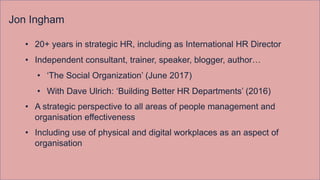
• 20+ years in strategic HR, including as International HR Director
• Independent consultant, trainer, speaker, blogger, author…
• ‘The Social Organization’ (June 2017)
• With Dave Ulrich: ‘Building Better HR Departments’ (2016)
• A strategic perspective to all areas of people management and
organisation effectiveness
• Including use of physical and digital workplaces as an aspect of
organisation
Remote Work and Distributed Organisations
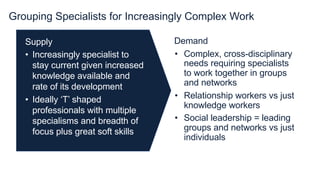
Grouping Specialists for Increasingly Complex Work
Supply
• Increasingly specialist to
stay current given increased
knowledge available and
rate of its development
• Ideally ‘T’ shaped
professionals with multiple
specialisms and breadth of
focus plus great soft skills
Demand
• Complex, cross-disciplinary
needs requiring specialists
to work together in groups
and networks
• Relationship workers vs just
knowledge workers
• Social leadership = leading
groups and networks vs just
individuals
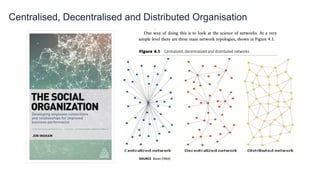
Centralised, Decentralised and Distributed Organisation
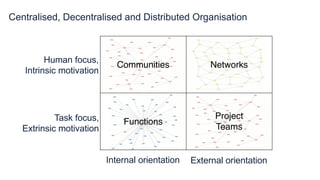
Communities Networks
Functions
Project
Teams
Centralised, Decentralised and Distributed Organisation
Task focus,
Extrinsic motivation
Human focus,
Intrinsic motivation
Internal orientation External orientation
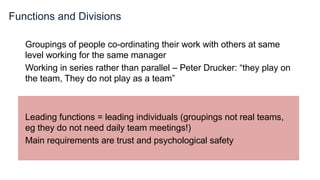
Functions and Divisions
Groupings of people co-ordinating their work with others at same
level working for the same manager
Working in series rather than parallel – Peter Drucker: “they play on
the team, They do not play as a team”
Leading functions = leading individuals (groupings not real teams,
eg they do not need daily team meetings!)
Main requirements are trust and psychological safety
Horizontal Teams
Cross-disciplinary collaboration to deliver outputs
Includes process, project, agile and product management teams
Increasing projectisation in many areas of work
Leading teams = focusing on the team outputs
Ensuring individuals are motivated to help the team
Balancing team and individual focus
Note increasing use of self managed teams
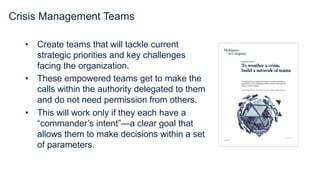
Crisis Management Teams
• Create teams that will tackle current
strategic priorities and key challenges
facing the organization.
• These empowered teams get to make the
calls within the authority delegated to them
and do not need permission from others.
• This will work only if they each have a
“commander’s intent”—a clear goal that
allows them to make decisions within a set
of parameters.
Communities
Small groups with passion for a domain
Cultivation of relationships across members who may decide to
work together
Opportunity for ‘communities of performance’
Leading communities = focusing on the people and the community,
facilitating connection
Henry Mintzberg ‘Communityship’: being personally engaged in
order to engage others, so that anyone and everyone can exercise
initiative.
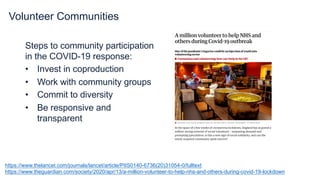
Volunteer Communities
Steps to community participation
in the COVID-19 response:
• Invest in coproduction
• Work with community groups
• Commit to diversity
• Be responsive and
transparent
https://www.thelancet.com/journals/lancet/article/PIIS0140-6736(20)31054-0/fulltext
https://www.theguardian.com/society/2020/apr/13/a-million-volunteer-to-help-nhs-and-others-during-covid-19-lockdown
Distributed Networks
Individuals linked by a common technological / cultural platform who
may decide to co-operate together around a particular domain
Great for sharing information - harder, but not impossible, to
produce outputs
Leading networks = encouraging curiosity and desire to co-operate
(eg by working out loud)
Brokering connections between network members and with other
networks
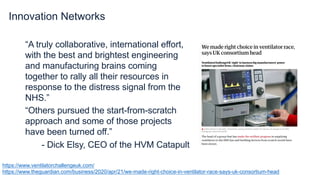
Innovation Networks
“A truly collaborative, international effort,
with the best and brightest engineering
and manufacturing brains coming
together to rally all their resources in
response to the distress signal from the
NHS.”
“Others pursued the start-from-scratch
approach and some of those projects
have been turned off.”
- Dick Elsy, CEO of the HVM Catapult
https://www.ventilatorchallengeuk.com/
https://www.theguardian.com/business/2020/apr/21/we-made-right-choice-in-ventilator-race-says-uk-consortium-head
The Social Organization
Combining functions, teams, communities and networks
Individual employees may often be participants within each type
of group / network
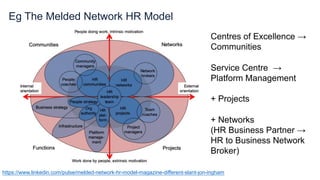
Eg The Melded Network HR Model
https://www.linkedin.com/pulse/melded-network-hr-model-magazine-different-slant-jon-ingham
Centres of Excellence →
Communities
Service Centre →
Platform Management
+ Projects
+ Networks
(HR Business Partner →
HR to Business Network
Broker)
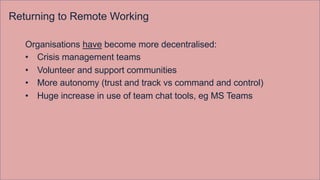
Returning to Remote Working
Organisations have become more decentralised:
• Crisis management teams
• Volunteer and support communities
• More autonomy (trust and track vs command and control)
• Huge increase in use of team chat tools, eg MS Teams
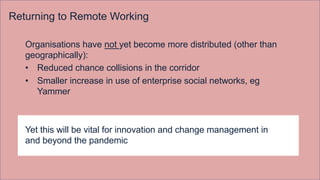
Returning to Remote Working
Organisations have not yet become more distributed (other than
geographically):
• Reduced chance collisions in the corridor
• Smaller increase in use of enterprise social networks, eg
Yammer
Yet this will be vital for innovation and change management in
and beyond the pandemic
For More Information
About me: joningham.com
“Strategic HCM”: strategic-hcm.com / strategic-hcm.blogspot.com
“The Social Organisation”: organization.social /
koganpage.com/SocialOrganization
Social media: linkedin.com/in/joningham, twitter.com/joningham
Email: jon@joningham.com, phone: +44 7904 185134

Hacking HR 'workshop' presentation on distributed vs remote work

  • 2.
    Jon Ingham • 20+years in strategic HR, including as International HR Director • Independent consultant, trainer, speaker, blogger, author… • ‘The Social Organization’ (June 2017) • With Dave Ulrich: ‘Building Better HR Departments’ (2016) • A strategic perspective to all areas of people management and organisation effectiveness • Including use of physical and digital workplaces as an aspect of organisation
  • 3.
    Remote Work andDistributed Organisations
  • 4.
    Grouping Specialists forIncreasingly Complex Work Supply • Increasingly specialist to stay current given increased knowledge available and rate of its development • Ideally ‘T’ shaped professionals with multiple specialisms and breadth of focus plus great soft skills Demand • Complex, cross-disciplinary needs requiring specialists to work together in groups and networks • Relationship workers vs just knowledge workers • Social leadership = leading groups and networks vs just individuals
  • 5.
    Centralised, Decentralised andDistributed Organisation
  • 6.
    Communities Networks Functions Project Teams Centralised, Decentralisedand Distributed Organisation Task focus, Extrinsic motivation Human focus, Intrinsic motivation Internal orientation External orientation
  • 7.
    Functions and Divisions Groupingsof people co-ordinating their work with others at same level working for the same manager Working in series rather than parallel – Peter Drucker: “they play on the team, They do not play as a team” Leading functions = leading individuals (groupings not real teams, eg they do not need daily team meetings!) Main requirements are trust and psychological safety
  • 8.
    Horizontal Teams Cross-disciplinary collaborationto deliver outputs Includes process, project, agile and product management teams Increasing projectisation in many areas of work Leading teams = focusing on the team outputs Ensuring individuals are motivated to help the team Balancing team and individual focus Note increasing use of self managed teams
  • 9.
    Crisis Management Teams •Create teams that will tackle current strategic priorities and key challenges facing the organization. • These empowered teams get to make the calls within the authority delegated to them and do not need permission from others. • This will work only if they each have a “commander’s intent”—a clear goal that allows them to make decisions within a set of parameters.
  • 10.
    Communities Small groups withpassion for a domain Cultivation of relationships across members who may decide to work together Opportunity for ‘communities of performance’ Leading communities = focusing on the people and the community, facilitating connection Henry Mintzberg ‘Communityship’: being personally engaged in order to engage others, so that anyone and everyone can exercise initiative.
  • 11.
    Volunteer Communities Steps tocommunity participation in the COVID-19 response: • Invest in coproduction • Work with community groups • Commit to diversity • Be responsive and transparent https://www.thelancet.com/journals/lancet/article/PIIS0140-6736(20)31054-0/fulltext https://www.theguardian.com/society/2020/apr/13/a-million-volunteer-to-help-nhs-and-others-during-covid-19-lockdown
  • 12.
    Distributed Networks Individuals linkedby a common technological / cultural platform who may decide to co-operate together around a particular domain Great for sharing information - harder, but not impossible, to produce outputs Leading networks = encouraging curiosity and desire to co-operate (eg by working out loud) Brokering connections between network members and with other networks
  • 13.
    Innovation Networks “A trulycollaborative, international effort, with the best and brightest engineering and manufacturing brains coming together to rally all their resources in response to the distress signal from the NHS.” “Others pursued the start-from-scratch approach and some of those projects have been turned off.” - Dick Elsy, CEO of the HVM Catapult https://www.ventilatorchallengeuk.com/ https://www.theguardian.com/business/2020/apr/21/we-made-right-choice-in-ventilator-race-says-uk-consortium-head
  • 14.
    The Social Organization Combiningfunctions, teams, communities and networks Individual employees may often be participants within each type of group / network
  • 15.
    Eg The MeldedNetwork HR Model https://www.linkedin.com/pulse/melded-network-hr-model-magazine-different-slant-jon-ingham Centres of Excellence → Communities Service Centre → Platform Management + Projects + Networks (HR Business Partner → HR to Business Network Broker)
  • 16.
    Returning to RemoteWorking Organisations have become more decentralised: • Crisis management teams • Volunteer and support communities • More autonomy (trust and track vs command and control) • Huge increase in use of team chat tools, eg MS Teams
  • 17.
    Returning to RemoteWorking Organisations have not yet become more distributed (other than geographically): • Reduced chance collisions in the corridor • Smaller increase in use of enterprise social networks, eg Yammer Yet this will be vital for innovation and change management in and beyond the pandemic
  • 18.
    For More Information Aboutme: joningham.com “Strategic HCM”: strategic-hcm.com / strategic-hcm.blogspot.com “The Social Organisation”: organization.social / koganpage.com/SocialOrganization Social media: linkedin.com/in/joningham, twitter.com/joningham Email: jon@joningham.com, phone: +44 7904 185134