E-waste Management
Submitted to, Submitted by,
Prof. AmarNath Gupta Rahul Kumar
E-Waste
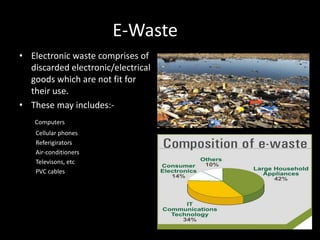
• Electronic waste comprises of
discarded electronic/electrical
goods which are not fit for
their use.
• These may includes:-
Computers
Cellular phones
Referigirators
Air-conditioners
Televisons, etc
PVC cables
Toxic constituents in E-waste
Components Constituents Affected body parts
Printed circuit boards Lead & Cadmium Nervous system and
Kidney
Motherboards Beryllium Lungs and Skin
CRT (Cathode Rode tube) Lead oxide, barium and
cadmium
Heart, liver and
muscles
Flat screen monitors Mercury Brain and skin
Computer Cadmium Kidney and liver
Cable insulating PVC(Polyvinyl Chloride) Immune system
Plastic housing Bromine Endocrine system
E-waste in India
India is the 5th biggest producer of e-waste in the world
India produces nearly 12.5 lakhs million tonnes of e-waste every year
India ranks 155 out of 178 nations in environmental performance Index
India is being used as dumping area for developed nations
E-waste Imports by India Share
USA 42%
CHINA 30%
EUROPE 18%
OTHERS 10%
Issues related to e-waste in India
Issues Explanation
Volume of e-waste generated India stands fifth in e-waste generation producing around 1.7
lakhs metric tonnes per annum
Child labor involvement 4.5 lakh childrens are engaged in e-waste activities without any
safeguards
Ineffective legislation 15 of the 35 PCBs/PCC do not have any information related to E-
waste on their websites
Lack of Infrastructure Lack of recycling facilities
E-waste Imports 80% of e-waste developed by developed nations are sent to some
countries like India , China and Nigeria for recycling
Lack of Incentive schemes No incentive schemes for producers who are doing something to
handle e-waste
Lack of Research Government must encourage research into the development and
standards of hazardous waste management, environmental
monitoring and the regulation of hazardous waste-disposal
E-waste Regulations
Rules and Regulations Nature
The Environmental Protection Act
1986
This Act came into action on 19 nov 1986 (passed in march 1986).It
deals with the protection and Improvement of the human
environment and prevention of hazards to human being.
The Batteries (Management and
Handling) rules 2001
These rules shall apply to every manufacturer, importer, re-
conditioner, assembler, dealer, recycler, auctioneer, consumer and
bulk consumer involved in manufacture, processing, sale, purchase
and use of batteries or components thereof.
The Hazardous Wastes
Management, Handling and Trans
boundary Movement) Rules 2008
Ensure safe handling , generation, processing, treatment, package,
storage, transportation, use reprocessing, collection, conversion,
and offering for sale, destruction and disposal of Hazardous Waste.
The Plastics (Manufacture, Usage
and Waste-management) Rules,
2009
Any person manufacturing or proposing to manufacture carry bags
and multi‐layered plastics shall apply to the State Pollution Control
Board (SPCB) and Pollution Control Committee (PCC) for the grant
of registration or the renewal of registration.
The E-waste (Management and
Handling) Rules, 2011
These rules shall apply to every producer , consumer or bulk
consumer involved in the manufacture, sale, purchase and
processing of electrical and electronic equipment.
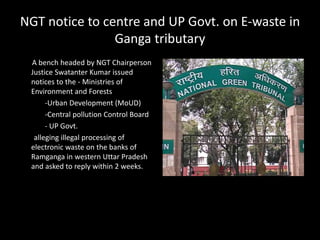
NGT notice to centre and UP Govt. on E-waste in
Ganga tributary
A bench headed by NGT Chairperson
Justice Swatanter Kumar issued
notices to the - Ministries of
Environment and Forests
-Urban Development (MoUD)
-Central pollution Control Board
- UP Govt.
alleging illegal processing of
electronic waste on the banks of
Ramganga in western Uttar Pradesh
and asked to reply within 2 weeks.
• Petition was filed by scientist Mahendra Pandey seeking action against illegal processing
of electronic waste in Moradabad, Bareilly and Shahjahanpur districts of Uttar Pradesh
along river Ramganga, an important tributary of the Ganges. The advocate name was
Gaurav Bansal
• Large numbers of people involvement in unscientific dismantling, crude chemical leaching
of printed circuit boards, burning of wires/waste electrical and electronic components on
the banks of Ramganga.
• Referring to the various studies, the petitioner said that copper levels were five times
higher in five different soil samples collected near Ramganga, while chromium level was
twice the Canadian standard and cadmium was 1.3 times.
• The results were similar for water samples taken from the river where mercury levels were
found to be eight times higher
• The petitioner asked to take strict actions to prohibit electronic waste processing along
river.
• http://indianexpress.com/article/india/centre-up-government-get-ngt-notice-on-e-waste-
in-ganga-tributary-4472736/
• https://www.youtube.com/watch?v=zqai70DNay0
Why E-waste Management?
• To control E-wastes and its effects.
• To conserve natural resources which are present in E-
waste like gold,silver,copper,aluminium,ferrous
metals etc.
• Recovery/reuse of functional peripherals or
components.
• Recycling of constituent materials: Recycle those
components that cannot be repaired.
• Responsible disposal of hazardous and non-
hazardous waste in permitted landfills.
E-waste recycling companies in India
Companies Functions
Attero It is a Roorkee-based e-waste management company,
handles almost 500 tonnes of e-waste per
month. the company currently provides its service to
nearly 100 cities across 22 states in the country.
E-Parisaraa Pvt Ltd India’s first government authorized electronic waste
recycle company which was started in 2005.It is
Bangaluru based company which extracts waste such
as gold and silver and converts them into industrial
raw materials.
Karma Recycling Delhi-based Karma Recycling has launched an e-
portal to offer a simple online electronics trade-in
service, which makes it easy for commoners to resell
or recycle their used electronic devices.
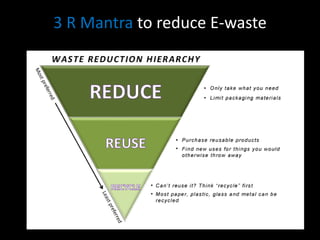
3 R Mantra to reduce E-waste
Responsibility of Govt. on E-waste
management
• Setting up regulatory agencies that are capable of coordinating with the
regulatory functions of the various government pertaining to electronic
waste.
• Government should make stringent laws on the proper disposal and
management of electronic waste by both private and public Institutions.
• Public awareness programs should be conducted at regular intervals in order
create a positive attitude among the public on E-Waste management.
• Encourage Research and Development activities related with E-Waste
Management and release funds if necessary for conducting R & D activities by
private and public research institutions.
• Heavy fines should be imposed on those industries or individuals who does
not follow the E-Waste management principles or dump the E-waste causing
environmental hazards.
• Government should tie up with manufacturers, retailers, industries in
exploring the opportunities in providing recycling services.
Responsibilities of Industries for
proper disposal of E-waste
• Industries that generate E-waste must take responsibility of
determining the source of this electronic waste and if the E-waste is
dangerous must take proper E-waste management policies.
• Properly trained and duly qualified Personnel
• The companies have the necessary freedom to adopt their own E-waste
management policies that may include:Standardizing the components
that can be easily dissembled
• Creating industrial products from bio-degradable materials
• Manufacturers of electronic products have the responsibility for
educating consumers and the public about the possibility of threats
from using their products and giving them instructions on how to avoid
them and the proper disposal of E-waste on event of the end of their
life cycle.
Euro Norms
• Bharat Stage (BS) emission norms are
based on the European norms followed
globally by all automakers across the
globe and act as a good reference point
as to how much does a vehicle pollute.
• signifies the emission regulation
standards set by Indian regulatory
bodies.
• BS-IV norm- For BS-IV compliant
vehicles, BS-IV standard fuel is required.
The government has spent investment
to the tune of thousands of crores over
past years in upgrades of refineries.
• The government has announced intent
in the past to move directly from BS-IV
to BS-VI in the future as there is not
much difference between BS-V and BS-
VI. It plans to bring BS-VI by 2020.
Conclusion
Ewaste is is a relatively new segment in the global problem of waste
removal. It is also the fastest growing segment worldwide in
discarded waste. This growing problem in the world is largely ignored
or misunderstood. Many people do not understand what it is or how
it affects them, the world, or the environment. Much of the ewaste
in developing nations is being exported to developing countries like
India,China,Pakistan and Nigeria etc. The dumping of these
materials following the harvesting of scrap can lead to contamination
of soil or water, damaging an area's environment and potentially
their food sources.
The purpose of this presentation is to make students aware of the
problems intended to increase awareness of this global situation and
encourage students to research not only the problem, but potential
solutions. https://www.youtube.com/watch?v=HzuXQUD9Rkg
Thank you

E waste management

  • 1.
    E-waste Management Submitted to,Submitted by, Prof. AmarNath Gupta Rahul Kumar
  • 2.
    E-Waste • Electronic wastecomprises of discarded electronic/electrical goods which are not fit for their use. • These may includes:- Computers Cellular phones Referigirators Air-conditioners Televisons, etc PVC cables
  • 3.
    Toxic constituents inE-waste Components Constituents Affected body parts Printed circuit boards Lead & Cadmium Nervous system and Kidney Motherboards Beryllium Lungs and Skin CRT (Cathode Rode tube) Lead oxide, barium and cadmium Heart, liver and muscles Flat screen monitors Mercury Brain and skin Computer Cadmium Kidney and liver Cable insulating PVC(Polyvinyl Chloride) Immune system Plastic housing Bromine Endocrine system
  • 4.
    E-waste in India Indiais the 5th biggest producer of e-waste in the world India produces nearly 12.5 lakhs million tonnes of e-waste every year India ranks 155 out of 178 nations in environmental performance Index India is being used as dumping area for developed nations E-waste Imports by India Share USA 42% CHINA 30% EUROPE 18% OTHERS 10%
  • 5.
    Issues related toe-waste in India Issues Explanation Volume of e-waste generated India stands fifth in e-waste generation producing around 1.7 lakhs metric tonnes per annum Child labor involvement 4.5 lakh childrens are engaged in e-waste activities without any safeguards Ineffective legislation 15 of the 35 PCBs/PCC do not have any information related to E- waste on their websites Lack of Infrastructure Lack of recycling facilities E-waste Imports 80% of e-waste developed by developed nations are sent to some countries like India , China and Nigeria for recycling Lack of Incentive schemes No incentive schemes for producers who are doing something to handle e-waste Lack of Research Government must encourage research into the development and standards of hazardous waste management, environmental monitoring and the regulation of hazardous waste-disposal
  • 6.
    E-waste Regulations Rules andRegulations Nature The Environmental Protection Act 1986 This Act came into action on 19 nov 1986 (passed in march 1986).It deals with the protection and Improvement of the human environment and prevention of hazards to human being. The Batteries (Management and Handling) rules 2001 These rules shall apply to every manufacturer, importer, re- conditioner, assembler, dealer, recycler, auctioneer, consumer and bulk consumer involved in manufacture, processing, sale, purchase and use of batteries or components thereof. The Hazardous Wastes Management, Handling and Trans boundary Movement) Rules 2008 Ensure safe handling , generation, processing, treatment, package, storage, transportation, use reprocessing, collection, conversion, and offering for sale, destruction and disposal of Hazardous Waste. The Plastics (Manufacture, Usage and Waste-management) Rules, 2009 Any person manufacturing or proposing to manufacture carry bags and multi‐layered plastics shall apply to the State Pollution Control Board (SPCB) and Pollution Control Committee (PCC) for the grant of registration or the renewal of registration. The E-waste (Management and Handling) Rules, 2011 These rules shall apply to every producer , consumer or bulk consumer involved in the manufacture, sale, purchase and processing of electrical and electronic equipment.
  • 7.
    NGT notice tocentre and UP Govt. on E-waste in Ganga tributary A bench headed by NGT Chairperson Justice Swatanter Kumar issued notices to the - Ministries of Environment and Forests -Urban Development (MoUD) -Central pollution Control Board - UP Govt. alleging illegal processing of electronic waste on the banks of Ramganga in western Uttar Pradesh and asked to reply within 2 weeks.
  • 8.
    • Petition wasfiled by scientist Mahendra Pandey seeking action against illegal processing of electronic waste in Moradabad, Bareilly and Shahjahanpur districts of Uttar Pradesh along river Ramganga, an important tributary of the Ganges. The advocate name was Gaurav Bansal • Large numbers of people involvement in unscientific dismantling, crude chemical leaching of printed circuit boards, burning of wires/waste electrical and electronic components on the banks of Ramganga. • Referring to the various studies, the petitioner said that copper levels were five times higher in five different soil samples collected near Ramganga, while chromium level was twice the Canadian standard and cadmium was 1.3 times. • The results were similar for water samples taken from the river where mercury levels were found to be eight times higher • The petitioner asked to take strict actions to prohibit electronic waste processing along river. • http://indianexpress.com/article/india/centre-up-government-get-ngt-notice-on-e-waste- in-ganga-tributary-4472736/ • https://www.youtube.com/watch?v=zqai70DNay0
  • 9.
    Why E-waste Management? •To control E-wastes and its effects. • To conserve natural resources which are present in E- waste like gold,silver,copper,aluminium,ferrous metals etc. • Recovery/reuse of functional peripherals or components. • Recycling of constituent materials: Recycle those components that cannot be repaired. • Responsible disposal of hazardous and non- hazardous waste in permitted landfills.
  • 11.
    E-waste recycling companiesin India Companies Functions Attero It is a Roorkee-based e-waste management company, handles almost 500 tonnes of e-waste per month. the company currently provides its service to nearly 100 cities across 22 states in the country. E-Parisaraa Pvt Ltd India’s first government authorized electronic waste recycle company which was started in 2005.It is Bangaluru based company which extracts waste such as gold and silver and converts them into industrial raw materials. Karma Recycling Delhi-based Karma Recycling has launched an e- portal to offer a simple online electronics trade-in service, which makes it easy for commoners to resell or recycle their used electronic devices.
  • 12.
    3 R Mantrato reduce E-waste
  • 13.
    Responsibility of Govt.on E-waste management • Setting up regulatory agencies that are capable of coordinating with the regulatory functions of the various government pertaining to electronic waste. • Government should make stringent laws on the proper disposal and management of electronic waste by both private and public Institutions. • Public awareness programs should be conducted at regular intervals in order create a positive attitude among the public on E-Waste management. • Encourage Research and Development activities related with E-Waste Management and release funds if necessary for conducting R & D activities by private and public research institutions. • Heavy fines should be imposed on those industries or individuals who does not follow the E-Waste management principles or dump the E-waste causing environmental hazards. • Government should tie up with manufacturers, retailers, industries in exploring the opportunities in providing recycling services.
  • 14.
    Responsibilities of Industriesfor proper disposal of E-waste • Industries that generate E-waste must take responsibility of determining the source of this electronic waste and if the E-waste is dangerous must take proper E-waste management policies. • Properly trained and duly qualified Personnel • The companies have the necessary freedom to adopt their own E-waste management policies that may include:Standardizing the components that can be easily dissembled • Creating industrial products from bio-degradable materials • Manufacturers of electronic products have the responsibility for educating consumers and the public about the possibility of threats from using their products and giving them instructions on how to avoid them and the proper disposal of E-waste on event of the end of their life cycle.
  • 15.
    Euro Norms • BharatStage (BS) emission norms are based on the European norms followed globally by all automakers across the globe and act as a good reference point as to how much does a vehicle pollute. • signifies the emission regulation standards set by Indian regulatory bodies. • BS-IV norm- For BS-IV compliant vehicles, BS-IV standard fuel is required. The government has spent investment to the tune of thousands of crores over past years in upgrades of refineries. • The government has announced intent in the past to move directly from BS-IV to BS-VI in the future as there is not much difference between BS-V and BS- VI. It plans to bring BS-VI by 2020.
  • 16.
    Conclusion Ewaste is isa relatively new segment in the global problem of waste removal. It is also the fastest growing segment worldwide in discarded waste. This growing problem in the world is largely ignored or misunderstood. Many people do not understand what it is or how it affects them, the world, or the environment. Much of the ewaste in developing nations is being exported to developing countries like India,China,Pakistan and Nigeria etc. The dumping of these materials following the harvesting of scrap can lead to contamination of soil or water, damaging an area's environment and potentially their food sources. The purpose of this presentation is to make students aware of the problems intended to increase awareness of this global situation and encourage students to research not only the problem, but potential solutions. https://www.youtube.com/watch?v=HzuXQUD9Rkg
  • 17.