E-WASTE
HAZARD:
THE
IMPENDING
CHALLENGE
Prepared by: Nikki Rose D. Dapanas
BSES-IV
What is E-waste?...
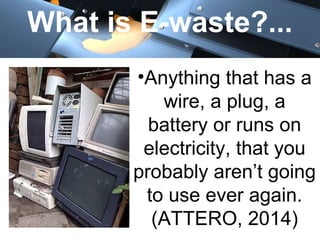
•Anything that has a
wire, a plug, a
battery or runs on
electricity, that you
probably aren’t going
to use ever again.
(ATTERO, 2014)
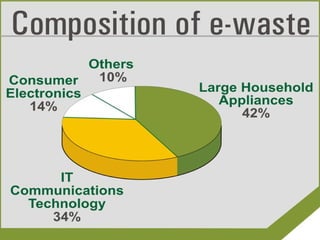
What is E-waste?...
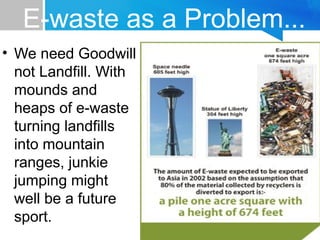
E-waste as a Problem...
• We need Goodwill
not Landfill. With
mounds and
heaps of e-waste
turning landfills
into mountain
ranges, junkie
jumping might
well be a future
sport.
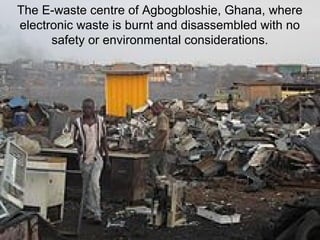
The E-waste centre of Agbogbloshie, Ghana, where
electronic waste is burnt and disassembled with no
safety or environmental considerations.
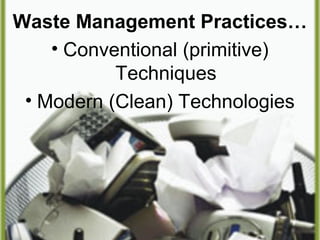
Waste Management Practices…
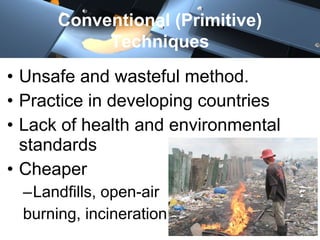
• Conventional (primitive)
Techniques
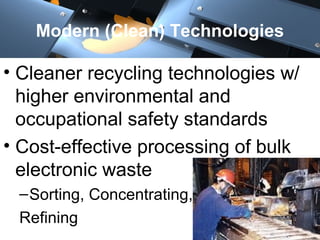
• Modern (Clean) Technologies
• Unsafe and wasteful method.
• Practice in developing countries
• Lack of health and environmental
standards
• Cheaper
–Landfills, open-air
burning, incineration
Conventional (Primitive)
Techniques
Modern (Clean) Technologies
• Cleaner recycling technologies w/
higher environmental and
occupational safety standards
• Cost-effective processing of bulk
electronic waste
–Sorting, Concentrating,
Refining
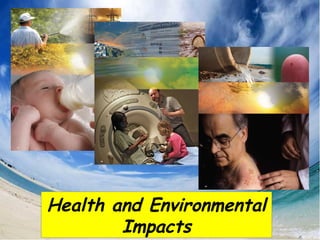
Health and Environmental
Impacts
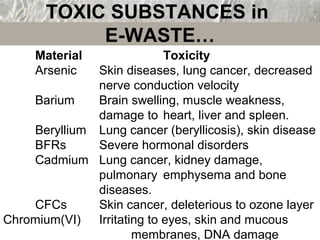
TOXIC SUBSTANCES in
E-WASTE…
Material Toxicity
Arsenic Skin diseases, lung cancer, decreased
nerve conduction velocity
Barium Brain swelling, muscle weakness,
damage to heart, liver and spleen.
Beryllium Lung cancer (beryllicosis), skin disease
BFRs Severe hormonal disorders
Cadmium Lung cancer, kidney damage,
pulmonary emphysema and bone
diseases.
CFCs Skin cancer, deleterious to ozone layer
Chromium(VI) Irritating to eyes, skin and mucous
membranes, DNA damage
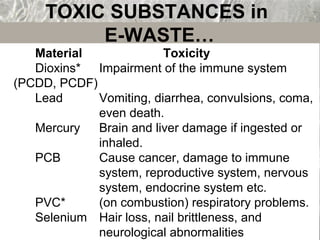
TOXIC SUBSTANCES in
E-WASTE…
Material Toxicity
Dioxins* Impairment of the immune system
(PCDD, PCDF)
Lead Vomiting, diarrhea, convulsions, coma,
even death.
Mercury Brain and liver damage if ingested or
inhaled.
PCB Cause cancer, damage to immune
system, reproductive system, nervous
system, endocrine system etc.
PVC* (on combustion) respiratory problems.
Selenium Hair loss, nail brittleness, and
neurological abnormalities
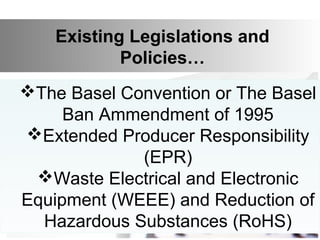
Existing Legislations and
Policies…
The Basel Convention or The Basel
Ban Ammendment of 1995
Extended Producer Responsibility
(EPR)
Waste Electrical and Electronic
Equipment (WEEE) and Reduction of
Hazardous Substances (RoHS)
[ Republic Act No. 9003 ]
• Act providing for :
–ecological solid waste management
program
–creating the necessary institutional
mechanisms and incentives
–declaring certain acts prohibited
–providing penalties, appropriating
funds therefor, and for other
purposes.
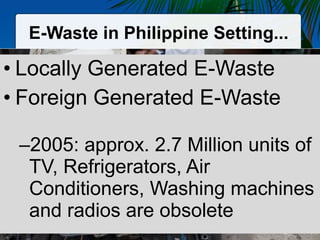
• Locally Generated E-Waste
• Foreign Generated E-Waste
–2005: approx. 2.7 Million units of
TV, Refrigerators, Air
Conditioners, Washing machines
and radios are obsolete
E-Waste in Philippine Setting...
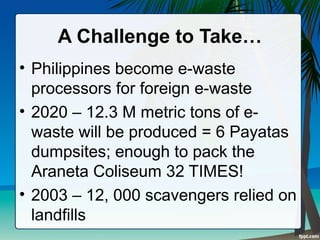
A Challenge to Take…
• Philippines become e-waste
processors for foreign e-waste
• 2020 – 12.3 M metric tons of e-
waste will be produced = 6 Payatas
dumpsites; enough to pack the
Araneta Coliseum 32 TIMES!
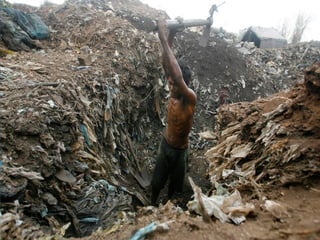
• 2003 – 12, 000 scavengers relied on
landfills
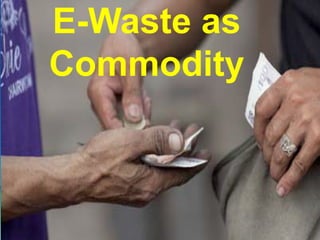
E-Waste as
Commodity
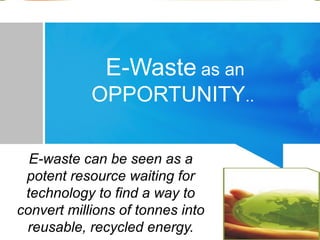
E-Waste as an
OPPORTUNITY..
E-waste can be seen as a
potent resource waiting for
technology to find a way to
convert millions of tonnes into
reusable, recycled energy.
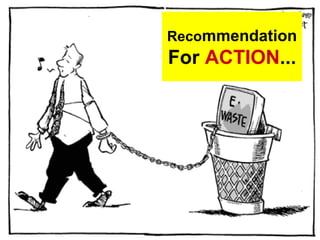
Recommendation
For ACTION...
WHAT CAN
ORGANIZATIONS
DO?
Public Awareness : Eco-
labelling
Ratification of the Basel
Ban Ammendment
Take Back Policy and
Livelihood Assistance
• Necessary
legislation and
strict regulatory
actions
WHAT CAN
INDIVIDUALS
DO?
Consumer Research
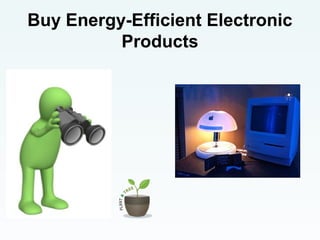
Buy Energy-Efficient Electronic
Products
3 Rs...
• Reduce: what you do need
• Reuse: what you can't reduce
• Recycle: what you can't reuse
Learn, Share & Act
• Learn more about the health effects of
e-waste and practical ways to protect
health now and into the future.
• Share this information with family,
friends and colleagues.
• Take action both to adapt to current
health threats and prevent future
changes.
CONCLUSION...
• Rapid technology change and low initial
cost have resulted in a fast-growing e-
waste problem.
• Legislation, regulatory action and
public awareness can Help.
• Adoption of modern recycling
technologies can help transform the
problem into a multi-million opportunity.
• Philippines is not equipped yet to face
this Challenge
We are all part of
the SOLUTION.
Not of the
PROBLEM.
References...
• Pirzada, M.D. and F.N. Pirzada. 2013. E-Waste:
An Impending Challenge. Pakistan Institute of
Nuclear Science & Technology, P.O. Nilore,
Islamabad, Pakistan
• Rode, S. 2012. E-WASTE MANAGEMENT IN
MUMBAI METROPOLITAN REGION:
CONSTRAINTS AND OPPORTUNITIES.
University of Mumbai, Mumbai, India.
Theoretical and Empirical Researches in Urban
Management Volume 7 Issue 2
References...
• Sthiannopkao S, Wong MH. (2012) Handling e-
waste in developed and developing countries:
Initiatives, practices, and consequences. Sci
Total Environ. China
• ATTERO Electronics Asset Management
Company. 2014. What is E-Waste: Electronic
Waste Generation, Management, Recycling by
Attero. India What%20is%20E%EF%BF
%BDWaste%20%20Electronic%20Waste
%20%20Generation,%20Management,
%20Recycling%20%20Attero%20India.htm
References...
• Gutierrez, R. and A. Gabrielle. 2011. The
Vanishing E-Waste of the Philippines. A
report of Ban Toxics. June 2011.
University of Cebu. Philippines
• SAÑEZ, G.R. 2012 International Workshop on
Management of Waste Electrical and Electronic
Equipment. “E-Waste Management Issues in
the Philippines”. 2012. Howard Civil Service
International House. Taipei, Taiwan.
Environmental Management Bureau
Thank You...God Bless...
Nikki Rose D. Dapanas
Bachelor of Science in Environmental Science IV

Turn off the Toxic Tap

E waste hazard-seminar paper

  • 1.
  • 2.
    What is E-waste?... •Anythingthat has a wire, a plug, a battery or runs on electricity, that you probably aren’t going to use ever again. (ATTERO, 2014)
  • 3.
  • 4.
    E-waste as aProblem... • We need Goodwill not Landfill. With mounds and heaps of e-waste turning landfills into mountain ranges, junkie jumping might well be a future sport.
  • 5.
    The E-waste centreof Agbogbloshie, Ghana, where electronic waste is burnt and disassembled with no safety or environmental considerations.
  • 6.
    Waste Management Practices… •Conventional (primitive) Techniques • Modern (Clean) Technologies
  • 7.
    • Unsafe andwasteful method. • Practice in developing countries • Lack of health and environmental standards • Cheaper –Landfills, open-air burning, incineration Conventional (Primitive) Techniques
  • 8.
    Modern (Clean) Technologies •Cleaner recycling technologies w/ higher environmental and occupational safety standards • Cost-effective processing of bulk electronic waste –Sorting, Concentrating, Refining
  • 9.
  • 10.
    TOXIC SUBSTANCES in E-WASTE… MaterialToxicity Arsenic Skin diseases, lung cancer, decreased nerve conduction velocity Barium Brain swelling, muscle weakness, damage to heart, liver and spleen. Beryllium Lung cancer (beryllicosis), skin disease BFRs Severe hormonal disorders Cadmium Lung cancer, kidney damage, pulmonary emphysema and bone diseases. CFCs Skin cancer, deleterious to ozone layer Chromium(VI) Irritating to eyes, skin and mucous membranes, DNA damage
  • 11.
    TOXIC SUBSTANCES in E-WASTE… MaterialToxicity Dioxins* Impairment of the immune system (PCDD, PCDF) Lead Vomiting, diarrhea, convulsions, coma, even death. Mercury Brain and liver damage if ingested or inhaled. PCB Cause cancer, damage to immune system, reproductive system, nervous system, endocrine system etc. PVC* (on combustion) respiratory problems. Selenium Hair loss, nail brittleness, and neurological abnormalities
  • 12.
    Existing Legislations and Policies… TheBasel Convention or The Basel Ban Ammendment of 1995 Extended Producer Responsibility (EPR) Waste Electrical and Electronic Equipment (WEEE) and Reduction of Hazardous Substances (RoHS)
  • 13.
    [ Republic ActNo. 9003 ] • Act providing for : –ecological solid waste management program –creating the necessary institutional mechanisms and incentives –declaring certain acts prohibited –providing penalties, appropriating funds therefor, and for other purposes.
  • 14.
    • Locally GeneratedE-Waste • Foreign Generated E-Waste –2005: approx. 2.7 Million units of TV, Refrigerators, Air Conditioners, Washing machines and radios are obsolete E-Waste in Philippine Setting...
  • 15.
    A Challenge toTake… • Philippines become e-waste processors for foreign e-waste • 2020 – 12.3 M metric tons of e- waste will be produced = 6 Payatas dumpsites; enough to pack the Araneta Coliseum 32 TIMES! • 2003 – 12, 000 scavengers relied on landfills
  • 17.
  • 18.
    E-Waste as an OPPORTUNITY.. E-wastecan be seen as a potent resource waiting for technology to find a way to convert millions of tonnes into reusable, recycled energy.
  • 19.
  • 20.
  • 21.
    Public Awareness :Eco- labelling
  • 22.
    Ratification of theBasel Ban Ammendment
  • 23.
    Take Back Policyand Livelihood Assistance
  • 24.
  • 25.
  • 26.
  • 27.
  • 28.
    3 Rs... • Reduce:what you do need • Reuse: what you can't reduce • Recycle: what you can't reuse
  • 29.
    Learn, Share &Act • Learn more about the health effects of e-waste and practical ways to protect health now and into the future. • Share this information with family, friends and colleagues. • Take action both to adapt to current health threats and prevent future changes.
  • 30.
    CONCLUSION... • Rapid technologychange and low initial cost have resulted in a fast-growing e- waste problem. • Legislation, regulatory action and public awareness can Help. • Adoption of modern recycling technologies can help transform the problem into a multi-million opportunity. • Philippines is not equipped yet to face this Challenge
  • 31.
    We are allpart of the SOLUTION. Not of the PROBLEM.
  • 32.
    References... • Pirzada, M.D.and F.N. Pirzada. 2013. E-Waste: An Impending Challenge. Pakistan Institute of Nuclear Science & Technology, P.O. Nilore, Islamabad, Pakistan • Rode, S. 2012. E-WASTE MANAGEMENT IN MUMBAI METROPOLITAN REGION: CONSTRAINTS AND OPPORTUNITIES. University of Mumbai, Mumbai, India. Theoretical and Empirical Researches in Urban Management Volume 7 Issue 2
  • 33.
    References... • Sthiannopkao S,Wong MH. (2012) Handling e- waste in developed and developing countries: Initiatives, practices, and consequences. Sci Total Environ. China • ATTERO Electronics Asset Management Company. 2014. What is E-Waste: Electronic Waste Generation, Management, Recycling by Attero. India What%20is%20E%EF%BF %BDWaste%20%20Electronic%20Waste %20%20Generation,%20Management, %20Recycling%20%20Attero%20India.htm
  • 34.
    References... • Gutierrez, R.and A. Gabrielle. 2011. The Vanishing E-Waste of the Philippines. A report of Ban Toxics. June 2011. University of Cebu. Philippines • SAÑEZ, G.R. 2012 International Workshop on Management of Waste Electrical and Electronic Equipment. “E-Waste Management Issues in the Philippines”. 2012. Howard Civil Service International House. Taipei, Taiwan. Environmental Management Bureau
  • 35.
    Thank You...God Bless... NikkiRose D. Dapanas Bachelor of Science in Environmental Science IV  Turn off the Toxic Tap