This document discusses e-waste and green computing. It defines e-waste as electronic products that are no longer working or obsolete, containing toxic materials. E-waste is generated from technology advances and short product lifecycles. Green computing aims to reduce hazardous materials and maximize energy efficiency throughout a product's lifecycle, including recycling. Some approaches are green disposal, design, manufacturing and use. Tips for individuals include using sleep/power save modes, LCD monitors, notebooks, and refilling cartridges.
CONTENT
What is ElectronicWaste?
How this become E-Waste?
Generators of E-Waste.
Methods of E-Waste
disposal.
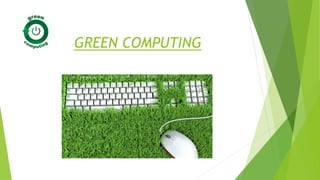
What is Green Computing?
Goals of Green Computing.
Approaches towards Green
computing.
Tips for Green Computing.
Conclusion.
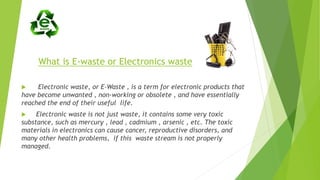
What is E-wasteor Electronics waste
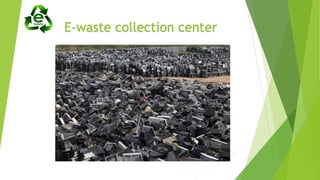
Electronic waste, or E-Waste , is a term for electronic products that
have become unwanted , non-working or obsolete , and have essentially
reached the end of their useful life.
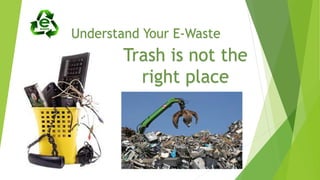
Electronic waste is not just waste, it contains some very toxic
substance, such as mercury , lead , cadmium , arsenic , etc. The toxic
materials in electronics can cause cancer, reproductive disorders, and
many other health problems, if this waste stream is not properly
managed.
5.
How This BecomeE-Waste?
Changes and Advancement in Technology.
Changes in Fashion, Style and Status.
Attractive offers from Manufacturers.
Small life of equipment's.
6.
Generators Of E-Waste
Small business and households.
Large Businesses.
Institutions and Government offices
Equipment Manufacturers.
Green Computing, also called Green technology , is the
environmentally responsible use of computers and related
resources.
It is the practice of using computer resources efficiently.
Designing manufacturing , disposing computers , servers
with no impact on the environment.
To reduce the use of hazardous materials , thus
maximizing energy efficiency during product’s lifetime.
What Is Green Computing?
16.
Reduce useof hazardous materials.
Maximize energy efficiency during the product’s lifetime.
Promoting RECYCLABILITY of defect products and factory
waste.
Goals of Green Computing
17.
Approaches towards GreenComputing
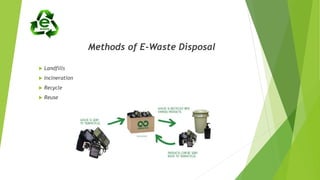
Green disposal: Re-purposing an existing computer or appropriately
disposing of, or recycling, unwanted electronic equipment.
Green design: Designing energy efficient computers , servers ,
printers , projectors and other digital devices.
Green manufacturing: Minimizing waste during the manufacturing
of computers and other subsystems to reduce the environmental
impact of these activities.
Green Use: Minimizing the electricity consumption of computers and
their peripheral devices and using them in an eco-friendly manner.
18.
Tips For GreenComputing
Use sleep mode when away from a computer for extended
periods.
Use flat-screen or LCD monitors , instead of conventional
cathode ray tube (CRT) monitors.
Buy energy efficient notebook computers , instead of
desktop computers.
Turn off computers at the end of each day.
Refill printer cartridges , rather than buying new ones.
Instead of purchasing a new computer , try refurbishing an
existing device.
19.
Conclusion
By going“green” in technology we help to promote an ecofriendly
and cleaner environment , along with our own benefits by reducing
costs , conserving energy , cutting down of waste