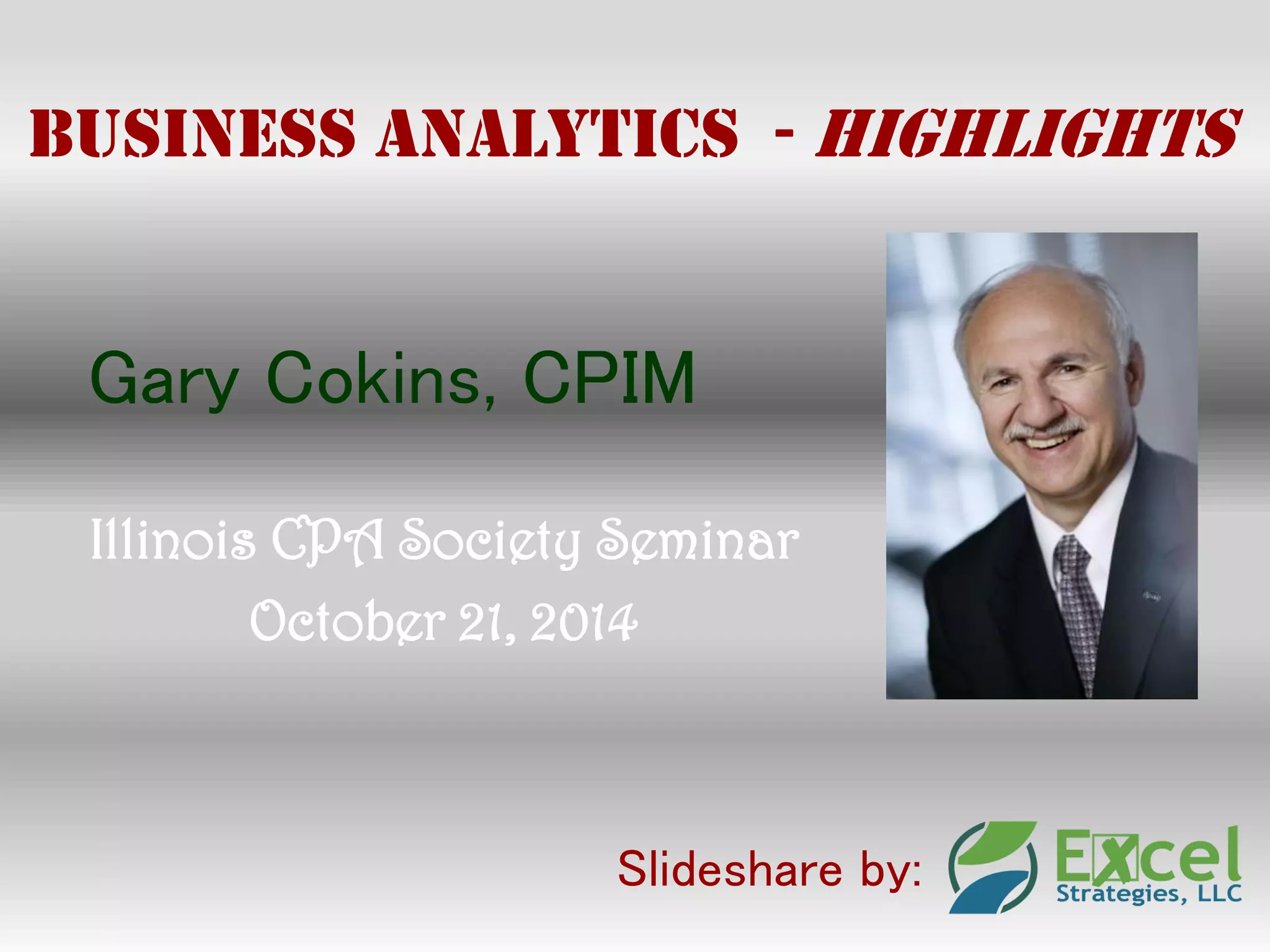
Business Analytics - Highlights 
Gary Cokins, CPIM 
Illinois CPA Society Seminar 
October 21, 2014 
Slideshare by:
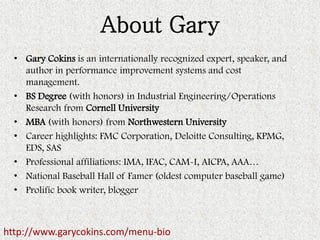
About Gary 
•Gary Cokins is an internationally recognized expert, speaker, and author in performance improvement systems and cost management. 
•BS Degree (with honors) in Industrial Engineering/Operations Research from Cornell University 
•MBA (with honors) from Northwestern University 
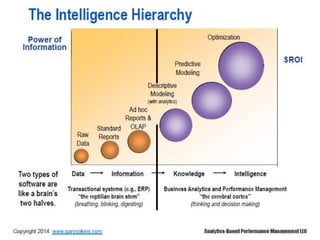
•Career highlights: FMC Corporation, Deloitte Consulting, KPMG, EDS, SAS 
•Professional affiliations: IMA, IFAC, CAM-I, AICPA, AAA… 
•National Baseball Hall of Famer (oldest computer baseball game) 
•Prolific book writer, blogger 
http://www.garycokins.com/menu-bio
Gary Cokins, CPIM 
Analytics-Based Performance Management LLC 
Cary, North Carolina USA 
www.garycokins.com 
919.720.2718 
gcokins@garycokins.com 
Contact Gary
“40% of important decisions are not based on facts but rather on intuition, experience, and anecdotal evidence.” 
Jeanne X. Harris, Accenture 
Why Business Analytics?
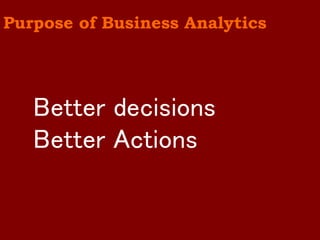
Better decisions 
Better Actions 
Purpose of Business Analytics
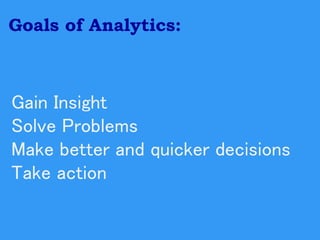
Goals of Analytics: 
Gain Insight 
Solve Problems 
Make better and quicker decisions 
Take action
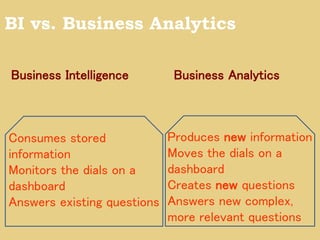
BI vs. Business Analytics 
Business Intelligence 
Business Analytics 
Consumes stored information 
Monitors the dials on a dashboard 
Answers existing questions 
Produces new information 
Moves the dials on a dashboard 
Creates new questions 
Answers new complex, more relevant questions
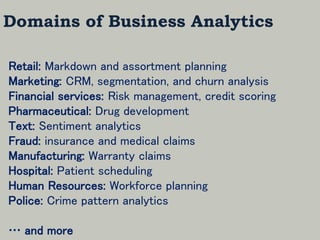
Domains of Business Analytics 
Retail: Markdown and assortment planning Marketing: CRM, segmentation, and churn analysis Financial services: Risk management, credit scoring Pharmaceutical: Drug development Text: Sentiment analytics Fraud: insurance and medical claims Manufacturing: Warranty claims Hospital: Patient scheduling Human Resources: Workforce planning Police: Crime pattern analytics … and more
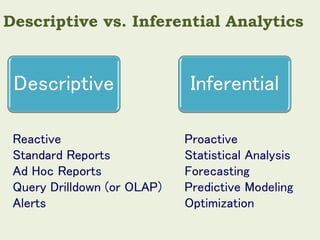
Descriptive vs. Inferential Analytics 
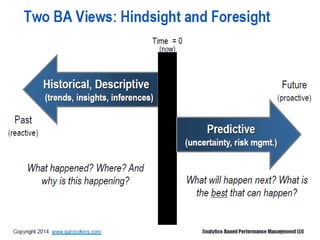
Reactive 
Standard Reports 
Ad Hoc Reports 
Query Drilldown (or OLAP) 
Alerts 
Proactive 
Statistical Analysis 
Forecasting 
Predictive Modeling 
Optimization 
Descriptive 
Inferential
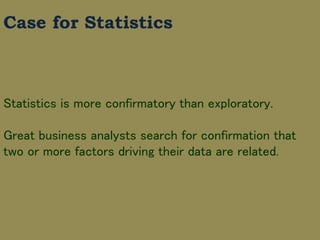
Statistics is more confirmatory than exploratory. 
Great business analysts search for confirmation that two or more factors driving their data are related. 
Case for Statistics
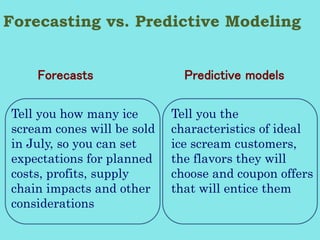
Forecasting vs. Predictive Modeling 
Forecasts 
Predictive models 
Tell you how many ice scream cones will be sold in July, so you can set expectations for planned costs, profits, supply chain impacts and other considerations 
Tell you the characteristics of ideal ice scream customers, the flavors they will choose and coupon offers that will entice them
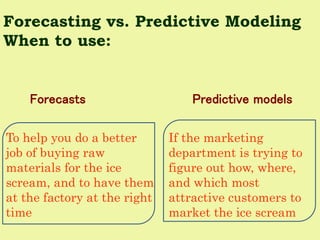
Forecasting vs. Predictive Modeling 
When to use: 
Forecasts 
Predictive models 
To help you do a better job of buying raw materials for the ice scream, and to have them at the factory at the right time 
If the marketing department is trying to figure out how, where, and which most attractive customers to market the ice scream
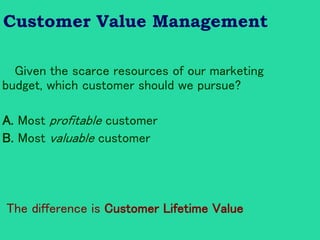
Given the scarce resources of our marketing budget, which customer should we pursue? 
A. Most profitable customer 
B. Most valuable customer 
The difference is Customer Lifetime Value 
Customer Value Management
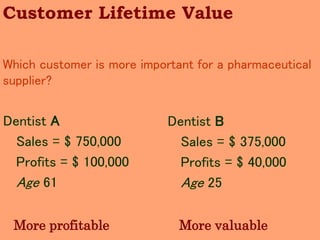
Which customer is more important for a pharmaceutical supplier? 
Customer Lifetime Value 
Dentist A 
Sales = $ 750,000 
Profits = $ 100,000 
Age 61 
Dentist B 
Sales = $ 375,000 
Profits = $ 40,000 
Age 25 
More profitable 
More valuable
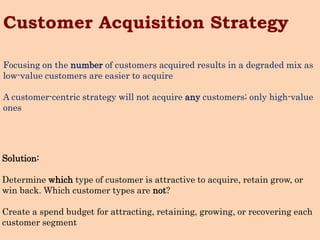
Focusing on the number of customers acquired results in a degraded mix as low-value customers are easier to acquire 
A customer-centric strategy will not acquire any customers; only high-value ones 
Customer Acquisition Strategy 
Solution: 
Determine which type of customer is attractive to acquire, retain grow, or win back. Which customer types are not? 
Create a spend budget for attracting, retaining, growing, or recovering each customer segment
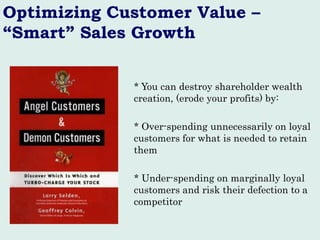
Optimizing Customer Value – “Smart” Sales Growth 
* You can destroy shareholder wealth creation, (erode your profits) by: 
* Over-spending unnecessarily on loyal customers for what is needed to retain them 
* Under-spending on marginally loyal customers and risk their defection to a competitor
Role of Analytics 
Analysts must overcome hunches and gut-feel guesses by others, and prove which actions yield the highest financial returns
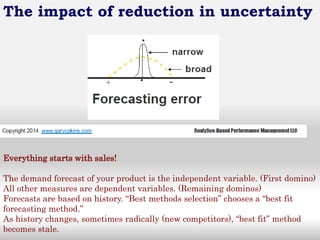
The impact of reduction in uncertainty 
Everything starts with sales! 
The demand forecast of your product is the independent variable. (First domino) 
All other measures are dependent variables. (Remaining dominos) 
Forecasts are based on history. “Best methods selection” chooses a “best fit forecasting method.” 
As history changes, sometimes radically (new competitors), “best fit” method becomes stale.
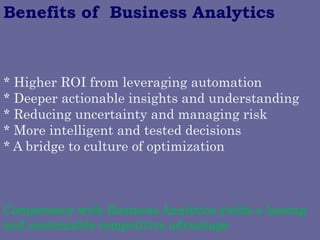
* Higher ROI from leveraging automation 
* Deeper actionable insights and understanding 
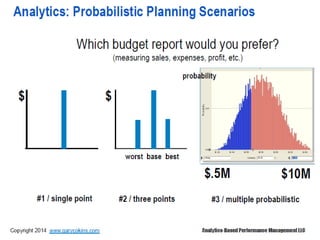
* Reducing uncertainty and managing risk 
* More intelligent and tested decisions 
* A bridge to culture of optimization 
Benefits of Business Analytics 
Competency with Business Analytics yields a lasting and sustainable competitive advantage
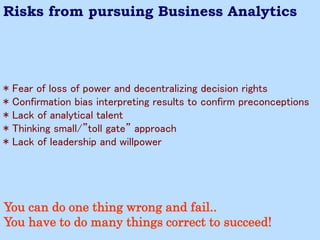
* Fear of loss of power and decentralizing decision rights 
* Confirmation bias interpreting results to confirm preconceptions 
* Lack of analytical talent 
* Thinking small/”toll gate” approach 
* Lack of leadership and willpower 
Risks from pursuing Business Analytics 
You can do one thing wrong and fail.. You have to do many things correct to succeed!
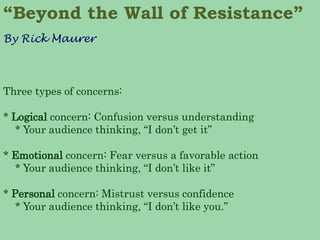
Three types of concerns: 
* Logical concern: Confusion versus understanding 
* Your audience thinking, “I don’t get it” 
* Emotional concern: Fear versus a favorable action 
* Your audience thinking, “I don’t like it” 
* Personal concern: Mistrust versus confidence 
* Your audience thinking, “I don’t like you.” 
“Beyond the Wall of Resistance” 
By Rick Maurer
Technical barriers include IT-related issues 
Perception barriers are excess complexity and affordability 
Design deficiencies include poor measurements or their calculations and weak models and assumptions 
Organizational behavior barriers involve resistance to change, culture, leadership 
Barrier categories
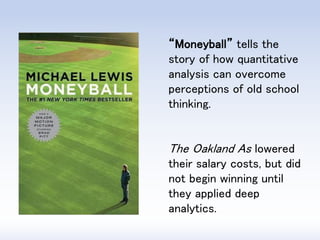
“Moneyball” tells the story of how quantitative analysis can overcome perceptions of old school thinking. 
The Oakland As lowered their salary costs, but did not begin winning until they applied deep analytics.
@ExcelStrategies 
http://www.ExcelStrategiesLLC.com 
http://Blog.ExcelStrategiesLLC.com 
http://Twitter.com/ExcelStrategies 
http://Google.com/+ExcelStrategiesLLC1 
http://LinkedIn.com/in/ExcelStrategies 
http://YouTube.com/user/ExcelStrategies 
Blog.ExcelStrategiesLLC.com 
+ExcelStrategiesLLC1 
ExcelStrategies 
ExcelStrategies

Business Analytics and Decision Making

  • 1.
    Business Analytics -Highlights Gary Cokins, CPIM Illinois CPA Society Seminar October 21, 2014 Slideshare by:
  • 2.
    About Gary •GaryCokins is an internationally recognized expert, speaker, and author in performance improvement systems and cost management. •BS Degree (with honors) in Industrial Engineering/Operations Research from Cornell University •MBA (with honors) from Northwestern University •Career highlights: FMC Corporation, Deloitte Consulting, KPMG, EDS, SAS •Professional affiliations: IMA, IFAC, CAM-I, AICPA, AAA… •National Baseball Hall of Famer (oldest computer baseball game) •Prolific book writer, blogger http://www.garycokins.com/menu-bio
  • 3.
    Gary Cokins, CPIM Analytics-Based Performance Management LLC Cary, North Carolina USA www.garycokins.com 919.720.2718 gcokins@garycokins.com Contact Gary
  • 4.
    “40% of importantdecisions are not based on facts but rather on intuition, experience, and anecdotal evidence.” Jeanne X. Harris, Accenture Why Business Analytics?
  • 5.
    Better decisions BetterActions Purpose of Business Analytics
  • 6.
    Goals of Analytics: Gain Insight Solve Problems Make better and quicker decisions Take action
  • 7.
    BI vs. BusinessAnalytics Business Intelligence Business Analytics Consumes stored information Monitors the dials on a dashboard Answers existing questions Produces new information Moves the dials on a dashboard Creates new questions Answers new complex, more relevant questions
  • 8.
    Domains of BusinessAnalytics Retail: Markdown and assortment planning Marketing: CRM, segmentation, and churn analysis Financial services: Risk management, credit scoring Pharmaceutical: Drug development Text: Sentiment analytics Fraud: insurance and medical claims Manufacturing: Warranty claims Hospital: Patient scheduling Human Resources: Workforce planning Police: Crime pattern analytics … and more
  • 9.
    Descriptive vs. InferentialAnalytics Reactive Standard Reports Ad Hoc Reports Query Drilldown (or OLAP) Alerts Proactive Statistical Analysis Forecasting Predictive Modeling Optimization Descriptive Inferential
  • 10.
    Statistics is moreconfirmatory than exploratory. Great business analysts search for confirmation that two or more factors driving their data are related. Case for Statistics
  • 11.
    Forecasting vs. PredictiveModeling Forecasts Predictive models Tell you how many ice scream cones will be sold in July, so you can set expectations for planned costs, profits, supply chain impacts and other considerations Tell you the characteristics of ideal ice scream customers, the flavors they will choose and coupon offers that will entice them
  • 12.
    Forecasting vs. PredictiveModeling When to use: Forecasts Predictive models To help you do a better job of buying raw materials for the ice scream, and to have them at the factory at the right time If the marketing department is trying to figure out how, where, and which most attractive customers to market the ice scream
  • 13.
    Given the scarceresources of our marketing budget, which customer should we pursue? A. Most profitable customer B. Most valuable customer The difference is Customer Lifetime Value Customer Value Management
  • 14.
    Which customer ismore important for a pharmaceutical supplier? Customer Lifetime Value Dentist A Sales = $ 750,000 Profits = $ 100,000 Age 61 Dentist B Sales = $ 375,000 Profits = $ 40,000 Age 25 More profitable More valuable
  • 15.
    Focusing on thenumber of customers acquired results in a degraded mix as low-value customers are easier to acquire A customer-centric strategy will not acquire any customers; only high-value ones Customer Acquisition Strategy Solution: Determine which type of customer is attractive to acquire, retain grow, or win back. Which customer types are not? Create a spend budget for attracting, retaining, growing, or recovering each customer segment
  • 16.
    Optimizing Customer Value– “Smart” Sales Growth * You can destroy shareholder wealth creation, (erode your profits) by: * Over-spending unnecessarily on loyal customers for what is needed to retain them * Under-spending on marginally loyal customers and risk their defection to a competitor
  • 17.
    Role of Analytics Analysts must overcome hunches and gut-feel guesses by others, and prove which actions yield the highest financial returns
  • 18.
    The impact ofreduction in uncertainty Everything starts with sales! The demand forecast of your product is the independent variable. (First domino) All other measures are dependent variables. (Remaining dominos) Forecasts are based on history. “Best methods selection” chooses a “best fit forecasting method.” As history changes, sometimes radically (new competitors), “best fit” method becomes stale.
  • 22.
    * Higher ROIfrom leveraging automation * Deeper actionable insights and understanding * Reducing uncertainty and managing risk * More intelligent and tested decisions * A bridge to culture of optimization Benefits of Business Analytics Competency with Business Analytics yields a lasting and sustainable competitive advantage
  • 23.
    * Fear ofloss of power and decentralizing decision rights * Confirmation bias interpreting results to confirm preconceptions * Lack of analytical talent * Thinking small/”toll gate” approach * Lack of leadership and willpower Risks from pursuing Business Analytics You can do one thing wrong and fail.. You have to do many things correct to succeed!
  • 24.
    Three types ofconcerns: * Logical concern: Confusion versus understanding * Your audience thinking, “I don’t get it” * Emotional concern: Fear versus a favorable action * Your audience thinking, “I don’t like it” * Personal concern: Mistrust versus confidence * Your audience thinking, “I don’t like you.” “Beyond the Wall of Resistance” By Rick Maurer
  • 25.
    Technical barriers includeIT-related issues Perception barriers are excess complexity and affordability Design deficiencies include poor measurements or their calculations and weak models and assumptions Organizational behavior barriers involve resistance to change, culture, leadership Barrier categories
  • 26.
    “Moneyball” tells thestory of how quantitative analysis can overcome perceptions of old school thinking. The Oakland As lowered their salary costs, but did not begin winning until they applied deep analytics.
  • 27.
    @ExcelStrategies http://www.ExcelStrategiesLLC.com http://Blog.ExcelStrategiesLLC.com http://Twitter.com/ExcelStrategies http://Google.com/+ExcelStrategiesLLC1 http://LinkedIn.com/in/ExcelStrategies http://YouTube.com/user/ExcelStrategies Blog.ExcelStrategiesLLC.com +ExcelStrategiesLLC1 ExcelStrategies ExcelStrategies