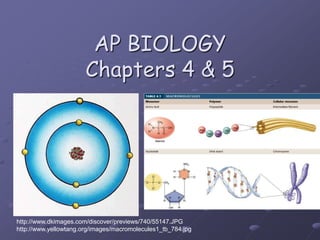
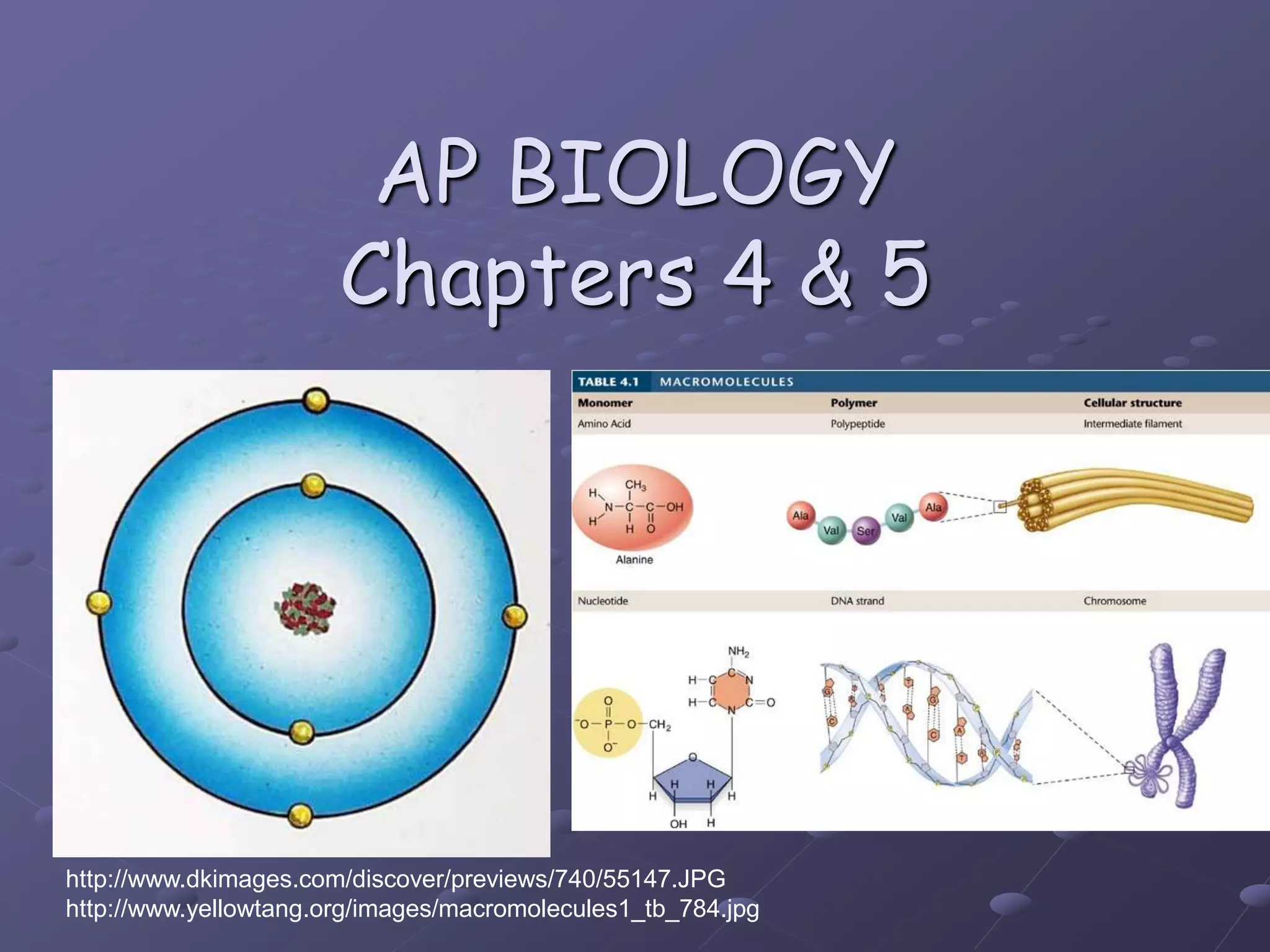
AP BIOLOGYChapters 4 & 5http://www.dkimages.com/discover/previews/740/55147.JPGhttp://www.yellowtang.org/images/macromolecules1_tb_784.jpg
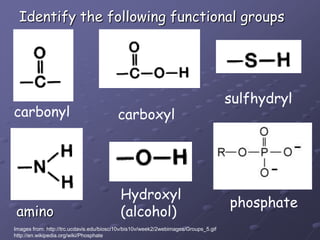
Identify the following functional groupssulfhydrylcarbonylcarboxylHydroxyl(alcohol)phosphateaminoImages from: http://trc.ucdavis.edu/biosci10v/bis10v/week2/2webimages/Groups_5.gifhttp://en.wikipedia.org/wiki/Phosphate
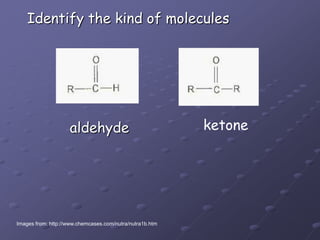
Identify the kind of moleculesketonealdehydeImages from: http://www.chemcases.com/nutra/nutra1b.htm
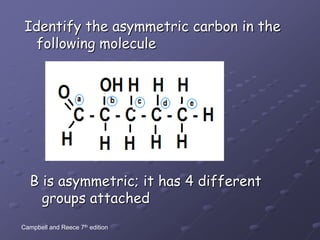
Identify the asymmetric carbon in the following moleculeB is asymmetric; it has 4 different groups attachedCampbell and Reece 7th edition
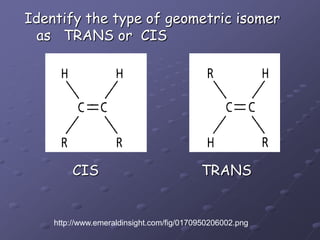
Identify the type of geometric isomeras   TRANS or  CISCIS                        TRANShttp://www.emeraldinsight.com/fig/0170950206002.png
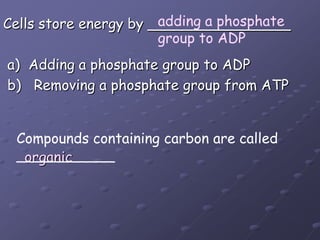
adding a phosphate group to ADPCells store energy by ________________ a)  Adding a phosphate group to ADP b)   Removing a phosphate group from ATPCompounds containing carbon are called___________organic
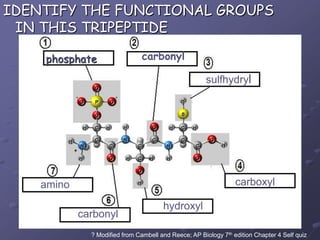
IDENTIFY THE FUNCTIONAL GROUPS IN THIS TRIPEPTIDEcarbonylphosphatesulfhydrylcarboxylaminohydroxylcarbonyl? Modified from Cambell and Reece; AP Biology 7th edition Chapter 4 Self quiz
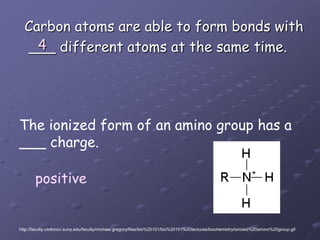
Carbon atoms are able to form bonds with ___ different atoms at the same time.4The ionized form of an amino group has a___ charge.positivehttp://faculty.clintoncc.suny.edu/faculty/michael.gregory/files/bio%20101/bio%20101%20lectures/biochemistry/ionized%20amino%20group.gif
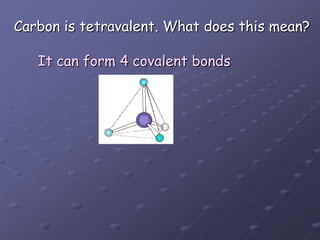
Carbon is tetravalent. What does this mean?It can form 4 covalent bonds
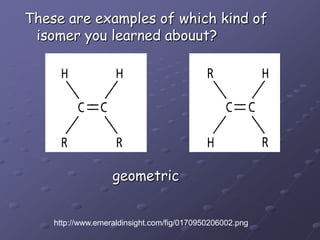
These are examples of which kind of isomer you learned abouut?geometrichttp://www.emeraldinsight.com/fig/0170950206002.png
Molecules that are mirror images of each other that differ in spatial arrangement around an asymmetric carbon are called ________________Enantiomers (stereoisomers)How are isomers are different from isotopes?ISOMERS are molecules with the same molecular formula but different structuresISOTOPES are atoms with the same number of protons but different numbers of neutrons
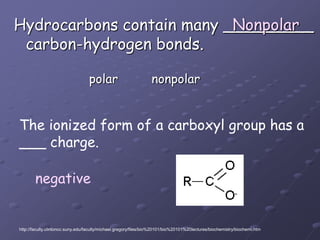
Hydrocarbons contain many _________carbon-hydrogen bonds.                 polar         nonpolarNonpolarThe ionized form of a carboxyl group has a___ charge.negativehttp://faculty.clintoncc.suny.edu/faculty/michael.gregory/files/bio%20101/bio%20101%20lectures/biochemistry/biochemi.htm
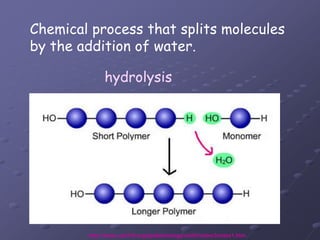
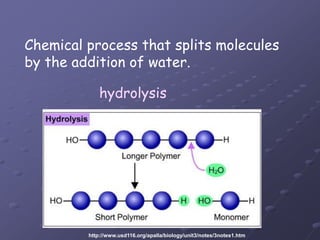
Chemical process that splits molecules by the addition of water.hydrolysishttp://www.usd116.org/apalla/biology/unit3/notes/3notes1.htm
Chemical reaction in which two molecules covalently bond to each other with the removal of a water moleculeCondensation reaction (Dehydration synthesis)Name the four main classes  ofbiological macromoleculesProteins, lipids, carbohydrates, nucleic acids
The simplest sugars are called________________monosaccharidesGLYCOGEN_____________ is the highly branchedpolysaccharide used by animal cells tostore glucose. NONPOLARLipids are____________ moleculespolar   nonpolar
Chemical process that splits molecules by the addition of water.hydrolysishttp://www.usd116.org/apalla/biology/unit3/notes/3notes1.htm
Molecules made of two monosaccharidesare called ______________dissaccharidesThe subunits joined to make proteinsare _______________ amino acidsThe major polysaccharide component found in plant cell walls is_____________________cellulose
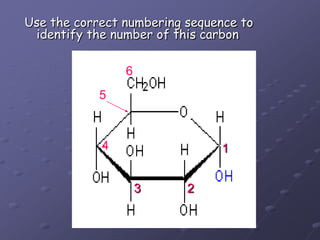
64123Use the correct numbering sequence to identify the number of this carbon5
Carbohydrates made from joining manysugar molecules together are called____________________polysaccharidesGlucose and fructose can be joined to makesucrose via a ___________________ reaction.dehydration synthesis
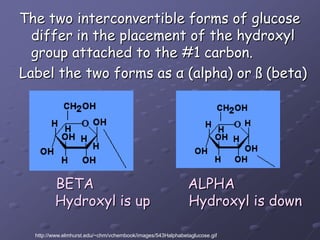
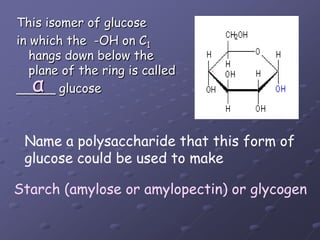
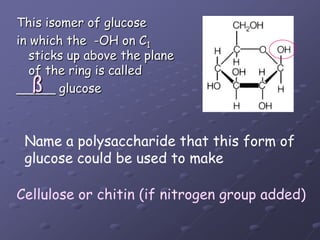
The two interconvertible forms of glucose differ in the placement of the hydroxyl group attached to the #1 carbon.Label the two forms as α (alpha) orß (beta)   BETA                      ALPHA      Hydroxyl is up         Hydroxyl is downhttp://www.elmhurst.edu/~chm/vchembook/images/543Halphabetaglucose.gif
Amylose and amylopectin are both forms of _____________starchHow are these different?Amylose is unbranched and joined onlyby  α  1,4 linkagesAmylopectin is branched with 1,6 linkagesat the branch points
How are starch and cellulose different?Starch is made up of glucose rings in the α (alpha) form joined by  1,4 linkages; helical; can be branched; humans can digest thisCellulose is made up of glucose rings in the ß (beta) form so every other glucose is upside down the respect to its neighbors; joined with 1,4 linkages; straight-never branched; hydrogen bonds join parallel molecules into microfibrils; humans can’t digest this
A structural polysaccharide of plant cell walls, consisting of glucose monomers joined by β-1, 4-glycosidic linkages. celluloseWhere is chitin found in nature?Cell walls of fungi; exoskeletons of arthropods
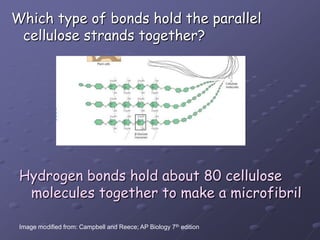
Which type of bonds hold the parallel cellulose strands together?Hydrogen bonds hold about 80 cellulose molecules together to make a microfibrilImage modified from: Campbell and Reece; AP Biology 7th edition
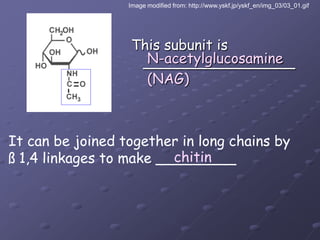
Image modified from: http://www.yskf.jp/yskf_en/img_03/03_01.gifThis subunit is _________________N-acetylglucosamine(NAG)It can be joined together in long chains by ß 1,4 linkages to make _________chitin
Which kind of fatty acids have kinks in their shape so that they don’t pack closely together-  saturated or unsaturated?unsaturatedAnother name for a triacylglycerol moleculefat
What kind of bond is a disulfide bridge?ionic      covalent         hydrogencovalentA fatty acid possessing one or more doublebonds between carbons in the hydrocarbontail is called _______________unsaturated
Which type of bonds hold the parallel cellulose strands together?Hydrogen bondsA fatty acid in which all carbons in thehydrocarbon tail are connected by singlebonds is called _______________saturated
The subunit used to make starch, cellulose, and glycogen is __________glucoseThe sequence of amino acids in a proteinis called the ________ structurePrimary 1o
The polysaccharide made up of glucose subunits with a nitrogen containing group attached which is used to build the exoskeletons of arthropods is called_______________chitinA fat is made up of one ________ moleculeand three ___________ molecules.                     glycerolfatty acid
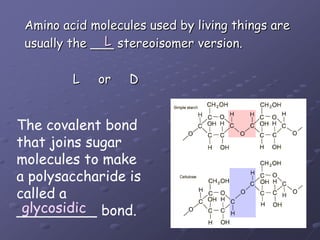
Amino acid molecules used by living things areusually the ___ stereoisomer version.             L     or     DLThe covalent bondthat joins sugarmolecules to make a polysaccharide iscalled a_________ bond.glycosidic
The alpha helix coiling and beta pleated sheet shapes seen in proteins is called the _____________ structure. Secondary 2oWhich kinds of bond holds these together?Hydrogen bonds between the C=O ofone amino acid and the N-H of another
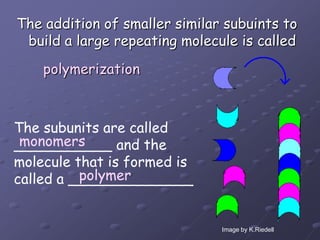
The addition of smaller similar subuints to build a large repeating molecule is called polymerizationThe subunits are called___________ and themolecule that is formed iscalled a ______________monomers              polymerImage by K.Riedell
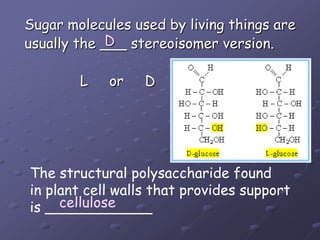
Sugar molecules used by living things areusually the ___ stereoisomer version.             L     or     DDThe structural polysaccharide foundin plant cell walls that provides supportis ____________cellulose
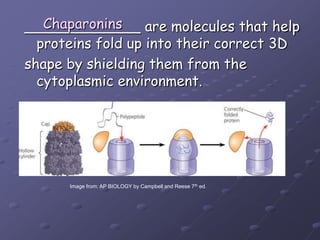
Chaparonins_____________ are molecules that help proteins fold up into their correct 3Dshape by shielding them from the cytoplasmic environment.Image from: AP BIOLOGY by Campbell and Reese 7th ed.
Sugars with 6 carbons are called_______________hexosesSucrose is made by joining which 2 sugars?Glucose + fructose = sucrose
Sugars made from 2 sugar monomers are called __________________disaccharidesName one of the polysaccharides you learned about.Glycogen, starch, cellulose, chitin
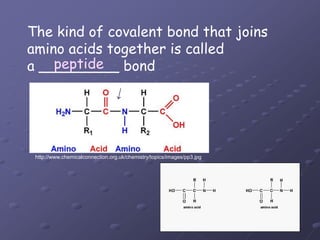
The kind of covalent bond that joins amino acids together is called a _________ bondpeptide->http://www.chemicalconnection.org.uk/chemistry/topics/images/pp3.jpg
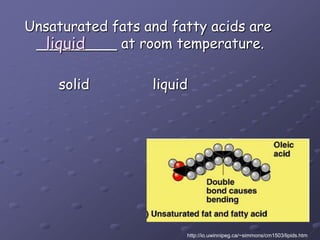
Unsaturated fats and fatty acids are _________ at room temperature.        solid		liquidliquidhttp://io.uwinnipeg.ca/~simmons/cm1503/lipids.htm
The folding of a protein molecule into its 3D shape due to the interactions of R side chains involved hydrophobic interactions, ionic bonds, hydrogen bonds, an disulfide bridges result in its ___________ structure.Tertiary 3o
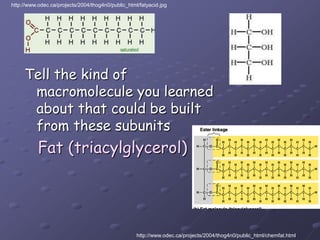
http://www.odec.ca/projects/2004/thog4n0/public_html/fatyacid.jpgTell the kind of macromolecule you learned about that could be built from these subunitsFat (triacylglycerol)http://www.odec.ca/projects/2004/thog4n0/public_html/chemfat.html
This isomer of glucosein which the  -OH on C1 hangs down below the plane of the ring is called _____ glucoseαName a polysaccharide that this form ofglucose could be used to makeStarch (amylose or amylopectin) or glycogen
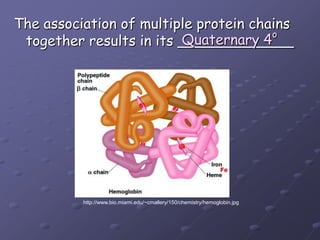
The association of multiple protein chainstogether results in its _____________Quaternary 4ohttp://www.bio.miami.edu/~cmallery/150/chemistry/hemoglobin.jpg
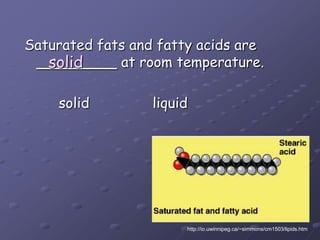
Saturated fats and fatty acids are _________ at room temperature.        solid		liquidsolidhttp://io.uwinnipeg.ca/~simmons/cm1503/lipids.htm
This isomer of glucosein which the  -OH on C1 sticks up above the plane of the ring is called _____ glucoseßName a polysaccharide that this form ofglucose could be used to makeCellulose or chitin (if nitrogen group added)
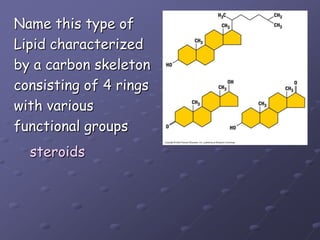
Name this type ofLipid characterizedby a carbon skeletonconsisting of 4 ringswith variousfunctional groupssteroids
Sugar molecules with 6 carbons arecalled ________ hexosesWhich nitrogen base is not found in RNA?thymine
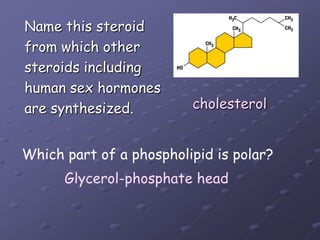
Name this steroidfrom which othersteroids includinghuman sex hormonesare synthesized.cholesterolWhich part of a phospholipid is polar?Glycerol-phosphate head
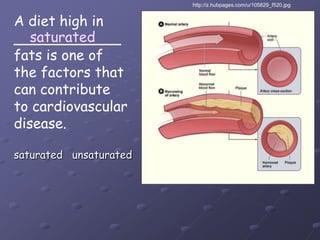
http://z.hubpages.com/u/105829_f520.jpgA diet high in____________fats is one of the factors that can contribute to cardiovasculardisease.saturatedsaturated   unsaturated
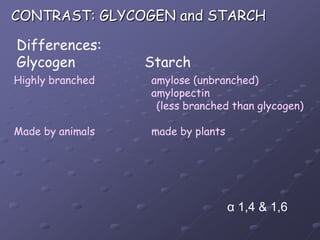
CONTRAST: GLYCOGEN and STARCHDifferences:Glycogen 			Starch	Highly branched		   amylose (unbranched)				   amylopectin                                             (less branched than glycogen)Made by animals		   made by plantsα 1,4 & 1,6
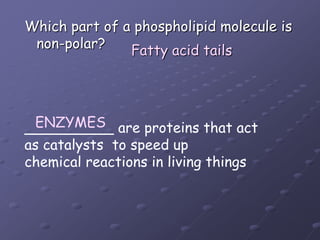
Which part of a phospholipid molecule is non-polar?Fatty acid tailsENZYMES__________ are proteins that act as catalysts  to speed upchemical reactions in living things
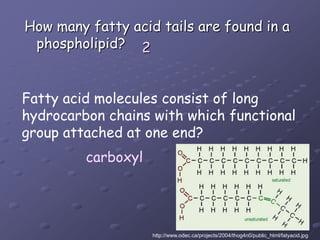
How many fatty acid tails are found in a phospholipid?2Fatty acid molecules consist of long hydrocarbon chains with which functionalgroup attached at one end?carboxylhttp://www.odec.ca/projects/2004/thog4n0/public_html/fatyacid.jpg
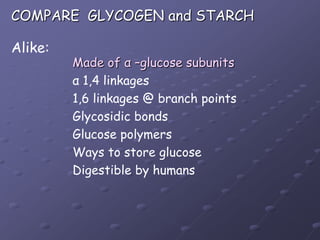
COMPARE  GLYCOGEN and STARCHAlike:Made of α –glucose subunitsα 1,4 linkages1,6 linkages @ branch pointsGlycosidic bondsGlucose polymersWays to store glucoseDigestible by humans
Which of the four biomolecule groups you learned is hydrophobic?lipidsAnother name for a fat is____________________triacylglycerol
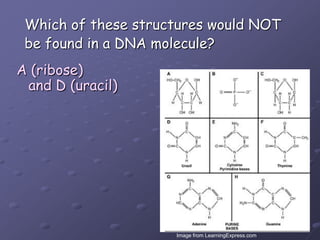
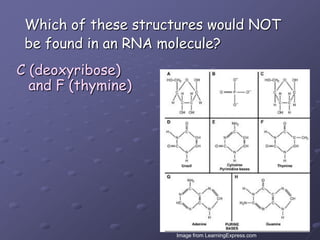
Which of these structures would NOTbe found in a DNA molecule?A (ribose)and D (uracil)Image from LearningExpress.com
Dehydration synthesis is also called____________ reaction.condensationWhich nitrogen base is not found in DNA?uracil
The addition of a phosphate group to ADP____________ energy.      stores                releasesstoresOrganic chemistry is the branch of chemistrythat studies molecules that contain _______ carbon
The removal of a phosphate group from ATP to form  ADP____________ energy.      stores                releasesreleasesTRUE or FALSEL and D stereoisomers have the samechemical properties because they contain the same number and kinds of atoms
TRUE or FALSEL and D stereoisomers have the samechemical properties because they contain the same number and kinds of atomsFALSEL and D enantiomers can have very differentchemical properties.Ex: L-Dopa is a drug used to treat Parkinson’s disease, but D-Dopa has no effect on patients.Thalidomide- one enantiomer of used to treat morning       sickness; other form caused birth defects
Name the structural polysaccharidefound in the cell walls of plants thatprovides supportcellulosePolymers of amino acids are called______________polypeptides
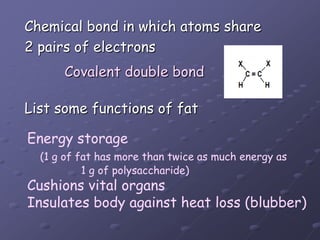
Chemical bond in which atoms share2 pairs of electronsList some functions of fatCovalent double bondEnergy storage (1 g of fat has more than twice as much energy as                  1 g of polysaccharide)Cushions vital organsInsulates body against heat loss (blubber)
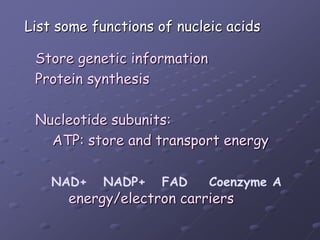
List some functions of nucleic acidsStore genetic informationProtein synthesisNucleotide subunits:    ATP: store and transport energy   NAD+   NADP+   FAD    Coenzyme A     energy/electron carriers
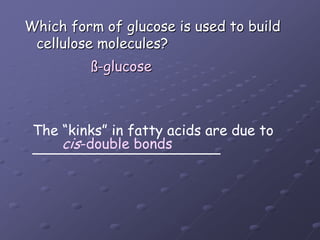
Which form of glucose is used to buildcellulose molecules?ß-glucoseThe “kinks” in fatty acids are due to_____________________cis-double bonds
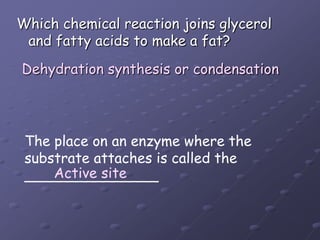
Which chemical reaction joins glycerol and fatty acids to make a fat?Dehydration synthesis or condensationThe place on an enzyme where the substrate attaches is called the_______________Active site
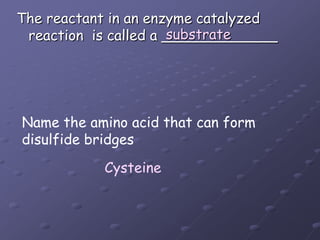
The reactant in an enzyme catalyzed reaction  is called a _____________substrateName the amino acid that can form disulfide bridgesCysteine
Which functional group is responsible for the formation of disulfide bridges?-SH  sulfhydrylThe unwinding and loss of conformationin proteins is called _____________ denaturing
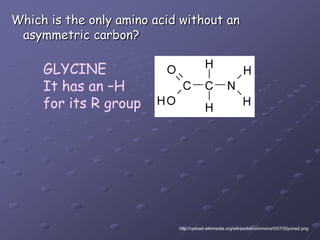
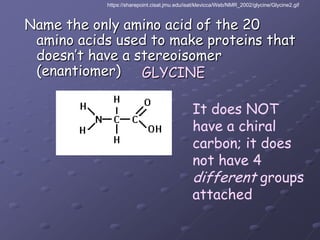
GLYCINEIt has an –Hfor its R groupWhich is the only amino acid without anasymmetric carbon?http://upload.wikimedia.org/wikipedia/commons/0/07/Glycine2.png
Name an environmental factor that can cause proteins to denaturepH extremesSalt concentrationTemperature (heat)TRUE or FALSEDenaturing in proteins is due to the disruption of peptide bondsFalse; 1° remains intact but hydrogen bonds, ionic bonds and disulfide bridges in 2° & 3°are disrupted
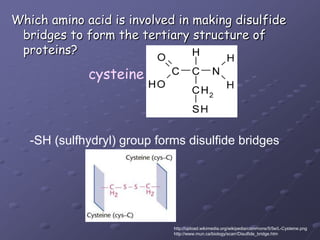
cysteine-SH (sulfhydryl) group forms disulfide bridgesWhich amino acid is involved in making disulfidebridges to form the tertiary structure of proteins?http://upload.wikimedia.org/wikipedia/commons/5/5e/L-Cysteine.pnghttp://www.mun.ca/biology/scarr/Disulfide_bridge.htm
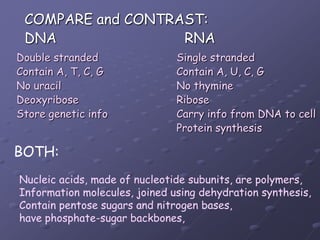
COMPARE and CONTRAST:DNA				RNADouble stranded			Single strandedContain A, T, C, G			Contain A, U, C, GNo uracil				No thymineDeoxyribose				Ribose Store genetic info			Carry info from DNA to cell						Protein synthesisBOTH:Nucleic acids, made of nucleotide subunits, are polymers,Information molecules, joined using dehydration synthesis,Contain pentose sugars and nitrogen bases, have phosphate-sugar backbones,
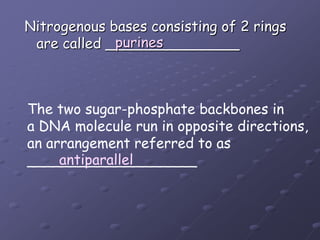
Nitrogenous bases consisting of 2 ringsare called _______________purinesThe two sugar-phosphate backbones ina DNA molecule run in opposite directions, an arrangement referred to as___________________antiparallel
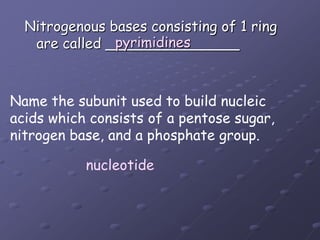
Nitrogenous bases consisting of 1 ringare called _______________pyrimidinesName the subunit used to build nucleic acids which consists of a pentose sugar, nitrogen base, and a phosphate group.nucleotide
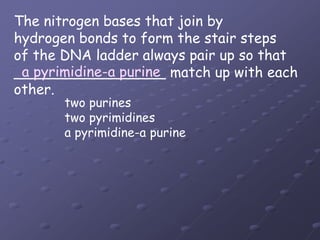
The nitrogen bases that join byhydrogen bonds to form the stair stepsof the DNA ladder always pair up so that_________________ match up with each other.a pyrimidine-a purinetwo purinestwo pyrimidinesa pyrimidine-a purine
Give an example of a pyrimidineCytosine (C), Thymine (T) and Uracil (U)In a DNA molecule guanine always pairs upwith _____________cytosine
Which of these structures would NOTbe found in an RNA molecule?C (deoxyribose)and F (thymine)Image from LearningExpress.com
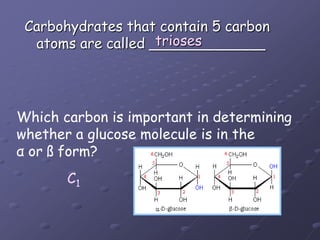
Carbohydrates that contain 5 carbon atoms are called _____________triosesWhich carbon is important in determiningwhether a glucose molecule is in theα or ß form?C1
In a DNA molecule adenine always pairs with _____________thymineA pentose sugar with only the nitrogen baseattached is called a _____________nucleoside
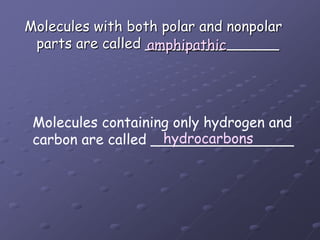
Molecules with both polar and nonpolar parts are called _______________amphipathicMolecules containing only hydrogen and carbon are called ________________hydrocarbons
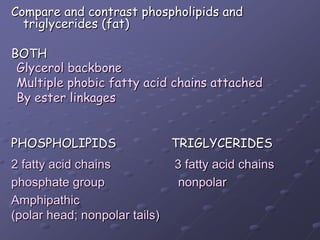
Compare and contrast phospholipids and triglycerides (fat)BOTHPHOSPHOLIPIDS		TRIGLYCERIDESGlycerol backboneMultiple phobic fatty acid chains attachedBy ester linkages 2 fatty acid chains 		 3 fatty acid chainsphosphate group			  nonpolarAmphipathic(polar head; nonpolar tails)
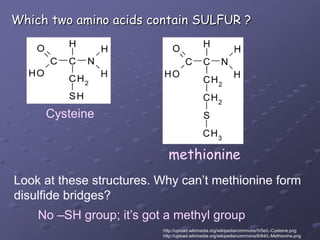
CysteinemethionineWhich two amino acids contain SULFUR ?methionineLook at these structures. Why can’t methionine formdisulfide bridges?No –SH group; it’s got a methyl grouphttp://upload.wikimedia.org/wikipedia/commons/5/5e/L-Cysteine.pnghttp://upload.wikimedia.org/wikipedia/commons/6/64/L-Methionine.png
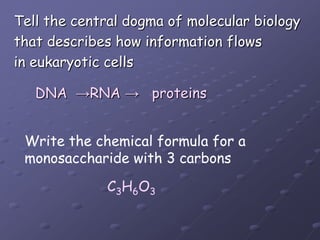
Tell the central dogma of molecular biologythat describes how information flowsin eukaryotic cells DNA  ->RNA ->   proteinsWrite the chemical formula for amonosaccharide with 3 carbonsC3H6O3
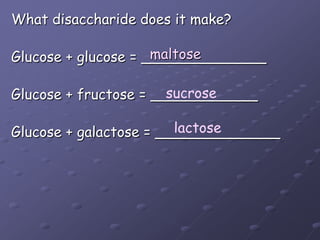
What disaccharide does it make?Glucose + glucose = ______________Glucose + fructose = ____________Glucose + galactose = ______________maltosesucroselactose
http://altopower.files.wordpress.com/2008/04/sugar.jpgTable sugar is called ____________sucroseWhich parts of a nucleotide form thebackbone of a nucleic acid?Sugar and phosphate
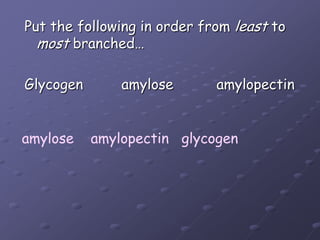
Put the following in order from least to most branched…Glycogen         amylose		amylopectinamylose    amylopectin   glycogen
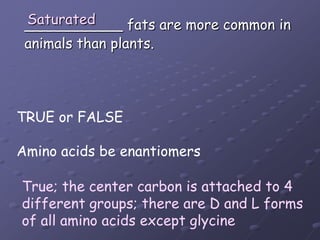
Saturated___________ fats are more common inanimals than plants.TRUE or FALSEAmino acids be enantiomersTrue; the center carbon is attached to 4different groups; there are D and L formsof all amino acids except glycine
https://sharepoint.cisat.jmu.edu/isat/klevicca/Web/NMR_2002/glycine/Glycine2.gifName the only amino acid of the 20 amino acids used to make proteins that doesn’t have a stereoisomer (enantiomer)GLYCINEIt does NOThave a chiralcarbon; it doesnot have 4different groupsattached
Amylase is an enzyme that can break glyosidic linkages between  α-glucose monomers.Which of the following could amylasebreak down?cellulose     glycogen     amylopectin     starch     chitinGlycogen, amylopectin, starch? From AP BIOLOGY by Campbell and Reese  7th edition Chapter 5 self quiz

Ch. 4 and 5 review ppt

  • 1.
    AP BIOLOGYChapters 4& 5http://www.dkimages.com/discover/previews/740/55147.JPGhttp://www.yellowtang.org/images/macromolecules1_tb_784.jpg
  • 2.
    Identify the followingfunctional groupssulfhydrylcarbonylcarboxylHydroxyl(alcohol)phosphateaminoImages from: http://trc.ucdavis.edu/biosci10v/bis10v/week2/2webimages/Groups_5.gifhttp://en.wikipedia.org/wiki/Phosphate
  • 3.
    Identify the kindof moleculesketonealdehydeImages from: http://www.chemcases.com/nutra/nutra1b.htm
  • 4.
    Identify the asymmetriccarbon in the following moleculeB is asymmetric; it has 4 different groups attachedCampbell and Reece 7th edition
  • 5.
    Identify the typeof geometric isomeras TRANS or CISCIS TRANShttp://www.emeraldinsight.com/fig/0170950206002.png
  • 6.
    adding a phosphategroup to ADPCells store energy by ________________ a) Adding a phosphate group to ADP b) Removing a phosphate group from ATPCompounds containing carbon are called___________organic
  • 7.
    IDENTIFY THE FUNCTIONALGROUPS IN THIS TRIPEPTIDEcarbonylphosphatesulfhydrylcarboxylaminohydroxylcarbonyl? Modified from Cambell and Reece; AP Biology 7th edition Chapter 4 Self quiz
  • 8.
    Carbon atoms areable to form bonds with ___ different atoms at the same time.4The ionized form of an amino group has a___ charge.positivehttp://faculty.clintoncc.suny.edu/faculty/michael.gregory/files/bio%20101/bio%20101%20lectures/biochemistry/ionized%20amino%20group.gif
  • 9.
    Carbon is tetravalent.What does this mean?It can form 4 covalent bonds
  • 10.
    These are examplesof which kind of isomer you learned abouut?geometrichttp://www.emeraldinsight.com/fig/0170950206002.png
  • 11.
    Molecules that aremirror images of each other that differ in spatial arrangement around an asymmetric carbon are called ________________Enantiomers (stereoisomers)How are isomers are different from isotopes?ISOMERS are molecules with the same molecular formula but different structuresISOTOPES are atoms with the same number of protons but different numbers of neutrons
  • 12.
    Hydrocarbons contain many_________carbon-hydrogen bonds. polar nonpolarNonpolarThe ionized form of a carboxyl group has a___ charge.negativehttp://faculty.clintoncc.suny.edu/faculty/michael.gregory/files/bio%20101/bio%20101%20lectures/biochemistry/biochemi.htm
  • 13.
    Chemical process thatsplits molecules by the addition of water.hydrolysishttp://www.usd116.org/apalla/biology/unit3/notes/3notes1.htm
  • 14.
    Chemical reaction inwhich two molecules covalently bond to each other with the removal of a water moleculeCondensation reaction (Dehydration synthesis)Name the four main classes ofbiological macromoleculesProteins, lipids, carbohydrates, nucleic acids
  • 15.
    The simplest sugarsare called________________monosaccharidesGLYCOGEN_____________ is the highly branchedpolysaccharide used by animal cells tostore glucose. NONPOLARLipids are____________ moleculespolar nonpolar
  • 16.
    Chemical process thatsplits molecules by the addition of water.hydrolysishttp://www.usd116.org/apalla/biology/unit3/notes/3notes1.htm
  • 17.
    Molecules made oftwo monosaccharidesare called ______________dissaccharidesThe subunits joined to make proteinsare _______________ amino acidsThe major polysaccharide component found in plant cell walls is_____________________cellulose
  • 18.
    64123Use the correctnumbering sequence to identify the number of this carbon5
  • 19.
    Carbohydrates made fromjoining manysugar molecules together are called____________________polysaccharidesGlucose and fructose can be joined to makesucrose via a ___________________ reaction.dehydration synthesis
  • 20.
    The two interconvertibleforms of glucose differ in the placement of the hydroxyl group attached to the #1 carbon.Label the two forms as α (alpha) orß (beta) BETA ALPHA Hydroxyl is up Hydroxyl is downhttp://www.elmhurst.edu/~chm/vchembook/images/543Halphabetaglucose.gif
  • 21.
    Amylose and amylopectinare both forms of _____________starchHow are these different?Amylose is unbranched and joined onlyby α 1,4 linkagesAmylopectin is branched with 1,6 linkagesat the branch points
  • 22.
    How are starchand cellulose different?Starch is made up of glucose rings in the α (alpha) form joined by 1,4 linkages; helical; can be branched; humans can digest thisCellulose is made up of glucose rings in the ß (beta) form so every other glucose is upside down the respect to its neighbors; joined with 1,4 linkages; straight-never branched; hydrogen bonds join parallel molecules into microfibrils; humans can’t digest this
  • 23.
    A structural polysaccharideof plant cell walls, consisting of glucose monomers joined by β-1, 4-glycosidic linkages. celluloseWhere is chitin found in nature?Cell walls of fungi; exoskeletons of arthropods
  • 24.
    Which type ofbonds hold the parallel cellulose strands together?Hydrogen bonds hold about 80 cellulose molecules together to make a microfibrilImage modified from: Campbell and Reece; AP Biology 7th edition
  • 25.
    Image modified from:http://www.yskf.jp/yskf_en/img_03/03_01.gifThis subunit is _________________N-acetylglucosamine(NAG)It can be joined together in long chains by ß 1,4 linkages to make _________chitin
  • 26.
    Which kind offatty acids have kinks in their shape so that they don’t pack closely together- saturated or unsaturated?unsaturatedAnother name for a triacylglycerol moleculefat
  • 27.
    What kind ofbond is a disulfide bridge?ionic covalent hydrogencovalentA fatty acid possessing one or more doublebonds between carbons in the hydrocarbontail is called _______________unsaturated
  • 28.
    Which type ofbonds hold the parallel cellulose strands together?Hydrogen bondsA fatty acid in which all carbons in thehydrocarbon tail are connected by singlebonds is called _______________saturated
  • 29.
    The subunit usedto make starch, cellulose, and glycogen is __________glucoseThe sequence of amino acids in a proteinis called the ________ structurePrimary 1o
  • 30.
    The polysaccharide madeup of glucose subunits with a nitrogen containing group attached which is used to build the exoskeletons of arthropods is called_______________chitinA fat is made up of one ________ moleculeand three ___________ molecules. glycerolfatty acid
  • 31.
    Amino acid moleculesused by living things areusually the ___ stereoisomer version. L or DLThe covalent bondthat joins sugarmolecules to make a polysaccharide iscalled a_________ bond.glycosidic
  • 32.
    The alpha helixcoiling and beta pleated sheet shapes seen in proteins is called the _____________ structure. Secondary 2oWhich kinds of bond holds these together?Hydrogen bonds between the C=O ofone amino acid and the N-H of another
  • 33.
    The addition ofsmaller similar subuints to build a large repeating molecule is called polymerizationThe subunits are called___________ and themolecule that is formed iscalled a ______________monomers polymerImage by K.Riedell
  • 34.
    Sugar molecules usedby living things areusually the ___ stereoisomer version. L or DDThe structural polysaccharide foundin plant cell walls that provides supportis ____________cellulose
  • 35.
    Chaparonins_____________ are moleculesthat help proteins fold up into their correct 3Dshape by shielding them from the cytoplasmic environment.Image from: AP BIOLOGY by Campbell and Reese 7th ed.
  • 36.
    Sugars with 6carbons are called_______________hexosesSucrose is made by joining which 2 sugars?Glucose + fructose = sucrose
  • 37.
    Sugars made from2 sugar monomers are called __________________disaccharidesName one of the polysaccharides you learned about.Glycogen, starch, cellulose, chitin
  • 38.
    The kind ofcovalent bond that joins amino acids together is called a _________ bondpeptide->http://www.chemicalconnection.org.uk/chemistry/topics/images/pp3.jpg
  • 39.
    Unsaturated fats andfatty acids are _________ at room temperature. solid liquidliquidhttp://io.uwinnipeg.ca/~simmons/cm1503/lipids.htm
  • 40.
    The folding ofa protein molecule into its 3D shape due to the interactions of R side chains involved hydrophobic interactions, ionic bonds, hydrogen bonds, an disulfide bridges result in its ___________ structure.Tertiary 3o
  • 41.
    http://www.odec.ca/projects/2004/thog4n0/public_html/fatyacid.jpgTell the kindof macromolecule you learned about that could be built from these subunitsFat (triacylglycerol)http://www.odec.ca/projects/2004/thog4n0/public_html/chemfat.html
  • 42.
    This isomer ofglucosein which the -OH on C1 hangs down below the plane of the ring is called _____ glucoseαName a polysaccharide that this form ofglucose could be used to makeStarch (amylose or amylopectin) or glycogen
  • 43.
    The association ofmultiple protein chainstogether results in its _____________Quaternary 4ohttp://www.bio.miami.edu/~cmallery/150/chemistry/hemoglobin.jpg
  • 44.
    Saturated fats andfatty acids are _________ at room temperature. solid liquidsolidhttp://io.uwinnipeg.ca/~simmons/cm1503/lipids.htm
  • 45.
    This isomer ofglucosein which the -OH on C1 sticks up above the plane of the ring is called _____ glucoseßName a polysaccharide that this form ofglucose could be used to makeCellulose or chitin (if nitrogen group added)
  • 46.
    Name this typeofLipid characterizedby a carbon skeletonconsisting of 4 ringswith variousfunctional groupssteroids
  • 47.
    Sugar molecules with6 carbons arecalled ________ hexosesWhich nitrogen base is not found in RNA?thymine
  • 48.
    Name this steroidfromwhich othersteroids includinghuman sex hormonesare synthesized.cholesterolWhich part of a phospholipid is polar?Glycerol-phosphate head
  • 49.
    http://z.hubpages.com/u/105829_f520.jpgA diet highin____________fats is one of the factors that can contribute to cardiovasculardisease.saturatedsaturated unsaturated
  • 50.
    CONTRAST: GLYCOGEN andSTARCHDifferences:Glycogen Starch Highly branched amylose (unbranched) amylopectin (less branched than glycogen)Made by animals made by plantsα 1,4 & 1,6
  • 51.
    Which part ofa phospholipid molecule is non-polar?Fatty acid tailsENZYMES__________ are proteins that act as catalysts to speed upchemical reactions in living things
  • 52.
    How many fattyacid tails are found in a phospholipid?2Fatty acid molecules consist of long hydrocarbon chains with which functionalgroup attached at one end?carboxylhttp://www.odec.ca/projects/2004/thog4n0/public_html/fatyacid.jpg
  • 53.
    COMPARE GLYCOGENand STARCHAlike:Made of α –glucose subunitsα 1,4 linkages1,6 linkages @ branch pointsGlycosidic bondsGlucose polymersWays to store glucoseDigestible by humans
  • 54.
    Which of thefour biomolecule groups you learned is hydrophobic?lipidsAnother name for a fat is____________________triacylglycerol
  • 55.
    Which of thesestructures would NOTbe found in a DNA molecule?A (ribose)and D (uracil)Image from LearningExpress.com
  • 56.
    Dehydration synthesis isalso called____________ reaction.condensationWhich nitrogen base is not found in DNA?uracil
  • 57.
    The addition ofa phosphate group to ADP____________ energy. stores releasesstoresOrganic chemistry is the branch of chemistrythat studies molecules that contain _______ carbon
  • 58.
    The removal ofa phosphate group from ATP to form ADP____________ energy. stores releasesreleasesTRUE or FALSEL and D stereoisomers have the samechemical properties because they contain the same number and kinds of atoms
  • 59.
    TRUE or FALSELand D stereoisomers have the samechemical properties because they contain the same number and kinds of atomsFALSEL and D enantiomers can have very differentchemical properties.Ex: L-Dopa is a drug used to treat Parkinson’s disease, but D-Dopa has no effect on patients.Thalidomide- one enantiomer of used to treat morning sickness; other form caused birth defects
  • 60.
    Name the structuralpolysaccharidefound in the cell walls of plants thatprovides supportcellulosePolymers of amino acids are called______________polypeptides
  • 61.
    Chemical bond inwhich atoms share2 pairs of electronsList some functions of fatCovalent double bondEnergy storage (1 g of fat has more than twice as much energy as 1 g of polysaccharide)Cushions vital organsInsulates body against heat loss (blubber)
  • 62.
    List some functionsof nucleic acidsStore genetic informationProtein synthesisNucleotide subunits: ATP: store and transport energy NAD+ NADP+ FAD Coenzyme A energy/electron carriers
  • 63.
    Which form ofglucose is used to buildcellulose molecules?ß-glucoseThe “kinks” in fatty acids are due to_____________________cis-double bonds
  • 64.
    Which chemical reactionjoins glycerol and fatty acids to make a fat?Dehydration synthesis or condensationThe place on an enzyme where the substrate attaches is called the_______________Active site
  • 65.
    The reactant inan enzyme catalyzed reaction is called a _____________substrateName the amino acid that can form disulfide bridgesCysteine
  • 66.
    Which functional groupis responsible for the formation of disulfide bridges?-SH sulfhydrylThe unwinding and loss of conformationin proteins is called _____________ denaturing
  • 67.
    GLYCINEIt has an–Hfor its R groupWhich is the only amino acid without anasymmetric carbon?http://upload.wikimedia.org/wikipedia/commons/0/07/Glycine2.png
  • 68.
    Name an environmentalfactor that can cause proteins to denaturepH extremesSalt concentrationTemperature (heat)TRUE or FALSEDenaturing in proteins is due to the disruption of peptide bondsFalse; 1° remains intact but hydrogen bonds, ionic bonds and disulfide bridges in 2° & 3°are disrupted
  • 69.
    cysteine-SH (sulfhydryl) groupforms disulfide bridgesWhich amino acid is involved in making disulfidebridges to form the tertiary structure of proteins?http://upload.wikimedia.org/wikipedia/commons/5/5e/L-Cysteine.pnghttp://www.mun.ca/biology/scarr/Disulfide_bridge.htm
  • 70.
    COMPARE and CONTRAST:DNA RNADoublestranded Single strandedContain A, T, C, G Contain A, U, C, GNo uracil No thymineDeoxyribose Ribose Store genetic info Carry info from DNA to cell Protein synthesisBOTH:Nucleic acids, made of nucleotide subunits, are polymers,Information molecules, joined using dehydration synthesis,Contain pentose sugars and nitrogen bases, have phosphate-sugar backbones,
  • 71.
    Nitrogenous bases consistingof 2 ringsare called _______________purinesThe two sugar-phosphate backbones ina DNA molecule run in opposite directions, an arrangement referred to as___________________antiparallel
  • 72.
    Nitrogenous bases consistingof 1 ringare called _______________pyrimidinesName the subunit used to build nucleic acids which consists of a pentose sugar, nitrogen base, and a phosphate group.nucleotide
  • 73.
    The nitrogen basesthat join byhydrogen bonds to form the stair stepsof the DNA ladder always pair up so that_________________ match up with each other.a pyrimidine-a purinetwo purinestwo pyrimidinesa pyrimidine-a purine
  • 74.
    Give an exampleof a pyrimidineCytosine (C), Thymine (T) and Uracil (U)In a DNA molecule guanine always pairs upwith _____________cytosine
  • 75.
    Which of thesestructures would NOTbe found in an RNA molecule?C (deoxyribose)and F (thymine)Image from LearningExpress.com
  • 76.
    Carbohydrates that contain5 carbon atoms are called _____________triosesWhich carbon is important in determiningwhether a glucose molecule is in theα or ß form?C1
  • 77.
    In a DNAmolecule adenine always pairs with _____________thymineA pentose sugar with only the nitrogen baseattached is called a _____________nucleoside
  • 78.
    Molecules with bothpolar and nonpolar parts are called _______________amphipathicMolecules containing only hydrogen and carbon are called ________________hydrocarbons
  • 79.
    Compare and contrastphospholipids and triglycerides (fat)BOTHPHOSPHOLIPIDS TRIGLYCERIDESGlycerol backboneMultiple phobic fatty acid chains attachedBy ester linkages 2 fatty acid chains 3 fatty acid chainsphosphate group nonpolarAmphipathic(polar head; nonpolar tails)
  • 80.
    CysteinemethionineWhich two aminoacids contain SULFUR ?methionineLook at these structures. Why can’t methionine formdisulfide bridges?No –SH group; it’s got a methyl grouphttp://upload.wikimedia.org/wikipedia/commons/5/5e/L-Cysteine.pnghttp://upload.wikimedia.org/wikipedia/commons/6/64/L-Methionine.png
  • 81.
    Tell the centraldogma of molecular biologythat describes how information flowsin eukaryotic cells DNA ->RNA -> proteinsWrite the chemical formula for amonosaccharide with 3 carbonsC3H6O3
  • 82.
    What disaccharide doesit make?Glucose + glucose = ______________Glucose + fructose = ____________Glucose + galactose = ______________maltosesucroselactose
  • 83.
    http://altopower.files.wordpress.com/2008/04/sugar.jpgTable sugar iscalled ____________sucroseWhich parts of a nucleotide form thebackbone of a nucleic acid?Sugar and phosphate
  • 84.
    Put the followingin order from least to most branched…Glycogen amylose amylopectinamylose amylopectin glycogen
  • 85.
    Saturated___________ fats aremore common inanimals than plants.TRUE or FALSEAmino acids be enantiomersTrue; the center carbon is attached to 4different groups; there are D and L formsof all amino acids except glycine
  • 86.
    https://sharepoint.cisat.jmu.edu/isat/klevicca/Web/NMR_2002/glycine/Glycine2.gifName the onlyamino acid of the 20 amino acids used to make proteins that doesn’t have a stereoisomer (enantiomer)GLYCINEIt does NOThave a chiralcarbon; it doesnot have 4different groupsattached
  • 87.
    Amylase is anenzyme that can break glyosidic linkages between α-glucose monomers.Which of the following could amylasebreak down?cellulose glycogen amylopectin starch chitinGlycogen, amylopectin, starch? From AP BIOLOGY by Campbell and Reese 7th edition Chapter 5 self quiz